Animal Behavior
Learned Behaviors
 Behaviors animals are NOT born with
 Acquired / Modified by experience
 Behaviors are learned from observations
and experience
 Often learned from parents
Types of Learned Behavior
 Non-Associative Learning
 Habituation
 Sensitization
 Associative Learning
 Classical Conditioning
 Operant Conditioning (Trial and Error)
 Latent Learning
 Imprinting
 Insight (Reasoning)
Non-Associative Leaning
 Organisms change their response to a
stimuli without association with a positive or
negative reinforcement.
 2 Types:
1. Habituation
2. Sensitization
Habituation
 A decrease in response to a stimulus after
repeat exposure
 Less sensitive to stimuli
 Eliminates responses that have no value on
an animals survival or welfare.
 Helps prevent waste of energy
Sensitization
 The increase that occurs in an organism’s
responsiveness to stimuli following an especially
intense or irritating stimulus.
 More sensitive to stimuli
 Depending on the intensity and duration of the
original stimulus, the period of increased
responsiveness can last from several seconds to
several days.
Classical Conditioning
 Experiment by Ivan Pavlov
 Pavlov began to observe salivation in dogs
1. He would enter the room and place
meat powder or a food morsel on
tongue and wait for salivation to occur
2. He began to see that the dogs were
salivating as soon as he entered the room,
which was before any food was even in
sight.
3. The dogs became conditioned by Pavlov to have
expectations. When he entered the room, the dogs
expected food; therefore, they began salivating in
expectation
Neutral Stimulus
 A neutral stimulus is something that normally
would not produce any salivation
 Pavlov chose to ring a bell since ringing a bell
would not normally produce salivation in the dogs.
 Pavlov began ringing a bell before placing the
meat powder or item on the dog's tongue
 Each and every time that the bell was rung, meat
powder or food was given to the dog.
 Pavlov repeated these experiments many, many
times.
 Eventually, the bell alone was enough to make the
dogs salivate.
 The dog had learned to associate the sound of the
bell with food.
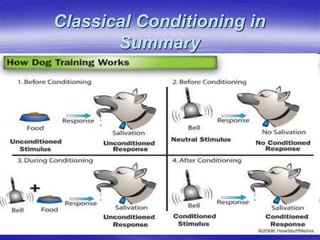
Classical Conditioning in
Summary
Unconditioned Stimulus
 Stimulus that leads to a response with NO
training
 Ex. Food
Conditioned Stimulus
 A former neutral stimulus that comes to elicit
a given response after pairing with an
unconditioned stimulus.
 Ex. Bell
Unconditioned Response
 Automatic Response to an unconditioned
stimulus.
 Ex. Salivate
Conditioned Response
 A learned response to a conditioned
stimulus.
 Ex. Salivate
What did this prove?
 Pavlov's experiment proved that all animals
could be trained or conditioned to expect a
consequence on the results of previous
experience.
Operant Conditioning
 an unassociated behavior becomes
associated with a reward
 Skinner designed an apparatus called a
"Skinner box" to test the interaction between
UCS and CS
Skinner Box
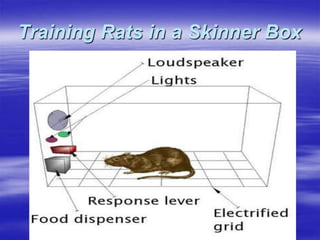
 A rat was placed inside the Skinner box
 If the rat pressed down a lever inside the box then
the box would release a food pellet
 Soon, the rat pressed the lever far more often than
he would just by chance.
 But with each instance of lever pressing, the
operant is reinforced by reward with food.
 The rat learns that pressing the lever is associated
with food, and so he will increasingly press it.
Training Rats in a Skinner Box
Classical vs. Operant
 In classical conditioning, the animal receives
no benefit from associating the CS with the
UCS.
Latent Learning
 When an organism learns something in its
life, but the knowledge is not immediately
expressed.
 Knowledge remains dormant until certain
circumstances allow or require it to be
expressed
 Learning WITHOUT REWARDS!
 No association with a positive or negative
stimulus.
Example of Latent Learning
 Place a rat in a maze with no food
 The rat will simply run around the maze,
familiarizing itself with the surroundings.
 If you then return the rat to the same maze the
next day and add food, the rat will find the food
much more quickly then will a rat placed in the
maze with food for the first time.
Imprinting
 Process by which a social attachment to a
particular object is formed during a critical
time period.
 Critical Time Period: Prior to birth to
somewhere around 30 hr old
 Early in life when recognition is critical
Insight Learning
 Type of learning or problem solving that
happens all-of-a-sudden.
 Prior experience is crucial to learning
 Investigations are difficult because the
learning happens quickly
Learning Ability of Domestic Animals
 What learning is possible for domestic
animals?
 Observations of behaviour and experimental
 studies of learning show that they can, for
example, learn to: navigate in their
environment, distinguish the qualities of food,
return to food sources, avoid physical dangers,
minimize predation risk, discriminate individual
animals and respond differentially to individuals
according to previously acquired information.
Studies indicating such abilities are described.
 Observations of learning in the real world,
 which domestic animals encounter, offer the
most impressive evidence of their ability.
 Pet-owners are familiar with the abilities of
their animals to learn how to get food and
other resources in their daily lives.
 sheep and cattle are very selective about
what they eat and they have to learn about
all the different plants they encounter.

Learned Behaviors.ppt

  • 1.
  • 2.
    Learned Behaviors  Behaviorsanimals are NOT born with  Acquired / Modified by experience  Behaviors are learned from observations and experience  Often learned from parents
  • 3.
    Types of LearnedBehavior  Non-Associative Learning  Habituation  Sensitization  Associative Learning  Classical Conditioning  Operant Conditioning (Trial and Error)  Latent Learning  Imprinting  Insight (Reasoning)
  • 4.
    Non-Associative Leaning  Organismschange their response to a stimuli without association with a positive or negative reinforcement.  2 Types: 1. Habituation 2. Sensitization
  • 5.
    Habituation  A decreasein response to a stimulus after repeat exposure  Less sensitive to stimuli  Eliminates responses that have no value on an animals survival or welfare.  Helps prevent waste of energy
  • 6.
    Sensitization  The increasethat occurs in an organism’s responsiveness to stimuli following an especially intense or irritating stimulus.  More sensitive to stimuli  Depending on the intensity and duration of the original stimulus, the period of increased responsiveness can last from several seconds to several days.
  • 7.
    Classical Conditioning  Experimentby Ivan Pavlov  Pavlov began to observe salivation in dogs 1. He would enter the room and place meat powder or a food morsel on tongue and wait for salivation to occur 2. He began to see that the dogs were salivating as soon as he entered the room, which was before any food was even in sight. 3. The dogs became conditioned by Pavlov to have expectations. When he entered the room, the dogs expected food; therefore, they began salivating in expectation
  • 8.
    Neutral Stimulus  Aneutral stimulus is something that normally would not produce any salivation  Pavlov chose to ring a bell since ringing a bell would not normally produce salivation in the dogs.  Pavlov began ringing a bell before placing the meat powder or item on the dog's tongue  Each and every time that the bell was rung, meat powder or food was given to the dog.  Pavlov repeated these experiments many, many times.  Eventually, the bell alone was enough to make the dogs salivate.  The dog had learned to associate the sound of the bell with food.
  • 9.
  • 10.
    Unconditioned Stimulus  Stimulusthat leads to a response with NO training  Ex. Food
  • 11.
    Conditioned Stimulus  Aformer neutral stimulus that comes to elicit a given response after pairing with an unconditioned stimulus.  Ex. Bell
  • 12.
    Unconditioned Response  AutomaticResponse to an unconditioned stimulus.  Ex. Salivate
  • 13.
    Conditioned Response  Alearned response to a conditioned stimulus.  Ex. Salivate
  • 14.
    What did thisprove?  Pavlov's experiment proved that all animals could be trained or conditioned to expect a consequence on the results of previous experience.
  • 15.
    Operant Conditioning  anunassociated behavior becomes associated with a reward  Skinner designed an apparatus called a "Skinner box" to test the interaction between UCS and CS
  • 16.
    Skinner Box  Arat was placed inside the Skinner box  If the rat pressed down a lever inside the box then the box would release a food pellet  Soon, the rat pressed the lever far more often than he would just by chance.  But with each instance of lever pressing, the operant is reinforced by reward with food.  The rat learns that pressing the lever is associated with food, and so he will increasingly press it.
  • 17.
    Training Rats ina Skinner Box
  • 18.
    Classical vs. Operant In classical conditioning, the animal receives no benefit from associating the CS with the UCS.
  • 19.
    Latent Learning  Whenan organism learns something in its life, but the knowledge is not immediately expressed.  Knowledge remains dormant until certain circumstances allow or require it to be expressed  Learning WITHOUT REWARDS!  No association with a positive or negative stimulus.
  • 20.
    Example of LatentLearning  Place a rat in a maze with no food  The rat will simply run around the maze, familiarizing itself with the surroundings.  If you then return the rat to the same maze the next day and add food, the rat will find the food much more quickly then will a rat placed in the maze with food for the first time.
  • 21.
    Imprinting  Process bywhich a social attachment to a particular object is formed during a critical time period.  Critical Time Period: Prior to birth to somewhere around 30 hr old  Early in life when recognition is critical
  • 22.
    Insight Learning  Typeof learning or problem solving that happens all-of-a-sudden.  Prior experience is crucial to learning  Investigations are difficult because the learning happens quickly
  • 23.
    Learning Ability ofDomestic Animals  What learning is possible for domestic animals?  Observations of behaviour and experimental  studies of learning show that they can, for example, learn to: navigate in their environment, distinguish the qualities of food, return to food sources, avoid physical dangers, minimize predation risk, discriminate individual animals and respond differentially to individuals according to previously acquired information. Studies indicating such abilities are described.
  • 24.
     Observations oflearning in the real world,  which domestic animals encounter, offer the most impressive evidence of their ability.  Pet-owners are familiar with the abilities of their animals to learn how to get food and other resources in their daily lives.  sheep and cattle are very selective about what they eat and they have to learn about all the different plants they encounter.