Honeywell Gas Detection
www.honeywellanalytics.com
24 September 2009 VIK
Christophe Stas
GSM: +32 (0)473.22.36.51
christophe.stas@honeywell.com
Hendrik Heeze
GSM: +32 (0)485.80.79.07
hendrik.heeze@honeywell.com
Honeywell Proprietary
Honeywell.com
Aerospace
Specialty MaterialsAutomation & Control
Systems
-Honeywell “ACS” –
$14.4 Billion
Transportation
Systems
14%14%
37%37%
14%14%
35%35%
• A Fortune 100 company – $37 billion in ’08 estimated sales
• 125,000 employees in more than 100+ countries
• One of 30 select Dow Jones industrial companies
Honeywell Proprietary
Honeywell.com
ACS Overview
Honeywell Proprietary
Honeywell.com
• Global Scope: Systems and Sensors
• Multi Brand and Channel Presence
• History of Exciting New Products
• Leading Smoke and Gas Technology
• Strong Dealer Partnerships
• Lowest Total Cost Solution, Global Mfg /
Distribution, Productivity Culture
• Safety Products Strong Portfolio Extension
• Long-Term Track Record of Growth
2008: $2.5B Sales ~ 11,000 Employees
Fire Control
Systems
~35%
Gas Detection
Systems
~20%
Top Performing Business In Growing Industries
Sensors and
Actuating
Devices
~15%
Safety
Products
~30%
Honeywell
HomMed
~1%
EN
UL
Honeywell Life Safety
Honeywell Proprietary
Honeywell.com
Profile:Profile:Profile:
Customers, Products by Lines of Business:Customers, Products by Lines of Business:Customers, Products by Lines of Business:
Strengths:Strengths:Strengths: • Mature portfolio serving diverse markets
• Excellence in flam/toxic gas detection
• Record of innovation, inventors of core
technologies, proven track record
• Dedicated to acting upon the ‘voice of
the customer’; product development,
sales, service, quality & reliability
• Excellent brand names/reputation
• Locally focused with global mindset
• Strong customer relationships enabling
value capture via ‘high & early’ sales
• Able to leverage low cost country supply
but maintain highest quality standards
• Leaders in SwissCo implementation
560 Employees
Workshop (RTB)
Field Operations
Contract Services
Confined Space
(Reg. Compliance)
Operational
(Safe Practice)
Residential
Specifier
Recreational
Security
Building Aut’n
Car Parks
Plant Rooms
HVAC/IAQ
Petrochemical
Utilities
Manufacturing
Semiconductor
R&D/Laboratories
Aerospace
Foaming
Oil & Gas
Exploration
Production
Distribution
ServicePortableConsumerCommercialIndustrialSemi/Hi-TechOil & Gas
Honeywell Gas Detection EMEAI Profile 2009
Honeywell Proprietary
Honeywell.com
What does Honeywell Gas Detection do ?
“We design & manufacture gas detection equipment
to protect plant & personnel from flammable and
toxic gas hazards.”
“The equipment is used in homes, commercial
property, manufacturing and the oil & gas industry. It
can be portable or a hard wired system”
Honeywell Proprietary
Honeywell.com
1.Gas detectie - Basisbegrippen
2.Gas detectie sensor technologieën
3.Sensor plaatsbepaling
4.SIL in gasdetectie
5.Calibratie en onderhoud
6.ATEX
Honeywell Proprietary
Honeywell.com
1 Gas detection basics
Honeywell Proprietary
Honeywell.com
What is Gas?
• The name gas comes from the word chaos
• Gas is a swarm of molecules moving
randomly and chaotically; constantly
colliding with each other and anything else
around it.
• Gases fill any available volume and due to
the very high speed at which they move
will mix rapidly into any atmosphere in
which they are released
Honeywell Proprietary
Honeywell.com
What is Gas?
Gases can be lighter, heavier or about
the same density as air
Gases can have an odour or be odourless
Gases can have colour or be colourless
Honeywell Proprietary
Honeywell.com
The 3 types of gas hazards
1. Flammable
– Risk of fire and or explosion,
e.g. Methane, Butane, Propane
2. Toxic
– Risk of poisoning,
e.g. Carbon Monoxide, Hydrogen Sulfide, Chlorine
3. Asphyxiant
– Risk of suffocation,
e.g. Oxygen deficiency, Nitrogen
Honeywell Proprietary
Honeywell.com
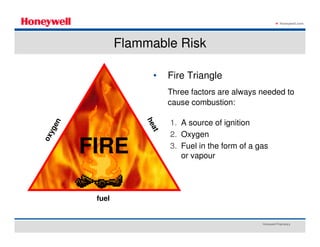
Flammable Risk
• Fire Triangle
Three factors are always needed to
cause combustion:
1. A source of ignition
2. Oxygen
3. Fuel in the form of a gas
or vapour
fuel
oxygen
heatFIRE
Honeywell Proprietary
Honeywell.com
Flammable Risk
• This can be demonstrated by taking the example
of an original type car combustion engine
• The spark plug supplies the ignition source, the
fuel is compressed into a vapour and the choke
adjusts the amount of oxygen available.
• The engine will not run if there is no spark from
the plug or if there is no fuel.
• It will also not run if the air/fuel mixture controlled
by the choke is either too lean or too rich
Honeywell Proprietary
Honeywell.com
Flammable Risk
• The operation of a car’s choke
illustrates an important part of
flammable gas hazards
• All flammable gases are only
ignitable over their flammable
range
• Flammable gases tend to be
measured in percentage of
their explosive Limit (%LEL)
L.E.L. (lower
explosive limit)
U.E.L. (upper
explosive limit)
0% v/v gas
100% v/v air
too lean
flammable
range
too rich
100% v/v gas
0% v/v air
Honeywell Proprietary
Honeywell.com
LEL/m
LEL/m = Lower Explosive Limit per metre.
Open path detectors measure the amount of gas present in the beam.
Does not differentiate between a low concentration gas cloud over a large
area or a high concentration gas cloud in a small area.
Flammable Risk Open Path Detectors
Honeywell Proprietary
Honeywell.com
Flash Point
• Flash Point (F.P. oC)
– The flash point of a flammable liquid is the lowest temperature
at which the surface of the liquid emits sufficient vapour to be
ignited by a small flame.
– Don’t confuse with Ignition Temperature as the two can be
very different:
310270Bitumen
21038Kerosene
595<-200Methane
Ignition Temp.Ignition Temp. OO
CCFlash PointFlash Point OO
CCGas / VapourGas / Vapour
Honeywell Proprietary
Honeywell.com
Ignition Temperature
• Flammable gases also have a
temperature where ignition will
take place, even without an
external ignition source such as a
spark or flame
• This temperature is called the
Ignition Temperature
• Apparatus for use in a hazardous
area must does not have a
surface temperature that exceeds
the ignition temperature
• Apparatus is therefore marked
with a maximum surface
temperature or T rating
Honeywell Proprietary
Honeywell.com
Toxic Risk
• Some gases are poisonous
and can be dangerous to life
at very low concentrations.
• Some toxic gases have
strong smells like the
distinctive ‘rotten eggs’ smell
of H2S !
• Others are completely
odourless like Carbon
Monoxide
Honeywell Proprietary
Honeywell.com
Toxic Risks
• A toxic gas that is a risk in the
home is CO.
• CO is a product of the burning of
the natural gas used in heating
systems.
• Badly maintained hot water gas
boilers can give of dangerous
levels of CO.
Honeywell Proprietary
Honeywell.com
General Definition PPM
• The measurement most often
used for the concentration of
toxic gases is parts per
million (ppm).
• Example:
1ppm would be equivalent to
a room filled with a total of 1
million balls and 1 of those
balls being red.
The red ball would represent
1ppm.
1 million balls
1 red ball
Honeywell Proprietary
Honeywell.com
Toxic Risk
Period of exposure in minutes
160804020105
500
1000
1500
2000
2500
CarbonMonoxideinpartspermillion(ppm)
Effects of exposure to
Carbon Monoxide
Honeywell Proprietary
Honeywell.com
Toxic gas limits & terminology
• Time Weighted Average (TWA)
– Toxic gas limits related to concentration &
time
• Short Term Exposure Limit (STEL)
– The maximum allowable concentration over
15 minutes.
• Long Term Exposure Limit (LTEL)
– The maximum allowable concentration over
an 8 hour period.
• Units of measure
– Parts per million (ppm)
– Milligrams per cubic metre (mg/m3)
• Levels
– COSHH
– OSHA, NIOSH
Honeywell Proprietary
Honeywell.com
Asphyxiant (oxygen deficiency) Risk
• We all need to breath the oxygen (O2)
in air to live.
• Normal ambient air contains an
oxygen concentration of 20.9% v/v.
• When the oxygen level dips below
19.5% v/v, the air is considered
oxygen-deficient.
• Oxygen concentrations below 16% v/v
are considered unsafe for humans.
Honeywell Proprietary
Honeywell.com
Asphyxiant gas limits
• Oxygen, Nitrogen
• Not flammable or toxic
• < 6% v/v O2 Instantly FATAL
• O2 depletion caused by:
– Displacement
– Combustion
– Oxidation
– Chemical reaction
0% v/v O2
19.0% v/v O2 Low alarm
20.9% v/v O2 Ambient
100% v/v O2
23.0% v/v O2 High alarm
Honeywell Proprietary
Honeywell.com
Oxygen Enrichment
• Oxygen enrichment can also cause a risk.
• At increased O2 levels the flammability of
materials and gases increases.
• At levels of 24% items such as clothing can
spontaneously combust.
• Oxyacetylene welding equipment combines
oxygen and acetylene gas to produce an
extremely high temperature.
• Leaks from the O2 cylinders is the main
hazard.
Honeywell Proprietary
Honeywell.com
Typical areas that require gas detection
Chemical Plants Power Stations Water Treatment Plants
Boiler Rooms Hospitals Tunnels
Honeywell Proprietary
Honeywell.com
2 Gas detection sensing technology
Honeywell Proprietary
Honeywell.com
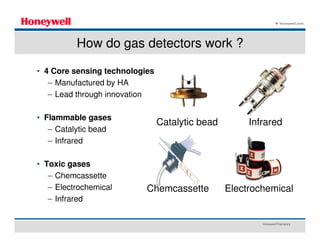
How do gas detectors work ?
• 4 Core sensing technologies
– Manufactured by HA
– Lead through innovation
• Flammable gases
– Catalytic bead
– Infrared
• Toxic gases
– Chemcassette
– Electrochemical
– Infrared
Electrochemical
Catalytic bead
Chemcassette
Infrared
Catalytic Bead Gas Detectors
Detection of flammable Gases
2008 1V1
Honeywell Proprietary
Honeywell.com
Catalytic gas detection (mV output)
• Pellistor (Pellet resistor)
– Catalytic beads
– Requires Oxygen to operate
• 450 - 500°C operating temp
– Gas combustion on sensitive
bead
• Sensitive bead
– Platinum wire coil
– Rhodium catalyst
• Non sensitive bead
– Gas coated or restricted inlet
– Pressure & temp compensation
• Poison resistant
– Long life porous structure
Sensitive
Bead
Non
Sensitive Bead
Control
Card
Concentration
Metre (%LEL)
Gassinter
+
_
Honeywell Proprietary
Honeywell.com
Catalytic Bead Construction/Operation
Flammable Gas
Water
Water
Hydrogen
Heated BeadConstruction
Honeywell Proprietary
Honeywell.com
Catalytic Beads Operate as ‘Matched Pairs’
• Sensitive
• Non-sensitive
+ve
-ve
Signal
Constant
Current
• 3 wire mV bridge
• 200mA +/- 2mA constant current
• +/-1mV per %VOL typically
(subject to gas type)
Examples
Signalpoint LEL
Sensepoint LEL
705
Apex
Electrochemical Sensors
for toxic Gases
2008 1V1
Honeywell Proprietary
Honeywell.com
Electro-chemical cells (mA output)
• Speed of response
– 10-90 seconds (T90)
• Sensitivity
– Part Per Million (ppm)
• Life
– 1 to 2 years
• Not fail safe
– Except O2 deficiency
• Low powered
– Ideal for portable devices
• Costs
– Low initial cost
– Moderate routine maintenance
costs
Gas permeable
membrane
Measuring
electrode
Reference
electrode
ElectrolyteV
Honeywell Proprietary
Honeywell.com
Modern Electrochemical Sensor Design
• Single reservoir
• Metal housing
• Compression fittings
• Dual reservoir
• Plastic housing
• Moulded/ultrasonically welded
Semi-Conductor Sensors
for Toxic Gases
2008 1V1
Honeywell Proprietary
Honeywell.com
Semi-Conductor Gas Detection
• Metal oxide film deposited onto
a silicon slice
– Similar to computer Silicon
‘Chips’
• Surface heated to 200-400ºC
depending on design
– Thin film, Thick Film, MOS,
MMOS
• Absorption of the sample gas on
the oxide surface plus catalytic
oxidation
– Causes change of electrical
resistance
– Resistance change can be
related to sample gas
concentration.
Electrode
Heater
Metal Oxide
Voltage Source
Meter
Silicon
Gas Sample
Photo Ionization Detector
(PID) Sensors for toxic
Levels of VOC Gases
2008 1V1
Honeywell Proprietary
Honeywell.com
•An ultra violet lamp ionises the sample gas,
causing it to become electrically charged
•If the Ionisation Potential (IP) of the gas is less
than the eV output of the lamp, the gas will be
ionised
•The sensor detects the charge of the ionised
gas and converts the signal into a current
•The current is amplified and displayed on the
meter as ppm, ppb or mg/m3 reading
How does a PID work ?
Honeywell Proprietary
Honeywell.com
• VOCs are carbon containing chemicals which
vaporise at ambient temperatures and typically have
no colour or taste making them difficult to detect
• They can be found in every day life and in a wide
range of industries
• Some are VOCs are immediately dangerous to life
and other are known to cause long term health
problems such as cancer
Volatile Organic Compounds VOCs
Honeywell Proprietary
Honeywell.com
Why Measure ppm Instead of LEL?
650650 ppm US LimitPetrol
30015 ppm US LimitDiesel
700200MEK
1000400Isopropyl Alcohol
450100Styrene
450-55050Xylenes
50050Toluene
55020Hexane
16501000Ethanol
950600Butane
1250800Acetone
5% LEL in ppmHSE Limit Value
8-Hour TWA in ppm
Compound
Infra Red Sensors for
Hydro-Carbon Gases
2008 1V1
Honeywell Proprietary
Honeywell.com
Infrared Operating Principles
• Light is made up of many
different wavelengths
• Flammable Infrared Detectors
– Use optical filters to ‘tune’ source to
wavelength that’s absorbed by gas
no gas
with gas
• All diatomic molecules absorb
light at various wavelengths
– HC, H2S, NH3, HF, CO2 etc
– Some more than others
Honeywell Proprietary
Honeywell.com
How does Infrared Gas Detection work ?
• All flammable hydrocarbon gas
molecules absorb light in the infrared
region of the Spectrum.
• The specific wavelength used is
dependent on a number of factors
including gas type to be detected,
interference from others gases,
strength of signal and effect of water
vapour.
• This absorption characteristic can be
used as the basis of a hydrocarbon
gas detector.
IR Spectrum of Methane Gas
at 3.4 microns
Honeywell Proprietary
Honeywell.com
Infrared Gas Detection Pros & Cons
• Fast speed of response
– >5 seconds (T90)
• Sensitivity
– 0-100% LEL or LEL Metres
• Works in Oxygen free
atmospheres
• Fail safe
– Self checking diagnostics
• Costs
– High initial cost
– Low routine maintenance
costs
Honeywell Proprietary
Honeywell.com
Closed Path Working at Two Wavelengths
S R
S R
S R
Fog, Rain,Snow,Dirt
Gas
Sample & Reference
signal strengths
IR
Source
IR
Detectors
Honeywell Proprietary
Honeywell.com
Open Path Increases the Chance of Seeing Gas
Point
Detector
Point
Detector
Pipeline
Gas leak missed by
point detectors but
picked up by Open Path
Detector
Open path
Detector
GAS
Honeywell Proprietary
Honeywell.com
Paper tape gas detection
• Paper Tape Doped with
Chemicals to cause ‘stain’
when subjected to target gas.
• IR sensors monitor ‘stain’
colour
Honeywell Proprietary
Honeywell.com
Paper Tape Gas Detection
• Used in Semi-Conductor
Industry
– Physical Evidence of Gas
Response
• Popular for Low Level Toxic
Gas detection
– Clean Room / Laboratory
– FAB applications
– Low Cross Interference
• Wide range of standards
gases
– H2S, Ammonia, Chlorine etc.
• High Sensitivity
– Part Per Billion (ppb) to ppm
levels
• Susceptible to environmental
fluctuations
• Tape Storage
– Limited Shelf Life
• Sample System Operation
• Costs
– High initial cost
– High routine maintenance
costs
– Replacement Tape
Honeywell Proprietary
Honeywell.com
3 Sensor Location
Honeywell Proprietary
Honeywell.com
Main purpose of gas detection
• Protect human live
• Prevent/minimize
environmental pollution
• Protect production
• Protect infrastructure
Honeywell Proprietary
Honeywell.com
Guidelines
• Indoor or outdoor site
• Potential leak source (i.e. Shell > 2 bar – 10mm)
• Nature of the gas or vapour to be detected
• Nature of possible gas or vapour release ( high pressure jet,
evaporation, liquid leaks)
• Presence or cavities, pits or cable channels
• Topography of the site
• Air movements: Temperature effects, Indoor natural ventilation,
Indoor mechanical ventilation. Outdoors – wind speed and direction.
• Local environment to plant
• Population of plant and locations
• Locations of potential sources of ignition.
• Alarm levels (TLV and %LEL)
Honeywell Proprietary
Honeywell.com
Detection Area
Some actual values used currently in the Petrochemical industry:
Outdoor installation: 250m²
Indoor (Pumphousing): 100m²
Along piperacks 50m
5m
Honeywell Proprietary
Honeywell.com
4 SIL in Gas Detection
Honeywell Proprietary
Honeywell.com
Positioning of gas detection solution in your plant ?
Figure 9 of IEC 61511
MITIGATION
Mechanical Mitigation Systems
Safety Instrumented Control Systems
Safety Instrumented Mitigation Systems
PLANT EMERGENCY RESPONSE
COMMUNITY EMERGENCY RESPONSE
PREVENTION
Mechanical Protection System
Process Alarms
Operator Supervision
Safety Instrumented Control Systems
Basic Process Control Systems
Monitoring Systems (process alarms)
Safety Instrumented Prevention Systems
Operator Supervision
Process Design
Safety Layer(s)
Mitigation:
e.g. Fire & Gas
Safety system
Prevention:
e.g. ESD Safety system
Honeywell Proprietary
Honeywell.com
Anatomy of an Abnormal Situation
process value Normal behavior
Time
SIS controlled
Emergency Shutdown Action
Mechanical Shutdown Action
Operator Action
Human controlled
Process Control
Control Action
There are required actions taken at each step to mitigate this escalation.
Normal
Operation
Upset
Condition
Critical
Situation
Honeywell Proprietary
Honeywell.com
Summary of the cases
• ESD: up to SIL 3
• F&G: up to SIL 2
• Alarm: up to SIL 1
Honeywell Proprietary
Honeywell.com
5 Calibration/Maintenance
Honeywell Proprietary
Honeywell.com
Interval
• According to EN61779_1
• Follow manufacturers guidelines
• Environmental conditions (f.e. Frequency, inhibitors)
• Government / Insurance policy
Honeywell Proprietary
Honeywell.com
Catalytic sensors
Honeywell Proprietary
Honeywell.com
Infrared detectors
Honeywell Proprietary
Honeywell.com
Cross Interferences of Sensepoint Toxic Gas Detectors
Electrochemical sensors
Honeywell Proprietary
Honeywell.com
6 ATEX
Honeywell Proprietary
Honeywell.com
ATEX ↔ ATEX Performance
• According to EN60079-29-1:2007
• Functional safety of installation
Honeywell Proprietary
Honeywell.com
Zareba: Comm/Light Ind Fixed Systems
• Flammable & toxic
gases
• Local display or blind
• PLC / BMS direct
interface
• Single & multipoint
controllers
Honeywell Proprietary
Honeywell.com
Sieger: Petrochemical Fixed Systems
• Flammable & toxic
gases
• Infrared: point,
open path & cross
duct detectors
• Smart transmitters
• Modular controller
system
Honeywell Proprietary
Honeywell.com
MDA Scientific: PPM/PPB Toxic gas detection
•Vertex
•8-72 point toxic
gas system
•40 gases @
ppm/ppb levels
•Chemcassette
technology
•Up to 400ft per
sample line
•Relay & serial
outputs
•CM 4
•1-4 point toxic gas system
•25 gases @ ppm/ppb levels
•Chemcassette technology
•Up to 300ft per sample line
•Relay & serial outputs
•SPM
•1 point toxic gas system
•50 gases @ ppm/ppb levels
•Chemcassette technology
•Up to 100ft per sample line
•Relay & serial outputs
Honeywell Proprietary
Honeywell.com
SF Detection: Domestic gas detection
•SF350 CO
•Alarm sounder & LED
•5 year life
•Battery operated
•EN50291 & UL2034
•SF340 CO
•Alarm sounder & LED
•5 year life
•Mains & 12-24V dc
•Battery backup
•Relay output
•Z10 Natural gas & LPG
•Mains operated
•Alarm sounder & LED
•Relay output
•Ez Sense Flammable
•Leak tracer
•Alarm sounder & LED
•Battery operated

Gas detection

  • 1.
    Honeywell Gas Detection www.honeywellanalytics.com 24September 2009 VIK Christophe Stas GSM: +32 (0)473.22.36.51 christophe.stas@honeywell.com Hendrik Heeze GSM: +32 (0)485.80.79.07 hendrik.heeze@honeywell.com
  • 2.
    Honeywell Proprietary Honeywell.com Aerospace Specialty MaterialsAutomation& Control Systems -Honeywell “ACS” – $14.4 Billion Transportation Systems 14%14% 37%37% 14%14% 35%35% • A Fortune 100 company – $37 billion in ’08 estimated sales • 125,000 employees in more than 100+ countries • One of 30 select Dow Jones industrial companies
  • 3.
  • 4.
    Honeywell Proprietary Honeywell.com • GlobalScope: Systems and Sensors • Multi Brand and Channel Presence • History of Exciting New Products • Leading Smoke and Gas Technology • Strong Dealer Partnerships • Lowest Total Cost Solution, Global Mfg / Distribution, Productivity Culture • Safety Products Strong Portfolio Extension • Long-Term Track Record of Growth 2008: $2.5B Sales ~ 11,000 Employees Fire Control Systems ~35% Gas Detection Systems ~20% Top Performing Business In Growing Industries Sensors and Actuating Devices ~15% Safety Products ~30% Honeywell HomMed ~1% EN UL Honeywell Life Safety
  • 5.
    Honeywell Proprietary Honeywell.com Profile:Profile:Profile: Customers, Productsby Lines of Business:Customers, Products by Lines of Business:Customers, Products by Lines of Business: Strengths:Strengths:Strengths: • Mature portfolio serving diverse markets • Excellence in flam/toxic gas detection • Record of innovation, inventors of core technologies, proven track record • Dedicated to acting upon the ‘voice of the customer’; product development, sales, service, quality & reliability • Excellent brand names/reputation • Locally focused with global mindset • Strong customer relationships enabling value capture via ‘high & early’ sales • Able to leverage low cost country supply but maintain highest quality standards • Leaders in SwissCo implementation 560 Employees Workshop (RTB) Field Operations Contract Services Confined Space (Reg. Compliance) Operational (Safe Practice) Residential Specifier Recreational Security Building Aut’n Car Parks Plant Rooms HVAC/IAQ Petrochemical Utilities Manufacturing Semiconductor R&D/Laboratories Aerospace Foaming Oil & Gas Exploration Production Distribution ServicePortableConsumerCommercialIndustrialSemi/Hi-TechOil & Gas Honeywell Gas Detection EMEAI Profile 2009
  • 6.
    Honeywell Proprietary Honeywell.com What doesHoneywell Gas Detection do ? “We design & manufacture gas detection equipment to protect plant & personnel from flammable and toxic gas hazards.” “The equipment is used in homes, commercial property, manufacturing and the oil & gas industry. It can be portable or a hard wired system”
  • 7.
    Honeywell Proprietary Honeywell.com 1.Gas detectie- Basisbegrippen 2.Gas detectie sensor technologieën 3.Sensor plaatsbepaling 4.SIL in gasdetectie 5.Calibratie en onderhoud 6.ATEX
  • 8.
  • 9.
    Honeywell Proprietary Honeywell.com What isGas? • The name gas comes from the word chaos • Gas is a swarm of molecules moving randomly and chaotically; constantly colliding with each other and anything else around it. • Gases fill any available volume and due to the very high speed at which they move will mix rapidly into any atmosphere in which they are released
  • 10.
    Honeywell Proprietary Honeywell.com What isGas? Gases can be lighter, heavier or about the same density as air Gases can have an odour or be odourless Gases can have colour or be colourless
  • 11.
    Honeywell Proprietary Honeywell.com The 3types of gas hazards 1. Flammable – Risk of fire and or explosion, e.g. Methane, Butane, Propane 2. Toxic – Risk of poisoning, e.g. Carbon Monoxide, Hydrogen Sulfide, Chlorine 3. Asphyxiant – Risk of suffocation, e.g. Oxygen deficiency, Nitrogen
  • 12.
    Honeywell Proprietary Honeywell.com Flammable Risk •Fire Triangle Three factors are always needed to cause combustion: 1. A source of ignition 2. Oxygen 3. Fuel in the form of a gas or vapour fuel oxygen heatFIRE
  • 13.
    Honeywell Proprietary Honeywell.com Flammable Risk •This can be demonstrated by taking the example of an original type car combustion engine • The spark plug supplies the ignition source, the fuel is compressed into a vapour and the choke adjusts the amount of oxygen available. • The engine will not run if there is no spark from the plug or if there is no fuel. • It will also not run if the air/fuel mixture controlled by the choke is either too lean or too rich
  • 14.
    Honeywell Proprietary Honeywell.com Flammable Risk •The operation of a car’s choke illustrates an important part of flammable gas hazards • All flammable gases are only ignitable over their flammable range • Flammable gases tend to be measured in percentage of their explosive Limit (%LEL) L.E.L. (lower explosive limit) U.E.L. (upper explosive limit) 0% v/v gas 100% v/v air too lean flammable range too rich 100% v/v gas 0% v/v air
  • 15.
    Honeywell Proprietary Honeywell.com LEL/m LEL/m =Lower Explosive Limit per metre. Open path detectors measure the amount of gas present in the beam. Does not differentiate between a low concentration gas cloud over a large area or a high concentration gas cloud in a small area. Flammable Risk Open Path Detectors
  • 16.
    Honeywell Proprietary Honeywell.com Flash Point •Flash Point (F.P. oC) – The flash point of a flammable liquid is the lowest temperature at which the surface of the liquid emits sufficient vapour to be ignited by a small flame. – Don’t confuse with Ignition Temperature as the two can be very different: 310270Bitumen 21038Kerosene 595<-200Methane Ignition Temp.Ignition Temp. OO CCFlash PointFlash Point OO CCGas / VapourGas / Vapour
  • 17.
    Honeywell Proprietary Honeywell.com Ignition Temperature •Flammable gases also have a temperature where ignition will take place, even without an external ignition source such as a spark or flame • This temperature is called the Ignition Temperature • Apparatus for use in a hazardous area must does not have a surface temperature that exceeds the ignition temperature • Apparatus is therefore marked with a maximum surface temperature or T rating
  • 18.
    Honeywell Proprietary Honeywell.com Toxic Risk •Some gases are poisonous and can be dangerous to life at very low concentrations. • Some toxic gases have strong smells like the distinctive ‘rotten eggs’ smell of H2S ! • Others are completely odourless like Carbon Monoxide
  • 19.
    Honeywell Proprietary Honeywell.com Toxic Risks •A toxic gas that is a risk in the home is CO. • CO is a product of the burning of the natural gas used in heating systems. • Badly maintained hot water gas boilers can give of dangerous levels of CO.
  • 20.
    Honeywell Proprietary Honeywell.com General DefinitionPPM • The measurement most often used for the concentration of toxic gases is parts per million (ppm). • Example: 1ppm would be equivalent to a room filled with a total of 1 million balls and 1 of those balls being red. The red ball would represent 1ppm. 1 million balls 1 red ball
  • 21.
    Honeywell Proprietary Honeywell.com Toxic Risk Periodof exposure in minutes 160804020105 500 1000 1500 2000 2500 CarbonMonoxideinpartspermillion(ppm) Effects of exposure to Carbon Monoxide
  • 22.
    Honeywell Proprietary Honeywell.com Toxic gaslimits & terminology • Time Weighted Average (TWA) – Toxic gas limits related to concentration & time • Short Term Exposure Limit (STEL) – The maximum allowable concentration over 15 minutes. • Long Term Exposure Limit (LTEL) – The maximum allowable concentration over an 8 hour period. • Units of measure – Parts per million (ppm) – Milligrams per cubic metre (mg/m3) • Levels – COSHH – OSHA, NIOSH
  • 23.
    Honeywell Proprietary Honeywell.com Asphyxiant (oxygendeficiency) Risk • We all need to breath the oxygen (O2) in air to live. • Normal ambient air contains an oxygen concentration of 20.9% v/v. • When the oxygen level dips below 19.5% v/v, the air is considered oxygen-deficient. • Oxygen concentrations below 16% v/v are considered unsafe for humans.
  • 24.
    Honeywell Proprietary Honeywell.com Asphyxiant gaslimits • Oxygen, Nitrogen • Not flammable or toxic • < 6% v/v O2 Instantly FATAL • O2 depletion caused by: – Displacement – Combustion – Oxidation – Chemical reaction 0% v/v O2 19.0% v/v O2 Low alarm 20.9% v/v O2 Ambient 100% v/v O2 23.0% v/v O2 High alarm
  • 25.
    Honeywell Proprietary Honeywell.com Oxygen Enrichment •Oxygen enrichment can also cause a risk. • At increased O2 levels the flammability of materials and gases increases. • At levels of 24% items such as clothing can spontaneously combust. • Oxyacetylene welding equipment combines oxygen and acetylene gas to produce an extremely high temperature. • Leaks from the O2 cylinders is the main hazard.
  • 26.
    Honeywell Proprietary Honeywell.com Typical areasthat require gas detection Chemical Plants Power Stations Water Treatment Plants Boiler Rooms Hospitals Tunnels
  • 27.
    Honeywell Proprietary Honeywell.com 2 Gasdetection sensing technology
  • 28.
    Honeywell Proprietary Honeywell.com How dogas detectors work ? • 4 Core sensing technologies – Manufactured by HA – Lead through innovation • Flammable gases – Catalytic bead – Infrared • Toxic gases – Chemcassette – Electrochemical – Infrared Electrochemical Catalytic bead Chemcassette Infrared
  • 29.
    Catalytic Bead GasDetectors Detection of flammable Gases 2008 1V1
  • 30.
    Honeywell Proprietary Honeywell.com Catalytic gasdetection (mV output) • Pellistor (Pellet resistor) – Catalytic beads – Requires Oxygen to operate • 450 - 500°C operating temp – Gas combustion on sensitive bead • Sensitive bead – Platinum wire coil – Rhodium catalyst • Non sensitive bead – Gas coated or restricted inlet – Pressure & temp compensation • Poison resistant – Long life porous structure Sensitive Bead Non Sensitive Bead Control Card Concentration Metre (%LEL) Gassinter + _
  • 31.
    Honeywell Proprietary Honeywell.com Catalytic BeadConstruction/Operation Flammable Gas Water Water Hydrogen Heated BeadConstruction
  • 32.
    Honeywell Proprietary Honeywell.com Catalytic BeadsOperate as ‘Matched Pairs’ • Sensitive • Non-sensitive +ve -ve Signal Constant Current • 3 wire mV bridge • 200mA +/- 2mA constant current • +/-1mV per %VOL typically (subject to gas type) Examples Signalpoint LEL Sensepoint LEL 705 Apex
  • 33.
  • 34.
    Honeywell Proprietary Honeywell.com Electro-chemical cells(mA output) • Speed of response – 10-90 seconds (T90) • Sensitivity – Part Per Million (ppm) • Life – 1 to 2 years • Not fail safe – Except O2 deficiency • Low powered – Ideal for portable devices • Costs – Low initial cost – Moderate routine maintenance costs Gas permeable membrane Measuring electrode Reference electrode ElectrolyteV
  • 35.
    Honeywell Proprietary Honeywell.com Modern ElectrochemicalSensor Design • Single reservoir • Metal housing • Compression fittings • Dual reservoir • Plastic housing • Moulded/ultrasonically welded
  • 36.
  • 37.
    Honeywell Proprietary Honeywell.com Semi-Conductor GasDetection • Metal oxide film deposited onto a silicon slice – Similar to computer Silicon ‘Chips’ • Surface heated to 200-400ºC depending on design – Thin film, Thick Film, MOS, MMOS • Absorption of the sample gas on the oxide surface plus catalytic oxidation – Causes change of electrical resistance – Resistance change can be related to sample gas concentration. Electrode Heater Metal Oxide Voltage Source Meter Silicon Gas Sample
  • 38.
    Photo Ionization Detector (PID)Sensors for toxic Levels of VOC Gases 2008 1V1
  • 39.
    Honeywell Proprietary Honeywell.com •An ultraviolet lamp ionises the sample gas, causing it to become electrically charged •If the Ionisation Potential (IP) of the gas is less than the eV output of the lamp, the gas will be ionised •The sensor detects the charge of the ionised gas and converts the signal into a current •The current is amplified and displayed on the meter as ppm, ppb or mg/m3 reading How does a PID work ?
  • 40.
    Honeywell Proprietary Honeywell.com • VOCsare carbon containing chemicals which vaporise at ambient temperatures and typically have no colour or taste making them difficult to detect • They can be found in every day life and in a wide range of industries • Some are VOCs are immediately dangerous to life and other are known to cause long term health problems such as cancer Volatile Organic Compounds VOCs
  • 41.
    Honeywell Proprietary Honeywell.com Why Measureppm Instead of LEL? 650650 ppm US LimitPetrol 30015 ppm US LimitDiesel 700200MEK 1000400Isopropyl Alcohol 450100Styrene 450-55050Xylenes 50050Toluene 55020Hexane 16501000Ethanol 950600Butane 1250800Acetone 5% LEL in ppmHSE Limit Value 8-Hour TWA in ppm Compound
  • 42.
    Infra Red Sensorsfor Hydro-Carbon Gases 2008 1V1
  • 43.
    Honeywell Proprietary Honeywell.com Infrared OperatingPrinciples • Light is made up of many different wavelengths • Flammable Infrared Detectors – Use optical filters to ‘tune’ source to wavelength that’s absorbed by gas no gas with gas • All diatomic molecules absorb light at various wavelengths – HC, H2S, NH3, HF, CO2 etc – Some more than others
  • 44.
    Honeywell Proprietary Honeywell.com How doesInfrared Gas Detection work ? • All flammable hydrocarbon gas molecules absorb light in the infrared region of the Spectrum. • The specific wavelength used is dependent on a number of factors including gas type to be detected, interference from others gases, strength of signal and effect of water vapour. • This absorption characteristic can be used as the basis of a hydrocarbon gas detector. IR Spectrum of Methane Gas at 3.4 microns
  • 45.
    Honeywell Proprietary Honeywell.com Infrared GasDetection Pros & Cons • Fast speed of response – >5 seconds (T90) • Sensitivity – 0-100% LEL or LEL Metres • Works in Oxygen free atmospheres • Fail safe – Self checking diagnostics • Costs – High initial cost – Low routine maintenance costs
  • 46.
    Honeywell Proprietary Honeywell.com Closed PathWorking at Two Wavelengths S R S R S R Fog, Rain,Snow,Dirt Gas Sample & Reference signal strengths IR Source IR Detectors
  • 47.
    Honeywell Proprietary Honeywell.com Open PathIncreases the Chance of Seeing Gas Point Detector Point Detector Pipeline Gas leak missed by point detectors but picked up by Open Path Detector Open path Detector GAS
  • 48.
    Honeywell Proprietary Honeywell.com Paper tapegas detection • Paper Tape Doped with Chemicals to cause ‘stain’ when subjected to target gas. • IR sensors monitor ‘stain’ colour
  • 49.
    Honeywell Proprietary Honeywell.com Paper TapeGas Detection • Used in Semi-Conductor Industry – Physical Evidence of Gas Response • Popular for Low Level Toxic Gas detection – Clean Room / Laboratory – FAB applications – Low Cross Interference • Wide range of standards gases – H2S, Ammonia, Chlorine etc. • High Sensitivity – Part Per Billion (ppb) to ppm levels • Susceptible to environmental fluctuations • Tape Storage – Limited Shelf Life • Sample System Operation • Costs – High initial cost – High routine maintenance costs – Replacement Tape
  • 50.
  • 51.
    Honeywell Proprietary Honeywell.com Main purposeof gas detection • Protect human live • Prevent/minimize environmental pollution • Protect production • Protect infrastructure
  • 52.
    Honeywell Proprietary Honeywell.com Guidelines • Indooror outdoor site • Potential leak source (i.e. Shell > 2 bar – 10mm) • Nature of the gas or vapour to be detected • Nature of possible gas or vapour release ( high pressure jet, evaporation, liquid leaks) • Presence or cavities, pits or cable channels • Topography of the site • Air movements: Temperature effects, Indoor natural ventilation, Indoor mechanical ventilation. Outdoors – wind speed and direction. • Local environment to plant • Population of plant and locations • Locations of potential sources of ignition. • Alarm levels (TLV and %LEL)
  • 53.
    Honeywell Proprietary Honeywell.com Detection Area Someactual values used currently in the Petrochemical industry: Outdoor installation: 250m² Indoor (Pumphousing): 100m² Along piperacks 50m 5m
  • 54.
  • 55.
    Honeywell Proprietary Honeywell.com Positioning ofgas detection solution in your plant ? Figure 9 of IEC 61511 MITIGATION Mechanical Mitigation Systems Safety Instrumented Control Systems Safety Instrumented Mitigation Systems PLANT EMERGENCY RESPONSE COMMUNITY EMERGENCY RESPONSE PREVENTION Mechanical Protection System Process Alarms Operator Supervision Safety Instrumented Control Systems Basic Process Control Systems Monitoring Systems (process alarms) Safety Instrumented Prevention Systems Operator Supervision Process Design Safety Layer(s) Mitigation: e.g. Fire & Gas Safety system Prevention: e.g. ESD Safety system
  • 56.
    Honeywell Proprietary Honeywell.com Anatomy ofan Abnormal Situation process value Normal behavior Time SIS controlled Emergency Shutdown Action Mechanical Shutdown Action Operator Action Human controlled Process Control Control Action There are required actions taken at each step to mitigate this escalation. Normal Operation Upset Condition Critical Situation
  • 57.
    Honeywell Proprietary Honeywell.com Summary ofthe cases • ESD: up to SIL 3 • F&G: up to SIL 2 • Alarm: up to SIL 1
  • 58.
  • 59.
    Honeywell Proprietary Honeywell.com Interval • Accordingto EN61779_1 • Follow manufacturers guidelines • Environmental conditions (f.e. Frequency, inhibitors) • Government / Insurance policy
  • 60.
  • 61.
  • 62.
    Honeywell Proprietary Honeywell.com Cross Interferencesof Sensepoint Toxic Gas Detectors Electrochemical sensors
  • 63.
  • 64.
    Honeywell Proprietary Honeywell.com ATEX ↔ATEX Performance • According to EN60079-29-1:2007 • Functional safety of installation
  • 65.
    Honeywell Proprietary Honeywell.com Zareba: Comm/LightInd Fixed Systems • Flammable & toxic gases • Local display or blind • PLC / BMS direct interface • Single & multipoint controllers
  • 66.
    Honeywell Proprietary Honeywell.com Sieger: PetrochemicalFixed Systems • Flammable & toxic gases • Infrared: point, open path & cross duct detectors • Smart transmitters • Modular controller system
  • 67.
    Honeywell Proprietary Honeywell.com MDA Scientific:PPM/PPB Toxic gas detection •Vertex •8-72 point toxic gas system •40 gases @ ppm/ppb levels •Chemcassette technology •Up to 400ft per sample line •Relay & serial outputs •CM 4 •1-4 point toxic gas system •25 gases @ ppm/ppb levels •Chemcassette technology •Up to 300ft per sample line •Relay & serial outputs •SPM •1 point toxic gas system •50 gases @ ppm/ppb levels •Chemcassette technology •Up to 100ft per sample line •Relay & serial outputs
  • 68.
    Honeywell Proprietary Honeywell.com SF Detection:Domestic gas detection •SF350 CO •Alarm sounder & LED •5 year life •Battery operated •EN50291 & UL2034 •SF340 CO •Alarm sounder & LED •5 year life •Mains & 12-24V dc •Battery backup •Relay output •Z10 Natural gas & LPG •Mains operated •Alarm sounder & LED •Relay output •Ez Sense Flammable •Leak tracer •Alarm sounder & LED •Battery operated