GETTTING REAL ABOUT SECURITY
MANAGEMENT AND "BIG DATA"
A Roadmap for "Big Data" in Security Analytics
                                          It’s an exciting yet daunting time to be a security professional. Security threats are
ESSENTIALS                                becoming more aggressive and voracious. Governments and industry bodies are
This paper examines:                      getting more prescriptive around compliance. Combined with exponentially more
                                          complex IT environments, security management is increasingly challenging. Moreover,
 •   Escalating complexity of the
                                          new “Big Data” technologies purport bringing advanced analytic techniques like
     security management
                                          predictive analysis and advanced statistical techniques close to the security
     environment, from threats to IT
                                          professional.
     environments to compliance
     mandates                             Given the state of today’s security systems, most organizations are a long way from
                                          using these types of advanced technologies for security management. Security
 •   How to get more meaning from
                                          professionals need to get more value from the data already collected and analyzed.
     data already collected, by
                                          They also need a better understanding of both current issues and impending
     “eliminating the hay from the
                                          challenges related to data. Starting with a foundational set of data management and
     haystack” rather than “looking for
                                          analytic capabilities enables organizations to effectively build and scale security
     the needles”
                                          management as the enterprise evolves to meet Big Data challenges.
 •   The combination of infrastructure,
     analytic tools, and threat           TODAY'S SECURITY LANDSCAPE LEAVES NO
     intelligence needed to drive
     business value from Big Data
                                          ROOM FOR AD HOC SECURITY
                                          When dealing with “Big Data,” the volume and types of data about IT and the business
                                          are too great to process in an ad hoc manner. Moreover, it has become increasingly
                                          difficult to secure meaningful information from the data being collected.

                                          Despite significant investment in information security, attackers appear to be getting
                                          the upper hand. According to the Verizon Data Breach Investigations report (2012), 91
                                          percent of breaches led to data compromise within “days” or less, whereas 79 percent
                                          of breaches took “weeks” or more to discover.
                                          There are a number of factors that explain this:
                                          •   Attackers are becoming more organized and better funded. But while attacks have
                                              become dynamic, defenses have remained static. Today’s attacks are designed to
                                              exploit the weaknesses of our user-centric, hyper-connected infrastructures.
                                          •   IT-enabled organizations continue to grow more complex. Organizations now
                                              demand much more open and agile systems, creating incredible new opportunities
                                              for collaboration, communication, and innovation. This also results in new
                                              vulnerabilities that cyber criminals, “hacktivist” groups, and nation states have
                                              learned to exploit.
                                          •   Compliance is even more far reaching. Regulators and legislators are getting more
                                              prescriptive. Companies, particularly those with multiple lines of business or
                                              international operations, have an increasingly hard time keeping track of current
                                              controls that are in place, controls that are needed, and how to ensure controls
                                              are being managed properly.
The combined effect of these factors in IT environments makes security management
much more complex, with many more interdependencies and a wider scope of
responsibility. As more business processes become digitized, security teams have both
the opportunity and the challenge to collect and manage more data. Investments are
increasingly made in log management, vulnerability management, identity
management, and configuration management tools. However, breaches continue to
happen, causing more disruption and expense than ever.


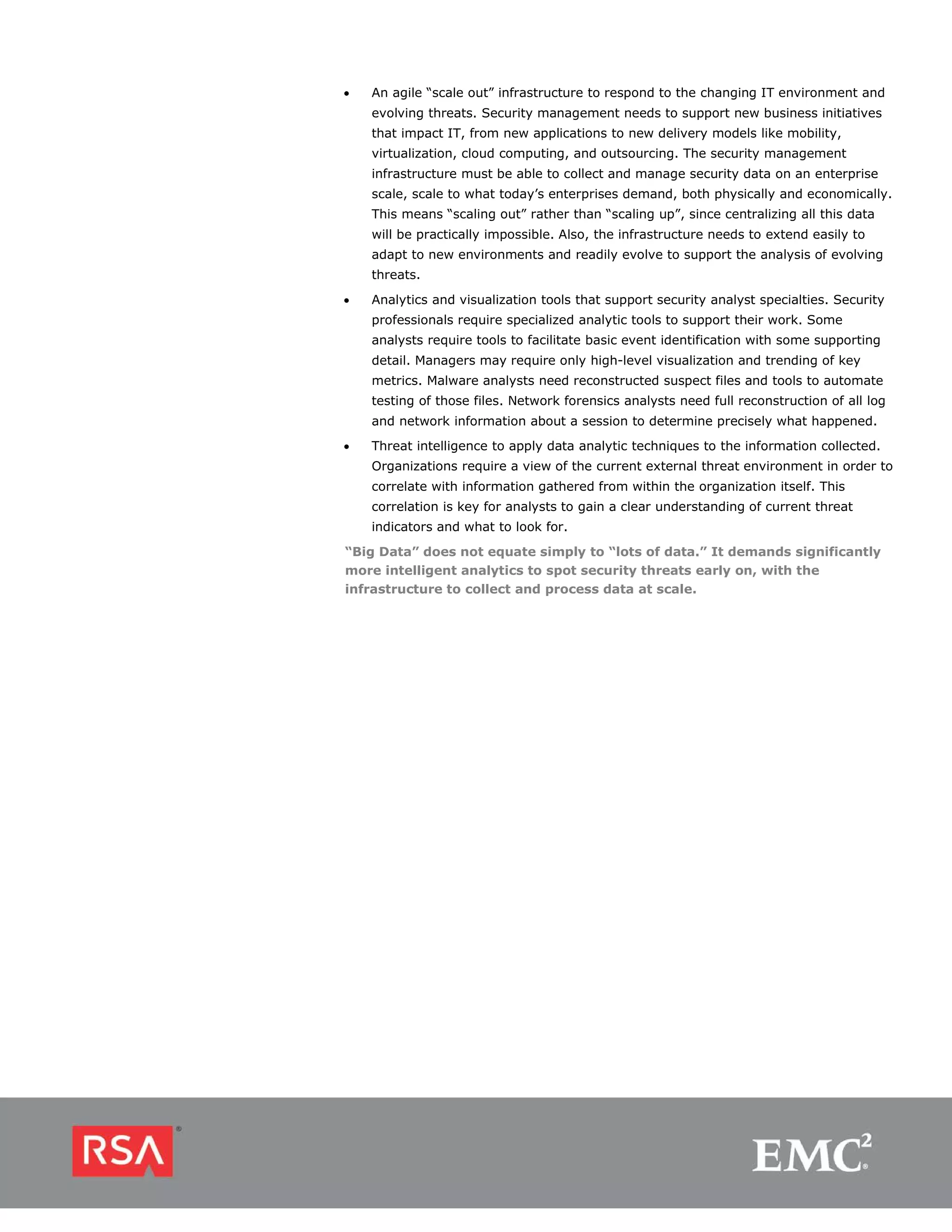
THE THREE FOUNDATIONAL CONCEPTS OF BIG
DATA IN SECURITY MANAGEMENT
A true “Big Data” strategy for security management must encompass all of
three aspects – the infrastructure, the analytic tools and intelligence – to
properly address the issues at hand.


                  Figure 1. The pillars of Big Data in security management


To extract value from data being gathered, drive efficiency into threat management
activities, and use compliance activities to drive decision making, security teams need
a to take “Big Data” approach to security management. This means having:
•   An agile “scale out” infrastructure to respond to the changing IT environment and
    evolving threats. Security management needs to support new business initiatives
    that impact IT, from new applications to new delivery models like mobility,
    virtualization, cloud computing, and outsourcing. The security management
    infrastructure must be able to collect and manage security data on an enterprise
    scale, scale to what today’s enterprises demand, both physically and economically.
    This means “scaling out” rather than “scaling up”, since centralizing all this data
    will be practically impossible. Also, the infrastructure needs to extend easily to
    adapt to new environments and readily evolve to support the analysis of evolving
    threats.

•   Analytics and visualization tools that support security analyst specialties. Security
    professionals require specialized analytic tools to support their work. Some
    analysts require tools to facilitate basic event identification with some supporting
    detail. Managers may require only high-level visualization and trending of key
    metrics. Malware analysts need reconstructed suspect files and tools to automate
    testing of those files. Network forensics analysts need full reconstruction of all log
    and network information about a session to determine precisely what happened.
•   Threat intelligence to apply data analytic techniques to the information collected.
    Organizations require a view of the current external threat environment in order to
    correlate with information gathered from within the organization itself. This
    correlation is key for analysts to gain a clear understanding of current threat
    indicators and what to look for.
“Big Data” does not equate simply to “lots of data.” It demands significantly
more intelligent analytics to spot security threats early on, with the
infrastructure to collect and process data at scale.
“BIG DATA” DRIVES EFFICIENT, PRODUCTIVE
SECURITY
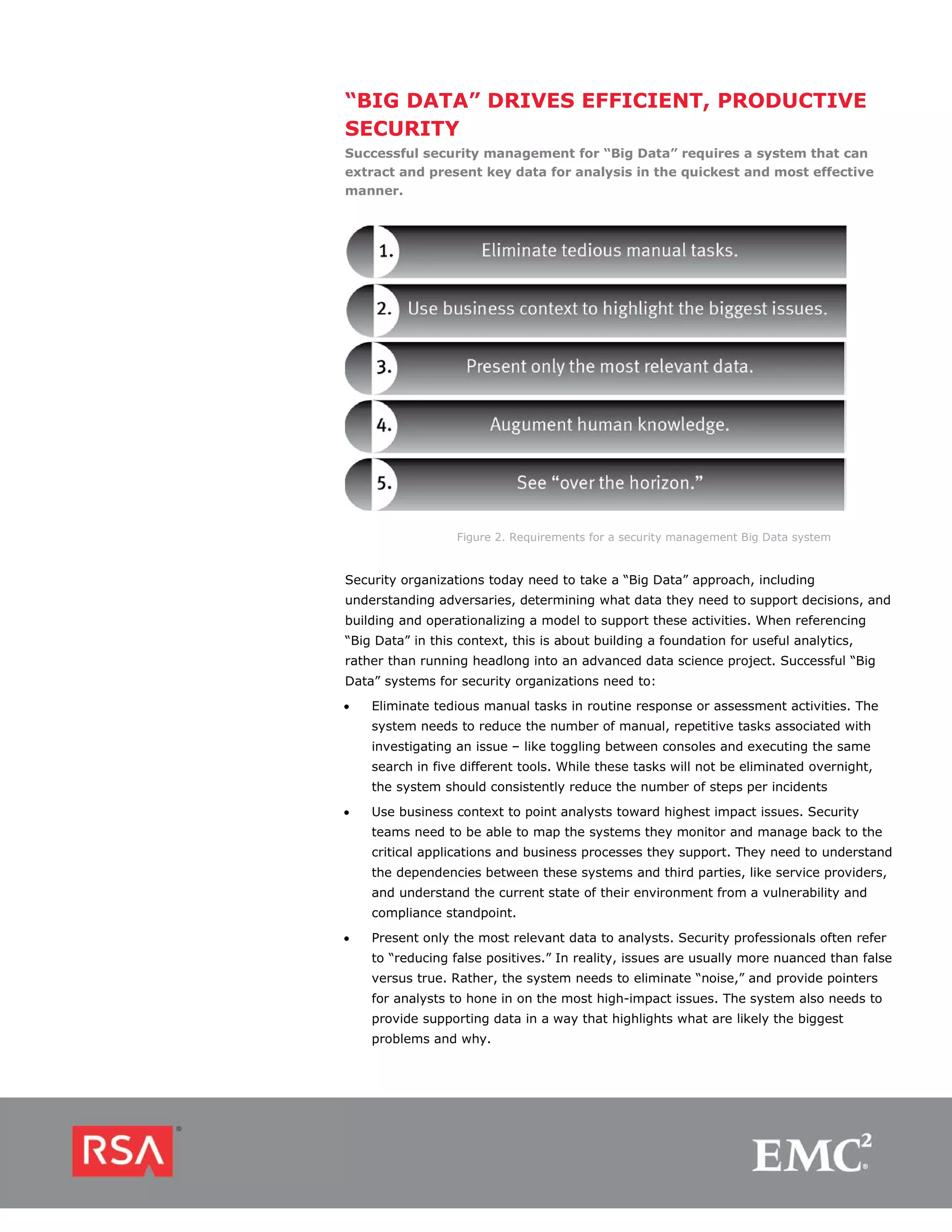
Successful security management for “Big Data” requires a system that can
extract and present key data for analysis in the quickest and most effective
manner.


                  Figure 2. Requirements for a security management Big Data system


Security organizations today need to take a “Big Data” approach, including
understanding adversaries, determining what data they need to support decisions, and
building and operationalizing a model to support these activities. When referencing
“Big Data” in this context, this is about building a foundation for useful analytics,
rather than running headlong into an advanced data science project. Successful “Big
Data” systems for security organizations need to:
•   Eliminate tedious manual tasks in routine response or assessment activities. The
    system needs to reduce the number of manual, repetitive tasks associated with
    investigating an issue – like toggling between consoles and executing the same
    search in five different tools. While these tasks will not be eliminated overnight,
    the system should consistently reduce the number of steps per incidents
•   Use business context to point analysts toward highest impact issues. Security
    teams need to be able to map the systems they monitor and manage back to the
    critical applications and business processes they support. They need to understand
    the dependencies between these systems and third parties, like service providers,
    and understand the current state of their environment from a vulnerability and
    compliance standpoint.

•   Present only the most relevant data to analysts. Security professionals often refer
    to “reducing false positives.” In reality, issues are usually more nuanced than false
    versus true. Rather, the system needs to eliminate “noise,” and provide pointers
    for analysts to hone in on the most high-impact issues. The system also needs to
    provide supporting data in a way that highlights what are likely the biggest
    problems and why.
•   Augment human knowledge. The system can help the analyst spend time
    analyzing the most critical items. This includes providing built-in techniques for
    identifying the most high priority issues, as well as current threat intelligence that
    uses those techniques to identify the latest tools, techniques, and procedures in
    use by the attacker community.
•   See ‘over the horizon.’ Defense against modern threats is a race against time. The
    system needs to provide early warning –and eventually predictive model -
    marrying external threat intelligence with internal situational awareness to move
    the security team from passive defense to active defense and prevention.

SECURITY ANALYTICS: A STAGED APPROACH FOR “BIG DATA”
While advanced techniques like predictive analytics and statistical inference
will likely prove important techniques in the future, it is important for
security teams to begin by focusing on the basics, taking a staged approach.


•   Start by implementing a security data infrastructure that can grow with you. This
    involves implementing an architecture that can not only collect detailed
    information about logs, network sessions, vulnerabilities, configurations, and
    identities, but also human intelligence about what systems do and how they work.
    Although you may start small, the system needs to be based on a robust,
    distributed architecture to ensure scalability as your requirements evolve. The
    system must support logical domains of trust including legal jurisdictions, as well
    as data for business units or different projects. The system needs to be able to
    manipulate and pivot on this data quickly and easily (e.g., show all logs, network
    sessions and scan results from a given IP address and its communication to a
    production financial system).
•   Deploy basic analytic tools to automate repetitive human interactions. A nearer-
    term goal is often to create a model that correlates information visually to reduce
    the number of steps a human would need to take to gather all that information
    into one view (e.g., show all the logs and network sessions involving systems that
    support credit card transaction processing, and that are vulnerable to an attack
    seen in other parts of the business).
•   Create visualizations and outputs that support major security functions. Some
    analysts will only need to see the most suspicious events with some supporting
    detail. Malware analysts will need a prioritized list of suspect files and the reasons
    why they are suspect. Network forensics analysts will need detailed results of
    complex queries. Others will need to review scheduled compliance reports, or
    general reports used to spot trends or areas for improvement in the system. The
    system also needs to be open to enable another system to access data and use it
    to take an action against an attacker, like quarantine them or step up monitoring
    of what they are doing.
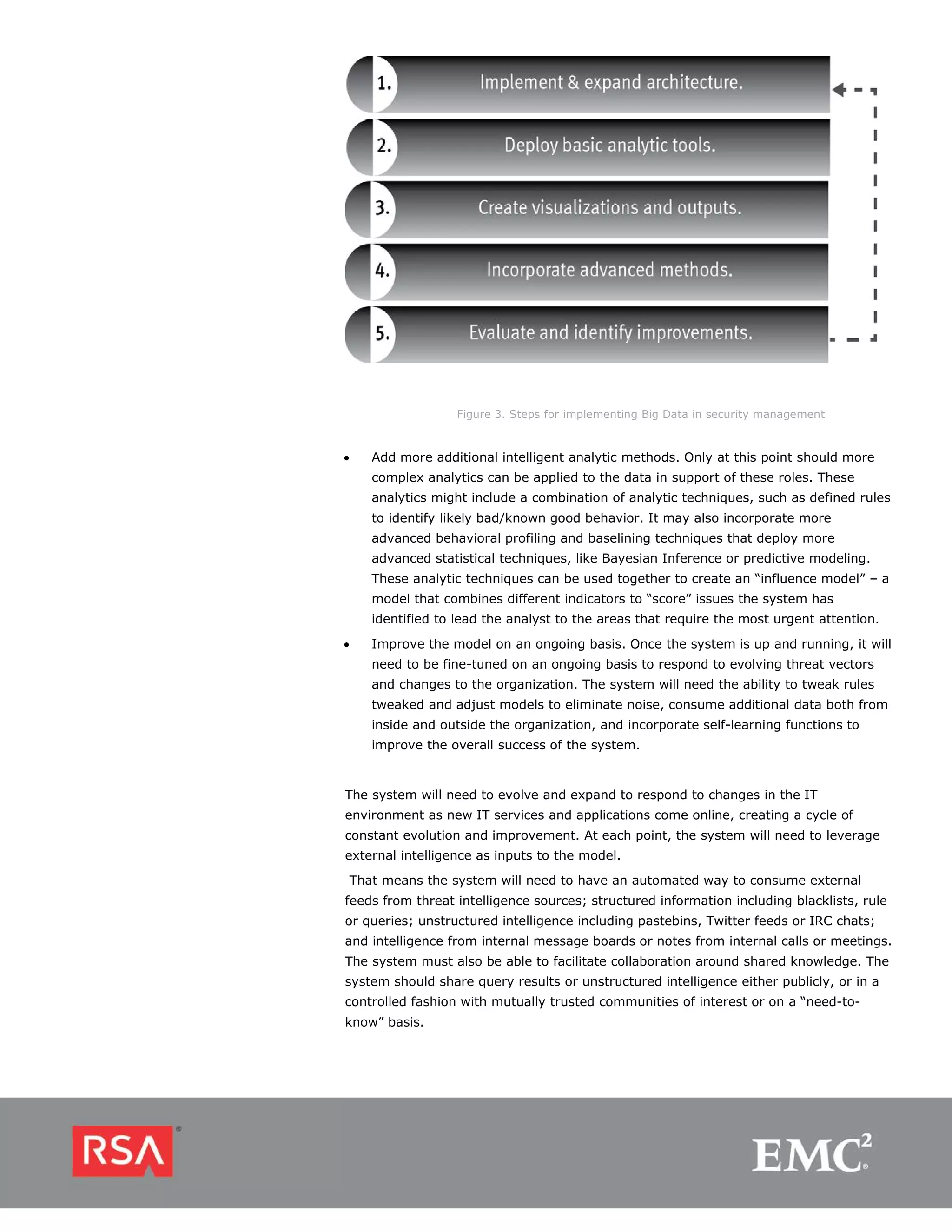
Figure 3. Steps for implementing Big Data in security management


•      Add more additional intelligent analytic methods. Only at this point should more
       complex analytics can be applied to the data in support of these roles. These
       analytics might include a combination of analytic techniques, such as defined rules
       to identify likely bad/known good behavior. It may also incorporate more
       advanced behavioral profiling and baselining techniques that deploy more
       advanced statistical techniques, like Bayesian Inference or predictive modeling.
       These analytic techniques can be used together to create an “influence model” – a
       model that combines different indicators to “score” issues the system has
       identified to lead the analyst to the areas that require the most urgent attention.
•      Improve the model on an ongoing basis. Once the system is up and running, it will
       need to be fine-tuned on an ongoing basis to respond to evolving threat vectors
       and changes to the organization. The system will need the ability to tweak rules
       tweaked and adjust models to eliminate noise, consume additional data both from
       inside and outside the organization, and incorporate self-learning functions to
       improve the overall success of the system.


The system will need to evolve and expand to respond to changes in the IT
environment as new IT services and applications come online, creating a cycle of
constant evolution and improvement. At each point, the system will need to leverage
external intelligence as inputs to the model.
    That means the system will need to have an automated way to consume external
feeds from threat intelligence sources; structured information including blacklists, rule
or queries; unstructured intelligence including pastebins, Twitter feeds or IRC chats;
and intelligence from internal message boards or notes from internal calls or meetings.
The system must also be able to facilitate collaboration around shared knowledge. The
system should share query results or unstructured intelligence either publicly, or in a
controlled fashion with mutually trusted communities of interest or on a “need-to-
know” basis.
FOUNDATIONAL INFRASTRUCTURE PAVES THE WAY FOR
MORE SOPHISTICATED TECHNIQUES
Security teams will greatly increase their likelihood of success in implementing “Big
Data” in security by focusing on first creating a scalable architecture and deploying
tools eliminating non-value added tasks. This will give “quick wins,” provide a solid
platform and free up staff to concentrate on deploying and managing more complex
analytic tools. Done properly this will:
•   Increase the efficiency of security analysts. The number of “issues per shift”
    analysts can deal with can be increased from a few to a dozen and beyond.
•   Reduce attacker free time and thus the impact of threats on the business. Analysts
    will be more automatically drawn to those issues which are most likely to cause
    problems and shut them down before they affect the business adversely.
Without this foundation or a clear, concrete objective in mind, a Big Data initiative
could easily flounder and not bring any of the expected gains.


RSA SECURITY MANAGEMENT: A FIRM
FOUNDATION FOR INFRASTRUCTURE,
ANALYTICS, AND INTELLIGENCE


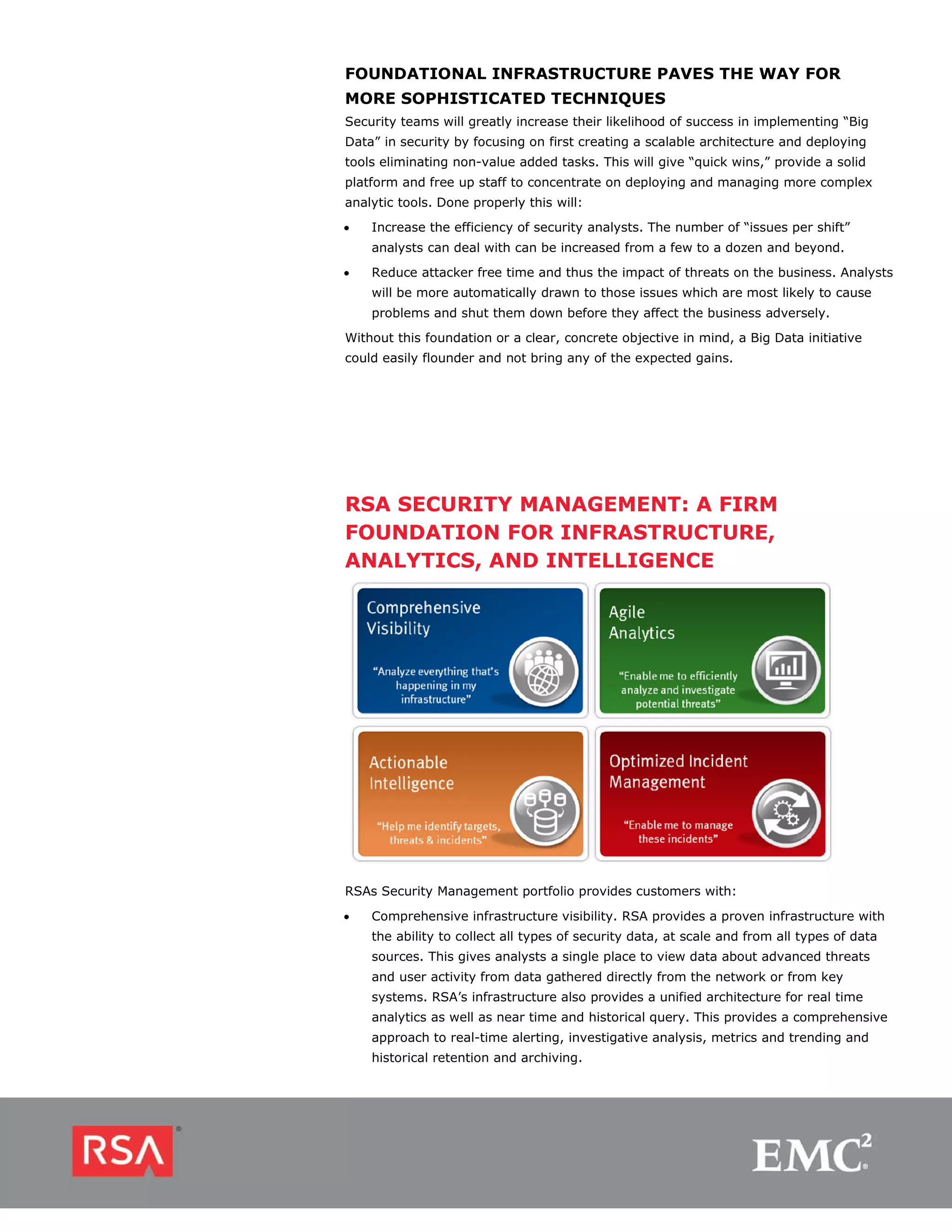
RSAs Security Management portfolio provides customers with:

•   Comprehensive infrastructure visibility. RSA provides a proven infrastructure with
    the ability to collect all types of security data, at scale and from all types of data
    sources. This gives analysts a single place to view data about advanced threats
    and user activity from data gathered directly from the network or from key
    systems. RSA’s infrastructure also provides a unified architecture for real time
    analytics as well as near time and historical query. This provides a comprehensive
    approach to real-time alerting, investigative analysis, metrics and trending and
    historical retention and archiving.
•    Agile analytics. The RSA platform gives analysts the tools to perform rapid
                                              investigations – including intuitive tools for investigation presented for rapid
                                              analysis, with detailed drill down and incorporation of business context to better
                                              inform the decision making process. RSA’s approach provides the ability to hone
                                              in on the most suspicious users and endpoints connected to your infrastructure
                                              and tell-tale signs of malicious activity through signature-free analytics. Full
                                              session replace provides the Ability to recreate and replay exactly what happened.
                                         •    Actionable intelligence. Threat intelligence provided by RSA helps security analysts
                                              get the most value from RSA products by incorporating feeds of current threat
                                              information. RSA’s threat research team provides proprietary intelligence from a
                                              community of security experts, automatically built into our tools through rules,
                                              reports, parsers and watchlists. This allows analysts to gain insight into threats
                                              from data collected from the enterprise, and prioritize response actions by
                                              incorporating information from the business showing relationship between the
                                              systems involved and the business functions they support.

                                         •    Optimized incident management. RSA products help security teams streamline the
                                              diverse set of activities related to preparedness and response, by providing a
                                              workflow system to define and activate response processes, plus tools to track
                                              current open issues, trends and lessons learned. Industry leading services to help
                                              prepare, detect and respond to incidents. The platform integrates with the RSA
                                              portfolio and third party tools to exchange information with the wide range of tools
                                              needed to identify and handle incidents and streaming compliance management.


CONTACT US
To learn more about how EMC
products, services, and solutions can
help solve your business and IT          EMC2, EMC, the EMC logo, [add other applicable product trademarks in alphabetical order] are
                                         registered trademarks or trademarks of EMC Corporation in the United States and other countries.
challenges, contact your local
                                         VMware [add additional per above, if required] are registered trademarks or trademarks of
representative or authorized reseller—   VMware, Inc., in the United States and other jurisdictions. © Copyright 2012 EMC Corporation. All
or visit us at www.EMC.com/rsa.          rights reserved. Published in the USA. 0812 Solution Overview HSMCBD0812

                                         EMC believes the information in this document is accurate as of its publication date. The
                                         information is subject to change without notice.

Getting Real About Security Management and “Big Data”

  • 1.
    GETTTING REAL ABOUTSECURITY MANAGEMENT AND "BIG DATA" A Roadmap for "Big Data" in Security Analytics It’s an exciting yet daunting time to be a security professional. Security threats are ESSENTIALS becoming more aggressive and voracious. Governments and industry bodies are This paper examines: getting more prescriptive around compliance. Combined with exponentially more complex IT environments, security management is increasingly challenging. Moreover, • Escalating complexity of the new “Big Data” technologies purport bringing advanced analytic techniques like security management predictive analysis and advanced statistical techniques close to the security environment, from threats to IT professional. environments to compliance mandates Given the state of today’s security systems, most organizations are a long way from using these types of advanced technologies for security management. Security • How to get more meaning from professionals need to get more value from the data already collected and analyzed. data already collected, by They also need a better understanding of both current issues and impending “eliminating the hay from the challenges related to data. Starting with a foundational set of data management and haystack” rather than “looking for analytic capabilities enables organizations to effectively build and scale security the needles” management as the enterprise evolves to meet Big Data challenges. • The combination of infrastructure, analytic tools, and threat TODAY'S SECURITY LANDSCAPE LEAVES NO intelligence needed to drive business value from Big Data ROOM FOR AD HOC SECURITY When dealing with “Big Data,” the volume and types of data about IT and the business are too great to process in an ad hoc manner. Moreover, it has become increasingly difficult to secure meaningful information from the data being collected. Despite significant investment in information security, attackers appear to be getting the upper hand. According to the Verizon Data Breach Investigations report (2012), 91 percent of breaches led to data compromise within “days” or less, whereas 79 percent of breaches took “weeks” or more to discover. There are a number of factors that explain this: • Attackers are becoming more organized and better funded. But while attacks have become dynamic, defenses have remained static. Today’s attacks are designed to exploit the weaknesses of our user-centric, hyper-connected infrastructures. • IT-enabled organizations continue to grow more complex. Organizations now demand much more open and agile systems, creating incredible new opportunities for collaboration, communication, and innovation. This also results in new vulnerabilities that cyber criminals, “hacktivist” groups, and nation states have learned to exploit. • Compliance is even more far reaching. Regulators and legislators are getting more prescriptive. Companies, particularly those with multiple lines of business or international operations, have an increasingly hard time keeping track of current controls that are in place, controls that are needed, and how to ensure controls are being managed properly.
  • 2.
    The combined effectof these factors in IT environments makes security management much more complex, with many more interdependencies and a wider scope of responsibility. As more business processes become digitized, security teams have both the opportunity and the challenge to collect and manage more data. Investments are increasingly made in log management, vulnerability management, identity management, and configuration management tools. However, breaches continue to happen, causing more disruption and expense than ever. THE THREE FOUNDATIONAL CONCEPTS OF BIG DATA IN SECURITY MANAGEMENT A true “Big Data” strategy for security management must encompass all of three aspects – the infrastructure, the analytic tools and intelligence – to properly address the issues at hand. Figure 1. The pillars of Big Data in security management To extract value from data being gathered, drive efficiency into threat management activities, and use compliance activities to drive decision making, security teams need a to take “Big Data” approach to security management. This means having:
  • 3.
    An agile “scale out” infrastructure to respond to the changing IT environment and evolving threats. Security management needs to support new business initiatives that impact IT, from new applications to new delivery models like mobility, virtualization, cloud computing, and outsourcing. The security management infrastructure must be able to collect and manage security data on an enterprise scale, scale to what today’s enterprises demand, both physically and economically. This means “scaling out” rather than “scaling up”, since centralizing all this data will be practically impossible. Also, the infrastructure needs to extend easily to adapt to new environments and readily evolve to support the analysis of evolving threats. • Analytics and visualization tools that support security analyst specialties. Security professionals require specialized analytic tools to support their work. Some analysts require tools to facilitate basic event identification with some supporting detail. Managers may require only high-level visualization and trending of key metrics. Malware analysts need reconstructed suspect files and tools to automate testing of those files. Network forensics analysts need full reconstruction of all log and network information about a session to determine precisely what happened. • Threat intelligence to apply data analytic techniques to the information collected. Organizations require a view of the current external threat environment in order to correlate with information gathered from within the organization itself. This correlation is key for analysts to gain a clear understanding of current threat indicators and what to look for. “Big Data” does not equate simply to “lots of data.” It demands significantly more intelligent analytics to spot security threats early on, with the infrastructure to collect and process data at scale.
  • 4.
    “BIG DATA” DRIVESEFFICIENT, PRODUCTIVE SECURITY Successful security management for “Big Data” requires a system that can extract and present key data for analysis in the quickest and most effective manner. Figure 2. Requirements for a security management Big Data system Security organizations today need to take a “Big Data” approach, including understanding adversaries, determining what data they need to support decisions, and building and operationalizing a model to support these activities. When referencing “Big Data” in this context, this is about building a foundation for useful analytics, rather than running headlong into an advanced data science project. Successful “Big Data” systems for security organizations need to: • Eliminate tedious manual tasks in routine response or assessment activities. The system needs to reduce the number of manual, repetitive tasks associated with investigating an issue – like toggling between consoles and executing the same search in five different tools. While these tasks will not be eliminated overnight, the system should consistently reduce the number of steps per incidents • Use business context to point analysts toward highest impact issues. Security teams need to be able to map the systems they monitor and manage back to the critical applications and business processes they support. They need to understand the dependencies between these systems and third parties, like service providers, and understand the current state of their environment from a vulnerability and compliance standpoint. • Present only the most relevant data to analysts. Security professionals often refer to “reducing false positives.” In reality, issues are usually more nuanced than false versus true. Rather, the system needs to eliminate “noise,” and provide pointers for analysts to hone in on the most high-impact issues. The system also needs to provide supporting data in a way that highlights what are likely the biggest problems and why.
  • 5.
    Augment human knowledge. The system can help the analyst spend time analyzing the most critical items. This includes providing built-in techniques for identifying the most high priority issues, as well as current threat intelligence that uses those techniques to identify the latest tools, techniques, and procedures in use by the attacker community. • See ‘over the horizon.’ Defense against modern threats is a race against time. The system needs to provide early warning –and eventually predictive model - marrying external threat intelligence with internal situational awareness to move the security team from passive defense to active defense and prevention. SECURITY ANALYTICS: A STAGED APPROACH FOR “BIG DATA” While advanced techniques like predictive analytics and statistical inference will likely prove important techniques in the future, it is important for security teams to begin by focusing on the basics, taking a staged approach. • Start by implementing a security data infrastructure that can grow with you. This involves implementing an architecture that can not only collect detailed information about logs, network sessions, vulnerabilities, configurations, and identities, but also human intelligence about what systems do and how they work. Although you may start small, the system needs to be based on a robust, distributed architecture to ensure scalability as your requirements evolve. The system must support logical domains of trust including legal jurisdictions, as well as data for business units or different projects. The system needs to be able to manipulate and pivot on this data quickly and easily (e.g., show all logs, network sessions and scan results from a given IP address and its communication to a production financial system). • Deploy basic analytic tools to automate repetitive human interactions. A nearer- term goal is often to create a model that correlates information visually to reduce the number of steps a human would need to take to gather all that information into one view (e.g., show all the logs and network sessions involving systems that support credit card transaction processing, and that are vulnerable to an attack seen in other parts of the business). • Create visualizations and outputs that support major security functions. Some analysts will only need to see the most suspicious events with some supporting detail. Malware analysts will need a prioritized list of suspect files and the reasons why they are suspect. Network forensics analysts will need detailed results of complex queries. Others will need to review scheduled compliance reports, or general reports used to spot trends or areas for improvement in the system. The system also needs to be open to enable another system to access data and use it to take an action against an attacker, like quarantine them or step up monitoring of what they are doing.
  • 6.
    Figure 3. Stepsfor implementing Big Data in security management • Add more additional intelligent analytic methods. Only at this point should more complex analytics can be applied to the data in support of these roles. These analytics might include a combination of analytic techniques, such as defined rules to identify likely bad/known good behavior. It may also incorporate more advanced behavioral profiling and baselining techniques that deploy more advanced statistical techniques, like Bayesian Inference or predictive modeling. These analytic techniques can be used together to create an “influence model” – a model that combines different indicators to “score” issues the system has identified to lead the analyst to the areas that require the most urgent attention. • Improve the model on an ongoing basis. Once the system is up and running, it will need to be fine-tuned on an ongoing basis to respond to evolving threat vectors and changes to the organization. The system will need the ability to tweak rules tweaked and adjust models to eliminate noise, consume additional data both from inside and outside the organization, and incorporate self-learning functions to improve the overall success of the system. The system will need to evolve and expand to respond to changes in the IT environment as new IT services and applications come online, creating a cycle of constant evolution and improvement. At each point, the system will need to leverage external intelligence as inputs to the model. That means the system will need to have an automated way to consume external feeds from threat intelligence sources; structured information including blacklists, rule or queries; unstructured intelligence including pastebins, Twitter feeds or IRC chats; and intelligence from internal message boards or notes from internal calls or meetings. The system must also be able to facilitate collaboration around shared knowledge. The system should share query results or unstructured intelligence either publicly, or in a controlled fashion with mutually trusted communities of interest or on a “need-to- know” basis.
  • 7.
    FOUNDATIONAL INFRASTRUCTURE PAVESTHE WAY FOR MORE SOPHISTICATED TECHNIQUES Security teams will greatly increase their likelihood of success in implementing “Big Data” in security by focusing on first creating a scalable architecture and deploying tools eliminating non-value added tasks. This will give “quick wins,” provide a solid platform and free up staff to concentrate on deploying and managing more complex analytic tools. Done properly this will: • Increase the efficiency of security analysts. The number of “issues per shift” analysts can deal with can be increased from a few to a dozen and beyond. • Reduce attacker free time and thus the impact of threats on the business. Analysts will be more automatically drawn to those issues which are most likely to cause problems and shut them down before they affect the business adversely. Without this foundation or a clear, concrete objective in mind, a Big Data initiative could easily flounder and not bring any of the expected gains. RSA SECURITY MANAGEMENT: A FIRM FOUNDATION FOR INFRASTRUCTURE, ANALYTICS, AND INTELLIGENCE RSAs Security Management portfolio provides customers with: • Comprehensive infrastructure visibility. RSA provides a proven infrastructure with the ability to collect all types of security data, at scale and from all types of data sources. This gives analysts a single place to view data about advanced threats and user activity from data gathered directly from the network or from key systems. RSA’s infrastructure also provides a unified architecture for real time analytics as well as near time and historical query. This provides a comprehensive approach to real-time alerting, investigative analysis, metrics and trending and historical retention and archiving.
  • 8.
    Agile analytics. The RSA platform gives analysts the tools to perform rapid investigations – including intuitive tools for investigation presented for rapid analysis, with detailed drill down and incorporation of business context to better inform the decision making process. RSA’s approach provides the ability to hone in on the most suspicious users and endpoints connected to your infrastructure and tell-tale signs of malicious activity through signature-free analytics. Full session replace provides the Ability to recreate and replay exactly what happened. • Actionable intelligence. Threat intelligence provided by RSA helps security analysts get the most value from RSA products by incorporating feeds of current threat information. RSA’s threat research team provides proprietary intelligence from a community of security experts, automatically built into our tools through rules, reports, parsers and watchlists. This allows analysts to gain insight into threats from data collected from the enterprise, and prioritize response actions by incorporating information from the business showing relationship between the systems involved and the business functions they support. • Optimized incident management. RSA products help security teams streamline the diverse set of activities related to preparedness and response, by providing a workflow system to define and activate response processes, plus tools to track current open issues, trends and lessons learned. Industry leading services to help prepare, detect and respond to incidents. The platform integrates with the RSA portfolio and third party tools to exchange information with the wide range of tools needed to identify and handle incidents and streaming compliance management. CONTACT US To learn more about how EMC products, services, and solutions can help solve your business and IT EMC2, EMC, the EMC logo, [add other applicable product trademarks in alphabetical order] are registered trademarks or trademarks of EMC Corporation in the United States and other countries. challenges, contact your local VMware [add additional per above, if required] are registered trademarks or trademarks of representative or authorized reseller— VMware, Inc., in the United States and other jurisdictions. © Copyright 2012 EMC Corporation. All or visit us at www.EMC.com/rsa. rights reserved. Published in the USA. 0812 Solution Overview HSMCBD0812 EMC believes the information in this document is accurate as of its publication date. The information is subject to change without notice.