Operationalize Deep Learning Models for
Fraud Detection with Azure Machine
Learning
Francesca Lazzeri (@frlazzeri)
Jaya Mathew (@mathew_jaya)
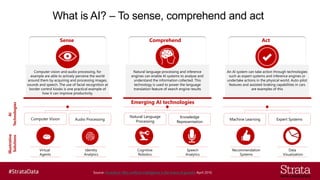
Source: Accenture: Why artificial intelligence is the future of growth, April 2016
Computer Vision Audio Processing
Natural Language
Processing
Knowledge
Representation
Machine Learning Expert Systems
AI
Technologies
Illustrative
Solutions
…
Virtual
Agents
Identity
Analytics
Cognitive
Robotics
Speech
Analytics
Recommendation
Systems
Data
Visualization
Emerging AI technologies
Computer vision and audio processing, for
example are able to actively perceive the world
around them by acquiring and processing images,
sounds and speech. The use of facial recognition at
border control kiosks is one practical example of
how it can improve productivity.
Sense
Natural language processing and inference
engines can enable AI systems to analyse and
understand the information collected. This
technology is used to power the language
translation feature of search engine results
Comprehend
An AI system can take action through technologies
such as expert systems and inference engines or
undertake actions in the physical world. Auto-pilot
features and assisted-braking capabilities in cars
are examples of this
Act
What is AI? – To sense, comprehend and act
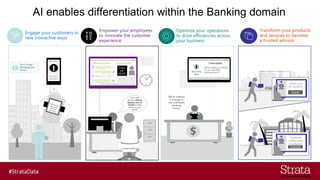
Empower your employees
to innovate the customer
experience
Optimize your operations
to drive efficiencies across
your business
Transform your products
and services to become
a trusted advisor
Engage your customers in
new interactive ways
We’re making
a change in
our overnight
banking
hours.
Recording
Now
Transcription
We’re making a change
in our overnight
banking hours|
We’re making
a change in
our overnight
banking
hours.
Recording
Now
Transcription
We’re making a change
in our overnight
banking hours|
Solicitar
Tarjeta de
crédito para
estudiantes
Solicitar
Tarjeta de
crédito para
estudiantes
Apply
Credit card
for students
Apply
Credit card
for students
Reminders
Don’t forget:
Mortgage due
Friday
Reminders
Don’t forget:
Mortgage due
Friday
Let’s talk
about a Home
Equity Line of
Credit to add
value to your
home.
Let’s talk
about a Home
Equity Line of
Credit to add
value to your
home.
Knowledge Center Next Best ActionKnowledge Center Next Best Action
What are our current
interest rates?
Home
Do want home or auto
interest rates?
The rate for a 30-year fixed
mortgage is 6.25% APR.
Knowledge Center Next Best Action
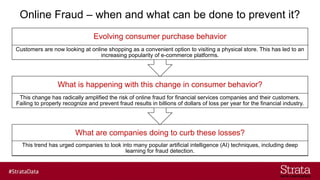
Online Fraud – when and what can be done to prevent it?
What are companies doing to curb these losses?
This trend has urged companies to look into many popular artificial intelligence (AI) techniques, including deep
learning for fraud detection.
What is happening with this change in consumer behavior?
This change has radically amplified the risk of online fraud for financial services companies and their customers.
Failing to properly recognize and prevent fraud results in billions of dollars of loss per year for the financial industry.
Evolving consumer purchase behavior
Customers are now looking at online shopping as a convenient option to visiting a physical store. This has led to an
increasing popularity of e-commerce platforms.
Fraud detection
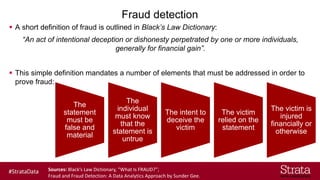
▪ A short definition of fraud is outlined in Black’s Law Dictionary:
“An act of intentional deception or dishonesty perpetrated by one or more individuals,
generally for financial gain”.
▪ This simple definition mandates a number of elements that must be addressed in order to
prove fraud:
The
statement
must be
false and
material
The
individual
must know
that the
statement is
untrue
The intent to
deceive the
victim
The victim
relied on the
statement
The victim is
injured
financially or
otherwise
Sources: Black’s Law Dictionary, “What Is FRAUD?”;
Fraud and Fraud Detection: A Data Analytics Approach by Sunder Gee.
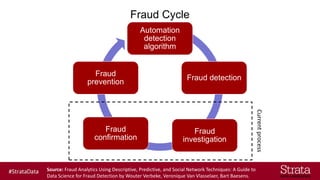
Fraud Cycle
Automation
detection
algorithm
Fraud detection
Fraud
investigation
Fraud
confirmation
Fraud
prevention
Currentprocess
Source: Fraud Analytics Using Descriptive, Predictive, and Social Network Techniques: A Guide to
Data Science for Fraud Detection by Wouter Verbeke, Veronique Van Vlasselaer, Bart Baesens.
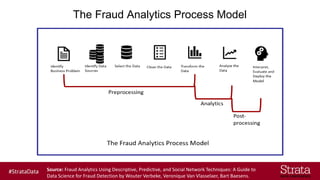
The Fraud Analytics Process Model
Source: Fraud Analytics Using Descriptive, Predictive, and Social Network Techniques: A Guide to
Data Science for Fraud Detection by Wouter Verbeke, Veronique Van Vlasselaer, Bart Baesens.
Credit Card Fraud Detection
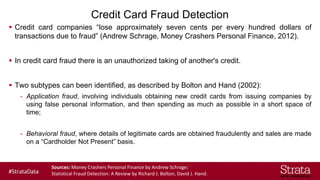
▪ Credit card companies “lose approximately seven cents per every hundred dollars of
transactions due to fraud” (Andrew Schrage, Money Crashers Personal Finance, 2012).
▪ In credit card fraud there is an unauthorized taking of another's credit.
▪ Two subtypes can been identified, as described by Bolton and Hand (2002):
- Application fraud, involving individuals obtaining new credit cards from issuing companies by
using false personal information, and then spending as much as possible in a short space of
time;
- Behavioral fraud, where details of legitimate cards are obtained fraudulently and sales are made
on a “Cardholder Not Present” basis.
Sources: Money Crashers Personal Finance by Andrew Schrage;
Statistical Fraud Detection: A Review by Richard J. Bolton, David J. Hand.
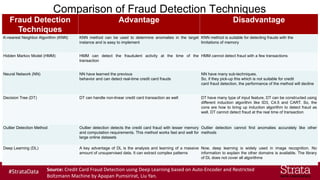
Comparison of Fraud Detection Techniques
Fraud Detection
Techniques
Advantage Disadvantage
K-nearest Neighbor Algorithm (KNN) KNN method can be used to determine anomalies in the target
instance and is easy to implement
KNN method is suitable for detecting frauds with the
limitations of memory
Hidden Markov Model (HMM) HMM can detect the fraudulent activity at the time of the
transaction
HMM cannot detect fraud with a few transactions
Neural Network (NN) NN have learned the previous
behavior and can detect real-time credit card frauds
NN have many sub-techniques.
So, if they pick-up this which is not suitable for credit
card fraud detection, the performance of the method will decline
Decision Tree (DT) DT can handle non-linear credit card transaction as well DT have many type of input feature, DT can be constructed using
different induction algorithm like ID3, C4.5 and CART. So, the
cons are how to bring up induction algorithm to detect fraud as
well. DT cannot detect fraud at the real time of transaction
Outlier Detection Method Outlier detection detects the credit card fraud with lesser memory
and computation requirements. This method works fast and well for
large online datasets
Outlier detection cannot find anomalies accurately like other
methods
Deep Learning (DL) A key advantage of DL is the analysis and learning of a massive
amount of unsupervised data. It can extract complex patterns
Now, deep learning is widely used in image recognition. No
information to explain the other domains is available. The library
of DL does not cover all algorithms
Source: Credit Card Fraud Detection using Deep Learning based on Auto-Encoder and Restricted
Boltzmann Machine by Apapan Pumsirirat, Liu Yan.
Our Approach
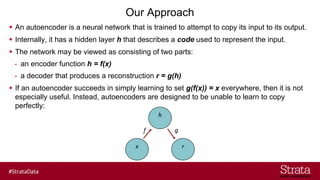
▪ An autoencoder is a neural network that is trained to attempt to copy its input to its output.
▪ Internally, it has a hidden layer h that describes a code used to represent the input.
▪ The network may be viewed as consisting of two parts:
- an encoder function h = f(x)
- a decoder that produces a reconstruction r = g(h)
▪ If an autoencoder succeeds in simply learning to set g(f(x)) = x everywhere, then it is not
especially useful. Instead, autoencoders are designed to be unable to learn to copy
perfectly:
x
h
r
f g
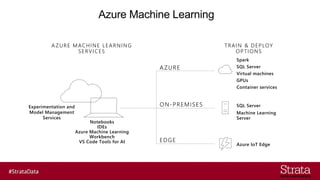
Notebooks
IDEs
Azure Machine Learning
Workbench
VS Code Tools for AI
Experimentation and
Model Management
Services
A ZURE MACHINE LEARNING
SERVICES
Spark
SQL Server
Virtual machines
GPUs
Container services
SQL Server
Machine Learning
Server
ON-PREMISES
EDGE
Azure IoT Edge
TRAIN & DEPLOY
OPTIONS
AZURE
Credit Card Fraud Detection Data Set
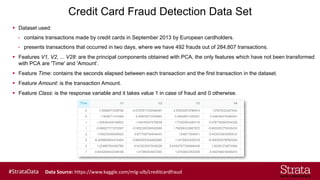
▪ Dataset used:
- contains transactions made by credit cards in September 2013 by European cardholders.
- presents transactions that occurred in two days, where we have 492 frauds out of 284,807 transactions.
▪ Features V1, V2, ... V28: are the principal components obtained with PCA, the only features which have not been transformed
with PCA are 'Time' and 'Amount’.
▪ Feature Time: contains the seconds elapsed between each transaction and the first transaction in the dataset.
▪ Feature Amount: is the transaction Amount.
▪ Feature Class: is the response variable and it takes value 1 in case of fraud and 0 otherwise.
Data Source: https://www.kaggle.com/mlg-ulb/creditcardfraud
Demo
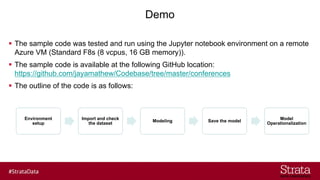
▪ The sample code was tested and run using the Jupyter notebook environment on a remote
Azure VM (Standard F8s (8 vcpus, 16 GB memory)).
▪ The sample code is available at the following GitHub location:
https://github.com/jayamathew/Codebase/tree/master/conferences
▪ The outline of the code is as follows:
Environment
setup
Import and check
the dataset
Modeling Save the model
Model
Operationalization
Demo
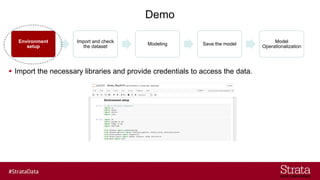
▪ Import the necessary libraries and provide credentials to access the data.
Environment
setup
Import and check
the dataset
Modeling Save the model
Model
Operationalization
Demo
Environment
setup
Import and
check the
dataset
Modeling Save the model
Model
Operationalization
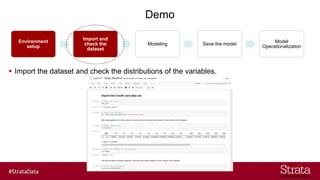
▪ Import the dataset and check the distributions of the variables.
Demo
Environment
setup
Import and
check the
dataset
Modeling Save the model
Model
Operationalization
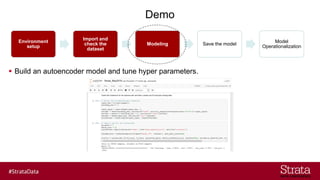
▪ Build an autoencoder model and tune hyper parameters.
Demo
Environment
setup
Import and
check the
dataset
Modeling Save the model
Model
Operationalization
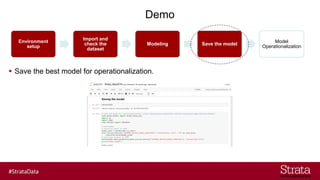
▪ Save the best model for operationalization.
Demo
Environment
setup
Import and
check the
dataset
Modeling Save the model
Model
Operationalization
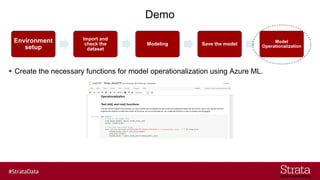
▪ Create the necessary functions for model operationalization using Azure ML.
Links to get started with AI:
▪ Here are some links to get you started:
- Azure ML: https://docs.microsoft.com/en-us/azure/machine-learning/preview/overview-what-is-azure-ml
- Installation: https://docs.microsoft.com/en-us/azure/machine-learning/preview/quickstart-installation
- Sample code for the Deep Learning use case: https://docs.microsoft.com/en-us/azure/machine-
learning/preview/scenario-deep-learning-for-predictive-maintenance
- Preconfigured Virtual Machines: https://azure.microsoft.com/en-us/services/virtual-machines/data-
science-virtual-machines/
- Data Source: https://www.kaggle.com/mlg-ulb/creditcardfraud
- Blog Post by Venelin Valkov: https://medium.com/@curiousily/credit-card-fraud-detection-using-
autoencoders-in-keras-tensorflow-for-hackers-part-vii-20e0c85301bd
- GitHub location: https://github.com/jayamathew/Codebase/tree/master/conferences
- Deep Learning Book by Ian Goodfellow, Yoshua Bengio, Aaron Courville:
http://www.deeplearningbook.org/
Bibliographic References
▪ Black’s Law Dictionary, “What Is FRAUD?”
▪ Fraud and Fraud Detection: A Data Analytics Approach by Sunder Gee
▪ Fraud Analytics Using Descriptive, Predictive, and Social Network Techniques: A Guide to
Data Science for Fraud Detection by Wouter Verbeke, Veronique Van Vlasselaer, Bart
Baesens
▪ Money Crashers Personal Finance by Andrew Schrage
▪ Statistical Fraud Detection: A Review by Richard J. Bolton, David J. Hand
▪ Credit Card Fraud Detection using Deep Learning based on Auto-Encoder and Restricted
Boltzmann Machine by Apapan Pumsirirat, Liu Yan
Thank you!
Francesca Lazzeri (@frlazzeri)
Jaya Mathew (@mathew_jaya)

Operationalize deep learning models for fraud detection with Azure Machine Learning

  • 1.
    Operationalize Deep LearningModels for Fraud Detection with Azure Machine Learning Francesca Lazzeri (@frlazzeri) Jaya Mathew (@mathew_jaya)
  • 2.
    Source: Accenture: Whyartificial intelligence is the future of growth, April 2016 Computer Vision Audio Processing Natural Language Processing Knowledge Representation Machine Learning Expert Systems AI Technologies Illustrative Solutions … Virtual Agents Identity Analytics Cognitive Robotics Speech Analytics Recommendation Systems Data Visualization Emerging AI technologies Computer vision and audio processing, for example are able to actively perceive the world around them by acquiring and processing images, sounds and speech. The use of facial recognition at border control kiosks is one practical example of how it can improve productivity. Sense Natural language processing and inference engines can enable AI systems to analyse and understand the information collected. This technology is used to power the language translation feature of search engine results Comprehend An AI system can take action through technologies such as expert systems and inference engines or undertake actions in the physical world. Auto-pilot features and assisted-braking capabilities in cars are examples of this Act What is AI? – To sense, comprehend and act
  • 3.
    Empower your employees toinnovate the customer experience Optimize your operations to drive efficiencies across your business Transform your products and services to become a trusted advisor Engage your customers in new interactive ways We’re making a change in our overnight banking hours. Recording Now Transcription We’re making a change in our overnight banking hours| We’re making a change in our overnight banking hours. Recording Now Transcription We’re making a change in our overnight banking hours| Solicitar Tarjeta de crédito para estudiantes Solicitar Tarjeta de crédito para estudiantes Apply Credit card for students Apply Credit card for students Reminders Don’t forget: Mortgage due Friday Reminders Don’t forget: Mortgage due Friday Let’s talk about a Home Equity Line of Credit to add value to your home. Let’s talk about a Home Equity Line of Credit to add value to your home. Knowledge Center Next Best ActionKnowledge Center Next Best Action What are our current interest rates? Home Do want home or auto interest rates? The rate for a 30-year fixed mortgage is 6.25% APR. Knowledge Center Next Best Action
  • 4.
    Online Fraud –when and what can be done to prevent it? What are companies doing to curb these losses? This trend has urged companies to look into many popular artificial intelligence (AI) techniques, including deep learning for fraud detection. What is happening with this change in consumer behavior? This change has radically amplified the risk of online fraud for financial services companies and their customers. Failing to properly recognize and prevent fraud results in billions of dollars of loss per year for the financial industry. Evolving consumer purchase behavior Customers are now looking at online shopping as a convenient option to visiting a physical store. This has led to an increasing popularity of e-commerce platforms.
  • 5.
    Fraud detection ▪ Ashort definition of fraud is outlined in Black’s Law Dictionary: “An act of intentional deception or dishonesty perpetrated by one or more individuals, generally for financial gain”. ▪ This simple definition mandates a number of elements that must be addressed in order to prove fraud: The statement must be false and material The individual must know that the statement is untrue The intent to deceive the victim The victim relied on the statement The victim is injured financially or otherwise Sources: Black’s Law Dictionary, “What Is FRAUD?”; Fraud and Fraud Detection: A Data Analytics Approach by Sunder Gee.
  • 6.
    Fraud Cycle Automation detection algorithm Fraud detection Fraud investigation Fraud confirmation Fraud prevention Currentprocess Source:Fraud Analytics Using Descriptive, Predictive, and Social Network Techniques: A Guide to Data Science for Fraud Detection by Wouter Verbeke, Veronique Van Vlasselaer, Bart Baesens.
  • 7.
    The Fraud AnalyticsProcess Model Source: Fraud Analytics Using Descriptive, Predictive, and Social Network Techniques: A Guide to Data Science for Fraud Detection by Wouter Verbeke, Veronique Van Vlasselaer, Bart Baesens.
  • 8.
    Credit Card FraudDetection ▪ Credit card companies “lose approximately seven cents per every hundred dollars of transactions due to fraud” (Andrew Schrage, Money Crashers Personal Finance, 2012). ▪ In credit card fraud there is an unauthorized taking of another's credit. ▪ Two subtypes can been identified, as described by Bolton and Hand (2002): - Application fraud, involving individuals obtaining new credit cards from issuing companies by using false personal information, and then spending as much as possible in a short space of time; - Behavioral fraud, where details of legitimate cards are obtained fraudulently and sales are made on a “Cardholder Not Present” basis. Sources: Money Crashers Personal Finance by Andrew Schrage; Statistical Fraud Detection: A Review by Richard J. Bolton, David J. Hand.
  • 9.
    Comparison of FraudDetection Techniques Fraud Detection Techniques Advantage Disadvantage K-nearest Neighbor Algorithm (KNN) KNN method can be used to determine anomalies in the target instance and is easy to implement KNN method is suitable for detecting frauds with the limitations of memory Hidden Markov Model (HMM) HMM can detect the fraudulent activity at the time of the transaction HMM cannot detect fraud with a few transactions Neural Network (NN) NN have learned the previous behavior and can detect real-time credit card frauds NN have many sub-techniques. So, if they pick-up this which is not suitable for credit card fraud detection, the performance of the method will decline Decision Tree (DT) DT can handle non-linear credit card transaction as well DT have many type of input feature, DT can be constructed using different induction algorithm like ID3, C4.5 and CART. So, the cons are how to bring up induction algorithm to detect fraud as well. DT cannot detect fraud at the real time of transaction Outlier Detection Method Outlier detection detects the credit card fraud with lesser memory and computation requirements. This method works fast and well for large online datasets Outlier detection cannot find anomalies accurately like other methods Deep Learning (DL) A key advantage of DL is the analysis and learning of a massive amount of unsupervised data. It can extract complex patterns Now, deep learning is widely used in image recognition. No information to explain the other domains is available. The library of DL does not cover all algorithms Source: Credit Card Fraud Detection using Deep Learning based on Auto-Encoder and Restricted Boltzmann Machine by Apapan Pumsirirat, Liu Yan.
  • 10.
    Our Approach ▪ Anautoencoder is a neural network that is trained to attempt to copy its input to its output. ▪ Internally, it has a hidden layer h that describes a code used to represent the input. ▪ The network may be viewed as consisting of two parts: - an encoder function h = f(x) - a decoder that produces a reconstruction r = g(h) ▪ If an autoencoder succeeds in simply learning to set g(f(x)) = x everywhere, then it is not especially useful. Instead, autoencoders are designed to be unable to learn to copy perfectly: x h r f g
  • 11.
    Notebooks IDEs Azure Machine Learning Workbench VSCode Tools for AI Experimentation and Model Management Services A ZURE MACHINE LEARNING SERVICES Spark SQL Server Virtual machines GPUs Container services SQL Server Machine Learning Server ON-PREMISES EDGE Azure IoT Edge TRAIN & DEPLOY OPTIONS AZURE
  • 12.
    Credit Card FraudDetection Data Set ▪ Dataset used: - contains transactions made by credit cards in September 2013 by European cardholders. - presents transactions that occurred in two days, where we have 492 frauds out of 284,807 transactions. ▪ Features V1, V2, ... V28: are the principal components obtained with PCA, the only features which have not been transformed with PCA are 'Time' and 'Amount’. ▪ Feature Time: contains the seconds elapsed between each transaction and the first transaction in the dataset. ▪ Feature Amount: is the transaction Amount. ▪ Feature Class: is the response variable and it takes value 1 in case of fraud and 0 otherwise. Data Source: https://www.kaggle.com/mlg-ulb/creditcardfraud
  • 13.
    Demo ▪ The samplecode was tested and run using the Jupyter notebook environment on a remote Azure VM (Standard F8s (8 vcpus, 16 GB memory)). ▪ The sample code is available at the following GitHub location: https://github.com/jayamathew/Codebase/tree/master/conferences ▪ The outline of the code is as follows: Environment setup Import and check the dataset Modeling Save the model Model Operationalization
  • 14.
    Demo ▪ Import thenecessary libraries and provide credentials to access the data. Environment setup Import and check the dataset Modeling Save the model Model Operationalization
  • 15.
    Demo Environment setup Import and check the dataset ModelingSave the model Model Operationalization ▪ Import the dataset and check the distributions of the variables.
  • 16.
    Demo Environment setup Import and check the dataset ModelingSave the model Model Operationalization ▪ Build an autoencoder model and tune hyper parameters.
  • 17.
    Demo Environment setup Import and check the dataset ModelingSave the model Model Operationalization ▪ Save the best model for operationalization.
  • 18.
    Demo Environment setup Import and check the dataset ModelingSave the model Model Operationalization ▪ Create the necessary functions for model operationalization using Azure ML.
  • 19.
    Links to getstarted with AI: ▪ Here are some links to get you started: - Azure ML: https://docs.microsoft.com/en-us/azure/machine-learning/preview/overview-what-is-azure-ml - Installation: https://docs.microsoft.com/en-us/azure/machine-learning/preview/quickstart-installation - Sample code for the Deep Learning use case: https://docs.microsoft.com/en-us/azure/machine- learning/preview/scenario-deep-learning-for-predictive-maintenance - Preconfigured Virtual Machines: https://azure.microsoft.com/en-us/services/virtual-machines/data- science-virtual-machines/ - Data Source: https://www.kaggle.com/mlg-ulb/creditcardfraud - Blog Post by Venelin Valkov: https://medium.com/@curiousily/credit-card-fraud-detection-using- autoencoders-in-keras-tensorflow-for-hackers-part-vii-20e0c85301bd - GitHub location: https://github.com/jayamathew/Codebase/tree/master/conferences - Deep Learning Book by Ian Goodfellow, Yoshua Bengio, Aaron Courville: http://www.deeplearningbook.org/
  • 20.
    Bibliographic References ▪ Black’sLaw Dictionary, “What Is FRAUD?” ▪ Fraud and Fraud Detection: A Data Analytics Approach by Sunder Gee ▪ Fraud Analytics Using Descriptive, Predictive, and Social Network Techniques: A Guide to Data Science for Fraud Detection by Wouter Verbeke, Veronique Van Vlasselaer, Bart Baesens ▪ Money Crashers Personal Finance by Andrew Schrage ▪ Statistical Fraud Detection: A Review by Richard J. Bolton, David J. Hand ▪ Credit Card Fraud Detection using Deep Learning based on Auto-Encoder and Restricted Boltzmann Machine by Apapan Pumsirirat, Liu Yan
  • 21.
    Thank you! Francesca Lazzeri(@frlazzeri) Jaya Mathew (@mathew_jaya)