IOSR Journal of Polymer and Textile Engineering (IOSR-JPTE)
e-ISSN: 2348-019X, p-ISSN: 2348-0181, Volume 2, Issue 1 (Jan - Feb. 2015), PP 47-55
www.iosrjournals.org
DOI: 10.9790/019X-0214755 www.iosrjournals.org 47 | Page
Study of Effect of Rotor Speed, Combing-Roll Speed and Type of
Recycled Waste on Rotor Yarn Quality Using Response Surface
Methodology
Md. Khalilur Rahman Khan1
, Habibur Rahman2
1, 2
(Department of Textile Engineering, Bangladesh University of Business and Technology, Bangladesh)
Abstract: A three factors, three level for two factors, i.e. combing roll speed and rotor speed and pneumafil
percentage as a categorical factor, face centered central composite design (CCD) was used and response
surface methodology was applied to determine the interactions of selected independent variables on rotor spun
yarn quality prepared by using 100% recycled spinning waste. The influence of these three independent
variables on the four dependent responses, i.e. total imperfections, yarn CSP value, elongation% and end
breakage rate was evaluated. Results indicate that rotor speed 85000 rpm and combing roll speed 8500 rpm
gives best result in terms of yarn CSP value and elongation% of 16 Ne rotor spun yarn produced from 100%
recycled spinning waste. Ends breakage increased drastically at increasing rotor speed and combing roll speed
but it can be minimized by using pneumafil in recycled fiber mixing. In addition, yarn quality can be improved
up to 5-25% by using 15% pneumafil instead of comber noil for any level of rotor speed and combing-roll
speed.
Keywords: combing-roll speed, recycled waste, response surface methodology, rotor speed, rotor spun yarn
I. Introduction
Cost of the raw materials has been increased in recent days as well as labor cost. Because of extreme
competition in textile industry, it has been obligatory in textile industries to reduce the production cost by any
means. It is reported that Raw material costs about 50-70% of the total cost of the product [1]. However;
improving raw material exploitation has become the most important challenge facing scientific and industrial
community [2].
In spite of the technical evolution for different blow room machines, generated wastes in cotton
spinning mill contain a great rate of fibers [3]. Ultimately, all spinning waste has gained vast importance for
spinner although modern machineries have been designed to produce yarn because all types of waste will
increase the production cost undoubtedly. One of the main methods to reduce the production costs is waste
recycling which is the most important challenge for the future [4]. It is reported that textiles are nearly 100%
recyclable, nothing in the textile and apparel industry should be wasted [5].
Many open-end spinning methods have been invented, but none have been successful than rotor
spinning [6]. Rotor spinning is considered as most suitable spinning principle in case of acceptable yarn
production by using low grade cotton at relatively lower cost than any other existed spinning technology till
now. In rotor spinning it is common to spin useful yarns from waste or by adding waste to the normal raw
material. It is of interest to note that more and more waste spinning units are being installed. This indicates that
profits are better in them, since the raw material, namely wastes from spinning mill, is relatively cheaper to give
better returns [1].
Some researchers have been studied the reuse of recycled fibers [1-4, 7, 8-10]. It is also said that the
speed of the rotor in connection with the speed of the combing roll which is called opening roller also has an
effect on fiber configuration in the yarn [11]. It is also observed that some researchers have been studied the
effect of rotor speed and combing roll speed on rotor yarn quality produced by using recycled waste as a blend
composition [2,10,12]. But yet it is not observed that any research has been made on the investigation of
combined effect of process parameters and type of recovered spinning wastes in rotor yarn production by using
100% recycled spinning wastes. Since recycled fibers have limitations in aspects of processing, so it can be said
Study of Effect of Rotor Speed, Combing-Roll Speed and Type of Recycled Waste on…
DOI: 10.9790/019X-0214755 www.iosrjournals.org 48 | Page
that it is necessary to reach a compromise when setting the parameters of process those depend on mainly raw
materials, desired yarn quality and machine running conditions.
Design of Experiment (DOE) is widely used in the field of science and engineering to statistically
signify the process parameters. Response Surface Methodology (RSM) with Central Composite Design is
considered as one of the most prominently used DOE techniques during understanding the optimum input
parameters to get best results of responses.
Yarn imperfections, strength and elongation are considered as most important properties of rotor yarn
in terms of quality aspects. On the other hand, end breakage rate is directly connected with production cost and
it carries a great importance during spinning of rotor yarn using 100% recycled wastes.
However, in this investigation, we have studied the combined effect of three independent variables, i.e.
Combing roll speed, rotor speed and pnemafil percentage on four responses, i.e. rotor yarn imperfections (R1),
strength (R2), elongation (R3) and end breakage rate (R4). The basic aim of this study was observing the
interactive effects and suitability to reduce the negative effect of rotor speed and combing roll speed on yarn
quality and productivity by using pneumafil. To conduct the tests using face centered central composite design
three levels for combing roll speed (A) of 8500, 9000, 9500 rpm and rotor speed (B) of 75000, 80000, 85000
rpm respectively and two levels for pneumafil% (C), i.e. 0% and 15% have been used.
II. Materials And Methods
2.1 Preparation Of Yarn Samples
Various types of recycled spinning wastes have been used as raw materials of our investigation. All
spinning wastes (flat strips 65%, noil 0% and 15%, filter waste 20%, pneumafil 15% and 0%) collected from
different positions of ring spinning process have been used after recycling process except pneumafil that is not
recycled but directly used. Recycled fibers are mixed manually and were processed in modern Rieter blow room
line and Rieter C-60 carding machine. Carded slivers of 90 grain/yard were drawn on a Rieter RSB D-45
breaker draw frame and then RSB D-22 to produce finisher sliver of 85 grain/yard. Rieter BT 923 spinning
frame (rotor diameter=41mm) has been used to produce 16 Ne yarn from finisher sliver of 100% recycled
wastes with yarn twist of 21.33 per inch. In this study, comber noil has been used in place of pnemafil when
pneumafil% was zero in mixing of recycled wastes as per design. All others processing parameters kept constant
for all runs according to the design. The coded values for rotor speed are -1 (75000 rpm), 0 (80000 rpm), +1
(85000 rpm) and the coded values for combing-roll speed are -1 (8500 rpm), 0 (9000 rpm) and +1 (9500 rpm).
Table-1: Results of dependent variables of 16 Ne rotor yarn
Expt.
No.
Combing-roll
speed (rpm)
Rotor speed
(rpm)
Pneumafil%
in blow room
mixing
Yarn
imperfections (IPI
value)
Strength
(CSP value)
Elongation at
break (%)
Ends
down/100
heads/hour
1 8500 80000 15 296.6 1661 6.77 12.8
2 8500 85000 15 326.5 1637 7.14 19.2
3 9000 80000 0 441.2 1496 5.89 26.5
4 9000 80000 0 414.5 1505 5.46 31.4
5 9500 85000 15 370 1672 6.21 23.7
6 9000 80000 15 320.5 1580 5.37 17.1
7 9500 80000 0 453.1 1509 5.02 39.05
8 9000 80000 0 445.2 1553 5.74 20.8
9 9000 80000 15 289.4 1542 6.29 22.06
10 9500 80000 15 308.6 1570 5.25 36.2
11 8500 80000 0 369.8 1544 6.15 18.8
12 9000 75000 15 327.4 1593 6.33 16.5
13 9500 75000 0 460 1521 5.34 27.2
14 9000 85000 15 315.5 1606 6.55 31.03
15 8500 75000 0 384 1560 6.25 17.2
16 8500 85000 0 423 1578 5.65 21.6
17 9000 80000 15 305.9 1624 6.12 25
18 9000 80000 15 319 1609 6.44 16.4
19 9500 85000 0 433 1486 5.19 34.3
20 9000 80000 0 371.5 1477 5.13 24.4
Study of Effect of Rotor Speed, Combing-Roll Speed and Type of Recycled Waste on…
DOI: 10.9790/019X-0214755 www.iosrjournals.org 49 | Page
21 9000 80000 0 365.7 1513 5.87 20.7
22 9500 75000 15 351 1522 5.54 26.6
23 9000 75000 0 385.1 1535 5.59 21.07
24 8500 75000 15 300.5 1623 7.2 14.9
25 9000 85000 0 403.3 1639 6.57 30.5
26 9000 80000 15 338 1619 6.41 19.9
2.2. Testing of yarn samples
Yarn Imperfections (IPI) results have been tested by UT- 5 at testing speed 400m/min. Total
IPI/1000m was calculated by adding Thin(-50%),Thick(+50%) and Neps (+280%) value. Single yarn strength
and Elongation % were tested by MAG Elestretch. Average results of 10 samples produced for each experiment
according to design have been calculated. The breakage rate was calculated by observing the number of yarn
piecing immediately after breakage per 100 rotor heads per hour.
III. Results And Discussion
The experimental results of 16 Ne rotor yarn (Table-1) have been statistically evaluated by using the
Design Expert software. Significant factors for yarn imperfections, strength, elongation and ends down rate have
been given in ANOVA table 2,3,4,5 respectively. A p-value less than 0.05 was considered as statistically
significant. Analysis of variance (ANOVA) for the responses indicated that the design model was significant
and valid for each of the responses, i.e. imperfections (p=0.0002), strength (p=0.0065), elongation (p=0.005),
ends down rate (p=0.03). The values of co-efficient of determination for the observed responses are 0.87, 0.77,
0.78, and 0.69 for yarn imperfections, strength, elongation and end breakage respectively. The predicted value
versus actual value of selected responses R1, R2, R3 and R4 are given in figure-2, 5, 8 and 11 respectively. The
terms A, B, C, AB, AC, BC, and ABC have been mentioned in ANOVA table. Response surface equations
reflecting the quantitative influence of process variables and their interactions on yarn imperfections, strength,
elongation and ends down rate in terms of actual factors are given as follows:
R1 =+420.4-0.63A+0.06B-(6.6E-6) AB+ (6.7E-5) A2-(1.6E-8) B2 (1)
R1=+4992.09885-(3.8E-3) A-0.12B-(7E-7) AB+ (5.3E-6) A2+ (8.06E-7) B2 (2)
R2 = +4556.24+1.47A-0.24B-(5.3E-6) AB-(6.14E-5) A2+ (1.8E-6) B2 (3)
R2=+17420.7-2.4A-0.13B + (1.4E-5) AB+ (6.9E-5) A2+ (5.8E-8) B2 (4)
R3= +29.5 + 0.01A – (1.9E-3) B + (4.5E-8) AB–(9.8E-7) A2 + (9.9E-9) B2 (5)
R3= +167.2 – (5.8E-3) A – (3.3E-3) B + (7.3E-8) AB – (8E-8) A2 + (1.6E-8) B2 (6)
R4= +282.02 -0.14 A+ (6.8E-3) B+ (2.7E-7) AB+ (7.24E-6) A2–(5.3E-8) B2 (7)
R4= -270.57-(7.28E-4) A+ (5.35E-3) B– (7.2E-7) AB + (4E-6) A2+ (1.03E-8) B2 (8)
Equations 1,3,5,7 and 2,4,6,8 represent the response surface equations in terms of actual factor for
mixing without using pneumafil and using pneumafil respectively.
Study of Effect of Rotor Speed, Combing-Roll Speed and Type of Recycled Waste on…
DOI: 10.9790/019X-0214755 www.iosrjournals.org 50 | Page
Table-2: ANOVA for yarn imperfections (R1) Table-3: ANOVA for yarn strength (R2)
Table-4: ANOVA for yarn elongation (R3) Table-5: ANOVA for end breakage (R4)
3.1. Yarn Imperfections
The results of yarn quality in consideration of yarn imperfections shown in Fig- 1 are distinguishable.
ANOVA table-2 reveals that, combing-roll speed and pneumafil percentage are significant factors in terms of
95% confidence level (p<0.05). Figure-1 shows that using pneumafil 15% instead of comber noil in recycled
fiber mixing resulted in a significant decrease in the yarn imperfection for any level of rotor speed and comber-
roll speed. It is believed in industry that pneumafil is the most valuable waste in spinning mill because of its
length and cleanness. Comber noil contains more impurities than pneumafil undoubtedly. The presence of dust
and trash is believed to contribute unfavorably to the measured yarn evenness, since a locally concentrated
group of fiber will increase yarn imperfections.
It is also seen in surface response plot (fig-3) that yarn imperfections have been increased with the increase of
combing-roll speed irrespective of recycled waste type. This occurrence may be attributed due to impairment of
fibers orientation in rotor groove during back-doubling process because of increasing damaged fibers at higher
speed. Yarn imperfections initially reduce slightly with increasing rotor speed but markedly with further
increase in speed. At higher speed, fibers get less time to be straightened that will be resulted in poor fiber
orientation in rotor groove. Ultimately, yarn imperfections increased with the increase of rotor speed.
Study of Effect of Rotor Speed, Combing-Roll Speed and Type of Recycled Waste on…
DOI: 10.9790/019X-0214755 www.iosrjournals.org 51 | Page
Figure-1: Effect of independent variables on yarn imperfections Figure-2: Predicted versus actual value of
imperfections
(a) (b)
Figure-3: Surface response plot of yarn imperfections (a) without pneumafil & (b) using 15% pneumafil
3.2. Yarn Strength
According to the results of ANOVA table for strength, the independent variables pneumafil%,
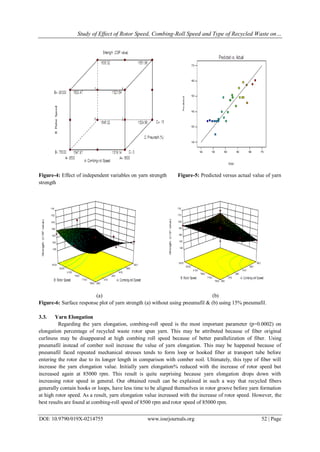
combing-roll speed and rotor speed have a significant effect on yarn strength (p<0.05). From figure-4 and 6, it is
clearly seen that yarn strength increased with the increase of rotor speed and with the presence of pneumafil in
mixing. The most important forces acting on the yarn inside the rotor is the centrifugal force [13]. However,
higher centrifugal force will be resulted at higher rotor speed that performs better consolidation of fibers which
in turn will lead to higher yarn strength. Response surface plots shown in fig-6(a), (b) indicate that pneumafil at
higher rotor speed improves the yarn strength. It may be due to better binding in belt fibers.
Yarn quality for the incidence of strength deteriorates at high combing roll speed. Fiber individualization and
trash removal% will be better with increasing speed but fiber breakages occur intensively simultaneously while
processing recycled spinning waste. Therefore, fiber damaging overweighs the effect of better individualization
and trash removal. As a result, lower yarn strength has been observed in higher combing-roll speed. The best
results are found at combing-roll speed of 8500 rpm and rotor speed of 85000 rpm.
Study of Effect of Rotor Speed, Combing-Roll Speed and Type of Recycled Waste on…
DOI: 10.9790/019X-0214755 www.iosrjournals.org 52 | Page
Figure-4: Effect of independent variables on yarn strength Figure-5: Predicted versus actual value of yarn
strength
(a) (b)
Figure-6: Surface response plot of yarn strength (a) without using pneumafil & (b) using 15% pneumafil.
3.3. Yarn Elongation
Regarding the yarn elongation, combing-roll speed is the most important parameter (p=0.0002) on
elongation percentage of recycled waste rotor spun yarn. This may be attributed because of fiber original
curliness may be disappeared at high combing roll speed because of better parallelization of fiber. Using
pneumafil instead of comber noil increase the value of yarn elongation. This may be happened because of
pneumafil faced repeated mechanical stresses tends to form loop or hooked fiber at transport tube before
entering the rotor due to its longer length in comparison with comber noil. Ultimately, this type of fiber will
increase the yarn elongation value. Initially yarn elongation% reduced with the increase of rotor speed but
increased again at 85000 rpm. This result is quite surprising because yarn elongation drops down with
increasing rotor speed in general. Our obtained result can be explained in such a way that recycled fibers
generally contain hooks or loops, have less time to be aligned themselves in rotor groove before yarn formation
at high rotor speed. As a result, yarn elongation value increased with the increase of rotor speed. However, the
best results are found at combing-roll speed of 8500 rpm and rotor speed of 85000 rpm.
Study of Effect of Rotor Speed, Combing-Roll Speed and Type of Recycled Waste on…
DOI: 10.9790/019X-0214755 www.iosrjournals.org 53 | Page
Figure-7: Effect of independent variables on yarn elongation Figure-8: Predicted versus actual value of
yarn elongation
(a) (b)
Figure-9: Surface response plot of yarn elongation (a) without using pneumafil & (b) using 15% pneumafil
3.4. End breakage rate
Economical running behavior can only be achieved by keeping in observation the effects of process
parameters on yarn properties and raw material [14]. End breakage is directly connected with the economical
running of a spinning frame. From ANOVA table-4, it is observed that combing-roll speed (p=0.0003) and rotor
speed (p=0.0526) are most significant factors for the incidence of ends down rate. Figure-10 reveals that ends
down rate increased with the increase of rotor speed as expected. It may be explained in such a way that trash
particles accumulated in rotor groove cannot taken away by the yarn due to better consolidation of fiber strand
resulted from higher centrifugal force at higher rotor speed. But using 15% pneumafil decreased the end
breakage rate almost 20% in case of spinning with rotor speed of 85000 rpm and combing-roll speed of 9500
rpm. Lower combing roller speed gives better results of ends down. Trash deposition in rotor groove will be
increased because of better individualization of fibers by higher combing-roll speed. As a result trash deposition
leads to end breakage. In case of end breakage rate rotor speed of 75000 rpm and combing roll speed of 8500
rpm and using pneumafil in mixing give best results undoubtedly.
Study of Effect of Rotor Speed, Combing-Roll Speed and Type of Recycled Waste on…
DOI: 10.9790/019X-0214755 www.iosrjournals.org 54 | Page
Figure-10: Effect of independent variables on yarn elongation Figure-11: Predicted versus actual value of
elongation
(a) (b)
Figure-12: Surface response plot of yarn end breakage (a) without using pneumafil & (b) using 15% pneumafil.
IV. Conclusion
The presented work demonstrated the dependency of rotor spun yarn quality and end breakage on
variations of rotor speed, combing-roll speed and pneumafil performances in rotor spun yarn produced from
recycled waste by using Response Surface Methodology (RSM) with face centered central composite design.
Keeping all other parameters the same, when pneumafil is used as recycled waste in mixing, yarn strength and
elongation percentage have been improved whereas yarn imperfections and end breakage rate have been
decreased mostly in the range of 5-25%. The negative impacts of rotor speed on yarn imperfections and end
breakage can be minimized by using 15% pneumafil wastes in mixing of blow room. However, rotor speed of
85000 rpm and combing-roll speed of 8500 rpm give better results in terms of yarn strength and elongation. The
best results in case of end breakage were found at lower rotor speed of 75000 rpm and combing-roll speed of
8500 rpm. Results from this study can provide some insight into the reuse of recycled spinning wastes fully in
mixing to produce rotor spun yarn on variations of rotor speed, combing-roll speed and type of recycled wastes.
The mixture of recycled spinning wastes and its effect on rotor yarn properties at different carding parameters
can be studied further.
References
[1]. A. R. Nityanand, “Waste investigation and control for a spinning mill”, The Indian Textile Journal, September (1984) Pp.79-86.
Study of Effect of Rotor Speed, Combing-Roll Speed and Type of Recycled Waste on…
DOI: 10.9790/019X-0214755 www.iosrjournals.org 55 | Page
[2]. Halimi Mohamed Taher, Ph.D., AzzouzBechir, Ph.D., “Ben Hassen Mohamed, Sakli Faouzi, Influence of Spinning Parameters and
Recovered Fibers from Cotton Waste on the Uniformity and Hairiness of Rotor Spun Yarn”, Journal of Engineered Fibers and
Fabrics, Volume 4, Issue 3 – 2009,pp-36-44
[3]. I. Hanafy, “Fabric from cotton waste”, The Indian Textile Journal, pp. 16–18, 1997.
[4]. Mohsen Shanbeh, Hossein Hasani, and Somayeh Akhavan Tabatabaei, “Modeling and Predicting the Breaking Strength and Mass
Irregularity of Cotton Rotor-Spun Yarns Containing Cotton Fiber Recovered from Ginning Process by Using Artificial Neural
Network Algorithm”, Modeling and Simulation in Engineering, Volume 2011 (2011), Article ID 591905, Hindawi Publishing
Corporation.
[5]. Youjiang Wang (Ed.), Recycling in textile, Page: 07 (Published by Woodhead Publishing Limited in association with the Textile
Institute, CRC press, LLC.)
[6]. Rameshkumar C.1, Anandkumar P.1 , Senthilnathan P.1, Jeevitha R.1 , Anbumani N.2, “COMPARITIVE STUDIES ON RING
ROTOR AND VORTEX YARN KNITTED FABRICS”, AUTEX Research Journal, December 2008, Vol. 8, No4, © AUTEX,pp-
100.
[7]. Bairagi N, “Recycling of Textiles in India”, J Textile Sci Eng., 2014, S2: 003. doi: 10.4172/2165-8064.S2-003.
[8]. M. Taher Halimia, M. Ben Hassena, B. Azzouza& F. Saklia, “Effect of cotton waste and spinning parameters on rotor yarn quality”,
Journal of the Textile Institute, Volume 98, Issue 5, 2007,pages 437-442 .
[9]. B. Wulfhorst, “The technological and economic aspects of the recycling of wastes in modern cotton mills”, Textile Praxis
International, 1984, August, pp741-743.
[10]. Pinar N. Duru and Osman Babaarslan, “Determining an Optimum Opening Roller Speed for Spinning Polyester/ Waste Blend Rotor
Yarns”, Textile Research Journal, October 2003; vol. 73, 10: pp. 907-911.
[11]. R. Senthil Kumar, Process management in spinning (CRC press, Taylor and Francis Group, LLC).
[12]. Farooq Ahmed Arain, AnwaruddinTanwari, TanveerHussain and Zulfiqar Ali Malik, “Multiple Response Optimization of Rotor
Yarn for Strength, Unevenness, Hairiness and Imperfections”, Fibers and Polymers 2012, Vol.13, No.1, 118-122.
[13]. P. Grosberg& S. A. Mansour, “Yarn Tension in Rotor-spinning”, Journal of the Textile Institute,1975,Volume 66, Issue 6,pages
228-231
[14]. F. Ahmed , S. Saleemi , A. W. Rajput , I. A. Shaikh ,A. R. Sahito ,“Characterization of Rotor Spun Knitting Yarn at High Rotor
Speeds”, Technical Journal, University of Engineering and Technology (UET) ,Taxila, Pakistan, 2014,Vol. 19 No IV.

Study of Effect of Rotor Speed, Combing-Roll Speed and Type of Recycled Waste on Rotor Yarn Quality Using Response Surface Methodology

  • 1.
    IOSR Journal ofPolymer and Textile Engineering (IOSR-JPTE) e-ISSN: 2348-019X, p-ISSN: 2348-0181, Volume 2, Issue 1 (Jan - Feb. 2015), PP 47-55 www.iosrjournals.org DOI: 10.9790/019X-0214755 www.iosrjournals.org 47 | Page Study of Effect of Rotor Speed, Combing-Roll Speed and Type of Recycled Waste on Rotor Yarn Quality Using Response Surface Methodology Md. Khalilur Rahman Khan1 , Habibur Rahman2 1, 2 (Department of Textile Engineering, Bangladesh University of Business and Technology, Bangladesh) Abstract: A three factors, three level for two factors, i.e. combing roll speed and rotor speed and pneumafil percentage as a categorical factor, face centered central composite design (CCD) was used and response surface methodology was applied to determine the interactions of selected independent variables on rotor spun yarn quality prepared by using 100% recycled spinning waste. The influence of these three independent variables on the four dependent responses, i.e. total imperfections, yarn CSP value, elongation% and end breakage rate was evaluated. Results indicate that rotor speed 85000 rpm and combing roll speed 8500 rpm gives best result in terms of yarn CSP value and elongation% of 16 Ne rotor spun yarn produced from 100% recycled spinning waste. Ends breakage increased drastically at increasing rotor speed and combing roll speed but it can be minimized by using pneumafil in recycled fiber mixing. In addition, yarn quality can be improved up to 5-25% by using 15% pneumafil instead of comber noil for any level of rotor speed and combing-roll speed. Keywords: combing-roll speed, recycled waste, response surface methodology, rotor speed, rotor spun yarn I. Introduction Cost of the raw materials has been increased in recent days as well as labor cost. Because of extreme competition in textile industry, it has been obligatory in textile industries to reduce the production cost by any means. It is reported that Raw material costs about 50-70% of the total cost of the product [1]. However; improving raw material exploitation has become the most important challenge facing scientific and industrial community [2]. In spite of the technical evolution for different blow room machines, generated wastes in cotton spinning mill contain a great rate of fibers [3]. Ultimately, all spinning waste has gained vast importance for spinner although modern machineries have been designed to produce yarn because all types of waste will increase the production cost undoubtedly. One of the main methods to reduce the production costs is waste recycling which is the most important challenge for the future [4]. It is reported that textiles are nearly 100% recyclable, nothing in the textile and apparel industry should be wasted [5]. Many open-end spinning methods have been invented, but none have been successful than rotor spinning [6]. Rotor spinning is considered as most suitable spinning principle in case of acceptable yarn production by using low grade cotton at relatively lower cost than any other existed spinning technology till now. In rotor spinning it is common to spin useful yarns from waste or by adding waste to the normal raw material. It is of interest to note that more and more waste spinning units are being installed. This indicates that profits are better in them, since the raw material, namely wastes from spinning mill, is relatively cheaper to give better returns [1]. Some researchers have been studied the reuse of recycled fibers [1-4, 7, 8-10]. It is also said that the speed of the rotor in connection with the speed of the combing roll which is called opening roller also has an effect on fiber configuration in the yarn [11]. It is also observed that some researchers have been studied the effect of rotor speed and combing roll speed on rotor yarn quality produced by using recycled waste as a blend composition [2,10,12]. But yet it is not observed that any research has been made on the investigation of combined effect of process parameters and type of recovered spinning wastes in rotor yarn production by using 100% recycled spinning wastes. Since recycled fibers have limitations in aspects of processing, so it can be said
  • 2.
    Study of Effectof Rotor Speed, Combing-Roll Speed and Type of Recycled Waste on… DOI: 10.9790/019X-0214755 www.iosrjournals.org 48 | Page that it is necessary to reach a compromise when setting the parameters of process those depend on mainly raw materials, desired yarn quality and machine running conditions. Design of Experiment (DOE) is widely used in the field of science and engineering to statistically signify the process parameters. Response Surface Methodology (RSM) with Central Composite Design is considered as one of the most prominently used DOE techniques during understanding the optimum input parameters to get best results of responses. Yarn imperfections, strength and elongation are considered as most important properties of rotor yarn in terms of quality aspects. On the other hand, end breakage rate is directly connected with production cost and it carries a great importance during spinning of rotor yarn using 100% recycled wastes. However, in this investigation, we have studied the combined effect of three independent variables, i.e. Combing roll speed, rotor speed and pnemafil percentage on four responses, i.e. rotor yarn imperfections (R1), strength (R2), elongation (R3) and end breakage rate (R4). The basic aim of this study was observing the interactive effects and suitability to reduce the negative effect of rotor speed and combing roll speed on yarn quality and productivity by using pneumafil. To conduct the tests using face centered central composite design three levels for combing roll speed (A) of 8500, 9000, 9500 rpm and rotor speed (B) of 75000, 80000, 85000 rpm respectively and two levels for pneumafil% (C), i.e. 0% and 15% have been used. II. Materials And Methods 2.1 Preparation Of Yarn Samples Various types of recycled spinning wastes have been used as raw materials of our investigation. All spinning wastes (flat strips 65%, noil 0% and 15%, filter waste 20%, pneumafil 15% and 0%) collected from different positions of ring spinning process have been used after recycling process except pneumafil that is not recycled but directly used. Recycled fibers are mixed manually and were processed in modern Rieter blow room line and Rieter C-60 carding machine. Carded slivers of 90 grain/yard were drawn on a Rieter RSB D-45 breaker draw frame and then RSB D-22 to produce finisher sliver of 85 grain/yard. Rieter BT 923 spinning frame (rotor diameter=41mm) has been used to produce 16 Ne yarn from finisher sliver of 100% recycled wastes with yarn twist of 21.33 per inch. In this study, comber noil has been used in place of pnemafil when pneumafil% was zero in mixing of recycled wastes as per design. All others processing parameters kept constant for all runs according to the design. The coded values for rotor speed are -1 (75000 rpm), 0 (80000 rpm), +1 (85000 rpm) and the coded values for combing-roll speed are -1 (8500 rpm), 0 (9000 rpm) and +1 (9500 rpm). Table-1: Results of dependent variables of 16 Ne rotor yarn Expt. No. Combing-roll speed (rpm) Rotor speed (rpm) Pneumafil% in blow room mixing Yarn imperfections (IPI value) Strength (CSP value) Elongation at break (%) Ends down/100 heads/hour 1 8500 80000 15 296.6 1661 6.77 12.8 2 8500 85000 15 326.5 1637 7.14 19.2 3 9000 80000 0 441.2 1496 5.89 26.5 4 9000 80000 0 414.5 1505 5.46 31.4 5 9500 85000 15 370 1672 6.21 23.7 6 9000 80000 15 320.5 1580 5.37 17.1 7 9500 80000 0 453.1 1509 5.02 39.05 8 9000 80000 0 445.2 1553 5.74 20.8 9 9000 80000 15 289.4 1542 6.29 22.06 10 9500 80000 15 308.6 1570 5.25 36.2 11 8500 80000 0 369.8 1544 6.15 18.8 12 9000 75000 15 327.4 1593 6.33 16.5 13 9500 75000 0 460 1521 5.34 27.2 14 9000 85000 15 315.5 1606 6.55 31.03 15 8500 75000 0 384 1560 6.25 17.2 16 8500 85000 0 423 1578 5.65 21.6 17 9000 80000 15 305.9 1624 6.12 25 18 9000 80000 15 319 1609 6.44 16.4 19 9500 85000 0 433 1486 5.19 34.3 20 9000 80000 0 371.5 1477 5.13 24.4
  • 3.
    Study of Effectof Rotor Speed, Combing-Roll Speed and Type of Recycled Waste on… DOI: 10.9790/019X-0214755 www.iosrjournals.org 49 | Page 21 9000 80000 0 365.7 1513 5.87 20.7 22 9500 75000 15 351 1522 5.54 26.6 23 9000 75000 0 385.1 1535 5.59 21.07 24 8500 75000 15 300.5 1623 7.2 14.9 25 9000 85000 0 403.3 1639 6.57 30.5 26 9000 80000 15 338 1619 6.41 19.9 2.2. Testing of yarn samples Yarn Imperfections (IPI) results have been tested by UT- 5 at testing speed 400m/min. Total IPI/1000m was calculated by adding Thin(-50%),Thick(+50%) and Neps (+280%) value. Single yarn strength and Elongation % were tested by MAG Elestretch. Average results of 10 samples produced for each experiment according to design have been calculated. The breakage rate was calculated by observing the number of yarn piecing immediately after breakage per 100 rotor heads per hour. III. Results And Discussion The experimental results of 16 Ne rotor yarn (Table-1) have been statistically evaluated by using the Design Expert software. Significant factors for yarn imperfections, strength, elongation and ends down rate have been given in ANOVA table 2,3,4,5 respectively. A p-value less than 0.05 was considered as statistically significant. Analysis of variance (ANOVA) for the responses indicated that the design model was significant and valid for each of the responses, i.e. imperfections (p=0.0002), strength (p=0.0065), elongation (p=0.005), ends down rate (p=0.03). The values of co-efficient of determination for the observed responses are 0.87, 0.77, 0.78, and 0.69 for yarn imperfections, strength, elongation and end breakage respectively. The predicted value versus actual value of selected responses R1, R2, R3 and R4 are given in figure-2, 5, 8 and 11 respectively. The terms A, B, C, AB, AC, BC, and ABC have been mentioned in ANOVA table. Response surface equations reflecting the quantitative influence of process variables and their interactions on yarn imperfections, strength, elongation and ends down rate in terms of actual factors are given as follows: R1 =+420.4-0.63A+0.06B-(6.6E-6) AB+ (6.7E-5) A2-(1.6E-8) B2 (1) R1=+4992.09885-(3.8E-3) A-0.12B-(7E-7) AB+ (5.3E-6) A2+ (8.06E-7) B2 (2) R2 = +4556.24+1.47A-0.24B-(5.3E-6) AB-(6.14E-5) A2+ (1.8E-6) B2 (3) R2=+17420.7-2.4A-0.13B + (1.4E-5) AB+ (6.9E-5) A2+ (5.8E-8) B2 (4) R3= +29.5 + 0.01A – (1.9E-3) B + (4.5E-8) AB–(9.8E-7) A2 + (9.9E-9) B2 (5) R3= +167.2 – (5.8E-3) A – (3.3E-3) B + (7.3E-8) AB – (8E-8) A2 + (1.6E-8) B2 (6) R4= +282.02 -0.14 A+ (6.8E-3) B+ (2.7E-7) AB+ (7.24E-6) A2–(5.3E-8) B2 (7) R4= -270.57-(7.28E-4) A+ (5.35E-3) B– (7.2E-7) AB + (4E-6) A2+ (1.03E-8) B2 (8) Equations 1,3,5,7 and 2,4,6,8 represent the response surface equations in terms of actual factor for mixing without using pneumafil and using pneumafil respectively.
  • 4.
    Study of Effectof Rotor Speed, Combing-Roll Speed and Type of Recycled Waste on… DOI: 10.9790/019X-0214755 www.iosrjournals.org 50 | Page Table-2: ANOVA for yarn imperfections (R1) Table-3: ANOVA for yarn strength (R2) Table-4: ANOVA for yarn elongation (R3) Table-5: ANOVA for end breakage (R4) 3.1. Yarn Imperfections The results of yarn quality in consideration of yarn imperfections shown in Fig- 1 are distinguishable. ANOVA table-2 reveals that, combing-roll speed and pneumafil percentage are significant factors in terms of 95% confidence level (p<0.05). Figure-1 shows that using pneumafil 15% instead of comber noil in recycled fiber mixing resulted in a significant decrease in the yarn imperfection for any level of rotor speed and comber- roll speed. It is believed in industry that pneumafil is the most valuable waste in spinning mill because of its length and cleanness. Comber noil contains more impurities than pneumafil undoubtedly. The presence of dust and trash is believed to contribute unfavorably to the measured yarn evenness, since a locally concentrated group of fiber will increase yarn imperfections. It is also seen in surface response plot (fig-3) that yarn imperfections have been increased with the increase of combing-roll speed irrespective of recycled waste type. This occurrence may be attributed due to impairment of fibers orientation in rotor groove during back-doubling process because of increasing damaged fibers at higher speed. Yarn imperfections initially reduce slightly with increasing rotor speed but markedly with further increase in speed. At higher speed, fibers get less time to be straightened that will be resulted in poor fiber orientation in rotor groove. Ultimately, yarn imperfections increased with the increase of rotor speed.
  • 5.
    Study of Effectof Rotor Speed, Combing-Roll Speed and Type of Recycled Waste on… DOI: 10.9790/019X-0214755 www.iosrjournals.org 51 | Page Figure-1: Effect of independent variables on yarn imperfections Figure-2: Predicted versus actual value of imperfections (a) (b) Figure-3: Surface response plot of yarn imperfections (a) without pneumafil & (b) using 15% pneumafil 3.2. Yarn Strength According to the results of ANOVA table for strength, the independent variables pneumafil%, combing-roll speed and rotor speed have a significant effect on yarn strength (p<0.05). From figure-4 and 6, it is clearly seen that yarn strength increased with the increase of rotor speed and with the presence of pneumafil in mixing. The most important forces acting on the yarn inside the rotor is the centrifugal force [13]. However, higher centrifugal force will be resulted at higher rotor speed that performs better consolidation of fibers which in turn will lead to higher yarn strength. Response surface plots shown in fig-6(a), (b) indicate that pneumafil at higher rotor speed improves the yarn strength. It may be due to better binding in belt fibers. Yarn quality for the incidence of strength deteriorates at high combing roll speed. Fiber individualization and trash removal% will be better with increasing speed but fiber breakages occur intensively simultaneously while processing recycled spinning waste. Therefore, fiber damaging overweighs the effect of better individualization and trash removal. As a result, lower yarn strength has been observed in higher combing-roll speed. The best results are found at combing-roll speed of 8500 rpm and rotor speed of 85000 rpm.
  • 6.
    Study of Effectof Rotor Speed, Combing-Roll Speed and Type of Recycled Waste on… DOI: 10.9790/019X-0214755 www.iosrjournals.org 52 | Page Figure-4: Effect of independent variables on yarn strength Figure-5: Predicted versus actual value of yarn strength (a) (b) Figure-6: Surface response plot of yarn strength (a) without using pneumafil & (b) using 15% pneumafil. 3.3. Yarn Elongation Regarding the yarn elongation, combing-roll speed is the most important parameter (p=0.0002) on elongation percentage of recycled waste rotor spun yarn. This may be attributed because of fiber original curliness may be disappeared at high combing roll speed because of better parallelization of fiber. Using pneumafil instead of comber noil increase the value of yarn elongation. This may be happened because of pneumafil faced repeated mechanical stresses tends to form loop or hooked fiber at transport tube before entering the rotor due to its longer length in comparison with comber noil. Ultimately, this type of fiber will increase the yarn elongation value. Initially yarn elongation% reduced with the increase of rotor speed but increased again at 85000 rpm. This result is quite surprising because yarn elongation drops down with increasing rotor speed in general. Our obtained result can be explained in such a way that recycled fibers generally contain hooks or loops, have less time to be aligned themselves in rotor groove before yarn formation at high rotor speed. As a result, yarn elongation value increased with the increase of rotor speed. However, the best results are found at combing-roll speed of 8500 rpm and rotor speed of 85000 rpm.
  • 7.
    Study of Effectof Rotor Speed, Combing-Roll Speed and Type of Recycled Waste on… DOI: 10.9790/019X-0214755 www.iosrjournals.org 53 | Page Figure-7: Effect of independent variables on yarn elongation Figure-8: Predicted versus actual value of yarn elongation (a) (b) Figure-9: Surface response plot of yarn elongation (a) without using pneumafil & (b) using 15% pneumafil 3.4. End breakage rate Economical running behavior can only be achieved by keeping in observation the effects of process parameters on yarn properties and raw material [14]. End breakage is directly connected with the economical running of a spinning frame. From ANOVA table-4, it is observed that combing-roll speed (p=0.0003) and rotor speed (p=0.0526) are most significant factors for the incidence of ends down rate. Figure-10 reveals that ends down rate increased with the increase of rotor speed as expected. It may be explained in such a way that trash particles accumulated in rotor groove cannot taken away by the yarn due to better consolidation of fiber strand resulted from higher centrifugal force at higher rotor speed. But using 15% pneumafil decreased the end breakage rate almost 20% in case of spinning with rotor speed of 85000 rpm and combing-roll speed of 9500 rpm. Lower combing roller speed gives better results of ends down. Trash deposition in rotor groove will be increased because of better individualization of fibers by higher combing-roll speed. As a result trash deposition leads to end breakage. In case of end breakage rate rotor speed of 75000 rpm and combing roll speed of 8500 rpm and using pneumafil in mixing give best results undoubtedly.
  • 8.
    Study of Effectof Rotor Speed, Combing-Roll Speed and Type of Recycled Waste on… DOI: 10.9790/019X-0214755 www.iosrjournals.org 54 | Page Figure-10: Effect of independent variables on yarn elongation Figure-11: Predicted versus actual value of elongation (a) (b) Figure-12: Surface response plot of yarn end breakage (a) without using pneumafil & (b) using 15% pneumafil. IV. Conclusion The presented work demonstrated the dependency of rotor spun yarn quality and end breakage on variations of rotor speed, combing-roll speed and pneumafil performances in rotor spun yarn produced from recycled waste by using Response Surface Methodology (RSM) with face centered central composite design. Keeping all other parameters the same, when pneumafil is used as recycled waste in mixing, yarn strength and elongation percentage have been improved whereas yarn imperfections and end breakage rate have been decreased mostly in the range of 5-25%. The negative impacts of rotor speed on yarn imperfections and end breakage can be minimized by using 15% pneumafil wastes in mixing of blow room. However, rotor speed of 85000 rpm and combing-roll speed of 8500 rpm give better results in terms of yarn strength and elongation. The best results in case of end breakage were found at lower rotor speed of 75000 rpm and combing-roll speed of 8500 rpm. Results from this study can provide some insight into the reuse of recycled spinning wastes fully in mixing to produce rotor spun yarn on variations of rotor speed, combing-roll speed and type of recycled wastes. The mixture of recycled spinning wastes and its effect on rotor yarn properties at different carding parameters can be studied further. References [1]. A. R. Nityanand, “Waste investigation and control for a spinning mill”, The Indian Textile Journal, September (1984) Pp.79-86.
  • 9.
    Study of Effectof Rotor Speed, Combing-Roll Speed and Type of Recycled Waste on… DOI: 10.9790/019X-0214755 www.iosrjournals.org 55 | Page [2]. Halimi Mohamed Taher, Ph.D., AzzouzBechir, Ph.D., “Ben Hassen Mohamed, Sakli Faouzi, Influence of Spinning Parameters and Recovered Fibers from Cotton Waste on the Uniformity and Hairiness of Rotor Spun Yarn”, Journal of Engineered Fibers and Fabrics, Volume 4, Issue 3 – 2009,pp-36-44 [3]. I. Hanafy, “Fabric from cotton waste”, The Indian Textile Journal, pp. 16–18, 1997. [4]. Mohsen Shanbeh, Hossein Hasani, and Somayeh Akhavan Tabatabaei, “Modeling and Predicting the Breaking Strength and Mass Irregularity of Cotton Rotor-Spun Yarns Containing Cotton Fiber Recovered from Ginning Process by Using Artificial Neural Network Algorithm”, Modeling and Simulation in Engineering, Volume 2011 (2011), Article ID 591905, Hindawi Publishing Corporation. [5]. Youjiang Wang (Ed.), Recycling in textile, Page: 07 (Published by Woodhead Publishing Limited in association with the Textile Institute, CRC press, LLC.) [6]. Rameshkumar C.1, Anandkumar P.1 , Senthilnathan P.1, Jeevitha R.1 , Anbumani N.2, “COMPARITIVE STUDIES ON RING ROTOR AND VORTEX YARN KNITTED FABRICS”, AUTEX Research Journal, December 2008, Vol. 8, No4, © AUTEX,pp- 100. [7]. Bairagi N, “Recycling of Textiles in India”, J Textile Sci Eng., 2014, S2: 003. doi: 10.4172/2165-8064.S2-003. [8]. M. Taher Halimia, M. Ben Hassena, B. Azzouza& F. Saklia, “Effect of cotton waste and spinning parameters on rotor yarn quality”, Journal of the Textile Institute, Volume 98, Issue 5, 2007,pages 437-442 . [9]. B. Wulfhorst, “The technological and economic aspects of the recycling of wastes in modern cotton mills”, Textile Praxis International, 1984, August, pp741-743. [10]. Pinar N. Duru and Osman Babaarslan, “Determining an Optimum Opening Roller Speed for Spinning Polyester/ Waste Blend Rotor Yarns”, Textile Research Journal, October 2003; vol. 73, 10: pp. 907-911. [11]. R. Senthil Kumar, Process management in spinning (CRC press, Taylor and Francis Group, LLC). [12]. Farooq Ahmed Arain, AnwaruddinTanwari, TanveerHussain and Zulfiqar Ali Malik, “Multiple Response Optimization of Rotor Yarn for Strength, Unevenness, Hairiness and Imperfections”, Fibers and Polymers 2012, Vol.13, No.1, 118-122. [13]. P. Grosberg& S. A. Mansour, “Yarn Tension in Rotor-spinning”, Journal of the Textile Institute,1975,Volume 66, Issue 6,pages 228-231 [14]. F. Ahmed , S. Saleemi , A. W. Rajput , I. A. Shaikh ,A. R. Sahito ,“Characterization of Rotor Spun Knitting Yarn at High Rotor Speeds”, Technical Journal, University of Engineering and Technology (UET) ,Taxila, Pakistan, 2014,Vol. 19 No IV.