Download to read offline
![IOSR Journal of Computer Engineering (IOSR-JCE)
e-ISSN: 2278-0661,p-ISSN: 2278-8727, Volume 17, Issue 6, Ver. II (Nov – Dec. 2015), PP 44-49
www.iosrjournals.org
DOI: 10.9790/0661-17624449 www.iosrjournals.org 44 | Page
Comparative Analysis of Computational Intelligence Paradigms
in WSN: Review
Sonal Chawla, Neetika Goswami
M.Tech Scholar, CSE Deptt., P.D.M. College of Engineering Bahadurgarh
M.Tech Scholar, CSE Deptt., P.D.M. College of Engineering Bahadurgarh
Abstract: Computational Intelligence is the study of the design of intelligent agents. An agent is something that
react according to an environment—it does something. Agents includes worms, dogs, thermostats, airplanes,
humans, and society. The purpose of computational intelligence is to understand the principles that make
intelligent behavior possible, in real or artificial systems. Techniques of Computational Intelligence are
designed to model the aspects of biological intelligence. These paradigms include that exhibit an ability to
learn or adapt to new situations,to generalize, abstract, learn and associate. This paper gives review of
comparison between computational intelligence paradigms in Wireless Sensor Network and Finally,a short
conclusion is provided.
Keywords: Computational Intelligence, Computational Intelligence Techniques, Swarm Intelligence ,Genetic
Algorithm, Artificial Neural Network.
I. Introduction
Computational Intelligence is a technique which is inspired from nature. It is used for complex
problem solutions.Computational Intelligence is used to make systems which can work in real time.
Computational intelligence is different from artificial intelligence. In artificial intelligence like robots, they are
used to do predefined things like they can place things from one place to another, opening or shutting of the
door etc. All such things are already inserted into the memory of the robot to perform all those tasks. Purpose of
CI is to introduce such intelligence in the system that it can take decisions like humans do, according to an
environment like they can select best solution from a set of available options.
Computational intelligence is defined as “The computational models and tools of intelligence, able of
inputting raw numerical sensory data directly, manage them by exploiting the representational parallelism and
pipelining the problem,generating authentic and timely responses and withstanding high fault liberality” [1].
CI has been a source of providing solutions in various fields. Computational Intelligence techniques
have been successfully employed in a wide range of application areas ,including decision support, genetic
clustering and classification, consumer electronic devices, stock market and other time-series
prediction,combinatorial optimization ,medical, bioinformatics problems and many others.
The rest of this paper is organized as given: Characterstics of Computational Intelligence in Section II.
Applications of Computational Intelligence is discussed in Section III. In Section IV A brief overview on
Computational Intelligence techniques.In Section V in which comparative analysis of computational intelligence
are given and last section VI concludes the work.
II. Characterstics Of CI
The characteristics of Computational Intelligence[2] with the following points:
Adaptation: As these systems are designed to work in real time and can react to different situations
accordingly like node failure or topology change. They are very adaptive so they can adjust to changing
situations
High Computational Speed: As these systems are working on real time so they must be very fast. For that
aim they have high computational speed so that they meet the requirement of real time applications.
Versatility: Versatility is another characteristic of CI. They are very adjustable and can handle highly non-
linear mappings without external help.
Robustness: It imposes little or no necessity on the objective function.
Self Organizing: Due to many reasons network topology gets changed. Self organization is the
characteristic which deals with this problem and also used in the initial stages of network deployment.
Self Learning: In self learning systems are given a set of instructions and rules. System then takes the input
from environment and then on the basis of that input processing is done. On the basis of that processed
information and given set of instructions, system gives output according to real time scenario but that
output was not fed into the memory of that system.](https://image.slidesharecdn.com/f017624449-160702094128/85/F017624449-1-320.jpg)
![Comparative Analysis of Computational Intelligence Paradigms in WSN: Review
DOI: 10.9790/0661-17624449 www.iosrjournals.org 45 | Page
III. Computational Intelligence Applications
CI‟s applications are diverse, including medical diagnosis, robots for hazardous environments, chess
playing, autonomous vehicles, natural language translation systems, and cooperative systems. Rather than
treating each application individually, we abstract important points of such applications to allow us to study
principles behind intelligent reasoning and action. The three application domains of computational intelligence
are:
Autonomous delivery robot: It can roam around a building delivering packages and coffee to people in the
building. This delivery agent requires to be skill to, for example, find paths, assign resources, receive
requests from people, make decisions about priorities, and supply of packages without injuring people or
itself.
Diagnostic assistant: Assistant helps a human troubleshoot problems and suggests repairs or treatments to
rectify the problems. An example is of a medical diagnostician that finds potential diseases, possible tests,
and appropriate treatments based on knowledge of a particular medical domain and a patient‟s symptoms
and history. This assistant needs to be able to explain its reasoning to the person who is carrying out the
tests and rebuilt, as that person is eventually supervise for what they do. The diagnostic assistant must
append valuable value in order to be worth using.
Infobot: One of the best application of computational intelligence can search for users such as company
managers or people off the street. In sequence to do this the infobot should find out, using the user‟s real
language, what data is requested, determine where to find out the information, and gain the information
from the appropriate sources. It then must explain its findings in an appropriate format so that the human
can understand the information found, including what they can infer from the lack of information.
IV. Computational Intelligence Paradigms
Computational Intelligence is the study of the design of intelligent agents. An intelligent agent is a
system that behave intelligently and what it does is appropriate for its circumstances and its goal,flexible to
changing environments and goals, gain from experience, and suitable choices given perceptual limitations and
finite computation.”[2].Better computer systems and improved performance of computational tasks such as
flexibility, adaptability, decentralization and fault tolerance are few important traits of CI.Paradigms of CI are
planned to model the aspects of biological intelligence. CI encompasses paradigms such as artificial neural
networks, reinforcement learning, swarm intelligence, evolutionary algorithms, fuzzy logic and artificial
immune systems.CI has been a source of producing solutions in various fields. Computational Intelligence
techniques have been successfully employed in a wide range of application areas ,including decision support,
genetic clustering and classification, consumer electronic devices, stock market and other time-series prediction,
combinatorial optimization ,medical, bioinformatics problems and many others.The CI paradigms address a
multidisciplinary, rich, and, diverse area of research in a number of applications in various fields. Such as WSN,
digital communications, RF and microwave communication, radars communication, signal processing,
acoustics, power, and lots more.
A. Artificial Neural Networks
Human brain is performing different tasks and working them faster than computers. Design of artificial
neural networks(ANN) is taken from brain‟s neural network. ANNs have abilities of learning, memorizing etc.
Huge numbers of nerve cells (neurons) combine to make a biological neural network. Axon, dendrites and cell
body creates up a neuron. Axon of one neuron join with dendrite of another neuron for communication. In same
way number of neurons gets interconnected. The connection between axon and dendrite is known as synapse.
Fig 1:Features of ANN
Signal moves from axon of one neuron to the dendrite of another neuron.Inside a neuron signal moves
from dendrite to body and then to axon and then axon passes that signal to all connected dendrites. “A signal is
transferred to the axon of a neuron only when the cell “fires”.
FEATURES OF ANN
Adaptive Learning
Self organization
Fault tolerant](https://image.slidesharecdn.com/f017624449-160702094128/85/F017624449-2-320.jpg)
![Comparative Analysis of Computational Intelligence Paradigms in WSN: Review
DOI: 10.9790/0661-17624449 www.iosrjournals.org 46 | Page
A neuron either can inhibit or excite a signal.” [3]. Artificial Neuron is raise on the basis of biological neuron. It
gathers the information from the environment or connected neurons and transmits the information to the
connected neurons only when it is fired. Neural Networks need very high processing and large memory. It
usually supply centralized solutions. Solutions are basically slow in speed. It usually provides centralized
solutions. It is good for data aggregation and fusion [4].Applications of Artificial Neural Network are Diagnosis
of diseases, Speech Recognition,Data mining,Image processing,Robot control,Pattern recognition and
Compression and many others.[5]
B. Genetic Algorithm
Inspired by Charles Darwin‟s theory of evolution: ‟the survival of the fittest”, Genetic Algorithm (GA)
was initiated formally by John Holland in 1970s [6]. GA is an adaptive heuristic search algorithm that models
biological genetic evolution. It displayed to be a robust optimizer that searches among a group of solutions, and
showed flexibility in solving dynamic problems.It has been successfully obtain to many NP-hard problems. The
main challenge in solving a problem with GA is the encoding of the problem into a set of chromosomes; each
representing a solution to the problem. The status of each chromosome is evaluated using a fitness function.
According to their fitness value, crossover 3 and mutation processes are applied on selected
chromosomes. The crossover process produces new solutions, called offspring,by interconnecting parts of two
selected chromosomes. Transmutation changes one or more genetic element in the produced offspring to prevent
being trapped in local minima.Applications of Genetic Algorithm are Data mining, Combinatorial
optimization,Fault diagnosis,Clustering and Scheduling.
Fig 2:Features of Genetic Algorithm
C. Fuzzy Logic
Fuzzy means vague, indistinct or difficult to perceive.Unlike Boolean where values are integer i.e. „1‟
or „0‟, where„1‟ represents true and „0‟ represents false, it (fuzzy) takes continuous values between „0‟ and „1‟.
In fuzzy systems „0‟ represents absolute wrong and „1‟ represents absolute correct and give continuous values
for other conditions.Let‟s take an example of fan, if we are using Boolean system then it would either TURN
ON or TURN OFF the fan,If it is tough or easy, if it is cold or hot. But if we use fuzzy system then it will set the
speed of fan from stop to slow, slow to medium and so on,depending on the value of temperature [6]. Fuzzy
logic is used in optimization, clustering heuristic and routing. The solutions it provides are not optimal. It is
good for security and QoS problems. It usually provides centralized solutions. It is good for data aggregation
and fusion [7].Applications of fuzzy logic are control systems,gear transmission,braking systems in vehicles,
controlling lifts,Home appliance and controlling traffic signals.
Fig 3:Features of Fuzzy Logic
D. Swarm Intelligence
Swarm intelligence is based on the study of swarms that how they live, communicate, forage for food
etc. They have no central control, no direct communication but still they manage to find shortest paths, find
FEATURES OF FUZZY
LOGIC
Put up system Nonlinearity
Deterministic
Performs best even with
small input
Accurate
FEATURES OF GENETIC
ALGORITHM
Solutions to optimization and
search problems.
Good global solutions](https://image.slidesharecdn.com/f017624449-160702094128/85/F017624449-3-320.jpg)
![Comparative Analysis of Computational Intelligence Paradigms in WSN: Review
DOI: 10.9790/0661-17624449 www.iosrjournals.org 47 | Page
foods and manage their resources well. Swarm introduce the large no of insects or other small organized entities,
esp. when they are in motion. Global intelligent behavior to which the individuals are entirely unknown is
emerged due to the local, self-organized and decentralized interaction of swarm‟s agents.
Fig 4:Features of Swarm Intelligence
Swarm intelligence (SI) is one of the aspiring solutions from bioinspired computing for such heuristic
optimization problems e.g. routing Natural examples of SI include ant colony, bird flocking, animal herding,
bacterial growth, fish schooling, drop water, fireflies etc. Examples algorithms under the head of SI are Ant
Colony Optimization (ACO), Particle Swarm Optimization (PSO), Gravitational Search Algorithm (GSA),
Intelligent Water Drop (IWD), Charged System Search (CSS) and Stochastic Diffusion Search (SDS) etc.Swarm
intelligence gives effective solutions for routing in the ad-hoc networks.It consumes vast amount of energy on
communication when it send to ants for route discovery. Applications of Swarm Intelligence are Function
approximation, Clustering, Optimization of Mechanical structures, Solving systems of Equations, Routing
optimization and Graph Coloring.
Partial Swarm Optimization: Particle Swarm Optimization (PSO) was developed in 1995 by James
Kennedy, and Russell Eberhart . PSO is a robust stochastic nonlinear- optimization technique based on
movement and intelligence of swarms.It is stimulate from social behavior of bird or fish, where a group of
birds search for food in an area by following the nearest bird to the food. It merge local search methods
with global search methods depending on social interaction between particles to locate the best achieved
position so far. PSO and GA are very similar. Both are population based stochastic optimization that starts
with a group of a randomly generated population. They have fitness values to evaluate their population, and
update the population and search for the optimum with random techniques. However, PSO differs from GA
in that there is no crossover and mutation. PSO particles do not die.They update themselves with the
internal velocity. Finally, the information sharing mechanism in PSO is significantly different. Each particle
is treated as a point in a multi-dimensional space, and modifies its position influenced by two components:
the cognitive component and the social component resulting from neighbor communication.
E. Artificial Immune System
Artificial immune system is basically inspired from natural or real immune system and it models some
aspects of artificial immune system. Natural immune system (NIS) is having a great pattern matching ability. It
is used to differentiate between foreign cells entering the body (antigen or non-self) and the cells belonging to
the body (self). NIS fights the antigens and memorizes their structure for faster future response if they try again
to enter the body. The four models of natural immune system are Classic view, clonal selection theory, danger
theory and network theory. Artificial immune system is use to give security, fault detection, optimization and
abnormality detection.
Immune network models: Immune network models are based on the hypothesis that the immune system
uses an idiotypic network of interconnected B cells - a component of the adaptive immune system - for
antigen recognition. The power of interconnection between two B cells is directly proportional to the
affinity they share. A B cell population has two kinds of sub-populations: the initial population and the
cloned population. The initial subset is produced from raw training data, and the rest are used for antigen
training items. Antigens are randomly choosed from training set and presented to areas of the B cell
network.
In case of successful binding, the B cell is cloned and mutated, leading to a diverse set of antibodies.
When a new B cell is produced, it is added into the network at the closest B cells. If the new cell cannot be
added, it is deleted from the population. If all binds fail, a B cell is produced using the antigen as a template and
is then included into the network.Applications of Artificial Immune System are Pattern Recognition problems,
Classification, Clustering, Anamoly Detection,Computer virus Detection.[8]
FEATURES OF SWARM
INTELLIGENCE
Distributiveapproach
Self organization
Decentralized control
Powerful
optimization tool](https://image.slidesharecdn.com/f017624449-160702094128/85/F017624449-4-320.jpg)
![Comparative Analysis of Computational Intelligence Paradigms in WSN: Review
DOI: 10.9790/0661-17624449 www.iosrjournals.org 49 | Page
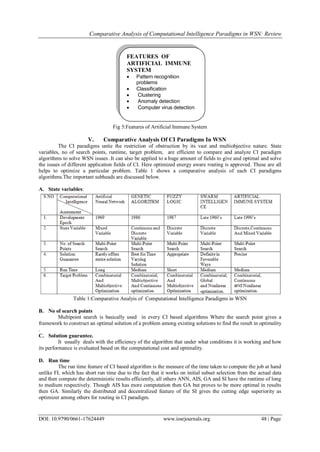
E. Target problem
There are optimization problems the Computational Intelligence focused as combinatorial optimization,
multi-objective optimization, continuous optimization, nonlinear optimization and global optimization. Each
paradigm in Table 1 shows a variation of optimization problems. A continuous optimization and combinatorial
optimization problem varies in respect to their feasibility of available solutions by maximizing and minimizing
of continuous and discrete function values respectively i.e. in continuous optimization an infinite feasible
solutions are available for selection of an
optimal solution, and in combinatorial optimization an optimal solution is selected from a finite number
of solutions .Multiobjective optimization problems deals with the multitudes objectives, which are to be
optimized simultaneously or a trade off exists between the multiple objectives for an optimal solutions.
Nonlinear optimization problems are used to optimize the problems of non linear objective functions. Similarly
the global optimization is responsible for the problems of certain criteria which need to be optimized.
VI. Conclusion
This paper represents the concept of computational intelligence and various applications are given. All
the computational intelligence paradigms are useful in various areas and every day paradigms are modified for
future use. Basically, In this paper we show the comparative analysis of Computational Intelligence techniques
in Wireless Sensor Network to solve the WSN issues. This review paper gives idea about basic computational
intelligence paradigms and comparative analaysis of CI techniques in WSN.
References:
[1] A.konar, computational intelligence: principles, techniques and applications. Springer, 2005.
[2] Anastasi, G., Conti, M., Francesco, D.M, Passarella. A, “Energy Conservation in WSNs: a Survey”, Elsevier Science Publishers
AdHoc Networks, vol.7, No.3 pp. 537-568, May 2009.
[3] P. Stone, M. Veloso, “Team-partitioned, opaque-transition reinforcement learning,” in Proc. 3rd Annual Conf. Autonomous Agents.
[4] Dressler, Self-Organization in Sensor and Actor Networks, John Wiley & Sons, 2007.
[5] P. Stone, M. Veloso, “Team-partitioned, opaque-transition reinforcement learning,” in Proc. 3rd Annual Conf. Autonomous Agents
(AGENTS). Newyork, USA.
[6] Basma Solaiman and Alaa Sheta. Computational Intelligence for Wireless Sensor Networks: Applications and Clustering
Algorithms. ” International Journal of Computer Applications (0975 8887)”:Volume 73 - No. 15, July 2013.
[7] http://www.csee.wvu.edu/classes/cpe521/presentations/System.pdf.
[8] Sajjad Hussain Shah, Kashif Naseer, Wajid Ali, Sohail Jabbar, Abid Ali Minhas. Prolonging the Network Life Time in WSN
through Computational Intelligence: Proceedings of the World Congress on Engineering and Computer Science 2011 Vol I WCECS
2011, October 19-21, 2011, San Francisco, USA.](https://image.slidesharecdn.com/f017624449-160702094128/85/F017624449-6-320.jpg)

This document provides a review of computational intelligence paradigms in wireless sensor networks. It begins with an introduction to computational intelligence and its characteristics such as adaptation, high computational speed, versatility, robustness, self-organization, and self-learning. Various applications of computational intelligence are discussed including autonomous delivery robots, diagnostic assistants, and infobots. Key computational intelligence paradigms like artificial neural networks, genetic algorithms, fuzzy logic, swarm intelligence, and artificial immune systems are described and compared. The document concludes with a table comparing the state variables and number of search points used in different computational intelligence algorithms.


