GUT-BRAIN
CROSSTALK
:THE KEY
PLAYERS
Dr. Aratrika Sen
Senior Resident
Murshidabad Medical College &
Hospital
INTRODUCTION
■ Bi-directional link
between CNS and
Enteric Nervous
System. [ENS]
■ Complex cross talk
between Endocrine
[HPA axis], Immune
[Cytokines,
Chemokines] and
Nervous System.
[ANS]
■ Microbiome plays a
pivotal role.
THE GUT
MICROBIOME
■ MICROBIOTA:
Microbe population within a specific ecosystem
of Host [Skin, oral, nasal, Gut, Genito-urinary].
Gut contains 1013 – 1014 microbiota
approximately.
10 times more than other cells of the human
body.
FERMICUTES & BACTEROIDES: comprises
75% of gut microbiota.
Disruption of Gut Microbiota: associated with
Allergy, Autoimmune Disorders, Metabolic
Disorders, Neurodegenerative Disorders,
Psychiatric Disorders.
THE GUT MICROBIOME CONTD.
■ MICROBIOME:
Collective Genetic material of all Microbiota residing on Host.
150 times> than Human Genome
Aptly called as Superorganisms.
Human Microbiome Project: Exploring symbiosis of
microbiome with host genome.
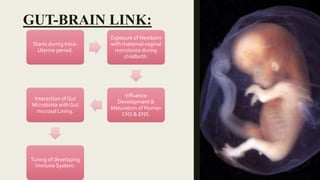
GUT-BRAIN LINK:
Starts during Intra-
Uterine period.
Exposure of Newborn
with maternal vaginal
microbiota during
childbirth.
Influence
Development &
Maturation of Human
CNS & ENS.
Interaction of Gut
Microbiota with Gut
mucosal Lining.
Tuning of developing
Immune System.
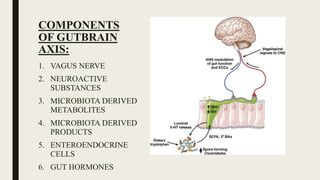
COMPONENTS
OF GUTBRAIN
AXIS:
1. VAGUS NERVE
2. NEUROACTIVE
SUBSTANCES
3. MICROBIOTA DERIVED
METABOLITES
4. MICROBIOTA DERIVED
PRODUCTS
5. ENTEROENDOCRINE
CELLS
6. GUT HORMONES
COMPONENTS
OF GUT BRAIN
AXIS CONTD.
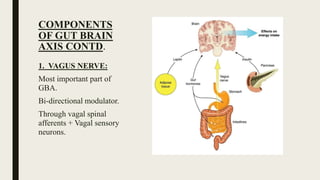
1. VAGUS NERVE:
Most important part of
GBA.
Bi-directional modulator.
Through vagal spinal
afferents + Vagal sensory
neurons.
DESCENDING
LIMBIC
PROJECTION
INTESTINE
BRAIN STEMTHALAMUS
HYPOTHALAMUS
[REGULATION OF
FOOD, HUNGER,
SATIETY.]
LIMBIC SYSTEM
[EMOTION,
MEMORY]
COMPONENTS OF
GUT BRAIN AXIS
CONTD.
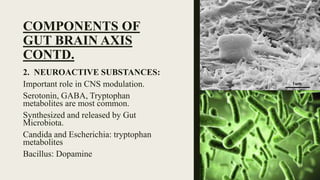
2. NEUROACTIVE SUBSTANCES:
Important role in CNS modulation.
Serotonin, GABA, Tryptophan
metabolites are most common.
Synthesized and released by Gut
Microbiota.
Candida and Escherichia: tryptophan
metabolites
Bacillus: Dopamine
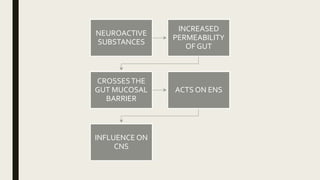
NEUROACTIVE
SUBSTANCES
INCREASED
PERMEABILITY
OF GUT
CROSSESTHE
GUT MUCOSAL
BARRIER
ACTS ON ENS
INFLUENCE ON
CNS
COMPONENTS OF GUT BRAIN AXIS
CONTD.
3. MICROBIOTA DERIVED METABOLITES
Significantly modify CNS Neuronal function & Fear
extinction Learning.
Mainly two metabolites:
1. Short Chain Fatty Acid.
2. Tryptophan Metabolite.
■ SHORT CHAIN FATTY ACID
[SCFA]:
Through decomposition of fermentable
carbohydrate by gut microbiota.
Acetate, Propionate, Butyrate
Important role in Glucose Homeostasis,
reduction of Food intake, modulation of
lymphocytic function.
Through G-protein Coupled Receptor.
[GPCR]/ Epigenetic Modulator of Histone
Deacetylase.
Expressed in GUT, Muscle, Liver,
Pancreas, Adipocytes.
■ TRYPTOPHAN METABOLITES:
Extensive role in cell cycles, mucosal barrier and immune
regulation.
Lactobacillus: Commonly identified to provide Indole
derivatives.
Person devoid of Tryptophan, catabolizing microbiota:
susceptible to colitis.
• TRYPTOPHAN
TRYPTOPHAN
MONO OXYGENASE
• INDOLE-3-
ACETAMIDE
INDOLE-3-
ACETAMIDE
HYDROLASE • INDOLE-3-
ACETIC ACID
INDOLE-3-ACETIC
ACID
DECARBOXYLASE
• 3-METHYL
INDOLE
ACTIVATE ARYL-
HYDROCARBON
RECEPTOR [AHR]
COMPONENTS OF GUT BRAIN AXIS
CONTD.
4. MICROBIOTA DERIVED PRODUCTS:
4 products:
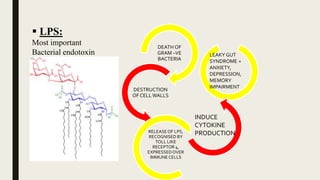
1. LIPOPOLYSACCHARIDE [LPS]
2. LPS BINDING PROTEIN
3. PEPTIDOGLYCAN
4. FLAGELLIN
DEATH OF
GRAM –VE
BACTERIA
DESTRUCTION
OF CELL WALLS
RELEASEOF LPS,
RECOGNISED BY
TOLL LIKE
RECEPTOR 4,
EXPRESSEDOVER
IMMUNECELLS
INDUCE
CYTOKINE
PRODUCTION
LEAKY GUT
SYNDROME +
ANXIETY,
DEPRESSION,
MEMORY
IMPAIRMENT
 LPS:
Most important
Bacterial endotoxin
COMPONENTS OF GUT BRAIN AXIS
CONTD.
5. ENTERO-ENDOCRINE CELLS
[EEC]
Represent only 1% of the epithelial
cells.
Scattered throughout the GI tract.
Release a variety of Gut Hormones in
response to diet related stimuli.
Prime importance in Gut motility,
Hormone release, appetite and
digestion.
COMPONENTS OF GUT
BRAIN AXIS CONTD.
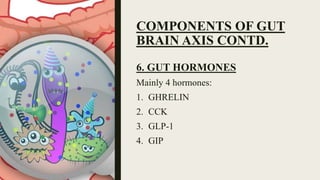
6. GUT HORMONES
Mainly 4 hormones:
1. GHRELIN
2. CCK
3. GLP-1
4. GIP
■ GHRELIN
Released from proximal A cells of stomach.
During food restriction.
FOOD
RESTRICTION/FASTI
NG, INCREASED
GHRELIN
RECEPTORON
VAGALAFFERENT
AND NODOSE
GANGLION
SIGNALSTO BRAIN
DIRECTLY CROSS
BBB
HYPOTHALAMUS
[FOOD
REGULATORY
CENTRE]
INDUCES FOOD
INTAKE, PROMOTE
MEMORY
REGULATION
BINDTO GROWTH
HORMONE
■ CCK
Also called
cholecystokinin.
Stimulates
digestion of Fat &
Protein.
Through G-PCR:
CCK-A and CCK-B
[Gut & Brain]
■ GLP—1
[GLUCAGON LIKE
PEPTIDE]
Released from L cells
along with PYY [Peptide
YY]: mostly from Ileum
and Colon
Inhibitory effect on energy
intake, promotes satiety.
Widely distributed: Gut,
Kidney, Pancreas, Vagus
Nerve, Hypothalamus.
GLP-1 agonist: help to
treat DM.
■ GIP [GLUCOSE
DEPENDENT
INSULINOTROPI
C
POLYPEPTIDE]
Released from K cells
of Duodenum &
Jejunum
Promote Insulin
release
Maintain Glucose
Homeostasis.
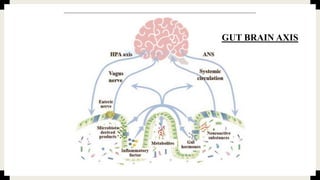
GUT BRAIN AXIS
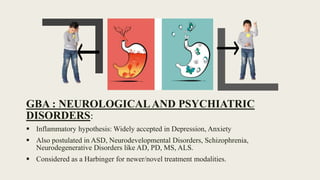
GBA : NEUROLOGICALAND PSYCHIATRIC
DISORDERS:
 Inflammatory hypothesis: Widely accepted in Depression, Anxiety
 Also postulated in ASD, Neurodevelopmental Disorders, Schizophrenia,
Neurodegenerative Disorders like AD, PD, MS, ALS.
 Considered as a Harbinger for newer/novel treatment modalities.
Gutbrain cross talk

Gutbrain cross talk

  • 1.
    GUT-BRAIN CROSSTALK :THE KEY PLAYERS Dr. AratrikaSen Senior Resident Murshidabad Medical College & Hospital
  • 2.
    INTRODUCTION ■ Bi-directional link betweenCNS and Enteric Nervous System. [ENS] ■ Complex cross talk between Endocrine [HPA axis], Immune [Cytokines, Chemokines] and Nervous System. [ANS] ■ Microbiome plays a pivotal role.
  • 3.
    THE GUT MICROBIOME ■ MICROBIOTA: Microbepopulation within a specific ecosystem of Host [Skin, oral, nasal, Gut, Genito-urinary]. Gut contains 1013 – 1014 microbiota approximately. 10 times more than other cells of the human body. FERMICUTES & BACTEROIDES: comprises 75% of gut microbiota. Disruption of Gut Microbiota: associated with Allergy, Autoimmune Disorders, Metabolic Disorders, Neurodegenerative Disorders, Psychiatric Disorders.
  • 4.
    THE GUT MICROBIOMECONTD. ■ MICROBIOME: Collective Genetic material of all Microbiota residing on Host. 150 times> than Human Genome Aptly called as Superorganisms. Human Microbiome Project: Exploring symbiosis of microbiome with host genome.
  • 5.
    GUT-BRAIN LINK: Starts duringIntra- Uterine period. Exposure of Newborn with maternal vaginal microbiota during childbirth. Influence Development & Maturation of Human CNS & ENS. Interaction of Gut Microbiota with Gut mucosal Lining. Tuning of developing Immune System.
  • 6.
    COMPONENTS OF GUTBRAIN AXIS: 1. VAGUSNERVE 2. NEUROACTIVE SUBSTANCES 3. MICROBIOTA DERIVED METABOLITES 4. MICROBIOTA DERIVED PRODUCTS 5. ENTEROENDOCRINE CELLS 6. GUT HORMONES
  • 7.
    COMPONENTS OF GUT BRAIN AXISCONTD. 1. VAGUS NERVE: Most important part of GBA. Bi-directional modulator. Through vagal spinal afferents + Vagal sensory neurons.
  • 8.
  • 9.
    COMPONENTS OF GUT BRAINAXIS CONTD. 2. NEUROACTIVE SUBSTANCES: Important role in CNS modulation. Serotonin, GABA, Tryptophan metabolites are most common. Synthesized and released by Gut Microbiota. Candida and Escherichia: tryptophan metabolites Bacillus: Dopamine
  • 10.
  • 11.
    COMPONENTS OF GUTBRAIN AXIS CONTD. 3. MICROBIOTA DERIVED METABOLITES Significantly modify CNS Neuronal function & Fear extinction Learning. Mainly two metabolites: 1. Short Chain Fatty Acid. 2. Tryptophan Metabolite.
  • 12.
    ■ SHORT CHAINFATTY ACID [SCFA]: Through decomposition of fermentable carbohydrate by gut microbiota. Acetate, Propionate, Butyrate Important role in Glucose Homeostasis, reduction of Food intake, modulation of lymphocytic function. Through G-protein Coupled Receptor. [GPCR]/ Epigenetic Modulator of Histone Deacetylase. Expressed in GUT, Muscle, Liver, Pancreas, Adipocytes.
  • 13.
    ■ TRYPTOPHAN METABOLITES: Extensiverole in cell cycles, mucosal barrier and immune regulation. Lactobacillus: Commonly identified to provide Indole derivatives. Person devoid of Tryptophan, catabolizing microbiota: susceptible to colitis.
  • 14.
    • TRYPTOPHAN TRYPTOPHAN MONO OXYGENASE •INDOLE-3- ACETAMIDE INDOLE-3- ACETAMIDE HYDROLASE • INDOLE-3- ACETIC ACID INDOLE-3-ACETIC ACID DECARBOXYLASE • 3-METHYL INDOLE ACTIVATE ARYL- HYDROCARBON RECEPTOR [AHR]
  • 15.
    COMPONENTS OF GUTBRAIN AXIS CONTD. 4. MICROBIOTA DERIVED PRODUCTS: 4 products: 1. LIPOPOLYSACCHARIDE [LPS] 2. LPS BINDING PROTEIN 3. PEPTIDOGLYCAN 4. FLAGELLIN
  • 16.
    DEATH OF GRAM –VE BACTERIA DESTRUCTION OFCELL WALLS RELEASEOF LPS, RECOGNISED BY TOLL LIKE RECEPTOR 4, EXPRESSEDOVER IMMUNECELLS INDUCE CYTOKINE PRODUCTION LEAKY GUT SYNDROME + ANXIETY, DEPRESSION, MEMORY IMPAIRMENT  LPS: Most important Bacterial endotoxin
  • 17.
    COMPONENTS OF GUTBRAIN AXIS CONTD. 5. ENTERO-ENDOCRINE CELLS [EEC] Represent only 1% of the epithelial cells. Scattered throughout the GI tract. Release a variety of Gut Hormones in response to diet related stimuli. Prime importance in Gut motility, Hormone release, appetite and digestion.
  • 18.
    COMPONENTS OF GUT BRAINAXIS CONTD. 6. GUT HORMONES Mainly 4 hormones: 1. GHRELIN 2. CCK 3. GLP-1 4. GIP
  • 19.
    ■ GHRELIN Released fromproximal A cells of stomach. During food restriction. FOOD RESTRICTION/FASTI NG, INCREASED GHRELIN RECEPTORON VAGALAFFERENT AND NODOSE GANGLION SIGNALSTO BRAIN DIRECTLY CROSS BBB HYPOTHALAMUS [FOOD REGULATORY CENTRE] INDUCES FOOD INTAKE, PROMOTE MEMORY REGULATION BINDTO GROWTH HORMONE
  • 20.
    ■ CCK Also called cholecystokinin. Stimulates digestionof Fat & Protein. Through G-PCR: CCK-A and CCK-B [Gut & Brain]
  • 21.
    ■ GLP—1 [GLUCAGON LIKE PEPTIDE] Releasedfrom L cells along with PYY [Peptide YY]: mostly from Ileum and Colon Inhibitory effect on energy intake, promotes satiety. Widely distributed: Gut, Kidney, Pancreas, Vagus Nerve, Hypothalamus. GLP-1 agonist: help to treat DM.
  • 22.
    ■ GIP [GLUCOSE DEPENDENT INSULINOTROPI C POLYPEPTIDE] Releasedfrom K cells of Duodenum & Jejunum Promote Insulin release Maintain Glucose Homeostasis.
  • 23.
  • 24.
    GBA : NEUROLOGICALANDPSYCHIATRIC DISORDERS:  Inflammatory hypothesis: Widely accepted in Depression, Anxiety  Also postulated in ASD, Neurodevelopmental Disorders, Schizophrenia, Neurodegenerative Disorders like AD, PD, MS, ALS.  Considered as a Harbinger for newer/novel treatment modalities.