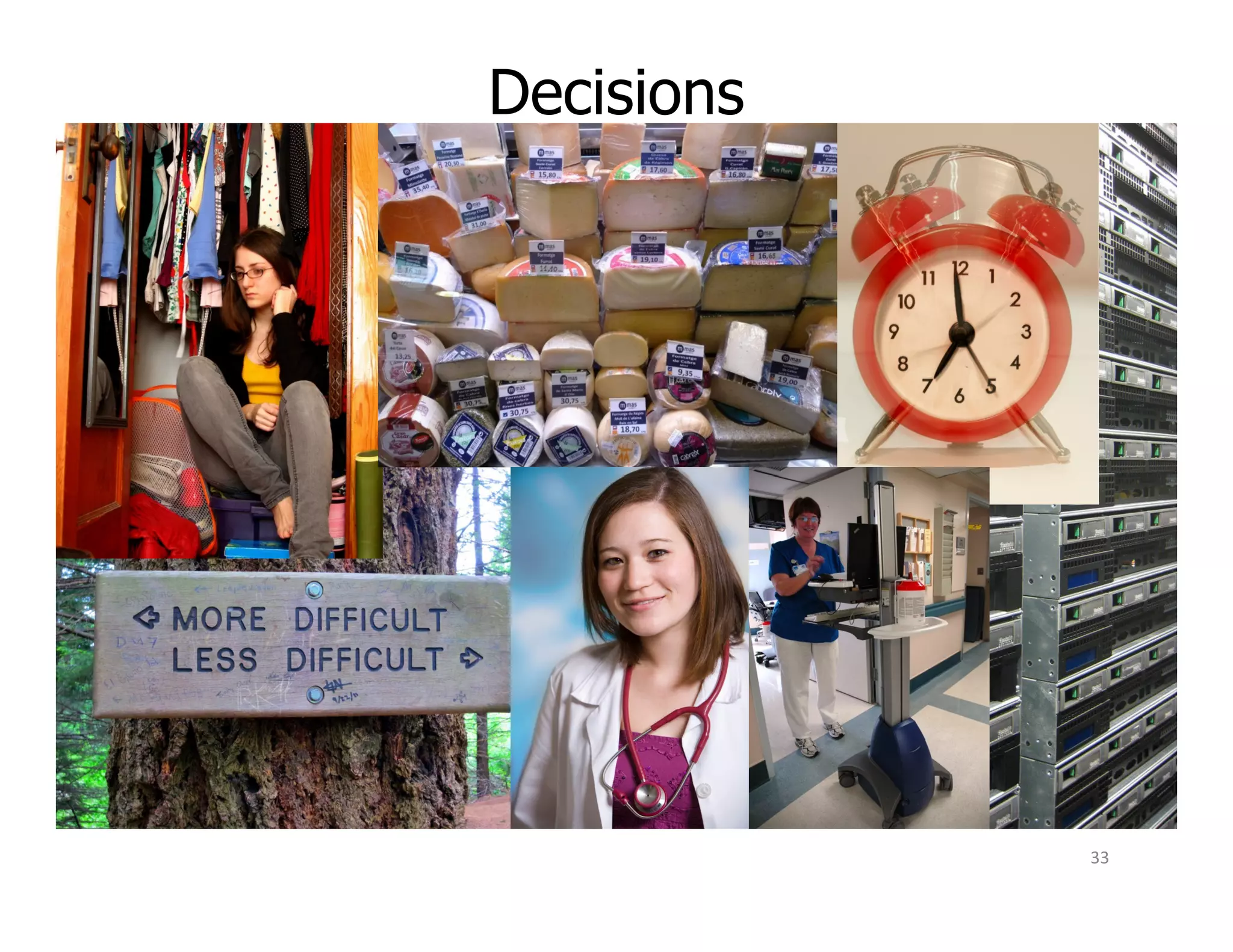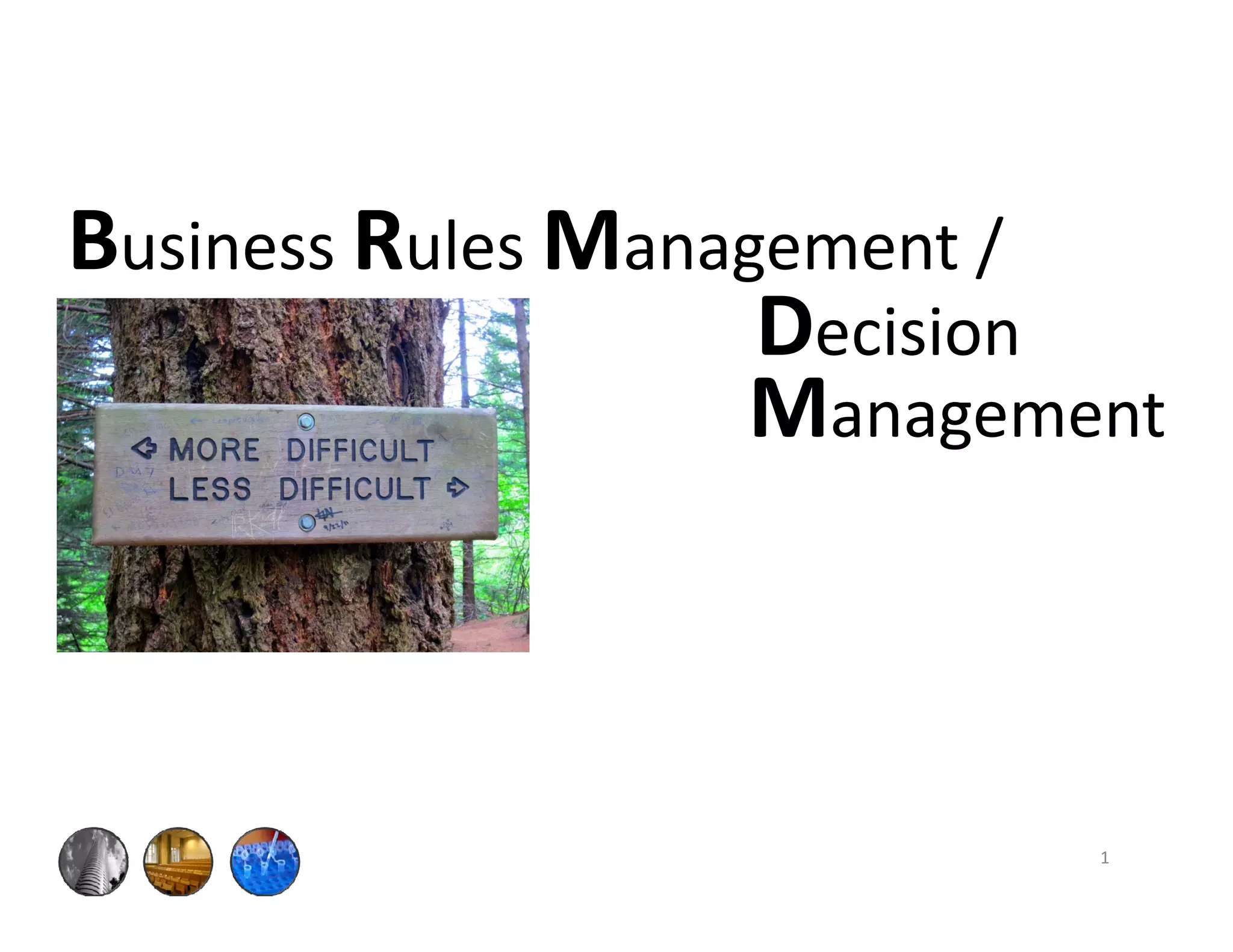


Decision
Management
Business Rules Management /
1
“Working together to develop and spread new insights
and solutions for practical problems.“
martijnzoet@gmail.com
(mzoet)
2
Last week
Common Mitsakes (1/3)Common Mitsakes (1/3)
“If you’re not making mistakes, then you’re not doing anything.” ~ John Wooden
What is a rule?
5
How much is the
small blind?
Which player
has to post the
small blind?
What is a rule?
6
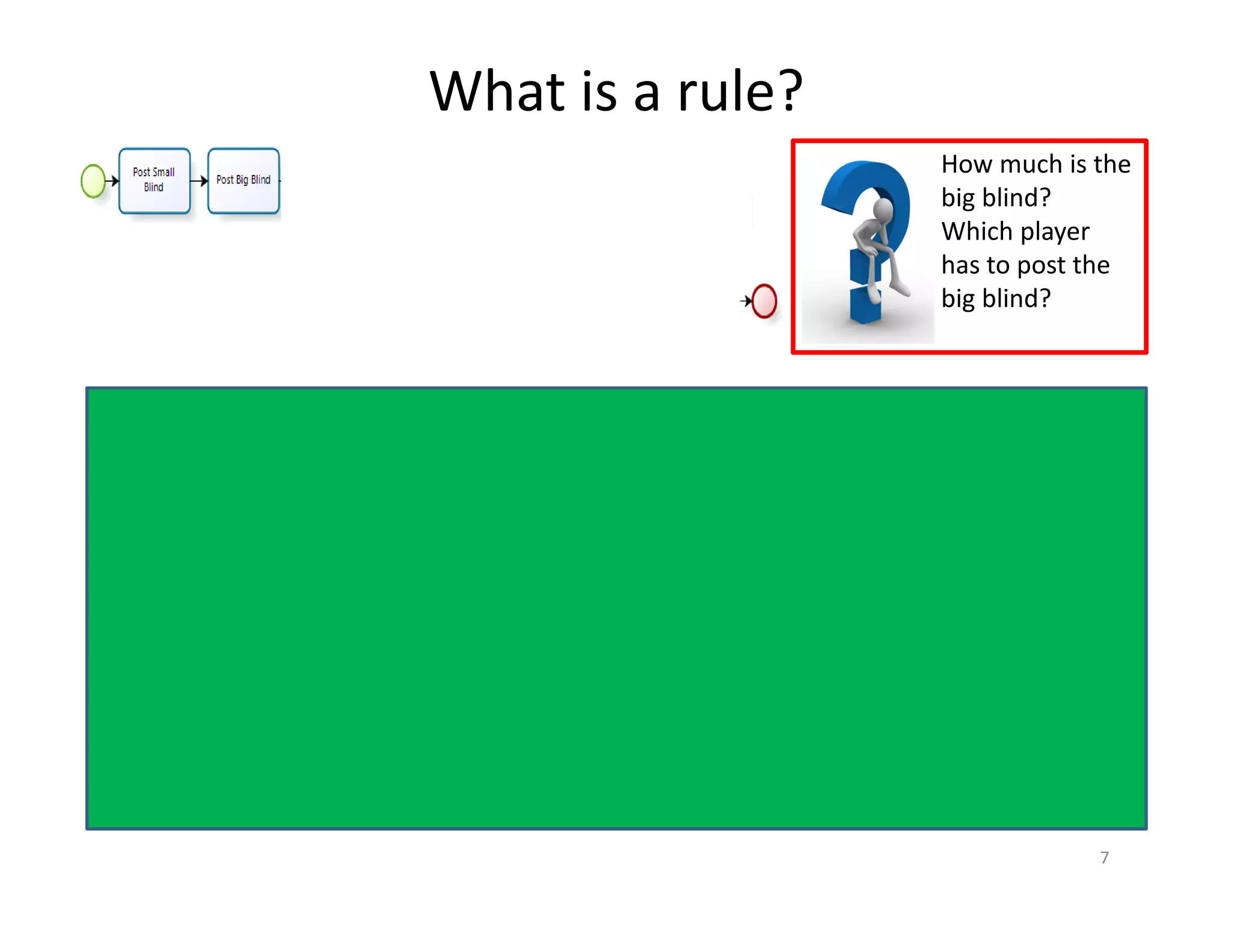
How much is the
big blind?
Which player
has to post the
big blind?
What is a rule?
7
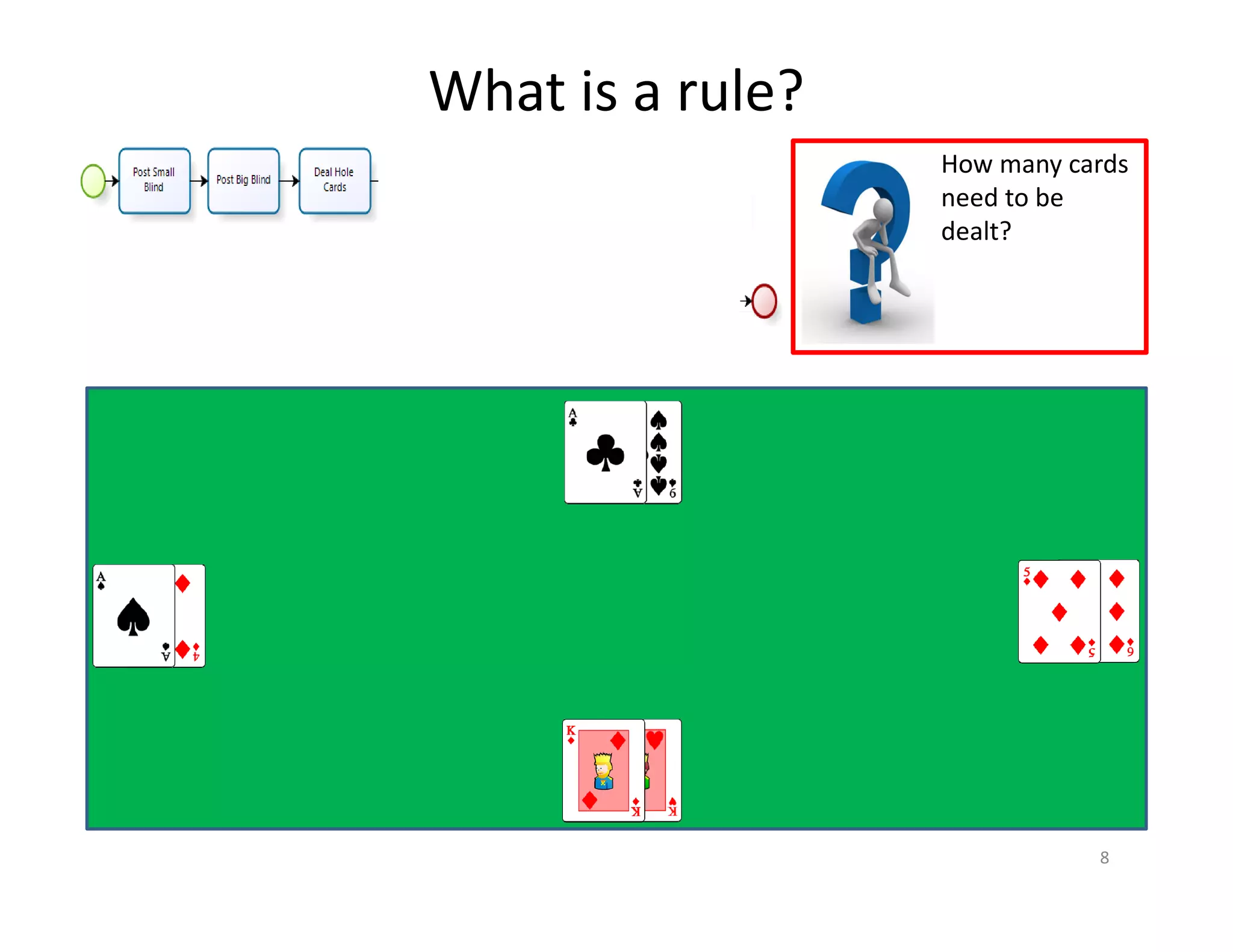
How many cards
need to be
dealt?
What is a rule?
8
The order of
activities?
What is a rule?
9
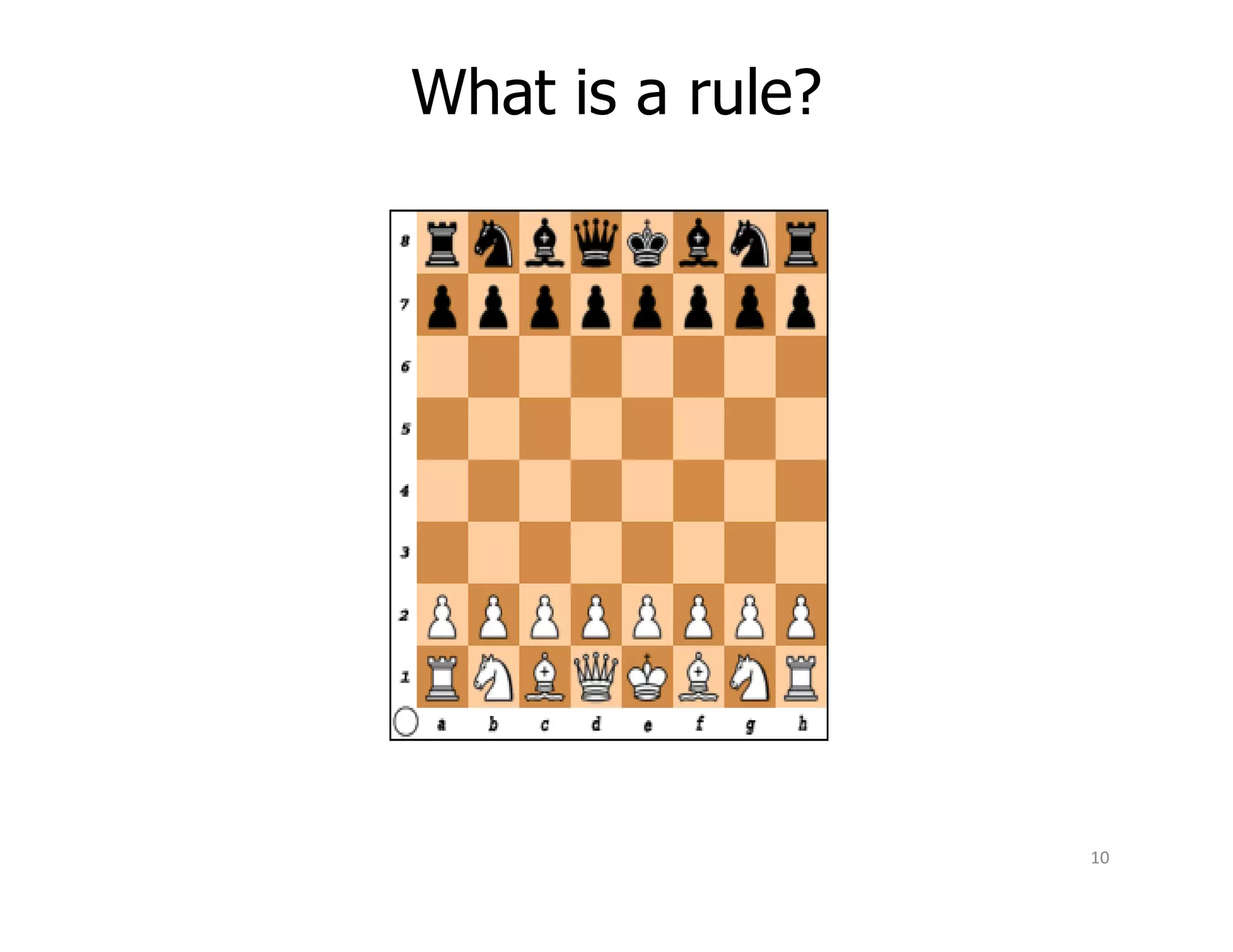
What is a rule?
10
Constraints Context
Oriented
Semantics
Implementation within
Constraints
Procedural Declarative
Product
Oriented
Syntax
Alternative
Execution
11
BR as SyntaxSemantics
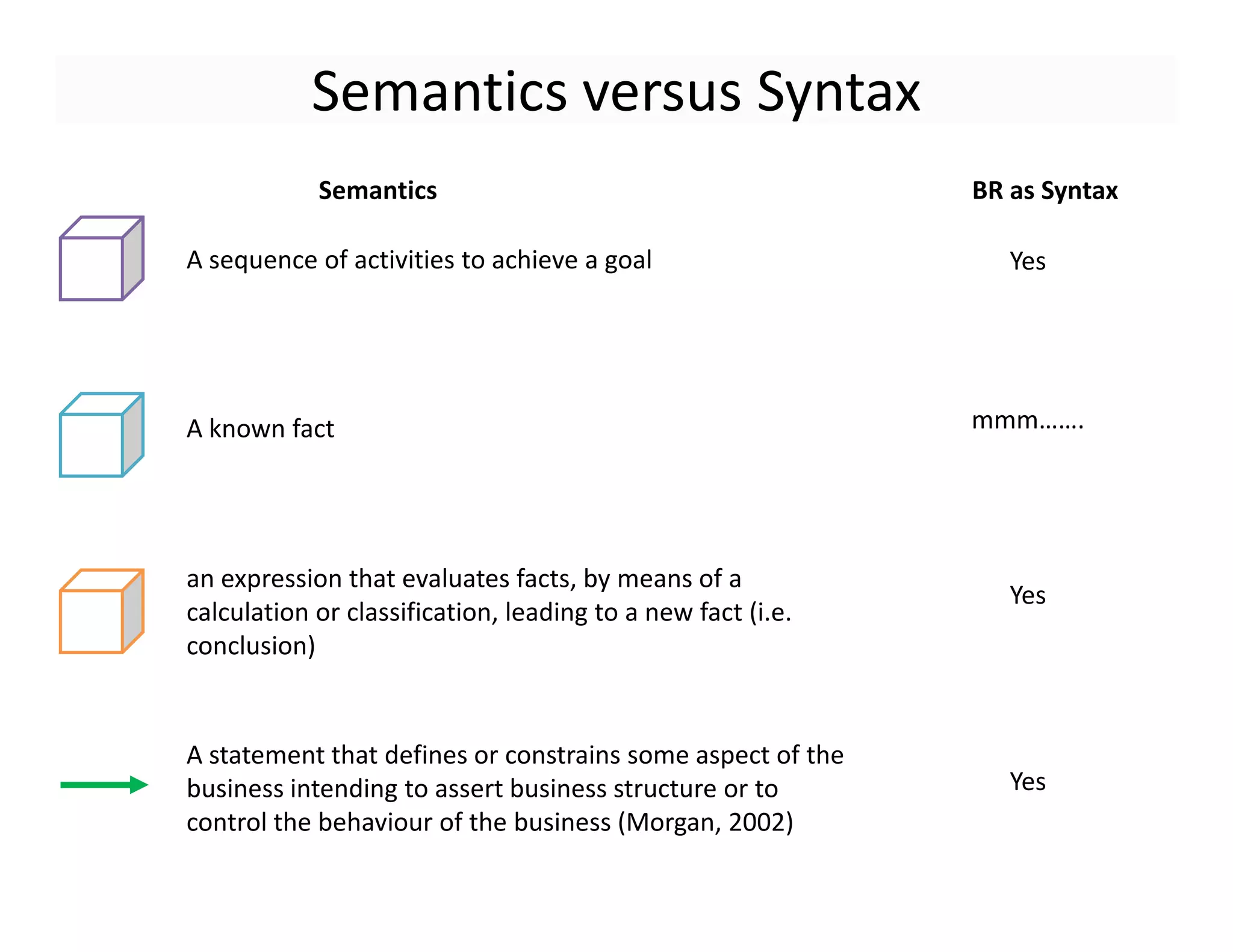
Semantics versus Syntax
A sequence of activities to achieve a goal
A known fact
Yes
mmm…….
an expression that evaluates facts, by means of a
calculation or classification, leading to a new fact (i.e.
conclusion)
A statement that defines or constrains some aspect of the
business intending to assert business structure or to
control the behaviour of the business (Morgan, 2002)
Yes
Yes
Common Mitsakes (2/3)Common Mitsakes (2/3)
“If you’re not making mistakes, then you’re not doing anything.” ~ John Wooden
I need EDM (Enterprise
Decision Management)
I need ODM
(Operational Decision
Management)
I need DMS (Decision
Management System)
I need DM (Decision
Management)
I need BDMS (Business Decision
Management Solutions)
14
I need PLM (Product
Lifecycle Management)
I need PLM (Policy
Lifecycle Management)
I need BRM (Business
Rules Management)
I need CLM (Compliance
Lifecycle Management)
I need Risk Management
15
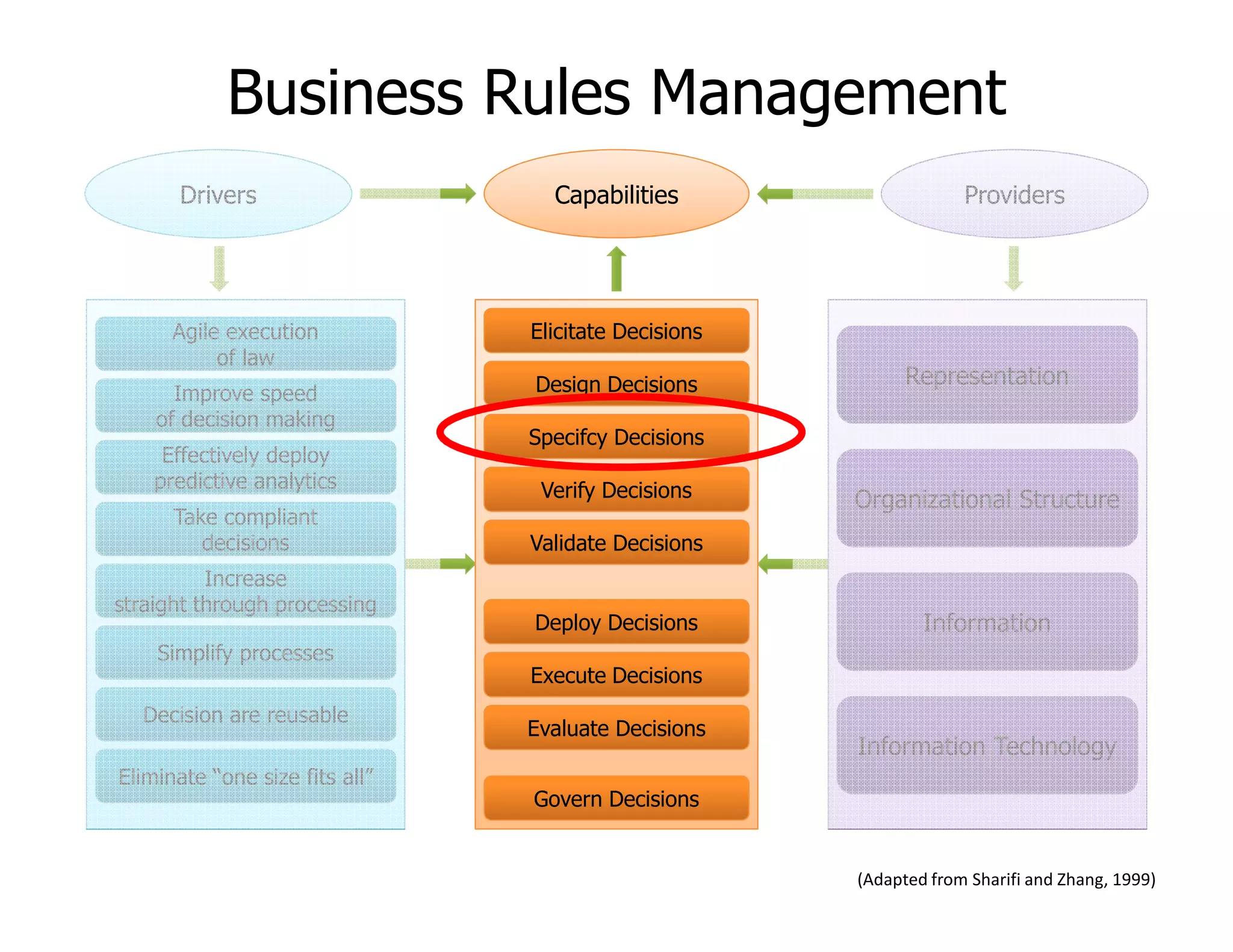
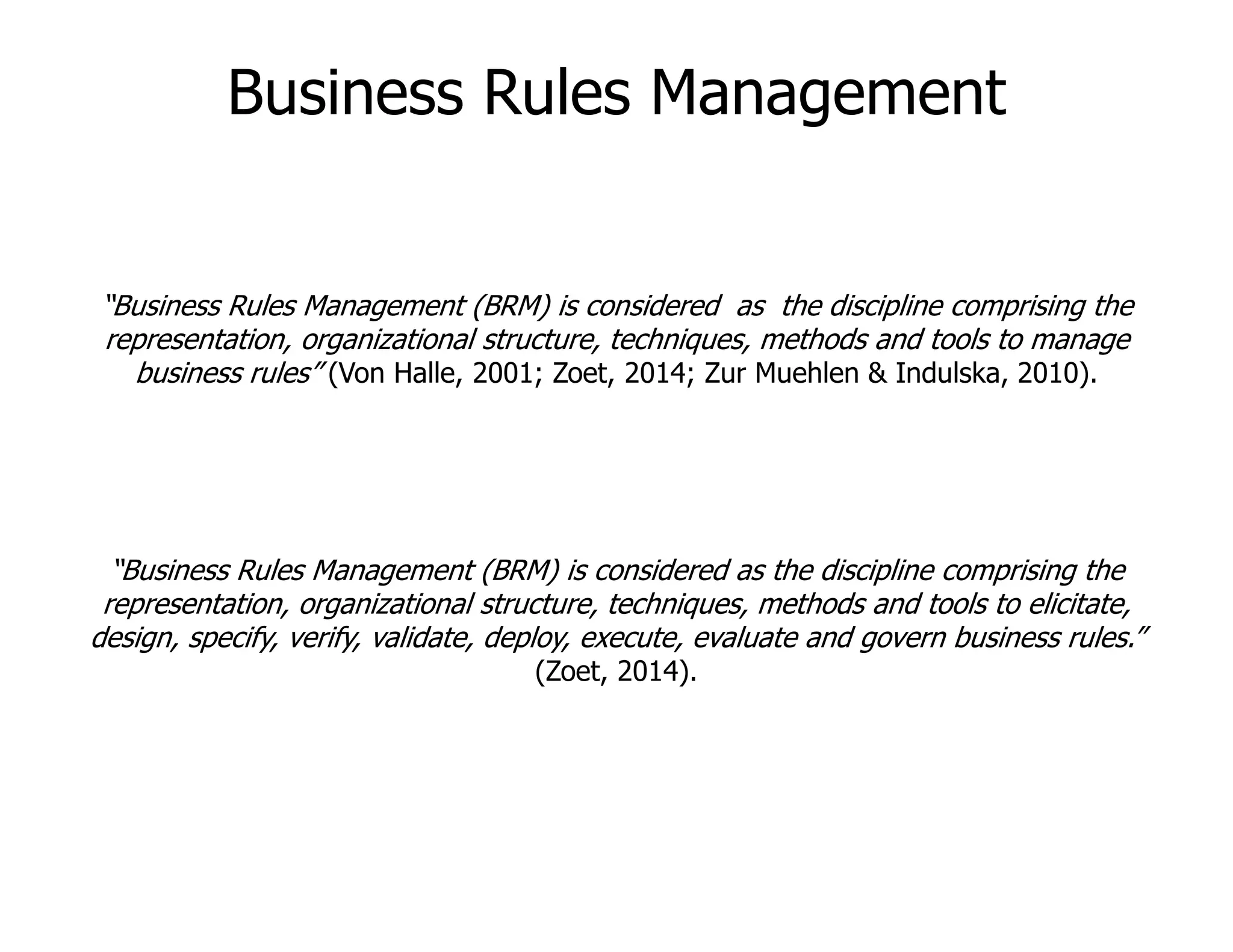
“Business Rules Management (BRM) is considered as the discipline comprising the
representation, organizational structure, techniques, methods and tools to manage
business rules” (Von Halle, 2001; Zoet, 2014; Zur Muehlen & Indulska, 2010).
Business Rules Management
“Business Rules Management (BRM) is considered as the discipline comprising the
representation, organizational structure, techniques, methods and tools to elicitate,
design, specify, verify, validate, deploy, execute, evaluate and govern business rules.”
(Zoet, 2014).
Capabilities
Elicitate
Design
Specifcy
Business Rules Management
Verify
Validate
Deploy
Execute
Evaluate
Govern
(Model Adapted from Sharifi and Zhang, 1999)
ProvidersCapabilities
Elicitate
Design
Specifcy
Business Rules Management
Representation
Verify
Validate
Deploy
Execute
Evaluate
Govern
Organizational Structure
Information
Information Technology
(Model Adapted from Sharifi and Zhang, 1999)
ProvidersCapabilitiesDrivers
Agile execution
of law
Improve speed
of decision making
Effectively deploy
predictive analytics
Elicitate
Design
Specifcy
Business Rules Management
Representation
predictive analytics
Take compliant
decisions
Increase
straight through processing
Simplify processes
Decision are reusable
Eliminate “one size fits all”
Verify
Validate
Deploy
Execute
Evaluate
Govern
Organizational Structure
Information
Information Technology
(Model Adapted from Sharifi and Zhang, 1999)
Common Mitsakes (3/3)Common Mitsakes (3/3)
“If you’re not making mistakes, then you’re not doing anything.” ~ John Wooden
(Copyrights of logos are retained by their owners)
https://www.youtube.com/watch?v=IQKsYXH2LCM
(Copyrights of logos are retained by their owners)
https://www.ted.com/talks/kevin_slavin_how_algorithms_shape_our_world?language=nl
(Copyrights of logos are retained by their owners)
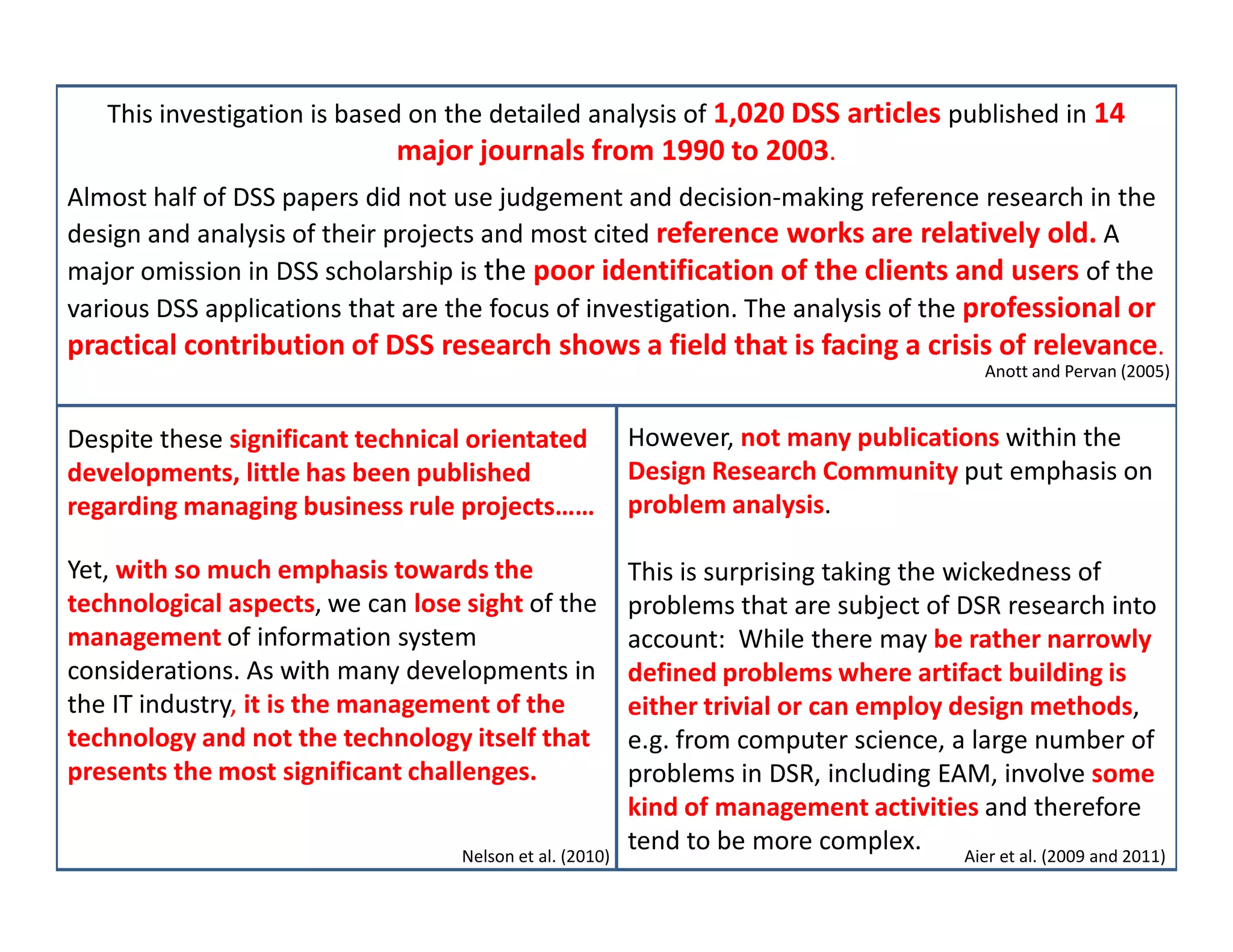
This investigation is based on the detailed analysis of 1,020 DSS articles published in 14
major journals from 1990 to 2003.
Almost half of DSS papers did not use judgement and decision-making reference research in the
design and analysis of their projects and most cited reference works are relatively old. A
major omission in DSS scholarship is the poor identification of the clients and users of the
various DSS applications that are the focus of investigation. The analysis of the professional or
practical contribution of DSS research shows a field that is facing a crisis of relevance.
Despite these significant technical orientated
developments, little has been published
Anott and Pervan (2005)
However, not many publications within the
Design Research Community put emphasis on
1
developments, little has been published
regarding managing business rule projects……
Yet, with so much emphasis towards the
technological aspects, we can lose sight of the
management of information system
considerations. As with many developments in
the IT industry, it is the management of the
technology and not the technology itself that
presents the most significant challenges.
Nelson et al. (2010) Aier et al. (2009 and 2011)
Design Research Community put emphasis on
problem analysis.
This is surprising taking the wickedness of
problems that are subject of DSR research into
account: While there may be rather narrowly
defined problems where artifact building is
either trivial or can employ design methods,
e.g. from computer science, a large number of
problems in DSR, including EAM, involve some
kind of management activities and therefore
tend to be more complex.
https://algorithmia.com/
(Copyrights of logos are retained by their owners)
“The Romance
of the Gut”
“A gut is a personal nontransferable
attribute, which increases the value of a
good one.”
31
“The Romance
of the Gut”
These results have interesting implications for the use of
decision support systems in procurement management. At
this point, it seems appropriate to quote Meehl’s (1986):
“Computer Phobia”
Review and reflection indicate that no more than 5% of what was written in the 1954 book entitled,
Clinical Versus Statistical Prediction (Meehl, 1954), needs to be retracted 30 years later. If anything,
these retractions would result in the book’s being more actuarial than it was. Seven factors appear
to account for the failure of mental health professionals to apply in practice the strong and clearly
supported empirical generalizations demonstrating the superiority of actuarial over clinical
prediction.
“A gut is a personal nontransferable
attribute, which increases the value of a
good one.”
32
1. Simple Business Rules;
2. Predictive Analytics;
3. Students;
4. Young Professional;
5. Experienced Professional.
this point, it seems appropriate to quote Meehl’s (1986):
‘‘There is no controversy in social science that shows
such a large body of qualitatively diverse studies
coming out so uniformly in the same direction as
this one [the relative validity of statistical versus clinical
prediction]. When you are pushing 90 investigations
[now over 130], predicting everything from the outcome
of football games to the diagnosis of liver disease and
when you can hardly come up with a half
dozen studies showing even a weak tendency in
favour of the clinician, it is time to draw a practical
conclusion.’’ (Meehl, 1986, pp. 372–373)
Meelh (1986) Grove and Meehl (1996) Wade and Travis (1998) Tazelaar and Batenburg (2003) Snijders and Tazelaar (2005)
Decisions
33
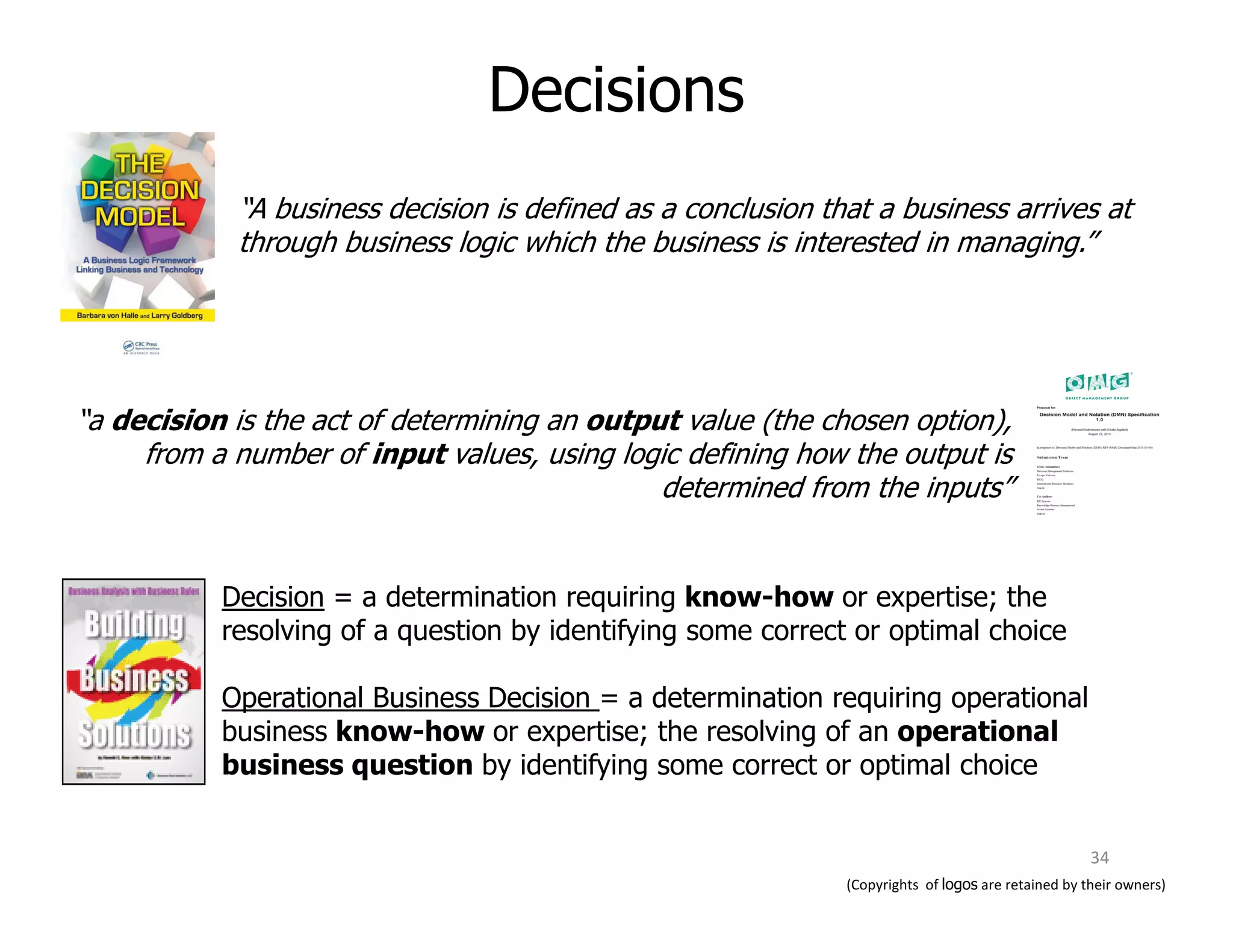
“A business decision is defined as a conclusion that a business arrives at
through business logic which the business is interested in managing.”
“a decision is the act of determining an output value (the chosen option),
from a number of input values, using logic defining how the output is
determined from the inputs”
Decisions
determined from the inputs”
Decision = a determination requiring know-how or expertise; the
resolving of a question by identifying some correct or optimal choice
Operational Business Decision = a determination requiring operational
business know-how or expertise; the resolving of an operational
business question by identifying some correct or optimal choice
(Copyrights of logos are retained by their owners)
34
“Ultimately, a company’s value is no more (and no less) than the
sum of the decisions it makes and executes. Its assets, capabilities,
and structure are useless unless through-out the organization
decisions are made right more often than not.”
Blenko (2010)
Decisions
“The job of a manager is, above all, to make decisions. At any
moment in any day, most executives are engaged in some aspect of
decision making: exchanging information, reviewing data, coming
up with ideas, evaluating alternatives, implementing directives,
following up.”
(Brousseau, Driver,
Hourihan en Larsson,
2006)
35
100% of your decisions are implemented!
How much are you aware of these decisions?_____________________________________
IncompetentCompetent
Unconscious
Conscious
(Maslow, 1954)
36
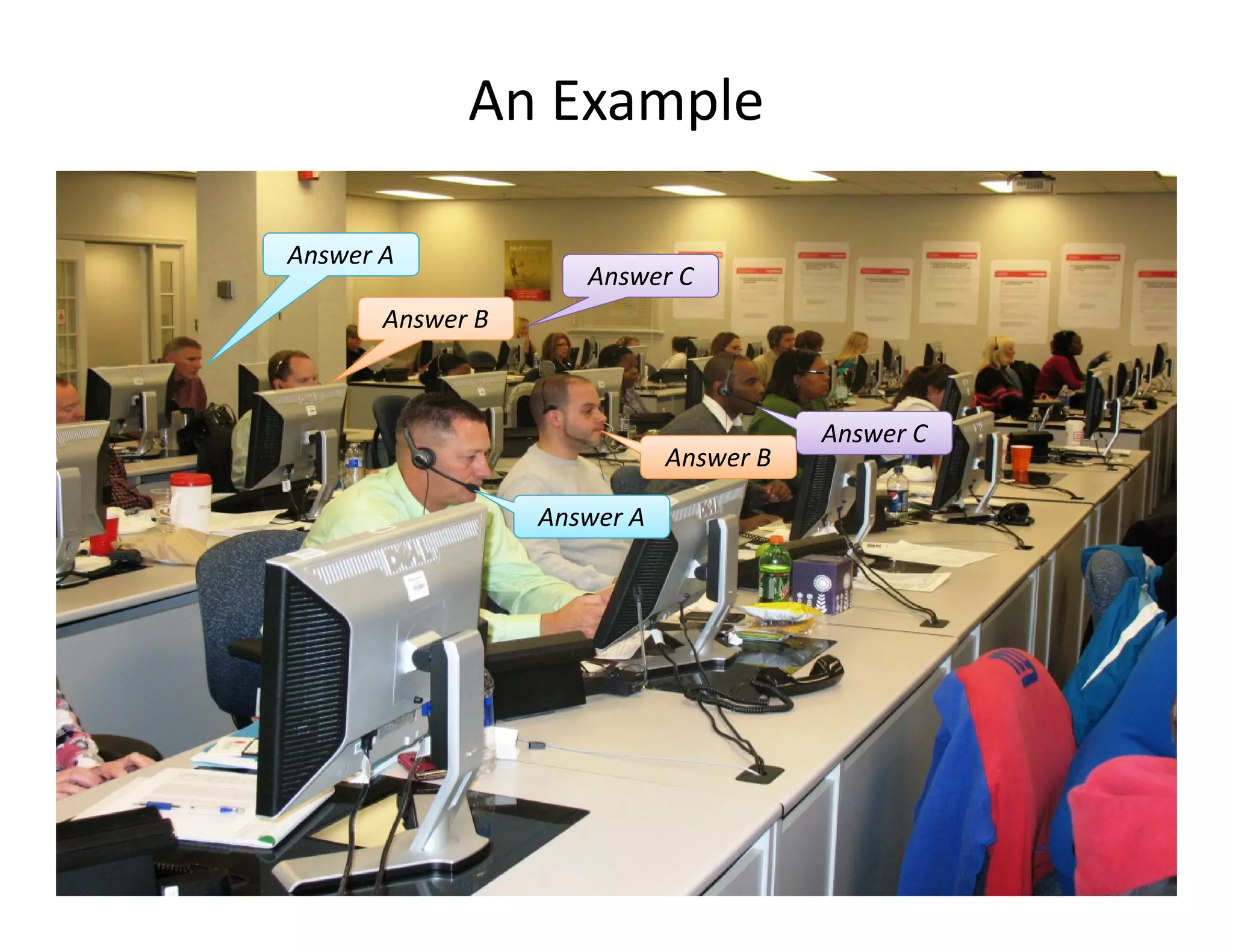
An Example
64% of product developers said, “we do” 83% of marketers said, “we do”
Who has the right to decide which
features will be standard?
Who has the right to decide which
colors will be offered?
64% of product developers said, “we do”
77% of product developers said, “we do”
83% of marketers said, “we do”
61% of marketers said, “we do”
MarketersProduct Developers
An Example
Answer B
Answer C
Answer C
Answer A
Answer B
Answer A
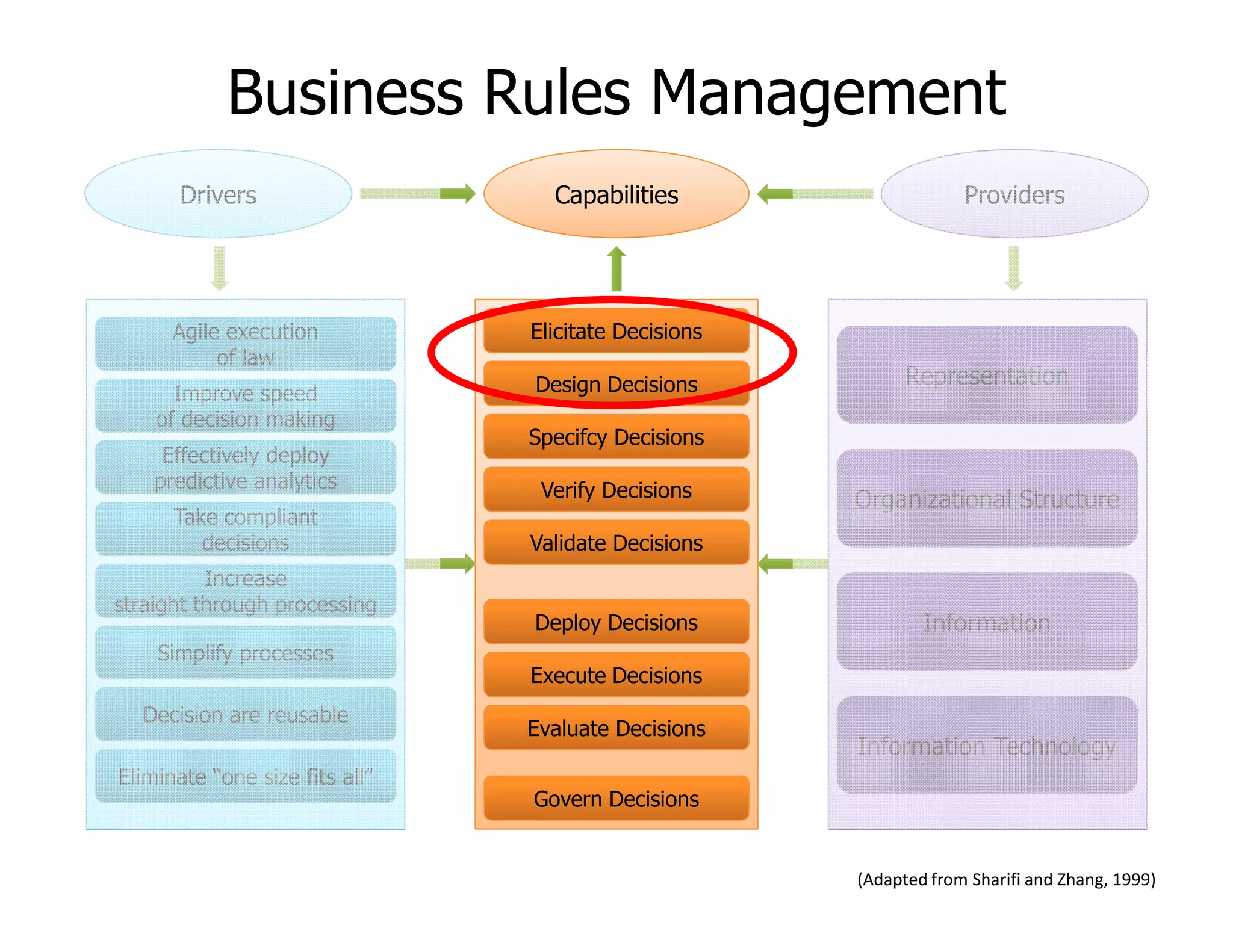
ProvidersCapabilitiesDrivers
Agile execution
of law
Improve speed
of decision making
Effectively deploy
predictive analytics
Elicitate Decisions
Design Decisions
Specifcy Decisions
Business Rules Management
Representation
predictive analytics
Take compliant
decisions
Increase
straight through processing
Simplify processes
Decision are reusable
Eliminate “one size fits all”
Verify Decisions
Validate Decisions
Deploy Decisions
Execute Decisions
Evaluate Decisions
Govern Decisions
Organizational Structure
Information
Information Technology
(Adapted from Sharifi and Zhang, 1999)
Assess Decisions
Volume
(number of times taken)
Velocity
(how fast must decision be taken)
Variety
(variety of decisions)
Value
(what is the result of the decision)
Veracity
(Quality and Accuracy)
Decision 1
40
Who has the Decision?
Perform
Input
Perform
Recommend Agree
Decide
(Based on Blenko et al, 2010)
ProvidersCapabilitiesDrivers
Agile execution
of law
Improve speed
of decision making
Effectively deploy
predictive analytics
Elicitate Decisions
Design Decisions
Specifcy Decisions
Business Rules Management
Representation
predictive analytics
Take compliant
decisions
Increase
straight through processing
Simplify processes
Decision are reusable
Eliminate “one size fits all”
Verify Decisions
Validate Decisions
Deploy Decisions
Execute Decisions
Evaluate Decisions
Govern Decisions
Organizational Structure
Information
Information Technology
(Adapted from Sharifi and Zhang, 1999)
Representation
Simplicity
Precise
Expressives
Natural
ProvidersCapabilitiesDrivers
Agile execution
of law
Improve speed
of decision making
Effectively deploy
predictive analytics
Elicitate Decisions
Design Decisions
Specifcy Decisions
Business Rules Management
Representation
predictive analytics
Take compliant
decisions
Increase
straight through processing
Simplify processes
Decision are reusable
Eliminate “one size fits all”
Verify Decisions
Validate Decisions
Deploy Decisions
Execute Decisions
Evaluate Decisions
Govern Decisions
Organizational Structure
Information
Information Technology
(Adapted from Sharifi and Zhang, 1999)
Changing Fact Values
Existing Fact Types/
New Business Rules
Third order
changes (part of the
design)
Enable
Agility
Reduce
Agility
Preservation of
structure
Modify the
Fourth order
changes
(configuration)
Change
Change in an existing
decision structure
Change in an existing
business rule
Change
the value proposition
Enable
Agility
Reduce
Agility
Modify the
structure New Fact Types/
New Business Rules/
Modified Decision Structure
New Fact types/
New Business Rules/
New Decision Structure
Create a new
structure
Second order
changes (design)
First order
changes
(architecture)
Change the decision
structure
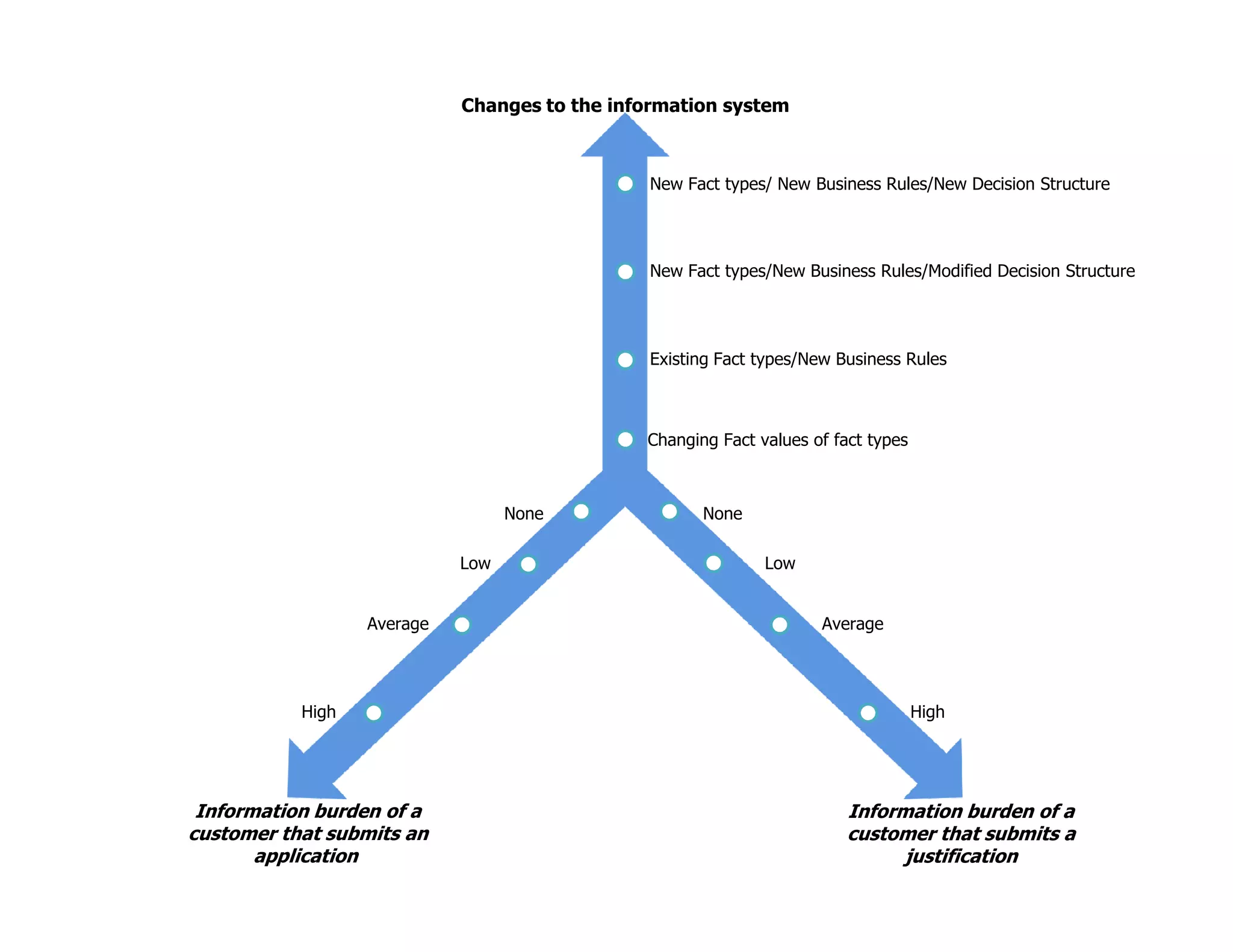
Changes to the information system
Changing Fact values of fact types
New Fact types/New Business Rules/Modified Decision Structure
New Fact types/ New Business Rules/New Decision Structure
Existing Fact types/New Business Rules
Information burden of a
customer that submits an
application
Low
Average
High
Low
Average
High
NoneNone
Information burden of a
customer that submits a
justification
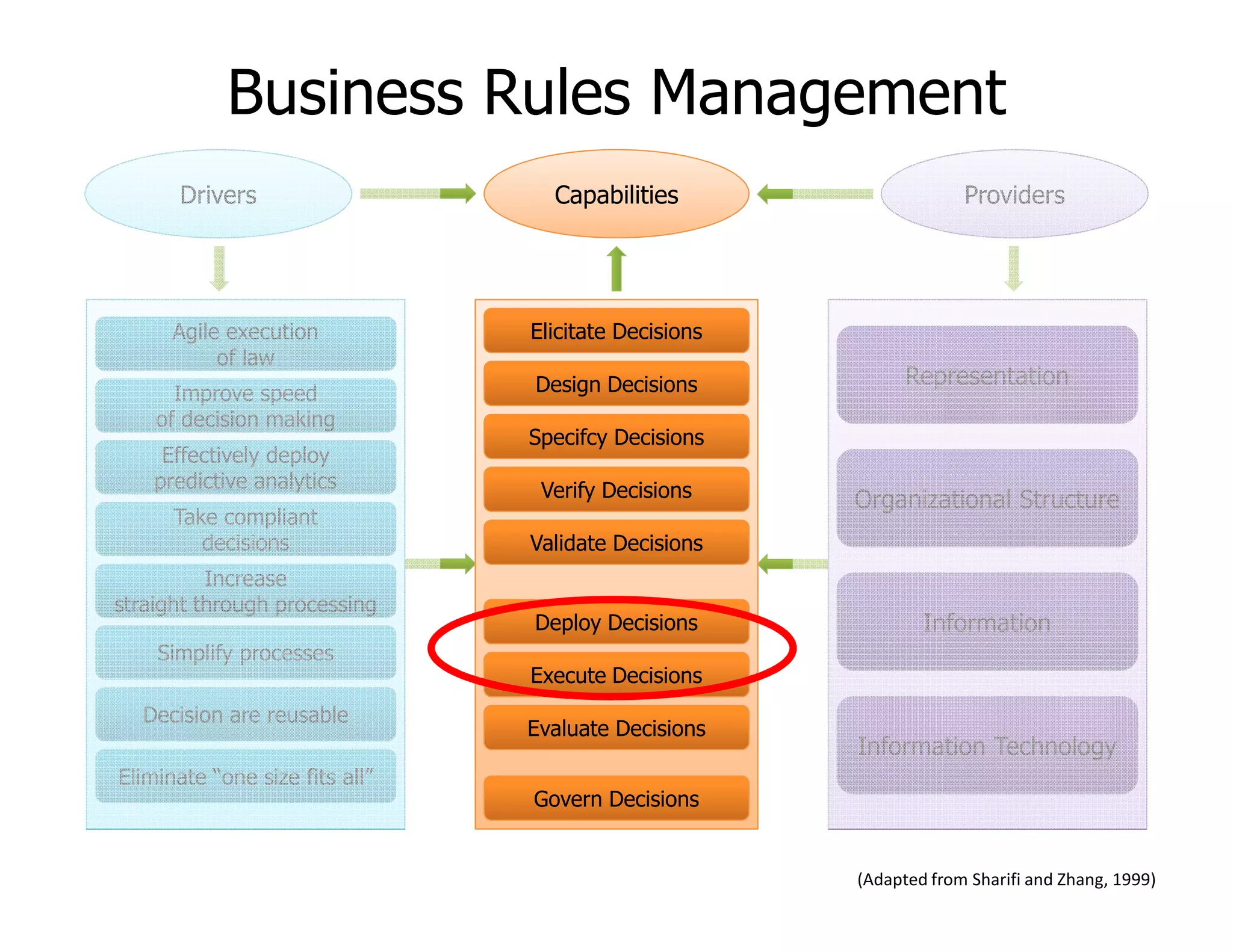
ProvidersCapabilitiesDrivers
Agile execution
of law
Improve speed
of decision making
Effectively deploy
predictive analytics
Elicitate Decisions
Design Decisions
Specifcy Decisions
Business Rules Management
Representation
predictive analytics
Take compliant
decisions
Increase
straight through processing
Simplify processes
Decision are reusable
Eliminate “one size fits all”
Verify Decisions
Validate Decisions
Deploy Decisions
Execute Decisions
Evaluate Decisions
Govern Decisions
Organizational Structure
Information
Information Technology
(Adapted from Sharifi and Zhang, 1999)
Femke and Kees
Femke Kees
52
Decision
Service I
Facts
ExecutionExecution
Service I
Assess Risk of
Malnutrition
Risk of
Malnutrition
BRMS Software Vendor ABRMS Software Vendor A
53
Decision
Service I
Facts
DesignDesign DeploymentDeployment ExecutionExecution
Decision
Service I
Decision
Service I Service I
Assess Risk of
Malnutrition
Risk of
Malnutrition
BRMS Software Vendor ABRMS Software Vendor A
Service I
Assess Risk of
Malnutrition
Service I
Assess Risk of
Malnutrition
54
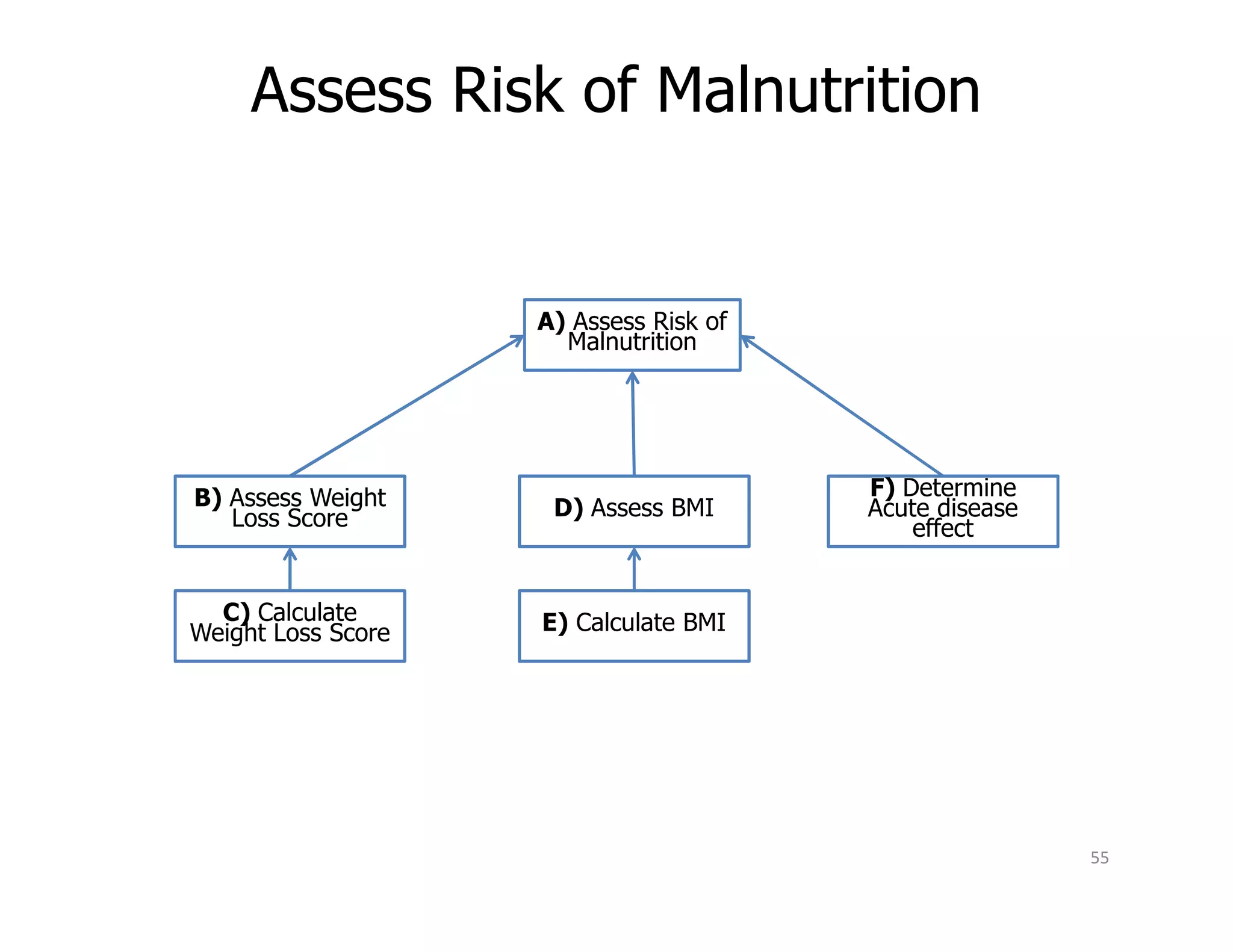
A) Assess Risk of
Malnutrition
F) Determine
Assess Risk of Malnutrition
B) Assess Weight
Loss Score D) Assess BMI
F) Determine
Acute disease
effect
C) Calculate
Weight Loss Score E) Calculate BMI
55
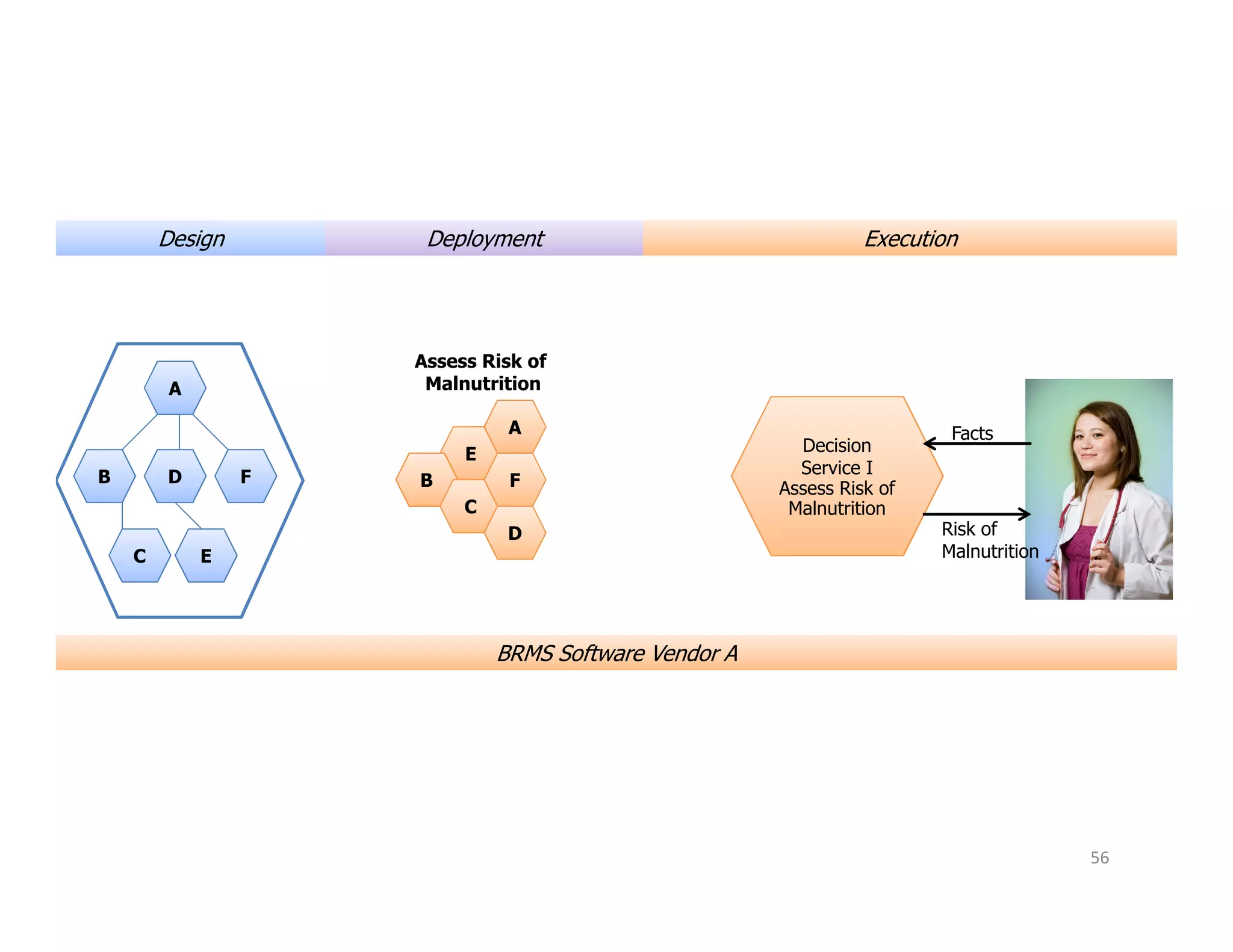
E Decision
Service I
Facts
A
B FD
A
B F
Assess Risk of
Malnutrition
DesignDesign DeploymentDeployment ExecutionExecution
Service I
Assess Risk of
Malnutrition
Risk of
Malnutrition
B
C
FD
E
B
C
F
D
BRMS Software Vendor ABRMS Software Vendor A
56
Facts
ExecutionExecution
G
a
t
e
A
B FD
Risk of
Malnutrition
BRMS Software Vendor B / C / D / E
e
w
a
y
B
C
FD
E
57
Facts
A
B FD
DesignDesign DeploymentDeployment ExecutionExecution
A
B FD
G
a
t
e
A
B FD
Risk of
Malnutrition
B
C
FD
E
BRMS Software Vendor ABRMS Software Vendor A
B
C
FD
E
BRMS Software Vendor B / C / D / E
e
w
a
y
B
C
FD
E
58
Facts
ExecutionExecution
G
a
t
eA
BC
DE
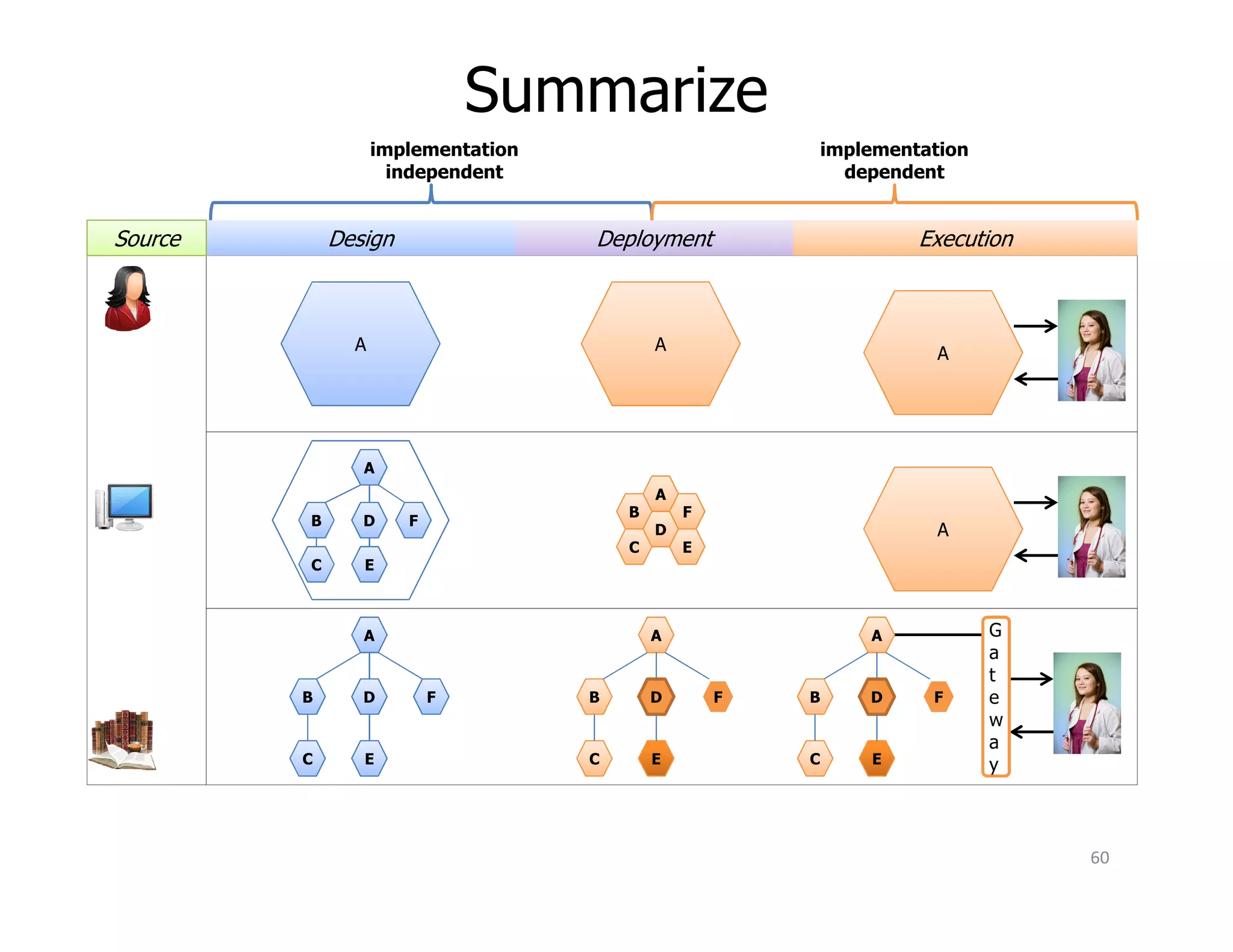
Systems are temporary,
Risk of
Malnutrition
e
w
a
y
A
F
DE
BRMS Software Vendor B / C / D / E
(Copyrights of logos are retained by their owners)
59
communication is forever
implementation
dependent
DesignDesign DeploymentDeployment ExecutionExecutionSource
AAA
A
Summarize
implementation
independent
A
B
C
F
D
E
A
B
C
FD
E
G
a
t
e
w
a
y
A
B
C
FD
E
A
A
B
C
FD
E
A
B
C
FD
E
60
Three Dimensions of Agility
Functionality
Technology
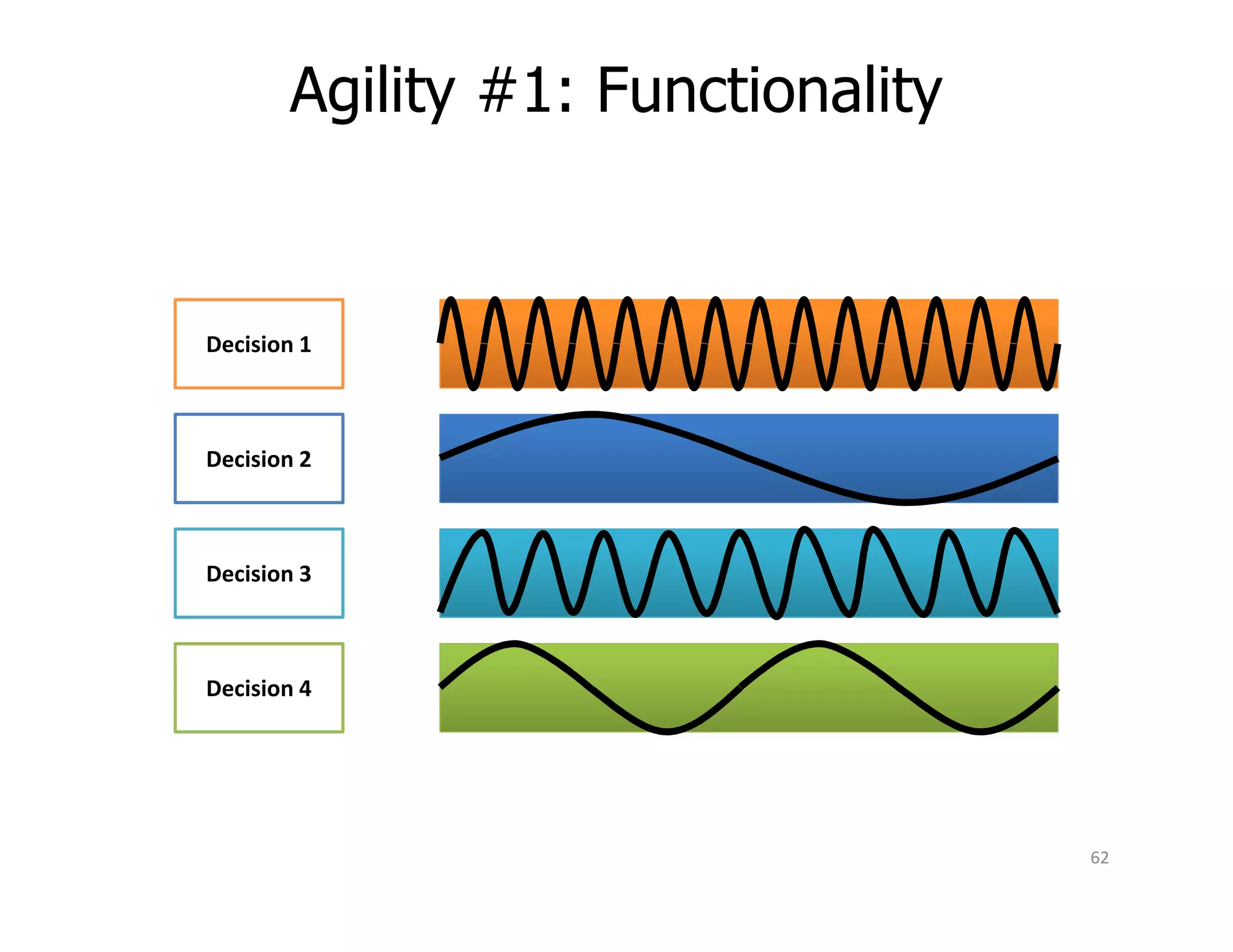
Decision 2
Decision 1
Agility #1: Functionality
Decision 4
Decision 3
62
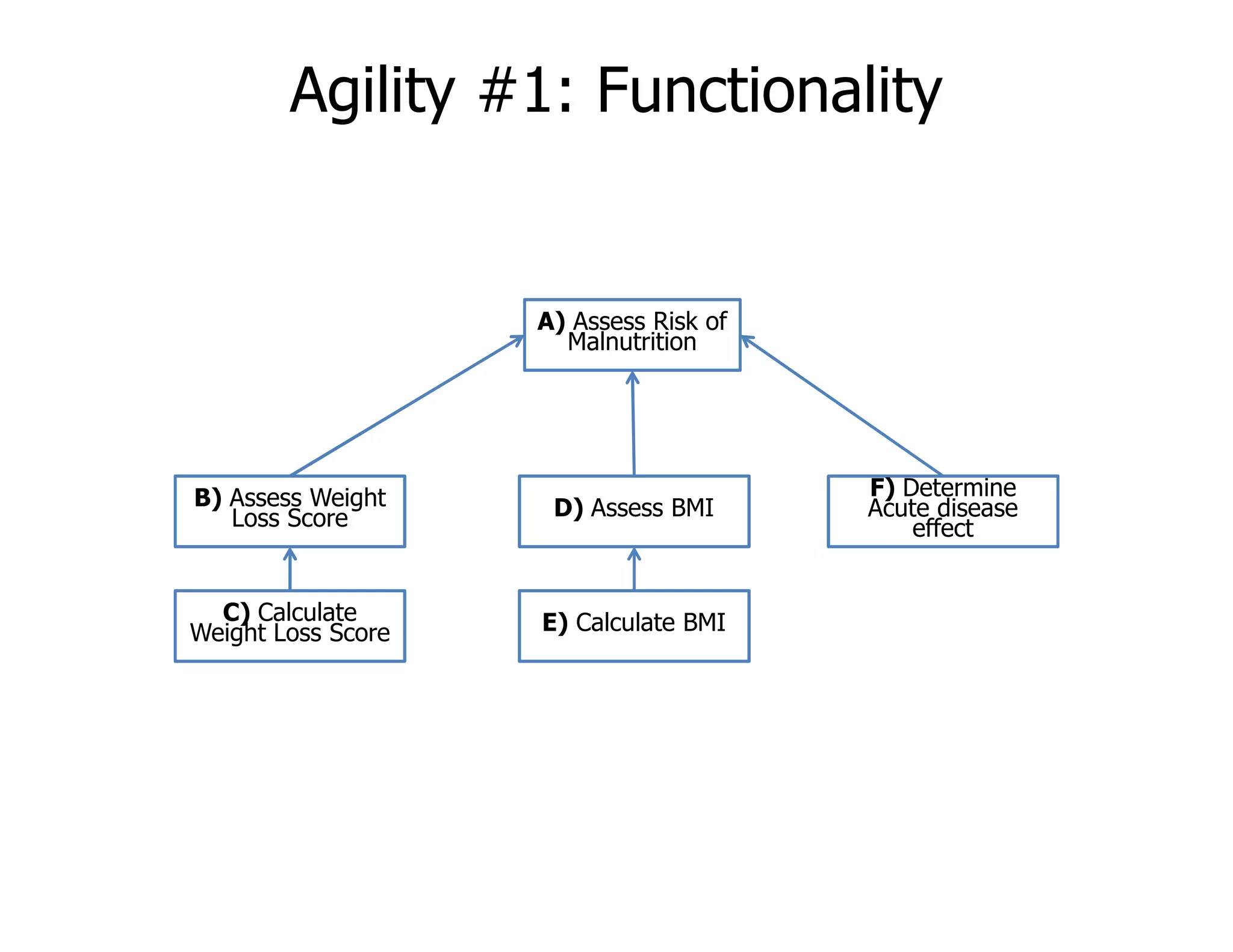
Agility #1: Functionality
A) Assess Risk of
Malnutrition
F) DetermineB) Assess Weight
Loss Score D) Assess BMI
F) Determine
Acute disease
effect
C) Calculate
Weight Loss Score E) Calculate BMI
Option 1
Option 2
Agility #1: Functionality
Option 2
Option 3
System 2
System 1
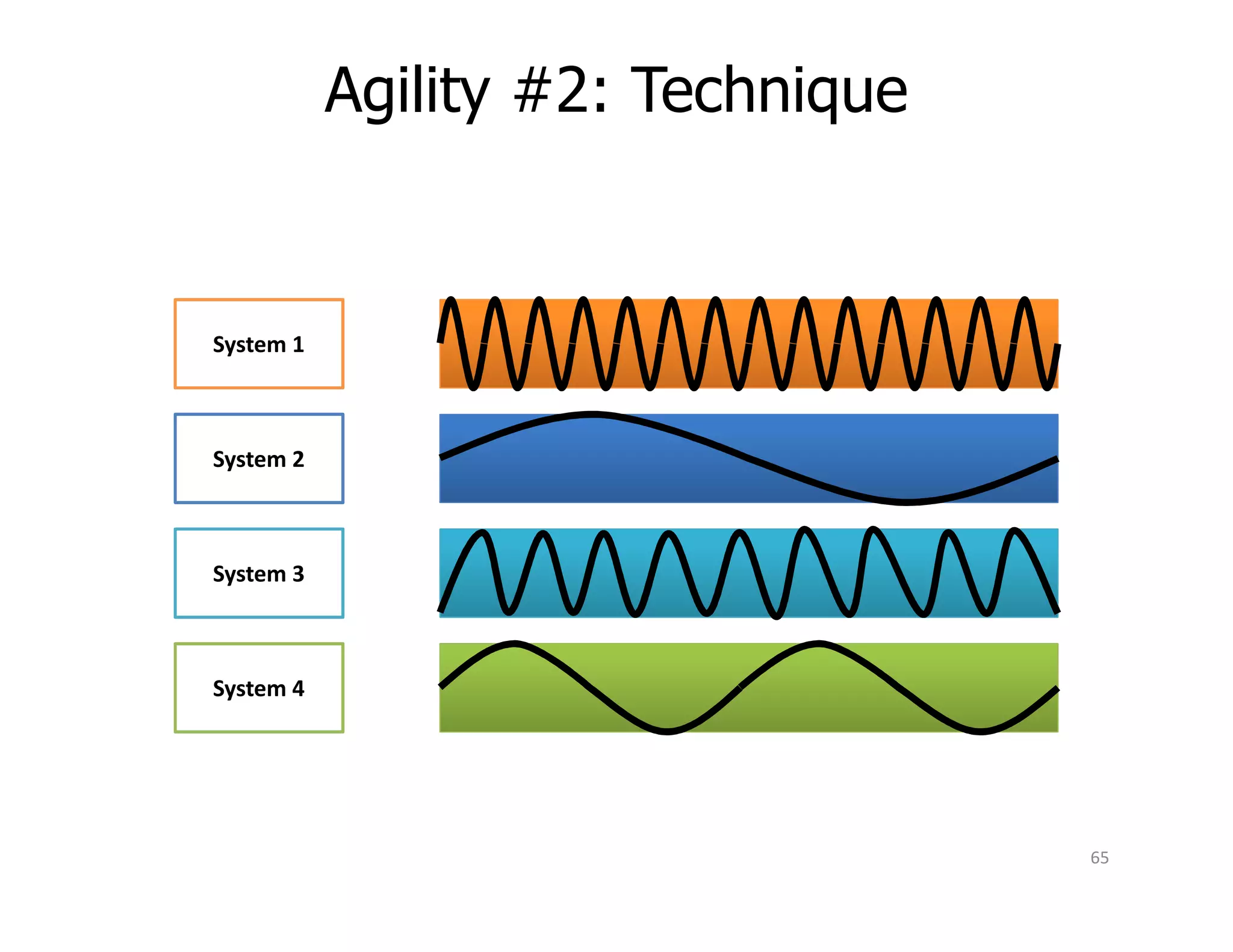
Agility #2: Technique
System 4
System 3
65
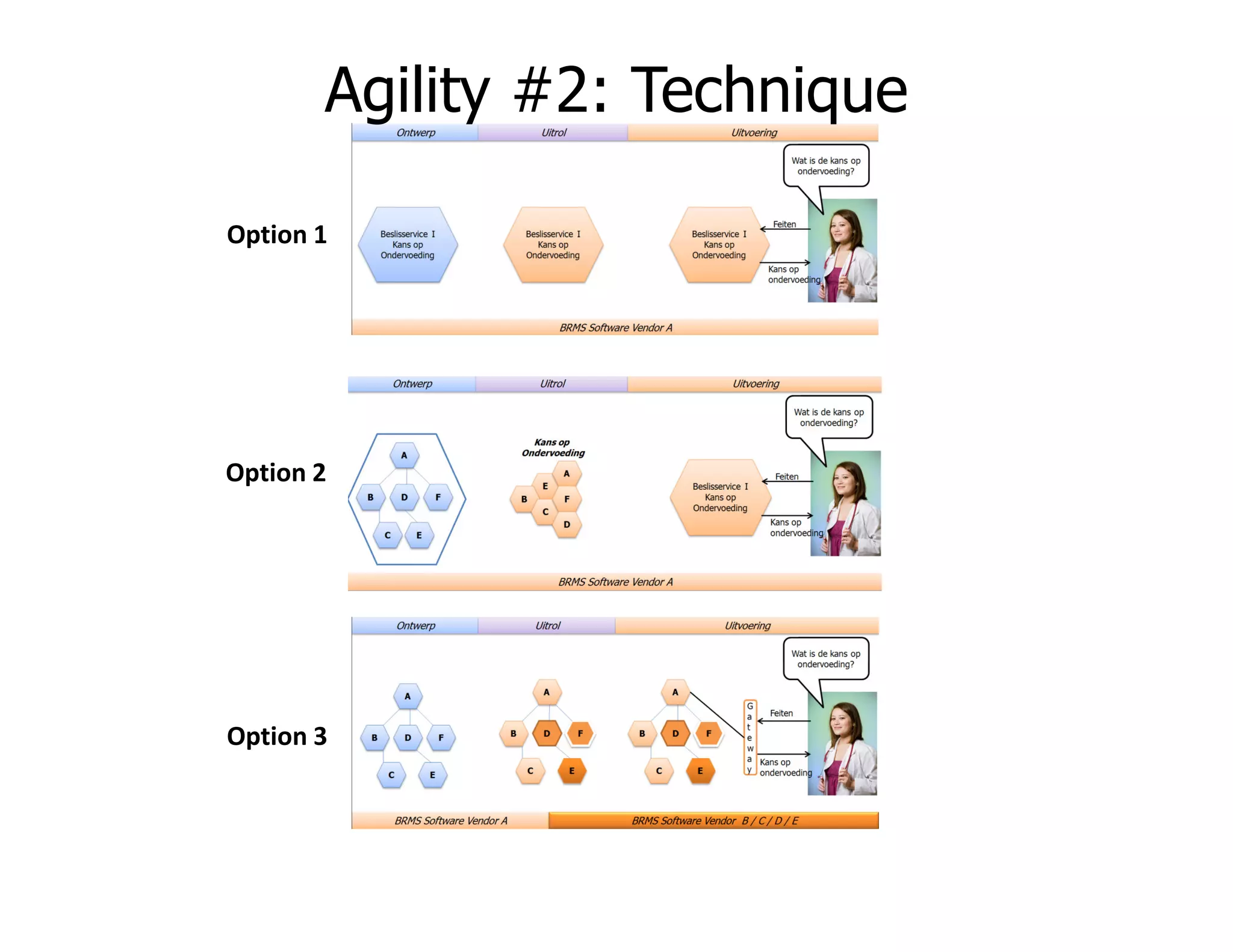
Agility #2: Technique
(Copyrights of logos are retained by their owners)
Option 1
Option 2
Agility #2: Technique
Option 2
Option 3
Decision
Service 2
Decision
Service 1
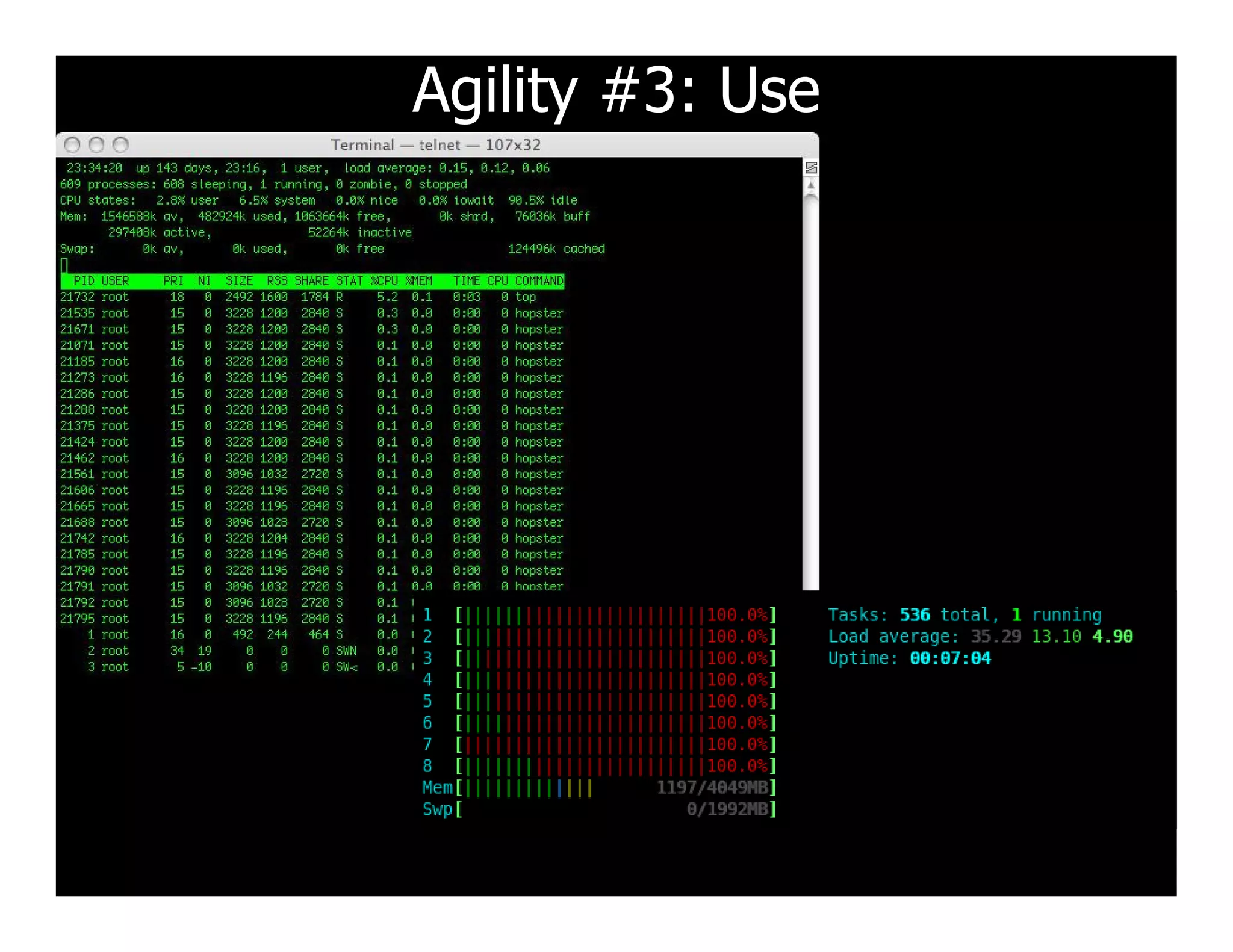
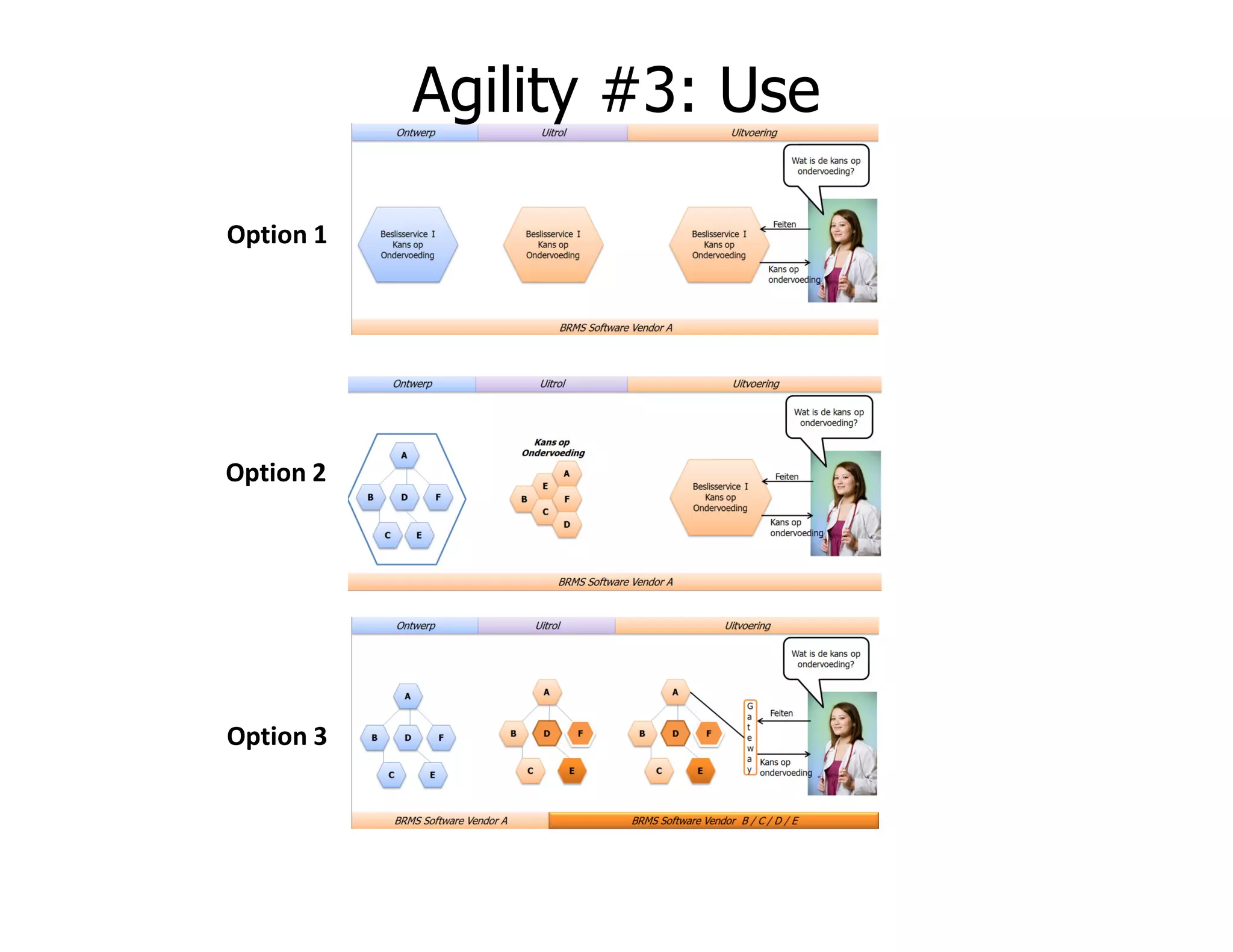
Agility #3: Use
Decision
Service 4
Decision
Service 3
Service 2
68
Agility #3: Use
Option 1
Option 2
Agility #3: Use
Option 2
Option 3
“Working together to develop and spread new insights
and solutions for practical problems.“
martijnzoet@gmail.com
(mzoet)
72
Slide Photo Artist/Contributor
1 Sign “more difficult / less difficult” SasquatchI
1 Tower Nimishgogri
1 Classroom Edwin11
1 Medical Tubs SNRE
2 Tower Nimishgogri
2 Classroom Edwin11
2 Medical Tubs SNRE
This presentation used photos and artwork offered under the creative commons license “attribution
generic” . None of the artists / licensors who created the work have endorsed me or my use of their
work. The Creative Commons Photos can be found on http://www.flickr.com/. Photos and artwork
not listed are copyrighted by the author or 3rd parties.
2 Medical Tubs SNRE
4 Sake ConiferConifer
13 Sake ConiferConifer
14 ‘ODM’ Girl Rennesi
14 ‘EDM’ Girl PumpkinCat
14 DMS Men Jcoterhals
14 BDMS Men Hamed Saber
14 DM Man Roger Blackwell
15 PLM Girl Rennesi
15 PLM Girl 2 PumpkinCat
15 BRM Men Jcoterhals
15 RM Men Hamed Saber
Slide Photo Artist/Contributor
15 CLM Man Roger Blackwell
20 Sake ConiferConifer
21 Pregnancy test Esparta Palma
22 Pregnancy test Esparta Palma
24 Pregnancy test Esparta Palma
25 Pregnancy test Esparta Palma
27 Pregnancy test Esparta Palma
This presentation used photos and artwork offered under the creative commons license “attribution
generic” . None of the artists / licensors who created the work have endorsed me or my use of their
work. The Creative Commons Photos can be found on http://www.flickr.com/. Photos and artwork
not listed are copyrighted by the author or 3rd parties.
27 Pregnancy test Esparta Palma
31 Hotelroom L'HOTEL PORTO BAY SÃO PAULO
31 Belly Fbellon
31 Flat ABS Tomas Sobek
33 Cheese Selection James Theophane
33 Alarm Clock Alan Cleaver
33 Sign “more difficult / less difficult” SasquatchI
33 Nurse Walt Stoneburner
33 Nurse with computer Wonderlane
33 Servers Paul Hammond
37 Business Women Victor
37 Business Men Victor
Slide Photo Artist/Contributor
37 IT-Guy Kellina Handbasket
38 Call Centre State Farm
40 Traffic Jam Epsos.De
40 Drifting Car Grandpar Bordeaux
40 Ferrari Damian Morys
40 Bentley Pedro Ribeiro Simoes
40 Parked Cars Alex
This presentation used photos and artwork offered under the creative commons license “attribution
generic” . None of the artists / licensors who created the work have endorsed me or my use of their
work. The Creative Commons Photos can be found on http://www.flickr.com/. Photos and artwork
not listed are copyrighted by the author or 3rd parties.
40 Parked Cars Alex
41 Girl Joseph Jude
50 Coffee Dominic Alves
50 Cocktail Dious
52 Nurse Walt Stoneburner
52 Room US Navy
52 Kees Roger Blackwell
53 Nurse Walt Stoneburner
54 Nurse Walt Stoneburner
56 Nurse Walt Stoneburner
57 Nurse Walt Stoneburner
58 Nurse Walt Stoneburner
Slide Photo Artist/Contributor
59 Nurse Walt Stoneburner
60 Nurse Walt Stoneburner
64 Nurse Walt Stoneburner
67 Nurse Walt Stoneburner
69 Terminal Telnet Andreas Pizsa
69 Server overload Javier Aroche
70 Nurse Walt Stoneburner
This presentation used photos and artwork offered under the creative commons license “attribution
generic” . None of the artists / licensors who created the work have endorsed me or my use of their
work. The Creative Commons Photos can be found on http://www.flickr.com/. Photos and artwork
not listed are copyrighted by the author or 3rd parties.
70 Nurse Walt Stoneburner
72 Tower Nimishgogri
72 Classroom Edwin11
72 Medical Tubs SNRE

Guest Lecture Business Rules Management / Decision Management Utrecht University

  • 1.
  • 2.
    “Working together todevelop and spread new insights and solutions for practical problems.“ martijnzoet@gmail.com (mzoet) 2
  • 3.
  • 4.
    Common Mitsakes (1/3)CommonMitsakes (1/3) “If you’re not making mistakes, then you’re not doing anything.” ~ John Wooden
  • 5.
    What is arule? 5
  • 6.
    How much isthe small blind? Which player has to post the small blind? What is a rule? 6
  • 7.
    How much isthe big blind? Which player has to post the big blind? What is a rule? 7
  • 8.
    How many cards needto be dealt? What is a rule? 8
  • 9.
  • 10.
    What is arule? 10
  • 11.
    Constraints Context Oriented Semantics Implementation within Constraints ProceduralDeclarative Product Oriented Syntax Alternative Execution 11
  • 12.
    BR as SyntaxSemantics Semanticsversus Syntax A sequence of activities to achieve a goal A known fact Yes mmm……. an expression that evaluates facts, by means of a calculation or classification, leading to a new fact (i.e. conclusion) A statement that defines or constrains some aspect of the business intending to assert business structure or to control the behaviour of the business (Morgan, 2002) Yes Yes
  • 13.
    Common Mitsakes (2/3)CommonMitsakes (2/3) “If you’re not making mistakes, then you’re not doing anything.” ~ John Wooden
  • 14.
    I need EDM(Enterprise Decision Management) I need ODM (Operational Decision Management) I need DMS (Decision Management System) I need DM (Decision Management) I need BDMS (Business Decision Management Solutions) 14
  • 15.
    I need PLM(Product Lifecycle Management) I need PLM (Policy Lifecycle Management) I need BRM (Business Rules Management) I need CLM (Compliance Lifecycle Management) I need Risk Management 15
  • 16.
    “Business Rules Management(BRM) is considered as the discipline comprising the representation, organizational structure, techniques, methods and tools to manage business rules” (Von Halle, 2001; Zoet, 2014; Zur Muehlen & Indulska, 2010). Business Rules Management “Business Rules Management (BRM) is considered as the discipline comprising the representation, organizational structure, techniques, methods and tools to elicitate, design, specify, verify, validate, deploy, execute, evaluate and govern business rules.” (Zoet, 2014).
  • 17.
  • 18.
  • 19.
    ProvidersCapabilitiesDrivers Agile execution of law Improvespeed of decision making Effectively deploy predictive analytics Elicitate Design Specifcy Business Rules Management Representation predictive analytics Take compliant decisions Increase straight through processing Simplify processes Decision are reusable Eliminate “one size fits all” Verify Validate Deploy Execute Evaluate Govern Organizational Structure Information Information Technology (Model Adapted from Sharifi and Zhang, 1999)
  • 20.
    Common Mitsakes (3/3)CommonMitsakes (3/3) “If you’re not making mistakes, then you’re not doing anything.” ~ John Wooden
  • 22.
    (Copyrights of logosare retained by their owners)
  • 23.
  • 24.
    (Copyrights of logosare retained by their owners)
  • 25.
    (Copyrights of logosare retained by their owners)
  • 26.
  • 27.
    (Copyrights of logosare retained by their owners)
  • 28.
    This investigation isbased on the detailed analysis of 1,020 DSS articles published in 14 major journals from 1990 to 2003. Almost half of DSS papers did not use judgement and decision-making reference research in the design and analysis of their projects and most cited reference works are relatively old. A major omission in DSS scholarship is the poor identification of the clients and users of the various DSS applications that are the focus of investigation. The analysis of the professional or practical contribution of DSS research shows a field that is facing a crisis of relevance. Despite these significant technical orientated developments, little has been published Anott and Pervan (2005) However, not many publications within the Design Research Community put emphasis on 1 developments, little has been published regarding managing business rule projects…… Yet, with so much emphasis towards the technological aspects, we can lose sight of the management of information system considerations. As with many developments in the IT industry, it is the management of the technology and not the technology itself that presents the most significant challenges. Nelson et al. (2010) Aier et al. (2009 and 2011) Design Research Community put emphasis on problem analysis. This is surprising taking the wickedness of problems that are subject of DSR research into account: While there may be rather narrowly defined problems where artifact building is either trivial or can employ design methods, e.g. from computer science, a large number of problems in DSR, including EAM, involve some kind of management activities and therefore tend to be more complex.
  • 29.
  • 30.
    (Copyrights of logosare retained by their owners)
  • 31.
    “The Romance of theGut” “A gut is a personal nontransferable attribute, which increases the value of a good one.” 31
  • 32.
    “The Romance of theGut” These results have interesting implications for the use of decision support systems in procurement management. At this point, it seems appropriate to quote Meehl’s (1986): “Computer Phobia” Review and reflection indicate that no more than 5% of what was written in the 1954 book entitled, Clinical Versus Statistical Prediction (Meehl, 1954), needs to be retracted 30 years later. If anything, these retractions would result in the book’s being more actuarial than it was. Seven factors appear to account for the failure of mental health professionals to apply in practice the strong and clearly supported empirical generalizations demonstrating the superiority of actuarial over clinical prediction. “A gut is a personal nontransferable attribute, which increases the value of a good one.” 32 1. Simple Business Rules; 2. Predictive Analytics; 3. Students; 4. Young Professional; 5. Experienced Professional. this point, it seems appropriate to quote Meehl’s (1986): ‘‘There is no controversy in social science that shows such a large body of qualitatively diverse studies coming out so uniformly in the same direction as this one [the relative validity of statistical versus clinical prediction]. When you are pushing 90 investigations [now over 130], predicting everything from the outcome of football games to the diagnosis of liver disease and when you can hardly come up with a half dozen studies showing even a weak tendency in favour of the clinician, it is time to draw a practical conclusion.’’ (Meehl, 1986, pp. 372–373) Meelh (1986) Grove and Meehl (1996) Wade and Travis (1998) Tazelaar and Batenburg (2003) Snijders and Tazelaar (2005)
  • 33.
  • 34.
    “A business decisionis defined as a conclusion that a business arrives at through business logic which the business is interested in managing.” “a decision is the act of determining an output value (the chosen option), from a number of input values, using logic defining how the output is determined from the inputs” Decisions determined from the inputs” Decision = a determination requiring know-how or expertise; the resolving of a question by identifying some correct or optimal choice Operational Business Decision = a determination requiring operational business know-how or expertise; the resolving of an operational business question by identifying some correct or optimal choice (Copyrights of logos are retained by their owners) 34
  • 35.
    “Ultimately, a company’svalue is no more (and no less) than the sum of the decisions it makes and executes. Its assets, capabilities, and structure are useless unless through-out the organization decisions are made right more often than not.” Blenko (2010) Decisions “The job of a manager is, above all, to make decisions. At any moment in any day, most executives are engaged in some aspect of decision making: exchanging information, reviewing data, coming up with ideas, evaluating alternatives, implementing directives, following up.” (Brousseau, Driver, Hourihan en Larsson, 2006) 35
  • 36.
    100% of yourdecisions are implemented! How much are you aware of these decisions?_____________________________________ IncompetentCompetent Unconscious Conscious (Maslow, 1954) 36
  • 37.
    An Example 64% ofproduct developers said, “we do” 83% of marketers said, “we do” Who has the right to decide which features will be standard? Who has the right to decide which colors will be offered? 64% of product developers said, “we do” 77% of product developers said, “we do” 83% of marketers said, “we do” 61% of marketers said, “we do” MarketersProduct Developers
  • 38.
    An Example Answer B AnswerC Answer C Answer A Answer B Answer A
  • 39.
    ProvidersCapabilitiesDrivers Agile execution of law Improvespeed of decision making Effectively deploy predictive analytics Elicitate Decisions Design Decisions Specifcy Decisions Business Rules Management Representation predictive analytics Take compliant decisions Increase straight through processing Simplify processes Decision are reusable Eliminate “one size fits all” Verify Decisions Validate Decisions Deploy Decisions Execute Decisions Evaluate Decisions Govern Decisions Organizational Structure Information Information Technology (Adapted from Sharifi and Zhang, 1999)
  • 40.
    Assess Decisions Volume (number oftimes taken) Velocity (how fast must decision be taken) Variety (variety of decisions) Value (what is the result of the decision) Veracity (Quality and Accuracy) Decision 1 40
  • 41.
    Who has theDecision? Perform Input Perform Recommend Agree Decide (Based on Blenko et al, 2010)
  • 42.
    ProvidersCapabilitiesDrivers Agile execution of law Improvespeed of decision making Effectively deploy predictive analytics Elicitate Decisions Design Decisions Specifcy Decisions Business Rules Management Representation predictive analytics Take compliant decisions Increase straight through processing Simplify processes Decision are reusable Eliminate “one size fits all” Verify Decisions Validate Decisions Deploy Decisions Execute Decisions Evaluate Decisions Govern Decisions Organizational Structure Information Information Technology (Adapted from Sharifi and Zhang, 1999)
  • 46.
  • 47.
    ProvidersCapabilitiesDrivers Agile execution of law Improvespeed of decision making Effectively deploy predictive analytics Elicitate Decisions Design Decisions Specifcy Decisions Business Rules Management Representation predictive analytics Take compliant decisions Increase straight through processing Simplify processes Decision are reusable Eliminate “one size fits all” Verify Decisions Validate Decisions Deploy Decisions Execute Decisions Evaluate Decisions Govern Decisions Organizational Structure Information Information Technology (Adapted from Sharifi and Zhang, 1999)
  • 48.
    Changing Fact Values ExistingFact Types/ New Business Rules Third order changes (part of the design) Enable Agility Reduce Agility Preservation of structure Modify the Fourth order changes (configuration) Change Change in an existing decision structure Change in an existing business rule Change the value proposition Enable Agility Reduce Agility Modify the structure New Fact Types/ New Business Rules/ Modified Decision Structure New Fact types/ New Business Rules/ New Decision Structure Create a new structure Second order changes (design) First order changes (architecture) Change the decision structure
  • 49.
    Changes to theinformation system Changing Fact values of fact types New Fact types/New Business Rules/Modified Decision Structure New Fact types/ New Business Rules/New Decision Structure Existing Fact types/New Business Rules Information burden of a customer that submits an application Low Average High Low Average High NoneNone Information burden of a customer that submits a justification
  • 51.
    ProvidersCapabilitiesDrivers Agile execution of law Improvespeed of decision making Effectively deploy predictive analytics Elicitate Decisions Design Decisions Specifcy Decisions Business Rules Management Representation predictive analytics Take compliant decisions Increase straight through processing Simplify processes Decision are reusable Eliminate “one size fits all” Verify Decisions Validate Decisions Deploy Decisions Execute Decisions Evaluate Decisions Govern Decisions Organizational Structure Information Information Technology (Adapted from Sharifi and Zhang, 1999)
  • 52.
  • 53.
    Decision Service I Facts ExecutionExecution Service I AssessRisk of Malnutrition Risk of Malnutrition BRMS Software Vendor ABRMS Software Vendor A 53
  • 54.
    Decision Service I Facts DesignDesign DeploymentDeploymentExecutionExecution Decision Service I Decision Service I Service I Assess Risk of Malnutrition Risk of Malnutrition BRMS Software Vendor ABRMS Software Vendor A Service I Assess Risk of Malnutrition Service I Assess Risk of Malnutrition 54
  • 55.
    A) Assess Riskof Malnutrition F) Determine Assess Risk of Malnutrition B) Assess Weight Loss Score D) Assess BMI F) Determine Acute disease effect C) Calculate Weight Loss Score E) Calculate BMI 55
  • 56.
    E Decision Service I Facts A BFD A B F Assess Risk of Malnutrition DesignDesign DeploymentDeployment ExecutionExecution Service I Assess Risk of Malnutrition Risk of Malnutrition B C FD E B C F D BRMS Software Vendor ABRMS Software Vendor A 56
  • 57.
    Facts ExecutionExecution G a t e A B FD Risk of Malnutrition BRMSSoftware Vendor B / C / D / E e w a y B C FD E 57
  • 58.
    Facts A B FD DesignDesign DeploymentDeploymentExecutionExecution A B FD G a t e A B FD Risk of Malnutrition B C FD E BRMS Software Vendor ABRMS Software Vendor A B C FD E BRMS Software Vendor B / C / D / E e w a y B C FD E 58
  • 59.
    Facts ExecutionExecution G a t eA BC DE Systems are temporary, Riskof Malnutrition e w a y A F DE BRMS Software Vendor B / C / D / E (Copyrights of logos are retained by their owners) 59 communication is forever
  • 60.
  • 61.
    Three Dimensions ofAgility Functionality Technology
  • 62.
    Decision 2 Decision 1 Agility#1: Functionality Decision 4 Decision 3 62
  • 63.
    Agility #1: Functionality A)Assess Risk of Malnutrition F) DetermineB) Assess Weight Loss Score D) Assess BMI F) Determine Acute disease effect C) Calculate Weight Loss Score E) Calculate BMI
  • 64.
    Option 1 Option 2 Agility#1: Functionality Option 2 Option 3
  • 65.
    System 2 System 1 Agility#2: Technique System 4 System 3 65
  • 66.
    Agility #2: Technique (Copyrightsof logos are retained by their owners)
  • 67.
    Option 1 Option 2 Agility#2: Technique Option 2 Option 3
  • 68.
    Decision Service 2 Decision Service 1 Agility#3: Use Decision Service 4 Decision Service 3 Service 2 68
  • 69.
  • 70.
    Option 1 Option 2 Agility#3: Use Option 2 Option 3
  • 72.
    “Working together todevelop and spread new insights and solutions for practical problems.“ martijnzoet@gmail.com (mzoet) 72
  • 73.
    Slide Photo Artist/Contributor 1Sign “more difficult / less difficult” SasquatchI 1 Tower Nimishgogri 1 Classroom Edwin11 1 Medical Tubs SNRE 2 Tower Nimishgogri 2 Classroom Edwin11 2 Medical Tubs SNRE This presentation used photos and artwork offered under the creative commons license “attribution generic” . None of the artists / licensors who created the work have endorsed me or my use of their work. The Creative Commons Photos can be found on http://www.flickr.com/. Photos and artwork not listed are copyrighted by the author or 3rd parties. 2 Medical Tubs SNRE 4 Sake ConiferConifer 13 Sake ConiferConifer 14 ‘ODM’ Girl Rennesi 14 ‘EDM’ Girl PumpkinCat 14 DMS Men Jcoterhals 14 BDMS Men Hamed Saber 14 DM Man Roger Blackwell 15 PLM Girl Rennesi 15 PLM Girl 2 PumpkinCat 15 BRM Men Jcoterhals 15 RM Men Hamed Saber
  • 74.
    Slide Photo Artist/Contributor 15CLM Man Roger Blackwell 20 Sake ConiferConifer 21 Pregnancy test Esparta Palma 22 Pregnancy test Esparta Palma 24 Pregnancy test Esparta Palma 25 Pregnancy test Esparta Palma 27 Pregnancy test Esparta Palma This presentation used photos and artwork offered under the creative commons license “attribution generic” . None of the artists / licensors who created the work have endorsed me or my use of their work. The Creative Commons Photos can be found on http://www.flickr.com/. Photos and artwork not listed are copyrighted by the author or 3rd parties. 27 Pregnancy test Esparta Palma 31 Hotelroom L'HOTEL PORTO BAY SÃO PAULO 31 Belly Fbellon 31 Flat ABS Tomas Sobek 33 Cheese Selection James Theophane 33 Alarm Clock Alan Cleaver 33 Sign “more difficult / less difficult” SasquatchI 33 Nurse Walt Stoneburner 33 Nurse with computer Wonderlane 33 Servers Paul Hammond 37 Business Women Victor 37 Business Men Victor
  • 75.
    Slide Photo Artist/Contributor 37IT-Guy Kellina Handbasket 38 Call Centre State Farm 40 Traffic Jam Epsos.De 40 Drifting Car Grandpar Bordeaux 40 Ferrari Damian Morys 40 Bentley Pedro Ribeiro Simoes 40 Parked Cars Alex This presentation used photos and artwork offered under the creative commons license “attribution generic” . None of the artists / licensors who created the work have endorsed me or my use of their work. The Creative Commons Photos can be found on http://www.flickr.com/. Photos and artwork not listed are copyrighted by the author or 3rd parties. 40 Parked Cars Alex 41 Girl Joseph Jude 50 Coffee Dominic Alves 50 Cocktail Dious 52 Nurse Walt Stoneburner 52 Room US Navy 52 Kees Roger Blackwell 53 Nurse Walt Stoneburner 54 Nurse Walt Stoneburner 56 Nurse Walt Stoneburner 57 Nurse Walt Stoneburner 58 Nurse Walt Stoneburner
  • 76.
    Slide Photo Artist/Contributor 59Nurse Walt Stoneburner 60 Nurse Walt Stoneburner 64 Nurse Walt Stoneburner 67 Nurse Walt Stoneburner 69 Terminal Telnet Andreas Pizsa 69 Server overload Javier Aroche 70 Nurse Walt Stoneburner This presentation used photos and artwork offered under the creative commons license “attribution generic” . None of the artists / licensors who created the work have endorsed me or my use of their work. The Creative Commons Photos can be found on http://www.flickr.com/. Photos and artwork not listed are copyrighted by the author or 3rd parties. 70 Nurse Walt Stoneburner 72 Tower Nimishgogri 72 Classroom Edwin11 72 Medical Tubs SNRE