PSRTC Research Forum Series 
Literature Translation Linguistics TESOL 
A Kaleidoscopic RReepprreesseennttaattiioonn 
ooff VViissuuaall LLiitteerraaccyy iinn aann EEFFLL CCllaassssrroooommss 
ooff aann AArraabb WWoorrlldd 
Ms. Maria Zaheer 
Lecturer 
PYP
Visual literacy 
The term “Visual Literacy” was first coined in 1969 by John Debes. 
Visual literacy is a set of abilities that enables an individual to 
effectively find, interpret, evaluate, use, and create images and 
visual media. Images and visual media may include photographs, 
illustrations, drawings, maps, diagrams, advertisements, and other 
visual messages and representations, both still and moving. 
(Source: The Association of College and Research Libraries Image 
Resources Interest Group)
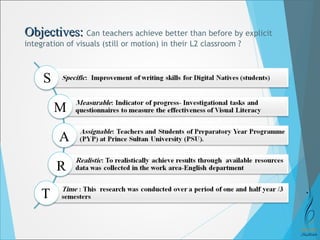
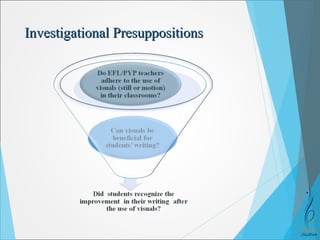
OObbjjeeccttiivveess:: Can teachers achieve better than before by explicit 
integration of visuals (still or motion) in their L2 classroom ? 
S 
M 
A 
R 
T
P Investigational Prreessuuppppoossiittiioonnss
RReesseeaarrcchh DDeessiiggnn 
Data was collected from a variety of 
individuals by using different 
methods/procedures.
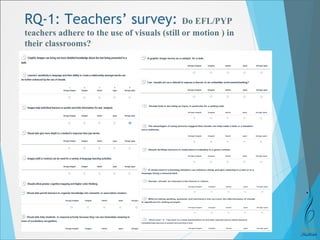
RQ-1: Teachers’ survey: Do EFL/PYP 
teachers adhere to the use of visuals (still or motion ) in 
their classrooms?
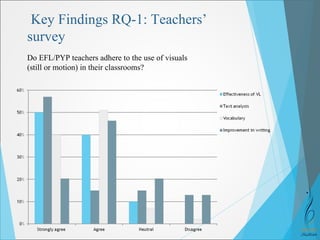
Key Findings RQ-1: Teachers’ 
survey 
Do EFL/PYP teachers adhere to the use of visuals 
(still or motion) in their classrooms?
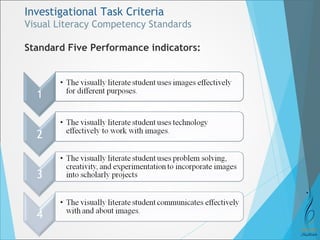
Investigational Task Criteria 
Visual Literacy Competency Standards 
Standard Five Performance indicators:
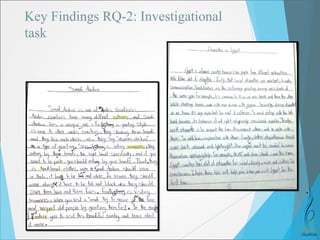
Key Findings RQ-2: Investigational 
task
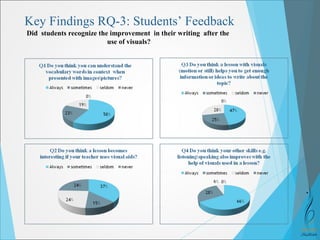
Key Findings RQ-3: Students’ Feedback 
Did students recognize the improvement in their writing after the 
use of visuals?
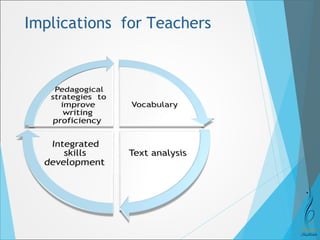
Implications for Teachers
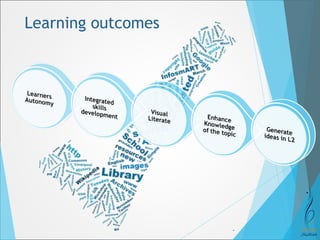
Learning outcomes
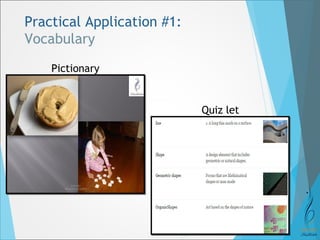
Practical Application #1: 
Vocabulary 
Pictionary 
Quiz let
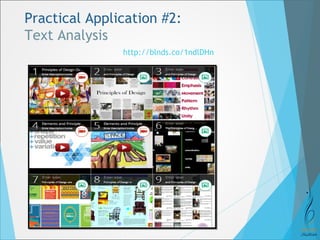
Practical Application #2: 
Text Analysis 
http://blnds.co/1ndlDHn
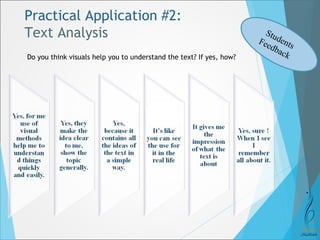
Practical Application #2: 
Text Analysis 
Do you think visuals help you to understand the text? If yes, how? 
Students 
Feedback
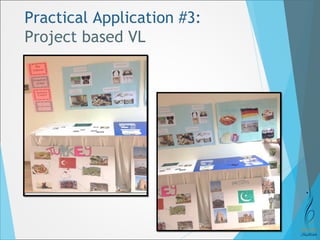
Practical Application #3: 
Project based VL
Practical Application #3b: 
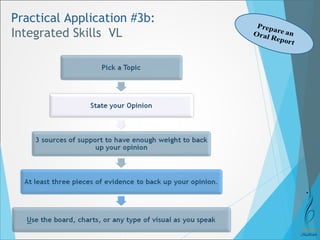
Integrated Skills VL
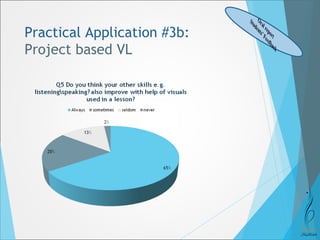
Practical Application #3b: 
Project based VL
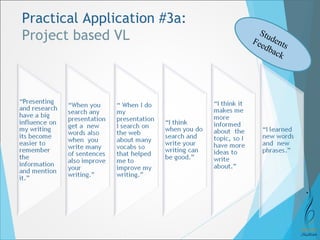
Practical Application #3a: 
Project based VL 
Students 
Feedback
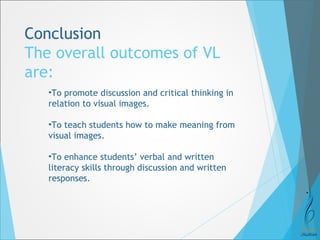
Conclusion 
The overall outcomes of VL 
are: 
•To promote discussion and critical thinking in 
relation to visual images. 
•To teach students how to make meaning from 
visual images. 
•To enhance students’ verbal and written 
literacy skills through discussion and written 
responses.
Thank You for Listening! 
Any Questions?

A Kaleidoscopic Representation of Visual Literacy in a EFL Classroom of a Arab World.

Editor's Notes

  • #4 The participants included in this study are on the basis of their ability, as judged by the researcher, to provide information relevant to the central purpose of the research Patton (1990).
  • #5 This study attempted to gauge the prevalence and the effectiveness of VL in the context of language teaching in PSU. The presuppositions under investigation are as follows Without taking spelling, grammar and mechanics into account,
  • #6 This study attempted to gauge the prevalence and the effectiveness of VL in the context of language teaching in PSU. The presuppositions under investigation are as follows Without taking spelling, grammar and mechanics into account,
  • #9 The visually literate student uses images and visual media effectively.