District Program Evaluation to
Improve RTI/MTSS
Clarisse Haxton, Ph.D.
Program Evaluation Coordinator
Palo Alto Unified School District
CERA Conference 2017
Agenda
• PAUSD District and RTI Overview
• RTI Evaluation Overview
• Findings
• RTI Monitoring Tool (data)
• Implementation progress and challenges
• Student outcomes
• Recommendations and next steps
PAUSD District and RTI Overview
• High-performing overall; substantial
within-district achievement gaps
• RTI/MTSS
• History of RTI work in elementary
• Recognized need for district system
• Recommendation for evaluation in MATD
Committee report and district Equity
Plan
• Program Evaluation Coordinator role
Bufum, Matos, & Weber (2012) 5
RTI Definition from NCRTI
“Response to intervention integrates assessment and
intervention within a multi-level prevention system to maximize
student achievement and to reduce behavioral problems. With
RTI, schools use data to identify students at risk for poor
learning outcomes, monitor student progress, provide
evidence-based interventions and adjust the intensity and
nature of those interventions depending on a student’s
responsiveness, and identify students with learning disabilities
or other disabilities… This system includes three levels of
intensity or three levels of prevention, which represent a
continuum of supports. Many schools use more than one
intervention within a given level of prevention.”
Palo Alto Unified School District 6National Center on Response to Intervention (2010)
RTI/MTSS “Rules of Thumb”
• Tier 1: classroom instruction (“best first instruction”)
provided to all students; serves 80 to 85% of
students
• Tier 2: interventions are supplementary instruction
and support on targeted areas of student need;
serves approximately 10-15% of students
• Tier 3: interventions are more intensive and
individualized, supplementary to core classroom
instruction; serve approximately 5 to 10% of
students
7
PAUSD Elementary RTI
Evaluation Overview
Evaluation Purpose
• Provide an inventory of Tier 2 interventions:
– # students are being served
– student characteristics
– Tier 2 interventions are being used
• Describe:
– screening and identification practices
– intervention implementation
– progress monitoring practices
– RTI student outcomes
• Make recommendations for continuous
improvement
Evaluation Questions
• Who’s being served?
• How are they identified?
• What are they getting?
• How are we monitoring progress?
• What progress are students making?
• What’s working well?
• What are challenges?
• What can we do better?
PAUSD Elementary RTI
Evaluation Findings
Lesson 1: Need data
• Problem of Practice
⁻ Lacked system to identify and track
students in Tier 2 intervention
⁻ Need to answer “who” and “what”
before you can answer “How are we
doing?”
• Solution: Created a RTI Monitoring Tool
(Google sheet) across all elementary
schools
RTI Monitoring Tool
(Google Sheets)
• Students who received RTI
• Classroom teacher and grade level
• RTI subject (math, reading/literacy)
• Intervention program name(s)
• Intervention teacher(s)
• Assessment scores that made a student eligible for
RTI
• Beginning of intervention (BOI) assessment score
• Progress monitoring score (at least 1)
• End of intervention (EOI) assessment score
RTI Monitoring Tool
(Google Sheets)
• 2016-17 RTI Monitoring Tool
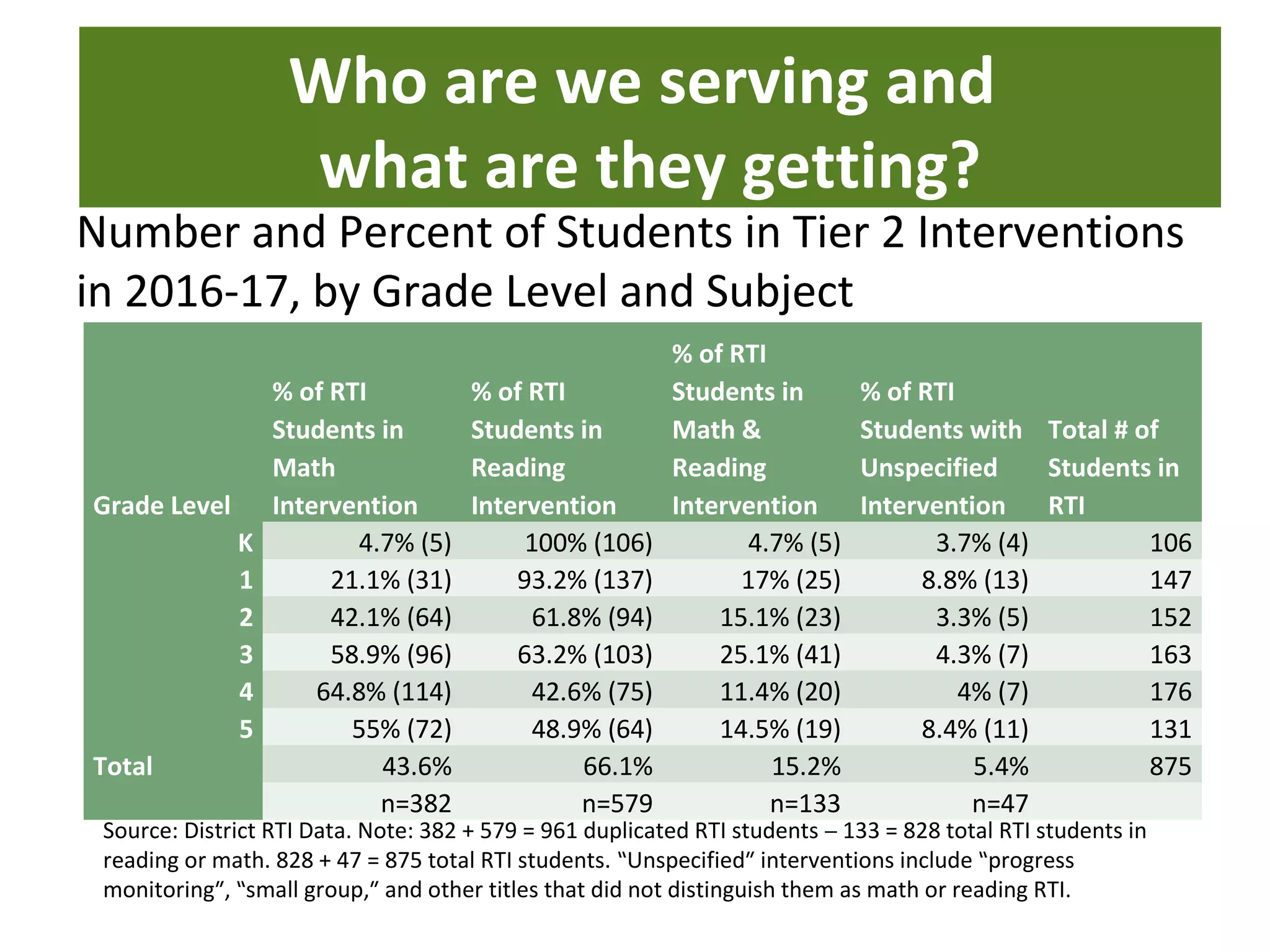
Who are we serving and
what are they getting?
Grade Level
% of RTI
Students in
Math
Intervention
% of RTI
Students in
Reading
Intervention
% of RTI
Students in
Math &
Reading
Intervention
% of RTI
Students with
Unspecified
Intervention
Total # of
Students in
RTI
K 4.7% (5) 100% (106) 4.7% (5) 3.7% (4) 106
1 21.1% (31) 93.2% (137) 17% (25) 8.8% (13) 147
2 42.1% (64) 61.8% (94) 15.1% (23) 3.3% (5) 152
3 58.9% (96) 63.2% (103) 25.1% (41) 4.3% (7) 163
4 64.8% (114) 42.6% (75) 11.4% (20) 4% (7) 176
5 55% (72) 48.9% (64) 14.5% (19) 8.4% (11) 131
Total 43.6% 66.1% 15.2% 5.4% 875
n=382 n=579 n=133 n=47
Number and Percent of Students in Tier 2 Interventions
in 2016-17, by Grade Level and Subject
Source: District RTI Data. Note: 382 + 579 = 961 duplicated RTI students – 133 = 828 total RTI students in
reading or math. 828 + 47 = 875 total RTI students. “Unspecified” interventions include “progress
monitoring”, “small group,” and other titles that did not distinguish them as math or reading RTI.
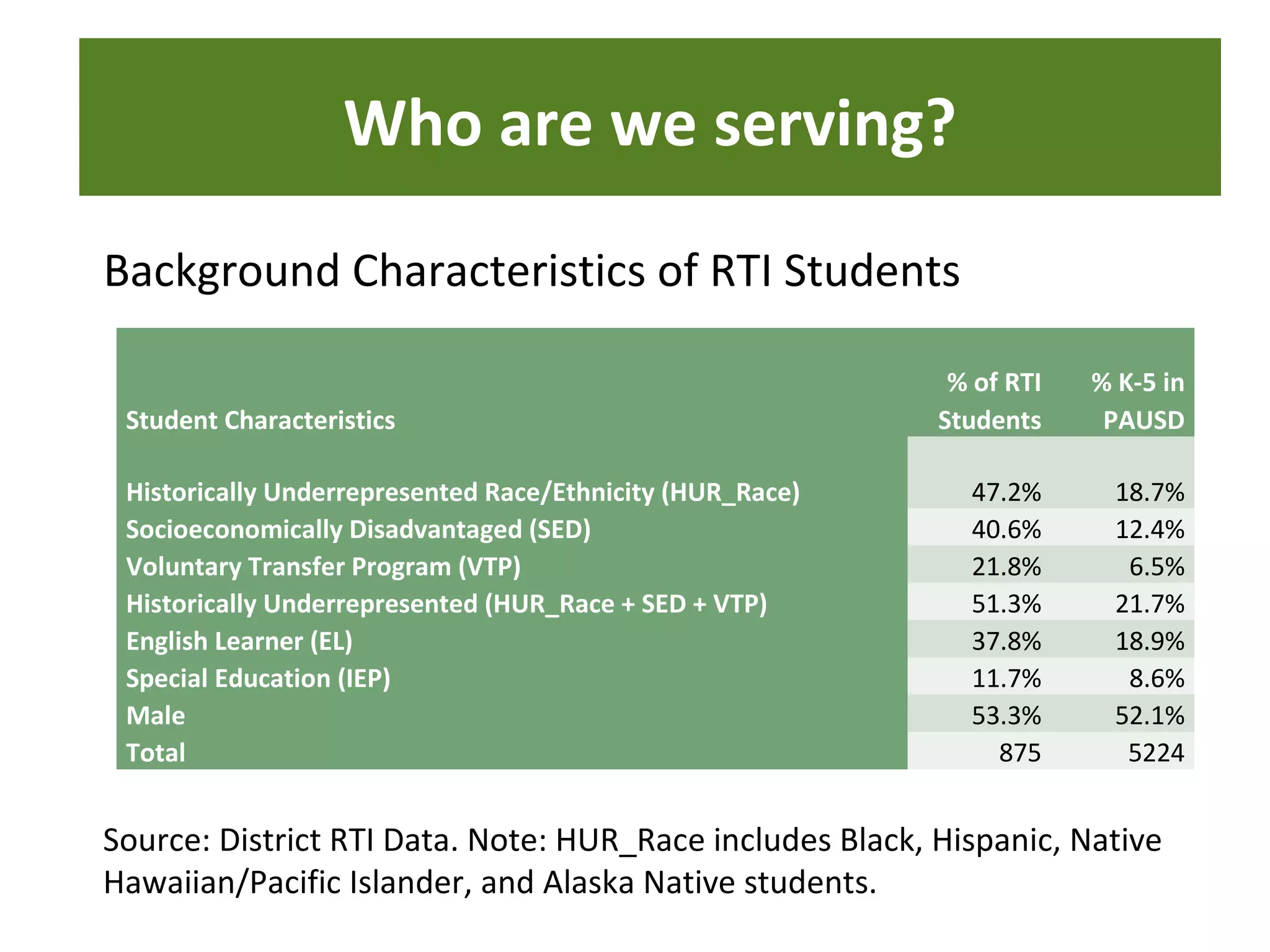
Who are we serving?
Background Characteristics of RTI Students
Source: District RTI Data. Note: HUR_Race includes Black, Hispanic, Native
Hawaiian/Pacific Islander, and Alaska Native students.
Student Characteristics
% of RTI
Students
% K-5 in
PAUSD
Historically Underrepresented Race/Ethnicity (HUR_Race) 47.2% 18.7%
Socioeconomically Disadvantaged (SED) 40.6% 12.4%
Voluntary Transfer Program (VTP) 21.8% 6.5%
Historically Underrepresented (HUR_Race + SED + VTP) 51.3% 21.7%
English Learner (EL) 37.8% 18.9%
Special Education (IEP) 11.7% 8.6%
Male 53.3% 52.1%
Total 875 5224
Lesson 2: Need (somewhat)
standardized RTI eligibility criteria
• Variability in student performance among RTI
students
– Below “PAUSD average” versus at or below
benchmark/standard
– Raised important discussions about Tier 1 and Tier 2
– Has now led to more common eligibility criteria
• RTI students’ CAASPP performance
– Among fourth and fifth grade RTI students, 11 to 37 percent of
Met or Exceeded standard on their prior year (2015-16) CAASPP
assessment, in the subject they received Tier 2 intervention.
Changing systems while systems
are always changing
•RTI reading students’ BOY reading performance
– Messy because we were transitioning to new assessment
– In fall 2016, 17 percent of students in Tier 2 reading
intervention performed at or above the district’s BOY reading
benchmark level on BAS and 46 percent performed at or above
the district’s BOY benchmark on DRA.
•Math RTI students’ BOY math performance
– Exploring how to best use NWEA MAP data in Year 1
– Less than 1 percent of RTI math students in grades 3 to 5 scored
at or above the PAUSD average on the BOY NWEA MAP
assessment.
– However, over 40 percent of students in RTI math intervention
scored above the national average for their grade level.
Lesson 3: Implementation progress;
system challenges remain
• Remaining challenges
– Finding qualified staff to teach after school
– Student transportation
– Dosage and implementing interventions with
fidelity
– Setting targeted goals for students and targeting
RTI instruction in groups with varying needs
– Progress monitoring
– Improving student achievement and closing
achievement gaps
Lesson 4: Time + Targeted
Instruction = Learning
• Need to focus on targeting instruction
• Need to improve outcomes
–Among K-5 RTI students who began the
year below benchmark, 44 percent in math
and 56 percent in reading “closed the gap”
(got closer to benchmark) from BOY to EOY
–There were no consistent patterns or
significant differences in outcomes by
student characteristics, program, or staff
type.
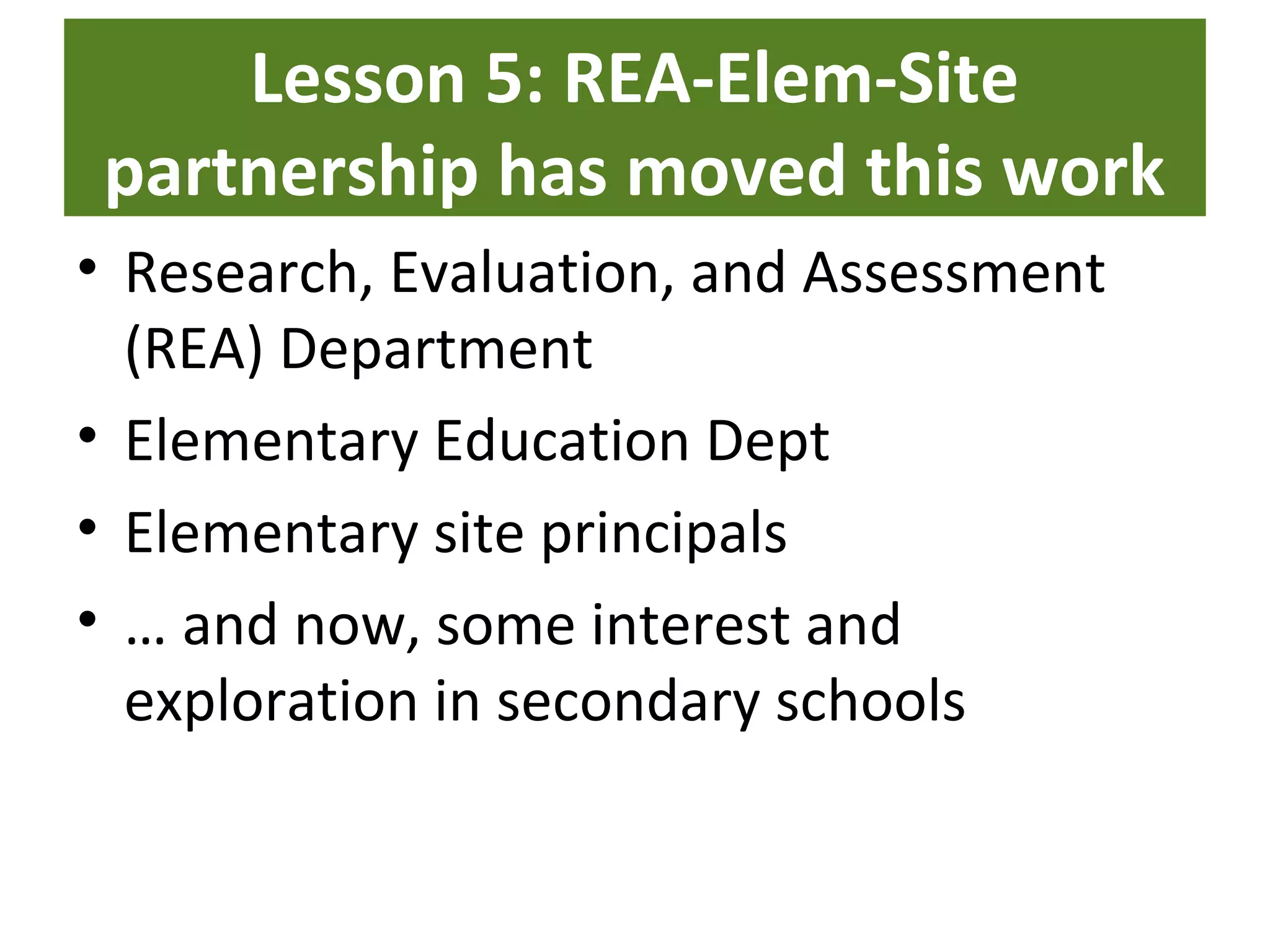
Lesson 5: REA-Elem-Site
partnership has moved this work
• Research, Evaluation, and Assessment
(REA) Department
• Elementary Education Dept
• Elementary site principals
• … and now, some interest and
exploration in secondary schools
Palo Alto Unified School District
PAUSD Elementary RTI Evaluation
Recommendations and Next Steps
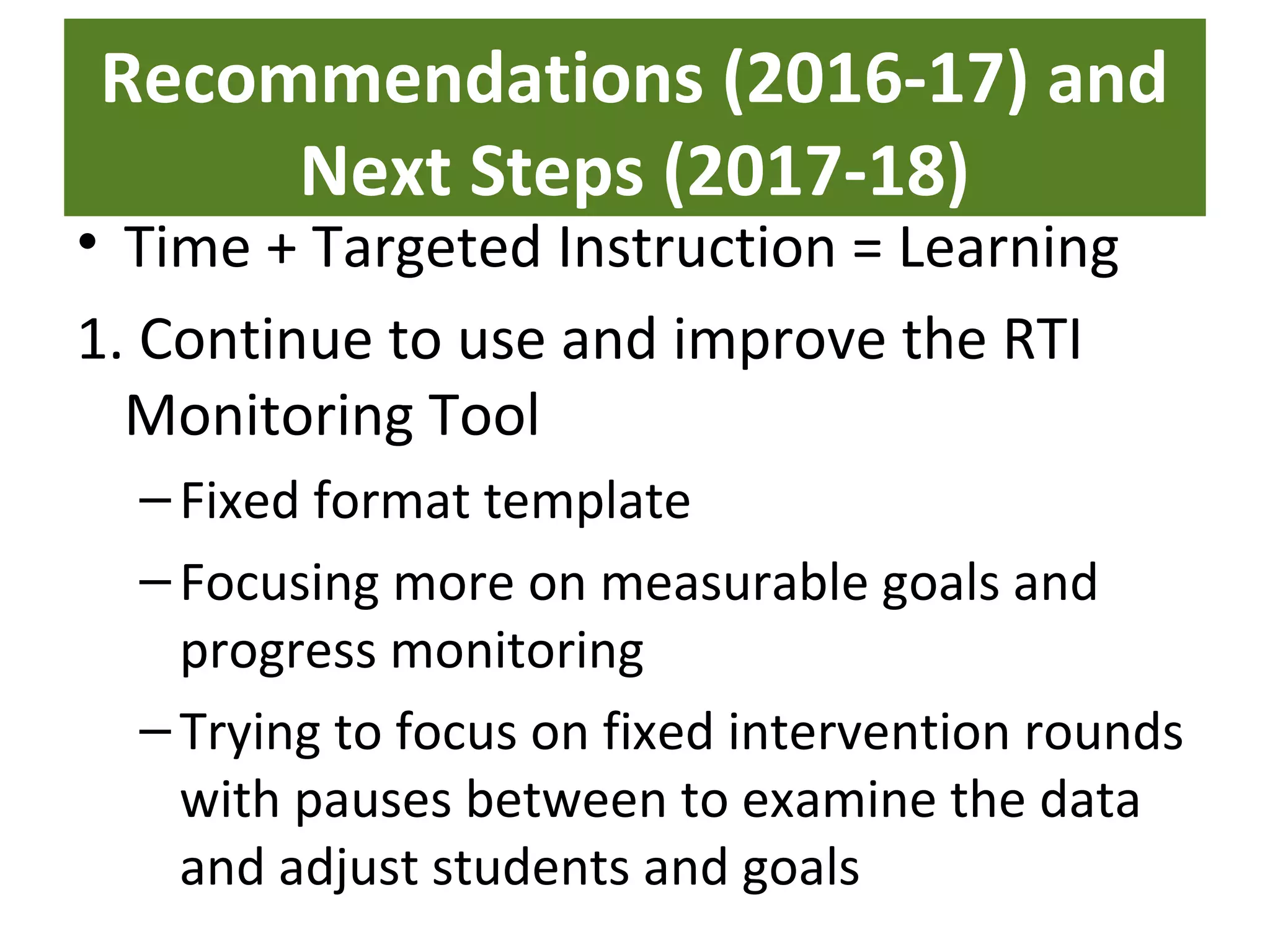
Recommendations (2016-17) and
Next Steps (2017-18)
• Time + Targeted Instruction = Learning
1. Continue to use and improve the RTI
Monitoring Tool
–Fixed format template
–Focusing more on measurable goals and
progress monitoring
–Trying to focus on fixed intervention rounds
with pauses between to examine the data
and adjust students and goals
Recommendations (2016-17) and
Next Steps (2017-18)
2. Set common expectation of prioritizing
students below benchmark or standard
(and generally, not in special education)
–Use state and local assessment data to
improve screening and identification
–Data available in DataZone, Google Sheets,
and NWEA
Recommendations (2016-17) and
Next Steps (2017-18)
3. Provide support for continuous
improvement of interventions
- TOSAs mapped standards to Bridges
Intervention volumes
- Bridges Intervention training
Recommendations (2016-17) and
Next Steps (2017-18)
4. Create a multi-tiered system of supports
(MTSS) that includes all staff PK-12
•Supporting an RTI/IST pilot at two sites,
connecting Tier 1 and 2 practices and data
through linked Google Forms and coaching
•Integrating RTI into LCAP and Equity Plan
•Supporting new high school RTI teams
•Conducting special education program
evaluation
Internal District Program Evaluation–
Breaking Down Department Silos
Internal District Program Evaluation–
Breaking Down Department Silos
Internal District Program Evaluation–
Breaking Down Department Silos
Internal District Program Evaluation
• Cost effective
⁻ $150K+ for a major research firm to do a
similar study
⁻ Previously, $70K research contractor
• Cost beneficial
⁻ We spend $130K + site expenditures on
elementary RTI. Important to know whether
the $ makes a difference to inform resource
allocation decisions.
Internal District Program Evaluation
• Research-Department partnerships
within the district can deepen and
move the work
⁻ Benefit of district context and relationships
⁻ Ability to regularly visit schools, observe, talk to
people
⁻ Strategically link programs and evaluations
together
⁻ Help the Board and administrators make
data-driven decisions
Questions?
• Thanks!
Palo Alto Unified School District

CERA 17: District Program Evaluation to Improve RTI/MTSS

  • 1.
    District Program Evaluationto Improve RTI/MTSS Clarisse Haxton, Ph.D. Program Evaluation Coordinator Palo Alto Unified School District CERA Conference 2017
  • 2.
    Agenda • PAUSD Districtand RTI Overview • RTI Evaluation Overview • Findings • RTI Monitoring Tool (data) • Implementation progress and challenges • Student outcomes • Recommendations and next steps
  • 3.
    PAUSD District andRTI Overview
  • 4.
    PAUSD District andRTI Overview • High-performing overall; substantial within-district achievement gaps • RTI/MTSS • History of RTI work in elementary • Recognized need for district system • Recommendation for evaluation in MATD Committee report and district Equity Plan • Program Evaluation Coordinator role
  • 5.
    Bufum, Matos, &Weber (2012) 5
  • 6.
    RTI Definition fromNCRTI “Response to intervention integrates assessment and intervention within a multi-level prevention system to maximize student achievement and to reduce behavioral problems. With RTI, schools use data to identify students at risk for poor learning outcomes, monitor student progress, provide evidence-based interventions and adjust the intensity and nature of those interventions depending on a student’s responsiveness, and identify students with learning disabilities or other disabilities… This system includes three levels of intensity or three levels of prevention, which represent a continuum of supports. Many schools use more than one intervention within a given level of prevention.” Palo Alto Unified School District 6National Center on Response to Intervention (2010)
  • 7.
    RTI/MTSS “Rules ofThumb” • Tier 1: classroom instruction (“best first instruction”) provided to all students; serves 80 to 85% of students • Tier 2: interventions are supplementary instruction and support on targeted areas of student need; serves approximately 10-15% of students • Tier 3: interventions are more intensive and individualized, supplementary to core classroom instruction; serve approximately 5 to 10% of students 7
  • 8.
  • 9.
    Evaluation Purpose • Providean inventory of Tier 2 interventions: – # students are being served – student characteristics – Tier 2 interventions are being used • Describe: – screening and identification practices – intervention implementation – progress monitoring practices – RTI student outcomes • Make recommendations for continuous improvement
  • 10.
    Evaluation Questions • Who’sbeing served? • How are they identified? • What are they getting? • How are we monitoring progress? • What progress are students making? • What’s working well? • What are challenges? • What can we do better?
  • 11.
  • 12.
    Lesson 1: Needdata • Problem of Practice ⁻ Lacked system to identify and track students in Tier 2 intervention ⁻ Need to answer “who” and “what” before you can answer “How are we doing?” • Solution: Created a RTI Monitoring Tool (Google sheet) across all elementary schools
  • 13.
    RTI Monitoring Tool (GoogleSheets) • Students who received RTI • Classroom teacher and grade level • RTI subject (math, reading/literacy) • Intervention program name(s) • Intervention teacher(s) • Assessment scores that made a student eligible for RTI • Beginning of intervention (BOI) assessment score • Progress monitoring score (at least 1) • End of intervention (EOI) assessment score
  • 14.
    RTI Monitoring Tool (GoogleSheets) • 2016-17 RTI Monitoring Tool
  • 15.
    Who are weserving and what are they getting? Grade Level % of RTI Students in Math Intervention % of RTI Students in Reading Intervention % of RTI Students in Math & Reading Intervention % of RTI Students with Unspecified Intervention Total # of Students in RTI K 4.7% (5) 100% (106) 4.7% (5) 3.7% (4) 106 1 21.1% (31) 93.2% (137) 17% (25) 8.8% (13) 147 2 42.1% (64) 61.8% (94) 15.1% (23) 3.3% (5) 152 3 58.9% (96) 63.2% (103) 25.1% (41) 4.3% (7) 163 4 64.8% (114) 42.6% (75) 11.4% (20) 4% (7) 176 5 55% (72) 48.9% (64) 14.5% (19) 8.4% (11) 131 Total 43.6% 66.1% 15.2% 5.4% 875 n=382 n=579 n=133 n=47 Number and Percent of Students in Tier 2 Interventions in 2016-17, by Grade Level and Subject Source: District RTI Data. Note: 382 + 579 = 961 duplicated RTI students – 133 = 828 total RTI students in reading or math. 828 + 47 = 875 total RTI students. “Unspecified” interventions include “progress monitoring”, “small group,” and other titles that did not distinguish them as math or reading RTI.
  • 16.
    Who are weserving? Background Characteristics of RTI Students Source: District RTI Data. Note: HUR_Race includes Black, Hispanic, Native Hawaiian/Pacific Islander, and Alaska Native students. Student Characteristics % of RTI Students % K-5 in PAUSD Historically Underrepresented Race/Ethnicity (HUR_Race) 47.2% 18.7% Socioeconomically Disadvantaged (SED) 40.6% 12.4% Voluntary Transfer Program (VTP) 21.8% 6.5% Historically Underrepresented (HUR_Race + SED + VTP) 51.3% 21.7% English Learner (EL) 37.8% 18.9% Special Education (IEP) 11.7% 8.6% Male 53.3% 52.1% Total 875 5224
  • 17.
    Lesson 2: Need(somewhat) standardized RTI eligibility criteria • Variability in student performance among RTI students – Below “PAUSD average” versus at or below benchmark/standard – Raised important discussions about Tier 1 and Tier 2 – Has now led to more common eligibility criteria • RTI students’ CAASPP performance – Among fourth and fifth grade RTI students, 11 to 37 percent of Met or Exceeded standard on their prior year (2015-16) CAASPP assessment, in the subject they received Tier 2 intervention.
  • 18.
    Changing systems whilesystems are always changing •RTI reading students’ BOY reading performance – Messy because we were transitioning to new assessment – In fall 2016, 17 percent of students in Tier 2 reading intervention performed at or above the district’s BOY reading benchmark level on BAS and 46 percent performed at or above the district’s BOY benchmark on DRA. •Math RTI students’ BOY math performance – Exploring how to best use NWEA MAP data in Year 1 – Less than 1 percent of RTI math students in grades 3 to 5 scored at or above the PAUSD average on the BOY NWEA MAP assessment. – However, over 40 percent of students in RTI math intervention scored above the national average for their grade level.
  • 19.
    Lesson 3: Implementationprogress; system challenges remain • Remaining challenges – Finding qualified staff to teach after school – Student transportation – Dosage and implementing interventions with fidelity – Setting targeted goals for students and targeting RTI instruction in groups with varying needs – Progress monitoring – Improving student achievement and closing achievement gaps
  • 20.
    Lesson 4: Time+ Targeted Instruction = Learning • Need to focus on targeting instruction • Need to improve outcomes –Among K-5 RTI students who began the year below benchmark, 44 percent in math and 56 percent in reading “closed the gap” (got closer to benchmark) from BOY to EOY –There were no consistent patterns or significant differences in outcomes by student characteristics, program, or staff type.
  • 21.
    Lesson 5: REA-Elem-Site partnershiphas moved this work • Research, Evaluation, and Assessment (REA) Department • Elementary Education Dept • Elementary site principals • … and now, some interest and exploration in secondary schools Palo Alto Unified School District
  • 22.
    PAUSD Elementary RTIEvaluation Recommendations and Next Steps
  • 23.
    Recommendations (2016-17) and NextSteps (2017-18) • Time + Targeted Instruction = Learning 1. Continue to use and improve the RTI Monitoring Tool –Fixed format template –Focusing more on measurable goals and progress monitoring –Trying to focus on fixed intervention rounds with pauses between to examine the data and adjust students and goals
  • 24.
    Recommendations (2016-17) and NextSteps (2017-18) 2. Set common expectation of prioritizing students below benchmark or standard (and generally, not in special education) –Use state and local assessment data to improve screening and identification –Data available in DataZone, Google Sheets, and NWEA
  • 25.
    Recommendations (2016-17) and NextSteps (2017-18) 3. Provide support for continuous improvement of interventions - TOSAs mapped standards to Bridges Intervention volumes - Bridges Intervention training
  • 26.
    Recommendations (2016-17) and NextSteps (2017-18) 4. Create a multi-tiered system of supports (MTSS) that includes all staff PK-12 •Supporting an RTI/IST pilot at two sites, connecting Tier 1 and 2 practices and data through linked Google Forms and coaching •Integrating RTI into LCAP and Equity Plan •Supporting new high school RTI teams •Conducting special education program evaluation
  • 27.
    Internal District ProgramEvaluation– Breaking Down Department Silos
  • 28.
    Internal District ProgramEvaluation– Breaking Down Department Silos
  • 29.
    Internal District ProgramEvaluation– Breaking Down Department Silos
  • 30.
    Internal District ProgramEvaluation • Cost effective ⁻ $150K+ for a major research firm to do a similar study ⁻ Previously, $70K research contractor • Cost beneficial ⁻ We spend $130K + site expenditures on elementary RTI. Important to know whether the $ makes a difference to inform resource allocation decisions.
  • 31.
    Internal District ProgramEvaluation • Research-Department partnerships within the district can deepen and move the work ⁻ Benefit of district context and relationships ⁻ Ability to regularly visit schools, observe, talk to people ⁻ Strategically link programs and evaluations together ⁻ Help the Board and administrators make data-driven decisions
  • 32.
    Questions? • Thanks! Palo AltoUnified School District