1 © Nokia Siemens Networks 
BSSPAR1: Chapter 4 Radio Resource Management
2 © Nokia Siemens Networks 
Legal Notice 
Intellectual Property Rights 
All copyrights and intellectual property rights for Nokia Siemens Networks training documentation, product documentation and slide presentation material, all of which are forthwith known as Nokia Siemens Networks training material, are the exclusive property of Nokia Siemens Networks . Nokia Siemens Networks owns the rights to copying, modification, translation, adaptation or derivatives including any improvements or developments. Nokia Siemens Networks has the sole right to copy, distribute, amend, modify, develop, license, sublicense, sell, transfer and assign the Nokia Siemens Networks training material. 
Individuals can use the Nokia Siemens Networks training material for their own personal self-development only, those same individuals cannot subsequently pass on that same Intellectual Property to others without the prior written agreement of Nokia Siemens Networks . 
The Nokia Siemens Networks training material cannot be used outside of an agreed Nokia Siemens Networks training session for development of groups without the prior written agreement of Nokia Siemens Networks.
3 © Nokia Siemens Networks 
Module Objectives 
•Give an overview about the signalling to establish and release a call 
•Discuss the standard and maximum acceptable interference level algorithm used for TCH allocation 
•Explain prioritised TCH allocation 
•Give an overview about the parameter settings applied to queuing 
•Explain how the queue is entered and left, and how these processes interact with handover and especially directed retry 
•Discuss the algorithms to verify call drop and re-establish a call 
•Explain TCH allocation and queuing for Wireless Priority of Service (WPS)
4 © Nokia Siemens Networks 
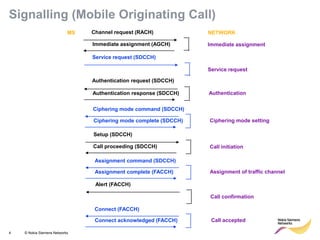
Channel request (RACH) 
MS 
NETWORK 
Immediate assignment 
Immediate assignment (AGCH) 
Service request (SDCCH) 
Service request 
Authentication request (SDCCH) 
Authentication response (SDCCH) 
Authentication 
Ciphering mode command (SDCCH) 
Ciphering mode complete (SDCCH) 
Ciphering mode setting 
Setup (SDCCH) 
Call initiation 
Call proceeding (SDCCH) 
Assignment command (SDCCH) 
Assignment complete (FACCH) 
Assignment of traffic channel 
Alert (FACCH) 
Call confirmation 
Connect (FACCH) 
Connect acknowledged (FACCH) 
Call accepted 
Signalling (Mobile Originating Call)
5 © Nokia Siemens Networks 
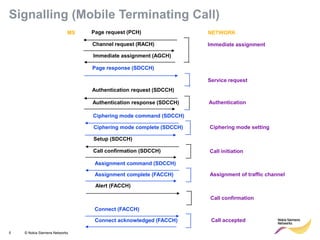
Page request (PCH) 
MS 
NETWORK 
Immediate assignment 
Channel request (RACH) 
Page response (SDCCH) 
Service request 
Authentication request (SDCCH) 
Authentication response (SDCCH) 
Authentication 
Ciphering mode command (SDCCH) 
Ciphering mode complete (SDCCH) 
Ciphering mode setting 
Setup (SDCCH) 
Call initiation 
Call confirmation (SDCCH) 
Assignment command (SDCCH) 
Assignment complete (FACCH) 
Assignment of traffic channel 
Alert (FACCH) 
Call confirmation 
Connect (FACCH) 
Connect acknowledged (FACCH) 
Call accepted 
Immediate assignment (AGCH) 
Signalling (Mobile Terminating Call)
6 © Nokia Siemens Networks 
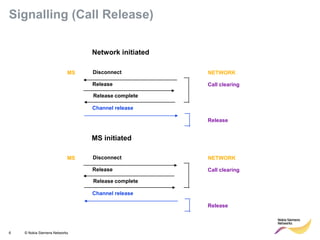
Disconnect 
MS 
NETWORK 
Call clearing 
Release 
Channel release 
Release 
Release complete 
Disconnect 
MS 
NETWORK 
Call clearing 
Release 
Channel release 
Release 
Release complete 
Network initiated 
MS initiated 
Signalling (Call Release)
7 © Nokia Siemens Networks 
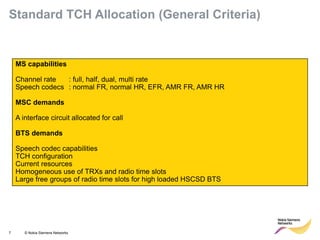
MS capabilities 
Channel rate : full, half, dual, multi rate 
Speech codecs : normal FR, normal HR, EFR, AMR FR, AMR HR 
MSC demands 
A interface circuit allocated for call 
BTS demands 
Speech codec capabilities 
TCH configuration 
Current resources 
Homogeneous use of TRXs and radio time slots 
Large free groups of radio time slots for high loaded HSCSD BTS 
Standard TCH Allocation (General Criteria)
8 © Nokia Siemens Networks 
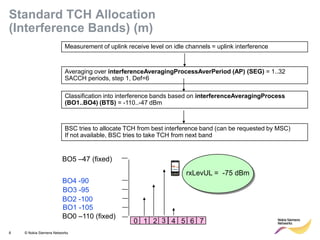
Measurement of uplink receive level on idle channels = uplink interference 
Averaging over interferenceAveragingProcessAverPeriod (AP) (SEG) = 1..32 SACCH periods, step 1, Def=6 
Classification into interference bands based on interferenceAveragingProcess (BO1..BO4) (BTS) = -110..-47 dBm 
BSC tries to allocate TCH from best interference band (can be requested by MSC) If not available, BSC tries to take TCH from next band 
0 
7 
1 
2 
3 
4 
5 
6 
rxLevUL = -75 dBm 
BO5 –47 (fixed) 
BO0 –110 (fixed) 
BO4 -90 
BO3 -95 
BO1 -105 
BO2 -100 
Standard TCH Allocation (Interference Bands) (m)
9 © Nokia Siemens Networks 
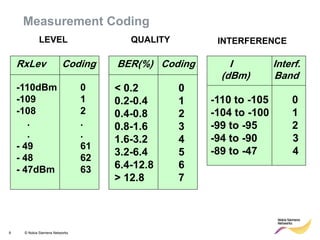
Measurement Coding 
RxLev Coding 
-110dBm 0 
-109 1 
-108 2 
. . 
. . 
- 49 61 
- 48 62 
- 47dBm 63 
BER(%) Coding 
< 0.2 0 
0.2-0.4 1 
0.4-0.8 2 
0.8-1.6 3 
1.6-3.2 4 
3.2-6.4 5 
6.4-12.8 6 
> 12.8 7 
I Interf. 
(dBm) Band 
-110 to -105 0 
-104 to -100 1 
-99 to -95 2 
-94 to -90 3 
-89 to -47 4 
LEVEL 
QUALITY 
INTERFERENCE
10 © Nokia Siemens Networks 
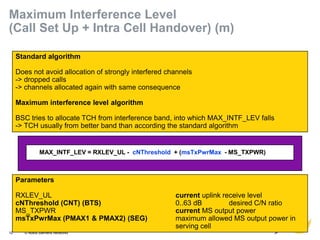
MAX_INTF_LEV = RXLEV_UL - cNThreshold + (msTxPwrMax - MS_TXPWR) 
Standard algorithm 
Does not avoid allocation of strongly interfered channels 
-> dropped calls 
-> channels allocated again with same consequence 
Maximum interference level algorithm 
BSC tries to allocate TCH from interference band, into which MAX_INTF_LEV falls 
-> TCH usually from better band than according the standard algorithm 
Parameters 
RXLEV_UL current uplink receive level 
cNThreshold (CNT) (BTS) 0..63 dB desired C/N ratio 
MS_TXPWR current MS output power 
msTxPwrMax (PMAX1 & PMAX2) (SEG) maximum allowed MS output power in serving cell 
Maximum Interference Level (Call Set Up + Intra Cell Handover) (m)
11 © Nokia Siemens Networks 
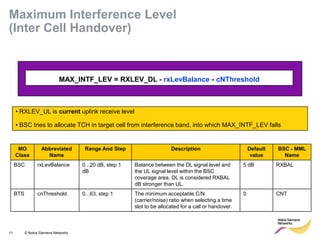
MAX_INTF_LEV = RXLEV_DL - rxLevBalance - cNThreshold 
• RXLEV_UL is current uplink receive level 
• BSC tries to allocate TCH in target cell from interference band, into which MAX_INTF_LEV falls 
Maximum Interference Level (Inter Cell Handover) 
MO Class 
Abbreviated Name 
Range And Step 
Description 
Default value 
BSC - MML Name 
BSC 
rxLevBalance 
0...20 dB, step 1 dB 
Balance between the DL signal level and the UL signal level within the BSC coverage area. DL is considered RXBAL dB stronger than UL. 
5 dB 
RXBAL 
BTS 
cnThreshold 
0...63, step 1 
The minimum acceptable C/N (carrier/noise) ratio when selecting a time slot to be allocated for a call or handover. 
0 
CNT
12 © Nokia Siemens Networks 
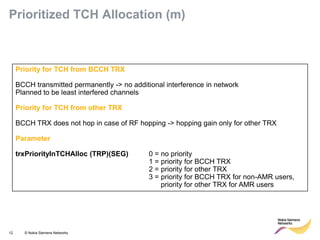
Priority for TCH from BCCH TRX 
BCCH transmitted permanently -> no additional interference in network 
Planned to be least interfered channels 
Priority for TCH from other TRX 
BCCH TRX does not hop in case of RF hopping -> hopping gain only for other TRX 
Parameter 
trxPriorityInTCHAlloc (TRP)(SEG) 0 = no priority 
1 = priority for BCCH TRX 
2 = priority for other TRX 
3 = priority for BCCH TRX for non-AMR users, 
priority for other TRX for AMR users 
Prioritized TCH Allocation (m)
13 © Nokia Siemens Networks 
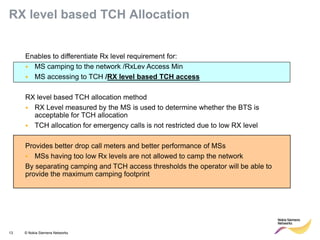
Enables to differentiate Rx level requirement for: 
•MS camping to the network /RxLev Access Min 
•MS accessing to TCH /RX level based TCH access RX level based TCH allocation method 
•RX Level measured by the MS is used to determine whether the BTS is acceptable for TCH allocation 
•TCH allocation for emergency calls is not restricted due to low RX level Provides better drop call meters and better performance of MSs 
•MSs having too low Rx levels are not allowed to camp the network By separating camping and TCH access thresholds the operator will be able to provide the maximum camping footprint 
RX level based TCH Allocation
14 © Nokia Siemens Networks 
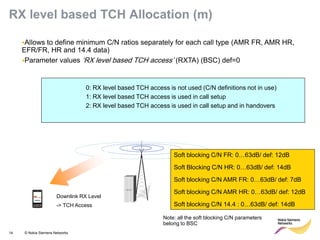
•Allows to define minimum C/N ratios separately for each call type (AMR FR, AMR HR, 
EFR/FR, HR and 14.4 data) 
•Parameter values ‘RX level based TCH access’ (RXTA) (BSC) def=0 
0: RX level based TCH access is not used (C/N definitions not in use) 
1: RX level based TCH access is used in call setup 
2: RX level based TCH access is used in call setup and in handovers 
Downlink RX Level 
-> TCH Access 
Soft blocking C/N FR: 0…63dB/ def: 12dB 
Soft Blocking C/N HR: 
Soft blocking C/N AMR FR: 
Soft blocking C/N AMR HR: 
Soft blocking C/N 
0…63dB/ def: 14dB 
0…63dB/ def: 7dB 
0…63dB/ def: 12dB 
14.4 : 0…63dB/ def: 14dB 
RX level based TCH Allocation (m) 
Note: all the soft blocking C/N parameters 
belong to BSC
15 © Nokia Siemens Networks 
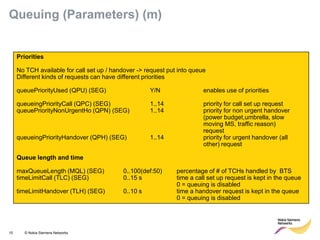
Priorities 
No TCH available for call set up / handover -> request put into queue 
Different kinds of requests can have different priorities 
queuePriorityUsed (QPU) (SEG) Y/N enables use of priorities 
queueingPriorityCall (QPC) (SEG) 1..14 priority for call set up request 
queuePriorityNonUrgentHo (QPN) (SEG) 1..14 priority for non urgent handover (power budget,umbrella, slow moving MS, traffic reason) 
request 
queueingPriorityHandover (QPH) (SEG) 1..14 priority for urgent handover (all other) request 
Queue length and time 
maxQueueLength (MQL) (SEG) 0..100(def:50) percentage of # of TCHs handled by BTS timeLimitCall (TLC) (SEG) 0..15 s time a call set up request is kept in the queue 
0 = queuing is disabled 
timeLimitHandover (TLH) (SEG) 0..10 s time a handover request is kept in the queue 
0 = queuing is disabled 
Queuing (Parameters) (m)
16 © Nokia Siemens Networks 
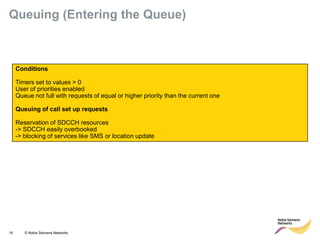
Conditions 
Timers set to values > 0 
User of priorities enabled 
Queue not full with requests of equal or higher priority than the current one 
Queuing of call set up requests 
Reservation of SDCCH resources 
-> SDCCH easily overbooked 
-> blocking of services like SMS or location update 
Queuing (Entering the Queue)
17 © Nokia Siemens Networks 
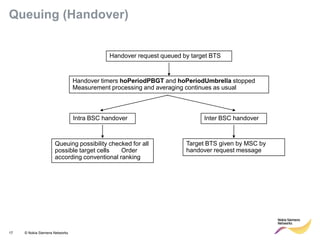
Handover request queued by target BTS 
Handover timers hoPeriodPBGT and hoPeriodUmbrella stopped Measurement processing and averaging continues as usual 
Intra BSC handover 
Inter BSC handover 
Queuing possibility checked for all possible target cells Order according conventional ranking 
Target BTS given by MSC by handover request message 
Queuing (Handover)
18 © Nokia Siemens Networks 
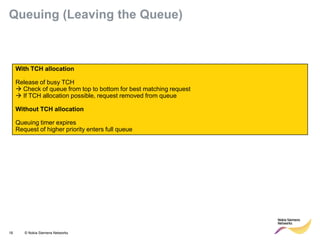
With TCH allocation 
Release of busy TCH 
 Check of queue from top to bottom for best matching request 
 If TCH allocation possible, request removed from queue 
Without TCH allocation 
Queuing timer expires 
Request of higher priority enters full queue 
Queuing (Leaving the Queue)
19 © Nokia Siemens Networks 
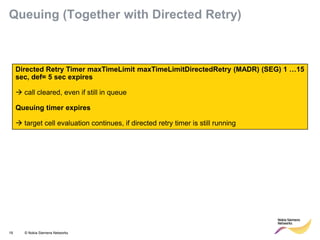
Directed Retry Timer maxTimeLimit maxTimeLimitDirectedRetry (MADR) (SEG) 1 …15 sec, def= 5 sec expires 
 call cleared, even if still in queue 
Queuing timer expires 
 target cell evaluation continues, if directed retry timer is still running 
Queuing (Together with Directed Retry)
20 © Nokia Siemens Networks 
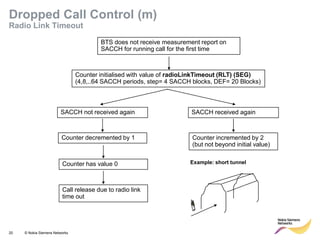
BTS does not receive measurement report on SACCH for running call for the first time 
Counter initialised with value of radioLinkTimeout (RLT) (SEG) (4,8,..64 SACCH periods, step= 4 SACCH blocks, DEF= 20 Blocks) 
SACCH not received again 
Counter decremented by 1 
SACCH received again 
Counter incremented by 2 (but not beyond initial value) 
Counter has value 0 
Call release due to radio link time out 
Example: short tunnel 
Dropped Call Control (m) Radio Link Timeout
21 © Nokia Siemens Networks 
•RLT is based on SACCH deletion but SACCH is though not using a dynamic codec like voice in AMR, which means: 
•Using the EFR RLT value an AMR customer can have the call dropped because RLT = 0 when still the FER is good 
•RLT is not anymore reliable with the same value in AMR than in EFR 
•Due to the fact that the FER performance is different when comparing AMR calls to EFR calls, the Radio Link Timeout need to be defined separately for AMR 
•The Radio Link Timeout parameters for AMR are ARLT and AHRLT. The principle of these is the same than in the RLT but it is used only for the AMR capable mobile stations. ARLT & AHRLT are not supported in Talk Family base stations. 
Dropped Call Control Radio Link Timeout
22 © Nokia Siemens Networks 
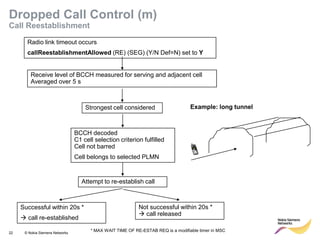
Radio link timeout occurs 
callReestablishmentAllowed (RE) (SEG) (Y/N Def=N) set to Y 
Receive level of BCCH measured for serving and adjacent cell Averaged over 5 s 
Strongest cell considered 
BCCH decoded C1 cell selection criterion fulfilled Cell not barred 
Cell belongs to selected PLMN 
Attempt to re-establish call 
Successful within 20s * 
 call re-established 
Not successful within 20s *  call released 
Example: long tunnel 
Dropped Call Control (m) Call Reestablishment 
* MAX WAIT TIME OF RE-ESTAB REQ is a modifiable timer in MSC
23 © Nokia Siemens Networks 
•Wireless Priority Service is intended for National Security and Emergency Preparedness (NS/EP) leaders and key personnel(ANSI Markets) 
•WPS calls are given priority access to the next available radio traffic channel in congestion situation 
•Reasonable amount of radio capacity must be available also for public users 
Wireless Priority Service
24 © Nokia Siemens Networks 
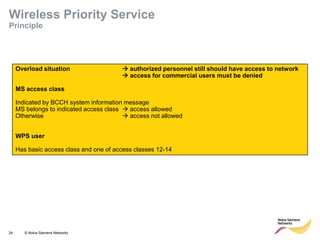
Overload situation  authorized personnel still should have access to network 
 access for commercial users must be denied 
MS access class 
Indicated by BCCH system information message 
MS belongs to indicated access class  access allowed 
Otherwise  access not allowed 
WPS user 
Has basic access class and one of access classes 12-14 
Wireless Priority Service Principle
25 © Nokia Siemens Networks 
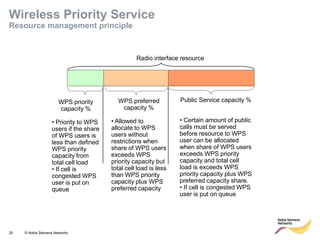
WPS priority capacity % 
• Priority to WPS users if the share of WPS users is less than defined WPS priority capacity from total cell load 
• If cell is congested WPS user is put on queue 
WPS preferred capacity % 
• Allowed to allocate to WPS users without restrictions when share of WPS users exceeds WPS priority capacity but total cell load is less than WPS priority capacity plus WPS preferred capacity 
Public Service capacity % 
• Certain amount of public calls must be served before resource to WPS user can be allocated when share of WPS users exceeds WPS priority capacity and total cell load is exceeds WPS priority capacity plus WPS preferred capacity share. 
• If cell is congested WPS user is put on queue 
Radio interface resource 
Wireless Priority Service Resource management principle
26 © Nokia Siemens Networks 
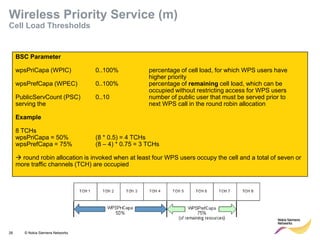
BSC Parameter 
wpsPriCapa (WPIC) 0..100% percentage of cell load, for which WPS users have higher priority 
wpsPrefCapa (WPEC) 0..100% percentage of remaining cell load, which can be occupied without restricting access for WPS users 
PublicServCount (PSC) 0..10 number of public user that must be served prior to serving the next WPS call in the round robin allocation 
Example 
8 TCHs 
wpsPriCapa = 50% (8 * 0.5) = 4 TCHs 
wpsPrefCapa = 75% (8 – 4) * 0.75 = 3 TCHs 
 round robin allocation is invoked when at least four WPS users occupy the cell and a total of seven or more traffic channels (TCH) are occupied 
Wireless Priority Service (m) Cell Load Thresholds
27 © Nokia Siemens Networks 
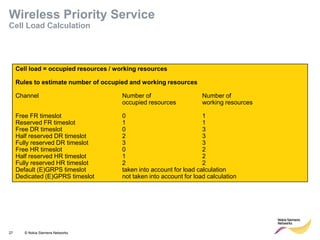
Cell load = occupied resources / working resources 
Rules to estimate number of occupied and working resources 
Channel Number of Number of 
occupied resources working resources 
Free FR timeslot 0 1 
Reserved FR timeslot 1 1 
Free DR timeslot 0 3 
Half reserved DR timeslot 2 3 
Fully reserved DR timeslot 3 3 
Free HR timeslot 0 2 
Half reserved HR timeslot 1 2 
Fully reserved HR timeslot 2 2 
Default (E)GRPS timeslot taken into account for load calculation 
Dedicated (E)GPRS timeslot not taken into account for load calculation 
Wireless Priority Service Cell Load Calculation
28 © Nokia Siemens Networks 
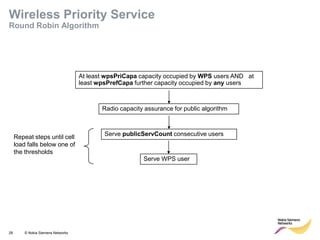
At least wpsPriCapa capacity occupied by WPS users AND at least wpsPrefCapa further capacity occupied by any users 
Radio capacity assurance for public algorithm 
Serve publicServCount consecutive users 
Serve WPS user 
Repeat steps until cell 
load falls below one of 
the thresholds 
Wireless Priority Service Round Robin Algorithm
29 © Nokia Siemens Networks 
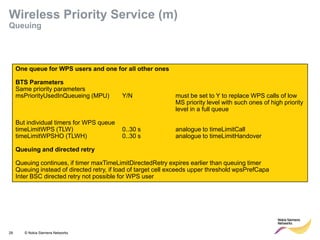
One queue for WPS users and one for all other ones 
BTS Parameters 
Same priority parameters 
msPriorityUsedInQueueing (MPU) Y/N must be set to Y to replace WPS calls of low MS priority level with such ones of high priority level in a full queue 
But individual timers for WPS queue 
timeLimitWPS (TLW) 0..30 s analogue to timeLimitCall 
timeLimitWPSHO (TLWH) 0..30 s analogue to timeLimitHandover 
Queuing and directed retry 
Queuing continues, if timer maxTimeLimitDirectedRetry expires earlier than queuing timer 
Queuing instead of directed retry, if load of target cell exceeds upper threshold wpsPrefCapa 
Inter BSC directed retry not possible for WPS user 
Wireless Priority Service (m) Queuing

radio resource_management_v1.1_chema

  • 1.
    1 © NokiaSiemens Networks BSSPAR1: Chapter 4 Radio Resource Management
  • 2.
    2 © NokiaSiemens Networks Legal Notice Intellectual Property Rights All copyrights and intellectual property rights for Nokia Siemens Networks training documentation, product documentation and slide presentation material, all of which are forthwith known as Nokia Siemens Networks training material, are the exclusive property of Nokia Siemens Networks . Nokia Siemens Networks owns the rights to copying, modification, translation, adaptation or derivatives including any improvements or developments. Nokia Siemens Networks has the sole right to copy, distribute, amend, modify, develop, license, sublicense, sell, transfer and assign the Nokia Siemens Networks training material. Individuals can use the Nokia Siemens Networks training material for their own personal self-development only, those same individuals cannot subsequently pass on that same Intellectual Property to others without the prior written agreement of Nokia Siemens Networks . The Nokia Siemens Networks training material cannot be used outside of an agreed Nokia Siemens Networks training session for development of groups without the prior written agreement of Nokia Siemens Networks.
  • 3.
    3 © NokiaSiemens Networks Module Objectives •Give an overview about the signalling to establish and release a call •Discuss the standard and maximum acceptable interference level algorithm used for TCH allocation •Explain prioritised TCH allocation •Give an overview about the parameter settings applied to queuing •Explain how the queue is entered and left, and how these processes interact with handover and especially directed retry •Discuss the algorithms to verify call drop and re-establish a call •Explain TCH allocation and queuing for Wireless Priority of Service (WPS)
  • 4.
    4 © NokiaSiemens Networks Channel request (RACH) MS NETWORK Immediate assignment Immediate assignment (AGCH) Service request (SDCCH) Service request Authentication request (SDCCH) Authentication response (SDCCH) Authentication Ciphering mode command (SDCCH) Ciphering mode complete (SDCCH) Ciphering mode setting Setup (SDCCH) Call initiation Call proceeding (SDCCH) Assignment command (SDCCH) Assignment complete (FACCH) Assignment of traffic channel Alert (FACCH) Call confirmation Connect (FACCH) Connect acknowledged (FACCH) Call accepted Signalling (Mobile Originating Call)
  • 5.
    5 © NokiaSiemens Networks Page request (PCH) MS NETWORK Immediate assignment Channel request (RACH) Page response (SDCCH) Service request Authentication request (SDCCH) Authentication response (SDCCH) Authentication Ciphering mode command (SDCCH) Ciphering mode complete (SDCCH) Ciphering mode setting Setup (SDCCH) Call initiation Call confirmation (SDCCH) Assignment command (SDCCH) Assignment complete (FACCH) Assignment of traffic channel Alert (FACCH) Call confirmation Connect (FACCH) Connect acknowledged (FACCH) Call accepted Immediate assignment (AGCH) Signalling (Mobile Terminating Call)
  • 6.
    6 © NokiaSiemens Networks Disconnect MS NETWORK Call clearing Release Channel release Release Release complete Disconnect MS NETWORK Call clearing Release Channel release Release Release complete Network initiated MS initiated Signalling (Call Release)
  • 7.
    7 © NokiaSiemens Networks MS capabilities Channel rate : full, half, dual, multi rate Speech codecs : normal FR, normal HR, EFR, AMR FR, AMR HR MSC demands A interface circuit allocated for call BTS demands Speech codec capabilities TCH configuration Current resources Homogeneous use of TRXs and radio time slots Large free groups of radio time slots for high loaded HSCSD BTS Standard TCH Allocation (General Criteria)
  • 8.
    8 © NokiaSiemens Networks Measurement of uplink receive level on idle channels = uplink interference Averaging over interferenceAveragingProcessAverPeriod (AP) (SEG) = 1..32 SACCH periods, step 1, Def=6 Classification into interference bands based on interferenceAveragingProcess (BO1..BO4) (BTS) = -110..-47 dBm BSC tries to allocate TCH from best interference band (can be requested by MSC) If not available, BSC tries to take TCH from next band 0 7 1 2 3 4 5 6 rxLevUL = -75 dBm BO5 –47 (fixed) BO0 –110 (fixed) BO4 -90 BO3 -95 BO1 -105 BO2 -100 Standard TCH Allocation (Interference Bands) (m)
  • 9.
    9 © NokiaSiemens Networks Measurement Coding RxLev Coding -110dBm 0 -109 1 -108 2 . . . . - 49 61 - 48 62 - 47dBm 63 BER(%) Coding < 0.2 0 0.2-0.4 1 0.4-0.8 2 0.8-1.6 3 1.6-3.2 4 3.2-6.4 5 6.4-12.8 6 > 12.8 7 I Interf. (dBm) Band -110 to -105 0 -104 to -100 1 -99 to -95 2 -94 to -90 3 -89 to -47 4 LEVEL QUALITY INTERFERENCE
  • 10.
    10 © NokiaSiemens Networks MAX_INTF_LEV = RXLEV_UL - cNThreshold + (msTxPwrMax - MS_TXPWR) Standard algorithm Does not avoid allocation of strongly interfered channels -> dropped calls -> channels allocated again with same consequence Maximum interference level algorithm BSC tries to allocate TCH from interference band, into which MAX_INTF_LEV falls -> TCH usually from better band than according the standard algorithm Parameters RXLEV_UL current uplink receive level cNThreshold (CNT) (BTS) 0..63 dB desired C/N ratio MS_TXPWR current MS output power msTxPwrMax (PMAX1 & PMAX2) (SEG) maximum allowed MS output power in serving cell Maximum Interference Level (Call Set Up + Intra Cell Handover) (m)
  • 11.
    11 © NokiaSiemens Networks MAX_INTF_LEV = RXLEV_DL - rxLevBalance - cNThreshold • RXLEV_UL is current uplink receive level • BSC tries to allocate TCH in target cell from interference band, into which MAX_INTF_LEV falls Maximum Interference Level (Inter Cell Handover) MO Class Abbreviated Name Range And Step Description Default value BSC - MML Name BSC rxLevBalance 0...20 dB, step 1 dB Balance between the DL signal level and the UL signal level within the BSC coverage area. DL is considered RXBAL dB stronger than UL. 5 dB RXBAL BTS cnThreshold 0...63, step 1 The minimum acceptable C/N (carrier/noise) ratio when selecting a time slot to be allocated for a call or handover. 0 CNT
  • 12.
    12 © NokiaSiemens Networks Priority for TCH from BCCH TRX BCCH transmitted permanently -> no additional interference in network Planned to be least interfered channels Priority for TCH from other TRX BCCH TRX does not hop in case of RF hopping -> hopping gain only for other TRX Parameter trxPriorityInTCHAlloc (TRP)(SEG) 0 = no priority 1 = priority for BCCH TRX 2 = priority for other TRX 3 = priority for BCCH TRX for non-AMR users, priority for other TRX for AMR users Prioritized TCH Allocation (m)
  • 13.
    13 © NokiaSiemens Networks Enables to differentiate Rx level requirement for: •MS camping to the network /RxLev Access Min •MS accessing to TCH /RX level based TCH access RX level based TCH allocation method •RX Level measured by the MS is used to determine whether the BTS is acceptable for TCH allocation •TCH allocation for emergency calls is not restricted due to low RX level Provides better drop call meters and better performance of MSs •MSs having too low Rx levels are not allowed to camp the network By separating camping and TCH access thresholds the operator will be able to provide the maximum camping footprint RX level based TCH Allocation
  • 14.
    14 © NokiaSiemens Networks •Allows to define minimum C/N ratios separately for each call type (AMR FR, AMR HR, EFR/FR, HR and 14.4 data) •Parameter values ‘RX level based TCH access’ (RXTA) (BSC) def=0 0: RX level based TCH access is not used (C/N definitions not in use) 1: RX level based TCH access is used in call setup 2: RX level based TCH access is used in call setup and in handovers Downlink RX Level -> TCH Access Soft blocking C/N FR: 0…63dB/ def: 12dB Soft Blocking C/N HR: Soft blocking C/N AMR FR: Soft blocking C/N AMR HR: Soft blocking C/N 0…63dB/ def: 14dB 0…63dB/ def: 7dB 0…63dB/ def: 12dB 14.4 : 0…63dB/ def: 14dB RX level based TCH Allocation (m) Note: all the soft blocking C/N parameters belong to BSC
  • 15.
    15 © NokiaSiemens Networks Priorities No TCH available for call set up / handover -> request put into queue Different kinds of requests can have different priorities queuePriorityUsed (QPU) (SEG) Y/N enables use of priorities queueingPriorityCall (QPC) (SEG) 1..14 priority for call set up request queuePriorityNonUrgentHo (QPN) (SEG) 1..14 priority for non urgent handover (power budget,umbrella, slow moving MS, traffic reason) request queueingPriorityHandover (QPH) (SEG) 1..14 priority for urgent handover (all other) request Queue length and time maxQueueLength (MQL) (SEG) 0..100(def:50) percentage of # of TCHs handled by BTS timeLimitCall (TLC) (SEG) 0..15 s time a call set up request is kept in the queue 0 = queuing is disabled timeLimitHandover (TLH) (SEG) 0..10 s time a handover request is kept in the queue 0 = queuing is disabled Queuing (Parameters) (m)
  • 16.
    16 © NokiaSiemens Networks Conditions Timers set to values > 0 User of priorities enabled Queue not full with requests of equal or higher priority than the current one Queuing of call set up requests Reservation of SDCCH resources -> SDCCH easily overbooked -> blocking of services like SMS or location update Queuing (Entering the Queue)
  • 17.
    17 © NokiaSiemens Networks Handover request queued by target BTS Handover timers hoPeriodPBGT and hoPeriodUmbrella stopped Measurement processing and averaging continues as usual Intra BSC handover Inter BSC handover Queuing possibility checked for all possible target cells Order according conventional ranking Target BTS given by MSC by handover request message Queuing (Handover)
  • 18.
    18 © NokiaSiemens Networks With TCH allocation Release of busy TCH  Check of queue from top to bottom for best matching request  If TCH allocation possible, request removed from queue Without TCH allocation Queuing timer expires Request of higher priority enters full queue Queuing (Leaving the Queue)
  • 19.
    19 © NokiaSiemens Networks Directed Retry Timer maxTimeLimit maxTimeLimitDirectedRetry (MADR) (SEG) 1 …15 sec, def= 5 sec expires  call cleared, even if still in queue Queuing timer expires  target cell evaluation continues, if directed retry timer is still running Queuing (Together with Directed Retry)
  • 20.
    20 © NokiaSiemens Networks BTS does not receive measurement report on SACCH for running call for the first time Counter initialised with value of radioLinkTimeout (RLT) (SEG) (4,8,..64 SACCH periods, step= 4 SACCH blocks, DEF= 20 Blocks) SACCH not received again Counter decremented by 1 SACCH received again Counter incremented by 2 (but not beyond initial value) Counter has value 0 Call release due to radio link time out Example: short tunnel Dropped Call Control (m) Radio Link Timeout
  • 21.
    21 © NokiaSiemens Networks •RLT is based on SACCH deletion but SACCH is though not using a dynamic codec like voice in AMR, which means: •Using the EFR RLT value an AMR customer can have the call dropped because RLT = 0 when still the FER is good •RLT is not anymore reliable with the same value in AMR than in EFR •Due to the fact that the FER performance is different when comparing AMR calls to EFR calls, the Radio Link Timeout need to be defined separately for AMR •The Radio Link Timeout parameters for AMR are ARLT and AHRLT. The principle of these is the same than in the RLT but it is used only for the AMR capable mobile stations. ARLT & AHRLT are not supported in Talk Family base stations. Dropped Call Control Radio Link Timeout
  • 22.
    22 © NokiaSiemens Networks Radio link timeout occurs callReestablishmentAllowed (RE) (SEG) (Y/N Def=N) set to Y Receive level of BCCH measured for serving and adjacent cell Averaged over 5 s Strongest cell considered BCCH decoded C1 cell selection criterion fulfilled Cell not barred Cell belongs to selected PLMN Attempt to re-establish call Successful within 20s *  call re-established Not successful within 20s *  call released Example: long tunnel Dropped Call Control (m) Call Reestablishment * MAX WAIT TIME OF RE-ESTAB REQ is a modifiable timer in MSC
  • 23.
    23 © NokiaSiemens Networks •Wireless Priority Service is intended for National Security and Emergency Preparedness (NS/EP) leaders and key personnel(ANSI Markets) •WPS calls are given priority access to the next available radio traffic channel in congestion situation •Reasonable amount of radio capacity must be available also for public users Wireless Priority Service
  • 24.
    24 © NokiaSiemens Networks Overload situation  authorized personnel still should have access to network  access for commercial users must be denied MS access class Indicated by BCCH system information message MS belongs to indicated access class  access allowed Otherwise  access not allowed WPS user Has basic access class and one of access classes 12-14 Wireless Priority Service Principle
  • 25.
    25 © NokiaSiemens Networks WPS priority capacity % • Priority to WPS users if the share of WPS users is less than defined WPS priority capacity from total cell load • If cell is congested WPS user is put on queue WPS preferred capacity % • Allowed to allocate to WPS users without restrictions when share of WPS users exceeds WPS priority capacity but total cell load is less than WPS priority capacity plus WPS preferred capacity Public Service capacity % • Certain amount of public calls must be served before resource to WPS user can be allocated when share of WPS users exceeds WPS priority capacity and total cell load is exceeds WPS priority capacity plus WPS preferred capacity share. • If cell is congested WPS user is put on queue Radio interface resource Wireless Priority Service Resource management principle
  • 26.
    26 © NokiaSiemens Networks BSC Parameter wpsPriCapa (WPIC) 0..100% percentage of cell load, for which WPS users have higher priority wpsPrefCapa (WPEC) 0..100% percentage of remaining cell load, which can be occupied without restricting access for WPS users PublicServCount (PSC) 0..10 number of public user that must be served prior to serving the next WPS call in the round robin allocation Example 8 TCHs wpsPriCapa = 50% (8 * 0.5) = 4 TCHs wpsPrefCapa = 75% (8 – 4) * 0.75 = 3 TCHs  round robin allocation is invoked when at least four WPS users occupy the cell and a total of seven or more traffic channels (TCH) are occupied Wireless Priority Service (m) Cell Load Thresholds
  • 27.
    27 © NokiaSiemens Networks Cell load = occupied resources / working resources Rules to estimate number of occupied and working resources Channel Number of Number of occupied resources working resources Free FR timeslot 0 1 Reserved FR timeslot 1 1 Free DR timeslot 0 3 Half reserved DR timeslot 2 3 Fully reserved DR timeslot 3 3 Free HR timeslot 0 2 Half reserved HR timeslot 1 2 Fully reserved HR timeslot 2 2 Default (E)GRPS timeslot taken into account for load calculation Dedicated (E)GPRS timeslot not taken into account for load calculation Wireless Priority Service Cell Load Calculation
  • 28.
    28 © NokiaSiemens Networks At least wpsPriCapa capacity occupied by WPS users AND at least wpsPrefCapa further capacity occupied by any users Radio capacity assurance for public algorithm Serve publicServCount consecutive users Serve WPS user Repeat steps until cell load falls below one of the thresholds Wireless Priority Service Round Robin Algorithm
  • 29.
    29 © NokiaSiemens Networks One queue for WPS users and one for all other ones BTS Parameters Same priority parameters msPriorityUsedInQueueing (MPU) Y/N must be set to Y to replace WPS calls of low MS priority level with such ones of high priority level in a full queue But individual timers for WPS queue timeLimitWPS (TLW) 0..30 s analogue to timeLimitCall timeLimitWPSHO (TLWH) 0..30 s analogue to timeLimitHandover Queuing and directed retry Queuing continues, if timer maxTimeLimitDirectedRetry expires earlier than queuing timer Queuing instead of directed retry, if load of target cell exceeds upper threshold wpsPrefCapa Inter BSC directed retry not possible for WPS user Wireless Priority Service (m) Queuing