4TC-Architectures de Réseaux Mobiles
Mobile Network Architectures
Part 1 – Logical Channels
R. Stanica & F. Valois
Version 1.0, Sept. 2014
l User and control planes
l Downlink/uplink
l Shared and dedicated information
l Physical channels
l Logical channels
l Transport channels
l Call establishment scenario
Outline
l Also known as data plane
l The goal of any (mobile) network:
l Get data from source to destination
l As quickly and efficiently as possible
l User data:
l Voice calls (GSM)
l Voice calls and IP applications (UMTS)
l IP applications (LTE)
User plane
l Any information exchange the network needs in order to
take the user data from source to destination
l Classical examples in the IP world: building routing tables
l In mobile networks:
l Keep track of the mobile nodes
l Call establishment
l Resource allocation
Control plane
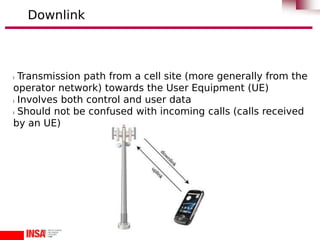
l Transmission path from a cell site (more generally from the
operator network) towards the User Equipment (UE)
l Involves both control and user data
l Should not be confused with incoming calls (calls received
by an UE)
Downlink
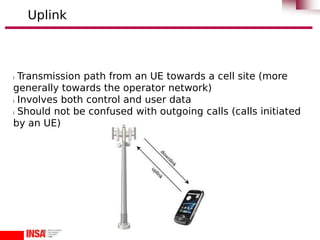
l Transmission path from an UE towards a cell site (more
generally towards the operator network)
l Involves both control and user data
l Should not be confused with outgoing calls (calls initiated
by an UE)
Uplink
l Information useful to multiple UEs
l Generally control data
l But also user data: multicast or broadcast groups
Common information
l Information destined to or coming from a single UE
l Some control data (channel estimation, resource
allocation, handover information, etc.)
l Secure transmission of most of the user data
Dedicated information
l Physical channels
l Define where data is transmitted over the air (which
slot/carrier frequency in GSM, which OFDM symbols in LTE)
lTransport channels
l Define how data is transmitted over the air (encoding,
interleaving options, etc.)
l Logical channels
l Define what type of information is transmitted over the air
(dedicated/shared, user/control)
Channels
l Common channels
l Carry common information
l Shared channels
l Carry dedicated information, using shared resources
l Dedicated channels
l Carry dedicated information on dedicated resources
Channels
l Define the way information is treated at the physical layer
l Can be considered as a service provided by the physical
layer to the MAC layer
l Data is multiplexed into transport channels depending on
how it is transmitted over the air
l Do not exist in the GSM architecture
Transport channels
l Broadcast Channel
l BCH (UMTS and LTE)
l Downlink
l Control
l Common
l Used to transmit system and cell related information to the
UE
Transport channels
l Multicast Channel
l MCH (LTE only)
l Downlink
l User and Control
l Common
l Used to establish and manage a multicast group and
multicast traffic exchange
Transport channels
l Paging Channel
l PCH (UMTS and LTE)
l Downlink
l Control
l Common
l Used to broadcast paging messages in one or several cells
l Supports discontinuous reception (DRX) from the UE,
enabling the power save mode
Transport channels
l Random Access Channel
l RACH (UMTS and LTE)
l CPCH = Common Packet Channel (UMTS)
l Uplink
l Control and User
l Common
l Used for initial access to the network by the UE and transport
of non-real-time user data
Transport channels
l Uplink Shared Channel
l USCH (UMTS) and UL-SCH (LTE)
l Uplink
l Control and User
l Shared
l Used for transmission of dedicated control and user
application by the UEs
Transport channels
l Downlink Shared Channel
l DSCH (UMTS) and DL-SCH (LTE)
l FACH = Forward Access Channel (UMTS)
l Downlink
l Control and User
l Shared
l Used for transmission of dedicated control and user
application to the UEs
Transport channels
l Dedicated Channel
l DCH (UMTS)
l Downlink and Uplink
l User
l Dedicated
l Used for transmission of dedicated control and user
application to the UEs
l Removed in LTE, the corresponding traffic goes through DL-
SCH
Transport channels
l Define the data transfer services offered by the MAC layer
l Unlike transport channels, they do not mix control and
data traffic
l Also exist in the GSM architecture
Logical channels
l Broadcast Control Channel
l BCCH (GSM, UMTS and LTE)
l Downlink
l Control
l Common
l Contains the System Information Block (SIB): cell access
information, scheduling of other system information
transmission, radio resource configuration, cell reselection
parameters, etc
l In GSM, some extra broadcast channels are defined:
Frequency Correction Channel (FCCH), Synchronization
Channel (SCH) and Cell Broadcast Control Channel (CBCH)
Logical channels
l Paging Control Channel
l PCH (GSM), PCCH (UMTS and LTE)
l Downlink
l Control
l Common
l Broadcast channel used to notify an UE of an incoming call
l Each UE periodically listens to the information
Logical channels
l Common Control Channel
l CCCH (GSM, UMTS and LTE)
l Downlink and Uplink
l Control
l Common
l Used to deliver control information when there is no
confirmed association between the UE and the network (i.e. in
the connection establishment phase)
l In GSM, consists of the Random Access Channel (RACH) and
the Access Grant Channel (AGCH)
Logical channels
l Dedicated Control Channel
l DCCH (GSM, UMTS and LTE)
l Downlink and Uplink
l Control
l Dedicated
l Used to deliver control information when a connection was
already established between the UE and the network
l In GSM, it is further divided on the Standalone Dedicated
Control Channel (SDCCH), the Fast Associated Control Channel
(FACCH), and the Slow Associated Control Channel (SACCH)
Logical channels
l Multicast Control Channel
l MCCH (LTE only)
l Downlink and Uplink
l Control
l Common
l Used for establishing Multicast/Broadcast Multimedia
Services (MBMS) groups
Logical channels
l Dedicated Traffic Channel
l TCH (GSM) and DTCH (UMTS, LTE)
l Downlink and Uplink
l User
l Dedicated
l Used to transmit user data after the establishment of a
connection
l In GSM, two types of TCH exist: Full Rate Traffic Channels
(TCHF) and Half Rate Traffic Channels (TCHH)
Logical channels
l Multicast Traffic Channel
l MTCH (LTE only)
l CTCH = Common Traffic Channel (UMTS) is an equivalent
point-to-multipoint channel, but only downlink
l Downlink and Uplink
l User
l Common
l Used to transmit user data in a multicast group
Logical channels
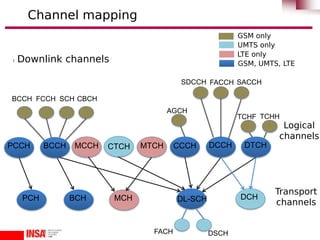
l Downlink channels
Channel mapping
Logical
channels
PCCH CCCH DCCH DTCH
MCCH MTCH
FCCH
BCCH
BCCH SCH CBCH
AGCH
SDCCH FACCH SACCH
TCHF TCHH
CTCH
PCH BCH DCH
DL-SCH
Transport
channels
MCH
FACH DSCH
GSM only
UMTS only
LTE only
GSM, UMTS, LTE
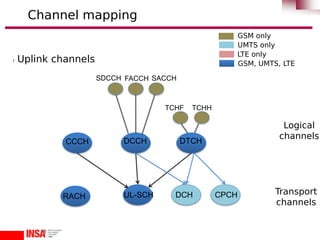
l Uplink channels
Channel mapping
Logical
channels
CCCH DCCH DTCH
DCH
UL-SCH Transport
channels
GSM only
UMTS only
LTE only
GSM, UMTS, LTE
RACH CPCH
SDCCH FACCH SACCH
TCHF TCHH
l Scenario: a phone is opened in order to place a call
Call establishment scenario
l Scenario: a phone is opened in order to place a call
l UE listens to BCCH information (frequency and time
synchronization, learning cell information, etc)
Call establishment scenario
l Scenario: a phone is opened in order to place a call
l UE listens to BCCH information (frequency and time
synchronization, learning cell information, etc)
l Without any resources, the UE asks for resources on the
RACH
Call establishment scenario
l Scenario: a phone is opened in order to place a call
l UE listens to BCCH information (frequency and time
synchronization, learning cell information, etc)
l Without any resources, the UE asks for resources on the
RACH
l Resource grant and control information (for upper layer
connection establishment) on the CCCH
Call establishment scenario
l Scenario: a phone is opened in order to place a call
l UE listens to BCCH information (frequency and time
synchronization, learning cell information, etc)
l Without any resources, the UE asks for resources on the
RACH
l Resource grant and control information (for upper layer
connection establishment) on the CCCH
l Establishment of a DCCH and a DTCH
Call establishment scenario
l Scenario: a phone is opened in order to place a call
l UE listens to BCCH information (frequency and time
synchronization, learning cell information, etc)
l Without any resources, the UE asks for resources on the
RACH
l Resource grant and control information (for upper layer
connection establishment) on the CCCH
l Establishment of a DCCH and a DTCH
l User data is transmitted on the DTCH, while control data
(buffer information, channel quality indicators, handover
related information) is exchanged on the DCCH
Call establishment scenario

4tc-arm_CanauxLogiques_version1.1111.pdf

  • 1.
    4TC-Architectures de RéseauxMobiles Mobile Network Architectures Part 1 – Logical Channels R. Stanica & F. Valois Version 1.0, Sept. 2014
  • 2.
    l User andcontrol planes l Downlink/uplink l Shared and dedicated information l Physical channels l Logical channels l Transport channels l Call establishment scenario Outline
  • 3.
    l Also knownas data plane l The goal of any (mobile) network: l Get data from source to destination l As quickly and efficiently as possible l User data: l Voice calls (GSM) l Voice calls and IP applications (UMTS) l IP applications (LTE) User plane
  • 4.
    l Any informationexchange the network needs in order to take the user data from source to destination l Classical examples in the IP world: building routing tables l In mobile networks: l Keep track of the mobile nodes l Call establishment l Resource allocation Control plane
  • 5.
    l Transmission pathfrom a cell site (more generally from the operator network) towards the User Equipment (UE) l Involves both control and user data l Should not be confused with incoming calls (calls received by an UE) Downlink
  • 6.
    l Transmission pathfrom an UE towards a cell site (more generally towards the operator network) l Involves both control and user data l Should not be confused with outgoing calls (calls initiated by an UE) Uplink
  • 7.
    l Information usefulto multiple UEs l Generally control data l But also user data: multicast or broadcast groups Common information
  • 8.
    l Information destinedto or coming from a single UE l Some control data (channel estimation, resource allocation, handover information, etc.) l Secure transmission of most of the user data Dedicated information
  • 9.
    l Physical channels lDefine where data is transmitted over the air (which slot/carrier frequency in GSM, which OFDM symbols in LTE) lTransport channels l Define how data is transmitted over the air (encoding, interleaving options, etc.) l Logical channels l Define what type of information is transmitted over the air (dedicated/shared, user/control) Channels
  • 10.
    l Common channels lCarry common information l Shared channels l Carry dedicated information, using shared resources l Dedicated channels l Carry dedicated information on dedicated resources Channels
  • 11.
    l Define theway information is treated at the physical layer l Can be considered as a service provided by the physical layer to the MAC layer l Data is multiplexed into transport channels depending on how it is transmitted over the air l Do not exist in the GSM architecture Transport channels
  • 12.
    l Broadcast Channel lBCH (UMTS and LTE) l Downlink l Control l Common l Used to transmit system and cell related information to the UE Transport channels
  • 13.
    l Multicast Channel lMCH (LTE only) l Downlink l User and Control l Common l Used to establish and manage a multicast group and multicast traffic exchange Transport channels
  • 14.
    l Paging Channel lPCH (UMTS and LTE) l Downlink l Control l Common l Used to broadcast paging messages in one or several cells l Supports discontinuous reception (DRX) from the UE, enabling the power save mode Transport channels
  • 15.
    l Random AccessChannel l RACH (UMTS and LTE) l CPCH = Common Packet Channel (UMTS) l Uplink l Control and User l Common l Used for initial access to the network by the UE and transport of non-real-time user data Transport channels
  • 16.
    l Uplink SharedChannel l USCH (UMTS) and UL-SCH (LTE) l Uplink l Control and User l Shared l Used for transmission of dedicated control and user application by the UEs Transport channels
  • 17.
    l Downlink SharedChannel l DSCH (UMTS) and DL-SCH (LTE) l FACH = Forward Access Channel (UMTS) l Downlink l Control and User l Shared l Used for transmission of dedicated control and user application to the UEs Transport channels
  • 18.
    l Dedicated Channel lDCH (UMTS) l Downlink and Uplink l User l Dedicated l Used for transmission of dedicated control and user application to the UEs l Removed in LTE, the corresponding traffic goes through DL- SCH Transport channels
  • 19.
    l Define thedata transfer services offered by the MAC layer l Unlike transport channels, they do not mix control and data traffic l Also exist in the GSM architecture Logical channels
  • 20.
    l Broadcast ControlChannel l BCCH (GSM, UMTS and LTE) l Downlink l Control l Common l Contains the System Information Block (SIB): cell access information, scheduling of other system information transmission, radio resource configuration, cell reselection parameters, etc l In GSM, some extra broadcast channels are defined: Frequency Correction Channel (FCCH), Synchronization Channel (SCH) and Cell Broadcast Control Channel (CBCH) Logical channels
  • 21.
    l Paging ControlChannel l PCH (GSM), PCCH (UMTS and LTE) l Downlink l Control l Common l Broadcast channel used to notify an UE of an incoming call l Each UE periodically listens to the information Logical channels
  • 22.
    l Common ControlChannel l CCCH (GSM, UMTS and LTE) l Downlink and Uplink l Control l Common l Used to deliver control information when there is no confirmed association between the UE and the network (i.e. in the connection establishment phase) l In GSM, consists of the Random Access Channel (RACH) and the Access Grant Channel (AGCH) Logical channels
  • 23.
    l Dedicated ControlChannel l DCCH (GSM, UMTS and LTE) l Downlink and Uplink l Control l Dedicated l Used to deliver control information when a connection was already established between the UE and the network l In GSM, it is further divided on the Standalone Dedicated Control Channel (SDCCH), the Fast Associated Control Channel (FACCH), and the Slow Associated Control Channel (SACCH) Logical channels
  • 24.
    l Multicast ControlChannel l MCCH (LTE only) l Downlink and Uplink l Control l Common l Used for establishing Multicast/Broadcast Multimedia Services (MBMS) groups Logical channels
  • 25.
    l Dedicated TrafficChannel l TCH (GSM) and DTCH (UMTS, LTE) l Downlink and Uplink l User l Dedicated l Used to transmit user data after the establishment of a connection l In GSM, two types of TCH exist: Full Rate Traffic Channels (TCHF) and Half Rate Traffic Channels (TCHH) Logical channels
  • 26.
    l Multicast TrafficChannel l MTCH (LTE only) l CTCH = Common Traffic Channel (UMTS) is an equivalent point-to-multipoint channel, but only downlink l Downlink and Uplink l User l Common l Used to transmit user data in a multicast group Logical channels
  • 27.
    l Downlink channels Channelmapping Logical channels PCCH CCCH DCCH DTCH MCCH MTCH FCCH BCCH BCCH SCH CBCH AGCH SDCCH FACCH SACCH TCHF TCHH CTCH PCH BCH DCH DL-SCH Transport channels MCH FACH DSCH GSM only UMTS only LTE only GSM, UMTS, LTE
  • 28.
    l Uplink channels Channelmapping Logical channels CCCH DCCH DTCH DCH UL-SCH Transport channels GSM only UMTS only LTE only GSM, UMTS, LTE RACH CPCH SDCCH FACCH SACCH TCHF TCHH
  • 29.
    l Scenario: aphone is opened in order to place a call Call establishment scenario
  • 30.
    l Scenario: aphone is opened in order to place a call l UE listens to BCCH information (frequency and time synchronization, learning cell information, etc) Call establishment scenario
  • 31.
    l Scenario: aphone is opened in order to place a call l UE listens to BCCH information (frequency and time synchronization, learning cell information, etc) l Without any resources, the UE asks for resources on the RACH Call establishment scenario
  • 32.
    l Scenario: aphone is opened in order to place a call l UE listens to BCCH information (frequency and time synchronization, learning cell information, etc) l Without any resources, the UE asks for resources on the RACH l Resource grant and control information (for upper layer connection establishment) on the CCCH Call establishment scenario
  • 33.
    l Scenario: aphone is opened in order to place a call l UE listens to BCCH information (frequency and time synchronization, learning cell information, etc) l Without any resources, the UE asks for resources on the RACH l Resource grant and control information (for upper layer connection establishment) on the CCCH l Establishment of a DCCH and a DTCH Call establishment scenario
  • 34.
    l Scenario: aphone is opened in order to place a call l UE listens to BCCH information (frequency and time synchronization, learning cell information, etc) l Without any resources, the UE asks for resources on the RACH l Resource grant and control information (for upper layer connection establishment) on the CCCH l Establishment of a DCCH and a DTCH l User data is transmitted on the DTCH, while control data (buffer information, channel quality indicators, handover related information) is exchanged on the DCCH Call establishment scenario