GSM Network
Architecture
HIMANSHU PAGHDAL
Motivation
Outline
Introduction and history.
GSM architecture.
Implementation.
Technology and standards.
Summary
Introduction
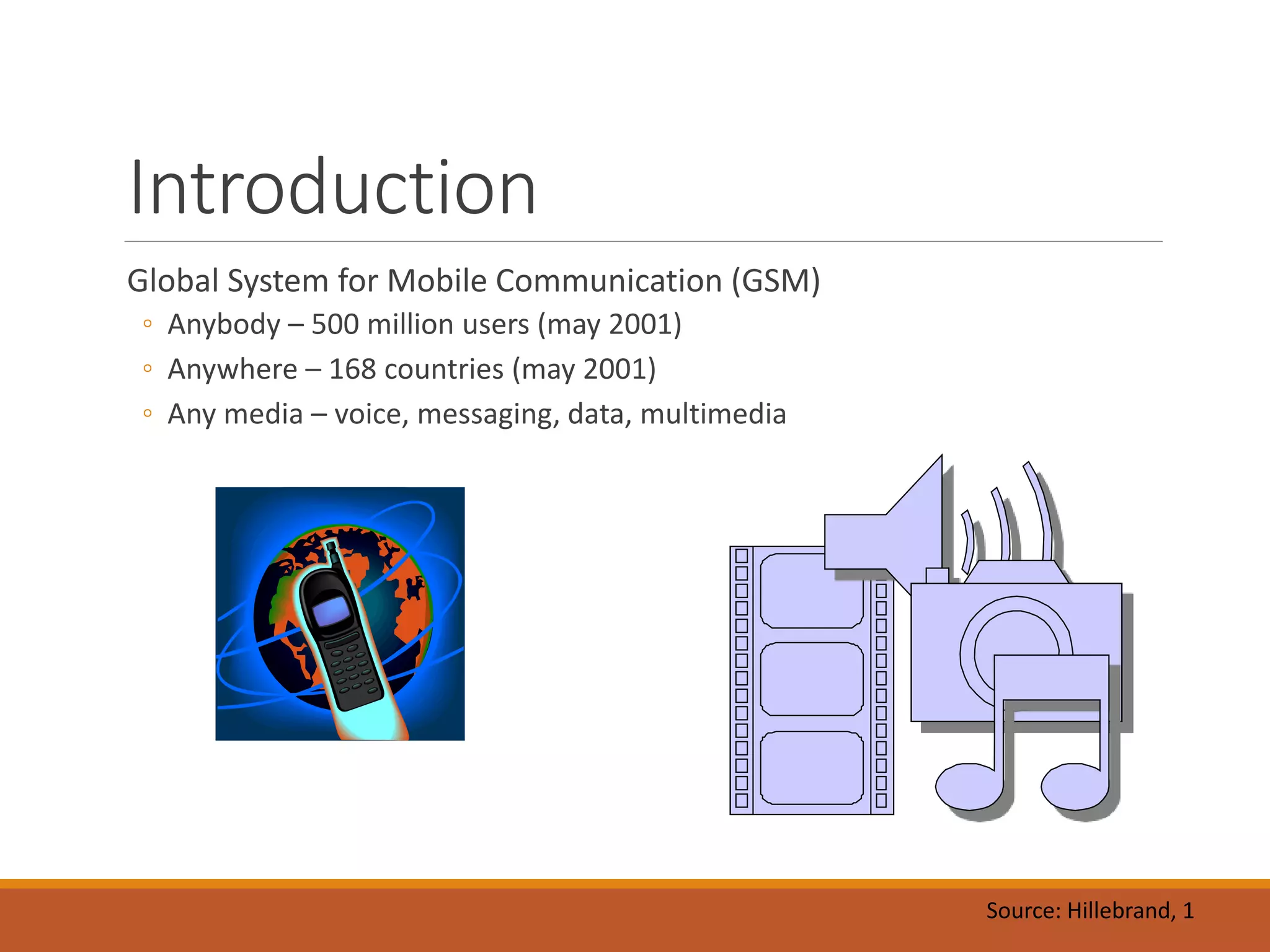
Global System for Mobile Communication (GSM)
◦ Anybody – 500 million users (may 2001)
◦ Anywhere – 168 countries (may 2001)
◦ Any media – voice, messaging, data, multimedia
Source: Hillebrand, 1
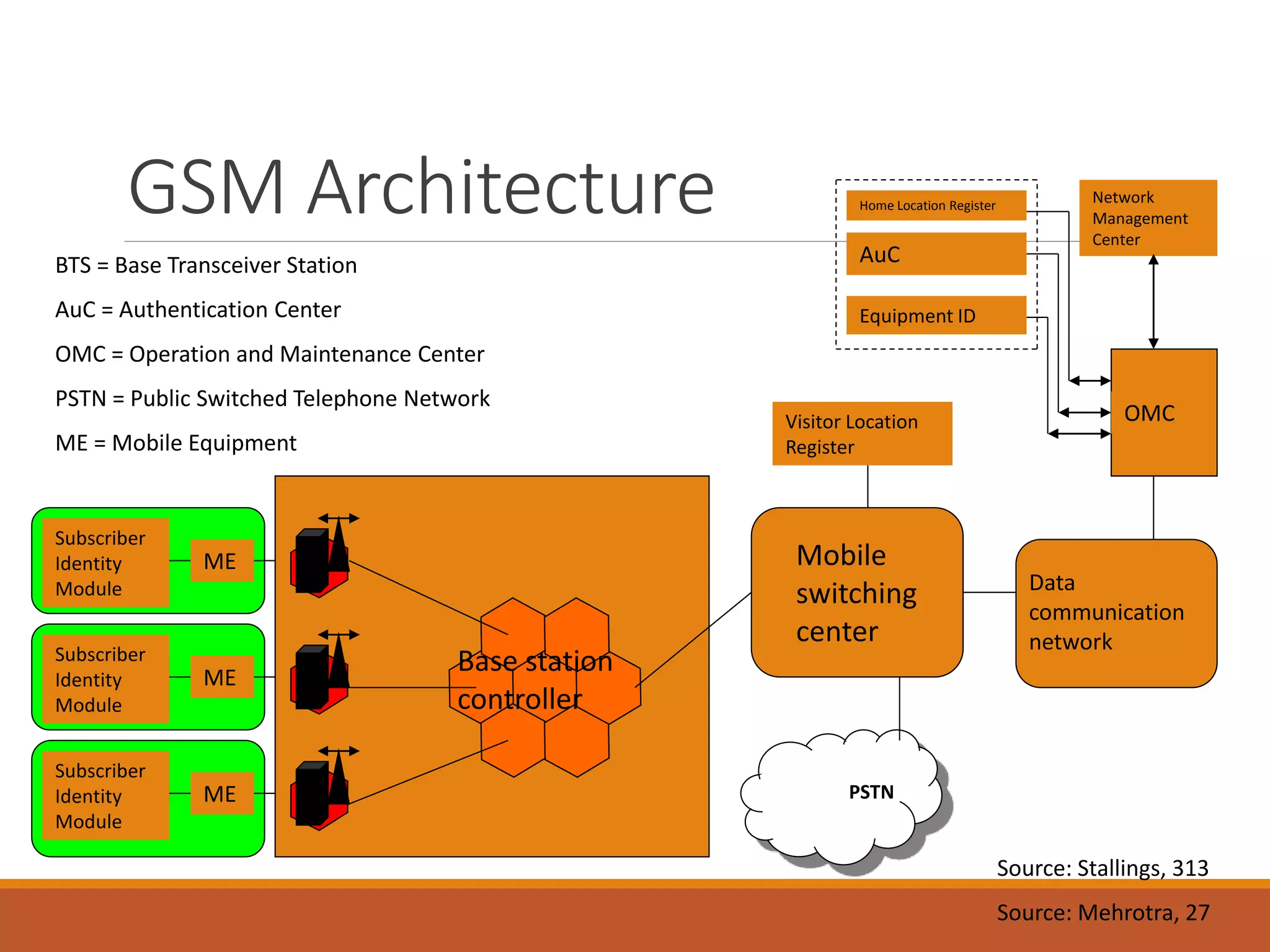
GSM Architecture
OMC
Home Location Register
AuC
Equipment ID
Network
Management
Center
BT
S
BT
S
BT
S
ME
ME
ME
Subscriber
Identity
Module
Subscriber
Identity
Module
Subscriber
Identity
Module
Base station
controller
PSTN
Mobile
switching
center
Data
communication
network
BTS = Base Transceiver Station
AuC = Authentication Center
OMC = Operation and Maintenance Center
PSTN = Public Switched Telephone Network
ME = Mobile Equipment
Source: Stallings, 313
Source: Mehrotra, 27
Visitor Location
Register
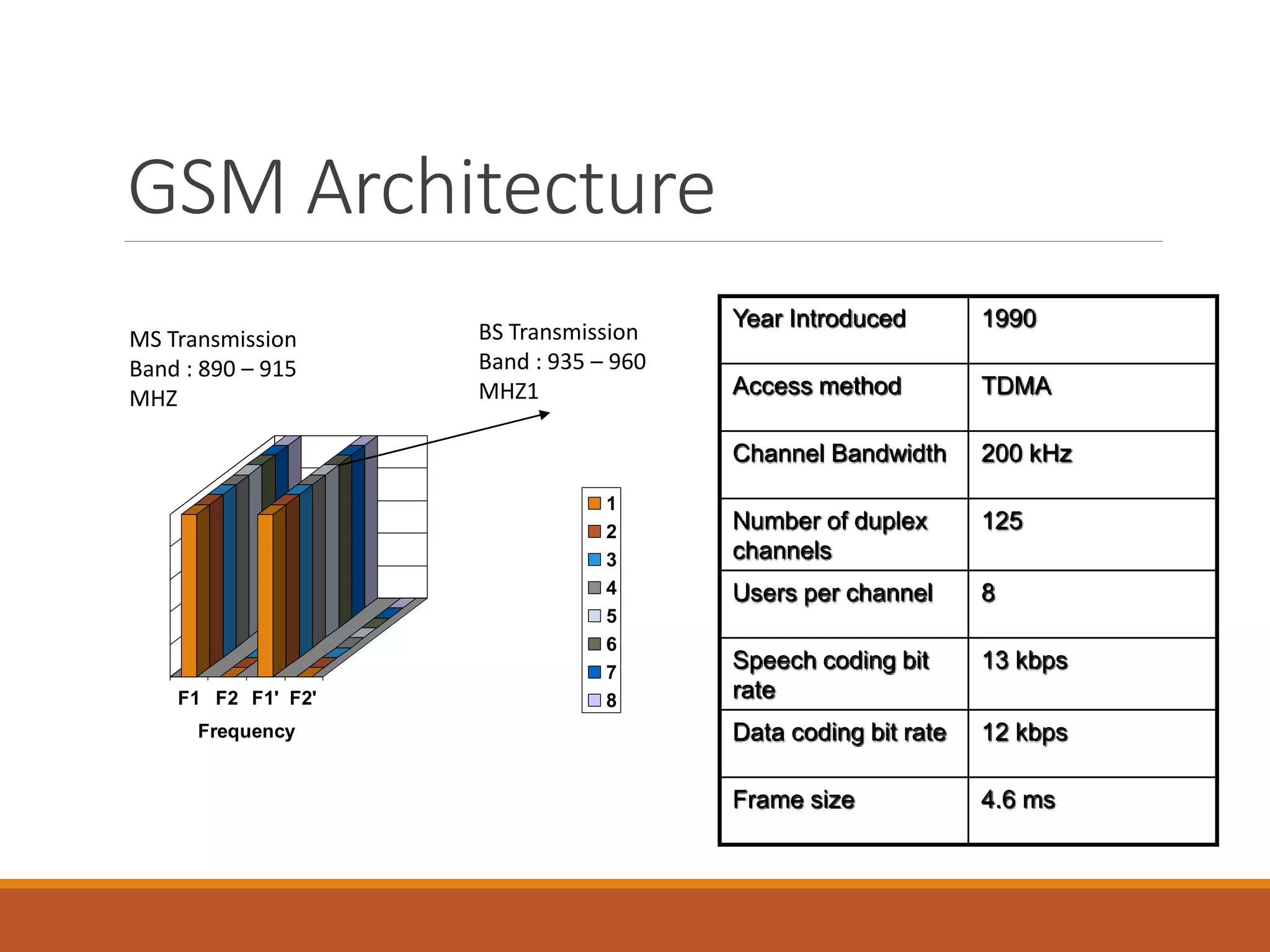
GSM Architecture
F1 F2 F1' F2'
Frequency
1
2
3
4
5
6
7
8
Year Introduced 1990
Access method TDMA
Channel Bandwidth 200 kHz
Number of duplex
channels
125
Users per channel 8
Speech coding bit
rate
13 kbps
Data coding bit rate 12 kbps
Frame size 4.6 ms
BS Transmission
Band : 935 – 960
MHZ1
MS Transmission
Band : 890 – 915
MHZ
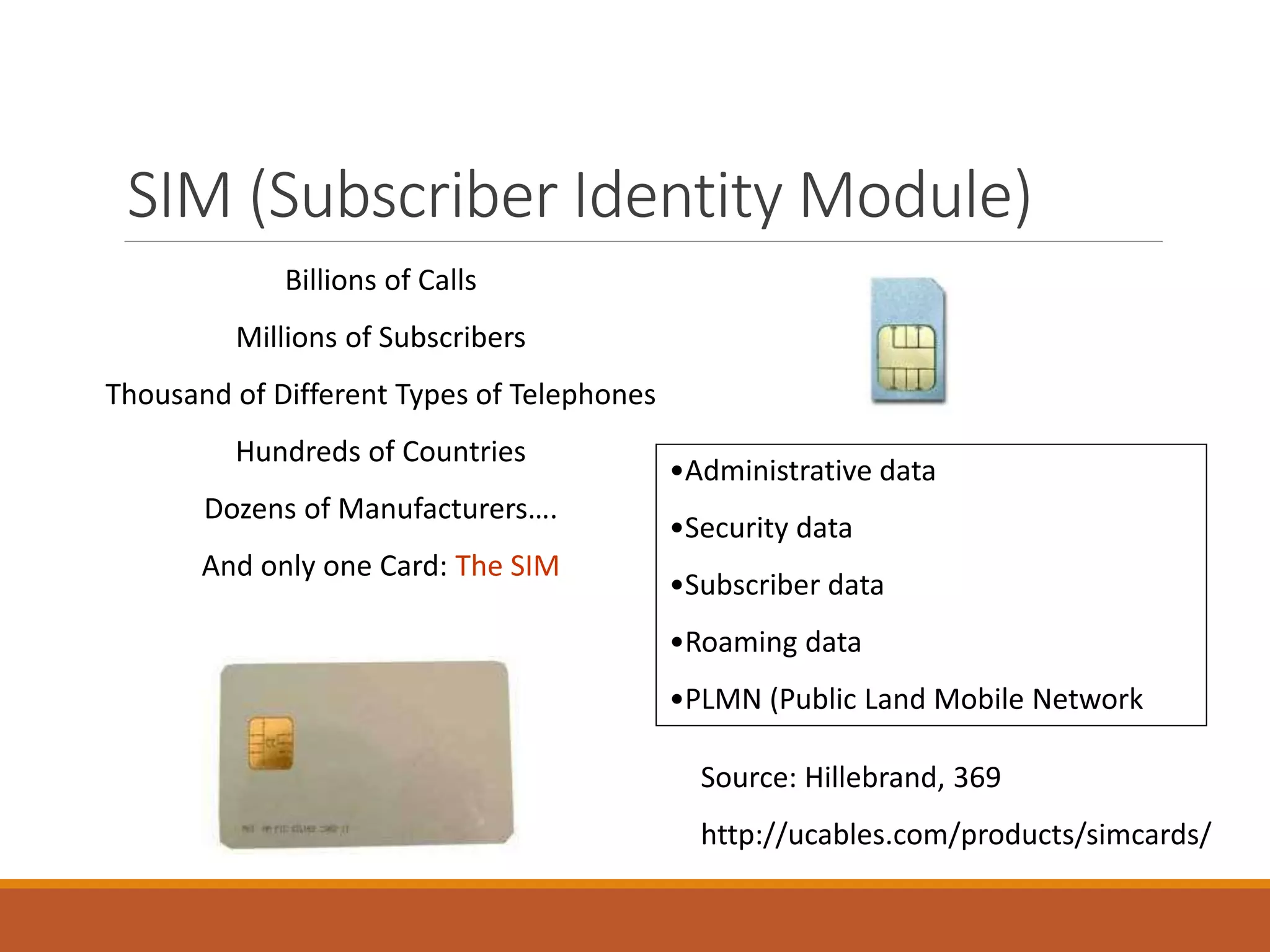
SIM (Subscriber Identity Module)
Billions of Calls
Millions of Subscribers
Thousand of Different Types of Telephones
Hundreds of Countries
Dozens of Manufacturers….
And only one Card: The SIM
Source: Hillebrand, 369
http://ucables.com/products/simcards/
•Administrative data
•Security data
•Subscriber data
•Roaming data
•PLMN (Public Land Mobile Network
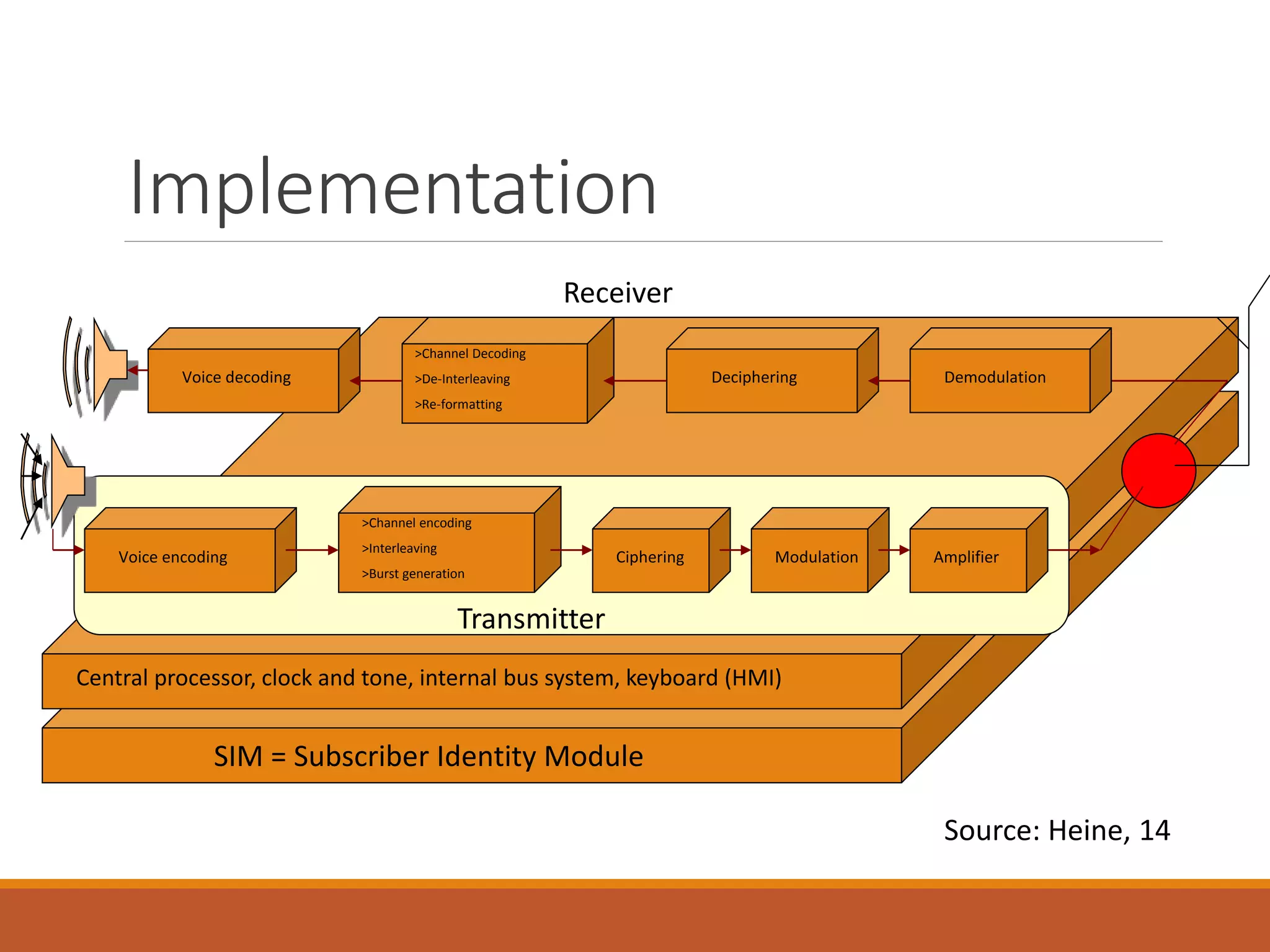
Implementation
SIM = Subscriber Identity Module
Central processor, clock and tone, internal bus system, keyboard (HMI)
Voice encoding Ciphering Modulation
Voice decoding
>Channel Decoding
>De-Interleaving
>Re-formatting
Deciphering
Amplifier
>Channel encoding
>Interleaving
>Burst generation
Receiver
Transmitter
Demodulation
Source: Heine, 14
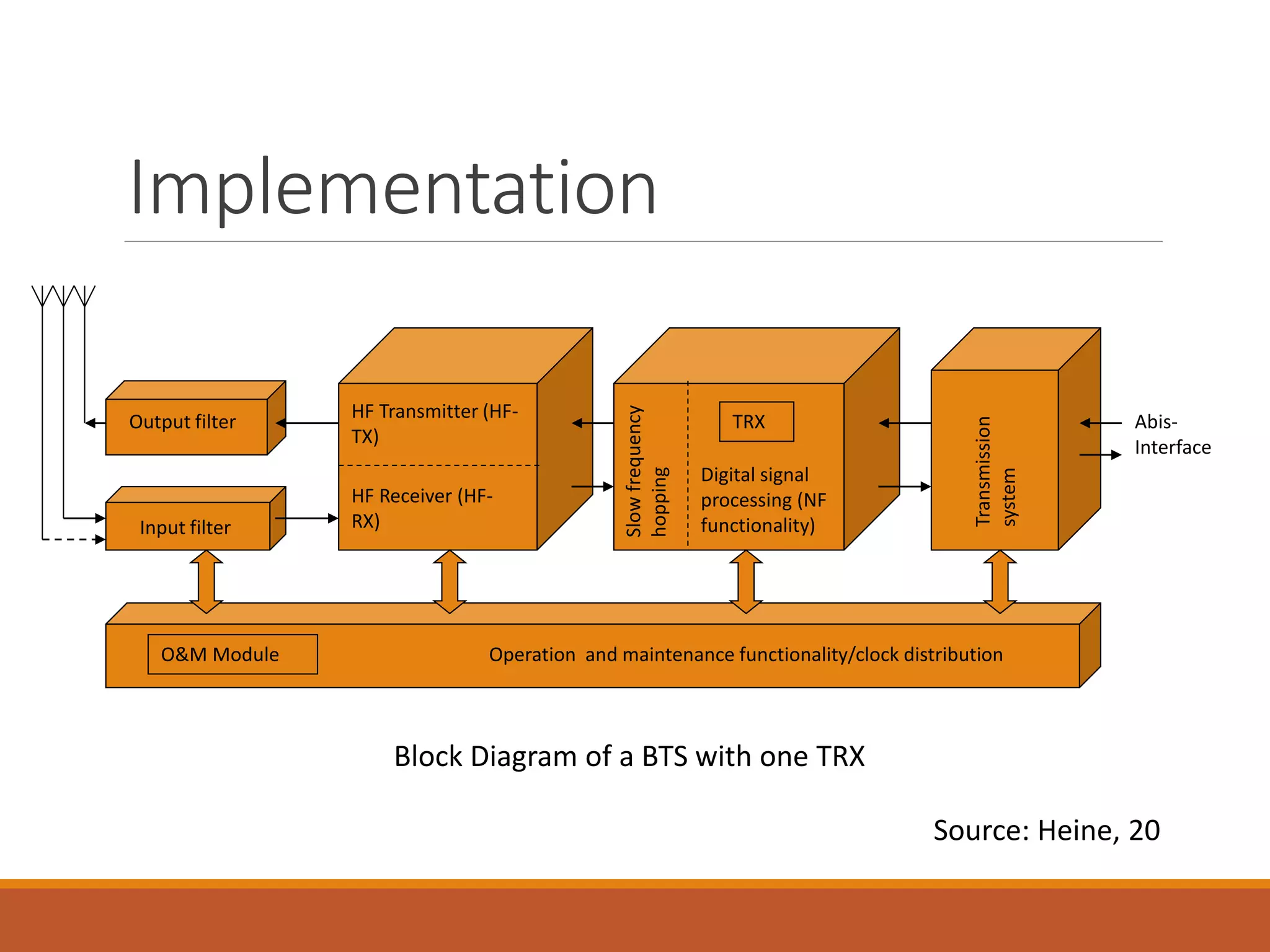
Implementation
Abis-
Interface
O&M Module Operation and maintenance functionality/clock distribution
Digital signal
processing (NF
functionality)
HF Transmitter (HF-
TX)
Input filter
Output filter
HF Receiver (HF-
RX)
Slowfrequency
hopping
Transmission
system
TRX
Block Diagram of a BTS with one TRX
Source: Heine, 20
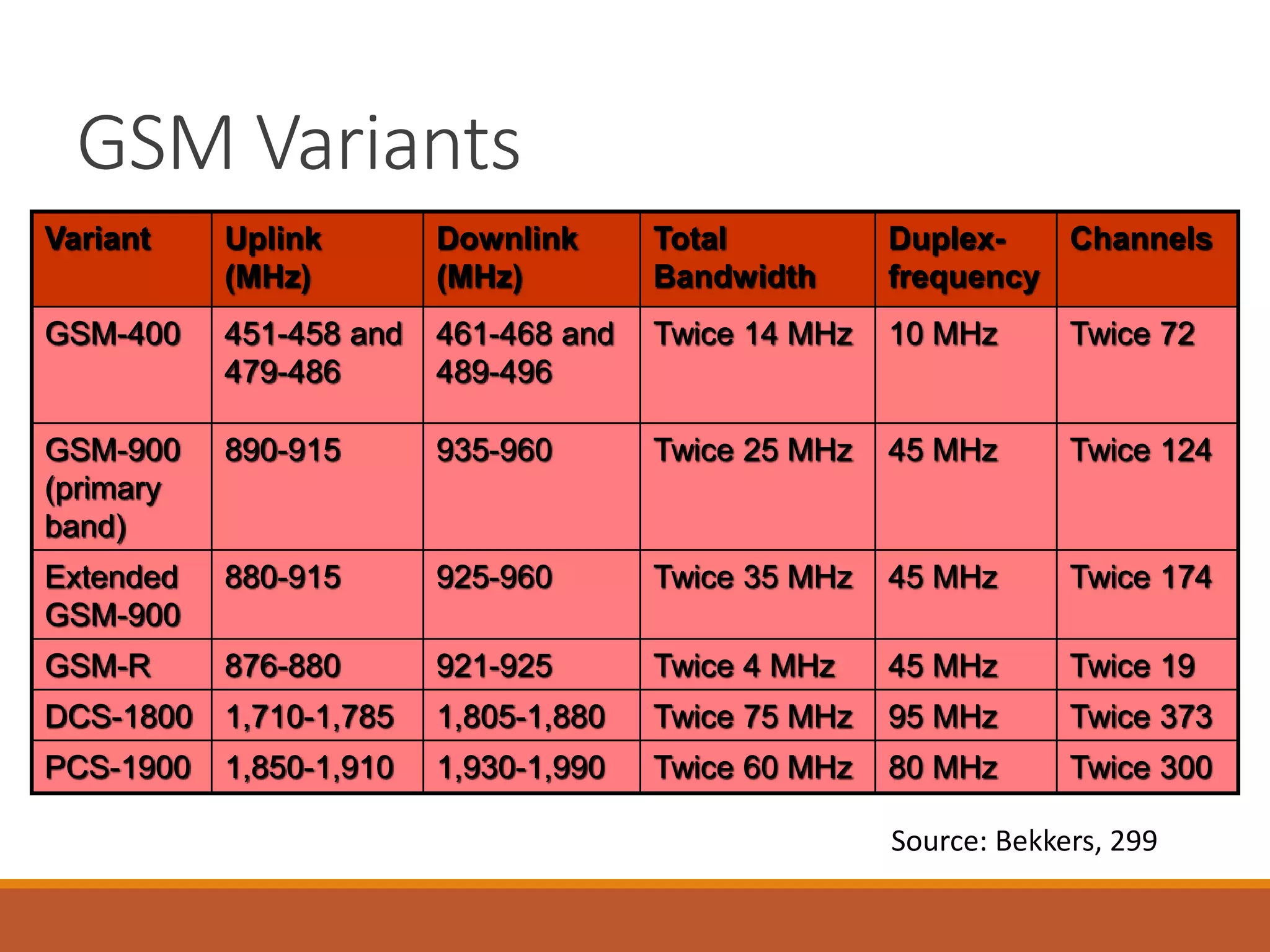
GSM Variants
Variant Uplink
(MHz)
Downlink
(MHz)
Total
Bandwidth
Duplex-
frequency
Channels
GSM-400 451-458 and
479-486
461-468 and
489-496
Twice 14 MHz 10 MHz Twice 72
GSM-900
(primary
band)
890-915 935-960 Twice 25 MHz 45 MHz Twice 124
Extended
GSM-900
880-915 925-960 Twice 35 MHz 45 MHz Twice 174
GSM-R 876-880 921-925 Twice 4 MHz 45 MHz Twice 19
DCS-1800 1,710-1,785 1,805-1,880 Twice 75 MHz 95 MHz Twice 373
PCS-1900 1,850-1,910 1,930-1,990 Twice 60 MHz 80 MHz Twice 300
Source: Bekkers, 299
Summary
Network architecture
Implementation
Voice application
Data application
References
Bekkers, Rudi. Mobile Communications Standards: GSM, UMTS, TETRA, and ERMES. Norwood,
MA: Artech House, Inc., 2001.
Halonen, Romero, and Melero. GSM, GPRS, and EDGE Performance: Evolution Towards 3G/UMTS.
England: John Wiley & Sons Ltd., 2003.
Hillebrand, Friedhelm. GSM and UMTS: The Creation of Global Mobile Communications. England:
John Wiley & Sons Ltd., 2002.
Heine, Gunnar. GSM Networks: Protocols, Terminology, and Implementation. Norwood, MA:
Artech House, Inc., 1999.
Mehrotra, Asha. GSM System Engineering. Norwood, MA: Artech House, Inc., 1997.
Harte, Levine, and Livingston. GSM Superphones. United States: APDG Publishing, Inc. A Division
of McGraw-Hill, 1999.

GSM Network Architecture

  • 1.
  • 2.
  • 3.
    Outline Introduction and history. GSMarchitecture. Implementation. Technology and standards. Summary
  • 4.
    Introduction Global System forMobile Communication (GSM) ◦ Anybody – 500 million users (may 2001) ◦ Anywhere – 168 countries (may 2001) ◦ Any media – voice, messaging, data, multimedia Source: Hillebrand, 1
  • 5.
    GSM Architecture OMC Home LocationRegister AuC Equipment ID Network Management Center BT S BT S BT S ME ME ME Subscriber Identity Module Subscriber Identity Module Subscriber Identity Module Base station controller PSTN Mobile switching center Data communication network BTS = Base Transceiver Station AuC = Authentication Center OMC = Operation and Maintenance Center PSTN = Public Switched Telephone Network ME = Mobile Equipment Source: Stallings, 313 Source: Mehrotra, 27 Visitor Location Register
  • 6.
    GSM Architecture F1 F2F1' F2' Frequency 1 2 3 4 5 6 7 8 Year Introduced 1990 Access method TDMA Channel Bandwidth 200 kHz Number of duplex channels 125 Users per channel 8 Speech coding bit rate 13 kbps Data coding bit rate 12 kbps Frame size 4.6 ms BS Transmission Band : 935 – 960 MHZ1 MS Transmission Band : 890 – 915 MHZ
  • 7.
    SIM (Subscriber IdentityModule) Billions of Calls Millions of Subscribers Thousand of Different Types of Telephones Hundreds of Countries Dozens of Manufacturers…. And only one Card: The SIM Source: Hillebrand, 369 http://ucables.com/products/simcards/ •Administrative data •Security data •Subscriber data •Roaming data •PLMN (Public Land Mobile Network
  • 8.
    Implementation SIM = SubscriberIdentity Module Central processor, clock and tone, internal bus system, keyboard (HMI) Voice encoding Ciphering Modulation Voice decoding >Channel Decoding >De-Interleaving >Re-formatting Deciphering Amplifier >Channel encoding >Interleaving >Burst generation Receiver Transmitter Demodulation Source: Heine, 14
  • 9.
    Implementation Abis- Interface O&M Module Operationand maintenance functionality/clock distribution Digital signal processing (NF functionality) HF Transmitter (HF- TX) Input filter Output filter HF Receiver (HF- RX) Slowfrequency hopping Transmission system TRX Block Diagram of a BTS with one TRX Source: Heine, 20
  • 10.
    GSM Variants Variant Uplink (MHz) Downlink (MHz) Total Bandwidth Duplex- frequency Channels GSM-400451-458 and 479-486 461-468 and 489-496 Twice 14 MHz 10 MHz Twice 72 GSM-900 (primary band) 890-915 935-960 Twice 25 MHz 45 MHz Twice 124 Extended GSM-900 880-915 925-960 Twice 35 MHz 45 MHz Twice 174 GSM-R 876-880 921-925 Twice 4 MHz 45 MHz Twice 19 DCS-1800 1,710-1,785 1,805-1,880 Twice 75 MHz 95 MHz Twice 373 PCS-1900 1,850-1,910 1,930-1,990 Twice 60 MHz 80 MHz Twice 300 Source: Bekkers, 299
  • 11.
  • 12.
    References Bekkers, Rudi. MobileCommunications Standards: GSM, UMTS, TETRA, and ERMES. Norwood, MA: Artech House, Inc., 2001. Halonen, Romero, and Melero. GSM, GPRS, and EDGE Performance: Evolution Towards 3G/UMTS. England: John Wiley & Sons Ltd., 2003. Hillebrand, Friedhelm. GSM and UMTS: The Creation of Global Mobile Communications. England: John Wiley & Sons Ltd., 2002. Heine, Gunnar. GSM Networks: Protocols, Terminology, and Implementation. Norwood, MA: Artech House, Inc., 1999. Mehrotra, Asha. GSM System Engineering. Norwood, MA: Artech House, Inc., 1997. Harte, Levine, and Livingston. GSM Superphones. United States: APDG Publishing, Inc. A Division of McGraw-Hill, 1999.