
Himanshu Paghdal
232825
REVIEW OF CURRENT DEVELOPMENTS IN LOW HEAD,
SMALL HYDROPOWER
Contents
 What is HYDROPOWER
 Classification Of Hydropower Plants
 Classification According to Facility Type
 Technologies Currently Under Development
 Facility Type Classification
 References
 Conclusion
Hydropower
 Hydropower transforms the potential energy of a
mass of water flowing in a river or stream with a certain
vertical fall (termed the “head”)
 Hydroelectric power is the cheapest source of
energy, renewable and environmentally benign during
running.
 The potential annual power generation of a
hydropower project is proportional to the head and flow
of water
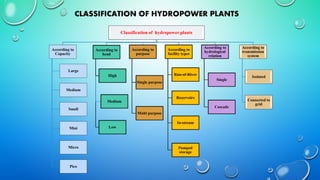
CLASSIFICATION OF HYDROPOWER PLANTS
Classification of hydropower plants
According to
Capacity
Large
Medium
Small
Mini
Micro
Pico
According to
head
High
Medium
Low
According to
purpose
Single purpose
Multi purpose
According to
facility types
Run-of-River
Reservoirs
In-stream
Pumped
storage
According to
hydrological
relation
Single
Cascade
According to
transmission
system
Isolated
Connected to
grid
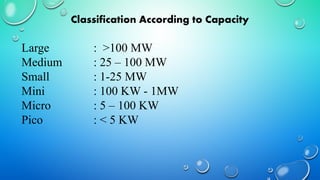
Large : >100 MW
Medium : 25 – 100 MW
Small : 1-25 MW
Mini : 100 KW - 1MW
Micro : 5 – 100 KW
Pico : < 5 KW
Classification According to Capacity
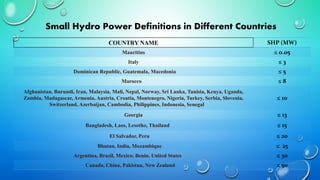
Small Hydro Power Definitions in Different Countries
COUNTRY NAME SHP (MW)
Mauritius ≤ 0.05
Italy ≤ 3
Dominican Republic, Guatemala, Macedonia ≤ 5
Marocco ≤ 8
Afghanistan, Burundi, Iran, Malaysia, Mali, Nepal, Norway, Sri Lanka, Tunisia, Kenya, Uganda,
Zambia, Madagascar, Armenia, Austria, Croatia, Montenegro, Nigeria, Turkey, Serbia, Slovenia,
Switzerland, Azerbaijan, Cambodia, Philippines, Indonesia, Senegal
≤ 10
Georgia ≤ 13
Bangladesh, Laos, Lesotho, Thailand ≤ 15
El Salvador, Peru ≤ 20
Bhutan, India, Mozambique ≤ 25
Argentina, Brazil, Mexico, Benin, United States ≤ 30
Canada, China, Pakistan, New Zealand ≤ 50
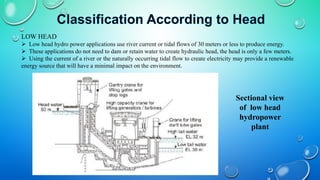
LOW HEAD
 Low head hydro power applications use river current or tidal flows of 30 meters or less to produce energy.
 These applications do not need to dam or retain water to create hydraulic head, the head is only a few meters.
 Using the current of a river or the naturally occurring tidal flow to create electricity may provide a renewable
energy source that will have a minimal impact on the environment.
Sectional view
of low head
hydropower
plant
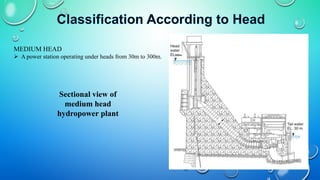
MEDIUM HEAD
 A power station operating under heads from 30m to 300m.
Sectional view of
medium head
hydropower plant
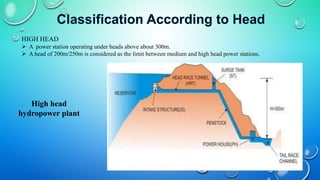
HIGH HEAD
 A power station operating under heads above about 300m.
 A head of 200m/250m is considered as the limit between medium and high head power stations.
High head
hydropower plant
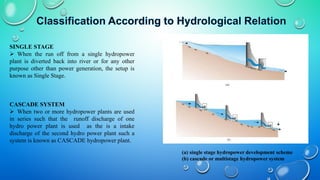
(a) single stage hydropower development scheme
(b) cascade or multistage hydropower system
SINGLE STAGE
 When the run off from a single hydropower
plant is diverted back into river or for any other
purpose other than power generation, the setup is
known as Single Stage.
CASCADE SYSTEM
 When two or more hydropower plants are used
in series such that the runoff discharge of one
hydro power plant is used as the is a intake
discharge of the second hydro power plant such a
system is known as CASCADE hydropower plant.
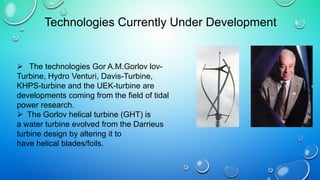
 The technologies Gor A.M.Gorlov lov-
Turbine, Hydro Venturi, Davis-Turbine,
KHPS-turbine and the UEK-turbine are
developments coming from the field of tidal
power research.
 The Gorlov helical turbine (GHT) is
a water turbine evolved from the Darrieus
turbine design by altering it to
have helical blades/foils.
Technologies Currently Under Development
 Hydropower plants with storage are supplied
with water from large storage reservoir that have
been developed by constructing dams across rivers.
 Assured flow for hydro power generation is
more certain for the storage schemes than the run-
of-river schemes.
 Up to now six prototypes have been built to
assess feasibility
under the supervision of the National Research
Council of Canada and independent
institutions.
 Unfortunately there are actually no binding
statements about the achieved degrees
of efficiency available, Bedard
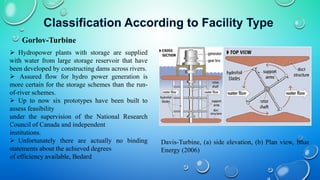
Gorlov-Turbine
Davis-Turbine, (a) side elevation, (b) Plan view, Blue
Energy (2006)
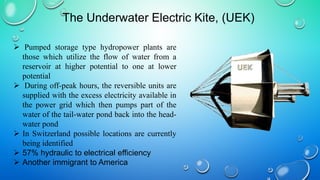
 Pumped storage type hydropower plants are
those which utilize the flow of water from a
reservoir at higher potential to one at lower
potential
 During off-peak hours, the reversible units are
supplied with the excess electricity available in
the power grid which then pumps part of the
water of the tail-water pond back into the head-
water pond
 In Switzerland possible locations are currently
being identified
 57% hydraulic to electrical efficiency
 Another immigrant to America
The Underwater Electric Kite, (UEK)
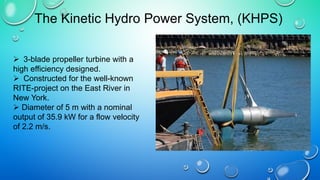
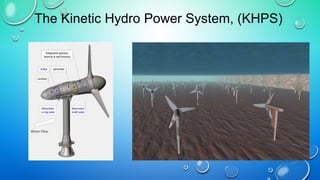
 3-blade propeller turbine with a
high efficiency designed.
 Constructed for the well-known
RITE-project on the East River in
New York.
 Diameter of 5 m with a nominal
output of 35.9 kW for a flow velocity
of 2.2 m/s.
The Kinetic Hydro Power System, (KHPS)
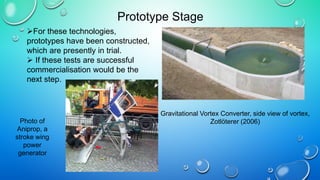
Prototype Stage
For these technologies,
prototypes have been constructed,
which are presently in trial.
 If these tests are successful
commercialisation would be the
next step.
Gravitational Vortex Converter, side view of vortex,
Zotlöterer (2006)Photo of
Aniprop, a
stroke wing
power
generator
References
 Brinnich A. (2001), Wasserkraft-Staudruckmaschine - Neues,
konkurrenzlos
wirtschaftliches Kraftwerkskonzept. Wasserwirtschaft, 91,2. 70-74
 Müller G. (2006), Die Staudruckmaschine – tatsächlich die innovative
Neuentwicklung?, Wasserwirtschaft, Nr. 11/2006, P. 28-29
 Aniprop, 2006, Aniprop, Göttingen, www.aniprop.de
 Gorlov, 2006, Gorlov-Turbine, San Antonio,
http://www.gcktechnology.com
 Zotloeterer, 2006, Gravitation Vortex Converter, Obergrafendorf,
http://home.tele2.at/gravitationswirbel/kontakt.html
Conclusion
 A large number of energy converters, currently unused hydropower
sites
with head differences lower than 2 m, and power ratings of 100 – 1000
kW.
 To consider the cost estimation is not much factual information is
present, cause of to selecting site of small hydro power plant.
 The energy converters have limited efficiency about 35%.
 According to ecological impact, only Rotary Hydraulic Presser machine
appears to have development potential commercial interests.
Review of current developments in low head  small hydropower

Review of current developments in low head small hydropower

  • 1.
    Himanshu Paghdal 232825 REVIEW OFCURRENT DEVELOPMENTS IN LOW HEAD, SMALL HYDROPOWER
  • 2.
    Contents  What isHYDROPOWER  Classification Of Hydropower Plants  Classification According to Facility Type  Technologies Currently Under Development  Facility Type Classification  References  Conclusion
  • 3.
    Hydropower  Hydropower transformsthe potential energy of a mass of water flowing in a river or stream with a certain vertical fall (termed the “head”)  Hydroelectric power is the cheapest source of energy, renewable and environmentally benign during running.  The potential annual power generation of a hydropower project is proportional to the head and flow of water
  • 4.
    CLASSIFICATION OF HYDROPOWERPLANTS Classification of hydropower plants According to Capacity Large Medium Small Mini Micro Pico According to head High Medium Low According to purpose Single purpose Multi purpose According to facility types Run-of-River Reservoirs In-stream Pumped storage According to hydrological relation Single Cascade According to transmission system Isolated Connected to grid
  • 5.
    Large : >100MW Medium : 25 – 100 MW Small : 1-25 MW Mini : 100 KW - 1MW Micro : 5 – 100 KW Pico : < 5 KW Classification According to Capacity
  • 6.
    Small Hydro PowerDefinitions in Different Countries COUNTRY NAME SHP (MW) Mauritius ≤ 0.05 Italy ≤ 3 Dominican Republic, Guatemala, Macedonia ≤ 5 Marocco ≤ 8 Afghanistan, Burundi, Iran, Malaysia, Mali, Nepal, Norway, Sri Lanka, Tunisia, Kenya, Uganda, Zambia, Madagascar, Armenia, Austria, Croatia, Montenegro, Nigeria, Turkey, Serbia, Slovenia, Switzerland, Azerbaijan, Cambodia, Philippines, Indonesia, Senegal ≤ 10 Georgia ≤ 13 Bangladesh, Laos, Lesotho, Thailand ≤ 15 El Salvador, Peru ≤ 20 Bhutan, India, Mozambique ≤ 25 Argentina, Brazil, Mexico, Benin, United States ≤ 30 Canada, China, Pakistan, New Zealand ≤ 50
  • 7.
    LOW HEAD  Lowhead hydro power applications use river current or tidal flows of 30 meters or less to produce energy.  These applications do not need to dam or retain water to create hydraulic head, the head is only a few meters.  Using the current of a river or the naturally occurring tidal flow to create electricity may provide a renewable energy source that will have a minimal impact on the environment. Sectional view of low head hydropower plant
  • 8.
    MEDIUM HEAD  Apower station operating under heads from 30m to 300m. Sectional view of medium head hydropower plant
  • 9.
    HIGH HEAD  Apower station operating under heads above about 300m.  A head of 200m/250m is considered as the limit between medium and high head power stations. High head hydropower plant
  • 10.
    (a) single stagehydropower development scheme (b) cascade or multistage hydropower system SINGLE STAGE  When the run off from a single hydropower plant is diverted back into river or for any other purpose other than power generation, the setup is known as Single Stage. CASCADE SYSTEM  When two or more hydropower plants are used in series such that the runoff discharge of one hydro power plant is used as the is a intake discharge of the second hydro power plant such a system is known as CASCADE hydropower plant.
  • 11.
     The technologiesGor A.M.Gorlov lov- Turbine, Hydro Venturi, Davis-Turbine, KHPS-turbine and the UEK-turbine are developments coming from the field of tidal power research.  The Gorlov helical turbine (GHT) is a water turbine evolved from the Darrieus turbine design by altering it to have helical blades/foils. Technologies Currently Under Development
  • 12.
     Hydropower plantswith storage are supplied with water from large storage reservoir that have been developed by constructing dams across rivers.  Assured flow for hydro power generation is more certain for the storage schemes than the run- of-river schemes.  Up to now six prototypes have been built to assess feasibility under the supervision of the National Research Council of Canada and independent institutions.  Unfortunately there are actually no binding statements about the achieved degrees of efficiency available, Bedard Gorlov-Turbine Davis-Turbine, (a) side elevation, (b) Plan view, Blue Energy (2006)
  • 13.
     Pumped storagetype hydropower plants are those which utilize the flow of water from a reservoir at higher potential to one at lower potential  During off-peak hours, the reversible units are supplied with the excess electricity available in the power grid which then pumps part of the water of the tail-water pond back into the head- water pond  In Switzerland possible locations are currently being identified  57% hydraulic to electrical efficiency  Another immigrant to America The Underwater Electric Kite, (UEK)
  • 14.
     3-blade propellerturbine with a high efficiency designed.  Constructed for the well-known RITE-project on the East River in New York.  Diameter of 5 m with a nominal output of 35.9 kW for a flow velocity of 2.2 m/s. The Kinetic Hydro Power System, (KHPS)
  • 15.
    The Kinetic HydroPower System, (KHPS)
  • 16.
    Prototype Stage For thesetechnologies, prototypes have been constructed, which are presently in trial.  If these tests are successful commercialisation would be the next step. Gravitational Vortex Converter, side view of vortex, Zotlöterer (2006)Photo of Aniprop, a stroke wing power generator
  • 17.
    References  Brinnich A.(2001), Wasserkraft-Staudruckmaschine - Neues, konkurrenzlos wirtschaftliches Kraftwerkskonzept. Wasserwirtschaft, 91,2. 70-74  Müller G. (2006), Die Staudruckmaschine – tatsächlich die innovative Neuentwicklung?, Wasserwirtschaft, Nr. 11/2006, P. 28-29  Aniprop, 2006, Aniprop, Göttingen, www.aniprop.de  Gorlov, 2006, Gorlov-Turbine, San Antonio, http://www.gcktechnology.com  Zotloeterer, 2006, Gravitation Vortex Converter, Obergrafendorf, http://home.tele2.at/gravitationswirbel/kontakt.html
  • 18.
    Conclusion  A largenumber of energy converters, currently unused hydropower sites with head differences lower than 2 m, and power ratings of 100 – 1000 kW.  To consider the cost estimation is not much factual information is present, cause of to selecting site of small hydro power plant.  The energy converters have limited efficiency about 35%.  According to ecological impact, only Rotary Hydraulic Presser machine appears to have development potential commercial interests.