Microwave Radio Planning and Link Design


             CISCOM Training Center

             Microwave Planning and Design


Slide No 1
Microwave Radio Planning and Link Design

             Microwave Radio Planning and Link Design
   Course Contents
   • PCM and E1 TDM Overview
   • Digital Multiplexing: PDH and SDH Overview
   • Digital Microwave Systems Overview
   • Microwave links Performance and Quality Objectives
   • Topology and Capacity Planning
   • Diversity
   • Microwave Antennas


Slide No 2
Microwave Radio Planning and Link Design

                 Microwave Radio Planning and Link Design
    Course Contents (con’d)
    • Radio Propagation
    • Microwave Link Planning and Design
             –   Path Profile
             –   LOS Survey
             –   Link Budget
             –   Performance Prediction
    •   Frequency Planning
    •   Interference
    •   Digital map and tools overview


Slide No 3
Microwave Radio Planning and Link Design

                        Planning Objectives
• MW Radio Planning Objectives
       – Selection of suitable radio component
       – Communication quality and availability
       – Link Design
       – Preliminary site location and path profile, LOS survey
       – Channel capacity
       – Topology
       – Radio frequency allocation (planning)


Slide No 4
Microwave Radio Planning and Link Design


             PCM and E1 Overview


Slide No 5
Microwave Radio Planning and Link Design

             Voice channel digitizing and TDM
• Transmission:
       – Voice
       – Data
• Voice is an analog signal and needs to be digitized before
     transmitted digitally
•    PCM, Pulse Code Modulation is the most used technique
•    The European implementation of PCM includes time
     division multiplexing of 30 64 kb/s voice channels and 2
     64kb/s for synchronization and signaling in basic digital
     channel called E1
•    E1 rate is 2.048 Mb/s = 32 x 64 kb/s

Slide No 6
Microwave Radio Planning and Link Design


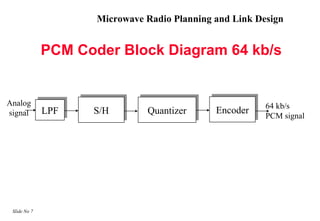
              PCM Coder Block Diagram 64 kb/s


Analog                                                   64 kb/s
signal
              LPF
              LPF   S/H
                    S/H        Quantizer
                               Quantizer      Encoder
                                              Encoder
                                                         PCM signal


 Slide No 7
Microwave Radio Planning and Link Design

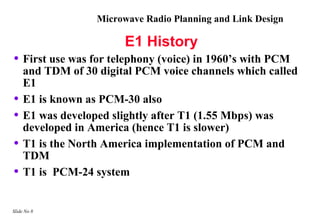
                         E1 History
• First use was for telephony (voice) in 1960’s with PCM
     and TDM of 30 digital PCM voice channels which called
     E1
•    E1 is known as PCM-30 also
•    E1 was developed slightly after T1 (1.55 Mbps) was
     developed in America (hence T1 is slower)
•    T1 is the North America implementation of PCM and
     TDM
•    T1 is PCM-24 system


Slide No 8
Microwave Radio Planning and Link Design

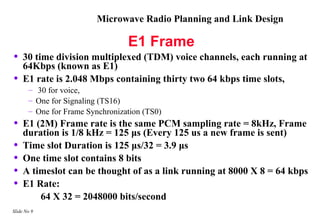
                                  E1 Frame
•    30 time division multiplexed (TDM) voice channels, each running at
     64Kbps (known as E1)
•    E1 rate is 2.048 Mbps containing thirty two 64 kbps time slots,
       – 30 for voice,
       – One for Signaling (TS16)
       – One for Frame Synchronization (TS0)
•    E1 (2M) Frame rate is the same PCM sampling rate = 8kHz, Frame
     duration is 1/8 kHz = 125 μs (Every 125 us a new frame is sent)
•    Time slot Duration is 125 μs/32 = 3.9 μs
•    One time slot contains 8 bits
•    A timeslot can be thought of as a link running at 8000 X 8 = 64 kbps
•    E1 Rate:
         64 X 32 = 2048000 bits/second
Slide No 9
Microwave Radio Planning and Link Design

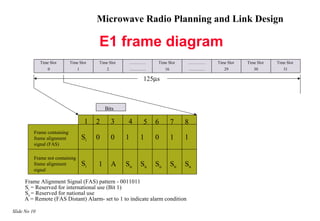
                                          E1 frame diagram
              Time Slot      Time Slot    Time Slot       …………    Time Slot      ………….     Time Slot   Time Slot   Time Slot
                  0              1            2           …………        16            …………      29          30          31

                                                             125µs


                                              Bits

                                      1   2       3   4      5   6         7    8
          Frame containing
          frame alignment            Si   0       0   1     1    0         1    1
          signal (FAS)

          Frame not containing
          frame alignment            Si   1       A   Sn    Sn   Sn        Sn   Sn
          signal

     Frame Alignment Signal (FAS) pattern - 0011011
     Si = Reserved for international use (Bit 1)
     Sn = Reserved for national use
     A = Remote (FAS Distant) Alarm- set to 1 to indicate alarm condition

Slide No 10
Microwave Radio Planning and Link Design

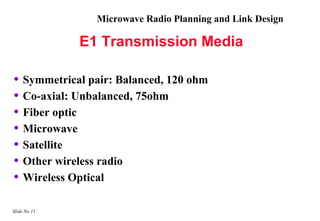
              E1 Transmission Media

• Symmetrical pair: Balanced, 120 ohm
• Co-axial: Unbalanced, 75ohm
• Fiber optic
• Microwave
• Satellite
• Other wireless radio
• Wireless Optical

Slide No 11
Microwave Radio Planning and Link Design

        GSM coding and TDM in terrestrial E1
• As we know PCM channel is 64Kb/s
• Bit rate for one voice GSM channel is 16Kb/s between
    BTS and BSC (terrestrial)
•   One GSM E1 is 120 GSM voice channels
•   The PCM-to-GSM TRAU (transcoder) reduces no of E1’s
    by 4
•   Each GSM radio carries 8 TCHs in the air, this equivalent
    to 8x16Kb/s=2x64Kb/s between BTS and BSC.
•   Each GSM radio has 2 time slots in the GSM E1.
•   Example: 3/3/3 site require 9x2=18 E1 time slots for
    traffic and time slot(s) for radio signaling links
Slide No 12
Microwave Radio Planning and Link Design


              Digital Multiplexing: PDH and SDH
                           Overview


Slide No 13
Microwave Radio Planning and Link Design


      European Digital Multiplexer Hierarchy
• Plesiochronous Digital Hierarchy (PDH)

• Synchronous Digital Hierarchy (SDH )


Slide No 14
Microwave Radio Planning and Link Design

                   PDH Multiplexing

• Based on a 2.048Mbit/s (E1) bearer
• Increasing traffic demands that more and more of these
    basic E1 bearers be multiplexed together to provide
    increased capacity
•   Once multiplexed, there is no simple way an individual E1
    bearer can be identified in a PDH hierarchy


Slide No 15
Microwave Radio Planning and Link Design

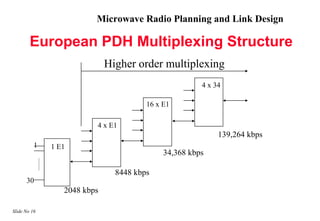
        European PDH Multiplexing Structure
                             Higher order multiplexing
                                                      4 x 34

                                       16 x E1

                         4 x E1
                                                           139,264 kbps
          1   1 E1
                                            34,368 kbps

                               8448 kbps
      30
                 2048 kbps

Slide No 16
Microwave Radio Planning and Link Design

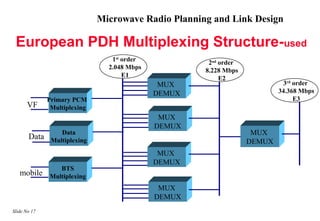
 European PDH Multiplexing Structure-used
                                 1st order            2nd order
                                2.048 Mbps           8.228 Mbps
                                     E1                   E2
                                              MUX                          3rd order
                                             DEMUX                        34.368 Mbps
              Primary PCM                                                      E3
      VF       Multiplexing
                                              MUX
                                             DEMUX
                  Data                                             MUX
       Data Multiplexing
                                                                  DEMUX
                                              MUX
                                             DEMUX
                  BTS
   mobile Multiplexing
                                              MUX
                                             DEMUX
Slide No 17
Microwave Radio Planning and Link Design

                   PDH Problems
• Inflexible and expensive because of asynchronous
    multiplexing
•   Limited network management and maintenance support
    capabilities
•   High capacity growth
•   Sensitive to network failure
•   Difficulty in verifying network status
•   Increased cost for O&M


Slide No 18
Microwave Radio Planning and Link Design

                                 SDH

•   Synchronous and based on byte interleaving
•   provides the capability to send data at multi-gigabit rates over
    fiber-optics links.
•   SDH is based on an STM-1 (155.52Mbit/s) rate
•   SDH supports the transmission of all PDH payloads, other than
    8Mbit/s


Slide No 19
Microwave Radio Planning and Link Design

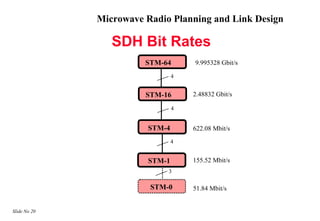
                 SDH Bit Rates
                        STM-64      9.995328 Gbit/s

                                4


                        STM-16      2.48832 Gbit/s

                                4


                        STM-4       622.08 Mbit/s
                                4


                        STM-1       155.52 Mbit/s
                             3

                         STM-0      51.84 Mbit/s


Slide No 20
Microwave Radio Planning and Link Design

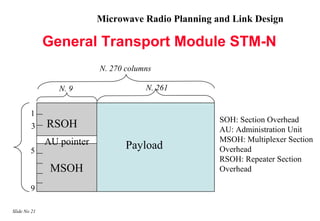
              General Transport Module STM-N
                           N. 270 columns
                 N. 9                  N. 261


        1
                                                     SOH: Section Overhead
        3     RSOH                                   AU: Administration Unit
              AU pointer                             MSOH: Multiplexer Section
        5
                                  Payload            Overhead
                                                     RSOH: Repeater Section
               MSOH                                  Overhead

        9

Slide No 21
Microwave Radio Planning and Link Design

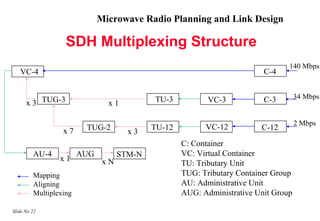
                   SDH Multiplexing Structure
                                                                                 140 Mbps
   VC-4                                                                   C-4


                                            TU-3                                     34 Mbps
      x 3 TUG-3                 x1                         VC-3           C-3

                                                                                     2 Mbps
                  x7     TUG-2              TU-12         VC-12          C-12
                                      x3
                                                    C: Container
         AU-4           AUG         STM-N           VC: Virtual Container
                 x1            xN                   TU: Tributary Unit
         Mapping                                    TUG: Tributary Container Group
         Aligning                                   AU: Administrative Unit
         Multiplexing                               AUG: Administrative Unit Group

Slide No 22
Microwave Radio Planning and Link Design

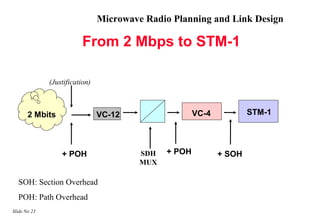
                          From 2 Mbps to STM-1

              (Justification)


       2 Mbits                  VC-12                  VC-4           STM-1


                  + POH                  SDH   + POH          + SOH
                                         MUX

  SOH: Section Overhead
  POH: Path Overhead
Slide No 23
Microwave Radio Planning and Link Design

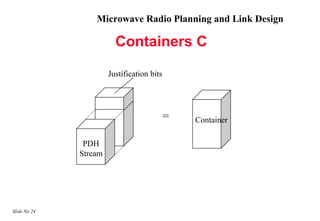
                         Containers C

                       Justification bits


                                            =   Container

               PDH
              Stream


Slide No 24
Microwave Radio Planning and Link Design

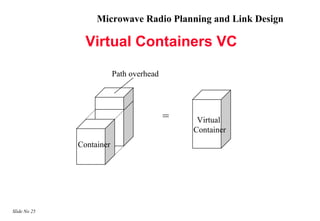
                Virtual Containers VC

                          Path overhead


                                          =    Virtual
                                              Container
              Container


Slide No 25
Microwave Radio Planning and Link Design

                    SDH Advantages
• Cost efficient and flexible networking
• Built in capacity for advanced network management and
    maintenance capabilities
•   Simplified multiplexing and demultiplexing
•   Low rate tributes visible within the high speed signal.
    Enables direct access to these signals
•   Cost efficient allocation of bandwidth
•   Fault isolation and Management
•   Byte interleaved and multiplexed

Slide No 26
Microwave Radio Planning and Link Design

                     SDH Benefits over PDH
•   SDH transmission systems have many benefits over PDH:
       – Software Control
                     allows extensive use of intelligent network management software for high
                        flexibility, fast and easy re-configurability, and efficient network
                        management.

       – Survivability
                     With SDH, ring networks become practicable and their use enables
                       automatic reconfiguration and traffic rerouting when a link is damaged.
                       End-to-end monitoring will allow full management and maintenance of
                       the whole network.

       – Efficient drop and insert
                     SDH allows simple and efficient cross-connect without full hierarchical
                       multiplexing or de-multiplexing. A single E1 2.048Mbit/s tail can be
                       dropped or inserted with relative ease even on Gbit/s links.
Slide No 27
Microwave Radio Planning and Link Design

              SDH Benefits over PDH- con’d
       – Standardization
                   enables the interconnection of equipment from different suppliers
                     through support of common digital and optical standards and
                     interfaces.


       – Robustness and resilience of installed networks is increased.

       – Equipment size and operating costs
                    reduced by removing the need for banks of multiplexers and de-
                      multiplexers. Follow-on maintenance costs are also reduced.

       – Backwards compatibly
                   will enable SDH links to support PDH traffic.
Slide No 28
Microwave Radio Planning and Link Design

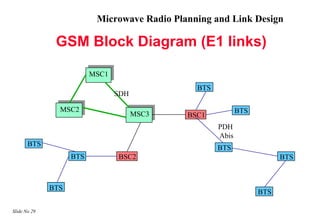
               GSM Block Diagram (E1 links)

                          MSC1
                                                BTS
                                 SDH

                MSC2                                         BTS
                                       MSC3   BSC1
                                                      PDH
                                                      Abis
       BTS
                                                      BTS
                    BTS          BSC2                                    BTS


              BTS
                                                                   BTS

Slide No 29
Microwave Radio Planning and Link Design

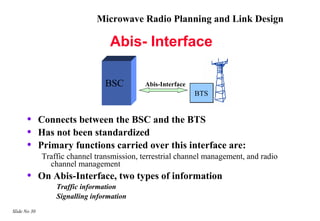
                                  Abis- Interface

                                 BSC         Abis-Interface
                                                              BTS


      •       Connects between the BSC and the BTS
      •       Has not been standardized
      •       Primary functions carried over this interface are:
              Traffic channel transmission, terrestrial channel management, and radio
                channel management
      •       On Abis-Interface, two types of information
                  Traffic information
                  Signalling information
Slide No 30
Microwave Radio Planning and Link Design

                              Abis- Interface
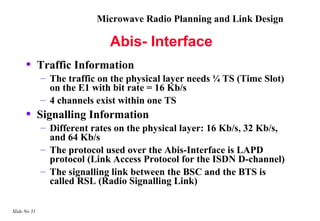
      •       Traffic Information
              – The traffic on the physical layer needs ¼ TS (Time Slot)
                on the E1 with bit rate = 16 Kb/s
              – 4 channels exist within one TS
      •       Signalling Information
              – Different rates on the physical layer: 16 Kb/s, 32 Kb/s,
                and 64 Kb/s
              – The protocol used over the Abis-Interface is LAPD
                protocol (Link Access Protocol for the ISDN D-channel)
              – The signalling link between the BSC and the BTS is
                called RSL (Radio Signalling Link)

Slide No 31
Microwave Radio Planning and Link Design


          Digital Microwave systems Overview


Slide No 32
Microwave Radio Planning and Link Design

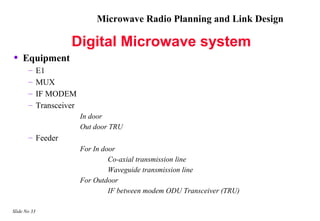
                       Digital Microwave system
•   Equipment
       –      E1
       –      MUX
       –      IF MODEM
       –      Transceiver
                            In door
                            Out door TRU
       – Feeder
                            For In door
                                     Co-axial transmission line
                                     Waveguide transmission line
                            For Outdoor
                                     IF between modem ODU Transceiver (TRU)

Slide No 33
Microwave Radio Planning and Link Design

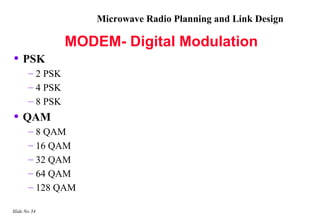
                 MODEM- Digital Modulation
• PSK
       – 2 PSK
       – 4 PSK
       – 8 PSK
• QAM
       – 8 QAM
       – 16 QAM
       – 32 QAM
       – 64 QAM
       – 128 QAM

Slide No 34
Microwave Radio Planning and Link Design

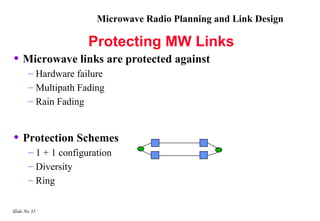
                      Protecting MW Links
• Microwave links are protected against
       – Hardware failure
       – Multipath Fading
       – Rain Fading


• Protection Schemes
       – 1 + 1 configuration
       – Diversity
       – Ring


Slide No 35
Microwave Radio Planning and Link Design

           Microwave Equipment Specification
• Operating Frequency
• Modulation
• Capacity
• Bandwidth
• Output power
• Receiver Thresholds @ BER’s 10-6 and 10-3
• MTBF
• FKTB

Slide No 36
Microwave Radio Planning and Link Design

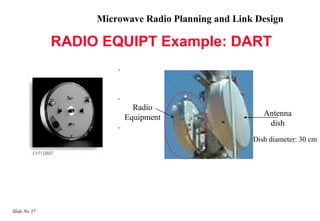
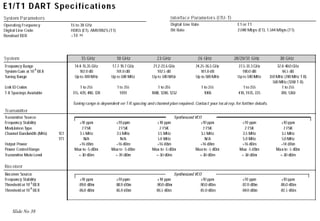
              RADIO EQUIPT Example: DART


                          Radio
                        Equipment                      Antenna
                                                        dish
                                                    Dish diameter: 30 cm


Slide No 37
Microwave Radio Planning and Link Design


Slide No 38
Microwave Radio Planning and Link Design

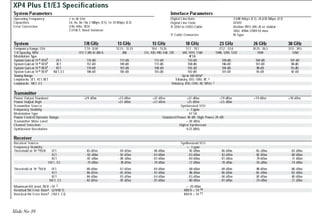
              Radio Equipment Datasheet


Slide No 39
Microwave Radio Planning and Link Design

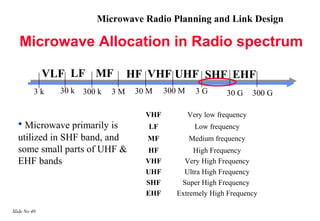
   Microwave Allocation in Radio spectrum

              VLF LF MF             HF VHF UHF SHF EHF
          3k    30 k   300 k   3M    30 M    300 M     3G       30 G      300 G

                                       VHF           Very low frequency
  • Microwave primarily is              LF             Low frequency
  utilized in SHF band, and            MF            Medium frequency
  some small parts of UHF &            HF            High Frequency
  EHF bands                            VHF        Very High Frequency
                                       UHF        Ultra High Frequency
                                       SHF       Super High Frequency
                                       EHF      Extremely High Frequency

Slide No 40
Microwave Radio Planning and Link Design

                   Microwave Bands
• Some Frequency bands used in microwave are
       – 2 GHz
       – 7 GHz
       – 13 GHz
       – 18 GHz
       – 23 GHz
       – 26 GHz
       – 38 GHz
• The usage of frequency bands will depend mainly on the
    budget calculation results and the path length

Slide No 41
Microwave Radio Planning and Link Design

                    Microwave Capacities

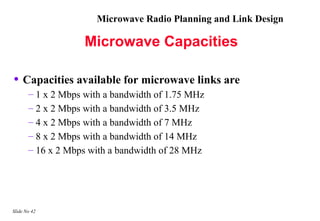
• Capacities available for microwave links are
       – 1 x 2 Mbps with a bandwidth of 1.75 MHz
       – 2 x 2 Mbps with a bandwidth of 3.5 MHz
       – 4 x 2 Mbps with a bandwidth of 7 MHz
       – 8 x 2 Mbps with a bandwidth of 14 MHz
       – 16 x 2 Mbps with a bandwidth of 28 MHz


Slide No 42
Microwave Radio Planning and Link Design

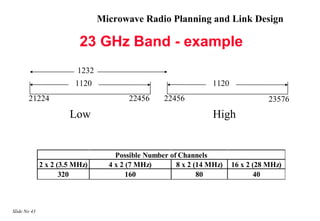
                          23 GHz Band - example
                         1232
                         1120                                    1120
       21224                            22456     22456                            23576
                       Low                                       High


                                    Possible Number of Channels
              2 x 2 (3.5 MHz)     4 x 2 (7 MHz)       8 x 2 (14 MHz)    16 x 2 (28 MHz)
                     320                160                  80                 40


Slide No 43
Microwave Radio Planning and Link Design

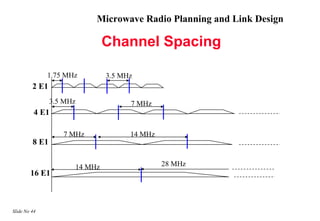
                                   Channel Spacing

              1.75 MHz             3.5 MHz
         2 E1
                3.5 MHz                  7 MHz
          4 E1

                   7 MHz                 14 MHz
         8 E1


                          14 MHz                  28 MHz
        16 E1


Slide No 44
Microwave Radio Planning and Link Design

              International Regulatory Bodies
• ITU-T
        Is to fulfil the purposes of the Union relating to telecommunication
         standardization by studying technical, operating and tariff questions
         and adopting Recommendations on them with a view to
         standardizing telecommunications on a world-wide basis.
• ITU-R
        plays a vital role in the management of the radio-frequency spectrum
         and satellite orbits, finite natural resources which are increasingly in
         demand from a large number of services such as fixed, mobile,
         broadcasting, amateur, space research, meteorology, global
         positioning systems, environmental monitoring and, last but not
         least, those communication services that ensure safety of life at sea
         and in the skies.

Slide No 45
Microwave Radio Planning and Link Design


              Performance and availability objectives


Slide No 46
Microwave Radio Planning and Link Design

    Performance Objectives and availability objectives
• Dimensioning      of network connection is based on the
    required availability objective and performance
•   Dimension a network must meet the standard
    requirements recommendations by ITU
•   The performance objectives are separated from
    availability objectives
•   Factors to be considered
       –      radio wave propagation
       –      hardware failure
       –      Resetting time after repair
       –      Frequency dependant interference problems

Slide No 47
Microwave Radio Planning and Link Design

    ITU-T Recs for Transmission in GSM Net

• All BTS, BSC and MSC connections in GSM network are
    defined as multiples of the primary rate if 2 Mbps,


•   ITU-T Rec G.821 applies as the overall standard for
    GSM network.


• ITU-T Rec G.826 applies for SDH.

Slide No 48
Microwave Radio Planning and Link Design

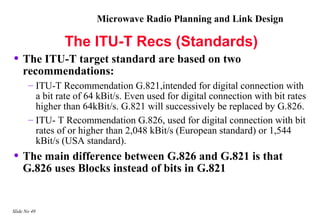
                The ITU-T Recs (Standards)
• The ITU-T target standard are based on two
    recommendations:
       – ITU-T Recommendation G.821,intended for digital connection with
         a bit rate of 64 kBit/s. Even used for digital connection with bit rates
         higher than 64kBit/s. G.821 will successively be replaced by G.826.
       – ITU- T Recommendation G.826, used for digital connection with bit
         rates of or higher than 2,048 kBit/s (European standard) or 1,544
         kBit/s (USA standard).
• The main difference between G.826 and G.821 is that
    G.826 uses Blocks instead of bits in G.821


Slide No 49
Microwave Radio Planning and Link Design

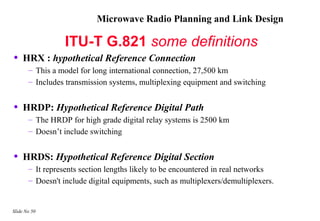
                  ITU-T G.821 some definitions
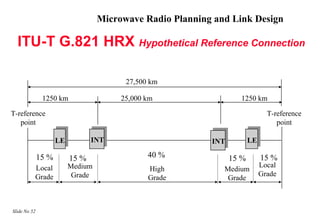
•   HRX : hypothetical Reference Connection
       – This a model for long international connection, 27,500 km
       – Includes transmission systems, multiplexing equipment and switching


•   HRDP: Hypothetical Reference Digital Path
       – The HRDP for high grade digital relay systems is 2500 km
       – Doesn’t include switching


•   HRDS: Hypothetical Reference Digital Section
       – It represents section lengths likely to be encountered in real networks
       – Doesn't include digital equipments, such as multiplexers/demultiplexers.


Slide No 50
Microwave Radio Planning and Link Design

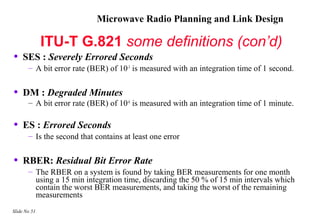
              ITU-T G.821 some definitions (con’d)
•   SES : Severely Errored Seconds
       – A bit error rate (BER) of 10-3 is measured with an integration time of 1 second.


•   DM : Degraded Minutes
       – A bit error rate (BER) of 10-6 is measured with an integration time of 1 minute.

•   ES : Errored Seconds
       – Is the second that contains at least one error


•   RBER: Residual Bit Error Rate
       – The RBER on a system is found by taking BER measurements for one month
         using a 15 min integration time, discarding the 50 % of 15 min intervals which
         contain the worst BER measurements, and taking the worst of the remaining
         measurements
Slide No 51
Microwave Radio Planning and Link Design

  ITU-T G.821 HRX Hypothetical Reference Connection

                                         27,500 km

               1250 km                  25,000 km                  1250 km

T-reference                                                                    T-reference
   point                                                                          point

                     LE          INT                       INT          LE

              15 %        15 %                 40 %              15 %        15 %
          Local           Medium                                             Local
                                               High           Medium
          Grade            Grade                                             Grade
                                               Grade           Grade


Slide No 52
Microwave Radio Planning and Link Design

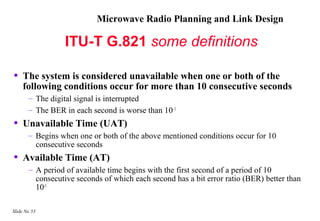
                  ITU-T G.821 some definitions

•   The system is considered unavailable when one or both of the
    following conditions occur for more than 10 consecutive seconds
       – The digital signal is interrupted
       – The BER in each second is worse than 10 –3
•   Unavailable Time (UAT)
       – Begins when one or both of the above mentioned conditions occur for 10
         consecutive seconds
•   Available Time (AT)
       – A period of available time begins with the first second of a period of 10
         consecutive seconds of which each second has a bit error ratio (BER) better than
         10-3

Slide No 53
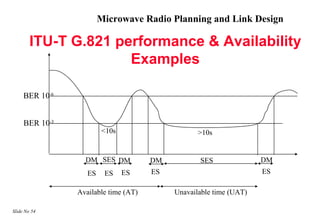
Microwave Radio Planning and Link Design

        ITU-T G.821 performance & Availability
                      Examples

     BER 10-6


     BER 10-3
                        <10s                      >10s


                  DM SES DM           DM          SES               DM
                   ES    ES    ES     ES                            ES

                Available time (AT)        Unavailable time (UAT)

Slide No 54
Microwave Radio Planning and Link Design

                   ITU-T G.821 Availability
• Route availability equals the sum of single link
    availabilities forming the route.
•   Unavailability might be due to
       – Propagation effect
       – Equipment effect

Note: Commonly used division is to allocate 2/3 of the allowed total
 unavailability to equipment failure and 1/3 to propagation related
 unavailability


Slide No 55
Microwave Radio Planning and Link Design

          ITU-T G.821 Performance Objectives
•   SES : Severely Errored Seconds
       – BER should not exceed 10–3 for more than 0.2% of one second intervals in any
         month
       – The total allocation of 0.2% is divided as: 0.1% for the three classifications
       – The remaining 0.1% is a block allowance to the high grade and the medium grade
         portions
•   DM : Degraded Minutes
       – BER should not exceed 10–6 for more than 10% of one minute intervals in any
         month
       – The allocations of the 10% to the three classes
•   ES : Errored Seconds
       – Less than 8% of one second intervals should have errors
       – The allocations of the 8% to the three classes

Slide No 56
Microwave Radio Planning and Link Design

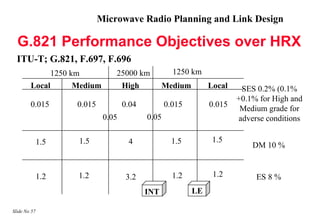
  G.821 Performance Objectives over HRX
  ITU-T; G.821, F.697, F.696
                    1250 km           25000 km            1250 km
        Local            Medium           High          Medium        Local    SES 0.2% (0.1%
                                                                              +0.1% for High and
        0.015             0.015           0.04          0.015         0.015
                                                                               Medium grade for
                                   0.05          0.05                         adverse conditions

              1.5         1.5              4              1.5          1.5
                                                                                  DM 10 %


              1.2         1.2              3.2            1.2          1.2         ES 8 %
                                                 INT             LE

Slide No 57
Microwave Radio Planning and Link Design

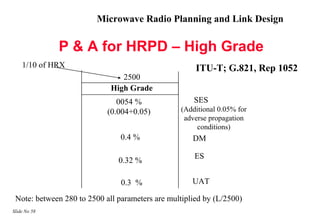
              P & A for HRPD – High Grade
    1/10 of HRX                                       ITU-T; G.821, Rep 1052
                                2500
                             High Grade
                               0054 %                SES
                            (0.004+0.05)         (Additional 0.05% for
                                                  adverse propagation
                                                      conditions)
                                0.4 %                DM

                                                     ES
                               0.32 %

                                0.3 %                UAT

 Note: between 280 to 2500 all parameters are multiplied by (L/2500)
Slide No 58
Microwave Radio Planning and Link Design

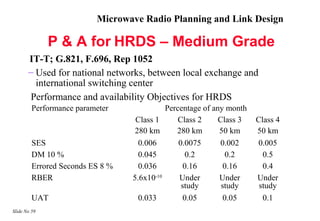
              P & A for HRDS – Medium Grade
       IT-T; G.821, F.696, Rep 1052
       – Used for national networks, between local exchange and
         international switching center
        Performance and availability Objectives for HRDS
         Performance parameter              Percentage of any month
                                   Class 1      Class 2     Class 3   Class 4
                                   280 km      280 km       50 km     50 km
         SES                        0.006       0.0075      0.002     0.005
         DM 10 %                    0.045          0.2         0.2      0.5
         Errored Seconds ES 8 %     0.036         0.16        0.16      0.4
         RBER                     5.6x10⁻¹⁰     Under       Under     Under
                                                 study       study     study
         UAT                        0.033         0.05        0.05      0.1
Slide No 59
Microwave Radio Planning and Link Design

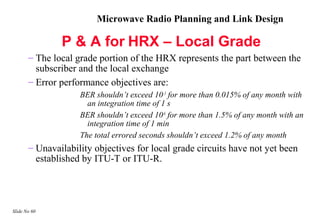
               P & A for HRX – Local Grade
       – The local grade portion of the HRX represents the part between the
         subscriber and the local exchange
       – Error performance objectives are:
                    BER shouldn’t exceed 10–3 for more than 0.015% of any month with
                      an integration time of 1 s
                    BER shouldn’t exceed 10-6 for more than 1.5% of any month with an
                      integration time of 1 min
                    The total errored seconds shouldn’t exceed 1.2% of any month
       – Unavailability objectives for local grade circuits have not yet been
         established by ITU-T or ITU-R.


Slide No 60
Microwave Radio Planning and Link Design

              Performance Predictions
• System performance is determined by the probability for
    the signal level to drop below the radio threshold level or
    the received spectrum to be severely distorted


• The larger fade margin, the smaller probability for the
    signal to drop below the receiver threshold level


Slide No 61
Microwave Radio Planning and Link Design

                          Availability
•   The total unavailability of a radio path is the sum of the
    probability of hardware failure and unavailability due to rain
•   The unavailability due to hardware failure is considered for
    both the go and return direction so the calculated value is
    doubled
•   The probability that electronic equipment fails in service is not
    constant with time
•   the high probability of hardware failure occurred during
    burn-in and wear-out periods
•   During life time the random failures have constant probability


Slide No 62
Microwave Radio Planning and Link Design

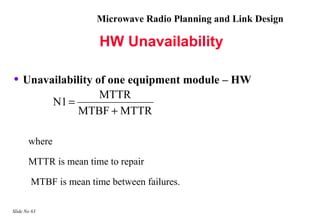
                        HW Unavailability

• Unavailability of one equipment module – HW
                       MTTR
               N1 =
                    MTBF + MTTR

       where

       MTTR is mean time to repair

        MTBF is mean time between failures.

Slide No 63
Microwave Radio Planning and Link Design

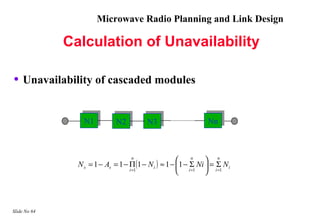
              Calculation of Unavailability

• Unavailability of cascaded modules

                  N1
                  N1          N2
                              N2         N3
                                         N3                     Nn
                                                                Nn


                                    n
                                                          n
                                                                 n
                N s = 1 − As = 1 − Π (1 − N i ) ≈ 1 − 1 − Σ Ni  = Σ N i
                                   i =1                i =1  i =1


Slide No 64
Microwave Radio Planning and Link Design

               Calculation of Unavailability

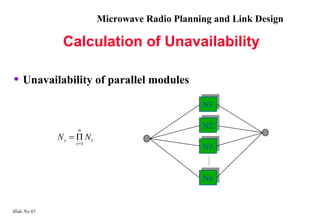
• Unavailability of parallel modules
                                                 N1
                                                 N1

                                                 N2
                                                 N2
                    n
              N s = Π Ni
                   i =1                          N3
                                                 N3


                                                 Nn
                                                 Nn


Slide No 65
Microwave Radio Planning and Link Design

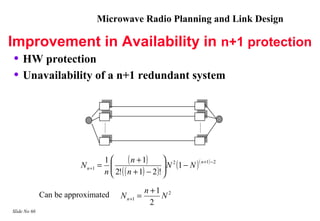
Improvement in Availability in n+1 protection
 • HW protection
 • Unavailability of a n+1 redundant system


                         N n +1 =
                                    1
                                     
                                              ( n + 1)  N 2 (1 − N ) ( n +1) −2
                                      2! ( ( n + 1) − 2 )! 
                                    n                      
                                                            
                                                   n +1 2
              Can be approximated         N n +1 =     N
                                                     2
Slide No 66
Microwave Radio Planning and Link Design

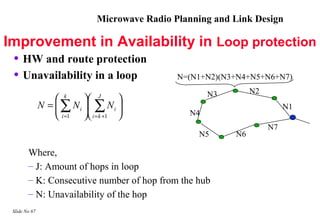
Improvement in Availability in Loop protection
 • HW and route protection
 • Unavailability in a loop N=(N1+N2)(N3+N4+N5+N6+N7)

                                                       N3        N2
                     k
                              J
                                      
               N =  ∑ N i  ∑ N i                                       N1
                    i =1  i = k +1            N4
                                                                      N7
                                                    N5      N6

        Where,
        – J: Amount of hops in loop
        – K: Consecutive number of hop from the hub
        – N: Unavailability of the hop
 Slide No 67
Microwave Radio Planning and Link Design

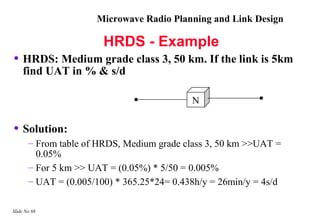
                        HRDS - Example
• HRDS: Medium grade class 3, 50 km. If the link is 5km
    find UAT in % & s/d

                                            N

• Solution:
       – From table of HRDS, Medium grade class 3, 50 km >>UAT =
         0.05%
       – For 5 km >> UAT = (0.05%) * 5/50 = 0.005%
       – UAT = (0.005/100) * 365.25*24= 0.438h/y = 26min/y = 4s/d

Slide No 68
Microwave Radio Planning and Link Design


              Topology Planning


Slide No 69
Microwave Radio Planning and Link Design

                 Capacity and Topology planning
•   Capacity demand per link results from transceiver capacity at those
    BTS which are to be connected to the microwave link
•   One transceiver reserves 2.5 time slots for traffic and signalling
•   It is common to design for the higher capacity demand.
•   For rapid traffic increase, the transmission network is dimensioned
    to reserve the capacity of 6 transceivers
•   The advantage to reserve capacity
       –      Flexibility in topology planning
       –      New BTS s can be added to existing transmission links
       –      New transceivers can be added without implementing new transmission links
       –      No need for changeover to new transmission links in fully operating network


Slide No 70
Microwave Radio Planning and Link Design

     Transmission Capacity Planning-Traffic
             Motorola-standards
• Bit rate for one voice PCM channel is 64Kb/s
• Bit rate for one voice GSM channel is 16Kb/s between
    BTS and BSC
•   Each GSM radio carries 8 TCHs in the air, this equivalent
    to 8x16Kb/s=2x64Kb/s between BTS and BSC.
•   Each GSM radio has 2 time slots in the GSM E1.
•   Example: 3/3/3 site require 9x2=18 E1 time slots for
    traffic and one time slot for RSL, total is 19 time slots

Slide No 71
Microwave Radio Planning and Link Design

Transmission Capacity Planning-Example
• Example: How Many Motorola micro-cells can be daisy
    chained using one E1 at maximum?
•   Solution:
       – Motorola micro cell has 2 radios (omni-2)
       – Each micrcell requires 2x2 time slots for traffic and 1 time slot for
         rsl
       – So each micro cell requires 5 time slots (64 kb/s time slots)
       – Each E1 contains 31 time slots
       – [31time slots] divided by [5 time slots/microcell] gives us the the
         maximum no of daisy chained microcells
       – So 6 microcells can be daisy chained at maximum
Slide No 72
Microwave Radio Planning and Link Design

                       Topology Planning
• Network topology is based on
       – Traffic
       – Outage requirements


• Most frequently used topologies
       – Star
       – Daisy Chain
       – Loop


Slide No 73
Microwave Radio Planning and Link Design

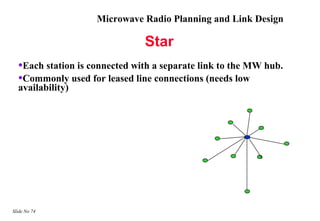
                               Star
  •Each station is connected with a separate link to the MW hub.
  •Commonly used for leased line connections (needs low
  availability)


Slide No 74
Microwave Radio Planning and Link Design

                                               Star
•   Advantages
       –      Easy to design
       –      Independent paths which mean link failure affects only one node
       –      Easy to configure and install
       –      Can be expanded easily


•   Disadvantages
       –      Limited distance from BTS or hub to the BSC
       –      Inefficient use of frequency band
       –      Inefficient link capacity use as each BTS uses the 2 Mbps
       –      High concentration of equipment at nodal point
       –      Interference problem

Slide No 75
Microwave Radio Planning and Link Design

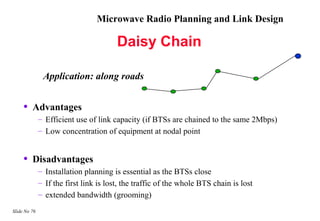
                                        Daisy Chain

               Application: along roads


     •   Advantages
              – Efficient use of link capacity (if BTSs are chained to the same 2Mbps)
              – Low concentration of equipment at nodal point


     •   Disadvantages
              – Installation planning is essential as the BTSs close
              – If the first link is lost, the traffic of the whole BTS chain is lost
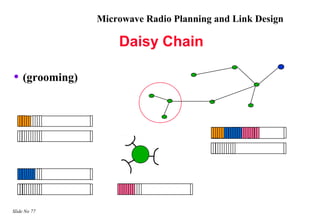
              – extended bandwidth (grooming)
Slide No 76
Microwave Radio Planning and Link Design

                   Daisy Chain

• (grooming)


Slide No 77
Microwave Radio Planning and Link Design

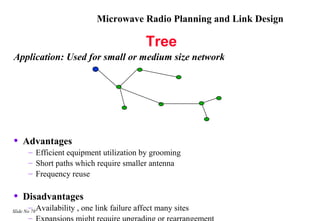
                                         Tree
Application: Used for small or medium size network


•   Advantages
       – Efficient equipment utilization by grooming
       – Short paths which require smaller antenna
       – Frequency reuse

•   Disadvantages
       – Availability , one link failure affect many sites
Slide No 78
       – Expansions might require upgrading or rearrangement
Microwave Radio Planning and Link Design

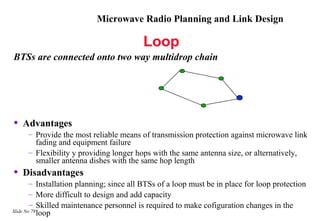
                                         Loop
BTSs are connected onto two way multidrop chain


•   Advantages
     – Provide the most reliable means of transmission protection against microwave link
       fading and equipment failure
     – Flexibility y providing longer hops with the same antenna size, or alternatively,
       smaller antenna dishes with the same hop length
•   Disadvantages
        – Installation planning; since all BTSs of a loop must be in place for loop protection
        – More difficult to design and add capacity
        – Skilled maintenance personnel is required to make cofiguration changes in the
Slide No 79
            loop
Microwave Radio Planning and Link Design

                Topology Planning

• Define clusters
• Select reference node
• Chose Backbone
• Decide the topology


Slide No 80
Microwave Radio Planning and Link Design


                     Diversity


Slide No 81
Microwave Radio Planning and Link Design

                                Diversity
• Diversity is a method used if project path is severely
    influenced by fading due to multi path propagation
•   The common protection of diversity techniques are:
       – Space Diversity
       – Frequency Diversity
       – Combination of frequency and space Diversity
       – Angle Diversity

        Note: frequency diversity technique takes advantage because of the
         frequency selectivity nature of the multi path depressive fading.


Slide No 82
Microwave Radio Planning and Link Design

                         Diversity
Diversity Improvement
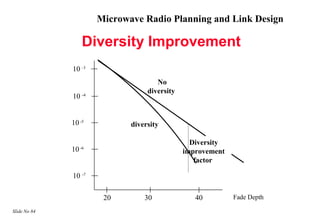
• The degree of improvement afforded by all of diversity
  techniques on the extents to witch the signals in the
  diversity branches of the system are uncorrelated.
• The improvement of diversity relative to a single channel
  given by:
                          PSinglechannel
   Improvement factor I =                where P refers to BER
                           PDiversity


Slide No 83
Microwave Radio Planning and Link Design

                   Diversity Improvement
              10 –3
                                       No
                                    diversity
              10 -4


              10 -5            diversity

                                                  Diversity
              10   -6
                                                improvement
                                                   factor

              10 -7

                         20        30              40         Fade Depth

Slide No 84
Microwave Radio Planning and Link Design

                          Single Diversity
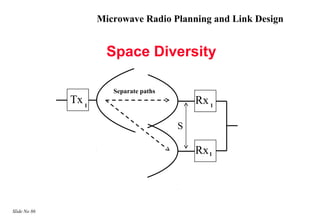
• Space diversity
       – Employs transmit antenna and two receiver antenna
       – The two receivers enables the reception of signals via different
         propagation paths
       – It requires double antenna on each side of the hop, a unit for the
         selection of the best signal and partially or fully duplicated
         receivers

       Note: whenever space diversity is used, angle diversity should also
        be employed by tilting the antenna at different upwards angles


Slide No 85
Microwave Radio Planning and Link Design


                       Space Diversity

                        Separate paths
              Tx 1                           Rx 1

                                         S

                                             Rx 1


Slide No 86
Microwave Radio Planning and Link Design

                  Frequency diversity
• The same signal is transmitted simultaneously on two
    different frequencies
•   One antenna is required on either side of the hops, a unit
    selecting the best signal and duplicate transmitters and
    receivers
•   A cost-effective technique
•   Provides equipment protection , also gives protection
    from multipath fading


Slide No 87
Microwave Radio Planning and Link Design

                  Frequency diversity
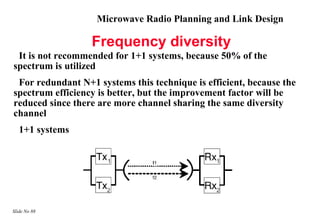
 It is not recommended for 1+1 systems, because 50% of the
spectrum is utilized
 For redundant N+1 systems this technique is efficient, because the
spectrum efficiency is better, but the improvement factor will be
reduced since there are more channel sharing the same diversity
channel
   1+1 systems


Slide No 88
Microwave Radio Planning and Link Design

              Hot standby configuration
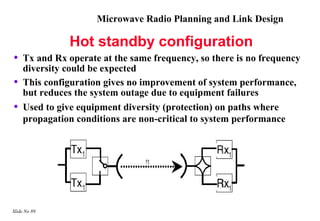
•   Tx and Rx operate at the same frequency, so there is no frequency
    diversity could be expected
•   This configuration gives no improvement of system performance,
    but reduces the system outage due to equipment failures
•   Used to give equipment diversity (protection) on paths where
    propagation conditions are non-critical to system performance


Slide No 89
Microwave Radio Planning and Link Design

                    Hybrid diversity
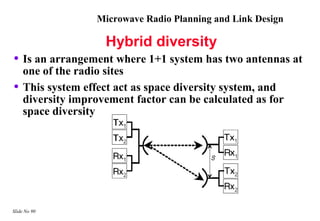
• Is an arrangement where 1+1 system has two antennas at
    one of the radio sites
•   This system effect act as space diversity system, and
    diversity improvement factor can be calculated as for
    space diversity


Slide No 90
Microwave Radio Planning and Link Design

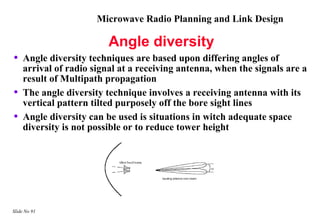
                         Angle diversity
•   Angle diversity techniques are based upon differing angles of
    arrival of radio signal at a receiving antenna, when the signals are a
    result of Multipath propagation
•   The angle diversity technique involves a receiving antenna with its
    vertical pattern tilted purposely off the bore sight lines
•   Angle diversity can be used is situations in witch adequate space
    diversity is not possible or to reduce tower height


Slide No 91
Microwave Radio Planning and Link Design

                 Combined diversity
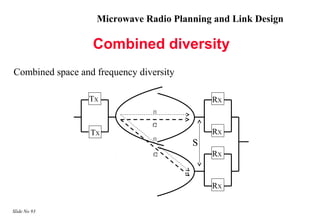
• In practical configuration a combination of space and
    frequency diversity is used
•   Different combination algorithms exist
•   The simple method (conservative) to calculate the
    improvement factor for combined diversity configuration
         I = Isd + Isd


Slide No 92
Microwave Radio Planning and Link Design

                  Combined diversity
Combined space and frequency diversity

                 TX                          RX
                                f1

                                f2
                  TX                         RX
                                f1
                                         S
                                f2           RX


                                             RX

Slide No 93
Microwave Radio Planning and Link Design

                         Path Diversity
•   Outage due to precipitation will not be reduced by use of
    frequency,angle or space diversity.
•   Rain attenuation is mainly a limiting factor at frequencies above
    ~10 GHz
•   Systems operating at these high frequencies are used in urban areas
    where the radio relay network may from a mix of star and mesh
    configurations
•   The area covered by an intense shower is normally much smaller
    than the coverage of the entire network
•   Re-Routing the signal via other paths


Slide No 94
Microwave Radio Planning and Link Design

                                    Path Diversity

•       The diversity gain (I.e. the difference between the attenuation
        (dB) exceeded for a specific percentage of time on single link and
        that simultaneously on two parallel links
       –      Tends to decrease as the path length increases from 12 km or a given percentage
              of time, and for a given lateral path separation
       –      Is generally greater for a spacing of 8 km than for 4 km, though an increase to
              12 km dose not provide further improvement
       –      Is not significantly dependent on frequency in the range 20 – 40 GHz, for a
              given geometry, and
                  - Ranges from about 2.8 dB at 0.1% of the time to 0.4 dB at 0.001% of the time, for
                      a spacing of 8 km, and path lengths of about the same value for a 4 km spacing
                      are about 1.8 to 2.0 dB.


Slide No 95
Microwave Radio Planning and Link Design


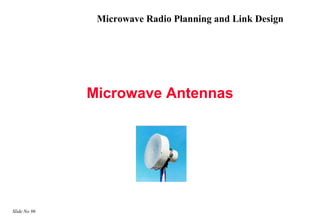
              Microwave Antennas


Slide No 96
Microwave Radio Planning and Link Design

                    Microwave Antennas
• The most commonly used type is parabolic antenna
• The performance of microwave system depends on the
    antenna parameters
•   Antenna parameters are:
       – Gain
       – Voltage Standing Wave Ratio (VSWR)
       – Side and back lobe levels
       – Beam width
       – Discrimination of cross polarization
       – Mechanical stability

Slide No 97
Microwave Radio Planning and Link Design

                               Antenna Gain
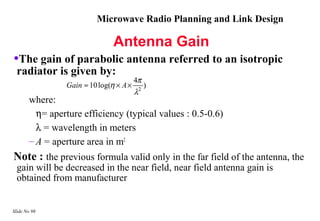
•The gain of parabolic antenna referred to an isotropic
  radiator is given by:
                                        4π
                Gain ≈ 10 log(η × A ×       2
                                                )
                                        λ
       where:
         η= aperture efficiency (typical values : 0.5-0.6)
         λ = wavelength in meters
       – A = aperture area in m2
Note : the previous formula valid only in the far field of the antenna, the
  gain will be decreased in the near field, near field antenna gain is
  obtained from manufacturer


Slide No 98
Microwave Radio Planning and Link Design

                     Antenna Gain-cont.
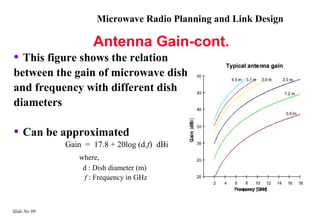
• This figure shows the relation
between the gain of microwave dish
and frequency with different dish
diameters

• Can be approximated
              Gain = 17.8 + 20log (d.f) dBi
                 where,
                  d : Dish diameter (m)
                   f : Frequency in GHz


Slide No 99
Microwave Radio Planning and Link Design

                           VSWR
• VSWR resembles Voltage Standing Wave Ratio
• It is important in the case of high capacity systems with
    stringent linearity objectives
•   VSWR should be minimum in order to avoid intermodulation
    interference
•   Typical values of VSWR are from 1.06 to 1.15
•   High performance antennas have VSWR from 1.04 to 1.06


Slide No 100
Microwave Radio Planning and Link Design

               Side and Back lobe Levels
• The important parameters in frequency planning and
    interference calculations are sidelobe and backlobes
•   Low levels of side and backlobes make the use of
    frequency spectrum more efficient
•   The levels of side and backlobes are specified in the
    radiation envelope patterns
•   The front to back ratio gives an indication of backlobe
    levels
•   The front to back ratio increases with increasing of
    frequency and antenna diameter

Slide No 101
Microwave Radio Planning and Link Design

                             Beam Width
• The half power beam width of antenna is defined as the
    angular width of the main beam at –3dB point


       – An approximate formula used to find the beam width is:
              α3dB = ± 35. λ/D in degrees
       – The 10dB deflection angle is found approximately by:
              α10dB = 60. λ/D in degrees


Slide No 102
Microwave Radio Planning and Link Design

     Antenna Characteristics – EIRP and ERP
•   Effective Isotropic Radiated Power (EIRP)
       – It is equal to the product of the power supplied to a transmitting antenna and the
         antenna gain in a given direction relative to an isotropic radiator (expressed in
         watts)
       – EIRP = Power - Feeder Loss + Antenna Gain
               Both EIRP and Power expressed in dBW
               Antenna gain expressed in dBi
•   Effective Radiated Power (ERP)
       – The same as EIRP but is relative to a half-wave dipole instead of an isotropic
         radiator
•   EIRP = ERP + 2.14 dB
•   Example
       Transmitter Output Power = 4 Watts = 36 dBm, Transmission Line Loss = 2 dB, and
       Antenna Gain = 10 dBd. Calculate the ERP
       – Answer: ERP = 36 - 2 + 10 = 44 dBmd
Slide No 103
Microwave Radio Planning and Link Design

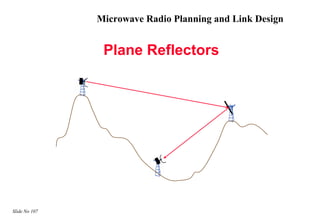
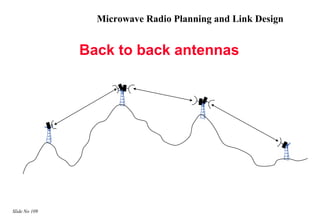
                         Passive Repeater
• Two types of passive repeaters :
       – Plane reflectors
       – Back to Back antennas
• The plane reflector reflects MW signals as the mirror
    reflects light
       – The laws of reflection are valid here
• The back to back antennas work just like an ordinary
    repeater station, but without frequency transportation or
    amplification of the signal


Slide No 104
Microwave Radio Planning and Link Design

                    Passive Repeater- cont.

• By using passive repeaters; the free space loss becomes:
                               AL= AFSA – GR + AFSB
where
       – AFSA is the free space loss for the path site A to passive repeater
       – AFSB is the free space loss for the path site B to passive repeater
       – GR is the gain of the passive repeater


Slide No 105
Microwave Radio Planning and Link Design

                               Plane Reflectors
•   More popular than back to back antennas due to :
       – Efficiency is around 100%
       – Can be produced with much larger dimensions than parabolic antennas
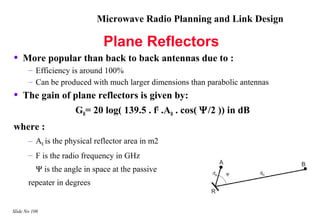
•   The gain of plane reflectors is given by:
                      GR= 20 log( 139.5 . f2 .AR . cos( Ψ/2 )) in dB
where :
       – AR is the physical reflector area in m2
       – F is the radio frequency in GHz
          Ψ is the angle in space at the passive
       repeater in degrees


Slide No 106
Microwave Radio Planning and Link Design


                Plane Reflectors


Slide No 107
Microwave Radio Planning and Link Design

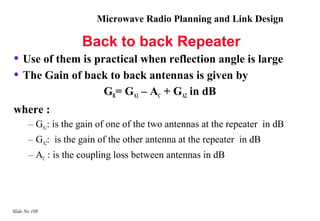
                     Back to back Repeater
• Use of them is practical when reflection angle is large
• The Gain of back to back antennas is given by
                          GR= GA1 – AC + GA2 in dB
where :
       – GA1: is the gain of one of the two antennas at the repeater in dB
       – GA2: is the gain of the other antenna at the repeater in dB
       – AC : is the coupling loss between antennas in dB


Slide No 108
Microwave Radio Planning and Link Design


               Back to back antennas


Slide No 109
Microwave Radio Planning and Link Design

         Antenna Characteristics - Polarization

• Co-Polarization
       – The transmit and receive antennas have the same polarization
       – Either horizontal or vertical (HH or VV)
• Cross-Polarization
       – The transmit and receive antennas have different polarization
       – Either HV or VH


Slide No 110
Microwave Radio Planning and Link Design

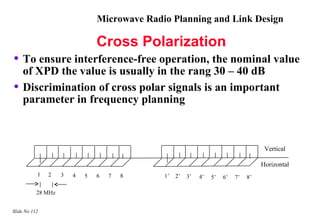
                             Cross Polarization
•   Transmission of two separate traffic channels is performed on the
    same radio frequency but on orthogonal polarization
•   The polarization planes are horizontal and vertical
•   The discrimination between the two polarization is called Cross
    Polar Discrimination (XPD)
•   Cross-Polarization Discrimination (XPD)
       –     the ratio between the power received in the orthogonal (cross polar) port to the
           power received at the co-polar port when the antenna is excited with a wave
           polarized as in the co-polar antenna element
•   Good cross polarization allows full utilization of the frequency band


Slide No 111
Microwave Radio Planning and Link Design

                                Cross Polarization
• To ensure interference-free operation, the nominal value
    of XPD the value is usually in the rang 30 – 40 dB
•   Discrimination of cross polar signals is an important
    parameter in frequency planning


                                                                                       Vertical

                                                                                      Horizontal
           1   2    3   4   5   6   7   8     1’   2’   3’   4’   5’   6’   7’   8’

           28 MHz


Slide No 112
Microwave Radio Planning and Link Design

                 Mechanical Stability
• Limitations in sway / twist   for the structure of the
    structure (tower or mast) correspond to a maximum 10
    dB signal attenuation due to antenna misalignment
•   The maximum deflection angle may be estimated for a
    given antenna diameter and frequency by using
    α 10dB = 60. λ/D in degrees


Slide No 113
Microwave Radio Planning and Link Design


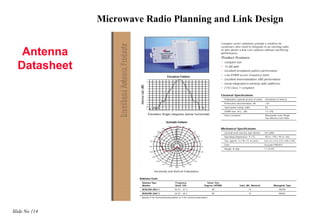
   Antenna
  Datasheet


Slide No 114
Microwave Radio Planning and Link Design

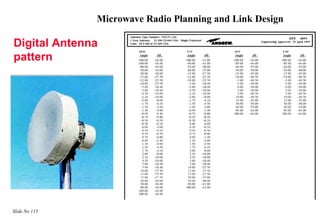
Digital Antenna
pattern


Slide No 115
Microwave Radio Planning and Link Design

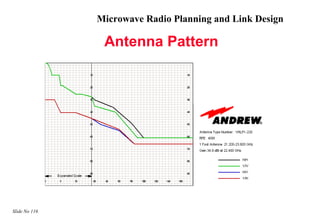
                Antenna Pattern


Slide No 116
Microwave Radio Planning and Link Design


               Radio Propagation


Slide No 117
Microwave Radio Planning and Link Design

                  Electromagnetic (EM) Waves
•   EM wave is a wave produced by the interaction of time varying
    electric and magnetic field
•   Electromagnetic fields are typically generated by alternating
    current (AC) in electrical conductors
•   The EM field composes of two fields (vectors)
       – Electric vector E
       – Magnetic vector H
•   Electromagnetic waves can be
       –   Reflected and scattered
       –   Refracted
       –   Diffracted
       –   Absorbed (its energy)

Slide No 118
Microwave Radio Planning and Link Design

               Electromagnetic Waves Properties
• E and H vectors are orthogonal
• In free space environment, the EM-wave propagates at
    the speed of light (c)
•   The distance between the wave crests is called the
    wavelength (λ)
•   The frequency ( f )is the number of times the wave
    oscillates
•   The relation that combines the EM-wave frequency and
    wavelength with the speed of light is:
                            λ=c/f
Slide No 119
Microwave Radio Planning and Link Design

                    Radio Wave Propagation

• The propagation of radio wave is affected by :
       – Frequency Effect
       – Terrain Effect
       – Atmospheric Effect
       – Multipath Effect


All the above mentioned effects cause a degradation in
 quality

Slide No 120
Microwave Radio Planning and Link Design

                         Frequency Effect

• Attenuation: Loss
• Propagation of radio depends on frequency band

• At frequencies above 6 GHz radio wave is more affected
    by gas absorption and precipitation
       – At frequencies close to 10 GHz the effects of precipitation begins to
         dominate
       – Gas absorption starts influencing at 22 GHz where the water vapour
         shows characteristic peak
Slide No 121
Microwave Radio Planning and Link Design

                           Terrain effect
• Reflection and scattering
• The radio wave propagating near the surface of earth is
    influenced by:
       – Electrical characteristics of earth
       – Topography of terrain including man-made structures


Slide No 122
Microwave Radio Planning and Link Design

                       Atmospheric effect
• Loss and refraction
• The gaseous constituents and temperature of the
    atmosphere influence radio waves by:
       – Absorbing its energy
       – Variations in refractive index which cause the radio wave reflect,
         refract and scatter


Slide No 123
Microwave Radio Planning and Link Design

                    Multipath effect
• Multipath effect occurs when many signals with different
    amplitude and/or phase reach the receiver


• Multipath effect is caused by reflection and refraction

• Multipath propagation cause    fading


Slide No 124
Microwave Radio Planning and Link Design

               EM wave Reflection and scattering

• When electromagnetic waves incide on a surface it might
    be reflected or scattered
•   Rayleigh criterion used to determine whether the wave
    will be scattered or reflected
•   The reflected waves depend on the frequency, incidence
    angle and electrical property of the surface


Slide No 125
Microwave Radio Planning and Link Design

                 EM wave Reflections

• Reflection of the radio beam from lakes and large surfaces
    are more critical than reflection from terrain with
    vegetation
•   Generally, vertical polarization gives reduced reflection
    especially at lower frequencies
•   If there is a great risk from reflection ,space diversity
    should be used


Slide No 126
Microwave Radio Planning and Link Design

               EM wave Reflection coefficient (ρ)

• Reflection can be characterized by its total reflection
    coefficient ρ
•   ρ is the quotient between the reflected and incident field
•   When ρ = 0 nothing will be reflected and when ρ =1 we
    have specular reflection
•   reflection coefficient decreases with frequency


Slide No 127
Microwave Radio Planning and Link Design

         EM wave Reflection coefficient-cont.
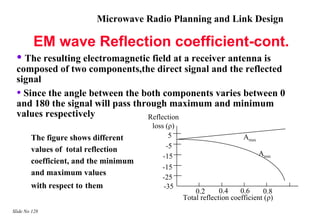
 • The resulting electromagnetic field at a receiver antenna is
 composed of two components,the direct signal and the reflected
 signal
 • Since the angle between the both components varies between 0
 and 180 the signal will pass through maximum and minimum
 values respectively             Reflection
                                       loss (ρ)
        The figure shows different           5                         Amax
        values of total reflection          -5
                                           -15                                Amin
        coefficient, and the minimum
                                           -15
        and maximum values
                                           -25
        with respect to them               -35
                                                      0.2      0.4    0.6     0.8
                                                  Total reflection coefficient (ρ)
Slide No 128
Microwave Radio Planning and Link Design

                   EM wave Refraction

• Refraction occurs because radio waves travel with
    different velocities in different medium according to their
    electrical characteristics.


• Index of refraction of a medium is the ratio of the velocity
    of radio waves in space to the velocity of radio waves in
    that medium


Slide No 129
Microwave Radio Planning and Link Design

                      EM wave Refraction
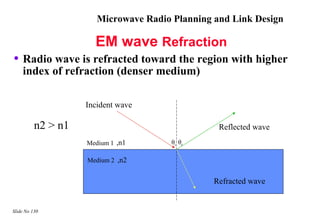
• Radio wave is refracted toward the region with higher
    index of refraction (denser medium)

                    Incident wave

          n2 > n1                                Reflected wave
                    Medium 1 ,n1       θi θr

                    Medium 2 ,n2


                                                Refracted wave


Slide No 130
Microwave Radio Planning and Link Design

                       EM wave Refraction
• Refractivity depends on
       – Pressure
       – Temperature
       – Humidity


• Refractive Gradient (dN/dh) represents refractive
    variation with respect to height (h), related to the earth
    radius.


Slide No 131
Microwave Radio Planning and Link Design

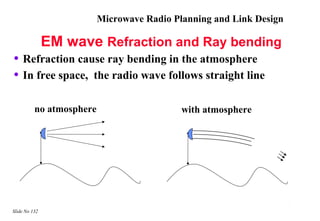
               EM wave Refraction and Ray bending
• Refraction cause ray bending in the atmosphere
• In free space, the radio wave follows straight line

          no atmosphere                     with atmosphere


Slide No 132
Microwave Radio Planning and Link Design

               EM wave Refraction: K-Factor
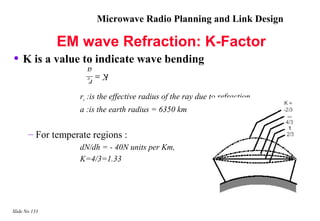
• K is a value to indicate wave bending
                         a
                      K= e
                         r

                    re :is the effective radius of the ray due to refraction
                    a :is the earth radius = 6350 km


       – For temperate regions :
                    dN/dh = - 40N units per Km,
                    K=4/3=1.33


Slide No 133
Microwave Radio Planning and Link Design

         K-Factor and Path Profile Correction
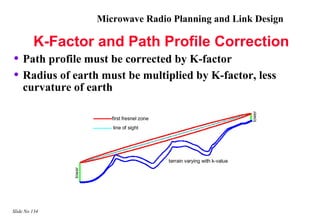
• Path profile must be corrected by K-factor
• Radius of earth must be multiplied by K-factor, less
    curvature of earth


Slide No 134
Microwave Radio Planning and Link Design

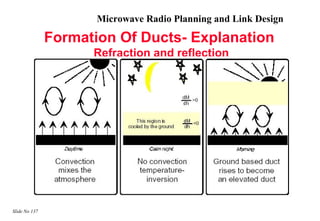
   Formation Of Ducts- Refraction and reflection
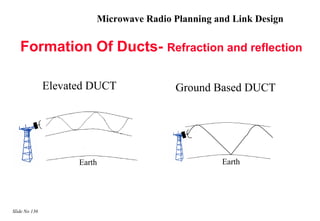
Ground Based Duct: Refraction and reflection
• The atmosphere has very dense layer at the ground with a
  thin layer on top of it.


Elevated Duct: Refraction only
• The atmosphere has a thick layer in some height above
  ground.
• If both the transmitter and the receiver are within the
  duct, multiple rays will reach the receiver
• If one is inside and the other is outside the duct, nearly no
  energy will reach the receiver
Slide No 135
Microwave Radio Planning and Link Design

   Formation Of Ducts- Refraction and reflection

               Elevated DUCT             Ground Based DUCT


                     Earth                         Earth


Slide No 136
Microwave Radio Planning and Link Design

               Formation Of Ducts- Explanation
                     Refraction and reflection


Slide No 137
Microwave Radio Planning and Link Design

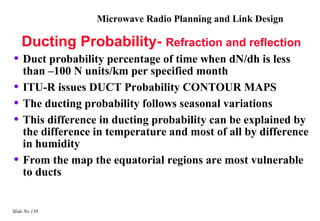
    Ducting Probability- Refraction and reflection
• Duct probability percentage of time when dN/dh is less
    than –100 N units/km per specified month
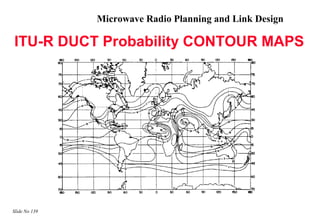
•   ITU-R issues DUCT Probability CONTOUR MAPS
•   The ducting probability follows seasonal variations
•   This difference in ducting probability can be explained by
    the difference in temperature and most of all by difference
    in humidity
•   From the map the equatorial regions are most vulnerable
    to ducts


Slide No 138
Microwave Radio Planning and Link Design

ITU-R DUCT Probability CONTOUR MAPS


Slide No 139
Microwave Radio Planning and Link Design

Multipath Propagation - Refraction and reflection
• Multipath propagation occurs when there are more than
    one ray reach the receiver
 • Disadvantages:
       – Signal strength changes rapidly over a short time and distance
       – Multipath delays which causes time dispersion
       – Random frequency modulation due to Doppler shifts
       – Delay spread of the received signal
 • Multipath transmission is the main cause of fading
 • Fading is explained in later slides
Slide No 140
Microwave Radio Planning and Link Design

                        Diffraction
• Diffraction occurs and causes increase in transmission loss
    when the size of obstacle between transmitter and
    receiver is large compared to wavelength
•   Diffraction effects are faster and more accentuated with
    increased obstruction for frequencies above 1 GHz
•   Transmission obstruction loss over irregular terrain is
    complicated function of frequency, path geometry,
    vegetation density and other less significant variable
•   Practical methods are used to estimate the obstruction
    losses.

Slide No 141
Microwave Radio Planning and Link Design

                             Diffraction loss
Practical methods are used to estimate the obstruction
  losses
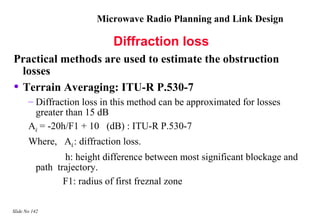
• Terrain Averaging: ITU-R P.530-7
       – Diffraction loss in this method can be approximated for losses
         greater than 15 dB
       Ad = -20h/F1 + 10 (dB) : ITU-R P.530-7
       Where, Ad : diffraction loss.
                 h: height difference between most significant blockage and
          path trajectory.
                 F1: radius of first freznal zone

Slide No 142
Microwave Radio Planning and Link Design

                        Knife edge models
• Knife edge approximation is used when the obstruction is
    sharp and inside the first freznal zone
       – Single Knife edge
       – Bullington
       – Epostein-Peterson
       – Japanese Atlas


Slide No 143
Microwave Radio Planning and Link Design

                                   Absorption
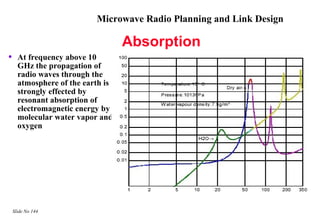
•     At frequency above 10
      GHz the propagation of
      radio waves through the
      atmosphere of the earth is
      strongly effected by
      resonant absorption of
      electromagnetic energy by
      molecular water vapor and
      oxygen


    Slide No 144
Microwave Radio Planning and Link Design

                   Rain Attenuation
• When radio waves interact with raindrops the
    electromagnetic wave will scatter
•   The attenuation depends on frequency band, specially for
    frequencies above 10 GHz
•   The rain attenuation calculated by introducing reduction
    factor and then effective path length
•   The rain attenuation depends on the rain rate, which
    obtained from long term measurement and very short
    integration time
•   The Earth is divided into 16 different rain zones

Slide No 145
Microwave Radio Planning and Link Design

                    Rain Attenuation
• Rain rate is measured to estimate attenuation because it is
    hard to actually count the number of raindrops and
    measure their individual sizes so
•   Rainfall is measured in millimeters [mm], and rain
    intensity in millimeters pr. hour [mm/h].
•   Since the radio waves are a time varying electromagnetic
    field, the incident field will induce a dipole moment in the
    raindrop will therefore act as an antenna and re-radiate
    the energy.
•   A raindrop is an antenna with low directivity and some
    energy will be re-radiated in arbitrary directions giving a
    net loss of energy in the direction towards the receiver.
Slide No 146
Microwave Radio Planning and Link Design

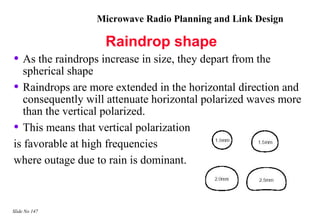
                    Raindrop shape
• As the raindrops increase in size, they depart from the
   spherical shape
• Raindrops are more extended in the horizontal direction and
   consequently will attenuate horizontal polarized waves more
   than the vertical polarized.
• This means that vertical polarization
is favorable at high frequencies
where outage due to rain is dominant.


Slide No 147
Microwave Radio Planning and Link Design

                           Fading

• The radio waves undergo variations while traveling in the
    atmosphere due to atmospheric changes. The received
    signal fades around nominal value.


• Multipath Fading is due to metrological conditions in the
    space separating the transmitter and the receiver which
    cause detrimental effects to the received signal


Slide No 148
Microwave Radio Planning and Link Design

                            Fade Margins
• Fade Margin is extra power

• Fade Margins will be explained in link design for the
    following:
•   Multipath Fading
       – Flat Fading
       – Selective Fading
• Rain Fading

Slide No 149
Microwave Radio Planning and Link Design

                     Mutipath Fading
• As the fading margin increased the probability of the
    signal to drop below the receiver threshold is decreased


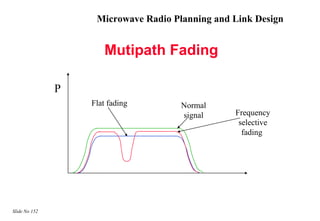
• Flat fading or non-selective occurs when all components
    of the useful signal are affected equally
• Frequency selective fading occurs if some of the spectral
    components are reduced causing distortion
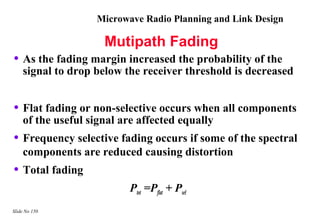
• Total fading
                           Ptot =Pflat + Psel
Slide No 150
Microwave Radio Planning and Link Design

                          Mutipath Fading
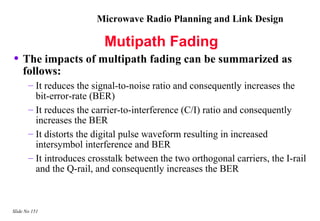
• The impacts of multipath fading can be summarized as
    follows:
       – It reduces the signal-to-noise ratio and consequently increases the
         bit-error-rate (BER)
       – It reduces the carrier-to-interference (C/I) ratio and consequently
         increases the BER
       – It distorts the digital pulse waveform resulting in increased
         intersymbol interference and BER
       – It introduces crosstalk between the two orthogonal carriers, the I-rail
         and the Q-rail, and consequently increases the BER


Slide No 151
Microwave Radio Planning and Link Design


                      Mutipath Fading

               P
                   Flat fading        Normal
                                      signal     Frequency
                                                  selective
                                                   fading


Slide No 152
Microwave Radio Planning and Link Design


        Microwave Link Planning and Design


Slide No 153
Microwave Radio Planning and Link Design

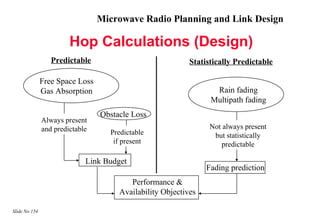
                        Hop Calculations (Design)
                  Predictable                              Statistically Predictable

               Free Space Loss
               Gas Absorption                                     Rain fading
                                                                 Multipath fading
                                 Obstacle Loss
               Always present
               and predictable                                   Not always present
                                   Predictable                    but statistically
                                    if present                      predictable

                             Link Budget
                                                                Fading prediction
                                         Performance &
                                      Availability Objectives

Slide No 154
Microwave Radio Planning and Link Design

                              Path Profile

• Path profile is essentially a plot of the elevation of the
    earth as function of the distance along the path between
    the transmitter and receiver


• The purpose of path profile:
       – To check the free line of sight
       – To check the clearance of the path to avoid obstacle attenuation
       – When determining the fading of received signal


Slide No 155
Microwave Radio Planning and Link Design

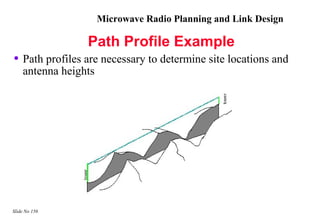
                 Path Profile Example
• Path profiles are necessary to determine site locations and
    antenna heights


Slide No 156
Microwave Radio Planning and Link Design

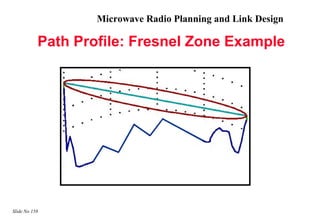
               Path Profile: Clearance of Path
• Design objective: Full clearance of direct line-of-sight and
    and an ellipsoid zone surrounding the direct line-of-sight
•   The ellipsoid zone is called the Fresnel Zone


Slide No 157
Microwave Radio Planning and Link Design

           Path Profile: Fresnel Zone Example


Slide No 158
Microwave Radio Planning and Link Design

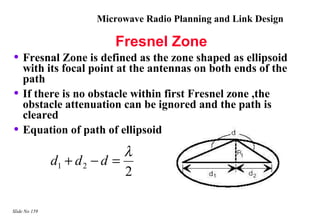
                           Fresnel Zone
• Fresnal Zone is defined as the zone shaped as ellipsoid
    with its focal point at the antennas on both ends of the
    path
•   If there is no obstacle within first Fresnel zone ,the
    obstacle attenuation can be ignored and the path is
    cleared
•   Equation of path of ellipsoid
                              λ
               d1 + d 2 − d =
                              2

Slide No 159
Microwave Radio Planning and Link Design

                            Fresnel Zone Equation
•   First Fresnel zone radius
                                                   d1 × d 2
                                     F1 = 17.3 ×              [m]
                                                   d× f

•   Fresnel zone – Exercise: Calculate the fresnel zone radius at mid
    path for the following cases
       – 1. f= 15GHz, K=4/3, d=10km
       – 2. f = 15GHz, K=4/3, d=20km
•   Solution:
                          = 17.3 ×
                                      5×5
                                             = 7m
       – 1. F1 (radius)              15 × 10

                                     10 × 10
                          = 17.3 ×           = 10m
       – 2. F1 (radius)              15 × 20

Slide No 160
Microwave Radio Planning and Link Design

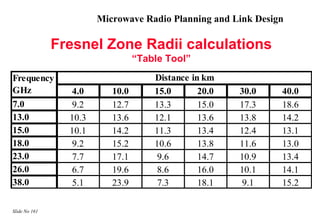
               Fresnel Zone Radii calculations
                                  “Table Tool”
Frequency                             Distance   in km
GHz              4.0       10.0       15.0         20.0   30.0   40.0
7.0              9.2       12.7       13.3         15.0   17.3   18.6
13.0             10.3      13.6       12.1         13.6   13.8   14.2
15.0             10.1      14.2       11.3         13.4   12.4   13.1
18.0             9.2       15.2       10.6         13.8   11.6   13.0
23.0             7.7       17.1        9.6         14.7   10.9   13.4
26.0             6.7       19.6        8.6         16.0   10.1   14.1
38.0             5.1       23.9        7.3         18.1    9.1   15.2

Slide No 161
Microwave Radio Planning and Link Design

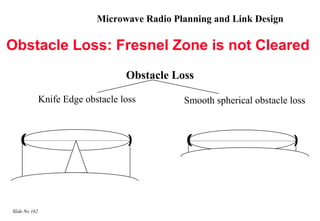
Obstacle Loss: Fresnel Zone is not Cleared
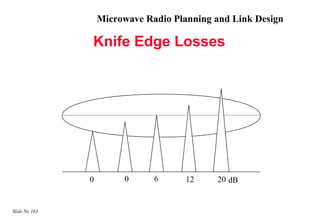
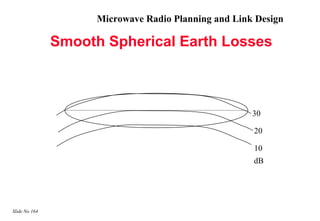
                                    Obstacle Loss

               Knife Edge obstacle loss        Smooth spherical obstacle loss


Slide No 162
Microwave Radio Planning and Link Design

               Knife Edge Losses


               0        0      6      12    20 dB


Slide No 163
Microwave Radio Planning and Link Design

               Smooth Spherical Earth Losses


                                                      30

                                                      20

                                                      10
                                                      dB


Slide No 164
Microwave Radio Planning and Link Design

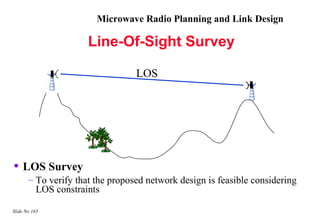
                      Line-Of-Sight Survey

                                  LOS


• LOS Survey
       – To verify that the proposed network design is feasible considering
         LOS constraints

Slide No 165
Microwave Radio Planning and Link Design

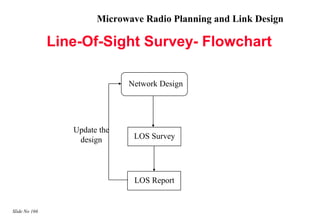
               Line-Of-Sight Survey- Flowchart

                               Network Design


                  Update the
                   design       LOS Survey


                                LOS Report


Slide No 166
Microwave Radio Planning and Link Design

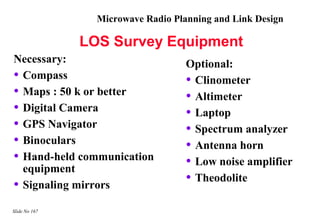
               LOS Survey Equipment
Necessary:                          Optional:
• Compass                           • Clinometer
• Maps : 50 k or better             • Altimeter
• Digital Camera                    • Laptop
• GPS Navigator                     • Spectrum analyzer
• Binoculars                        • Antenna horn
• Hand-held communication           • Low noise amplifier
  equipment
• Signaling mirrors                 • Theodolite

Slide No 167
Microwave Radio Planning and Link Design

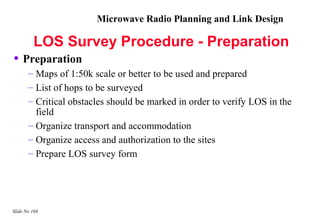
         LOS Survey Procedure - Preparation
• Preparation
       – Maps of 1:50k scale or better to be used and prepared
       – List of hops to be surveyed
       – Critical obstacles should be marked in order to verify LOS in the
         field
       – Organize transport and accommodation
       – Organize access and authorization to the sites
       – Prepare LOS survey form


Slide No 168
Microwave Radio Planning and Link Design

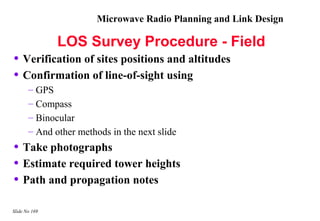
               LOS Survey Procedure - Field
• Verification of sites positions and altitudes
• Confirmation of line-of-sight using
       – GPS
       – Compass
       – Binocular
       – And other methods in the next slide
• Take photographs
• Estimate required tower heights
• Path and propagation notes
Slide No 169
Microwave Radio Planning and Link Design

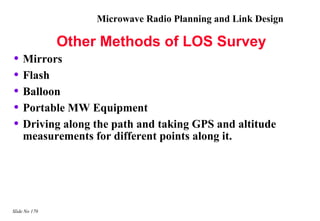
               Other Methods of LOS Survey
• Mirrors
• Flash
• Balloon
• Portable MW Equipment
• Driving along the path and taking GPS and altitude
    measurements for different points along it.


Slide No 170
Microwave Radio Planning and Link Design

                       LOS Survey Report
• Site Data
       – Name
       – Coordinates
       – Height
       – Address
• Proposed Tower Height
• LOS Confirmation
• Azimuth and Elevation
• Path short description
• Photographs
Slide No 171
Microwave Radio Planning and Link Design

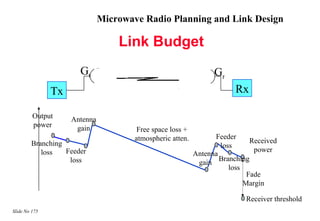
                           Link Budget

•   Includes all gains and losses as the signal passes from transmitter to
    the receiver.


•   It is used to calculate fade margin which is used to estimate the
    performance of radio link system.


Slide No 172
Microwave Radio Planning and Link Design

                             Link Budget
• Link budget is the sum of all losses and gains of the signal
    between the transmitter output and the receiver input.
•   Items related to the link budget
       – Transmitted power
       – Received power
       – Feeder loss
       – Antenna gain
       – Free space loss
       – Attenuations
• Used to calculate received signal level     (fading is ignored)
Slide No 173
Microwave Radio Planning and Link Design

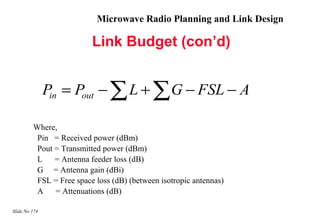
                          Link Budget (con’d)


               Pin = Pout − ∑ L + ∑ G − FSL − A

         Where,
          Pin = Received power (dBm)
          Pout = Transmitted power (dBm)
          L    = Antenna feeder loss (dB)
          G = Antenna gain (dBi)
          FSL = Free space loss (dB) (between isotropic antennas)
          A    = Attenuations (dB)

Slide No 174
Microwave Radio Planning and Link Design

                                  Link Budget
                      Gt                                         Gr
               Tx                                                       Rx

         Output     Antenna
         power       gain              Free space loss +
                                      atmospheric atten.         Feeder
        Branching                                                            Received
                                                                   loss
           loss   Feeder                                                      power
                                                           Antenna
                   loss                                            Branching
                                                            gain
                                                                      loss
                                                                            Fade
                                                                           Margin

                                                                           Receiver threshold
Slide No 175
Microwave Radio Planning and Link Design

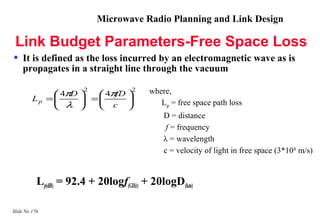
 Link Budget Parameters-Free Space Loss
•   It is defined as the loss incurred by an electromagnetic wave as is
    propagates in a straight line through the vacuum

                 4π 
                    D
                       2
                          4π 
                             fD
                                   2   where,
         Lp    =      =               Lp = free space path loss
                  λ      c 
                                           D = distance
                                            f = frequency
                                           λ = wavelength
                                           c = velocity of light in free space (3*108 m/s)


           Lp(dB) = 92.4 + 20logf(GHz) + 20logD(km)

Slide No 176
Microwave Radio Planning and Link Design

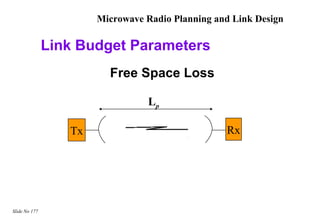
               Link Budget Parameters
                         Free Space Loss

                                 Lp

                  Tx                              Rx


Slide No 177
Microwave Radio Planning and Link Design

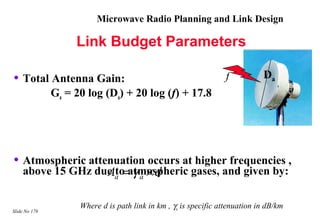
                    Link Budget Parameters

• Total Antenna Gain:                                             f           Da
               Ga = 20 log (Da) + 20 log (f) + 17.8


• Atmospheric attenuation occurs at higher frequencies ,
    above 15 GHz due a = γ a × d
                   Ato atmospheric gases, and given by:

                     Where d is path link in km , γa is specific attenuation in dB/km
Slide No 178
Microwave Radio Planning and Link Design

                        Link Budget Parameters

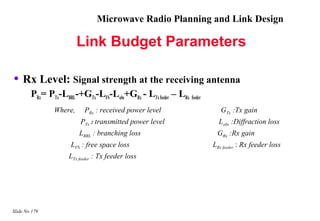
• Rx Level: Signal strength at the receiving antenna
        PRx= PTx-LBRL-+GTx-LFS-Lobs+GRx - LTx feeder – LRx feeder
               Where,     PRx : received power level                   GTx :Tx gain
                        PTx : transmitted power level                 Lobs :Diffraction loss
                        LBRL : branching loss                        GRx :Rx gain
                     LFS : free space loss                          LRx feeder : Rx feeder loss
                    LTx feeder : Tx feeder loss


Slide No 179
Microwave Radio Planning and Link Design

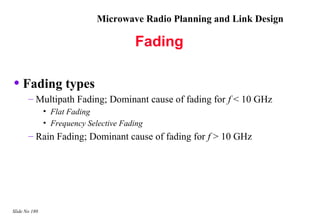
                                        Fading

• Fading types
       – Multipath Fading; Dominant cause of fading for f < 10 GHz
               • Flat Fading
               • Frequency Selective Fading
       – Rain Fading; Dominant cause of fading for f > 10 GHz


Slide No 180
Microwave Radio Planning and Link Design

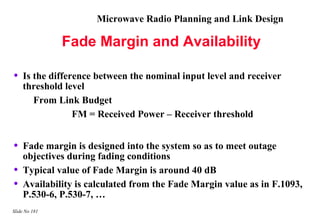
               Fade Margin and Availability

•   Is the difference between the nominal input level and receiver
    threshold level
       From Link Budget
                 FM = Received Power – Receiver threshold


•   Fade margin is designed into the system so as to meet outage
    objectives during fading conditions
•   Typical value of Fade Margin is around 40 dB
•   Availability is calculated from the Fade Margin value as in F.1093,
    P.530-6, P.530-7, …
Slide No 181
Microwave Radio Planning and Link Design

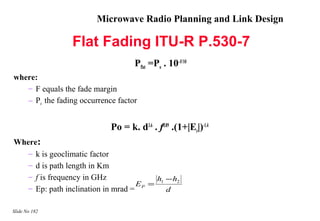
                 Flat Fading ITU-R P.530-7
                                    Pflat =Po . 10–F/10
where:
   – F equals the fade margin
   – Po the fading occurrence factor


                            Po = k. d3.6 . f0.89 .(1+|Ep|)-1.4
Where:
   – k is geoclimatic factor
   – d is path length in Km
   – f is frequency in GHz              h − h2
                                    EP = 1
   – Ep: path inclination in mrad =        d

Slide No 182
Microwave Radio Planning and Link Design

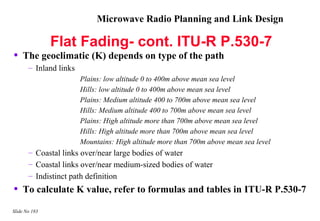
               Flat Fading- cont. ITU-R P.530-7
•   The geoclimatic (K) depends on type of the path
       – Inland links
                        Plains: low altitude 0 to 400m above mean sea level
                        Hills: low altitude 0 to 400m above mean sea level
                        Plains: Medium altitude 400 to 700m above mean sea level
                        Hills: Medium altitude 400 to 700m above mean sea level
                        Plains: High altitude more than 700m above mean sea level
                        Hills: High altitude more than 700m above mean sea level
                        Mountains: High altitude more than 700m above mean sea level
       – Coastal links over/near large bodies of water
       – Coastal links over/near medium-sized bodies of water
       – Indistinct path definition
•   To calculate K value, refer to formulas and tables in ITU-R P.530-7

Slide No 183
Microwave Radio Planning and Link Design

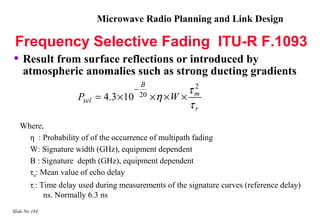
Frequency Selective Fading ITU-R F.1093
• Result from surface reflections or introduced by
    atmospheric anomalies such as strong ducting gradients
                                            B              2
                                        −                 τm
                      Psel = 4.3 × 10       20   ×η × W ×
                                                          τr
   Where,
     η : Probability of of the occurrence of multipath fading
     W: Signature width (GHz), equipment dependent
     B : Signature depth (GHz), equipment dependent
     τm: Mean value of echo delay
        τr : Time delay used during measurements of the signature curves (reference delay)
              ns. Normally 6.3 ns
Slide No 184
Microwave Radio Planning and Link Design

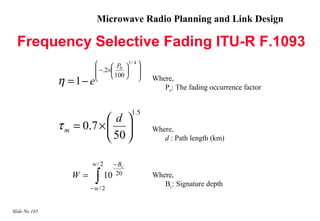
  Frequency Selective Fading ITU-R F.1093
                                       3/ 4 
                           −.2× P0  
                                     
                                100  
               η = 1− e                        Where,
                                                    Po: The fading occurrence factor


                                          1.5
                           d 
               τ m = 0.7 ×                     Where,
                            50                    d : Path length (km)


                       w/ 2     − Bc
                  W=      ∫
                       −w/ 2
                              10 20              Where,
                                                    Bc: Signature depth


Slide No 185
Microwave Radio Planning and Link Design

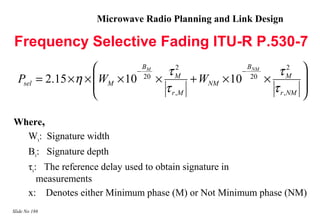
Frequency Selective Fading ITU-R P.530-7
                            B
                            − M   τM  2             B
                                                   − NM   τM   2    
  Psel = 2.15 × η × WM × 10 20 ×        + WNM × 10 20 ×            
                                 τ r ,M                 τ r , NM   
                                                                   

Where,
  Wx: Signature width
       Bx: Signature depth
       τx: The reference delay used to obtain signature in
          measurements
       x: Denotes either Minimum phase (M) or Not Minimum phase (NM)
Slide No 186
Microwave Radio Planning and Link Design

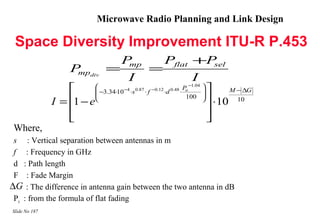
 Space Diversity Improvement ITU-R P.453
                                        P              Pflat +P
                     P div =
                      mp
                                         mp
                                                  =            sel

                                          I                      I
                       
                         −3.34⋅10−4 ⋅s 0.87 ⋅ f −0.12 ⋅d 0.48 ⋅ Po
                        
                                                                          
                                                                    −1.04 

                                                                          
                                                                                 M − ∆G

               I= 1 − e                                         100 
                                                                             ⋅10 10
                                                                           
                                                                           
 Where,
 s : Vertical separation between antennas in m
 f : Frequency in GHz
 d : Path length
 F : Fade Margin
∆G : The difference in antenna gain between the two antenna in dB
 Po : from the formula of flat fading
Slide No 187
Microwave Radio Planning and Link Design

                  Rain Attenuation ITU-R P.530
•   Rain Intensity in mm/h
       – The reference level is the rain intensity that is exceeded .01% of all the time (R 0.01)
•   The attenuation due to the rain in .01% of the time for a given path
    may be found by:
                     AR = γ R .d eff

               where
               γR : Specific rain attenuation (dB/km)
               deff : Effective path length, km
                     γ R = k × Ra
               k and a are given in the table
Slide No 188
Microwave Radio Planning and Link Design

      Usable path lengths with rain intensity
                example: 15 GHz


Slide No 189
Microwave Radio Planning and Link Design
     ITU-R presents the cumulative distribution of rain
       intensity for 15 different zone as shown below


 Rain zone contours (Far East)          Rain zone contours    Rain zone contours (Americas)
                                        (Europe and Africa)

Slide No 190
Microwave Radio Planning and Link Design

                     Rain Fading ITU-R P.530
•   The relation between fading margin and unavailability for the path
    is given by:

                                                                 P = 10
         11.628 ( −0.546 + 0.29812 +0.172 log( 0.12× AR 0.01 / F )
                                                                          %

       Where
       – AR0.01 : Rain attenuation exceeded 0.01% of the time
       – F: Fade margin


Slide No 191
Microwave Radio Planning and Link Design


               Frequency Planning


Slide No 192
Microwave Radio Planning and Link Design

                       Frequency planning
• Objective of frequency planning
       – Efficient use of available frequency band
       – Keep interference level as low as possible
• Frequency plan must consider interference
       – C/I Objectives
• Note: the requirements depends on
       – Equipment
       – Frequency
                      For adjacent channel interference
       – Bandwidth


Slide No 193
Microwave Radio Planning and Link Design

                      Frequency Planning
Frequency Allocation
• From operator’s point of view, it is best to get a block of
  frequencies or several adjacent channels from each
  frequency band
       – Installation and maintenance of microwave radio is less complicated
       – Interference analysis is only needed between operators own hops
• It is recommended to assign the available channels or
    frequency block to certain capacities so that 2X2, 4X2,
    8X2, 16X2 will not interleave.
•   Normally in 18-38 GHz, four hops using the same channel
    can arrive at star if they are at 90 degrees angle from each
    other
Slide No 194
Microwave Radio Planning and Link Design

                          Frequency Planning
Interference
• Interference needs more concern at star points because several
  microwave radios transmit and receive are close to each other
• Don’t use higher transmitter output power than required
• Frequency planning in star points is trivial if multiple channels are
  used (inefficient use of channels)
• Re use same channel (efficient use of channels)
       – All stations at star transmit either high or low, while high-low alteration must be
         applied in chains.
       – Good angle separation
       – Cross polarization gives extra discrimination
       Note: Rain has greater attenuation on horizontal polarization thus use horizontal
         polarization for shorter hops


Slide No 195
Microwave Radio Planning and Link Design

                     Frequency Planning
• The radio spectrum is allocated to various services by
    ITU’s Administrative Radio Conference (WARC)
•   ITU-R is responsible for providing RF channel
    arrangement
       – Alternated channel arrangement
       – Co-channel arrangement
       – Interleaved arrangement


Slide No 196
Microwave Radio Planning and Link Design

               Alternated Channel arrangement
• Every channel will have opposite polarization to the
    adjacent channels
•   This arrangement is used(neglecting co-polar adjacent
    interference) if the below rule holds
                   XPDmin+(NFD –3)>(C/I)min
                   NFD=adj. Ch. Received power / adj. Ch. Power received after BB
                    filter
• Advantage:
                   Easily filfilled by standard antenna to radio equipment
• Disadvantage:
                   Limited spectrum effective

Slide No 197
Microwave Radio Planning and Link Design

                   Co-channel arrangement
• In this arrangement every radio channel is utilized twice
    for independent traffic on opposite polarization for the
    same path


• The following demand must be fulfilled
          [10log(1/(1/10^((XPD + XIF)/10) +1/10^((NFD-3)/10)))] > (C/I)
                    Where,
                    NFD :Net Filter discriminator
                    XIF :is XPD improvement factor


Slide No 198
Microwave Radio Planning and Link Design

               Channel Capacity and Separation


                            Channel separation

                     Capacity            Channel Separation
                    2 X 2 Mbps                   3.5 MHz
                    4 X 2 Mbps                   7 MHz
                    8 X 2 Mbps                   14 MHz
                   16 X 2 Mbps                   28 MHz

Slide No 199
Microwave Radio Planning and Link Design

                Co-channel Interference – Far


         Tx/Rx                                         Tx/Rx
       Tx = f1                                        Tx = f2
       Rx = f2                                        Rx = f1


               Tx/Rx
               Tx = f1
                                                             Tx/Rx
               Rx = f2                             Tx = f2
                                                   Rx = f1
Slide No 200
Microwave Radio Planning and Link Design

               Co-channel Interference – Near


                                     Tx = f1
                               Tx/Rx
                                     Rx = f2


                                  Tx/Rx
                                  Tx = f2
                                  Rx = f1


Slide No 201
Microwave Radio Planning and Link Design

               Adjacent Channel Interference


                       fRx         fTx

                         Interference

Slide No 202
Microwave Radio Planning and Link Design

               Receiver Threshold Degradation

•   Presence of interfering signals will give a receiver threshold
    degradation
•   The degraded receiver threshold level LTel is calculated from:

                                  (
               LTel = LTe + 10 log 1 + 10   ( ( − LTe + C R + LI ) / 10 )
                                                                            )
•   A Rule of Thumb
                   Threshold Degradation < 3 dB

Slide No 203
Microwave Radio Planning and Link Design

                            Threshold Degradation
                            -70
                            -72
                            -74
                            -76
                Receiver    -78
               threshold,   -80
                  dBm       -82
                            -84
                            -86      3dB
                            -88

                                   14 15 16 17 18 19 20 21 22 23
                                     Signal to Interference ratio, dB

Slide No 204
Microwave Radio Planning and Link Design

                               Channel plan

                 Low sub-band                     High sub-band
               1A 2A 3A 4A 5A 6A 7A             1B 2B 3B 4B 5B 6B 7B


                              Duplex distance


                   Tx=4A                                   Tx=4B
                   Rx=4B                                   Rx=4A


Slide No 205
Microwave Radio Planning and Link Design

               High / Low Tx Channel Allocation
                                           L
                                H

               H      L

                                H
                                                         L
                                               H

                            H          L

                                                       Near interference
                                               H/L
Slide No 206
Microwave Radio Planning and Link Design

                High / Low Tx Channel Allocation

               Rings with odd number of sites should be avoided

                      H           H           L               H
                                                                   New
               L                                      L         frequency
                                                                   band

                      H/L          L          H                H
           Interference


Slide No 207
Microwave Radio Planning and Link Design

                         Channel Plan


         7 Channels

      1A         2A     3A       4A      5A       6A       7A


          28 MHz                                                 f
        (17x2 Mbps)


Slide No 208
Microwave Radio Planning and Link Design

                          Channel Plan


        11 Channels


           28 MHz         14 MHz                                  f
         (17x2 Mbps)    (8x2 Mbps)


Slide No 209
Microwave Radio Planning and Link Design

                              Channel Plan


        15 Channels


           28 MHz        14 MHz       7 MHz                         f
         (17x2 Mbps)   (8x2 Mbps)   (4x2 Mbps)


Slide No 210
Microwave Radio Planning and Link Design

                             Output Power
          Only High output power


           High output     High output   High output
             power           power         power


                                               Interference


Slide No 211
Microwave Radio Planning and Link Design

                              Output Power
               High and low output power


           Low output       High output    Low output
             power            power          power


                                               No Interference


Slide No 212
Microwave Radio Planning and Link Design


                   Interference


Slide No 213
Microwave Radio Planning and Link Design

                 Digital Systems and BER
• Performance of digital transmission system can be
    evaluated by BER, Bit Error Rate
•   Telephony BER degradation versus audible degradation:
       – 10-6: Noise not audible
       – 10-5: Barely audible
       – 10-4: audible, understandable
       – 10-3: disturbing
       – More than 10-3: sync loss, link loss
•    Data and in particular multimedia media application
    require a very low BER

Slide No 214
Microwave Radio Planning and Link Design

               Noise in Digital Systems
Noise can originate from a variety of sources, and many of
  these sources are man-made so they can be eliminated
• Thermal noise
• Noise Factor and Noise Figure
• S/N Ratio
• Receiver Thresholds


Slide No 215
Microwave Radio Planning and Link Design

               White Noise in Digital Systems

• Thermal noise is generated from random motion of
    electrons due to thermal energy
•   Pn=KTB (W) where :
       – k=Boltzmann’s constant
       – T=temperature in Kelvin
       – B=bandwidth of noise spectrum
• Typical values are : T=300 K , b= 6MHz , -106 dBm


Slide No 216
Microwave Radio Planning and Link Design

                  Noise Factor and Noise Figure
• Noise Factor and Noise Figure are figures of merit used to
    indicate how much the S/N deteriorates as a signal passes
    through a circuit or series of circuits.
•   Noise factor:
     – Is defined in terms of signal to noise ratio

                   available S/N power ratio at input
               F=                                     (unitless)
                  available S/N power ratio at output

• Noise Figure
     NF = 10 log(F) (dB)
Slide No 217
Microwave Radio Planning and Link Design

               Noise in Digital Systems

• Signal to interference ratio defines the minimum
    difference between the signal and the interferer levels. It
    depends on bandwidth, modulation and manufacturer.

• Usually for digital system signal to interference ratio 15-
    25 dB


Slide No 218
Microwave Radio Planning and Link Design

                         Receiver Thresholds
• Threshold (10-3): Received level at BER 10-3
• Threshold (10-6): Received level at BER 10-6
               Threshold = White noise + Noise figure + S/N

                                     Threshold


                              S/N


                         NF
                                      White noise
Slide No 219
Microwave Radio Planning and Link Design

                Threshold Degradation
•A Rule of Thumb
Threshold Degradation < 3 dB
 given that the required            -70
                                    -72
 signal to interferer is not        -74
 violated                           -76
                          Receiver -78
                         threshold, -80
                            dBm     -82
                                    -84
                                    -86     3dB
                                    -88

                                          14 15 16 1 18 19 20 21 22 23
                                          Signal to Interference ratio, dB
                                                     7


Slide No 220
Microwave Radio Planning and Link Design

               Cross Polar Interference XPI
• Both multi path- and rain fading can result in severe
    degradation of XPD level
•   Cross Polar interference Cancellers (XPIC) in the receiver
    remove the unwanted signal that has leaked from the
    opposite polarization into the wanted one
                                        E11
The quantitative          XPI = 20. Log     dB
Description of cross-
                                        E21
Polar interference XPI
                                       E11
                          XPD = 20.Log     dB
                                       E12          Where E11and E12 are
                                                   given in the next figure

Slide No 221
Microwave Radio Planning and Link Design

                     Cross Polar Interference

• Depolarization Causes
       – Scattering or reflection from land or water surfaces
       – Reflection from an atmospheric layer
       – Tropospherical turbulence


Slide No 222
Microwave Radio Planning and Link Design

                    Cross Polar Interference

                     E1

                                                          E11


                                                                E21


                                                            E12
               E2                                   E22


                    Dual polarized system suffering from XPI
Slide No 223
Microwave Radio Planning and Link Design

               Ways to include interference in
                 performance calculation
• The interference calculation are performed by calculation
    the interference level and determining the receiver
    threshold degradation
•   Start from allowed interference level at the input of the
    disturbed receiver and then comparing it with level of the
    interfering signal
•   The degradation receiver threshold level

                                           (
                  LTel ≈ LTe + 10 log 1 + 10( ( − LTe +C R + L1 ) /10 )   )
Slide No 224
Microwave Radio Planning and Link Design

Interfering waves propagation mechanisms
 • Long-term interference mechanisms:
       – Diffraction
       – Troposcatter
       – Line-of-site
 • Short-term interference mechanisms:
       – Ducting: layer refraction/reflection
       – Hydrometeor scatter


Slide No 225
Microwave Radio Planning and Link Design

                Selecting Interfering Stations
 •   Before performing interference calculation the possible interfering
     station must be selected in the area of interference
 •   Co-ordination area are the area around given station where
     possible co-channel interference from near site are situated


Key hole
 region


                                              Co-ordination area for off-
                                                   key hole region
 Slide No 226
Microwave Radio Planning and Link Design

           Propagation in Interference Calculations
•   Select interfering site by calculating coordination area
•   Select minimum interference levels
•   Predict interferer signal level
       – Decide whether an average year or worst –month prediction is required
       – Assemble the basic input data
       – Derive the annual or worst-month radio meteorological data from maps
       – Analyze the path profile, and classify the path according to the path geometry
       – Identify which individual propagation models need to be invoked
       – Calculate the individual propagation predictions using each of the models
         identified in the previous step
       – Combine the individual predictions to give the overall statistics


Slide No 227
Microwave Radio Planning and Link Design

                   Interference Calculation
• Undesirable RF coupling between radio channels
       – Cross polarization: occurred in channels operating on opposite
         polarization
       – Adjacent channel:the channel filter at the receiver and the width of
       the transmitted spectrum determined the interference level
       – Front to back:The interference level is mainly a function of the
         antenna front-to-back ratio
       – Over shoot:If the paths are aligned , interference due to overshoot
       is critical. Use of opposite polarization or change of radio channels
       is recommended.


Slide No 228
Microwave Radio Planning and Link Design

       Examples of Interference RF coupling
• Examples

                     V                                              f2
                         f1
                     H
                                                                    f1
        Cross Polarization                            Adjacent channel


               f1’            f1                 f1           f1’        f1
               Front-to-Back
                                                       Over Shoot

Slide No 229
Microwave Radio Planning and Link Design

                   Interference Calculations- cont.
• Preconditions
       – Network diagram: drawn to scale and angle, includes all radio-relay
         circuits within the frequency band concerned
       – Network data : antenna types and radiation patterns, transmitter
         output power
       – RL equipment interference data, normally given as diagrams
               •   Digital to digital interference diagrams
               •   Digital to analog interference diagrams
               •   Analog to digital interference diagrams
               •   Adjacent-channel attenuation as a function of channel spacing
       – Antenna radiation patterns: for all types of antennas used in the
         network
Slide No 230
Microwave Radio Planning and Link Design

               Interference Calculations- cont.
• Interference evaluation on digital network
       – It is necessary to check each antenna discrimination in the nodal
         stations for all disturbances
       – In the beginning, only the most critical interference path has to be
         examined
       – As a start, standard performance antennas are used, and no level
         adjustments are made to reduce interference problems, this case is
         worst case
       – Co-polar operation
       – Cross-polar operation


Slide No 231
Microwave Radio Planning and Link Design


               Digital Map and Tools Overview


Slide No 232
Microwave Radio Planning and Link Design

                             Digital Maps
• Digitized Geographical data is needed

• Maps sampling (examples)
       – Urban: 20 to 50m
       – Suburban: 50-100m
       – Open: 100m


Slide No 233
Microwave Radio Planning and Link Design

       Digital Maps-Geographical Databases
• The choice of the geographical databases depends on the
    propagation model used
•   A compromise has to be reached between:
       – Cost
       – Accuracy
       – Calculation speed
       – The chosen configuration
• Geographical databases types are:
       – Vector data (Linear)
       – Altitude
       – Clutter (land use data)

Slide No 234
Microwave Radio Planning and Link Design

               Digital Maps - Vector Data (Linear)

• Succession of points describing:
       – Highway
       – Roads
       – Railways
       – Rivers
       – Borders
       – coastlines


Slide No 235
Microwave Radio Planning and Link Design

                   Digital Maps - Altitude
• One altitude value per each pixel
• Each point of the pixel is assumed at the same altitude
• Two categories of altitude databases
       – Digital Terrain Model (DTM)
       – Digital Evaluation Model (DEM)


Slide No 236

52528672 microwave-planning-and-design

  • 1.
    Microwave Radio Planningand Link Design CISCOM Training Center Microwave Planning and Design Slide No 1
  • 2.
    Microwave Radio Planningand Link Design Microwave Radio Planning and Link Design Course Contents • PCM and E1 TDM Overview • Digital Multiplexing: PDH and SDH Overview • Digital Microwave Systems Overview • Microwave links Performance and Quality Objectives • Topology and Capacity Planning • Diversity • Microwave Antennas Slide No 2
  • 3.
    Microwave Radio Planningand Link Design Microwave Radio Planning and Link Design Course Contents (con’d) • Radio Propagation • Microwave Link Planning and Design – Path Profile – LOS Survey – Link Budget – Performance Prediction • Frequency Planning • Interference • Digital map and tools overview Slide No 3
  • 4.
    Microwave Radio Planningand Link Design Planning Objectives • MW Radio Planning Objectives – Selection of suitable radio component – Communication quality and availability – Link Design – Preliminary site location and path profile, LOS survey – Channel capacity – Topology – Radio frequency allocation (planning) Slide No 4
  • 5.
    Microwave Radio Planningand Link Design PCM and E1 Overview Slide No 5
  • 6.
    Microwave Radio Planningand Link Design Voice channel digitizing and TDM • Transmission: – Voice – Data • Voice is an analog signal and needs to be digitized before transmitted digitally • PCM, Pulse Code Modulation is the most used technique • The European implementation of PCM includes time division multiplexing of 30 64 kb/s voice channels and 2 64kb/s for synchronization and signaling in basic digital channel called E1 • E1 rate is 2.048 Mb/s = 32 x 64 kb/s Slide No 6
  • 7.
    Microwave Radio Planningand Link Design PCM Coder Block Diagram 64 kb/s Analog 64 kb/s signal LPF LPF S/H S/H Quantizer Quantizer Encoder Encoder PCM signal Slide No 7
  • 8.
    Microwave Radio Planningand Link Design E1 History • First use was for telephony (voice) in 1960’s with PCM and TDM of 30 digital PCM voice channels which called E1 • E1 is known as PCM-30 also • E1 was developed slightly after T1 (1.55 Mbps) was developed in America (hence T1 is slower) • T1 is the North America implementation of PCM and TDM • T1 is PCM-24 system Slide No 8
  • 9.
    Microwave Radio Planningand Link Design E1 Frame • 30 time division multiplexed (TDM) voice channels, each running at 64Kbps (known as E1) • E1 rate is 2.048 Mbps containing thirty two 64 kbps time slots, – 30 for voice, – One for Signaling (TS16) – One for Frame Synchronization (TS0) • E1 (2M) Frame rate is the same PCM sampling rate = 8kHz, Frame duration is 1/8 kHz = 125 μs (Every 125 us a new frame is sent) • Time slot Duration is 125 μs/32 = 3.9 μs • One time slot contains 8 bits • A timeslot can be thought of as a link running at 8000 X 8 = 64 kbps • E1 Rate: 64 X 32 = 2048000 bits/second Slide No 9
  • 10.
    Microwave Radio Planningand Link Design E1 frame diagram Time Slot Time Slot Time Slot ………… Time Slot …………. Time Slot Time Slot Time Slot 0 1 2 ………… 16 ………… 29 30 31 125µs Bits 1 2 3 4 5 6 7 8 Frame containing frame alignment Si 0 0 1 1 0 1 1 signal (FAS) Frame not containing frame alignment Si 1 A Sn Sn Sn Sn Sn signal Frame Alignment Signal (FAS) pattern - 0011011 Si = Reserved for international use (Bit 1) Sn = Reserved for national use A = Remote (FAS Distant) Alarm- set to 1 to indicate alarm condition Slide No 10
  • 11.
    Microwave Radio Planningand Link Design E1 Transmission Media • Symmetrical pair: Balanced, 120 ohm • Co-axial: Unbalanced, 75ohm • Fiber optic • Microwave • Satellite • Other wireless radio • Wireless Optical Slide No 11
  • 12.
    Microwave Radio Planningand Link Design GSM coding and TDM in terrestrial E1 • As we know PCM channel is 64Kb/s • Bit rate for one voice GSM channel is 16Kb/s between BTS and BSC (terrestrial) • One GSM E1 is 120 GSM voice channels • The PCM-to-GSM TRAU (transcoder) reduces no of E1’s by 4 • Each GSM radio carries 8 TCHs in the air, this equivalent to 8x16Kb/s=2x64Kb/s between BTS and BSC. • Each GSM radio has 2 time slots in the GSM E1. • Example: 3/3/3 site require 9x2=18 E1 time slots for traffic and time slot(s) for radio signaling links Slide No 12
  • 13.
    Microwave Radio Planningand Link Design Digital Multiplexing: PDH and SDH Overview Slide No 13
  • 14.
    Microwave Radio Planningand Link Design European Digital Multiplexer Hierarchy • Plesiochronous Digital Hierarchy (PDH) • Synchronous Digital Hierarchy (SDH ) Slide No 14
  • 15.
    Microwave Radio Planningand Link Design PDH Multiplexing • Based on a 2.048Mbit/s (E1) bearer • Increasing traffic demands that more and more of these basic E1 bearers be multiplexed together to provide increased capacity • Once multiplexed, there is no simple way an individual E1 bearer can be identified in a PDH hierarchy Slide No 15
  • 16.
    Microwave Radio Planningand Link Design European PDH Multiplexing Structure Higher order multiplexing 4 x 34 16 x E1 4 x E1 139,264 kbps 1 1 E1 34,368 kbps 8448 kbps 30 2048 kbps Slide No 16
  • 17.
    Microwave Radio Planningand Link Design European PDH Multiplexing Structure-used 1st order 2nd order 2.048 Mbps 8.228 Mbps E1 E2 MUX 3rd order DEMUX 34.368 Mbps Primary PCM E3 VF Multiplexing MUX DEMUX Data MUX Data Multiplexing DEMUX MUX DEMUX BTS mobile Multiplexing MUX DEMUX Slide No 17
  • 18.
    Microwave Radio Planningand Link Design PDH Problems • Inflexible and expensive because of asynchronous multiplexing • Limited network management and maintenance support capabilities • High capacity growth • Sensitive to network failure • Difficulty in verifying network status • Increased cost for O&M Slide No 18
  • 19.
    Microwave Radio Planningand Link Design SDH • Synchronous and based on byte interleaving • provides the capability to send data at multi-gigabit rates over fiber-optics links. • SDH is based on an STM-1 (155.52Mbit/s) rate • SDH supports the transmission of all PDH payloads, other than 8Mbit/s Slide No 19
  • 20.
    Microwave Radio Planningand Link Design SDH Bit Rates STM-64 9.995328 Gbit/s 4 STM-16 2.48832 Gbit/s 4 STM-4 622.08 Mbit/s 4 STM-1 155.52 Mbit/s 3 STM-0 51.84 Mbit/s Slide No 20
  • 21.
    Microwave Radio Planningand Link Design General Transport Module STM-N N. 270 columns N. 9 N. 261 1 SOH: Section Overhead 3 RSOH AU: Administration Unit AU pointer MSOH: Multiplexer Section 5 Payload Overhead RSOH: Repeater Section MSOH Overhead 9 Slide No 21
  • 22.
    Microwave Radio Planningand Link Design SDH Multiplexing Structure 140 Mbps VC-4 C-4 TU-3 34 Mbps x 3 TUG-3 x1 VC-3 C-3 2 Mbps x7 TUG-2 TU-12 VC-12 C-12 x3 C: Container AU-4 AUG STM-N VC: Virtual Container x1 xN TU: Tributary Unit Mapping TUG: Tributary Container Group Aligning AU: Administrative Unit Multiplexing AUG: Administrative Unit Group Slide No 22
  • 23.
    Microwave Radio Planningand Link Design From 2 Mbps to STM-1 (Justification) 2 Mbits VC-12 VC-4 STM-1 + POH SDH + POH + SOH MUX SOH: Section Overhead POH: Path Overhead Slide No 23
  • 24.
    Microwave Radio Planningand Link Design Containers C Justification bits = Container PDH Stream Slide No 24
  • 25.
    Microwave Radio Planningand Link Design Virtual Containers VC Path overhead = Virtual Container Container Slide No 25
  • 26.
    Microwave Radio Planningand Link Design SDH Advantages • Cost efficient and flexible networking • Built in capacity for advanced network management and maintenance capabilities • Simplified multiplexing and demultiplexing • Low rate tributes visible within the high speed signal. Enables direct access to these signals • Cost efficient allocation of bandwidth • Fault isolation and Management • Byte interleaved and multiplexed Slide No 26
  • 27.
    Microwave Radio Planningand Link Design SDH Benefits over PDH • SDH transmission systems have many benefits over PDH: – Software Control allows extensive use of intelligent network management software for high flexibility, fast and easy re-configurability, and efficient network management. – Survivability With SDH, ring networks become practicable and their use enables automatic reconfiguration and traffic rerouting when a link is damaged. End-to-end monitoring will allow full management and maintenance of the whole network. – Efficient drop and insert SDH allows simple and efficient cross-connect without full hierarchical multiplexing or de-multiplexing. A single E1 2.048Mbit/s tail can be dropped or inserted with relative ease even on Gbit/s links. Slide No 27
  • 28.
    Microwave Radio Planningand Link Design SDH Benefits over PDH- con’d – Standardization enables the interconnection of equipment from different suppliers through support of common digital and optical standards and interfaces. – Robustness and resilience of installed networks is increased. – Equipment size and operating costs reduced by removing the need for banks of multiplexers and de- multiplexers. Follow-on maintenance costs are also reduced. – Backwards compatibly will enable SDH links to support PDH traffic. Slide No 28
  • 29.
    Microwave Radio Planningand Link Design GSM Block Diagram (E1 links) MSC1 BTS SDH MSC2 BTS MSC3 BSC1 PDH Abis BTS BTS BTS BSC2 BTS BTS BTS Slide No 29
  • 30.
    Microwave Radio Planningand Link Design Abis- Interface BSC Abis-Interface BTS • Connects between the BSC and the BTS • Has not been standardized • Primary functions carried over this interface are: Traffic channel transmission, terrestrial channel management, and radio channel management • On Abis-Interface, two types of information Traffic information Signalling information Slide No 30
  • 31.
    Microwave Radio Planningand Link Design Abis- Interface • Traffic Information – The traffic on the physical layer needs ¼ TS (Time Slot) on the E1 with bit rate = 16 Kb/s – 4 channels exist within one TS • Signalling Information – Different rates on the physical layer: 16 Kb/s, 32 Kb/s, and 64 Kb/s – The protocol used over the Abis-Interface is LAPD protocol (Link Access Protocol for the ISDN D-channel) – The signalling link between the BSC and the BTS is called RSL (Radio Signalling Link) Slide No 31
  • 32.
    Microwave Radio Planningand Link Design Digital Microwave systems Overview Slide No 32
  • 33.
    Microwave Radio Planningand Link Design Digital Microwave system • Equipment – E1 – MUX – IF MODEM – Transceiver In door Out door TRU – Feeder For In door Co-axial transmission line Waveguide transmission line For Outdoor IF between modem ODU Transceiver (TRU) Slide No 33
  • 34.
    Microwave Radio Planningand Link Design MODEM- Digital Modulation • PSK – 2 PSK – 4 PSK – 8 PSK • QAM – 8 QAM – 16 QAM – 32 QAM – 64 QAM – 128 QAM Slide No 34
  • 35.
    Microwave Radio Planningand Link Design Protecting MW Links • Microwave links are protected against – Hardware failure – Multipath Fading – Rain Fading • Protection Schemes – 1 + 1 configuration – Diversity – Ring Slide No 35
  • 36.
    Microwave Radio Planningand Link Design Microwave Equipment Specification • Operating Frequency • Modulation • Capacity • Bandwidth • Output power • Receiver Thresholds @ BER’s 10-6 and 10-3 • MTBF • FKTB Slide No 36
  • 37.
    Microwave Radio Planningand Link Design RADIO EQUIPT Example: DART Radio Equipment Antenna dish Dish diameter: 30 cm Slide No 37
  • 38.
    Microwave Radio Planningand Link Design Slide No 38
  • 39.
    Microwave Radio Planningand Link Design Radio Equipment Datasheet Slide No 39
  • 40.
    Microwave Radio Planningand Link Design Microwave Allocation in Radio spectrum VLF LF MF HF VHF UHF SHF EHF 3k 30 k 300 k 3M 30 M 300 M 3G 30 G 300 G VHF Very low frequency • Microwave primarily is LF Low frequency utilized in SHF band, and MF Medium frequency some small parts of UHF & HF High Frequency EHF bands VHF Very High Frequency UHF Ultra High Frequency SHF Super High Frequency EHF Extremely High Frequency Slide No 40
  • 41.
    Microwave Radio Planningand Link Design Microwave Bands • Some Frequency bands used in microwave are – 2 GHz – 7 GHz – 13 GHz – 18 GHz – 23 GHz – 26 GHz – 38 GHz • The usage of frequency bands will depend mainly on the budget calculation results and the path length Slide No 41
  • 42.
    Microwave Radio Planningand Link Design Microwave Capacities • Capacities available for microwave links are – 1 x 2 Mbps with a bandwidth of 1.75 MHz – 2 x 2 Mbps with a bandwidth of 3.5 MHz – 4 x 2 Mbps with a bandwidth of 7 MHz – 8 x 2 Mbps with a bandwidth of 14 MHz – 16 x 2 Mbps with a bandwidth of 28 MHz Slide No 42
  • 43.
    Microwave Radio Planningand Link Design 23 GHz Band - example 1232 1120 1120 21224 22456 22456 23576 Low High Possible Number of Channels 2 x 2 (3.5 MHz) 4 x 2 (7 MHz) 8 x 2 (14 MHz) 16 x 2 (28 MHz) 320 160 80 40 Slide No 43
  • 44.
    Microwave Radio Planningand Link Design Channel Spacing 1.75 MHz 3.5 MHz 2 E1 3.5 MHz 7 MHz 4 E1 7 MHz 14 MHz 8 E1 14 MHz 28 MHz 16 E1 Slide No 44
  • 45.
    Microwave Radio Planningand Link Design International Regulatory Bodies • ITU-T Is to fulfil the purposes of the Union relating to telecommunication standardization by studying technical, operating and tariff questions and adopting Recommendations on them with a view to standardizing telecommunications on a world-wide basis. • ITU-R plays a vital role in the management of the radio-frequency spectrum and satellite orbits, finite natural resources which are increasingly in demand from a large number of services such as fixed, mobile, broadcasting, amateur, space research, meteorology, global positioning systems, environmental monitoring and, last but not least, those communication services that ensure safety of life at sea and in the skies. Slide No 45
  • 46.
    Microwave Radio Planningand Link Design Performance and availability objectives Slide No 46
  • 47.
    Microwave Radio Planningand Link Design Performance Objectives and availability objectives • Dimensioning of network connection is based on the required availability objective and performance • Dimension a network must meet the standard requirements recommendations by ITU • The performance objectives are separated from availability objectives • Factors to be considered – radio wave propagation – hardware failure – Resetting time after repair – Frequency dependant interference problems Slide No 47
  • 48.
    Microwave Radio Planningand Link Design ITU-T Recs for Transmission in GSM Net • All BTS, BSC and MSC connections in GSM network are defined as multiples of the primary rate if 2 Mbps, • ITU-T Rec G.821 applies as the overall standard for GSM network. • ITU-T Rec G.826 applies for SDH. Slide No 48
  • 49.
    Microwave Radio Planningand Link Design The ITU-T Recs (Standards) • The ITU-T target standard are based on two recommendations: – ITU-T Recommendation G.821,intended for digital connection with a bit rate of 64 kBit/s. Even used for digital connection with bit rates higher than 64kBit/s. G.821 will successively be replaced by G.826. – ITU- T Recommendation G.826, used for digital connection with bit rates of or higher than 2,048 kBit/s (European standard) or 1,544 kBit/s (USA standard). • The main difference between G.826 and G.821 is that G.826 uses Blocks instead of bits in G.821 Slide No 49
  • 50.
    Microwave Radio Planningand Link Design ITU-T G.821 some definitions • HRX : hypothetical Reference Connection – This a model for long international connection, 27,500 km – Includes transmission systems, multiplexing equipment and switching • HRDP: Hypothetical Reference Digital Path – The HRDP for high grade digital relay systems is 2500 km – Doesn’t include switching • HRDS: Hypothetical Reference Digital Section – It represents section lengths likely to be encountered in real networks – Doesn't include digital equipments, such as multiplexers/demultiplexers. Slide No 50
  • 51.
    Microwave Radio Planningand Link Design ITU-T G.821 some definitions (con’d) • SES : Severely Errored Seconds – A bit error rate (BER) of 10-3 is measured with an integration time of 1 second. • DM : Degraded Minutes – A bit error rate (BER) of 10-6 is measured with an integration time of 1 minute. • ES : Errored Seconds – Is the second that contains at least one error • RBER: Residual Bit Error Rate – The RBER on a system is found by taking BER measurements for one month using a 15 min integration time, discarding the 50 % of 15 min intervals which contain the worst BER measurements, and taking the worst of the remaining measurements Slide No 51
  • 52.
    Microwave Radio Planningand Link Design ITU-T G.821 HRX Hypothetical Reference Connection 27,500 km 1250 km 25,000 km 1250 km T-reference T-reference point point LE INT INT LE 15 % 15 % 40 % 15 % 15 % Local Medium Local High Medium Grade Grade Grade Grade Grade Slide No 52
  • 53.
    Microwave Radio Planningand Link Design ITU-T G.821 some definitions • The system is considered unavailable when one or both of the following conditions occur for more than 10 consecutive seconds – The digital signal is interrupted – The BER in each second is worse than 10 –3 • Unavailable Time (UAT) – Begins when one or both of the above mentioned conditions occur for 10 consecutive seconds • Available Time (AT) – A period of available time begins with the first second of a period of 10 consecutive seconds of which each second has a bit error ratio (BER) better than 10-3 Slide No 53
  • 54.
    Microwave Radio Planningand Link Design ITU-T G.821 performance & Availability Examples BER 10-6 BER 10-3 <10s >10s DM SES DM DM SES DM ES ES ES ES ES Available time (AT) Unavailable time (UAT) Slide No 54
  • 55.
    Microwave Radio Planningand Link Design ITU-T G.821 Availability • Route availability equals the sum of single link availabilities forming the route. • Unavailability might be due to – Propagation effect – Equipment effect Note: Commonly used division is to allocate 2/3 of the allowed total unavailability to equipment failure and 1/3 to propagation related unavailability Slide No 55
  • 56.
    Microwave Radio Planningand Link Design ITU-T G.821 Performance Objectives • SES : Severely Errored Seconds – BER should not exceed 10–3 for more than 0.2% of one second intervals in any month – The total allocation of 0.2% is divided as: 0.1% for the three classifications – The remaining 0.1% is a block allowance to the high grade and the medium grade portions • DM : Degraded Minutes – BER should not exceed 10–6 for more than 10% of one minute intervals in any month – The allocations of the 10% to the three classes • ES : Errored Seconds – Less than 8% of one second intervals should have errors – The allocations of the 8% to the three classes Slide No 56
  • 57.
    Microwave Radio Planningand Link Design G.821 Performance Objectives over HRX ITU-T; G.821, F.697, F.696 1250 km 25000 km 1250 km Local Medium High Medium Local SES 0.2% (0.1% +0.1% for High and 0.015 0.015 0.04 0.015 0.015 Medium grade for 0.05 0.05 adverse conditions 1.5 1.5 4 1.5 1.5 DM 10 % 1.2 1.2 3.2 1.2 1.2 ES 8 % INT LE Slide No 57
  • 58.
    Microwave Radio Planningand Link Design P & A for HRPD – High Grade 1/10 of HRX ITU-T; G.821, Rep 1052 2500 High Grade 0054 % SES (0.004+0.05) (Additional 0.05% for adverse propagation conditions) 0.4 % DM ES 0.32 % 0.3 % UAT Note: between 280 to 2500 all parameters are multiplied by (L/2500) Slide No 58
  • 59.
    Microwave Radio Planningand Link Design P & A for HRDS – Medium Grade IT-T; G.821, F.696, Rep 1052 – Used for national networks, between local exchange and international switching center Performance and availability Objectives for HRDS Performance parameter Percentage of any month Class 1 Class 2 Class 3 Class 4 280 km 280 km 50 km 50 km SES 0.006 0.0075 0.002 0.005 DM 10 % 0.045 0.2 0.2 0.5 Errored Seconds ES 8 % 0.036 0.16 0.16 0.4 RBER 5.6x10⁻¹⁰ Under Under Under study study study UAT 0.033 0.05 0.05 0.1 Slide No 59
  • 60.
    Microwave Radio Planningand Link Design P & A for HRX – Local Grade – The local grade portion of the HRX represents the part between the subscriber and the local exchange – Error performance objectives are: BER shouldn’t exceed 10–3 for more than 0.015% of any month with an integration time of 1 s BER shouldn’t exceed 10-6 for more than 1.5% of any month with an integration time of 1 min The total errored seconds shouldn’t exceed 1.2% of any month – Unavailability objectives for local grade circuits have not yet been established by ITU-T or ITU-R. Slide No 60
  • 61.
    Microwave Radio Planningand Link Design Performance Predictions • System performance is determined by the probability for the signal level to drop below the radio threshold level or the received spectrum to be severely distorted • The larger fade margin, the smaller probability for the signal to drop below the receiver threshold level Slide No 61
  • 62.
    Microwave Radio Planningand Link Design Availability • The total unavailability of a radio path is the sum of the probability of hardware failure and unavailability due to rain • The unavailability due to hardware failure is considered for both the go and return direction so the calculated value is doubled • The probability that electronic equipment fails in service is not constant with time • the high probability of hardware failure occurred during burn-in and wear-out periods • During life time the random failures have constant probability Slide No 62
  • 63.
    Microwave Radio Planningand Link Design HW Unavailability • Unavailability of one equipment module – HW MTTR N1 = MTBF + MTTR where MTTR is mean time to repair MTBF is mean time between failures. Slide No 63
  • 64.
    Microwave Radio Planningand Link Design Calculation of Unavailability • Unavailability of cascaded modules N1 N1 N2 N2 N3 N3 Nn Nn n  n  n N s = 1 − As = 1 − Π (1 − N i ) ≈ 1 − 1 − Σ Ni  = Σ N i i =1  i =1  i =1 Slide No 64
  • 65.
    Microwave Radio Planningand Link Design Calculation of Unavailability • Unavailability of parallel modules N1 N1 N2 N2 n N s = Π Ni i =1 N3 N3 Nn Nn Slide No 65
  • 66.
    Microwave Radio Planningand Link Design Improvement in Availability in n+1 protection • HW protection • Unavailability of a n+1 redundant system N n +1 = 1  ( n + 1)  N 2 (1 − N ) ( n +1) −2  2! ( ( n + 1) − 2 )!  n   n +1 2 Can be approximated N n +1 = N 2 Slide No 66
  • 67.
    Microwave Radio Planningand Link Design Improvement in Availability in Loop protection • HW and route protection • Unavailability in a loop N=(N1+N2)(N3+N4+N5+N6+N7) N3 N2  k  J  N =  ∑ N i  ∑ N i  N1  i =1  i = k +1  N4 N7 N5 N6 Where, – J: Amount of hops in loop – K: Consecutive number of hop from the hub – N: Unavailability of the hop Slide No 67
  • 68.
    Microwave Radio Planningand Link Design HRDS - Example • HRDS: Medium grade class 3, 50 km. If the link is 5km find UAT in % & s/d N • Solution: – From table of HRDS, Medium grade class 3, 50 km >>UAT = 0.05% – For 5 km >> UAT = (0.05%) * 5/50 = 0.005% – UAT = (0.005/100) * 365.25*24= 0.438h/y = 26min/y = 4s/d Slide No 68
  • 69.
    Microwave Radio Planningand Link Design Topology Planning Slide No 69
  • 70.
    Microwave Radio Planningand Link Design Capacity and Topology planning • Capacity demand per link results from transceiver capacity at those BTS which are to be connected to the microwave link • One transceiver reserves 2.5 time slots for traffic and signalling • It is common to design for the higher capacity demand. • For rapid traffic increase, the transmission network is dimensioned to reserve the capacity of 6 transceivers • The advantage to reserve capacity – Flexibility in topology planning – New BTS s can be added to existing transmission links – New transceivers can be added without implementing new transmission links – No need for changeover to new transmission links in fully operating network Slide No 70
  • 71.
    Microwave Radio Planningand Link Design Transmission Capacity Planning-Traffic Motorola-standards • Bit rate for one voice PCM channel is 64Kb/s • Bit rate for one voice GSM channel is 16Kb/s between BTS and BSC • Each GSM radio carries 8 TCHs in the air, this equivalent to 8x16Kb/s=2x64Kb/s between BTS and BSC. • Each GSM radio has 2 time slots in the GSM E1. • Example: 3/3/3 site require 9x2=18 E1 time slots for traffic and one time slot for RSL, total is 19 time slots Slide No 71
  • 72.
    Microwave Radio Planningand Link Design Transmission Capacity Planning-Example • Example: How Many Motorola micro-cells can be daisy chained using one E1 at maximum? • Solution: – Motorola micro cell has 2 radios (omni-2) – Each micrcell requires 2x2 time slots for traffic and 1 time slot for rsl – So each micro cell requires 5 time slots (64 kb/s time slots) – Each E1 contains 31 time slots – [31time slots] divided by [5 time slots/microcell] gives us the the maximum no of daisy chained microcells – So 6 microcells can be daisy chained at maximum Slide No 72
  • 73.
    Microwave Radio Planningand Link Design Topology Planning • Network topology is based on – Traffic – Outage requirements • Most frequently used topologies – Star – Daisy Chain – Loop Slide No 73
  • 74.
    Microwave Radio Planningand Link Design Star •Each station is connected with a separate link to the MW hub. •Commonly used for leased line connections (needs low availability) Slide No 74
  • 75.
    Microwave Radio Planningand Link Design Star • Advantages – Easy to design – Independent paths which mean link failure affects only one node – Easy to configure and install – Can be expanded easily • Disadvantages – Limited distance from BTS or hub to the BSC – Inefficient use of frequency band – Inefficient link capacity use as each BTS uses the 2 Mbps – High concentration of equipment at nodal point – Interference problem Slide No 75
  • 76.
    Microwave Radio Planningand Link Design Daisy Chain Application: along roads • Advantages – Efficient use of link capacity (if BTSs are chained to the same 2Mbps) – Low concentration of equipment at nodal point • Disadvantages – Installation planning is essential as the BTSs close – If the first link is lost, the traffic of the whole BTS chain is lost – extended bandwidth (grooming) Slide No 76
  • 77.
    Microwave Radio Planningand Link Design Daisy Chain • (grooming) Slide No 77
  • 78.
    Microwave Radio Planningand Link Design Tree Application: Used for small or medium size network • Advantages – Efficient equipment utilization by grooming – Short paths which require smaller antenna – Frequency reuse • Disadvantages – Availability , one link failure affect many sites Slide No 78 – Expansions might require upgrading or rearrangement
  • 79.
    Microwave Radio Planningand Link Design Loop BTSs are connected onto two way multidrop chain • Advantages – Provide the most reliable means of transmission protection against microwave link fading and equipment failure – Flexibility y providing longer hops with the same antenna size, or alternatively, smaller antenna dishes with the same hop length • Disadvantages – Installation planning; since all BTSs of a loop must be in place for loop protection – More difficult to design and add capacity – Skilled maintenance personnel is required to make cofiguration changes in the Slide No 79 loop
  • 80.
    Microwave Radio Planningand Link Design Topology Planning • Define clusters • Select reference node • Chose Backbone • Decide the topology Slide No 80
  • 81.
    Microwave Radio Planningand Link Design Diversity Slide No 81
  • 82.
    Microwave Radio Planningand Link Design Diversity • Diversity is a method used if project path is severely influenced by fading due to multi path propagation • The common protection of diversity techniques are: – Space Diversity – Frequency Diversity – Combination of frequency and space Diversity – Angle Diversity Note: frequency diversity technique takes advantage because of the frequency selectivity nature of the multi path depressive fading. Slide No 82
  • 83.
    Microwave Radio Planningand Link Design Diversity Diversity Improvement • The degree of improvement afforded by all of diversity techniques on the extents to witch the signals in the diversity branches of the system are uncorrelated. • The improvement of diversity relative to a single channel given by: PSinglechannel Improvement factor I = where P refers to BER PDiversity Slide No 83
  • 84.
    Microwave Radio Planningand Link Design Diversity Improvement 10 –3 No diversity 10 -4 10 -5 diversity Diversity 10 -6 improvement factor 10 -7 20 30 40 Fade Depth Slide No 84
  • 85.
    Microwave Radio Planningand Link Design Single Diversity • Space diversity – Employs transmit antenna and two receiver antenna – The two receivers enables the reception of signals via different propagation paths – It requires double antenna on each side of the hop, a unit for the selection of the best signal and partially or fully duplicated receivers Note: whenever space diversity is used, angle diversity should also be employed by tilting the antenna at different upwards angles Slide No 85
  • 86.
    Microwave Radio Planningand Link Design Space Diversity Separate paths Tx 1 Rx 1 S Rx 1 Slide No 86
  • 87.
    Microwave Radio Planningand Link Design Frequency diversity • The same signal is transmitted simultaneously on two different frequencies • One antenna is required on either side of the hops, a unit selecting the best signal and duplicate transmitters and receivers • A cost-effective technique • Provides equipment protection , also gives protection from multipath fading Slide No 87
  • 88.
    Microwave Radio Planningand Link Design Frequency diversity It is not recommended for 1+1 systems, because 50% of the spectrum is utilized For redundant N+1 systems this technique is efficient, because the spectrum efficiency is better, but the improvement factor will be reduced since there are more channel sharing the same diversity channel 1+1 systems Slide No 88
  • 89.
    Microwave Radio Planningand Link Design Hot standby configuration • Tx and Rx operate at the same frequency, so there is no frequency diversity could be expected • This configuration gives no improvement of system performance, but reduces the system outage due to equipment failures • Used to give equipment diversity (protection) on paths where propagation conditions are non-critical to system performance Slide No 89
  • 90.
    Microwave Radio Planningand Link Design Hybrid diversity • Is an arrangement where 1+1 system has two antennas at one of the radio sites • This system effect act as space diversity system, and diversity improvement factor can be calculated as for space diversity Slide No 90
  • 91.
    Microwave Radio Planningand Link Design Angle diversity • Angle diversity techniques are based upon differing angles of arrival of radio signal at a receiving antenna, when the signals are a result of Multipath propagation • The angle diversity technique involves a receiving antenna with its vertical pattern tilted purposely off the bore sight lines • Angle diversity can be used is situations in witch adequate space diversity is not possible or to reduce tower height Slide No 91
  • 92.
    Microwave Radio Planningand Link Design Combined diversity • In practical configuration a combination of space and frequency diversity is used • Different combination algorithms exist • The simple method (conservative) to calculate the improvement factor for combined diversity configuration I = Isd + Isd Slide No 92
  • 93.
    Microwave Radio Planningand Link Design Combined diversity Combined space and frequency diversity TX RX f1 f2 TX RX f1 S f2 RX RX Slide No 93
  • 94.
    Microwave Radio Planningand Link Design Path Diversity • Outage due to precipitation will not be reduced by use of frequency,angle or space diversity. • Rain attenuation is mainly a limiting factor at frequencies above ~10 GHz • Systems operating at these high frequencies are used in urban areas where the radio relay network may from a mix of star and mesh configurations • The area covered by an intense shower is normally much smaller than the coverage of the entire network • Re-Routing the signal via other paths Slide No 94
  • 95.
    Microwave Radio Planningand Link Design Path Diversity • The diversity gain (I.e. the difference between the attenuation (dB) exceeded for a specific percentage of time on single link and that simultaneously on two parallel links – Tends to decrease as the path length increases from 12 km or a given percentage of time, and for a given lateral path separation – Is generally greater for a spacing of 8 km than for 4 km, though an increase to 12 km dose not provide further improvement – Is not significantly dependent on frequency in the range 20 – 40 GHz, for a given geometry, and - Ranges from about 2.8 dB at 0.1% of the time to 0.4 dB at 0.001% of the time, for a spacing of 8 km, and path lengths of about the same value for a 4 km spacing are about 1.8 to 2.0 dB. Slide No 95
  • 96.
    Microwave Radio Planningand Link Design Microwave Antennas Slide No 96
  • 97.
    Microwave Radio Planningand Link Design Microwave Antennas • The most commonly used type is parabolic antenna • The performance of microwave system depends on the antenna parameters • Antenna parameters are: – Gain – Voltage Standing Wave Ratio (VSWR) – Side and back lobe levels – Beam width – Discrimination of cross polarization – Mechanical stability Slide No 97
  • 98.
    Microwave Radio Planningand Link Design Antenna Gain •The gain of parabolic antenna referred to an isotropic radiator is given by: 4π Gain ≈ 10 log(η × A × 2 ) λ where: η= aperture efficiency (typical values : 0.5-0.6) λ = wavelength in meters – A = aperture area in m2 Note : the previous formula valid only in the far field of the antenna, the gain will be decreased in the near field, near field antenna gain is obtained from manufacturer Slide No 98
  • 99.
    Microwave Radio Planningand Link Design Antenna Gain-cont. • This figure shows the relation between the gain of microwave dish and frequency with different dish diameters • Can be approximated Gain = 17.8 + 20log (d.f) dBi where, d : Dish diameter (m) f : Frequency in GHz Slide No 99
  • 100.
    Microwave Radio Planningand Link Design VSWR • VSWR resembles Voltage Standing Wave Ratio • It is important in the case of high capacity systems with stringent linearity objectives • VSWR should be minimum in order to avoid intermodulation interference • Typical values of VSWR are from 1.06 to 1.15 • High performance antennas have VSWR from 1.04 to 1.06 Slide No 100
  • 101.
    Microwave Radio Planningand Link Design Side and Back lobe Levels • The important parameters in frequency planning and interference calculations are sidelobe and backlobes • Low levels of side and backlobes make the use of frequency spectrum more efficient • The levels of side and backlobes are specified in the radiation envelope patterns • The front to back ratio gives an indication of backlobe levels • The front to back ratio increases with increasing of frequency and antenna diameter Slide No 101
  • 102.
    Microwave Radio Planningand Link Design Beam Width • The half power beam width of antenna is defined as the angular width of the main beam at –3dB point – An approximate formula used to find the beam width is: α3dB = ± 35. λ/D in degrees – The 10dB deflection angle is found approximately by: α10dB = 60. λ/D in degrees Slide No 102
  • 103.
    Microwave Radio Planningand Link Design Antenna Characteristics – EIRP and ERP • Effective Isotropic Radiated Power (EIRP) – It is equal to the product of the power supplied to a transmitting antenna and the antenna gain in a given direction relative to an isotropic radiator (expressed in watts) – EIRP = Power - Feeder Loss + Antenna Gain Both EIRP and Power expressed in dBW Antenna gain expressed in dBi • Effective Radiated Power (ERP) – The same as EIRP but is relative to a half-wave dipole instead of an isotropic radiator • EIRP = ERP + 2.14 dB • Example Transmitter Output Power = 4 Watts = 36 dBm, Transmission Line Loss = 2 dB, and Antenna Gain = 10 dBd. Calculate the ERP – Answer: ERP = 36 - 2 + 10 = 44 dBmd Slide No 103
  • 104.
    Microwave Radio Planningand Link Design Passive Repeater • Two types of passive repeaters : – Plane reflectors – Back to Back antennas • The plane reflector reflects MW signals as the mirror reflects light – The laws of reflection are valid here • The back to back antennas work just like an ordinary repeater station, but without frequency transportation or amplification of the signal Slide No 104
  • 105.
    Microwave Radio Planningand Link Design Passive Repeater- cont. • By using passive repeaters; the free space loss becomes: AL= AFSA – GR + AFSB where – AFSA is the free space loss for the path site A to passive repeater – AFSB is the free space loss for the path site B to passive repeater – GR is the gain of the passive repeater Slide No 105
  • 106.
    Microwave Radio Planningand Link Design Plane Reflectors • More popular than back to back antennas due to : – Efficiency is around 100% – Can be produced with much larger dimensions than parabolic antennas • The gain of plane reflectors is given by: GR= 20 log( 139.5 . f2 .AR . cos( Ψ/2 )) in dB where : – AR is the physical reflector area in m2 – F is the radio frequency in GHz Ψ is the angle in space at the passive repeater in degrees Slide No 106
  • 107.
    Microwave Radio Planningand Link Design Plane Reflectors Slide No 107
  • 108.
    Microwave Radio Planningand Link Design Back to back Repeater • Use of them is practical when reflection angle is large • The Gain of back to back antennas is given by GR= GA1 – AC + GA2 in dB where : – GA1: is the gain of one of the two antennas at the repeater in dB – GA2: is the gain of the other antenna at the repeater in dB – AC : is the coupling loss between antennas in dB Slide No 108
  • 109.
    Microwave Radio Planningand Link Design Back to back antennas Slide No 109
  • 110.
    Microwave Radio Planningand Link Design Antenna Characteristics - Polarization • Co-Polarization – The transmit and receive antennas have the same polarization – Either horizontal or vertical (HH or VV) • Cross-Polarization – The transmit and receive antennas have different polarization – Either HV or VH Slide No 110
  • 111.
    Microwave Radio Planningand Link Design Cross Polarization • Transmission of two separate traffic channels is performed on the same radio frequency but on orthogonal polarization • The polarization planes are horizontal and vertical • The discrimination between the two polarization is called Cross Polar Discrimination (XPD) • Cross-Polarization Discrimination (XPD) – the ratio between the power received in the orthogonal (cross polar) port to the power received at the co-polar port when the antenna is excited with a wave polarized as in the co-polar antenna element • Good cross polarization allows full utilization of the frequency band Slide No 111
  • 112.
    Microwave Radio Planningand Link Design Cross Polarization • To ensure interference-free operation, the nominal value of XPD the value is usually in the rang 30 – 40 dB • Discrimination of cross polar signals is an important parameter in frequency planning Vertical Horizontal 1 2 3 4 5 6 7 8 1’ 2’ 3’ 4’ 5’ 6’ 7’ 8’ 28 MHz Slide No 112
  • 113.
    Microwave Radio Planningand Link Design Mechanical Stability • Limitations in sway / twist for the structure of the structure (tower or mast) correspond to a maximum 10 dB signal attenuation due to antenna misalignment • The maximum deflection angle may be estimated for a given antenna diameter and frequency by using α 10dB = 60. λ/D in degrees Slide No 113
  • 114.
    Microwave Radio Planningand Link Design Antenna Datasheet Slide No 114
  • 115.
    Microwave Radio Planningand Link Design Digital Antenna pattern Slide No 115
  • 116.
    Microwave Radio Planningand Link Design Antenna Pattern Slide No 116
  • 117.
    Microwave Radio Planningand Link Design Radio Propagation Slide No 117
  • 118.
    Microwave Radio Planningand Link Design Electromagnetic (EM) Waves • EM wave is a wave produced by the interaction of time varying electric and magnetic field • Electromagnetic fields are typically generated by alternating current (AC) in electrical conductors • The EM field composes of two fields (vectors) – Electric vector E – Magnetic vector H • Electromagnetic waves can be – Reflected and scattered – Refracted – Diffracted – Absorbed (its energy) Slide No 118
  • 119.
    Microwave Radio Planningand Link Design Electromagnetic Waves Properties • E and H vectors are orthogonal • In free space environment, the EM-wave propagates at the speed of light (c) • The distance between the wave crests is called the wavelength (λ) • The frequency ( f )is the number of times the wave oscillates • The relation that combines the EM-wave frequency and wavelength with the speed of light is: λ=c/f Slide No 119
  • 120.
    Microwave Radio Planningand Link Design Radio Wave Propagation • The propagation of radio wave is affected by : – Frequency Effect – Terrain Effect – Atmospheric Effect – Multipath Effect All the above mentioned effects cause a degradation in quality Slide No 120
  • 121.
    Microwave Radio Planningand Link Design Frequency Effect • Attenuation: Loss • Propagation of radio depends on frequency band • At frequencies above 6 GHz radio wave is more affected by gas absorption and precipitation – At frequencies close to 10 GHz the effects of precipitation begins to dominate – Gas absorption starts influencing at 22 GHz where the water vapour shows characteristic peak Slide No 121
  • 122.
    Microwave Radio Planningand Link Design Terrain effect • Reflection and scattering • The radio wave propagating near the surface of earth is influenced by: – Electrical characteristics of earth – Topography of terrain including man-made structures Slide No 122
  • 123.
    Microwave Radio Planningand Link Design Atmospheric effect • Loss and refraction • The gaseous constituents and temperature of the atmosphere influence radio waves by: – Absorbing its energy – Variations in refractive index which cause the radio wave reflect, refract and scatter Slide No 123
  • 124.
    Microwave Radio Planningand Link Design Multipath effect • Multipath effect occurs when many signals with different amplitude and/or phase reach the receiver • Multipath effect is caused by reflection and refraction • Multipath propagation cause fading Slide No 124
  • 125.
    Microwave Radio Planningand Link Design EM wave Reflection and scattering • When electromagnetic waves incide on a surface it might be reflected or scattered • Rayleigh criterion used to determine whether the wave will be scattered or reflected • The reflected waves depend on the frequency, incidence angle and electrical property of the surface Slide No 125
  • 126.
    Microwave Radio Planningand Link Design EM wave Reflections • Reflection of the radio beam from lakes and large surfaces are more critical than reflection from terrain with vegetation • Generally, vertical polarization gives reduced reflection especially at lower frequencies • If there is a great risk from reflection ,space diversity should be used Slide No 126
  • 127.
    Microwave Radio Planningand Link Design EM wave Reflection coefficient (ρ) • Reflection can be characterized by its total reflection coefficient ρ • ρ is the quotient between the reflected and incident field • When ρ = 0 nothing will be reflected and when ρ =1 we have specular reflection • reflection coefficient decreases with frequency Slide No 127
  • 128.
    Microwave Radio Planningand Link Design EM wave Reflection coefficient-cont. • The resulting electromagnetic field at a receiver antenna is composed of two components,the direct signal and the reflected signal • Since the angle between the both components varies between 0 and 180 the signal will pass through maximum and minimum values respectively Reflection loss (ρ) The figure shows different 5 Amax values of total reflection -5 -15 Amin coefficient, and the minimum -15 and maximum values -25 with respect to them -35 0.2 0.4 0.6 0.8 Total reflection coefficient (ρ) Slide No 128
  • 129.
    Microwave Radio Planningand Link Design EM wave Refraction • Refraction occurs because radio waves travel with different velocities in different medium according to their electrical characteristics. • Index of refraction of a medium is the ratio of the velocity of radio waves in space to the velocity of radio waves in that medium Slide No 129
  • 130.
    Microwave Radio Planningand Link Design EM wave Refraction • Radio wave is refracted toward the region with higher index of refraction (denser medium) Incident wave n2 > n1 Reflected wave Medium 1 ,n1 θi θr Medium 2 ,n2 Refracted wave Slide No 130
  • 131.
    Microwave Radio Planningand Link Design EM wave Refraction • Refractivity depends on – Pressure – Temperature – Humidity • Refractive Gradient (dN/dh) represents refractive variation with respect to height (h), related to the earth radius. Slide No 131
  • 132.
    Microwave Radio Planningand Link Design EM wave Refraction and Ray bending • Refraction cause ray bending in the atmosphere • In free space, the radio wave follows straight line no atmosphere with atmosphere Slide No 132
  • 133.
    Microwave Radio Planningand Link Design EM wave Refraction: K-Factor • K is a value to indicate wave bending a K= e r re :is the effective radius of the ray due to refraction a :is the earth radius = 6350 km – For temperate regions : dN/dh = - 40N units per Km, K=4/3=1.33 Slide No 133
  • 134.
    Microwave Radio Planningand Link Design K-Factor and Path Profile Correction • Path profile must be corrected by K-factor • Radius of earth must be multiplied by K-factor, less curvature of earth Slide No 134
  • 135.
    Microwave Radio Planningand Link Design Formation Of Ducts- Refraction and reflection Ground Based Duct: Refraction and reflection • The atmosphere has very dense layer at the ground with a thin layer on top of it. Elevated Duct: Refraction only • The atmosphere has a thick layer in some height above ground. • If both the transmitter and the receiver are within the duct, multiple rays will reach the receiver • If one is inside and the other is outside the duct, nearly no energy will reach the receiver Slide No 135
  • 136.
    Microwave Radio Planningand Link Design Formation Of Ducts- Refraction and reflection Elevated DUCT Ground Based DUCT Earth Earth Slide No 136
  • 137.
    Microwave Radio Planningand Link Design Formation Of Ducts- Explanation Refraction and reflection Slide No 137
  • 138.
    Microwave Radio Planningand Link Design Ducting Probability- Refraction and reflection • Duct probability percentage of time when dN/dh is less than –100 N units/km per specified month • ITU-R issues DUCT Probability CONTOUR MAPS • The ducting probability follows seasonal variations • This difference in ducting probability can be explained by the difference in temperature and most of all by difference in humidity • From the map the equatorial regions are most vulnerable to ducts Slide No 138
  • 139.
    Microwave Radio Planningand Link Design ITU-R DUCT Probability CONTOUR MAPS Slide No 139
  • 140.
    Microwave Radio Planningand Link Design Multipath Propagation - Refraction and reflection • Multipath propagation occurs when there are more than one ray reach the receiver • Disadvantages: – Signal strength changes rapidly over a short time and distance – Multipath delays which causes time dispersion – Random frequency modulation due to Doppler shifts – Delay spread of the received signal • Multipath transmission is the main cause of fading • Fading is explained in later slides Slide No 140
  • 141.
    Microwave Radio Planningand Link Design Diffraction • Diffraction occurs and causes increase in transmission loss when the size of obstacle between transmitter and receiver is large compared to wavelength • Diffraction effects are faster and more accentuated with increased obstruction for frequencies above 1 GHz • Transmission obstruction loss over irregular terrain is complicated function of frequency, path geometry, vegetation density and other less significant variable • Practical methods are used to estimate the obstruction losses. Slide No 141
  • 142.
    Microwave Radio Planningand Link Design Diffraction loss Practical methods are used to estimate the obstruction losses • Terrain Averaging: ITU-R P.530-7 – Diffraction loss in this method can be approximated for losses greater than 15 dB Ad = -20h/F1 + 10 (dB) : ITU-R P.530-7 Where, Ad : diffraction loss. h: height difference between most significant blockage and path trajectory. F1: radius of first freznal zone Slide No 142
  • 143.
    Microwave Radio Planningand Link Design Knife edge models • Knife edge approximation is used when the obstruction is sharp and inside the first freznal zone – Single Knife edge – Bullington – Epostein-Peterson – Japanese Atlas Slide No 143
  • 144.
    Microwave Radio Planningand Link Design Absorption • At frequency above 10 GHz the propagation of radio waves through the atmosphere of the earth is strongly effected by resonant absorption of electromagnetic energy by molecular water vapor and oxygen Slide No 144
  • 145.
    Microwave Radio Planningand Link Design Rain Attenuation • When radio waves interact with raindrops the electromagnetic wave will scatter • The attenuation depends on frequency band, specially for frequencies above 10 GHz • The rain attenuation calculated by introducing reduction factor and then effective path length • The rain attenuation depends on the rain rate, which obtained from long term measurement and very short integration time • The Earth is divided into 16 different rain zones Slide No 145
  • 146.
    Microwave Radio Planningand Link Design Rain Attenuation • Rain rate is measured to estimate attenuation because it is hard to actually count the number of raindrops and measure their individual sizes so • Rainfall is measured in millimeters [mm], and rain intensity in millimeters pr. hour [mm/h]. • Since the radio waves are a time varying electromagnetic field, the incident field will induce a dipole moment in the raindrop will therefore act as an antenna and re-radiate the energy. • A raindrop is an antenna with low directivity and some energy will be re-radiated in arbitrary directions giving a net loss of energy in the direction towards the receiver. Slide No 146
  • 147.
    Microwave Radio Planningand Link Design Raindrop shape • As the raindrops increase in size, they depart from the spherical shape • Raindrops are more extended in the horizontal direction and consequently will attenuate horizontal polarized waves more than the vertical polarized. • This means that vertical polarization is favorable at high frequencies where outage due to rain is dominant. Slide No 147
  • 148.
    Microwave Radio Planningand Link Design Fading • The radio waves undergo variations while traveling in the atmosphere due to atmospheric changes. The received signal fades around nominal value. • Multipath Fading is due to metrological conditions in the space separating the transmitter and the receiver which cause detrimental effects to the received signal Slide No 148
  • 149.
    Microwave Radio Planningand Link Design Fade Margins • Fade Margin is extra power • Fade Margins will be explained in link design for the following: • Multipath Fading – Flat Fading – Selective Fading • Rain Fading Slide No 149
  • 150.
    Microwave Radio Planningand Link Design Mutipath Fading • As the fading margin increased the probability of the signal to drop below the receiver threshold is decreased • Flat fading or non-selective occurs when all components of the useful signal are affected equally • Frequency selective fading occurs if some of the spectral components are reduced causing distortion • Total fading Ptot =Pflat + Psel Slide No 150
  • 151.
    Microwave Radio Planningand Link Design Mutipath Fading • The impacts of multipath fading can be summarized as follows: – It reduces the signal-to-noise ratio and consequently increases the bit-error-rate (BER) – It reduces the carrier-to-interference (C/I) ratio and consequently increases the BER – It distorts the digital pulse waveform resulting in increased intersymbol interference and BER – It introduces crosstalk between the two orthogonal carriers, the I-rail and the Q-rail, and consequently increases the BER Slide No 151
  • 152.
    Microwave Radio Planningand Link Design Mutipath Fading P Flat fading Normal signal Frequency selective fading Slide No 152
  • 153.
    Microwave Radio Planningand Link Design Microwave Link Planning and Design Slide No 153
  • 154.
    Microwave Radio Planningand Link Design Hop Calculations (Design) Predictable Statistically Predictable Free Space Loss Gas Absorption Rain fading Multipath fading Obstacle Loss Always present and predictable Not always present Predictable but statistically if present predictable Link Budget Fading prediction Performance & Availability Objectives Slide No 154
  • 155.
    Microwave Radio Planningand Link Design Path Profile • Path profile is essentially a plot of the elevation of the earth as function of the distance along the path between the transmitter and receiver • The purpose of path profile: – To check the free line of sight – To check the clearance of the path to avoid obstacle attenuation – When determining the fading of received signal Slide No 155
  • 156.
    Microwave Radio Planningand Link Design Path Profile Example • Path profiles are necessary to determine site locations and antenna heights Slide No 156
  • 157.
    Microwave Radio Planningand Link Design Path Profile: Clearance of Path • Design objective: Full clearance of direct line-of-sight and and an ellipsoid zone surrounding the direct line-of-sight • The ellipsoid zone is called the Fresnel Zone Slide No 157
  • 158.
    Microwave Radio Planningand Link Design Path Profile: Fresnel Zone Example Slide No 158
  • 159.
    Microwave Radio Planningand Link Design Fresnel Zone • Fresnal Zone is defined as the zone shaped as ellipsoid with its focal point at the antennas on both ends of the path • If there is no obstacle within first Fresnel zone ,the obstacle attenuation can be ignored and the path is cleared • Equation of path of ellipsoid λ d1 + d 2 − d = 2 Slide No 159
  • 160.
    Microwave Radio Planningand Link Design Fresnel Zone Equation • First Fresnel zone radius d1 × d 2 F1 = 17.3 × [m] d× f • Fresnel zone – Exercise: Calculate the fresnel zone radius at mid path for the following cases – 1. f= 15GHz, K=4/3, d=10km – 2. f = 15GHz, K=4/3, d=20km • Solution: = 17.3 × 5×5 = 7m – 1. F1 (radius) 15 × 10 10 × 10 = 17.3 × = 10m – 2. F1 (radius) 15 × 20 Slide No 160
  • 161.
    Microwave Radio Planningand Link Design Fresnel Zone Radii calculations “Table Tool” Frequency Distance in km GHz 4.0 10.0 15.0 20.0 30.0 40.0 7.0 9.2 12.7 13.3 15.0 17.3 18.6 13.0 10.3 13.6 12.1 13.6 13.8 14.2 15.0 10.1 14.2 11.3 13.4 12.4 13.1 18.0 9.2 15.2 10.6 13.8 11.6 13.0 23.0 7.7 17.1 9.6 14.7 10.9 13.4 26.0 6.7 19.6 8.6 16.0 10.1 14.1 38.0 5.1 23.9 7.3 18.1 9.1 15.2 Slide No 161
  • 162.
    Microwave Radio Planningand Link Design Obstacle Loss: Fresnel Zone is not Cleared Obstacle Loss Knife Edge obstacle loss Smooth spherical obstacle loss Slide No 162
  • 163.
    Microwave Radio Planningand Link Design Knife Edge Losses 0 0 6 12 20 dB Slide No 163
  • 164.
    Microwave Radio Planningand Link Design Smooth Spherical Earth Losses 30 20 10 dB Slide No 164
  • 165.
    Microwave Radio Planningand Link Design Line-Of-Sight Survey LOS • LOS Survey – To verify that the proposed network design is feasible considering LOS constraints Slide No 165
  • 166.
    Microwave Radio Planningand Link Design Line-Of-Sight Survey- Flowchart Network Design Update the design LOS Survey LOS Report Slide No 166
  • 167.
    Microwave Radio Planningand Link Design LOS Survey Equipment Necessary: Optional: • Compass • Clinometer • Maps : 50 k or better • Altimeter • Digital Camera • Laptop • GPS Navigator • Spectrum analyzer • Binoculars • Antenna horn • Hand-held communication • Low noise amplifier equipment • Signaling mirrors • Theodolite Slide No 167
  • 168.
    Microwave Radio Planningand Link Design LOS Survey Procedure - Preparation • Preparation – Maps of 1:50k scale or better to be used and prepared – List of hops to be surveyed – Critical obstacles should be marked in order to verify LOS in the field – Organize transport and accommodation – Organize access and authorization to the sites – Prepare LOS survey form Slide No 168
  • 169.
    Microwave Radio Planningand Link Design LOS Survey Procedure - Field • Verification of sites positions and altitudes • Confirmation of line-of-sight using – GPS – Compass – Binocular – And other methods in the next slide • Take photographs • Estimate required tower heights • Path and propagation notes Slide No 169
  • 170.
    Microwave Radio Planningand Link Design Other Methods of LOS Survey • Mirrors • Flash • Balloon • Portable MW Equipment • Driving along the path and taking GPS and altitude measurements for different points along it. Slide No 170
  • 171.
    Microwave Radio Planningand Link Design LOS Survey Report • Site Data – Name – Coordinates – Height – Address • Proposed Tower Height • LOS Confirmation • Azimuth and Elevation • Path short description • Photographs Slide No 171
  • 172.
    Microwave Radio Planningand Link Design Link Budget • Includes all gains and losses as the signal passes from transmitter to the receiver. • It is used to calculate fade margin which is used to estimate the performance of radio link system. Slide No 172
  • 173.
    Microwave Radio Planningand Link Design Link Budget • Link budget is the sum of all losses and gains of the signal between the transmitter output and the receiver input. • Items related to the link budget – Transmitted power – Received power – Feeder loss – Antenna gain – Free space loss – Attenuations • Used to calculate received signal level (fading is ignored) Slide No 173
  • 174.
    Microwave Radio Planningand Link Design Link Budget (con’d) Pin = Pout − ∑ L + ∑ G − FSL − A Where, Pin = Received power (dBm) Pout = Transmitted power (dBm) L = Antenna feeder loss (dB) G = Antenna gain (dBi) FSL = Free space loss (dB) (between isotropic antennas) A = Attenuations (dB) Slide No 174
  • 175.
    Microwave Radio Planningand Link Design Link Budget Gt Gr Tx Rx Output Antenna power gain Free space loss + atmospheric atten. Feeder Branching Received loss loss Feeder power Antenna loss Branching gain loss Fade Margin Receiver threshold Slide No 175
  • 176.
    Microwave Radio Planningand Link Design Link Budget Parameters-Free Space Loss • It is defined as the loss incurred by an electromagnetic wave as is propagates in a straight line through the vacuum  4π  D 2  4π  fD 2 where, Lp =  =  Lp = free space path loss  λ   c  D = distance f = frequency λ = wavelength c = velocity of light in free space (3*108 m/s) Lp(dB) = 92.4 + 20logf(GHz) + 20logD(km) Slide No 176
  • 177.
    Microwave Radio Planningand Link Design Link Budget Parameters Free Space Loss Lp Tx Rx Slide No 177
  • 178.
    Microwave Radio Planningand Link Design Link Budget Parameters • Total Antenna Gain: f Da Ga = 20 log (Da) + 20 log (f) + 17.8 • Atmospheric attenuation occurs at higher frequencies , above 15 GHz due a = γ a × d Ato atmospheric gases, and given by: Where d is path link in km , γa is specific attenuation in dB/km Slide No 178
  • 179.
    Microwave Radio Planningand Link Design Link Budget Parameters • Rx Level: Signal strength at the receiving antenna PRx= PTx-LBRL-+GTx-LFS-Lobs+GRx - LTx feeder – LRx feeder Where, PRx : received power level GTx :Tx gain PTx : transmitted power level Lobs :Diffraction loss LBRL : branching loss GRx :Rx gain LFS : free space loss LRx feeder : Rx feeder loss LTx feeder : Tx feeder loss Slide No 179
  • 180.
    Microwave Radio Planningand Link Design Fading • Fading types – Multipath Fading; Dominant cause of fading for f < 10 GHz • Flat Fading • Frequency Selective Fading – Rain Fading; Dominant cause of fading for f > 10 GHz Slide No 180
  • 181.
    Microwave Radio Planningand Link Design Fade Margin and Availability • Is the difference between the nominal input level and receiver threshold level From Link Budget FM = Received Power – Receiver threshold • Fade margin is designed into the system so as to meet outage objectives during fading conditions • Typical value of Fade Margin is around 40 dB • Availability is calculated from the Fade Margin value as in F.1093, P.530-6, P.530-7, … Slide No 181
  • 182.
    Microwave Radio Planningand Link Design Flat Fading ITU-R P.530-7 Pflat =Po . 10–F/10 where: – F equals the fade margin – Po the fading occurrence factor Po = k. d3.6 . f0.89 .(1+|Ep|)-1.4 Where: – k is geoclimatic factor – d is path length in Km – f is frequency in GHz h − h2 EP = 1 – Ep: path inclination in mrad = d Slide No 182
  • 183.
    Microwave Radio Planningand Link Design Flat Fading- cont. ITU-R P.530-7 • The geoclimatic (K) depends on type of the path – Inland links Plains: low altitude 0 to 400m above mean sea level Hills: low altitude 0 to 400m above mean sea level Plains: Medium altitude 400 to 700m above mean sea level Hills: Medium altitude 400 to 700m above mean sea level Plains: High altitude more than 700m above mean sea level Hills: High altitude more than 700m above mean sea level Mountains: High altitude more than 700m above mean sea level – Coastal links over/near large bodies of water – Coastal links over/near medium-sized bodies of water – Indistinct path definition • To calculate K value, refer to formulas and tables in ITU-R P.530-7 Slide No 183
  • 184.
    Microwave Radio Planningand Link Design Frequency Selective Fading ITU-R F.1093 • Result from surface reflections or introduced by atmospheric anomalies such as strong ducting gradients B 2 − τm Psel = 4.3 × 10 20 ×η × W × τr Where, η : Probability of of the occurrence of multipath fading W: Signature width (GHz), equipment dependent B : Signature depth (GHz), equipment dependent τm: Mean value of echo delay τr : Time delay used during measurements of the signature curves (reference delay) ns. Normally 6.3 ns Slide No 184
  • 185.
    Microwave Radio Planningand Link Design Frequency Selective Fading ITU-R F.1093  3/ 4   −.2× P0       100   η = 1− e   Where, Po: The fading occurrence factor 1.5 d  τ m = 0.7 ×   Where,  50  d : Path length (km) w/ 2 − Bc W= ∫ −w/ 2 10 20 Where, Bc: Signature depth Slide No 185
  • 186.
    Microwave Radio Planningand Link Design Frequency Selective Fading ITU-R P.530-7  B − M τM 2 B − NM τM 2  Psel = 2.15 × η × WM × 10 20 × + WNM × 10 20 ×   τ r ,M τ r , NM    Where, Wx: Signature width Bx: Signature depth τx: The reference delay used to obtain signature in measurements x: Denotes either Minimum phase (M) or Not Minimum phase (NM) Slide No 186
  • 187.
    Microwave Radio Planningand Link Design Space Diversity Improvement ITU-R P.453 P Pflat +P P div = mp mp = sel I I    −3.34⋅10−4 ⋅s 0.87 ⋅ f −0.12 ⋅d 0.48 ⋅ Po   −1.04   M − ∆G I= 1 − e 100   ⋅10 10     Where, s : Vertical separation between antennas in m f : Frequency in GHz d : Path length F : Fade Margin ∆G : The difference in antenna gain between the two antenna in dB Po : from the formula of flat fading Slide No 187
  • 188.
    Microwave Radio Planningand Link Design Rain Attenuation ITU-R P.530 • Rain Intensity in mm/h – The reference level is the rain intensity that is exceeded .01% of all the time (R 0.01) • The attenuation due to the rain in .01% of the time for a given path may be found by: AR = γ R .d eff where γR : Specific rain attenuation (dB/km) deff : Effective path length, km γ R = k × Ra k and a are given in the table Slide No 188
  • 189.
    Microwave Radio Planningand Link Design Usable path lengths with rain intensity example: 15 GHz Slide No 189
  • 190.
    Microwave Radio Planningand Link Design ITU-R presents the cumulative distribution of rain intensity for 15 different zone as shown below Rain zone contours (Far East) Rain zone contours Rain zone contours (Americas) (Europe and Africa) Slide No 190
  • 191.
    Microwave Radio Planningand Link Design Rain Fading ITU-R P.530 • The relation between fading margin and unavailability for the path is given by: P = 10 11.628 ( −0.546 + 0.29812 +0.172 log( 0.12× AR 0.01 / F ) % Where – AR0.01 : Rain attenuation exceeded 0.01% of the time – F: Fade margin Slide No 191
  • 192.
    Microwave Radio Planningand Link Design Frequency Planning Slide No 192
  • 193.
    Microwave Radio Planningand Link Design Frequency planning • Objective of frequency planning – Efficient use of available frequency band – Keep interference level as low as possible • Frequency plan must consider interference – C/I Objectives • Note: the requirements depends on – Equipment – Frequency For adjacent channel interference – Bandwidth Slide No 193
  • 194.
    Microwave Radio Planningand Link Design Frequency Planning Frequency Allocation • From operator’s point of view, it is best to get a block of frequencies or several adjacent channels from each frequency band – Installation and maintenance of microwave radio is less complicated – Interference analysis is only needed between operators own hops • It is recommended to assign the available channels or frequency block to certain capacities so that 2X2, 4X2, 8X2, 16X2 will not interleave. • Normally in 18-38 GHz, four hops using the same channel can arrive at star if they are at 90 degrees angle from each other Slide No 194
  • 195.
    Microwave Radio Planningand Link Design Frequency Planning Interference • Interference needs more concern at star points because several microwave radios transmit and receive are close to each other • Don’t use higher transmitter output power than required • Frequency planning in star points is trivial if multiple channels are used (inefficient use of channels) • Re use same channel (efficient use of channels) – All stations at star transmit either high or low, while high-low alteration must be applied in chains. – Good angle separation – Cross polarization gives extra discrimination Note: Rain has greater attenuation on horizontal polarization thus use horizontal polarization for shorter hops Slide No 195
  • 196.
    Microwave Radio Planningand Link Design Frequency Planning • The radio spectrum is allocated to various services by ITU’s Administrative Radio Conference (WARC) • ITU-R is responsible for providing RF channel arrangement – Alternated channel arrangement – Co-channel arrangement – Interleaved arrangement Slide No 196
  • 197.
    Microwave Radio Planningand Link Design Alternated Channel arrangement • Every channel will have opposite polarization to the adjacent channels • This arrangement is used(neglecting co-polar adjacent interference) if the below rule holds XPDmin+(NFD –3)>(C/I)min NFD=adj. Ch. Received power / adj. Ch. Power received after BB filter • Advantage: Easily filfilled by standard antenna to radio equipment • Disadvantage: Limited spectrum effective Slide No 197
  • 198.
    Microwave Radio Planningand Link Design Co-channel arrangement • In this arrangement every radio channel is utilized twice for independent traffic on opposite polarization for the same path • The following demand must be fulfilled [10log(1/(1/10^((XPD + XIF)/10) +1/10^((NFD-3)/10)))] > (C/I) Where, NFD :Net Filter discriminator XIF :is XPD improvement factor Slide No 198
  • 199.
    Microwave Radio Planningand Link Design Channel Capacity and Separation Channel separation Capacity Channel Separation 2 X 2 Mbps 3.5 MHz 4 X 2 Mbps 7 MHz 8 X 2 Mbps 14 MHz 16 X 2 Mbps 28 MHz Slide No 199
  • 200.
    Microwave Radio Planningand Link Design Co-channel Interference – Far Tx/Rx Tx/Rx Tx = f1 Tx = f2 Rx = f2 Rx = f1 Tx/Rx Tx = f1 Tx/Rx Rx = f2 Tx = f2 Rx = f1 Slide No 200
  • 201.
    Microwave Radio Planningand Link Design Co-channel Interference – Near Tx = f1 Tx/Rx Rx = f2 Tx/Rx Tx = f2 Rx = f1 Slide No 201
  • 202.
    Microwave Radio Planningand Link Design Adjacent Channel Interference fRx fTx Interference Slide No 202
  • 203.
    Microwave Radio Planningand Link Design Receiver Threshold Degradation • Presence of interfering signals will give a receiver threshold degradation • The degraded receiver threshold level LTel is calculated from: ( LTel = LTe + 10 log 1 + 10 ( ( − LTe + C R + LI ) / 10 ) ) • A Rule of Thumb Threshold Degradation < 3 dB Slide No 203
  • 204.
    Microwave Radio Planningand Link Design Threshold Degradation -70 -72 -74 -76 Receiver -78 threshold, -80 dBm -82 -84 -86 3dB -88 14 15 16 17 18 19 20 21 22 23 Signal to Interference ratio, dB Slide No 204
  • 205.
    Microwave Radio Planningand Link Design Channel plan Low sub-band High sub-band 1A 2A 3A 4A 5A 6A 7A 1B 2B 3B 4B 5B 6B 7B Duplex distance Tx=4A Tx=4B Rx=4B Rx=4A Slide No 205
  • 206.
    Microwave Radio Planningand Link Design High / Low Tx Channel Allocation L H H L H L H H L Near interference H/L Slide No 206
  • 207.
    Microwave Radio Planningand Link Design High / Low Tx Channel Allocation Rings with odd number of sites should be avoided H H L H New L L frequency band H/L L H H Interference Slide No 207
  • 208.
    Microwave Radio Planningand Link Design Channel Plan 7 Channels 1A 2A 3A 4A 5A 6A 7A 28 MHz f (17x2 Mbps) Slide No 208
  • 209.
    Microwave Radio Planningand Link Design Channel Plan 11 Channels 28 MHz 14 MHz f (17x2 Mbps) (8x2 Mbps) Slide No 209
  • 210.
    Microwave Radio Planningand Link Design Channel Plan 15 Channels 28 MHz 14 MHz 7 MHz f (17x2 Mbps) (8x2 Mbps) (4x2 Mbps) Slide No 210
  • 211.
    Microwave Radio Planningand Link Design Output Power Only High output power High output High output High output power power power Interference Slide No 211
  • 212.
    Microwave Radio Planningand Link Design Output Power High and low output power Low output High output Low output power power power No Interference Slide No 212
  • 213.
    Microwave Radio Planningand Link Design Interference Slide No 213
  • 214.
    Microwave Radio Planningand Link Design Digital Systems and BER • Performance of digital transmission system can be evaluated by BER, Bit Error Rate • Telephony BER degradation versus audible degradation: – 10-6: Noise not audible – 10-5: Barely audible – 10-4: audible, understandable – 10-3: disturbing – More than 10-3: sync loss, link loss • Data and in particular multimedia media application require a very low BER Slide No 214
  • 215.
    Microwave Radio Planningand Link Design Noise in Digital Systems Noise can originate from a variety of sources, and many of these sources are man-made so they can be eliminated • Thermal noise • Noise Factor and Noise Figure • S/N Ratio • Receiver Thresholds Slide No 215
  • 216.
    Microwave Radio Planningand Link Design White Noise in Digital Systems • Thermal noise is generated from random motion of electrons due to thermal energy • Pn=KTB (W) where : – k=Boltzmann’s constant – T=temperature in Kelvin – B=bandwidth of noise spectrum • Typical values are : T=300 K , b= 6MHz , -106 dBm Slide No 216
  • 217.
    Microwave Radio Planningand Link Design Noise Factor and Noise Figure • Noise Factor and Noise Figure are figures of merit used to indicate how much the S/N deteriorates as a signal passes through a circuit or series of circuits. • Noise factor: – Is defined in terms of signal to noise ratio available S/N power ratio at input F= (unitless) available S/N power ratio at output • Noise Figure NF = 10 log(F) (dB) Slide No 217
  • 218.
    Microwave Radio Planningand Link Design Noise in Digital Systems • Signal to interference ratio defines the minimum difference between the signal and the interferer levels. It depends on bandwidth, modulation and manufacturer. • Usually for digital system signal to interference ratio 15- 25 dB Slide No 218
  • 219.
    Microwave Radio Planningand Link Design Receiver Thresholds • Threshold (10-3): Received level at BER 10-3 • Threshold (10-6): Received level at BER 10-6 Threshold = White noise + Noise figure + S/N Threshold S/N NF White noise Slide No 219
  • 220.
    Microwave Radio Planningand Link Design Threshold Degradation •A Rule of Thumb Threshold Degradation < 3 dB given that the required -70 -72 signal to interferer is not -74 violated -76 Receiver -78 threshold, -80 dBm -82 -84 -86 3dB -88 14 15 16 1 18 19 20 21 22 23 Signal to Interference ratio, dB 7 Slide No 220
  • 221.
    Microwave Radio Planningand Link Design Cross Polar Interference XPI • Both multi path- and rain fading can result in severe degradation of XPD level • Cross Polar interference Cancellers (XPIC) in the receiver remove the unwanted signal that has leaked from the opposite polarization into the wanted one E11 The quantitative XPI = 20. Log dB Description of cross- E21 Polar interference XPI E11 XPD = 20.Log dB E12 Where E11and E12 are given in the next figure Slide No 221
  • 222.
    Microwave Radio Planningand Link Design Cross Polar Interference • Depolarization Causes – Scattering or reflection from land or water surfaces – Reflection from an atmospheric layer – Tropospherical turbulence Slide No 222
  • 223.
    Microwave Radio Planningand Link Design Cross Polar Interference E1 E11 E21 E12 E2 E22 Dual polarized system suffering from XPI Slide No 223
  • 224.
    Microwave Radio Planningand Link Design Ways to include interference in performance calculation • The interference calculation are performed by calculation the interference level and determining the receiver threshold degradation • Start from allowed interference level at the input of the disturbed receiver and then comparing it with level of the interfering signal • The degradation receiver threshold level ( LTel ≈ LTe + 10 log 1 + 10( ( − LTe +C R + L1 ) /10 ) ) Slide No 224
  • 225.
    Microwave Radio Planningand Link Design Interfering waves propagation mechanisms • Long-term interference mechanisms: – Diffraction – Troposcatter – Line-of-site • Short-term interference mechanisms: – Ducting: layer refraction/reflection – Hydrometeor scatter Slide No 225
  • 226.
    Microwave Radio Planningand Link Design Selecting Interfering Stations • Before performing interference calculation the possible interfering station must be selected in the area of interference • Co-ordination area are the area around given station where possible co-channel interference from near site are situated Key hole region Co-ordination area for off- key hole region Slide No 226
  • 227.
    Microwave Radio Planningand Link Design Propagation in Interference Calculations • Select interfering site by calculating coordination area • Select minimum interference levels • Predict interferer signal level – Decide whether an average year or worst –month prediction is required – Assemble the basic input data – Derive the annual or worst-month radio meteorological data from maps – Analyze the path profile, and classify the path according to the path geometry – Identify which individual propagation models need to be invoked – Calculate the individual propagation predictions using each of the models identified in the previous step – Combine the individual predictions to give the overall statistics Slide No 227
  • 228.
    Microwave Radio Planningand Link Design Interference Calculation • Undesirable RF coupling between radio channels – Cross polarization: occurred in channels operating on opposite polarization – Adjacent channel:the channel filter at the receiver and the width of the transmitted spectrum determined the interference level – Front to back:The interference level is mainly a function of the antenna front-to-back ratio – Over shoot:If the paths are aligned , interference due to overshoot is critical. Use of opposite polarization or change of radio channels is recommended. Slide No 228
  • 229.
    Microwave Radio Planningand Link Design Examples of Interference RF coupling • Examples V f2 f1 H f1 Cross Polarization Adjacent channel f1’ f1 f1 f1’ f1 Front-to-Back Over Shoot Slide No 229
  • 230.
    Microwave Radio Planningand Link Design Interference Calculations- cont. • Preconditions – Network diagram: drawn to scale and angle, includes all radio-relay circuits within the frequency band concerned – Network data : antenna types and radiation patterns, transmitter output power – RL equipment interference data, normally given as diagrams • Digital to digital interference diagrams • Digital to analog interference diagrams • Analog to digital interference diagrams • Adjacent-channel attenuation as a function of channel spacing – Antenna radiation patterns: for all types of antennas used in the network Slide No 230
  • 231.
    Microwave Radio Planningand Link Design Interference Calculations- cont. • Interference evaluation on digital network – It is necessary to check each antenna discrimination in the nodal stations for all disturbances – In the beginning, only the most critical interference path has to be examined – As a start, standard performance antennas are used, and no level adjustments are made to reduce interference problems, this case is worst case – Co-polar operation – Cross-polar operation Slide No 231
  • 232.
    Microwave Radio Planningand Link Design Digital Map and Tools Overview Slide No 232
  • 233.
    Microwave Radio Planningand Link Design Digital Maps • Digitized Geographical data is needed • Maps sampling (examples) – Urban: 20 to 50m – Suburban: 50-100m – Open: 100m Slide No 233
  • 234.
    Microwave Radio Planningand Link Design Digital Maps-Geographical Databases • The choice of the geographical databases depends on the propagation model used • A compromise has to be reached between: – Cost – Accuracy – Calculation speed – The chosen configuration • Geographical databases types are: – Vector data (Linear) – Altitude – Clutter (land use data) Slide No 234
  • 235.
    Microwave Radio Planningand Link Design Digital Maps - Vector Data (Linear) • Succession of points describing: – Highway – Roads – Railways – Rivers – Borders – coastlines Slide No 235
  • 236.
    Microwave Radio Planningand Link Design Digital Maps - Altitude • One altitude value per each pixel • Each point of the pixel is assumed at the same altitude • Two categories of altitude databases – Digital Terrain Model (DTM) – Digital Evaluation Model (DEM) Slide No 236

Editor's Notes

  • #7 PCM and E1
  • #8 PCM and E1
  • #9 PCM and E1
  • #10 PCM and E1
  • #11 PCM and E1
  • #12 PCM and E1
  • #13 PCM and E1
  • #15 Digital Multiplexing: PDH and SDH
  • #16 Digital Multiplexing: PDH and SDH
  • #17 Digital Multiplexing: PDH and SDH
  • #18 Digital Multiplexing: PDH and SDH
  • #19 Digital Multiplexing: PDH and SDH
  • #20 Digital Multiplexing: PDH and SDH
  • #21 Digital Multiplexing: PDH and SDH
  • #22 Digital Multiplexing: PDH and SDH
  • #23 Digital Multiplexing: PDH and SDH
  • #24 Digital Multiplexing: PDH and SDH
  • #25 Digital Multiplexing: PDH and SDH
  • #26 Digital Multiplexing: PDH and SDH
  • #27 Digital Multiplexing: PDH and SDH
  • #28 Digital Multiplexing: PDH and SDH
  • #29 Digital Multiplexing: PDH and SDH
  • #30 Digital Multiplexing: PDH and SDH
  • #31 Digital Multiplexing: PDH and SDH
  • #32 Digital Multiplexing: PDH and SDH
  • #34 Digital Microwave systems Overview
  • #35 Digital Microwave systems Overview
  • #36 Digital Microwave systems Overview
  • #37 Digital Microwave systems Overview
  • #38 Digital Microwave systems Overview
  • #39 Digital Microwave systems Overview
  • #40 Digital Microwave systems Overview
  • #41 Digital Microwave systems Overview
  • #42 Digital Microwave systems Overview
  • #43 Digital Microwave systems Overview
  • #44 Digital Microwave systems Overview
  • #45 Digital Microwave systems Overview
  • #46 Digital Microwave systems Overview
  • #48 Performance and availability objectives
  • #49 Performance and availability objectives
  • #50 Performance and availability objectives
  • #51 Performance and availability objectives
  • #52 Performance and availability objectives
  • #53 Performance and availability objectives
  • #54 Performance and availability objectives
  • #55 Performance and availability objectives
  • #56 Performance and availability objectives
  • #57 Performance and availability objectives
  • #58 Performance and availability objectives
  • #59 Performance and availability objectives
  • #60 Performance and availability objectives
  • #61 Performance and availability objectives
  • #62 Performance and availability objectives
  • #63 Performance and availability objectives
  • #64 Performance and availability objectives
  • #65 Performance and availability objectives
  • #66 Performance and availability objectives
  • #67 Performance and availability objectives
  • #68 Performance and availability objectives
  • #69 Performance and availability objectives
  • #71 Topology Planning
  • #72 Topology Planning
  • #73 Topology Planning
  • #74 Topology Planning
  • #75 Topology Planning
  • #76 Topology Planning
  • #77 Topology Planning
  • #78 Topology Planning
  • #79 Topology Planning
  • #80 Topology Planning
  • #81 Topology Planning
  • #83 Diversity
  • #84 Diversity
  • #85 Diversity
  • #86 Diversity
  • #87 Diversity
  • #88 Diversity
  • #89 Diversity
  • #90 Diversity
  • #91 Diversity
  • #92 Diversity
  • #93 Diversity
  • #94 Diversity
  • #95 Diversity
  • #96 Diversity
  • #98 Microwave Antennas
  • #99 Microwave Antennas
  • #100 Microwave Antennas
  • #101 Microwave Antennas
  • #102 Microwave Antennas
  • #103 Microwave Antennas
  • #104 Microwave Antennas
  • #105 Microwave Antennas
  • #106 Microwave Antennas
  • #107 Microwave Antennas
  • #108 Microwave Antennas
  • #109 Microwave Antennas
  • #110 Microwave Antennas
  • #111 Microwave Antennas
  • #112 Microwave Antennas
  • #113 Microwave Antennas
  • #114 Microwave Antennas
  • #116 Microwave Antennas
  • #117 Microwave Antennas
  • #119 Radio Propagation
  • #120 Radio Propagation
  • #121 Radio Propagation
  • #122 Radio Propagation
  • #123 Radio Propagation
  • #124 Radio Propagation
  • #125 Radio Propagation
  • #126 Radio Propagation
  • #127 Radio Propagation
  • #128 Radio Propagation
  • #129 Radio Propagation
  • #130 Radio Propagation
  • #131 Radio Propagation
  • #132 Radio Propagation
  • #133 Radio Propagation
  • #134 Radio Propagation
  • #135 Radio Propagation
  • #136 Radio Propagation
  • #137 Radio Propagation
  • #138 Radio Propagation
  • #139 Radio Propagation
  • #140 Radio Propagation
  • #141 Radio Propagation
  • #142 Radio Propagation
  • #143 Radio Propagation
  • #144 Radio Propagation
  • #145 Radio Propagation
  • #146 Radio Propagation
  • #147 Radio Propagation
  • #148 Radio Propagation
  • #149 Radio Propagation
  • #150 Radio Propagation
  • #151 Radio Propagation
  • #152 Radio Propagation
  • #153 Radio Propagation
  • #155 Microwave Link Planning and Design
  • #156 Microwave Link Planning and Design
  • #157 Microwave Link Planning and Design
  • #158 Microwave Link Planning and Design
  • #159 Microwave Link Planning and Design
  • #160 Microwave Link Planning and Design
  • #161 Microwave Link Planning and Design
  • #162 Microwave Link Planning and Design
  • #163 Microwave Link Planning and Design
  • #164 Microwave Link Planning and Design
  • #165 Microwave Link Planning and Design
  • #166 Microwave Link Planning and Design
  • #167 Microwave Link Planning and Design
  • #168 Microwave Link Planning and Design
  • #169 Microwave Link Planning and Design
  • #170 Microwave Link Planning and Design
  • #171 Microwave Link Planning and Design
  • #172 Microwave Link Planning and Design
  • #173 Microwave Link Planning and Design
  • #174 Microwave Link Planning and Design
  • #175 Microwave Link Planning and Design
  • #176 Microwave Link Planning and Design
  • #177 Microwave Link Planning and Design
  • #178 Microwave Link Planning and Design
  • #179 Microwave Link Planning and Design
  • #180 Microwave Link Planning and Design
  • #181 Microwave Link Planning and Design
  • #182 Microwave Link Planning and Design
  • #183 Microwave Link Planning and Design
  • #184 Microwave Link Planning and Design
  • #185 Microwave Link Planning and Design
  • #186 Microwave Link Planning and Design
  • #188 Microwave Link Planning and Design
  • #189 Microwave Link Planning and Design
  • #190 Microwave Link Planning and Design
  • #191 Microwave Link Planning and Design
  • #192 Microwave Link Planning and Design
  • #194 Frequency Planning
  • #195 Frequency Planning
  • #196 Frequency Planning
  • #197 Frequency Planning
  • #198 Frequency Planning
  • #199 Frequency Planning
  • #200 Frequency Planning
  • #201 Frequency Planning
  • #202 Frequency Planning
  • #203 Frequency Planning
  • #204 Frequency Planning
  • #205 Frequency Planning
  • #206 Frequency Planning
  • #207 Frequency Planning
  • #208 Frequency Planning
  • #209 Frequency Planning
  • #210 Frequency Planning
  • #211 Frequency Planning
  • #212 Frequency Planning
  • #213 Frequency Planning