Dr.C.Suresh Babu
NRIIMS
Sangivalasa, Vizag
ļ‚ž 1. Define effective small groups
ļ‚ž 2. Recognize situations where group
performance is more effective than an
individual work
ļ‚ž 3. Describe stages of small group work
ļ‚ž 4. Define a team and team building
ļ‚ž Two or more individuals who interact with
each other to accomplish certain goals or to
meet certain needs
ļ‚ž Two or more freely interacting individuals
who share a common identity and purpose
ļ‚ž The way the group functions and the type of
interaction that takes place is group
dynamics
ļ‚ž People interact with each other and each
one influences or influenced by others
Biggest challenge is?
Getting people to
W----- T---------- !
Biggest challenge is?
Getting people to
WORK TOGETHER
ļ‚ž Two or more people working together to achieve
a shared goal
A group of people with complimentary skills who
are committed to a common mission, committed
for achieving goals through a common approach.
ļ‚ž Essence of a team is common commitment
ļ‚ž Team is a powerful unit of collective
performance
ļ‚ž The process of getting people to work
together effectively to achieve a shared goal
ļ‚ž A set of techniques aimed at improving the
functioning of a work group
ļ‚ž It strives for greater cooperation, better
communication and less dysfunctional
conflicts
ļ‚ž 1. How does the message change when it is
conveyed from one to another?
ļ‚ž 2. What are the weaknesses of message
transfer?
ļ‚ž 3. What are the weaknesses of people in
transferring the message?
ļ‚ž 4. How can we communicate in a better and
effective way?
ļ‚ž One way communication is ineffective when
two way communication is needed
ļ‚ž Listening is as effective as talking
ļ‚ž What we say is often not what people hear
What did we learn?
ļ‚ž Who influenced the decisions and how?
ļ‚ž How could better decisions have been made?
ļ‚ž Did people listen to each other? if not why?
ļ‚ž How was conflict managed?
ļ‚ž What roles did group members adopt?
ļ‚ž What kinds of behavior helped or hindered
the group?
ļ‚ž Classification:
ļ‚ž 1. Control based
ļ‚ž 2. Group size based
Teacher control:
ļ‚ž 1. Lecture
ļ‚ž 2. Symposium
ļ‚ž 3. Bed side clinic
ļ‚ž 4. Tutorial
ļ‚ž 5. Demonstration
Learner Based:
ļ‚ž 1. Free group discussion
ļ‚ž 2. Project work
ļ‚ž 3. Self study
ļ‚ž 4. Programmed study
ļ‚ž Large group method :
ļ‚ž Number is more than 30
ļ‚ž A] Lecture
ļ‚ž B] Panel discussion
ļ‚ž C] Symposium
Small Group Method:
ļ‚ž Number will be up to 30
ļ‚ž A] Work shop
ļ‚ž B] Group discussion
ļ‚ž C] Field visit
ļ‚ž D] Seminar
Individual
ļ‚ž A] Project work
ļ‚ž B] Self study
ļ‚ž C] Assignments
ļ‚ž 1. Group Discussions
ļ‚ž 2. Seminar
ļ‚ž 3. Tutorial
ļ‚ž 4. Demonstration
ļ‚ž 5. Work shop
ļ‚ž 6. Role play
ļ‚ž 7. Practical [ Lab, bedside, field work ]
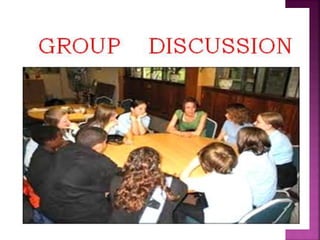
ļ‚ž A small group teaching and learning method
when 7-8 members get together and
collectively work upon a common task to find
out the solution and reach to an agreement
ļ‚ž This has become an integral part of higher
education, evaluation and recruitments
ļ‚ž For effective functioning of a group certain
guidelines are framed.
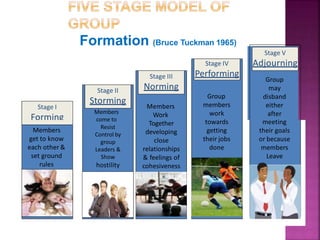
ļ‚ž Functioning of a group undergoes Five stages
ļ‚ž 1. Forming [ stage I]
ļ‚ž 2. Storming [ stage II ]
ļ‚ž 3. Norming [ Stage III ]
ļ‚ž 4. Performing [ Stage IV ]
ļ‚ž 5. Adjourning or Transforming [stage V]
Formation (Bruce Tuckman 1965)
Members
Work
Group
may
disband
either
after
Stage I
Forming
Stage II
Storming
Stage III
Norming
Stage IV
Performing
Stage V
Adjourning
Members
get to know
each other &
set ground
rules
Members
come to
Resist
Control by
group
Leaders &
Show
hostility
Together
developing
close
relationships
& feelings of
cohesiveness
Group
members
work
towards
getting
their jobs
done
meeting
their goals
or because
members
Leave
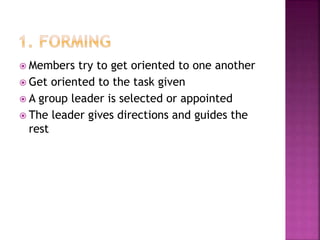
ļ‚ž Members try to get oriented to one another
ļ‚ž Get oriented to the task given
ļ‚ž A group leader is selected or appointed
ļ‚ž The leader gives directions and guides the
rest
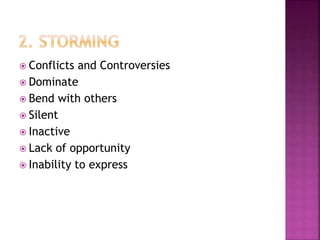
ļ‚ž Conflicts and Controversies
ļ‚ž Dominate
ļ‚ž Bend with others
ļ‚ž Silent
ļ‚ž Inactive
ļ‚ž Lack of opportunity
ļ‚ž Inability to express
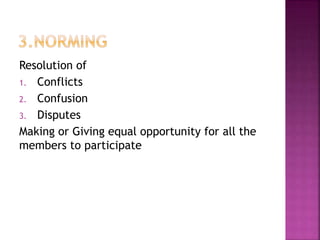
Resolution of
1. Conflicts
2. Confusion
3. Disputes
Making or Giving equal opportunity for all the
members to participate
ļ‚ž A productive stage
ļ‚ž Each member is task oriented
ļ‚ž Discussion will lead to optimal resolution
ļ‚ž Terminal stage
ļ‚ž Each and every member participate and
come out with CONCLUSION
ļ‚ž 1. to reach to an agreement on the given
task
ļ‚ž 2. to maintain satisfactory relations among
the members
ļ‚ž Well prepared grouped leader or expert
ļ‚ž Experienced in conducting or leading
ļ‚ž Know the members of group
ļ‚ž Plan a suitable environment
ļ‚ž Regulate the group than take over
ļ‚ž Prepared / interested group
ļ‚ž Ready to contribute
ļ‚ž Optimum teacher student ratio
ļ‚ž Poorly prepared and inexperienced group is
ineffective in providing meaningful
interaction
ļ‚ž Learner aptitude varies widely, may be too
fast or too slow
ļ‚ž Subject may not be covered to the
satisfaction of the group
ļ‚ž Composition
ļ‚ž Size
ļ‚ž cohesiveness
Task oriented roles
1. Initiators – contributors, recommend new
solutions to solve the problems
2. Information seekers – attempt to obtain
necessary facts
3. Opinion givers – share own opinions with
others
4. Energizers – stimulate the group when it is
needed
5. Expediters – suggests to go further smoothly
6. Encouragers – praises others
7. Harmonizers – mediate group conflicts
8. Blockers – act stubborn and resist the group
9. Dominators – manipulate the group
10.Avoiders – maintains distance and isolates
from the group
ļ‚ž 1. Security
ļ‚ž 2. Status
ļ‚ž 3. Self-Esteem
ļ‚ž 4. Affiliation
ļ‚ž 5. Power
ļ‚ž 6. Goal achievement
Six guidelines:
ļ‚ž 1. Communication
ļ‚ž 2. Support
ļ‚ž 3. Respect
ļ‚ž 4. Fairness
ļ‚ž 5. Competence
ļ‚ž 6. Predictability
TRUST NEEDS TO BE EARNED NOT TO BE
DEMANDED
ļ‚ž Bonding exercises
ļ‚ž Problem solving
ļ‚ž Away days or retreats
ļ‚ž Exercises and Team games
ļ‚ž Encourage development skills
ļ‚ž Support and encourage leadership
ļ‚ž 1.Future focused
ļ‚ž 2.Focused on task
ļ‚ž 3.High communication
ļ‚ž 4.Creative talents
ļ‚ž 5.Rapid response
ļ‚ž 6.Aligned on purpose
ļ‚ž 7.Shared responsibilities
ļ‚ž 8.Participative leadership
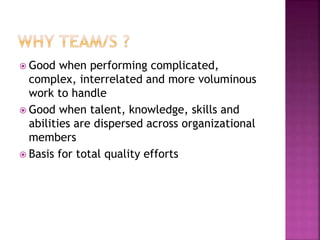
ļ‚ž Good when performing complicated,
complex, interrelated and more voluminous
work to handle
ļ‚ž Good when talent, knowledge, skills and
abilities are dispersed across organizational
members
ļ‚ž Basis for total quality efforts
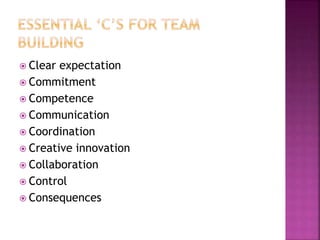
ļ‚ž Clear expectation
ļ‚ž Commitment
ļ‚ž Competence
ļ‚ž Communication
ļ‚ž Coordination
ļ‚ž Creative innovation
ļ‚ž Collaboration
ļ‚ž Control
ļ‚ž Consequences
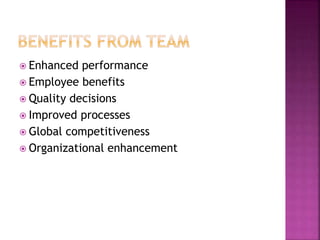
ļ‚ž Enhanced performance
ļ‚ž Employee benefits
ļ‚ž Quality decisions
ļ‚ž Improved processes
ļ‚ž Global competitiveness
ļ‚ž Organizational enhancement
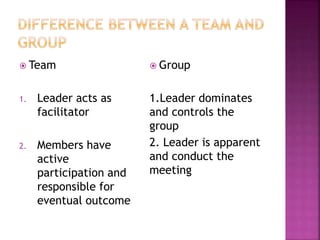
ļ‚ž Team
1. Leader acts as
facilitator
2. Members have
active
participation and
responsible for
eventual outcome
ļ‚ž Group
1.Leader dominates
and controls the
group
2. Leader is apparent
and conduct the
meeting
ļ‚ž Work teams
ļ‚ž Management teams
ļ‚ž Problem solving teams
ļ‚ž Self managed teams
1. Understanding Group dynamics helps to
identify personalities and helps in making
Ability grouping
2. A team is a group whose members work
intensely to achieve a specific or a common
goal or objective
3. Learning outcome from a badly conducted
group discussion would be still better than
that from a good lecture
4. All Teams are Groups but all Groups are not
Teams.[teams are difficult to form and it
takes long time]
TEAM – Together Everyone Achieves More
Thank You All

Groupd dynamics & team building in teaching

  • 1.
  • 2.
    ļ‚ž 1. Defineeffective small groups ļ‚ž 2. Recognize situations where group performance is more effective than an individual work ļ‚ž 3. Describe stages of small group work ļ‚ž 4. Define a team and team building
  • 3.
    ļ‚ž Two ormore individuals who interact with each other to accomplish certain goals or to meet certain needs ļ‚ž Two or more freely interacting individuals who share a common identity and purpose
  • 4.
    ļ‚ž The waythe group functions and the type of interaction that takes place is group dynamics ļ‚ž People interact with each other and each one influences or influenced by others
  • 5.
    Biggest challenge is? Gettingpeople to W----- T---------- !
  • 6.
    Biggest challenge is? Gettingpeople to WORK TOGETHER
  • 7.
    ļ‚ž Two ormore people working together to achieve a shared goal A group of people with complimentary skills who are committed to a common mission, committed for achieving goals through a common approach. ļ‚ž Essence of a team is common commitment ļ‚ž Team is a powerful unit of collective performance
  • 8.
    ļ‚ž The processof getting people to work together effectively to achieve a shared goal ļ‚ž A set of techniques aimed at improving the functioning of a work group ļ‚ž It strives for greater cooperation, better communication and less dysfunctional conflicts
  • 9.
    ļ‚ž 1. Howdoes the message change when it is conveyed from one to another? ļ‚ž 2. What are the weaknesses of message transfer? ļ‚ž 3. What are the weaknesses of people in transferring the message? ļ‚ž 4. How can we communicate in a better and effective way?
  • 10.
    ļ‚ž One waycommunication is ineffective when two way communication is needed ļ‚ž Listening is as effective as talking ļ‚ž What we say is often not what people hear
  • 11.
    What did welearn? ļ‚ž Who influenced the decisions and how? ļ‚ž How could better decisions have been made? ļ‚ž Did people listen to each other? if not why? ļ‚ž How was conflict managed? ļ‚ž What roles did group members adopt? ļ‚ž What kinds of behavior helped or hindered the group?
  • 12.
    ļ‚ž Classification: ļ‚ž 1.Control based ļ‚ž 2. Group size based
  • 13.
    Teacher control: ļ‚ž 1.Lecture ļ‚ž 2. Symposium ļ‚ž 3. Bed side clinic ļ‚ž 4. Tutorial ļ‚ž 5. Demonstration
  • 14.
    Learner Based: ļ‚ž 1.Free group discussion ļ‚ž 2. Project work ļ‚ž 3. Self study ļ‚ž 4. Programmed study
  • 15.
    ļ‚ž Large groupmethod : ļ‚ž Number is more than 30 ļ‚ž A] Lecture ļ‚ž B] Panel discussion ļ‚ž C] Symposium
  • 16.
    Small Group Method: ļ‚žNumber will be up to 30 ļ‚ž A] Work shop ļ‚ž B] Group discussion ļ‚ž C] Field visit ļ‚ž D] Seminar
  • 17.
    Individual ļ‚ž A] Projectwork ļ‚ž B] Self study ļ‚ž C] Assignments
  • 18.
    ļ‚ž 1. GroupDiscussions ļ‚ž 2. Seminar ļ‚ž 3. Tutorial ļ‚ž 4. Demonstration ļ‚ž 5. Work shop ļ‚ž 6. Role play ļ‚ž 7. Practical [ Lab, bedside, field work ]
  • 20.
    ļ‚ž A smallgroup teaching and learning method when 7-8 members get together and collectively work upon a common task to find out the solution and reach to an agreement ļ‚ž This has become an integral part of higher education, evaluation and recruitments
  • 21.
    ļ‚ž For effectivefunctioning of a group certain guidelines are framed. ļ‚ž Functioning of a group undergoes Five stages ļ‚ž 1. Forming [ stage I] ļ‚ž 2. Storming [ stage II ] ļ‚ž 3. Norming [ Stage III ] ļ‚ž 4. Performing [ Stage IV ] ļ‚ž 5. Adjourning or Transforming [stage V]
  • 22.
    Formation (Bruce Tuckman1965) Members Work Group may disband either after Stage I Forming Stage II Storming Stage III Norming Stage IV Performing Stage V Adjourning Members get to know each other & set ground rules Members come to Resist Control by group Leaders & Show hostility Together developing close relationships & feelings of cohesiveness Group members work towards getting their jobs done meeting their goals or because members Leave
  • 23.
    ļ‚ž Members tryto get oriented to one another ļ‚ž Get oriented to the task given ļ‚ž A group leader is selected or appointed ļ‚ž The leader gives directions and guides the rest
  • 24.
    ļ‚ž Conflicts andControversies ļ‚ž Dominate ļ‚ž Bend with others ļ‚ž Silent ļ‚ž Inactive ļ‚ž Lack of opportunity ļ‚ž Inability to express
  • 25.
    Resolution of 1. Conflicts 2.Confusion 3. Disputes Making or Giving equal opportunity for all the members to participate
  • 26.
    ļ‚ž A productivestage ļ‚ž Each member is task oriented ļ‚ž Discussion will lead to optimal resolution
  • 27.
    ļ‚ž Terminal stage ļ‚žEach and every member participate and come out with CONCLUSION
  • 28.
    ļ‚ž 1. toreach to an agreement on the given task ļ‚ž 2. to maintain satisfactory relations among the members
  • 29.
    ļ‚ž Well preparedgrouped leader or expert ļ‚ž Experienced in conducting or leading ļ‚ž Know the members of group ļ‚ž Plan a suitable environment ļ‚ž Regulate the group than take over ļ‚ž Prepared / interested group ļ‚ž Ready to contribute
  • 30.
    ļ‚ž Optimum teacherstudent ratio ļ‚ž Poorly prepared and inexperienced group is ineffective in providing meaningful interaction ļ‚ž Learner aptitude varies widely, may be too fast or too slow ļ‚ž Subject may not be covered to the satisfaction of the group
  • 31.
  • 32.
    Task oriented roles 1.Initiators – contributors, recommend new solutions to solve the problems 2. Information seekers – attempt to obtain necessary facts 3. Opinion givers – share own opinions with others 4. Energizers – stimulate the group when it is needed 5. Expediters – suggests to go further smoothly
  • 33.
    6. Encouragers –praises others 7. Harmonizers – mediate group conflicts 8. Blockers – act stubborn and resist the group 9. Dominators – manipulate the group 10.Avoiders – maintains distance and isolates from the group
  • 34.
    ļ‚ž 1. Security ļ‚ž2. Status ļ‚ž 3. Self-Esteem ļ‚ž 4. Affiliation ļ‚ž 5. Power ļ‚ž 6. Goal achievement
  • 35.
    Six guidelines: ļ‚ž 1.Communication ļ‚ž 2. Support ļ‚ž 3. Respect ļ‚ž 4. Fairness ļ‚ž 5. Competence ļ‚ž 6. Predictability TRUST NEEDS TO BE EARNED NOT TO BE DEMANDED
  • 36.
    ļ‚ž Bonding exercises ļ‚žProblem solving ļ‚ž Away days or retreats ļ‚ž Exercises and Team games ļ‚ž Encourage development skills ļ‚ž Support and encourage leadership
  • 37.
    ļ‚ž 1.Future focused ļ‚ž2.Focused on task ļ‚ž 3.High communication ļ‚ž 4.Creative talents ļ‚ž 5.Rapid response ļ‚ž 6.Aligned on purpose ļ‚ž 7.Shared responsibilities ļ‚ž 8.Participative leadership
  • 38.
    ļ‚ž Good whenperforming complicated, complex, interrelated and more voluminous work to handle ļ‚ž Good when talent, knowledge, skills and abilities are dispersed across organizational members ļ‚ž Basis for total quality efforts
  • 39.
    ļ‚ž Clear expectation ļ‚žCommitment ļ‚ž Competence ļ‚ž Communication ļ‚ž Coordination ļ‚ž Creative innovation ļ‚ž Collaboration ļ‚ž Control ļ‚ž Consequences
  • 40.
    ļ‚ž Enhanced performance ļ‚žEmployee benefits ļ‚ž Quality decisions ļ‚ž Improved processes ļ‚ž Global competitiveness ļ‚ž Organizational enhancement
  • 41.
    ļ‚ž Team 1. Leaderacts as facilitator 2. Members have active participation and responsible for eventual outcome ļ‚ž Group 1.Leader dominates and controls the group 2. Leader is apparent and conduct the meeting
  • 42.
    ļ‚ž Work teams ļ‚žManagement teams ļ‚ž Problem solving teams ļ‚ž Self managed teams
  • 43.
    1. Understanding Groupdynamics helps to identify personalities and helps in making Ability grouping 2. A team is a group whose members work intensely to achieve a specific or a common goal or objective
  • 44.
    3. Learning outcomefrom a badly conducted group discussion would be still better than that from a good lecture 4. All Teams are Groups but all Groups are not Teams.[teams are difficult to form and it takes long time] TEAM – Together Everyone Achieves More
  • 45.

Editor's Notes