Dr. Chaduvula Suresh Babu
Professor
Department of OBGYN
GIMSR
Visakhapatnam, AP, India
 It is made up of 4 bones
 1. Os innominatum [2]
 2. Sacrum
 3. Coccyx
 Os innominatum is made up of 3 bones
 1. Ilium
 2. Ischium
 3. Pubis
 Pelvis has 4 joints
 1. Pubic symphysis – Fibrocartilagenous jt. It
has 3 ligaments – superior and inferior pubic
ligaments and arcuate ligament in between
 2. Sacroiliac jt. Or synchondrosis [2] -
synovial
 3. Sacrococcygeal jt. – Synovial hinge
 1. Angle of inclination – 55-60 degrees [more
the angle bad is outcome]
 2. Sacral Angle – 90 degrees [ less is bad]
 3. Subpubic angle – 85-90 degrees [ less is
bad and it will increase waste space of
Morris]
 Any decrease in diameter will alter mechanism of
labour. They are
 1. AP diameter of Inlet – 11cm
 2. AP diameter of least pelvic dimension – 11.5 cm
 3. ISD – 10.5 cm
 4. AP diameter of outlet – 11.5 cm
 5. ITD – 11 cm
 6. Obstetrical conjugate – 10cm
 7. Diagonal conjugate – 12.5 cm
 8. True or Anatomical conjugate or conjugate vera -
11cm
 There are 4 types – Caldwell Moloy
classification
 1. Gynaecoid type [50%]
 2. Android type [25 %]
 3. Anthropoid type [20%]
 4. Platypelloid type [ 5%]
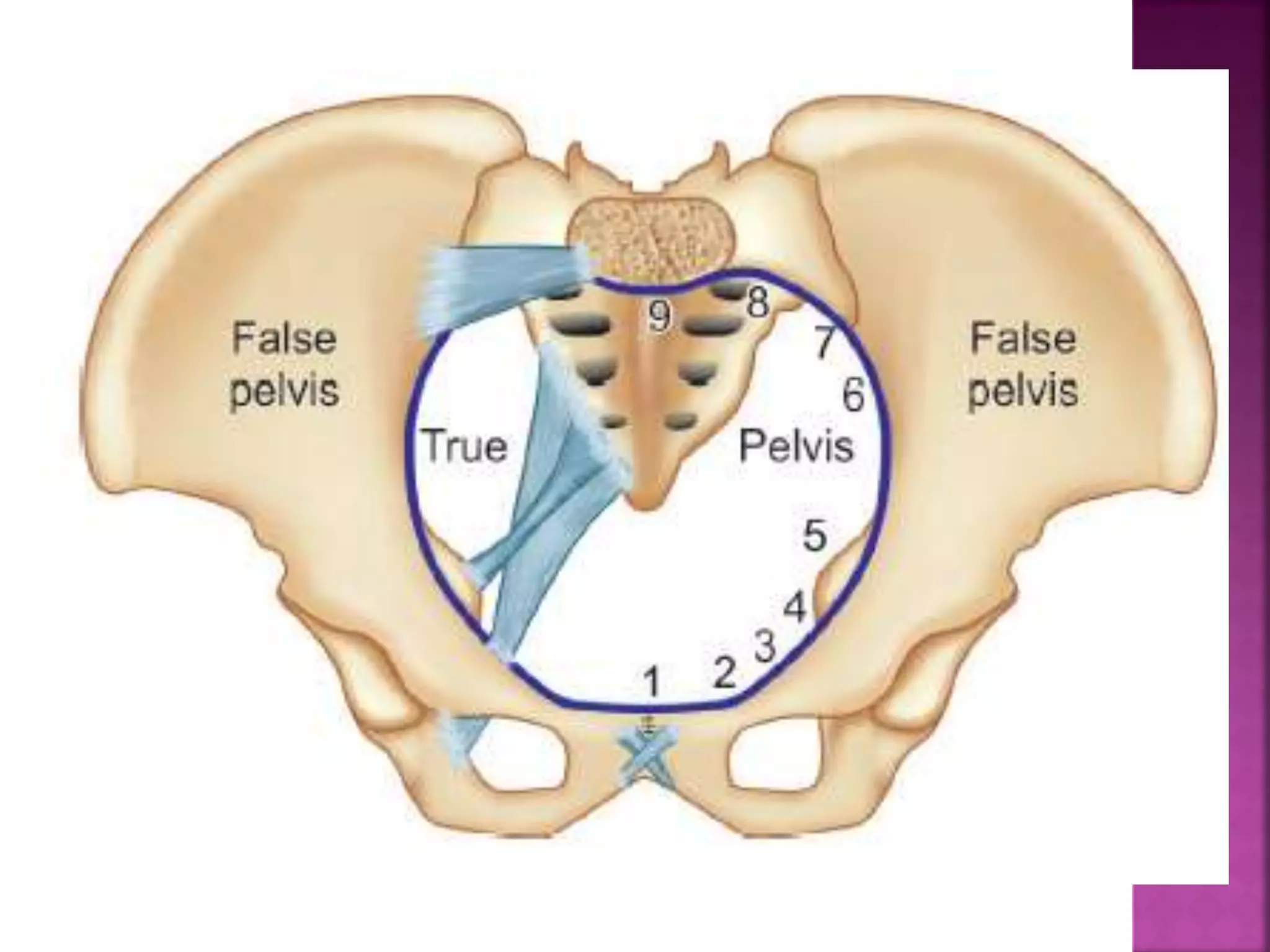
 Pelvis is divided into Pelvis Major or False
Pelvis and Pelvis Minor or True Pelvis by Linea
Terminalis.
 Linea Terminalis is formed by upper border of
Sacral vertebra, arcuate line of the Ilium and
pectineal line of the Pubis.
 Pelvis above linea is Pelvis major.
 Pelvis below linea is Pelvis minor.
 True Pelvis is divided into Inlet, Cavity and
Outlet.
 Inlet or Brim is formed by from anterior to
posterior upper border of symphysis pubis,
pubic crest, pubic tubercle, pectineal line
iliopubic eminence, iliopectineal line,
sacroiliac joint, anterior border of ala of
sacrum and upper border of sacral
promontory and same on the opposite side.
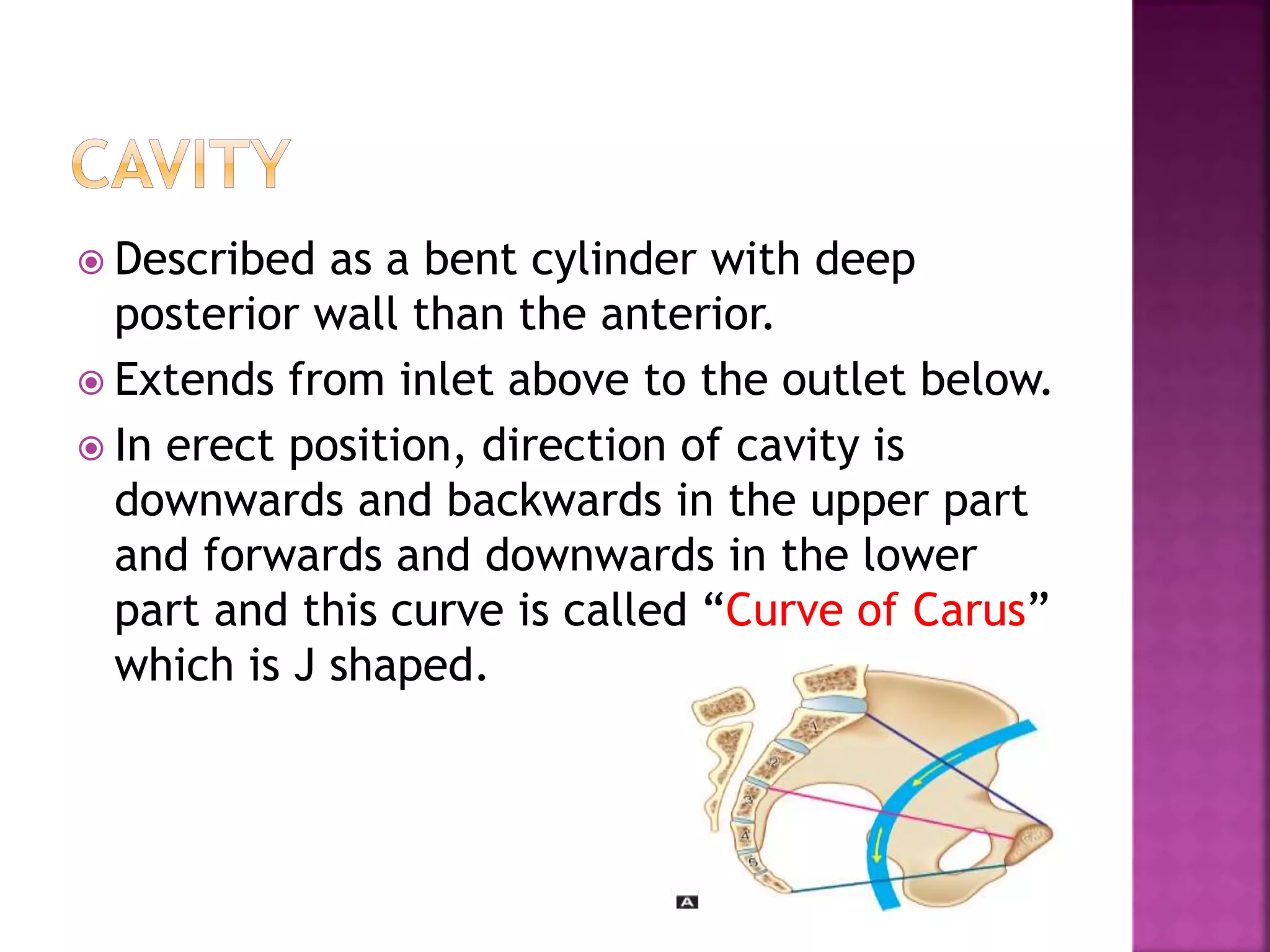
 Described as a bent cylinder with deep
posterior wall than the anterior.
 Extends from inlet above to the outlet below.
 In erect position, direction of cavity is
downwards and backwards in the upper part
and forwards and downwards in the lower
part and this curve is called “Curve of Carus”
which is J shaped.
 Length of anterior wall of pelvis is 5 cm and
posterior is 10 cm.
 Boundaries of true pelvis is formed by, bones,
ligaments, muscles and fascia around them.
 Bony boundaries are posteriorly anterir surface
of sacrum, laterally ischial bones, sacrosciatic
nothes and anteriorly pubic bones, ascending
rami of pubis and obturator foramina.
 Ligaments like sacrotuberous and sacrospinous
ligaments and fascia surrounding them.
 Muscles are posteriorly by cocygeus, laterally
pyriformis and obturator internus, inferiorly
levator ani.
 Musculoaponeurotic part separating
peritoneal cavity from vulva.
 It is made up of levator ani and coccygei
muscles.
 It has 3 orifices. They are urethral meatus,
vaginal introitus and anus.
 1. Plane of Inlet – corresponds to brim of
pelvis – It has AP, transvers and oblique
diameters – 11,13 and 12 cm and post sagital
4cm
 2. Plane of greatest pelvic dimension –
middle of posterior part of sym. Pubis to jt.
Of 2nd and 3 rd sacral vertebra and laterally
no bony land marks. It has 2 diameters – AP –
12 and Trans. 12 cm
 3. Plane of least pelvic dimension – lower
border of Symphysis Pubis to ischial spine
upto tip of 5th sacral vertebra or jt. of S4 and
S5. It has AP 11.5 cm. ISD – 10cm and Post.
Sagital – 4.5 cm
 4. Plane of outlet – lower border of sym.
Pubis to ischail tuberosity to tip of coccyx
formed anteriorly by urogenital triangle
formed by ischiopubic rami and line joining
ischial tuberosities & posteriorly by anal
triangle formed by tip of coccyx and line
joining ischial tuberosities. It has AP 11.5 ,
ITD 11cm and Post sagital 7.5 cm
 1. Station of the presenting part
 2. Internal rotation occurs
 3. Levator ani muscle exists
 4. Pudendal block
 5. Forward curvature of pelvis occurs
 6. Narrowest plane
 It has 3 diameters –
 1. Interspinous – 10cm
 2. AP diameter- 11.5 cm
 3. Post.sagital – 4.5 cm
 Inlet has 3 boundaries –
 Anteriorly – symphysis pubis and horizontal
rami of pubis
 Laterally – linea terminalis
 Posteriorly – sacral promontory and alae of
sacrum
 It has 3 diameters
 1. AP dia.[3] -
 2. Transverse - 13 cm – farthest pts. Of linea
 3. Oblique dia- 12 cm – SI.jt to iliopectineal
eminence
 Antero-postero diameter has 3 diameters.
 1. Obstetrical conjugate – important – from
sacral promontory to neaest point on the
post. Surface of pubis – 10 cm
 2. Diagonal conjugate – clinically detected –
from sacral Promontory to lower border of SP
or apex of pubic arch – 12cm [DC-1.5 to 2cm
is obs.conj.]
 3. Anatomical conjugate or conjugate vera or
true conjugate – from sacral promontory to
inner surface of upper part of sym. Pubis –
11cm
Transverse diameter
of inlet transects
diagonal conjugate 4
cm from sacral
promontory.[ Post.
Sagital]
It is the distance
between lateral brim
of the pelvis to
ischial spines.
 Irregular in outline and formed by 2 triangles
with intervening inter-tuberous line.
 Boundaries are-
 Posteriorly – tip of coccyx
 Laterally – ischial tuberosities
 Anteriorly - Pubic arch formed by rami of
ischium and pubis
 3 diameters
 1. AP diameter – from lower border of SP to
tip of coccyx - 9.5 to 11.5 cm
 2. Transverse – Bituberous – 11 cm
 3. Post.sagital diameter – tip of sacrum to
transecting point of bitubrous diameter – 7.5
cm
 1. Relaxation of sacroiliac joints and SP
occurs due to Relaxin in pregnancy
 2. Upward gliding movement of SI jt. occurs
 3. At the time of delivery in dorsal lithotomy
position displacement of SIJ occurs by 1.5 to
2 cm
 4. In shoulder dystocia while doing
McRobert’s technique success occurs due to
mobility of SIJ
 1. Gynecoid –
 Inlet is round or oval
 Mid pelvis – side walls parallel and iscial
spines not prominent, ISD -10cm
 Outlet – Pubic arch is wide
 Sacrum – inclined neither anterior or
posterior and sacro-sciatic notches are round
 2. Android –
 Inlet – Heart or triangular shaped
 Cavity – side walls convergent, ischial spines
prominent
 Oulet – Pubic arch narrowed
 Sacrum – Inclined anteriorly, straight sacrum
without curve, Sacro-sciatic notch – narrow
 Importance – Occipitoposterior common,
Deep transverse arrest,
 3. Anthropoid
 Inlet is Oval antero-posteriorly
 Cavity – convergent , spines prominent
 Outlet – Arch- narrow
 Sacrum – 6 segments and sacrosciatic notch is
large
 Importance - Persistent OccipitoPosterior
Position
 4. Platypelloid
 Inlet – Oval transversely
 Cavity – side walls straight, spines not
prominent, ISD wide
 Outlet – Arch is wider, ITD wide
 Sacrum – Sacral inclination average,
sacrosciatic notch – narrow
 Importance – Difficulty in engagement of
Head
 1. Rachtic Pelvis – A child with rickets no
treated properly.
 2. Naegele’s Pelvis – Absence of one ala of
sacrum
 3. Robert’s Pelvis – Absence of both ala
 4. Pelvic deformity due to Spinal problems
and lower limb problems. Ex.- pott’s spine,
spinal injuries, fracture vertebra and femur,
Poliomyelitis etc.,
 Most of the pelves are mixed varieties. It
means it has combination of 2 types of
pelves.
 Gynecoid pelvis with Android tendency – Here
posterior segment denotes type and anterior
segment signifies android tendency.
Thank You All

Pelvis - Obstetrical Significance

  • 1.
    Dr. Chaduvula SureshBabu Professor Department of OBGYN GIMSR Visakhapatnam, AP, India
  • 2.
     It ismade up of 4 bones  1. Os innominatum [2]  2. Sacrum  3. Coccyx  Os innominatum is made up of 3 bones  1. Ilium  2. Ischium  3. Pubis
  • 3.
     Pelvis has4 joints  1. Pubic symphysis – Fibrocartilagenous jt. It has 3 ligaments – superior and inferior pubic ligaments and arcuate ligament in between  2. Sacroiliac jt. Or synchondrosis [2] - synovial  3. Sacrococcygeal jt. – Synovial hinge
  • 4.
     1. Angleof inclination – 55-60 degrees [more the angle bad is outcome]  2. Sacral Angle – 90 degrees [ less is bad]  3. Subpubic angle – 85-90 degrees [ less is bad and it will increase waste space of Morris]
  • 5.
     Any decreasein diameter will alter mechanism of labour. They are  1. AP diameter of Inlet – 11cm  2. AP diameter of least pelvic dimension – 11.5 cm  3. ISD – 10.5 cm  4. AP diameter of outlet – 11.5 cm  5. ITD – 11 cm  6. Obstetrical conjugate – 10cm  7. Diagonal conjugate – 12.5 cm  8. True or Anatomical conjugate or conjugate vera - 11cm
  • 8.
     There are4 types – Caldwell Moloy classification  1. Gynaecoid type [50%]  2. Android type [25 %]  3. Anthropoid type [20%]  4. Platypelloid type [ 5%]
  • 9.
     Pelvis isdivided into Pelvis Major or False Pelvis and Pelvis Minor or True Pelvis by Linea Terminalis.  Linea Terminalis is formed by upper border of Sacral vertebra, arcuate line of the Ilium and pectineal line of the Pubis.  Pelvis above linea is Pelvis major.  Pelvis below linea is Pelvis minor.
  • 10.
     True Pelvisis divided into Inlet, Cavity and Outlet.  Inlet or Brim is formed by from anterior to posterior upper border of symphysis pubis, pubic crest, pubic tubercle, pectineal line iliopubic eminence, iliopectineal line, sacroiliac joint, anterior border of ala of sacrum and upper border of sacral promontory and same on the opposite side.
  • 12.
     Described asa bent cylinder with deep posterior wall than the anterior.  Extends from inlet above to the outlet below.  In erect position, direction of cavity is downwards and backwards in the upper part and forwards and downwards in the lower part and this curve is called “Curve of Carus” which is J shaped.
  • 13.
     Length ofanterior wall of pelvis is 5 cm and posterior is 10 cm.  Boundaries of true pelvis is formed by, bones, ligaments, muscles and fascia around them.  Bony boundaries are posteriorly anterir surface of sacrum, laterally ischial bones, sacrosciatic nothes and anteriorly pubic bones, ascending rami of pubis and obturator foramina.  Ligaments like sacrotuberous and sacrospinous ligaments and fascia surrounding them.  Muscles are posteriorly by cocygeus, laterally pyriformis and obturator internus, inferiorly levator ani.
  • 14.
     Musculoaponeurotic partseparating peritoneal cavity from vulva.  It is made up of levator ani and coccygei muscles.  It has 3 orifices. They are urethral meatus, vaginal introitus and anus.
  • 15.
     1. Planeof Inlet – corresponds to brim of pelvis – It has AP, transvers and oblique diameters – 11,13 and 12 cm and post sagital 4cm  2. Plane of greatest pelvic dimension – middle of posterior part of sym. Pubis to jt. Of 2nd and 3 rd sacral vertebra and laterally no bony land marks. It has 2 diameters – AP – 12 and Trans. 12 cm
  • 16.
     3. Planeof least pelvic dimension – lower border of Symphysis Pubis to ischial spine upto tip of 5th sacral vertebra or jt. of S4 and S5. It has AP 11.5 cm. ISD – 10cm and Post. Sagital – 4.5 cm  4. Plane of outlet – lower border of sym. Pubis to ischail tuberosity to tip of coccyx formed anteriorly by urogenital triangle formed by ischiopubic rami and line joining ischial tuberosities & posteriorly by anal triangle formed by tip of coccyx and line joining ischial tuberosities. It has AP 11.5 , ITD 11cm and Post sagital 7.5 cm
  • 17.
     1. Stationof the presenting part  2. Internal rotation occurs  3. Levator ani muscle exists  4. Pudendal block  5. Forward curvature of pelvis occurs  6. Narrowest plane  It has 3 diameters –  1. Interspinous – 10cm  2. AP diameter- 11.5 cm  3. Post.sagital – 4.5 cm
  • 18.
     Inlet has3 boundaries –  Anteriorly – symphysis pubis and horizontal rami of pubis  Laterally – linea terminalis  Posteriorly – sacral promontory and alae of sacrum  It has 3 diameters  1. AP dia.[3] -  2. Transverse - 13 cm – farthest pts. Of linea  3. Oblique dia- 12 cm – SI.jt to iliopectineal eminence
  • 19.
     Antero-postero diameterhas 3 diameters.  1. Obstetrical conjugate – important – from sacral promontory to neaest point on the post. Surface of pubis – 10 cm  2. Diagonal conjugate – clinically detected – from sacral Promontory to lower border of SP or apex of pubic arch – 12cm [DC-1.5 to 2cm is obs.conj.]  3. Anatomical conjugate or conjugate vera or true conjugate – from sacral promontory to inner surface of upper part of sym. Pubis – 11cm
  • 20.
    Transverse diameter of inlettransects diagonal conjugate 4 cm from sacral promontory.[ Post. Sagital]
  • 21.
    It is thedistance between lateral brim of the pelvis to ischial spines.
  • 24.
     Irregular inoutline and formed by 2 triangles with intervening inter-tuberous line.  Boundaries are-  Posteriorly – tip of coccyx  Laterally – ischial tuberosities  Anteriorly - Pubic arch formed by rami of ischium and pubis
  • 25.
     3 diameters 1. AP diameter – from lower border of SP to tip of coccyx - 9.5 to 11.5 cm  2. Transverse – Bituberous – 11 cm  3. Post.sagital diameter – tip of sacrum to transecting point of bitubrous diameter – 7.5 cm
  • 26.
     1. Relaxationof sacroiliac joints and SP occurs due to Relaxin in pregnancy  2. Upward gliding movement of SI jt. occurs  3. At the time of delivery in dorsal lithotomy position displacement of SIJ occurs by 1.5 to 2 cm  4. In shoulder dystocia while doing McRobert’s technique success occurs due to mobility of SIJ
  • 27.
     1. Gynecoid–  Inlet is round or oval  Mid pelvis – side walls parallel and iscial spines not prominent, ISD -10cm  Outlet – Pubic arch is wide  Sacrum – inclined neither anterior or posterior and sacro-sciatic notches are round
  • 28.
     2. Android–  Inlet – Heart or triangular shaped  Cavity – side walls convergent, ischial spines prominent  Oulet – Pubic arch narrowed  Sacrum – Inclined anteriorly, straight sacrum without curve, Sacro-sciatic notch – narrow  Importance – Occipitoposterior common, Deep transverse arrest,
  • 29.
     3. Anthropoid Inlet is Oval antero-posteriorly  Cavity – convergent , spines prominent  Outlet – Arch- narrow  Sacrum – 6 segments and sacrosciatic notch is large  Importance - Persistent OccipitoPosterior Position
  • 30.
     4. Platypelloid Inlet – Oval transversely  Cavity – side walls straight, spines not prominent, ISD wide  Outlet – Arch is wider, ITD wide  Sacrum – Sacral inclination average, sacrosciatic notch – narrow  Importance – Difficulty in engagement of Head
  • 31.
     1. RachticPelvis – A child with rickets no treated properly.  2. Naegele’s Pelvis – Absence of one ala of sacrum  3. Robert’s Pelvis – Absence of both ala  4. Pelvic deformity due to Spinal problems and lower limb problems. Ex.- pott’s spine, spinal injuries, fracture vertebra and femur, Poliomyelitis etc.,
  • 32.
     Most ofthe pelves are mixed varieties. It means it has combination of 2 types of pelves.  Gynecoid pelvis with Android tendency – Here posterior segment denotes type and anterior segment signifies android tendency.
  • 33.