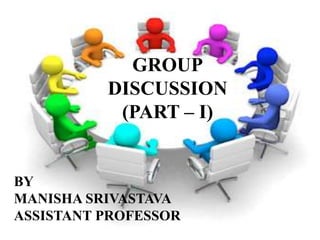
GROUP
DISCUSSION
(PART – I)
BY
MANISHA SRIVASTAVA
ASSISTANT PROFESSOR
INTRODUCTION
• An important activity in academic, business
and administrative spheres.
• systematic and purposeful interactive oral
process.
• Here the exchange of ideas, thoughts and
feelings take place through oral
communication.
NOTE POINT
• The exchange of ideas takes place in a
systematic and structured way.
• The participants sit facing each other almost
in a semi-circle and express their views on the
given topic/issue/problem.
DIFFERANCE BETWEEN GROUP
DISCUSSION AND DEBATE
Debate
• Competitive in nature.
• speaker can speak either
‘for’ the topic or ‘against’
the topic.
• final decision or result in
a debate depends on
voting.
Group Discussion
• Co-operative group
process.
• the speaker can express
both.
• the group reaches group
consensus.
Phases in a GD
• Initiation/introduction
• The central group discussion
• Summarization/conclusion
IMPORTANT ACTIVITY AT
COLLEGE LEVEL
• helps you to train yourself to discuss and
argue about the topic given.
• helps you to express your views on serious
subjects and in formal situations.
• improves your thinking, listening and
speaking skills.
• promotes your confidence level.
Cont….
• an effective tool in problem solving, decision
making and personality assessment.
• GD skills may ensure academic success,
popularity and good admission or job offer.
Expectations of the Panel
You should have the following qualities:
• Subject knowledge
• Communication skills
• Team management & Team player
• Reasoning
• Leadership
• Flexible
Cont…
• Assertiveness
• Initiative
• Creativity (out of the box thinking)
• Inspiring ability
• Listening
• Awareness
• Goal Orientation
Advantages of a GD
• Ideas can be generated, shared and tried out.
• Groups provide a support and growth for any
endeavor.
• Combine talents to provide innovative
solutions.
Roles in a Structured GD
• Initiator
• Information seeker and giver
• Procedure facilitator
• Opinion seeker/giver
• Clarifier
• Summarizer
Cont….
• Social supporter
• Harmonizer
• Tension reliever
• Energizer
• Attacker
• Dominator
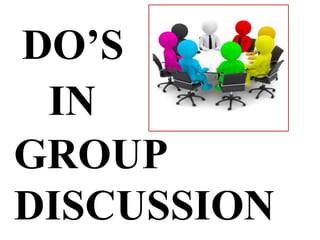
DO’S
IN
GROUP
DISCUSSION
DO’S IN GROUP DISCUSSION
• Listen “SUBJECT” carefully.
• Write down your “THOUGHTS” on a paper.
• INITIATE Discussion, only if you know the
subject well.
• LISTEN to others if you don’t know the
subject.
• Support your points with some FACTS &
FIGURES.
Cont….
• TIME MANAGEMENT- make short
contribution of 25 – 30 seconds of 3-4 times.
• Give others chance to speak. Respect
contribution from other members.
• Speak Politely & Pleasantly. Disagree
Politely & Agree with what is right.
• Maintain Gesture & Posture.
Cont….
• Maintain Eye Contact.
• Maintain Confidence.
• Maintain Voice modulation. (be clear, precis
& audible)
• Summarize the discussion, if the group has
not reached a conclusion.
DON’TS
IN
GROUP
DISCUSSION
DON’TS IN GROUP DISCUSSION
• Don’t initiate the discussion, if you don’t
know about the subject well.
• Don’t OVER SPEAK, INTERVENE &
SNATCH other’s chance to speak.
• Don’t Argue & Shout.
• Don’t look at the evaluator or a particular
group member.
Cont…
• Don’t talk IRRELEVANT things &
DISTRACT the discussion.
• Don’t mention ERRATIC STATISTICS.
• Don’t pose NEGATIVE BODY Gesture /
Posture. ( like – touching nose, leaning back
on the chair, knocking the table with pen etc..)
Cont…
• Don’t display low self confidence with shaky
voice & trembling hands.
• Don’t try to dominate the discussion.
• Don’t put others in an embarrassing
situation by asking them to speak if they don’t
want.
NOTE POINT
• Most of the candidates believe that “One who
speaks most in the GD, wins.”
• However, they forget that it is a group activity
where everyone must be given a chance.
• The one who tries to dominate, looses.
THANK YOU
ANY QUESTION ?

Group discussion (1)

  • 1.
    GROUP DISCUSSION (PART – I) BY MANISHASRIVASTAVA ASSISTANT PROFESSOR
  • 2.
    INTRODUCTION • An importantactivity in academic, business and administrative spheres. • systematic and purposeful interactive oral process. • Here the exchange of ideas, thoughts and feelings take place through oral communication.
  • 3.
    NOTE POINT • Theexchange of ideas takes place in a systematic and structured way. • The participants sit facing each other almost in a semi-circle and express their views on the given topic/issue/problem.
  • 4.
    DIFFERANCE BETWEEN GROUP DISCUSSIONAND DEBATE Debate • Competitive in nature. • speaker can speak either ‘for’ the topic or ‘against’ the topic. • final decision or result in a debate depends on voting. Group Discussion • Co-operative group process. • the speaker can express both. • the group reaches group consensus.
  • 5.
    Phases in aGD • Initiation/introduction • The central group discussion • Summarization/conclusion
  • 6.
    IMPORTANT ACTIVITY AT COLLEGELEVEL • helps you to train yourself to discuss and argue about the topic given. • helps you to express your views on serious subjects and in formal situations. • improves your thinking, listening and speaking skills. • promotes your confidence level.
  • 7.
    Cont…. • an effectivetool in problem solving, decision making and personality assessment. • GD skills may ensure academic success, popularity and good admission or job offer.
  • 8.
    Expectations of thePanel You should have the following qualities: • Subject knowledge • Communication skills • Team management & Team player • Reasoning • Leadership • Flexible
  • 9.
    Cont… • Assertiveness • Initiative •Creativity (out of the box thinking) • Inspiring ability • Listening • Awareness • Goal Orientation
  • 10.
    Advantages of aGD • Ideas can be generated, shared and tried out. • Groups provide a support and growth for any endeavor. • Combine talents to provide innovative solutions.
  • 11.
    Roles in aStructured GD • Initiator • Information seeker and giver • Procedure facilitator • Opinion seeker/giver • Clarifier • Summarizer
  • 12.
    Cont…. • Social supporter •Harmonizer • Tension reliever • Energizer • Attacker • Dominator
  • 14.
  • 15.
    DO’S IN GROUPDISCUSSION • Listen “SUBJECT” carefully. • Write down your “THOUGHTS” on a paper. • INITIATE Discussion, only if you know the subject well. • LISTEN to others if you don’t know the subject. • Support your points with some FACTS & FIGURES.
  • 16.
    Cont…. • TIME MANAGEMENT-make short contribution of 25 – 30 seconds of 3-4 times. • Give others chance to speak. Respect contribution from other members. • Speak Politely & Pleasantly. Disagree Politely & Agree with what is right. • Maintain Gesture & Posture.
  • 17.
    Cont…. • Maintain EyeContact. • Maintain Confidence. • Maintain Voice modulation. (be clear, precis & audible) • Summarize the discussion, if the group has not reached a conclusion.
  • 18.
  • 19.
    DON’TS IN GROUPDISCUSSION • Don’t initiate the discussion, if you don’t know about the subject well. • Don’t OVER SPEAK, INTERVENE & SNATCH other’s chance to speak. • Don’t Argue & Shout. • Don’t look at the evaluator or a particular group member.
  • 20.
    Cont… • Don’t talkIRRELEVANT things & DISTRACT the discussion. • Don’t mention ERRATIC STATISTICS. • Don’t pose NEGATIVE BODY Gesture / Posture. ( like – touching nose, leaning back on the chair, knocking the table with pen etc..)
  • 21.
    Cont… • Don’t displaylow self confidence with shaky voice & trembling hands. • Don’t try to dominate the discussion. • Don’t put others in an embarrassing situation by asking them to speak if they don’t want.
  • 22.
    NOTE POINT • Mostof the candidates believe that “One who speaks most in the GD, wins.” • However, they forget that it is a group activity where everyone must be given a chance. • The one who tries to dominate, looses.
  • 23.