Debate
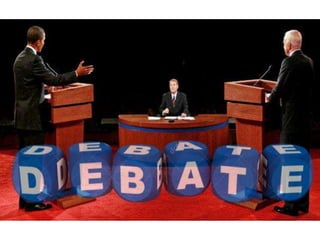
a formal discussion on a
particular topic in a public
meeting or legislative assembly,
in which opposing arguments
are put forward.
British Parliamentary Debate
the most commonly used
format for competitive
debating.
Terminologies
• Motion
• Point of Information
• Rebut/Rebuttal
• Government
• Opposition
Motion
• Every debate has a motion;
this is the issue for
discussion.
• A good motion has clear
arguments in favor of it and
against it.
Point of Information (POI)
• Points of Information are a very
important part of BP.
• They enable you to keep involved
throughout the whole debate,
rather than just during your five
minutes are up.
Point of Information (POI)
• They do not figure too heavily in
most judging decisions, but in a
close round where the teams are
all similarly good at style and
content could be the deciding
factor.
Rules for POI
• It could be offered during
unprotected time.
• They should be offered by members
of the opposite side only.
• You offer a point of information by
standing and saying “point of
information”.
Rules for POI
• Speakers may accept or decline the
point of information in any way they
like; the simplest is by saying “yes
please”, or “no thank you”.
• Points of Information should be quick
and to the point (no more than about
• fifteen seconds).
How to deal with POI
1. Dismiss them briefly and then
get on with your speech (if it
was a stupid point).
2. Answer them more fully and
merge your answer into what
you were going to say next.
How to deal with POI
3. Say that you are planning to deal with
that point later on in your speech and
carry on where you were. If you do this,
you absolutely MUST make it utterly
explicit when you refute the point later
on. You must not use this as a ducking
tactic since adjudicators will notice.
Rebut/Rebuttal
is a form of evidence that is
presented to contradict or
nullify other evidence that has
been presented by an adverse
party.
Government
supports the motion.
In supporting the motion, the
Government carries out these functions:
• Defining the motion
• Constructing a positive case in favor
of the motion
• Providing substantive materials and
arguments in support of the case
• Responding to any challenges made
to the case made by the Opposition
Opposition
Opposes the motion.
In negating the motion, the Opposition
carries out these functions:
• Responding to the Government's
definition
• Constructing a case in opposition to the
motion
• Providing substantive material and
arguments in support of the opposition
case
• Responding to the arguments delivered
by the Government.
The Four Teamsin Debate
• Opening Proposition Team
• Opening Opposition Team
• Closing Proposition Team
• Closing Opposition Team
Opening Proposition Team
First speaker
1. Define the motion (see below).
2. Outline the case he and his partner will
put forward and explain which speaker will
deal with which arguments.
3. Develop his own arguments, which
should be separated into two or three
main points.
4. Finish by summarizing his main points
Opening Proposition Team
Second speaker
1. Re-cap the team line.
2. Rebut the response made by the first
opposition speaker to his partner’s speech.
3. Rebut the first opposition speaker’s main
arguments.
4. Develop his own arguments – separated into
two or three main points.
5. Finish with a summary of the whole team
case.
Opening Opposition Team
First speaker
1. Respond to the definition if it is unfair or
makes no link to the motion. You can re-define
(offer an alternative interpretation of the
motion), but this can be risky and should only be
done when the definition is not debatable
(usually better to complain a little and hope the
adjudicator gives you credit – “well this is a silly
definition but we’re going to debate it and beat
you on it anyway” approach).
Opening Opposition Team
2. Rebut the first proposition speech.
3. Outline the case which she and her
partner will put forward and explain which
speakers will deal with which arguments
4. Offer additional arguments (roughly 2)
about why the policy is a bad idea, or
develop a counter case (i.e. an alternative
proposal). This decision is largely based on
the circumstances of the debate, and only
experience will provide guidance on this.
Opening Opposition Team
Second speaker
1. Rebut the speech of the second
proposition speaker.
2. Offer some more arguments to support
your partner’s approach to the motion.
3. Summarize the case for your team,
including your own and your partner’s
arguments.
Closing Proposition Team
First speaker
The first speaker must stake his team’s
claim in the debate by doing one of the
following:
1. Extend the debate into a new area (i.e.
“this debate has so far focused on the
developed world, and now our team will
extend that to look at the important
benefits for the developing world)
Closing Proposition Team
2. Introduce a couple of new arguments
that make the case on his side more
persuasive.
Closing Proposition Team
Second speaker
The last speech of a debate is known as a
Summary Speech. In it you should step
back and look at the debate as a whole
and explain why on all the areas you have
argued your side has won. You can:
1. Go through the debate chronologically
(this is not very advanced and usually not
very persuasive either).
2. Go through one side’s case and then
the other.
3. Go through the debate according to
the main points of contention (this is
the most persuasive and advanced way)
explaining why on each of the main
issues that have been debated have
been won by your side.
Closing Proposition Team
Closing Opposition Team
First speaker
This is very similar to the second prop
role.
1. You must rebut the new analysis of the
third proposition speaker.
2. You must also bring an extension to the
debate – i.e. extend the debate into a new
area or bring a couple of new arguments
to the debate.
Second speaker
• Like the closing proposition, the last
opposition speaker must devote their
whole speech to a summing up and
should not introduce new of
Information
Closing Opposition Team
Government Side
• Prime Minister
• Deputy Prime Minister
• Member of the Government
• Government Whip
Prime Minister
• offer a reasonable interpretation of
the motion
• present a case supporting that
interpretation
• employ other strategies deemed
necessary in advancing the
Government's stance
Deputy Prime Minister
• to reestablish the First
Proposition’s case by confronting
any refutation presented by the
Leader of the Opposition
• refute some or all of the
arguments presented by the
Leader of the Opposition
Deputy Prime Minister
• further develop the case
presented by the Prime Minister
• employ other strategies deemed
necessary in advancing the
Government's stance.
Member of the Government
• to briefly support the case developed
by the First Proposition team
• to introduce a different argument,
sometimes called a “case extension”
which is consistent with yet different
from the case introduced by the First
Proposition team
• to employ other strategies
deemed necessary in advancing
the Government's stance.
Member of the Government
Government Whip
• to support any new arguments
introduced by the Member of the
Government
• to reply to any new arguments
introduced by the Member of the
Opposition
Government Whip
• to summarize the debate from the
perspective of the Proposition Teams,
especially from that of the Second
Proposition team
• to employ other strategies deemed
necessary in advancing the
Government's stance.
• The Government Whip should not
introduce new arguments into the
debate.
Opposition Side
• Leader of the Opposition
• Deputy Leader of the Opposition
• Member of the Opposition
• Opposition Whip
Leader of the Opposition
• directly or indirectly refute part or all
of the government's case
• make at least one argument that
demonstrates why the First
Opposition team opposes the motion
as interpreted by the Prime Minister
• employ other strategies deemed
necessary in advancing the
Opposition's stance.
Leader of the Opposition
Deputy Leader of the Opposition
• continue refutation initiated by the
Leader of the Opposition
• reestablish the Leader of Opposition’s
arguments against the motion
• initiate a new argument against the
motion as interpreted by the First
Proposition team
• employ other strategies deemed
necessary in advancing the
Opposition's stance.
Deputy Leader of the Opposition
Member of the Opposition
• briefly support one or more
arguments introduced by the First
Opposition team;
• introduce direct and/or indirect
refutation to the case extension
presented by the Member of
Government
• introduce some new argument,
compatible with, but different from
that of the First Opposition Team
• employ other strategies deemed
necessary in advancing the
Opposition's stance
Member of the Opposition
Opposition Whip
• support any new arguments
introduced by the Member of the
Opposition
• reply to any new arguments
introduced by the Member of the
Government;
• summarize the debate from the
perspective of the Proposition Teams,
especially from that of the Second
Opposition team
• employ other strategies deemed
necessary in advancing the
Opposition's stance.
Opposition Whip
Debate

Debate

  • 4.
    Debate a formal discussionon a particular topic in a public meeting or legislative assembly, in which opposing arguments are put forward.
  • 5.
    British Parliamentary Debate themost commonly used format for competitive debating.
  • 6.
    Terminologies • Motion • Pointof Information • Rebut/Rebuttal • Government • Opposition
  • 7.
    Motion • Every debatehas a motion; this is the issue for discussion. • A good motion has clear arguments in favor of it and against it.
  • 8.
    Point of Information(POI) • Points of Information are a very important part of BP. • They enable you to keep involved throughout the whole debate, rather than just during your five minutes are up.
  • 9.
    Point of Information(POI) • They do not figure too heavily in most judging decisions, but in a close round where the teams are all similarly good at style and content could be the deciding factor.
  • 10.
    Rules for POI •It could be offered during unprotected time. • They should be offered by members of the opposite side only. • You offer a point of information by standing and saying “point of information”.
  • 11.
    Rules for POI •Speakers may accept or decline the point of information in any way they like; the simplest is by saying “yes please”, or “no thank you”. • Points of Information should be quick and to the point (no more than about • fifteen seconds).
  • 12.
    How to dealwith POI 1. Dismiss them briefly and then get on with your speech (if it was a stupid point). 2. Answer them more fully and merge your answer into what you were going to say next.
  • 13.
    How to dealwith POI 3. Say that you are planning to deal with that point later on in your speech and carry on where you were. If you do this, you absolutely MUST make it utterly explicit when you refute the point later on. You must not use this as a ducking tactic since adjudicators will notice.
  • 14.
    Rebut/Rebuttal is a formof evidence that is presented to contradict or nullify other evidence that has been presented by an adverse party.
  • 15.
  • 16.
    In supporting themotion, the Government carries out these functions: • Defining the motion • Constructing a positive case in favor of the motion • Providing substantive materials and arguments in support of the case • Responding to any challenges made to the case made by the Opposition
  • 17.
  • 18.
    In negating themotion, the Opposition carries out these functions: • Responding to the Government's definition • Constructing a case in opposition to the motion • Providing substantive material and arguments in support of the opposition case • Responding to the arguments delivered by the Government.
  • 19.
    The Four TeamsinDebate • Opening Proposition Team • Opening Opposition Team • Closing Proposition Team • Closing Opposition Team
  • 20.
    Opening Proposition Team Firstspeaker 1. Define the motion (see below). 2. Outline the case he and his partner will put forward and explain which speaker will deal with which arguments. 3. Develop his own arguments, which should be separated into two or three main points. 4. Finish by summarizing his main points
  • 21.
    Opening Proposition Team Secondspeaker 1. Re-cap the team line. 2. Rebut the response made by the first opposition speaker to his partner’s speech. 3. Rebut the first opposition speaker’s main arguments. 4. Develop his own arguments – separated into two or three main points. 5. Finish with a summary of the whole team case.
  • 22.
    Opening Opposition Team Firstspeaker 1. Respond to the definition if it is unfair or makes no link to the motion. You can re-define (offer an alternative interpretation of the motion), but this can be risky and should only be done when the definition is not debatable (usually better to complain a little and hope the adjudicator gives you credit – “well this is a silly definition but we’re going to debate it and beat you on it anyway” approach).
  • 23.
    Opening Opposition Team 2.Rebut the first proposition speech. 3. Outline the case which she and her partner will put forward and explain which speakers will deal with which arguments 4. Offer additional arguments (roughly 2) about why the policy is a bad idea, or develop a counter case (i.e. an alternative proposal). This decision is largely based on the circumstances of the debate, and only experience will provide guidance on this.
  • 24.
    Opening Opposition Team Secondspeaker 1. Rebut the speech of the second proposition speaker. 2. Offer some more arguments to support your partner’s approach to the motion. 3. Summarize the case for your team, including your own and your partner’s arguments.
  • 25.
    Closing Proposition Team Firstspeaker The first speaker must stake his team’s claim in the debate by doing one of the following: 1. Extend the debate into a new area (i.e. “this debate has so far focused on the developed world, and now our team will extend that to look at the important benefits for the developing world)
  • 26.
    Closing Proposition Team 2.Introduce a couple of new arguments that make the case on his side more persuasive.
  • 27.
    Closing Proposition Team Secondspeaker The last speech of a debate is known as a Summary Speech. In it you should step back and look at the debate as a whole and explain why on all the areas you have argued your side has won. You can: 1. Go through the debate chronologically (this is not very advanced and usually not very persuasive either).
  • 28.
    2. Go throughone side’s case and then the other. 3. Go through the debate according to the main points of contention (this is the most persuasive and advanced way) explaining why on each of the main issues that have been debated have been won by your side. Closing Proposition Team
  • 29.
    Closing Opposition Team Firstspeaker This is very similar to the second prop role. 1. You must rebut the new analysis of the third proposition speaker. 2. You must also bring an extension to the debate – i.e. extend the debate into a new area or bring a couple of new arguments to the debate.
  • 30.
    Second speaker • Likethe closing proposition, the last opposition speaker must devote their whole speech to a summing up and should not introduce new of Information Closing Opposition Team
  • 31.
    Government Side • PrimeMinister • Deputy Prime Minister • Member of the Government • Government Whip
  • 32.
    Prime Minister • offera reasonable interpretation of the motion • present a case supporting that interpretation • employ other strategies deemed necessary in advancing the Government's stance
  • 33.
    Deputy Prime Minister •to reestablish the First Proposition’s case by confronting any refutation presented by the Leader of the Opposition • refute some or all of the arguments presented by the Leader of the Opposition
  • 34.
    Deputy Prime Minister •further develop the case presented by the Prime Minister • employ other strategies deemed necessary in advancing the Government's stance.
  • 35.
    Member of theGovernment • to briefly support the case developed by the First Proposition team • to introduce a different argument, sometimes called a “case extension” which is consistent with yet different from the case introduced by the First Proposition team
  • 36.
    • to employother strategies deemed necessary in advancing the Government's stance. Member of the Government
  • 37.
    Government Whip • tosupport any new arguments introduced by the Member of the Government • to reply to any new arguments introduced by the Member of the Opposition
  • 38.
    Government Whip • tosummarize the debate from the perspective of the Proposition Teams, especially from that of the Second Proposition team • to employ other strategies deemed necessary in advancing the Government's stance. • The Government Whip should not introduce new arguments into the debate.
  • 39.
    Opposition Side • Leaderof the Opposition • Deputy Leader of the Opposition • Member of the Opposition • Opposition Whip
  • 40.
    Leader of theOpposition • directly or indirectly refute part or all of the government's case • make at least one argument that demonstrates why the First Opposition team opposes the motion as interpreted by the Prime Minister
  • 41.
    • employ otherstrategies deemed necessary in advancing the Opposition's stance. Leader of the Opposition
  • 42.
    Deputy Leader ofthe Opposition • continue refutation initiated by the Leader of the Opposition • reestablish the Leader of Opposition’s arguments against the motion • initiate a new argument against the motion as interpreted by the First Proposition team
  • 43.
    • employ otherstrategies deemed necessary in advancing the Opposition's stance. Deputy Leader of the Opposition
  • 44.
    Member of theOpposition • briefly support one or more arguments introduced by the First Opposition team; • introduce direct and/or indirect refutation to the case extension presented by the Member of Government
  • 45.
    • introduce somenew argument, compatible with, but different from that of the First Opposition Team • employ other strategies deemed necessary in advancing the Opposition's stance Member of the Opposition
  • 46.
    Opposition Whip • supportany new arguments introduced by the Member of the Opposition • reply to any new arguments introduced by the Member of the Government;
  • 47.
    • summarize thedebate from the perspective of the Proposition Teams, especially from that of the Second Opposition team • employ other strategies deemed necessary in advancing the Opposition's stance. Opposition Whip