BY
MANISHA SRIVASTAVA
ASSISTANT PROFESSOR
OR
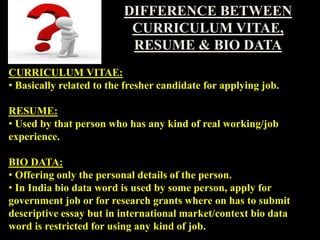
DIFFERENCE BETWEEN
CURRICULUM VITAE,
RESUME & BIO DATA
CURRICULUM VITAE:
• Basically related to the fresher candidate for applying job.
RESUME:
• Used by that person who has any kind of real working/job
experience.
BIO DATA:
• Offering only the personal details of the person.
• In India bio data word is used by some person, apply for
government job or for research grants where on has to submit
descriptive essay but in international market/context bio data
word is restricted for using any kind of job.
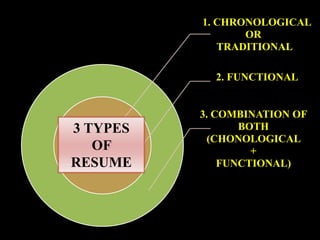
1. CHRONOLOGICAL
OR
TRADITIONAL
2. FUNCTIONAL
3. COMBINATION OF
BOTH
(CHONOLOGICAL
+
FUNCTIONAL)
3 TYPES
OF
RESUME
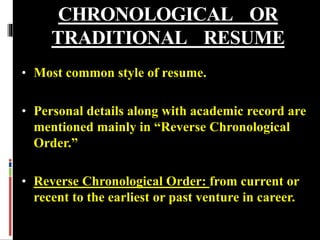
CHRONOLOGICAL OR
TRADITIONAL RESUME
• Most common style of resume.
• Personal details along with academic record are
mentioned mainly in “Reverse Chronological
Order.”
• Reverse Chronological Order: from current or
recent to the earliest or past venture in career.
FUNCTIONALRESUME
• Emphasis more upon the quality of work &
special accomplishment or achievement of
the applicant.
• Dose not stated the duration of work.
• Highlights the responsible attitude &
his/her capacity of handling challenging
situations.
COMBINATION OF BOTH
(CHRONOLOGICAL+FUNCTIONAL)
• Fusion of the best characteristics of
“Chronological + Functional resume”.
• Highlights the quality of candidate’s ‘Special
Skills’ but gives accounts of his ‘Personal
details’, ‘Academic record’ & ‘Experiences’.
ELEMENTS / STRUCTURE OF
RESUME
1. HEADING
2. POSITION SOUGHT
3. CAREER OBJECTIVE
4. WORK EXPERIENCE
5. EDUCATIONAL
QUALIFICATION
6. PROJECT DETAILS
7. WORKSHOP,
SEMINARS &
CONFERENCES
8. SPECIAL SKILLS
9. ACHIEVEMENTS OR
AWARDS
10. ACTIVITIES &
INTEREST
11. REFERENCES
12. PERSONAL DETAILS
13. DECLEARATION
14. DATE, PLACE & FULL
NAME
1. HEADING
• Begins with a heading.
• Top portion includes:
 Candidate’s Name
 Postal Address
 Contact Number
 Fax Number
 Email Address
 Passport size photo of candidate
2. POSITION SOUGHT
• While responding to a “solicited job positions”,
the candidate should clearly mention ‘the post
he/she is applying for’.
• REASON: often many organizations / institutions
advertise many job positions simultaneously.
• NOTE: In an “Unsolicited Application, should
not mention one particular job position sought.
3. CAREER OBJECTIVE
• Should be planned & drafted with at most care.
• It should be drafted keeping in view the advertiser’s
requirement.
• If it is an “Unsolicited application”, the career
objective should reflect the strongest traits of the
candidate’s personality.
• Should never make “tall claims or mention lofty or
arrogant ambitions” in career objectives.
• Should prepare himself/herself to answer related
questions at the time of interview.
4. WORK EXPERIENCE
• Drafted very carefully.
• Only include relevant work experience.
• Must include about:
 Past Employer’s Name
Past Organization’s Name
Period of working (year , months)
Highlights the job responsibilities
Applicant’s role in the activities of the organization
Applicant’s willingness to learn & ability to interact
with people of all kinds… etc
5. EDUCATIONAL QUALIFICATIONS
• It include :
• Should be mention in “Reverse Chronological
Order” i.e. starting from the most recent to the
earliest examination passed.
• Keep information about your education as short
as possible.
• Should mention “Course name, Institutions
name, Board/University name, Year of passing,
Percentage.
 PROFESSIONAL QUALIFICATIONS
 ACADEMIC QUALIFICATIONS
6. PROJECT DETAILS
• Mention details of internship projects or other
training projects.
• Should include:
 Project Title
 Organization Name (where you have done work)
 Year (when you have done work)
 Duration of work period
 Brief details about project
7. WORKSHOP, SEMINARS &
CONFERENCES
• Mention the details regarding “Workshop,
Seminars & Conferences” which applicant have
attended.
• It include:
 Title or Topic
 Date
 City
 Institutes / Organizations Name
 Publication Name
8. SPECIAL SKILLS
• Mention “Special Skills & Aptitude” which
have direct link with the targeted job.
• EXAMPLE: Computer programming, Data
Processing , Knowledge of Foreign
Language, Operation of some machinery,
Technical writing …… etc.
9.ACHIEVEMENTS ORAWARDS
• Mention the details about the awards,
fellowships, certificates of proficiency that
applicant have achieved.
• BENEFITS:
 It shows that the applicant is an “ACHIEVER”.
 It makes applicant standout among the rest.
10.ACTIVIES & INTERESTS
• It includes “Extracurricular, Co-curricular or
Professional Activities, Hobbies & interests” of
the applicant.
• It reflects “The Leadership qualities, Initiative
& drive” within a person”
11. REFERENCES
• Employer wants references name of persons who can
“Verify the facts mentioned by the applicants”
• Such persons includes:
Past Employers,
Research Guides,
Senior Colleagues,
Eminent persons holding responsible post … etc
• NOTE:
1. They should not include blood–relatives of the
applicants.
2. They should be one who is reliable or trustworthy.
12. PERSONALDETAILS
• It includes:
Father / Husband Name
Mother / Wife Name
Date of Birth
Nationality
Languages Known…. etc
13. DECLEARATION
• Applicant should mention the “Declaration
Statement” that above mention information
are valid & correct.
14. DATE, PLACE & FULLNAME
• At the last applicant should mention his/her
“DATE , Current PLACE & Full Name in
(capital latter)”.
• EXAMPLE:
• DATE:
• PLACE (FULL NAME)
TIPS FOR DRAFTING PERFECT
RESUME
• A terse concise writing style should be adopted.
• It should be well – punctuated.
• It should be fact- based & mention exact dates,
years, address, E-mail address, designation to
ensure credibility.
• It should be drafted in well format.
• Should be focus on 7C’s of communication
(Clarity, Completeness, Correctness,
Conciseness, Concreteness, Consideration).
• Use the right keywords.
• Use bullet points to list responsibilities and
accomplishments.
• Use a basic font that is easy to read, both
for hiring managers and for applicant
management systems.
Curriculum vitae

Curriculum vitae

  • 1.
  • 2.
    DIFFERENCE BETWEEN CURRICULUM VITAE, RESUME& BIO DATA CURRICULUM VITAE: • Basically related to the fresher candidate for applying job. RESUME: • Used by that person who has any kind of real working/job experience. BIO DATA: • Offering only the personal details of the person. • In India bio data word is used by some person, apply for government job or for research grants where on has to submit descriptive essay but in international market/context bio data word is restricted for using any kind of job.
  • 3.
    1. CHRONOLOGICAL OR TRADITIONAL 2. FUNCTIONAL 3.COMBINATION OF BOTH (CHONOLOGICAL + FUNCTIONAL) 3 TYPES OF RESUME
  • 4.
    CHRONOLOGICAL OR TRADITIONAL RESUME •Most common style of resume. • Personal details along with academic record are mentioned mainly in “Reverse Chronological Order.” • Reverse Chronological Order: from current or recent to the earliest or past venture in career.
  • 5.
    FUNCTIONALRESUME • Emphasis moreupon the quality of work & special accomplishment or achievement of the applicant. • Dose not stated the duration of work. • Highlights the responsible attitude & his/her capacity of handling challenging situations.
  • 6.
    COMBINATION OF BOTH (CHRONOLOGICAL+FUNCTIONAL) •Fusion of the best characteristics of “Chronological + Functional resume”. • Highlights the quality of candidate’s ‘Special Skills’ but gives accounts of his ‘Personal details’, ‘Academic record’ & ‘Experiences’.
  • 7.
    ELEMENTS / STRUCTUREOF RESUME 1. HEADING 2. POSITION SOUGHT 3. CAREER OBJECTIVE 4. WORK EXPERIENCE 5. EDUCATIONAL QUALIFICATION 6. PROJECT DETAILS 7. WORKSHOP, SEMINARS & CONFERENCES 8. SPECIAL SKILLS 9. ACHIEVEMENTS OR AWARDS 10. ACTIVITIES & INTEREST 11. REFERENCES 12. PERSONAL DETAILS 13. DECLEARATION 14. DATE, PLACE & FULL NAME
  • 8.
    1. HEADING • Beginswith a heading. • Top portion includes:  Candidate’s Name  Postal Address  Contact Number  Fax Number  Email Address  Passport size photo of candidate
  • 9.
    2. POSITION SOUGHT •While responding to a “solicited job positions”, the candidate should clearly mention ‘the post he/she is applying for’. • REASON: often many organizations / institutions advertise many job positions simultaneously. • NOTE: In an “Unsolicited Application, should not mention one particular job position sought.
  • 10.
    3. CAREER OBJECTIVE •Should be planned & drafted with at most care. • It should be drafted keeping in view the advertiser’s requirement. • If it is an “Unsolicited application”, the career objective should reflect the strongest traits of the candidate’s personality. • Should never make “tall claims or mention lofty or arrogant ambitions” in career objectives. • Should prepare himself/herself to answer related questions at the time of interview.
  • 11.
    4. WORK EXPERIENCE •Drafted very carefully. • Only include relevant work experience. • Must include about:  Past Employer’s Name Past Organization’s Name Period of working (year , months) Highlights the job responsibilities Applicant’s role in the activities of the organization Applicant’s willingness to learn & ability to interact with people of all kinds… etc
  • 12.
    5. EDUCATIONAL QUALIFICATIONS •It include : • Should be mention in “Reverse Chronological Order” i.e. starting from the most recent to the earliest examination passed. • Keep information about your education as short as possible. • Should mention “Course name, Institutions name, Board/University name, Year of passing, Percentage.  PROFESSIONAL QUALIFICATIONS  ACADEMIC QUALIFICATIONS
  • 13.
    6. PROJECT DETAILS •Mention details of internship projects or other training projects. • Should include:  Project Title  Organization Name (where you have done work)  Year (when you have done work)  Duration of work period  Brief details about project
  • 14.
    7. WORKSHOP, SEMINARS& CONFERENCES • Mention the details regarding “Workshop, Seminars & Conferences” which applicant have attended. • It include:  Title or Topic  Date  City  Institutes / Organizations Name  Publication Name
  • 15.
    8. SPECIAL SKILLS •Mention “Special Skills & Aptitude” which have direct link with the targeted job. • EXAMPLE: Computer programming, Data Processing , Knowledge of Foreign Language, Operation of some machinery, Technical writing …… etc.
  • 16.
    9.ACHIEVEMENTS ORAWARDS • Mentionthe details about the awards, fellowships, certificates of proficiency that applicant have achieved. • BENEFITS:  It shows that the applicant is an “ACHIEVER”.  It makes applicant standout among the rest.
  • 17.
    10.ACTIVIES & INTERESTS •It includes “Extracurricular, Co-curricular or Professional Activities, Hobbies & interests” of the applicant. • It reflects “The Leadership qualities, Initiative & drive” within a person”
  • 18.
    11. REFERENCES • Employerwants references name of persons who can “Verify the facts mentioned by the applicants” • Such persons includes: Past Employers, Research Guides, Senior Colleagues, Eminent persons holding responsible post … etc • NOTE: 1. They should not include blood–relatives of the applicants. 2. They should be one who is reliable or trustworthy.
  • 19.
    12. PERSONALDETAILS • Itincludes: Father / Husband Name Mother / Wife Name Date of Birth Nationality Languages Known…. etc
  • 20.
    13. DECLEARATION • Applicantshould mention the “Declaration Statement” that above mention information are valid & correct.
  • 21.
    14. DATE, PLACE& FULLNAME • At the last applicant should mention his/her “DATE , Current PLACE & Full Name in (capital latter)”. • EXAMPLE: • DATE: • PLACE (FULL NAME)
  • 22.
    TIPS FOR DRAFTINGPERFECT RESUME • A terse concise writing style should be adopted. • It should be well – punctuated. • It should be fact- based & mention exact dates, years, address, E-mail address, designation to ensure credibility. • It should be drafted in well format. • Should be focus on 7C’s of communication (Clarity, Completeness, Correctness, Conciseness, Concreteness, Consideration).
  • 23.
    • Use theright keywords. • Use bullet points to list responsibilities and accomplishments. • Use a basic font that is easy to read, both for hiring managers and for applicant management systems.