GROUP DISCUSSION
By : Dr.P.Muthukumar
Contents
 Intention of conducting GD in Interviews and as a teaching
tool
 Strategies for Improving ones Group-Discussion Skills using
POPP – (Prepare, Observe, Practice & Participate)
 The Process
 Introduction
 Leading
 Through the Discussion
 Additional Tips for the Discussion
 Do’s & Don’ts
 Peer Group Practice
 Group Discussion - Learning Out Come
Group Discussion in
Interviews
Group Discussion is a methodology used to gauge
the candidates
 Communication skills
 Personality traits
 Ability to work in a team
 Reasoning ability
 Leadership skills
 Initiative
 Assertiveness
 Flexibility
 Creativity
Group Discussion as a
Teaching Tool
Reasons: It helps to improve the
 understanding of a subject more deeply.
 critical thinking and analyzing ability
 problem solving capacity.
 decision making capability.
 listening skills.
 confidence level.
 communication skills
 self understanding of ones level.
 attitude of one-self.
 exchange of thoughts
Strategies for Improving ones
Group-Discussion Skills - POPP
 Prepare
 Reading Current Topics
 Logical Reasoning
 Analytical and Critical View point
 Interrogation Questions
 I CAN & I WILL Attitude
 Confidence Building
 Communication Skill Development
 Observe
 Attending & Observing as many seminars as possible
 Asking yourself:
 How do other students make critical comments?
 How do they ask questions?
 How do they disagree with or support arguments?
 What special phrases are used to be polite even when voicing
disagreement?
 How do they interrupt, ask a question, agree, disagree or make a point?
 Practice & Participate
 Small Group Practice
 Simple Concepts
 Informal Discussions
 Asking opinions
 Asking for information
Introduction & Initiation
 Introductions should be dynamic
 Introducing yourself and group members
 State the purpose
 A good level of general awareness will come in
handy so that you aren't at a loss of words on
certain issues
 Understand the topic and analyze it mentally
before speaking
The Leader
 Any one you takes up the following
responsibilities would be considered as the
Leader of the GD
 introducing yourself and the members of the
group
 inviting quiet group members to speak
 directing when misled.
 summarizing the discussion
Through the Discussion
 Be clear about the purpose and content of your viewpoint
 One should be able to communicate his views in an effective
manner to everyone. Be clear in speech, audible but not too
loud and above all remain confident
 Remember the six C's of effective communication -- Clarity,
Completeness, Conciseness, Confidence, Correctness and
Courtesy
 You should maintain eye contact with all others in the group
and not focus on a particular person
 Be responsive to ideas from other people and seem to be very
receptive and open-minded but don't allow others to change
your own viewpoint.
Through the Discussion – Cont.
 Starting the discussion is considered to be good however it
isn't that important; what is important is that you speak for a
period long enough for you to be able to communicate your
viewpoint
 Always maintain your calm and never get aggressive.
 If you haven't been able to talk then one can cut in saying
"Excuse me, but what I think is .........." or something of that
sort
 Never lose your temper and never attack anyone on a
personal front. Your attitude should be one of cooperation
and not one of conflict
 Don't lose sight of the goal of the discussion
 Listen to any criticisms and give them a thought before trying
to defend your views
In A Group Discussion
 Knowledge is strength. A candidate with good reading habits
has more chances of success. In other words, sound
knowledge on different topics like politics, finance, economy,
science and technology is helpful.
 Power to convince effectively is another quality that makes
you stand out among others.
 Clarity in speech and expression is yet another essential
quality.
 If you are not sure about the topic of discussion, it is better
not to initiate. Lack of knowledge or wrong approach creates
a bad impression. Instead, you might adopt the wait and
watch attitude. Listen attentively to others, may be you
would be able to come up with a point or two later.
 A GD is a formal occasion where slang is to avoided.
In A Group Discussion – Cont.
 A GD is not a debating stage. Participants should confine
themselves to expressing their viewpoints. In the second
part of the discussion candidates can exercise their choice
in agreeing, disagreeing or remaining neutral.
 Language use should be simple, direct and straight forward.
 Don't interrupt a speaker when the session is on. Try to
score by increasing your size, not by cutting others short.
 Maintain rapport with fellow participants. Eye contact plays
a major role. Non-verbal gestures, such as listening intently
or nodding while appreciating someone's viewpoint speak of
you positively.
 Communicate with each and every candidate present. While
speaking don't keep looking at a single member. Address the
entire group in such a way that everyone feels you are
speaking to him or her.
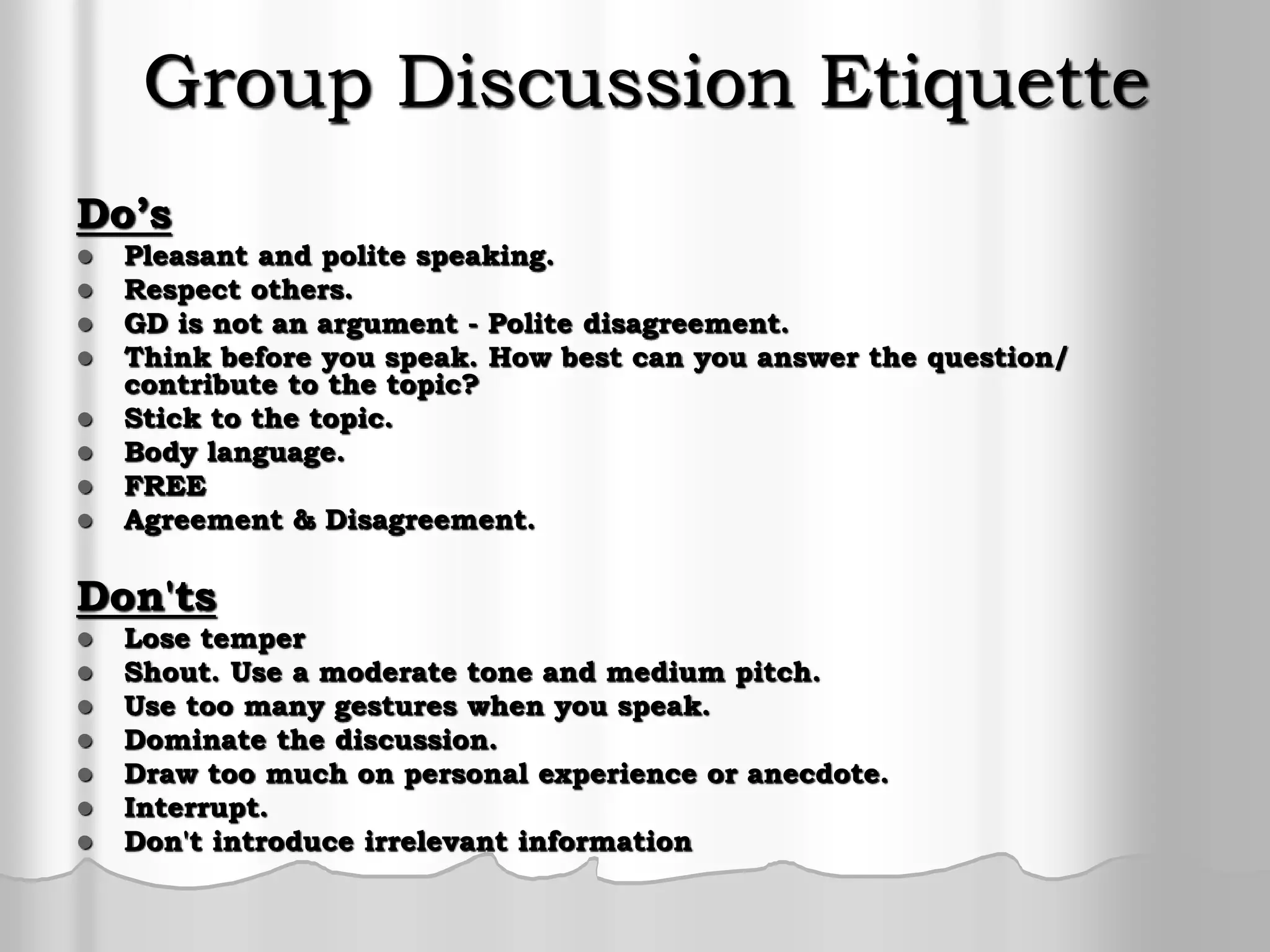
Group Discussion Etiquette
Do’s
 Pleasant and polite speaking.
 Respect others.
 GD is not an argument - Polite disagreement.
 Think before you speak. How best can you answer the question/
contribute to the topic?
 Stick to the topic.
 Body language.
 FREE
 Agreement & Disagreement.
Don'ts
 Lose temper
 Shout. Use a moderate tone and medium pitch.
 Use too many gestures when you speak.
 Dominate the discussion.
 Draw too much on personal experience or anecdote.
 Interrupt.
 Don't introduce irrelevant information
Peer Group Practice
 Dividing the students into groups based on their
knowledge and communication skill and allotting a
leader to help the group practice.
 Giving homework to gain knowledge on wide range
current issues and interview based topics.
 Conducting GD between the groups to assess
group strength and individual performance.
 Motivating Non-performers to participate by
separating the active participants.
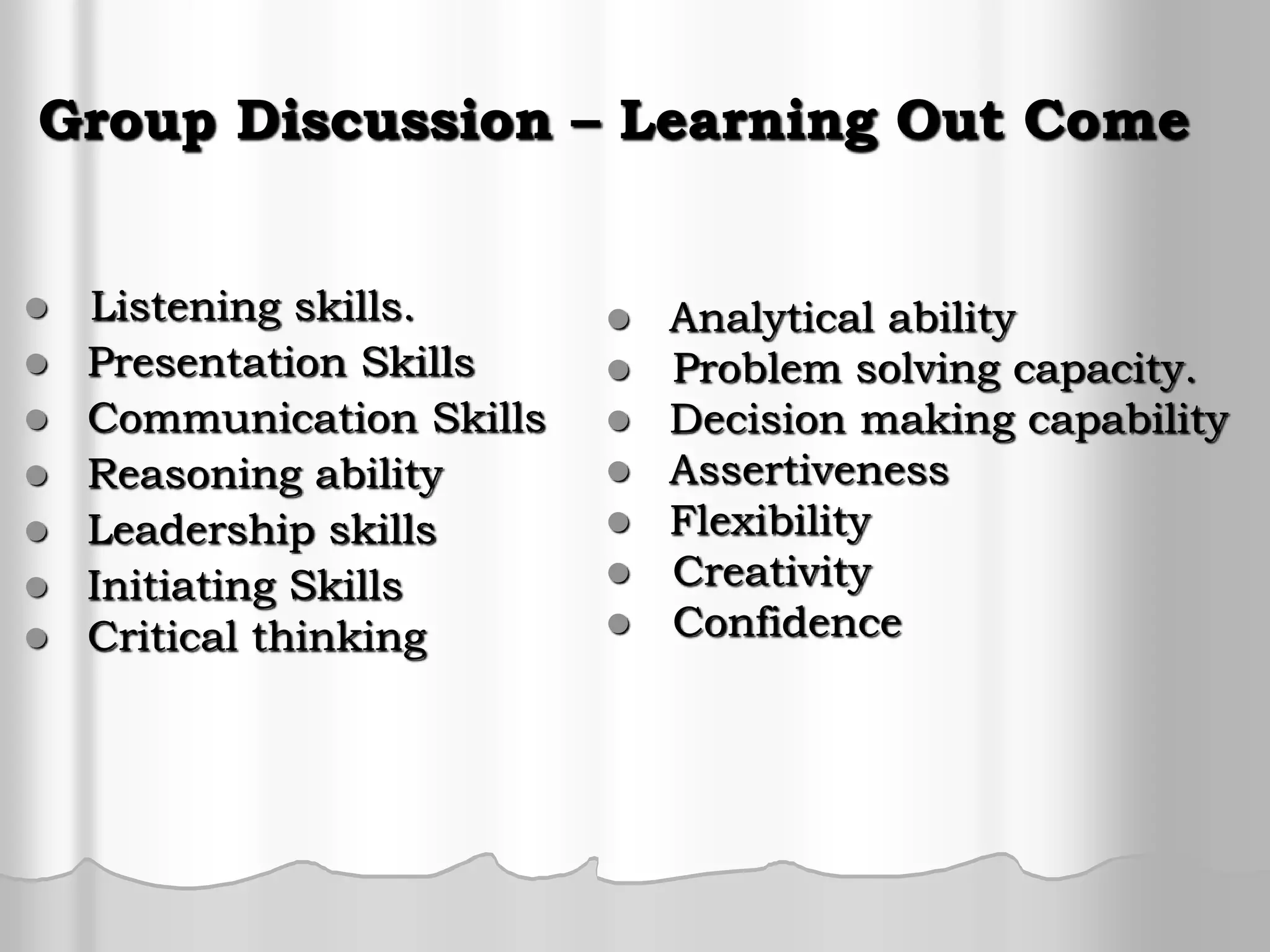
Group Discussion – Learning Out Come
 Listening skills.
 Presentation Skills
 Communication Skills
 Reasoning ability
 Leadership skills
 Initiating Skills
 Critical thinking
 Analytical ability
 Problem solving capacity.
 Decision making capability
 Assertiveness
 Flexibility
 Creativity
 Confidence
Group Discussion – Assessment of
learning outcomes
Assessment is based on:
 Initiation
 Participation
 Communication Skills
 Relevance of responses
 Team spirit
Group discussion

Group discussion

  • 1.
    GROUP DISCUSSION By :Dr.P.Muthukumar
  • 2.
    Contents  Intention ofconducting GD in Interviews and as a teaching tool  Strategies for Improving ones Group-Discussion Skills using POPP – (Prepare, Observe, Practice & Participate)  The Process  Introduction  Leading  Through the Discussion  Additional Tips for the Discussion  Do’s & Don’ts  Peer Group Practice  Group Discussion - Learning Out Come
  • 3.
    Group Discussion in Interviews GroupDiscussion is a methodology used to gauge the candidates  Communication skills  Personality traits  Ability to work in a team  Reasoning ability  Leadership skills  Initiative  Assertiveness  Flexibility  Creativity
  • 4.
    Group Discussion asa Teaching Tool Reasons: It helps to improve the  understanding of a subject more deeply.  critical thinking and analyzing ability  problem solving capacity.  decision making capability.  listening skills.  confidence level.  communication skills  self understanding of ones level.  attitude of one-self.  exchange of thoughts
  • 5.
    Strategies for Improvingones Group-Discussion Skills - POPP  Prepare  Reading Current Topics  Logical Reasoning  Analytical and Critical View point  Interrogation Questions  I CAN & I WILL Attitude  Confidence Building  Communication Skill Development  Observe  Attending & Observing as many seminars as possible  Asking yourself:  How do other students make critical comments?  How do they ask questions?  How do they disagree with or support arguments?  What special phrases are used to be polite even when voicing disagreement?  How do they interrupt, ask a question, agree, disagree or make a point?  Practice & Participate  Small Group Practice  Simple Concepts  Informal Discussions  Asking opinions  Asking for information
  • 6.
    Introduction & Initiation Introductions should be dynamic  Introducing yourself and group members  State the purpose  A good level of general awareness will come in handy so that you aren't at a loss of words on certain issues  Understand the topic and analyze it mentally before speaking
  • 7.
    The Leader  Anyone you takes up the following responsibilities would be considered as the Leader of the GD  introducing yourself and the members of the group  inviting quiet group members to speak  directing when misled.  summarizing the discussion
  • 8.
    Through the Discussion Be clear about the purpose and content of your viewpoint  One should be able to communicate his views in an effective manner to everyone. Be clear in speech, audible but not too loud and above all remain confident  Remember the six C's of effective communication -- Clarity, Completeness, Conciseness, Confidence, Correctness and Courtesy  You should maintain eye contact with all others in the group and not focus on a particular person  Be responsive to ideas from other people and seem to be very receptive and open-minded but don't allow others to change your own viewpoint.
  • 9.
    Through the Discussion– Cont.  Starting the discussion is considered to be good however it isn't that important; what is important is that you speak for a period long enough for you to be able to communicate your viewpoint  Always maintain your calm and never get aggressive.  If you haven't been able to talk then one can cut in saying "Excuse me, but what I think is .........." or something of that sort  Never lose your temper and never attack anyone on a personal front. Your attitude should be one of cooperation and not one of conflict  Don't lose sight of the goal of the discussion  Listen to any criticisms and give them a thought before trying to defend your views
  • 10.
    In A GroupDiscussion  Knowledge is strength. A candidate with good reading habits has more chances of success. In other words, sound knowledge on different topics like politics, finance, economy, science and technology is helpful.  Power to convince effectively is another quality that makes you stand out among others.  Clarity in speech and expression is yet another essential quality.  If you are not sure about the topic of discussion, it is better not to initiate. Lack of knowledge or wrong approach creates a bad impression. Instead, you might adopt the wait and watch attitude. Listen attentively to others, may be you would be able to come up with a point or two later.  A GD is a formal occasion where slang is to avoided.
  • 11.
    In A GroupDiscussion – Cont.  A GD is not a debating stage. Participants should confine themselves to expressing their viewpoints. In the second part of the discussion candidates can exercise their choice in agreeing, disagreeing or remaining neutral.  Language use should be simple, direct and straight forward.  Don't interrupt a speaker when the session is on. Try to score by increasing your size, not by cutting others short.  Maintain rapport with fellow participants. Eye contact plays a major role. Non-verbal gestures, such as listening intently or nodding while appreciating someone's viewpoint speak of you positively.  Communicate with each and every candidate present. While speaking don't keep looking at a single member. Address the entire group in such a way that everyone feels you are speaking to him or her.
  • 12.
    Group Discussion Etiquette Do’s Pleasant and polite speaking.  Respect others.  GD is not an argument - Polite disagreement.  Think before you speak. How best can you answer the question/ contribute to the topic?  Stick to the topic.  Body language.  FREE  Agreement & Disagreement. Don'ts  Lose temper  Shout. Use a moderate tone and medium pitch.  Use too many gestures when you speak.  Dominate the discussion.  Draw too much on personal experience or anecdote.  Interrupt.  Don't introduce irrelevant information
  • 13.
    Peer Group Practice Dividing the students into groups based on their knowledge and communication skill and allotting a leader to help the group practice.  Giving homework to gain knowledge on wide range current issues and interview based topics.  Conducting GD between the groups to assess group strength and individual performance.  Motivating Non-performers to participate by separating the active participants.
  • 14.
    Group Discussion –Learning Out Come  Listening skills.  Presentation Skills  Communication Skills  Reasoning ability  Leadership skills  Initiating Skills  Critical thinking  Analytical ability  Problem solving capacity.  Decision making capability  Assertiveness  Flexibility  Creativity  Confidence
  • 15.
    Group Discussion –Assessment of learning outcomes Assessment is based on:  Initiation  Participation  Communication Skills  Relevance of responses  Team spirit