TOPICS
• Definition ofGroup Discussion
• Benefits in Group Discussion
• Salient features
• Do’s and Don’ts in Group Discussion
• Important points in Group Discussion
• Accept criticism
• Suggestion
3.
Group Discussion IsThe First Criteria For
Screening The Candidates For Face-to-face
Interviews.
4.
DEFINITION OF GROUPDISCUSSION
• Group Discussion is a modern method of
assessing students personality.
• It is both a technique and an art and a
comprehensive tool to judge the worthiness of the
student and his appropriateness for the job.
5.
BENEFITS IN GROUPDISCUSSION
• Stimulation of thinking in a new way.
• Expansion of knowledge.
• Understanding of your strength and weakness.
• Your true personality is revealed and qualities of
leadership crystallize.
6.
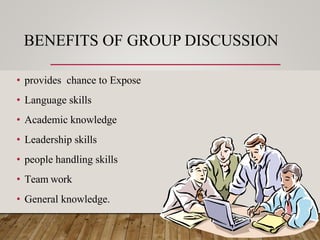
BENEFITS OF GROUPDISCUSSION
• provides chance to Expose
• Language skills
• Academic knowledge
• Leadership skills
• people handling skills
• Team work
• General knowledge.
7.
SALIENT FEATURES OFG.D
• Topic may be given to judge your public speaking talent.
• Discussion revolves around a specific subject.
• The examiner does not interfere once he announced the topic.
• Maintain cordiality and free expression of thought and opinion.
8.
DO`S IN GROUPDISCUSSION
• Appropriate to the issue .
• Make original points & support them by substantial reasoning .
• Listen to the other participants actively &carefully.
• Whatever you say must be with a logical flow,&validate it with an
example as far as possible.
• Make only accurate statements.
9.
DO`S IN GROUPDISCUSSION
• Modulate the volume, pitch and tone.
• Be considerate to the feelings of the others.
• Try to get your turn.
• Be an active and dynamic participant by listening.
• Talk with confidence and self-assurance.
10.
DON’TS DURING GROUPDISCUSSION
• Being shy /nervous / keeping isolated from G.D
• Interrupting another participant before his arguments are
over.
• Speak in favour.
• Don’t make fun of any participant even if his arguments are
funny.
11.
DON`TS DURING GROUPDISCUSSION
• Don’t engage yourself in sub-group conversation.
• Don’t repeat and use irrelevant materials.
• Addressing yourself to the examiner.
• Worrying about making some grammatical mistakes, for your interest
the matter you put across are important.
12.
IMPORTANT POINTS INGROUP DISCUSSION
• Be assertive: An assertive person is direct , honest careful about
not hurting others ‘self-respect’.
• A patient listener: listening to another person is one way of
showing appreciation.
• Right language : Words can make friends & right words at the
right time make the best results.
• Be analytical and fact-oriented : It is necessary to make relevant
points which can be supported with facts and analyzed logically.
13.
ACCEPT CRITICISM
• Ifany member of the group criticizes or disapproves a point, it is
unwise to get upset or react sharply.
• In case the criticism is flimsy,the same can be pointed out politely.
• Maximize participation ; one must try to contribute fully, vigorously &
steadily throughout the discussion.
• Show leadership ability: A group discussion also evaluates your
leadership qualities.
14.
• Accept thecontradicts view
• Express your argument with few facts, cases, %, Newspapers
publications etc.
• Express without hurting others feelings.
15.
SUGGESTIONS
• Never tryto bluff.
• Practice group discussion with friends on different
subjects.
• Remember !speech is a powerful weapon.
16.
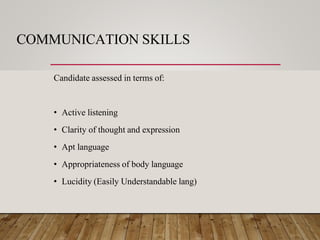
COMMUNICATION SKILLS
Candidate assessedin terms of:
• Active listening
• Clarity of thought and expression
• Apt language
• Appropriateness of body language
• Lucidity (Easily Understandable lang)
17.
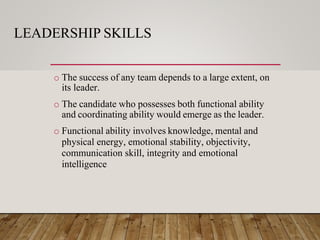
LEADERSHIP SKILLS
o Thesuccess of any team depends to a large extent, on
its leader.
o The candidate who possesses both functional ability
and coordinating ability would emerge as the leader.
o Functional ability involves knowledge, mental and
physical energy, emotional stability, objectivity,
communication skill, integrity and emotional
intelligence