A GD is a methodology used by an
organization to gauge whether the candidate
has certain personality traits and /or skills
that it desires in its members.

In this methodology,the group of candidates
is given a topic or a situation, given a few
minutes to think about the same and then
ask to discuss it among themselves.
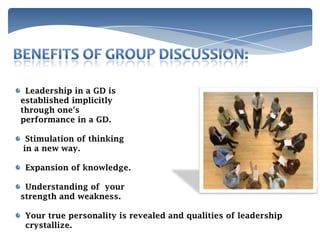
Leadership in a GD is
established implicitly
through one's
performance in a GD.

 Stimulation of thinking
in a new way.

 Expansion of knowledge.

 Understanding of your
strength and weakness.

 Your true personality is revealed and qualities of leadership
 crystallize.
Leadership skills :
Ability to take leadership roles and ability to lead, inspire and
carry the team along to help them achieve group’s objectives.

Interpersonal skills :
It is reflected in the ability of the individual to interact with
other members of the group in a brief situation.
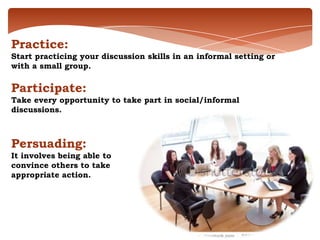
Practice:
Start practicing your discussion skills in an informal setting or
with a small group.

Participate:
Take every opportunity to take part in social/informal
discussions.


Persuading:
It involves being able to
convince others to take
appropriate action.
Be assertive:
 An assertive person is direct , honest careful about not hurting
others ‘self-respect’.
A patient listener:
Listening to another person is one way of showing appreciation.
Right language :
Words can make friends & right words at the right time make the
best results.
Be analytical and fact-oriented :
It is necessary to make relevant points which can be supported
with facts and analyzed logically.
Appropriate to the issue .
  Make original points &
support them by substantial            reasoning .
  Listen to the other participants actively &carefully.
  Whatever you say must be with a logical flow, & validate it with
  an example as far as possible.
  Make only accurate statements.
  Modulate the volume, pitch and tone.
  Be considerate to the feelings of the others.
  Try to get your turn.
  Be an active and dynamic participant by listening.
  Talk with confidence and self-assurance.
Shy /nervous / keeping isolated from G.D
Interrupting another participant before his arguments are over
Speak in favour ; example : Establish your position and stand by it
stubbornly
Changed opinions
Don’t make fun of any participant even if his arguments are funny
Being .
Don’t engage yourself in sub-group conversation.
Don’t repeat and use irrelevant materials.
Addressing yourself to the examiner.
Worrying about making some grammatical mistakes , for your
interest the matter you put across are important.
A GD is generally of 15-20 minutes duration.

 Don't ever make the mistake of addressing
 the panel members. The GD is between you and the other
 members, not the panel members. You must avoid even looking at
 the panel members while
the GD is in progress. Just ignore their   existence.

 Seating arrangement could be semi-circular, or seating along side a
 rectangular table , depending upon the venue.
You would not be looked upon favourably if you kept speaking
all the time and did not listen to anyone else. Contrary to the
misconception, the person who talks the most is not necessarily
the one who is judged the best.
The quality and not the quantity of your contribution is the
success factor it is important to be cool and emotionally
objective in a GD.
If you react emotionally you are likely to lose control over
yourself during the group discussion.
You have to be calm and logical, not emotional in a GD.
Group discussion

Group discussion

  • 2.
    A GD isa methodology used by an organization to gauge whether the candidate has certain personality traits and /or skills that it desires in its members. In this methodology,the group of candidates is given a topic or a situation, given a few minutes to think about the same and then ask to discuss it among themselves.
  • 3.
    Leadership in aGD is established implicitly through one's performance in a GD. Stimulation of thinking in a new way. Expansion of knowledge. Understanding of your strength and weakness. Your true personality is revealed and qualities of leadership crystallize.
  • 5.
    Leadership skills : Abilityto take leadership roles and ability to lead, inspire and carry the team along to help them achieve group’s objectives. Interpersonal skills : It is reflected in the ability of the individual to interact with other members of the group in a brief situation.
  • 6.
    Practice: Start practicing yourdiscussion skills in an informal setting or with a small group. Participate: Take every opportunity to take part in social/informal discussions. Persuading: It involves being able to convince others to take appropriate action.
  • 7.
    Be assertive: Anassertive person is direct , honest careful about not hurting others ‘self-respect’. A patient listener: Listening to another person is one way of showing appreciation. Right language : Words can make friends & right words at the right time make the best results. Be analytical and fact-oriented : It is necessary to make relevant points which can be supported with facts and analyzed logically.
  • 8.
    Appropriate to theissue . Make original points & support them by substantial reasoning . Listen to the other participants actively &carefully. Whatever you say must be with a logical flow, & validate it with an example as far as possible. Make only accurate statements. Modulate the volume, pitch and tone. Be considerate to the feelings of the others. Try to get your turn. Be an active and dynamic participant by listening. Talk with confidence and self-assurance.
  • 9.
    Shy /nervous /keeping isolated from G.D Interrupting another participant before his arguments are over Speak in favour ; example : Establish your position and stand by it stubbornly Changed opinions Don’t make fun of any participant even if his arguments are funny Being . Don’t engage yourself in sub-group conversation. Don’t repeat and use irrelevant materials. Addressing yourself to the examiner. Worrying about making some grammatical mistakes , for your interest the matter you put across are important.
  • 10.
    A GD isgenerally of 15-20 minutes duration. Don't ever make the mistake of addressing the panel members. The GD is between you and the other members, not the panel members. You must avoid even looking at the panel members while the GD is in progress. Just ignore their existence. Seating arrangement could be semi-circular, or seating along side a rectangular table , depending upon the venue.
  • 11.
    You would notbe looked upon favourably if you kept speaking all the time and did not listen to anyone else. Contrary to the misconception, the person who talks the most is not necessarily the one who is judged the best. The quality and not the quantity of your contribution is the success factor it is important to be cool and emotionally objective in a GD. If you react emotionally you are likely to lose control over yourself during the group discussion. You have to be calm and logical, not emotional in a GD.