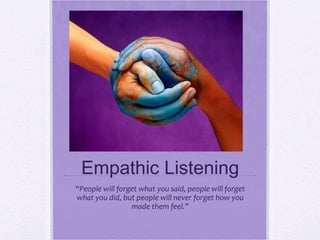
Empathic Listening “ People will forget what you said, people will forget what you did, but people will never forget how you made them feel.”
What is Empathetic Listening? Empathic listening is when one listens  with the intent to understand how the speaker  feels  in addition to understanding his or her ideas Showing empathy involves identifying with a person’s emotions and situation; even if not in agreement with them
What are the Benefits of Empathetic Listening? Empathic listening is typically an effective technique to use in emotional situations,  problem resolution , or if there is a conflict which requires attention. The goal is to enable the listener to share emotions free from judgment or criticism
How do you Listen Empathetically? Ways to listen empathetically  “ You feel…” “ It seems like…” “ As I understand it, you sound…” “ It appears as if…” “ If I hear you correctly, you’d like…”
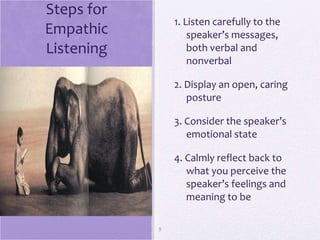
Steps for Empathic Listening 1. Listen carefully to the speaker’s messages, both verbal and nonverbal 2. Display an open, caring posture 3. Consider the speaker’s emotional state 4. Calmly reflect back to what you perceive the speaker’s feelings and meaning to be
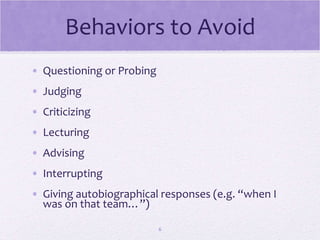
Behaviors to Avoid Questioning or Probing Judging Criticizing Lecturing Advising Interrupting Giving autobiographical responses (e.g. “when I was on that team…”)
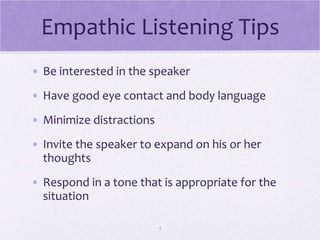
Empathic Listening Tips Be interested in the speaker Have good eye contact and body language Minimize distractions Invite the speaker to expand on his or her thoughts Respond in a tone that is appropriate for the situation
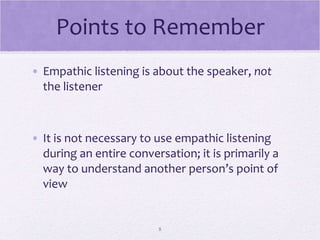
Points to Remember Empathic listening is about the speaker,  not  the listener It is not necessary to use empathic listening during an entire conversation; it is primarily a way to understand another person’s point of view
No matter who you are, where you live, or what your religion – when we truly need to be heard we speak to the greatest “ empathetic listener”  known  to mankind…

Empathy.ppt 09 dec 5pm

  • 1.
    Empathic Listening “People will forget what you said, people will forget what you did, but people will never forget how you made them feel.”
  • 2.
    What is EmpatheticListening? Empathic listening is when one listens with the intent to understand how the speaker feels in addition to understanding his or her ideas Showing empathy involves identifying with a person’s emotions and situation; even if not in agreement with them
  • 3.
    What are theBenefits of Empathetic Listening? Empathic listening is typically an effective technique to use in emotional situations, problem resolution , or if there is a conflict which requires attention. The goal is to enable the listener to share emotions free from judgment or criticism
  • 4.
    How do youListen Empathetically? Ways to listen empathetically “ You feel…” “ It seems like…” “ As I understand it, you sound…” “ It appears as if…” “ If I hear you correctly, you’d like…”
  • 5.
    Steps for EmpathicListening 1. Listen carefully to the speaker’s messages, both verbal and nonverbal 2. Display an open, caring posture 3. Consider the speaker’s emotional state 4. Calmly reflect back to what you perceive the speaker’s feelings and meaning to be
  • 6.
    Behaviors to AvoidQuestioning or Probing Judging Criticizing Lecturing Advising Interrupting Giving autobiographical responses (e.g. “when I was on that team…”)
  • 7.
    Empathic Listening TipsBe interested in the speaker Have good eye contact and body language Minimize distractions Invite the speaker to expand on his or her thoughts Respond in a tone that is appropriate for the situation
  • 8.
    Points to RememberEmpathic listening is about the speaker, not the listener It is not necessary to use empathic listening during an entire conversation; it is primarily a way to understand another person’s point of view
  • 12.
    No matter whoyou are, where you live, or what your religion – when we truly need to be heard we speak to the greatest “ empathetic listener” known to mankind…