GROUP 
DISCUSSION
INDEX 
Definition of Group Discussion 
Types of Group Discussion 
Personality traits 
Benefits in Group Discussion 
Salient features 
Do’s and Don’ts in Group Discussion 
Important points in Group Discussion 
Accept criticism 
Suggestion 
Tips
DEFINITION OF GROUP 
DISCUSSION 
 A GD is a methodology used by an organization 
to gauge whether the candidate has certain 
personality, traits or skills that it desires in its 
members. 
 In this methodology the group of candidates is 
given a topic or a situation and are given a few 
minutes to think about the same and are then 
asked to discuss the same among themselves for 
15-20 minutes. 
 A GD usually consists of a group of 8-12 persons.
TYPE OF GROUP DISCUSSION 
GD can be topic based or case based. 
Topic based: 
1.Factual topics: 
 Practical things which an ordinary person is aware of in 
his day to day life. 
 It gives the candidate a chance to prove that he is aware of 
and sensitive to his environment. 
 Ex: Education policy of India, tourism in India
2. Controversial topics: 
 Argumentative in nature 
 They are meant to generate controversy 
 The idea behind this is to check the maturity 
of the candidate in keeping his temper under 
control 
 Ex: reservation should be removed, women 
make better managers 
3. Abstract topics: 
 They are about intangible things. 
 These topics test the lateral thinking and 
creativity. 
 Ex: A is an alphabet, the number 10
Case based: 
 Case is discussed instead of a topic. 
 It tries to stimulate a real life situation. 
 The objective is to test the thoughts of a person 
about various situations from different angles.
PERSONALITY TRAITS 
 Ability to work in a team 
 Communication skills 
 Reasoning ability 
 Leadership skills 
 Initiative 
 Assertiveness 
 Flexibility 
 Creativity 
 Ability to think on one’s feet
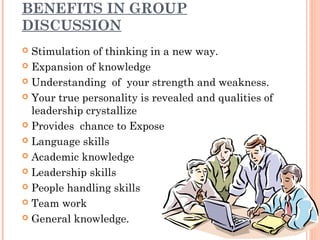
BENEFITS IN GROUP 
DISCUSSION 
 Stimulation of thinking in a new way. 
 Expansion of knowledge 
 Understanding of your strength and weakness. 
 Your true personality is revealed and qualities of 
leadership crystallize 
 Provides chance to Expose 
 Language skills 
 Academic knowledge 
 Leadership skills 
 People handling skills 
 Team work 
 General knowledge.
SALIENT FEATURES OF G.D 
 Topic may be given to judge your public speaking talent. 
 Discussion revolves around a specific subject. 
 The examiner does not interfere once he announced the 
topic. 
 Maintain cordiality and free expression of thought and 
opinion.
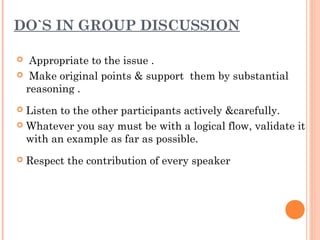
DO`S IN GROUP DISCUSSION 
 Appropriate to the issue . 
 Make original points & support them by substantial 
reasoning . 
 Listen to the other participants actively &carefully. 
 Whatever you say must be with a logical flow, validate it 
with an example as far as possible. 
 Respect the contribution of every speaker
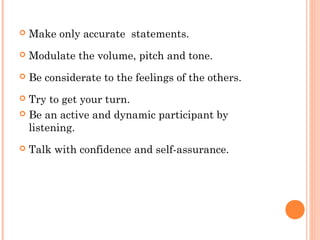
 Make only accurate statements. 
 Modulate the volume, pitch and tone. 
 Be considerate to the feelings of the others. 
 Try to get your turn. 
 Be an active and dynamic participant by 
listening. 
 Talk with confidence and self-assurance.
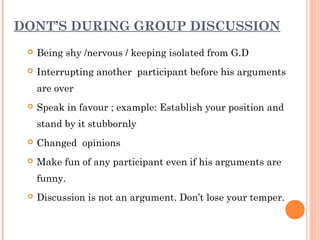
DONT’S DURING GROUP DISCUSSION 
 Being shy /nervous / keeping isolated from G.D 
 Interrupting another participant before his arguments 
are over 
 Speak in favour ; example: Establish your position and 
stand by it stubbornly 
 Changed opinions 
 Make fun of any participant even if his arguments are 
funny. 
 Discussion is not an argument. Don’t lose your temper.
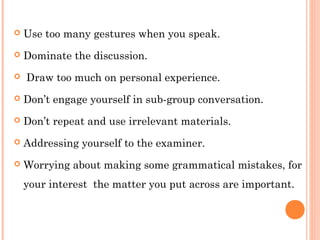
 Use too many gestures when you speak. 
 Dominate the discussion. 
 Draw too much on personal experience. 
 Don’t engage yourself in sub-group conversation. 
 Don’t repeat and use irrelevant materials. 
 Addressing yourself to the examiner. 
 Worrying about making some grammatical mistakes, for 
your interest the matter you put across are important.
IMPORTANT POINTS IN GROUP 
DISCUSSION 
 Be assertive: An assertive person is direct , honest 
careful about not hurting others ‘self-respect’. 
 A patient listener: listening to another person is one 
way of showing appreciation. 
 Right language : Words can make friends & right 
words at the right time make the best results. 
 Express without hurting others feelings.
 Be analytical and fact-oriented : It is 
necessary to make relevant points which can be 
supported with facts and analyzed logically. 
 Accept someone's point of view 
 Praise the argument 
 Accept the contradicts view 
 Express your argument with few facts, cases, %, 
newspapers publications etc.
ACCEPT CRITICISM 
 If any member of the group criticizes or 
disapproves a point, it is unwise to get upset or 
react sharply. 
 In case the criticism is flimsy, the same can be 
pointed out politely. 
 Maximize participation ; one must try to contribute 
fully, vigorously & steadily throughout the 
discussion. 
 Show leadership ability: A group discussion also 
evaluates your leadership qualities.
ADVANTAGES 
 Helps in understanding a subject more deeply. 
 Improves your ability to think critically. 
 Helps in solving a particular problem. 
 Helps the group to make a particular decision. 
 Improves listening skills. 
 Increases confidence in speaking. 
 It can change your attitude.
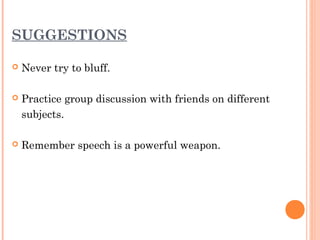
SUGGESTIONS 
 Never try to bluff. 
 Practice group discussion with friends on different 
subjects. 
 Remember speech is a powerful weapon.
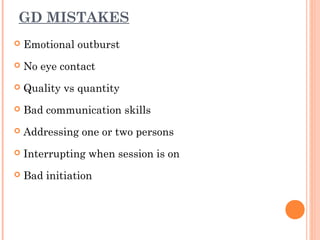
GD MISTAKES 
 Emotional outburst 
 No eye contact 
 Quality vs quantity 
 Bad communication skills 
 Addressing one or two persons 
 Interrupting when session is on 
 Bad initiation
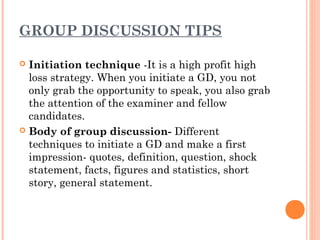
GROUP DISCUSSION TIPS 
 Initiation technique -It is a high profit high 
loss strategy. When you initiate a GD, you not 
only grab the opportunity to speak, you also grab 
the attention of the examiner and fellow 
candidates. 
 Body of group discussion- Different 
techniques to initiate a GD and make a first 
impression- quotes, definition, question, shock 
statement, facts, figures and statistics, short 
story, general statement.
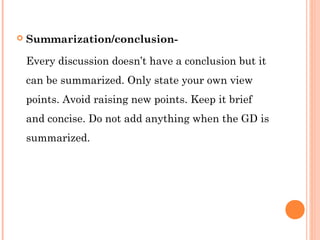
 Summarization/conclusion- 
Every discussion doesn’t have a conclusion but it 
can be summarized. Only state your own view 
points. Avoid raising new points. Keep it brief 
and concise. Do not add anything when the GD is 
summarized.
Group discussion

Group discussion

  • 1.
  • 2.
    INDEX Definition ofGroup Discussion Types of Group Discussion Personality traits Benefits in Group Discussion Salient features Do’s and Don’ts in Group Discussion Important points in Group Discussion Accept criticism Suggestion Tips
  • 3.
    DEFINITION OF GROUP DISCUSSION  A GD is a methodology used by an organization to gauge whether the candidate has certain personality, traits or skills that it desires in its members.  In this methodology the group of candidates is given a topic or a situation and are given a few minutes to think about the same and are then asked to discuss the same among themselves for 15-20 minutes.  A GD usually consists of a group of 8-12 persons.
  • 4.
    TYPE OF GROUPDISCUSSION GD can be topic based or case based. Topic based: 1.Factual topics:  Practical things which an ordinary person is aware of in his day to day life.  It gives the candidate a chance to prove that he is aware of and sensitive to his environment.  Ex: Education policy of India, tourism in India
  • 5.
    2. Controversial topics:  Argumentative in nature  They are meant to generate controversy  The idea behind this is to check the maturity of the candidate in keeping his temper under control  Ex: reservation should be removed, women make better managers 3. Abstract topics:  They are about intangible things.  These topics test the lateral thinking and creativity.  Ex: A is an alphabet, the number 10
  • 6.
    Case based: Case is discussed instead of a topic.  It tries to stimulate a real life situation.  The objective is to test the thoughts of a person about various situations from different angles.
  • 7.
    PERSONALITY TRAITS Ability to work in a team  Communication skills  Reasoning ability  Leadership skills  Initiative  Assertiveness  Flexibility  Creativity  Ability to think on one’s feet
  • 8.
    BENEFITS IN GROUP DISCUSSION  Stimulation of thinking in a new way.  Expansion of knowledge  Understanding of your strength and weakness.  Your true personality is revealed and qualities of leadership crystallize  Provides chance to Expose  Language skills  Academic knowledge  Leadership skills  People handling skills  Team work  General knowledge.
  • 9.
    SALIENT FEATURES OFG.D  Topic may be given to judge your public speaking talent.  Discussion revolves around a specific subject.  The examiner does not interfere once he announced the topic.  Maintain cordiality and free expression of thought and opinion.
  • 10.
    DO`S IN GROUPDISCUSSION  Appropriate to the issue .  Make original points & support them by substantial reasoning .  Listen to the other participants actively &carefully.  Whatever you say must be with a logical flow, validate it with an example as far as possible.  Respect the contribution of every speaker
  • 11.
     Make onlyaccurate statements.  Modulate the volume, pitch and tone.  Be considerate to the feelings of the others.  Try to get your turn.  Be an active and dynamic participant by listening.  Talk with confidence and self-assurance.
  • 12.
    DONT’S DURING GROUPDISCUSSION  Being shy /nervous / keeping isolated from G.D  Interrupting another participant before his arguments are over  Speak in favour ; example: Establish your position and stand by it stubbornly  Changed opinions  Make fun of any participant even if his arguments are funny.  Discussion is not an argument. Don’t lose your temper.
  • 13.
     Use toomany gestures when you speak.  Dominate the discussion.  Draw too much on personal experience.  Don’t engage yourself in sub-group conversation.  Don’t repeat and use irrelevant materials.  Addressing yourself to the examiner.  Worrying about making some grammatical mistakes, for your interest the matter you put across are important.
  • 14.
    IMPORTANT POINTS INGROUP DISCUSSION  Be assertive: An assertive person is direct , honest careful about not hurting others ‘self-respect’.  A patient listener: listening to another person is one way of showing appreciation.  Right language : Words can make friends & right words at the right time make the best results.  Express without hurting others feelings.
  • 15.
     Be analyticaland fact-oriented : It is necessary to make relevant points which can be supported with facts and analyzed logically.  Accept someone's point of view  Praise the argument  Accept the contradicts view  Express your argument with few facts, cases, %, newspapers publications etc.
  • 16.
    ACCEPT CRITICISM If any member of the group criticizes or disapproves a point, it is unwise to get upset or react sharply.  In case the criticism is flimsy, the same can be pointed out politely.  Maximize participation ; one must try to contribute fully, vigorously & steadily throughout the discussion.  Show leadership ability: A group discussion also evaluates your leadership qualities.
  • 17.
    ADVANTAGES  Helpsin understanding a subject more deeply.  Improves your ability to think critically.  Helps in solving a particular problem.  Helps the group to make a particular decision.  Improves listening skills.  Increases confidence in speaking.  It can change your attitude.
  • 18.
    SUGGESTIONS  Nevertry to bluff.  Practice group discussion with friends on different subjects.  Remember speech is a powerful weapon.
  • 19.
    GD MISTAKES Emotional outburst  No eye contact  Quality vs quantity  Bad communication skills  Addressing one or two persons  Interrupting when session is on  Bad initiation
  • 20.
    GROUP DISCUSSION TIPS  Initiation technique -It is a high profit high loss strategy. When you initiate a GD, you not only grab the opportunity to speak, you also grab the attention of the examiner and fellow candidates.  Body of group discussion- Different techniques to initiate a GD and make a first impression- quotes, definition, question, shock statement, facts, figures and statistics, short story, general statement.
  • 21.
     Summarization/conclusion- Everydiscussion doesn’t have a conclusion but it can be summarized. Only state your own view points. Avoid raising new points. Keep it brief and concise. Do not add anything when the GD is summarized.