GL Bajaj Institute of Management & Research
Greater Noida
Post Graduate Diploma in Management
Academic Session:2020-21
Trimester: II
Organizational Behavior-II
PG09
COURSE FACILITATOR:
Dr. Parul Yadav, e-mail: parul.yadav@glbimr.org
Dr. Prachi Agarwal, e-mail: prachi.aggarwal@glbimr.org
COURSE OVERVIEW:
Organizational behavior, or "people skills," is the field of study that investigates the impact that
individuals, groups, and structure have on behavior within organizations, for the purpose of
applying such knowledge toward improving an organization's effectiveness. Organizational
behaviour has a goal to help the managers make a transition to the new paradigm. Some of the
new paradigm characteristics include coverage of second-generation information technology
and total quality management such as empowerment, reengineering and benchmarking, and
learning organizations for managing diversity at work. The new paradigm sets the stage for the
study, understanding, and application of the time-tested micro-variables, dynamics and macro-
variables. One must know why management needs a new perspective to meet the environmental
challenges and to shift to a new paradigm.
Understanding human behaviour plays an important role in determining a manager's
effectiveness. Developing managers' interpersonal skills helps organizations attract and keep
high-performing employees. Positive social relationships are associated with lower stress at
work and lower turnover. Finally, companies with reputations as good places to work have been
found to generate superior financial performance.
COURSE CONTENTS:
Unit I: Groups Dynamics and Teams
Groups: Meaning and Definition; Why People join Groups; Types of Groups – Formal Groups
and Informal Groups;
Characteristics of groups: Composition, size, status hierarchy, norms, group cohesiveness, size,
leadership; Stages of Group Formation: Tuckman’s Five Stage Model; The Punctuated –
Equilibrium Model; Teams: Meaning and Definition; Nature of Teams; Benefits of Teams;
Differences between Groups and Teams; Types of Teams – Problem-Solving, Self-Managed,
Virtual Teams and Cross-Functional Teams; Team-effectiveness Model
Unit II: Leadership
Leadership: Meaning and Definition; Difference between managers and leaders; Leadership
styles, traits and skills of Effective Leaders; Theories of Leadership: Trait Perspective;
Behavioural Perspective; Contingency Perspective; Transformational versus Transactional
Perspective, Leadership and Emotional Intelligence
Unit III: Power, Politics and Conflict Management
Power: The concept of power, Classification of power, two faces of power, Sources of power,
Consequences of power.
Politics: Politics -Power in Action; Managing political behavior in organizations; Impression
Management.
Conflict Management: Concept, Functional versus dysfunctional conflict; Sources and forms
of conflict; Conflict Management Styles.
.
Unit IV: Organization Structure and Culture
Organization structure: Meaning and definition; Elements of Organizational Structure; Types
of Organizational Structure:
Functional, Divisional, Matrix, Horizontal, Modular& Hybrid Structures.
Organizational Culture: Meaning and definition; Elements of Organizational Culture;
Managing Organizational Culture; Understanding Cross-Cultural Dimensions.
Unit V: Organizational Change and Development
Organizational Change :Meaning, Definition and Importance; Forces of Change in the
Organization; Resistance to Change; Overcoming Resistance to Change.; Approaches to
managing organizational Change: Lewin’s Three Step Model, Kotter’s Eight Step Plan.
Organizational Development: Meaning and Relevance of organizational development, OD
Practitioner and OD Interventions
Text Books:
1. Robbins Stephen P.,Timothy A. Judge &Neharika Vohra (2016), “Organizational Behavior”,
Pearson Education
2. Singh Kavita (2015),”Organizational Behavior: Text and Cases”, Vikas Publishing
References:
1. James A F Stoner, R Edward Freeman, Daniel R Gilbert (2018),”Management”, Pearson
Eductation,
2. Fred Luthans (2016)”Organizational Behavior:An Evidence based Approach”, Tata McGraw Hill
3. K. Aswathappa (2013),”Organisational Behavior”, Himalaya Publishing House
4. Steven McShane & Mary Von Glinow (2018),”Organizational Behavior”, McGrawHill
5. Richard Daft (2012),”New Era of Management”, Cengage Learning
Chapter 1
Groups Dynamics and Teams
1.1 Groups: Meaning and Definition;
1.2 Types of Groups
1.3 Characteristics of groups
1.4 Stages of Group Formation
1.5 Teams: Meaning and Definition;
1.6 Nature of Teams
1.7 Benefits of Teams
1.8 Differences between Groups and Teams
1.9 Types of Teams
1.10 Team-effectiveness Model
An Overview of Groups:
The importance of group behaviour has been realized from time to time. Elton Mayo and his
associates way back in 1920 conducted the famous Hawthorne experiments and came to know
that the group behaviour have major impact on productivity. Individuals form groups. They
move in groups. They work in groups and influence work and work behaviour. They cannot be
ignored. They exert significant influence on the organisation. They are inseparable from
organisation. Individual and group behaviour differs from each other. Group behaviour affects
productivity. Group helps individual to feel stronger, have fewer self-doubts, and be more
contrary to threats.
1.1Definition:
We define a group as two or more individuals, interacting and interdependent, who have come
together to achieve particular objectives. A group behavior can be stated as a course of action a
group takes as a family. For example: Strike. Groups can be either formal or informal. By a
formal group , we mean one defined by the organization’s structure, with designated work
assignments establishing tasks. In formal groups, the behaviors team members should engage
in are stipulated by and directed toward organizational goals.
Meaning of Group Behaviour
Human resources comprise individuals and individuals move in groups. Every manager must
possess the knowledge of group behaviour along with individual behaviour. He must understand
group psychology. He should understand individual behaviour in the context of group
behaviour. Individual behaviour is influenced by the group behaviour.
An individual’s work, job satisfaction and effective performance is influenced by the group in
which he moves. At lower level of the organisation it is the small groups of employees work as
a team. They have the responsibility to finish a task assigned to them within a stipulated period
of time.
If they come across a problem they tackle it by themselves. They get guidance from senior
fellow workers in solving the problem and accomplishing it. It is needless to say that groups are
important in employee’s life. They spend increasing proportion of time with the group at
workplace.
M.E. Shaw defined a group “as two or more people who interact and influence one another.”
Viewers in a theatre, passengers in a train are not a group unless they interact for long and exert
some influence on each other. Such people’s gatherings are referred to as collection. They
interact at a very low level nor they get influenced with each other but enjoy being in collection.
The collection of people may get-converted into a group temporarily if they are caught up in a
dangerous situation like fire, robbery etc. They will come over a problem fighting as a group
unitedly.
Why People join Groups
Man is a social animal and he lives in groups, he moves in groups. So, group is inherent to
human beings. Why do people form groups, and why do they feel so strongly about them?
Consider the celebrations that follow a sports team’s winning a national championship.
Fans have staked their own self-image on the performance of someone else. The winner’s
supporters are elated, and sales of team-related shirts, jackets, and hats declaring support for the
team skyrocket. Fans of the losing team feel dejected, even embarrassed. Our tendency to take
personal pride or offense for the accomplishments of a group is the territory of social identity
theory . Social identity theory proposes that people have emotional reactions to the failure or
success of their group because their self-esteem gets tied into the group’s performance. 1 When
your group does well, you bask in reflected glory, and your own self-esteem rises. When your
group does poorly, you might feel bad about yourself, or you might even reject that part of your
identity, like “fair weather fans.” Social identities also help people reduce uncertainty about
who they are and what they should do.
Social identities help us understand who we are and where we fit in with other people, but they
can have a negative side as well. Ingroup favoritism means we see members of our ingroup as
better than other people, and people not in our group as all the same. This obviously paves the
way for stereotyping. When do people develop a social identity? Several characteristics make a
social identity important to a person:
SimilarityNot surprisingly, people who have the same values or characteristics as other
members of their organization have higher levels of group identification. Demographic
similarity can also lead to strong identification for new hires, while those who are
demographically different may have a hard time identifying with the group as a whole.
DistinctivenessPeople are more likely to notice identities that show how they are different from
other groups. Respondents in one study identified more strongly with those in their work group
with whom they shared uncommon or rare demographic characteristics. For example,
veterinarians who work in veterinary medicine (where everyone is a veterinarian) identify with
their organization, and veterinarians in non veterinary medicine fields such as animal research
or food inspection (where being a veterinarian is a more distinctive characteristic) identify with
their profession.
Status Because people use identities to define themselves and increase self esteem, it makes
sense that they are most interested in linking themselves to high-status groups. Graduates of
prestigious universities will go out of their way to emphasize their links to their alma maters
and are also more likely to make donations. 8People are likely to not identify with a low-status
organization and will be more likely to quit in order to leave that identity behind.
Uncertainty reductionMembership in a group also helps some people understand who they are
and how they fit into the world. One study showed how the creation of a spin-off company
created questions about how employees should develop a unique identity that corresponded
more closely to what the division was becoming. Managers worked to define and communicate
an idealized identity for the new organization when it became clear employees were confused.
Following are the few reasons why group is essential:
I. Management of modern organisations is making concerted efforts to introduce industrial
democracy at workplace. They are using task force, project teams, work committees where
workers get due representation. They participate very often in decision-making. This takes
place in groups.
II. The tasks in modern industries are becoming more complex, tedious and monotonous. To
change these conditions and make the environment at workplace more lively, work
committees and work groups and teams are formed to monitor the work and change.
III. To make participative management more effective and relieve executives of petty
responsibilities employees are given these responsibilities to carry on successfully and
effectively. Group of employees are also given joint responsibility to carry on the work.
IV. Groups of all kinds and types are used by inviting their cooperation in all matters related to
production as well as with human relations to make the organisation effective.
V. There are several works which an individual cannot perform. To complete such tasks, group
efforts are required for its completion, e.g. building of a ship, making of a movie,
construction of a fly-over, a complex etc.
VI. All these require coordinated and unified efforts of many individuals i.e. groups. A group
can do the work which cannot be performed by an individual or beyond his capabilities.
VII. A group can make better judgment as compared to an individual.
VIII. While accomplishing tasks group can use creative instinct and innovative ideas than a single
individual.
1.2 Types of Groups
Groups can be either formal or informal.
i) Formal Group- By a formal group , we mean one defined by the organization’s structure, with
designated work assignments establishing tasks. In formal groups, the behaviors team members
should engage in are stipulated by and directed toward organizational goals. The six members of
an airline flight crew are a formal group.
Formal groups are created as part of organisation structure to accomplish organisational tasks.
A work group in a plant is the example of formal group. They are bound by hierarchical
authority in the organisation. They have to follow rules, regulation and policy of the
organisation. These groups are required by the system. The organisation provides a system of
rules and regulation for attaining organisational objectives.
According to A.L. Stencombe, “a formal group is said to be any social arrangement in which
the activities of some persons are planned by others to achieve a common purpose”.
Formal groups help in achieving goals without any difficulty. They facilitate coordination of
activities and help in forming logical relationship among people and positions. They create
group unity. Leonard R Sayles has subdivided formal group into command group and task
group.
ii)Informal Group- An informal group is neither formally structured nor organizationally
determined. Informal groups are natural formations in the work environment that appear in
response to the need for social contact. Three employees from different departments who
regularly have lunch or coffee together are an informal group. These types of interactions among
individuals, though informal, deeply affect their behavior and performance.
Informal groups exist within the formal organisations and arise because of individuals’ social
needs and desire to develop and maintain relations with people. Working at a plant or office
leads to formation of informal groups. They work together and this leads to their interaction.
Through interaction groups are formed. These groups are spontaneous and emotional. Keith
Davis has defined informal group as, “the network of persons and social relations which is not
established or required for formal organisation.”
These are the groups formed by the employees themselves at the workplace while working
together. The organisation has not taken any active interest in their formation. According to M.
Dalton, “informal groups are cliques.” Cliques are a group of people of different organisation
levels coming together with a common interest. Cliques are horizontal, vertical, and random.
Horizontal Cliques comprise people from the same rank and work area. Vertical Cliques consist
of people of different organisation levels. Random Cliques are made up of employees from both
horizontal and vertical lines coming together with a common interest.
Informal groups are very effective and powerful. Some managers view them harmful and
disruptive to the interest of the organisation. They suspect their integrity and consider as a
virtual threat. Some managers seek their help in getting the task completed quickly. They do
not consider them as threat. The strength of these informal groups can be utilized for
accomplishment of organisational objectives.
1.3Characteristics of groups
Group Composition- Group composition is important because it determines the group adequacy
of communications; makes for systematic differences in interaction process because of the
diverse rather than shared values, norms and goals; and reflects the extent to which individual
members complement both descriptive and behavioural attributes of potential members are
important considerations in selecting members for a group. The descriptive attributes refer to a
position an individual occupies within a group. Age, sex, ethnicity, education, skills, are
examples of descriptive attributes. On the other hand, the behavioural attributes refer to the way
in which an individual behaves in a specific task. The compromiser, competitor, evaluator, and
harmonizer are examples of behavioural attributes. each other's skills in the interaction process.
Regarding the number of members, small groups seems to function better than large groups in
which some members tend be 'asleep' or excluded from interesting interactions [20, 21]. Most
of the mechanisms described in the previous section, e.g. mutual regulation, social grounding,
shared cognitive load, ..., can only occur between a few participants. This does not argue in
disfavor of large group sessions. It simply means that distance learning activities should also
include 'closed' sessions, in which a restricted number of subjects collaborate and/or 'monitored'
session in which the teacher takes care that no learner is left out the interaction.
Regarding the participants, some developmental level is necessary to be able to collaborate, but
this is only an issue for children and does hence not directly concern current distance education
activities which mainly concern adult learners.
The most intensively studied variable is the heterogeneity of the group. It refers to the objective
or the subjective differences (how subjects perceive each other) among group members. These
differences can be general (age, intelligence, development, school performance, ...) or task
specific. Results indicate there exists some 'optimal heterogeneity', i.e. some difference of
viewpoints is required to trigger interactions, but within the boundaries of mutual interest and
intelligibility. Basically, group composition could be categorized on the basis of homogeneous
or heterogeneous characteristics. Heterogeneity can easily be understood as a condition to
trigger conflicts and require social grounding, two important mechanisms described above.
Heterogeneity is also implicit in the socio-cultural theory and its related mechanisms
(internalization and appropriation) which rely on the observation of adult-child pairs or at least
pairs with one member being more knowledgeable on the task than the other.
Size- Does the size of a group affect the group’s overall behavior? Yes, but the effect depends
on what dependent variables we look at. Smaller groups are faster at completing tasks than
larger ones, and individuals perform better in smaller Groups. However, in problem solving,
large groups consistently get better marks than their smaller counterparts. 52 Translating these
results into specific numbers is a bit more hazardous, but groups with a dozen or more members
are good for gaining diverse input. So if the goal is fact-finding, larger groups One of the most
important findings about the size of a group concerns social loafing , the tendency for
individuals to expend less effort when working collectively than alone. It directly challenges
the assumption that the productivity of the group as a whole should at least equal the sum of the
productivity of the individuals in it. Does team spirit spur individual effort and enhance the
group’s overall productivity?
Group performance increases with group size, but the addition of new members has diminishing
returns on productivity. So more may be better in that total productivity of a group of four is
greater than that of three, but the individual productivity of each member declines. What causes
social loafing? It may be a belief that others in the group are not carrying their fair share. If you
see others as lazy or inept, you can reestablish equity by reducing your effort. Another
explanation is the dispersion of responsibility.
Because group results cannot be attributed to any single person, the relationship between an
individual’s input and the group’s output is clouded.
Individuals may then be tempted to become free riders and coast on the group’s efforts. The
implications for OB are significant. When managers use collective work situations to enhance
morale and teamwork, they must also be able to identify individual efforts. Otherwise, they
must weigh the potential losses in productivity from using groups against the possible gains in
worker satisfaction.
Social loafing appears to have a Western bias. It’s consistent with individualistic cultures, such
as the United States and Canada, that are dominated by self-interest. It is not consistent with
collective societies, in which individuals are motivated by in-group goals. In studies comparing
U.S. employees with employees from the People’s Republic of China and Israel (both
collectivist societies), the Chinese and Israelis showed no propensity to engage in social loafing
and actually performed better in a group than alone.
There are several ways to prevent social loafing:
(1) Set group goals, so the group has a common purpose to strive toward;
(2) increase intergroup competition, which again focuses on the shared outcome;
(3) engage in peer evaluation so each person evaluates each other person’s contribution;
(4) select Members who have high motivation and prefer to work in groups, and
(5) if possible, base group rewards in part on each member’s unique contributions.
Although no magic bullet will prevent social loafing in all cases, these steps should help
minimize its effect. As a property of a group, size has logical implications. An additional
member above, one may add resources to the group or may be a complete redundant. At the
same time, the additional process may complicate the amount of possible simple interactions
among group members. The small groups may have their highest morale and be more
productive. Also smaller groups generally performed better than larger ones in operational
settings when assigned to the same task. Performance variability across individuals in the
groups is generally found to be dependent on group size. it is clear that group size is not a mere
"number game”
Interaction Process - As a group enlarges in size, the frequency of interaction between any two
members decreases. In the larger groups, more competition is possible in who will send and
who will receive. In addition, the probability that role expectations are less clear is high; this
would result in frustrations for the members and tendency to form informal groups. it is
expected that those who fail to interact will feel more threatened in large groups. It is also
expected that as groups increase in size, a smaller proportion of persons become central to the
group, make decisions for it, and communicate to the total membership.
Motivation- As a group increases in size, there is a great possibility that group members' efforts
will be depressed. The reason behind that, is that members feel that their own efforts are less
important to the whole group because there are many other people available to do the work.
Moreover, individuals may find it increasingly difficult to obtain satisfaction of their own needs
because of the limited amount of tasks. available to members of the large group. In addition,
increased size tends to limit the possibility that a group will be able to interact regularly in the
direct and meaningful faceto-face manner, and develop and maintain a consensus about norms
for their behaviour as group members
Status—A socially defined position or rank given to groups or group members by others—
permeates every society. Even the smallest group will develop roles, rights, and rituals to
differentiate its members. Status is a significant motivator and has major behavioral
consequences when individuals perceive a disparity between what they believe their status is
and what others perceive it to be.
What Determines Status? According to status characteristics theory, status tends to derive
from one of three sources:
1. The power a person wields over others. Because they likely control the group’s resources,
people who control the outcomes tend to be perceived as high status.
2. A person’s ability to contribute to a group’s goals. People whose contributions are critical
to the group’s success tend to have high status. Some thought NBA star Kobe Bryant had more
say over player decisions than his coaches (though not as much as Bryant wanted!).
3. An individual’s personal characteristics. Someone whose personal characteristics are
positively valued by the group (good looks, intelligence, money, or a friendly personality)
typically has higher status than someone with fewer valued attributes.
Norms- All groups have established norms —acceptable standards of behavior shared by their
members that express what they ought and ought not to do under certain circumstances. When
agreed to and accepted by the group, norms influence members’ behavior with a minimum of
external controls. Different groups, communities, and societies have different norms, but they
all have them.
Norms can cover virtually any aspect of group behavior. Probably the most common is a
performance norm, providing explicit cues about how hard members should work, what the
level of output should be, how to get the job done, what level of tardiness is appropriate, and
the like. These norms are extremely powerful and are capable of significantly modifying a
performance prediction based solely on ability and level of personal motivation. Other norms
include appearance norms (dress codes, unspoken rules about when to look busy), social
arrangement norms (with whom to eat lunch, whether to form friendships on and off the job),
and resource allocation norms (assignment of difficult jobs, distribution of resources like pay
or equipment).
The Hawthorne Studies Full-scale appreciation of the influence of norms on worker behavior
did not occur until the early 1930s, following studies undertaken between 1924 and 1932 at the
Western Electric Company’s Hawthorne Works in Chicago.
The Hawthorne researchers began by examining the relationship between the physical
environment and productivity. As they increased the light level for the experimental group of
workers, output rose for that unit and the control group. But to their surprise, as they dropped
the light level in the experimental group, productivity continued to increase in both groups. In
fact, productivity in the experimental group decreased only when the light intensity had been
reduced to that of moonlight. As a follow-up, the researchers began a second set of experiments
at Western Electric. A small group of women assembling telephone relays was isolated from
the main work group so their behavior could be more carefully observed. Observations covering
a multiyear period found this small group’s. The norms the group established included a
number of “don’ts.” Don’t be a rate-buster, turning out too much work. Don’t be a chiseler,
turning out too little work. Don’t squeal on any of your peers. How did the group enforce these
norms?
The methods included sarcasm, name-calling, ridicule, and even punches to the upper arm of
any member who violated the group’s norms. Members also ostracized individuals whose
behavior was against the group’s interest.
Conformity As a member of a group, you desire acceptance by the group. Thus you are
susceptible to conforming to the group’s norms. Considerable evidence suggests that groups
can place strong pressures on individual members to change their attitudes and behaviors to
conform to the group’s standard. There are numerous reasons for conformity, with recent
research highlighting the importance of a desire to form accurate perceptions of reality based
on group consensus, to develop meaningful social relationships with others, and to maintain a
favorable self-concept.
people belong to many groups, and their norms vary and sometimes are contradictory. So what
do people do? They conform to the important groups to which they belong or hope to belong.
These important groups are reference groups, Deviant workplace behavior (also called
antisocial behavior or workplace incivility ) is voluntary behavior that violates significant
organizational norms and, in doing so, threatens the well-being of the organization or its
members.
Group Cohesiveness- Groups differ in their cohesiveness —the degree to which members are
attracted to each other and motivated to stay in the group. Some work groups are cohesive
because the members have spent a great deal of time together, or the group’s small size
facilitates high interaction, or external threats have brought members close together.
Cohesiveness affects group productivity. Studies consistently show that the relationship
between cohesiveness and productivity depends on the group’s performance-related norms. If
norms for quality, output, and cooperation
with outsiders, for instance, are high, a cohesive group will be more productive than will a less
cohesive group. But if cohesiveness is high and performance norms are low, productivity will
be low. If cohesiveness is low and performance norms are high, productivity increases, but less
than in the high-cohesiveness/high-norms situation. When cohesiveness and performance-
related norms are both low, productivity tends to fall into the low-to-moderate range. These
conclusions are summarized in Exhibit 9-6 . What can you do to encourage group cohesiveness?
(1) Make the group smaller, (2) encourage agreement with group goals, (3) increase the time
members spend together, (4) increase the group’s status and the perceived difficulty of attaining
membership, (5) stimulate competition with other groups, (6) give rewards to the group rather
than to individual members, and (7) physically isolate the group.
Leadership- The valued leaders as those who can accomplish the job, develop satisfaction and
loyalty from the group, and strengthen group cohesiveness. leadership could be defined in
conjunction with the leader, the followers, the situation, communications, and the goals. In other
words, the leadership process results from the interaction of these variables, and many
leadership styles would come to existence. Leadership, therefore, occurs when one person can
influence others to do something because it is required or because they fear the consequences
on noncompliance. Leader must be someone who lead decisively and gain acceptance from the
group members. the leader must influence the subordinates' behavior
1)Directly and indirectly;
2) Subordinate's behaviour, in turn, must produce positive performance outcomes;
3) The environment variables independent of the leader may possibly influence a subordinate's,
but with result credit to leader; and
4) Environment influences of the subordinate may also influence performance but due to the
subordinate himself.
Group performance is often closely tied to leadership effectiveness. This seems especially easy
to appreciate for groups where leaders have earned their status by virtue of their function's
performance.
Leadership functions is expected to have a great impact on groups' interaction process. The
study of interaction process as focuses on the following aspects (Nixon, 1979): a) Integration:
how parts of a group fit together as a whole. b) Maintenance: How major patterns of culture and
interaction are maintained. c) Goal attainment: How groups organise and controls to the pursuit
of its tasks and goals. d) Adaptation: how a group relates to environment.
The above statement implies that a leader cannot control all factors (internal/external) that might
affect the group performance. As a consequence, part of his power has to be shared with the
other group members, and the important functions can be performed by various members of a
group. The leadership does not assume responsibility for the performance of group members.
Instead he deals with the group as a unit. This involves the following leadership activities: -
Make sure that the group has appropriate size and composition; and - Creating a support work
environment for the group In conclusion, the successful leadership has to do with sharing of
leadership functions because group members will have greater feelings of commitment to a
decision in which they have a part.
1.4Stages of Group Formation:
The five-stage group-development model characterizes groups as proceeding through the
distinct stages of forming, storming, norming, performing, and adjourning.
The first stage, forming stage , is characterized by a great deal of uncertainty about the group’s
purpose, structure, and leadership. Members “test the waters” to determine what types of
behaviors are acceptable. This stage is complete when members have begun to think of
themselves as part of a group.
The storming stage is one of intragroup conflict. Members accept the existence of the group
but resist the constraints it imposes on individuality. There is conflict over who will control the
group. When this stage is complete, there will be a relatively clear hierarchy of leadership within
the group.
In the third stage, close relationships develop and the group demonstrates cohesiveness. There
is now a strong sense of group identity and camaraderie. This norming stage is complete when
the group structure solidifies and the group has assimilated a common set of expectations of
what defines correct member behavior.
The fourth stage is performing . The structure at this point is fully functional and accepted.
Group energy has moved from getting to know and understand each other to performing the
task at hand.
For permanent work groups, performing is the last stage in development. However, for
temporary committees, teams, task forces, and similar groups that have a limited task to
perform.
The adjourning stage is for wrapping up activities and preparing to disband. Some group
members are upbeat, basking in the group’s accomplishments. Others may be depressed over
the loss of camaraderie and friendships gained during the work group’s life.
Many interpreters of the five-stage model have assumed a group becomes more effective as it
progresses through the first four stages. Although this may be generally true, what makes a
group effective is actually more complex.
First, groups proceed through the stages of group development at different rates. Those with a
strong sense of purpose and strategy rapidly achieve high performance and improve over time,
whereas those with less sense of purpose actually see their performance worsen over time.
The Punctuated –Equilibrium Model- The Punctuated Equilibrium Model (PEM) is a social
theory for understanding change in complex social systems, including in organisations (Burnes,
2009).Punctuated equilibrium model (PEM) is an important model of organisational change in
which change is relatively stable but experiences short bursts of fundamental change. The
concept explains the strengths and drawbacks of the model and uses illustrative case studies to
highlight the usefulness of the PEM for explaining change. Definition The punctuated
equilibrium model of change "sees organisations as evolving through relatively long periods of
stability (equilibrium periods) in their basic patterns of activity that are punctuated by relatively
short bursts of fundamental change (revolutionary periods)" (Burnes, 2009).
(i) The first meeting sets the group’s directions
(ii) The first phase of group activity is one of inertia
(iii) A transition takes place at the end of the first phase which occurs exactly when the group
has used up half its allotted time.
(iv) The transition initiates major changes.
(v) A second phase of inertia follows the transition.
(vi) The group’s last meeting is characterised by markedly accelerated activity.
According to their theory this group development proceeds on four stages:
(1) Mutual acceptance
(2) Communication and Decision making
(3) Motivation and Productivity
(4) Control and Organisation
1.5Teams: Meaning and Definition;
Teams are increasingly the primary means for organizing work in contemporary business firms.
As organizations have restructured themselves to compete more effectively and efficiently, they
have turned to teams as a better way to use employee talents. Teams are more flexible and
responsive to changing events than traditional departments or other forms of permanent
groupings. They can quickly assemble, deploy, refocus, and disband. But don’t overlook the
motivational properties of teams. Consistent with our discussion in Chapter 7 of employee
involvement as a motivator, teams facilitate employee participation in operating decisions. So
another explanation for their popularity is that they are an effective means for management to
democratize organizations and increase employee motivation.
The fact that organizations have turned to teams doesn’t necessarily mean they’re always
effective. Decision makers, as humans, can be swayed by fads and herd mentality.
A work team, generates positive synergy through coordinated effort. The individual efforts
result in a level of performance greater than the sum of those individual inputs. Management is
looking for positive synergy that will allow the organizations to increase performance.The
extensive use of teams creates the potential for an organization to generate greater outputs with
no increase in inputs. Notice, however, that we said potential. There is nothing inherently
magical that ensures the achievement of positive synergy in the creation of teams. Merely
calling a group a team doesn’t automatically improve its performance. As we show later in this
chapter, effective teams have certain common characteristics. If management hopes to gain
increases in organizational performance through the use of teams, its teams must possess these.
1.6Benefits of Teams;
1.Fosters Creativity and Learning-Creativity thrives when people work together on a team.
Brainstorming ideas as a group prevents stale viewpoints that often come out of working
solo. Combining unique perspectives from each team member creates more effective selling
solutions.
What you have learned from your individual experiences is entirely different from your
coworkers. Thus, teamwork also maximizes shared knowledge in the workplace and helps you
learn new skills you can use for the rest of your career.
Collaborating on a project creates an enthusiasm for learning that solitary work usually lacks.
Being able to share discoveries with the rest of your team excites employees and fosters both
individual and team knowledge.
2. Blends Complementary Strengths
Working together lets employees build on the talents of their teammates. While your strength
may be creative thinking, a coworker might shine in organization and planning. Do not hesitate
to share your abilities with the team.
Often, a team works well together because team members rely on each other to bring individual
talents to the table. By observing the process behind these skills, you can learn how to combine
your gifts and become a stronger team.
Every time you see your coworkers utilize a different approach in sales, you have a chance to
adjust or improve your methods.
3. Builds Trust
Relying on other people builds trust, and teamwork establishes strong relationships with
coworkers. Despite occasional disagreements, an effective team enjoys working together and
shares a strong bond. When you put your trust in a coworker, you are establishing the foundation
of a relationship that can endure minor conflicts.
Trusting your teammates also provides a feeling of safety that allows ideas to emerge. It helps
employees open up and encourage each other. Open communication is key when working on a
team and produces effective solutions in difficult group projects.
Without trust, a team crumbles and cannot succeed on assigned projects. Great teams build each
other up and strengthen individual members to create a cohesive group. By working together,
employees learn that wins and losses affect everyone on the team. Teamwork necessitates
confidence in each other’s distinct abilities.
4. Teaches Conflict Resolution Skills
Conflicts inevitably happen when you put together a group of unique people. Employees come
from varied backgrounds and have different work styles and habits. While these unique
viewpoints create the most successful work, they can also generate resentment that quickly turns
into conflict.
When conflict arises in teamwork situations, employees are forced to resolve the conflicts
themselves instead of turning to management. Learning conflict resolution firsthand is a skill
that employees can use to become efficient managers down the road.
5. Promotes a Wider Sense of Ownership
Team projects encourage employees to feel proud of their contributions. Tackling obstacles and
creating notable work together makes team members feel fulfilled. Working toward achieving
company goals allows employees to feel connected to the company. This builds loyalty, leading
to a higher level of job satisfaction among employees.
Teamwork is not just helpful for employees. It benefits the employer in the long run as well.
Employees that connect directly with their workplace are more likely to stay with the company.
While employees leaving their jobs often cite a lacking salary, another common complaint is
that their contributions do not seem to matter. Teamwork allows people to engage with the
company and add to the bigger picture.
6. Encourages Healthy Risk-Taking
An employee working on a project alone will probably not want to stick their neck out for
an off-the-wall idea. If the project fails when working solo, that employee takes the full brunt
of the blame. While you may not get full credit for a successful team project, working with
other people spreads out the responsibility for a failed assignment.
Working as a team allows team members to take more risks, as they have the support of the
entire group to fall back on in case of failure. Conversely, sharing success as a team is a bonding
experience. Once a team succeeds together, their brainstorming sessions will produce
revolutionary ideas without hesitation. In many cases, the riskiest idea turns out to be the best
idea. Teamwork allows employees the freedom to think outside the box.
There may be no “I” in team, but teamwork can still benefit employees on a personal level. Do
not allow competitive natures to get in the way of personal growth in the workplace. Instead,
understand how to resolve conflicts and trust teammates to contribute their best ideas. Learn
from your team members and build on each other’s skills to create more impressive results in
the workplace.
1.7Differences between Groups and Teams
Groups and teams are not the same thing. agroup as two or more individuals, interacting and
interdependent, who have come together to achieve particular objectives. A work group is a
group that interacts primarily to share information and make decisions to help each member
perform within his or her area of responsibility. Work groups have no need or opportunity to
engage in collective work that requires joint effort. So their performance is merely the
summation of each group member’s individual contribution. There is no positive synergy that
would create an overall level of performance greater than the sum of the inputs.
A work team , on the other hand, generates positive synergy through coordinated effort. The
individual efforts result in a level of performance greater than the sum of those individual inputs.
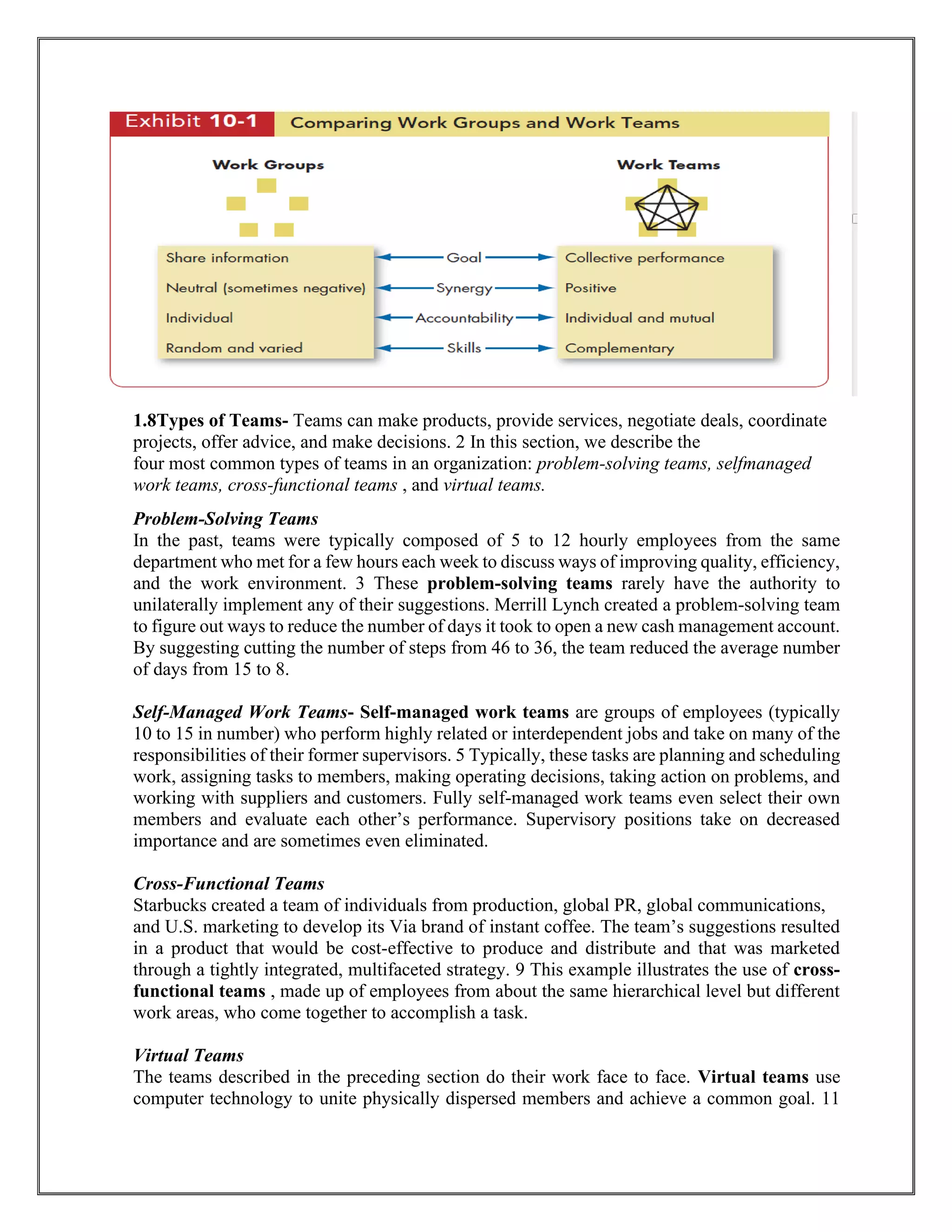
Exhibit 10-1 highlights the differences between work groups and work teams.
1.8Types of Teams- Teams can make products, provide services, negotiate deals, coordinate
projects, offer advice, and make decisions. 2 In this section, we describe the
four most common types of teams in an organization: problem-solving teams, selfmanaged
work teams, cross-functional teams , and virtual teams.
Problem-Solving Teams
In the past, teams were typically composed of 5 to 12 hourly employees from the same
department who met for a few hours each week to discuss ways of improving quality, efficiency,
and the work environment. 3 These problem-solving teams rarely have the authority to
unilaterally implement any of their suggestions. Merrill Lynch created a problem-solving team
to figure out ways to reduce the number of days it took to open a new cash management account.
By suggesting cutting the number of steps from 46 to 36, the team reduced the average number
of days from 15 to 8.
Self-Managed Work Teams- Self-managed work teams are groups of employees (typically
10 to 15 in number) who perform highly related or interdependent jobs and take on many of the
responsibilities of their former supervisors. 5 Typically, these tasks are planning and scheduling
work, assigning tasks to members, making operating decisions, taking action on problems, and
working with suppliers and customers. Fully self-managed work teams even select their own
members and evaluate each other’s performance. Supervisory positions take on decreased
importance and are sometimes even eliminated.
Cross-Functional Teams
Starbucks created a team of individuals from production, global PR, global communications,
and U.S. marketing to develop its Via brand of instant coffee. The team’s suggestions resulted
in a product that would be cost-effective to produce and distribute and that was marketed
through a tightly integrated, multifaceted strategy. 9 This example illustrates the use of cross-
functional teams , made up of employees from about the same hierarchical level but different
work areas, who come together to accomplish a task.
Virtual Teams
The teams described in the preceding section do their work face to face. Virtual teams use
computer technology to unite physically dispersed members and achieve a common goal. 11
They collaborate online—using communication links such as wide-area networks,
videoconferencing, or e-mail—whether they’re a room away or continents apart. Virtual teams
are so pervasive, and technology has advanced so far, that it’s probably a bit of a misnomer to
call them “virtual.”
Nearly all teams today do at least some of their work remotely.
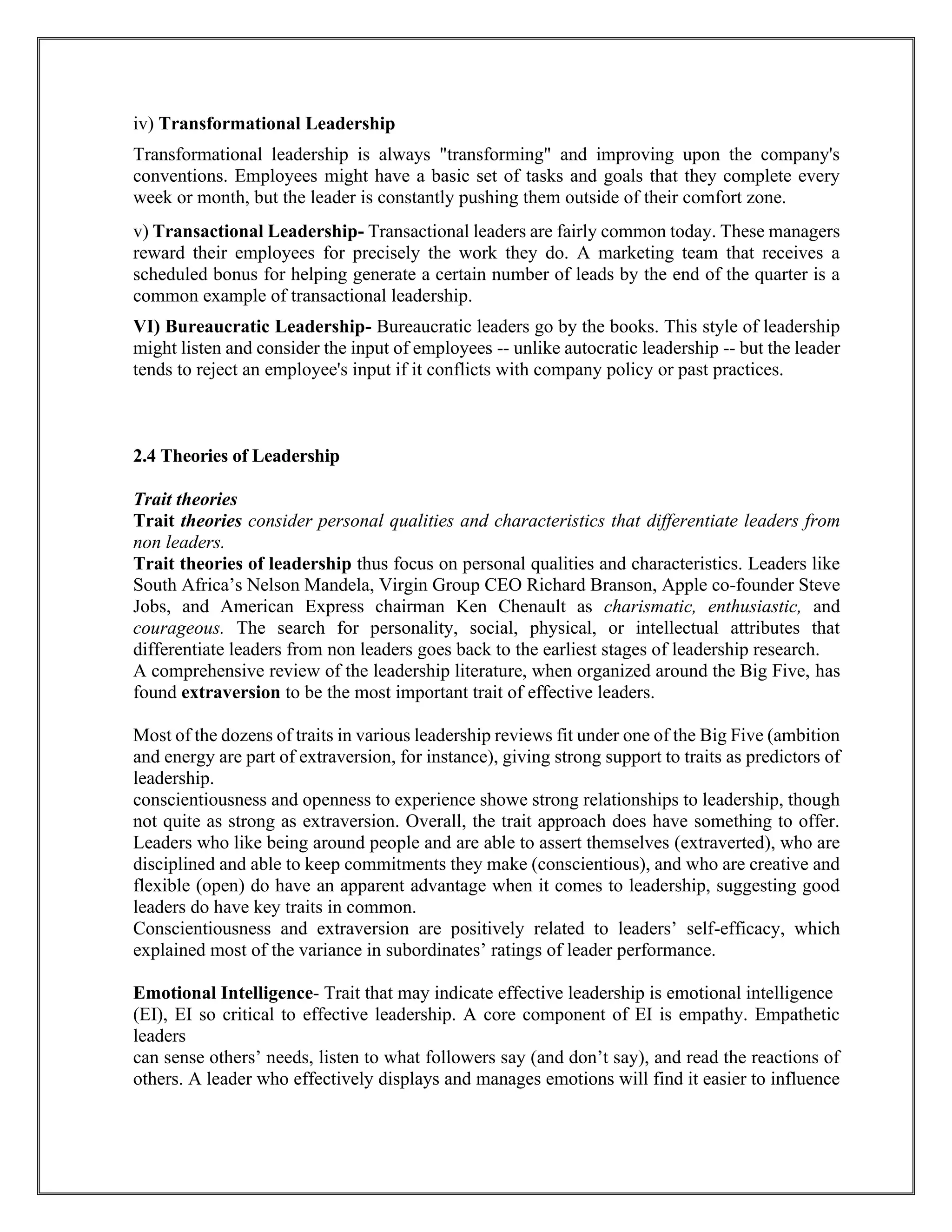
1.9Team-effectiveness Model
Context: What Factors Determine Whether
Teams Are Successful
The four contextual factors most significantly related to team performance are adequate
resources, effective leadership, a climate of trust, and a performance evaluation and reward
system that reflects team contributions.
Adequate Resources Teams are part of a larger organization system; every work team relies
on resources outside the group to sustain it. A scarcity of resources directly reduces the ability
of a team to perform its job effectively and achieve its goals. As one study concluded, after
looking at 13 factors related to group performance, “perhaps one of the most important
characteristics of an effective work group is the support the group receives from the
organization” This support includes timely information, proper equipment, adequate staffing,
encouragement, and administrative assistance.
Leadership and Structure Teams can’t function if they can’t agree on who is to do what and
ensure all members share the workload. Agreeing on the specifics of work and how they fit
together to integrate individual skills requires leadership and structure, either from management
or from the team members themselves.It’s true in self-managed teams that team members
absorb many of the duties typically assumed by managers. However, a manager’s job then
becomes managing outside (rather than inside) the team.
Leadership is especially important in multi team systems , in which different teams coordinate
their efforts to produce a desired outcome. Here, leaders need to empower teams by delegating
responsibility to them, and they play the role of facilitator, making sure the teams work together
rather than against one another. Teams that establish shared leadership by effectively delegating
it are more effective than teams with a traditional single-leader structure.
Climate of Trust Members of effective teams trust each other. They also exhibit trust in their
leaders. 21 Interpersonal trust among team members facilitates cooperation, reduces the need
to monitor each others’ behavior, and bonds members around the belief that others on the team
won’t take advantage of them. Team members are more likely to take risks and expose
vulnerabilities when they believe they can trust others on their team. trust is the foundation of
leadership. It allows a team to accept and commit to its leader’s goals and decisions.
Performance Evaluation and Reward Systems How do you get team members to be both
individually and jointly accountable? Individual performance evaluations and incentives may
interfere with the development of high-performance teams. So, in addition to evaluating and
rewarding employees for their individual contributions, management should modify the
traditional, individually oriented evaluation and reward system to reflect team performance and
focus on hybrid systems that recognize individual members for their exceptional contributions
and reward the entire group for positive outcomes. Groupbased appraisals, profit sharing,
gainsharing, small-group incentives, and other system modifications can reinforce team effort
and commitment.
CHAPTER 2:
Leadership
2.1 Meaning and Definition
2.2 Difference between managers and leaders
2.3 Leadership styles
2.4 Theories of Leadership
2.5 Leadership and Emotional Intelligence
2.1 Meaning and Definition- We define leadership as the ability to influence a group toward
the achievement of a vision or set of goals. The source of this influence may be formal, such as
that provided by managerial rank in an organization. But not all leaders are managers, nor, for
that matter, are all managers leaders.
Just because an organization provides its managers with certain formal rights is no assurance
they will lead effectively. Non sanctioned leadership the ability to influence that arises outside
the formal structure of the organization—is often as important or more important than formal
influence.
In other words, leaders can emerge from within a group as well as by formal appointment.
Organizations need strong leadership and strong management for optimal effectiveness. We
need leaders today to challenge the status quo, create visions of the future, and inspire
organizational members to want to achieve the visions. We also need managers to formulate
detailed plans, create efficient organizational structures, and oversee day-to-day operations.
2.2 Difference between managers and leaders
Leadership is a skill and the person who possess this ability is known as a LEADER. On the
other hand, Management is a discipline, and the practitioner of this discipline is known as the
MANAGER.There are important distinctions between managing and leading people.
i) Leaders create a vision, managers create goals.
Leaders paint a picture of what they see as possible and inspire and engage their people in
turning that vision into reality. They think beyond what individuals do. They activate people to
be part of something bigger. They know that high-functioning teams can accomplish a lot more
working together than individuals working autonomously. Managers focus on setting,
measuring and achieving goals. They control situations to reach or exceed their objectives.
ii) Leaders are change agents, managers maintain the status quo.
Leaders are proud disrupters. Innovation is their mantra. They embrace change and know that
even if things are working, there could be a better way forward. And they understand and accept
the fact that changes to the system often create waves. Managers stick with what works, refining
systems, structures and processes to make them better.
iii) Leaders are unique, managers copy.
Leaders are willing to be themselves. They are self-aware and work actively to build their
unique and differentiated personal brand. They are comfortable in their own shoes and willing
to stand out. They’re authentic and transparent. Managers mimic the competencies and
behaviors they learn from others and adopt their leadership style rather than defining it.
iv) Leaders take risks, managers control risk .
Leaders are willing to try new things even if they may fail miserably. They know that failure is
often a step on the path to success. Managers work to minimize risk. They seek to avoid or
control problems rather than embracing them.
v) Leaders are in it for the long haul, managers think short-term.
Leaders have intentionality. They do what they say they are going to do and stay motivated
toward a big, often very distant goal. They remain motivated without receiving regular rewards.
Managers work on shorter-term goals, seeking more regular acknowledgment or accolades.
vi) Leaders grow personally, managers rely on existing, proven skills.
Leaders know if they aren’t learning something new every day, they aren’t standing still, they’re
falling behind. They remain curious and seek to remain relevant in an ever-changing world of
work. They seek out people and information that will expand their thinking. Managers often
double down on what made them successful, perfecting existing skills and adopting proven
behaviors.
2.3 Leadership styles
Leadership is a fluid practice. We're always changing and improving the way in which we help
our direct reports and the company grow. And the longer we lead, the more likely we'll change
the way we choose to complete the sentence above. But in order to become better leaders
tomorrow, we need to know where we stand today. To help you understand the impact each
type of leader has on a company, I'll explain eight of the most common types of leadership
styles in play today and how effective they are.
i) Democratic Leadership- Democratic leadership is exactly what it sounds like -- the leader
makes decisions based on the input of each team member. Although he or she makes the final
call, each employee has an equal say on a project's direction. Democratic leadership is one of
the most effective leadership styles because it allows lower-level employees to exercise
authority they'll need to use wisely in future positions they might hold. It also resembles how
decisions can be made in company board meetings.
ii) Autocratic Leadership- Autocratic leadership is the inverse of democratic leadership. In
this leadership style, the leader makes decisions without taking input from anyone who reports
to them. Employees are neither considered nor consulted prior to a direction, and are expected
to adhere to the decision at a time and pace stipulated by the leader.
iii) Laissez-Faire Leadership
The French term "laissez faire" literally translates to "let them do," and leaders who embrace it
afford nearly all authority to their employees.. laissez-faire leadership can empower employees
by trusting them to work however they'd like, it can limit their development and overlook
critical company growth opportunities. Therefore, it's important that this leadership style is kept
in check.
iv) Transformational Leadership
Transformational leadership is always "transforming" and improving upon the company's
conventions. Employees might have a basic set of tasks and goals that they complete every
week or month, but the leader is constantly pushing them outside of their comfort zone.
v) Transactional Leadership- Transactional leaders are fairly common today. These managers
reward their employees for precisely the work they do. A marketing team that receives a
scheduled bonus for helping generate a certain number of leads by the end of the quarter is a
common example of transactional leadership.
VI) Bureaucratic Leadership- Bureaucratic leaders go by the books. This style of leadership
might listen and consider the input of employees -- unlike autocratic leadership -- but the leader
tends to reject an employee's input if it conflicts with company policy or past practices.
2.4 Theories of Leadership
Trait theories
Trait theories consider personal qualities and characteristics that differentiate leaders from
non leaders.
Trait theories of leadership thus focus on personal qualities and characteristics. Leaders like
South Africa’s Nelson Mandela, Virgin Group CEO Richard Branson, Apple co-founder Steve
Jobs, and American Express chairman Ken Chenault as charismatic, enthusiastic, and
courageous. The search for personality, social, physical, or intellectual attributes that
differentiate leaders from non leaders goes back to the earliest stages of leadership research.
A comprehensive review of the leadership literature, when organized around the Big Five, has
found extraversion to be the most important trait of effective leaders.
Most of the dozens of traits in various leadership reviews fit under one of the Big Five (ambition
and energy are part of extraversion, for instance), giving strong support to traits as predictors of
leadership.
conscientiousness and openness to experience showe strong relationships to leadership, though
not quite as strong as extraversion. Overall, the trait approach does have something to offer.
Leaders who like being around people and are able to assert themselves (extraverted), who are
disciplined and able to keep commitments they make (conscientious), and who are creative and
flexible (open) do have an apparent advantage when it comes to leadership, suggesting good
leaders do have key traits in common.
Conscientiousness and extraversion are positively related to leaders’ self-efficacy, which
explained most of the variance in subordinates’ ratings of leader performance.
Emotional Intelligence- Trait that may indicate effective leadership is emotional intelligence
(EI), EI so critical to effective leadership. A core component of EI is empathy. Empathetic
leaders
can sense others’ needs, listen to what followers say (and don’t say), and read the reactions of
others. A leader who effectively displays and manages emotions will find it easier to influence
the feelings of followers, by both expressing genuine sympathy and enthusiasm for good
performance and by using irritation for those who fail to perform.
Behavioral Theories
Behavioral theories of leadership implied we could train people to be leaders. The most
comprehensive theories resulted from the Ohio State Studies in the late 1940s, which sought to
identify independent dimensions of leader behavior.
Beginning with more than a thousand dimensions, the studies narrowed the list to two that
substantially accounted for most of the leadership behavior described by employees: initiating
structure and consideration.
Initiating structure is the extent to which a leader is likely to define and structure his or her
role and those of employees in the search for goal attainment.
It includes behavior that attempts to organize work, work relationships, and goals. A leader high
in initiating structure is someone who “assigns group members to particular tasks,” “expects
workers to maintain definite standards of performance,” and “emphasizes the meeting of
deadlines.”
Consideration is the extent to which a person’s job relationships are characterized by mutual
trust, respect for employees’ ideas, and regard for their feelings. A leader high in consideration
helps employees with personal problems, is friendly and approachable, treats all employees as
equals, and expresses appreciation and support.
The Michigan group also came up with two behavioral dimensions: the employee-oriented
leader emphasized interpersonal relationships by taking a personal interest in the needs of
employees and accepting individual differences among them, and the production oriented
leader emphasized the technical or task aspects of the job, focusing on accomplishing the
group’s tasks.
The Fiedler Model
Fred Fiedler developed the first comprehensive contingency model for leadership. The Fiedler
contingency model proposes that effective group performance depends on the proper match
between the leader’s style and the degree to which the situation gives the leader control.
Identifying Leadership Style Fiedler believes a key factor in leadership success is the
individual’s basic leadership style. He created the least preferred co-worker (LPC)
questionnaire to identify that style by measuring whether a person is task or relationship
oriented. The LPC questionnaire asks respondents to think of all the co-workers they have ever
had and describe the one they least enjoyed working with by rating that person on a scale of 1
to 8 for each of 16 sets of contrasting
adjectives (such as pleasant–unpleasant, efficient–inefficient, open–guarded, supportive–
hostile). If you describe the person you are least able to work with in favorable terms (a high
LPC score), Fiedler would label you relationship oriented . If you see your least-preferred co-
worker in unfavorable terms (a low LPC score), you are primarily interested in productivity and
are task oriented. About 16 percent of respondents score in the middle range and thus fall
outside the theory’s predictions.
Defining the Situation After assessing an individual’s basic leadership style through the LPC
questionnaire, we match the leader with the situation. Fiedler has identified three contingency
or situational dimensions:
1. Leader–member relations is the degree of confidence, trust, and respect members have in
their leader.
2. Task structure is the degree to which the job assignments are procedurized (that is,
structured or unstructured).
3. Position power is the degree of influence a leader has over power variables such as hiring,
firing, discipline, promotions, and salary increases.
The next step is to evaluate the situation in terms of these three variables. Fiedler states that the
better the leader–member relations, the more highly structured the job, and the stronger the
position power, the more control the leader has. A very favorable situation (in which the leader
has a great deal of control) might include a payroll manager who is well respected and whose
employees have confidence in her (good leader–member relations); activities that are clear and
specific—such as wage computation, check writing, and report filing (high task structure); and
provision of considerable freedom to reward and punish employees (strong position power). An
unfavorable situation might be that of the disliked chairperson of a volunteer United Way
fundraising team. In this job, the leader has very little control.
Matching Leaders and Situations Combining the three contingency dimensions yields eight
possible situations in which leaders can find themselves ( Exhibit 12-1 ). The Fiedler model
proposes matching an individual’s LPC score and these eight situations to achieve maximum
leadership effectiveness.
Fiedler concluded that task-oriented leaders perform better in situations very favorable to them
and very unfavorable. So, when faced with a category I, II, III, VII, or VIII situation, task-
oriented leaders perform better. Relationship oriented leaders, however, perform better in
moderately favorable situations— categories IV, V, and VI. In recent years, Fiedler has
condensed these eight situations down to three. 20 He now says task-oriented leaders perform
best in situations of high and low control, while relationship-oriented leaders perform best in
moderate control situations.
How would you apply Fiedler’s findings? You would match leaders—in terms of their LPC
scores—with the type of situation—in terms of leader– member relationships, task structure,
and position power—for which they were best suited. But remember that Fiedler views an
individual’s leadership style as fixed.
Therefore, there are only two ways to improve leader effectiveness. First, you can change the
leader to fit the situation—as a baseball manager puts a right- or left-handed pitcher into the
game depending on the hitter. If a group situation rates highly unfavorable but is currently led
by a relationship-oriented manager, the group’s performance could be improved under a
manager who is task-oriented. The second alternative is to change the situation to fit the leader
by restructuring tasks or increasing or decreasing the leader’s power to control factors such as
salary increases, promotions, and disciplinary actions.
Evaluation Studies testing the overall validity of the Fiedler model find considerable evidence
to support substantial parts of it. If we use only three categories rather than the original eight,
ample evidence supports Fiedler’s conclusions. 22 But the logic underlying the LPC
questionnaire is not well understood, and respondents’ scores are not stable.
Other Contingency Theories
Although LPC theory is the most widely researched contingency theory, three others deserve
mention, Situational Leadership Theory Situational leadership theory (SLT) focuses on the
followers. It says successful leadership depends on selecting the right leadership style
contingent on the followers’ readiness, or the extent to which they are willing and able to
accomplish a specific task. A leader should choose one of four behaviors depending on follower
readiness If followers are unable and unwilling to do a task, the leader needs to give clear and
specific directions; if they are unable and willing, the leader needs to display high task
orientation to compensate for followers’ lack of ability and high relationship orientation to get
them to “buy into” the leader’s desires.
If followers are able and unwilling, the leader needs to use a supportive and participative style;
if they are both able and willing, the leader doesn’t need to do much.
SLT has intuitive appeal. It acknowledges the importance of followers and builds on the logic
that leaders can compensate for their limited ability and motivation. Yet research efforts to test
and support the theory have generally been disappointing. Why? Possible explanations include
internal ambiguities and inconsistencies in the model itself as well as problems with research
methodology in tests. So, despite its intuitive appeal and wide popularity, any endorsement must
be cautious for now.
Path–Goal Theory Developed by Robert House, path–goal theory extracts elements from the
Ohio State leadership research on initiating structure and consideration and the expectancy
theory of motivation. 26 It says it’s the leader’s job to provide followers with the information,
support, or other resources necessary to achieve their goals. (The term path–goal implies
effective leaders clarifyfollowers’ paths to their work goals and make the journey easier by
reducing roadblocks.)
According to path–goal theory, whether a leader should be directive or supportive or should
demonstrate some other behavior depends on complex analysis of the situation. It predicts the
following:
● Directive leadership yields greater satisfaction when tasks are ambiguous
or stressful than when they are highly structured and well laid out.
● Supportive leadership results in high performance and satisfaction when
employees are performing structured tasks.
● Directive leadership is likely to be perceived as redundant among employees with high ability
or considerable experience.
Leader-Participation Model The final contingency theory we cover argues that the way the
leader makes decisions is as important as what she or he decides.
Victor Vroom and Phillip Yetton’sleader-participation model relates leadership behavior and
participation in decision making. 31 Like path–goal theory, it says leader behavior must adjust
to reflect the task structure. The model is normative—it provides a decision tree of seven
contingencies and five leadership styles for determining the form and amount of participation
in decision making.
Research testing both the original and revised leader-participation models has not been
encouraging, although the revised model rates higher in effectiveness. Criticism focuses on the
model’s complexity and the variables it omits.
Although Vroom and Jago have developed a computer program to guide managers through all
the decision branches in the revised model, it’s not very realistic to expect practicing managers
to consider 12 contingency variables, eight problem types, and five leadership styles to select
the decision process for a problem.
Member Exchange (LMX) Theory
Leader–member exchange (LMX) theory
argues that, because of time pressures, leaders establish a special relationship with a small group
of their followers. These individuals make up the in group they are trusted, get a
disproportionate amount of the leader’s attention, and are more likely to receive special
privileges. Other followers fall into the group.
The theory proposes that early in the history of the interaction between a leader and a given
follower, the leader implicitly categorizes the follower as an “in” or an “out” and that
relationship is relatively stable over time. Leaders induce LMX by rewarding those employees
with whom they want a closer linkage and punishing those with whom they do not.
Just how the leader chooses who falls into each category is unclear, but there is evidence ingroup
members have demographic, attitude, and personality characteristics similar to those of their
leader or a higher level of competence.
Leaders and followers of the same gender tend to have closer (higher LMX) relationships than
those of different genders. Even though the leader does the choosing, the follower’s
characteristics drive the categorizing decision.
Research to test LMX theory has been generally supportive, with substantive evidence that
leaders do differentiate among followers; these disparities are far from random; and followers
with ingroup status will have higher performance ratings, engage in more helping or
“citizenship” behaviors at work, and report greater satisfaction with their superior.
Transformational versus Transactional Perspective
Transformational leaders
inspire followers to transcend their self-interests for the good of the organization and can have
an extraordinary effect on their followers. Andrea Jung at Avon, Richard Branson of the Virgin
Group, and Jim McNerney of Boeing are all transformational leaders. They pay attention to the
concerns and needs of individual followers; they change followers’ awareness of issues by
helping them look at old problems in new ways; and they excite and inspire followers to put out
extra effort to achieve group goals.
How Transformational Leadership Works Transformational leaders are more effective
because they are more creative, but also because they encourage those who follow them to be
creative, too. Companies with transformational leaders have greater decentralization of
responsibility, managers have more propensity to take risks, and compensation plans are geared
toward long-term results—all of which facilitate corporate entrepreneurship.
Idealized Influence: Provides vision and sense of mission, instills pride, gains respect and trust.
Inspirational Motivation: Communicates high expectations, uses symbols to focus efforts,
expresses important purposes in simple ways.
Intellectual Stimulation: Promotes intelligence, rationality, and careful problem solving.
Individualized Consideration: Gives personal attention, treats each employee individually,
coaches, advises.
Transformational leaders are able to increase follower self-efficacy, giving the group a “can do”
spirit.
Evaluation of Transformational Leadership Transformational leadership has been
impressively supported at diverse job levels and occupations (school principals, teachers,
marine commanders, ministers, presidents of MBA associations, military cadets, union shop
stewards, sales reps).
Transactional Leader
The Ohio State studies, Fiedler’s model, and path–goal theory describe transactional leaders ,
who guide their followers toward established goals by clarifying role and task requirements.
Contingent Reward: Contracts exchange of rewards for effort, promises rewards for good
performance, recognizes accomplishments.
Management by Exception (active): Watches and searches for deviations from rules and
standards, takes correct action.
Management by Exception (passive): Intervenes only if standards are not met.
Laissez-Faire: Abdicates responsibilities, avoids making decisions.
2.5 Leadership and Emotional Intelligence
Emotional intelligence (EI) is a person’s ability to (1) perceive emotions in the self and others,
(2) understand the meaning of these emotions, and (3) regulate one’s emotions accordingly in
a cascading model, as shown in Exhibit 4-6 . People who know their own emotions and are
good at reading emotional cues—for instance, knowing why they’re angry and how to express
themselves without violating norms—are most likely to be effective.
Effective leaders rely on emotional appeals to help convey their messages. In fact, the
expression of emotions in speeches is often the critical element that makes us accept or reject a
leader’s message. “When leaders feel excited, enthusiastic, and active, they may be more likely
to energize their subordinates and convey a sense of efficacy, competence, optimism, and
enjoyment.
Emotions
• Caused by specific event • Very brief in duration (seconds or minutes) • Specific and numerous
in nature (many specific emotions such as anger, fear, sadness, happiness, disgust, surprise)
• Usually accompanied by distinct facial expressions and Action oriented in nature
CHAPTER-3
Power, Politics and Conflict Management
3.1 The concept of power
3.2 Sources of power
3.3 Dependency: The Key to Power
3.4Power Tactics
3.5 Politics -Power in Action
3.6Managing political behavior in organizations; Impression Management.
3.7 Conflict Management- Concept
3.8Causes of Conflict
3.9 Nature and Types of Conflict
3.10 The Conflict Process
3.11 Impact of Conflict
3.12 Conflict Resolution Strategies
Introduction
Power has been described as the last dirty word. It is easier for most of us to talk about money
than it is to talk about power. People who have it deny it, people who want it try not to appear
to be seeking it, and those who are good at getting it are secretive about how they got it. OB
researchers have learned a lot in recent years about how people gain and use power in
organizations. In this chapter, we present you with their findings. A major theme throughout
this chapter is that power is a natural process in any group or organization. As such, you need
to know how it’s acquired and exercised if you’re going to fully understand organizational
behavior. While you may have heard the phrase that “power corrupts, and absolute power
corrupts absolutely,” power is not always bad. As one author has noted, most medicines can kill
if taken in the wrong amount and thousands die each year in automobile accidents, but we don’t
abandon chemicals or cars because of the dangers associated with them. Rather, we consider
danger an incentive to get training and information that’ll help us to use these forces
productively. The same applies to power. It’s a reality of organizational life and it’s not going
to go away. Moreover, by learning how power works in organizations, you’ll be better able to
use your knowledge to help you be a more effective manager.
3.1 Concept of Power
Power refers to a capacity that A has to influence the behavior of B, so that B acts in accordance
with A’s wishes.This definition implies a potential that need not be actualized to be effective
and a dependency relationship. Power may exist but not be used. It is, therefore, a capacity or
potential. One can have power but not impose it.
Probably the most important aspect of power is that it is a function of dependency. The greater
B’s dependence on A, the greater is A’s power in the relationship. Dependence, in turn, is based
on alternatives that B perceives and the importance that B places on the alternative(s) that A
controls. A person can have power over you only if he or she controls something you desire. If
you want a college degree and have to pass a certain course to get it, and your current instructor
is the only faculty member in the college who teaches that course, he or she has power over
you. Your alternatives are highly limited and you place a high degree of importance on
obtaining a passing grade. Similarly, if you’re attending college on funds totally provided by
your parents, you probably recognize the power that they hold over you. You’re dependent on
them for financial support. But once you’re out of school, have a job, and are making a solid
income, your parents’ power is reduced significantly.
3.2 Sources of Power
Where does power come from? What is it that gives an individual or a group influence over
others? The answer to these questions is a five-category classification scheme identified by
French and Raven. They proposed that there were five bases or sources of power: coercive,
reward, legitimate, expert, and referent.
Coercive Power
The coercive power base is defined by French and Raven as being dependent on fear. One reacts
to this power out of fear of the negative results that might occur if one failed to comply. It rests
on the application, or the threat of application, of physical sanctions such as the infliction of
pain, the generation of frustration through restriction of movement, or the controlling by force
of basic physiological or safety needs.
At the organizational level, A has coercive power over B if A can dismiss, suspend, or demote
B, assuming that B values his or her job. Similarly, if A can assign B work activities that B
finds unpleasant or treat B in a manner that B finds embarrassing, A possesses coercive power
over B
Reward Power
The opposite of coercive power is reward power. People comply with the wishes or directives
of another because doing so produces positive benefits; therefore, one who can distribute
rewards that others view as valuable will have power over those others. These rewards can be
anything that another person values. In an organizational context, we think of money, favorable
performance appraisals, promotions, interesting work assignments, friendly colleagues,
important information, and preferred work shifts or sales territories.
Coercive power and reward power are actually counterparts of each other. If you can remove
something of positive value from another or inflict something of negative value upon him or
her, you have coercive power over that person. If you can give someone something of positive
value or remove something of negative value, you have reward power over that person. Again,
as with coercive power, you don’t need to be a manager to be able to exert influence through
rewards. Rewards such as friendliness, acceptance, and praise are available to everyone in an
organization. To the degree that an individual seeks such rewards, your ability to give or
withhold them gives you power over that individual.
Legitimate Power
In formal groups and organizations, probably the most frequent access to one or more of the
power bases is one’s structural position. This is called legitimate power. It represents the power
a person receives as a result of his or her position in the formal hierarchy of an organization.
Positions of authority include coercive and reward powers. Legitimate power, however, is
broader than the power to coerce and reward. Specifically, it includes acceptance by members
of an organization of the authority of a position. When school principals, bank presidents, or
army captains speak (assuming that their directives are viewed to be within the authority of their
positions), teachers, tellers, and first lieutenants listen and usually comply.
Expert Power
Expert power is influence wielded as a result of expertise, special skill, or knowledge. Expertise
has become one of the most powerful sources of influence as the world has become more
technologically oriented. As jobs become more specialized, we become increasingly dependent
on experts to achieve goals. So, while it is generally acknowledged that physicians have
expertise and hence expert power—most of us follow the advice that our doctor gives us—you
should also recognize that computer specialists, tax accountants, solar engineers, industrial
psychologists, and other specialists are able to wield power as a result of their expertise.
Referent Power
Its base is identification with a person who has desirable resources or personal traits. If I admire
and identify with you, you can exercise power over me because I want to please you. Referent
power develops out of admiration of another and a desire to be like that person. In a sense, then,
it is a lot like charisma. If you admire someone to the point of modeling your behavior and
attitudes after him or her, this person possesses referent power over you. Referent power
explains why celebrities are paid millions of dollars to endorse products in commercials.
3.3 Dependency: The Key to Power
The greater B’s dependency on A, the greater the power A has over B. When you possess
anything that others require but that you alone control, you make them dependent upon you and,
therefore, you gain power over them. Dependency, then, is inversely proportional to the
alternative sources of supply. If something is plentiful, possession of it will not increase your
power. If everyone is intelligent, intelligence gives no special advantage. Similarly, among the
superrich, money is no longer power.
What Creates Dependency?
Dependency is increased when the resource you control is important, scarce, and non
substitutable.
a. IMPORTANCE
If nobody wants what you’ve got, it’s not going to create dependency. To create dependency,
therefore, the thing(s) you control must be perceived as being important.
b. SCARCITY
If something is plentiful, possession of it will not increase power. A resource needs to be
perceived as scarce to create dependency. This can help to explain how low-ranking members
in an organization who have important knowledge not available to high-ranking members gain
power over the high-ranking members. Possession of a scarce resource—in this case, important
knowledge—makes the high-ranking member dependent on the low ranking member.
c. NONSUBSTITUTABILITY
The more that a resource has no viable substitutes, the more power that control over that
resource provides.
3.4 Power Tactics
Power Tactics are the ways in which individuals translate power bases into specific actions.
Seven tactical dimensions or strategies:
Reason: Use of facts and data to make a logical or rational presentation of ideas
Friendliness: Use of flattery, creation of goodwill, acting humble, and being friendly prior to
making a request
Coalition: Getting the support of other people in the organization to back up the request
Bargaining: Use of negotiation through the exchange of benefits or favors
Assertiveness: Use of a direct and forceful approach such as demanding compliance with
requests, repeating reminders, ordering individuals to do what is asked, and pointing out that
rules require compliance
Higher authority: Gaining the support of higher levels in the organization to back up requests
Sanctions: Use of organizationally derived rewards and punishments such as preventing or
promising a salary increase, threatening to give an unsatisfactory performance evaluation, or
withholding a promotion
A manager’s relative power impacts the selection of tactics in two ways. First, managers who
control resources that are valued by others, or who are perceived to be in positions of
dominance, use a greater variety of tactics than do those with less power. Second, managers
with power use assertiveness with greater frequency than do those with less power. Initially, we
can expect that most managers will attempt to use simple requests and reason. Assertiveness is
a backup strategy, used when the target of influence refuses or appears reluctant to comply with
the request. Resistance leads to managers using more directive strategies. Typically, they shift
from using simple requests to insisting that their demands be met.
But the manager with relatively little power is more likely to stop trying to influence others
when he or she encounters resistance because he or she perceives the costs associated with
assertiveness as unacceptable. Managers vary their power tactics in relation to their objectives.
When managers seek benefits from a superior, they tend to rely on kind words and the
promotion of pleasant relationships; that is, they use friendliness. In comparison, managers
attempting to persuade their superiors to accept new ideas usually rely on reason. This matching
of tactics to objectives also holds true for downward influence. For example, managers use
reason to sell ideas to subordinates and friendliness to obtain favors. The manager’s
expectations of success guide his or her choice of tactics. When past experience indicates a high
probability of success, managers use simple requests to gain compliance. Where success is less
predictable, managers are more tempted to use assertiveness and sanctions to achieve their
objectives.
3.5 Politics -Power in Action
Political behavior in organizations as those activities that are not required as part of one’s formal
role in the organization, but that influence, or attempt to influence, the distribution of advantages
and disadvantages within the organization. This definition encompasses key elements from
what most people mean when they talk about organizational politics. Political behavior is
outside one’s specified job requirements. The behavior requires some attempt to use one’s
power bases.
Legitimate political behavior refers to normal everyday politics—complaining to your
supervisor, bypassing the chain of command, forming coalitions, obstructing organizational
policies or decisions through inaction or excessive adherence to rules, and developing contacts
outside the organization through one’s professional activities
On the other hand, illegitimate political behaviors that violate the implied rules of the game.
Those who pursue such extreme activities are often described as individuals who “play
hardball.” Illegitimate activities include sabotage, whistleblowing, and symbolic protests such
as wearing unorthodox dress or protest buttons, and groups of employees simultaneously calling
in sick.
The Reality of Politics
Politics is a fact of life in organizations. Organizations are made up of individuals and groups
with different values, goals, and interests. This sets up the potential for conflict over resources.
Departmental budgets, space allocations, project responsibilities, and salary adjustments are just
a few examples of the resources about whose allocation organizational members will disagree.
Resources in organizations are also limited, which often turns potential conflict into real
conflict. If resources were abundant, then all the various constituencies within the organization
could satisfy their goals. But because they are limited, not everyone’s interests can be provided
for. Furthermore, whether true or not, gains by one individual or group are often perceived as
being at the expense of others within the organization. These forces create a competition among
members for the organization’s limited resources.
Finally, because most decisions have to be made in a climate of ambiguity—where facts are
rarely fully objective, and thus are open to interpretation—people within organizations will use
whatever influence they can to taint the facts to support their goals and interests. That, of course,
creates the activities called politicking
INDIVIDUAL FACTORS
At the individual level, researchers have identified certain personality traits, needs, and other
factors that are likely to be related to political behavior. In terms of traits, employees who are
high self-monitors, possess an internal locus of control, and have a high need for power are
more likely to engage in political behavior. The high self-monitor is more sensitive to social
cues, exhibits higher levels of social conformity, and is more likely to be skilled in political
behavior than the low self-monitor. Individuals with an internal locus of control, because they
believe they can control their environment, are more prone to take a proactive stance and
attempt to manipulate situations in their favor. And, not surprisingly, the Machiavellian
personality—which is characterized by the will to manipulate and the desire for power—is
comfortable using politics as a means to further his or her self-interest.
Additionally, an individual’s investment in the organization, perceived alternatives, and
expectations of success will influence the degree to which he or she will pursue illegitimate
means of political action. The more that a person has invested in the organization in terms of
expectations of increased future benefits, the more a person has to lose if forced out and the less
likely he or she is to use illegitimate means. The more alternative job opportunities an individual
has—due to a favorable job market or the possession of scarce skills or knowledge, a prominent
reputation, or influential contacts outside the organization—the more likely he or she is to risk
illegitimate political actions. Finally, if an individual has a low expectation of success in using
illegitimate means, it is unlikely that he or she will attempt to do so. High expectations of
success in the use of illegitimate means are most likely to be the province of both experienced
and powerful individuals with polished political skills and inexperienced and naive employees
who misjudge their chances.
ORGANIZATIONAL FACTORS
Political activity is probably more a function of the organization’s characteristics than of
individual difference variables. Because many organizations have a large number of employees
with the individual characteristics, yet the extent of political behavior varies widely. When an
organization’s resources are declining, when the existing pattern of resources is changing, and
when there is opportunity for promotions, politics is more likely to surface. In addition, cultures
characterized by low trust, role ambiguity, unclear performance evaluation systems, zero-sum
reward allocation practices, democratic decision making, high pressures for performance, and
self-serving senior managers will create breeding grounds for politicking.
When organizations downsize to improve efficiency, reductions in resources have to be made.
Threatened with the loss of resources, people may engage in political actions to safeguard what
they have. But any changes, especially those that imply significant reallocation of resources
within the organization, are likely to stimulate conflict and increase politicking. Promotion
decisions have consistently been found to be one of the most political in organizations. The
opportunity for promotions or advancement encourages people to compete for a limited
resource and to try to positively influence the decision outcome.
The less trust there is within the organization, the higher the level of political behavior and the
more likely that the political behavior will be of the illegitimate kind. So high trust should
suppress the level of political behavior in general and inhibit illegitimate actions in particular.
Role ambiguity means that the prescribed behaviors of the employee are not clear. There are
fewer limits, therefore, to the scope and functions of the employee’s political actions. Since
political activities are defined as those not required as part of one’s formal role, the greater the
role ambiguity, the more one can engage in political activity with little chance of it being visible.
The practice of performance evaluation is far from a perfected science. The more that
organizations use subjective criteria in the appraisal, emphasize a single outcome measure, or
allow significant time to pass between the time of an action and its appraisal, the greater the
likelihood that an employee can get away with politicking. Subjective performance criteria
create ambiguity. The use of a single outcome measure encourages individuals to do whatever
is necessary to “look good” on that measure, but often at the expense of performing well on
other important parts of the job that are not being appraised. The amount of time that elapses
between an action and its appraisal is also a relevant factor. The longer the time period, the
more unlikely that the employee will be held accountable for his or her political behaviors
3.6 Managing political behavior in organizations; Impression Management.
The process by which individuals attempt to control the impression others form of them is called
impression management.
Impression Management (IM) Techniques
Conformity-Agreeing with someone else’s opinion to gain his or her approval is a form of
ingratiation.
Favors -Doing something nice for someone to gain that person’s approval is a form of
ingratiation.
Excuses- Explanations of a predicament-creating event aimed at minimizing the apparent
severity of the predicament is a defensive IM technique
Apologies- Admitting responsibility for an undesirable event and simultaneously seeking to get
a pardon for the action is a defensive IM technique.
Self-Promotion- Highlighting one’s best qualities, downplaying one’s deficits, and calling
attention to one’s achievements is a self-focused IM technique.
Enhancement-Claiming that something you did is more valuable than most other members of
the organizations would think is a self-focused IM technique.
Flattery- Complimenting others about their virtues in an effort to make oneself appear
perceptive and likeable is an assertive IM technique
Exemplification-Doing more than you need to in an effort to show how dedicated and hard
working you are is an assertive IM technique.
3.7 Conflict Management- Concept
The concept of conflict is supposed to be an outcome of behaviours and is an integral part of
human life. The place where people interact there is every chance of conflict. Conflict can be
defined or explain in many ways as an expression of hostility, negative attitudes, antagonism,
aggression rivalry and misunderstanding. This also involves situation that involve contradiction
between two opposing groups.
In other words, conflicts is basically a disagreement between two or more individuals or groups,
with each individual or group trying to gain acceptance of its own view on others. Sometimes
intense conception among the groups leads to conflicts. But both competition and conflict
should not be confused. Competition is directed towards obtaining a goal while conflict is
directed against another group and action to frustrate other group members towards goal
achievement.
Conflict can mean many different things to many different people and can range in intensity
from a minor difference of opinion to war between nations. Argyrols holds that given the
mature, adult human being and the nature of the formal organisation, conflict is inevitable.
Within every individual there are usually (1) a number of competing needs and roles, (2) a
variety of different ways that drives and roles can be expressed, (3) many types of barriers which
can occur between the drive and goal and (4) both positive and negative aspects attached to the
desired goals. These complicate the human adaptation process and often result in conflict.
Definitions
According to S.P. Robbins, “Conflict is a process in which an effort is purposefully made by
one person or unit to block another that results in frustrating the attainment of the other’s goals
or the furthering of his or her interests.”
Mary Parker Follet defines conflict as, “The appearance of difference, difference of opinions,
of interests.”
Louis R. Pondy defines, “Conflict may be viewed as a breakdown in the standard mechanism
of decision making.”
3.8Causes of Conflict
1. Communicational Aspect of Conflict : Poor communication can also have a powerful effect
in causing conflict. Any misunderstanding or partial information during the communication
process is another factor supporting it. Due to the improper sending and receiving of the
information conflicts situation. The filtering of information is also said to be playing its role at
various levels of the organisation structure. Amount of information is functional upto a point,
beyond which it becomes a source of conflict. Semantic difficulties arise due to differences in
background, training, selective perception and incomplete or inadequate information regarding
others. In respect of completion of any job in absence of the senior or supervisor it is essential
that proper information in a correct and understandable form must be disseminated.
2. Behavioural Aspect of Conflict : These types of conflicts arise because of human thoughts,
feelings, attitudes, emotions, values, perceptions and reflects basic traits of a personality. So
perceptions of certain people any arise conflicts among others. On the other hand individuals
who are of low self-esteem may feel threatened by others in simple matters and over-react
causing a conflict.
3. Structural Aspects of Conflict : These conflicts arise due to issues related to the structural
design of the organisation as a whole as well as its sub-units. some of the structurally related
factor are :
(i) Size of Organisation : The larger the size of the organisation, the more is the basis for
existence of conflict. In a big organisation there is less goal clarity, more supervisory levels and
supervision and greater chances of information being diluted or distorted as it is passed along.
(ii) Participation : It is seen that if subordinates are not allowed to participate in the decision-
making process they show resortment which gives rise to conflict. On the other side, if more
participation of the subordinates are allowed then also chances of conflict increases as they
become more aware of the things in detailed manner.
(iii) Role Ambiguity : Role is a certain set of activities associated with a certain position in the
organisation. When the work is illdefined the person at that osition fails to perform well. This
creates conflict with that person and the others who are dependent on that particular individual.
Such conflicts can be reduced by redefining and classifying roles and their inter-dependencies.
(iv) Scarcity of Resources : The resources are made available to the working employees, but
when there is an uneven distribution it gives rise to dissatisfaction and resentment. Specially in
declining organisation cut back is made on personnel and services so that the concerned unit
shrinking pool of resources and this breeds conflict. The chances of conflict rise high when
resources such as capital facilities, staff assistance and many other factors start decreasing or
are in inadequate forms.
3.9 Nature and Types of Conflict
Over the years conflict has acquired divergent meanings. Certain commonalities can be
identified there: the conflicting parties must perceive it; that is, it is a perception issue. Another
commonality is the opposition or incompatibility and some form of interaction. Conflict is
disagreement in a social situation over issues of substance or whenever interpersonal emotions
create frictions between individuals or groups. Issues of substance essentially mean any
fundamental disagreement over ends or goals to be pursued and the means for their
accomplishment. Emotional conflict involves interpersonal difficulties that arise over feelings
of anger, mistrust, dislike, fear, resentment etc.
Robbins defines conflict "as a process that begins when one party perceives that another party
has negatively affected or is about to negatively affect, something that the first party cares
about". The definition encompasses a wide range of conflicts that people experience in
organisations. There is increasing evidence that not all conflicts are bad for performance and
productivity. Some conflicts do support the goals of the group and improve the group's
performance. These have been labeled functional constructive forms of conflict.
The conflicts that decrease and obstruct group performance are known as dysfunctional or
destructive forms of conflict. To gain a perspective on what differentiates a functional conflict
from a dysfunctional one, we need to understand the type of conflict. In organisations, there are
three types of conflicts:
1) Task Conflict
2) Relationship Conflict
3) Process Conflict
Task Conflict relates to the content and goals of the work; relationship conflict focuses on
interpersonal relationships and process conflict relates to how does the work get done. Research
shows that relationship conflicts are almost always dysfunctional. The dysfunctionality is
because the friction and interpersonal hostilities inherent in the relationship conflicts which
increase ego clashes and decrease mutual understanding, thereby blocking the completion of
jobs.
The functionality of low levels of process conflict come about when task roles are clear and
adequate time to complete the task is given; a low-to-moderate level of task conflict consistently
demonstrates a positive effect on group performance because it stimulates discussion of ideas
that help groups perform better.
3.10 The Conflict Process
In order to understand the nature of conflict, one needs to examine the conflict process. The
process consists of four stages:
Stage I : Antecedent conditions for conflict exist at the interpersonal level. One party plans to
block the attempts of another party from achieving a goal. In organisations some potential
danger and harm threaten the harmonious functioning and their existence. This stage is referred
to the source of conflict. Examples of these antecedent conditions are scarcity of resources,
heterogeneity of members and diversity of goals, values. perception; also the degree of
dependence between groups and insufficient exchange of information .
Stage II :The antecedent conditions must be perceived as threatening for conflict to develop.
The person whose attempts are sought to be thwarted perceives the harm that might be done to
him and feels/realizes the potential damage. When the conflict is personalised it is termed as
felt conflict. Realisation makes him emotionally involve himself. Emotional involvement makes
him feel frustrated, anxious and tense all of which are symptoms of conflict. The same pattern
previously seen in two groups or departments in an organisation.
Stage III: In this stage, a party engages in action that was planned in Stage I. That is, he now
blocks the other party's attempts in attainment of goals. The conflict is now out in the open.
Overt conflict covers a full range of behaviours from the subtle, indirect and highly controlled
forms of interference to direct aggressive, violent and uncontrolled struggle. At the
organisational level, strikes or lockouts are the result.
Stage IV: The interplay between different forms of overt conflict behaviour and conflict
handling strategies of stimulation or resolution influence the consequences. The conflict finally
results in an outcome that may be functional or dysfunctional. If the conflict is handled well,
the result is functional conflict. If it is mismanaged the result is dysfunctional conflict.
3.11Impact of Conflict
Conflict can have both positive and negative impact on individuals, groups and organisations.
Intergroup conflict may produce some changes within the group which are: Group cohesiveness
increases • Group becomes task-oriented • Leadership becomes more directive •Rigidification
of organisational structure • Group unity is stressed
Prolonged conflict is likely to affect the relationship between groups in the following manner:•
Groups become antagonistic toward each other • Perceptual distortion • Ineffective or absence
of communication • Groups apply a double standard
The potential benefits of intergroup conflicts are: • Conflict clarifies the real issue • Conflict
increases innovation •Intergroup conflict produces cohesiveness within the group • Conflict
serves as a catharsis • Conflict resolution solidifies in group relationships
3.12 Conflict Resolution Strategies
One must know when to resolve conflict and when to stimulate it if one is to avoid its potentially
disruptive effects. When a potentially harmful conflict situation exists a manager needs to
engage in conflict resolution. Conflict should be resolved when its focus is on the group's
internal goals rather than on organisational goals. If the conflict becomes excessive or
destructive the manager needs to adapt a strategy to reduce or resolve it.
First attempt to determine the source of the conflict. If the source of destructive conflict is a
particular person or two, it might be appropriate to alter the membership of one or both groups.
If it is due to differences in goals, perceptions of the difficulty of goal attainment or the
importance of the goals to the conflicting parties, then the manager can attempt to move the
conflicting parties into one of the five types of reactions to conflict (i.e., avoidance,
accommodation, competition, collaboration and compromise), depending on the nature of the
conflicting parties.
When the level of conflict is too high, conflict needs to be resolved so as to restore high
performance and optimal level of conflict. In most organisations where the manifest conflict is
high, knowledge of different strategies of conflict resolution is essential.
1) Conflict-avoidance strategies 2) Conflict-diffusion strategies 3) Conflict-containment
strategies 4) Conflict-confrontation strategies.
Conflict-Avoidance Strategies: The strategies are characterised by an attempt to avoid the
conflict. There is an absence of action from the part of the manager. This would usually result
in the situation becoming even worse over time. However, there are some situations in which it
is a reasonable way of dealing with the problem. For example, when the issue seems to be
symptomatic of other more basic conflicts - i.e., two groups may experience conflict over office
space; this may reflect in a deeper problem about relative power and status. Resolving the space
problem would not address the key issues. In such a situation, the office space conflict may be
ignored, but the basic concern should be dealt with.
Another way in which conflicts are avoided is to force the conflicting parties to accept a solution
decided by a higher-level manager. By this sort of forceful imposition of solution the conflict
is suppressed, the parties do not have an opportunity to air their grievances, resulting in
ineffective resolution. The gains are short-lived, because the underlying issues are not
addressed. Usually the conflict appears in another form.
Conflict-Diffusion Strategies: The strategies are aimed at keeping the conflict in abeyance and
to let the situation cool-off before any resolution is attempted. Smoothing is the tactic that has
been used to smooth things over by playing down its importance. The groups are persuaded that
their views are not very different and that there are many similarities in their positions. Hurt
feelings are catered to and smoothing the conflict plays down the importance of the issue.
Generally smoothing is rather ineffective because it does not address the key points of the
conflict. Smoothing is useful in serving as a stopgap measure, letting people cool down and
regain perspective. Escalation is avoided and the disagreement is brought down to manageable
levels. It is also appropriate for non-work issues.
Conflicts may be diffused by focusing on super ordinate goals, that is, higher goals that the
groups share or the long-range objectives that they have in common. This usually makes the
current problem seem insignificant. However, identifying super ordinate goals is not easy.
Achieving these goals requires cooperation between the groups, so the rewards for achieving
the goals must be significant. The most frequently used super ordinate goal is organisational
survival.
Conflict-Containment Strategies: The strategies use representatives to contain conflict. The
manager meets with the representatives of the opposing groups, rather than the entire
membership of the groups to decide the issue. Though this seems reasonable, in most cases the
use of representatives as a means of resolving a group conflict is consistently negative. This is
because the representatives are not entirely free to compromise and are usually motivated to
win. A representative who is not able to win is likely to be rejected by the group so generally
he will try to deadlock a solution. A way out is to use group representatives from each side to
help overcome individual anxiety about group rejection. Use of representatives as a means of
conflict resolution is most effective before positions become fixed or are made public.
Managers have tried to increase interaction to decrease conflict. Sometimes increased
interaction can add more fuel to the fire and make the situation worse. However, structuring the
interaction between the groups can be effective in resolving conflict by providing a framework
in which issues are to be discussed and the manner in which they are to be resolved. Structuring
interaction is especially useful in two situations: (a) when previous attempts to discuss issues
openly led to conflict escalation rather than problem solution; and (b) when a respected third
party is available to provide and enforce some structure in the interactions between the groups.
Conflict-Confrontation Strategies: An attempt is made to achieve resolution by confronting
the problem. Problem solving is aimed at finding a solution that reconciles or integrates the
needs of both parties who work together to define the problem and identify mutually satisfactory
solutions. Here there is open expression of feelings as well as exchange of task-related
information. For problem solving two preconditions are necessary: (a) a minimal level of trust
between the groups. Without trust each group will fear manipulation and may not reveal its true
preferences, (b) integrative problem solving takes a lot of time and can succeed only in the
absence of pressure for a quick settlement.
CHAPTER-4
Organization Structure and Culture
4.1 Organization Structure
4.2 Types of Organization Structure
4.2.1 Traditional Organizational Designs
4.2.2 Contemporary Organizational Designs
4.3 Organizational Culture
4.4 Do Organizations Have Uniform Cultures?
4.5 How Employees Learn Culture
4.1 Organization Structure
It is how job tasks are formally divided, grouped, and coordinated within an organization. When
managers develop or change the structure, they are engaged in organizational design, a process
that involves decisions about six key elements: work specialization, departmentalization, chain
of command, span of control, centralization and decentralization, and formalization.
Work Specialization-The degree to which tasks in an organization are subdivided into separate
jobs. The essence of work specialization is that an entire job is not done by one individual but
instead is broken down into steps, and each step is completed by a different person. Individual
employees specialize in doing part of an activity rather than the entire activity.
Departmentalization- Once jobs have been divided up through work specialization, they have
to be grouped back together so that common tasks can be coordinated. The basis on which jobs
are grouped together is called departmentalization. Every organization will have its own specific
way of classifying and grouping work activities. Functional departmentalization groups jobs
by functions performed. This approach can be used in all types of organizations, although the
functions change to reflect the organization’s purpose and work. Product departmentalization
groups jobs by product line. In this approach, each major product area is placed under the
authority of a manager who is responsible for everything having to do with that product line.
Geographical departmentalization groups jobs on the basis of territory or geography. Process
departmentalization groups jobs on the basis of product or customer flow. In this approach,
work activities follow a natural processing flow of products or even of customers. Finally,
customer departmentalization groups jobs on the basis of customers who have common needs
or problems that can best be met by having specialists for each.
Chain of Command- The chain of command is the continuous line of authority that extends
from upper organizational levels to the lowest levels and clarifies who reports to whom. It helps
employees answer questions such as “Who do I go to if I have a problem?” or “To whom am I
responsible?”
Span of Control- How many employees can a manager efficiently and effectively manage?
This question of span of control is important because, to a large degree, it determines the number
of levels and managers an organization needs. All things being equal, the wider or larger the
span, the more efficient the organization.
Centralization and Decentralization- Centralization describes the degree to which decision
making is concentrated at a single point in the organization. If top managers make the
organization’s key decisions with little or no input from below, then the organization is
centralized. In contrast, the more that lower-level employees provide input or actually make
decisions, the more decentralization there is.
Formalization- refers to the degree to which jobs within the organization are standardized and
the extent to which employee behaviour is guided by rules and procedures. If a job is highly
formalized, the person doing that job has little freedom to choose what is to be done, when it is
to be done, and how he or she does it. Employees can be expected to handle the same input in
exactly the same way, resulting in consistent and uniform output. Organizations with high
formalization have explicit job descriptions, numerous organizational rules, and clearly defined
procedures covering work processes. On the other hand, where formalization is low, job
behaviours are relatively unstructured, and employees have a great deal of freedom in how they
do their work.
4.2 Types of Organization Structure
4.2.1 Traditional Organizational Designs
In designing a structure to support the efficient and effective accomplishment of organizational
goals, managers may choose to follow more traditional organizational designs. These designs—
the simple structure, functional structure, and divisional structure—tend to be more
mechanistic.
Simple Structure-Most organizations start as entrepreneurial ventures with a simple structure
consisting of owners and employees. A simple structure is an organizational structure with low
departmentalization, wide spans of control, authority centralized in a single person, and little
formalization.This structure is most commonly used by small businesses in which the owner
and manager are one and the same.
Functional Structure-A functional structure is an organizational structure that groups similar
or related occupational specialties together. It is the functional approach to departmentalization
applied to the entire organization. Revlon, for example, is organized around the functions of
operations, finance, human resources, and product research and development.
Divisional Structure-The divisional structure is an organizational structure that consists of
separate business units or divisions. In this structure, each unit or division has relatively limited
autonomy, with a division manager responsible for performance who has strategic and
operational authority over his or her unit.
4.2.2 Contemporary Organizational Designs
Team Structure- In a team structure, the entire organization is made up of work groups or
teams that perform the organization’s work.Employee empowerment is crucial in a team
structure, because there is no line of managerial authority from top to bottom. Rather, employee
teams are free to design work in the way they think is best.
Matrix and Project Structures- The matrix structure is an organizational structure that assigns
specialists from different functional departments to work on one or more projects led by project
managers. Once a project is completed, the specialists return to their functional departments.
Employees in a matrix organization have two managers: their functional department manager
and their product or project manager, who share authority. The project managers have authority
over the functional members who are part of their project team in areas relative to the project’s
goals. However, decisions such as promotions, salary recommendations, and annual reviews
remain the functional manager’s responsibility. To work effectively, project and functional
managers have to communicate regularly, coordinate work demands on employees, and resolve
conflicts together.
Boundaryless Organizations- Another approach to contemporary organizational design is the
boundaryless organization, an organization whose design is not determined by a predefined
structure. Instead the organization seeks to eliminate the chain of command, places no limits on
spans of control, and replaces departments with empowered teams.
What do we mean by “boundaries”? A typical organization has internal boundaries— horizontal
boundaries imposed by work specialization and departmentalization, and vertical boundaries
created by separating employees into organizational levels and hierarchies. The organization
also has external boundaries, which separate the organization from its customers, suppliers, and
other stakeholders. To minimize or eliminate these boundaries, managers might use virtual or
network organizational structures.
Virtual Organizations-A virtual organization has elements of a traditional organization, but
also relies on recent developments in information technology to get work done. Thus, the
organization could consist of a small core of full-time employees plus outside specialists hired
on a temporary basis to work on opportunities that arise.The virtual organization could also be
composed of employees who work from their own home offices—connected by technology but
perhaps occasionally getting together face to face.
Network Organizations- Another structural option for managers wanting to minimize or
eliminate organizational boundaries is the network organization, which is a small core
organization that outsources major business functions. This approach allows organizations to
concentrate on what they do best and to contract out other activities to companies that specialize
in those activities. Many large organizations use the network structure to outsource
manufacturing.
4.3 Organizational Culture
Organizational culture refers to a system of shared meaning held by members that distinguishes
the organization from other organizations. This system of shared meaning is, on closer
examination, a set of key characteristics that the organization values. The most recent research
suggests that there are seven primary characteristics that, in aggregate, capture the essence of
an organization’s culture.
1. Innovation and risk taking. The degree to which employees are encouraged to be innovative
and take risks.
2. Attention to detail. The degree to which employees are expected to exhibit precision, analysis,
and attention to detail.
3. Outcome orientation. The degree to which management focuses on results or outcomes rather
than on the techniques and processes used to achieve these outcomes.
4. People orientation. The degree to which management decisions take into consideration the
effect of outcomes on people within the organization.
5. Team orientation. The degree to which work activities are organized around teams rather than
individuals.
6. Aggressiveness. The degree to which people are aggressive and competitive rather than
easygoing.
7. Stability. The degree to which organizational activities emphasize maintaining the status quo
in contrast to growth.
Each of these characteristics exists on a continuum from low to high. Appraising the
organization on these seven characteristics, then, gives a composite picture of the organization’s
culture. This picture becomes the basis for feelings of shared understanding that members have
about the organization, how things are done in it, and the way members are supposed to behave.
4.4. Do Organizations Have Uniform Cultures?
Organizational culture represents a common perception held by the organization’s members.
Most large organizations have a dominant culture and numerous sets of subcultures.
A dominant culture expresses the core values that are shared by a majority of the
organization’s members. When we talk about an organization’s culture, we are referring to its
dominant culture. It is this macro view of culture that gives an organization its distinct
personality.
Subcultures tend to develop in large organizations to reflect common problems, situations, or
experiences that members face. These subcultures are likely to be defined by department
designations and geographical separation.
If organizations had no dominant culture and were composed only of numerous subcultures, the
value of organizational culture as an independent variable would be significantly lessened
because there would be no uniform interpretation of what represented appropriate and
inappropriate behavior. It is the “shared meaning” aspect of culture that makes it such a potent
device for guiding and shaping behavior.
4.5 How Employees Learn Culture
Culture is transmitted to employees in a number of forms, the most potent being stories, rituals,
material symbols, and language.
Stories- They typically contain a narrative of events about the organization’s founders, rule
breaking, rags-to-riches successes, reductions in the work force, relocation of employees,
reactions to past mistakes, and organizational coping.These stories anchor the present in the
past and provide explanations and legitimacy for current practices.
Rituals -are repetitive sequences of activities that express and reinforce the key values of the
organization, what goals are most important, which people are important and which are
expendable.
Material Symbols- material symbols convey to employees who is important, the degree of
egalitarianism desired by top management, and the kinds of behavior (for example, risk taking,
conservative, authoritarian, participative, individualistic, social) that are appropriate.
Language- Many organizations and units within organizations use language as a way to identify
members of a culture or subculture. By learning this language, members attest to their
acceptance of the culture and, in so doing, help to preserve it.
CHAPTER-5
Organization Change and Development
5.1 Organizational Change
5. 2 The Imperative of Change
5.3 Stimulating Forces
5.4 Planned Change
5.5 Unplanned Change
5.6 Lewin’s Force-Field Theory of Change
5.7 Resistance to Change
5.8 Overcoming Resistance to Change
5.9 What is Organizational Development?
5.10 Organization Development Intervention
5.1 Organizational Change
The change means the alteration of status quo or making things different. It may refer to any
alteration which occurs in the overall work environment of an organization. When an
organizational system is disturbed by some internal or external force, the change may occur.
The change is modification of the structure or process of a system, that may be good or even
bad. It disturbs the existing equilibrium or status quo in an organization. The change in any part
of the organization may affect the whole of the organization, or various other parts of
organization in varying degrees of speed and significance. It may affect people, structure,
technology, and other elements of an organization. It may be reactive or proactive in nature.
When change takes place due to external forces, it is called reactive change. However, proactive
change is initiated by the management on its own to enhance the organizational effectiveness.
The change is one of the most critical aspects of effective management. It is the coping process
of moving from the present state to a desired state that individuals, groups and organizations
undertake in response to various internal and external factors that alter current realities.
5. 2 The Imperative of Change
Any organization that ignores change does so at its own peril. One might suggest that for many
the peril would come sooner rather than later. To survive and prosper, the organizations must
adopt strategies that realistically reflect their ability to manage multiple future scenarios. Six
major external changes that organizations are currently addressing or will have to come to terms
with in the new millennium are:
1. A large global marketplace made smaller by enhanced technologies and competition from
abroad. The liberalization of Eastern European states, the creation of a simple European
currency, e-trading, the establishment of new trading blocs such as the ‘tiger’ economies of the
Far East, and reductions in transportation, information and communication costs, mean that the
world is a different place from what it was.
2. A Worldwide recognition of the environment as an influencing variable and government
attempts to draw back from environmental calamity. There are legal, cultural and socio-
economic implications in realizing that resource use and allocation have finite limits and that
global solutions to ozone depletion, toxic waste dumping, raw material depletion, and other
environmental concerns will force change on organizations, sooner rather than later.
3. Health consciousness as a permanent trend amongst all age groups throughout the world. The
growing awareness and concern with the content of food and beverage products has created a
movement away from synthetic towards natural products.
4. Changes in lifestyle trends are affecting the way in which people view work, purchases,
leisure time and society.
5. The changing workplace creates a need for non-traditional employees. Many organizations
have downsized too far and created management and labour skill shortages as a result. In order
to make up the shortfall, organizations are currently resorting to a core/periphery workforce,
teleworking, multi-skilled workers and outsourcing.
6. The knowledge asset of the company, its people, is becoming increasingly crucial to its
competitive wellbeing. Technological and communication advances are leading to reduced
entry costs across world markets. This enables organizations to become multinational without
leaving their own borders.
5.3 Stimulating Forces
What makes an organization to think about change? There are a number of specific, even
obvious factors which will necessitate movement from the status quo. The change may occur
in response to the:
• Changes in technology used
• Changes in customer expectations or tastes
• Changes as a result of competition
• Changes as a result of government legislation
• Changes as a result of alterations in the economy at home or abroad
• Changes in communication media
• Changes in society’s value systems
• Changes in the supply chain
• Changes in the distribution chain
Internal changes can be seen as responses or reactions to the outside world which are regarded
as external triggers. There are also a large number of factors which lead to what are termed
internal triggers for change. Organization redesigns to fit a new product line or new marketing
strategy are typical examples, as are changes in job responsibilities to fit new organizational
structures. The final cause of change in organizations is where the organization tries to be ahead
of change by being proactive.
5.4 Planned Change
Planned organizational change is normally targeted at improving effectiveness at one or more
of four different levels: human resources, functional resources, technological capabilities, and
organizational capabilities.
Human Resources Human resources are an organization’s most important asset. Ultimately, an
organization’s distinctive competencies lie in the skills and abilities of its employees. Because
these skills and abilities give an organization a competitive advantage, organizations must
continually monitor their structures to find the most effective way of motivating and organizing
human resources to acquire and use their skills.
Functional Resources Each organizational function needs to develop procedures that allow it to
manage the particular environment it faces. As the environment changes, organizations often
transfer resources to the functions where the most value can be created. Critical functions grow
in importance, while those whose usefulness is declining shrink. An organization can improve
the value that its functions create by changing its structure, culture, and technology.
Technological Capabilities- Technological capabilities give an organization an enormous
capacity to change itself in order to exploit market opportunities. The ability to develop a
constant stream of new products or to modify existing products so that they continue to attract
customers is one of an organization’s core competencies. Similarly, the ability to improve the
way goods and services are produced in order to increase their quality and reliability is a crucial
organizational capability.
Organizational Capabilities- Through the design of organizational structure and culture an
organization can harness its human and functional resources to take advantage of technological
opportunities. Organizational change often involves changing the relationship between people
and functions to increase their ability to create value. Changes in structure and culture take place
at all levels of the organization and include changing the routines an individual uses to greet
customers, changing work group relationships, improving integration between divisions, and
changing corporate culture by changing the top-management team.
5.5 Unplanned Change
Not all the forces for change are the results of strategic planning. Indeed organizations often are
responsive to changes that are unplanned – especially those derived from the factors internal to
the organization. Two such forces are the changes in the demographic composition of the
workforce and performance gaps.
Changing Employee Demographics: It is easy to see, even within our own lifetimes, how the
composition of the workforce has changed. The percentage of women in the workforce is greater
than ever before. More and more women with professional qualifications are joining the
organization at the junior and the middle management levels. In addition to these, the workforce
is getting older. Many of the old retired employees from government and public sector are
joining the private sector, thereby changing the employee demographics. With the opening up
of the economy and globalization, the workforce is also continually becoming more diverse.
Performance Gaps: If you have ever heard the phrase, “It isn’t broken, don’t fix it,” you already
have a good idea of one of the potent sources of unplanned internal changes in organizations –
performance gaps. A product line that isn’t moving, a vanishing profit margin, and a level of
sales that is not up to corporate expectations – these are examples of gaps between real and
expected levels of organizational performance. Few things force change more than sudden
unexpected information about poor performance.
Further, one of the greatest challenges faced by an organization is its ability to respond to
changes from outside, something over which it has little or no control. As the environment
changes, organizations must follow the suit. Two of the most important unplanned external
factors are governmental regulation and economic competition.
Government Regulation: One of the most commonly witnessed unplanned organizational
changes results from government regulation. With the opening up of the economy and various
laws passed by the government about de-licensing, full or partial convertibility of the currency,
etc., the ways in which the organizations need to operate change swiftly. These activities greatly
influence the way business is to be conducted in organizations.
Economic Competition in the Global Arena: It happens every day: someone builds a better
mousetrap – or at least a chapter one. As a result, companies must often fight to maintain their
share of market, advertise more effectively, and produce products more inexpensively. This
kind of economic competition not only forces organizations to change, but also demands that
they change effectively if they are to survive.
5.6 Lewin’s Force-Field Theory of Change
A wide variety of forces make organizations resistant to change, and a wide variety of forces
push organizations toward change. Researcher Kurt Lewin developed a theory about
organizational change. According to his force-field theory, these two sets of forces are always
in opposition in an organization. When the forces are evenly balanced, the organization is in a
state of inertia and does not change. To get an organization to change, the managers must find
a way to increase the forces for change, reduce resistance to change, or do both simultaneously.
Any of these strategies will overcome inertia and cause an organization to change.
An organization at performance level X is in balance (Figure). Forces for change and resistance
to change are equal. Management, however, decides that the organization should strive to
achieve performance level Y. To get to level Y, the managers must increase the forces for
change (the increase is represented by the lengthening of the up arrows), reduce resistance to
change (the reduction is represented by the shortening of the down arrows), or do both. If they
pursue any of the three strategies successfully, the organization will change and reach
performance level Y. Kurt Lewin, whose Force-Field theory argues that organizations are
balanced between forces for change and resistance to change, has a related perspective on how
managers can bring change to their organization.
In Lewin’s view, implementing change is a three-step process: (1) Unfreezing the organization
from its present state, (2) Making the change, or movement, and (3) Refreezing the organization
in the new, desired state so that its members do not revert to their previous work attitudes and
role behaviours.
Lewin warns that resistance to change will quickly cause an organization and its members to
revert to their old ways of doing things unless the organization actively takes steps to refreeze
the organization with the changes in place. It is not enough to make some changes in task and
role relationships and expect the changes to be successful and to endure. To get an organization
to remain in its new state, managers must actively manage the change process.
5.7 Resistance to Change
The goal of planned organizational change is to find new or improved ways of using resources
and capabilities in order to increase an organization’s ability to create value and improve returns
to its stakeholders. An organization in decline may need to restructure its resources to improve
its fit with the environment. At the same time even a thriving organization may need to change
the way it uses its resources so that it can develop new products or find new markets for its
existing products. In the last decade, over half of all Fortune 500 companies have undergone
major organizational changes to allow them to increase their ability to create value. One of the
most well-documented findings from studies have revealed that organizations and their
members often resist change. In a sense, this is positive. It provides a degree of stability and
predictability to behaviour. If there weren’t some resistance, organizational behaviour would
take on characteristics of chaotic randomness. Resistance to change can also be a source of
functional conflict.
Sources of Resistance
Sources of resistance could be at the individual level or at the organizational level. Sometimes
the sources can overlap.
Individual Factors Individual sources of resistance to change reside in basic human
characteristics such as perceptions, personalities and needs. There are basically four reasons
why individuals resist change.
Habit: Human beings are creatures of habit. Life is complex enough; we do not need to consider
the full range of options for the hundreds of decisions we have to make every day. To cope with
this complexity, we all rely on habits of programmed responses. But when confronted with
change, this tendency to respond in our accustomed ways become a source of resistance. So
when your office is moved to a new location, it means you’re likely to have to change many
habits, taking a new set of streets to work, finding a new parking place, adjusting to a new office
layout, developing a new lunch time routine and so on. Habit are hard to break. People have a
built in tendency to their original behaviour, a tendency to stymies change.
Security: People with a high need for security are likely to resist change because it threatens
their feeling of safety. They feel uncertain and insecure about what its outcome will be. Worker
might be given new tasks. Role relationships may be reorganized. Some workers might lose
their jobs. Some people might benefit at the expense of others. Worker’s resistance to the
uncertainty and insecurity surrounding change can cause organizational inertia. Absenteeism
and turnover may increase as change takes place and workers may become uncooperative,
attempt to delay or slow the change process and otherwise passively resist the change in an
attempt to quash it.
Selective Information Processing: Individuals shape their world through their perceptions. They
selectively process information in order to keep their perceptions intact. They hear what they
want to hear. They ignore information that challenges the world they have created. Therefore,
there is a general tendency for people to selectively perceive information that is consistent with
their existing views of their organizations. Thus, when change takes place workers tend to focus
only on how it will affect them on their function or division personally. If they perceive few
benefits they may reject the purpose behind the change. Not surprisingly it can be difficult for
an organization to develop a common platform to promote change across the organization and
get people to see the need for change in the same way.
Economic Factors: Another source of individual resistance is concern that change will lower
one’s income. Changes in job tasks or established work routines also can arouse economic fears
if people are concerned they won’t be able to perform the new tasks or routines to their previous
standards, especially when pay is closely tied to productivity. For example, the introduction of
TQM means production workers will have to learn statistical process control techniques, some
may fear they’ll be unable to do so. They may, therefore, develop a negative attitude towards
TQM or behave dysfunctional if required to use statistical techniques.
Group Level Factors
Much of an organization’s work is performed by groups and several group characteristics can
produce resistance to change:
Group Inertia: Many groups develop strong informal norms that specify appropriate and
inappropriate behaviours and govern the interactions between group members. Often change
alters tasks and role relationships in a group; when it does, it disrupts group norms and the
informal expectations that group members have of one another. As a result, members of a group
may resist change because a whole new set of norms may have to be developed to meet the
needs of the new situation.
Structural Inertia: Group cohesiveness, the attractiveness of a group to its members, also affects
group performance. Although, some level of cohesiveness promotes group performance, too
much cohesiveness may actually reduce performance because it stifles opportunities for the
group to change and adapt. A highly cohesive group may resist attempts by management to
change what it does or even who is a member of the group. Group members may unite to
preserve the status quo and to protect their interests at the expense of other groups.
Group think is a pattern of faulty decision making that occurs in cohesive groups when members
discount negative information in order to arrive at a unanimous agreement. Escalation of
commitment worsens this situation because even when group members realize that their
decision is wrong, they continue to pursue it because they are committed to it. These group
processes make changing a group’s behaviour very difficult. And the more important the
group’s activities are to the organization, the greater the impact of these processes are on
organizational performance.
Power Maintenance: Change in decision-making authority and control to resource allocation
threatens the balance of power in organizations. Units benefiting from the change will endorse
it, but those losing power will resist it, which can often slow or prevent the change process.
Managers, for example, often resist the establishment of self-managed work teams. Or,
manufacturing departments often resist letting purchasing department control input quality.
Functional Sub-optimisation: Differences in functional orientation, goals and resources
dependencies can cause changes that are seen as beneficial to one functional unit to be perceived
as threatening to other. Functional units usually think of themselves first when evaluating
potential changes. They support those that enhance their own welfare, but resist the ones that
reduce it or even seem inequitable.
Organizational Culture: Organizational culture, that is, established values, norms and
expectations, act to promote predictable ways of thinking and behaving. Organisational
members will resist changes that force them to abandon established assumptions and approved
ways of doing things.
5.8 Overcoming Resistance to Change
Education and Communication: Resistance can be reduced through communicating with
employees to help them see the logic of a change. This tactic basically assumes that the source
of resistance lies in misinformation or poor communication. If employees receive the full facts
and get any misunderstanding cleared up, resistance will subside. Communication can be
achieved through one-to-one discussions, memos, group presentations, or reports. Does it work?
It does, provided the source of resistance is inadequate communication and that management-
employee relations are characterized by mutual trust and credibility. If these conditions don’t
exist, the change is unlikely to succeed.
Participation and Involvement: It is difficult for individuals to resist a change decision in which
they would have participated. Prior to making a change, those opposed can be brought into the
decision process. People can be encouraged to help design and implement the change in order
to draw out their ideas and to foster commitment. Participation increases understanding,
enhance feelings of control, reduces uncertainty and promotes a feeling of ownership when
change directly affects people.
Facilitation and Support: If employees are provided with encouragement, support, training,
counseling and resources adapt to new requirements easily. By accepting people’s anxiety as
legitimate and helping them cope with change, managers have a better chance of gaining respect
and the commitment to make it work.
Negotiation and Agreement: Management can bargain to offer incentives in return for
agreement to change. This tactic is often necessary while dealing with powerful resistance, like
bargaining units. Sometimes specific things can be exchanged in return for help in bringing
about a change. Other times, general perks can be widely distributed and facilitate to implement
the change.
Manipulation and Cooptation: Manipulation is framing and selectively using information and
implied incentives to maximise the likelihood of acceptance.
Explicit and Implicit Coercion: Sometimes management might use authority and the threat of
negative incentives to force acceptance of the proposed change. Management might decide that
if employees do not accept proposed changes, then it has to shut the plant down, decrease
salaries or layoff people.
5.9 What is Organizational Development?
According to Middlemist and Hitt organizational development is: A systematic means for
planned change that involves the entire organization and is intended to increase organizational
effectiveness. Cummings and Huse define OD in broader terms: A system wide application of
behavioral science knowledge to the planned development and reinforcement of organizational
strategies, structure, and processes for improving an organization’s effectiveness.
Several parts of the above definitions are particularly worth emphasizing. The first is that
organizational development is a systematic activity, an ongoing process that can help
organizations deal with current and anticipated problems, putting leaders in a proactive, rather
than reactive, stance. This stance differs from the “putting-out-fires” approach that so many
groups and organizations have relied upon historically.
The second noteworthy item is that OD involves planned change within an entire organization
or work team. This means that a proactive stance is absolutely necessary for change to be
effective; otherwise, the planned change effort will lag too far behind the need that it is intended
to address.
The third part of an OD definition to keep in mind is the rationale for organizational
development -- to improve organizational effectiveness. Organizations and work teams must be
effective and efficient, particularly in the current environment of limited resources. In thinking
about effectiveness, every organization and team would be well-advised to adopt a “quality”
mentality regarding OD efforts.
5.10 Organization Development Intervention
An intervention is a deliberate process by which change is introduced into peoples’ thoughts,
feelings and behaviors. The overall objective of any intervention is to confront individuals,
teams or units of people in a non-threatening way and allow them to see their self-destructive
behavior and how it affects themselves and colleagues. It might involve several people who
have prepared themselves to talk to the target group that has been engaging in some sort of self-
destructive behavior.
Organization Development (OD) intervention would be a combination of the ways a manager
can influence the productivity of his/her team by understanding how managerial style impacts
organizational climate and more importantly how to create an environment of high performance.
Most OD interventions are plans or programs comprised of specific activities designed to effect
change in some facet of an organization.
Organization Development Interventions
OD interventions could be carried out at individual, interpersonal, group, inter-group and
organizational levels. Examples of interventions on the individual level are: coaching and
counseling, management consultation, training and development, role playing, transactional
analysis, life and career planning activities. On the person-to-person, dyad/triad level the
interventions include shuttle diplomacy, mediation and process consultation. At the group level
OD interventions involve team-building, leadership training, communication training and other
educative efforts, survey feedback, problem solving consultation. At the intergroup level,
organizations use interventions such as shuttle diplomacy and mediation and team-building. At
the organizational level the interventions might include combinations of the above, as well as
strategic planning, problem analysis, interviews and questionnaires, confrontation meetings and
making recommendations for structural or procedural changes
Structural Intervention- Structural interventions are those that are aimed at changes in task,
structural and technological subsystems of organizations. Job designs, quality circles,
Management by objectives bolstered by knowledge of OD experiments are included under the
category of structural interventions. Elements of OD may include finding ways to adapt to the
changing context while maintaining and enhancing the organization’s integrity and internal
integration. OD involves establishing structures, processes and a climate that allow it to
effectively manage its important and pressing business (e.g. projects, problems, crises, etc.)
while giving adequate attention to strategic issues (e.g., long term development and renewal,
planning and envisioning, engaging new opportunities, crisis prevention, etc.)
Strategic OD Interventions
Strategic Planning - A dynamic process which defines the organization’s mission and vision,
sets goals and develops action steps to help an organization focus its present and future
resources toward fulfilling its vision. Many organizations today were facing external threats to
their survival, whether it be from takeovers, technological obsolescence or global competition.
Technology and OD Solutions
Elements of OD may include finding ways to adapt to the changing context while maintaining
and enhancing the organization’s integrity and internal integration. OD involves establishing
structures, processes and a climate that allow it to effectively manage its important and pressing
business (e.g. projects, problems, crises, etc.) while giving adequate attention to strategic issues
(e.g., long term development and renewal, planning and envisioning, engaging new
opportunities, crisis prevention, etc.). Technologies are also used to enable OD interventions
and improve human connectivity and better team work
Sensitivity Training
Sensitivity training is a method of laboratory training where an unstructured group of
individuals exchange thoughts and feelings on a face-to-face basis. Sensitivity training helps
give insight into how and why others feel the way they do on issues of mutual concern. Training
in small groups in which people develop a sensitive awareness and understanding of themselves
and of their relationships with others. Sensitivity training is based on research on human
behavior that came out of efforts during World War II to ascertain whether or not an enemy’s
core beliefs and behavior could be modified by the application of certain psychological
techniques. These techniques have been gradually perfected over the years by efforts of business
and industry leaders to persuade people to buy products, including the radio and television
industry to ascertain how an audience might be habituated to certain types of programming.
Sensitivity training is a type of experience-based learning in which participants work together
in a small group over an extended period of time learning through analysis of their own
experiences. The primary setting is the T Group (T for training) in which a staff member sets
up an ambiguous situation which allows participants to choose the roles they will play while
observing and reacting to the behavior of other members and in turn having an impact on them.
The perceptions and reactions are the data for learning. T-Group theory emphasizes each
participant’s responsibility for his own learning, the staff person’s role of facilitating
examination and understanding, provision for detailed examination required to draw valid
generalizations, creation of authentic interpersonal relationships which facilitate honest and
direct communication, and the development of new skills in working with people. Goals of
sensitivity training are to allow participants to gain a picture of the impact that they make on
others and to facilitate the study of group dynamics and of larger organizational concepts such
as status, influence, division of labor, and styles of managing conflict.
Survey-Feedback
Survey feedback technology is probably the most powerful way that OD professionals involve
very large numbers of people in diagnosing situations that need attention within the organization
and to plan and implement improvements. The general method requires developing reliable,
valid questionnaires, collecting data from all personnel, analyzing it for trends and feeding the
results back to everyone for action planning. “Walk-the-talk” assessment: Most organizations
have at least some leaders who “say one thing and do another.” This intervention, which can be
highly threatening, concentrates on measuring the extent to which the people within the
organization are behaving with integrity.
Survey Feedback in OD
The most important step in the diagnostic process is feeding back diagnostic information to the
client organization. Although the data may have been collected with the client’s help, the OD
practitioner usually is responsible for organizing and presenting them to the client. A flexible
and potentially powerful technique for data feedback that has arisen out of the wide use of
questionnaires in OD work is known as survey feedback. Survey feedback is a process of
collecting and feeding back data from an organization or department through the use of a
questionnaire or survey. The data are analyzed, fed back to organization members, and used by
them to diagnose the organization and to develop intervention to improve it.
Process Consultation
The concept of process consultation as a mode of inquiry grew out of insight that to be helpful
one had to learn enough about the system to understand where it needed help and that this
required a period of very low key inquiry oriented diagnostic interventions designed to have a
minimal impact on the processes being inquired about. Process consultation as a philosophy
acknowledges that the consultant is not an expert on anything but how to be helpful and starts
with total ignorance of what is actually going on in the client system. One of the skills, then, of
process consulting is to “access one’s ignorance,” to let go of the expert or doctor role and get
attuned to the client system as much as possible. Only when one has genuinely understood the
problem and what kind of help is needed, can one begin to recommend and prescribe.

Coursepack obii pg09

  • 1.
    GL Bajaj Instituteof Management & Research Greater Noida Post Graduate Diploma in Management Academic Session:2020-21 Trimester: II Organizational Behavior-II PG09 COURSE FACILITATOR: Dr. Parul Yadav, e-mail: parul.yadav@glbimr.org Dr. Prachi Agarwal, e-mail: prachi.aggarwal@glbimr.org
  • 2.
    COURSE OVERVIEW: Organizational behavior,or "people skills," is the field of study that investigates the impact that individuals, groups, and structure have on behavior within organizations, for the purpose of applying such knowledge toward improving an organization's effectiveness. Organizational behaviour has a goal to help the managers make a transition to the new paradigm. Some of the new paradigm characteristics include coverage of second-generation information technology and total quality management such as empowerment, reengineering and benchmarking, and learning organizations for managing diversity at work. The new paradigm sets the stage for the study, understanding, and application of the time-tested micro-variables, dynamics and macro- variables. One must know why management needs a new perspective to meet the environmental challenges and to shift to a new paradigm. Understanding human behaviour plays an important role in determining a manager's effectiveness. Developing managers' interpersonal skills helps organizations attract and keep high-performing employees. Positive social relationships are associated with lower stress at work and lower turnover. Finally, companies with reputations as good places to work have been found to generate superior financial performance. COURSE CONTENTS: Unit I: Groups Dynamics and Teams Groups: Meaning and Definition; Why People join Groups; Types of Groups – Formal Groups and Informal Groups; Characteristics of groups: Composition, size, status hierarchy, norms, group cohesiveness, size, leadership; Stages of Group Formation: Tuckman’s Five Stage Model; The Punctuated – Equilibrium Model; Teams: Meaning and Definition; Nature of Teams; Benefits of Teams; Differences between Groups and Teams; Types of Teams – Problem-Solving, Self-Managed, Virtual Teams and Cross-Functional Teams; Team-effectiveness Model Unit II: Leadership Leadership: Meaning and Definition; Difference between managers and leaders; Leadership styles, traits and skills of Effective Leaders; Theories of Leadership: Trait Perspective; Behavioural Perspective; Contingency Perspective; Transformational versus Transactional Perspective, Leadership and Emotional Intelligence Unit III: Power, Politics and Conflict Management Power: The concept of power, Classification of power, two faces of power, Sources of power, Consequences of power. Politics: Politics -Power in Action; Managing political behavior in organizations; Impression Management. Conflict Management: Concept, Functional versus dysfunctional conflict; Sources and forms of conflict; Conflict Management Styles. . Unit IV: Organization Structure and Culture
  • 3.
    Organization structure: Meaningand definition; Elements of Organizational Structure; Types of Organizational Structure: Functional, Divisional, Matrix, Horizontal, Modular& Hybrid Structures. Organizational Culture: Meaning and definition; Elements of Organizational Culture; Managing Organizational Culture; Understanding Cross-Cultural Dimensions. Unit V: Organizational Change and Development Organizational Change :Meaning, Definition and Importance; Forces of Change in the Organization; Resistance to Change; Overcoming Resistance to Change.; Approaches to managing organizational Change: Lewin’s Three Step Model, Kotter’s Eight Step Plan. Organizational Development: Meaning and Relevance of organizational development, OD Practitioner and OD Interventions Text Books: 1. Robbins Stephen P.,Timothy A. Judge &Neharika Vohra (2016), “Organizational Behavior”, Pearson Education 2. Singh Kavita (2015),”Organizational Behavior: Text and Cases”, Vikas Publishing References: 1. James A F Stoner, R Edward Freeman, Daniel R Gilbert (2018),”Management”, Pearson Eductation, 2. Fred Luthans (2016)”Organizational Behavior:An Evidence based Approach”, Tata McGraw Hill 3. K. Aswathappa (2013),”Organisational Behavior”, Himalaya Publishing House 4. Steven McShane & Mary Von Glinow (2018),”Organizational Behavior”, McGrawHill 5. Richard Daft (2012),”New Era of Management”, Cengage Learning Chapter 1 Groups Dynamics and Teams 1.1 Groups: Meaning and Definition; 1.2 Types of Groups 1.3 Characteristics of groups 1.4 Stages of Group Formation 1.5 Teams: Meaning and Definition; 1.6 Nature of Teams 1.7 Benefits of Teams 1.8 Differences between Groups and Teams 1.9 Types of Teams
  • 4.
    1.10 Team-effectiveness Model AnOverview of Groups: The importance of group behaviour has been realized from time to time. Elton Mayo and his associates way back in 1920 conducted the famous Hawthorne experiments and came to know that the group behaviour have major impact on productivity. Individuals form groups. They move in groups. They work in groups and influence work and work behaviour. They cannot be ignored. They exert significant influence on the organisation. They are inseparable from organisation. Individual and group behaviour differs from each other. Group behaviour affects productivity. Group helps individual to feel stronger, have fewer self-doubts, and be more contrary to threats. 1.1Definition: We define a group as two or more individuals, interacting and interdependent, who have come together to achieve particular objectives. A group behavior can be stated as a course of action a group takes as a family. For example: Strike. Groups can be either formal or informal. By a formal group , we mean one defined by the organization’s structure, with designated work assignments establishing tasks. In formal groups, the behaviors team members should engage in are stipulated by and directed toward organizational goals. Meaning of Group Behaviour Human resources comprise individuals and individuals move in groups. Every manager must possess the knowledge of group behaviour along with individual behaviour. He must understand group psychology. He should understand individual behaviour in the context of group behaviour. Individual behaviour is influenced by the group behaviour. An individual’s work, job satisfaction and effective performance is influenced by the group in which he moves. At lower level of the organisation it is the small groups of employees work as a team. They have the responsibility to finish a task assigned to them within a stipulated period of time. If they come across a problem they tackle it by themselves. They get guidance from senior fellow workers in solving the problem and accomplishing it. It is needless to say that groups are important in employee’s life. They spend increasing proportion of time with the group at workplace. M.E. Shaw defined a group “as two or more people who interact and influence one another.” Viewers in a theatre, passengers in a train are not a group unless they interact for long and exert some influence on each other. Such people’s gatherings are referred to as collection. They interact at a very low level nor they get influenced with each other but enjoy being in collection. The collection of people may get-converted into a group temporarily if they are caught up in a dangerous situation like fire, robbery etc. They will come over a problem fighting as a group unitedly.
  • 5.
    Why People joinGroups Man is a social animal and he lives in groups, he moves in groups. So, group is inherent to human beings. Why do people form groups, and why do they feel so strongly about them? Consider the celebrations that follow a sports team’s winning a national championship. Fans have staked their own self-image on the performance of someone else. The winner’s supporters are elated, and sales of team-related shirts, jackets, and hats declaring support for the team skyrocket. Fans of the losing team feel dejected, even embarrassed. Our tendency to take personal pride or offense for the accomplishments of a group is the territory of social identity theory . Social identity theory proposes that people have emotional reactions to the failure or success of their group because their self-esteem gets tied into the group’s performance. 1 When your group does well, you bask in reflected glory, and your own self-esteem rises. When your group does poorly, you might feel bad about yourself, or you might even reject that part of your identity, like “fair weather fans.” Social identities also help people reduce uncertainty about who they are and what they should do. Social identities help us understand who we are and where we fit in with other people, but they can have a negative side as well. Ingroup favoritism means we see members of our ingroup as better than other people, and people not in our group as all the same. This obviously paves the way for stereotyping. When do people develop a social identity? Several characteristics make a social identity important to a person: SimilarityNot surprisingly, people who have the same values or characteristics as other members of their organization have higher levels of group identification. Demographic similarity can also lead to strong identification for new hires, while those who are demographically different may have a hard time identifying with the group as a whole. DistinctivenessPeople are more likely to notice identities that show how they are different from other groups. Respondents in one study identified more strongly with those in their work group with whom they shared uncommon or rare demographic characteristics. For example, veterinarians who work in veterinary medicine (where everyone is a veterinarian) identify with their organization, and veterinarians in non veterinary medicine fields such as animal research or food inspection (where being a veterinarian is a more distinctive characteristic) identify with their profession. Status Because people use identities to define themselves and increase self esteem, it makes sense that they are most interested in linking themselves to high-status groups. Graduates of prestigious universities will go out of their way to emphasize their links to their alma maters and are also more likely to make donations. 8People are likely to not identify with a low-status organization and will be more likely to quit in order to leave that identity behind. Uncertainty reductionMembership in a group also helps some people understand who they are and how they fit into the world. One study showed how the creation of a spin-off company created questions about how employees should develop a unique identity that corresponded more closely to what the division was becoming. Managers worked to define and communicate an idealized identity for the new organization when it became clear employees were confused. Following are the few reasons why group is essential: I. Management of modern organisations is making concerted efforts to introduce industrial democracy at workplace. They are using task force, project teams, work committees where workers get due representation. They participate very often in decision-making. This takes place in groups.
  • 6.
    II. The tasksin modern industries are becoming more complex, tedious and monotonous. To change these conditions and make the environment at workplace more lively, work committees and work groups and teams are formed to monitor the work and change. III. To make participative management more effective and relieve executives of petty responsibilities employees are given these responsibilities to carry on successfully and effectively. Group of employees are also given joint responsibility to carry on the work. IV. Groups of all kinds and types are used by inviting their cooperation in all matters related to production as well as with human relations to make the organisation effective. V. There are several works which an individual cannot perform. To complete such tasks, group efforts are required for its completion, e.g. building of a ship, making of a movie, construction of a fly-over, a complex etc. VI. All these require coordinated and unified efforts of many individuals i.e. groups. A group can do the work which cannot be performed by an individual or beyond his capabilities. VII. A group can make better judgment as compared to an individual. VIII. While accomplishing tasks group can use creative instinct and innovative ideas than a single individual. 1.2 Types of Groups Groups can be either formal or informal. i) Formal Group- By a formal group , we mean one defined by the organization’s structure, with designated work assignments establishing tasks. In formal groups, the behaviors team members should engage in are stipulated by and directed toward organizational goals. The six members of an airline flight crew are a formal group. Formal groups are created as part of organisation structure to accomplish organisational tasks. A work group in a plant is the example of formal group. They are bound by hierarchical authority in the organisation. They have to follow rules, regulation and policy of the organisation. These groups are required by the system. The organisation provides a system of rules and regulation for attaining organisational objectives. According to A.L. Stencombe, “a formal group is said to be any social arrangement in which the activities of some persons are planned by others to achieve a common purpose”. Formal groups help in achieving goals without any difficulty. They facilitate coordination of activities and help in forming logical relationship among people and positions. They create group unity. Leonard R Sayles has subdivided formal group into command group and task group. ii)Informal Group- An informal group is neither formally structured nor organizationally determined. Informal groups are natural formations in the work environment that appear in response to the need for social contact. Three employees from different departments who regularly have lunch or coffee together are an informal group. These types of interactions among individuals, though informal, deeply affect their behavior and performance. Informal groups exist within the formal organisations and arise because of individuals’ social needs and desire to develop and maintain relations with people. Working at a plant or office leads to formation of informal groups. They work together and this leads to their interaction.
  • 7.
    Through interaction groupsare formed. These groups are spontaneous and emotional. Keith Davis has defined informal group as, “the network of persons and social relations which is not established or required for formal organisation.” These are the groups formed by the employees themselves at the workplace while working together. The organisation has not taken any active interest in their formation. According to M. Dalton, “informal groups are cliques.” Cliques are a group of people of different organisation levels coming together with a common interest. Cliques are horizontal, vertical, and random. Horizontal Cliques comprise people from the same rank and work area. Vertical Cliques consist of people of different organisation levels. Random Cliques are made up of employees from both horizontal and vertical lines coming together with a common interest. Informal groups are very effective and powerful. Some managers view them harmful and disruptive to the interest of the organisation. They suspect their integrity and consider as a virtual threat. Some managers seek their help in getting the task completed quickly. They do not consider them as threat. The strength of these informal groups can be utilized for accomplishment of organisational objectives. 1.3Characteristics of groups Group Composition- Group composition is important because it determines the group adequacy of communications; makes for systematic differences in interaction process because of the diverse rather than shared values, norms and goals; and reflects the extent to which individual members complement both descriptive and behavioural attributes of potential members are important considerations in selecting members for a group. The descriptive attributes refer to a position an individual occupies within a group. Age, sex, ethnicity, education, skills, are examples of descriptive attributes. On the other hand, the behavioural attributes refer to the way in which an individual behaves in a specific task. The compromiser, competitor, evaluator, and harmonizer are examples of behavioural attributes. each other's skills in the interaction process. Regarding the number of members, small groups seems to function better than large groups in which some members tend be 'asleep' or excluded from interesting interactions [20, 21]. Most of the mechanisms described in the previous section, e.g. mutual regulation, social grounding, shared cognitive load, ..., can only occur between a few participants. This does not argue in disfavor of large group sessions. It simply means that distance learning activities should also include 'closed' sessions, in which a restricted number of subjects collaborate and/or 'monitored' session in which the teacher takes care that no learner is left out the interaction. Regarding the participants, some developmental level is necessary to be able to collaborate, but this is only an issue for children and does hence not directly concern current distance education activities which mainly concern adult learners. The most intensively studied variable is the heterogeneity of the group. It refers to the objective or the subjective differences (how subjects perceive each other) among group members. These differences can be general (age, intelligence, development, school performance, ...) or task specific. Results indicate there exists some 'optimal heterogeneity', i.e. some difference of viewpoints is required to trigger interactions, but within the boundaries of mutual interest and intelligibility. Basically, group composition could be categorized on the basis of homogeneous or heterogeneous characteristics. Heterogeneity can easily be understood as a condition to
  • 8.
    trigger conflicts andrequire social grounding, two important mechanisms described above. Heterogeneity is also implicit in the socio-cultural theory and its related mechanisms (internalization and appropriation) which rely on the observation of adult-child pairs or at least pairs with one member being more knowledgeable on the task than the other. Size- Does the size of a group affect the group’s overall behavior? Yes, but the effect depends on what dependent variables we look at. Smaller groups are faster at completing tasks than larger ones, and individuals perform better in smaller Groups. However, in problem solving, large groups consistently get better marks than their smaller counterparts. 52 Translating these results into specific numbers is a bit more hazardous, but groups with a dozen or more members are good for gaining diverse input. So if the goal is fact-finding, larger groups One of the most important findings about the size of a group concerns social loafing , the tendency for individuals to expend less effort when working collectively than alone. It directly challenges the assumption that the productivity of the group as a whole should at least equal the sum of the productivity of the individuals in it. Does team spirit spur individual effort and enhance the group’s overall productivity? Group performance increases with group size, but the addition of new members has diminishing returns on productivity. So more may be better in that total productivity of a group of four is greater than that of three, but the individual productivity of each member declines. What causes social loafing? It may be a belief that others in the group are not carrying their fair share. If you see others as lazy or inept, you can reestablish equity by reducing your effort. Another explanation is the dispersion of responsibility. Because group results cannot be attributed to any single person, the relationship between an individual’s input and the group’s output is clouded. Individuals may then be tempted to become free riders and coast on the group’s efforts. The implications for OB are significant. When managers use collective work situations to enhance morale and teamwork, they must also be able to identify individual efforts. Otherwise, they must weigh the potential losses in productivity from using groups against the possible gains in worker satisfaction. Social loafing appears to have a Western bias. It’s consistent with individualistic cultures, such as the United States and Canada, that are dominated by self-interest. It is not consistent with collective societies, in which individuals are motivated by in-group goals. In studies comparing U.S. employees with employees from the People’s Republic of China and Israel (both collectivist societies), the Chinese and Israelis showed no propensity to engage in social loafing and actually performed better in a group than alone. There are several ways to prevent social loafing: (1) Set group goals, so the group has a common purpose to strive toward; (2) increase intergroup competition, which again focuses on the shared outcome; (3) engage in peer evaluation so each person evaluates each other person’s contribution; (4) select Members who have high motivation and prefer to work in groups, and (5) if possible, base group rewards in part on each member’s unique contributions. Although no magic bullet will prevent social loafing in all cases, these steps should help minimize its effect. As a property of a group, size has logical implications. An additional member above, one may add resources to the group or may be a complete redundant. At the same time, the additional process may complicate the amount of possible simple interactions
  • 9.
    among group members.The small groups may have their highest morale and be more productive. Also smaller groups generally performed better than larger ones in operational settings when assigned to the same task. Performance variability across individuals in the groups is generally found to be dependent on group size. it is clear that group size is not a mere "number game” Interaction Process - As a group enlarges in size, the frequency of interaction between any two members decreases. In the larger groups, more competition is possible in who will send and who will receive. In addition, the probability that role expectations are less clear is high; this would result in frustrations for the members and tendency to form informal groups. it is expected that those who fail to interact will feel more threatened in large groups. It is also expected that as groups increase in size, a smaller proportion of persons become central to the group, make decisions for it, and communicate to the total membership. Motivation- As a group increases in size, there is a great possibility that group members' efforts will be depressed. The reason behind that, is that members feel that their own efforts are less important to the whole group because there are many other people available to do the work. Moreover, individuals may find it increasingly difficult to obtain satisfaction of their own needs because of the limited amount of tasks. available to members of the large group. In addition, increased size tends to limit the possibility that a group will be able to interact regularly in the direct and meaningful faceto-face manner, and develop and maintain a consensus about norms for their behaviour as group members Status—A socially defined position or rank given to groups or group members by others— permeates every society. Even the smallest group will develop roles, rights, and rituals to differentiate its members. Status is a significant motivator and has major behavioral consequences when individuals perceive a disparity between what they believe their status is and what others perceive it to be. What Determines Status? According to status characteristics theory, status tends to derive from one of three sources: 1. The power a person wields over others. Because they likely control the group’s resources, people who control the outcomes tend to be perceived as high status. 2. A person’s ability to contribute to a group’s goals. People whose contributions are critical to the group’s success tend to have high status. Some thought NBA star Kobe Bryant had more say over player decisions than his coaches (though not as much as Bryant wanted!). 3. An individual’s personal characteristics. Someone whose personal characteristics are positively valued by the group (good looks, intelligence, money, or a friendly personality) typically has higher status than someone with fewer valued attributes. Norms- All groups have established norms —acceptable standards of behavior shared by their members that express what they ought and ought not to do under certain circumstances. When agreed to and accepted by the group, norms influence members’ behavior with a minimum of external controls. Different groups, communities, and societies have different norms, but they all have them. Norms can cover virtually any aspect of group behavior. Probably the most common is a performance norm, providing explicit cues about how hard members should work, what the level of output should be, how to get the job done, what level of tardiness is appropriate, and
  • 10.
    the like. Thesenorms are extremely powerful and are capable of significantly modifying a performance prediction based solely on ability and level of personal motivation. Other norms include appearance norms (dress codes, unspoken rules about when to look busy), social arrangement norms (with whom to eat lunch, whether to form friendships on and off the job), and resource allocation norms (assignment of difficult jobs, distribution of resources like pay or equipment). The Hawthorne Studies Full-scale appreciation of the influence of norms on worker behavior did not occur until the early 1930s, following studies undertaken between 1924 and 1932 at the Western Electric Company’s Hawthorne Works in Chicago. The Hawthorne researchers began by examining the relationship between the physical environment and productivity. As they increased the light level for the experimental group of workers, output rose for that unit and the control group. But to their surprise, as they dropped the light level in the experimental group, productivity continued to increase in both groups. In fact, productivity in the experimental group decreased only when the light intensity had been reduced to that of moonlight. As a follow-up, the researchers began a second set of experiments at Western Electric. A small group of women assembling telephone relays was isolated from the main work group so their behavior could be more carefully observed. Observations covering a multiyear period found this small group’s. The norms the group established included a number of “don’ts.” Don’t be a rate-buster, turning out too much work. Don’t be a chiseler, turning out too little work. Don’t squeal on any of your peers. How did the group enforce these norms? The methods included sarcasm, name-calling, ridicule, and even punches to the upper arm of any member who violated the group’s norms. Members also ostracized individuals whose behavior was against the group’s interest. Conformity As a member of a group, you desire acceptance by the group. Thus you are susceptible to conforming to the group’s norms. Considerable evidence suggests that groups can place strong pressures on individual members to change their attitudes and behaviors to conform to the group’s standard. There are numerous reasons for conformity, with recent research highlighting the importance of a desire to form accurate perceptions of reality based on group consensus, to develop meaningful social relationships with others, and to maintain a favorable self-concept. people belong to many groups, and their norms vary and sometimes are contradictory. So what do people do? They conform to the important groups to which they belong or hope to belong. These important groups are reference groups, Deviant workplace behavior (also called antisocial behavior or workplace incivility ) is voluntary behavior that violates significant organizational norms and, in doing so, threatens the well-being of the organization or its members. Group Cohesiveness- Groups differ in their cohesiveness —the degree to which members are attracted to each other and motivated to stay in the group. Some work groups are cohesive because the members have spent a great deal of time together, or the group’s small size facilitates high interaction, or external threats have brought members close together. Cohesiveness affects group productivity. Studies consistently show that the relationship between cohesiveness and productivity depends on the group’s performance-related norms. If norms for quality, output, and cooperation
  • 11.
    with outsiders, forinstance, are high, a cohesive group will be more productive than will a less cohesive group. But if cohesiveness is high and performance norms are low, productivity will be low. If cohesiveness is low and performance norms are high, productivity increases, but less than in the high-cohesiveness/high-norms situation. When cohesiveness and performance- related norms are both low, productivity tends to fall into the low-to-moderate range. These conclusions are summarized in Exhibit 9-6 . What can you do to encourage group cohesiveness? (1) Make the group smaller, (2) encourage agreement with group goals, (3) increase the time members spend together, (4) increase the group’s status and the perceived difficulty of attaining membership, (5) stimulate competition with other groups, (6) give rewards to the group rather than to individual members, and (7) physically isolate the group. Leadership- The valued leaders as those who can accomplish the job, develop satisfaction and loyalty from the group, and strengthen group cohesiveness. leadership could be defined in conjunction with the leader, the followers, the situation, communications, and the goals. In other words, the leadership process results from the interaction of these variables, and many leadership styles would come to existence. Leadership, therefore, occurs when one person can influence others to do something because it is required or because they fear the consequences on noncompliance. Leader must be someone who lead decisively and gain acceptance from the group members. the leader must influence the subordinates' behavior 1)Directly and indirectly; 2) Subordinate's behaviour, in turn, must produce positive performance outcomes; 3) The environment variables independent of the leader may possibly influence a subordinate's, but with result credit to leader; and 4) Environment influences of the subordinate may also influence performance but due to the subordinate himself. Group performance is often closely tied to leadership effectiveness. This seems especially easy to appreciate for groups where leaders have earned their status by virtue of their function's performance. Leadership functions is expected to have a great impact on groups' interaction process. The study of interaction process as focuses on the following aspects (Nixon, 1979): a) Integration: how parts of a group fit together as a whole. b) Maintenance: How major patterns of culture and interaction are maintained. c) Goal attainment: How groups organise and controls to the pursuit of its tasks and goals. d) Adaptation: how a group relates to environment. The above statement implies that a leader cannot control all factors (internal/external) that might affect the group performance. As a consequence, part of his power has to be shared with the other group members, and the important functions can be performed by various members of a group. The leadership does not assume responsibility for the performance of group members. Instead he deals with the group as a unit. This involves the following leadership activities: - Make sure that the group has appropriate size and composition; and - Creating a support work environment for the group In conclusion, the successful leadership has to do with sharing of leadership functions because group members will have greater feelings of commitment to a decision in which they have a part. 1.4Stages of Group Formation:
  • 12.
    The five-stage group-developmentmodel characterizes groups as proceeding through the distinct stages of forming, storming, norming, performing, and adjourning. The first stage, forming stage , is characterized by a great deal of uncertainty about the group’s purpose, structure, and leadership. Members “test the waters” to determine what types of behaviors are acceptable. This stage is complete when members have begun to think of themselves as part of a group. The storming stage is one of intragroup conflict. Members accept the existence of the group but resist the constraints it imposes on individuality. There is conflict over who will control the group. When this stage is complete, there will be a relatively clear hierarchy of leadership within the group. In the third stage, close relationships develop and the group demonstrates cohesiveness. There is now a strong sense of group identity and camaraderie. This norming stage is complete when the group structure solidifies and the group has assimilated a common set of expectations of what defines correct member behavior. The fourth stage is performing . The structure at this point is fully functional and accepted. Group energy has moved from getting to know and understand each other to performing the task at hand. For permanent work groups, performing is the last stage in development. However, for temporary committees, teams, task forces, and similar groups that have a limited task to perform. The adjourning stage is for wrapping up activities and preparing to disband. Some group members are upbeat, basking in the group’s accomplishments. Others may be depressed over the loss of camaraderie and friendships gained during the work group’s life. Many interpreters of the five-stage model have assumed a group becomes more effective as it progresses through the first four stages. Although this may be generally true, what makes a group effective is actually more complex. First, groups proceed through the stages of group development at different rates. Those with a strong sense of purpose and strategy rapidly achieve high performance and improve over time, whereas those with less sense of purpose actually see their performance worsen over time.
  • 13.
    The Punctuated –EquilibriumModel- The Punctuated Equilibrium Model (PEM) is a social theory for understanding change in complex social systems, including in organisations (Burnes, 2009).Punctuated equilibrium model (PEM) is an important model of organisational change in which change is relatively stable but experiences short bursts of fundamental change. The concept explains the strengths and drawbacks of the model and uses illustrative case studies to highlight the usefulness of the PEM for explaining change. Definition The punctuated equilibrium model of change "sees organisations as evolving through relatively long periods of stability (equilibrium periods) in their basic patterns of activity that are punctuated by relatively short bursts of fundamental change (revolutionary periods)" (Burnes, 2009). (i) The first meeting sets the group’s directions (ii) The first phase of group activity is one of inertia (iii) A transition takes place at the end of the first phase which occurs exactly when the group has used up half its allotted time. (iv) The transition initiates major changes. (v) A second phase of inertia follows the transition. (vi) The group’s last meeting is characterised by markedly accelerated activity. According to their theory this group development proceeds on four stages: (1) Mutual acceptance (2) Communication and Decision making (3) Motivation and Productivity (4) Control and Organisation
  • 14.
    1.5Teams: Meaning andDefinition; Teams are increasingly the primary means for organizing work in contemporary business firms. As organizations have restructured themselves to compete more effectively and efficiently, they have turned to teams as a better way to use employee talents. Teams are more flexible and responsive to changing events than traditional departments or other forms of permanent groupings. They can quickly assemble, deploy, refocus, and disband. But don’t overlook the motivational properties of teams. Consistent with our discussion in Chapter 7 of employee involvement as a motivator, teams facilitate employee participation in operating decisions. So another explanation for their popularity is that they are an effective means for management to democratize organizations and increase employee motivation. The fact that organizations have turned to teams doesn’t necessarily mean they’re always effective. Decision makers, as humans, can be swayed by fads and herd mentality. A work team, generates positive synergy through coordinated effort. The individual efforts result in a level of performance greater than the sum of those individual inputs. Management is looking for positive synergy that will allow the organizations to increase performance.The extensive use of teams creates the potential for an organization to generate greater outputs with no increase in inputs. Notice, however, that we said potential. There is nothing inherently magical that ensures the achievement of positive synergy in the creation of teams. Merely calling a group a team doesn’t automatically improve its performance. As we show later in this chapter, effective teams have certain common characteristics. If management hopes to gain increases in organizational performance through the use of teams, its teams must possess these. 1.6Benefits of Teams;
  • 15.
    1.Fosters Creativity andLearning-Creativity thrives when people work together on a team. Brainstorming ideas as a group prevents stale viewpoints that often come out of working solo. Combining unique perspectives from each team member creates more effective selling solutions. What you have learned from your individual experiences is entirely different from your coworkers. Thus, teamwork also maximizes shared knowledge in the workplace and helps you learn new skills you can use for the rest of your career. Collaborating on a project creates an enthusiasm for learning that solitary work usually lacks. Being able to share discoveries with the rest of your team excites employees and fosters both individual and team knowledge. 2. Blends Complementary Strengths Working together lets employees build on the talents of their teammates. While your strength may be creative thinking, a coworker might shine in organization and planning. Do not hesitate to share your abilities with the team. Often, a team works well together because team members rely on each other to bring individual talents to the table. By observing the process behind these skills, you can learn how to combine your gifts and become a stronger team. Every time you see your coworkers utilize a different approach in sales, you have a chance to adjust or improve your methods. 3. Builds Trust Relying on other people builds trust, and teamwork establishes strong relationships with coworkers. Despite occasional disagreements, an effective team enjoys working together and shares a strong bond. When you put your trust in a coworker, you are establishing the foundation of a relationship that can endure minor conflicts. Trusting your teammates also provides a feeling of safety that allows ideas to emerge. It helps employees open up and encourage each other. Open communication is key when working on a team and produces effective solutions in difficult group projects. Without trust, a team crumbles and cannot succeed on assigned projects. Great teams build each other up and strengthen individual members to create a cohesive group. By working together, employees learn that wins and losses affect everyone on the team. Teamwork necessitates confidence in each other’s distinct abilities. 4. Teaches Conflict Resolution Skills Conflicts inevitably happen when you put together a group of unique people. Employees come from varied backgrounds and have different work styles and habits. While these unique viewpoints create the most successful work, they can also generate resentment that quickly turns into conflict. When conflict arises in teamwork situations, employees are forced to resolve the conflicts themselves instead of turning to management. Learning conflict resolution firsthand is a skill that employees can use to become efficient managers down the road.
  • 16.
    5. Promotes aWider Sense of Ownership Team projects encourage employees to feel proud of their contributions. Tackling obstacles and creating notable work together makes team members feel fulfilled. Working toward achieving company goals allows employees to feel connected to the company. This builds loyalty, leading to a higher level of job satisfaction among employees. Teamwork is not just helpful for employees. It benefits the employer in the long run as well. Employees that connect directly with their workplace are more likely to stay with the company. While employees leaving their jobs often cite a lacking salary, another common complaint is that their contributions do not seem to matter. Teamwork allows people to engage with the company and add to the bigger picture. 6. Encourages Healthy Risk-Taking An employee working on a project alone will probably not want to stick their neck out for an off-the-wall idea. If the project fails when working solo, that employee takes the full brunt of the blame. While you may not get full credit for a successful team project, working with other people spreads out the responsibility for a failed assignment. Working as a team allows team members to take more risks, as they have the support of the entire group to fall back on in case of failure. Conversely, sharing success as a team is a bonding experience. Once a team succeeds together, their brainstorming sessions will produce revolutionary ideas without hesitation. In many cases, the riskiest idea turns out to be the best idea. Teamwork allows employees the freedom to think outside the box. There may be no “I” in team, but teamwork can still benefit employees on a personal level. Do not allow competitive natures to get in the way of personal growth in the workplace. Instead, understand how to resolve conflicts and trust teammates to contribute their best ideas. Learn from your team members and build on each other’s skills to create more impressive results in the workplace. 1.7Differences between Groups and Teams Groups and teams are not the same thing. agroup as two or more individuals, interacting and interdependent, who have come together to achieve particular objectives. A work group is a group that interacts primarily to share information and make decisions to help each member perform within his or her area of responsibility. Work groups have no need or opportunity to engage in collective work that requires joint effort. So their performance is merely the summation of each group member’s individual contribution. There is no positive synergy that would create an overall level of performance greater than the sum of the inputs. A work team , on the other hand, generates positive synergy through coordinated effort. The individual efforts result in a level of performance greater than the sum of those individual inputs. Exhibit 10-1 highlights the differences between work groups and work teams.
  • 17.
    1.8Types of Teams-Teams can make products, provide services, negotiate deals, coordinate projects, offer advice, and make decisions. 2 In this section, we describe the four most common types of teams in an organization: problem-solving teams, selfmanaged work teams, cross-functional teams , and virtual teams. Problem-Solving Teams In the past, teams were typically composed of 5 to 12 hourly employees from the same department who met for a few hours each week to discuss ways of improving quality, efficiency, and the work environment. 3 These problem-solving teams rarely have the authority to unilaterally implement any of their suggestions. Merrill Lynch created a problem-solving team to figure out ways to reduce the number of days it took to open a new cash management account. By suggesting cutting the number of steps from 46 to 36, the team reduced the average number of days from 15 to 8. Self-Managed Work Teams- Self-managed work teams are groups of employees (typically 10 to 15 in number) who perform highly related or interdependent jobs and take on many of the responsibilities of their former supervisors. 5 Typically, these tasks are planning and scheduling work, assigning tasks to members, making operating decisions, taking action on problems, and working with suppliers and customers. Fully self-managed work teams even select their own members and evaluate each other’s performance. Supervisory positions take on decreased importance and are sometimes even eliminated. Cross-Functional Teams Starbucks created a team of individuals from production, global PR, global communications, and U.S. marketing to develop its Via brand of instant coffee. The team’s suggestions resulted in a product that would be cost-effective to produce and distribute and that was marketed through a tightly integrated, multifaceted strategy. 9 This example illustrates the use of cross- functional teams , made up of employees from about the same hierarchical level but different work areas, who come together to accomplish a task. Virtual Teams The teams described in the preceding section do their work face to face. Virtual teams use computer technology to unite physically dispersed members and achieve a common goal. 11
  • 18.
    They collaborate online—usingcommunication links such as wide-area networks, videoconferencing, or e-mail—whether they’re a room away or continents apart. Virtual teams are so pervasive, and technology has advanced so far, that it’s probably a bit of a misnomer to call them “virtual.” Nearly all teams today do at least some of their work remotely. 1.9Team-effectiveness Model Context: What Factors Determine Whether Teams Are Successful The four contextual factors most significantly related to team performance are adequate resources, effective leadership, a climate of trust, and a performance evaluation and reward system that reflects team contributions. Adequate Resources Teams are part of a larger organization system; every work team relies on resources outside the group to sustain it. A scarcity of resources directly reduces the ability of a team to perform its job effectively and achieve its goals. As one study concluded, after looking at 13 factors related to group performance, “perhaps one of the most important characteristics of an effective work group is the support the group receives from the organization” This support includes timely information, proper equipment, adequate staffing, encouragement, and administrative assistance. Leadership and Structure Teams can’t function if they can’t agree on who is to do what and ensure all members share the workload. Agreeing on the specifics of work and how they fit together to integrate individual skills requires leadership and structure, either from management or from the team members themselves.It’s true in self-managed teams that team members absorb many of the duties typically assumed by managers. However, a manager’s job then becomes managing outside (rather than inside) the team. Leadership is especially important in multi team systems , in which different teams coordinate their efforts to produce a desired outcome. Here, leaders need to empower teams by delegating responsibility to them, and they play the role of facilitator, making sure the teams work together rather than against one another. Teams that establish shared leadership by effectively delegating it are more effective than teams with a traditional single-leader structure.
  • 19.
    Climate of TrustMembers of effective teams trust each other. They also exhibit trust in their leaders. 21 Interpersonal trust among team members facilitates cooperation, reduces the need to monitor each others’ behavior, and bonds members around the belief that others on the team won’t take advantage of them. Team members are more likely to take risks and expose vulnerabilities when they believe they can trust others on their team. trust is the foundation of leadership. It allows a team to accept and commit to its leader’s goals and decisions. Performance Evaluation and Reward Systems How do you get team members to be both individually and jointly accountable? Individual performance evaluations and incentives may interfere with the development of high-performance teams. So, in addition to evaluating and rewarding employees for their individual contributions, management should modify the traditional, individually oriented evaluation and reward system to reflect team performance and focus on hybrid systems that recognize individual members for their exceptional contributions and reward the entire group for positive outcomes. Groupbased appraisals, profit sharing, gainsharing, small-group incentives, and other system modifications can reinforce team effort and commitment. CHAPTER 2: Leadership 2.1 Meaning and Definition 2.2 Difference between managers and leaders 2.3 Leadership styles
  • 20.
    2.4 Theories ofLeadership 2.5 Leadership and Emotional Intelligence 2.1 Meaning and Definition- We define leadership as the ability to influence a group toward the achievement of a vision or set of goals. The source of this influence may be formal, such as that provided by managerial rank in an organization. But not all leaders are managers, nor, for that matter, are all managers leaders. Just because an organization provides its managers with certain formal rights is no assurance they will lead effectively. Non sanctioned leadership the ability to influence that arises outside the formal structure of the organization—is often as important or more important than formal influence. In other words, leaders can emerge from within a group as well as by formal appointment. Organizations need strong leadership and strong management for optimal effectiveness. We need leaders today to challenge the status quo, create visions of the future, and inspire organizational members to want to achieve the visions. We also need managers to formulate detailed plans, create efficient organizational structures, and oversee day-to-day operations. 2.2 Difference between managers and leaders Leadership is a skill and the person who possess this ability is known as a LEADER. On the other hand, Management is a discipline, and the practitioner of this discipline is known as the MANAGER.There are important distinctions between managing and leading people. i) Leaders create a vision, managers create goals. Leaders paint a picture of what they see as possible and inspire and engage their people in turning that vision into reality. They think beyond what individuals do. They activate people to be part of something bigger. They know that high-functioning teams can accomplish a lot more working together than individuals working autonomously. Managers focus on setting, measuring and achieving goals. They control situations to reach or exceed their objectives. ii) Leaders are change agents, managers maintain the status quo. Leaders are proud disrupters. Innovation is their mantra. They embrace change and know that even if things are working, there could be a better way forward. And they understand and accept the fact that changes to the system often create waves. Managers stick with what works, refining systems, structures and processes to make them better. iii) Leaders are unique, managers copy. Leaders are willing to be themselves. They are self-aware and work actively to build their unique and differentiated personal brand. They are comfortable in their own shoes and willing to stand out. They’re authentic and transparent. Managers mimic the competencies and behaviors they learn from others and adopt their leadership style rather than defining it. iv) Leaders take risks, managers control risk .
  • 21.
    Leaders are willingto try new things even if they may fail miserably. They know that failure is often a step on the path to success. Managers work to minimize risk. They seek to avoid or control problems rather than embracing them. v) Leaders are in it for the long haul, managers think short-term. Leaders have intentionality. They do what they say they are going to do and stay motivated toward a big, often very distant goal. They remain motivated without receiving regular rewards. Managers work on shorter-term goals, seeking more regular acknowledgment or accolades. vi) Leaders grow personally, managers rely on existing, proven skills. Leaders know if they aren’t learning something new every day, they aren’t standing still, they’re falling behind. They remain curious and seek to remain relevant in an ever-changing world of work. They seek out people and information that will expand their thinking. Managers often double down on what made them successful, perfecting existing skills and adopting proven behaviors. 2.3 Leadership styles Leadership is a fluid practice. We're always changing and improving the way in which we help our direct reports and the company grow. And the longer we lead, the more likely we'll change the way we choose to complete the sentence above. But in order to become better leaders tomorrow, we need to know where we stand today. To help you understand the impact each type of leader has on a company, I'll explain eight of the most common types of leadership styles in play today and how effective they are. i) Democratic Leadership- Democratic leadership is exactly what it sounds like -- the leader makes decisions based on the input of each team member. Although he or she makes the final call, each employee has an equal say on a project's direction. Democratic leadership is one of the most effective leadership styles because it allows lower-level employees to exercise authority they'll need to use wisely in future positions they might hold. It also resembles how decisions can be made in company board meetings. ii) Autocratic Leadership- Autocratic leadership is the inverse of democratic leadership. In this leadership style, the leader makes decisions without taking input from anyone who reports to them. Employees are neither considered nor consulted prior to a direction, and are expected to adhere to the decision at a time and pace stipulated by the leader. iii) Laissez-Faire Leadership The French term "laissez faire" literally translates to "let them do," and leaders who embrace it afford nearly all authority to their employees.. laissez-faire leadership can empower employees by trusting them to work however they'd like, it can limit their development and overlook critical company growth opportunities. Therefore, it's important that this leadership style is kept in check.
  • 22.
    iv) Transformational Leadership Transformationalleadership is always "transforming" and improving upon the company's conventions. Employees might have a basic set of tasks and goals that they complete every week or month, but the leader is constantly pushing them outside of their comfort zone. v) Transactional Leadership- Transactional leaders are fairly common today. These managers reward their employees for precisely the work they do. A marketing team that receives a scheduled bonus for helping generate a certain number of leads by the end of the quarter is a common example of transactional leadership. VI) Bureaucratic Leadership- Bureaucratic leaders go by the books. This style of leadership might listen and consider the input of employees -- unlike autocratic leadership -- but the leader tends to reject an employee's input if it conflicts with company policy or past practices. 2.4 Theories of Leadership Trait theories Trait theories consider personal qualities and characteristics that differentiate leaders from non leaders. Trait theories of leadership thus focus on personal qualities and characteristics. Leaders like South Africa’s Nelson Mandela, Virgin Group CEO Richard Branson, Apple co-founder Steve Jobs, and American Express chairman Ken Chenault as charismatic, enthusiastic, and courageous. The search for personality, social, physical, or intellectual attributes that differentiate leaders from non leaders goes back to the earliest stages of leadership research. A comprehensive review of the leadership literature, when organized around the Big Five, has found extraversion to be the most important trait of effective leaders. Most of the dozens of traits in various leadership reviews fit under one of the Big Five (ambition and energy are part of extraversion, for instance), giving strong support to traits as predictors of leadership. conscientiousness and openness to experience showe strong relationships to leadership, though not quite as strong as extraversion. Overall, the trait approach does have something to offer. Leaders who like being around people and are able to assert themselves (extraverted), who are disciplined and able to keep commitments they make (conscientious), and who are creative and flexible (open) do have an apparent advantage when it comes to leadership, suggesting good leaders do have key traits in common. Conscientiousness and extraversion are positively related to leaders’ self-efficacy, which explained most of the variance in subordinates’ ratings of leader performance. Emotional Intelligence- Trait that may indicate effective leadership is emotional intelligence (EI), EI so critical to effective leadership. A core component of EI is empathy. Empathetic leaders can sense others’ needs, listen to what followers say (and don’t say), and read the reactions of others. A leader who effectively displays and manages emotions will find it easier to influence
  • 23.
    the feelings offollowers, by both expressing genuine sympathy and enthusiasm for good performance and by using irritation for those who fail to perform. Behavioral Theories Behavioral theories of leadership implied we could train people to be leaders. The most comprehensive theories resulted from the Ohio State Studies in the late 1940s, which sought to identify independent dimensions of leader behavior. Beginning with more than a thousand dimensions, the studies narrowed the list to two that substantially accounted for most of the leadership behavior described by employees: initiating structure and consideration. Initiating structure is the extent to which a leader is likely to define and structure his or her role and those of employees in the search for goal attainment. It includes behavior that attempts to organize work, work relationships, and goals. A leader high in initiating structure is someone who “assigns group members to particular tasks,” “expects workers to maintain definite standards of performance,” and “emphasizes the meeting of deadlines.” Consideration is the extent to which a person’s job relationships are characterized by mutual trust, respect for employees’ ideas, and regard for their feelings. A leader high in consideration helps employees with personal problems, is friendly and approachable, treats all employees as equals, and expresses appreciation and support. The Michigan group also came up with two behavioral dimensions: the employee-oriented leader emphasized interpersonal relationships by taking a personal interest in the needs of employees and accepting individual differences among them, and the production oriented leader emphasized the technical or task aspects of the job, focusing on accomplishing the group’s tasks. The Fiedler Model Fred Fiedler developed the first comprehensive contingency model for leadership. The Fiedler contingency model proposes that effective group performance depends on the proper match between the leader’s style and the degree to which the situation gives the leader control. Identifying Leadership Style Fiedler believes a key factor in leadership success is the individual’s basic leadership style. He created the least preferred co-worker (LPC) questionnaire to identify that style by measuring whether a person is task or relationship oriented. The LPC questionnaire asks respondents to think of all the co-workers they have ever had and describe the one they least enjoyed working with by rating that person on a scale of 1 to 8 for each of 16 sets of contrasting adjectives (such as pleasant–unpleasant, efficient–inefficient, open–guarded, supportive– hostile). If you describe the person you are least able to work with in favorable terms (a high LPC score), Fiedler would label you relationship oriented . If you see your least-preferred co- worker in unfavorable terms (a low LPC score), you are primarily interested in productivity and are task oriented. About 16 percent of respondents score in the middle range and thus fall outside the theory’s predictions.
  • 24.
    Defining the SituationAfter assessing an individual’s basic leadership style through the LPC questionnaire, we match the leader with the situation. Fiedler has identified three contingency or situational dimensions: 1. Leader–member relations is the degree of confidence, trust, and respect members have in their leader. 2. Task structure is the degree to which the job assignments are procedurized (that is, structured or unstructured). 3. Position power is the degree of influence a leader has over power variables such as hiring, firing, discipline, promotions, and salary increases. The next step is to evaluate the situation in terms of these three variables. Fiedler states that the better the leader–member relations, the more highly structured the job, and the stronger the position power, the more control the leader has. A very favorable situation (in which the leader has a great deal of control) might include a payroll manager who is well respected and whose employees have confidence in her (good leader–member relations); activities that are clear and specific—such as wage computation, check writing, and report filing (high task structure); and provision of considerable freedom to reward and punish employees (strong position power). An unfavorable situation might be that of the disliked chairperson of a volunteer United Way fundraising team. In this job, the leader has very little control. Matching Leaders and Situations Combining the three contingency dimensions yields eight possible situations in which leaders can find themselves ( Exhibit 12-1 ). The Fiedler model proposes matching an individual’s LPC score and these eight situations to achieve maximum leadership effectiveness. Fiedler concluded that task-oriented leaders perform better in situations very favorable to them and very unfavorable. So, when faced with a category I, II, III, VII, or VIII situation, task- oriented leaders perform better. Relationship oriented leaders, however, perform better in moderately favorable situations— categories IV, V, and VI. In recent years, Fiedler has condensed these eight situations down to three. 20 He now says task-oriented leaders perform best in situations of high and low control, while relationship-oriented leaders perform best in moderate control situations.
  • 25.
    How would youapply Fiedler’s findings? You would match leaders—in terms of their LPC scores—with the type of situation—in terms of leader– member relationships, task structure, and position power—for which they were best suited. But remember that Fiedler views an individual’s leadership style as fixed. Therefore, there are only two ways to improve leader effectiveness. First, you can change the leader to fit the situation—as a baseball manager puts a right- or left-handed pitcher into the game depending on the hitter. If a group situation rates highly unfavorable but is currently led by a relationship-oriented manager, the group’s performance could be improved under a manager who is task-oriented. The second alternative is to change the situation to fit the leader by restructuring tasks or increasing or decreasing the leader’s power to control factors such as salary increases, promotions, and disciplinary actions. Evaluation Studies testing the overall validity of the Fiedler model find considerable evidence to support substantial parts of it. If we use only three categories rather than the original eight, ample evidence supports Fiedler’s conclusions. 22 But the logic underlying the LPC questionnaire is not well understood, and respondents’ scores are not stable. Other Contingency Theories Although LPC theory is the most widely researched contingency theory, three others deserve mention, Situational Leadership Theory Situational leadership theory (SLT) focuses on the followers. It says successful leadership depends on selecting the right leadership style contingent on the followers’ readiness, or the extent to which they are willing and able to accomplish a specific task. A leader should choose one of four behaviors depending on follower
  • 26.
    readiness If followersare unable and unwilling to do a task, the leader needs to give clear and specific directions; if they are unable and willing, the leader needs to display high task orientation to compensate for followers’ lack of ability and high relationship orientation to get them to “buy into” the leader’s desires. If followers are able and unwilling, the leader needs to use a supportive and participative style; if they are both able and willing, the leader doesn’t need to do much. SLT has intuitive appeal. It acknowledges the importance of followers and builds on the logic that leaders can compensate for their limited ability and motivation. Yet research efforts to test and support the theory have generally been disappointing. Why? Possible explanations include internal ambiguities and inconsistencies in the model itself as well as problems with research methodology in tests. So, despite its intuitive appeal and wide popularity, any endorsement must be cautious for now. Path–Goal Theory Developed by Robert House, path–goal theory extracts elements from the Ohio State leadership research on initiating structure and consideration and the expectancy theory of motivation. 26 It says it’s the leader’s job to provide followers with the information, support, or other resources necessary to achieve their goals. (The term path–goal implies effective leaders clarifyfollowers’ paths to their work goals and make the journey easier by reducing roadblocks.) According to path–goal theory, whether a leader should be directive or supportive or should demonstrate some other behavior depends on complex analysis of the situation. It predicts the following: ● Directive leadership yields greater satisfaction when tasks are ambiguous or stressful than when they are highly structured and well laid out. ● Supportive leadership results in high performance and satisfaction when employees are performing structured tasks. ● Directive leadership is likely to be perceived as redundant among employees with high ability or considerable experience. Leader-Participation Model The final contingency theory we cover argues that the way the leader makes decisions is as important as what she or he decides. Victor Vroom and Phillip Yetton’sleader-participation model relates leadership behavior and participation in decision making. 31 Like path–goal theory, it says leader behavior must adjust to reflect the task structure. The model is normative—it provides a decision tree of seven contingencies and five leadership styles for determining the form and amount of participation in decision making. Research testing both the original and revised leader-participation models has not been encouraging, although the revised model rates higher in effectiveness. Criticism focuses on the model’s complexity and the variables it omits. Although Vroom and Jago have developed a computer program to guide managers through all the decision branches in the revised model, it’s not very realistic to expect practicing managers to consider 12 contingency variables, eight problem types, and five leadership styles to select the decision process for a problem. Member Exchange (LMX) Theory Leader–member exchange (LMX) theory
  • 27.
    argues that, becauseof time pressures, leaders establish a special relationship with a small group of their followers. These individuals make up the in group they are trusted, get a disproportionate amount of the leader’s attention, and are more likely to receive special privileges. Other followers fall into the group. The theory proposes that early in the history of the interaction between a leader and a given follower, the leader implicitly categorizes the follower as an “in” or an “out” and that relationship is relatively stable over time. Leaders induce LMX by rewarding those employees with whom they want a closer linkage and punishing those with whom they do not. Just how the leader chooses who falls into each category is unclear, but there is evidence ingroup members have demographic, attitude, and personality characteristics similar to those of their leader or a higher level of competence. Leaders and followers of the same gender tend to have closer (higher LMX) relationships than those of different genders. Even though the leader does the choosing, the follower’s characteristics drive the categorizing decision. Research to test LMX theory has been generally supportive, with substantive evidence that leaders do differentiate among followers; these disparities are far from random; and followers with ingroup status will have higher performance ratings, engage in more helping or “citizenship” behaviors at work, and report greater satisfaction with their superior. Transformational versus Transactional Perspective Transformational leaders inspire followers to transcend their self-interests for the good of the organization and can have an extraordinary effect on their followers. Andrea Jung at Avon, Richard Branson of the Virgin Group, and Jim McNerney of Boeing are all transformational leaders. They pay attention to the concerns and needs of individual followers; they change followers’ awareness of issues by helping them look at old problems in new ways; and they excite and inspire followers to put out extra effort to achieve group goals. How Transformational Leadership Works Transformational leaders are more effective because they are more creative, but also because they encourage those who follow them to be creative, too. Companies with transformational leaders have greater decentralization of responsibility, managers have more propensity to take risks, and compensation plans are geared toward long-term results—all of which facilitate corporate entrepreneurship. Idealized Influence: Provides vision and sense of mission, instills pride, gains respect and trust. Inspirational Motivation: Communicates high expectations, uses symbols to focus efforts, expresses important purposes in simple ways. Intellectual Stimulation: Promotes intelligence, rationality, and careful problem solving. Individualized Consideration: Gives personal attention, treats each employee individually, coaches, advises. Transformational leaders are able to increase follower self-efficacy, giving the group a “can do” spirit. Evaluation of Transformational Leadership Transformational leadership has been impressively supported at diverse job levels and occupations (school principals, teachers,
  • 28.
    marine commanders, ministers,presidents of MBA associations, military cadets, union shop stewards, sales reps). Transactional Leader The Ohio State studies, Fiedler’s model, and path–goal theory describe transactional leaders , who guide their followers toward established goals by clarifying role and task requirements. Contingent Reward: Contracts exchange of rewards for effort, promises rewards for good performance, recognizes accomplishments. Management by Exception (active): Watches and searches for deviations from rules and standards, takes correct action. Management by Exception (passive): Intervenes only if standards are not met. Laissez-Faire: Abdicates responsibilities, avoids making decisions. 2.5 Leadership and Emotional Intelligence Emotional intelligence (EI) is a person’s ability to (1) perceive emotions in the self and others, (2) understand the meaning of these emotions, and (3) regulate one’s emotions accordingly in a cascading model, as shown in Exhibit 4-6 . People who know their own emotions and are good at reading emotional cues—for instance, knowing why they’re angry and how to express themselves without violating norms—are most likely to be effective. Effective leaders rely on emotional appeals to help convey their messages. In fact, the expression of emotions in speeches is often the critical element that makes us accept or reject a leader’s message. “When leaders feel excited, enthusiastic, and active, they may be more likely to energize their subordinates and convey a sense of efficacy, competence, optimism, and enjoyment. Emotions • Caused by specific event • Very brief in duration (seconds or minutes) • Specific and numerous in nature (many specific emotions such as anger, fear, sadness, happiness, disgust, surprise) • Usually accompanied by distinct facial expressions and Action oriented in nature CHAPTER-3 Power, Politics and Conflict Management 3.1 The concept of power 3.2 Sources of power 3.3 Dependency: The Key to Power 3.4Power Tactics 3.5 Politics -Power in Action 3.6Managing political behavior in organizations; Impression Management. 3.7 Conflict Management- Concept 3.8Causes of Conflict
  • 29.
    3.9 Nature andTypes of Conflict 3.10 The Conflict Process 3.11 Impact of Conflict 3.12 Conflict Resolution Strategies Introduction Power has been described as the last dirty word. It is easier for most of us to talk about money than it is to talk about power. People who have it deny it, people who want it try not to appear to be seeking it, and those who are good at getting it are secretive about how they got it. OB researchers have learned a lot in recent years about how people gain and use power in organizations. In this chapter, we present you with their findings. A major theme throughout this chapter is that power is a natural process in any group or organization. As such, you need to know how it’s acquired and exercised if you’re going to fully understand organizational behavior. While you may have heard the phrase that “power corrupts, and absolute power corrupts absolutely,” power is not always bad. As one author has noted, most medicines can kill if taken in the wrong amount and thousands die each year in automobile accidents, but we don’t abandon chemicals or cars because of the dangers associated with them. Rather, we consider danger an incentive to get training and information that’ll help us to use these forces productively. The same applies to power. It’s a reality of organizational life and it’s not going to go away. Moreover, by learning how power works in organizations, you’ll be better able to use your knowledge to help you be a more effective manager. 3.1 Concept of Power Power refers to a capacity that A has to influence the behavior of B, so that B acts in accordance with A’s wishes.This definition implies a potential that need not be actualized to be effective and a dependency relationship. Power may exist but not be used. It is, therefore, a capacity or potential. One can have power but not impose it. Probably the most important aspect of power is that it is a function of dependency. The greater B’s dependence on A, the greater is A’s power in the relationship. Dependence, in turn, is based on alternatives that B perceives and the importance that B places on the alternative(s) that A controls. A person can have power over you only if he or she controls something you desire. If you want a college degree and have to pass a certain course to get it, and your current instructor is the only faculty member in the college who teaches that course, he or she has power over you. Your alternatives are highly limited and you place a high degree of importance on obtaining a passing grade. Similarly, if you’re attending college on funds totally provided by
  • 30.
    your parents, youprobably recognize the power that they hold over you. You’re dependent on them for financial support. But once you’re out of school, have a job, and are making a solid income, your parents’ power is reduced significantly. 3.2 Sources of Power Where does power come from? What is it that gives an individual or a group influence over others? The answer to these questions is a five-category classification scheme identified by French and Raven. They proposed that there were five bases or sources of power: coercive, reward, legitimate, expert, and referent. Coercive Power The coercive power base is defined by French and Raven as being dependent on fear. One reacts to this power out of fear of the negative results that might occur if one failed to comply. It rests on the application, or the threat of application, of physical sanctions such as the infliction of pain, the generation of frustration through restriction of movement, or the controlling by force of basic physiological or safety needs. At the organizational level, A has coercive power over B if A can dismiss, suspend, or demote B, assuming that B values his or her job. Similarly, if A can assign B work activities that B finds unpleasant or treat B in a manner that B finds embarrassing, A possesses coercive power over B Reward Power The opposite of coercive power is reward power. People comply with the wishes or directives of another because doing so produces positive benefits; therefore, one who can distribute rewards that others view as valuable will have power over those others. These rewards can be anything that another person values. In an organizational context, we think of money, favorable performance appraisals, promotions, interesting work assignments, friendly colleagues, important information, and preferred work shifts or sales territories. Coercive power and reward power are actually counterparts of each other. If you can remove something of positive value from another or inflict something of negative value upon him or her, you have coercive power over that person. If you can give someone something of positive value or remove something of negative value, you have reward power over that person. Again, as with coercive power, you don’t need to be a manager to be able to exert influence through rewards. Rewards such as friendliness, acceptance, and praise are available to everyone in an organization. To the degree that an individual seeks such rewards, your ability to give or withhold them gives you power over that individual. Legitimate Power
  • 31.
    In formal groupsand organizations, probably the most frequent access to one or more of the power bases is one’s structural position. This is called legitimate power. It represents the power a person receives as a result of his or her position in the formal hierarchy of an organization. Positions of authority include coercive and reward powers. Legitimate power, however, is broader than the power to coerce and reward. Specifically, it includes acceptance by members of an organization of the authority of a position. When school principals, bank presidents, or army captains speak (assuming that their directives are viewed to be within the authority of their positions), teachers, tellers, and first lieutenants listen and usually comply. Expert Power Expert power is influence wielded as a result of expertise, special skill, or knowledge. Expertise has become one of the most powerful sources of influence as the world has become more technologically oriented. As jobs become more specialized, we become increasingly dependent on experts to achieve goals. So, while it is generally acknowledged that physicians have expertise and hence expert power—most of us follow the advice that our doctor gives us—you should also recognize that computer specialists, tax accountants, solar engineers, industrial psychologists, and other specialists are able to wield power as a result of their expertise. Referent Power Its base is identification with a person who has desirable resources or personal traits. If I admire and identify with you, you can exercise power over me because I want to please you. Referent power develops out of admiration of another and a desire to be like that person. In a sense, then, it is a lot like charisma. If you admire someone to the point of modeling your behavior and attitudes after him or her, this person possesses referent power over you. Referent power explains why celebrities are paid millions of dollars to endorse products in commercials. 3.3 Dependency: The Key to Power The greater B’s dependency on A, the greater the power A has over B. When you possess anything that others require but that you alone control, you make them dependent upon you and, therefore, you gain power over them. Dependency, then, is inversely proportional to the alternative sources of supply. If something is plentiful, possession of it will not increase your power. If everyone is intelligent, intelligence gives no special advantage. Similarly, among the superrich, money is no longer power. What Creates Dependency? Dependency is increased when the resource you control is important, scarce, and non substitutable. a. IMPORTANCE If nobody wants what you’ve got, it’s not going to create dependency. To create dependency, therefore, the thing(s) you control must be perceived as being important.
  • 32.
    b. SCARCITY If somethingis plentiful, possession of it will not increase power. A resource needs to be perceived as scarce to create dependency. This can help to explain how low-ranking members in an organization who have important knowledge not available to high-ranking members gain power over the high-ranking members. Possession of a scarce resource—in this case, important knowledge—makes the high-ranking member dependent on the low ranking member. c. NONSUBSTITUTABILITY The more that a resource has no viable substitutes, the more power that control over that resource provides. 3.4 Power Tactics Power Tactics are the ways in which individuals translate power bases into specific actions. Seven tactical dimensions or strategies: Reason: Use of facts and data to make a logical or rational presentation of ideas Friendliness: Use of flattery, creation of goodwill, acting humble, and being friendly prior to making a request Coalition: Getting the support of other people in the organization to back up the request Bargaining: Use of negotiation through the exchange of benefits or favors Assertiveness: Use of a direct and forceful approach such as demanding compliance with requests, repeating reminders, ordering individuals to do what is asked, and pointing out that rules require compliance Higher authority: Gaining the support of higher levels in the organization to back up requests Sanctions: Use of organizationally derived rewards and punishments such as preventing or promising a salary increase, threatening to give an unsatisfactory performance evaluation, or withholding a promotion A manager’s relative power impacts the selection of tactics in two ways. First, managers who control resources that are valued by others, or who are perceived to be in positions of dominance, use a greater variety of tactics than do those with less power. Second, managers with power use assertiveness with greater frequency than do those with less power. Initially, we can expect that most managers will attempt to use simple requests and reason. Assertiveness is a backup strategy, used when the target of influence refuses or appears reluctant to comply with
  • 33.
    the request. Resistanceleads to managers using more directive strategies. Typically, they shift from using simple requests to insisting that their demands be met. But the manager with relatively little power is more likely to stop trying to influence others when he or she encounters resistance because he or she perceives the costs associated with assertiveness as unacceptable. Managers vary their power tactics in relation to their objectives. When managers seek benefits from a superior, they tend to rely on kind words and the promotion of pleasant relationships; that is, they use friendliness. In comparison, managers attempting to persuade their superiors to accept new ideas usually rely on reason. This matching of tactics to objectives also holds true for downward influence. For example, managers use reason to sell ideas to subordinates and friendliness to obtain favors. The manager’s expectations of success guide his or her choice of tactics. When past experience indicates a high probability of success, managers use simple requests to gain compliance. Where success is less predictable, managers are more tempted to use assertiveness and sanctions to achieve their objectives. 3.5 Politics -Power in Action Political behavior in organizations as those activities that are not required as part of one’s formal role in the organization, but that influence, or attempt to influence, the distribution of advantages and disadvantages within the organization. This definition encompasses key elements from what most people mean when they talk about organizational politics. Political behavior is outside one’s specified job requirements. The behavior requires some attempt to use one’s power bases. Legitimate political behavior refers to normal everyday politics—complaining to your supervisor, bypassing the chain of command, forming coalitions, obstructing organizational policies or decisions through inaction or excessive adherence to rules, and developing contacts outside the organization through one’s professional activities On the other hand, illegitimate political behaviors that violate the implied rules of the game. Those who pursue such extreme activities are often described as individuals who “play hardball.” Illegitimate activities include sabotage, whistleblowing, and symbolic protests such as wearing unorthodox dress or protest buttons, and groups of employees simultaneously calling in sick. The Reality of Politics Politics is a fact of life in organizations. Organizations are made up of individuals and groups with different values, goals, and interests. This sets up the potential for conflict over resources. Departmental budgets, space allocations, project responsibilities, and salary adjustments are just a few examples of the resources about whose allocation organizational members will disagree. Resources in organizations are also limited, which often turns potential conflict into real conflict. If resources were abundant, then all the various constituencies within the organization
  • 34.
    could satisfy theirgoals. But because they are limited, not everyone’s interests can be provided for. Furthermore, whether true or not, gains by one individual or group are often perceived as being at the expense of others within the organization. These forces create a competition among members for the organization’s limited resources. Finally, because most decisions have to be made in a climate of ambiguity—where facts are rarely fully objective, and thus are open to interpretation—people within organizations will use whatever influence they can to taint the facts to support their goals and interests. That, of course, creates the activities called politicking INDIVIDUAL FACTORS At the individual level, researchers have identified certain personality traits, needs, and other factors that are likely to be related to political behavior. In terms of traits, employees who are high self-monitors, possess an internal locus of control, and have a high need for power are more likely to engage in political behavior. The high self-monitor is more sensitive to social cues, exhibits higher levels of social conformity, and is more likely to be skilled in political behavior than the low self-monitor. Individuals with an internal locus of control, because they believe they can control their environment, are more prone to take a proactive stance and attempt to manipulate situations in their favor. And, not surprisingly, the Machiavellian
  • 35.
    personality—which is characterizedby the will to manipulate and the desire for power—is comfortable using politics as a means to further his or her self-interest. Additionally, an individual’s investment in the organization, perceived alternatives, and expectations of success will influence the degree to which he or she will pursue illegitimate means of political action. The more that a person has invested in the organization in terms of expectations of increased future benefits, the more a person has to lose if forced out and the less likely he or she is to use illegitimate means. The more alternative job opportunities an individual has—due to a favorable job market or the possession of scarce skills or knowledge, a prominent reputation, or influential contacts outside the organization—the more likely he or she is to risk illegitimate political actions. Finally, if an individual has a low expectation of success in using illegitimate means, it is unlikely that he or she will attempt to do so. High expectations of success in the use of illegitimate means are most likely to be the province of both experienced and powerful individuals with polished political skills and inexperienced and naive employees who misjudge their chances. ORGANIZATIONAL FACTORS Political activity is probably more a function of the organization’s characteristics than of individual difference variables. Because many organizations have a large number of employees with the individual characteristics, yet the extent of political behavior varies widely. When an organization’s resources are declining, when the existing pattern of resources is changing, and when there is opportunity for promotions, politics is more likely to surface. In addition, cultures characterized by low trust, role ambiguity, unclear performance evaluation systems, zero-sum reward allocation practices, democratic decision making, high pressures for performance, and self-serving senior managers will create breeding grounds for politicking. When organizations downsize to improve efficiency, reductions in resources have to be made. Threatened with the loss of resources, people may engage in political actions to safeguard what they have. But any changes, especially those that imply significant reallocation of resources within the organization, are likely to stimulate conflict and increase politicking. Promotion decisions have consistently been found to be one of the most political in organizations. The opportunity for promotions or advancement encourages people to compete for a limited resource and to try to positively influence the decision outcome. The less trust there is within the organization, the higher the level of political behavior and the more likely that the political behavior will be of the illegitimate kind. So high trust should suppress the level of political behavior in general and inhibit illegitimate actions in particular. Role ambiguity means that the prescribed behaviors of the employee are not clear. There are fewer limits, therefore, to the scope and functions of the employee’s political actions. Since political activities are defined as those not required as part of one’s formal role, the greater the role ambiguity, the more one can engage in political activity with little chance of it being visible. The practice of performance evaluation is far from a perfected science. The more that organizations use subjective criteria in the appraisal, emphasize a single outcome measure, or allow significant time to pass between the time of an action and its appraisal, the greater the
  • 36.
    likelihood that anemployee can get away with politicking. Subjective performance criteria create ambiguity. The use of a single outcome measure encourages individuals to do whatever is necessary to “look good” on that measure, but often at the expense of performing well on other important parts of the job that are not being appraised. The amount of time that elapses between an action and its appraisal is also a relevant factor. The longer the time period, the more unlikely that the employee will be held accountable for his or her political behaviors 3.6 Managing political behavior in organizations; Impression Management. The process by which individuals attempt to control the impression others form of them is called impression management. Impression Management (IM) Techniques Conformity-Agreeing with someone else’s opinion to gain his or her approval is a form of ingratiation. Favors -Doing something nice for someone to gain that person’s approval is a form of ingratiation. Excuses- Explanations of a predicament-creating event aimed at minimizing the apparent severity of the predicament is a defensive IM technique Apologies- Admitting responsibility for an undesirable event and simultaneously seeking to get a pardon for the action is a defensive IM technique. Self-Promotion- Highlighting one’s best qualities, downplaying one’s deficits, and calling attention to one’s achievements is a self-focused IM technique. Enhancement-Claiming that something you did is more valuable than most other members of the organizations would think is a self-focused IM technique. Flattery- Complimenting others about their virtues in an effort to make oneself appear perceptive and likeable is an assertive IM technique Exemplification-Doing more than you need to in an effort to show how dedicated and hard working you are is an assertive IM technique. 3.7 Conflict Management- Concept The concept of conflict is supposed to be an outcome of behaviours and is an integral part of human life. The place where people interact there is every chance of conflict. Conflict can be defined or explain in many ways as an expression of hostility, negative attitudes, antagonism, aggression rivalry and misunderstanding. This also involves situation that involve contradiction between two opposing groups.
  • 37.
    In other words,conflicts is basically a disagreement between two or more individuals or groups, with each individual or group trying to gain acceptance of its own view on others. Sometimes intense conception among the groups leads to conflicts. But both competition and conflict should not be confused. Competition is directed towards obtaining a goal while conflict is directed against another group and action to frustrate other group members towards goal achievement. Conflict can mean many different things to many different people and can range in intensity from a minor difference of opinion to war between nations. Argyrols holds that given the mature, adult human being and the nature of the formal organisation, conflict is inevitable. Within every individual there are usually (1) a number of competing needs and roles, (2) a variety of different ways that drives and roles can be expressed, (3) many types of barriers which can occur between the drive and goal and (4) both positive and negative aspects attached to the desired goals. These complicate the human adaptation process and often result in conflict. Definitions According to S.P. Robbins, “Conflict is a process in which an effort is purposefully made by one person or unit to block another that results in frustrating the attainment of the other’s goals or the furthering of his or her interests.” Mary Parker Follet defines conflict as, “The appearance of difference, difference of opinions, of interests.” Louis R. Pondy defines, “Conflict may be viewed as a breakdown in the standard mechanism of decision making.” 3.8Causes of Conflict 1. Communicational Aspect of Conflict : Poor communication can also have a powerful effect in causing conflict. Any misunderstanding or partial information during the communication process is another factor supporting it. Due to the improper sending and receiving of the information conflicts situation. The filtering of information is also said to be playing its role at various levels of the organisation structure. Amount of information is functional upto a point, beyond which it becomes a source of conflict. Semantic difficulties arise due to differences in background, training, selective perception and incomplete or inadequate information regarding others. In respect of completion of any job in absence of the senior or supervisor it is essential that proper information in a correct and understandable form must be disseminated. 2. Behavioural Aspect of Conflict : These types of conflicts arise because of human thoughts, feelings, attitudes, emotions, values, perceptions and reflects basic traits of a personality. So perceptions of certain people any arise conflicts among others. On the other hand individuals who are of low self-esteem may feel threatened by others in simple matters and over-react causing a conflict.
  • 38.
    3. Structural Aspectsof Conflict : These conflicts arise due to issues related to the structural design of the organisation as a whole as well as its sub-units. some of the structurally related factor are : (i) Size of Organisation : The larger the size of the organisation, the more is the basis for existence of conflict. In a big organisation there is less goal clarity, more supervisory levels and supervision and greater chances of information being diluted or distorted as it is passed along. (ii) Participation : It is seen that if subordinates are not allowed to participate in the decision- making process they show resortment which gives rise to conflict. On the other side, if more participation of the subordinates are allowed then also chances of conflict increases as they become more aware of the things in detailed manner. (iii) Role Ambiguity : Role is a certain set of activities associated with a certain position in the organisation. When the work is illdefined the person at that osition fails to perform well. This creates conflict with that person and the others who are dependent on that particular individual. Such conflicts can be reduced by redefining and classifying roles and their inter-dependencies. (iv) Scarcity of Resources : The resources are made available to the working employees, but when there is an uneven distribution it gives rise to dissatisfaction and resentment. Specially in declining organisation cut back is made on personnel and services so that the concerned unit shrinking pool of resources and this breeds conflict. The chances of conflict rise high when resources such as capital facilities, staff assistance and many other factors start decreasing or are in inadequate forms. 3.9 Nature and Types of Conflict Over the years conflict has acquired divergent meanings. Certain commonalities can be identified there: the conflicting parties must perceive it; that is, it is a perception issue. Another commonality is the opposition or incompatibility and some form of interaction. Conflict is disagreement in a social situation over issues of substance or whenever interpersonal emotions create frictions between individuals or groups. Issues of substance essentially mean any fundamental disagreement over ends or goals to be pursued and the means for their accomplishment. Emotional conflict involves interpersonal difficulties that arise over feelings of anger, mistrust, dislike, fear, resentment etc. Robbins defines conflict "as a process that begins when one party perceives that another party has negatively affected or is about to negatively affect, something that the first party cares about". The definition encompasses a wide range of conflicts that people experience in organisations. There is increasing evidence that not all conflicts are bad for performance and productivity. Some conflicts do support the goals of the group and improve the group's performance. These have been labeled functional constructive forms of conflict. The conflicts that decrease and obstruct group performance are known as dysfunctional or destructive forms of conflict. To gain a perspective on what differentiates a functional conflict from a dysfunctional one, we need to understand the type of conflict. In organisations, there are three types of conflicts:
  • 39.
    1) Task Conflict 2)Relationship Conflict 3) Process Conflict Task Conflict relates to the content and goals of the work; relationship conflict focuses on interpersonal relationships and process conflict relates to how does the work get done. Research shows that relationship conflicts are almost always dysfunctional. The dysfunctionality is because the friction and interpersonal hostilities inherent in the relationship conflicts which increase ego clashes and decrease mutual understanding, thereby blocking the completion of jobs. The functionality of low levels of process conflict come about when task roles are clear and adequate time to complete the task is given; a low-to-moderate level of task conflict consistently demonstrates a positive effect on group performance because it stimulates discussion of ideas that help groups perform better. 3.10 The Conflict Process In order to understand the nature of conflict, one needs to examine the conflict process. The process consists of four stages: Stage I : Antecedent conditions for conflict exist at the interpersonal level. One party plans to block the attempts of another party from achieving a goal. In organisations some potential danger and harm threaten the harmonious functioning and their existence. This stage is referred to the source of conflict. Examples of these antecedent conditions are scarcity of resources, heterogeneity of members and diversity of goals, values. perception; also the degree of dependence between groups and insufficient exchange of information . Stage II :The antecedent conditions must be perceived as threatening for conflict to develop. The person whose attempts are sought to be thwarted perceives the harm that might be done to him and feels/realizes the potential damage. When the conflict is personalised it is termed as felt conflict. Realisation makes him emotionally involve himself. Emotional involvement makes him feel frustrated, anxious and tense all of which are symptoms of conflict. The same pattern previously seen in two groups or departments in an organisation. Stage III: In this stage, a party engages in action that was planned in Stage I. That is, he now blocks the other party's attempts in attainment of goals. The conflict is now out in the open. Overt conflict covers a full range of behaviours from the subtle, indirect and highly controlled forms of interference to direct aggressive, violent and uncontrolled struggle. At the organisational level, strikes or lockouts are the result. Stage IV: The interplay between different forms of overt conflict behaviour and conflict handling strategies of stimulation or resolution influence the consequences. The conflict finally
  • 40.
    results in anoutcome that may be functional or dysfunctional. If the conflict is handled well, the result is functional conflict. If it is mismanaged the result is dysfunctional conflict. 3.11Impact of Conflict Conflict can have both positive and negative impact on individuals, groups and organisations. Intergroup conflict may produce some changes within the group which are: Group cohesiveness increases • Group becomes task-oriented • Leadership becomes more directive •Rigidification of organisational structure • Group unity is stressed Prolonged conflict is likely to affect the relationship between groups in the following manner:• Groups become antagonistic toward each other • Perceptual distortion • Ineffective or absence of communication • Groups apply a double standard The potential benefits of intergroup conflicts are: • Conflict clarifies the real issue • Conflict increases innovation •Intergroup conflict produces cohesiveness within the group • Conflict serves as a catharsis • Conflict resolution solidifies in group relationships 3.12 Conflict Resolution Strategies One must know when to resolve conflict and when to stimulate it if one is to avoid its potentially disruptive effects. When a potentially harmful conflict situation exists a manager needs to engage in conflict resolution. Conflict should be resolved when its focus is on the group's internal goals rather than on organisational goals. If the conflict becomes excessive or destructive the manager needs to adapt a strategy to reduce or resolve it. First attempt to determine the source of the conflict. If the source of destructive conflict is a particular person or two, it might be appropriate to alter the membership of one or both groups. If it is due to differences in goals, perceptions of the difficulty of goal attainment or the importance of the goals to the conflicting parties, then the manager can attempt to move the conflicting parties into one of the five types of reactions to conflict (i.e., avoidance, accommodation, competition, collaboration and compromise), depending on the nature of the conflicting parties. When the level of conflict is too high, conflict needs to be resolved so as to restore high performance and optimal level of conflict. In most organisations where the manifest conflict is high, knowledge of different strategies of conflict resolution is essential. 1) Conflict-avoidance strategies 2) Conflict-diffusion strategies 3) Conflict-containment strategies 4) Conflict-confrontation strategies. Conflict-Avoidance Strategies: The strategies are characterised by an attempt to avoid the conflict. There is an absence of action from the part of the manager. This would usually result in the situation becoming even worse over time. However, there are some situations in which it
  • 41.
    is a reasonableway of dealing with the problem. For example, when the issue seems to be symptomatic of other more basic conflicts - i.e., two groups may experience conflict over office space; this may reflect in a deeper problem about relative power and status. Resolving the space problem would not address the key issues. In such a situation, the office space conflict may be ignored, but the basic concern should be dealt with. Another way in which conflicts are avoided is to force the conflicting parties to accept a solution decided by a higher-level manager. By this sort of forceful imposition of solution the conflict is suppressed, the parties do not have an opportunity to air their grievances, resulting in ineffective resolution. The gains are short-lived, because the underlying issues are not addressed. Usually the conflict appears in another form. Conflict-Diffusion Strategies: The strategies are aimed at keeping the conflict in abeyance and to let the situation cool-off before any resolution is attempted. Smoothing is the tactic that has been used to smooth things over by playing down its importance. The groups are persuaded that their views are not very different and that there are many similarities in their positions. Hurt feelings are catered to and smoothing the conflict plays down the importance of the issue. Generally smoothing is rather ineffective because it does not address the key points of the conflict. Smoothing is useful in serving as a stopgap measure, letting people cool down and regain perspective. Escalation is avoided and the disagreement is brought down to manageable levels. It is also appropriate for non-work issues. Conflicts may be diffused by focusing on super ordinate goals, that is, higher goals that the groups share or the long-range objectives that they have in common. This usually makes the current problem seem insignificant. However, identifying super ordinate goals is not easy. Achieving these goals requires cooperation between the groups, so the rewards for achieving the goals must be significant. The most frequently used super ordinate goal is organisational survival. Conflict-Containment Strategies: The strategies use representatives to contain conflict. The manager meets with the representatives of the opposing groups, rather than the entire membership of the groups to decide the issue. Though this seems reasonable, in most cases the use of representatives as a means of resolving a group conflict is consistently negative. This is because the representatives are not entirely free to compromise and are usually motivated to win. A representative who is not able to win is likely to be rejected by the group so generally he will try to deadlock a solution. A way out is to use group representatives from each side to help overcome individual anxiety about group rejection. Use of representatives as a means of conflict resolution is most effective before positions become fixed or are made public. Managers have tried to increase interaction to decrease conflict. Sometimes increased interaction can add more fuel to the fire and make the situation worse. However, structuring the interaction between the groups can be effective in resolving conflict by providing a framework
  • 42.
    in which issuesare to be discussed and the manner in which they are to be resolved. Structuring interaction is especially useful in two situations: (a) when previous attempts to discuss issues openly led to conflict escalation rather than problem solution; and (b) when a respected third party is available to provide and enforce some structure in the interactions between the groups. Conflict-Confrontation Strategies: An attempt is made to achieve resolution by confronting the problem. Problem solving is aimed at finding a solution that reconciles or integrates the needs of both parties who work together to define the problem and identify mutually satisfactory solutions. Here there is open expression of feelings as well as exchange of task-related information. For problem solving two preconditions are necessary: (a) a minimal level of trust between the groups. Without trust each group will fear manipulation and may not reveal its true preferences, (b) integrative problem solving takes a lot of time and can succeed only in the absence of pressure for a quick settlement. CHAPTER-4 Organization Structure and Culture 4.1 Organization Structure 4.2 Types of Organization Structure 4.2.1 Traditional Organizational Designs 4.2.2 Contemporary Organizational Designs 4.3 Organizational Culture 4.4 Do Organizations Have Uniform Cultures? 4.5 How Employees Learn Culture 4.1 Organization Structure It is how job tasks are formally divided, grouped, and coordinated within an organization. When managers develop or change the structure, they are engaged in organizational design, a process that involves decisions about six key elements: work specialization, departmentalization, chain of command, span of control, centralization and decentralization, and formalization. Work Specialization-The degree to which tasks in an organization are subdivided into separate jobs. The essence of work specialization is that an entire job is not done by one individual but instead is broken down into steps, and each step is completed by a different person. Individual employees specialize in doing part of an activity rather than the entire activity. Departmentalization- Once jobs have been divided up through work specialization, they have to be grouped back together so that common tasks can be coordinated. The basis on which jobs are grouped together is called departmentalization. Every organization will have its own specific way of classifying and grouping work activities. Functional departmentalization groups jobs
  • 43.
    by functions performed.This approach can be used in all types of organizations, although the functions change to reflect the organization’s purpose and work. Product departmentalization groups jobs by product line. In this approach, each major product area is placed under the authority of a manager who is responsible for everything having to do with that product line. Geographical departmentalization groups jobs on the basis of territory or geography. Process departmentalization groups jobs on the basis of product or customer flow. In this approach, work activities follow a natural processing flow of products or even of customers. Finally, customer departmentalization groups jobs on the basis of customers who have common needs or problems that can best be met by having specialists for each. Chain of Command- The chain of command is the continuous line of authority that extends from upper organizational levels to the lowest levels and clarifies who reports to whom. It helps employees answer questions such as “Who do I go to if I have a problem?” or “To whom am I responsible?” Span of Control- How many employees can a manager efficiently and effectively manage? This question of span of control is important because, to a large degree, it determines the number of levels and managers an organization needs. All things being equal, the wider or larger the span, the more efficient the organization. Centralization and Decentralization- Centralization describes the degree to which decision making is concentrated at a single point in the organization. If top managers make the organization’s key decisions with little or no input from below, then the organization is centralized. In contrast, the more that lower-level employees provide input or actually make decisions, the more decentralization there is. Formalization- refers to the degree to which jobs within the organization are standardized and the extent to which employee behaviour is guided by rules and procedures. If a job is highly formalized, the person doing that job has little freedom to choose what is to be done, when it is to be done, and how he or she does it. Employees can be expected to handle the same input in exactly the same way, resulting in consistent and uniform output. Organizations with high formalization have explicit job descriptions, numerous organizational rules, and clearly defined procedures covering work processes. On the other hand, where formalization is low, job behaviours are relatively unstructured, and employees have a great deal of freedom in how they do their work. 4.2 Types of Organization Structure 4.2.1 Traditional Organizational Designs In designing a structure to support the efficient and effective accomplishment of organizational goals, managers may choose to follow more traditional organizational designs. These designs— the simple structure, functional structure, and divisional structure—tend to be more mechanistic.
  • 44.
    Simple Structure-Most organizationsstart as entrepreneurial ventures with a simple structure consisting of owners and employees. A simple structure is an organizational structure with low departmentalization, wide spans of control, authority centralized in a single person, and little formalization.This structure is most commonly used by small businesses in which the owner and manager are one and the same. Functional Structure-A functional structure is an organizational structure that groups similar or related occupational specialties together. It is the functional approach to departmentalization applied to the entire organization. Revlon, for example, is organized around the functions of operations, finance, human resources, and product research and development. Divisional Structure-The divisional structure is an organizational structure that consists of separate business units or divisions. In this structure, each unit or division has relatively limited autonomy, with a division manager responsible for performance who has strategic and operational authority over his or her unit. 4.2.2 Contemporary Organizational Designs Team Structure- In a team structure, the entire organization is made up of work groups or teams that perform the organization’s work.Employee empowerment is crucial in a team structure, because there is no line of managerial authority from top to bottom. Rather, employee teams are free to design work in the way they think is best. Matrix and Project Structures- The matrix structure is an organizational structure that assigns specialists from different functional departments to work on one or more projects led by project managers. Once a project is completed, the specialists return to their functional departments. Employees in a matrix organization have two managers: their functional department manager and their product or project manager, who share authority. The project managers have authority over the functional members who are part of their project team in areas relative to the project’s goals. However, decisions such as promotions, salary recommendations, and annual reviews remain the functional manager’s responsibility. To work effectively, project and functional managers have to communicate regularly, coordinate work demands on employees, and resolve conflicts together. Boundaryless Organizations- Another approach to contemporary organizational design is the boundaryless organization, an organization whose design is not determined by a predefined structure. Instead the organization seeks to eliminate the chain of command, places no limits on spans of control, and replaces departments with empowered teams. What do we mean by “boundaries”? A typical organization has internal boundaries— horizontal boundaries imposed by work specialization and departmentalization, and vertical boundaries created by separating employees into organizational levels and hierarchies. The organization also has external boundaries, which separate the organization from its customers, suppliers, and other stakeholders. To minimize or eliminate these boundaries, managers might use virtual or network organizational structures.
  • 45.
    Virtual Organizations-A virtualorganization has elements of a traditional organization, but also relies on recent developments in information technology to get work done. Thus, the organization could consist of a small core of full-time employees plus outside specialists hired on a temporary basis to work on opportunities that arise.The virtual organization could also be composed of employees who work from their own home offices—connected by technology but perhaps occasionally getting together face to face. Network Organizations- Another structural option for managers wanting to minimize or eliminate organizational boundaries is the network organization, which is a small core organization that outsources major business functions. This approach allows organizations to concentrate on what they do best and to contract out other activities to companies that specialize in those activities. Many large organizations use the network structure to outsource manufacturing. 4.3 Organizational Culture Organizational culture refers to a system of shared meaning held by members that distinguishes the organization from other organizations. This system of shared meaning is, on closer examination, a set of key characteristics that the organization values. The most recent research suggests that there are seven primary characteristics that, in aggregate, capture the essence of an organization’s culture. 1. Innovation and risk taking. The degree to which employees are encouraged to be innovative and take risks. 2. Attention to detail. The degree to which employees are expected to exhibit precision, analysis, and attention to detail. 3. Outcome orientation. The degree to which management focuses on results or outcomes rather than on the techniques and processes used to achieve these outcomes. 4. People orientation. The degree to which management decisions take into consideration the effect of outcomes on people within the organization. 5. Team orientation. The degree to which work activities are organized around teams rather than individuals. 6. Aggressiveness. The degree to which people are aggressive and competitive rather than easygoing. 7. Stability. The degree to which organizational activities emphasize maintaining the status quo in contrast to growth. Each of these characteristics exists on a continuum from low to high. Appraising the organization on these seven characteristics, then, gives a composite picture of the organization’s culture. This picture becomes the basis for feelings of shared understanding that members have about the organization, how things are done in it, and the way members are supposed to behave.
  • 46.
    4.4. Do OrganizationsHave Uniform Cultures? Organizational culture represents a common perception held by the organization’s members. Most large organizations have a dominant culture and numerous sets of subcultures. A dominant culture expresses the core values that are shared by a majority of the organization’s members. When we talk about an organization’s culture, we are referring to its dominant culture. It is this macro view of culture that gives an organization its distinct personality. Subcultures tend to develop in large organizations to reflect common problems, situations, or experiences that members face. These subcultures are likely to be defined by department designations and geographical separation. If organizations had no dominant culture and were composed only of numerous subcultures, the value of organizational culture as an independent variable would be significantly lessened because there would be no uniform interpretation of what represented appropriate and inappropriate behavior. It is the “shared meaning” aspect of culture that makes it such a potent device for guiding and shaping behavior. 4.5 How Employees Learn Culture Culture is transmitted to employees in a number of forms, the most potent being stories, rituals, material symbols, and language. Stories- They typically contain a narrative of events about the organization’s founders, rule breaking, rags-to-riches successes, reductions in the work force, relocation of employees, reactions to past mistakes, and organizational coping.These stories anchor the present in the past and provide explanations and legitimacy for current practices. Rituals -are repetitive sequences of activities that express and reinforce the key values of the organization, what goals are most important, which people are important and which are expendable. Material Symbols- material symbols convey to employees who is important, the degree of egalitarianism desired by top management, and the kinds of behavior (for example, risk taking, conservative, authoritarian, participative, individualistic, social) that are appropriate. Language- Many organizations and units within organizations use language as a way to identify members of a culture or subculture. By learning this language, members attest to their acceptance of the culture and, in so doing, help to preserve it.
  • 47.
    CHAPTER-5 Organization Change andDevelopment 5.1 Organizational Change 5. 2 The Imperative of Change 5.3 Stimulating Forces 5.4 Planned Change 5.5 Unplanned Change 5.6 Lewin’s Force-Field Theory of Change 5.7 Resistance to Change 5.8 Overcoming Resistance to Change 5.9 What is Organizational Development? 5.10 Organization Development Intervention 5.1 Organizational Change
  • 48.
    The change meansthe alteration of status quo or making things different. It may refer to any alteration which occurs in the overall work environment of an organization. When an organizational system is disturbed by some internal or external force, the change may occur. The change is modification of the structure or process of a system, that may be good or even bad. It disturbs the existing equilibrium or status quo in an organization. The change in any part of the organization may affect the whole of the organization, or various other parts of organization in varying degrees of speed and significance. It may affect people, structure, technology, and other elements of an organization. It may be reactive or proactive in nature. When change takes place due to external forces, it is called reactive change. However, proactive change is initiated by the management on its own to enhance the organizational effectiveness. The change is one of the most critical aspects of effective management. It is the coping process of moving from the present state to a desired state that individuals, groups and organizations undertake in response to various internal and external factors that alter current realities. 5. 2 The Imperative of Change Any organization that ignores change does so at its own peril. One might suggest that for many the peril would come sooner rather than later. To survive and prosper, the organizations must adopt strategies that realistically reflect their ability to manage multiple future scenarios. Six major external changes that organizations are currently addressing or will have to come to terms with in the new millennium are: 1. A large global marketplace made smaller by enhanced technologies and competition from abroad. The liberalization of Eastern European states, the creation of a simple European currency, e-trading, the establishment of new trading blocs such as the ‘tiger’ economies of the Far East, and reductions in transportation, information and communication costs, mean that the world is a different place from what it was. 2. A Worldwide recognition of the environment as an influencing variable and government attempts to draw back from environmental calamity. There are legal, cultural and socio- economic implications in realizing that resource use and allocation have finite limits and that global solutions to ozone depletion, toxic waste dumping, raw material depletion, and other environmental concerns will force change on organizations, sooner rather than later. 3. Health consciousness as a permanent trend amongst all age groups throughout the world. The growing awareness and concern with the content of food and beverage products has created a movement away from synthetic towards natural products. 4. Changes in lifestyle trends are affecting the way in which people view work, purchases, leisure time and society. 5. The changing workplace creates a need for non-traditional employees. Many organizations have downsized too far and created management and labour skill shortages as a result. In order to make up the shortfall, organizations are currently resorting to a core/periphery workforce, teleworking, multi-skilled workers and outsourcing.
  • 49.
    6. The knowledgeasset of the company, its people, is becoming increasingly crucial to its competitive wellbeing. Technological and communication advances are leading to reduced entry costs across world markets. This enables organizations to become multinational without leaving their own borders. 5.3 Stimulating Forces What makes an organization to think about change? There are a number of specific, even obvious factors which will necessitate movement from the status quo. The change may occur in response to the: • Changes in technology used • Changes in customer expectations or tastes • Changes as a result of competition • Changes as a result of government legislation • Changes as a result of alterations in the economy at home or abroad • Changes in communication media • Changes in society’s value systems • Changes in the supply chain • Changes in the distribution chain Internal changes can be seen as responses or reactions to the outside world which are regarded as external triggers. There are also a large number of factors which lead to what are termed internal triggers for change. Organization redesigns to fit a new product line or new marketing strategy are typical examples, as are changes in job responsibilities to fit new organizational structures. The final cause of change in organizations is where the organization tries to be ahead of change by being proactive. 5.4 Planned Change Planned organizational change is normally targeted at improving effectiveness at one or more of four different levels: human resources, functional resources, technological capabilities, and organizational capabilities. Human Resources Human resources are an organization’s most important asset. Ultimately, an organization’s distinctive competencies lie in the skills and abilities of its employees. Because these skills and abilities give an organization a competitive advantage, organizations must continually monitor their structures to find the most effective way of motivating and organizing human resources to acquire and use their skills. Functional Resources Each organizational function needs to develop procedures that allow it to manage the particular environment it faces. As the environment changes, organizations often transfer resources to the functions where the most value can be created. Critical functions grow
  • 50.
    in importance, whilethose whose usefulness is declining shrink. An organization can improve the value that its functions create by changing its structure, culture, and technology. Technological Capabilities- Technological capabilities give an organization an enormous capacity to change itself in order to exploit market opportunities. The ability to develop a constant stream of new products or to modify existing products so that they continue to attract customers is one of an organization’s core competencies. Similarly, the ability to improve the way goods and services are produced in order to increase their quality and reliability is a crucial organizational capability. Organizational Capabilities- Through the design of organizational structure and culture an organization can harness its human and functional resources to take advantage of technological opportunities. Organizational change often involves changing the relationship between people and functions to increase their ability to create value. Changes in structure and culture take place at all levels of the organization and include changing the routines an individual uses to greet customers, changing work group relationships, improving integration between divisions, and changing corporate culture by changing the top-management team. 5.5 Unplanned Change Not all the forces for change are the results of strategic planning. Indeed organizations often are responsive to changes that are unplanned – especially those derived from the factors internal to the organization. Two such forces are the changes in the demographic composition of the workforce and performance gaps. Changing Employee Demographics: It is easy to see, even within our own lifetimes, how the composition of the workforce has changed. The percentage of women in the workforce is greater than ever before. More and more women with professional qualifications are joining the organization at the junior and the middle management levels. In addition to these, the workforce is getting older. Many of the old retired employees from government and public sector are joining the private sector, thereby changing the employee demographics. With the opening up of the economy and globalization, the workforce is also continually becoming more diverse. Performance Gaps: If you have ever heard the phrase, “It isn’t broken, don’t fix it,” you already have a good idea of one of the potent sources of unplanned internal changes in organizations – performance gaps. A product line that isn’t moving, a vanishing profit margin, and a level of sales that is not up to corporate expectations – these are examples of gaps between real and expected levels of organizational performance. Few things force change more than sudden unexpected information about poor performance. Further, one of the greatest challenges faced by an organization is its ability to respond to changes from outside, something over which it has little or no control. As the environment changes, organizations must follow the suit. Two of the most important unplanned external factors are governmental regulation and economic competition.
  • 51.
    Government Regulation: Oneof the most commonly witnessed unplanned organizational changes results from government regulation. With the opening up of the economy and various laws passed by the government about de-licensing, full or partial convertibility of the currency, etc., the ways in which the organizations need to operate change swiftly. These activities greatly influence the way business is to be conducted in organizations. Economic Competition in the Global Arena: It happens every day: someone builds a better mousetrap – or at least a chapter one. As a result, companies must often fight to maintain their share of market, advertise more effectively, and produce products more inexpensively. This kind of economic competition not only forces organizations to change, but also demands that they change effectively if they are to survive. 5.6 Lewin’s Force-Field Theory of Change A wide variety of forces make organizations resistant to change, and a wide variety of forces push organizations toward change. Researcher Kurt Lewin developed a theory about organizational change. According to his force-field theory, these two sets of forces are always in opposition in an organization. When the forces are evenly balanced, the organization is in a state of inertia and does not change. To get an organization to change, the managers must find a way to increase the forces for change, reduce resistance to change, or do both simultaneously. Any of these strategies will overcome inertia and cause an organization to change. An organization at performance level X is in balance (Figure). Forces for change and resistance to change are equal. Management, however, decides that the organization should strive to
  • 52.
    achieve performance levelY. To get to level Y, the managers must increase the forces for change (the increase is represented by the lengthening of the up arrows), reduce resistance to change (the reduction is represented by the shortening of the down arrows), or do both. If they pursue any of the three strategies successfully, the organization will change and reach performance level Y. Kurt Lewin, whose Force-Field theory argues that organizations are balanced between forces for change and resistance to change, has a related perspective on how managers can bring change to their organization. In Lewin’s view, implementing change is a three-step process: (1) Unfreezing the organization from its present state, (2) Making the change, or movement, and (3) Refreezing the organization in the new, desired state so that its members do not revert to their previous work attitudes and role behaviours. Lewin warns that resistance to change will quickly cause an organization and its members to revert to their old ways of doing things unless the organization actively takes steps to refreeze the organization with the changes in place. It is not enough to make some changes in task and role relationships and expect the changes to be successful and to endure. To get an organization to remain in its new state, managers must actively manage the change process. 5.7 Resistance to Change The goal of planned organizational change is to find new or improved ways of using resources and capabilities in order to increase an organization’s ability to create value and improve returns to its stakeholders. An organization in decline may need to restructure its resources to improve its fit with the environment. At the same time even a thriving organization may need to change the way it uses its resources so that it can develop new products or find new markets for its existing products. In the last decade, over half of all Fortune 500 companies have undergone major organizational changes to allow them to increase their ability to create value. One of the most well-documented findings from studies have revealed that organizations and their members often resist change. In a sense, this is positive. It provides a degree of stability and predictability to behaviour. If there weren’t some resistance, organizational behaviour would take on characteristics of chaotic randomness. Resistance to change can also be a source of functional conflict. Sources of Resistance Sources of resistance could be at the individual level or at the organizational level. Sometimes the sources can overlap. Individual Factors Individual sources of resistance to change reside in basic human characteristics such as perceptions, personalities and needs. There are basically four reasons why individuals resist change.
  • 53.
    Habit: Human beingsare creatures of habit. Life is complex enough; we do not need to consider the full range of options for the hundreds of decisions we have to make every day. To cope with this complexity, we all rely on habits of programmed responses. But when confronted with change, this tendency to respond in our accustomed ways become a source of resistance. So when your office is moved to a new location, it means you’re likely to have to change many habits, taking a new set of streets to work, finding a new parking place, adjusting to a new office layout, developing a new lunch time routine and so on. Habit are hard to break. People have a built in tendency to their original behaviour, a tendency to stymies change. Security: People with a high need for security are likely to resist change because it threatens their feeling of safety. They feel uncertain and insecure about what its outcome will be. Worker might be given new tasks. Role relationships may be reorganized. Some workers might lose their jobs. Some people might benefit at the expense of others. Worker’s resistance to the uncertainty and insecurity surrounding change can cause organizational inertia. Absenteeism and turnover may increase as change takes place and workers may become uncooperative, attempt to delay or slow the change process and otherwise passively resist the change in an attempt to quash it. Selective Information Processing: Individuals shape their world through their perceptions. They selectively process information in order to keep their perceptions intact. They hear what they want to hear. They ignore information that challenges the world they have created. Therefore, there is a general tendency for people to selectively perceive information that is consistent with their existing views of their organizations. Thus, when change takes place workers tend to focus only on how it will affect them on their function or division personally. If they perceive few benefits they may reject the purpose behind the change. Not surprisingly it can be difficult for an organization to develop a common platform to promote change across the organization and get people to see the need for change in the same way. Economic Factors: Another source of individual resistance is concern that change will lower one’s income. Changes in job tasks or established work routines also can arouse economic fears if people are concerned they won’t be able to perform the new tasks or routines to their previous standards, especially when pay is closely tied to productivity. For example, the introduction of TQM means production workers will have to learn statistical process control techniques, some may fear they’ll be unable to do so. They may, therefore, develop a negative attitude towards TQM or behave dysfunctional if required to use statistical techniques. Group Level Factors Much of an organization’s work is performed by groups and several group characteristics can produce resistance to change: Group Inertia: Many groups develop strong informal norms that specify appropriate and inappropriate behaviours and govern the interactions between group members. Often change alters tasks and role relationships in a group; when it does, it disrupts group norms and the
  • 54.
    informal expectations thatgroup members have of one another. As a result, members of a group may resist change because a whole new set of norms may have to be developed to meet the needs of the new situation. Structural Inertia: Group cohesiveness, the attractiveness of a group to its members, also affects group performance. Although, some level of cohesiveness promotes group performance, too much cohesiveness may actually reduce performance because it stifles opportunities for the group to change and adapt. A highly cohesive group may resist attempts by management to change what it does or even who is a member of the group. Group members may unite to preserve the status quo and to protect their interests at the expense of other groups. Group think is a pattern of faulty decision making that occurs in cohesive groups when members discount negative information in order to arrive at a unanimous agreement. Escalation of commitment worsens this situation because even when group members realize that their decision is wrong, they continue to pursue it because they are committed to it. These group processes make changing a group’s behaviour very difficult. And the more important the group’s activities are to the organization, the greater the impact of these processes are on organizational performance. Power Maintenance: Change in decision-making authority and control to resource allocation threatens the balance of power in organizations. Units benefiting from the change will endorse it, but those losing power will resist it, which can often slow or prevent the change process. Managers, for example, often resist the establishment of self-managed work teams. Or, manufacturing departments often resist letting purchasing department control input quality. Functional Sub-optimisation: Differences in functional orientation, goals and resources dependencies can cause changes that are seen as beneficial to one functional unit to be perceived as threatening to other. Functional units usually think of themselves first when evaluating potential changes. They support those that enhance their own welfare, but resist the ones that reduce it or even seem inequitable. Organizational Culture: Organizational culture, that is, established values, norms and expectations, act to promote predictable ways of thinking and behaving. Organisational members will resist changes that force them to abandon established assumptions and approved ways of doing things. 5.8 Overcoming Resistance to Change Education and Communication: Resistance can be reduced through communicating with employees to help them see the logic of a change. This tactic basically assumes that the source of resistance lies in misinformation or poor communication. If employees receive the full facts and get any misunderstanding cleared up, resistance will subside. Communication can be achieved through one-to-one discussions, memos, group presentations, or reports. Does it work?
  • 55.
    It does, providedthe source of resistance is inadequate communication and that management- employee relations are characterized by mutual trust and credibility. If these conditions don’t exist, the change is unlikely to succeed. Participation and Involvement: It is difficult for individuals to resist a change decision in which they would have participated. Prior to making a change, those opposed can be brought into the decision process. People can be encouraged to help design and implement the change in order to draw out their ideas and to foster commitment. Participation increases understanding, enhance feelings of control, reduces uncertainty and promotes a feeling of ownership when change directly affects people. Facilitation and Support: If employees are provided with encouragement, support, training, counseling and resources adapt to new requirements easily. By accepting people’s anxiety as legitimate and helping them cope with change, managers have a better chance of gaining respect and the commitment to make it work. Negotiation and Agreement: Management can bargain to offer incentives in return for agreement to change. This tactic is often necessary while dealing with powerful resistance, like bargaining units. Sometimes specific things can be exchanged in return for help in bringing about a change. Other times, general perks can be widely distributed and facilitate to implement the change. Manipulation and Cooptation: Manipulation is framing and selectively using information and implied incentives to maximise the likelihood of acceptance. Explicit and Implicit Coercion: Sometimes management might use authority and the threat of negative incentives to force acceptance of the proposed change. Management might decide that if employees do not accept proposed changes, then it has to shut the plant down, decrease salaries or layoff people. 5.9 What is Organizational Development? According to Middlemist and Hitt organizational development is: A systematic means for planned change that involves the entire organization and is intended to increase organizational effectiveness. Cummings and Huse define OD in broader terms: A system wide application of behavioral science knowledge to the planned development and reinforcement of organizational strategies, structure, and processes for improving an organization’s effectiveness. Several parts of the above definitions are particularly worth emphasizing. The first is that organizational development is a systematic activity, an ongoing process that can help organizations deal with current and anticipated problems, putting leaders in a proactive, rather than reactive, stance. This stance differs from the “putting-out-fires” approach that so many groups and organizations have relied upon historically.
  • 56.
    The second noteworthyitem is that OD involves planned change within an entire organization or work team. This means that a proactive stance is absolutely necessary for change to be effective; otherwise, the planned change effort will lag too far behind the need that it is intended to address. The third part of an OD definition to keep in mind is the rationale for organizational development -- to improve organizational effectiveness. Organizations and work teams must be effective and efficient, particularly in the current environment of limited resources. In thinking about effectiveness, every organization and team would be well-advised to adopt a “quality” mentality regarding OD efforts. 5.10 Organization Development Intervention An intervention is a deliberate process by which change is introduced into peoples’ thoughts, feelings and behaviors. The overall objective of any intervention is to confront individuals, teams or units of people in a non-threatening way and allow them to see their self-destructive behavior and how it affects themselves and colleagues. It might involve several people who have prepared themselves to talk to the target group that has been engaging in some sort of self- destructive behavior. Organization Development (OD) intervention would be a combination of the ways a manager can influence the productivity of his/her team by understanding how managerial style impacts organizational climate and more importantly how to create an environment of high performance. Most OD interventions are plans or programs comprised of specific activities designed to effect change in some facet of an organization. Organization Development Interventions OD interventions could be carried out at individual, interpersonal, group, inter-group and organizational levels. Examples of interventions on the individual level are: coaching and counseling, management consultation, training and development, role playing, transactional analysis, life and career planning activities. On the person-to-person, dyad/triad level the interventions include shuttle diplomacy, mediation and process consultation. At the group level OD interventions involve team-building, leadership training, communication training and other educative efforts, survey feedback, problem solving consultation. At the intergroup level, organizations use interventions such as shuttle diplomacy and mediation and team-building. At the organizational level the interventions might include combinations of the above, as well as strategic planning, problem analysis, interviews and questionnaires, confrontation meetings and making recommendations for structural or procedural changes Structural Intervention- Structural interventions are those that are aimed at changes in task, structural and technological subsystems of organizations. Job designs, quality circles, Management by objectives bolstered by knowledge of OD experiments are included under the
  • 57.
    category of structuralinterventions. Elements of OD may include finding ways to adapt to the changing context while maintaining and enhancing the organization’s integrity and internal integration. OD involves establishing structures, processes and a climate that allow it to effectively manage its important and pressing business (e.g. projects, problems, crises, etc.) while giving adequate attention to strategic issues (e.g., long term development and renewal, planning and envisioning, engaging new opportunities, crisis prevention, etc.) Strategic OD Interventions Strategic Planning - A dynamic process which defines the organization’s mission and vision, sets goals and develops action steps to help an organization focus its present and future resources toward fulfilling its vision. Many organizations today were facing external threats to their survival, whether it be from takeovers, technological obsolescence or global competition. Technology and OD Solutions Elements of OD may include finding ways to adapt to the changing context while maintaining and enhancing the organization’s integrity and internal integration. OD involves establishing structures, processes and a climate that allow it to effectively manage its important and pressing business (e.g. projects, problems, crises, etc.) while giving adequate attention to strategic issues (e.g., long term development and renewal, planning and envisioning, engaging new opportunities, crisis prevention, etc.). Technologies are also used to enable OD interventions and improve human connectivity and better team work Sensitivity Training Sensitivity training is a method of laboratory training where an unstructured group of individuals exchange thoughts and feelings on a face-to-face basis. Sensitivity training helps give insight into how and why others feel the way they do on issues of mutual concern. Training in small groups in which people develop a sensitive awareness and understanding of themselves and of their relationships with others. Sensitivity training is based on research on human behavior that came out of efforts during World War II to ascertain whether or not an enemy’s core beliefs and behavior could be modified by the application of certain psychological techniques. These techniques have been gradually perfected over the years by efforts of business and industry leaders to persuade people to buy products, including the radio and television industry to ascertain how an audience might be habituated to certain types of programming. Sensitivity training is a type of experience-based learning in which participants work together in a small group over an extended period of time learning through analysis of their own experiences. The primary setting is the T Group (T for training) in which a staff member sets up an ambiguous situation which allows participants to choose the roles they will play while observing and reacting to the behavior of other members and in turn having an impact on them. The perceptions and reactions are the data for learning. T-Group theory emphasizes each participant’s responsibility for his own learning, the staff person’s role of facilitating
  • 58.
    examination and understanding,provision for detailed examination required to draw valid generalizations, creation of authentic interpersonal relationships which facilitate honest and direct communication, and the development of new skills in working with people. Goals of sensitivity training are to allow participants to gain a picture of the impact that they make on others and to facilitate the study of group dynamics and of larger organizational concepts such as status, influence, division of labor, and styles of managing conflict. Survey-Feedback Survey feedback technology is probably the most powerful way that OD professionals involve very large numbers of people in diagnosing situations that need attention within the organization and to plan and implement improvements. The general method requires developing reliable, valid questionnaires, collecting data from all personnel, analyzing it for trends and feeding the results back to everyone for action planning. “Walk-the-talk” assessment: Most organizations have at least some leaders who “say one thing and do another.” This intervention, which can be highly threatening, concentrates on measuring the extent to which the people within the organization are behaving with integrity. Survey Feedback in OD The most important step in the diagnostic process is feeding back diagnostic information to the client organization. Although the data may have been collected with the client’s help, the OD practitioner usually is responsible for organizing and presenting them to the client. A flexible and potentially powerful technique for data feedback that has arisen out of the wide use of questionnaires in OD work is known as survey feedback. Survey feedback is a process of collecting and feeding back data from an organization or department through the use of a questionnaire or survey. The data are analyzed, fed back to organization members, and used by them to diagnose the organization and to develop intervention to improve it. Process Consultation The concept of process consultation as a mode of inquiry grew out of insight that to be helpful one had to learn enough about the system to understand where it needed help and that this required a period of very low key inquiry oriented diagnostic interventions designed to have a minimal impact on the processes being inquired about. Process consultation as a philosophy acknowledges that the consultant is not an expert on anything but how to be helpful and starts with total ignorance of what is actually going on in the client system. One of the skills, then, of process consulting is to “access one’s ignorance,” to let go of the expert or doctor role and get attuned to the client system as much as possible. Only when one has genuinely understood the problem and what kind of help is needed, can one begin to recommend and prescribe.