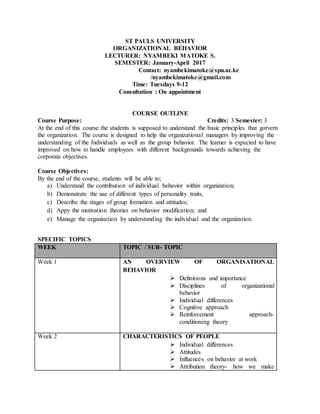
ST PAULS UNIVERSITY
ORGANIZATIONAL BEHAVIOR
LECTURER: NYAMBEKI MATOKE S.
SEMESTER: January-April 2017
Contact: nyambekimatoke@spu.ac.ke
/nyambekimatoke@gmail.com
Time: Tuesdays 9-12
Consultation : On appointment
COURSE OUTLINE
Course Purpose: Credits: 3 Semester: 3
At the end of this course the students is supposed to understand the basic principles that gorvern
the organization. The course is designed to help the organizational managers by improving the
understanding of the Individuals as well as the group behavior. The learner is expected to have
improved on how to handle employees with different backgrounds towards achieving the
corporate objectives.
Course Objectives:
By the end of the course, students will be able to;
a) Understand the contribution of individual behavior within organization;
b) Demonstrate the use of different types of personality traits,
c) Describe the stages of group formation and attitudes;
d) Appy the motivation theories on behavior modification; and
e) Manage the organization by understanding the individual and the organization.
SPECIFIC TOPICS
WEEK TOPIC / SUB- TOPIC
Week 1 AN OVERVIEW OF ORGANISATIONAL
BEHAVIOR
 Definitions and importance
 Disciplines of organizational
behavior
 Individual differences
 Cognitive approach
 Reinforcement approach-
conditioning theory
Week 2 CHARACTERISTICS OF PEOPLE
 Individual differences
 Attitudes
 Influences on behavior at work
 Attribution theory- how we make
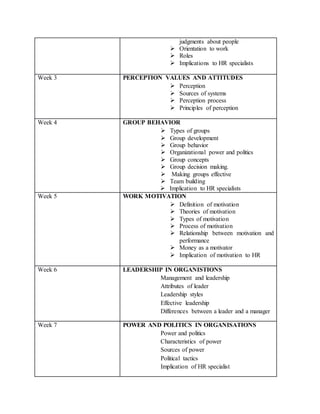
judgments about people
 Orientation to work
 Roles
 Implications to HR specialists
Week 3 PERCEPTION VALUES AND ATTITUDES
 Perception
 Sources of systems
 Perception process
 Principles of perception
Week 4 GROUP BEHAVIOR
 Types of groups
 Group development
 Group behavior
 Organizational power and politics
 Group concepts
 Group decision making.
 Making groups effective
 Team building
 Implication to HR specialists
Week 5 WORK MOTIVATION
 Definition of motivation
 Theories of motivation
 Types of motivation
 Process of motivation
 Relationship between motivation and
performance
 Money as a motivator
 Implication of motivation to HR
Week 6 LEADERSHIP IN ORGANISTIONS
Management and leadership
Attributes of leader
Leadership styles
Effective leadership
Differences between a leader and a manager
Week 7 POWER AND POLITICS IN ORGANISATIONS
Power and politics
Characteristics of power
Sources of power
Political tactics
Implication of HR specialist
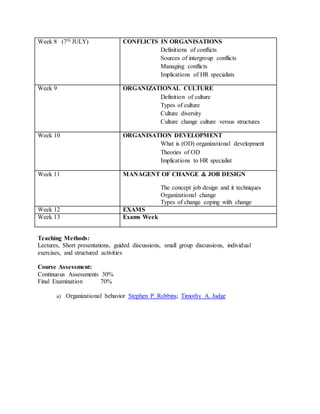
Week 8 (7th JULY) CONFLICTS IN ORGANISATIONS
Definitions of conflicts
Sources of intergroup conflicts
Managing conflicts
Implications of HR specialists
Week 9 ORGANIZATIONAL CULTURE
Definition of culture
Types of culture
Culture diversity
Culture change culture versus structures
Week 10 ORGANISATION DEVELOPMENT
What is (OD) organizational development
Theories of OD
Implications to HR specialist
Week 11 MANAGENT OF CHANGE & JOB DESIGN
The concept job design and it techniques
Organizational change
Types of change coping with change
Week 12 EXAMS
Week 13 Exams Week
Teaching Methods:
Lectures, Short presentations, guided discussions, small group discussions, individual
exercises, and structured activities
Course Assessment:
Continuous Assessments 30%
Final Examination 70%
a) Organizational behavior Stephen P. Robbins; Timothy A. Judge

Organizational Behaviour COURSE OUTLINE

  • 1.
    ST PAULS UNIVERSITY ORGANIZATIONALBEHAVIOR LECTURER: NYAMBEKI MATOKE S. SEMESTER: January-April 2017 Contact: nyambekimatoke@spu.ac.ke /nyambekimatoke@gmail.com Time: Tuesdays 9-12 Consultation : On appointment COURSE OUTLINE Course Purpose: Credits: 3 Semester: 3 At the end of this course the students is supposed to understand the basic principles that gorvern the organization. The course is designed to help the organizational managers by improving the understanding of the Individuals as well as the group behavior. The learner is expected to have improved on how to handle employees with different backgrounds towards achieving the corporate objectives. Course Objectives: By the end of the course, students will be able to; a) Understand the contribution of individual behavior within organization; b) Demonstrate the use of different types of personality traits, c) Describe the stages of group formation and attitudes; d) Appy the motivation theories on behavior modification; and e) Manage the organization by understanding the individual and the organization. SPECIFIC TOPICS WEEK TOPIC / SUB- TOPIC Week 1 AN OVERVIEW OF ORGANISATIONAL BEHAVIOR  Definitions and importance  Disciplines of organizational behavior  Individual differences  Cognitive approach  Reinforcement approach- conditioning theory Week 2 CHARACTERISTICS OF PEOPLE  Individual differences  Attitudes  Influences on behavior at work  Attribution theory- how we make
  • 2.
    judgments about people Orientation to work  Roles  Implications to HR specialists Week 3 PERCEPTION VALUES AND ATTITUDES  Perception  Sources of systems  Perception process  Principles of perception Week 4 GROUP BEHAVIOR  Types of groups  Group development  Group behavior  Organizational power and politics  Group concepts  Group decision making.  Making groups effective  Team building  Implication to HR specialists Week 5 WORK MOTIVATION  Definition of motivation  Theories of motivation  Types of motivation  Process of motivation  Relationship between motivation and performance  Money as a motivator  Implication of motivation to HR Week 6 LEADERSHIP IN ORGANISTIONS Management and leadership Attributes of leader Leadership styles Effective leadership Differences between a leader and a manager Week 7 POWER AND POLITICS IN ORGANISATIONS Power and politics Characteristics of power Sources of power Political tactics Implication of HR specialist
  • 3.
    Week 8 (7thJULY) CONFLICTS IN ORGANISATIONS Definitions of conflicts Sources of intergroup conflicts Managing conflicts Implications of HR specialists Week 9 ORGANIZATIONAL CULTURE Definition of culture Types of culture Culture diversity Culture change culture versus structures Week 10 ORGANISATION DEVELOPMENT What is (OD) organizational development Theories of OD Implications to HR specialist Week 11 MANAGENT OF CHANGE & JOB DESIGN The concept job design and it techniques Organizational change Types of change coping with change Week 12 EXAMS Week 13 Exams Week Teaching Methods: Lectures, Short presentations, guided discussions, small group discussions, individual exercises, and structured activities Course Assessment: Continuous Assessments 30% Final Examination 70% a) Organizational behavior Stephen P. Robbins; Timothy A. Judge