BBVA in2018
2018
Contents
Letters from the Group Executive Chairman and CEO 4
Introduction
About BBVA
The Group’s organizationalchart
Environment
9
10
11
12
Strategy and business model
Vision andaspiration
Progress in BBVA’stransformation journey
OurValues
Materiality
Responsible bankingmodel
16
17
19
21
23
25
Group financial information
BBVA Grouphighlights
Relevant events
Results
Balance sheet and business activity
Solvency
Risk management
The BBVAshare
26
27
28
30
36
38
40
44
Business Areas
Banking activity inSpain
Non Core Real Estate
The United States
Mexico
Turkey
South America
Rest of Eurasia
Corporate Center
Otherinformation: Corporate &Investment Banking
46
50
53
55
58
61
64
68
70
71
2018
Customer relationship
Customer experience
Customer care
Solutions forcustomers
74
75
77
81
People management
Professional development
Working environment
Remuneration
Volunteer work
84
86
94
99
101
Responsible practices
Compliance system
Internal controlmodel
Commitment to humanrights
Fiscal transparency
Suppliers
102
103
109
111
114
117
Sustainable finance
Sustainable financing
Social and environmental impactmanagement
Engagement with globalinitiatives
120
122
127
134
Community investment
Investment in socialprograms
Financial education
Entrepreneurship
Knowledge, education andculture
144
145
148
152
155
Corporate Governance
BBVA Corporate GovernanceSystem
158
159
Report preparation guidelines
Criteria andstandards
GRI indicators
Independent assurancereport
164
165
167
177
Letters from the
Group Executive
Chairman and
CEO
Creating Opportunities
L e t t e r f r o m t h e Group executive chairman2018 P.5
Letter from the GroupExecutive
Chairman
DearShareholders,
It is an honor for me to address you as Chairman of BBVA for
the first time. My appointment and other recentchanges to
the managementteamwill provide continuity to our strategy
andanevengreaterfocus onourPurpose:to bring the age of
opportunity to everyone.Thisis whatmovesallofusatBBVA.
The Purpose guidesour strategyand inspires our culture
andvalues.It is whatultimatelyenablesustoachievebetter
financial results for ourshareholderswithalong-termvision.
BBVA’s excellentresults in 2018 are a good exampleof our
successful strategy, despite the volatilityin some of the
countries within our footprint, namely Turkey and Argentina.
Our net attributable profit reached €5,324 million in 2018,
a 51% increase over 2017 (or 7% in comparableterms) - an
achievement driven by recurring revenues,cost containment,
and the capital gains from the sale of BBVA Chile. The book
value per share increased 10.1% and the return on tangible
equity stood at 14.1%, positioning BBVA as a leader in
profitability in the financial sector. The Group’s fully-loaded
CET1 ratio ended the yearat 11.34%,26 basis points above
December2017.
In addition to achieving excellentfinancial results, in 2018 we
also workedtoaddressthebigchallengesfacingsociety today.
Weare living in a truly revolutionaryage,driven by the rapid
emergenceof newtechnologies, such as artificial intelligence,
cloud computing, the proliferation of connected devices,
decentralized applications, blockchain and biometrics, to
name a few.All of this representsa genuineera of opportunity
for humanity, but thereare also significant social and
environmental challenges,such as the fight against climate
changeandinequality.Challengesthatareglobalinnature
and that requireeveryone’sinvolvement,including banks as
important playersin theeconomy.Wecanmakeadifferenceby
financing socially sustainable projects and providingfinancial
advicetohelppeopleachievetheir lifegoals.
This is why I specifically want to emphasizeour contribution
in the face of these challenges.In 2018, in addition to our
commitment with the United Nations Global Compact, we
publicly embraced the Pledge 2025, our commitment to
sustainable finance, which is based on three central pillars.
First, a commitment to finance sustainable development,
mobilizing€100billion through2025tocombatclimate
change, facilitating the transition to a low-carbon economy,
andpromotingsustainableinfrastructure, financial inclusion
and entrepreneurship.Second, a commitment to manage
theimpactour business activityhason theenvironment.
Our commitments include reducing CO₂ emissions by 68%
by2025andreaching70%useofrenewableenergy.Lastly,
actively engagingother stakeholderstopromoteacollective
approach to sustainabledevelopment.
In 2018 we played a defining role in the development of the
Principles for Responsible Banking, togetherwith 16other
financial institutions. These principles representthe guiding
frameworkfor financial institutions-anewapproachtobanking
that society both demands and needs.Our success ultimately
depends on the prosperity of the communities weserve. We
need an inclusive society, one that takes a sustainable
approach to naturalresources.
In addition to promoting sustainable development and
contributing tothegeneration ofwealth,growth,andindividual
prosperity, the BBVA foundations make an invaluable
contribution to society. The foundations undertake an
important work in economic, cultural, and scientific
fields, such as promoting the development of vulnerable
segments of the population. Other examples include BBVA
Foundation’sprestigious Frontiersof KnowledgeAwards,BBVA
Bancomer Foundation’sprogramto rebuild schools and its
scholarship program“Porlos quesequedan”.Additionally,
theBBVAMicrofinance Foundationhasworkedon creating
opportunities for the most vulnerable, especially women
forovertenyears.Thisfinal exampleisin fact theprivate
philanthropic initiativethat has had the greatest social impact
in LatinAmerica, successfully supporting morethanfivemillion
entrepreneursoverthepast tenyears.
Technologyandtheconsiderablechangestakingplacein the
Worldareclearlyhavingasignificant impacton ourbusiness.
Opportunities are increasinglyfound in the digital world. At
BBVA wehavebeen pioneers, and wecontinue to be at the
forefrontwithourcommitmenttodigitaltransformation.
Thanks to these efforts our customers increasinglyinteract
with the bank throughdigital channels, which are always
availableandmoreconvenientthaneverthankstoour simple,
intuitiveuserexperience.
L e t t e r f r o m t h e Group executive chairman2018 P.6
Our business is changing both profoundly and quickly. These
changesareexemplified byour increasing digitization.In 2018,
41% of BBVA Group unit sales were made through digital
channels, compared to just 16%two years ago. In terms of
value, digital sales account for 32% compared to 12%two
years ago. This significant transformation is not only reflected
at the Group level,but representsa trend that is repeated in
eachofthecountries whereweoperate.
The evidenceshows that customers who use digital
channelsinteractwith us morefrequently,andreportgreater
satisfaction and loyaltyto BBVA.In 2018 we achieved a key
milestone: our digital customer base surpassed the 50%
threshold, reaching 27million.The bank’s mobile customer
base has increased by 29%, reaching 23 million mobile users,
or 43% of total customers. Our goal is to havemore than 50%
our customers interacting with us through their smartphones
in 2019.
Beyondtheimportant changesin thewaycustomers interact
with us, the newera in which weliveenablesus to create
opportunitiesthroughanevenbettervalueproposition.
The focus is on helping people and businesses make
better financial decisions that help them better achieve
their personal and professional goals.The waywetreat our
customers’ data and the use of artificial intelligenceare
fundamentalingredientsin thisenhancedvalueproposition.
In 2018,wedevelopednew features that use data to help
anticipate problems, draw conclusions, and make better
recommendations; ultimately to offer our customers value-
added services. As a result, BBVA Spain’s mobile banking
app was recognized as the best in the world for the second
year in a row by consulting firm Forrester Research. BBVA
Turkey’s app ranked second in thesamestudy.Among other
distinctions, wewererecognized as thebest digital bank
in Spain,Mexico, andTurkeyaccording toWorld Finance
magazine’sDigital BankingAwards.
Ourbusiness transformation is undoubtedlytiedtohow
wedo things internally.For this reason,the waywework is
also changing,driven by the necessary cultural revolutionin
this newage.We are leaders in the financial sector in the
adoption of agile methodologies, which has transformed
the way the entire organization works, using independent,
multi-disciplinary teams. By workingin thismanner,wehave
managedto improvethe qualityof our deliverables, reduce
time-to-market, increaseproductivity andenhanceemployees’
senseofbelonging.Therearecurrently some30,000 peopleat
BBVAusingagilemethodologiesintheir dailyactivities.
Most importantly, beyond changingthe waywework, BBVA’s
culture remainsdeeplyrooted in a strong set of values. We
havealways considered thistobeoneofour biggeststrengths.
BBVA is a honest bank, and we will always act in the
best interest of our shareholders showing absolutely no
tolerance for any conduct or behaviour that runs counter
to our values.
Thethreevaluesguidingour actionsandbehaviorsare:
“The customer comes first,” meaning weare empatheticand
putourselvesinthecustomer’s shoes.Weare,andhavealways
been,principled andresourcefulandarefast agileanddecisive
whensolvingcustomers’problems andaddressing their needs.
“We think big,”notjustin thesensethatweareambitious,
but also becausewebreak molds. Weinnovateand
promotechangein thestatu quo, amazingcustomers with
uniquepersonal experiencesand solutions that beat their
expectations.
“We are one team,” personally committed to the bank, the
project,andour customers.Thereis mutualtrust,asenseof
ownershipandafeelingthatweallareBBVA.
In conclusion, I amtremendously proud to be leadingwhat I
believeto be the greatestproject in the world of banking.A
projectthatispossiblethankstoeachandeveryoneofthemore
than 125,000people who work at BBVA. I would liketo thank
them for their dedication and commitment to our Purpose and
ourvalues,andcongratulatethemonajobwelldone.
Finally,thanks to you, our shareholders, for your constant
support, which motivates us to continue giving our best
every day.
1March2019
CarlosTorres Vila
L e t t e r f r o m t h e chief executive o f f i c e r2018 P.7
Letter from the ChiefExecutive
Officer
DearShareholders,
BBVA posted strong results in 2018. Our diversified
business model has once again proved its resilience
and capacity to generate recurring income with double-
digit returns, despite a complex environment with high
volatility and significant depreciation of currency in some
footprint countries.
The global economy grewby 3.6% despiteincreased volatility
and trade tensions. In our footprint, performance varied
among countries. Wesaw positive trends in Spain, with
growth of 2.5%, which was above the Eurozone average,and
in theUnited States, theeconomy grewby2.9%,driven
by expansionary fiscal policies. Growth in our U.S. Sunbelt
footprint was 3.2%,higher than thecountry’s average.Mexico
maintained solid growth of more than 2%, which was strong
in ayearinfluencedbypresidentialelections.Colombia
and Peru also showed strong growth of 2.6% and 3.9%
respectively. In Turkey and Argentina, volatility was high and
BBVAfaced significantcurrency devaluations, although there
was someimprovementin thelast quarterof theyear.
BBVA Group’s net attributable profit in 2018was €5,324
million, representing a 51.3%increase versus 2017(7%
increase on amorecomparable basis).The net attributable
profit was impacted by the capital gains realized from the
2018sale of BBVA Chile and the 2017impairment of the
Group’s stake inTelefónica.
Tangiblebook valueper share plus dividends increased by
10.1%overtheyear,despitethedepreciationsin theTurkishlira
andtheArgentinepeso.Thisincreaseis accompaniedbypeer-
leading double-digit returns in both return on tangibleequity
andreturnon equity,which were14.1%and11.6%respectively.
Also of note is the trend in recurring revenue,10.4% growth
in the year in constant Euros (without accounting for the
impact of the exchange rate) and discipline in cost control,
which grew by just 2.5%, well below the averageinflation of
our footprint. This trend was repeatedconsistently across
our geographies. Because of this, the efficiency ratio of the
Group has improvedby 89 basis points to 49.3%,despite the
negative accounting impact the hyperinflation adjustment in
Argentina had on grossincome.
Oneof thekeysto efficiency improvementhas been making
our business more digital, which has increased sales in a
very efficient manner. It also has an impact on customer
satisfaction and weare leaders in six of our banking
franchises,which has adirect effect on improving customer
loyalty and reducingattrition.
The strength of the Group’s risk indicators must also be
highlighted, with the NPL ratio improving significantly, ending
2018at 3.9%, down 61basis points compared to 2017.The
NPL coverage ratioimproved812basis points over theyear to
73%.The Group’s cost of risk remainedlowat 1%.
The resilience of our capital position from a solvency
standpoint is also worth to mention. The fully loadedCET1
ratio was 11.34%in 2018,an increaseof 26 basis points over
theyear.Thishasbeenachieved,despitetheimpactofmarket
trends, particularly the depreciation of some currencies and
thefirst implementationoftheIFRS 9 standard.
The most notable impacts in themainbusiness areas
included thefollowing:
Banking activity in Spain: Net attributable profit grew
10.8% to €1,522 million driven by fees, significant costs
reductionand lowerimpairments.In termsof asset quality,
wesaw asignificantdecliningtrend in our NPL ratioand the
cost of risk, which were4.6%and 0.21%respectively.
In Non-Core Real Estate, the significant reduction of net
realestate exposure stands out,as aresult of theOctober
close of thesale of BBVA’s realestatebusiness in Spain to
Cerberus, as well as other portfolio sales during the year.
Net losses weresignificantlyreduced to €78 million.
IntheUnited States, netattributableprofit was €735million,
56.9%higherthan2017inrealterms,primarilysupportedby
thefavorableperformanceofnetinterestincome.
In Mexico, netattributableprofitfor theareawas€2,384
million, representinga year-over-yearincreaseof 16.1%
inrealterms,supported bythenetinterestincomeand
efficiency improvement.Risk indicators werestrong,withall
ratios showingimprovements.
L e t t e r f r o m t h e chief executive o f f i c e r2018 P.8
In Turkey, the bank again demonstrated its capacity to
generate high pre-provision profit that can absorb the
increase in provisions derived from the deterioration in
macroeconomicconditions. Net attributableprofit wasat
€569 million,representing ayear-over-yeardecrease of
4.5% in realterms.
South America generated a net attributable profit of €591
millionin 2018,which representsayear-over-yearchangeof
-16.5%mainlyduetotheaccounting impactofhyperinflation
in Argentina (-€266 million) and the changein the business
unit composition derived from thesale of BBVA Chile, which
closed inJuly 2018.
Finally, I wantto heartilythank the more than 125,000
employeesin the Group for their effort and enormous
contribution to the Group’sperformance.Also, thanks to you,
the shareholders,for your constant support which drives us to
fulfillourPurposeofbringingtheageofopportunitytoeveryone.
1March2019
Onur Genç
Introduction
About BBVA
The Group’s organizationalchart
Environment
i nt ro d uc t i o n2018 P.10
Introduction
about BBva
BBVA is a customer-centric global financial services group
founded in 1857.Its Purpose is to bring theageof opportunity
to everyone. This motto reflects the Entity’s role as enabler,
offering its customers the best bankingsolutions, helping
them make the best financial decisions and making a true
difference in their lives. Welive in the era of opportunities,
where technology offers universal access to education and
offers many more people than ever before the possibility of
embarking on projects and chasing their dreams. BBVAhelps
people maketheir dreams come true.
The Group operates in more than 30 countries. The Group
has a solid position in Spain, is the largest financial institution
in Mexico and has leadingfranchises in South America and
theSunbeltRegion of theUnited States. It is also Turkish bank
Garanti’s leadingshareholder.Its diversified business is based
on high-growth markets and it relies on technology as a key
sustainable competitive advantage.
BBVAhas aresponsiblebankingmodel based on seeking
out areturn adjusted to principles, legalcompliance,best
practices and the creation of long-term value for all its
stakeholders.
Europe
Germany
NorthAmerica Belgium
The UnitedStates Cyprus
Mexico Spain
Finland
France
South America
Holland
Italy
Asia-Pacific
China
Argentin
a Bolivia
Brazil
Chile
Colombi
a
Paraguay
Peru
Uruguay
Ireland
Luxembour
g Malta
Portugal
UnitedKingdom
Romania
Switzerland
Turkey
Hong Kong
Japan
Singapor
e
Venezuela
€ 677 74.5 >30 7,963 32,029 125,627
billion in total
assets
million
customers
countries branches ATMs employees
Dataat the close of 2018.Those countries in whichBBVA hasno legalentity or the volumeof activity is notsignificantarenot included.
i nt ro d uc t i o n2018 P.11
the Group’s organizational chart
At the end of 2018,the Board of Directors of BBVA approved
anew organizational structure,aimedat fostering the Group’s
transformation and businesses, whilefurther specifying
responsibilities for executivefunctions.
The mainaspects of theneworganizational structure areas
follows:
The Group Executive Chairman is responsiblefor
the management and well-functioning of the Board of
Directors,thesupervision of the managementof theGroup,
the institutional representation, and leadingand boosting
theGroup’s strategy and its transformation process.
The areas reporting directly to the executive chairman
are those related to the transformation’s key levers:
Engineering & Organization, Talent & Culture and Data;
those related to the Group’s strategy: Global Economics
& Public Affairs, Strategy & M&A, Communications and
the new figure Senior Advisor to the Chairman; and the
Legal-relatedand Board-relatedareas:Legaland General
Secretary.
The Chief Executive Officer (CEO) is in charge of the daily
management of the Group’s businesses, reporting directly
to BBVA’s Board of Directors.
The areas reporting to theCEO aretheBusiness Units in the
differentcountries and Corporate & Investment Banking,
as wellas thefollowing globalfunctions: Client Solutions,
Finance, that integrates the functions of accounting and
tax,and Global Risk Management.
Additionally, certain control areas strengthen their
independence, establishing a direct reporting of their
heads to the Board of Directors through the corresponding
committees.Thesecontrol areasareInternalAudit andthe
new Supervisors, Regulation & Compliance, areathat is in
charge of the relationship with regulators and supervisors,
the monitoring and analysis of regulatory trends and the
developmentof the Group’s regulatory agenda, and the
management of compliance-relatedrisks.
Chief ExecutiveOfficer
Onur Genç
BUSINESS UNITS
Corporate&Investment Banking
Luisa Gómez Bravo
Country Monitoring(1)
Jorge Sáenz-Azcúnaga
Country ManagerSpain
Cristina de Parias
Country ManagerMexico
Eduardo Osuna
Country Manager The UnitedStates
Javier Rodríguez Soler
GLOBALFUNCTIONS
ClientSolutions
Derek White
Finance
Jaime Sáenz de Tejada
Global RiskManagement
Rafael Salinas
TRANSFORMATION
Engineering&Organization
Ricardo Forcano
Talent &Culture
Carlos Casas
Data
David Puente
STRATEGY
GlobalEconomics& PublicAffairs
José Manuel González-Páramo
SeniorAdvisorto the Chairman
Juan Asúa
Strategy &M&A
Victoria delCastillo
Communications
Paul G.Tobin
LEGAL AND CONTROL
Legal
María JesúsArribas
GeneralSecretary
Domingo Armengol
Internal Audit(2)
Joaquín Gortari
GroupExecutiveChairman
Carlos Torres
Supervisors, Regulation &
Compliance (2)
Eduardo Arbizu
Country Manager Turkey
Fuat Erbil
(1)Reportingchannel toCEOfor Argentina,Colombia,Peru, Venezuela, Uruguayand Paraguay,as wellas monitoringof allcountries,including Spain, Mexico,The UnitedStates and Turkey
(2) ReportingtotheBoard ofDirectorsthroughitscorrespondingcommittees
i nt ro d uc t i o n2018 P.12
environment
Macroeconomic environment
Global economic growth maintained robust throughout 2018
(approximately 3.6%), althoughit slowed morethan expected
in the second half of the year and the latest data on activity
and confidencehave generallygiven negative surprises.
In particular, indicators linked to the industrial sector and
international trade showed a clear deterioration, while those
most closely linked to consumption and investment have
resisted better.Poorer economic figures in Europe and China
were accompanied by downwards trends in Asian countries
and a certain cyclical deterioration in the United States that
was new. The fear of a rapid global slowdown and the rise of
protectionist risks also led to a sharp increase in the prices
of refugeassets and capitaloutflows.Given this context of
greater global uncertainty,and with inflation moderating as a
result of lower oil prices, the main central banks, particularly
the FederalReserve (Fed), reacted with caution in their plans
for normalization of monetary policy, which has been a key
factor in the containment and partial reversal of tensions
since thebeginningof theyear.
Global GDP growth and inflation in 2018
(Real percentagegrowth)
GDP Inflation
World 3.6 3.9
Eurozone 1.8 1.7
Spain 2.5 1.7
The UnitedStates 2.9 2.4
Mexico 2.2 4.9
South America (1) 1.3 8.4
Turkey 3.0 16.3
China 6.6 1.9
Source: BBVA Researchestimates.
(1)It includes Argentina,Brasil,Chile, Colombia,Paraguay,Peru andUruguay.
Digitalization and changing consumer behavior
Digital activity is outpacing growth in overalleconomic
activity. Society is changing in line with the exponential
growth in technology (internet, mobile devices, social
networks, cloud, etc.).As aresult,digitalization is therefore
revolutionizing financial services worldwide.Consumers
are altering their purchasing habits through use of digital
technologies, which increase theirability to access financial
productsand services at anytimeand fromanywhere.
Greater availability of information is creating more demanding
customers, who expect swift, easy and immediate responses
to their needs. And digitalization is what enables the financial
industry to meetthesenewcustomer demands.
Technology is the lever for change which allows the value
proposition to be redefined to focus on customers’ real
needs.The use of mobile devices as the preferred and often
only tool for customers’ interactions with their financial
institutions has changed the nature of this relationship and
thewayin which financial decisionsaremade.It is crucial
to offer customers a simple, consistent and user-friendly
experience, without jeopardizing security and making the
most of technologicalresources.
Artificial intelligence (AI) and big data are two of the
technologies that are currently driving the transformation
of the financial industry. Their adoption by various entities
translates intonewservices for clientsthat moreaccessible
andagile,andatransformation in internal processes.AI allows,
among other things, offering personalized products and
recommendations to customers and makedecisions more
intelligently.These technologies are not only in the hands of
traditional companies butFintechalsomakesuseof them.
Data are the cornerstone of the digital economy. Financial
institutions must make the most of the opportunities offered
by technology and innovation, analyzing customer behavior,
needs and expectations in order to offer them personalized
andvalue-added services,and helpthemin makingdecisions.
The developmentof algorithms based on big data can lead to
thedevelopmentof new advisory toolsfor managing personal
finances and access to products which until recently were
only availableto high-valuesegments.
The digital transformation of the financial industry is
boosting efficiency through automation of internal processes,
with theuse of newtechnologies to remainrelevant in
the new environment, such as blockchain and the cloud;
data exploitation; and new business models (platforms).
Participation in digital ecosystems through alliances and
investments provides awayto learn and takeadvantageof
theopportunities emergingin thedigital world.
The financial services market is also evolving with the arrival
of new players: companies offering financial services to a
specific segment or focused on a part of the value chain
(payment, finance, etc.).Thesecompanies aredigital natives,
rely on data use and offer a good customer experience,
sometimes exploiting a laxer regulatory framework than that
for the bankingsector.
i nt ro d uc t i o n2018 P.13
Regulatory environment
1.Banking package for the reduction and distribution of
risks to finalize the banking union
The most important focus in the European regulatory
agenda in 2018was the negotiation of the banking package
that includes the measures proposed by the Commission
intended to reduce and share risks in the bankingindustry. In
recent years, the construction of the banking union project
has madesignificant progress but there are still elements
pending development,which regulators have been adjusting
at thetechnical levelthroughout theyear.
a) Prudential measures
The prudential measures proposed are intended to
implement internationally agreedreforms between the
years of 2014and 2016(which do not correspond to the
standards known as Basel IV). Additional requirements
include the requirement of a net stable financing ratio, or
aleverageratio,and thereview of the capitalrequirements
of the financial liabilities held for trading (fundamental
review of the trading book - FRTB). At the same time,
2018was the first year in which the Single Resolution
Mechanism (SRM)communicated the Minimum Required
Eligible Liabilities (MREL) for each European bank on the
basis of the Bank Recovery and Resolution Directive 1
(BRRD 1).
b) Non-Performing Loans
In theadvances madein thepackageof measures for the
adequate recognition and valuationof non-performing
loans, twoprovision backstops stand out:theaddendum
to the Guide on NPLs (Non-Performing Loans) of the
ECB,within thesupervisory dialog ensconced in Pillar
II, alreadyin force, and the proposal of the European
Commission, for mandatory compliance contained within
Pillar I, still under discussion.Minimumcoverage levelsare
established for these loans based on the time they have
been classified as non-performing and based on whether
or not they have applicable guarantees in effect. Any lack
of provisions must bededucted from theCET1 capital.
c) Guarantee systems
On the one hand, an agreementwas reached to begin
political negotiations involving the European deposit
insurance scheme (EDIS). On the other hand, it was
agreed at the June Euro Summit that the European
StabilityMechanism (ESM) will evolve intothe backstop
for the Single Resolution Fund (SRF), with a maximum
provision of €60.0billion.
d) Sovereignrisk
At the global level, the work performed by the Basel
Committee establishes not to modify the regulatory
treatmentof sovereignexposures in theshort term.
At theEuropean level,thediscussion focused on the
developmentof a new low-risk asset backed by a
set of Eurozone sovereignbonds(sovereign bond-
backed securities - SBBS). According to the European
Commission, these assets could potentially contribute
to the diversification of the sovereign portfolios of credit
institutions,as wellas to reduce financial fragmentation.
These measures were encouraged in order to get all
Banking Union elementsoperational in 2019,and thus
to create greater integration and diversification in the
European financial sector and to build a stronger and
moreresilienteconomic andmonetary union.
2. Culmination of the Capital Markets Union (CMU)
In 2018,theEuropean Commissionadvanced anumber of
its pending action plans to complete the Capital Markets
Union (CMU) in mid-2019.These include: i) review of the
Directive and Regulation of mortgage-covered bonds and
the Regulation of simple, transparent and standardized
securitization (STS) to boost both markets with the goal
of lowering the cost of financing for therealeconomy and
SMEs; ii) measures to facilitate the cross-borderdistribution
of mutualfunds and securities and boost thegrowth of SME
markets; iii) a pan-European venture capital fund program
(VentureEU) intended to stimulate investment in emerging
and expandinginnovativecompanies throughout Europe;
and iv) asustainable finance action plan,consolidating
theregulatory importanceof integrating this typeof finance
into the EU financial system, as well as the inclusion of
environmental,social and governanceissues (ESG) in long-
term investmentdecision-making.
3. Reference indices: EONIA and Euribor
The revision of interbank offering rates (IBORs) continues
in order to adapt them to international principles and
European regulations on indexesin termsof methodology,
transparency, governanceand others. In 2018,the ECB
formed a working group with representatives of the
financial industry (ERFR) with the goalof identifying and
recommending alternativerisk-free indices to thoseexisting
in the eurozonetoday.
The ERFR recommended the Euro Short-Term Rate
(ESTER) prepared by the ECB as the alternative index to
EONIA.The transitionfrom EONIA to ESTER will becarried
out in 2019according to theERFR work plan.
The hybrid methodology that combines real operations
and expert judgment advances in accordance with the
deadlines established and could be implemented in 2019.
The Euribor supervisor, FSMA (Financial Services and
Markets Authority), confirmed that the results of the
parallel exercise,between the current methodology and the
newhybrid methodology,carried out byits administrator,
i nt ro d uc t i o n2018 P.14
EMMI (European Money Markets Institute), would allow to
approvethe newmethodologyduring thesecond quarterof
2019.
4. Global discussions focused on the implementation of
capital and resolution measures
UponcompletionoftheBaselIIIframeworkinDecember2017,
which is set to come into force in January 2022 (although
some of its elementswill not be fully operational until2027),
theEuropeanCommissionbeganitspreparationworkin
2018by publishing a Call for Advice (CfA) to the EBA on the
implementationof Basel III in Europeanlegislation. For this
reason,theEBAlaunchedanad-hocquantitativeimpactstudy
(QIS) in August. This exercise was based on the Basel QIS
exercise,inwhichBBVAalsoparticipated.
With regard to financialinstitutions’ recovery and resolution
framework, thereareopendiscussions thatrevolvearoundthe
implementationof the bail-intool and the needfor liquidity in
resolution.For this reason, the FinancialStabilityBoard (FSB)
publishedits final guidelineson resolutionfunding, as well as
a reviewon the implementationof the total loss-absorbing
capacityguidelines(TLAC),inadditiontobankresolutionplans.
5. Regulation in the field of the digital transformation of
the financial sector
In 2018,the digital transformation of the financial sector
was specified as a priority for the authorities. In Europe, the
Commission and the European Banking Authority published
action plans, and in Mexico, a Law to RegulateFinancial
TechnologyInstitutions was enacted. At the global level, the
regulatory debatethat beganin 2017intensified, and calls for
greater international cooperation in the definition of the new
regulatory framework for digital financial services increased.
The authorities have agreedon their identification of
priorities. They have highlighted: i) the identification
of measures to favor the controlled developmentof
newbusiness models, and barriers to the adoption of
innovativetechnologies in thefinancial sector; andii)
the implementation of schemes to facilitate innovation
(regulatory sandboxes -scheme to enablefirms to test,
pursuantto aspecific testing plan agreedand monitored by
adedicated function of thecompetent authority, innovative
financial products, financial services or business models- and
innovation hubs -point of contact for firms to raise enquiries
with competent authorities on FinTech-related issues and to
seek non-binding guidance on the conformity of innovative
financial products, financial services or business models
with licensing or registration requirements and regulatory
and supervisory expectations-). A legislative proposal was
presented in Spain in 2018 to create a regulatory sandbox,
which will beoperational in 2019.
Cybersecurity also remainedamongthetop priorities
of the financial sector and authorities. Increases in the
frequency and sophistication of cyberattacks explain why
work continued to improveharmonization and international
cooperation throughout 2018.Cybersecurity took center
stage in the agenda of the European Commission and the
European Central Bank in 2018.
The new Payment Services Directive (PSD2) came into
force in January 2018,and work continued on the process
defining the technical details throughout the course of the
year. This Directive seeks to encourage competition and
strengthen the security of payments in Europe. Tothis end,
it regulates access to customer paymentaccounts by third
partiesthat may offer information-aggregation services and
initiate payments.
Digitization makesit possible to store, process andexchange
largevolumes of data. This trend facilitates the adoption of
technologies, such as big data or artificial intelligence, but
also raises concerns about how to ensure the privacy and
integrity of customer data. In Europe, this has materialized
in the form of two regulations:the GeneralRegulation of Data
Protection (GDPR), which came into force in May 2018,and
thee-Privacy Regulation,which is still under debate.
The recognition of data as a strategic asset in the digital
economy increased in 2018,making it necessary to create
attractive value propositions and strengthen customer
confidence. In 2018,the approvalof the new European
regulationof freeflow of non-personaldata joinedtheopen-
bankingregulations, such as theaforementionedPSD2
and GDPR, or the standards included under the Fintech
lawin Mexico, which regulateaccessibility and theright to
portabilityof data,was added in 2018.
In addition,the public debateon therole of largetechnology
companies in the digital economy and financial sector
intensifiedthroughout thecourse of theyear.In Europe,
the Commission presented a proposal for regulations
to delimitcertain obligations in its role as aplatformfor
theintermediation of online services,in the interest of
transparency and equity.It is expected that this trend will
continue throughout2019.
i nt ro d uc t i o n2018 P.15
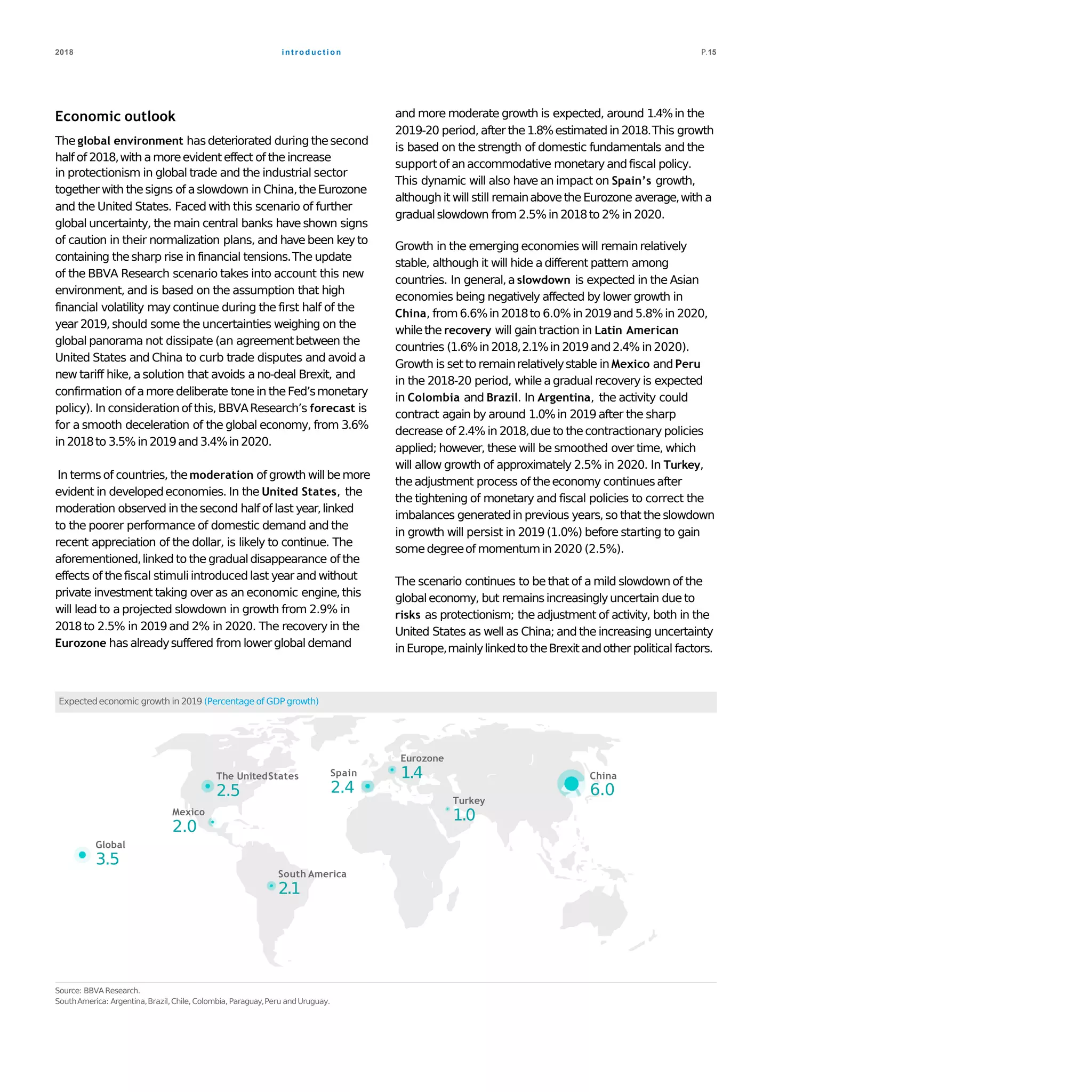
Economic outlook
The global environment hasdeteriorated during thesecond
half of 2018,with amoreevident effect of theincrease
in protectionism in global trade and the industrial sector
togetherwith thesigns of aslowdown in China,theEurozone
and the United States. Faced with this scenario of further
global uncertainty, the main central banks have shown signs
of caution in their normalization plans, and have been key to
containing thesharp rise in financial tensions.The update
of the BBVA Research scenario takes into account this new
environment, and is based on the assumption that high
financial volatility may continue during the first half of the
year 2019, should some the uncertainties weighing on the
global panorama not dissipate (an agreementbetween the
United States and China to curb trade disputes and avoid a
new tariff hike, a solution that avoids a no-deal Brexit, and
confirmation of amoredeliberate tone in theFed’smonetary
policy). In consideration of this,BBVAResearch’s forecast is
for a smooth deceleration of the global economy, from 3.6%
in 2018to 3.5% in 2019and3.4%in 2020.
In terms of countries, themoderation of growth will bemore
evident in developedeconomies. In the United States, the
moderation observed in thesecond half of last year,linked
to the poorer performance of domestic demand and the
recent appreciation of the dollar, is likely to continue. The
aforementioned,linked to the gradualdisappearance of the
effects of thefiscal stimuliintroduced last yearand without
private investment taking over as an economic engine, this
will lead to a projected slowdown in growth from 2.9% in
2018to 2.5% in 2019and 2% in 2020. The recovery in the
Eurozone has alreadysuffered from lowerglobal demand
and more moderate growth is expected, around 1.4%in the
2019-20 period,after the1.8%estimated in 2018.This growth
is based on the strength of domestic fundamentals and the
supportof anaccommodative monetary and fiscal policy.
This dynamic will also have an impact on Spain’s growth,
althoughit will still remainabovethe Eurozone average,with a
gradualslowdown from 2.5% in 2018to 2% in 2020.
Growth in the emerging economies will remain relatively
stable, although it will hide a different pattern among
countries. In general,a slowdown is expected in the Asian
economies being negatively affected by lower growth in
China, from6.6%in 2018to 6.0%in 2019and 5.8%in 2020,
whilethe recovery will gain traction in Latin American
countries (1.6%in 2018,2.1%in 2019and2.4% in 2020).
Growth is set to remainrelativelystable in Mexico and Peru
in the 2018-20 period, while a gradual recovery is expected
in Colombia and Brazil. In Argentina, the activity could
contract again by around 1.0%in 2019 after the sharp
decrease of 2.4% in 2018,due to thecontractionary policies
applied; however, these will be smoothed over time, which
will allow growth of approximately 2.5% in 2020. In Turkey,
theadjustment process of theeconomy continuesafter
the tightening of monetary and fiscal policies to correct the
imbalances generatedin previous years,so that theslowdown
in growth will persist in 2019 (1.0%) before starting to gain
somedegreeof momentumin 2020 (2.5%).
The scenario continues to be that of a mild slowdown of the
globaleconomy, but remainsincreasinglyuncertain due to
risks as protectionism; the adjustment of activity, both in the
United States as well as China; and the increasing uncertainty
inEurope,mainlylinkedtotheBrexitandother political factors.
Expectedeconomic growth in 2019 (Percentage of GDP growth)
6.0
China
Global
3.5
South America
2.1
Mexico
2.0
The UnitedStates
2.5
Spain
2.4
Eurozone
1.4
Turkey
1.0
Source: BBVA Research.
SouthAmerica: Argentina,Brazil,Chile, Colombia, Paraguay,Peru andUruguay.
Strategy and
business model
Vision andaspiration
Progress in BBVA’stransformation journey
OurValues
Materiality
Responsible bankingmodel
StrateGy a nd BuSineSS modeL2018 P.17
Strategy and businessmodel
BBVAmadesignificantprogress in its transformation
process during 2018,based on its Purpose, thesix Strategic
Priorities,and its Values, allof which arefundamental pillars
of the Organization’s overallstrategy.
vision and aspiration
BBVAisatransformationprocess thatisnecessaryforadapting
to the new environmentin the financial industry,characterized
by trends thatconfirm the Group’s strategicvision, that is, a
reconfiguration of the entire financial services industry is
takingplace.Thesetrendsarethefollowing:
Acomplex macroeconomic environment,characterized
by strong regulatory pressure, low interest rates, high
currency volatility,and geopolitical risks.
A highlyregulatedbanking industry, that is, traditional
bankingsubject to alargenumber of legalregulations,
both globally andlocally.
A shift in the needs and expectations of customers
who demand higher value-added services that enable
them to achieve their objectives, with asimple,
transparent and immediate relationship model similarto
the one they already enjoy with a number of otherhighly
digitized industries.
Certain data that is evolving into a strategic asset. Given
the largeamount of data stored within organizations, the
ability to interpret and makevalueproposals to customers
is considered to be critical, provided there is customer
consent under all circumstances.
Certain technological giants, with business models based
on data that create ecosystems where the lines between
differenttypes of businesses aregettingblurred.
Greater competitionas aresult of thearrival of new players
whofocus on themost profitableaspects of thevalue chain.
In this context, the main objective of the Group’s
transformation strategy its aspiration is to strengthen the
relationship with its customers.
Providing the bestsolutions
that generate trust for our
customers, being clear,
transparent andbased
on integrity
Helping ourcustomers
to make the bestfinancial decisions
offering relevantadvice
Through an easy and
convenientexperience
DIY throughdigital channels or
human interaction
New valueproposition
Based on our customers’ realneeds
Our aspirationis to strengthen therelationshipwith thecustomer
StrateGy a nd BuSineSS modeL2018 P.18
With the aim of promoting the newvalueproposition of the
Groupwithintheframeworkofthetransformationstrategy,we
wanttooffercustomers:
advice based on data through the developmentof
solutions that provide them with added value, helping
themto achievetheir objectives, thebest decision-making
and providing peace of mind whilestrengthening the
relationship of trust with BBVA; and
productsandservices forcustomers and non-customers,
100% digital, simple and fast, through fully automated
processes,and from our own andthird-party channels.
Forthis wearesupporting ourselves in:
advancefirmly in the transformationtowards atruly data-
driven company in which alldecisionsaremadebased on
data and in which the creation of our product and service
offerings is fed with data-based intelligence;
in a software developmentplatform that enables a global
ecosystem of developers who work collaboratively to build
productsthat customers request, increasingly rapidly and
incorporating the latest technologies;and
an agile organization, in which the teams are directly
responsible for what they do, build everythingfrom the
customer’s feedback and are focused on delivering the
solutionsthat best meetthe current and futureneeds of
the clients.
StrateGy a nd BuSineSS modeL2018 P.19
progress in BBva’s transformation journey
BBVA advanced in fulfillment of its Purpose in 2018:To
bring the ageof opportunityto everyone,which is reflected
in the tagline: Creating Opportunities.Wewantto help our
customers makebetter financial decisionsand attain their
life goals; wewant to be more than a bank, wewant to be
an engineof opportunities and have a positive impact on
peoples’lives and companies’businesses.
In this respect, important steps were taken in the
developmentof the six Strategic Priorities of the Group
throughout the year in order to continue its advances in the
transformationprocess. These advances were reflected in the
results of keyperformanceindicators (KPIs).
OUR PURPOSE
To bring theage
of opportunity
to everyone
SIX STRATEGIC PRIORITIES
New standard in customer experience
Digitalsales
New businessmodels
Optimize capitalallocation
Unrivaled efficiency
A first classworkforce
Strategic priorities
1.A new standard in customer experience
BBVA Group’s main focus is based on providing a new
standard in customer experience that stands out for its
simplicity,transparency and swiftness,further empowering
its customers whileoffering thempersonalizedadvice.
BBVA’s business model is customer-oriented,with thegoal
of being a leader in customer satisfaction across its global
footprint. In order to learn moreabout thedegreeof customer
recommendation, and,in turn,their degreeof satisfaction, the
Group uses the Net Promoter Score (NPS) methodology,
which recognizes BBVA as one of the most recommendable
bankingentities in everycountry whereit operates.
Likewise, progress in customer satisfaction is reflected in the
positiveperformance of strategic indicators such as thetarget
customers (segment of customers which theGroup wishes to
grow and retain), as well as its corresponding client attrition
rate. The digital customers base are more satisfied and this
translate into digital clients attrition rate reduction (-47% vs
non digital clients). In short, BBVA is making progress in its
strategy,and succeeding in attracting a greaternumber of
customers,whoarealsomoresatisfiedandmoreloyal.
2. Digital sales
BBVA’srelationshipmodelisevolvingtoadapttothegrowing
multi-channelcustomer profile,which is whyitis essential
tofoster digitalization.Forthispurpose,itis developingan
important digitalofferingincludingproductsandservices that
letcustomers usethemost convenientchannelfor them.
The number of digital and mobile customers of the Group
grewconsiderablyin 2018,reachingthetippingpoint of50% in
digitalcustomers attheGroup levelandin six countries where
BBVA operates:Spain, The United States, Turkey,Argentina,
Colombia andVenezuela.
Digital and mobile customers(BBVA Group.Million)
18.1
22.6
27.2
Dec.16 Dec.17 Dec.18
12.2
17.8
23.0
Dec.16 Dec.17 Dec.18
Digital customers Mobilecustomers
+20% +29%
StrateGy a nd BuSineSS modeL2018 P.20
Furthermore,asignificant boost to digital channel sales
is being made, which is having a very positive evolution
across the global footprint. In 2018, 41%of sales were made
through the Group’s digital channels compared to 28% in the
previous year.
3. New business models
Throughout 2018,BBVA continued to consolidate itself as
one of the leadingbanks in terms of digital transformation
and activity in the entrepreneurship ecosystem. The Group is
actively participating in the disruption of the financial industry
in order to incorporate key findings into the Bank’s value
proposition, both through the search for new digital business
modelsas wellas theleveraging of theFinTech ecosystem.
This activity is being implemented in five key levers: i)
exploring (Open Talent y Open Summit); ii) constructing
(Upturn and Azlo); iii) partnering (Alipay); iv) acquiring and
investing(Solaris and the increase of participation inAtom);
andv) venture capital(Sinovationand Propel).
4. Optimize capital allocation
The objective of this priority is to improvetheprofitabilityand
sustainability of the business while simplifying and focusing
it on the most relevant activities. Throughout 2018,efforts
continued to promote the correct allocation of capital and
this is allowing the Group to continue improving in terms of
solvency. Thus, the fully-loaded CET1 capital ratio stood at
11,3%at the end of the year, up 26 basis points on the close
of 2017.
CET1 fully-loaded (Percentage)
11.1%
11.3%
31-12-2017 31-12-2018
5. Unrivaled efficiency
In an environment of lower profitability for the financial
industry, efficiency has become anessential priority in BBVA’s
transformation plan. This priority is based on building a new
organizational model that is as agile,simple and automated
as possible. In 2018,the Group’s efficiency ratio stood at
49,3%,which is lower than theprevious year (49,5%).
Efficiency ratio(Percentage)
49.5
49.3
2017 2018
6.A first class workforce
BBVA Group’s most important asset is its people; therefore,
a first class workforce is one of the six Strategic Priorities,
which entails attracting, selecting, training, developing and
retaining top-class talent.
BBVA Group has developed new people management
models and new ways of working which have enabled the
Bank to keep transforming its operational model, but have
also promoted cultural transformation andhave favored the
ability to become a purpose-driven company, or, in other
words, a company where staff guide their actions according
to the Values, and are genuinely inspired and motivated by
the same Purpose.
StrateGy a nd BuSineSS modeL2018 P.21
our values
BBVAis engagedin an open process to identifytheGroup’s
Values,which took on board the opinionof employeesfrom
across the global footprint and units of the Group. These
Valuesdefine our identity and arethepillars for makingour
Purpose areality:
1.Customer comes first
BBVA has always been customer-focused, but the customer
now comes first before everything else. The Bank aspires to
takeaholistic customer vision,notjust financial. This means
working in awaywhich is empathetic, agileand with integrity,
among otherthings.
We are empathetic: we take the customer’s viewpoint into
account from the outset, putting ourselves in their shoes to
better understand theirneeds.
We have integrity: everything wedo is legal,publishable
and morally acceptable to society. Wealwaysputcustomer
interests’first.
We meet their needs: Weareswift, agileand responsive
in resolving the problems and needs of our customers,
overcoming any difficulties weencounter.
2. We thinkbig
It is not about innovatingforits ownsake but instead to have
a significant impact on the lives of people, enhancing their
opportunities. BBVAGroup is ambitious,constantly seeking
to improve,not settling for doing things reasonably well,but
instead seekingexcellenceas standard.
We are ambitious: we set ourselves ambitious and
aspirationalchallenges to havearealimpact on people’s
lives.
We break the mold: we question everything wedo to
discover newwaysof doing things, innovatingand testing
newideas which enablesus to learn.
We amaze our customers: we seek excellencein
everythingwedo in order to amazeour customers, creating
unique experiences and solutions which exceed their
expectations.
3. We are oneteam
People arewhatmatters mosttotheGroup.Allemployeesare
owners and shareresponsibility in this endeavor.Wetear down
silosandtrustin othersas wedo ourselves.WeareBBVA.
I am committed: I am committed to my role and my
objectives and I feelempoweredand fully responsiblefor
delivering them,working with passion and enthusiasm.
I trust others: I trust others from the outset and work
generously,collaboratingand breakingdown silos between
areas and hierarchicalbarriers.
I am BBVA: I feelownership of BBVA.The Bank’s objectives
are my own and I do everythingin my power to achieve
themand makeour Purposeareality.
OurValues
Weareempathetic Weareambitious I amcommitted
Wehaveintegrity Webreakthemold I trustothers
Wemeettheirneeds Weamaze ourcustomers I amBBVA
Customer comes first Wethink big We are one team
TheValuesarereflected in the daily life of all BBVAGroup employees,influencingeverydecision.
StrateGy a nd BuSineSS modeL2018 P.22
The implementation and adoption of these Valuesis
supported by the entire Organization, including senior
management, launching local and global initiatives which
ensure these Valuesare adopted uniformly throughout
the Group. Thus, in 2018 the core values were present in
the various people management levers (recruitment,
training, development,etc.), as wellas in agileandbudget
management processes. Within the people management
levers,anewpeople assessment model was launched, in
which the cultural skills of 97% of employeeswere evaluated.
In the global report it has been verified that the best rated
value (4.66 out of 5) and, therefore, the most focused-on
principle for theEntity is theconcept of Customer comes first.
In addition,inJuly 2018,BBVAheld its first globalValues Day,
an eventthat took place across its global footprint, with the
objective that employeesreflect on the implications of values
and propose actions for their effectiveimplementation. The
main activity at this global eventwas workshops organized to
identify improvementprojects and determine opportunities
has for implementing its values in the Group. In these
workshops:
morethan 23,000 employees(nearly 20% of thetotal)
fromdifferentcountries andareas participated;
theytook place both at corporate headquarters around the
world,as wellas through activities in thebranch network;
Mexico was the country with the highestparticipation in the
workshops, with atotalof 11,475participants (31%);
Customer comes first value was the most cited value at a
global level, 47% of the participants focused on this value,
and one in four employeesfocused onWemeettheir needs
behavior;
the online and individual version of the workshop that was
madeavailableto all employeesthrough anad-hoc webapp
for this eventhadparticipationlevelsof 63%.
In short,ValuesDayhelped to create listening mechanisms
and transform employees’feedback into data through
machine-learning algorithms; thus becoming an event
specific to a data-drivenorganization.
In addition, in 2018 BBVA shared Our Valueswith other
stakeholders: with customers through the actions carried
out in branches during the ValuesDay;with shareholders
in the framework of the General Shareholders’ Meeting;
and with society in general,with the publication of articles
specialized in mediaof different countries. More than 500
local initiatives have also been launched to consolidate
therelationship with customers, promotethetransforming
vocation of teams and collaborative work schemes and
encouragethefeelingof belonging to BBVA.
StrateGy a nd BuSineSS modeL2018 P.23
materiality
BBVA performs a materiality analysis in order to become
awareof and prioritize the most relevant issues, both for its
keystakeholders andfor its overallstrategy.In other words,
it is an analysis that contributes to the developmentof the
business strategy in line with whatis expected of theGroup,
as well as a way to determine what information should be
reported.
In 2018,in addition to the data-based analysis alreadyin
use in recent years,therehas been participationfrom the
Strategy & M&A area,and the collaboration of different
stakeholder teams (Client Solutions, Talent & Culture,
Investor Relations, Supervisory Relations,Legal Services,
and ResponsibleBusiness).This has improvedtheprocess of
identifying relevant issues and led to a deeper debate on the
relationship between the priorities of the stakeholders and
business strategies.
The materialityanalysis phases wereas follows:
1. Identification of relevant issues for each of the
stakeholders based on interviews with theteams they
interactwith.These,in turn,reliedon informationthat was
obtained fromtheusual listening and dialog tools.
2. Agregation into a single list, based on all issuesidentified
for each of the stakeholders. BBVA madea list of twelve
issues.
3. Prioritization of issues according to their importance to
thestakeholders. BBVAcarried out aseries of surveys and
interviews with various stakeholders, as wellas an analysis
of social mediaand networks. In order to complete the
prioritization, an analysis on trends and sectoral data was
made,based on data from Datamaran, from which the
issues most relevant to their peerswereobtained.
4. Subjects were prioritized according to their impact on
BBVA’s strategy. The strategy team assessed how each
issue impacts the six Strategic Priorities. The most
relevant issues for BBVAarethosethat help it achieveits
strategy to a greaterextent.
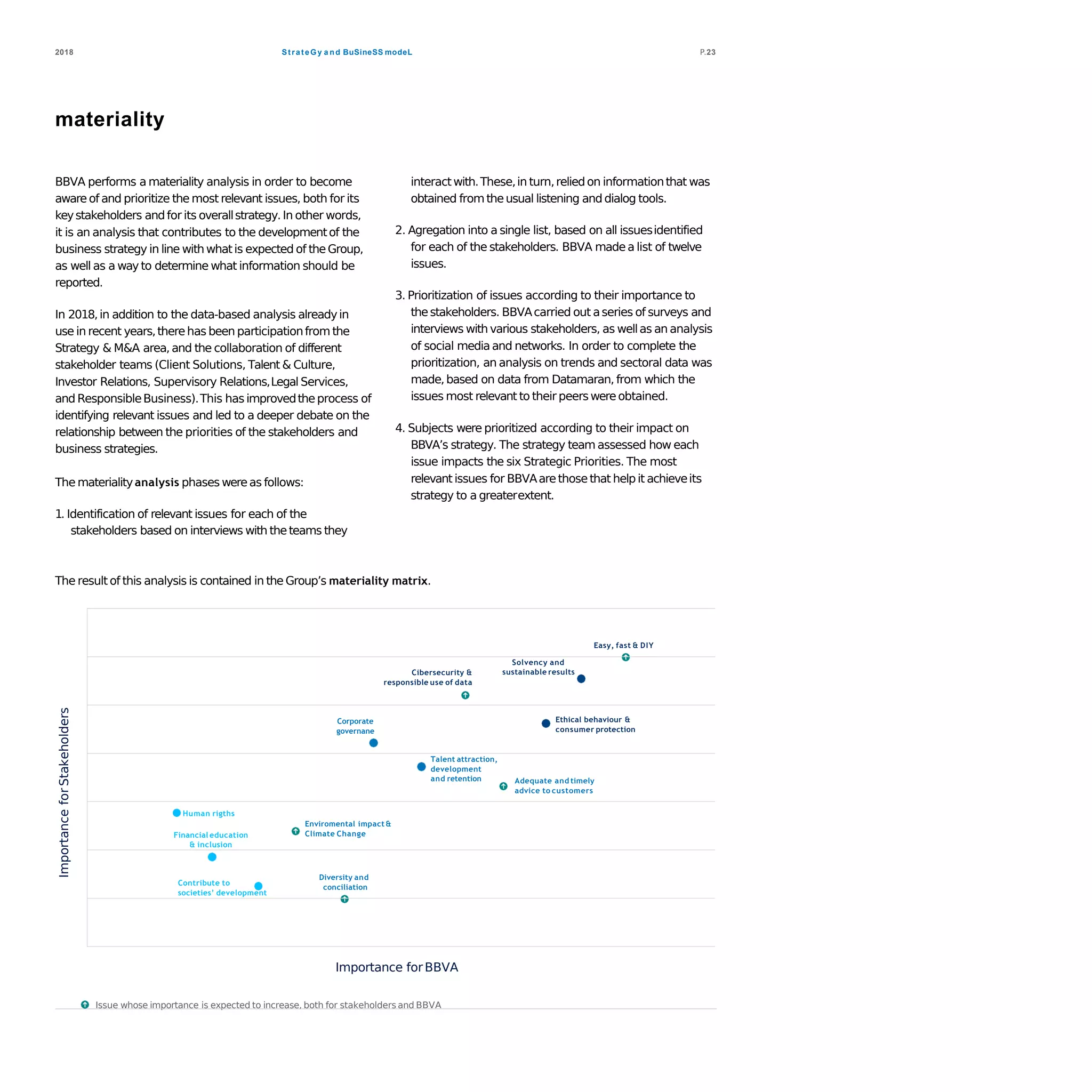
The result of this analysis is contained in the Group’s materiality matrix.
ImportanceforStakeholders
Importance forBBVA
Issue whose importance is expected to increase, both for stakeholders and BBVA
Easy, fast & DIY
Cibersecurity &
responsible use of data
Solvency and
sustainable results
Corporate
governane
Ethical behaviour &
consumer protection
Talent attraction,
development
and retention Adequate and timely
advice to customers
Human rigths
Financial education
& inclusion
Enviromental impact &
Climate Change
Contribute to
societies’ development
Diversity and
conciliation
StrateGy a nd BuSineSS modeL2018 P.24
Therefore, the five most relevant issues for BBVA’s
business strategy and its stakeholders are(in order of joint
importance):
Easy, fast and DIY (do it yourself): stakeholders expect
to operate in an agileand simple way with BBVA, at any
time and from anywhere,leveraging in the use of new
technologies. These new technologies will allow greater
efficiency in the operation, generatingvalue for the
shareholders.
Solvency and sustainable results: stakeholders expect
BBVA to be a robust, solvent and sustainable bank, thus
contributing to thestabilityof thesystem.They demanda
business model that responds to changes in the context:
disruptive technologies, new competitors, geopolitical
issues, etc.
Ethical behavior and consumer protection: stakeholders
expect BBVAto behavein acomprehensive mannerand
to protect clients or depositors by acting transparently,
offering products that are appropriate to their risk profile
and managing theethical challenges presented bycertain
new technologies withintegrity.
Adequate and timely advice to customers: stakeholders
expect BBVA to provide appropriate solutions to clients’
personal needs and circumstances. It is also expected
that the Bank will help them in managing their finances,
proactively and with properhandling.
Cybersecurity and responsible use of data: stakeholders
expect their data to be secure at BBVA and to used only for
agreed purposes, always complying with current law.This is
critical to maintainingtrust.
Information on the Group’s performance in these relevant
matters in 2018is reflected in thedifferent chapters of this
annualreport BBVAin 2018.
StrateGy a nd BuSineSS modeL2018 P.25
responsible banking model
At BBVA wehave a differential banking model that werefer
to as responsible banking, based on seeking out a return
adjusted to principles, strict legalcompliance,best practices
and thecreation of long-termvalue for all stakeholders. It
is reflected in the Bank’s Corporate Social Responsibility
or Responsible Banking Policy.The Policy’s mission is to
managethe responsibility for the Bank’s impact on people
and society, which is keyto thedelivery of BBVA’s Purpose.
All the Group’s business and support areas integrate this
policy into their operational models. The Responsible
Business Unit coordinates the implementation and basically
operates as asecond line for defining standards and offering
support.
The responsible banking model is supervised by the Board of
Directors and its committees, as well as by the Bank’s senior
management.
The four pillars of BBVA’s responsiblebankingmodel areas
follows:
Balanced relations with its customers, based on
transparency, clarity andresponsibility.
Sustainable finance to combat climate change,respect
humanrights and achievetheUN SustainableDevelopment
Goals(SDGs).
Responsiblepractices with employees,suppliers and other
stakeholders.
Communityinvestmentto promotesocial changeand
create opportunities forall.
In 2018, BBVA approvedits climate change and sustainable
developmentstrategy to contribute to theachievementof the
Sustainable DevelopmentGoals (SDGs) and alignedwith the
ParisAgreement.This strategy is described in the Sustainable
finance chapter.
Group financial
information
Relevant events
Results
Balance sheet and business activity
Solvency
Risk management
The BBVAshare
Group financiaL i nf orma t ion2018 P.27
Group financial information
BBva Group highlights
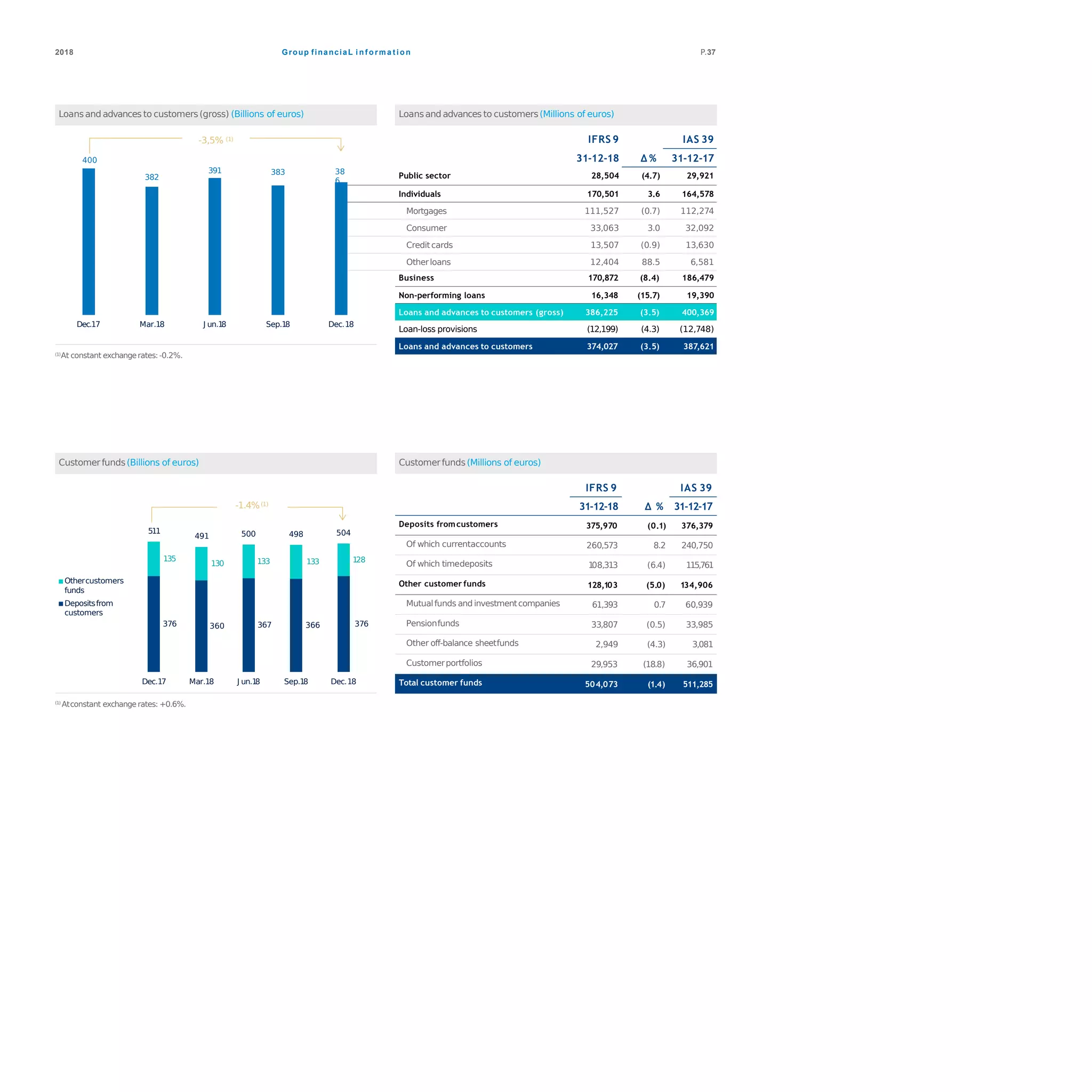
BBVAGroup highlights (Consolidated figures)
IFRS 9 IAS 39
31-12-18 ∆ % 31-12-17 31-12-16
Balance sheet (millions of euros)
Total assets 676,689 (1.9) 690,059 731,856
Loans and advances to customers (gross) 386,225 (3.5) 400,369 430,474
Deposits fromcustomers 375,970 (0.1) 376,379 401,465
Other customerfunds 128,103 (5.0) 134,906 132,092
Total customerfunds 504,073 (1.4) 511,285 533,557
Total equity 52,874 (0.8) 53,323 55,428
Income statement (millions of euros)
Net interestincome 17,591 (0.9) 17,758 17,059
Gross income 23,747 (6.0) 25,270 24,653
Operatingincome 12,045 (5.7) 12,770 11,862
Protit/(loss) beforetax 7,580 9.4 6,931 6,392
Net attributableprofit 5,324 51.3 3,519 3,475
The BBVA share and share performance ratios
Number of shares(million) 6,668 - 6,668 6,567
Share price(euros) 4.64 (34.8) 7.11 6.41
Earningper share (euros)(1) 0.76 55.9 0.48 0.49
Book value per share(euros) 7.12 2.2 6.96 7.22
Tangible book value pershare (euros) 5.86 2.9 5.69 5.73
Marketcapitalization (millionsof euros) 30,909 (34.8) 47,422 42,118
Yield (dividend/price;%) 5.4 4.2 5.8
Significant ratios (%)
ROE (net attributable profit/average shareholders' funds +/- average accumulated other
comprehensive income)(2)
11.6 7.4 7.3
ROTE (net attributable profit/average shareholders' funds excluding average intangible
assets +/- average accumulated othercomprehensive income)(2)
14.1 9.1 9.2
ROA(Profitor loss for the year/average total assets) 0.91 0.68 0.64
RORWA(Profitor loss for the year/average risk-weighted assets- RWA) 1.74 1.27 1.19
Efficiency ratio 49.3 49.5 51.9
Cost ofrisk 1.01 0.89 0.85
NPL ratio 3.9 4.6 5.0
NPLcoverage ratio 73 65 70
Capital adequacy ratios (%)
CET1fully-loaded 11.3 11.1 10.9
CET1 phased-in(3) 11.6 11.7 12.2
Tier 1phased-in(3) 13.2 13.0 12.9
Total ratio phased-in(3) 15.7 15.5 15.1
Other information
Number ofshareholders 902,708 1.3 891,453 935,284
Number ofemployees 125,627 (4.7) 131,856 134,792
Number ofbranches 7,963 (3.7) 8,271 8,660
Number ofATMs 32,029 1.1 31,688 31,120
Generalnote:dataas of 31-12-17and31-12-16arepresentedforcomparison purposes only.
(1) Adjusted byadditionalTier1instrument remuneration.
(2) The ROE and ROTE ratios include,in the denominator,the Group’saverageshareholders’ funds and takeinto account the item called “Accumulated other comprehensiveincome”,
whichforms part ofthe equity.Excludingthis item,the ROE wouldstand at 10.1%,in 2018; 6.7%,in 2017; and6.9%, in 2016; andthe ROTEat 12.0%,8.0% and8.6%, respectively.
(3) As of December,312018 phased-in ratiosincludethe temporary treatment on the impact of IFRS 9,calculated in accordance withArticle 473 bis of CapitalRequirementsRegulation
(CRR).Thecapital ratiosarecalculated underCRD IV from Basel III regulation,inwhichaphase-in of80% is applied for 2017 andaphase-in of60% for2016.
Group financiaL i nf orma t ion2018 P.28
relevant events
Results
Generalizedgrowthinthemore recurring revenue items for
almost all businessareas.
Containmenttrendin operating expenses,whose
performanceis affectedbyexchangeratestrends.
Lower amount of impairment on financial assets not
measured at fair value through profit or loss (hereinafter,
“impairmenton financial assets”) affected by the negative
impact of the recognition in the fourth quarter of 2017of
impairmentlosses,amounting€1,123mfrom BBVA’sstakein
Telefónica,S.A.
The financial statements of the Group for 2018 include, on
one hand,the negative impact derived from the accounting
for hyperinflation in Argentina (-€266m) in the net
attributableprofit,andon theother hand,thepositiveimpact
on equityof€129m.
The result of corporate operations amountedto €633m
andincludes thecapitalgains(netoftaxes)arising from the
sale ofBBVA’sequitystakeinBBVA Chile.
Thenetattributableprofit was€5,324m,51.3%higherthan
in2017.
Net attributable profit excluding results from corporate
operations stood at €4,691m,up 33.3% higherthan the
result reachedin2017.
Balance sheet and business activity
Lower volume of loans and advances to customers
(gross); however, by business areas, in the United States,
Mexico, SouthAmerica (excluding BBVAChile)and Rest of
Eurasia volumesincreased.
Non-performing loans continueto reducein 2018.
Within off-balance-sheet funds, mutual funds continue to
perform positively.
Solvency
The capital position is above regulatory requirements.
BBVAhas once againexcelled in EU-wide bank stress tests
thanks to its resilience in the face of potential economic
shocks.According to theexerciseresults,under theadverse
scenario, BBVA is the second bank among its European
peers with lower negative impact in CET1 fully-loaded
capital ratio and one of the few banks with the ability to
generateanaccumulated profit in thethree-year period
under analysis(2018,2019,and2020), under this scenario.
Risk management
Solid indicators of themain credit-risk metrics: as of
31-December-2018,theNPL ratioclosed at 3.9%,theNPL
coverage ratio at 73% and the cumulative cost of risk at
1.01%.
Net attributable profit (Millions of euros)
3,519
5,324
2017 2018
51.3%
Net attributable profit breakdown (1)
(Percentage.2018)
24.8
12.6
41.0
9.8
10.2
1.6
(2
)
Spain (2)
The UnitedStates
Mexico
Turkey
SouthAmerica
Rest ofEurasia
(1) Excludesthe CorporateCenter.
(2) IncludestheareasBanking activity inSpainandNonCore RealEstate.
Capitaland leverage ratios(Percentage as of 31-12-18)
11.6% 11.3%
6.4%
CET1phased-in CET1fully-loaded Leveragefully-loaded
NPL and NPL coverageratios (Percentage)
65%
71%
73% 73% 73%
4.6% 4.4% 4.4%
4.1% 3.9%
Dec.17 Mar.18 J un.18 Sep.18 Dec.18
NPL
coverage
ratio
NPL ratio
Group financiaL i nf orma t ion2018 P.29
Transformation
The Group’s digital and mobile customer base and digital
sales continue to increase in all the geographic areas where
BBVAoperates with apositive impact in efficiency.
Digital and mobile customers(Million)
18.1
22.6
27.2
Dec.16 Dec.17 Dec.18
12.2
17.8
23.0
Dec.16 Dec.17 Dec.18
Digital customers Mobile customers
+20% +29%
Appointments
BBVA’s Board of Directors,in its meetingheld on December
20, 2018,approved the succession plans for the Group
Executive Chairman and for the Chief Executive Officer
and appointed Carlos TorresVila as Executive Chairman
of BBVA, replacing Francisco González Rodríguez and
Onur Genç as memberof theBoard of Directorsand as
Chief Executive Officer of BBVA.The Board of Directors
also approvedorganisational changes,which involve
changes at thesenior managementlevelof BBVAGroup. On
December,21st,BBVA received the required administrative
authorisations to givefull effect to theresolutions approved.
Other matters ofinterest
On December,26th, BBVA reached an agreementwith
VoyagerInvesting UK Limited Partnership, an entity
managed by Canada Pension Plan Investment Board
(“CPPIB”) for the transfer of a credit portfolio mainly
composed by non-performing and defaulted mortgage
loans. The closing of the Transaction will be completed
as soon as therelevant conditions arefulfilled,which is
expected to occur within thesecond quarterof 2019.In
addition, it is expected that the impact in the Group’s
attributable profit, which is currently expected to be
positive by€150m,netof taxesand other adjustments,
and theimpactin theCommon Equity Tier 1(fully-loaded),
which is expected to beslightly positive.
Impact of the initial implementation of IFRS 9: The figures
corresponding to 2018are prepared under International
FinancialReporting Standard 9 (IFRS 9), which enteredinto
forceonJanuary 1,2018.This newaccounting standard did
not require the restatement of comparative information
from prior periods, so the comparative figures shown for
the year 2017have been prepared in accordance with the
IAS 39 (International Accounting Standard 39) regulation
applicable at that time. The impacts derived from the first
applicationof IFRS 9,as ofJanuary 1,2018,wereregistered
with acharge to reserves of approximately €900m (net
of fiscal effect) mainly due to the allocation of provisions
based on expected losses, compared to themodel of losses
incurred under theprevious IAS 39.
In capital, the impact derived from the first application of
IFRS 9 has beenareduction of 31basis points with respect
to thefully-loadedCET1ratioof December2017.
IFRS 16came into effect on January 1,2019,a standard
on leases introduces a single lessee accounting model
and will require lessees to recognize assets and liabilities
of all leasecontracts. The mainimpactin theGroup is the
recognition of the right-of-useassets and lease liabilitiesin
an approximate amount of €3,600m mainly coming from
the Group’s activity in Spain and lease of premises of its
branch network. The estimated impact in terms of capital
for theGroup amountsto approximately -12basis points in
terms ofCET1.
Banco BilbaoVizcayaArgentaria, S.A. (“BBVA,S.A.”)
stand-alonefinancial statements: BBVAhas estimated that,
mainly due to the depreciation of the Turkish lira, there is
animpairment of its participationin Garanti Bank that only
affects the stand-alone financial statements of BBVA, S.A.
Forthis reason, anegative adjustment for anet amountof
€1,517mhas been registered in the income statement of
BBVA,S.A. for theyear2018.Totalequity for BBVA,S.A. as
of December31,2018has decreased bythis sameamount.
The impacton thefully-loadedCET1 capitalratioof BBVA,
S.A.is approximately -10basis points.
It is importanttonotethat therecognition of this accounting
impact in thestand-alone financial statements of BBVA,
S.A. does not generate any impact on the Consolidated
Group (neitheron theattributed profit,total equity or capital
ratios),it doesnotgenerateanyadditional cash outflowand
will notaffectthedividend distributiontoshareholders.
Group financiaL i nf orma t ion2018 P.30
r esults
BBVAgeneratedanetattributableprofit of €5,324m in 2018,
which represents a year-on-year increase of 51.3%(+78.2%
at constant exchange rates) that includes the results from
corporate operations originated by the capital gains(net of
taxes) from the sale of BBVA Chile. Moreover,at constant
exchange rates, it is worth mentioningthe good performance
of recurring revenue,lower loan-loss impairments (affected
bythenegativeimpactof therecognition in thefourth quarter
of 2017of impairment losses, amounting€1,123mfrom BBVA
stake in Telefónica,S.A.) and provisions, which offsets the
lower contribution from net trading income (NTI) compared
to thesameperiod theprevious year.
Consolidated incomestatement:quarterly evolution (Millions of euros)
IFRS 9 IAS 39
2018 2017
4Q 3Q 2Q 1Q 4Q 3Q 2Q 1Q
Net interest income 4,692 4,256 4,355 4,288 4,557 4,399 4,481 4,322
Net fees andcommissions 1,226 1,161 1,256 1,236 1,215 1,249 1,233 1,223
Net tradingincome 316 200 297 410 552 347 378 691
Dividendincome 62 11 72 12 86 35 169 43
Share of profit or loss of entities accounted for using the equitymethod (19) (3) 6 8 5 6 (2) (5)
Other operating income andexpenses (126) (102) (10) 142 (54) 154 77 108
Gross income 6,151 5,522 5,977 6,096 6,362 6,189 6,336 6,383
Operatingexpenses (2,981) (2,779) (2,963) (2,979) (3,114) (3,075) (3,175) (3,137)
Personnelexpenses (1,557) (1,438) (1,560) (1,566) (1,640) (1,607) (1,677) (1,647)
Other administrativeexpenses (1,119) (1,044) (1,105) (1,106) (1,143) (1,123) (1,139) (1,136)
Depreciation (305) (297) (299) (307) (331) (344) (359) (354)
Operating income 3,170 2,743 3,014 3,117 3,248 3,115 3,161 3,246
Impairment on financial assetsnot measured at fair value through profit or loss (1,353) (1,018) (788) (823) (1,885) (976) (997) (945)
Provisions orreversal of provisions (66) (121) (86) (99) (180) (201) (193) (170)
Other gains(losses) (183) (36) 67 41 (267) 44 (3) (66)
Profit/(loss) before tax 1,568 1,569 2,207 2,237 916 1,982 1,969 2,065
Incometax (421) (428) (602) (611) (499) (550) (546) (573)
Profit/(loss) after tax from ongoing operations 1,147 1,141 1,604 1,626 417 1,431 1,422 1,492
Resultsfrom corporateoperations (1) - 633 - - - - - -
Profit/(loss) for theyear 1,147 1,774 1,604 1,626 417 1,431 1,422 1,492
Non-controllinginterests (145) (100) (295) (286) (347) (288) (315) (293)
Net attributable profit 1,001 1,674 1,309 1,340 70 1,143 1,107 1,199
Net attributable profit excluding results from corporate operations 1,001 1,040 1,309 1,340 70 1,143 1,107 1,199
Earning per share (euros) (2) 0.14 0.24 0.18 0.19 (0.00) 0.16 0.16 0.17
Generalnote:the dataforthe quarters of 2018 arepresented as proforma whichareconsidered asAlternativePerformance Measures (APM), the accumulated effect beingfully collected
to reflect the impact derived from the accountingfor hyperinflation in Argentinabetween1-1-2018and 30-9-2018 in the third quarter of 2018, withouthavingbeen reexpressedthe data
shownin theprevioustableforthe first andsecond quarter of 2018.
(1) Includes net capital gains from the sale of BBVAChile.
(2) Adjusted byadditional Tier1instrument remuneration.
Group financiaL i nf orma t ion2018 P.31
Consolidated incomestatement (Millions of euros)
IFRS 9 IAS 39
2018 ∆%
∆ % at constant
exchangerates 2017
Net interest income 17,591 (0.9) 10.8 17,758
Net fees andcommissions 4,879 (0.8) 8.9 4,921
Net tradingincome 1,223 (37.8) (33.9) 1,968
Dividendincome 157 (52.9) (52.0) 334
Share of profit or loss of entities accounted for using theequity method (7) n.s. n.s. 4
Other operating income andexpenses (96) n.s. n.s. 285
Gross income 23,747 (6.0) 4.3 25,270
Operatingexpenses (11,702) (6.4) 2.5 (12,500)
Personnelexpenses (6,120) (6.9) 2.0 (6,571)
Other administrativeexpenses (4,374) (3.7) 6.1 (4,541)
Depreciation (1,208) (12.9) (6.5) (1,387)
Operating income 12,045 (5.7) 6.2 12,770
Impairment on financial assets not measuredat fair valuethrough profit or loss (3,981) (17.1) (12.0) (4,803)
Provisions orreversal of provisions (373) (49.9) (47.1) (745)
Other gains(losses) (110) (62.1) (63.0) (292)
Profit/(loss) before tax 7,580 9.4 30.4 6,931
Incometax (2,062) (4.9) 9.2 (2,169)
Profit/(loss) after tax from ongoing operations 5,518 15.9 40.6 4,762
Resultsfrom corporateoperations (1) 633 - - -
Profit/(loss) for theyear 6,151 29.2 56.7 4,762
Non-controllinginterests (827) (33.5) (11.7) (1,243)
Net attributable profit 5,324 51.3 78.2 3,519
Net attributable profit excluding results from corporate operations 4,691 33.3 57.0 3,519
Earning per share (euros) (2) 0.76 0.48
(1) Includes net capital gains from the sale of BBVAChile..
(2)Adjusted byadditionalTier 1instrument remuneration.
Unless expressly indicatedotherwise,to betterunderstand
the changes in the main headings of the Group’s income
statement, the year-on-year percentage changes provided
belowrefer to constant exchange rates.
Gross income
Gross income accumulated in theperiod grewby4.3% year-
on-year,supported by the positive performance of the more
recurring items.
Net interest income grew by 10.8% year-on-year,leveraged
mainly by higher contribution from inflation-linked bonds in
Turkey. The other business areas, with the exceptionof Spain
and Rest of Eurasia, also registered positive year-on-year
changes, with Mexico, South America and the United States
standing out, in this order, for its contribution. In the fourth
quarter,netinterest incomegrew by5.2%in comparison with
the previous quarter.
Gross income (Millions ofeuros) Net interest income/ATAs(Percentage)
6,383
6,336
6,189
6,362
6,096
5,977
5,522
6,151
5,677
5,557
5,607
5,916
5,854 5,825
5,874
6,194
1Q17 2Q17 3Q17 4Q17 1Q18 2Q18 3Q18 4Q18
Atconstant
exchange
rates
-6.0% (1)
25,270 23,747
2.60
2.56 2.54 2.52
2.75
4Q17 1Q18 2Q18 3Q18 4Q18
(1)At constant exchangerates:+4.3%.
Group financiaL i nf orma t ion2018 P.32
On the other hand, cumulative net fees and commissions
(up 8.9%year-on-year) also registered afavorableevolution
highlydriven by their diversification. The quarterly figure
performedwell(up 1.1%in thefourth quarter).
As a result, the more recurring revenue items (net interest
income plus net fees and commissions) increased by 10.4%
year-on-year (up 4.3% over thethird quarter).
Net interest incomeplus netfees and commissions (Millions of euros)
5,546
5,714 5,647 5,772 5,524 5,611
5,918
4,886 5,002
5,114
5,360 5,310
5,477
5,719
5,417 5,964
1Q17 2Q17 3Q17 4Q17 1Q18 2Q18 3Q18 4Q18
Atconstant
exchange
rates
22,679
-0.9%(1)
22,470
(1) At constant exchangerates+10.4%.
NTI in 2018moderated in comparison with the previous year,
when it was exceptionallyhigh, largelydue to the registration
of the capital gainsof €228m beforetaxes,frommarket sales
of the stake in China Citic Bank (CNCB): €204m in the first
quarter, from the sale of 1.7%stake, and €24m in the third
quarterfrom thesale of the remaining0.34%.Therehavealso
been lower sales of ALCO portfolios in Spain in the first nine
months of 2018compared to the same period of the previous
year.By business areas,NTI had agood performancein South
America andTurkey.
Other operating income and expenses closed at -€96m
in 2018compared to €285m in 2017,mainlydueto negative
impactof thehyperinflation inArgentinawhich meant
-€323m in this line of theincomestatement.The change
is also explainedby thehighercontribution, amounting to
€44m, to the Single Resolution Fund (SRF) and Deposit
Guarantee Fund (DGF) in Spain. The net contribution of
theinsurance business grewby 8.7%in cumulative terms
(+15.4%in the fourthquarter).
Operating income
Operating expenses in 2018registered an increase of 2.5%,
year-on-year,well below the inflation rate recorded in the
main countries where BBVA is present (down 6.4% at current
exchangerates). Cost discipline hasbeenmaintainedin allthe
Group’s areas through various efficiency plans. By business
area the biggest year-on-year reductions were in Banking
activity in Spain and Non Core RealEstate. In the United
States, Mexico and Turkey the growth of operating expenses
waslower than thegrowth of gross income.
Operating expenses (Millions ofeuros)
3,137
3,175
3,075
3,114
2,979
2,963
2,802
2,839
2,845
2,933 2,877
2,901
2,779
2,941
2,981
2,983
1Q17 2Q17 3Q17 4Q17 1Q18 2Q18 3Q18 4Q18
At constant
exchange
rates
-6.4% (1)
12,500 11,702
(1) Atconstant exchangerates: +2.5%.
Group financiaL i nf orma t ion2018 P.33
Breakdownof operatingexpenses andefficiency calculation(Millions of euros)
2018 ∆% 2017
Personnel expenses 6,120 (6.9) 6,571
Wages andsalaries 4,786 (7.3) 5,163
Employee welfare expenses 869 (4.6) 911
Training expenses andother 465 (6.4) 497
Other administrative expenses 4,374 (3.7) 4,541
Property, fixtures andmaterials 982 (5.0) 1,033
IT 1,133 11.2 1,018
Communications 235 (12.7) 269
Advertising andpublicity 336 (4.5) 352
Corporateexpenses 109 (0.8) 110
Otherexpenses 1,162 (10.7) 1,301
Levies andtaxes 417 (8.6) 456
Administration costs 10,494 (5.6) 11,112
Depreciation 1,208 (12.9) 1,387
Operating expenses 11,702 (6.4) 12,500
Gross income 23,747 (6.0) 25,270
Efficiency ratio (operating expenses/gross income; % ) 49.3 49.5
Number ofemployees Number ofbranches
30,543
1,198
29,423
1,099
25,050
1,138
23,678 22,615
21,994
37,378 37,207
36,123
10,544 10,928
10,984
31,451 30,584
30,338
Dec.16 Dec.17 Dec.18
Spain
The UnitedStates
Mexico
Turkey
SouthAmerica
Rest ofEurasia
134,792
125,627
131,856
1,667
47
1,631
35
1,543
32
1,131 1,095 1,066
1,836
1,836
676 651
1,840
646
3,303 3,019 2,840
Dec.16 Dec.17 Dec.18
Spain
The UnitedStates
Mexico
Turkey
SouthAmerica
Rest ofEurasia
8,660
8,271 7,963
Number ofATMs
6,939
27
7,376
25
6,924
24
5,125 5,219 5,476
11,434
11,724
12,610
800
6,570
1,025
6,378
966
6,195
Dec.16 Dec.17 Dec.18
Spain
The UnitedStates
Mexico
Turkey
SouthAmerica
Rest ofEurasia
31,120 31,688 32,029
Group financiaL i nf orma t ion2018 P.34
As aconsequence of this evolution of operating expenses, the
efficiency ratiostood at 49.3%and theoperating income
posted ayear-on-year growth of 6.2% (+9.4%in thelast
quarter of2018).
Efficiency ratio(Percentage) Operating Income (Millions ofeuros)
51.9
49.5
53.1
50.2
49.3 49.3
2016 2017 2018
At current
exchangerates
At constant
exchangerates
-89 basis
points
3,246
3,161
3,115
3,248
3,117
3,014
2,743
3,170
2,876
2,718
2,762
2,983
2,977 2,924 2,934
3,210
1Q17 2Q17 3Q17 4Q17 1Q18 2Q183Q18 4Q18
Atconstant
exchange
rates
-5.7% (1)
12,770 12,045
(1)At constant exchangerates:+6.2%.
Provisions and other
Impairment losses on financial assets in 2018decreased
by 12.0% in comparison with the figure for 2017,affected by
thenegativeimpactof therecognitionin 2017of impairment
losses, amounting €1,123mfromBBVAstake inTelefónica,
S.A.as aresultof theevolution of theprice of the latterand in
compliancewith the requirements of the accounting standard
IAS 39 which was in force at that point in time. By business
area,they continued to fall in Spain, due to lower loan-loss
provisioning requirements for largecustomers. In contrast,
they increased, especially in Turkey, due to the deterioration
of the macroeconomic scenario and some wholesale-
customers and to a lesser extent in South America. On the
other hand,Mexico stood in line with 2017.
Impairment on financial assets(Millions of euros)
945
997 976
1,885
823 788
1,018
1,353
854 898
902
1,869
797 770
1,043
1,371
Atconstant
exchange
rates
-17.1%(1)
4,803 3,981
1Q17 2Q17 3Q17 4Q17 1Q18 2Q183Q18 4Q18
(1)At constant exchangerates:-12.0%.
The headingprovisions or reversal of provisions
(hereinafter, provisions) was 47.1%lower than the figure of
2017,as aresult of lower restructuring costs in 2018.The line
other gains (losses) showed anegativebalance,duemainly
to certain operationswith anunfavorableeffect fromtheNon
Core RealEstate area,recorded in thelast quarter.
The headingresults from corporate operations amounted
to €633m and registered the capital gains (net of taxes)
originated bythesale of BBVA’S equity stake in BBVAChile.
Results
As aresultof theabove,theGroup’s net attributable profit
accumulated in 2018reached an amount of €5,324m and
continued to show a very positive year-on-year evolution
(up 78.2% at constant exchange rates, up 51.3%at current
exchange rates). The net attributable profit, excluding
results from corporate operations, stood at €4,691m,or
33.3%higherthan theamountrecorded for the previous year,
when operations of this kind were not carried out (up 57.0%
at constant exchangerates).
By business area, Banking activity in Spaingeneratedaprofit
of €1,522m, Non Core Real Estate a loss of €78m, the United
States contributed aprofitof €735m,Mexico registered
€2,384m,Turkeycontributed aprofitof €569m, South
America€591mand theRest of Eurasia €93m.
Group financiaL i nf orma t ion2018 P.35
Net attributable profit (Millions of euros) Earning per share(1)
(Euros)
1,199 1,107 1,143
1,340 1,309
1,674
1,001
1,071
930
1,016
70
-30
1,299 1,284
1,737
1,005
1Q17 2Q17 3Q17 4Q17 1Q18 2Q18 3Q18 4Q18
Atconstant
exchange
rates
+51.3%(1)
3,519 5,324
0.17
0.16 0.16
0.19 0.18
0.24
0.14
2Q18 3Q18 4Q18
0.48 0.76
+55.9%
(1)At constant exchangerates:+78.2%.
(0.00)
1Q17 2Q17 3Q17 4Q17 1Q18
(1)Adjusted byadditionalTier1instrument remuneration.
ROE and ROTE(1)
(Percentage) ROA and RORWA(Percentage)
9.2 9.1
14.1
7.3 7.4
11.6ROTE
ROE 1.19
1.27
1.74
0.64 0.68
0.91
2016 2017 2018
RORWA
ROA
2016 2017 2018
(1) The ROE andROTE ratios include,in the denominator,the Group’saverage
shareholders’ funds and takeinto account the item called “Accumulatedother
comprehensiveincome”,which forms part of the equity.Excludingthis item, the ROE
wouldstand at 6.9% in2016,6.7% in2017 and10.1%in2018; andthe ROTEon8.6%,
8.0% and 12.0%,respectively.
Group financiaL i nf orma t ion2018 P.36
Balance sheet and business activity
The year-on-year comparison of the Group´s balance sheet
and business activity has been affected by the sale of BBVA
Chile, completed in July 2018 and therefore as of December
31,2018,was not included within BBVA’s perimeter.
The evolution of the Group’s balance sheet and activity are
presented below,from the opening balance sheet after the
first implementation of IFRS 9 until the end of December
2018.These figures includethe newcategories comprised in
the aforementionedstandard.
RegardingtheGroup’s activity, themost significantaspects
duringthis period aresummarizedbelow:
Lower volume of loans and advances to customers
(gross); however, by business area,in the United States,
Mexico, SouthAmerica (excluding BBVAChile)and Rest of
Eurasia volumesincreased.
Non-performing loans fell mainly due to a favorable trend
in Spain and, to a lesser extent, in South America and Rest
of Eurasia.
The headings of other assets and other liabilities are
affected by the sale of BBVA Chile completed in July 2018.
Until then, these items included BBVA Chile’s balance
sheet reclassified in thecategory of non-currentassets and
liabilities held forsale.
In deposits from customers, timedeposits showed a
decrease, offset by an increase in demand deposits,
particularly inSpain.
In off-balance-sheet funds, mutual funds continued to
perform well.
Consolidated balancesheet (Millions of euros)
31-12-18 ∆ % 01-01-18
Cash, cash balances at central banks and other demand deposits 58,196 36.4 42,680
Financial assets held fortrading 90,117 (1.9) 91,854
Non-tradingfinancial assetsmandatorily at fair value through profit or loss 5,135 15.4 4,451
Financial assetsdesignated at fair valuethrough profit or loss 1,313 28.9 1,019
Financial assetsat fair value through accumulated other comprehensive income 56,337 (9.3) 62,115
Financial assets at amortizedcost 419,660 (0.5) 421,685
Loans and advances to central banks and creditinstitutions 13,103 (26.0) 17,716
Loans and advances tocustomers 374,027 0.0 374,009
Debtsecurities 32,530 8.6 29,959
Investmentsin subsidiaries,jointventuresand associates 1,578 (0.7) 1,589
Tangibleassets 7,229 0.5 7,191
Intangibleassets 8,314 (1.8) 8,464
Otherassets 28,809 (40.4) 48,368
Total assets 676,689 (1.8) 689,414
Financial liabilities held fortrading 80,774 (0.0) 80,783
Otherfinancial liabilities designated at fair valuethrough profit or loss 6,993 27.3 5,495
Financial liabilities at amortizedcost 509,185 0.6 506,118
Depositsfrom centralbanks and creditinstitutions 59,259 (14.0) 68,928
Deposits fromcustomers 375,970 3.4 363,689
Debtcertificates 61,112 (0.9) 61,649
Other financialliabilities 12,844 8.4 11,851
Liabilities under insurancecontracts 9,834 6.6 9,223
Otherliabilities 17,029 (51.9) 35,392
Total liabilities 623,814 (2.1) 637,010
Non-controllinginterests 5,764 (17.7) 7,008
Accumulated other comprehensiveincome (7,215) 2.6 (7,036)
Shareholders’funds 54,326 3.6 52,432
Total equity 52,874 0.9 52,404
Total liabilities and equity 676,689 (1.8) 689,414
Memorandum item:
Guarantees given 47,574 5.2 47,668
Group financiaL i nf orma t ion2018 P.37
Loansand advances to customers(gross) (Billions of euros)
Dec.17 Mar.18 J un.18 Sep.18 Dec.18
(1)At constant exchangerates:-0.2%.
Customerfunds(Billions of euros)
376 360 367 366 376
135
130 133 133 128
511
491 500 498 504
Dec.17 Mar.18 J un.18 Sep.18 Dec.18
Othercustomers
funds
Depositsfrom
customers
-1.4%(1)
(1) Atconstant exchangerates: +0.6%.
Loansand advances to customers(Millions of euros)
-3,5% (1) IFRS 9 IAS 39
400 31-12-18 ∆ % 31-12-17
391 383
382
38
6
Public sector 28,504 (4.7) 29,921
Individuals 170,501 3.6 164,578
Mortgages 111,527 (0.7) 112,274
Consumer 33,063 3.0 32,092
Creditcards 13,507 (0.9) 13,630
Otherloans 12,404 88.5 6,581
Business 170,872 (8.4) 186,479
Non-performing loans 16,348 (15.7) 19,390
Loans and advances to customers (gross) 386,225 (3.5) 400,369
Loan-loss provisions (12,199) (4.3) (12,748)
Loans and advances to customers 374,027 (3.5) 387,621
Customerfunds(Millions of euros)
IFRS 9 IAS 39
31-12-18 ∆ % 31-12-17
Deposits fromcustomers 375,970 (0.1) 376,379
Of which currentaccounts 260,573 8.2 240,750
Of which timedeposits 108,313 (6.4) 115,761
Other customer funds 128,103 (5.0) 134,906
Mutualfunds and investmentcompanies 61,393 0.7 60,939
Pensionfunds 33,807 (0.5) 33,985
Other off-balance sheetfunds 2,949 (4.3) 3,081
Customerportfolios 29,953 (18.8) 36,901
Total customer funds 504,073 (1.4) 511,285
Group financiaL i nf orma t ion2018 P.38
Solvency
Capital base
The fully-loaded CET1 ratio stood at 11.3%for the period
ended December 31,2018.In the third quarter of 2018,the
sale of the stake in BBVA Chile generated a positive impact on
thefully-loaded CET1ratioof 50 basis points.Additionally,the
transfer of BBVA’s realestate business in Spain to Cerberus
hadapositive impact on theratio,althoughit wasnotmaterial.
It is noted that this ratioincludestheimpact of -31basis points
for first application of IFRS 9, which came into force January
1,2018.In this context, the Parliament and the European
Commission have established transitional arrangements that
are voluntary for the institutions, adapting the impact of IFRS
9 on capital adequacy ratios. The Group has informed the
supervisory body of its adherencetothesearrangements.
Risk-weighted assets (RWA) have decreased in the year,
mainly due to the sale of BBVA Chile and the depreciations of
currencies against the euro. During 2018,the Group carried
out threesecuritizations whoseimpact,through thereleaseof
risk weightedassets, was a positive in the amount of €971m.
In addition, BBVA received European Central Bank (ECB)
authorization to update the RWA calculation by structural
exchange raterisk under thestandard model.
Regardingcapitalissues, during thefirst partof the year,
the Group computed a new issuance in the amount of
US$1,000m, carried out in November2017,of contingent
convertible bonds that may be converted into ordinary
shares (CoCos) as an AT1instrument. In May, another AT1
instrument for US$1,500m issued in 2013 was redeemed
early. During the second part of the year, in September, the
Group carried out a new issuance of contingent convertible
bonds for €1,000m and more recently, in January 2019,
announced that it would exercisetheearly redemption option
for theAT1instrumentfor €1,500missued in February 2014.
The Group has continued with its program to meet the
MREL requirements,publishedin May 2018,byclosing two
public issuances of non-preferred senior debtfor atotal of
€2,500m.The Group estimates that it is currently in line with
this MRELrequirement.
Evolutionof fully-loaded capital ratios (Percentage)
11.1 10.9 10.8 11.3 11.3
1.7 1.7
1.7
2.5
1.7
2.5 2.7
2.5 2.5
1.6
15.3 15.1 15.2 15.6 15.5
31-12-17 31-03-18 30-06-18 30-09-18 31-12-18
Total capitalratio
Tier2
Additional Tier1
CET1
Capital base (Millions ofeuros)
30-09-18
Common EquityTier 1(CET1) 38,925
Tier1 44,868
Tier2 8,670
Total Capital (Tier 1+ Tier 2) 53,538
Risk-weighted assets 343,271
CET1(%) 11.3
Tier1(%) 13.1
Tier2 (%)
CRD IV phased-in CRD IV fully-loaded
31-12-18(1) 31-12-17 30-09-18 31-12-18(1) 31-12-17
40,311 42,341 39,662 39,569 40,061
45,945 46,980 45,765 45,044 46,316
8,754 9,134 8,847 8,859 8,891
54,699 56,114 54,612 53,903 55,207
348,254 361,686 343,051 348,795 361,686
11.6 11.7 11.6 11.3 11.1
13.2 13.0 13.3 12.9 12.8
2.5 2.5 2.6 2.5 2.5 2.5
Total capital ratio (%) 15.7 15.5 15.9 15.5 15.3 15.6
Generalnote: as of December 31andSeptember 30 of 2018, the maindifferencebetweenthe phased-in andfully loadedratiosarises from the temporary treatmentof the impact of IFRS
9,towhichtheBBVA Grouphasadheredvoluntarily(in accordance withArticle 473bis ofthe CRR).
(1) Preliminary data.Excludesthe February2014 issuance of1,500 millioneuros fromAT1which hasbeen amortized in advancein February2019.
Group financiaL i nf orma t ion2018 P.39
Regardingshareholder remuneration, on October, 10th
BBVA paid a cash dividend with a gross amount of €0.10
per share against the2018fiscal year account.In addition,
on April 10,2018,BBVA paid a final dividend against the
2017fiscal yearaccount for anamountof €0.15 gross per
share,also in cash. Both distributions areconsistent with the
Group’s shareholder remuneration policy, which consists of
maintainingapay-outratio of 35-40% of recurring profit.
As of December 31,2018,the phased-in CET1 ratio stood
at 11.6%,taking into account the impact of the initial
implementationofIFRS 9.Tier 1capitalstood at13.2%and
Tier 2 at2.5%resultinginatotal capital ratio of15.7%.These
levelsareabovetherequirementsestablishedbytheregulator
in its SREP letterand the systemic buffers applicablein 2018
for BBVA Group.Since January 1,2018,the requirement has
beenestablishedat 8.438%for the phased-in CET1 ratio and
11.938%forthetotalcapitalratio.Thechangewithrespect
to 2017is due to the steady implementation of the capital
conservationbuffers and the capitalbufferapplicableto other
systemicallyimportant banks. The regulatory requirement for
2018infully-loadedtermsremainedunchanged(CET1of9.25%
andtotalratioof12.75%)comparedwiththepreviousyear.
Finally,the Group’s leverage ratio maintained asolid position,
at 6.4% fully-loaded (6.5% phased-in), which is still the
highest of itspeer group.
Ratings
Duringthe first half of theyear 2018,Moody’s, S&P and DBRS
upgraded one notch BBVA’s rating to A3, A- and A (high),
respectively.During thesecond half of 2018,thethreeleading
agencies Moody´s, S&P and Fitch reaffirmed the rating given
to BBVA(A3,A- andA-,respectively), although both S&P and
Fitch placed its perspective in negative dueto the evolution
of theeconomy inTurkey(both agencies) andMexico (Fitch).
At present, all agencies assign to BBVAacategory“A”rating,
which did not occur since mid-2012, thus recognizing the
strength androbustness of BBVA’s business model.
Ratings
Rating agency Long term Short term Outlook
DBRS A (high) R-1(middle) Stable
Fitch A- F-2 Negative
Moody's (1) A3 P-2 Stable
Scope Ratings A+ S-1+ Stable
Standard & Poor's A- A-2 Negative
(1) Additionally,Moody’s assignsanA3 rating toBBVA’s long-term deposits.
Group financiaL i nf orma t ion2018 P.40
risk management
Credit risk
BBVAGroup’s risk metrics continued to perform wellalong
2018:
Credit risk decreasedby3.6%throughout2018or -0.4%
isolatingtheimpactofthesaleofBBVAChile (-1.8%and
+1.3%,respectively,atconstant exchangerates),mainlydue
toloweractivityin Non Core RealEstateandcontraction
inTurkey andSouthAmerica duetotheexchangerates
evolution.Duringthefourth quarter credit risk increasedby
+1.3%(+0.6%atconstant exchangerates).
The balance of non-performing loans decreased
throughout 2018 by -16.6%(-11.1%in constant terms),
highlightingthegood performanceof theBanking activity
in Spain and Non Core RealEstate. Wholesale customers
in Turkey and the United States deteriorated, having a
negativeimpactin its balance of non-performingloans.In
thelast quarterof 2018therewas adecrease of 3.4%at
current exchange rates (-0.5% atconstant exchange rates).
The NPL ratio stood at 3.9% as of December 31,2018,a
reduction of 19basis points with respect to September 30,
2018andof 61basis points throughout theyear.
Loan-loss provisions decreased by 6.2% during the last
12months (-0.3% at constant exchange rates) whereas
thedecrease over thequarteramounted to 3.1%(-2.5% at
constant exchangerates).
NPL coverage ratio closed at 73%with animprovementof
812basis points over theyearand 26 basis points in thelast
3 months.
The cumulative cost of risk through December2018was
1.01%,+13basis points higherthan thefigurefor 2017.
Non-performing loans and provisions (Millions of euros)
20,492
17,087
Dec.17 Dec.18
-16.6%
13,319
12,493
Dec.17 Dec.18
-6.2%
Creditrisk (1)
(Millions of euros)
31-12-18 30-09-18 30-06-18 (2) 31-03-18(2) 31-12-17(2)
Credit risk 433,799 428,318 451,587 442,446 450,045
Non-performing loans 17,087 17,693 19,654 19,516 20,492
Provisions 12,493 12,890 13,954 14,180 13,319
NPL ratio( %) 3.9 4.1 4.4 4.4 4.6
NPL coverage ratio ( %) 73 73 71 73 65
(1) Includegross loans andadvancesto customers plusguaranteesgiven.
(2) Figures withoutconsidering the classificationof non-currentassets heldfor sale.
Non-performing loans evolution (Millions of euros)
4Q 18 (1) 3Q18 2Q18(2) 1Q18(2) 4Q17(2)
Beginning balance 17,693 19,654 19,516 20,492 20,932
Entries 3,005 2,168 2,596 2,065 3,757
Recoveries (1,548) (1,946) (1,655) (1,748) (2,142)
Net variation 1,456 222 942 317 1,616
Write-offs (1,681) (1,606) (863) (913) (1,980)
Exchange rate differences and other (382) (576) 59 (380) (75)
Period-end balance 17,087 17,693 19,654 19,516 20,492
Memorandum item:
Non-performing loans 16,348 17,045 18,627 18,569 19,753
Non-performing guaranteesgiven 739 649 1,027 947 739
(1) Preliminary data.
(2) Figures withoutconsidering theclassificationof non-current assets heldforsale.
Group financiaL i nf orma t ion2018 P.41
Structural risks
Liquidity and funding
Management of liquidity and funding in BBVA aims to
finance the recurring growth of the banking business
at suitable maturities and costs, using a wide range of
instruments that provide access to a large number of
alternative sources of financing, always in compliance with
current regulatoryrequirements.
Dueto its subsidiary-based managementmodel, BBVA Group
is one of the fewlargeEuropeanbanks that follows the MPE
resolution strategy (“Multiple Point of Entry”): the parent
companysetstheliquidityandrisk policies,butthesubsidiaries
are self-sufficient and responsible for the managing their
liquidity (taking deposits or accessing the market with their
own rating), without funds transfer or financing occurring
betweeneithertheparentcompanyandthesubsidiaries
or betweendifferentsubsidiaries. This principle limits the
spreadofaliquiditycrisis amongtheGroup’sdifferentareas
andensuresthatthecost ofliquidityandfundingiscorrectly
reflectedinthepriceformation process.
The financial soundness of theGroup’s banks continues to
be based on the funding of lending activity, fundamentally
through the use of stable customer funds. During 2018,
liquidity conditions remainedcomfortable across BBVA
Group’s globalfootprint:
In theEurozone,theliquiditysituation is still comfortable,
reducing thecreditgapand growth in customer deposits.
In theUnited States,theliquiditysituation is adequate.The
credit gap increased during the year due to the dynamism
of consumer and commercial credit as wellas to the cost-
containment strategy for deposits, in an environment of
competitionin prices andrising rates.
In Mexico, theliquidityposition is sound as theenvironment
has improvedafter the electoral process and the new
commercial agreementwith the United States. The credit
gap has widened year-to-date due to deposits growing less
thanlending.
The liquidity situation in Turkeyis stable, showing a
reduction in thecredit gapas aresult of deposits growing
faster thanlending.
In South America, the liquidity situation remains
comfortable in all geographies. In Argentina, despite the
volatility of themarkets which has beenreducing attheend
of theyear,theliquiditysituation is adequate.
The wholesale funding markets in the geographic areas
where the Group operates continued to be stable, with the
exceptionofTurkeywhere thevolatility increased during the
third quarter,havingstabilizedin thefourth quarter with the
renewal of the maturities of syndicated loans of different
entities.
The main operations carried out bytheentities that form
part of theBBVAGroup during 2018were:
BBVA, S.A. completed three operations: an issuance of
senior non-preferred debt for €1.5 billion,with afloating
coupon at3-month Euribor plus 60 basis points and
a maturity of five years. It also carried out the largest
issuance madeby a financial institution in the Eurozone
of the so-called“green bonds”(€1 billion).It wasa7-year
senior non-preferred debt issuance, which made BBVA
the first Spanish bank to carry out this type of issuance.
The highdemand allowed theprice to beloweredto mid-
swap plus 80 basis points. Finally, BBVA carried out an
issuance of preferred securities contingently convertible
intonewly issued ordinaryshares of BBVA(CoCos). This
transaction was,for the first time,availabletoSpanish
institutionalinvestors and it was registered with theCNMV
for an amount of €1 billion, an annualcoupon of 5.875%
for the first five years and amortization option from the
fifth year.Additionally, it closed aprivate issuance ofTier
2 subordinateddebtfor US$300m, with amaturity of 15
years,with acoupon of 5.25%.
In the United States, BBVA Compass issued in June a
seniordebtbond for US$1.15billionin two tranches,both at
three years: US$700m at a fixed rate with a reoffer yield of
3.605%, and US$450m at a floating rate of 3-month Libor
plus 73 basispoints.
In Mexico, BBVA Bancomer completed an international
issuance of subordinated Tier 2 debt of US$1 billion. The
instrument was issued at a price equivalentto Treasury
bonds plus 265 basis points at a maturity of 15years, with
a ten-year call (BBVA Bancomer 15NC10).In addition, two
newBanking Securities Certificates wereissued for 7billion
Mexican pesos in two tranches, one of them being the first
green bond issued by a private bank in Mexico (3.5 billion
Mexican pesos at threeyears atTIIE28 +10basis points).
InTurkey,Garanti issued thefirst privatebond in emerging
markets for US$75m over six years, to support women’s
entrepreneurship, and renewed the financing of two
syndicated loans.
On theother hand,in SouthAmerica,in Chile,Forum issued
seniordebt on thelocal market for anamountequivalentto
€108mandBBVAPeru issued athree-year seniordebt in
thelocalmarket for anaggregateamountof €53m.
As of December31,2018,theliquiditycoverage ratio(LCR)
in BBVA Group remainedcomfortably above 100% in the
period andstood at 127%.Forthecalculationof theratio
Group financiaL i nf orma t ion2018 P.42
it is assumed that there is no transfer of liquidity among
subsidiaries; i.e. no kind of excess liquidity levels in the
subsidiaries abroad are considered in the calculation of the
consolidated ratio. When considering this excess liquidity
levels,the ratio would stand at 154%(27 percentage points
above 127%). All the subsidiaries remainedcomfortably
above100% (Eurozone,145%;Mexico, 154%;Turkey,209%;
andtheUnited States, 143%).
Foreign exchange
Foreign-exchange risk management of BBVA’s long-term
investments,basically stemming from its franchises abroad,
aims to preserve the Group’s capital adequacy ratios and
ensurethestabilityof its incomestatement.
The year 2018 was notable for the depreciation againstthe
euro of the Turkish lira (down 25.0%) and the Argentine
peso (down 47.8%),whiletheMexican peso (+5.2%) andthe
U.S. Dollar (+4.7%)appreciated. BBVA has maintained its
policy of actively hedgingits main investments in emerging
countries, covering on average between 30% and 50% of the
earnings for the year and around 70% of the excess of CET1
capital ratio. In accordance with this policy, the sensitivity of
the CET1 ratio to a depreciation of 10%of the main emerging
currencies (Mexican peso or Turkish lira) againstthe euro
remains at around a negativetwo basis points for each of
these currencies. In the case of the dollar, the sensitivity is
approximatelya positive eleven basis points to a depreciation
of 10%of the dollar againstthe euro,as a result of RWAs
denominated in U.S. Dollar outside the United States. The
coveragelevelof theexpectedearningsfor 2019,at theclosing
ofJanuary, 2019is,85%for Mexico and30% forTurkey.
Interest rates
The aim of managing interest-rate risk is to maintain a
sustained growth of net interest income in the short and
medium-term, irrespective of interest-rate fluctuations,
whilecontrolling theimpact on capital through the valuation
of the portfolio of financial assets at fair value with changes
reflected in other accumulated comprehensive income.
The Group’s banks have fixed-income portfolios to manage
their balance-sheet structure. During 2018,the results of this
management were satisfactory, with limited risk strategies in
all the Group’s banks. Their capacity of resilience to market
events has allowed themto face thecases of Italy andTurkey.
After the formation of the new government in Italy, the
reaction of themarket to thebudgetnegotiation process has
contributed to the sustained pressure on the Italian debt,
however without significantimpact on thecapital ratio.
In Turkey, an excessive economic growth have given rise to
inflationary tensions that, together with the levelof current
account deficits, have weakened the Turkish Lira. In this
context, the Central Bank of Turkey(CBRT) has raised rates
to contain the depreciation of the currency. Risk management
and bond portfolio with a high component of inflation-linked
bonds have stabilized the net interest income and limited
impact on the capitalratio.
Finally,it is worth noting thefollowing monetary policies
pursued by the different central banks in the main
geographical areas where BBVAoperates:
No relevant changes in theEurozone,where interest rates
remainat 0% andthedeposit facilityrate at-0.40%.
In the United States the upward trend in interest rates
continues.The increases of 25 basis points each in March,
June, September and December,lefttherateat 2.50%.
In Mexico, after making two increases in the first half of the
year, Banxico raised them again twice in the fourth quarter
from 7.75%to8.25%.
In Turkey, after the increases in the first three quarters of
theyear,thecentral bank maintainedtheaverageinterest
rateat 24.00%in thefourth quarter.
In South America, the monetary authorities of Colombia
and Peru have maintained their referencerates flat
throughout the quarter, considering in its decision the
behavior of inflation next to the established goals, as well
as the dynamics of domestic demand. In Argentina, the
adopted measures at the beginningof the quarterin terms
of monetary policy (increase in reserve requirements and
the referencerate) in order not to increase the monetary
base and curb inflation which have deliveredtheir results,
with acertain deceleration in inflation.
Group financiaL i nf orma t ion2018 P.43
Economic capital
Consumption of economic risk capital (ERC) at theclose
of December 2018,in consolidated terms, was €31,177m,
equivalentto adeclineof 0.8% compared to September 2018.
Variation within exact time period and at constant exchange
rates was down 2.1%,which is mainly explained by structural
risk associated with the transferof therealestateassets
of BBVA in Spain to Cerberus Capital Management, L.P.
(Cerberus).Therewerealso less relevant decreases in credit
risk and equity(goodwill).
Consolidated economic risk capitalbreakdown
(Percentage as of December2018)
57.6
11.6
5.3
9.0
2.9
4.7
1.2
7.7
Credit
Equity
Structural
Operational
Trading
Fixed asset
Insurance
Other
Group financiaL i nf orma t ion2018 P.44
the BBva share
Global economic growth maintained a robust growth of
approximately 3.6% in 2018,although slowed more than
expected during the second half of 2018,due to both the
poorer performance seen by retailers and the industrial
sector along with a strong increase in financial tensions,
especially in the developedeconomies, as a result of higher
uncertainty. Poorer economic figures in Europe and China
was accompanied by downwards trends in Asian countries
and a cyclical deterioration in the United States. In this
context, both the FederalReserve (Fed) and the ECB have
been morecautious and patientin thepath towards monetary
policy normalization and their decisions going forward will
depend on the performance of the economy. The main short-
term risk continues to beprotectionism,notonly because
of the direct impact of the commercial channel, but also
because its indirect effect on confidence and on financial
volatility.Additionally, there areconcerns about the intensity
of the adjustment on economic activity during the following
quarters,both in theUnited States and in China.
Most stock-market indices showed adownward trend during
2018.In Europe, the Stoxx 50 and the Euro Stoxx 50 fell by
13.1%and 14.3%, respectively. On the other hand, in Spain,
the Ibex 35 lost 15.0%over the same period. Finally, in the
United States the S&P 500 index fell 6.2% in the last twelve
months, mainly due to the decline in the last quarter (down
14.0%).
In particular, the banking sector indices were notably
morenegativeduring 2018than these generalindices.The
European Stoxx Banks index,which includesBritish banks,
lost 28.0%, andtheEurozone bank index,theEuro Stoxx
Banks,was down 33.3%,whilein theUnited States theS&P
Regional Banks index declined 20.5% in comparison at the
close of2017.
The BBVA share closed 2018 at €4.64, a fall of 34.8% for
this year.
BBVAshare evolution compared with European indices
(Base indice100=31-12-17)
50
60
70
80
90
100
110
40
31-12-17 31-03-18 30-06-18 30-09-18 31-12-18
BBVA
Stoxx50
EuroStoxx50
The BBVAshare andshare performance ratios
31-12-18 31-12-17
Number ofshareholders 902,708 891,453
Number of sharesissued 6,667,886,580 6,667,886,580
Daily average number of sharestraded 35,909,997 35,820,623
Daily average trading (millioneuros) 213 252
Maximum price(euros) 7.73 7.93
Minimum price(euros) 4.48 5.92
Closing price(euros) 4.64 7.11
Book value per share(euros) 7.12 6.96
Tangible book value pershare (euros) 5.86 5.69
Market capitalization (millioneuros) 30,909 47,422
Yield (dividend/price; %)(1) 5.4 4.2
(1) Calculated bydividingshareholder remunerationoverthe last twelve months bythe
closing price ofthe period.
Regardingshareholder remuneration, on October 10,BBVA
paid in cash a gross amount of €0.10 per share on account
of the 2018 fiscal year. This paymentis consistent with the
shareholder remuneration policy announced by Relevant
Event of February 1,2017,that envisages,subject to the
pertinentapprovals by the corresponding corporate bodies,
thepaymentof two dividendsin cash, foreseeablyon October
and April of each year. It is expected to be proposed for the
consideration of the competent governing bodies a cash
paymentin a gross amount of euro 0.16per share to be paid
inApril2019as final dividend for 2018.
Shareholder remuneration
(Gross euros/share)
0.09
0.15
0.10
Oct.17 Apr.18 Oct.18
Cash
As of December 31,2018,the number of BBVA shares
remained at 6,668 million, and the number of shareholders
was 902,708. By type of investor,residents in Spain held
44.82%of theshare capital,whilethe remaining55.18%was
owned by non-residentshareholders.
Group financiaL i nf orma t ion2018 P.45
Shareholder structure(31-12-2018)
Shareholders Shares
Number of
shares Number % Number %
Up to150 179,213 19.9 12,701,058 0.2
151to450 179,572 19.9 49,210,098 0.7
451to 1800 284,225 31.5 278,003,301 4.2
1,801 to 4,500 136,369 15.1 388,215,619 5.8
4,501 to9,000 63,647 7.1 401,194,972 6.0
9,001 to45,000 53,104 5.9 921,740,895 13.8
More than45,001 6,578 0.7 4,616,820,637 69.2
Total 902,708 100.0 6,667,886,580 100.0
BBVA shares areincluded on themain stock-market indices,
including the Ibex 35, Euro Stoxx 50 and Stoxx 50, with a
weightingof 7.0%,1.4%and 0.9% respectively. They also
form part of several sector indices, including the Euro Stoxx
Banks,with aweightingof 8.3%,and the Stoxx Banks, with a
weightingof3.8%.
Finally,BBVAmaintains asignificantpresence on anumber of
international sustainability indices or ESG (environmental,
social and governance)indices, which evaluate the
performance of companies in this area. In September 2018,
BBVA joined the Dow Jones Sustainability Index (DJSI),
benchmark in the market, which measures the performance
of nearly 3,400 listed companiesin environmental,social
and corporate governancematters.Among theaspects
most valued in BBVA’s analysis are the fiscal strategy,
theinformationsecurity and cybersecurity policies, the
management of environmental risks and opportunities,
financial inclusion and,above all,Pledge2025 announced this
year.
Main sustainability indices on which BBVAis listed
as of31-12-2018
Listed on the DJSI Worldand DJSI Europe
indices
(1) Listed on the MSCI ESG Leaders Indexes
AAA Rating
Listed on the FTSE4Good Global IndexSeries
Listed on the EuronextVigeoEurozone 120
and Europe 120indices
Listed on the Ethibel Sustainability
Excellence Europe and Eithebel Sustainability
Excellence Globalindices
In 2018,BBVA obtained a“B”rating
(1) The inclusion of BBVA inanyMSCI index,andthe useof MSCI logos,trademarks, service
marks or indexnames herein, do not constitute a sponsorship, endorsement or promotion
of BBVA byMSCI or any of its affiliates. The MSCI indices arethe exclusiveproperty of
MSCI. MSCI andthe MSCI indexnamesandlogos aretrademarks or service marks ofMSCI
or itsaffiliates.
Business Areas
Banking activity inSpain
Non CoreReal Estate
The United States
Mexico
Turkey
South America
Rest of Eurasia
Corporate Center
Otherinformation:
Corporate & InvestmentBanking
BuSineSS areaS2018 P.47
Business areas
This section presents and analyzes the most relevant aspects
of the Group’s different business areas. Specifically, it shows
a summary of the income statement and balance sheet, the
business activity figures and the most significant ratios in
each ofthem.
At the closing of 2018 the reporting structure of BBVA
Group’s business areas remainedbasically the same evenif
its composition differs from the one presented in 2017due
to thesale of BBVAChile announced on November 28,2017,
and which was closed onJuly 6,2018.This operation,which
has affected the composition of the business area of South
America, will be detailed in the following sections as well as
therest of theGroup’s business areas:
Banking activity in Spain includes the Retail Network in
Spain,Corporate and Business Banking (CBB), Corporate
& Investment Banking (CIB), BBVA Seguros and Asset
Management units in Spain. It also includes the new loan
production to developers or loans that are no longer in
difficulties as wellas theportfolios, funding and structural
interest-rate positionsof theeurobalance sheet.
Non Core Real Estate covers thespecialized management
in Spain of loans to developers in difficulties and real-
estate assets mainly coming from foreclosed assets,
originated from both, residential mortgages, as well as
loans to developers. On November 29, 2017,BBVA Group
signed anagreementwith Cerberus CapitalManagement,
L.P. (Cerberus) for the creation of a joint venture in which
the real-estate business area of BBVA in Spain would be
transferred. At a later stage,80% of this entity would be
sold to asubsidiary of Cerberus (Divarian). On October 10,
2018,the stated operation was closed and, at the close of
2018,theparticipationin Divarianwhich BBVAmaintains at
20%,is recorded in theCorporate Center.
The United States includes the Group’s business activity
in the country through the BBVA Compass group and the
BBVANew York branch.
Mexico basically includes all the banking and insurance
businesses carried out by the Group in the country. Since
2018 it has also included the BBVA Bancomer branch in
Houston (inprevious years located in the United States).
Consequently, the figures from previous years have
been reworked to incorporate thischange and show
comparableseries.
Turkey includes theactivity of theGaranti group.
South America basically includes BBVA’s banking and
insurancebusinesses in theregion.OnJuly 6,2018,the sale
of BBVAChile toThe Bank of NovaScotia(Scotiabank)was
completed which affects the comparability of the results,
the balance sheet, the activity and the most significant
ratios of this business areawith prior periods.
The rest of Eurasia includestheGroup’s retailand
wholesalebusiness activity in therest of Europe andAsia.
In addition to the above, all the areas include a remainder
madeup basically of other businesses andasupplementthat
includes deletions and allocations not assigned to the units
making up the aboveareas.
Lastly, the Corporate Center is an aggregatethat contains
the rest of the items that have not been allocated to the
business areas, as it corresponds to the Group’s holding
function. It includes:thecosts of theheadoffices that have
acorporate function; managementof structural exchange-
rate positions; specific issues of equity instruments to
ensure adequate management of the Group’s global
solvency; portfoliosand their corresponding results,whose
management is not linked to customer relations, such as
industrial holdings; certain tax assets and liabilities; funds
dueto commitments with employees;goodwill and other
intangibles. At the close of 2018,theparticipation in Davarian,
which BBVAmaintains at 20%,is includedin this unit.
In addition to this geographical breakdown, supplementary
information is provided for all the wholesale businesses
carried out by BBVA, i.e. Corporate & Investment Banking
(CIB), in the geographical areas where it operates. This
aggregate business is considered relevant to better
understand the Group because of the characteristics of the
customers served, thetypeof products offered and therisks
assumed.
Finally,as usual, in the case of theAmericas,Turkeyand CIB
areas, the results of applying constant exchange rates are
given in addition to the year-on-year variations at current
exchange rates.
The information by areas is based on unitsat thelowest level
and/or companies making up the Group, which are assigned
to thedifferentareas according to themain geographical area
in which theycarry out theiractivity.
BuSineSS areaS2018 P.48
Major income statement items by businessarea(Millions of euros)
Business areas
BBVA
Group
Banking
activityin
Spain
NonCore
RealEstate
The
United
States Mexico Turkey
South
America
Restof
Eurasia
∑ Business
areas
Corporate
Center
2018
Net interestincome 17,591 3,672 32 2,276 5,568 3,135 3,009 175 17,867 (276)
Gross income 23,747 5,943 38 2,989 7,193 3,901 3,701 415 24,179 (432)
Operatingincome 12,045 2,680 (28) 1,127 4,825 2,658 2,011 124 13,397 (1,352)
Profit/(loss) beforetax 7,580 2,017 (129) 919 3,294 1,448 1,307 144 9,000 (1,420)
Net attributableprofit 5,324 1,522 (78) 735 2,384 569 591 93 5,818 (494)
2017
Net interestincome 17,758 3,738 71 2,119 5,476 3,331 3,200 180 18,115 (357)
Gross income 25,270 6,180 (17) 2,876 7,122 4,115 4,451 468 25,196 73
Operatingincome 12,770 2,790 (116) 1,025 4,671 2,612 2,444 160 13,585 (815)
Profit/(loss) beforetax 6,931 1,854 (656) 748 2,984 2,147 1,691 177 8,944 (2,013)
Net attributableprofit 3,519 1,374 (490) 486 2,187 826 861 125 5,368 (1,848)
Gross income (1)
,operatingincome (1)
and netattributable profit (1)
breakdown (Percentage.2018)
19.8
8.4
36.0
19.8
Operatingincome
0.9
15.0
24.8
12.6
41.0
9.8
10.2
1.6
Net attributableprofit
24.7
12.4
29.7
16.1
15.3
Grossincome
1.7
(2)
Mexico
Turkey
SouthAmerica
Rest ofEurasia
Spain(2)
The UnitedStates
(1) Excludesthe CorporateCenter.
(2) IncludestheareasBanking activity inSpainandNonCore RealEstate.
Major balancesheet items and risk-weighted assets bybusinessarea(Millions of euros)
tocustomers
customers
funds
and equity
Business areas
BBVA
Banking
activityin
NonCore
Real
The
United South Restof ∑Business Corporate NCA&L
Group Spain Estate States Mexico Turkey America Eurasia areas Center variation(1)
31-12-18
Loans and advances
374,027 169,856 582 60,808 51,101 41,478 34,469 15,731 374,027 - -
Deposits from
375,970 180,891 36 63,891 50,530 39,905 35,842 4,876 375,970 - -
Off-balance sheet
98,150 62,557 2 - 20,647 2,894 11,662 388 98,150 - -
Total assets/liabilities
676,689 335,294 4,163 82,057 96,455 66,250 52,385 18,000 654,605 22,084 -
Risk-weighted assets 348,254 100,950 3,022 64,146 53,359 56,486 42,736 15,449 336,149 12,105 -
31-12-17
Loans and advances
387,621 183,172 3,521 53,718 45,768 51,378 48,272 14,864 400,693 - (13,072)
Deposits from
376,379 177,763 13 60,806 49,964 44,691 45,666 6,700 385,604 - (9,225)
Off-balance sheet
98,005 62,054 4 - 19,472 3,902 12,197 376 98,005 - -
Total assets/liabilities
690,059 319,417 9,714 75,775 94,061 78,694 74,636 17,265 669,562 20,497 -
Risk-weighted assets 361,686 108,141 9,692 58,688 44,941 62,768 55,975 15,150 355,354 6,332 -
to customers
customers
funds
and equity
(1)Non-currentassets andliabilities heldforsale (NCA&L) from the BBVA Chile andrealestate operations.
BuSineSS areaS2018 P.49
Interest rates (Quarterly averages.Percentage)
2018 2017
4Q 3Q 2Q 1Q 4Q 3Q 2Q 1Q
Official ECBrate 0.00 0.00 0.00 0.00 0.00 0.00 0.00 0.00
Euribor 3months (0.32) (0.32) (0.33) (0.33) (0.33) (0.33) (0.33) (0.33)
Euribor 1year (0.14) (0.17) (0.19) (0.19) (0.19) (0.16) (0.13) (0.10)
USA Federalrates 2.28 2.01 1.81 1.58 1.30 1.25 1.05 0.80
TIIE (Mexico) 8.26 8.11 7.88 7.84 7.42 7.37 7.04 6.41
CBRT(Turkey) 24.00 19.29 14.82 12.75 12.17 11.97 11.80 10.10
Exchangerates (Expressed incurrency/euro)
Year-end exchange rates Average exchangerates
31-12-18
∆ % on
31-12-
17
∆ % on
30-09-18 2018
∆ % on
201
7
Mexican peso 22.4921 5.2 (3.2) 22.7046 (6.1)
U.S.dollar 1.1450 4.7 1.1 1.1810 (4.3)
Argentinepeso 43.2900 (47.8) 5.7 43.2900 (56.7)
Chilean peso 795.54 (7.2) (3.8) 757.00 (3.2)
Colombianpeso 3,745.32 (4.3) (7.6) 3,484.32 (4.3)
Peruviansol 3.8621 0.5 (1.2) 3.8787 (5.1)
Turkishlira 6.0588 (25.0) 15.0 5.7058 (27.8)
BuSineSS areaS2018 P.50
Banking activity in Spain
Highlights
• Activity growth in high profitable segments.
• Good performance of net fees and commissions.
• Significant cost reduction.
• Solid asset-quality indicators: lower impairments and provisions.
Business activity (1)
(Year-on-year change.Data as of 31-12-18)
Net interestincome/ATAs
(Percentage)
-0.7%
2.9%
Performingloans
and advances to
customers
undermanagement
Customers funds
undermanagement
1.18 1.17
1.15
1.12 1.11
4Q17 1Q18 2Q18 3Q18 4Q18
(1) Excludingrepos.
Operatingincome
(Millions ofeuros)
Net attributableprofit
(Millions ofeuros)
818
667 693
612
773
632
656
619
1Q17 2Q17 3Q17 4Q17 1Q18 2Q18 3Q18 4Q18
-3.9%
2,790 2,680
372
293
390
318
437
356
374 356
1Q17 2Q17 3Q17 4Q17 1Q18 2Q18 3Q18 4Q18
+10.8%
1,5221,374
Breakdownof performing loans undermanagement(1)
(31-12-18)
Breakdownof customer funds undermanagement(1)
(31-12-18)
9%
45%
7%
3%
15%
8%
12%
Publicsector
Mortgages
Consumer andcredit cards
Other
Corporates
Very smallbusinesses
Othercommercial
59%
16%
26%
Demanddeposits
Timedeposits
Off-balance-sheet funds
(1) Excludingrepos. (1) Excludingrepos.
BuSineSS areaS2018 P.51
Macro and industrytrends
According to the latest informationfrom the National Institute
of Statistics (INE for its acronym in Spanish), the Spanish
economy grew0.6% on aquarterlybasis duringthe thethird
quarterof 2018,consolidatingasolid growth throughout the
significantly(down 28.2% year-on-year as of October 2018)
driven bythecompletion of severaltransactions of non-
Activity
The most relevant aspects related to the area’sactivity during
2018were:
0.7% year-on-year), mainly due to the reduction in the
mortgageportfolio (down 3.6%) and other commercial
portfolios (-11.2%).In contrast, consumer financing and
credit cards maintained a very positive performance
(during the course of the year up 21.9%), which, together
with thegood evolution of theSME portfolio (+6.5%), offset
thereductionof mortgageloans.In thelast threemonths
of 2018there has been a transfer of outstanding portfolio
of performing loansfrom Non Core RealEstate to Banking
Activity in Spain,amountingto €60m,which, in addition to
theeonecompleted in thefirst semester amountsto atotal
of €260min the year.
In asset quality,thenon-performingloans balance showed
a downward trend over the year that positively affected the
area’sNPL ratio, which reduced to 4.6% from the 5.5% as
of 31-December-2017. The NPL coverage ratio closed at
57%,660 basis points abovetheclosing of 2017.
Financialstatements andrelevant businessindicators
(Millions ofeuros and percentage)
IFRS 9 IAS39
Income statement 2018 ∆% 2017
Net interest income 3,672 (1.8) 3,738
Net fees and commissions 1,681 7.7 1,561
measuredat fair value through profit or loss
year but at a more moderate pace than the twoprevious Net tradingincome 466 (16.1) 555
years.The most recent indicators show that this progress of Other operating incomeand expenses 124 (62.0) 327
theGDP has continuedin thelast quarterof 2018,supported of which insurance activities(1) 485 12.0 433
by robust domestic factors related to the improvementof Gross income
5,943 (3.8) 6,180
Operatingexpenses (3,262) (3.8) (3,390)
thelabor market and favorablefinancial conditions. Both Personnel expenses (1,862) (2.9) (1,917)
monetary andfiscal policy continueto support growth,while Other administrativeexpenses (1,113) (3.6) (1,154)
thedepreciation of theeuroand demandin theeurozone Depreciation (288) (9.8) (319)
must continueto support exports.All in all,theeconomy Operating income 2,680 (3.9) 2,790
could have grown around 2.5%in 2018. Impairment on financialassets not
(371) (34.6) (567)
Provisions or reversal of provisionsand (292) (20.9) (369)
Regardingthe Spanish banking system and according to other results
October 2018data from the Bank of Spain (latest published Profit/(loss) before tax
2,017 8.8 1,854
Incometax (492) 3.1 (477)
data), the totalvolumeof lending to theprivate sector Profit/(loss) for the year 1,525 10.8 1,377
(household and corporate) continued todecline year-on-year Non-controllinginterests (3) 7.1 (3)
(down 3.0%).Non-performing loans in the sector decreased Net attributable profit 1,522 10.8 1,374
(1)Includespremiums receivednet of estimatedtechnical insurancereserves.
performing loans and real-estate assets during 2018.At the Balance sheets
IFRS 9
31-12-18 ∆%
IAS 39
31-12-17
end of October, the sector’s NPL ratio was 6.08%,that is Cash,cash balances atcentralbanksand
26.0% belowthefigureregistered in theprevious year. other demanddeposits
27,841 106.8 13,463
Financial assetsdesignated at fair value 100,094 25.9 79,501
of which loans andadvances 28,451 n.s. 1,312
Financial assets at amortized cost 193,936 (12.4) 221,391
of which loans and advances to
customers
169,856 (7.3) 183,172
n.s. 1,806Inter-area positions 7,314
Tangibleassets 1,263 44.1 877
Otherassets 4,846 103.6 2,380
Lending (performing loansunder management)closed Total assets/liabilities and equity 335,294 5.0 319,417
in line with thefigureat theend of December2017(down Financial liabilitiesheld for tradingand
institutions
designated at fair value throughprofit or 66,255
loss
80.0 36,817
Deposits from central banksand credit 44,043 (29.2) 62,226
Depositsfrom customers 180,891 1.8 177,763
Debt certificates 30,451 (8.6) 33,301
Inter-area positions - - -
Otherliabilities 5,756 n.s. 391
Economic capital allocated 7,898 (11.5) 8,920
Relevant business indicators 31-12-18 ∆% 31-12-17
Performingloans and advances to
166,131 (0.7) 167,291
customers under management(1)
Non-performing loans 9,101 (16.0) 10,833
Customer depositsunder management(1) 181,119 3.6 174,822
Off-balance sheet funds(2) 62,557 0.8 62,054
Risk-weighted assets 100,950 (6.6) 108,141
Efficiency ratio(%) 54.9 54.9
NPLratio (%) 4.6 5.5
NPLcoverage ratio (%) 57 50
Cost of risk(%) 0.21 0.32
(1) Excludingrepos.
(2) Includesmutualfunds,pension funds andother off-balance-sheet funds.
BuSineSS areaS2018 P.52
Customer deposits under management grew by 3.6%
compared to theclose of December2017(up 3.5% in the
last quarterof 2018).By products, therewas adeclinein
time deposits (down 20.4% year-on-date), that has by
far offset bytheincrease in demand deposits (up 12.7%),
which as of December represent approximately 80% of
totalliabilities.
The off-balance-sheet funds showed a slight increase
with respect to the figureregistered twelvemonths before
(+0.8%), despite of the unfavorableevolution of the
markets, especiallyin thelast quarter.
Results
The netattributableprofit generatedbytheBanking Activity
in Spain in 2018reached €1,522m, which represents a
year-on-year increase of 10.8%,strongly supported bythe
favorableperformance of commissions, a strict control of
operating expenses and provisions. The highlights of the
area’sincome statementare:
Net interest income showed adeclineof 1.8%year-on-
year although it increased slightly in the fourth quarter
of 2018(+1.2%).The smallercontribution from targeted
longer-term refinancing operations (TLTRO) explained
most of thisevolution.
Positive performance of net fees and commissions (up
7.7%year-on-year), which offset by far the decline in net
interest income.Therewas asignificantcontribution from
asset management fees and bankingcommissions.
Lower contribution from NTI compared to the same period
of previous year (down 16.1%), associated with lower ALCO
portfolio sales in2018.
Reduction in other income/expenses (down 62.0%year-
on-year). One of the aspects explaining this is the greater
contribution madeto theDGFand SRF compared to 2017.
Also,netearnings fromtheinsurance business showed an
increase of12.0%.
Operating expenses declinedby3.8%and theefficiency
ratio closed at 54.9%, in line with the figure registered at
the close of2017.
Declinein impairment losses on financial assets (down
34.6% year-on-year) explained by lower gross additions
to NPLs and loan-loss provisions for largecustomers. As
a result, the cumulative cost of risk stood at 0.21%as of
December 31,2018.
Lastly, provisions (net) and other gains (losses) showed
a year-on-year decline of 20.9%, mainly favoured by lower
restructuring costs.
BuSineSS areaS2018 P.53
non core real estate
Highlights
• Continued positive trend in the Spanish real-estate market, although with a more moderate growth rate.
• Significant reduction in the net losses in the area.
• Successful reduction of the net real-estate exposure to minimum levels.
Industry trends
The Spanish realestatemarket continues to show agrowth
trend, somewhat more moderated. The macroeconomic
context continues to be favorablefor residential demand:
interest rates remain at minimum levels and the economy
is still generatingjobs.However,theuncertainty regarding
economic policy could affect thedecision of householdsand
entrepreneurs of thesector.
Investment in housing acceleratedits growth in the
third quarter of 2018, after the slowdown registeredin
thepreviousquarter.According todatafromtheNational
Quarterly Accounting Office of the INE investment in housing
grewby1.6%betweenJuly andSeptember,an evolutionthat,
onceagain,exceededtheeconomyasawhole.
Between January and November,526,840 homes were
sold in Spain,ayear-on-year increase of 8.5%,according to
information from the General Council of Spanish Notaries
(CIEN).
Housing prices accelerated in thethird quarterof 2018to
7.2%in year-on-year terms (INE figures), exceeding the
figures registered in thetwo previous quarters.
Evolutionof netexposure to real estate(Millions of euros)
1,079 371
5,321
4,327
1,718
10,212
6,416
2,498
31-12-16 31-12-17
541
1,934
22
31-12-18
Net exposure to real estate
(1
)
Foreclosedassets
(2)
-61.1%
Real-estate developerloans(1)
3,812
Other real-estateassets
(2)
The interest rate applied to new loan operations remains
at 2.3% and the cost of mortgage financing remains at
relatively low levels. As a result, new home loans grew by
17.1%in thefirst elevenmonthsof theyear.
Finally,theevolution of theconstruction activity continued
to be robust, in response to the increase in residential
demand. According to data from the Ministry of Public
Works, nearly 84,000 new housing construction permits
were approved in the first ten months of the year 2018,
23.2%morethan in thesame period of 2017.
Coverageof real-estateexposure
(Millions of euros as of 31-12-18)
andother
progress
andother
assets (2)
Gross
Value Provisions
Net
exposure C
%
overage
Real-estate developer
1,006
loans (1)
465 541 46%
Performing 174 23 150 13%
Finished properties 145 18 127 13%
Constructionin
progress
14 3 11 23%
Land 14 1 13 8%
Without collateral
1 - - 46%
NPL 832 442 390 53%
Finished properties 361 160 201 44%
Construction in
23 11 13 45%
Land 392 237 156 60%
Without collateral
55 35 21 62%
Foreclosed assets 4,310 2,376 1,934 55%
Finished properties 3,037 1,501 1,536 49%
Constructionin
progress
209 131 78 63%
Land 1,064 744 320 70%
Other real-estate
25 3 22 11%
Real-estate exposure 5,341 2,843 2,498 53%
(1) Comparedto Bank of Spain’sTransparencyscope (Circular 5/2011 dated November 30), real-estate developerloans do not include€2.1Bn (December 2018) mainlyrelated performing
loans todeveloperstransferred tothe BankingActivity in Spainarea.
(2) Other real-estateassets notoriginatedfrom foreclosures.
BuSineSS areaS2018 P.54
Activity
The netreal-estate exposure amounted to €2,498mas of
31-December-2018, which means a very significant reduction
in year-on-year terms(-61.1%).
(Cerberus). The closing of this operation implies the sale of
80% of thesharecapital of Divarian,thejointventureto which
the real-estate business had been transferred, however the
effectivetransfer of some real estate owned assets (“REOs”)
is subject to the fulfillment of certain conditions and in the
meanwhile,BBVAwill continue tomanagethose assets.As of
December 31,43,900 assets with a value2,828 million euros
wouldhavebeentransferred toDivarian.17,485assets with a
valueof approximately€900m arependingtransfer,subjectto
specific authorizationsin process ofobtainingthem.
As of December31,2018theparticipationin Divarianwhich
BBVAmaintains at 20%,is recorded in Corporate Center.
In addition, on December 21,2018 BBVA reached an
agreementwith Blackstone for the sale of its participationof
its 25.24% stake inTestafor €478m.
Total real-estate exposure, including loans to developers,
foreclosures and other assets,had acoverage ratio of 53% at
theclose of December2018.The coverage ratioof foreclosed
assets stood at55%.
Non-performing loan balances showed a downward trend
alongtheyear,thanks to lower NPL entriesand therecovery
of activity over the quarter. The NPL coverage ratio was
maintained at53%.
Results
At the close of December 2018 this business areaposted a
cumulative loss in 2018of €78m,which represents a positive
evolution compared to aloss of €490m in thesameperiod
With regards to theloansto developers,in thelast three
the previous year.
months of 2018outstanding performing loansto developers Financialstatements (Millions of euros)
for anamountof €60m weretransferred fromNon Core
IFRS 9 IAS 39
RealEstate to Banking Activity in Spain, that together with Income statement 2018 ∆% 2017
the transfer alreadymadeduring the first half of 2018stood Net interest income 32 (55.8) 71
at €260m in the year.In addition,the agreementwith the Net fees andcommissions 1 (56.7) 3
Canada Pension Plan Investment Board (CPPIB) for the sale Net tradingincome 64 n.s. 0
of non-performingand written-offloans to developers for a Other operating incomeand expenses (59) (35.7) (91)
gross amountof approximately €1 billion was closed inJuly.
Gross income
38 n.s. (17)
Operatingexpenses (65) (33.9) (99)
Personnelexpenses (39) (23.3) (51)
Havingreceivedtheregulatoryauthorizations,BBVAclosed Other administrativeexpenses (22) (28.1) (30)
on October10,2018theoperation of thetransfer of its real- Depreciation (5) (73.3) (18)
estatebusinessin SpaintoCerberus CapitalManagement,L.P. Operating income (28) (76.1) (116)
Impairment on financial assets not
measuredat fair value through profit or loss
(12) (91.0) (138)
Provisions or reversal of provisionsand
(89) (77.8) (403)
otherresults
Profit/(loss) before tax (129) (80.3) (656)
Incometax 52 (68.8) 166
Profit/(loss) for theyear (78) (84.2) (491)
Non-controllinginterests (0) n.s. 1
Net attributable profit (78) (84.2) (490)
IFRS 9 IAS 39
Balance sheets 31-12-18 ∆% 31-12-17
Cash, cash balances at central banks and
14 19.8 12
customers
other demand deposits
Financial assetsdesignated at fair value 1,358 n.s. 9
of which loans andadvances 1,368 n.s. -
Financial assets at amortizedcost 582 (83.5) 3,521
of which loans andadvances to 582 (83.5) 3,521
Inter-area positions - - -
Tangibleassets 30 n.s. 0
Otherassets 2,179 (64.7) 6,172
Total assets/liabilities and equity 4,163 (57.1) 9,714
Financial liabilitiesheld for tradingand
designated at fairvalue through profit or - - -
loss
Depositsfrom centralbanks and credit
36 n.s. 0
institutions
Deposits fromcustomers 36 187.5 13
Debtcertificates 239 (69.6) 785
Inter-area positions 2,691 (53.4) 5,775
Otherliabilities 205 n.s. -
Economic capitalallocated 956 (69.6) 3,141
Memorandum item:
Risk-weighted assets 3,022 (68.8) 9,692
BuSineSS areaS2018 P.55
the united States
Highlights
• Lending growth supported by business financing and retail segments.
• Good performance of net interest income and provisions.
• Efficiency improvement.
• Net attributable profit affected by the tax reform at the end of 2017.
Business activity (1)
(Year-on-year changeat constant exchangerate.Data as of 31-12-18)
Net interestincome/ATAs
(Percentage. Constant exchangerate)
7.4%
0.3%
Performing loans
and advances to
customers
undermanagement
Customers funds
undermanagement
2.72
2.84
2.88 2.86
2.91
4Q17 1Q18 2Q18 3Q18 4Q18
(1) Excludingrepos.
Operatingincome
(Millions of euros at constant exchangerate)
Net attributableprofit
(Millions of euros at constant exchangerate)
229 236 251 268 275 284
260
308
1Q18 2Q18 3Q18 4Q18
+14.5%(1)
985 1,127
117
145
120
86
204
192
151
188
1Q18 2Q18 3Q18 4Q18
+56.9% (1)
468 735
1Q17 2Q17 3Q17 4Q17
(1)At currentexchangerate:+10.0%.
1Q17 2Q17 3Q17 4Q17
(1)At currentexchangerate:+51.3%.
Breakdownof performing loans undermanagement(1)
(31-12-18)
Breakdownof customer funds undermanagement(1)
(31-12-18)
9%
18%
15%
4%
54%
Publicsector
Mortgages
Consumer
SMEs
Othercommercial 64%
26%
9%
Demanddeposits
Timedeposits
Other
(1) Excludingrepos. (1) Excludingrepos.
BuSineSS areaS2018 P.56
Macro and industrytrends
According to thelatest availableinformationfrom theBureau
of Economic Analysis (BEA), in thethird quarterof 2018,
the fall of prices of energy products was reflected in a strong
moderation of headlineinflation to 1.9% in November from
rates close to 3% in themiddle of theyear.The Fedcontinued
with the normalization process, with four increases of 25
basis points each in 2018(up to the2.25%-2.50%range).
The persistence of theexpansivecycle in thecountry,
togetherwith the resurgence of uncertainty and financial
while real estate loans (including the mortgage loans) stayed
flattish in the last twelve months. On the other hand, deposits
remainedbasicallyat thesamelevelas theprior year
(down 0.6%). Lastly, non-performing loans continued their
downward trend, with anNPL ratioof 1.58%at theendof the
third quarter of2018.
Activity
Unlessexpresslystatedotherwise,allthecommentsbelowon
ratesofchange,for both activityandearnings,willbegivenat
constant exchangerate.These rates,togetherwithchangesat
current exchange rate, can be seen in the attached tables of
financial statementsandrelevantbusiness indicators.
Themost relevantaspectsrelatedtothearea’sactivityin 2018
were:
Financialstatements andrelevant businessindicators
(Millions ofeuros and percentage)
Income statement
IFRS 9
2018 ∆ % ∆ % (1)
IAS 39
2017
measuredatfair valuethrough profit or loss
annualized US GDP growth moderated from 4.2% to 3.4% Net interest income 2,276 7.4 12.1 2,119
as aresult of themoderation of non-residentialinvestment Net fees andcommissions 596 (7.5) (3.8) 644
and thedrop in exports after thestrong rebound in the Net tradingincome 109 (1.9) 0.9 111
previous quarter. Furthermore, privateconsumption remains Other operating incomeand expenses
9 n.s. 256.4 2
Gross income 2,989 3.9 8.3 2,876
robust, supported by the dynamism of the labor market and Operatingexpenses (1,862) 0.6 4.9 (1,851)
thegrowth in wages,as wellas public spending,driven bya Personnel expenses (1,051) (1.6) 2.7 (1,067)
moreexpansivefiscal policy.According to themost recent Other administrativeexpenses (633) 6.0 10.5 (598)
indicators growth could reach approximately2.9% during Depreciation (178) (4.6) (0.4) (187)
2018.Despite the strength of domestic demand and an Operating income
1,127 10.0 14.5 1,025
unemploymentratebelow 4% last year,core inflation (PCE)
Impairment on financialassets not (225) (6.8) (2.6) (241)
remainedrelativelystable at approximately 2% in 2018,while Provisions or reversal ofprovisions and
16 n.s. n.s. (36)
otherresults
Profit/(loss) beforetax 919 22.9 27.6 748
Incometax (184) (262)
Profit/(loss) for theyear 735
(29.8) (26.9)
51.3 56.9 486
Non-controllinginterests - -
Net attributable profit 735
- -
51.3 56.9 486
Balance sheets
IFRS 9
31-12-18
IAS 39
∆ % ∆ % (1) 31-12-17
institutions
volatility,associated with acombinationof factors (among
Cash,cash balances atcentralbanksand
other demanddeposits
4,835 (32.3) (35.3) 7,138
them,thefearof anescalating protectionismand agreater Financial assetsdesignated at fair value 10,481 (5.3) (9.6) 11,068
perception of risk on the vulnerability of emergingmarkets) of which loans andadvances 156 179.2 n.s. 56
have substantially revalued the dollar sincethe second Financial assets at amortizedcost 63,539 16.1 10.9 54,705
quarterof 2018,which appreciated byaround 7% during the
of which loans and advances to
customers
60,808 13.2 8.1 53,718
year,with December closing data of theeffectiveexchange Inter-area positions - - - -
rate weightedby the importanceof its main trading partners. Tangibleassets 668 1.5 (3.1) 658
Otherassets 2,534 14.8 9.6 2,207
The generalsituation of thecountry’s banking system
Total assets/liabilities and equity
82,057 8.3 3.4 75,775
Financial liabilities held fortrading and
continued to befavorable.According to thelatest available designated at fairvalue through profit or 234 68.2 60.6 139
data from theFed through November 2018,the total volume loss
Depositsfrom centralbanks and credit
of bank credit in thesystem increased by5.0% overthe 3,370 (5.9) (10.1) 3,580
same month of the previous year,with aparticularly positive Deposits fromcustomers 63,891 5.1 0.3 60,806
performance in commercial loans (up17.0%year-on-year), Debtcertificates 3,599 78.4 70.3 2,017
Inter-area positions 2,528 127.8 117.5 1,110
Other liabilities 5,395 (0.7) (5.2) 5,431
Economic capital allocated 3,040 12.9 7.8 2,693
Relevant business indicators 31-12-18
Performingloans and advances to
60,784
∆ % ∆ % (1) 31-12-17
12.5 7.4 54,036
customers under management(2)
Non-performing loans 802 15.1 9.9 696
Customer depositsunder management(2) 63,888 5.1 0.3 60,806
Off-balance sheet funds(3) - - - -
Risk-weighted assets 64,146 9.3 4.4 58,688
Efficiency ratio(%) 62.3 64.4
NPLratio (%) 1.3 1.2
NPLcoverage ratio (%) 85 104
Cost of risk(%) 0.39 0.43
(1)Figures at constant exchangerate.
(2) Excludingrepos.
(3) Includesmutualfunds,pension funds andother off-balance-sheet funds.
BuSineSS areaS2018 P.57
Lending activity in thearea(performing loansunder
management)showed an increase by 7.4%year-on-year.
By portfolio, higher interest rates continued affecting
negatively the mortgages and loans to developers
(construction real estate). By contrast, the consumer
and creditcard loans,which havehigher margins and are
thereforemoreprofitable,increased by28.2% year-on-
year.Both other commercial(up 7.0%)and corporates also
performed well (up12.3%).
Regardingthe risk indicators, slight rebound of the
NPL ratio in the quarter, which stood at 1.3%from
1.1%registered as of 30-September-2018,dueto the
deterioration of certain singularclients. On theother hand,
theNPL coverage ratioclosed at 85%.
Customer deposits under management closed in line
with the figure of December 2017(+0.3%), affected by
the deposit-gathering campaigns, with an increase the
time deposits (+2.2%) and a decrease in the demand
deposits (-4.0%).
Results
The United States generateda cumulative net attributable
profit of €735m during 2018,56.9% higher than the one
registered twelvemonths earlier,duemainly to theincrease in
net interest income, lower provisions and lower tax expenses.
Also worth noting arethefollowing:
Net interest income continued to perform positively,with
the cumulative figure up by 12.1%year-on-year and 2.9%
over the last quarter of 2018.This was due partly to the
Fed’sinterest-rate hikes, but also the measures adopted
by BBVA Compass to improveloan yields and contain the
increase in thecost of deposits (improved deposit mixand
wholesalefunding).
Net fees and commissions declined by 3.8% year-on-
year,dueto alower contribution from markets, investment
banking and moneytransfers.
Operating expenses grew by 4.9% year-on-year,mainly
due to greater activity related to the growth of consumer
loans.This increase is lowerthan that shown bythegross
margin(+8.3%),as aresult,theefficiency ratioimproved.
Impairment losses on financial assets fell by 2.6% in
the last twelve months, due to the lower provisioning
requirements in those portfolios affected by the 2017
hurricanes.As aresult,thecumulative cost of risk through
31-December-2018 declined to0.39%.
Lastly, income tax declined as a result of a reduction in the
effectivetaxratefollowingthetaxreformapprovedattheend
of 2017,which in addition generated a one-off charge in the
amountof€78mduetothevaluationofdeferredtaxassets.
BuSineSS areaS2018 P.58
mexico
Highlights
• Good performance of the activity, with growth in all segments.
• Expenses increase below the rate of gross income.
• Double-digit year-on-year growth in net attributable profit.
• Good assetquality indicators.
Business activity (1)
(Year-on-year changeat constant exchangerate.Data as of 31-12-18)
Net interestincome/ATAs
(Percentage. Constant exchangerate)
8.1%
3.6%
Performing loans Customers funds
and advances to under management
customers
undermanagement
5.62
5.80
5.51
5.97
5.77
4Q17 1Q18 2Q18 3Q18 4Q18
(1) Excludingrepos.
Operatingincome
(Millions of euros at constant exchangerate)
Net attributableprofit
(Millions of euros at constant exchangerate)
1,089 1,067
1,094 1,137 1,161
1,199 1,226 1,239
1Q18 2Q18 3Q18 4Q18
+10.0%(1)
4,8254,388
516
498 500
541
580
648
625
531
1Q18 2Q18 3Q18 4Q18
+16.1% (1)
2,3842,055
1Q17 2Q17 3Q17 4Q17
(1)At currentexchangerate:+3.3%.
1Q17 2Q17 3Q17 4Q17
(1)At currentexchangerate:+9.0%.
Breakdownof performing loans undermanagement(1)
(31-12-18)
Breakdownof customer funds undermanagement(1)
(31-12-18)
11%
18%
14%
1% 9%
7%
40%
Publicsector
Mortgages
Consumer
Creditcards
Other
SMEs
Othercommercial
54%
16%
25%
4%
Demanddeposits
Time deposits
Off-balance-sheetfunds
Other
(1) Excludingrepos. (1) Excludingrepos.
BuSineSS areaS2018 P.59
Macro and industrytrends
The quarterlyGDP growth in Mexico was 0.8%in thethird
relativelystable. This, together with contained inflation
pressures, suggests that additional interest rate hikes by
Banxico mightnot benecessary for theremainder of theyear.
Foryet another quarter,the Mexican banking system showed
Unless expressly stated otherwise,all the comments below on
rates of change,for both activity and earnings, will begiven at
constant exchange rate.These rates, togetherwith changes at
current exchange rate, can be seen in the attached tables of
financial statements andrelevant business indicators.
The most relevant aspects related to the area’sactivity year in
2018were:
Year-on-year increasein lending (performing loans and
advances to customers under management) of 8.1%.BBVA
maintains its leading position in the country, with a market
share of 22.6% in outstanding performing loans, according
tolocal figuresfrom theCNBV attheendofNovember2018.
Financialstatements andrelevant businessindicators
(Millions ofeuros and percentage)
IFRS 9 IAS 39
∆ %
otherresults
quarter of2018,measured in figures adjusted by seasonality. Income statement 2018 ∆% (1)
2017
This expansion, afteragrowth by 1.1%in the first quarterand Net interest income 5,568 1.7 8.2 5,476
aslight contraction of 0.1%in the second quarter,is mainly Net fees andcommissions 1,205 (1.2) 5.1 1,219
explained by theexpansion of services and themanufacturing Net tradingincome 223 (10.4) (4.6) 249
sector. On the demand side,the main contribution to growth Otheroperating income and expenses
197 11.2 18.3 177
Gross income 7,193 1.0 7.5 7,122
in the third quarter has been from consumption. Whileprivate Operatingexpenses (2,368) (3.4) 2.8 (2,452)
investment has shown newsigns of weakness.The trade Personnel expenses (1,024) (2.6) 3.7 (1,051)
agreementreached byMexico, theUnited States and Canada, Other administrativeexpenses (1,091) (4.7) 1.5 (1,145)
as wellas thereductionin uncertainty regardingthe economic Depreciation (253) (1.3) 5.1 (256)
policy of the administrationofAndrés ManuelLópez Obrador, Operating income
4,825 3.3 10.0 4,671
whoassumed thepresidency of thecountry on December1,
Impairment on financial assets not
measuredat fair valuethrough profit (1,555) (5.8) 0.2 (1,651)
could help to maintainin thefollowing periodsthedynamism
or loss
Provisions or reversal of provisionsand
observed in the thirdquarter. 24 n.s. n.s. (35)
Profit/(loss) beforetax 3,294 10.4 17.5 2,984
With respect to inflation, the increase observed in recent Income tax (909) 14.0 21.4 (797)
months seems to be transitory,since it is mainly due to Profit/(loss) for the year 2,385 9.0 16.1 2,187
the increase in energyprices, whilecore inflation remains
Non-controllinginterests
(0) 9.1 16.1 (0)
Net attributable profit 2,384 9.0 16.1 2,187
Balance sheets
IFRS9
31-12-18
Cash,cash balances atcentralbanksand
other demanddeposits
8,274 (6.3)
IAS39
∆ % ∆ % (1) 31-12-17
(11.0) 8,833
institutions
excellentlevelsof solvency andasset quality.According to Financial assetsdesignated at fairvalue 26,022 (9.1) (13.6) 28,627
thelatest availableinformationfrom theMexican National of which loansand advances 72 (95.4) (95.6) 1,558
Banking andSecurities Commission(CNBV) in November Financial assets at amortizedcost 57,709 21.0 15.0 47,691
2018,activity remainedasstrong as in previous quarters,with
year-on-year growth in the volumeof lending and deposits
of which loans and advances to
customers
Tangibleassets
51,101
1,788
11.7
2.2
6.1
(2.8)
45,768
1,749
(demand and timedeposits)at 10.6%and 8.4%,respectively. Otherassets 2,663 (62.8) (64.7) 7,160
Both theNPL ratio(2.2%) and NPL coverage ratio (150%) Total assets/liabilities and equity 96,455 2.5 (2.5) 94,061
werestable. Finally,solvency in thesystem is at acomfortable
Financial liabilities held fortrading and
designated atfair valuethrough profit 18,028 91.7 82.2 9,405
level,with acapitaladequacy ratioof 15.65%as of theend of or loss
October 2018. Deposits fromcentral banks and credit 683 (88.3) (88.9) 5,853
Depositsfromcustomers 50,530 1.1 (3.9) 49,964
Debtcertificates 8,566 17.1 11.4 7,312
Activity Otherliabilities 14,508 (17.7) (21.8) 17,627
Economic capitalallocated 4,140 6.2 0.9 3,901
Relevant business indicators 31-12-18 ∆% ∆ % (1) 31-12-
17
Performingloans and advances to
customersunder management (2)
51,387 13.7 8.1 45,196
Non-performing loans 1,138 1.3 (3.7) 1,124
Customer deposits undermanagement
(2)
49,740 10.3 4.9 45,093
Off-balance sheet funds(3) 20,647 6.0 0.8 19,472
Risk-weighted assets 53,359 18.7 12.9 44,941
Efficiency ratio(%) 32.9 34.4
NPLratio (%) 2.1 2.3
NPLcoverage ratio (%) 154 123
Cost of risk(%) 3.07 3.24(1)Figures at constant exchangerate.
(2) Excludingrepos.
(3) Includesmutualfunds,pension funds andother off-balance-sheet funds.
BuSineSS areaS2018 P.60
By portfolios: the wholesale portfolio, which represents
51.8%of total lending, increased by9.4% in year-on-year
terms, driven mainly by medium-sized companies and
the corporates segment. As for the retail portfolio, it
increased by6.7%(including SMEs), which was heavily
supported by consumer loans (payroll, personaland auto),
which rose by8.7%.
With respect to theasset quality indicators, theNPL ratio
closed at 2.1%from the 2.3% registered twelvemonths
earlier.The NPL coverage ratio closed at 154%.
Total customer funds (customer deposits under
management,mutualfunds and other off-balance sheet
funds) showed a year-on-year increase of 3.6%, with
remarkablegrowth in demand deposits (+7.6%),in time
deposits (+4.0%)and mutualfunds (+2.6%).
A profitablefunding mix: low-cost accounts represent 77%
of totalcustomer deposits under management.
Results
BBVAin Mexico posted in 2018anetattributableprofit
of €2,384m, a year-on-year increase of 16.1%.The main
highlights in theevolution of incomestatement in Mexico is
summarized below:
Positive performance of the net interest income, which
showed ayear-on-year growth of +8.2%,highlyalignedwith
lending activity (+8.1%).
Good performance of net fees and commissions, which
showed anincrease of 5.1%as aresult of increased activity
in mutual funds, as well as a higher volumeof transactions
with on-line bankingandcredit card customers.
NTI registered adecrease (-4.6%) due to the unfavorable
performanceof theGlobal Markets unit during 2018.
The other operating income/expenses line registered
year-on-year growth of 18.3%,mainly dueto the positive
performance of the insuranceactivity.
Operating expenses continued to grow at a very
controlled pace (up +2.8%year-on-year) and below the
area’sgross income growth (+7.5%).As a result, the
efficiency ratio has continued to improve and stood at
32.9% as ofDecember 31,2018.
Adequate risk management has been reflected in the
change in the impairment losses on financial assets line
item,which remains at the samelevelas 2017(+0.2%year-
on-year), despite the loan growth during the year, mainly
explainedbyachangein themixof theloan portfolio.As
aresult,thecumulative cost of risk in theareaclosed at
3.07%versus 3.24% as of December2017.
The positive evolution in the other gains (losses) line,
that included the extraordinary income from the sale of
BBVABancomer’sstake in areal-estate developmentand
the capital gain from the sale of a corporate building by
Bancomer.
BuSineSS areaS2018 P.61
turkey
Highlights
• Activity impacted by the evolution of exchange rates.
• Good performance of recurring revenue items, as a result of the inflation-linked bonds performance.
• Operating expenses growth below inflation.
• Risk indicators affected by the update of the macroeconomic scenario and certain negative impacts of the portfolio
of wholesale customers.
Business activity (1)
(Year-on-year changeat constant exchangerate.Data as of 31-12-18)
Net interestincome/ATAs
(Percentage. Constant exchangerate)
6.2%
17.7%
Performingloans
and advances to
customers
Customers funds
undermanagement
4.86
4.24
4.35 4.34
5.73
4Q17 1Q18 2Q18 3Q18 4Q18undermanagement
(1) Excludingrepos.
Operatingincome
(Millions of euros at constant exchangerate)
Net attributableprofit
(Millions of euros at constant exchangerate)
406 444 464
573
528
555
738
837
4Q17 1Q18 2Q18 3Q18 4Q18
+40.9% (1)
1,886 2,658
110
148 140
198
165 159
147
99
1Q18 2Q18 3Q18 4Q18
-4.5% (1)
596 569
1Q17 2Q17 3Q17
(1)At current exchangerate:+1.8%.
1Q17 2Q17 3Q17 4Q17
(1)At currentexchangerate:-31.0%.
Breakdownof performing loans undermanagement(1)
(31-12-18)
Breakdownof customer funds undermanagement(1)
(31-12-18)
9%
13%
9%
1%
67%
Mortgages
Consumer
Creditcards
Other
Othercommercial
29%
64%
7%
Demanddeposits
Time deposits
Off-balance-sheet funds
(1) Excludingrepos. (1) Excludingrepos.
BuSineSS areaS2018 P.62
Macro and industrytrends
According to the most recent figures from the Turkish
Statistical Institute, Turkey’s year-on-year economicgrowth
improvementin inflationoutlook dueto thedevelopments in
import prices and domestic demand conditions. Regarding
fiscal policy stance, the government’sbudget targets were
metat the end of 2018with the supportof one-off revenues.
last weekof December2018,the year-on-year total lending
growth ratefellto 6.2% (adjusted for thedepreciation of the
currency deposits (mainly in U.S.dollars)contracted by7.6%.
Activity
Unless expressly stated and communicated otherwise,rates
of changes explained ahead,both for activity and for income
will be presented at constant exchange rates. These rates,
together with changes at current exchange rates, can be
observed in the attached tables of the financial statements
and relevant businessindicators.
The most relevant aspects related to the area’sactivity year-
to-date as of December31,2018havebeen:
Financialstatements andrelevant businessindicators
(Millions ofeuros and percentage)
Income statement
IFRS 9
2018 ∆ % ∆ % (1)
IAS 39
2017
measuredat fair valuethrough profit
and otherresults
was 1.6%in the third quarter of 2018,supported by the Net interest income 3,135 (5.9) 30.3 3,331
considerable positive externaldemandcontribution, while Net fees andcommissions 686 (2.4) 35.1 703
domestic demand, including inventories,hindered growth. Net tradingincome 11 (24.2) 5.0 14
Otheroperating income and expenses 70 3.4 43.1 67
Year-on-year inflation experienced a rapid correctionas it
Gross income
3,901 (5.2) 31.3 4,115
Operatingexpenses (1,243) (17.3) 14.5 (1,503)
declinedfrom 24.5% in September to 20.3% in December, Personnel expenses (656) (17.9) 13.6 (799)
as aresult of taxreductionsin certain items, price discount Other administrativeexpenses (449) (14.6) 18.2 (526)
campaigns, thecontraction in oil prices and theappreciation Depreciation (138) (22.4) 7.5 (178)
of theTurkish lira by around 20% in the last four months of Operating income 2,658 1.8 40.9 2,612
2018. Impairment on financial assetsnot
(1,202) 165.3 267.4 (453)
orloss
Throughoutthe year,the Central Bank (CBRT) increased its Provisions or reversalof provisions
(8) (33.7) (8.2) (12)
funding interest rate by1.125basis points. However,in its Profit/(loss) before tax 1,448 (32.5) (6.6) 2,147
DecembermeetingtheCBRT decided to keep it at 24.0%. Incometax (294) (31.0) (4.5) (426)
With this decision, theCBRT strengthened its message Profit/(loss) for theyear 1,154 (32.9) (7.1) 1,720
against the easing expectations of the market,saying that Non-controllinginterests (585) (34.6) (9.5) (895)
risks on price stability continue to prevaildespitethe recent
Net attributable profit
569 (31.0) (4.5) 826
Balance sheets
IFRS 9
31-12-18 ∆ % ∆ % (1)
IAS 39
31-12-17
Cash,cash balances atcentralbanks
and other demanddeposits
7,853 4,036
Financial assetsdesignated atfair
value
5,506
94.6 159.3
(14.2) 14.3 6,419
customers
designated atfair valuethrough profit 1,852
institution
Regardingtheevolution of theTurkish financial sector, year- of which loansand advances 410 n.s. n.s. -
on-year credit growth has continued to decelerate during the Financial assets at amortizedcost 50,315 (22.7) 3.0 65,083
last quarter of 2018,mainly dueto business lending. By the of which loans andadvances to 41,478 (19.3) 7.6 51,378
Tangible assets 1,059 (21.2) 5.1 1,344
growth rate(adjusted for the depreciation of thelira effect) Otherassets 1,517 (16.3) 11.6 1,811
fellto 3.1%.On theother hand,customer deposits havealso Total assets/liabilities and equity 66,250 (15.8) 12.2 78,694
shown sign of aslowdown. The year-on-year totaldeposits Financial liabilitiesheld for tradingand
185.9 281.0 648
orloss
lira effect).Turkish-lira deposits grew by 10.6%and foreign- Depositsfrom central banks and credit
s
6,73
4
(39.8) (19.8) 11,195
Depositsfromcustomers 39,905 (10.7) 19.0 44,691
Lastly, the NPL ratio closed at 3.66%for December28th (an Debtcertificates 5,964 (28.5) (4.8) 8,346
increase of 59 basis points in the last quarter). Otherliabilities 9,267 (18.1) 9.1 11,321
Economic capitalallocated 2,529 1.4 35.2 2,493
Relevant business indicators 31-12-18 31-12-17
Performingloans and advances to
40,996
∆ % ∆ % (1)
(20.3) 6.2 51,438
customers under management(2)
Non-performing loans 2,876 12.7 50.1 2,553
Customer depositsunder
management (2)
39,897 (10.4) 19.4 44,539
Off-balance sheet funds(3) 2,894 (25.8) (1.2) 3,902
Risk-weighted assets 56,486 (10.0) 19.9 62,768
Efficiency ratio(%) 31.9 36.5
NPLratio (%) 5.3 3.9
NPLcoverage ratio (%) 81 85
Cost of risk(%) 2.44 0.82
(1)Figures at constant exchangerate.
(2) Excludingrepos.
(3) Includesmutualfunds,pension funds andother off-balance-sheet funds.
BuSineSS areaS2018 P.63
Lending activity (performing loans under management)
grewby6.2%in theyeardrivenbytheevolutionof exchange
rates (down 11.2%in thequarter).On theonehand,Garanti
Bank continued to reduce its exposurein foreign-currency
loans (in U.S. dollars) in all quarters of 2018 in line with its
corporate strategy; while on the other hand, Turkish-lira
loan growth decelerated in the third quarter and decreased
significantly in thelastquarter of 2018.
By segments, contraction has accelerated in the fourth
quarter in all types of loans except auto loans and credit
cards, which grew above the sector. On the contrary, the
contraction in consumer and mortgageloans accelerated
in the quarter in line with the sector and there was a
contraction inTurkish-lira business bankingloans which is
in line with theprivatebanks.
In terms of asset quality, the NPL ratio increased to 5.3%
due to the macroeconomic conditions and the inflow of
certaindoubtfulclients.TheNPLcoverage ratiostood at81%.
Customer deposits (60% of total liabilitiesin theareaas of
December 31,2018) remainedthe main source of funding
for the Turkish´s balance sheet and grew by 19.4%in 2018
mainlysupported bythegrowth of Garanti BankTurkish-lira
deposits. On the other hand, shrinkage in foreign-currency
customer deposits (in U.S.dollars)continued dueto higher
interest rates inTurkish-lira deposits.
All funding and liquidity ratios remainedwithin comfort
levels,andGaranti maintainedits solvency levelswellabove
requirements.
Results
In 2018,Turkeygeneratedacumulative attributableprofit of
€569m, ayear-on-year declineof 4.5%.The most significant
aspects of the year-on-year evolution in the income
statement were asfollows:
Positive performance of net interest income (up to
30.3%) despite the pressure on customer spreads, mainly
due to the significant income from inflation-linked bonds,
whose contribution, compared to previous year, is more
than double.
Income from net fees and commissions grew by 35.1%.
This significantincrease was mainlydriven bythe positive
performance in paymentsystems, advances, money
transfers and othercommissions.
Increase in NTI (by 5.0%) where the high performance
of globalmarkets, asset andliabilitiesmanagement and
derivatives offsets theTurkish liradepreciation.
Gross income was up 31.3% in 2018compared to 2017,
thanks to the increase in core banking activities and the
aforementioned higher inflation-linked bondscontribution.
Operating expenses increased by 14.5%,below the
averageinflation rate (16.2%) and well below the year-on-
yeargrowth rate in gross income.As aresult of strict cost-
control discipline,theefficiency ratio declined to 31.9%.
Impairment on financial assets increased in year-on-
year terms by 267.4%, mainly denominated by big ticket
provisions coming from the wholesale-customer portfolio
and also themacroeconomicscenario update.As aresult,
thecumulative cost of risk of the areaincreased to 2.44%.
BuSineSS areaS2018 P.64
South america
Highlights
• Excluding BBVA Chile, the activity evolves at a good pace.
• Argentina hyperinflation adjustment impacts in every item of the income statement.
Business activity (1)
(Year-on-year changeat constant exchangerates.Data as of 31-12-18)
Net interestincome/ATAs
(Percentage. Constant exchangerates)
8.6%
10.5%
Performingloans
and advances to
customers
undermanagement
Customers funds
undermanagement
4.06
4.28
4.38
5.47
5.80
4Q17 1Q18 2Q18 3Q18 4Q18
(1)Excludingrepos.ExcludesBBVA Chile
Operatingincome
(Millions of euros at constant exchangerates)
Net attributableprofit
(Millions of euros at constant exchangerates)
465
526 534 538 541
592
406
473
1Q18 2Q18 3Q18 4Q18
-2,5%(1)
2,0112,062
145
172 180
212
188
217
67
120
1Q18 2Q18 3Q18 4Q18
-16.5%
(1)
591708
1Q17 2Q17 3Q17 4Q17
(1)At currentexchangerates:-17.7%.
1Q17 2Q17 3Q17 4Q17
(1)At currentexchangerates:-31.3%.
Breakdownof performing loans undermanagement(1)
(31-12-18)
Breakdownof customer funds undermanagement(1)
(31-12-18)
12%
6%
34%
39%
9%
Argentina
Chile
Colombia
Peru
Other
14%
29%
30%
26%
Argentina
Colombia
Peru
Other
(1) Excludingrepos. (1) Excludingrepos.
BuSineSS areaS2018 P.65
Macro and industrytrends
The activity of theSouthAmerican economieshas exhibited,
monetaryauthorities could begin in the coming months. As
with the case of economic activity, the situation in Argentina
contrasts withthatoftheother countries in theregion.Despite
recentsignsofmoderation,inflation remainshigh,in acontext
of this transaction were reflected in the financial statements
of the BBVA Group for the third quarter of 2018.In addition,
as it was announced to themarket through relevant eventon
December 19,2018 BBVA has decided to initiate a strategic
review of alternatives for its automobile financing business
in Chile mainly carried out by the company Forum Servicios
Financieros, S.A. (“Forum”). Despite Forum being a highly
attractive business, BBVA´s sale of its banking business in
Chile,advises theinitiationof this review process.
Financialstatements andrelevant businessindicators
(Millions ofeuros and percentage)
∆ %in general,apositive performancein the third quarter of 2018, Income statement
IFRS 9
2018 ∆ % (1)
IAS 39
2017
mainly in theAndean countries, supported by arelatively Net interest income 3,009 (6.0) 12.8 3,200
expansivemonetary policy. In contrast, economic activity Net fees andcommissions 631 (11.4) 10.9 713
in Argentina contracted onceagain,although significantly Net tradingincome 405 (15.7) 5.2 480
less than in the second quarter,in anenvironment in which Otheroperating income and expenses
(344) n.s. n.s. 59
Gross income 3,701 (16.9) 1.9 4,451
stabilization signs arebeginning to appear after the financial Operatingexpenses (1,690) (15.8) 7.7 (2,008)
tensionsthat werepreviously present, and in which restrictive Personnel expenses (846) (18.3) 5.9 (1,035)
economic policies continueto bemaintained.In the rest Other administrativeexpenses (719) (15.5) 7.4 (851)
of the countries in the region,consumption continues to Depreciation (125) 3.2 24.7 (121)
recover, supported by relativelylow levelsof inflation,and also Operating income
2,011 (17.7) (2.5) 2,444
investment,driven by theincrease in domesticdemand and
Impairment on financial assets not
measuredat fair valuethrough profit (638) (1.9) 5.2 (650)
the recovery ofconfidence.
or loss
Provisions or reversal of provisions (65) (36.3) (15.5) (103)
and otherresults
Inflation in theregionremainsgenerally undercontrol, at Profit/(loss) before tax 1,307 (22.7) (5.1) 1,691
levelsclose totheobjectives of therespectivecentralbanks. Incometax (475) (2.2) 23.9 (486)
In thissense,anendtothelaxmonetarypolicy phasecould Profit/(loss) for the year 833 (30.9) (16.3) 1,205
becoming,andgradualincreases in interestratesbythe
Non-controllinginterests
(241) (29.9) (15.9) (345)
Net attributable profit 591 (31.3) (16.5) 861
Balance sheets
IFRS 9
31-12-18
IAS 39
∆ % ∆ % (1) -31-12-17
andotherdemand deposits
value
customers under management(2)
in which therestrictive toneofmonetarypolicy is implemented
Cash,cash balances atcentralbanks 8,987 (0.6) 11.0 9,039
throughthenominalstability of monetaryaggregates. Financial assets designated at fair 5,634 (51.5) (47.0) 11,627
Regardingthebanking systems withinBBVA’sregional
of which loansand advances 129
n.s. n.s. 3
Financial assets atamortizedcost 36,649 (28.4) (21.3) 51,207
footprint, themacroeconomic backdrop andlowlevelsof of which loans and advances to
banking penetrationin thesecountries in aggregateterms customers 34,469 (28.6) (21.6) 48,272
(obviously with differencesbetweencountries)ledto strong Tangible assets 813 12.1 33.3 725
results in themainindicators ofprofitability andsolvency,while
Other
assets 302 (85.2) (83.9) 2,038
Total assets/liabilities andequity 52,385 (29.8) (22.7) 74,636
non-performing loans remained undercontrol. In addition, Financial liabilities heldfor tradingand
therehasbeensustained growthin lendinganddeposits. designated at fair valuethrough profit 1,357 (51.9) (48.4) 2,823
orloss
Depositsfrom central banks and credit 3,076 (59.3) (57.9) 7,552
institutions
Activity Deposits fromcustomers 35,842 (21.5) (13.0) 45,666
Debtcertificates 3,206 (55.5) (53.0) 7,209
On 6-July-2018,afterobtaining all requiredauthorizations, Otherliabilities 6,551 (23.0) (10.4) 8,505
BBVAcompletedthesale toThe Bank of NovaScotiaof its Economic capitalallocated 2,355 (18.3) (7.5) 2,881
direct and indirectstake in Banco BilbaoVizcayaArgentaria,
Chile (BBVA Chile) as wellas in other companiesof its group
in Chile whose operationsarecomplementary to thebanking Relevant business indicators 31-12-18 ∆ % ∆ % (1)
31-12-
17
business (particularly, BBVASegurosVida,S.A.).The impacts Performing loans and advancesto 34,518 (28.2) (21.2) 48,068
Non-performingloans 1,747 (7.3) (3.2) 1,884Customer depositsunder
35,984 (21.7) (13.2) 45,970
management (3)
Off-balance sheet funds(4) 11,662 (4.4) (1.1) 12,197
Risk-weighted assets 42,736 (23.7) (14.4) 55,975
Efficiency ratio(%) 45.7 45.1
NPLratio (%) 4.3 3.4
NPLcoverage ratio (%) 97 89
Cost of risk(%) 1.44 1.32
(1)Figures at constant exchangerates.
(2) Excludingrepos.
(3) Excludingrepos andincludingspecific marketabledebt securities.
(4) Includesmutualfunds,pension funds andother off-balance-sheet funds.
BuSineSS areaS2018 P.66
Unless expressly stated otherwise,all the comments below
on rates of change,for both activity and earnings, will be
provided at constant exchange rates, and will be impacted
bythe divestment in BBVAChile.Theserates, together with
changes at current exchange rates, can befound in the
attached tables of financial statements and relevant business
indicators.
The most relevant aspects related to thearea’sactivity in
2018were:
Lending (performing loansunder management)inSouth
America was 21.2%below the same period the previous
year. Excluding BBVA Chile from the comparison, loans
to customers grewby8.6%since 31-12-2017.By country,
the most significant increase was in Argentina (up 41.6%
year-on-year) together with the improvementin lending
in Colombia and Peru. By portfolios, excluding BBVA
Chile from thecomparison, performancewas especially
positive in themortgage,consumer and business banking
segments.
Regardingasset quality of theportfolio, theNPL ratio, as of
31-December-2018 stood at 4.3%, in line with the previous
quarter, whilethe NPL coverage ratio decreased to 97%
(101%as of30-September-2018).
Customer funds decreased by 13.2%,although on a
comparable basis, i.e.excluding BBVA Chile from the
comparison, they grew by 10.7%. Off-balance-sheet funds,
on acomparable basis, increased by10.1%year-on-year.By
country there was a positive trend in Argentina, Colombia
and to a lesser extent in Peru, with a total customer funds
increase of +61.8,+8.3and+4.7%,respectively.
Results
SouthAmericagenerated anetattributable profit of €591m,
which represents year-on-year variation of -16.5%(-31.3%
at current exchangerates). This evolutionis affected by the
negativeimpact of accounting for hyperinflation inArgentina
in thenetattributable profit of thearea(€-266m) as wellas by
the changein the perimeter originated from the sale of BBVA
Chile.Excludingthesetwoimpacts, themost recurrent income
(net interest income and commissions) and NTI increased by
11.7%in year-on-year terms, which offsets the increase of the
impairment losses on financial assets (up 5.2% compared to
the close of 2017). As a result, the cumulativecost of risk at
thecloseofDecemberstood at1.44%.
By country,thetrendsin 2018wereas follows:
In Argentina, there was year-on-year growth in gross
income of 29.2%. This increase was based both on the
performance of recurring revenue(boosted by higher
volumes of business) and the positive performance of
NTI (mainlydueto exchange rates).The aforementioned
in combination with theincrease in impairment losses on
financial assets and the negative effect of hyperinflation
adjustment posted anetattributableprofit of -€29m.
In Colombia, the increase in earnings was based on the
good performance of net interest income (due to a positive
performance in activity and customer spreads) and higher
netfees and commissions, which boosted gross income (up
5.3%). The aforementioned, together with the reduction of
impairment losses on financial assets, this led to a year-on-
yearincrease of 16.6%in thenetattributableprofit.
In Peru, net attributable profit increased by 14.3%year-
on-year,leveraged by the good performance of net
interest income(increase in lending),higher netfeesand
commissionsand agood performanceof theimpairment
losses on financialassets.
SouthAmerica. Data per country (Millions of euros)
Operating income Net attributableprofit
Country IFRS 9 2018 ∆% ∆ % (1) IAS39 2017 IFRS 9 2018 ∆ % ∆ % (1) IAS39 2017
Argentina 179 (65.7) (20.6) 522 (29) n.s. n.s. 219
Chile 289 (31.2) (28.9) 421 137 (27.1) (24.7) 188
Colombia 645 0.3 4.8 644 229 11.6 16.6 206
Peru 736 1.3 6.7 726 195 8.4 14.3 180
Other countries(2) 161 23.0 29.7 131 59 (13.6) (8.2) 68
Total 2,011 (17.7) (2.5) 2,444 591 (31.3) (16.5) 861
(1)Figures at constant exchangerates.
(2) Venezuela,Paraguay,UruguayandBolivia.Additionally,it includes eliminations andother charges.
BuSineSS areaS2018 P.67
SouthAmerica. Relevant businessindicators per country (Millions of euros)
Argentina Chile Colombia Peru
31-12-18 31-12-17 31-12-18 31-12-17 31-12-18 31-12-17 31-12-18 31-12-17
Performingloans and advances to customers under
management(1, 2)
4,221 2,982 2,045 13,542 11,835 11,385 13,351 13,021
Non-performing loans and guaranteesgiven(1) 87 24 58 390 768 643 709 648
Customer depositsunder management (1, 3) 5,986 3,531 10 8,975 12,543 11,702 12,843 12,263
Off-balance sheet funds(1, 4) 783 654 - 1,201 1,287 1,070 1,666 1,589
Risk-weighted assets 8,036 9,364 2,243 14,398 12,672 12,299 15,760 14,879
Efficiency ratio(%) 73.0 56.1 42.1 45.2 36.3 36.0 35.4 35.6
NPLratio (%) 2.0 0.8 2.8 2.6 6.0 5.3 4.0 3.8
NPLcoverage ratio (%) 111 198 93 60 100 88 93 100
Cost of risk(%) 1.60 0.61 0.81 0.76 2.16 2.59 0.98 1.14
(1) Figures at constant exchangerates.
(2) Excludingrepos.
(3) Excludingrepos andincludingspecific marketabledebt securities.
(4) Includesmutualfunds,pension funds andother off-balance-sheet funds.
BuSineSS areaS2018 P.68
rest of eurasia
Highlights
• Positive trend in lendingactivity.
• Performance of deposits strongly influenced by the environment of negative interest rates.
• Despite de control costs, earnings affected by decrease in revenues.
• Improvement of the NPL and NPL coverage ratios.
Macroeconomic environment
Growth in the Eurozone moderated in the third quarter
of 2018to 0.2% quarterly from 0.4% in the second
quarter, according to the latest Eurostat information.
This performanceis mainly explainedbyaworse exports
evolution, whilethe contribution of domestic demand
remained stable despite the lower growth of private
consumption. Domesticfundamentals remainsolid, with
animprovementin the labor market which, together with
the moderation in prices, continues to support the growth
of private spending,whilefavorablefinancial conditions and
the absorption of the economy’s idle capacity will continue
to sustain the recovery of investment. For its part, the
depreciation of theeurofromthe second quarter of 2018
will continueto support thecompetitiveness of exports.As a
result, GDP growth could have been somewhat below 2% in
2018,after atotalof 2.5% in 2017.
Headline inflation moderated to 1.6% in December after
the strong rebound since mid-year due to the significant
deceleration in the prices of energy products, while core
inflation remained relatively stable at low levels (1.1%). In
this context, the ECB announced the completion of asset
purchases in December of 2018, although it will continue
to reinvestin thosethat reach theirmaturity term and will
maintain interest rates at low levelsuntil, at least, the summer
of 2019.The recent increase in downside risks to growth will
keep the ECBcautious.
Activity and results
This business areabasically includesthe Group’s retailand
wholesalebusiness in Europe (excluding Spain)andAsia.
The keyaspects of theactivity and results as of
31-December-2018 in this areawere:
Lending (performing loans under management)showed a
year-on-year change of7.7%.
Financialstatements andrelevant businessindicators
(Millions ofeuros and percentage)
IFRS 9 IAS 39
Income statement 2018 ∆% 2017
Net interest income 175 (2.5) 180
Net fees and commissions 138 (15.9) 164
Net tradingincome 101 (17.3) 123
Other operating incomeand expenses (0) n.s. 1
Gross income 415 (11.4) 468
Operatingexpenses (291) (5.6) (308)
Personnel expenses (136) (12.8) (156)
Otheradministrative expenses (149) 5.4 (141)
Depreciation (6) (44.2) (11)
Operating income 124 (22.5) 160
Impairment on financial assetsnot measured
atfair valuethrough profit or loss
24 4.0 23
Provisions or reversal of provisionsand other
(3) (40.4) (6)
results
Profit/(loss) before tax 144 (18.5) 177
Income tax (51) (2.6) (52)
Profit/(loss) for the year 93 (25.2) 125
Non-controlling interests - - -
Net attributable profit 93 (25.2) 125
IFRS 9 IAS 39
Balance sheets 31-12-18 ∆ % 31-12-17
Cash, cash balances at central banks and
other demanddeposits
273 (68.9) 877
Financial assets designated atfair value 504 (49.1) 991
of which loansand advances - - -
Financial assets atamortizedcost 16,930 12.8 15,009
of which loans and advances to customers 15,731 5.8 14,864
Inter-area positions - - -
Tangible assets 39 10.4 36
Otherassets 254 (27.8) 352
Total assets/liabilities and equity 18,000 4.3 17,265
Financial liabilities held fortrading and
designated atfair valuethrough profit or loss
42 (6.3) 45
Depositsfrom central banks and credit
institutions
1,316 (44.3) 2,364
Deposits from customers 4,876 (27.2) 6,700
Debt certificates 213 (39.9) 354
Inter-area positions 9,977 76.8 5,643
Other liabilities 819 (34.2) 1,246
Economic capital allocated 757 (17.1) 913
Relevant business indicators 31-12-18 ∆ % 31-12-17
Performingloans and advancestocustomers
under management (1)
16,553 7.7 15,362
Non-performingloans 430 (22.7) 556
Customer depositsunder management (1) 4,876 (27.2) 6,700
Off-balance sheet funds(2) 388 3.2 376
Risk-weighted assets 15,449 (0.3) 15,150
Efficiency ratio (%) 70.2 65.9
NPLratio (%) 1.7 2.4
NPLcoverage ratio (%) 83 74
Cost of risk(%) (0.11) (0.16)
(1) Excludingrepos.
(2) Includesmutualfunds,pension funds andother off-balance-sheet funds.
BuSineSS areaS2018 P.69
Credit risk indicators improved in the last twelve months:
the NPL ratio closed at 1.7%(2.4% as of the close of 2017)
andtheNPL coverage ratioclosed at83% (74% as of
31-December-2017).
Customer deposits under management were still strongly
influenced by the negative interest rate environment in the
regionand showed adeclineof 27.2%.
Regardingresults, gross income declined (-11.4%year-on-
year): Europe (excluding Spain) fell by 13.6%and Asia grew
by11.0%.On theother hand,operating expenses continued
to fall (down 5.6%), due to tight control of personnel costs.
Impairments on financial assets recorded a release of
provisions that were 4.0% higher than the previous year, as
a result of lower loan-loss provisions in Europe. As a result,
the cumulative net attributable profit of 2018 stood at €93
million (down 25.2%year-on-year).
BuSineSS areaS2018 P.70
corporate center
Negativecontribution from NTI, compared to the capital
gains recorded, in the amount of €436m before taxes as
of the end of 2017,from the market sales of the stakes in
CNCB (€204m in the first quarter, for the sale of 1.7%,
and €24m in thethird quarterfor thesale of theremaining
0.34%).
Lower impairment on financial assets, as in 2017 this line
registered the recognition of impairment losses of €1,123m
fromBBVA’s stake inTelefónica,S.A.
The results from corporate operations includes the
capital gains(net of taxes) originated by the sale of BBVA
Chile, which amounts to €633m. Excluding this effect, the
attributableprofit without corporate operations,amounted
to -€1,127m, representing a loss 39.0% lower than the
amount registered twelvemonthsearlier.
measuredat fair value through profit or loss
TheCorporateCenterbasicallyincludesthecosts ofthe Financialstatements (Millions of euros and percentage)
headoffices thathaveacorporatefunction;managementof
IFRS 9 IAS 39
structural exchange-ratepositions; certain issuancesofequity Income statement 2018 ∆ % 2017
instrumentstoensureadequatemanagementoftheGroup’s Net interest income (276) (22.8) (357)
globalsolvency; portfolios andtheircorresponding earnings, Net fees andcommissions (59) (32.1) (86)
whosemanagementis notlinked tocustomer relationships, Net tradingincome (155) n.s. 436
Otheroperating income and expenses 57 (29.2) 80
such asindustrialholdings;certaintaxassetsandliabilities; Gross income (432) n.s. 73
funds duetocommitmentswithemployees;goodwillandother Operatingexpenses (920) 3.6 (888)
intangibles.As oftheendof2018,theareaincludesthe20% Personnelexpenses (507) 2.4 (496)
participationthatBBVAmaintainsinDivarian. Other administrativeexpenses (199) 106.3 (96)
Depreciation (214) (27.8) (297)
The Corporate Center registered anet attributableloss of Operating income
(1,352) 65.9 (815)
Impairment on financial assetsnot
€494m during 2018,which positively compares with aloss (2) (99.8) (1,125)
of €1,848m in 2017.By entries, the most relevant arethe Provisions or reversal of provisionsand other (65) (10.8) (73)
results
following: Profit/(loss) before tax (1,420) (29.5) (2,013)
Incometax 290 75.0 166
Profit/(loss) after tax fromongoing
(1,130) (38.8) (1,847)
operations
Resultsfrom corporateoperations (1) 633 - -
Profit/(loss) for theyear (497) (73.1) (1,847)
Non-controllinginterests 3 n.s. (1)
Net attributable profit (494) (73.3) (1,848)
Netattributable profit excluding results
from corporate operations
(1,127) (39.0) (1,848)
(1) Includesnet capital gainsfrom the sale ofBBVA Chile.
IFRS 9 IAS 39
Balance sheets 31-12-18 ∆ % 31-12-17
Cash,cash balances at central banks and 119 n.s. 5
other demand deposits
Financial assetsdesignated at fair value 3,304 31.5 2,514
of which loans and advances - - -
Financial assetsatamortizedcost - - -
of which loans and advancesto customers - - -
designated atfair valuethrough profit or loss
Inter-area positions (7,314) n.s. (1,501)
Tangibleassets 1,567 (17.2) 1,893
Otherassets 24,406 38.8 17,585
Total assets/liabilities and equity 22,084 7.7 20,497
Financial liabilities held fortrading and
- - -
Depositsfrom central banks and credit
institutions
- - -
Deposits fromcustomers - - -
Debtcertificates 8,874 1.2 8,772
Inter-area positions (15,195) (7.3) (16,384)
Otherliabilities 153 (65.5) 443
Economic capitalallocated (21,674) (13.1) (24,941)
Shareholders' funds 49,927 (5.1) 52,606
BuSineSS areaS2018 P.71
other information: corporate & investment Banking
Highlights
• The context of pressure in margins and excess of liquidity are maintained.
• Better year-on-year performance of lending.
• Good performance of net interest income.
• Net attributable profit impacted by higher provisions.
Business activity (1)
(Year-on-year changeat constant exchangerates.Data as of 31-12-18)
Gross income/ATAs
(Percentage. Constant exchangerates)
8.3%
-7.0%
Performingloans
and advancesto
customers
undermanagement
Customers funds
undermanagement
1.57
1.79
1.69
1.76 1.76
4Q17 1Q18 2Q18 3Q18 4Q18
(1) Excludingrepos.
Operatingincome
(Millions of euros at constant exchangerates)
Net attributableprofit
(Millions of euros at constant exchangerates)
549
467
429
401
491 470 476
498
1Q18 2Q18 3Q18 4Q18
+4.8% (1)
1,9351,846
327
272
243
196
303
278 266
169
1Q18 2Q18 3Q18 4Q18
-2.1% (1)
1,038 1,016
1Q17 2Q17 3Q17 4Q17
(1)At currentexchangerates:-6.1%.
1Q17 2Q17 3Q17 4Q17
(1)At currentexchangerates:-9.8%.
Breakdownof performing loans undermanagement(1)
(31-12-18)
Breakdownof customer funds undermanagement(1)
(31-12-18)
22%
16%
17%
15%
9%
20%
Spain
The UnitedStates
Mexico
Turkey
SouthAmerica
RestofEurasia
40%
13%
19%
12%
13%
3%
Spain
The UnitedStates
Mexico
Turkey
SouthAmerica
Rest ofEurasia
(1) Excludingrepos. (1) Excludingrepos.
BuSineSS areaS2018 P.72
Financial market trends
In thefourth quarter oftheyear,therewasacorrection of
highrisk financial assets.Thistime,developedcountries,
inparticular theUnited States,sufferedthemajorityofthe
adjustment. At first, the downward movementwas initiated by
a revaluation of the assets at higherinterestrates. However,
the fear of deceleration of developed economies ended up
accentuatingthetrend.Doubts concerning thedisengagement
processbetweentheUnited KingdomandtheEuropeanUnion,
andtradetensions betweenChina andtheUnited States,along
with the clash betweenthe EuropeanCommission and the
Italian government,also contributed to the increasing caution
in financial markets.In this environment,the implied volatility
in equityand interestrates returned to high levels, close to
those reached in the first quarter of 2018. Investors sought
refugein sovereignbonds, which led to a significant decline in
debtyields,both in theUnited States,wheretheyremained
atJanuary 2018levels,aswellasinGermany,wherethey
retreatedtoOctober 2016levels.
The central banks continued with their processes of
normalization of monetary policies. The Fed raised its
benchmark interest rate for thefourth timein theyear,to
2.25-2.50%,in December,andmaintained thestrategy
relevant businessindicators.
Themost relevantaspectsrelatedtothearea’sactivityin 2018
were:
The market conditions remain unchanged, with margins
squeezed and excessliquidity. Lending (performing loans
under management)grewby8.3% during theyear.
Positive trend in customer funds which stood in line with
the previous quarter (+0.1%), although the year-on-year
comparison is negative(-7.0%).
Financialstatements andrelevant businessindicators
(Millions ofeuros and percentage)
IFRS 9 IAS 39
Income statement 2018 ∆% ∆ % (1)
2017
Net interest income 1,441 5.0 16.2 1,372
Net fees andcommissions 692 (10.5) (2.3) 774
Net tradingincome 849 (2.5) 6.4 871
Otheroperating income and expenses (40) n.s. n.s. 112
Gross income 2,941 (6.0) 2.9 3,128
Operatingexpenses (1,007) (5.8) (0.7) (1,068)
Personnelexpenses (450) (11.3) (7.9) (508)
Other administrativeexpenses (448) (1.2) 6.9 (453)
Depreciation (109) 1.1 2.6 (108)
Operating income 1,935 (6.1) 4.8 2,060
Impairment on financial assetsnot
measured at fair value throughprofit (340) 131.6 175.0 (147)
or loss
Provisions or reversal of provisions
and otherresults
(36) (14.7) (12.2) (42)
Profit/(loss) before tax 1,558 (16.7) (7.3) 1,871
Incometax (362) (25.9) (17.7) (489)
Profit/(loss) for theyear 1,196 (13.5) (3.6) 1,382
Non-controllinginterests (180) (29.4) (11.0) (255)
Net attributable profit 1,016 (9.8) (2.1) 1,127
value
customers
IFRS 9 IAS 39
of balance sheet reduction. The ECB,in turn,kept interest Balance sheets 31-12-18 ∆% ∆% (1)
31-12-
17
rates unchanged,but confirmed the end of the financial Cash,cash balances atcentralbanks
assets purchase program in December2018;however,it will and otherdemand deposits 5,084 21.0 15.1 4,200
continueto bepresent in the market through theprogram Financial assets designatedat fair
92,394 26.8 26.4 72,878
for thereinvestmentof theprincipal maturities of its asset of which loansand advances 28,870 n.s. n.s. 648
portfolio.The economic slowdown anduncertainty caused by Financial assetsat amortizedcost 65,120 (30.7) (28.9) 93,948
Brexit weighed on the euro,which ended the quarter slightly of which loans andadvances to
58,718 (13.0) (10.4) 67,529
depreciated.TheTurkish lirareversedpart of thedepreciation Inter-area positions - - - -
suffered in thethird quarter of 2018.Conversely,thevolatility Tangibleassets 29 (17.3) (14.0) 35
of the Mexican pesoremained. Otherassets 2,119 (9.5) (7.3) 2,342
Total assets/liabilities and equity 164,747 (5.0) (3.9) 173,403
Financial liabilitiesheld for trading and
designated at fair valuethrough profit 81,312 65.7 65.9 49,060
Activity or loss
Deposits from central banksand credit
14,805 (67.4) (67.7) 45,427
All the comments below regarding rates of change,for both institutions
activity and earnings, will be given atconstant exchange Deposits fromcustomers 40,026 (18.0) (15.9) 48,792
rate, unless expressly stated otherwise.These rates,
Debt certificates 1,117 113.7 112.9 523
Inter-areapositions 20,155 (7.1) (2.3) 21,687
together with changes at the current exchangerate, can Otherliabilities 3,915 0.2 (0.5) 3,908
be seen in the attached tables of financialstatements and Economic capitalallocated 3,416 (14.7) (12.8) 4,007
Relevant business indicators
IFRS 9
31-12-18
Performingloans and advances to
customers under management(2)
58,783 4.4
Customer depositsunder
management(2)
40,007 (9.3)
IAS 39
∆ % ∆ % (1) 31-12-17
8.3 56,315
(6.7) 44,095
Off-balance sheet funds(3) 993 (26.9) (15.4) 1,357
34.1Efficiency ratio (%) 34.2
(1)Figures at constant exchangerates.
(2) Excludingrepos.
(3) Includesmutualfunds,pension funds andother off-balance-sheet funds.
BuSineSS areaS2018 P.73
In the mergers & acquisitions (M&A) business, activity
in theSpanish market in 2018has beenpositive showing a
growth in the number of operations, driven by the rebound
of foreign investors. The High liquidity levels, the attractive
financing conditions and theeconomic growth situation
in Spain areexpected to continueto stimulate themarket
during2019.
In theEquity Capital Markets Unit (ECM), the last quarter
of theyearhas been markedbyhighlevelsof volatility that
have madeit more difficult to complete the operations
expected in the primary market. The market for IPOs has
suffered especially throughout Europe during 2018,the
Spanish market is not an exceptionto this trend, since
significantoperationshavebeen canceled or postponed
in the last part of the year. Despite the deterioration in the
market environment,BBVAhas been one of themost active
banks measured bythenumber of primary transactions
in theprimarySpanish equitymarket,excludingABBs and
convertibles.
In 2018,BBVA has consolidated its leadership in the
sustainable loans, whileat the same time it has continued
betting on innovation, setting new milestones, particularly
with theapplicationof blockchain technology to corporate
loans,also using its ownplatform.
In the market of the sustainable loans, BBVA has been
the most active bank globally leading 17transactions (of
the 23 investees) not only in Spain, but also in Mexico,
Italy,theUnited States,Turkeyand Peru,highlightingthe
globalization of this market in strong growth.
In terms of innovative solutions for its customers, BBVA
has been the first entity to apply blockchain technology
to the field of corporate financing with 4 formalized
operations.
Results
CIB registered anet attributableprofitof €1,016min 2018,
a2.1%less than in 2017.The highlights of theyear-on-year
changes in the income statement in this aggregate are
summarized below:
Positive performance of net interest income (+16.2%
year-on-year), specially in the second half of the year,
driven by good performance in the United States, South
America andTurkey.
Net fees and commissions showed adecrease, dueto
loweractivity volumein Corporate Finance.
Rise in NTI (up 6.4%), that, nevertheless does not offset
the lower contribution from other operating income and
expenses.
As aresultof theabove,thegross income registered an
increase of 2.9%,year-on-year.
Operating expenses closed in line with 2017(-0.7%),
thanks to anadequatemanagement of discretionary costs,
which offsets those affected by inflation on emerging
economiesand byinvestment in technology.
Finally,impairment losses on financial assets increased
(+175,0%),mainly as a result of higher provision needs,
especially inTurkey.
Customer
relationship
Customer experience
Customer care
Solutions forcustomers
cuStomer reLationShip2018 P.75
Customer relationship
customer experience
One of the Group's Strategic Priorities is a new standard in
customer experience, that is, to ensure that the customer
experience is distinguished by its simplicity, transparency,
and swiftness, to further the customers empowerment and
to offer them personalized advice. In 2018,BBVA's value
proposition with its clients evolvedwith focus on severalvalue
streams: Open Market,DIY– Doit yourself,Physical & Human
touchpoints, Advice and Smart Interactions, for both retail
andcompany projects. In this sense, thesolutionsweremore
alignedwith the needs of the customers, which had a direct
effect on the customer experience. In parallel, BBVA also
wants to be prepared to face possible disruptive trends that
can change the current paradigm, which is why wealso work
on projects that mayhaveanimpactover atimehorizon.
Through new ways of doing things and organizing
(working in agileand applying anewoperating model)the
developmentof solutions is prioritized, a greater alignment
and coordination at the Group levelis created and the
developmentof global solutions is motivated. All this
contributes to offer bettersolutionsin less time for customers
whileimproving internal efficiency. In addition, BBVA works
with an open banking mentality,which means working with
third parties to offer customers the best solutions availablein
the market and also to be able to offer these solutions to the
clients ofthese third parties.
Over the 2018,BBVA continued to build global products and
capabilities. One example of this is GloMo (GLobal Mobile), a
mobile banking platform developed globally by BBVA that is
alreadyavailablein Mexico and Uruguay, and is expected to
belaunched in Peru in 2019.This newBBVAapplicationis the
first one that has been builton aglobaldevelopmentplatform,
which provides efficiency and optimizes resources, allowing
for thereuse of components.This typeof development
allows for service modularity, making it possible to unify the
customer experience in all countries with aunique design, but
with a navigationlogic adapted to the needs of the client in
each country.
Net Promoter Score
In 2018,BBVA consolidated the quality and customer
experience model that was launched in the previous year,
year,placing thecustomer at the center of decisions, with a
very clear and ambitious goal:to offer a differential service,
regardless of the channel of communication they choose
and to allowto beleaders in customer satisfaction in all the
geographicalareasin which it operates.
The internationally recognized Net Promoter Score
(NPS or Net Recommendation Index – (IReNe, for its
acronym is Spanish)) methodologycalculates thelevelof
recommendation, and hence,the levelof satisfaction of BBVA
customers with its different products, channels and services.
This indexis based on asurvey that measures on ascale of
0 to 10whether abank's customers arepositive (score of 9
or 10),neutral (score of 7or 8) or negative (score of 0 to 6)
when asked if theywould recommend their bank,aspecific
product or a channel to a friend or family member. This is
vitalinformationfor identifying their needs and drawing up
improvementplans,on multidisciplinaryteams work to create
unique and personalexperiences.
The Group's internalization and application of this
methodology over the last eight years has led to a steady
increase in thecustomers' levelof trust, as theyrecognize
BBVA to be one of the most secure and recommendable
bankinginstitutions in everycountry whereit operates.
In 2018, BBVA ranked first in the NPS indicator in six
countries: Spain,Mexico,Turkey,Peru,Uruguay and Paraguay
and second inColombia.
TCR Communication
The Transparent, Clear and Responsible (TCR)
Communication project promotes transparent, clear and
responsiblerelations between BBVAand its customers.
T is for transparency: providing customers with all relevant
information at the right time, maintaining a balance
between benefits andcosts.
cuStomer reLationShip2018 P.76
C is for clarity, meaningeasyto understand. It is achieved
bytheGroup through language,structure and design.
R is for responsibility,and meanslookingafterthe
customers' interests in theshort,mediumand long term.
The objectives are to help customers make informed
decisions, improvecustomer relations with the Bank, look
out for their interests and make BBVA the most transparent
and clearest bank in all themarkets whereit operates. It also
means BBVA can attract new customers and encourage
existing customers torecommend it.
In 2018,theproject had three lines of work:
Implement the TCR principles as they pertain to new digital
solutions, with the participationofTCR experts in the global
design of the BBVAmobile application,whose development,
adaptation and implementation was made for Mexico and
Peru, and collaboration in the developmentof the new
Public Webin Mexico, Colombia and Peru. Work continues
on a largenumber of global digital projects, both for mobile
and for theweb.
Incorporate the TCR principles in the key content intended
for customers, with theperformanceof maintenanceworks
ofTCR materials (files deliverableto customers, contracts,
sales scripts,and claimletter responses) and theobjective
of continuing with all applicable updates, putting focus on
improving the customerexperience.
Spread TCR principles throughout the Group, by means of
training provided in workshops directed principallyto digital
project teams in Spain, Mexico, Argentina, Colombia and
Peru.In addition,twoneweditionsof theClear Languagein
BBVA program were launched, which earned a satisfaction
rating of 4.8 out of 5; the online course TCR Apply was
created to help apply these principles on a day-to-day
basis; and the TCR training was extended to the legal
departmentsin Spain,Argentina,Colombia.
The project is coordinated byaglobalteamworking together
with a network of local TCR owners located in the main
countries in which the Group has a presence, and various
Bank areasand individualsparticipatein its implementation.
TCR Indicators
BBVA uses an indicator, the Net TCR Score (NTCRS), which
allows us to measure thedegreeto which customers perceive
BBVA as a transparent and clear bank compared to its peers
in the mainlocalities.
cuStomer reLationShip2018 P.77
customer care
Complaints and claims
BBVAhas anappropriateclaims managementand service
model that positively transforms thecustomer experience.
In this way, every interaction that the Group has with
its customers is an opportunityto improvethis model,
thus ensuring that the business is customer-centric and
transforming these interactions into positive experiences.
This is important because one of the key moments
determining customer experience is considered to bewhen
acustomer communicatesdissatisfaction with aproduct or
service, that is,when complaints and claims arereceived.
Following the path of digital transformation, any type of
opinion that the customer provides by any means (NPS,
digital feedback, complaints,claims, etc.) is examined,with
the objective of learning more about their opinions and of
havingtheopportunityto help themresolve anyproblemby
offering simple,clear,agileand personalizedresponses.
Mainindicators of claims (BBVA Group)
2018 2017
Number of claimsbeforethe banking authority (for each
10,000 activecustomers)
9.40 10.02
Average timefor settling claims(normal days) 7 7
Claims settled by First ContactResolution (FCR)
(% over totalclaims)
26 31
The various Group claims units are constantly evolving,
optimizing processes and improving the management
and care model, as a key aspect of differentiation in an
increasingly competitive environment, thus reinforcing
the objective of offering a unique experience tocustomers
and the fulfillment of BBVA's aspiration: to strengthen the
relationship with itscustomers.
These claims units focus their efforts on:
reviewing andconstantly monitoringclaimmetrics trends
and thecauses that generatethese claims;
implementing action plans focused on solving the root
causes that generatethese claims;and
improving the execution of processes through their
optimizationor automation, finding asuitablebalance of
efficiency and improvementin thecustomer experience.
All of the registered and available information regarding
claims in the Group is reviewed periodically through a global
online site, with customized queries generated depending
on the indicator or variable that is to be analyzed. The
Group's senior management has a direct involvement in the
follow-up of customer claims andcomplaints.
In short, BBVA’s claim management is an opportunity to
offer greater value to customers and strengthen their loyalty
to the Group, to achieve its aspiration to strengthen the
relationship with its customers. In this respect, BBVA aims
to promote greater agility and simplicity in the management
of complaints and claims, through the implementation of
optimal processes in this management, with the focus on
the elimination of the main causes that generate the claims
and with resolution of alternatives upon first contact.
As a result of the improvements implemented in the claims
management process in BBVA, these registered a significant
decrease in 2018 (-39.0% with respect to the figure of
the previous year), basically in Spain and Mexico. This last
country, with the biggest active customer base of the Group,
is also the country with the biggest number of claims.
Number of claims before thebankingauthority bycountry
(Number for each10.000 activecustomers)(1)
Spain
The UnitedStates
Mexico
Turkey
Argentina
Chile
Colombia
Peru
Venezuela
Paraguay
Uruguay
2018 2017
3.54 4.87
4.56 4.96
17.94 16.12
4.03 3.21
1.11 2.68
- 5.55
21.56 21.65
1.19 2.21
0.47 1.04
1.19 0.79
0.68 0.41
Portugal 21.92 34.84
Scope: BBVAGroup.
(1)The bankingauthority refers to the externalbodyin whichthe customers can complain
againstBBVA.
The average time for resolving claims in the Group is
maintainedin 7days,improving in Spain (10days compared
to 25 theprevious year) and in Peru.
cuStomer reLationShip2018 P.78
Averagetime for settling claims by countries (Normal days)
2018 2017
Spain 10 25
The UnitedStates 4 3
Mexico 5 4
Turkey 2 2
Argentina 7 7
Chile - 5
Colombia 5 4
Peru 9 12
Venezuela 13 13
Paraguay 6 6
Uruguay 7 8
5Portugal 4
The claims settled by the First Contact Resolution (FCR)
model account for 26% of total claims, thanks to the
managementand handling of these claims aims to reduce
resolution times and increase the service quality, thus
improving the customerexperience.
Claims settled by First ContactResolution
(FCR. Percentageover totalclaims)
2018 2017
Spain(1) n.a. n.a.
The UnitedStates 54 63
Mexico 30 38
Turkey(2) 38 44
Argentina
21 27
Chile - 6
Colombia 69 73
Peru 8 4
Venezuela 0 1
Paraguay 39 28
Uruguay 14 12
Portugal(3) n.a. n.a.
n.a. =notapplicable.
(1) In Spain,is applicable aFCR type called IRR (Immediate resolution response) to credit
card incidents, butnotclaims.
(2) InTurkey,theweightingis calculated bythetotal numberofcustomers.
(3) This kind ofmanagementdoes not applyin Portugal.
Customer Care Service and Customer
Ombudsman
In 2018,the activities of the Customer Care Service and
Customer Ombudsman were carried out in accordance
with the stipulations of article 17of the Ministerial Order
(OM) ECO/734/2004, dated March 11,of theMinistry
of Economy, regardingcustomer care and consumer
ombudsman departments at financial institutions, and in
line with BBVA Group's Regulation for Customer Protection
in Spain,approvedin 2015bytheBank's Board of Directors,
with regard to regulation of the activities and powers of the
Customer CareService and Customer Ombudsman.
In accordance with the aforementioned regulation, the
Customer Ombudsman has been made aware of and
resolved,in thefirst instance, all complaints and claims
submitted bytheparticipants and beneficiariesof the
pensionplans,as wellas thoserelated to insurance andother
financial products that BBVA Group Customer Care Service
considered appropriate to escalate, based on the amount or
particular complexity, as established under article 4 of the
Regulation for CustomerProtection.
Likewise, the Customer Ombudsman has been madeaware
of and resolved, in the second instance, all complaints and
claims that customers opted to submit for theirconsideration
after having obtained a dismissal resolution from the
Customer CareService.
Activity report on the Customer Care Service in
Spain
The activity of theCustomer Care Service takes place within
thescope of the O.M ECO / 734 and in compliancewith the
competences and procedures established in the Regulation
for the Defenseof Customers in Spain of the BBVA Group.
As stipulated in the Regulations, theCustomer Care Service
is entrusted with thetask of dealingwith and resolving
the complaints received from customers in relation to the
products andservices marketed and contracted in Spanish
territory bytheentities of theBBVAGroup.
The Customer Care Service in compliance with the European
guidelineson claims established by the competent authorities
ESMA (European Securities Market Authority) and EBA
(European Banking Authority), works to detect the recurrent,
systemic or potential problemsof theEntity.
Like previous years, 2018has been characterized by a
complex environment.The main types of claims havebeen
related to mortgageloans.
The Customer Care Service (SAC) continued thetraining
plan that was launched in 2017for the whole team. This
plan has addressed, amongother issues, regulations
on transparency and protection of customers, as well
as obligations arising from contracts for products
andservices.The objective of theplan is to guarantee
adequate knowledgefor managersin order to facilitate the
continuous improvementin theclaims managementand the
identificationof theroot causes thereof.
Claims of customers admitted to BBVA's Customer Care
Service in Spain amounted to 84,533 cases in 2018,51%less
than in 2017,of which 81,626were resolved by the Customer
Care Service and concluded in the same year, which
represents 97% of the total. 2,907 claims remainedpending
analysis. On theother hand,42,688claims were notadmitted
for processing as theydid not meettherequirementsset
out in OM ECO/734.Nearly 40% of theclaims received
corresponded to mortgageloans, mainly mortgage
arrangementexpenses.
cuStomer reLationShip2018 P.79
Complaints handled by CustomerCare Service by complaint type
(Percentage)
Complaints handled by Customer Care Service according to resolution
(Number)
Activity report of the BBVA Group´s customer
ombudsman inSpain
In 2018,the Customer Ombudsman, along with the BBVA
Group, has maintained the objective of unifying criteria and
fostering the protection and security of customers, making
progress in compliance with transparency and customer
protection regulations. In order to efficiently translate their
observations and criteria on the matters submitted for their
consideration, theOmbudsman promotedseveralmeetings
with the Group's areas and units: Insurance, Pension Plan
Manager,Business, LegalServices,etc.
In this sense, theCustomer Ombudsman hasbeen holding
a Claims Follow-up Committee on a monthly basis, with
the main objective of keepinga permanent dialog with the
BBVA Group Services that contribute to positioning the
Group in relation to its customers.The Directors of Quality,
Legal Services and the Customer Care Service attend this
committee. Likewise, the Customer Ombudsman participates
in the Transparency and Good Practices Committee, in which
theBank's actions areanalyzed,in order to adaptthemto the
regulations on transparency and good bankingpractices and
standards.
Customer claims managed in theCustomer Ombudsman's
Office for a decision during the year 2018have amounted
to 3,020 cases. Of these, 114have not been finally admitted
for processing as theydid not meettherequirements of
Ministerial Order (OM) ECO/734/2004, and 133remainedas
pending as of31-12-18.
Complaints handled by theCustomerOmbudsmanoffice by complaint type
(Number)
Type 2018 2017 Type 2018 2017
Resources 29 9 Insurance and welfareproduct 753 600
Assets products/loans 39 79 Assets operations 709 367
Insurances 3 1 Investmentservices 146 133
Collection and paymentservices 5 2 Liabilitiesoperations 753 257
Financial counselling and qualityservice 4 2
Creditcards 13 4
Other banking products (credit card,ATMs, etc.) 437 140
Securities and equityportfolios 1 1
Collection and paymentservices 106 69
Other 6 2 Other 116 95
Total 100 100 Total 3,020 1,661
The categorization of the claims managedin the previous
tablefollowsthecriteria established bytheClaimsDepartment
oftheBank ofSpain,in its requestsforinformation.
2018 2017
In favorof the personsubmittingthe complaint 25,970 29,041
Partiallyin favorof the person submitting thecomplaint 18,563 90,047 Complaints handled by CustomerOmbudsmanoffice according to resolution
In favorof the BBVA Group 37,093 52,058 (Number)
Total 81,626 171,146
2018 2017
In favorof the person submittingthe complaint - -
Partially in favor of the person submittingthe complaint 1,482 797
In favor of the BBVA Group 1,290 622
Processing suspended 1 8
Total 2,773 1,427
51.3%of customers who brought claims beforethe Customer
Ombudsman during the course of the yearobtained some
type of satisfaction, total or partial, byresolution of the
CustomerOmbudsmanin2018.Customersunsatisfied bythe
Customer Ombudsman's response may appearbeforethe
official supervisory bodies (Bank ofSpain,CNMV andGeneral
Directorate of Insurance and Pension Funds). The number of
claims submitted bycustomers tosupervisory bodies was260
in2018.
In 2018, the BBVA Group continued to makeprogress in
theimplementationofthedifferentrecommendationsand
suggestionsoftheCustomerOmbudsmanwithregard
to adaptingproducts to the customer profiles and the
needfor transparent,clear andresponsible information.
Allrecommendationsandsuggestions oftheCustomer
Ombudsman focus on raising the level of transparency and
clarity of the information that BBVA Group providesfor its
customers, both in terms of commercial offers availableto
themfor eachproduct, andincompliancewiththeorders and
instructionsthereof,so thatthefollowingisguaranteed:
anunderstanding bycustomers of thenatureand risks of
thefinancial products offeredto them,
thesuitabilityof theproduct for the customer profile,and
theimpartiality and clarity of the informationthat the Entity
targets at customers, includingadvertising information.
cuStomer reLationShip2018 P.80
In addition, and with the advance in the digitalization of the
productsofferedtocustomers andtheincreasing complexity
thereof,adegreeofspecial sensitivity is requiredwithcertain
groups that, due to their profile, ageor personal situation,
presentacertaindegreeofvulnerability.
Operational risk management andcustomer
protection
The security measures at BBVA continued to be reinforced
in 2018 through its monitoring and cyberprotection
capabilities, for both employeesand customers. In this
respect,and alongside the strategy of using data as the main
point of relationship with customers, analytical capabilities
were developedthat allow for the new threats associated
with cybersecurity through data,and to combatthem
fromapreventive viewpoint.Furthermore, anewprogram
was created focusing on providing suitable protection of
the Group's information, which is considered one of the
main assets and which also allows it to adapt to any new
regulations that mayarise within the industry.
During the year 2018,a series of process services and
security services in the field of Engineering has been
introduced and improved. All this has been a direct result
of the teamwork of the different technical areas that
collaboratedin improving the user experience and security.
It is worth mentioning the improvementof the process of
digital onboarding in Spain,introduced in the financial market
in apioneering mannerin 2016;theimprovementinthe
time required to become a customer through new validation
techniques that guaranteecustomer identity; andthe set-up
of our own in-house developments allowing facial biometric
payment,alreadyunderwaywith employeesand planned for
implementation withcustomers.
Various initiatives have been taken in 2018in the area of
business continuity, i.e.,for incidents with low probability of
occurrence but very high impact, mainly with regard to the
enhancementof the ContinuityPlan managementtools.Tobe
specific, the business impact analysis was updated, and the
technological dependences on which the critical processes
are based were reviewed, informing the corresponding
continuity committees of their results so that, when
applicable, they are aware of them and are able to improve
their responses in case of unavailability due to information
system failures.
Over the course of the year, various business continuity
strategies were activated within theGroup, including those
related to torrential rains and hurricanes in the United
States, and others pertaining to one-time social conflict
events, problems with electrical/water supplies, and the
extraordinary monitoring of the process of monetary
reconversion inVenezuela.
With regardto personal data protection, theproject for the
implementation of the General DataProtection Regulation
(GDPR) was finalized in theGroup companiesand branches
in 2018.It is a continuous and living process, which means
that each new product or service must comply with privacy
requirements from its design, requiring a firm commitment
to ensure respect for the fundamental right to the personal
data protection. In addition, the protection of personal data
is beingstrengthened in other areas with regardto suppliers
and employees,where new protocols have been adopted in
accordance with aforementionedregulation.
In addition, BBVA carried out a communication process with
its customers on thenewrequirements imposed bythe GDPR
and the new range of rights that the data holders hold. For
that, different communication channels were used: branches,
postalmail,ATM and digital channels.
Educational and awareness-raising actions were carried out
in this regard,in theareaof employeetraining, planned for all
thosewhoform part of theGroup, byareasand departments,
and which culminate in theincorporation of aspecific course
on data protection in the corporate training catalog.
The position of the data protection delegateas a guarantor
of the respect of the fundamental right to the personal data
protection was reinforced and strengthened in 2018.Its team
has progressively equipped itself with theresources and tools
necessary to undertake all tasks entrusted to it in accordance
with regulations, in order to guaranteethe fulfillment of its
duties andfunctions.
Finally,work is being carried out on the internal adaptation
required by the new Organic Law for the Personal Data
Protection.
cuStomer reLationShip2018 P.81
Solutions for customers
At BBVA, weinvolve customers in the process of designing
and developingnew products and services, when launching
new solutions. Todo so, wehave a team of design
researchers who get to know customers and the problems
theyfacein regardto theservices provided, and in this way,to
provide themsolutions.
Wecan thereforedesign customer-focused services andmeet
our motto of the Customer comes first; wemeet their needs
by talking to them. Tothis end, during the period 2017–2018,
wecarried out 93 studies in 8 different countries, including
interviews with more than 1500 individual customers, 1300
business customers and 241contacts with managers.This
data demonstrates our ability to listen and understand
people, and define ourselves as a company that creates
customer-focused designs. It is essential to understand both
the functional and emotional problems of users so wecan
provide a solution. This means that you have to study the
problem; talk to people, customers, prospective customers
and employees;and once everyone (stakeholders and
designers included) understand the problem, you can design
thesolution.
In addition,our goalis to beabank that makesall its decisions
based on data. In this regard,weareundertaking aprocess
of informationdemocratization,in such awaythat decisions
at all levels of the Bank are increasingly based on evidence
derived from availabledata and from our customers' deep
insights. With this knowledge,we build smart interactions,
adapting and customizing experiences to help customers
achievetheir goalsand reduce theirfinancial worries.
Furthermore, data plays avery prominent role in theproducts
themselves, which, through the use of machine learning
techniques and artificial intelligence, we're able to provide the
capacity to adapt and learn from the different situations that
arise.The data andanalytics arepresent from theideaphase
to the development,measurement and feedback stages for
the products wedevelop, and are a fundamental pillar upon
which webase our value proposition and our development
into a digitalcompany.
Solutions launched in2018
As alreadymentioned in the Customer Experience section,
during 2018,BBVAcontinued developingglobalproducts and
capacities,such as GloMo(GlobalMobile).
Along these lines, BBVA has continued to develop global
solutions within the various geographical areas in which
theGroup operates, such as Automik, a100% digital car
financing experience in Spain and Mexico, or Global Home
Experience, an end-to-end solution that supports customers
in looking for and purchasing a home,and subsequent
services In Mexico, functionality to search by map or with a
specific address isnow available.
In companies and corporations, progress has continued in
Digital Workplace, a unique tool for managersto establish
smart interactions with customers based on acomprehensive
view of their customers and full traceability of customers'
dealings with BBVA. The tool is alreadyavailablein Spain,
Mexico and Peru.As an outcomeof this development,over the
last year, we've increased the number of leads by over 25%
and,giventhe degreeof reuse of technical components, we've
madeefficiencies of over 70%. In addition, to ensure the best
customer experience, weare using Salesforce cloud
computing services to expeditethe process of resolving
incidents andclaims from our customers.
In 2018,wealso launched a comprehensive corporate
cards solution that allows enterprises in the Corporate
&Investment Banking, Business andSME sectors at the
local, regional or global levelsto homogeneously manage
purchases madeby their employeeswith BBVA Corporate
and Business cards, automating compatibility of the cards
with the main market solutions. The solution is now available
in Spain, Portugal,Mexico,Argentina,Colombia,Paraguay and
Uruguay.In thecoming months,thesolution will berolled out
inTurkey,theUnitedStates and Peru.
Lastly,westrengthenedour capabilitiestoprovide customers
with globalsolutions, thereby increasing the capacity of the
global payments hub toprocess evermoretransactions.
Both the number of customers and volumes processed have
increased by morethan 20% each yearsince 2016.As well we
havecontinuedtopromoteemergingtechnologies,such asthe
newdistributed ledger technology (DLT), thanks to which a
syndicated loan was made in record time,with transactional
benefits for customers andefficiency improvements.
By business area,these aresomeof thenewinitiatives
and customer-centric solutions launched in 2018,as well
developmentsof other solutionsthat werelaunched in 2016
and2017:
Spain
OneView, the first financial aggregatorfor businesses
that allows customers to control theiraccounts across all
financial institutions from asingle dashboard.A financial
aggregatoris also availablefor private customers, using the
cuStomer reLationShip2018 P.82
same app and the BBVA website, where customers can add
products from other financial institutions (accounts, cards,
loans,funds, pension plans and deposits from other banks).
Avalbox, BBVA's newdigital tool for companiesthat allows
them to request, submit and view endorsements online,
something that until now could only have been done face-
to-face and onpaper.
BBVA Invest, anadvisory and mutual fund trading platform
for private customers, which is availableon an app, online
and in the branchnetwork.
The solutions launched in 2017 have developedpositively:
one out of everythreedigital customers uses Bconomy on
amonthly basis to track their financial health based on the
performanceof their incomeandexpenditure (more than
40% of mobile customers); and 56,000 SMEs use Click&Pay
again and again,with an annualgrowth of 44%. Of the total
number of withdrawals,morethan 80% arealreadydigital.
Mexico
The S.O.S Seguros Bancomer (S.O.S. Bancomer
insurance) app, a new feature that allows customers to
takeout acar insurance policy through themobile banking
app in less than threeminutes.
Integration of the AI Chatbot smart assistant with a
messaging app likeWhatsApp.This chatbot helps our
customers in their daily servicing operations.
Link Card, an account designed for under 18swith features
such as BBVA Send, through which parents can easily send
money to theirchildren.
The solutions launched in 2017haveshown good progress.
Since its launch, financial CheckUp received 7 million queries.
Weare working on integratingit into GloMo with tips and
explanationsfromWhyHealththatadvisecustomers onhowto
improvetheir financial health.Andweapproved 650 mortgages
through Hipoteca Digital(digital mortgage), a product for both
customers and non-customers that allows them to check
whetherthey are eligiblefor a mortgage and estimatetheir
repayment capacity using a simulator,thereby beingable to
obtainanapprovedloanthatis readytobeformalized.
The United States
Botón Verde Único (single green button), anewfaster
and easier wayto open a newaccount through the app. This
dashboardshowstheproducts availableinasinglerepository
sothatcustomers caneasilynavigatethroughthem.
Net Cash has been implemented, which includes the
introduction of the RealTime ARP and Positive Pay
products, which enablesreal-time fraud monitoringand
preventionin a DIY environment; and a mobile app for
business customers has beenrolled out.
Reward cards, revolvingcredit cards for themass market
with which customers can earn rewards at 1.5%on
purchases and thepossibility of additional bonuses.
Turkey
Money transfers through QR codes,whichsimplifiesmoney
transfersbyintegratingQRcodesintomobilebanking.
Online mortgage requests via online and mobile
channels, which allow customers to complete the
preliminary assessment phase of the home loanprocess
and have the result of the home loan application shared
instantly with thecustomer.
South America
In Argentina, developmentof a newfeaturethat allows
businesscustomers tonegotiatechecks inBBVAFrancésNet
Cash and BBVA FrancésNet Cash Mobile from anywhere,
redeemingall of 100%of them and receiving moneyin their
accountthesamedaythroughafullydigitalprocess.
BBVA Referidos Nóminas (salary referrals) was launched
in 2017,a tool that evaluatesreferrals and generatesa
commercialoffer and acommunicationthereof.By the end
of 2018,it amassed more than 7,000 referrals with more
than 5,000 credit offers made,and with anapprovalrate of
over60%.
In Colombia, welaunched the option of getting a pre-
approvedconsumer loan 100% digitally with an online
simulation,andtheoption of being ableto refinance loans.
Since 2016,thanks to BBVA Wallet, transactions have
increased by 30%, with morethan one million downloads
and more than 500,000 users. The Theft at ATMs
insurance, launched in 2017,had anaverageof morethan
300,000 activations.
In Peru, there was developmentin credit card sales via
the digital channel. A customer or non-customer can be
assessed online and be issued with a credit card (with
delivery to the branch of their choice) from the website
or mobile app 100% digitally. And welaunched Lukita to
transfer andreceivemoneymoreeasily and quickly from
theMobileBanking App viaacellphone.
cuStomer reLationShip2018 P.83
In Venezuela,channelswerestabilized through actions that
would maintain and ensure services on digital channels. A
newP2C functionalitywas launched with theDineroRápido
(fast money) mobile application that allows customers to
send immediatepayments fromtheir cell phone notonly
to individuals,butto retailersthat areaffiliated with the
interbank mobile paymentservice.
In Paraguay, welaunched a new mobile bankingapp with
an entirely updated design, improveddigital services and
transactions, digital analytics,and optimizations in theflow
of sales of digital products.
In Uruguay, non-customers are able to open a digital
account bystarting with entering data on thepublic website
andthen completingtheprocess in abranch.
People
management
Professional development
Working environment
Remuneration
Volunteer work
peopLe manaGement2018 P.85
People management
BBVA's most important asset is its team, the people who
make up the Group. For this reason, one of the six Strategic
Priorities is having a first-class workforce. In this context,
BBVAaccompaniesits transformation strategy with different
initiatives in questionsinvolvingemployees,such as:
Developmentof a more transversal, transparent and
effectivemodel of people management, in such a way
that each employee can occupy themost appropriaterole
for their profile in order to bring the greatest value to the
Organization, with thegreatest commitment; and,in turn,
learn and growprofessionally.
Evolutionintheforms of working towardsanagile
organizationalmodel,in which teamsaredirectly responsible
for what they do, building everythingfrom customer
feedbackand which are focused on the delivery of solutions
thatbest meetcurrent andfutureneedsoftheclients.
Promoting a corporate culture of collaboration and
entrepreneurship,which revolves around aset of valuesand
behaviors that are shared by the individuals of the Group
and which generate identity traits that differentiate it from
other entities (see Our Values in the correspondingsection
of theStrategy and business model chapter).
Incorporation of talentin arangeof capacities not usually
found in the financial sector, but which are key in the new
stage in which the Group finds itself (data specialists,
customer experience,etc.).
All this has enabled to become a purpose-driven company,
that is, a company where staff guidetheir actions according
to theValues,and aregenuinelyinspiredand motivated bythe
samePurpose.
As of December 31,2018, the BBVA Group had 125,627
employeeslocated in morethan30 countries, 54% of whom
werewomenand 46% men.The averageageof thestaff was
37.6years.The averagelength of service in theOrganization
was 10.3years, with aturnover of 7.6%in theyear.
BBVA Group (December2018)
Ageaverage:
38 years
BBVA GROUP:
125,627
employees
THE UNITED
STATES
10,984 SPAIN
30,338
TURKEY
21,994
MEXICO
36,123
SOUTH
AM ERICA
25,050
REST OF
EURAS IA
1,138
46% 54%
In 2018,the number of Group employees decreased (-6,229)
due,toalargeextent,toperimetervariationssuch asthesaleof
BBVAChile(-4,005),completedinthethirdquarteroftheyear.
peopLe manaGement2018 P.86
professional development
The new people management model was consolidated
and rolled out in 2018,aprocess that culminated with the
globallaunch of anewpeople assessment system. All Group
employeeswere invited to participate in this system in a
360º review, whilethe group of around 1,400 people who
work for projects did so through a model specially designed
for them. The calibrated assessments resulting from this
process are the basis for building the BBVA talent map,on
which thesegmentation of theworkforce rests,as wellas the
differentiated managementpolicies.
The combination of the above with the identification and
assessment of the existing roles in the Group makes it
possible to get to know the professional possibilities of the
employeesevenbetter, as well as to establish individual
developmentplans,which promotefunctionalmobility and
professionalgrowth.
Recruitment and development
In 2018,18,656professionals joined the Group, with one
of the focuses being the attraction, recruitment and
incorporation of new capacities profiles needed byBBVA in
its transformation process.
Inthis manner,inordertobeadata-drivenorganization,in2018
thefirst editionoftheYoungDataProfessionalsglobalprogram
waslaunched.Throughthisprogram,35recentgraduates
from universities in Spain, Argentina or Colombia participated
in real projects with empowered and multidisciplinary teams,
receivingfirst-leveltraining,both intheirspecialtyaswellasin
transversal competencies,accompaniedatalltimesbymentors
toaidintheirdevelopment.
As a result of the initiatives involvingbrand positioning and
promotion of the professional opportunities availableat
BBVA through various channels, 204,148 candidates were
attracted. In 2018,BBVA eliminated genderand ageas
differential fields of the candidates, to avoiddiscrimination in
the selection for both reasons, so the distribution by gender
and ageof the externalcandidatescannot be facilitated.
For its part, BBVA reinforced its internal mobility model
throughout the year, placing the employee at the center
of the process as the protagonist of their own career. In
this sense, anewin-house portal was set-up in theGroup,
whereall employeescan learn about theopportunities
availablein the different locations, register for those that
theyareinterestedin,andseetheirprogress in thedifferent
recruitment processes in which theyparticipate. Newpolicies
based on transparency, trust and flexibility are thus brought
intoexistence.
Training
BBVA's training priority in 2018 was to develop a
continuous learning culture,necessary to drive theGroup's
transformation strategy. The people management model
positions the employee as the true protagonist of their own
development,andfor this,thenecessary knowledgefor
the performance of their functions is madeavailableto all
employees,with quick access to the training catalog. During
2018,existing training resources were incorporated into the
market from platforms, suppliers and speakers of recognized
prestige, which made it possible to offer a global catalog of
training which included more than 9,000 training actions.
The training contents of 2018 focused on training involving
the Group's core values, on regulatory requirements, on the
necessary competencies linked to the people management
model and, in particular, on the new required capacities:
Agile,DesignThinking,Dataor Behavioral Economics, among
others. This training allowed BBVA to have more than 1,000
Design Ambassadors, more than 50 Agile Coaches and 250
DataScientists.
The legal requirements of the MiFID II Directive (Markets in
FinancialInstruments Directive) was another priority focus of
training through the different programs designed, and which
guaranteethe knowledgethat employeeswho distribute
information or advise on financial products and services to
clients at the European levelmust possess. In 2018,14,021
professionals were officially certified in Spain, in the different
forms of the European Financial Planner Advisor (DAF/EIP,
EFA andEFP).
Regardingtraining channels, online remains the priority
channel and represents 71%of the total training provided in
the Group. The main new developmentin online training in
2018was the B-Token launch within the Group, a new model
that allows access to training through asystem of tokens that
puts employeesin charge of their own development,as they
are the ones who choose which training to undertake, as well
as howandwhen to undertakeit.
peopLe manaGement2018 P.87
Basic training data(BBVA Group)
2018 2017
Total investmentin training(millions of euros) 49.5 52.2
Investmentin trainingper employee (euros)(1) 394 396
Hours of trainingper employee(2) 47.3 38.9
Employeeswho receivedtraining(%) 88 84
Satisfactionwith the training(rating out of 10) 9.3 8,6
Amountsreceivedfrom FORCEM for trainingin Spain
(millions ofeuros)
3.3 3.1
(1) RatiocalculatedconsideringtheGroup’sworkforceattheendof eachyear.
(2) Ratiocalculated considering the workforceof BBVA withaccess tothe training.
Training data by professionalcategory and gender
(BBVAGroup. 2018. Number)
Employees with
training Traininghours
Total Male Female Total Male Female
Management team(1) 2,501 1,773 728 118,099 80,542 37,557
Middle men 6,599 3,947 2,652 265,789 160,147 105,643
Specialists 26,831 13,231 13,600 1,102,70
3
570,189 532,514
Salesforce 35,794 16,665 19,129 2,198,559 1,020,344 1,178,215
Base positions 37,004 14,069 22,935 1,462,670 544,211 918,458
Total 108,729 49,685 59,044 5,147,8202,375,433 2,772,387
(1) The managementteamincludes the highestrangeof the Group´smanagement.
Diversity and inclusion
BBVA considers diversity in its workforce to be one of the
keyelementsit uses to attract and retain thebest talentand
offer thebest possible service to its customers. It is proven
that teams madeup of people with differentways of thinking,
dealingwith problems, and making decisions obtain better
results.
In terms of genderdiversity, women make up 53.9% of
theGroup's workforce. Womenhold 48% of management
positions, 30.3% of technology and engineeringpositions,
and58.1%of business and profitgenerationpositions.
In 2018,initiatives werelaunched to break down barriers that
prevent greater diversity, with a focus placed on facilitating
access to positions of responsibility for women. The most
importantinitiatives put in place are:
Implementation of theRooney Rule,which requires that
50% of all candidates for management positions be
women.
Trainingin unconscious biases: various programs, both
physicalandonline,sothatteamsupervisorsatBBVAbecome
more awareof their unconscious biases, which mainlyharm
womenandminorities,andlearntoneutralizethem.
Improvement in the way in which job offers are drafted so
as to makethemmoreattractive for womenandminorities.
Coaching programs for women with high potential to help
them assume positions of maximum responsibility and, in
turn,for themto support other womenin their careers.
BBVA'seffortin favor of diversity has led to it beingincluded in
the Bloomberg Gender Equality Index, a ranking that includes
the 100 best global companies in genderdiversity, and in the
Equileap Global Report on Gender Equality, which selects the
200 best global companies in terms of genderequality. BBVA
is also a signatory of the Diversity Charter at European level
and of theUnited NationsWomen'sEmpowermentPrinciples.
In Spain, in 2018,BBVA renewed its Company Equality Seal
granted by the Ministry of the Presidency, Parliamentary
Relations and Equality to companies that are a model for
good practices in this area.Likewise, theEqualTreatment and
Opportunities Plan signed with the workers' representation
allowed for progress in women's access to positions of
greater responsibility in theOrganization.
In addition, BBVA Spain won the good practices contest for
companies in the network. This contest was created by the
sameMinistry to analyze indicators andevaluationtools, both
through the semi-annual monitoring of metrics undertaken
by the Equal Treatment and Opportunities Commission and
with theparticipation of theTradeUnion Representation,
and through the creation of the Diversity Dashboard. This
board gives visibility to the metrics by gender, age,training,
country of origin,etc. within the Bank itself, through which you
can check the degreeof diversity of the teams and areas for
improvement.
Additionally, BBVA renewed the Family-friendly Company
certificate granted by the Más FamiliaFoundation for the
practices and regulations in place at BBVA involving equal
treatment and labor, work-family and personal life balance.
It was also included in the VariableD2019report that
recognizes the 30 companiesin Spain with best practices in
diversity andinclusion.
In the United States, BBVA Compass received the highest
possible score (100%) in the2018Corporate Equality Index,
an index that assesses corporate practices and policies for
LGBT employees(Lesbian, Gay,Bisexual and Transgender).
This indexalso functionsas anational comparison between
themainandmost influentialcompaniesin thecountry.
In Mexico, BBVA Bancomer conducted the WomenMatter
study at country level,in order to better understand
opportunities for improvementin diversity issues. In line with
this, the maternity and paternity program was continued as a
supportive measuretohelpemployeesthrough this newstage
andtohaveuseful information togeneratenewinitiatives.
In Turkey,Garanti implementedits maternity program by
redesigning the process beforeand after maternity leave.
peopLe manaGement2018 P.88
Among other policies to support women who suffer from
domestic violence,theBank maintains adirect helplinefor its
employees.
Finally, at the end of 2018,all the banks of the Group’s
footprint, have protocols for the prevention of sexual
harassment, in Spain and the United States for severalyears,
and preparedduringtheyearin therest of countries.
In particular, in theBank's protocol in Spain,theEntity
and the trade union representatives signing the document
expressly state their rejection of any behaviour with sexual
nature or connotation that has the purpose or produces
theeffect of threateningthedignity of aperson,particularly
when anintimidating, degrading or offensiveenvironment is
created, and they commit themselves to the application of
this agreementas asolution to prevent,detect, correct and
sanction this typeof conduct in thecompany.
Employees by countries and gender(BBVA Group)
2018 2017
Number of
employees Male Female
Number of
employees Male Female
Spain 30,338 14,930 15,408 30,584 15,097 15,487
The UnitedStates 10,984 4,566 6,418 10,928 4,470 6,458
Mexico 36,123 16,843 19,280 37,207 17,271 19,936
Turkey 21,994 9,505 12,489 22,615 9,719 12,896
South America 25,050 11,492 13,558 29,423 13,385 16,038
Argentina 6,262 3,372 2,890 6,264 3,389 2,875
Colombia 6,803 2,819 3,984 6,769 2,765 4,004
Venezuela 3,384 1,148 2,236 4,159 1,400 2,759
Peru 6,267 3,027 3,240 5,955 2,873 3,082
Chile 923 436 487 4,852 2,244 2,608
Paraguay 430 219 211 446 228 218
Uruguay 578 314 264 592 330 262
Bolivia 396 154 242 379 153 226
Brazil 6 2 4 6 2 4
Cuba 1 1 - 1 1 -
Rest ofEurasia 1,138 637 501 1,099 611 488
France 72 46 26 72 44 28
UnitedKingdom 126 87 39 125 87 38
Italy 52 29 23 56 31 25
Germany 41 24 17 44 27 17
Begium 24 15 9 27 17 10
Portugal 469 235 234 472 234 238
Switzerland 122 77 45 121 76 45
Ireland 4 3 1 4 3 1
Luxembourg - - - 3 2 1
Finland 83 54 29 39 29 10
Hong Kong 89 46 43 85 42 43
China 25 9 16 20 7 13
Japan 3 2 1 3 2 1
Singapore 8 1 7 8 1 7
United ArabEmirates 2 1 1 2 1 1
Russia 3 2 1 3 2 1
India 2 1 1 2 1 1
Indonesia 2 1 1 2 1 1
South Korea 2 1 1 2 1 1
Taiwan 9 3 6 9 3 6
Total 125,627 57,973 67,654 131,856 60,553 71,303
peopLe manaGement2018 P.89
Promotedemployees bygender(BBVA Group)
2018 2017
Number of
promoted
employees Male Female
Number of
promoted
employees Male Female
Spain 4,827 2,172 2,655 3,878 2,066 1,812
The UnitedStates 1,049 461 588 450 292 158
Mexico 11,422 3,844 7,578 8,928 4,391 4,537
Turkey 4,284 1,749 2,535 4,082 1,822 2,260
South America 3,266 1,243 2,023 3,131 1,318 1,813
Rest ofEurasia 75 36 39 290 186 104
Total 24,923 9,505 15,418 20,759 10,075 10,684
Employees average age and distributionby age stages(BBVA Group.Yearsand percentage)
2018 2017
Average <25 25-45 >45 Average <25 25-45 >45
Spain 42.8 0.9 63.7 35.4 42.5 0.8 65.6 33.6
The UnitedStates 41.1 6.7 58.0 35.2 40.9 6.4 58.8 34.8
Mexico 33.8 10.8 75.1 14.1 34.2 10.3 74.6 15.1
Turkey 34.3 4.8 87.9 7.2 33.7 5.3 88.7 6.0
South America 37.8 7.3 67.3 25.4 37.8 6.7 68.7 24.6
Rest ofEurasia 43.1 1.5 56.0 42.5 43.1 0.5 57.7 41.8
Total 37.6 6.2 71.4 22.4 37.5 6.0 72.2 21.8
Averagelength of service by gender(BBVA Group.Years)
2018 2017
Total Male Female Total Male Female
Spain 16.3 17.0 15.5 16.1 17.1 15.1
The UnitedStates 6.6 5.3 7.5 7.2 5.8 8.1
Mexico 7.4 7.4 7.4 7.9 8.0 7.9
Turkey 8.1 8.2 7.9 7.6 7.7 7.4
South America 10.8 11.4 10.2 10.1 10.9 9.4
Rest ofEurasia 12.1 11.4 13.0 12.2 11.5 13.1
Total 10.3 10.7 10.0 10.2 10.7 9.7
peopLe manaGement2018 P.90
Employee distribution byprofessional categoryand gender(BBVA Group.Percentage)
2018 2017
Total Male Female Total Male Female
Spain
Management team(1) 3.5 76.6 23.4 3.4 77.1 22.9
Middle men 6.4 63.1 36.9 6.3 64.1 35.9
Specialists 30.7 51.5 48.5 24.5 54.1 45.9
Salesforce 45.2 44.2 55.8 45.8 44.7 55.3
Base positions 14.2 47.3 52.7 19.9 44.8 55.2
The United States
Management team(1) 0.4 93.0 7.0 0.3 85.7 14.3
Middle men 18.7 59.3 40.7 19.0 59.8 40.2
Specialists 17.8 43.0 57.0 18.2 42.2 57.8
Salesforce 35.9 49.4 50.6 32.7 50.8 49.2
Base positions 27.3 17.4 82.6 29.9 16.9 83.1
Mexico
Management team(1) 0.5 84.4 15.6 0.6 84.0 16.0
Middle men 2.1 66.4 33.6 1.8 68.9 31.1
Specialists 34.1 49.4 50.6 35.6 50.6 49.4
Salesforce 29.4 52.4 47.6 29.9 52.6 47.4
Base positions 33.9 37.1 62.9 32.0 34.0 66.0
Turkey
Management team(1) 0.0 85.7 14.3 0.0 90.0 10.0
Middle men 29.2 40.9 59.1 23.5 41.8 58.2
Specialists 34.9 35.3 64.7 33.5 36.0 64.0
Salesforce 28.0 41.0 59.0 35.3 39.2 60.8
Base positions 7.8 95.2 4.8 7.6 94.7 5.3
South America
Management team(1) 0.7 72.1 27.9 0.8 75.2 24.8
Middle men 8.0 54.5 45.5 7.6 57.2 42.8
Specialists 39.2 51.5 48.5 38.2 50.5 49.5
Salesforce 38.7 40.3 59.7 39.6 38.8 61.2
Base positions 13.4 38.9 61.1 13.8 43.0 57.0
Rest of Eurasia
Management team(1) 5.2 86.4 13.6 5.6 86.9 13.1
Middle men 9.7 70.0 30.0 9.6 67.9 32.1
Specialists 45.8 51.8 48.2 43.0 52.4 47.6
Salesforce 33.7 57.8 42.2 35.2 56.3 43.7
Base positions 5.6 26.6 73.4 6.6 27.8 72.2
Group average
Management team(1) 1.2 77.9 22.1 1.2 78.4 21.6
Middle men 10.6 50.8 49.2 9.4 52.8 47.2
Specialists 33.1 47.5 52.5 31.9 48.2 51.8
Salesforce 35.4 45.4 54.6 37.0 44.7 55.3
Base positions 19.6 40.7 59.3 20.6 39.6 60.4
(1) The managementteamincludes the highestrangeof the Group´smanagement.
peopLe manaGement2018 P.91
Employee distribution bytype of contractand gender(BBVA Group.Percentage)
2018 2017
Total Male Female Total Male Female
Spain
Permanent employee. Full-time 92.6 51.3 48.7 93.1 51.3 48.7
Permanent employee. Part-time 3.1 6.1 93.9 2.6 4.6 95.4
Temporaryemployee 4.3 35.2 64.8 4.3 34.8 65.2
The United States
Permanent employee. Full-time 97.2 42.2 57.8 97.1 41.5 58.5
Permanent employee. Part-time 2.7 19.5 80.5 2.9 21.7 78.3
Temporaryemployee 0.0 100.0 0.0 0.1 62.5 37.5
Mexico
Permanent employee. Full-time 90.7 46.3 53.7 89.7 46.1 53.9
Permanent employee. Part-time 0.0 20.0 80.0 0.7 24.0 76.0
Temporaryemployee 9.3 50.2 49.8 9.5 51.0 49.0
Turkey
Permanent employee. Full-time 99.6 43.2 56.8 99.4 43.0 57.0
Permanent employee. Part-time 0.0 0.0 0.0 0.0 0.0 0.0
Temporaryemployee 0.4 54.5 45.5 0.6 47.3 52.7
South America
Permanent employee. Full-time 89.1 46.8 53.2 89.6 46.4 53.6
Permanent employee. Part-time 2.8 34.3 65.7 2.7 34.1 65.9
Temporaryemployee 8.1 39.4 60.6 7.7 38.7 61.3
Rest of Eurasia
Permanent employee. Full-time 99.6 56.0 44.0 98.5 55.8 44.2
Permanent employee. Part-time 0.1 100.0 0.0 0.0 0.0 0.0
Temporaryemployee 0.4 50.0 50.0 1.5 43.8 56.3
Group average
Permanent employee. Full-time 93.1 46.7 53.3 92.8 46.5 53.5
Permanent employee. Part-time 1.5 18.3 81.7 1.7 20.2 79.8
Temporaryemployee 5.4 44.1 55.9 5.5 44.2 55.8
Employee distribution bytype of contractand age stages(BBVA Group.Percentage)
2018 2017
Total <25 25-45 >45 Total <25 25-45 >45
Spain
Permanent employee.Full-time 92.6 0.5 61.8 37.7 93.1 0.4 63.9 35.7
Permanent employee.Part-time 3.1 0.0 89.8 10.2 2.6 0.0 89.5 10.5
Temporaryemployee 4.3 10.1 86.1 3.8 4.3 9.1 88.5 2.5
The United States
Permanent employee.Full-time 97.2 5.8 58.6 35.6 93.1 5.3 59.5 35.2
Permanent employee.Part-time 2.7 39.4 37.7 22.8 2.9 38.9 38.2 22.9
Temporaryemployee 0.0 100.0 0.0 0.0 0.1 75.0 25.0 0.0
Mexico
Permanent employee.Full-time 90.7 7.7 76.8 15.5 89.7 7.1 76.3 16.6
Permanent employee.Part-time 0.0 0.0 80.0 20.0 0.7 34.7 59.0 6.3
Temporaryemployee 9.3 40.8 58.7 0.5 9.5 38.9 59.8 1.3
Turkey
Permanent employee.Full-time 99.6 4.8 88.0 7.2 99.4 5.2 88.8 6.0
Permanent employee.Part-time 0.0 0.0 0.0 0.0 0.0 0.0 0.0 0.0
Temporaryemployee 0.4 11.7 76.6 11.7 0.6 29.0 66.4 4.6
South America
Permanent employee.Full-time 89.1 4.2 67.8 27.9 89.6 3.8 69.3 26.9
Permanent employee.Part-time 2.8 19.6 75.1 5.3 2.7 21.9 73.7 4.3
Temporaryemployee 8.1 36.2 59.2 4.6 7.7 35.8 59.7 4.5
Rest of Eurasia
Permanent employee.Full-time 99.6 1.4 56.0 42.6 98.5 0.5 57.2 42.3
Permanent employee.Part-time 0.1 0.0 0.0 100.0 0.0 0.0 0.0 0.0
Temporaryemployee 0.4 25.0 75.0 0.0 1.5 6.3 87.5 6.3
Group average
Permanent employee.Full-time 93.1 4.5 71.7 23.7 92.8 4.3 72.6 23.2
Permanent employee.Part-time 1.5 13.1 76.4 10.5 1.7 17.9 72.6 9.5
Temporaryemployee 5.4 33.2 64.3 2.5 5.5 32.4 65.0 2.6
peopLe manaGement2018 P.92
Employee distribution byprofessional categoryand type of contract (BBVAGroup.Percentage)
2018 2017
Permanent
employee.
Permanent
employee. Temporary
Permanent
employee.
Permanent
employee. Temporary
Full-time Part-time employee Full-time Part-time employee
Spain
Management team(1) 99.9 0.1 0.0 99.8 0.2 0.0
Middle men 98.5 1.5 0.0 97.8 2.2 0.0
Specialists 88.3 4.9 6.8 96.7 2.7 0.5
Salesforce 96.5 1.9 1.6 97.4 1.6 1.0
Base positions 84.9 4.6 10.5 76.3 5.4 18.3
The United States
Management team(1) 100.0 0.0 0.0 100.0 0.0 0.0
Middle men 99.8 0.2 0.0 99.9 0.1 0.0
Specialists 99.6 0.3 0.1 99.6 0.3 0.1
Salesforce 99.9 0.1 0.0 99.9 0.0 0.1
Base positions 90.3 9.7 0.0 90.6 9.3 0.1
Mexico
Management team(1) 100.0 0.0 0.0 100.0 0.0 0.0
Middle men 98.9 0.1 0.9 99.4 0.1 0.4
Specialists 95.8 0.0 4.2 87.9 0.0 12.1
Salesforce 94.9 0.0 5.1 92.9 0.0 7.1
Base positions 81.2 0.0 18.7 88.1 2.3 9.6
Turkey
Management team(1) 100.0 0.0 0.0 100.0 0.0 0.0
Middle men 99.8 0.0 0.2 99.8 0.0 0.2
Specialists 99.4 0.0 0.6 99.2 0.0 0.8
Salesforce 99.7 0.0 0.3 99.3 0.0 0.7
Base positions 99.9 0.0 0.1 99.9 0.0 0.1
South America
Management team(1) 97.7 2.3 0.0 97.3 2.7 0.0
Middle men 99.5 0.1 0.3 99.5 0.1 0.4
Specialists 98.4 0.4 1.2 98.3 0.4 1.3
Salesforce 87.6 4.1 8.2 88.1 4.1 7.8
Base positions 59.3 7.4 33.3 64.0 6.8 29.2
Rest of Eurasia
Management team(1) 98.3 1.7 0.0 100.0 0.0 0.0
Middle men 100.0 0.0 0.0 100.0 0.0 0.0
Specialists 99.6 0.0 0.4 97.7 0.0 2.3
Salesforce 99.7 0.0 0.3 99.2 0.0 0.8
Base positions 98.4 0.0 1.6 97.2 0.0 2.8
Group average
Management team(1) 99.6 0.4 0.0 99.5 0.5 0.0
Middle men 99.5 0.3 0.2 99.4 0.4 0.2
Specialists 95.6 1.2 3.1 94.9 0.6 4.4
Salesforce 95.0 1.5 3.6 94.6 1.4 3.9
Base positions 81.4 3.0 15.6 82.9 4.3 12.7
(1) The managementteamincludes the highestrangeof the Group´smanagement.
peopLe manaGement2018 P.93
Different capabilities
BBVA manifests its commitment to the labor integration
of people with different skills through the Integra Plan,
which is born of theconviction that employmentserves as
a fundamental pillar in the promotion of equal opportunities
for allpeople.The Integra Plan is developedthrough alliances
with the main Spanish organizations in the disability sector
and is a transversal plan that seeks to promote accessibility,
labor integration and greater knowledgeand awareness of
theneeds andpotential of people with disabilities.As part
of the Plan, the BBVA Integra Awards have been presented
every year in Spain since 2009, recognizing the work of
organizations that carry out labor integration projects and
promotethedevelopmentof initiatives and good practices in
this field ofactivity.
In Mexico, BBVA made agreements with the Ministry of
Education and the Secretariatof Public Education so that
students with intellectual disabilitiescould carry out their
professional practices in the Bank, as well as a pilot test
program for the inclusion of people with disabilitiesin the
circuit de Bancomerraces.
As of December31,2018,BBVAhad 727people with different
capabilitiesin theGroup's staff, of which 215arein Spain, 192
in the United States, 28 in Mexico, 279 in Turkey and 33 in
SouthAmerica.
Additionally, progress is being madein the accessibility of the
branches of the different banks that make up the Group. The
corporate headquarters of BBVAin Madrid,BBVABancomer
in Mexico and BBVA Francés in Argentina are all accessible.
And in 2018,BBVA Spain launched a new mobile application
aimed at facilitating cashier operations for blind people and
thosewith amild physical or intellectual disability.
peopLe manaGement2018 P.94
Working environment
BBVA carries out, on ageneraland biennial basis, asurvey
to measure its employees' commitment and discover their
opinions.In 2017,thelast survey performed,87%ofthe
employees that BBVA has worldwide participated. One of the
highlightsoftheresults is theaverageofthe12mainquestions
ofthesurvey,which was4.02outof5,representinganincrease
of11basispoints.ThelevelofcommitmentofBBVAemployees
was maintained at 4.40, out of 5, improving due to the more
than 11,000action plans that were agreed as a result of the
previoussurvey.
Freedom of association and representation
In accordance with the different regulations in force in the
countries in which BBVAis present, theworking conditions
and the rights of the employees,such as freedom of
association and union representation, are included in the
rules, conventions and agreements signed, in their case,
with the corresponding representations of theworkers.
Dialog and negotiation are part of our way of dealing with any
difference or conflict in the Group, for which there are specific
proceduresfor consultationwith union representatives.
In BBVA Spain, the banking sector collective agreement
is applied to the entire workforce, complemented by the
company collective agreements which build upon and
improvethe provisions of sector agreement,and which are
enteredinto on behalf of workers. Employeerepresentatives
are elected every four years by personal, free, direct and
secret ballot, and are informed of the relevant changes that
mayoccur in theorganization of work in theEntity,under the
terms provided in accordance with thelegislationin force.
In other countries, the employeesof the Group are included
in any collective agreementin such a way that in Mexico
35% of the workforce is covered by an agreement,reaching
100% in Argentina, Colombia, Venezuela and Paraguay, and
6% in Peru . As an example of this type of coverage, under
Colombian legislation there are two forms of representation
for employees,which has led to the existence of two
agreements in the Bank: the Collective Pact, which covers
77%of thestaff, with representation exerciseddirectly bythe
employees, and the Collective Convention, which benefits
22% of the workforce and is agreedwith the trade union
organizations, whose representatives are the individuals
chosen byeach union.On its part,the regulations in force
in theUnited States andTurkeydo not requirethesame
applicationof theagreementtoits staff.
Health and laborsafety
BBVA considers the promotion of health and safety as one
of the basic principles and fundamental objectives, which is
addressed through the continuous improvementof working
conditions.
In this sense, the work risk prevention model in BBVA Spain
is legallyregulatedand is based on the right of workers to
consult and participate in these areas, which they exercise
and developthrough the assistance of the employee
representatives in theexisting equalitycommittees,wherethe
consultations are discussed and matters of health and safety
at work are dealt with, monitoring any and all activity related
to prevention.
The Occupational Risk Prevention Service is the unit
responsible for defining and carrying out the preventive
policy that affects 100% of the Bank’s workforce, and which
is embodied in two lines of action: a) preventive-technical,
including periodic workstation assessments, implementation
of emergencyand evacuationplans, and coordination of
preventive initiatives; andb) occupationalmedicine,including
medical examinations for employees,protection of specially
sensitive employees,and theadaptation of workstations
with specific ergonomic equipment, as well as carrying out
preventive initiatives and campaigns to maintainand improve
employee health and contribute to the developmentof a
preventive culture and thepromotion of healthyhabits.
Occupational health(BBVA Spain.Number)
2018 2017
Number of technical preventiveactions 3,078 2,655
Number ofpreventive actionsto improveworking
conditions
Appointments for healthchecks
Employees represented inhealth and safety
committees (%)
3,854 3,429
15,590 18,471
100 100
Absenteeism rate (%) 2.8 2.6
In other geographical areas in which the Group is present,
there were also advances in 2018in the field of occupational
health and safety, many of them as a result of the activity of
thehealthand safety committeesin which theemployeesare
100% represented in most of thecountries.Thatis:
In the United States, BBVACompass' Wellthy for
Life wellness program provides employeeswith a
comprehensive wellness program that theycan customize
according to their needs and interests (physical, medical,
and socioeconomic) no matter where they are. During the
year, six technical-preventive actions were madeand the
absenteeism rate was1.1%.
peopLe manaGement2018 P.95
In Mexico, whose workforce is 100% represented in health
andsafetycommittees, various campaignswerecarried out
to promote awarenessand preventionin the area of health
and safety at work, specifically the national campaignfor
thepreventionof breastandprostate cancer,as wellas the
national campaignfor thepreventionandcontrolof seasonal
flu. During the year,106 technical-preventiveactions were
carried outandtheabsenteeismratewas2.0%.
In Turkey,theBank uses occupationalhealth andsafety
(OHS) software to track various activities,including
risk assessment, training programs, and corrective and
preventive actions, etc. During the year, 174technical-
preventive actions were carried out, 816preventive
actions to improveworking conditions, morethan 40,000
appointments for health checks and an absenteeism rate of
1.1%.100% of employees are represented on the health and
safety committees.
In South America, there is no uniform health and safety
managementmodel for theentire area.By country,during
the year, 24 technical-preventive actions were carried out
inArgentina,2,256 in Colombia,116in Peru,9 inVenezuela
and 5 in Paraguay.Preventiveactions to improveworking
conditions were15,5,621,662,6,and 10,respectively,
and anabsenteeismrateof 1.6%,3.6%, 1.2%,13.6%and
0,9%, was recorded respectively. Altogether, about 10,000
appointments for health checks were issued. 100% of
employeesin Colombia,Peru and Paraguayarerepresented
in the health and safety committees, 3% in Argentina and
60% in Venezuela.Uruguay has a labor safety committees
composed of union and bank representatives to overseethe
working, health, and occupational safety conditions of its
employees.Likewise, it offers a complete medical check-up
of 100% of its staff as abenefit.
Volumeand absenteeismtypology of employees (BBVA Group)
2018 2017
Total Male Female Total Male Female
Number withdrawn 30,696 10,181 20,515 40,187 13,513 26,673
Total number of withdrawnhours by illnessor accident
during theyear
4,027,728 1,335,408 2,692,320 4,826,776 1,597,272 3,229,504
Number of accidentswithmedical withdrawn 437 147 290 473 132 341
Frequencyindex 2.58 1.84 3.23 2.93 2.09 3.66
Severityindex 2.24 1.62 2.79 2.30 1.38 3.09
Absenteeism rate(%) 1.2 0.9 1.5 1.5 1.1 1.9
In 2018,BBVAregistered atotal of 437 cases of work-related
accidents with medical leavethroughout the Group (only
twoout of every100casualties aredueto accidents), most of
themcommuting accident which represent 7.6%less than the
last year.
In Spain,no case of occupational disease wasregistered,while
the number of work accidents was 200 in the year,a figure
that represents a very low severity. Thus, the Bank's severity
index stands at 0.15(0.11men and 0.19 women), whilethe
frequencyindexstandsat3.92(2.68 menand5.14women).
Organization of work
In 2018,practical ideas have been promoted to favor work-
life balance, such as setting adeadlinefor leavingwork that
serves as a referencefor the whole team, and thus avoiding
presenteeism and to respect the digital disconnection time
with the initiative of not sending emails between 8 pm and 8
am or atweekends.
Regarding the organization of working time, and with the aim
of being more productive and more efficient, initiatives have
been implemented such as making better use of meetings,
reducing the number of meetings, their duration (by default
45 minutes) and the number of people called to attend,
being more punctual and using more concise, clear and
simple documentation.
peopLe manaGement2018 P.96
Voluntaryresignations (turn over) (1)
and breakdown bygender (BBVA Group.Percentage)
2018 2017
Totalworkforce
turnover Male Female
Totalworkforce
turnover Male Female
Spain 1.3 62.6 37.4 1.0 66.3 33.7
The UnitedStates 13.0 41.2 58.8 14.0 39.1 60.9
Mexico 13.3 50.7 49.3 12.9 51.3 48.7
Turkey 3.9 41.2 58.8 3.4 36.8 63.2
South America 7.7 42.7 57.3 7.6 45.6 54.4
Rest ofEurasia 4.5 46.0 54.0 5.4 63.1 36.9
Total 7.6 47.1 52.9 7.3 47.5 52.5
(1) Turn-over=[Resignations (excludingearly retirement)/Number of employeesat start of period]x100
Recruitment of employees by gender(BBVA Group.Number)
2018 2017
Total Male Female Total Male Female
Spain 3,242 1,494 1,748 2,714 1,175 1,539
The UnitedStates 2,657 1,184 1,473 2,987 1,373 1,614
Mexico 8,133 4,184 3,949 7,664 4,024 3,640
Turkey 2,223 987 1,236 1,931 827 1,104
South America 3,386 1,569 1,817 3,787 1,708 2,079
Rest ofEurasia 155 96 59 68 36 32
Total 19,796 9,514 10,282 19,151 9,143 10,008
Ofwhich new hires are (1):
Spain 1,252 786 466 1,237 827 410
The UnitedStates 2,650 1,177 1,473 2,951 1,350 1,601
Mexico 5,951 2,997 2,954 6,468 3,314 3,154
Turkey 2,186 973 1,213 1,823 795 1,028
South America 2,521 1,213 1,308 2,765 1,427 1,338
Rest ofEurasia 142 88 54 55 30 25
Total 14,702 7,234 7,468 15,299 7,743 7,556
(1) Including hires throughconsolidations.
peopLe manaGement2018 P.97
Dischargeof employees by discharge type and gender(BBVA Group.Number)
2018 2017
Total Male Female Total Male Female
Spain
Retirementand earlyretirement 525 366 159 839 621 218
Voluntaryredundancies 71 33 38 129 83 46
Resignations 406 254 152 323 214 109
Dismissals 79 48 31 69 39 30
Others(1) 2,407 960 1,447 2,221 816 1,405
The United States
Retirementand earlyretirement 59 10 49 51 11 40
Voluntaryredundancies 2 1 1 1 1 0
Resignations 1,420 585 835 1,479 578 901
Dismissals 101 45 56 144 61 83
Others(1) 1,019 447 572 928 439 489
Mexico
Retirementand earlyretirement 385 190 195 362 207 155
Voluntaryredundancies 105 59 46 47 28 19
Resignations 4,931 2,499 2,432 4,814 2,469 2,345
Dismissals 2,613 1,193 1,420 1,711 925 786
Others(1) 1,183 671 512 901 460 441
Turkey
Retirementand earlyretirement 90 46 44 101 46 55
Voluntaryredundancies 110 57 53 46 28 18
Resignations 883 364 519 810 298 512
Dismissals 19 13 6 10 7 3
Others(1) 1,742 721 1,021 2,027 774 1,253
South America
Retirementand earlyretirement 54 29 25 32 22 10
Voluntaryredundancies 416 231 185 855 382 473
Resignations 2,273 971 1,302 2,335 1,064 1,271
Dismissals 334 164 170 682 322 360
Others(1) 4,682 2,067 2,615 1,003 460 543
Rest of Eurasia
Retirementand earlyretirement 3 2 1 12 7 5
Voluntaryredundancies 10 4 6 47 33 14
Resignations 50 23 27 65 41 24
Dismissals 10 6 4 13 7 6
Others(1) 43 35 8 30 19 11
Total Group
Retirementand earlyretirement 1,116 643 473 1,397 914 483
Voluntaryredundancies 714 385 329 1,125 555 570
Resignations 9,963 4,696 5,267 9,826 4,664 5,162
Dismissals 3,156 1,469 1,687 2,629 1,361 1,268
Others(1) 11,076 4,901 6,175 7,110 2,968 4,142
(1) Others includepermanenttermination anddeath.In 2018, SouthAmerica andTotalGroupincludethe sale of BBVA Chile.
peopLe manaGement2018 P.98
Dismissals by professional category and age stages (BBVAGroup. Number)
2018 2017
Total <25 25-45 >45 Total <25 25-45 >45
Spain
Management team(1) 12 0 2 10 7 0 3 4
Middle men 3 0 0 3 6 0 3 3
Specialists 23 1 15 7 33 0 23 10
Salesforce 27 0 18 9 0 0 0 0
Base positions 14 0 8 6 23 0 16 7
The United States
Management team(1) 0 0 0 0 0 0 0 0
Middle men 4 0 2 2 6 0 3 3
Specialists 3 0 0 3 16 0 12 4
Salesforce 44 6 28 10 51 6 37 8
Base positions 50 13 34 3 71 19 40 12
Mexico
Management team(1) 10 0 1 9 13 0 3 10
Middle men 23 0 6 17 29 0 14 15
Specialists 1,338 39 897 402 1,132 30 842 260
Salesforce 824 35 602 187 180 6 136 38
Base positions 418 44 340 34 357 15 257 85
Turkey
Management team(1) 0 0 0 0 0 0 0 0
Middle men 3 0 3 0 4 0 4 0
Specialists 11 2 9 0 5 0 5 0
Salesforce 5 0 5 0 0 0 0 0
Base positions 0 0 0 0 1 0 1 0
South America
Management team(1) 3 0 0 3 6 0 1 5
Middle men 20 0 8 12 101 0 55 46
Specialists 77 2 45 30 308 10 229 69
Salesforce 178 12 132 34 47 1 35 11
Base positions 56 20 27 9 220 48 134 38
Rest of Eurasia
Management team(1) 2 0 0 2 2 0 0 2
Middle men 1 0 0 1 0 0 0 0
Specialists 4 0 3 1 10 0 2 8
Salesforce 3 0 1 2 1 0 1 0
Base positions 0 0 0 0 0 0 0 0
Group Total
Management team(1) 27 0 3 24 28 0 7 21
Middle men 54 0 19 35 146 0 79 67
Specialists 1,456 44 969 443 1,504 40 1,113 351
Salesforce 1,081 53 786 242 279 13 209 57
Base positions 538 77 409 52 672 82 448 142
(1) The managementteamincludes the highestrangeof the Group´smanagement.
peopLe manaGement2018 P.99
remuneration
BBVA has a remuneration policy designed within the
framework of the specific regulations applicable to credit
institutions, and geared towards the recurring generation
of value for the Group, seeking also the alignmentof the
interestsof its employeesandshareholders,with prudent
risk management. This policy is adapted at all times to what
is established under applicable legal standards at all times,
and incorporates thestandards andprinciples of national and
international bestpractices.
This policy is part of theelementsdesigned bytheBoard of
Directorsas part of theBBVAcorporate governancesystem
to ensure proper management of the Group, and meets the
following requirements:
it is compatible and promotes prudent and effectiverisk
management,not offering incentives to assume risks that
exceed the leveltoleratedby the Group;
it is compatible with BBVA's business strategy, objectives,
values and long-term interests, and will include measures
intendedto avoidconflicts of interest;
clearly distinguishesthecriteria for theestablishment of
fixed remuneration and variableremuneration;
promotes equal treatment for all staff, not introducing
differences dueto genderor personalreasons of any kind;
and
ensures that remuneration is not based exclusively or
primarily on quantitative criteria and takes into account
adequatequalitative criteria that reflect compliancewith
the applicablestandards.
The remuneration model applicable in generalto theentire
staff of theBBVAGroup contains two differentelements:
Fixed remuneration, which takes into account the levelof
responsibility,thefunctionscarried out andtheprofessional
career of each employee, the principles of internal equity,
and the value of the function in the market, constituting a
relevant part of the total compensation. The concession
and the amount of the fixed remuneration are based on a
predetermined objective and are non-discretionarycriteria.
Variableremuneration constituted by thosepayments or
benefits additional to the fixed remuneration, whether
monetary or not,that arebased on variableparameters.
This remuneration must be linked, in general,to the
achievementof previously specified objectives, and will take
current and future risks intoaccount.
The remuneration policy of the BBVA Group promotes
equal treatment between men and women, which does
not establish or encourage wage differentiation. The
remuneration model rewards the levelof responsibility
and career pathway,ensuring internal equity and external
competitiveness.
The wagegap by homogeneous professional categories in
the Group as a whole is -10.6%. The differences observed in
the averageremunerations of some groups are derived from
factors such as seniority, and its wide composition, and are
not representative of the wagegap.The aforementioned is
dueto thefact that theseaverageremunerations includevery
diverse professional categories, and therefore are influenced
by aspects such as the different distribution of men and
women by professional category or the greater proportion of
womenin countries with lower averageremunerations.
In this sense, the Group has launched various initiatives to
continueimproving in amorebalanced representation of all
the groups in the different areas and levels of responsibility
(see the Professional Developmentsection).
Wagegap (1)
(Percentage)
2018 2017
BBVA Group (10.6) (10.1)
(1)Wagegapmeasuredas adifferencein averagewagesbetweenwomenandmen,
expressedas a percentageof theaverageremunerationof men.
Total average remunerationby professional category(BBVA Group.Euros)
2018 2017
Management team (1) 110,159 106,651
Middle men 59,594 59,866
Specialists 28,384 28,194
Base Positions 20,757 19,510
(1) The managementteamincludes the highestrangeof the Group´smanagement.
peopLe manaGement2018 P.100
Total average remunerationby age stagesand gender(BBVAGroup.Euros)
2018 2017
Female Male Total Female Male Total
<25years 8,880 10,829 9,714 8,333 9,722 8,897
25-45 years 23,651 31,884 27,263 23,413 32,317 27,293
>45years 44,755 66,114 56,358 42,487 63,952 54,324
The remunerations of the members of the Board are
disclosed at an individual leveland by remunerativeconcept
in theNote 54 to theConsolidated FinancialStatements. With
regards to the members of the senior management, the total
remuneration amounted to €1,965 million in the case of men
andto €1,759million in thecase of women.
Pensions and otherbenefits
BBVA has an employee welfaresystem which is ordered
according to thegeographicalareas and coverage offered
to differentgroupsof employees.In general,the social
security system has a defined contribution for the retirement
provision. The Group's pension policy is compatible with the
Entity's business strategy,objectives and long-terminterests.
Contributions to the social security systems of the Group's
employeesaremadewithin theframework of applicable labor
regulations and individual or collective agreements applicable
in each entity,sector or geographicalarea.The bases of
calculation on which the benefits revolve(commitments for
retirement,death anddisability) reflect fixedannualamounts,
there being no temporary fluctuations derived from variable
components or individualresults.
Regardingtheother benefits, theGroup provides for alocal
framework of application, according to which each entity,
depending on its activity sector and thegeographical areain
which it operates, has a packageof benefits for employees
within the entity’s specificremuneration scheme.
In 2018,the Bank in Spain madea paymentof 23.5 million
eurosbywayofsavingscontributions topensionplansandlife
andaccidentinsurancepremiums,ofwhich13.3millioneuros
corresponds tocontributions tomenand10.2milliontowomen.
Thispaymentrepresentsmorethan95%oftheexpenditure
on pensions in Spain, excludingsinglepolicies. On average, the
contributionreceivedbyeachemployeeis 964 eurosduringthe
year(1,105eurosmenand826euroswomen).
peopLe manaGement2018 P.101
volunteer work
In theCorporate Volunteer Work Policy,BBVAexpresses
its commitmentto this typeof activity and facilitates
the conditions for its employeesto carry out corporate
volunteer work actions that generatesocial impact.This
policy is applied in all countries in which the Group is
present. Corporate volunteer work activities empower
thedevelopmentof employees,channeling their spirit of
solidarity,allowingthemto makeapersonalcontribution of
their time and knowledgein order to help the people who
needit most.This results in animprovementof self-esteem,
increasing the sense of pride in belonging to the company,
and,consequently, in theattraction and retention of talent.
It also generatesa positive impact in terms of the Group's
levelof social responsibility.During 2018,wehaveseen more
than 14,000employee participations in volunteer actions
promoted byBBVA.
One new event to highlight is the Global Volunteer Week,
which took place during the month of September.More than
8,000 BBVA employees were organized into 325 solidarity
activities carried out in over 15countries. The employees,
accompanied in many cases by family and friends,
demonstrated their concern for social and environmental
issues, and for one week, they participated in activities that
reinforced their relationship between colleagues, working as
a single team and contributing to the improvement of their
environment. Below is a brief summary bycountry:
In Argentina, employeesparticipated in almost 30
activities such as awareness talks, preparation and
classification of food, financial education workshops
in schools or adayof artisticexpression in apediatric
hospital.They havecollaborated with thegroups likeTecho
Foundation or Banco deAlimentos.
In Colombia, employeesparticipated in initiatives to
support children and young people at risk of social
exclusion alongwith Hogar San PedroClaver,theEsperanza
deAmaly Foundation, or the Houseof Motherand Child.
In Spain, employeeshad the opportunity to choose from
90 activities: collection of food and clothing, training in
school support, reforestation, support in soup kitchens,
solidarity markets. with entities such as the Spanish
Federationof Food Banks,Red Cross,Theodora Foundation
or theSanVicente dePaulFoundation. Morethan 36 tons of
food were collected inSpain.
In Mexico, theinitiative with thegreatestlevel
of participation was the reforestation and rehabilitation of
the Chapultepec forest, neighbor of the BBVA Bancomer
Towerand themost importantnatural lung in Mexico City.
They planted 4,000 plants of differentspecies, and painted
one of the most important open forum spaces in the
park.Other activities werecarried out,such as mentoring
the employeesof the BBVA Bancomer Foundation by
employees;reforestation in Saltillo, planting in the State
of Mexico andin threeschools of theprogram undergoing
reconstruction after theearthquakes.
In Paraguay, employeeshave giventalks on financial
education and awareness of theimportanceof taking care
of theplanet to childrenof Fundación Alda
and others from public schools. They have made piggy
banks with recyclable materials, collected byemployees.
In Peru, employeescollected plastic caps in order to buy
wheelchairs for hospitalizedchildren.In addition,agroup
of volunteers also dedicated themselves to cleaning Los
Pescadoresbeach.The result was 120kilos of waste and
plastics collected in afewhours.
In Turkey, employeesfocused on children, with book
collections and organization of birthday parties for the
children ofThe Hope Foundation for Childrenwith Cancer.
In addition,theyhave acted to provide visibility to the work
of different NGOs with the organization of a solidarity fair
and collection offunds.
In Uruguay, the centers for two solidarity organizations
were set up, and activities involving animation for the
children who are beneficiaries of the Ronald McDonald
Foundation were carried out.There, too, BBVAawarded20
scholarships for children to access The Electric Academy,
an innovativetraining space that works to bring the
education of thefuture to thepresent.
In the United States, employeesfocused on the
collection and distribution of food, the adaptation and
reconstruction of schools and homes, and the support of
financial education for adults.Morethan 2,000 employees
participated in thisvolunteer week.
In Venezuela, employeeshave collected toys and
participated in entertainment activities for hospitalized
children, among other initiatives. In addition, a talk on
thepreventionoftechnological fraud was held at theSan
Francisco deSales School,wherechildren weremade
aware of the most frequent risks to which they are exposed
when using social networks and security tips were provided
on howto safeguard accounts, passwords and privacy.
The GlobalVolunteerWeekwas also heldin theoffices in
London,Paris and Hong Kong.
Responsible
practices
Compliancesystem
Internal control model
Commitment to humanrights
Fiscal transparency
Suppliers
reSponSiBLe practiceS2018 P.103
Responsible practices
compliance system
Mission and scope of action
The Group's compliance system constitutes one of
thebaseson which BBVAconsolidates theinstitutional
commitment to conduct all its activities and businesses in
strict compliancewith current legislationat all times and in
accordance with strict codes of ethical conduct.Toachieve
this, the cornerstone of the BBVA compliance system, the
Code of Conduct, was availableon the BBVA corporate
website (bbva.com), the model for internal controls and
Compliancerequirements.
The Code of Conduct establishesthebehavior guidelines
that, according to the principles of the BBVA Group,
ensure that conduct adheres to the internal values of the
organization. Tothis end,it establishes the duty of respect
for applicable laws andregulations for all its members in
anintegral and transparent manner,with theprudence and
professionalism that correspond to the social impact of
thefinancial activity,and to the trust that shareholdersand
clients have placed inBBVA.
The BBVA internal control model, built in accordance
with the guidelines and recommendations of regulators
and supervisors and with best international practices, on
the existence of three different levelsof control, which is
commonlyknownas athree-lines model of defense,is
intended to identify, prevent and correct the situations of risk
inherent to the performances of their activity in the areas and
locations in which it operates.
Compliance is a global unit integrated within the second line
of defenseand is entrusted, by the Board of Directors, with
thefunction of promoting andsupervising, with independence
and objectivity, measures to ensure that BBVA acts with
integrity,particularlyinareassuch as thepreventionofmoney
laundering,conduct with customers,behaviorin thesecurities
market, preventionof corruption (compliance issues) and
othersthat mayrepresentareputationalrisk for BBVA:
promotingaculture of compliancewithin BBVA,as wellas
theknowledgebyits members of therulesand regulations
applicable to the above matters, through advisory,
dissemination, training and awarenessactions;
defining and promoting the implementation and total
ascription of the organization to the risk management
frameworks and measures related to complianceissues.
For an adequate performance of its functions, Compliance
maintains a configuration and systems of internal
organization in accordance with the principles of internal
governanceestablished under the European guidelines for
this matter and in its configuration and developmentof the
activity is attached to the principles established by theBank
for International Settlements (BIS), as well as the reference
regulations applicable to complianceissues.
Toreinforce theseaspects and specifically,the independence
of the control areas, on December 20, 2018,the Board of
Directorsheld ameetingwheretheyagreedto thecreation
of a new area,Supervisors, Regulation & Compliance, within
theframework of aneworganizational structure,in which the
Compliance unit is integrated, and which will have a direct
report to the Board of Directors through its corresponding
Committees.
Organization, internal governmentand
management model
The Compliance function is handled globally at BBVA, and is
composed of a corporate unit, with a transversal scope for
the entire Group, and local units that, sharing the mission
entrusted, carry out the function in the countries where
BBVAcarries out its activities.Forthis purpose,it has aglobal
compliancemanager,as wellas thosewho areresponsiblefor
requirements in the localunits.
reSponSiBLe practiceS2018 P.104
The function carried out by the Chief Compliance Officers
relies on a set of departments specialized in different
activities, which, in turn, have their own designated officers.
Thus,the function is addressed byindividualsresponsiblefor
each discipline related to complianceissues, for thedefinition
and articulation of the strategy, and for the management
model of the function or for the execution and continuous
improvementof the area’sinternal operational processes,
among othersfunctions.
Included amongthemainfunctionsof thecomplianceunits at
BBVA are asfollows:
Reviewand periodic analysis of theapplicable norms and
regulations.
Issue, promotion or updating of compliance-related policies
andprocedures.
Advice to theorganization in theinterpretation of the code
of conduct or compliancepolicies.
Continuous supervision of activities with compliance risk.
Management of complaintchannels.
Participation in committeesthat dealwith issues relatedto
compliancematters.
Participation in independent review processes on the
subject.
Periodic reporting to themanagement and to governing
bodies.
Representation of thefunction beforeregulatory bodies and
supervisors in matters of compliance.
Representation of thefunction in national and international
forums.
In 2018,thestructure of thecomplianceunits in thedifferent
countries evolvedto betteralignwith thesefoundations.
The scope and complexity of the activities, as well as
the international presence of BBVA, give rise to a wide
variety of regulatory requirements and expectationsof
thesupervisory bodies that must beaddressed in relation
to risk management associated with compliance issues.
This makes it necessary to have internal mechanisms that
establish transversal mechanisms for managing this risk in a
homogeneous and integralmanner.
For this purpose, Compliance has a global model for
estimating and managing said risk, which, with an integraland
preventive approach,has evolvedover timeto reinforce the
elementsand pillars on which it is based and to anticipate the
developmentsand initiatives that mayarise in this area.
This model starts from periodic cycles of identification and
assessment of compliance risk, upon which its management
strategy is based. The aforementioned results in the revision
and updating of the multi-year strategy and its corresponding
annualaction lines, both of which are aimedat strengthening
the applicable mitigation and control measures, as well as
improvementthe modelitself.
The basic pillars of themodel arethefollowing elements:
A suitableorganizational structure with aclear assignment
of roles and responsibilities throughout theOrganization.
A set of policies and proceduresthat clearly define
positionsandrequirements to beapplied.
Mitigationprocesses and controlsapplied to enforce these
policies andprocedures.
An adequate organizational structure, with a clear
assignment of roles and responsibilities throughout the
Organization.
Communication and training systems and policies
implementedto raise employeeawareness of theapplicable
requirements.
Metrics andindicators that allowfor thesupervision of the
global modelimplementation.
Independent periodic review of effectivemodel
implementation.
Throughout 2018,work continued on strengthening the
documentation and management of this model. Thus, the
ComplianceUnit continued with thereview and updateof the
global typologies of compliance risks, both at a generallevel
as wellas in differentgeographicalareas.
The effectiveness of the model and compliance risk
management is subject to extensive and different annual
verification processes, including the testing activity carried
out bythecomplianceunits,BBVA’s internal audit activities,
thereviewscarried out by prestigiousauditingfirms and the
regular or specific inspection processes carried out by the
supervisory bodies in each of thegeographicalareas.
Additionally, during the year, the Compliance function
reinforced the compliance testing framework, evolving the
globalmethodologyto adaptit to the applicable regulations
and to the bestindustry practices regardingin compliance.
reSponSiBLe practiceS2018 P.105
On theother hand,in recent years,oneof themost relevant
axesof applicationof thecompliancemodel focuses on
thedigital transformation of BBVA.For this reason, in 2018,
the Compliance Unit continued reinforcing the governance,
supervision and advisory mechanisms for the activities of
theareasthat promoteand developbusiness initiatives and
digital projects inthe Group.
Anti-money laundering and financing of
terrorism
Anti-moneylaundering and the financing of terrorism (AML)
is a constant factor in the objectives that the BBVA Group
associates with its commitment to improving the various
social environments in which it carries out its activities,
and a requirement that is indispensable in preserving
corporate integrity and one of its mainassets: thetrust of the
people and institutions with which it works on a daily basis
(customers, employees,shareholders, suppliers, etc.) in the
different jurisdictions where itoperates.
In addition, the Group is exposed to the risk of violating
theAML regulation and therestrictions imposed by national
or international organizations to operate with certain
jurisdictions and individuals or legal entities, which could
entail sanctions and/or significant economic fines imposed
by the competent authorities of the various geographical
locations in which theGroup operates.
As a result of the above, as a global financial group with
branches and subsidiaries operating in numerous countries,
BBVA applies the compliance model described above for
AML risk management in all the entities that make up the
Group. This model takes into account all regulations of the
jurisdictions in which BBVA is present, the best practices of
the international financial industry regardingthis matter,and
recommendationsissued byinternational bodies,such as the
International FinancialAction Group (FATF).
This management model is constantly evolving.Thus, the
risk analyses that arecarried out annuallyallowus to tighten
controls and to establish, where appropriate, additional
mitigatingmeasures to enhanceit. In 2018,the regulated
entities of the Group carried out this AML risk assessment
exercise,under thesupervision of thecorporate AML area.
The BBVA Code of Conduct, in Sections 4.1and 4.2,
establishes the basic guidelines for action in this area.In
line with these guidelines, BBVA has established a series of
corporate proceduresthat areapplied in each geographical
area,includingtheCorporate ProcedureofAction for the
Establishment of Business Relations with Politically Exposed
Persons(PEPs), theCorporate ProcedureofAction for
thePrevention of Money Laundering and theFinancing
ofTerrorist Activities in theProvision of Cross-Border
Correspondent Services or the Standard that establishes the
Operational Restrictions with Countries, Jurisdictions and
Entities designated by National orInternational Organizations.
All applicable standards are availablefor consultation by
employeesin eachzone.
During2018, BBVA continued to roll out its monitoring tool in
TurkeyandMexico,alreadyimplementedin Spain.Likewise,the
Groupcontinuedwithits strategytoapplynewtechnologies
toitsAMLprocesses (machine learning,artificialintelligence,
etc.), in order to reinforceboth the detection capabilities of
suspicious activitiesofthedifferententitiesthatmakeup
the Group,as well as the efficiency of the said processes. For
this reason it participated in the IIF Working Group Machine
LearningApplication toAML,amongothers.Oneresultofthe
above has been the implementation,in severalcountries, of
improvements in processes and/or systems thathaveallowed
forincreasesin efficiencyinAMLequipment.
In 2018,the BBVAGroup handled 144,576 investigation
filesthat resulted in 66,636 suspicioustransaction
communications,which were then sent to the corresponding
authorities in eachcountry.
In terms of training related toAML, each of theBBVAGroup
entities offers an annualtraining plan for employees. In this
plan, defined according to the training needs identified in
each of theentities, training activities of differentnature
are established (face-to-face or e-learning courses, videos,
brochures, etc.), both for new hires as well as for the
employeeson staff. Likewise, the content of each training
action is adapted to the target group, including general
concepts derived from the regulation of applicable AML
standards, both internal and external,as well as specific
issues that affect thefunctionsdevelopedbythetargetgroup
for the training. In 2018,69,572 attendees participated in
AML training activities,of which 15,035belonged to the most
sensitive groups,fromtheperspective ofAML.
The AML risk management model is subject to continuous
independent review. This review is complemented by
internal and externalaudits carried out bylocal supervisory
bodies, both in Spain as well as in other jurisdictions. In
accordance with Spanish regulations, an externalexpert
performs a yearly review of the Group's parent. In 2018,no
material deficiencies were identified. In turn, the internal
control body, which BBVA maintains at the corporate level,
meets periodically, and oversees the implementation and
effectiveness of the AML risk management model. This
supervision scheme is replicated at thelocallevelas well.
It is importantto mentionBBVA's collaboration work
with the different government agencies and international
organizations in this field: attendance at the meetingsof the
AML&FinancialCrimeCommitteeof theEuropean Banking
Federation,member of theAMLWorking Group of theIIF,
reSponSiBLe practiceS2018 P.106
participationin initiatives and forums to increase and improve
exchanges of information for AML purposes, as well as
contributions to public consultations issued by national and
international organizations (European Commission, FATF/
GAFI,European Supervisory Authorities).
Conduct withcustomers
BBVA's Code of Conduct puts its customers at the center
of its activities,with the aimof establishing lasting relations
based on mutual confidenceand thecontribution of value.
As mentionedinthechapter oncustomer relationship,
BBVA's main focus is to satisfy the needs of its customers,
simultaneouslycombining innovativesolutions, experience and
the higheststandards of conduct. Providing the best possible
customer experience is oneoftheGroup's Strategic Priorities.
In order achieve this objective, BBVA has implemented
policies and procedures aimed at getting to know its
customers better,with thepurpose of being ableto offer them
products andservices in line with their financial needs,as
wellas providing them with clear and accurate information,
sufficientlyin advance,on therisks of the productsin which
they invest. BBVA has also implemented processes geared
towards prevention,or, when this has not been possible,
managementof thepossible conflicts of interest that might
arisein themarketing of its products.
In 2018,progress continued on aglobalcustomer compliance
model, which aims to establish a minimum framework of
standards of conduct to berespected in therelationship
with customers, applicable in all jurisdictions of the Group
alignedwiththe principles of the Code of Conduct.This model
responds to a regulation governing customer protection that
is increasingly uniform at global level, and contributes to a
better customer experience atBBVA.
With this in mind,the ComplianceUnit focused its activity on
the promotion of plans to adapt the Community regulations
and internal processes to the obligations derived from new
regulatory developments. Among them, the following stand
out due to their importance to customer protection: the
Directive on Markets in Financial Instruments (MiFID II); the
Regulation on packaged products and based on insurance
for the retail public (PRIIPs); and the Private Insurance
Distribution Directive;and (iv) the European Union Directive
on real-estate loans.
During theyear,BBVAcontinued with the deploymentof the
adaptation plan to MiFID II through the implementation of
policies and procedures on different areas. Procedures that
help to get to know its customers better, with the purpose
of beingableto offer themproducts andservices in line with
their financial needs,as wellas providing themwith clear and
accurate information on the risks of the products in which
theyinvest, sufficientlyin advance.As part of this adaptation
plan, regardingthe knowledgeand skills of the personnel
that inform or advise, BBVA continued to develop a training
program that concluded with theaccreditation of practically
all of the employeesand agents affected. In the Group, the
number of certified salesrepresentatives,following the
requirementsof localregulations in each country,amountsto
39,157 employeesas of31-12-18.
In addition, BBVA continues to develop processes aimed
at prevention or, failing that, the management of possible
conflicts of interest that may arise in the marketing of its
products. In this regard,in 2018,internal communication
channels and the transparency framework were strengthened
in relation to the income obtained from the provision of
services.Furthermore, something newfor the2018fiscal year,
the corporate policy of product governancewas deployed in
thedifferentcountries where theGroup is present. This policy
establishes the guiding principles that BBVA must follow
when launching its products; and it introducesthe variables
to takeintoaccount when identifying thegroup of customers
to whom to direct their products, according to their different
needs andobjectives.
Other measures focused on customer protection during 2018
were thefollowing:
Analysis of the characteristics, risks and costs of the new
products, services and activities of BBVA, as wellas its
distribution channels,through thedifferent Committeesfor
new products implemented in the Group. Over the course
of the year, 103new products, services or activities in the
Bankwere approved within these committees.
Close and continuous collaboration with wholesale and
retail product and business developmentunits, focusing
on digital bankinginitiatives, with the aimof includingthe
customers' point of view,and investor protection in its
projects from theoutset.
The evolution of product classification tools, allowing a
betteradaptation of thesame to thecharacteristics and
needs of thecustomers.
Promoting communication and training actions for the
salesnetwork andsupport departments,particularlyon
howto advisecustomers and howto sell productsin the
branch network.
Enhancement of the compliance risk monitoring metrics
and indicators to promote a proactive approach, with a
particular focus on customer complaints. In this context,
during 2018,BBVA,S.A.has focused on collaborationwith
the Customer CareServices.
reSponSiBLe practiceS2018 P.107
Evaluationof the internal measures in force, based
on internal and externalaudit reviewsand regulatory
inspections andrequirements.
Conduct on securitiesmarkets
The BBVA Code of Conduct includes the basic principles
for action aimedat preserving theintegrity of the markets,
setting the standards to be followed aimedat preventing
market abuse, and guaranteeingtransparency and free
competition in the professional activity carried out on the
market by the BBVAcollective.
These basic principles are specifically developedinthe Policy
on Conduct in the Field of Securities Markets, which applies
to alltheindividualswhoform apart of theBBVAGroup.
Specifically, this policy establishes the minimum standards
that are to be respected with the activity carried out in the
securities markets in terms of privileged information,market
manipulation, and conflicts of interest; furthermore, it is
complemented in each jurisdictionwith aninternal code
of conduct (ICC) addressed to thesubject group with the
greatest exposure in the markets. The ICC develops the
contents established in the policy, adjusting them, where
appropriate,to locallegalrequirements.
The BBVA's policy andICC wereupdatedin 2017,and in
2018 in the rest of the geographical areas in which the Group
operates. The degree of adhesion to the new ICC approached
100% of theindividualsin question.
Furthermore, during 2018,training on Market Abuse has
been reinforced for the groups affected by the ICC in order
to keep them updated as to their obligations and all related
newdevelopments.Particularlynoteworthy is theglobaland
mandatory training course of the Internal Code of Conduct
aimed at all persons subject to this Regulation, a collective
that amounts to6,849 people.
In relation to the market abuse prevention program, the
process of improving thedetection tools of suspicious market
abuse operations continued. Thus, the training of employees
in this area continues to be a priority, to the extent that, in
2018,specific internal and externaltraining actions were
carried out, highlighting courses on privileged information
and marketmanipulationin Spain and LatinAmerica.
In addition,in 2018,training actions havebeen carried out for
teams dedicated to the sale of financial instruments, in light
of theadhesion of BBVAin Spain and in Mexico to theForeign
Exchange (FX) global code of conduct; the swap dealer
activity control program was reinforced in accordance with
the American Dodd Frank regulation, both in its governance
as well as in several of its elements, including the training of
sales personnel(Associated Persons)who sellderivatives to
customers considered as US. Persons; and theannualVolcker
Rule training was given to a group of 2,417employeesin the
Group, with essentially entirety being affected.
Other standards ofconduct
One of the main mechanisms for managing conduct risk
in theGroup is its whistleblowing channels. As set out in
theCode of Conduct,BBVAemployeeshavetheobligation
notto tolerate anyconduct that is contrary to theCode,
or any conduct in the performance of their professional
dutiesthat maybring harm thereputation or good nameof
BBVA. This whistleblowing channel serves as a means for
enablingemployeesto report any breaches they observe
or are notified by their collaborators, customers, suppliers
or colleagues. The channel is available24/7,allyearround,
and is also open to the Group's suppliers. All reports are
processed diligently and promptly.They arereviewed,and
measures aretakento resolve anyissues.The informationis
analyzed in an objective, impartial and confidentialmanner.
BBVAhas 16complaints channelsaccessible to employeesin
all its main countries, which can be accessed through email
andtelephone.In 2018,1,649complaints werereceivedin the
Group, whose main complaintaspects referto thecategories
of behavior with our colleagues (44%), and behavior with the
company (36.5%). Approximately 44% of the complaints
processed during the year ended with the imposition of
disciplinary penalties.
The work carried out in 2018 includedongoingadvice
on applying the Code of Conduct. Specifically, the Group
formally received 510different kinds of individual, written
and telephone queries, such as the resolution of possible
conflicts of interest, the managementof personalassets, or
the developmentof other professional activities. Over the
year, BBVA continued with the work of communication and
dissemination of thenewCode of Conduct,as wellas the
training on its contents,whose online course has been carried
out byatotalof 115,085employees.
In addition,since theintroduction in Spain of the newcriminal
liability regimeof the legal entity, BBVA has developeda
model of criminal risk management, framed within its
generalinternal control model, with the aim of specifying
measures directly aimed at preventingcriminal acts through
a government structure suited to this purpose. This model,
which is periodically subjected to independent review
processes,is intended to be adynamic process in continuous
evolution, so that the experience in its application, the
changes in the activity and the structure of the Entity and, in
particular in its control model, as well as the legal,economic,
social and technological developments that occur will
facilitate their adaptation andimprovement.
reSponSiBLe practiceS2018 P.108
Among the possible crimes included in the crime prevention
model arethose relatedto corruption and bribery, as
thereareanumber of risks that could arisein this respect
in an entity of the nature of BBVA. Among such risks are
those related to activities such as the offering, delivery
and acceptance of gifts or personalbenefits,promotional
events, facilitation payments, donations and sponsorships,
expenses, hiring of personnel, relationships with suppliers,
agents,intermediaries and business partners,the processes
of mergers,acquisitions and joint venturesor the accounting
and recording ofoperations.
In order toregulatetheidentification andmanagementofrisks,
BBVAhasabodyofinternalregulationsmadeupofprinciples,
policies andother internalarrangements,including:
Principles:
Principlesapplicable to thedisinvestment processes for
BBVAGroup goods or services in favor of Group employees.
Principlesto beapplied to those involved in BBVA’s
procurement process.
Policies:
Anti-corruptionpolicy.
Policy for the preventionandmanagementof conflicts of
interest withinBBVA.
Responsible procurement policy.
Eventpolicy and policy for theacceptance of gifts related to
major sportingevents.
Corporate travelpolicy.
Other internal developments:
Managementmodel for corporate and travelexpenses for
personnel.
Managementmodel for expenses andinvestment.
Code of ethics for therecruitment of personnel.
Code of ethics for suppliers.
Rules relating to theacquisition of goodsand services.
Rules relating to gifts for employeesfrompersons/entities
outside thebank.
Rules for delivery of gifts and organization of promotional
events.
Rules for authorizing thehiring of consultancy services.
Rules on dealingwith individualsof public importancein
matters of finance andguarantees.
Rules for delegatingcreditrisk.
Requirementsfor establishing and maintaining business
relations with politicallyexposed persons (PEP).
Manualfor managementof donations in theResponsible
Business Department.
Procedural manual(treatment and registration of
communications in the whistleblowerchannel).
Corporate rules for managing theoutsourcing life cycle.
Disciplinary regime(internal proceduralrules).
The BBVAGroup's anti-corruptionpolicy developsthe
principles and guidelinescontained,primarily, in section
4.3 of the Code of Conduct and conforms to the spirit of
national andinternational standardson thesubject, taking
into consideration the recommendations of international
organizations for thepreventionofcorruptionand
those established bytheInternational Organization for
Standardization(ISO).
The BBVAanti-corruption framework is notonly composed of
the aforementioned regulatory body, but also, in compliance
with the crime preventionmodel, has a program that includes
the following elements: i) a risk map, ii) a set of mitigation
measures aimedatreducing theserisks, iii) action procedures
in theface of the emergenceof risk situations, iv) training
andcommunicationprograms andplans,v) indicators aimed
at understanding the situation of risks and their mitigation
and control framework, vi) a whistleblower channel, vii) a
disciplinary regime,and viii) aspecific government model.
In this context, it should be noted that the Entity takes into
account thecorruptionrisk present in themain jurisdictions
in which it operates, based on the valuations published by
themost relevant international organizations in this area.
Additionally, BBVA has provided other specific instruments
for themanagementof basic commitmentsin each functional
area.The most salient of theseare:
Basic risk managementprinciples and therisk
management policy manual.
Rules on dealingwith individualsand entities of public
importancein matters of financesand guarantees.
Other basic commitments taken Within the generaltraining
program in this area,there is an online course that describes
matters such as the basic principles related to the Group's
preventionframework on anti-corruption that reminds
employeesof BBVA's zero tolerance policy with respect to any
form of corruption or bribery in its business activities. Finally,
BBVA obtained AENOR certification, which certifies that its
criminal compliance management system is in compliance
with UNE 19601:2017Standard in 2017;this certification was
revised in 2018with satisfactory results.
Other basic commitmentsacquired bytheGroup are:
Rules of conduct indefense.
Environmental Commitment.
Responsible procurementpolicy.
Commitment to humanrights.
reSponSiBLe practiceS2018 P.109
internal control model
Based on best operational risk managementpractices, BBVA
Group has established and maintained an internal control
model organized around three lines of defense (3LoD), as
wellas agovernancescheme called Corporate Assurance.
The Group's internal control model has twocomponents. The
first component is the model based on three lines of defense,
which ensures compliance with the most advanced internal
control standardsand is organized as follows:
The Group's areasand/or business units constitute the first
line of defense. They are responsible for managing current
and emergingrisks, implementing control procedures and
reporting to theirunit/business or supportarea.
The second line of defense consists of the areas/units
specializing in control, the main ones being the following:
Compliance, Finance (specifically, Internal Financial
Control),Global Risk Management(including, InternalRisk
Control) and Engineering (specifically, Internal Operations
Controland InternalTechnologyControl).This line helps
identify current and emergingrisks, defines the control
policies within thescope of its cross-sector aspect, ensures
that they are implemented correctly, and provides training
and advice to the unit representing thefirst line.In addition,
one of its main functions is to monitor and question the
control activity carried out bythefirst line of defense.
The control activity of the first and second linesof defensewill
be coordinated by the Global Internal Control Unit within the
Global Risk Management area,which will also be responsible
for providing these areas/units with a common internal
control methodology.
The third line of defenseis madeup of theInternalAudit
area,for which theGroup assumes the guidelinesof the
Basel Committee on Banking Supervision and of the
Instituteof InternalAuditors. Its function is designed
to provide independent and objective assurance and
consulting activity intended to add valueand improvethe
Organization's operations.The duties and linesof work of
this areaare describedbelow..
Internal controlmodel
Business units
OR and
control specialist
Internal
Audit
1st
2nd
3rd
Global Committee CA
Operating Committee CA
(Group)
Committees CA (Local)
The second component is the Corporate Assurance (CA)
scheme, which has the role of providing a comprehensive
and standardized approach to the Board of Directors and
the management bodies on the Group's internal control
situation. This provides timely information on the main
control weaknesses that mayarise in thedifferentassurance
processes and makes it possible to prioritize their solution
and monitor the implementation of measures for mitigating
them moreeffectively.
Toensure correct operation, the model includes an orderly
mechanism for reporting to management. The mechanism
is madeup of a number of committees that meet every four
months, in which members of the senior management of the
Group and its subsidiaries takepart.The committeesseek to
discover and makedecisionson control issues that mayhave
a significant impact on the objectives of the different areas/
units,both atthe localleveland for theconsolidatedGroup.
reSponSiBLe practiceS2018 P.110
Internal Audit
The Internal Audit area depends directly on the Board of
Directors. It is completely independent from the functions
beingaudited and is notpart of anyother activity that may be
subject to anaudit.
Its function is universal in scope and includes all activities
and entities in BBVA Group, with no exceptions and
irrespective of geographic location or reporting situation. Its
scope also extends to the activities and services the Group
hasoutsourced.
This areahas unrestricted access to employees,workplaces,
systems, IT and physical records and, in general,any
information required to perform its functions effectively. It
must maintain such informationconfidentialand comply with
data protectionlaws.
A three-year plan was drawn up in 2018 (following on from
theone in 2017and in 2016)in responseto theexpectations
of themainstakeholders. This plan has been based on three
core aspects:
analysis of the inherentrisk and levelof control of the
processes and lines ofbusiness;
coverage of supervisory expectations andcompliancewith
regulatoryrequirements;
theGroup's StrategicPrioritiesand emergingrisks.
The plan'sstructure is based on 11types of risk, from which
thefollowing mainpoints for action havebeen derived:
Tocover the main sources of risk in the business model,
work has been carried out on defining the indicators
linked to the Strategic Priorities, basically non-financial
KPIs, as wellas monitoring thedigital transformationand
developmentstrategy of thebusiness in Spain.
The assessment of internal governancerisk includes
analysis of the risk appetite framework of the main
geographicareas.
Tocover operational risk, thefocus has been placed on data
governanceand information quality, in the operational risk
associated with the Group's relevant business processes
and analysis of new digital businesses and strategic
projects.
Tocover legal risk in the Group the legal risk control
framework has been reviewed in a number of geographic
areas, as has the management framework for complaints
and claims in Spain andTurkey.The main accounting items
have also been reviewed (foreclosed assets, deferred tax
assets and consolidationadjustments).
Reviews have been carried out on compliance risk in
all functionaland geographicareas and thepolicies for
preventingmoneylaundering and terrorist financing have
been audited.In addition,work has beendone on practices
related to sales and commercial incentives in the main
areas, as well as market regulation and personal data
protection.
In the areaof IT risk, as is the case with previous years,
therehas been significantwork on cybersecurity, as well
as the control environment on the cloud platform. The
outsourcing lifecycle has been reviewed to cover risks
associated with theoutsourcing processes in the Group,
with the focus on cloud computing and technology
suppliers.
With respect to credit risk there has been a significant
review of guarantees and refinancing, as well as the
admission and quality of the portfolios for consumer
finance, mortgages and developerloans in a number of
geographicareas.Also of note is the assessment of the
implementation of theInternational FinancialReporting
Standard 9 (IFRS9).
With respect to financial risks in market activities,annual
revisions of the internal models used by the Group have
been carried out to determine the capital charges for
marketrisk.
Asset and liability risks are covered with respect to
liquidity by a review of the interest-rate risk governance
and management and control framework, as well as
through atriennial reviewof theinternal liquidityadequacy
assessment process(ILAAP).
The framework of the three-year audit plan covers all the
internal capital adequacy assessment process (ICAAP),
as well as compliance in this matter with local capital
adequacy requirements to which the Group is subject in
each of thegeographicareas in which it operates. In 2018
the economic capital models were also reviewed in the
Group as awholeand inTurkey,Colombia and Mexico.
reSponSiBLe practiceS2018 P.111
commitment to human rights
BBVAadheres to aCommitment to Human Rights that seeks
to guaranteerespect for the dignity of all people and the
rights that areinherent to them.This is the perspective under
which the bank has decided to identify the social and labor
risks that derive from its activity in the different areas and
countries in which it carries out its business. Once theserisks
havebeen identified,theGroup managesits possible impacts
through processes specifically designed for this purpose
(for example, the due diligence processes in Project finance
under the Equator Principles or through existing processes
that integrate the Human Rights perspective such as the
supplier approval process or the diversity policy). On the
other hand,the methodology for the identification,evaluation
and management of BBVA's reputational risk is an essential
complement to this management, since the assessment of
reputational risks highlights thefact that humanrights issues
havethepotential to affect the bank's reputation.
In order to reinforce this detection and evaluationof risks
from a human rights perspective, in 2017,an external
consultant carried out a due diligence process in all the
countries and businesses in which the Group is present,
mainly in order to comply with the United Nations Guiding
Principles on Business and Human Rights and with the
responsibilityof preventing, mitigating, and remedying the
potential impacts on human rights in all of its operating
environments and in all its businesses. The procedure used
to identifyand evaluatethese risks or impacts was based
on the aforementioned Principles. In this manner, guidelines
werefollowed that indicate that companiesmust activate due
diligenceprocesses through three fundamental steps:
Identifythepotential impacts of theiroperationson human
rights;
Designmechanisms within thecompany to prevent and
mitigatethese;and,
Providechannelsand processes that ensure that,in case
of violation, there are adequate mechanisms in place to
ensure that victims arecompensated.
As a result of the process, the potential impacts of the
operations on human rights wereidentified and mechanisms
were designed within the Entity to prevent and mitigate
them, making the adequate channels and procedures
available to the affected party in order to ensure that, in
case of any violation, the appropriate mechanismsremain in
place to ensure all necessary repairs. In this process, certain
key issues were identified that could potentially serve as
levers for the improvement of the management system
within theorganization.
These issues are grouped into four areas that serve as the
basis and foundation of the Group's Action Plan on Human
Rights 2018-2020, which is public and is updated everyyear.
1.Policy and structure
The updating of the Human Rights Commitment, which was
renewed in 2018,was recommended in the due diligence
process. For this update, the Guiding Principles of Business
and Human Rights guidelines, backed on June 16,2011by the
United NationsHuman RightsCouncil and,on theother hand,
theresults of the globalprocess itself, weretakenas reference
markers for duediligence.
This commitment is articulated around the stakeholders
with which BBVAis related:employees,customers, suppliers
and society; and it includes the three pillars on which the
aforementionedGuiding Principlesarebased, which are:
state duty toprotect,
corporate responsibilityto respect humanrights,
and thejoint duty to implement mechanisms that ensure
theremedyof possible humanrights abuses.
All the individuals employedin the Group are responsible for
makingthis commitmentarealityon aday-to-day basis. Each
areaand employeehas theduty to be familiar with all matters
that pertain to them that may imply a violation of human
rights,and implement themeasures of duediligenceto
avoid it. However,BBVA has a structured governancemodel
following theinternal control model,composed of three lines
of defense:
The first line of defense consists of the Group's units
directly responsiblefor the managementof these risks.
The second line of defense lies with the Responsible
Business Department, which is also responsible for
designing, implementing andimproving commitmentas
wellas acting as asecond lineof defense.
The third line of defenseis theInternalAuditArea.
Likewise, the CEO, with the support of senior management,
decides on its definitionand updating within theframework of
theCSR Policy approvedby theBoard of Directors.
reSponSiBLe practiceS2018 P.112
2. Training andcultural transformation
With regardto the duediligenceprocess, it was advisable to
integratethehumanrights perspective into:
Internal and externalcommunicationplan.
Plan on diversity andconciliation.
Generaland specialized training plan for employees.
Respect for the equality of people and their diversity is
reflected in the corporate culture and management style, is
a guiding principle of employee policies, especially those of
selection,developmentand compensation,which guarantee
non-discrimination based on gender, race, religion or age,
and,as such, is included in theBBVACode of Conduct.
Thus,this Code,amongother matters, includesthe treatment
of discrimination, harassment or intimidation in labor
relations, objectivity in the selection, hiring and promotion
that avoids discrimination or conflicts of interest, among
other issues, as well as safety and health in the workplace,
employeesmust communicate any situation they understand
that poses arisk to safety or health at work.
Withintheframework of thediversity and inclusion plan for
employeesand with a focus on genderdiversity, three lines
ofaction havebeenstrengthenedduring 2018:i) promoting
transparency using newmetrics, ii) promoting these issues in
thecorporateculture, iii)mitigatetheglass ceiling,for example
with theextension oftheRooneyRuletoallGroup vacancies.
In addition, BBVA’s Commitment to Human Rights assumes
the commitment to the application, for example, of the
content of the fundamental conventions of the International
Labor Organization (ILO) such as those related to the
eliminationof all forms of forced labor;the effectiveabolition
of child labor (minimumageand worst forms of child labor);
and the elimination of discrimination in employmentand
occupation, among othercommitments.
3. Process improvement
Aftertheanalysis,theimportanceofstrengtheningtheprocess
of approval and evaluation of suppliers, and the operation and
scope oftherepairmechanismswasconcluded.
From the point of viewof suppliers, BBVAhas aresponsible
purchasing policy andanethical code of suppliers
(more information on this can be found in the suppliers
chapter) and,during2018,reinforced compliancewith the
Commitment to Human Rights with the integration of the
prism of humanrights in theevaluationof suppliers in the
approvalprocess.
BBVA works to establish remedy mechanisms in the role
of corporate lender,employeror as a company that hires
services to others.As such,it is open to managingany issue
raised by any of its stakeholders regardingits credit activity
and in relation to performance in the field of human rights
through two channels: the official listening channels of the
Bank,aimedat clients, andexternalchannels.An example
of an externalchannel is theOECD's national contact points,
whose objective is to admit and resolve claims related to
losses of the OECD Guidelines for Multinational Enterprises.
In relation to employees,suppliers and society in general,the
BBVA Code of Conduct includes an express mention of the
commitment to human rights and provides a whistleblower
channel to reportpossible breaches of thecode itself.
4. Business and strategy alignment
The analysis recommended the inclusion of human rights
criteria in strategic projects of the Group, such as the due
diligenceprocess in theacquisition of companies(M&A and
M&A Digital)or thesocial andenvironmentalframework.
A social and environmental frameworkwas developed from
the perspective of customers, launched in 2018, in which
specific rules were developed for the financing of sensitive
sectors (mining,energy,agro-industry andinfrastructure). The
ResponsibleBusiness Departmentfunction becamepart ofthe
newproducts and business committees in Spain, Mexico, the
United States,Colombia,Peru,TurkeyandVenezuela.
In addition, as signatories to Equator Principles, BBVA
complies with the requirement to conduct a due diligence
analysis of potential humanrights impacts in project finance
operations.In case of detecting potential risks, the operation
must include an effectiveform of management of these
risks, as well as operational mechanisms to support claims
management.
Also within the framework of the Equator Principles, BBVA
actively promotesthe inclusion of freeprior informed consent
(FPIC), not only in emergingcountries, but also in projects in
countries wherearobust legislative system is presupposed as
well,which guarantees the protection of the environment and
thesocial rightsof its inhabitants.
BBVA is also a signatory of the United Nations Global
Compact Principles, maintaining a constant dialog and
exchange of experiences with other signatory entities
(companies, SMEs, third sector entities, educational
institutions and professional associations). Along the same
lines, BBVA promotes a dialog with NGOs concerning its
fiscal responsibility,and participatesin various meetings with
investors and stakeholders in which it follows up on issues
related to humanrights.
reSponSiBLe practiceS2018 P.113
BBVA participates in different work groups related to human
rights and is in constant dialog with its stakeholders. At a
sectoral level, BBVA makes up part of the Thun Group, a
group of globalbanks that works to understand howto better
applytheUnited NationsGuiding Principleson Business
and Human Rights in thepractices and policies of financial
institutions,and across various bankingbusinesses.
An important milestone in 2018 was the launching of the
Responsible Banking Principles to which BBVAhas adhered
as one of the sponsors and founding banks for the initiative.
Under the auspices of the United Nations, these Principles
are put forth with the aim of providing a sustainable financing
framework andsupporting thesector in amanner that shows
its contribution to society. In this sense, the implementation
guidelines expressly mention the importance of integrating
the Guiding Principles of Business and Human Rights, in the
implementation of the six principles, which are:1.Alignment,
2.Impact, 3.Clients andCustomers, 4.Stakeholders,5.
Governanceandtarget setting, and 6.Transparency and
Accountability.
Finally,in addition to theseinitiatives, and taking the relevance
of the mortgagemarket in Spain into account, BBVA
generateda social housingpolicy.
Social Housing Policy in Spain
Since the beginning of the crisis, BBVA seeks to explore all of
therefinancing possibilities availablebased on thecustomer's
ability to pay, with the main objective of maintaining their
home.This is whatBBVAhasdone with 76,538customers
in 2018.Any situation maybebrought to theattention of
the Protection Committee of the Mortgage Provider, which
analyzes all cases that might occur with regard to customers
or theirfamilies, anycircumstances involvingrisk of exclusion
that is notcoveredunder theLaw,offering individual solutions
that depend on the particular circumstances of each family
(refinancing, debt cancellation, paymentin kind, rent in social
housing availabledirectly from the Bank, etc.). In this sense,
BBVAhas mademorethan 29,000 dations in payments to its
customers.
In February 2012,BBVA decided voluntarily to adhere to the
Code of Good Practices which had the objective of granting
benefits to certain families who had contracted a mortgage
loan and who were at risk of exclusion. In light of theapproval
of RoyalDecree-Law (RDL) 27/2012, of Law 1/2013 and,
finally,of RDL1/2015 andLaw9/2015, BBVAdetermined, in
a proactive manner, to inform all of its customers currently
involved in a foreclosure process of the existence of the
aforementionedstandards,andthe extentof their effects, so
that theymightbenefitfrom thebenefitsdescribed therein.
In 2018,BBVA transferred its real-estate business to
Cerberus Capital Management. The scope of the Social
Housing Policy in Spain has adapted to this new situation
accordingly as aresult andis nowaimedat offering solutions
that are adapted to the holders of mortgageloans who are
experiencing difficulties in the paymentof said loans. BBVA
has signed collaboration agreements with public entities for
approximately 2,500homes.
reSponSiBLe practiceS2018 P.114
fiscal transparency
Fiscal strategy
In 2015,theBBVABoard of Directors approvedtheCorporate
Principles in BBVA's Tax and Fiscal Strategy.
The strategy forms part of BBVA's corporate governance
system and establishesthepolicies, principles and valuesthat
guidethe way the Group behaveswith respect to taxes. This
strategy has a global scope and affects everyone who is part
of the Bank. Compliance with the strategy is very important,
given the scale and impact that the tax contributions of large
multinationals such as BBVA have on the jurisdictions where
theyoperate.
Effective compliancewith thetaxstrategy is duly monitored
and supervised by BBVA'sgoverning bodies.
Accordingly, BBVA'sfiscal strategy consistsof thefollowing
basic points:
BBVA´s decisions concerning fiscal-related matters are
determined by the paymentof taxes, given that they
contribute heavily to the economies of all the jurisdictions
in which it operates.Taxpayments arealignedwith effective
business practices and the generation of value in the
differentcountries in which BBVAoperates.
Active adaptation to the new digital environment, also
in terms of taxation, through theincorporation of virtual
presence intothegeneration of value,andits consequent
valuation.
The establishment of reciprocal cooperative relations
with tax authorities that are based on the principles of
transparency, mutualtrust, good faith andfairness.
Promotion ofaclear,transparent and responsiblereporting
strategy to stakeholders on its main fiscal-related matters.
Governance Model and Fiscal Risk
Management
BBVAhas amodel of government in matters tributary and
control mechanisms of fiscal risk.
The fiscal strategy has been implementedthrough fiscal
policies provided to all Group employees, and complaints
channels havebeen set up for use in the event of non-
compliance with the Code of Conduct and/or the fiscal
strategy.Fiscal risk managementmechanismsarealso in place
toensurethattheGroup's taxobligationsarebeingfulfilled.
The head of the TaxDepartment regularly appears before
governing bodies charged with duties in this area(theAudit
and Compliance Committee and the Board) in order to
report on the Group's main tax figures and the fiscal risk
management measures it hasadopted.
Cooperation with TaxAuthorities
BBVA has a cooperative relationship with the tax authorities
in the countries in which it operates. Notably, as an active
member of the Spanish Large Corporations Forum, BBVA is
subject to theCBPT (Código de BuenasPrácticasTributarias
— Code of GoodTaxPractices) adopted bytheForum onJuly
20,2010.
In the 2018financial year, once again BBVA voluntarily
submitted the Annual Fiscal Transparency Report for
Companies Adhering to the Code of Good TaxPractices and
its corporate income tax declaration for the previous year,
which included its performanceand proposals to strengthen
the good practices on fiscal transparency—adopted in a
plenary session of theSpanish Large Corporations Forum on
December20,2016—for companiesadhering to theCode.
BBVA also adopted the Code of Practice on Taxation for
Banks, an initiative from the United Kingdom describing the
approach expected to be taken by financial institutions in
terms of governance, tax planning and engagement with the
British tax authorities, in order to promote the adoption of
best practices in taxation matters. In 2017,BBVApublished its
fiscal strategy for theUnited Kingdomon its website.
Lastly, as a financial institution, BBVA is classed as a
cooperative institution in terms of taxcollection in the
countries in which it operates.
Total tax contribution
BBVA is committed to providing full transparency in tax
payments, which is why once more this year the Group has
voluntarily disclosed all majortaxpayments in thecountries
where it has asignificant presence,as it has done everyyear
since 2011.
BBVA Group's total tax contribution(TTC), which uses a
method created by PwC, includes its own and third-party
payments of corporate taxes, VAT,local taxes and fees,
income tax withholdings, Social Security payments, and
payments madeduring theyear arising from taxlitigation
in relation to theaforementionedtaxes.In other words,it
reSponSiBLe practiceS2018 P.115
includesboth thetaxesrelatedto theBBVAGroup companies
(taxes which represent acost to themand affect theirresults)
and taxescollected on behalf of third parties.TheTTC Report
gives all the stakeholders an opportunity to understand
BBVA's tax payments and represents a forward-looking
approach andcommitmentto corporate social responsibility,
bywhich it assumes aleadingposition in fiscal transparency.
GlobalTaxcontribution (BBVA Group.Millions of euros)
2018 2017
BBVA maintains a policy on activities in entities permanently
registered in offshore financial centers, which includes a plan
for reducing thenumber of offshorefinancial centers.
In this respect,in 2018 theGroup closed thebranch in
the Cayman Islands so, as of December 31,2018,BBVA's
permanent establishmentsregistered in offshorefinancial
centers considered tax havens both from the perspective
of theOCDEas of theSpanish regulations, aretheissuers
of securities: BBVA Global Finance, Ltd., Continental DPR
Finance Company, Garanti Diversified Payment Rights
Finance Company and RPVCompany.
Branchat offshore entities (BBVA Group.Millions of euros)
Main figures of the balance sheets 31-12-18 31-12-17
Loans and advances to customers,net 1,499
Deposits fromcustomers 1,144
Issuers of securities
The BBVAGroup has four issuers registered in Grand
Cayman, twoof themfrom theGaranti Group.
Issuances outstanding at offshoreentities
(BBVA Group.Millions of euros)
Issuing entities 31-12-18 31-12-17
Subordinated debts(1)
BBVA Global FinanceLTD 175 162
Other debt securities
Continental DPRFinance Company (2) 48 59
Garanti Diversified PaymentRights
FinanceCompany
1,793 1,879
RPV Company 1,329 1,262
TOTAL 3,345 3,362
(1) Securitiesissued beforethe enactment ofAct 19/2003 dated4 July 2003.
(2) Securitizationbondissuances in flows generatedfrom exportbills.
Own taxes 4,502 4,106
Third-partytaxes 5,250 5,775 Supervision and control of the permanent establishments
Total tax contribution 9,752 9,881 of the BBVA Group in offshore financial centers
Offshore financial centers
The BBVAGroup appliesrisk management criteria and
policies to all its permanent establishmentsin offshore
financial centers that areidenticalto those for therest of the
companies making up theGroup.
During thereviewscarried out annuallyon each and everyone
of the BBVA Group's permanent establishments in offshore
financial centers, BBVA’s Internal Audit Department checks
the following: i) that their activities match the definition of
their corporate purpose, ii) that they comply with corporate
policies and procedures in matters relating to knowledgeof
the customers and preventionof money laundering, iii) that
the information submitted to the parent company is true, iv)
and that they comply with tax obligations. In addition, every
year a specific review of Spanish legislation applicable to the
transfer of funds between the Group’s banks in Spain and its
companiesestablished in offshorecenters is performed.
In 2018,BBVA’s Compliance and Internal Audit
Departments havesupervised the action plans deriving from
theaudit reports on each one of thesecenters.
For 2018,as far as external audits are concerned, all of
theBBVAGroup’s permanent establishmentsregistered in
offshore financial centers have the same externalauditor
(KPMG),except ContinentalDPR Finance Company.
reSponSiBLe practiceS2018 P.116
Other tax information by countries
Taxinformation by countries (BBVA Group.Millions of euros)
2018 2017
Country Subsidies
CIT
payments
cash basis Subsidies
Spain - 454 -
TheUnited
States
- 154 -
Mexico - 795 -
Turkey - 354 -
Colombia - 101 -
Argentina - 51 -
Peru - 151 -
Venezuela - 3 -
Chile - 99 -
Uruguay - 25 -
Paraguay - 6 -
Bolivia - 2 -
Brasil - - -
Curaçao - - -
Romania - 2 -
Portugal - 5
Netherlands - 2 -
Switzwerland - 3 -
Finland - - -
Ireland - 2 -
UnitedKingdom - 1 -
HongKong - - -
France - 15 -
Italy - 4 -
Germany - 25 -
Belgium - - -
China - - -
SouthKorea - - -
Singapur - 1 -
Japan - - -
Taiwan - - -
Luxembourg - 2 -
Chipre - 2 -
Malta - 2 -
Poland
CIT payments PBT
cash basis CIT expense consol consol (1)
534 383 1,295
165 188 977
903 902 3,241
422 269 1,225
85 117 355
32 116 66
146 163 584
- 20 2
365 43 205
15 6 37
9 3 35
2 2 9
- - -
- - 6
1 4 38
6 27 59
7 5 20
9 1 4
- - (12)
- 2 10
3 2 21
- 1 14
14 12 36
8 8 29
17 1 16
- - 2
- - (1)
- - -
1 1 7
- - -
- - (2)
- - -
3 7 30
6 10 136
- - 2
- -
PBT
CIT expense consol consol (1)
137 (856)
274 805
798 2,946
426 1,902
86 299
89 443
142 528
20 12
66 317
10 35
4 35
2 7
1 4
- 2
2 35
31 42
13 48
2 7
- (8)
- 11
18 44
- 16
9 36
15 43
13 29
- (1)
- (2)
- (1)
1 5
- (4)
(1) (4)
- (1)
4 17
6 140
1 -
-
2,169 6,931 -Total 2,753 2,295 8,446 - 2,261
Nota: the results of this breakdownof the branches areintegratedin the financialstatements of the parentcompanieson which they depend.
(1) PBT: Profit beforetax.
During 2018,BBVA Group has not received public aid for
the financial sector which has the aim of promoting the
carrying out of bankingactivities and which is significant, as
mentionedin theAppendix XIII – Annual bankingreport of the
Consolidated FinancialStatements.
reSponSiBLe practiceS2018 P.117
Suppliers
BBVA understands that integrating ethical, social and
environmental factors into its supply chain is part of its
responsibility. Thus, in 2018,BBVA has reinforced the three
basic pillars of theGroup’s ProcurementModelwith theend
of the transformation of the procurement function. These
pillars include:
service orientation,maximizing the quality and experience
of internalcustomers,
limitationof reputational risk in contracting suppliers, and
contribution to efficiency, through theactive management
of both costs and suppliers.
Essential data about suppliers (BBVA Group (1)
)
Number of suppliers(2)
Volume provided by suppliers(millionsof euros)(2)
Average payment term to suppliers(days)
Supplierssatisfactionindex(3)
2018 2017
4,620 4,563
7,478 7,077
22 23
n.a. 82
4,895Number ofapproved suppliers 5,819
n.a. =notapplicable.
(1) Supplier´s dataexcludethe informationaboutTurkey.
(2) Payments to third parties. Supplierslowerthan 100,000 euros arenot included.
(3) Bienalsurvey.
Within the procurement process, it is necessary to correctly
manageall effects that abank such as BBVAmaycause, both
real and potential. BBVA has a series of mechanisms and
standards designed to managethese impacts: Responsible
Procurement Policy, Approval Process, and the Corporate
Standardfor theAcquisition of Goods and theContracting
of Services.These impacts may beenvironmental,produced
because of poor labor practices of suppliers, arising from
the lack of association freedom, against human rights, and
positive or negative onsociety.
During 2018,the implementation of the Supplier Code of
Ethics was consolidated in all purchasing units in all the
countries where the Group is present, establishing minimum
standards of behavior that suppliers areexpected to follow in
terms of ethical, social and environmental conduct when they
provideproducts andservices.Alongwith theethical supplier
code,BBVAmaintains aresponsibleprocurement policy.
Responsible procurement policy
The responsible procurement policy establishes, among
other aspects, that it is necessary to ensure compliance
with all applicable legalrequirementsthroughout the
provisioning process regardinghuman, labor, association
and environmental rights by all parties involved in this
process as well becoming involved in the Group's efforts
aimedat preventingcorruption.In thesame way,it is ensured
that the selection of suppliers remains in compliance with
existing internal regulations at all times and, in particular,
with the values of the Group's Code of Conduct, based on
respect for legality,commitmentto integrity,competition,
objectivity, transparency, creation of value and confidentiality.
The following are included among the clauses included in the
specifications and in thecontractual model:
Compliancewith current legislationin each locality and,
in particular, with theobligations imposedon it by its
personnel,Social Security or alternative provision systems,
hiring of foreign workers, the Public Treasury,public
records,etc.
Compliancewith current legislationon thesocial
integration of individualswith disabilities.
Clauses that ensure that non-discrimination policies are
established for reasonsof gender,as wellas measures to
reconcile work and familylife.
Equalityclause.
Compliancewith all labor,occupational health,and safety
legislation.
Anti-corruptionstatement.
Adherence to theUnited NationsGlobal Compact.
The ResponsibleProcurementPolicy also establishes,as one
of its principles, the “raising awareness, in terms of social
responsibility, among staff and other interested parties
involved in theprocurement processes of theGroup.”
Supplier management
BBVA carries out an approval process for recurring suppliers
with higherpurchasevolumes.The financial, legal,labor and
reputationalsituation of the suppliers is assessed during this
approvalprocess,inordertodeterminewhethertheyfulfill their
legalresponsibilities as welltheir basic technicalcapacities,
which makes it possible to validatethat they share the same
valuesas the Group in terms of social responsibility.In this
process,suppliers mustcomplywiththefollowingpoints:
Compliancewith thesocial and environmental principles of
theUN.
reSponSiBLe practiceS2018 P.118
Adoption of internal measures to guaranteediversity
and equalopportunities in themanagementof human
resources.
Adoption of measures to promote occupational health
and safety and thepreventionof workplace accidents and
incidents.
Support for the freedom of affiliation and collective
bargainingof its workers in all thecountries in which it
operates.
Possession of a code of conduct or policy to avoid forced
labor,child labor and other violationsof humanrights,both
within the company itself as wellas in its subcontractors.
Possession of acode of conduct or policy designed to avoid
corruption andbribery.
Participation or collaboration in activities related to
culture, scientific knowledge,sports, the environment
or disadvantaged sectors, either through direct actions
or by means of donations, in collaboration with other
organizations orinstitutions.
Policy for hiring of persons with disabilities.
Existence of acorporate responsibilitypolicy within the
company.
Approval is reviewed periodicallyand is subject to continuous
monitoring. The percentage of approvedsuppliers is 29%,
which account for 85% of thetotalawarded.
Security companies, especially those criticalto these matters,
have established compliance with current legislation with
regard to specifications and contracts, with special attention
provided to labor legislation and the specific laws applicable
to these types of companies, as well as compliance with
human rights obligations, non-discrimination and equality
policies, etc.
With regard to local suppliers, these represent 97.7%of
BBVA´s total providers in 2018 which represents 94.6%
of thetotalturnover,which facilitatescontributionsto the
economic and social developmentof the countries in which
the Group is present (Uruguay is excluded from the scope,
since thebreakdown bylocal suppliers is not available).The
local supplier, in this context, is one whose taxidentification
matches thecountry of thecompany receivingthegoods or
service.
On the other hand, the turnover of special employment
centers (CEE, for its acronym is Spanish)in Spain to theBank
is estimated at more than €3.2 million for the year. The hiring
of CEEs favors inclusion and diversity.
BBVA performs supplier audits in which the quality of the
service provided bythemis evaluatedin accordance with the
provisions of thecontracts and theBank's needs.
reSponSiBLe practiceS2018 P.119
Number of suppliersand turnoverby country
2018 2017 2016
Suppliers(1) and annual Number of Annual turnover Number of Annual turnover Number of Annual turnover
turnover(2) suppliers (millions ofeuros) suppliers (millions ofeuros) suppliers (millions ofeuros)
Spain 1,308 2,667 1,377 2,381 1,240 2,457
The UnitedStates 809 683 576 443 489 704
Turkey 1,258 3,033 1,182 2,957 1,142 3,381
Mexico n.av. n.av. n.av. n.av. n.av. n.av.
Argentina 382 421 520 569 408 458
Chile 153 93 224 178 242 171
Colombia 213 229 208 190 180 198
Peru 281 246 272 232 285 246
Venezuela 63 34 60 59 81 61
Paraguay 51 18 44 15 49 16
Uruguay 50 26 55 27 54 27
Portugal 52 27 45 25 70 31
Total 4,620 7,478 4,563 7,077 4,240 7,751
Totalsuppliers(3)
Spain 28,065 2,827 29,395 2,553 14.020 2.588
The UnitedStates 12,890 755 2,603 476 2.073 731
Turkey 7,703 3,153 6,962 3,067 5.988 3.486
Mexico n.av. n.av. n.av. n.av. n.av. n.av.
Argentina 2,294 455 2,448 608 2.262 491
Chile 980 106 1,357 196 1.462 190
Colombia 2,484 255 2,683 215 2.827 223
Peru 3,754 273 3,231 261 2.972 274
Venezuela 911 38 696 64 869 68
Paraguay 1,069 24 984 22 1.119 23
Uruguay 552 33 523 33 567 33
Portugal 732 33 803 61 844 38
Total 61,434 7,952 51,685 7,555 35.003 8.144
n.av.=notavailable.
(1) Including suppliersandcreditors.
(2)Payments madeto third parties (not includingsupplierswithamounts less than €100,000). Cash flow criterion.
(3)Including all suppliers,creditorsandthird parties invoicingto BBVA withoutalimit tothe amount.
Averagepayment period to suppliers(1)
(Days)
2018 2017 2016
Spain 46 50 47
The UnitedStates 4 4 4
Mexico 15 16 21
Argentina 34 34 34
Chile 29 29 26
Colombia 30 19 13
Perú 11 11 26
Venezuela 25 28 26
Paraguay 30 30 30
Uruguay 3 4 5
Group average(2) 22 23 23
(1) Average pymentperiodcalculated as anaverageresulting from the difference betweenthe paymentdateandthe basedate.Withnoweighingbyamount.
(2) Totalaveragepaymentperiodis calculated basedinaa ponderation betweenthe differentgeographiesas is not possible to be done takingthe wholeinvoicedata.
Information fromTurkeyandPortugal is not available.
Sustainable
finance
Sustainable financing
Management of environmental and social impacts
Engagement with globalinitiatives
SuStainaBLe finance2018 P.121
Sustainable finance
Banks play acrucial role in thefight against climate change
and in achieving theUnited NationsSustainableDevelopment
Goals thanks to their unique position in mobilizing capital
through investments, loans,issuance and advisory functions.
They have effectivemeasures in place to help tackle
these challenges: firstly, providing innovativesolutions to
help customers transition to a low-carbon economy and
driving sustainable finance; and,secondly, systematically
incorporating social and environmental risk into their
decision-makingprocesses.
BBVA's commitmentto sustainable developmentis reflected
in its global-reach environmental Commitment. In 2018,
BBVA announced its strategy on climate change and
sustainable development to help the Bank meetthe United
Nations Sustainable DevelopmentGoals and achieve the
objectives of the Paris Agreement on climate change.2025
Pledge will helpthe Bank progressively alignits activity with
theParisAgreementon climate changeand achieveabalance
between sustainable energyand investments in fossil fuels.
The strategy is based on athreefold commitment:
1.Tofinance: BBVA is pledging to mobilize € 100 billion in
green finance, sustainable infrastructure and agribusiness,
entrepreneurship and financialinclusion.
2. Tomanagethe environmental and social risk associated
with the Bank's activity, to minimize potentially negative
direct and indirectimpacts.
3.Toengageall stakeholders to increase thefinancial sector's
collective contribution to sustainabledevelopment.
BBVA’s environmental Commitment and strategy on climate
changeandsustainabledevelopmentareboth approvedbythe
Chief ExecutiveOfficer andbackedbysenior management.
SuStainaBLe finance2018 P.122
Sustainable financing
Sustainablefinance products areinstruments that channel
funds to finance customer transactions in sectors such as
renewableenergy, energy efficiency, waste management
andwater treatment, as wellas access to social goods
andservices, includinghousing, education, healthand
employment.
BBVA strives to mobilize the necessary capital to curb
climate change and achievethe Sustainable Development
Goals.Tothis end,it has pledged to mobilize € 100billionin
sustainable financing between 2018and 2025.
Pendingpublicationof the European Commission's taxonomy
proposal on sustainable finance, the Bank has used leading
frameworks such as the Green Bond Principles and Social
Bond Principles, as well as the Sustainable Development
Goals,to determinetheBank’s levelof sustainable financing.
In addition, it has created a platform for identifying
this sustainable balance sheet and following up on the
commitmentsmade,all thewhileensuring arobust and
traceableprocess.
In accordance with these standards,threetypes of
sustainable financing have beendefined:
Greenfinancing for thetransition to alow-carbon economy:
• Certified greenloans.
• Corporate financing to customers that undertake more
than 80% of theiractivities in green sectors, according
to the Green Bond Principles: renewableenergy;
sustainablewater and wastewater management; clean
transportation; and energyefficiency.
• Greenproject finance relatedto some of the
aforementionedcategories.
• Greenbonds intermediated as abook runner.
• Greensolutionsfor retailcustomers.
Green infrastructure andagribusiness:
• Corporate financing to customers that undertake more
than 80% of theiractivities in social sectors, according
to the Social Bond Principles: health, education,
community support and affordablehousing.
• Social infrastructures projectfinance.
• Socialbondsintermediated as abook runner.
• Sustainableagribusiness.
Financial inclusion and entrepreneurship: loans to low-
income communities, vulnerable micro-entrepreneurs
and femaleentrepreneurs;newdigital modelsand impact
investments.
In 2018,the first year of its commitment, BBVA mobilized €
11,815million in sustainable financing, distributed as follows:
Sustainable financing(BBVA. Millions of euros)
2018production 2025 Pledge
Green financing 8,126 70,000
Certified greenloans 1,684
Corporate greenfinancing 4,708
Green projectfinance 645
Greenbonds 1,055
Green retailsolutions 35
Sustainable infrastructures andagribusiness 1,601 18,000
Social corporatefinancing 1,028
Social infrastructure projectfinance 177
Social bonds 397
Financial inclusion and entrepreneurship 2,087 12,000
Financial inclusion 537
Loans to vulnerableentrepreneurs 1,283
Loans to femaleentrepreneurs 224
Impactinvesting 43
Total 11,815 100,000
Note: This tableincludes the activity undertakenbyCIB, EnterprisesandInstitutions Banking andConsumer Finance in Spain,the BBVA Microfinance Foundationandthe financial
inclusion businessareasin Mexico andtheUnited States. BBVA willcontinueworkingin2019 togrowits sustainable activity acrosstheGroup.
SuStainaBLe finance2018 P.123
14.3%
39.8%
8.9% 5.5%
4.5%
3.4%
1.5%
8.7%
0.3%
10.9%
0.4%
1.9%
Corporate greenfinancing
Greenprojectfinance
Greenbonds
Greenretailsolutions
Socialinfrastructure project finance
Socialbonds
Loans to vulnerableentrepreneurs
Loans tofemaleentrepreneurs
Impactinvesting
Greenfinancing
Certified greenloans
Sustainableinfrastructures
and agribusiness
Social corporatefinancing
Financial inclusion
andentrepreneurship
Financialinclusion
13%
18%
69%
BBVAhasthemeans,knowledgeandexperiencetoprovide its
customers with superior adviceon sustainable finance
solutions,andhasonceagainledthewayinthismarketin2018.
Sustainable bonds
BBVAis one of theSpanish entities with most experience
in providing advice on bondsto its customers, anactivity
that it launched in 2007 when it participated in the issuance
of the first green bond by the European Investment Bank.
Since then, BBVA has led, structured, advised and placed
green and social bonds in Europe, the United States and
Latin Americafor companies, financial institutions and public
sector entities that have assumed a nominal amount issued
of morethan € 25 billion.
In 2018, BBVA maintainedits good position in this market,
acting as the book runner in 13deals representingthe
placementof € 7.1billion, with BBVA's share in such deals
totaling€ 1.5billion.Mostnotableamongthesedealsarethe
inauguralgreenbondsissued byACS SCE,EnBW,theBasque
Government, Aguas Andinas and Commerzbank, the second
greenbond issued by ADIF AV,and the second sustainable
bond issued bytheAutonomous CommunityofMadrid.
The Bank also emergedas alead issuerof bondsof this kind
after it unveiled its framework for the issue of SDG-linked
sustainable bonds,as anintrinsicpart of its commitmentto
sustainable issues, allowing it to mobilize funds for projects
in sectors alignedwith its 2025 Pledge.This framework
was recognized in the2018Global CapitalSustainableand
ResponsibleCapitalMarkets Awards as the Best Designed
Green/SRI DebtFramework.BBVAalso becamethe issuer
of the largest evergreen bond (€ 1billion) by a eurozone
financial institution to that date. BBVA Bancomer also
becamethefirst private bankto successfully issue agreen
bond in Mexico, for atotalof MXN 7billion.In addition,
Garanti Bank issued thefirst social bond inTurkeyfor female
entrepreneurs, in collaboration with the International Finance
Corporation, for atotalof USD 75million.
Sustainable corporate loans
BBVA is a leader in the corporate green loans business.
In 2018, the Bank released a comprehensive portfolio of
innovativesustainable finance solutionsin theform of
certified loans, which established it as a referencepoint for
the rest of the world. In fact, BBVA contributed € 14.3billion
to 23 operations in countries including the United States,
Mexico, Peru,Spain,Italy andTurkey,in the form of corporate
syndicated, bilateral and project finance loans,linking price to
sustainability indicators in many cases. Of these operations,
17wereled byBBVA,which directly provided € 1.85billion.All
of them wereindependently certified.Of particular note were:
The world's largest syndicated green financing project in
the form of revolvingcredit facilities in favor of Iberdrola,
for atotalof € 5.3 billion,with BBVAacting as book runner
and thesole sustainable agent.The particularity of this deal
is that it includedanadjustment mechanism linking the
2
interest rate to the company's CO emissions.
The first syndicated green loan for an insurer,MAPFRE,
amounting to € 1billion. This operation has the unique
feature that the interest rate is linked not only to
MAPFRE's credit rating, but to its progress in terms of
sustainability criteria.
The first syndicated loan provided to anairport operator,
Aena, for € 800 million as a revolving credit facility. In
this operation,theinterest rate is linked both to the
company's credit ratingand to its performancein terms of
sustainability, as assessed byanindependent third party.
SuStainaBLe finance2018 P.124
Green financing in the form of a € 196 million loan provided
to Forestalia, Mirova, GE and Engie, for the construction of a
complex of ninewind farms in Spain(projectGoya).
The first syndicated green loan in favor of a gas utilities
company,SNAM, in theamountof € 3.2 billion.In this case
the interest rate is linked to the company's fulfillment of
environmentalindicators.
The syndicated sustainable revolvingcredit facility in favor
of A2A, worth € 400 million. The syndicated loan uses a
groundbreaking ESG performance-based mechanism,
andis also linked to twoenvironmental indicators: the
company's waste managementcapacity,and the volumeof
renewableenergyit sells in thewholesalemarket.
The first sustainable revolvingcredit facility in Italy with
Hera, worth € 200 million. This is the first sustainable
operation of its kind in thecountry.
The first syndicated green loan in theUnited States with
arevolvingcredit facilitystructure in favorofAVANGRID,
valued at USD 2.5 billion. The operation includes an
innovativeprice-adjustment mechanism based on the
continuous reduction ofAVANGRID'semission intensity.
The first syndicated green loan in Latin America, signed
with IberdrolaMexico for atotal of USD 400 million, for the
re-financing and construction of three wind farms.
The first corporate green loan in Peru and in SouthAmerica
as awholeto Ferreycorp,for USD 70 million.
The first green loan provided to acompany in the realestate
sector, GMP,for € 68 million.
The first green loan to a company in Spain's distribution
sector, the cooperative Consum, worth € 5 million.This loan
is intended to finance energy efficiency measures in the
company's new and existingsupermarkets.
The world's first green buyer's credit with CESCE coverage,
for € 16.5million, in favor of Hidralpor. The loan is intended
to support implementation of the "Hydroelectric Mine
School Project" inColombia.
Sustainable corporate financing
BBVAalso promotes sustainable financing, by providing
corporate financing to customers in specific sectors:
Corporate green financing provided to customers that
undertake more than 80% of their activities in green
sectors — according to the Green Loan Principles:
renewableenergy; sustainable water and wastewater
management; clean transportation; and energyefficiency.
In 2018,theGroup provided € 4.7 billionin corporate green
financing.
Social corporate financing, provided to customers that
undertake more than 80% of their activities in social
sectors — according to the SocialBond Principles: health,
education, community support, social housing and
sustainable agribusiness.In 2018,theGroup provided € 1
billion in sustainable infrastructurefinancing.
Advice and Sustainable Transactional Banking
BBVA is the only bankin Spain with a Corporate Financeteam
(itsM&Aunit)dedicatedtorenewable energy transactions,and
isalsooneoftheworld'smostactivebanksinthissector.Itisfor
this reason that BBVA is a leaderin providingadviceto energy
companies,fortheirdisinvestmentincoalplantsandthecapital
increasetofinanceanddeveloprenewableenergyprojects.
In 2018,BBVA worked on a sustainable transactional
product framework linked to the United Nations Sustainable
Development Goals, based on which the transactional
banking operations of its customers may be classified as
either green,social or sustainable.
Sustainable projectfinancing
BBVAhas beencommitted to therenewableenergysector for
years.In 2018,theGroup provided € 645 million in funding for
renewableenergy projects, including the financing of a 950-
MW offshore wind farm in the United Kingdom, a portfolio of
130photovoltaic plants in Italy,and 7wind farms in Spain.The
Bank also provided € 177million in funding for sustainable
infrastructure projects in2018.
Sustainable solutions for retail customers
BBVAoffers sustainable solutionsfor retailcustomers in
various countries.
In Spain, it offers lines of credit to small businesses and
individuals to purchase hybrid and electric vehicles, install
renewable energy solutionsandimproveenergyefficiencyin
buildings. In 2018, it also launched a line of consumer credit
for the purchase of electric or hybrid cars in collaboration
with theEuropean Investment Bank,and continuesto explore
green solutionsand productsfor retailcustomers, mainly
in the consumer, mortgages, advice, consumer finance and
BBVAdeCompras sectors.The goalis for customers to have
agreen offer for all of themajorproducts.The plan for 2019is
to continueworking on thedevelopmentand implementation
of this type ofsolution.
SuStainaBLe finance2018 P.125
For its part, Garanti in Turkey continues to support the green
mortgagemarket, under the agreementwith the International
Finance Corporation (IFC) for the purchase of energy-efficient
homes. In addition, since 2016,it has offered a green loan for
thepurchase of hybrid and electric cars.
Financial inclusion
BBVAis awarethat greaterfinancial inclusion has afavorable
impact on the welfareand sustained economic growth of
countries. The fight against financial exclusion is therefore
consistent with its ethical and social commitment,as well
as with its medium- and long-term business objectives. For
this purpose, the Group has developeda financial inclusion
business model to cover the low-income population in
emergingcountries within its global footprint. This model is
based on the developmentof a responsible business model
that is sustainable in the long term, shifting from a model
that is intensive in humancapitaland of limited scalabilityto
ascalable strategy that is intensive in alternativeand digital
channels with a multi-product focus. In short, this model is
based on:
The use of newdigital technologies.
An increase in products andservices offered through non-
branch platforms.
Innovative,low-cost financial solutionsdesigned for this
segment.
At theclose of 2018,BBVAhad 8.4million customers in this
segment.
The main initiatives implemented over the course of the year
havebeen:
In Mexico, short-term microcredit, known as salary
advances, reached a monthly averageof 10,000 loans
placed.The number of life insurancecontracts takenout at
ATMs reached250,000.
In Colombia, the Bank launched an online account,
simplifying the registration process for customers in the
financial inclusion segment. In addition, it extendedits
physical customer support network, culminating in 8000
new service points to meetthe transactional needs of
customers in thissegment.
In Peru, the functionality of the digital walletapp, BIM, has
beenexpandedso that users arenowableto withdraw cash
fromparticipatingagentsandATMs.
As part of its CommunityReinvestmentAct (CRA) program,
BBVACompassoffers awiderangeof financial products and
services specially designed for thelow-incomecommunities
in which it operates. In 2018,it provided € 391million in
mortgages under thisprogram.
Entrepreneurship
In 2018,the BBVA Microfinance Foundation continued
its work to promotetheeconomic,social, sustainable and
inclusive developmentofdisadvantaged people through
productive loans.This model seeks to foster thedevelopment
of its customers and offers participating entrepreneurs a
customized service byoffering not only financial products and
services, but also advice and training related to the financial
planning and managementof their smallbusinesses.
Since the Foundation was set up, it has disbursed an
aggregate volumeof USD 11.775billion to low-income
entrepreneurs in Latin America to upscale their production
operations.It is nowone of the largest private philanthropic
initiatives in the region. The Foundation works with six
microfinance institutions across five Latin American
countries: Colombia, Peru, Dominican Republic, Chile and
Panama.
During 2018,the BBVA Microfinance Foundation and its
more than 8,000 employees,served more than two million
customers, 57% of whom were women, which directly
contributes to reducing genderinequality, and it now
continuesits work on reaching thegeographicareas with the
greatest needs. The total value of microcredit extendedin
2018was € 1.283billion,averaging EU € R 1.134per loan.
The BBVA Microfinance Foundation activity is published
annuallyin its social performance report,"Measuring what
reallymatters," availableon its website.
For its part, Garanticontinues to support the inclusion of
women in the Turkish labor market as part of its Women
Entrepreneurprogram.Underthisprogram,theBank provided
€ 224millionin loans tofemaleentrepreneursin 2018.
Socially Responsible Investment
BBVA assumed its commitment to Socially Responsible
Investment (SRI) in 2008 whenit joinedtheUN Principlesfor
ResponsibleInvestment (PRI) through the employee pension
plan and one of the Group's major asset managers,Gestión
dePrevisión y Pensiones.The goal then was to start building
BBVA's own SRI model from the ground up, with the initial
implementation focused on employmentpension funds.
Tenyears later,theBank continuesto work on improving its
model,makingit morecomprehensive and robust everyday.
In 2018, BBVA Asset Management (BBVA AM) continued
to adaptto themarket and thechanges within it,working to
extend and improvetheSRI solutionsoffered.In this vein,it
SuStainaBLe finance2018 P.126
maintains various training programs, for example, holding
events that are streamed and availableon its website,
preparing regular newsletters on SRI issues, also available
on the BBVA AM website; and, most notably, through
personalizedmeetingswith its customers to respond to the
differentconcerns that mayarise in this area.
The strategies implemented bytheBBVAAM SRI model are:
1.Integration of ESG criteria in the investment process, by
developingits ownmodel that incorporates non-financial
criteria into a model portfolio, based on a fundamental
analysis.
2.Exclusion: Rulesofconductindefense:applicabletoallBBVA
Group units and subsidiaries, including asset managers and
employment pension funds. In their application, BBVA uses
companyandcountry exclusionlists.
3. ESG analysis of third-partyfunds, including questionsabout
theiractionsintermsofSRIandtheirstatusassignatoriesto
the UNPRI.
4.Engagementand exerciseof political rights.
BBVAoffersarangeof SRI solutions in response to growing
demand from responsibleinvestors:
BBVA Futuro Sostenible ISR (former BBVASolidaridad)
is amixed fund that has experienced astrong changein
its investment process in order to have full integration
of socially responsibleinvestmentcriteria in allits asset
classes. It has aninvestment mainlyin fixedincome. During
2018there have been additional donations from BBVA
Solidaridad, dueto thechangein the donationscheme with
thechangeto BBVAFuturo SostenibleISR.
BBVA Bolsa Desarrollo Sostenible ISR is anequityfund
that combines fundamental analysis criteria through
investingaccording to SRI criteria.The fund also makesan
annualdonation of EUR 15,000 to FIMA (Fundación para
la Investigación Médica Aplicada — Foundation forApplied
Medical Research),to finance research projects.
B+EDUCA is afixed-income fund that allocates25% of the
monthly returns directly to the Por los que se quedan (For
thoseleftbehind) integration grant program in Mexico.
BBVABancomer also charges alower feefor funds of this
kind,and makesdirect contributionsto this grantprogram.
BBVA Leer es estar Adelante (Reading Means Keeping
Ahead) was the first mutual fund in Peru to support a
social cause. This is a fixed-income fund through which
investors donate one tenth of the share value (fund price)
to theBBVAContinentalFoundation program, Leer es estar
adelante (Reading Means Keeping Ahead). For its part,
BBVA Asset Management Continental is committed to
contributing the equivalentin dollars for each tenth of the
share value,in addition to theinvestor's donation.
Assets managedunderSRI criteria,per investment vehicle(BBVAAssetManagement.31-12-2018)
Mutualfunds Individual pension plansand EPSVs
(Entidades de Previsión Social Voluntaria -
voluntary social benefitentities)
Employee pension plans and EPSVs
Total assetsmanaged
(millions ofeuros) 39,183 16,443 8,044
SRI Strategy
Integration (%) 0.18%(1) 5.41% 21.88%
Exclusion (%) 100% 100% 100%
Vote(%) 100% 100% 100%(2)
Note: EPSVs refer toVoluntarySocialWelfare Entities.
(1) It refers to BBVA Desarrollo Sostenible ISR fundandBBVA Futuro Sostenible, whicharetotally managedunderthe integrationstrategy.
(2) It refers to the 100% ofthe fundsthat havedelegatedthe votetothe asset manager.
Amountdonated, volume andsolidarity fund investors(BBVAAssetManagement.31-12-2018)
Donation generated bysolidarity
funds (euros)
Volume
(millions ofeuros) Investors
BBVA Solidaridad/ Futuro Sostenible ISR 60,246 21 636
BBVA Bolsa Desarrollo sostenible ISR 15,000 50 5,196
B+Educa 13,876,293 728 37,735
Leer es estaradelante
(Reading MeansKeepingAhead)
2,590 10 103
Total 13,954,129 808 43,670
SuStainaBLe finance2018 P.127
Social and environmental impact management
As a financial institution, BBVA directly impacts the
environmentandsociety throughtheuseofnaturalresources
in its operations;andindirectly,throughits lendingactivityand
the projects itfinances.
In its 2025 Pledge, BBVA has committed to managing
environmental and social risk in order to mitigate any
potential direct and indirect negative impacts linked to its
activity,in linewithits commitmenttohumanrights updatedin
2018(see chapter onResponsiblePractices).
BBVA's strategy in terms of environmental and social risks
aims to graduallyintegrate their managementinto the Group's
Risk Management Framework,in order to mitigate these risks
basedon theprinciple ofprudence. Accordingly,theBank has
developedaseries oftoolsandmethodologiestostrengthenits
abilitytoidentify,assess andmanagethesetypesofrisks.
New Sector Norms
In 2018, BBVA published its newsector norms setting out
the due diligenceto be performed on four sectors with a
high environmental and social impact: mining, energy,
infrastructure and agribusiness. These standards provide
clear guidanceontheprocedurestofollowwhenmanaging
customers andtransactions inthesesectors.Steps weretaken
this yearto assess the alignmentof all customers in the four
sectors mentionedabovewith thesestandards,which willallow
ustobetterunderstandtheir sustainabilitystrategies.
BBVA maintains an ongoing dialog with its various
stakeholders to bring the standards into line with their
expectations. As such,the standards will bereviewed on an
annualbasis.
Climate Risk Management
In addition to setting industry standards and limits in key
sectors as a way of managing climate risk, in 2018,BBVA
madeprogress in the analysisof climate change risks as part
of the recommendations of the Task Force on Climate-related
Financial Disclosures (TCFD) that differentiate between two
types of risk: transition and physical.
Transition Risks
These are risks that may result from the transition to a
low-carbon economy andany ensuing policy changes and
technological, market or reputational developments.They
can affect theincome, cash flows and balance sheets of
companies, and thereforetheir profits, assets and financing
capacity.This then has animpacton their risk profile with
regardto their relationship with theBank.
BBVA's goalis to developamethodologythat will help to build
the necessary tools within the Bank to be able to incorporate
these climate-related risks within its business decisions and
within the Group's riskmodel.
Forthis,3 linesof work havebeenestablished:
First, a scenario and pathways analysis to a low-carbon
economy,calibrating themodel using OliverWymantools
and processes.The objective is to assess BBVA's financial
impactresulting from thetransition risk.
Second, developmentof a methodology to assess the
degreeof alignmentof loan portfolios in leadingsectors
with the ParisAgreement.This line of action will becarried
out jointly with the 2° Investing Initiative using the PACTA
tool within theframework of theKatowiceCommitment.
Third, a new line that will start in 2019,incorporating
qualitative and quantitative information into themain
industry frameworks regardingtransitionrisk.
Scenario Analysis and Stress-Testing
The Oliver Wyman tool created as part of the UNEP FI
framework initiative,togetherwith aworking group of 15other
banks, proposes scenarioanalysis for use in sectors that
are of particular relevanceto BBVA's portfolio and that are
associated with possible climate-related transition risks. This
methodology (from the TCFD pilot) aims to narrow down
thealmost infinitenumber of variables that can arisearound
climate changeusing ananalysis based on predictions
fromdifferent modelsand provides differentchanges in the
markets used for each scenario. As areference,BBVAused
the outcomes given in the International Energy Agency's
Sustainable DevelopmentScenario (SDS), which is the
closest to the1.5°Ctarget.
The difficulty lies in objectively converting those changes to
financial indicators. The use of risk pathways is therefore
recommended as a way to study how these changes would
affect specific indicators that arerelatableto businesses.The
four pathways usedare:
Increasein thecost of directemissions
Increasein thecost of indirectemissions
Increasein capitalcosts associated with atransition to a
low-carbon economy
SuStainaBLe finance2018 P.128
Variations inrevenues.
For the stress-testing, BBVA chose to further define which
events might cause changes to the stress situations and to
analyze thedifferent possibilities offered bythe scenarios.
A matrix was created for this to separately analyze different
events.It analyzes their impact on thedifferent stressors, and
this is weightedby the probability of these events occurring
in themediumterm.The result of this analysis is theaverage
impact in each stress situation that has been transferred to
themodel used within theframework of theUNEP FI pilot.
Theevents analyzed are the following:
Fallin demand for fossil fuels and rise in the price of fuel.
2
Increased cost of CO emissions.
Increaseindiesel tax.
Change in marketpreferences.
Replacement of obsoletetechnology.
Tosimulate this outcome, themodel is calibrated bystudying
a rangeof customers. Calibration can be performed by
estimating how the customer's rating will vary depending on
its environmental performanceor,alternatively,by evaluating
how the probability of default (PD) will be modified. BBVA
opted to use rating variations basing its predictions on those
provided bytheCarbon DisclosureProject(CDP).
The customers selected for this calibration are those with
thehighest turnover in each sector. Customer groups were
selected and companies belonging to those groups were
included in theanalysis.
The Oliver Wyman model analyzes the changes in PDs for
each sub-sector based on environmental models for the
coming years. The result of this analysis will be used to
determinehowcustomer financing and investment decisions
should beredirected, if necessary.
The selected sectors in this first phase were oil & gas, utilities
and transportation, as they are considered the most relevant
both for BBVAand for climate change.
The results obtained fromthis study will bepublished in a
special report in2019.
PACTA Methodology Used to Evaluate Loan Portfolios and
Their Alignment with the Paris Agreement
Oneof the objectives of BBVA's climate changestrategy is to
gradually align the bank's activity with the Paris Agreement.
Toachieve this objective, it has joined forces with ING, BNP
Paribas, Société Générale and Standard Chartered in a joint
initiative to developmethodologies to evaluate portfolios
in sectors with the highest impact and gradually alignthem
with thegoals set in the ParisAgreement on climate change.
The initial methodology that is going to be used is PACTA,
developedbythe2°Investing Initiative think tank.
This methodologyconsists of gaining abetterunderstanding
of the climate change strategy used by customers in these
sectors, thetechnological changes required and theplans
to reduce their carbon dioxide emissions. These simulations
can be used to make a five-year projection of the customer's
technological transition in agivenindustry and provide
acomparison, in line with thescenarios offered bythe
International EnergyAgency.
This methodologyis dueto bepiloted in 2019in theoil & gas,
utilities and vehiclemanufacturingsectors.
As apreliminary step andfollowing therecommendationsof
the TCFD, BBVA is one of the first banks to have published
its exposure to sectors associated with fossil fuels (table
attached).
The PACTA methodology offers a more in-depth analysis:
firstly, by offering a more rounded assessment of BBVA's
exposure to key sectors and their alignmentwith the Paris
Agreement;and secondly, as a basis for subsequently
establishing atargetpath for each of thosesectors which may
beconsistent with Science BasedTargets.
The relevant metrics in allthree of thechosen sectors to
monitor customers' performanceare:
Oil&Gas: product mix
Utilities:product mixand intensity of CO2 emissions/kWh
Transport: CO2 emissions of thefleet per km (standardized
by the NEDCstandard)
BBVAreports on theproduct mixandintensity of CO2
emissions/kWhin the utilities sector.
SuStainaBLe finance2018 P.129
Total exposure to fosil fuels (Millions of euros)
Utilities Oil&Gas Carbon Mining Total
Corporatefinancing 7,074 14,343 243 21,660
Project financing 269 1,393 0 1,662
Structured tradefinance 336 1,157 0 1,493
Equity 0 6,5 0 6.5
Total exposure to fossilfuels 7,679 16,894 243 24,815
% of total assets 3.67%
Mix of energy generationof utilities customers andemissions2017 CO2
/kwh (weighted average)(December 2017)
24%
2%
23%
4%
41%Carbon
Oil
Gas
Nuclear
Hidro
Reno
491
342(2)
334(1)
6% 0 200 400
World(2017)
Peer 1(2017)
BBVA(2017)
220g C02/kWh in 2030
80g C02/kWh in 2040
IEA Sustinable
Developmnet Scenario
Last dataavailable.
(1) Calculated as a weightedaverageof customer financingin 2018 and its energymix.Scope of 88% on power generationcompanies,based on information available.
Emissionsandmixdataas of December 2017 pendingthepublication of newdatainannualreports.
(2) Dataobtained from peer 1sustainabilityreport.
Physical Risks
Physical risks are those resulting from the direct impact of
climate change which may affect both the solvency of bank
customers and assets in the banks' possession or those used
as security on assets loanedto customers.
The analysis is based on clearly demarcated risks such
as floods, long-term droughts, storms and typhoons, and
large fires.
The effect of these risks dependson thesector analyzed.The
most risk-sensitive sectors analyzed within the UNEP FI pilot
areagribusiness and realestate.The pilot analysis focused on
analyzing the effect of potential concurrent climate events
on thePD (Probability of Default).
BBVA conducted an analysis of its mortgageportfolio in
Mexico to assess thepossible impact of theserisks in thelong
term. The analysis was performed using the SwisRe CatNET
tool, which yielded the various probabilities of climate events.
Based on the model provided by Acclimatise (an advisory
company collaborating on the project), these probabilities
were transferred to BBVA's portfolio and the financial impact
of these events was assessed. Due to the geographical
diversification of BBVA mortgages in Mexico, no significant
risks wereidentifiedin themediumterm.
Equator Principles
Energy,transport and social services infrastructures,which
promote economic developmentand create employment,
can haveanimpact on theenvironmentand on society.
BBVA's commitment is to managethe financing of these
projects to reduce and avoid negative impacts and enhance
theireconomic,social andenvironmental value.All decisions
to finance projects are based on the criterion of ethical
principle-based profitability. Placing people at the center of
the business means meetingstakeholder expectations and
dealingwith social demands to fight against climate change
and respect humanrights.
In line with this commitment, in 2004 BBVA made a
commitment to the Equator Principles (EPs). Based on
the International Finance Corporation's (IFC) Policy and
Performance Standards on Social and Environmental
Sustainabilityand theWorldBank's GeneralEnvironmental,
Health, and Safety Guidelines, theEquatorPrinciplesareaset
of standards for managing environmental and social risk in
project finance. These principles have set the benchmark for
responsiblefinance.
Corporate & Investment Banking (CIB)'s SustainableFinance
and Reputational Risk team is responsible for analyzing
projects, representing the Bank before its stakeholders,
reporting to senior management, and designing and
implementing the management system, by proposing the
adoption of best practices, and being involved in training and
communicationon matters related to the EquatorPrinciples.
SuStainaBLe finance2018 P.130
In its risk analysis and decision-making processes, BBVA
evaluatesand takes into consideration not only financial,
but also environmental, social and reputational aspects.
During a project analysis, environmental and social due
diligence must be performedon each transaction,starting
with theallocation of acategory (A, B or C), which reflects
theproject's levelof risk. Reviewing thedocumentation
provided bythecustomer and independent advisers is away
to assess compliancewith therequirements established
in the EPs, according to the project category. Financing
agreements include the customer's environmental and
social obligations, which aremonitored byaspecialized
team inCIB.
The application of the EPs at BBVA is integrated into
theinternal processes for structuring,acceptance and
monitoringof operations,and is subject to regular checks
by the Internal Audit Department. In 2017,BBVA took the
decision to strengthen its duediligence processes associated
with the financing of projects whose developmentaffects
indigenous communities. Under these circumstances, free,
prior and informed consent (FPIC) is required from these
communities, regardless of the geographic location of the
project. This means extendingthe current demand of the
EPs, which limits this requirement to countries classified as
non-designated, leavingout thecountries that aredesignated
(those that are considered to have a robust legal system and
an institutional capacity that provides sufficient guarantees
of environmental protection and their inhabitants' social
rights). In 2017,BBVAwasone of ten banks to call on therest
of the Equator Principles financial institutions to support the
adoption of amendments in this respect. For BBVA, the EPs
act as abasis for applying best practices and aframework
for dialog with customers and stakeholders involved in the
projects itfinances.
The fourth version of the EquatorPrincipleswas initiated
in 2017,and in 2018,BBVA actively contributed to its
development byparticipatingin twoworking groups.
With this new version, the Equator Principles Association
recognizes the need to update the PEs in line with the
changing landscape of sustainable finance, and establishes
four key issues to be addressed: social impacts and human
rights,climate change,international standards applicable to
projects and thescope of applicabilityof the Principles.
Operational DataAnalyzedAccording to theEquator Principles Criteria
2018 2017 2016
Number oftransactions 29 22 32
Total amount (millions ofeuros) 13,613 7,069 6,863
Amountfinanced by BBVA (millions of euros) 1,289 1,054 1,451
Note:Of the29 transactionsanalyzed,14fallundertheEquatorPrinciples,andtheremaining
15wereanalyzedvoluntarilybyBBVA usingthesamecriteria.
Eco-rating
The Eco-rating tool is used to ratetherisk portfolio of
BBVA business customers in Spain from an environmental
perspective. Tothis end, each customer is assigned a levelof
environmental risk based on acombinationof severalfactors,
such as their location, polluting emissions, consumption of
resources,potential to impact theirenvironment or applicable
legislation.
In 2018,the environmental risk of 264,869 customers in
Spain was rated, with a total exposure volume of 75.444
billion euro.
Science Based Targets
BBVA was the first Spanish bank to join the Science
BasedTargets initiative.The purpose of this initiative is for
companiesto establish greenhousegasemission reduction
targets that are alignedwith the levelof decarbonization
neededto maintain theglobaltemperaturerise below
2°C abovepre-industriallevels,as established in theParis
Agreement.
Duringthefirst phase, theBank established areduction target
of 68% for its scope 1and 2 emissions, along with a target of
70% consumption of renewableenergy, within the framework
of its 2025Pledge.
In 2019,it hopes to set targets regardingthe impact on
climate change through science-based lending activity,
focusing on thesectors with thegreatest impact,and once
the above-mentioned PACTA evaluationmethodology has
beenapplied.
Eco-efficiency
As part of its commitmentto reducethe direct environmental
impacts of its activity, in 2018BBVAcontinuedto work within
the framework of the Global Eco-efficiency Plan (GEP),
whose vision is to position theBank amongtheleading
eco-efficiency entities worldwide. The GEP establishes the
following strategic vectors and globalobjectives for the2016-
2020 period.
SuStainaBLe finance2018 P.131
Global Eco-efficiency Plan
Strategic guidelines Global targetVectors
Environmental managementand
sustainableconstruction
Energy and climatechange
Water
% occupantsin certifiedbuildings 46%*
Consumption per occupant (kWh/occup) -5%
% of clean energy 48%
CO2 eq emissions per occupant (tCO2eq /occp) -8%
Consumption per occupant(m3/occup) -5%
%occupants in buildings with alternative water sources 9%
Paper consumption per occupant (kg/occup) -5%
% occupants in occupants in buildings with separate wastecollection 30%
Awareness campaignsfor employeesand supplier
Paper andwaste
Extension of thecommitment
* updatedobjectiveafter the incorporation of the datafrom Turkey.Objectives per person
In 2018,changes in the GEP indicators compared to the
previous year were very positive, showing reductions of 4%
in CO2 emissions (according to market based methodology)
,13%in water consumption and 18%in paper use (all per
person). Furthermore, renewableenergy consumption
has increased to 37%,and thenumber of people working
in buildings with environmental certification has already
reached 43%.
In addition to the objectives set out in the GEP, the climate
change and sustainable development strategy approved
in 2018establishes newpledges by2025,for thereduction of
BBVA's carbon footprint. Firstly,theBank has set areduction
targetof 68% of its scope 1and2 emissions bythat date;and
is also committed to ensuring that 70% of the energy it uses
is renewableby2025,and100% by2030.Toachievethis last
target,BBVAhas joinedtheRE100 initiative this year,through
which the most influential companies around the world
undertake to have 100% renewableenergy before 2050. It
was also the first Spanish bank to join the Science Based
Targets initiative, asexplained above.
The evolution of the eco-efficiency targets over the last year is
shown in the tablebelow:
GEP indicators evolution (BBVA Group)
2018 2017 2016
People working in certified buildings (%) (1) 43 42 40
Electricity consumption per person(MWh) 6 6 5.9
Energy from renewable sources(%) 35 28 26
CO2 emissions perperson (T) (marketbased) 2.2 2.3 2.1
Water consumption per person(m3) 18.9 21.7 (2) 21.1
ofwatersupply(%)
People working in buildings with selectivewaste
collection(%)
43 41 39
(1) IncludesISO 14001 andLEED certifications.
(2) Datarecalculated withrespect to theinformation published in2017.
Note: For comparability purposes, the datafor2017 and2016 havebeenrecalculated
excludingChile, dueto thecessation of activity inthiscountry in2018.
Toachieve these targets, BBVA continued its efforts to
minimizeits environmental footprint through initiatives in all
of the countries in which theGroup operates, most notably:
Energysupply agreement betweenBBVA and Endesa in
Spain,through a Power Purchase Agreement(PPA) for the
purchase and sale of green energy.The agreement includes
the construction of a wind farm that guaranteesa generating
capacityof80 GWfrom2020.InMexico,BBVABancomerhas
aPPAthatcovers80%oftheenergyconsumedbytheBank.
Establishment and monitoring of the implementationof
energysavingmeasuresinbuildingsinSpain.Thesemeasures
haveled to a saving of 10,330MWh in 2018,which equates
to 4.3% less than the energy consumptionin buildings the
previousyear.
Completion ofvariousprojects toincreasetheefficiencyofair
conditioning systems,systemsmonitoring,adjustmentstoair
conditioningandlightingsettingsinbuildingsandbranches
in Mexico, Venezuela,Paraguay, Uruguay,the United States
andPeru.Thesemeasureswillmeansavingsofapproximately
2,926MWhoverthenextthreeyears.
Installationof remotemanagementacross severalbranches
intheUnitedStatestocontroltheairconditioning,lightingand
building managementsystem(BMS).
Operational improvementsand remodelingof water
consumptionfacilitiesin Spain,Colombia,Venezuela,the
UnitedStatesandMexico,thatwillprovidesavingsof237,264
m3over the nextthreeyears.These measures includethe
installationofweather-basedirrigationcontrollersandfaucet
People working in buildings withalternativesources
13 12 11 aeratorstoreducewaterflowintheUnitedStates.
Paper consumption perperson (T) 0.05 0.06 0.06
Renewalof the environmentalmanagementsystem
certifications under ISO 14001:2015in Argentina,Colombia,
Spain,Mexico,Peru,Uruguay,MexicoandTurkey.In2018,the
numberofcertifiedbuildingsincreasedto1,067branchesand
84buildingsacross theentireGroup.Certificationsforenergy
SuStainaBLe finance2018 P.132
StateswasawardedtheEnergyStarcertificationforenergy
efficiency.
liketherecyclingrallyinVenezuela,thankstowhichatotalof
17.2tonsofunusedpaperandfileswerecollected.
Celebration of sustainability weekin the BBVA City in Madrid,
duringwhichemployeestookpartininitiatives,workshopsand
visits aimedat promoting energy saving,sustainable mobility
and environmentalawareness.
Participation in international campaigns and initiativesto
support thefightagainstclimatechange,such asEarthHour,
in which 121buildings and 330 offices from the entire Group
aroundtheworldparticipated.BBVAalsojoinedenvironment
day,during which it lit up some of its most emblematic
buildings in green, including the Madrid, Lima and Buenos
Airesheadquarters.
Sustainablemobilitycampaignandpurchaseofrenewable
energybyBBVASwitzerland.
basedmethod(3)
managementunderISO50001inthebuildingsinSpainwere Environmental Footprint (BBVAGroup)
alsoretained,andtheBirminghambuildingintheUnited
2018 2017 2016
Consumption
Public water supply(cubic meters) 2,809,426 3,242,273 3,149,802
Measurestoreducepaperconsumptionthroughdigitization
Paper(tons) 7,535 9,281 9,219
ofdocumentsusedinofficesinParaguay,Colombiaand Energy (Megawatt hour)(1)
987,443 966,091 950,789
Venezuela,amongothers. CO2 emissions
Scope 1emissions (tonsCO2e)(2) 17,631 12,936 13,046
DevelopmentofbluebranchesinSpain.Theseofficesare Scope 2 emissions (tonsCO2
e) market-
244,070 271,325 264,102
plannedandbuiltaccording tosustainableconstruction Scope 2 emissions (tons COe)
criteriaandincludeenergy-efficientfacilities,designedto
2
location-based method(4) 338,503 349,808 332,401
reducetheenvironmentalandenergyimpactofthebranches Scope 3 emissions (tons CO2e)(5) 67,104 59,557 45,108
on theirenvironment. Waste
Hazardous waste(tons) 650 164 391
Wastemanagementcampaignsinseveralcountries,such as Non-hazardous waste(tons) 6,700 4,879 847
(1) Includesthe consumption of electricityandfossilfuels (diesel oil,naturalgasandLP
gas),exceptfuelsconsumedinfleets.
(2) Emissions from direct energyconsumption (fossil fuels), calculated based on the
emission factors of the 2006 IPCC Guidelinesfor National GreenhouseGas Inventories.
The IPCC Fifth Assessment Reportandthe IEA were used as sources toconvert these to
CO2e.
(3) Emissionsfrom electricityconsumption, calculated basedon thelatest emission factors
availablefrom the IEAforeachcountry.
(4) Emissionsfrom electricityconsumption, calculated basedon contractual anddataor,
failing this,on the latestemission factorsavailablefrom the IEAforeach country.
(5) Emissions from business trips byplaneand from journeysmadebyemployeesin
central services to the work place, usingDEFRA 2017 factors. Emissions from journeys
madebyemployeesto the work place were calculated for the first time in 2017 based
onsurveysconducted on asample ofemployeesandextrapolatingthe datato the total
numberof employeesincentral services. These emissionsarenot takeninto account for
the GlobalEco-efficiency Plan.
Note: Forcomparability purposes, the datafor2017 and2016 havebeenrecalculated
excludingChile, due to thecessation of activity inthiscountry in2018.
Reputational Risk Management
In 2016,BBVAimplementedamethodologytoidentify,assess
and managereputational risk. Using this methodology,the
Bank regularlydefinesandrevisesamaponwhich itprioritizes
thereputationalrisks itfaces,aswellasaset ofaction plans
to mitigate them. The prioritization is based on two variables:
theimpact onstakeholders' perceptions andBBVA's strength
againstrisk.
This exercise is carried out annuallyin all countries in which
theGroup operates,as wellasin theCIB EMEAArea.Following
the outcome of the exercise,32 mitigationaction plans were
carried out in2018.
SuStainaBLe finance2018 P.133
Newmeasuresaimedatstrengtheningthemost outstanding
reputationalrisk managementmodelof2018are:
Reviewof the risk factors undergoing analysis with the
incorporation of feedback on areas of improvementcarried
out bythe Global Risk Managementand Complianceareas,
as wellas theResponsibleBusiness areaitself.
Coordination of theannualreview of therisk mapbythe
reputational risk specialist at local level.
Reviewof thecatalog of reputational risk indicators in order
to improvethe handling of any potential events that may
occur in any givenlocation.
Incorporation of localreputational risk specialists in the
New Product Committees in Spain, Mexico, the United
States, Colombia,Peru,VenezuelaandTurkey.
SuStainaBLe finance2018 P.134
engagement with global initiatives
BBVA is involved with major international sustainable
developmentinitiatives such as the United Nations Global
Compact, Equator Principles, Principles for Responsible
Investment, United Nations Environment Program Finance
Initiative (UNEP FI), CDP, Thun Group of Banks and Human
Rights,GreenBond Principles, Social BondsPrinciples, Green
Loan Principles, RE100 initiative and Science Based Targets.
It is also firmly committed to the United Nations Sustainable
Development Goals and the Paris Agreement on climate
changeand, since 2017,has been part of the pilot group of
banks that have committed to implementing the finance and
climate changerecommendations that werepublished bythe
FinancialStabilityBoardas partoftheG20 summit.
In 2018,BBVA was part of a joint initiative comprising 28
banks from around the world to develop a set of Principles
for Responsible Banking, launched this year in Paris. It was
also one of the signatories to an open letter addressed to
the global leaders and heads of government who attended
theUN Conventionon Climate ChangeinKatowice (Poland),
committing to finance and design the financial services
neededto support customers as they transition to a low-
carboneconomy.
TheBankis alsoanactive promoter ofsustainable finance in
a large number of international forums, as a European bank
representativeon theGlobal Steering Committee of theUNEP
FI Sustainable Finance Forum, and chair of the Sustainable
FinanceWorkingGroup oftheEuropeanBanking Federation.
Furthermore, in 2018the Bank held the first edition of
theBBVASustainable Finance Forumat its headquarters
in Madrid. This meetingbrought together investors,
businesspeople, representativesfrompublicand private
institutions,andexperts on sustainable finance to promote the
role of the finance industry in sustainable developmentand in
climate action.
Sustainable Development Goals(SDG)
On September 25,2015,world leaders adopted 17SDGs
to protect the planet, fight against poverty and work to
eradicate it, and achievea prosperous world for generations
to come.Thesegoalsareat the heart of the2030 Agendafor
Sustainable Development.Involvementwas therefore sought
from all parties: governments,companies, civil society and
individuals. Each goal has a specific purpose and different
targets to achieveit.Each targetalso has its ownindicators to
determinethedegreeof achievementof each goal.
As such, in 2018BBVA announcedits strategy around
climate change and sustainable developmentto help the
Bank meet the SDGs, and assumes a particular commitment
with regard to SDG 17(Revitalize the GlobalPartnership for
SustainableDevelopment),whichseekstostrengthen alliances
to achieve the targets. BBVA has therefore pledgedto engage
all stakeholdersto increasethe financial sector's collective
contributionto sustainabledevelopment.Duetothemagnitude
of this, the challenges arising from the SDGs and global
warming can only be overcomewith firm commitmentfrom
all.This requiresawareness,sharedknowledge,calltoaction,
dialogandallianceswithallstakeholders,aswellasparticipation
ininternationalandsectoralinitiativesthatjoinforces.
As awhole,BBVAcontributes to all SDGs,giventheGroup's
wide rangeof businesses, including the activity of the
Microfinance Foundation, and its globalpresence.With
that in mind, it aims to meet the commitments from the
2030 Agenda,whileat thesame timeseizing any business
opportunities that mayarisefrom its compliance.
2018 P.135SuStainaBLe finance
Sustainable Development Goals
Goals
Positive and Negative
Impacts BBVA Initiatives Description Current Situation (2018) Future Plans
Goal1:Endpoverty inall
its formseverywhere
Bringingfinancialservices tothe
most remote corners of Latin
America
BBVAMicrofinance
Foundation(BBVAMF)
TheBBVAMicrofinanceFoundation is anon-profitorganization formedin 2007byBBVAwithinthe
framework ofits corporatesocialresponsibility.With abudgetofUSD 300millionandmorethan
it publishesitssocialperformance report,"Measuring whatreallymatters."
Social performancereport
·Over8,000employees
150years' experience,it supports disadvantagedpeople engagedinproductive activities. Everyyear · Over2M customers,57%women
·€1,283billioninmicrocredit grantedin2018
2030:toprovidemorethan$ 25billionin
productionloanstoreduce poverty
Financialinclusion
countrieswithintheGroup'sglobalfootprint.Thismodelis basedon:
·Use ofnewdigital technology
·Moreproductsandservices thanks tomobile,branch-lessplatforms
·Innovative,low-costfinancialsolutionsdesignedforthis segment
Atthecloseof2018,BBVAhad8.4millioncustomersinthissegment.
Developmentofafinancialinclusionbusinessmodelto helpthelow-income populationin emerging Majorinitiativesimplementedduringtheyear:
· Mexico: "salary advance"microcredit. Monthlyaverage:10,000loans
placed;lifeinsurance throughATMs:250,000policies
· Colombia: online accounts facilitate sign-upsfor customersin the
segment.8,000 newservice pointsto meetcustomers' transactional
needs
· Peru:extensionoftheBIM mobilewallet functionalities
2019:local programdrives
Collaborationswithsocial
institutions
Main areasofactioninthe2016–2018CommunityInvestmentPlan:
·Financial education
·Socialentrepreneurship
·Knowledge,education andculture
The Support to SocialOrganizations program backs educational, cultural and community
developmentprojects bynon-governmentalorganizations, social entities and other non-profit
associations
€104.5 M allocated to social initiatives andmore than 8 million
beneficiaries (2% ofthe Group's netattributable profit).TheCommunity
InvestmentPlan has benefited morethan24millionpeople
2019:newdonation managementplatform and
standards
Goal 2: End hunger,
achieve foodsecurity
and improved nutrition,
and promotesustainable
agriculture
Supportforfarmers through
rural microcredit
BBVAMicrofinance
Foundation(BBVAMF)
Developmentofavalueproposition andaspecific service modelforfarmers whorepresenta
significantportionoftheBBVAMF'srural customers.
20%annualgrowthin theassets ofagricultural sectorentrepreneurs
serviced byBBVAMF(2015–2017)
2030:toreducepovertybybringingfinancial
resources to themostremotepopulations
Goal3:Ensurehealthy life
everyoneofallages
andpromotewellbeingfor
Financingof biomedicine and
health researchprojects
Occupational healthand
safety
A commitment to guaranteehealthyworking environments andimprovethe quality of life of
peoplethroughhealthpromotionandpreventioncampaigns, as wellas training,information and
awareness-raising activities.
·3,078preventiveactions
·15,590health screeningreferrals
·100%ofemployeesrepresentedon healthandsafety committees
·2.8% absencerate
BBVAFoundation Promotionofresearch infields suchas biomedicine andhealth.
2018research promotioninitiatives:
·Leonardo Grants for scientificresearchers
·Grants toscientificresearch teams working inbiomedicine,ecologyand
Topromote knowledge,culture,science-
generationandart throughprojectdevelopment
conservation biology,big data, economicsandthe digital society, andthe and financing
digital humanities
Goal4:Ensureinclusive
and equitable quality
education andpromote
lifelong learning
opportunitiesforall
Financialeducation
GlobalFinancial Education Plan based onthree linesofaction:
· Financial education forsociety in all countriesin whichBBVAoperates, through ourownprograms
andincollaborationwiththird parties
· Promotionof financialeducation
· Financial education in customersolutions
Morethan€ 80 M investedand13.4millionbeneficiaries since2008
In 2018,investmentin therunningoftheGlobalFinancial Education Plan
2019:topromotecollaborationamongrelevant
financialeducation stakeholders throughthe
reached € 7.5M. This year, 1,995,259people havebenefited from financial Centerfor FinancialEducationand Capability
education programs
Putting the opportunitiesof this Educationprograms
newerawithinthe reach ofthe
most disadvantagedpeople
oradults
· Qualityofeducation: promotionofeducational socialinnovationandtalent amongteachers by
providingaccesstotraining,knowledge,visibility andnetworks
· Developmentofessential21stCentury skills:usingaudiovisual content anduniversal,free-of-
chargelearningmethodologiesforfamilies andteachers
SupportfromtheBBVAFoundationforvarious education programsrelatedto:
·Access to education: financialaid to facilitate access to education for children, young peopleand/ In 2018,279,909people benefited from the followinginitiatives:
· Accessto education: "NiñosAdelante"scholarships(Colombia,Mexico,
Paraguay,Peru,UruguayandVenezuela)
·Qualityofeducation:AcciónMagistral programtosupportteachers(Spain)
·21stCenturyskills: BBVAAprendemosJuntos(WeLearnTogether)(Spain)
Knowledge,educationand
culture
· BBVAResearch:studiestheevolutionoftheeconomy andprovides economicstudies,reportsand
analysestoshareholders, investors andthe generalpublic
· BBVAFoundation:drives andpromotes knowledge.Its work to promoteexcellenceincludes:
In 2018,it invested€ 75.5M, benefiting 3.8people.
·BBVAResearch:in 2018,it produced1,334economicpublications
Leonardo Grants, Biodiversity Conservation and Climate Changeprogram andthe Frontier Awards ·BBVA Foundation: 1,646,705beneficiaries in 2018,through initiatives
·OpenMind initiative: contributes to the generationand dissemination of knowledgeonthe key supportingscience
issuesofourtime-opentoall andfree-of-charge-using anonlinecommunity"
Tocontinue promoting scientificknowledgeand
research
2018 P.136SuStainaBLe finance
Goals
Positive and Negative
Impacts BBVA Initiatives Description Current Situation (2018) Future Plans
women andgirls
Fosteringa work environment
Goal 5:Achieve gender that supports genderequality,
equality and empower all both with regard to itsemployees
andits supportforinitiatives and
productofferings
Diversity andinclusion
· Global Diversity and InclusionPlan
· Signatoryto theUnited Nations'Women'sEmpowermentPrinciples
· Implementation oftheRooneyRule,whichstipulates that 50%ofcandidates formanagement
positionsmust bewomen
· Unconscious biastraining
· Improvingthewayinwhichoffersarewritten
· Coaching program forwomen
·53.9%oftheGroup'sworkforce arewomen
·48%ofmanagementpositionsheldbywomen
·2018BloombergGender-EqualityIndex
·BBVACompassincluded in the 2018CorporateEqualityIndexonLGBT
equality
·Protocolsforthepreventionofsexualharassment at all oftheGroup's
banks
To continue the commitment to diversity in the
workforce as one of the keyelements to attract
and retain the besttalent
BBVAMicrofinance
Foundation(BBVAMF)
· Contributingdirectlyto reducinggenderinequality(61%ofentrepreneurs are women)
· Collaborationwith UN Women:The United Nations Entity for Gender Equalityandthe
EmpowermentofWomen,to promote the entrepreneurialpotentialofwomen andtheir capacity
to helpreducepoverty
·61%of entrepreneurs arewomen
· BBVAMFidentified as acase study bythe UN Secretary-General's High-
LevelPanel onWomen'sEconomicEmpowerment
Toempowerwomen through specialized financial
and non-financialservices
and sustainable
managementofwater
and sanitation forall
Developingwatermanagement
projectswithintheGroup's
for the operations in question
Financingforprojectsthathave
jeopardized theprotection
of water andindigenous
populations(Dakotapipeline)
Global Eco-efficiencyPlan
Goal 6: Ensureavailability infrastructure andduediligence (GEP)
Responsibleuse ofwater,throughwater savingsanduseofrecycled water
· 13%reduction in waterconsumption
· 13% ofemployeesin buildingswith alternativesourcesofwater supply
2016–2020:water-related targets: 5% reduction
in consumption per occupant (kWh/ocup.); 9%
ofoccupantsin buildingswith alternativewater
sources
BBVA strategy on climate
changeand sustainable
development(Pledge2025)
Mobilizationofcapital required to curb climate changeandachievethe Sustainable Development
Goals (SDGs) (€ 100billion) between2018and 2025for greenfinancing,includingfundingfor
sustainable water managementinfrastructure)
€. 4.7billionof Corporate financing to customersthat undertakemore
than80%oftheir activities in greensectors,accordingto the GreenBond
Principles ( includingsustainable water andwastemanagement)
2018–2025:€ 70billionforatransitiontoalow-
carboneconomy:solutionsforenergyefficiency,
water, waste managementfor individuals and
SMEs
Goal 7:Ensureaccess
to affordable,reliable,
sustainable andmodern
energyforall
Implementing energyefficiency
andemissionreductionprojects
Global Eco-efficiencyPlan
(GEP)
Energyefficiency improvementsanduse ofrenewableenergies
·4% saving in CO emissiones2
·43%ofpeopleworking in certified buildings"
2016–2020:Energy-relatedtargets: 5% reduction
inconsumptionperoccupant(kWh/ocup.);
48%ofenergyfromrenewablesourcesand8%
2 2
reduction in C0 emissions per occupant (tCO/
ocup.)
BBVA strategyon climate
changeandsustainable
development(Pledge2025)
Mobilizationofcapital required tocurb climate changeandachievethe SDGs(€ 100billion between
2018and 2025for greenfinancing,including renewableenergyprojects, energyefficiency, issuing
greenbondsetc.)
·€ 7.1billiongreenandsocialbondsplaced (€1.45 billionasbookrunner)
·€ 1.85billioningreenloans
2025:70%renewableenergya68%reduction in
CO2emissions
2030: 100% renewableenergy
Goal 8: Promote
sustained, inclusiveand
sustainableeconomic
growth, full and
productiveemployment
anddecentworkfor all
Nurturing vulnerable
entrepreneurs, community
support bypromotingcorporate
responsibility
Entrepreneurship
· BBVAMF:supportfordisadvantagedpeoplein Latin Americathroughentrepreneurship
· BBVAMomentum: comprehensiveprogramprovidingsupporttogrowingsocialenterprises
· BlueBBVAChallenge:training in entrepreneurship techniques foryounggraduatesto helpthem
developprojectsthat can changetheworld
In 2018,BBVAallocated almost € 9 M that benefited 2.2M people
·BBVAMF:2M customers(77% vulnerable)
·BBVAMomentum: 492entrepreneurs benefited since2011
·BBVABlueChallenge:3,000youngbeneficiaries since2016
·BBVAOpenTalent:Theworld'sbiggestFinTechcompetition to identify andrecognize startupswith ·OpenTalent:6,000startupsfrom8 countrieshavebenefited frommore
the greatest potentialto transformfinancial services than€ 1.65M inawards(since2016)"
2019:Momentum in Mexico, theUnited States,
Colombia andTurkey
Financialinclusion
Afinancialinclusionbusinessmodelto coverthe low-income populationin emergingcountries
withinits globalfootprint.Moreinformation in SDG1
8.4M customersin this segment.Moreinformation on themaininitiatives
implementedin2018in SDG1.
2018–2025:to provideaccess to credit
according to sustainability criteria, particularly
in emerging economiesthrough sustainable
financing.€ 18billionfor financial inclusionand
entrepreneurship: loans to the underserved;
loans to vulnerablemicroentrepreneurs; loans
tofemaleentrepreneurs;newdigital modelsand
impact investments
Diversitypolicy
"Plan Integra in collaborationwith major Spanishorganizations in the disability sector. It seeks
to encourageaccessibility and integration into the labor market, andto promote a greater
understandingandawarenessofthe needsandpotentialofpeoplewith disabilities.
- Promotionandhiringofpeoplewith disabilities, at bothBBVAandits suppliers
- Relationships withSpecial EmploymentCenters (SEC) forrecruitment"
theUnited States, 28in Mexico, 279inTurkeyand33in SouthAmerica
·Morethan€ 3.2M turnoverat SECs
Toimproveaccessibility in thebranches ofthe
·727differentlyabled people in the Group'sworkforce: 215in Spain, 192in
variousbanksthat makeup the Group.The
Madrid,Mexico andArgentinaheadofficesare
alreadyaccessible.
Freedomofassociation
The rights and working conditionsof Group employeesare included in the rules, conventions
andagreementsconcluded ineach entity with the corresponding workers' representatives,in
accordance withlocallegislation ineach country.
Staff undera collectiveagreement:
·100%inSpain,Argentina, Colombia,VenezuelaandParaguay
·35% inMexico
·6% inPeru
·TheUnited States. andTurkeydonot requirethe sameapplication
2018 P.137SuStainaBLe finance
Goals
Positive and Negative
Impacts BBVA Initiatives Description Current Situation (2018) Future Plans
Goal 9: Buildresilient
infrastructure, promote Mobilizing capital to finance
inclusive and sustainable sustainable and inclusive
industrialization and infrastructure
foster innovation
BBVA strategy on climate
changeand sustainable
development(2025Pledge)
Contribution tothe mobilization ofcapital required to curb climate changeandachievetheSDGs
(€ 100 billionbetween2018and 2025 forgreen financing,including mitigationof its impact by
financing sustainable infrastructureandagribusiness).
- € 1.6billionforsustainable infrastructureandagribusiness
2018–2025:€ 12billioninfundingforeducation
infrastructure, health, social housing and clean
transportation;socialbondsintermediated as a
bookrunner;investmentfundsandinvestments
in associates; and agribusiness financing under
sustainability criteria
BBVATransformationPlan
Thetransformation processthat is required to adapt to the newfinancialindustry environment,and
is characterized bythefollowingtrends:
- Digital sales: impetus todigitization
- New businessmodels:FinTech
· 51.43%digitalcustomers
· 43.45%customers accessing through mobiledevices
Goal 10:Reduce
inequality withinand
amongcountries
Fiscaltransparency
CorporatePrinciplesin BBVA’sTaxandFiscal Strategy,a strategy that sets thepolicies,principles
andvaluesthat shouldguidetheGroup'sbehavior ontaxmatters.
BBVAiscommittedtoprovidingtransparencyintaxpayments,andsince2011hasvoluntarily
disclosed abreakdownofitstotaltaxcontributioninthecountrieswhereit hasasignificant presence
CorporatePrinciples inBBVA’sTaxand Fiscal Strategy
·AnnualReportonFiscalTransparencyforCompanies adheringto the
CBPT(Code ofGoodTaxPractices), alongwith its corporatetaxreturn for Plan to reduce thenumberofoffshore financial
theprevious year centers
·€ 9.752billiontaxespaidgloballyin 2018
Goal 11:Make citiesand
humansettlements
inclusive, safe, resilient
and sustainable
Promotingconstructionof
sustainableinfrastructure
Socialhousing
policy inSpain
to decenthousing
· Social housing:providingsocial housing inareas whereit is needed,preventingevictions of people
at risk ofexclusion
·Accessto housing:access to housingloans,particularlyin developingcountries,supporting access
29,000 debts discharged withcustomers(includingforproductssuch as
residential mortgagesand consumerloans)
·Morethan2,500homesprovidedtopublicentities
·€ 111.527billioninhomesfinanced byBBVA
·Morethan750,000familiesliveinhomesfinanced byBBVAin Spain
BBVA strategy on climate
changeand sustainable
development(2025Pledge)
Mobilizationofcapital required to curb climate changeandachievetheSDGs(EUR100billion
between2018and 2025for greenfinancing). Part of this funding is aimedat sustainable
infrastructure andagribusiness
€ 1.6billionforsustainable infrastructureandagribusiness
2018–2025:€ 12billioninfundingforeducation
infrastructure, health,social housingandclean
transportation; socialbondsintermediatedasa
bookrunner;investmentfundsandinvestments
in associates; and agribusiness financing under
sustainabilitycriteria
2020–2025:GreenPowerPurchaseAgreement
withEndesa.Construction ofanewwindfarm
Global Eco-efficiencyPlan
(GEP)
Recycling andwastemanagement
·43%ofpeopleworking in certified buildings
·43%arein buildingswith selective waste collection
2016–2020:waste managementtargets: 46%
of occupants in certified buildings;-5% paper
consumptionper occupant (kg/ocup.); 30%
of occupants in buildingswith selective waste
collection
Goal 12:Ensure
and productionpatterns
sustainableconsumption
theneedsof thisnewera
Sector Norms for Integration of sustainability issues specific to foursectors with special environmentaland social
environmental and social due impact: mining,energy,infrastructure and agribusiness. These standards norms provideclear
diligence guidanceontheprocedures to follow whenmanagingcustomersandtransactionsin these sectors
Evaluationof the alignmentof these standards norms with customersin
these sectorsin orderto better understand their sustainability strategies.
2019:updateofsector-specific standards
Sociallyresponsible
Adaptingthebank's practicesto investment(SRI)
BBVAcommitted to provideto SRI productstoourcustomerandclients.In 2008whenit,BBVA
signed up to theUnited NationsPrinciplesforResponsible Investment (PRI) through its employee
of SRIsolutions:
·BBVA FuturoSostenible
·BBVABolsaDesarrollo Sostenible
·B+EDUCA
·BBVALeer es estar adelante(Reading meanskeepingahead)
In 2018,improvingtheSRI solutionsoffered:
pensionplanandoneofthe Group'smajor asset managers,Gestión dePrevisión yPensionesRange
· Trainingpathways:eventsstreamedandonthewebsite
·SRInewsletter
·Tailoredbriefingswithcustomers
website
Toimprovethemodel,year-on-year,to makeit
morecomprehensiveandrobust
ResponsibleProcurement
Policy
Supplychain control topreventabusiveconditionsat supplierbusinesses,usingprinciplesapplied
to those involvedin supplyprocessesandthe CodeofConductforSuppliersof the BBVAGroup
Consolidation ofthe Code of Conduct for Suppliers byestablishing
minimumstandardsofbehavior forethical, socialandenvironmental
matters
· 29%ofsuppliersapproved:29%(85%ofthetotal procurement volume
awarded)
· 97%local suppliers:97%(94%oftotal turnover)
2018 P.138SuStainaBLe finance
Goals
Positive and Negative
Impacts BBVA Initiatives Description Current Situation (2018) Future Plans
Goal 13:Takeurgent
Mobilizing capital forsustainable
developmentandthefight
BBVA strategy on climate
changeand sustainable
development(2025Pledge)
A strategy to helpthe Bank achievethe United Nations Sustainable DevelopmentGoals and meet
the challenges of the Paris Agreementon climate changebyaligning theGroup's activities with a
scenario whereglobalwarmingis limited to 2°Cand striking a balancebetweensustainable energy
andinvestments in fossilfuels.
In the firstyearofthis commitment, BBVAhas mobilized€ 8,126M in
greenfinancing
·29NumberofoperationsundertheEquatorPrinciples
·€ 645M investmentinrenewableenergy
·€ 7,116billioningreenandsocialbondsplaced( 1,452asbookrunners)
2018-2025:€ 70 billion forgreen financingto
companies and institutions; intermediation of
greenbonds;energyefficiency, waterandwaste
managementsolutions; and investmentfunds
andinvestments inassociates.
Sector Normsfor
diligence
Integration of sustainability issuesspecificto foursectors with specialenvironmentalandsocial
environmentaland social due
impact: mining,energy,infrastructure and agribusiness. These norms takeas areference the Paris Evaluationof the alignmentof these standards norms with customersin
Agreementof the United Nations Framework Convention onClimate Change(UNFCCC), among these sectors in orderto better understand their sustainability strategies.
other
action to combat climate againstclimate change
change and its impacts Direct negativeenvironmental
impact from the bank's activities GlobalEco-efficiencyPlan
(GEP)
Improvementsto waste management,responsible use ofwater,energyefficiency anduse of
renewableenergy.
Plan follow-upresults:
·43%ofpeopleworking in certified buildings
· 4%savingsinCO2emissions
· 35% renewableenergyconsumption
· 13%savingin waterconsumption
· 13%ofpeoplethroughoutthe Groupwork in buildingswith modernwater
recycling systems
2016-2020:strategic vectorsandglobal
objectives:
· 46%ofoccupantsin certified buildings
· 8%reduction inC02emissionsperoccupant
(tCO2/ocup.)
· 5%electricityconsumptionreduction per
occupant(kWh/ocup.)
· 48%energyfromrenewablesources
· 9%occupantsin buildingswith alternative
sourcesofwater
· 5%reduction inwater consumptionper
occupant(m3/ocup.)
· 5%paperconsumptionreductionperoccupant
(kg/ocup.)
· 30%ofoccupantsin buildingswith selective
Major sustainabilityindices
Belonging to the major globalsustainability indices. Beingselected for and remainingwithin these
indicesdependson companies demonstrating steadyprogress on sustainability issuesand
influences their eligibility for investment portfolios, which attaches growingimportance to factors
beyonda company's financialcredentials
waste collection
· DowJonesSustainability Indices
·FTSE4Good
·MSCI
·CDP
·EURONEXT (VigeoEiris)
·Memberofthe"EthibelExcellenceinvestmentregister"
Tomaintainapresence inthese indices
environmentalstandards
·TheUnited NationsGlobal Compact(since2002)
·UNEPFI (since1998)
·Equator Principles (since2004)
Compliance with International ·CDP(since 2004)
·GreenBondPrinciples(since2004)
·Taskforce on Climate-related Financial Disclosure – TCFD (since2017)
·Science-Based Targets(since2018)
·RE100(since2018)
TCFD:progressin theanalysis ofrisksassociated with climate change
Bonds:amarket leader with participationintheissuance of13operations
theissueofSDG-linked sustainable bondswas publishedthis year.
Framework for the issueof SDG-linkedsustainablebonds
as a bookrunner,with a placementof EUR 7.889billion Theframework for
2020:implementationof the TCFD
recommendations
Goal 14:Conserve and
sustainablyuse the
oceans,seasandmarine
development
Momentum forthe protection of
marineecosystemsbyfunding
resources for sustainable
researchteams
ecology and conservation biology
BBVAFoundation
Financial aid to ecologyandconservation biologyresearch teams with aclear focuson actionsto
conserve habitats and/orthreatenedspeciesin Spain.
During2018.Project:"Effect of GlobalWarmingonCoastalTrophic
Interactionswith the Mediterranean Sea" (InterBioClima)
Investment in thisproject
2019:Upcomingcallsforaid toresearch
Goal 15:Protect, restore
and promotesustainable
use of terrestrial
ecosystems, sustainably
manageforests, combat
desertification,and
haltandreverseland
degradationandhalt
biodiversityloss
Momentum forthe protection of
forests byfundingecology and
conservation biologyresearch
teams
BBVAFoundation
Financialaidtoecologyandconservationbiologyresearchteamswithaclear focusonactions to
conservehabitatsand/orthreatenedspecies inSpain.
During2018.Project:Invisible Extinctions: diversitylossin aridzones of
the Iberian Peninsuladueto the spread of plant specieslinkedto human 2019:Upcomingcallsforaid toresearch
activity (ExIn)
2018 P.139SuStainaBLe finance
Goals
Positive and Negative
Impacts BBVA Initiatives Description Current Situation (2018) Future Plans
Goal 16:Promotepeaceful
and inclusive societiesfor
provide access to justice
forall,andbuildeffective,
accountable andinclusive
institutions at alllevels
sustainable development,
Controversies overcorruption
andweaponsfunding
Creation ofamodelfor
responsiblebanking
bancaresponsable)
(Desarrollo deunmodelode
informeddecisions
Creation of amodelfoundedon principle-basedprofitability: integrity,prudenceandtransparency. A
In 2018,BBVAwas recognizedas agloballeaderforits corporate
drivefor clear and responsible communication andfinancialeducation to help ourcustomers make
responsibility and social investment programsbyThe CEO Forcefor Good.
BBVAis in thetop 25%most sociallycommitted companies.
·No.ofTCRsales guides
at all levels or illicitactivities
in keepingwiththespirit ofrelevantnationalandinternationalstandards
Fight corruption and bribery Ensure that neitherBBVA employeesnor customersencouragecorruption or participate in bribery
TheBBVA Group'santi-corruption policy operates underthe principles and
Tolaunch an anti-corruption policy with global
guidelinesprimarily contained in Section 4.3 of the Code of Conduct and is
reach
Toabstain fromfinancing
controversial weapons
Abstaining fromthe financingofweaponsconsidered controversial Updated DefensePolicy 2019:Entry into force oftheDefensePolicy
Commitment to human
rights(Compromisoconlos
derechoshumanos)
-Commitmentto humanrightsandduediligenceprocess(2017–2018)
· Launch of the United Nations Principles for Responsible Banking, which
promote practices that respect the Guiding Principles on Business and
HumanRights
· UpdatedActionPlan onHumanRights2018–2020
2018–2020:Action Plan onHuman Rights
Corporatevolunteering
Corporate VolunteeringPolicy. A commitment to provideemployeeswith conditions for engagingin · 14,000volunteers
corporatevolunteeractionsthat generatea positive socialimpact.Activitiesaimedat strengthening ·First GlobalWeekofVolunteering:morethan 8000employees,325
BBVA'sown initiatives or those it coordinates in relationto education, primarily financialeducation charitable activities conducted inover15countries
2019:secondGlobalWeekofVolunteering
Goal 17:Strengthenthe
and revitalize the
globalpartnershipfor
sustainabledevelopment
Increase inpartnershipsand
meansof implementation
commitment to initiatives
to achievetheSustainable
DevelopmentGoals
Strategic alliances
Long-standing relationships with multilateralfinancialinstitutions that can providefinanceto
sectorsandprojectscontributingtothedevelopmentofsocieties
·United Nations Sustainable DevelopmentGoals2030
·ParisAgreement
·PrinciplesforResponsible Banking(UNEPFI)
·G20
·United NationsGuidingPrinciplesonHumanRights
2025:to engageall stakeholders to increase
the financial sector's collective contribution
to sustainable development.Supervisors
andregulators, customers,corporateclients,
investors, employees,suppliers,observers and
competitors
Principles forResponsible
Banking (UNEPFI)
10principlestoredefinebankingin linewith socialneeds.28banksjoined forcesagainstclimate
change,channelingfundsto financesustainable activities
Active promotionofthePrinciplesforResponsibleBanking
Participation inworking
groups andassociations
Takingpartin those associationsandgroupsthat promoteengagementandthe forgingofalliances
· United Nations GlobalCompact
· EquatorPrinciples
· PrinciplesforResponsible Investment(PRI)
·ThunGrouponBanksandHumanRights
· Social BondsPrinciples
· CSR Europe
· GISR
· Integrated Reporting(IR)
· Spainsif
· UNEPFI
· Regionalbanking associations(EBF) andlocalones( forexample
AEB,Asobancariaetc)
SuStainaBLe finance2018 P.140
Task Force on Climate-related Financial
Disclosures (TCFD)
Following the ratification of the Paris Agreement, the
importance of climate change has come into focus on
the international agenda. Governments andinstitutions
committed themselves to the demands of this pact, and we
aregraduallyseeing anincrease in regulation (soft and hard)
in this regard,with companies being pushed to reduce their
emissions to bein line with the1.5and 2 degreescenarios.
Many sectors are being affected by this trend, which limits
their access to the use of certain commodities, taxes
emissions, and requires the establishment of an ad-hoc
strategy and the dissemination of information on this matter.
Thereis also anopportunity resulting fromthenewbusiness
that will begeneratedaround sustainable initiatives.
Banking plays afundamental role in this matter as asource
of funding for all sectors involved in this change.Such
exposure requires the levelof risk to which it is exposed to
be taken into account. The climate change performance of
its customers and theirability to adaptto environmental
challenges can affect thebankingbusiness, increasing default
and solvencyrisks.
Against this backdrop, the FSB charged the TCFD with
setting up a reporting framework that could help the
market to evaluate companies' performancewith respect to
climate change.The aimwas to create acommon reporting
framework that was consistent, comparable, reliable, clear
and efficient to beused in thedecision-making processes of
allstakeholders.
The initiative recommendsthat climate-related financial
disclosures addressfour main areas:
Core elementsof Recomended Climate-related FinancialDisclosures
Governance
Strategy
Risk
Management
Metricsand
Targets
The organization’s governance around climate-related risks and opportunities
The processees used by the organization to identify, asses and manage climate-related risks
The metrics and targets used to assess and manage relevantclimate-related risks and opportunities
The actualand potential impacts of climate-related risks and opportunitieson the organization’s
bussinesses, strategy and financialplanning
Source:TCFD FinalReportJune 2017
The timelinefor implementation of these recommendationsis
shown below,andis structured so as not to haveto tackle the
entire project from thestart:
SuStainaBLe finance2018 P.141
Implementation process
Broad understanding of the concentration of
carbon-relatedassetsin theinancialsystem and
the financialsystem’s exposure to climate-related risks
Grater adoption, futher development of
information provided (e.g., metrics and
scenarioanalysis),and greater maturityin
usinginformation
More complete, consistent and
comparable information for market
participants, increasedtransparency,
and appropriate picingof
climate-related risk andopportunities
Climate-related issues viewd as
mainstream business andinvestment
considerations by bothuser
andpreparers
Organizationbegin
to disclose in financialfilings
Final TCFD
ReportReleased
Companies already reporting under other frameworks implement the Task
Force’s recommendations.Other consider climated-related issues within
theirbusiness
Five Year TimeFrame
AdoptionVolume
Source:TCFD FinalReportJune 2017
As part of its commitment to mitigatingthe impacts of
climate change and integrating these risks into its risk
management model, BBVA has committed to observing
theindicationsset out in theTCFD.In 2017it joinedthe pilot
group of banks that, guided by UNEP FI (United Nations
Environment Programme - Finance Initiative), are striving
to implement therecommendationsof theTask Forceon
Climate-related Disclosures, created bythe FinancialStability
Board (FSB).
Duringthe first half of 2018,this working group employed
a methodology to incorporate environmental risks, both
physical (directly derived from climate change) and
transitional(regulatoryrisks to achievetheParisAgreement
goals),into theentity's overallrisk managementstrategy.
The result of this work were two documents, one focused on
physical risks and the other on transitional risks, which were
published in2018.
The section relating to environmental and social risk reflects
thework carried out on this matter byBBVAin 2018.
The following table summarizes the progress of the
initiative as of December31,2018.A specific reporton
the implementation of its recommendations is due to
bepublishedin thefirst half of 2019.TheTCFD defines
carbon-relatedassets as thoseassets that rely on the
energyand utilitiessectors, according to theGlobal Industry
Classification Standard, excluding water management and
independent power andrenewableelectricity producers.
SuStainaBLe finance2018 P.142
Área Plan 2019
Governance
Recommendations Done
Includedin the CSR Policyapproved by the Board od
Describe the board’s oversight of climate-related Directors
risks andopportunities
Board of Directors’oversight(3 times in 2018)
Reporting to the Boardof Directorsand
to the Board ExecutiveCommittee
Progressive inclusion in BoardRisk
Committee agenda
Describe management’s role assessing and
managing climate-related risks andopportunities
Plans & norms approved and oversightedby the CEO
Global Leadership Team & Sustainable Finance
WorkingGroupas forums to helpdecision-making
Responsible Business as specialistfunction
coordinating implementation &monitoring
Reporting to the Global Leadership
Team meeting
Sustainability KPI to be included in
variable compensation scheme for
executive boardmembers
Strategy
Describe the climate-related risks and
opportunities the organization has identified
over the short, medium and long term
Quantifycreditexposure to carbon-relatedassets&
mix energy generation inutilities
First climate risks (transition& physical) defined
Update risks andopportunities
definitionthat arematerialfor BBVA
Describe the impact of climate-related risks and
opportunities on the organization´s businesses,
strategy and financialplanning
Pledge2025.Strategy on climate change and
sustainable development
Product portfolio defined at CIB
Dashboard for climate finance in 2018
Climateissuesin strategic planning
Retail businessopportunities
Describe the resilience of the organization’s
strategy, taking into consideration different
scenarios, including a 2ºC or lower scenario
Climatescenarios:participationin pilotgroup with
UNEP FI
Joint the initiativeto develop methodologies to assess
thealignmentof lending portfolios to the ParisAg
Second climate scenarioexercise
Pilot PACTAmethodologyin most
intensivesectors
Risk
management
Describe the organization’s processes for
identifying and assessing climate-relatedrisks
Sustainable FinanceWorkingGroupoversights
climate-related risksidentification
Research unit & PublicAffairsunit update regulation
trends
Processformalization
Describe the organization’s processesfor
managing climate-relatedrisks
New sector norms approvedby the CEO
Equator Principlesimplemented
Due diligenceprocessesin clients,transactions&
products implementation
Updatesector norms& conclude
implementation
Inclusion in keyindustryframeworks
Describe how processes for identifying, assessing
& managing these risks are integrated into the
organization’s overall risk management
Integration as emergingrisk
Road map definitionto fully integration
Metrics
andtargets
Disclose the metrics used toassess climate-
related risks and opportunities in line with its
strategy and risk managementprocess
Quantifycreditexposure to carbon-relatedassets&
mix energy generation inutilities
Dashboard for climate finance in 2018
Definition ofkeysector metricsto
assess Parisalignment
DiscloseScope 1,Scope 2 and, ifappropriate,
Scope 3 greenhouse gas (GHG) emissions
Emissions reported Scope 1,Scope 2
Committedwith ScienceBasedTargets Initiative
Describe the targets used by the organization to
manage climate-related risks and opportunities
and performance against targets
Performance reporting in 2018 against targets set:
mobilize €100 Billion2018-2025. Renewable energy
70% and 68% reduction in direct GHG emissions.
100% renewable energy in2030
Enhancegranularity of climate finance
targets at country& product level
Definetargets on climate pathways at
the most relevantsectors
Principles for ResponsibleBanking
In 2018,BBVAjoinedforces with 27other banks to develop
a set of Principles for Responsible Banking. Under the
auspices of theUnited NationsEnvironment Programme
Finance Initiative (UNEP FI),these Principlesfor Responsible
Banking are a collective response for aligningthe banking
industry with long-termobjectives in order to better integrate
social and environmentalchallenges. By committingto the
new framework, banks will adapt their businesses to the
UN's SustainableDevelopmentGoals (SDGs) andtheParis
Agreement on climatechange.
The Principles for Responsible Banking are articulated
around six lines of action: alignment;impact; clients &
customers; stakeholders; governanceandtargetsetting; and
transparency andaccountability.
SuStainaBLe finance2018 P.143
Which are theprinciples?
1ALIGNMENT
We will align our business strategy
to be consistent withand contribute
to individuals’ needs and society’s goals,
as expressed in the Sustainable
Development Goals (SDGs), the Paris
Climate Agreement and relevantnational
and regional frameworks.We willfocus
our efforts where we have the most significant
impact
4
2IMPACT
We will continuously increase our positive
impacts while reducing the negative impacts
on, and managing the risks to, people and
environment resulting from our activities,
products andservices
5GOVERNANCE AND
TARGET SETTING
We will implement our commitment to these
Principles through effective governance
and a culture of responsible banking,
demonstrating ambition and accountability
by setting public targets relating to our most
significant impacts
6TRANSPARENCY AND
ACCOUNTABILITY
We will periodicallyreview our
individual and collective implementation
of these Principles and be transparent
about and accountable for our positive
and negative impacts and our
contribution to society’sgoals
STAKEHOLDERS
We will proactively and responsibly consult,
engage and partner with relevant stakeholders
to achieve society’s goals
3CLIENTS AND CUSTOMERS
We will work responsibly with our
clients and our customers to encourage
sustainable practices and enable
economic activities that create shared
prosperity for current and future
generations
The signatories commit to being publicly accountable for
their significant positive and negative social, environmental
and economic impacts.They also agreeto set public targets
on addressing their most significant negative impacts and
scaling up their positive impacts. Banks that fail to meet
transparency requirements, set adequate targets and
demonstrate progress will face removal from the list of
signatories to thesePrinciples.
The Principles entered a public consultation period with
various stakeholders, beforetheywill besigned by banks from
around the world at the United Nations General Assembly in
September 2019.
The Katowice Commitment
BBVAjoinedING,BNP Paribas,Société GénéraleandStandard
Chartered in backing the Katowice Commitment , an initiative
thataimstodevelopanimpact assessment methodology
toadaptourloanportfoliototheParisAgreementonclimate
change.
In an open letter addressed to the world leaders and heads
of governmentgatheredat the 24th UN Climate Change
ConferenceinKatowice(Poland),thesebankscommittedto
finance and design the financial services needed to support
customers astheytransition toalow-carbon economy.
Community
investment
Investment in socialprograms
Financial education
Entrepreneurship
Knowledge, education andculture
community inveStment2018 P.145
Community investment
BBVAstrives to beanengineof opportunities for people and
to generate a positive impact in their lives. Through various
social programs,wedeliveron BBVA’s purpose.Put all the
opportunities of this new era within reach of everyone. In
particular, for those in more difficult situations, including more
vulnerableindividuals.
investment in social programs
In 2018, BBVAallocated that have benefited morethan This figurerepresented
approximately
2%
of the Group’s net
attributable profit
104.5€M
to social initiatives
+8Million
people
7%
9%
72%
12%
25%
27%
48%
TOTAL INVESTMENT
104.5€M
TOTAL BENEFICIARIES
8M
Investment in social programs and beneficiaries by strategic line
Financialeducation Entrepreneurship Others
STRATEGICLINE
Knowledge, education,and culture
community inveStment2018 P.146
investment allocation by strategic line and geographical areas andfoundations
evolution of investment by geographical areas and foundation (2016-2018)
35
30
25
20
15
10
5
0
2016 2017 2018
Spain and corporate areas
28.1€M
8%
74%
15%
3%
30%
South america
3.9€M
40%
26%
4%
the united States
11.1€M
24%
27%
43% 6%
37%
turkey
8%
5.1€M
55%
BBva foundation
25.7€M
BBva foundation
Microfinance
5€M
25.3€M
1%
80%
6%
mexico
13%
Financialeducation Entrepreneurship Others
AREAS
STRATEGICLINE
Spain and corporateareas
The UnitedStates
Turkey
Mexico
SouthAmerica
BBVAFoundation
BBVA FoundationMicrofinance
Knowledge, education,and culture
100%
100%
community inveStment2018 P.147
BBVA channeled its investment through its local banks and
corporate foundations. Wecontributed to the development
of society in thecountries in which wearepresent.The
Foundationsplayafundamental role in channeling avital part
of thegroup'ssocial investment initiatives.
The BBVA Foundation focuses on the promotion of
knowledge,culture, the dissemination of science and art,
and the recognition of talent and innovation. Its activity is
grouped intofivestrategicareas:Environment, Biomedicine
and Health, Economy and Society, Basic Sciences and
Technology, and Culture. In each one of these, it designs,
develops and finances research projects, either individually
or in teams; facilitates advanced and specialized training
through scholarships, courses, seminars and workshops;
awards prizes to researchers and professionals who have
contributed significantlyto theadvancementofknowledge;
and communicatesand disseminates this knowledgethrough
publications andconferences.
The BBVA Microfinance Foundation is a non-profit
organization formed in 2007 by BBVA within the framework
of its corporate social responsibility to support vulnerable
people and provide them with access to productive activities,
with a budget of 300 million dollars and its experience of
more than 150 years. Its objective is to create opportunities
for people in vulnerablesituations, expandingand facilitating
access to financial services. For this, it uses a proprietary
methodologycalled“ProductiveFinance”,which seeks
thedevelopmentof thecustomer and offerspersonalized
attention to the entrepreneurs to whom it provides. That
is,it provides not only financial productsand services,but
also advice and training for the administrationand financial
management of their smallbusinesses.
In 2018,BBVA continued to push forward the strategic
priorities of theCommunityInvestment Plan for the2016-
2018period, whichinclude:
Financial education, aimedat promoting theacquisition of
financial skills and competencies to enablepeople to make
informed financialdecisions.
Social entrepreneurship, designed to support the most
vulnerableentrepreneurs and those whose companieshave
a positive socialimpact.
Knowledge, education, and culture, by supporting
initiatives that promote developmentand that allow the
creation of opportunities for people. Education for society,
which is framed within this strategic line, shares priority
with other initiatives of the Group, such as the activities of
the BBVA Foundation and the research work carried out by
the BBVA ResearchDepartment.
Since 2016,BBVA's activity of community involvement has
focused on these three strategic lines; however, at a local
level, the Group's banks have maintained their investment
commitments in the community to face local social
challenges. In this sense, theSocialEntitiesSupportProgram
promotes the implementation of cultural, educational, and
community developmentprojects by non-governmental
organizations, social entities, and other non-profit
associations.
Throughout the three years in which the Community
Investment Plan has been in force, BBVA has contributed
significantly to the developmentof the communities in which
it is present, which benefitfrom thesocial programs offered to
more than 24 millionpeople.
The perception of BBVA as a company that contributes
positively to society has evolvedpositively overtheyears of
validity of the plan. At the end of 2015,BBVA occupied the
third and fourth places in the citizenship ranking in 5 of 9
countries in which it is located, enjoyingleadership only in
Argentina,Mexico, and Spain. BBVAcurrently ranks first or
second in all thecountries where it is present.
community inveStment2018 P.148
financial education
Financial education is one of our strategic priorities
established in the Community Investment Plan. The global
objective of BBVA's commitment to financial education is to
promoteaconcept of financial education in thebroad sense,
through the Global Financial Education Plan, based on three
lines ofaction:
Financial education for society: Encourage the
acquisition of knowledge,skills and attitudesin all countries
where BBVA operates, through its own programs and in
collaboration with third parties, in order to achievegreater
knowledgeof financial concepts andachangein behavior in
financial decision-making.
Promotion of financial education: Promote the
importanceof knowledgeandfinancial capabilities,as a
fundamental issue that has a direct impact on the well-
being ofpeople.
Financial education in customer solutions: Integrate
financial capabilities in the customer's experience in order
to facilitate informed decision-making, which will result in
animprovementin their financial well-being and allowthem
to access greateropportunities.
Our commitment to financial education is long-term, with
morethan € 80 million investedand more than 13.4million
people benefited in differentprogramssince 2008.
In 2018,investment in thedevelopmentof the Global Financial
Education Plan was€7.5 million.
Financial education forsociety
In 2018,1,995,259people benefited fromfinancial education
programs.
BBVA's commitmentto financial education includes programs
aimed at children and young people, adults, and small- and
medium-sized businesses. These programs make face-to-
face and online workshops, videos availableto society, as well
as a whole series of financial tools and tips to improve
knowledgeandacquire theskills that help people makebetter
financial decisions and,therefore,havemoreopportunities.
Furthermore, the BBVA Microfinance Foundation promotes
education and the developmentof financial and other
capacities related to the managementof its customers' small
businesses. Throughout all of its entities, the Foundation
provides its 2 million customers with theknowledgeand
the necessary support in order to advise ethically and
responsibly on financial decisions related to access to
adequate financial services and the performance of their
production activities. In Chile, Fondo Esperanza trains all its
clients in its Entrepreneurship School.In Colombia, Bancamía
provides financial education through personalized advice and
workshops. Finally, in Peru, Financiera Confianza implements
financial education initiatives for groups of particularly
vulnerableentrepreneurs.
1,995,259
TOTAL BENEFICIARIES
Children 0-12year
1,788,286
Adults 18+years
133,731
Young 12-18years
71,482
SME's
1,760
community inveStment2018 P.149
Spain
Promote valuesrelated
to the responsible use of
money and theacquisition
of financial literacy skills
aligned with the PISA
Report in order to prepare
children andyoung
people for their future
and promote financial
education for adults,
so that they areableto
make informeddecisions
and provide content to
contribute to the most
thorough knowledge
possible of the pension
system.
Beneficiaries
1,277,576
highlighted program
future values
Mexico
Help make well-informed,
conscious decisions that
promote the well-being of
personal finances,through
the choice of products
and/or banking services
according to your needs,
favoring the acquisition of
financial skills.
financial education
in mexico
Beneficiaries
589,937
highlighted program
Argentina
Provide knowledge on
financial education to
children and youngpeople
with the aim of promoting
social integration,
training in values and
the development of
entrepreneurialskills.
Beneficiaries
2,554
highlighted program
My first company
Colombia
Fomentar elconocimiento
de conceptosbásicos
de economía y finanzas
personales, así como
adquirir habilidades para
hacer un uso adecuado de
los productos financieros
y aportar a las personas
herramientas paramejorar
su saludfinanciera.
entrepreneurship
School
Beneficiaries
104,410
highlighted program
Main initiatives of financial education for the society by countries
The United States
Improve financial well-
being through financial
education in communities
by providing knowledge
about banking services
and effectivemanagement
of money and credit to
improve financial health.
Beneficiaries
10,229
highlighted program
financial education
for adults (everfi)
Paraguay
Provide people withbasic
financial training toassist
them in making better
decisions about their
finances, strengthening
the practical application
of concepts through
interactive exercises and
calculators.
Beneficiaries
2,070
highlighted program
financial education
in paraguay
community inveStment2018 P.150
Financial education in customer solutions
At BBVA weare ableto help our customers improvetheir
financial welfaresituation by creating opportunities to achieve
their dreams.Since2017,wehavebeentransferring experience
in the field of practical teachingof financial education to direct
customer experience.Financial educationallowsthecustomer
to be assisted throughout the process of making financial
decisions, covering their lack of knowledge and skills and
empoweringtheclient tomakebetterdecisionsandcreatinga
balancedandtrusting relationshipwiththecustomer.
The year2018 has been a keyyearin the development of
globalandlocal solutionsfor customers thatintegratefinancial
education throughtips, contextualaids, reminders and
communications.These solutionshelpcustomers improve
the managementof their personal finances, optimize their
financial skillsandaccompanythemthroughouttheir financial
life,so that they can access newopportunities and fulfill their
dreams.Thedetailsofthesedevelopments canbefound in the
Customer Experiencesection.
Promotion of financialeducation
ForBBVA,financial educationhasahighsocialvaluefor both
societies and individuals. It is essential to createawareness
oftheneedfor it,andtofoster collaboration amongthe
differentrelevantactorsin both educationalaswellasfinancial
capacities.
Forthisreason,BBVAcollaborateswithanumberofnational
andmultinationalorganizations,promotingthecreation
of multidisciplinary spaces of knowledge and debate and
supporting researchonthemost diverseissues ofeducation
and financialtraining.
Through the Center for Financial Education and Capability,
created in 2017,BBVA continues to channel its efforts in
thepromotion of financial education globally.This Center is
advised byateamof financial education experts that includes
representatives of organizations as reputable as the IDB, the
World Bank,theCAF,theEuropean Banking Federation,the
Uruguay
Contribute to a more
responsible society inthe
management of financial
tools and promote the
banking process by
supporting theeducation
of individuals, focusing
on theimprovement
of their current and
future personalfinancial
situation.
Beneficiaries
479
highlighted program
financial education
in uruguay
Venezuela
Todevelop knowledgeand
financial skills, promoting
training and education in
financial education andits
impact on the well-being
of people.
chair of financial
education and
entrepreneurship
BBva provincial
foundation
Beneficiaries
1,295
highlighted program
Turkey
Provide tools for young
people and teacherstools
for the development of
their financialcapacities.
5 pebbles - Social &
financial Leadership
Beneficiaries
5,250
highlighted program
Peru
Facilitate the
understanding ofproducts
and services, through
educational conferences
held nationwide.
financial education
in peru
Beneficiaries
1,459
highlighted program
community inveStment2018 P.151
Organization for Economic Cooperation and Development
(OECD) or the Ibero-American General Secretariat, among
others. In addition,theCenterpromotesresearch supporting
innovativeresearch projects and collaborateswith morethan
10research centers worldwide. The Center promotes the
creation of knowledgespaces where debate and reflection
on the most current issues related to education and financial
capabilities are invited. The EduFin Summit is the global
eventof reference.Held in MexicoCity in 2017and in Buenos
Aires in 2018,themeetinggathers each yearmorethan
200 participants from 16 nationalities to share knowledge
and address the present and future challenges of financial
education.
community inveStment2018 P.152
entrepreneurship
In the 2016-2018 Community Investment Plan the
entrepreneurship support programs are organized into a
strategic line that became particularly important. It has been
a boost for the developmentof programs and initiatives
aimed at the most vulnerable entrepreneurs in our society,
and those that generate a positive social impact through their
companies. In 2018,BBVAallocated close to €9 million, which
has benefited 2.2 millionpeople.
BBVA also promotes the ecosystem of social
entrepreneurship through its participation in leading
organizations such as The European Venture Philanthropy
Association and The Aspen Network of Development
Entrepreneurs (ANDE).
Belowweexplain whatthe most importantentrepreneurship
support initiativesareduetotheirimpactataglobaland/or local
levelinthecountriesinwhichBBVAispresentduring2018.
Global initiatives
BBVAOpen Talent
Fundación BBVAMicroFinanzasBBVAMomentum
momentum.bbva.com
fundacionmicrofinanzasbbva.org
bluebbva.com
The largest ‘fintech’ competition held at a
global level that aims to identify and recognize
the ‘startups’ with the greatest potential to
transform financial services. Promotes alliances
based on openinnovation.
Supports social entrepreneurs to grow and
expand their impact. Offers training, strategic
support, networking, visibility and access to
financing.
Launch year
2011
Launch year
2008
Beneficiaries
5,018 young
Prizes
€1.63 M
Executives
involved+700 Launch year
2016
Countries
26
Countries
+80
Beneficiaries
6 0 0 startups
opentalent.bbva.com
Employees
8,022
Productive credit
since launch
$11,775 M
Countries
6
Beneficiaries
519 entrepreneurs
Executivesinvolved
319
Promotes the sustainable and inclusive
economic and social development of vulnerable
entrepreneurs through ProductiveFinance.
It has two lines of action: build a group of
sustainable and innovative microfinance
entities and promote the transformation of the
microfinance sector.
BBVABlue Challenge
Offers training in entrepreneurshiptechniques
to university students to help them channel all
their energy into the development of projects
may allow them to change the world.
Launch year
2007
Beneficiaries
2 million
(customers)
Countries
5
community inveStment2018 P.153
Argentina
Provides visibility and recognizes the most innovative
entrepreneurs in the agriculturaland livestock sector.
featured local initiative
agricultural entrepreneur award
Colombia
Promotes the development ofentrepreneurial skills
among young people, who accompany them in the
creation of new business ideas and promotes the
growth of existing socialenterprises.
featured local initiative
entrepreneurship School
Spain
Promotes an ecosystem of innovation and
entrepreneurship through different lines ofaction:
learning spaces open tosociety.
featured local initiative
BBva open Space
Local iniciatives
The United States
Promotes an ecosystem of innovation and
entrepreneurship through different lines of action:
facilitates the incubation and acceleration of new
businesses, contributes to the growth of small
companies in the education or technology sector,
collaborates with local Chambers of Commerce and
provides loans.
featured local initiative
Small Business
Turkey
Promotes an ecosystem of innovation and
entrepreneurship through different lines of action:
encourages female entrepreneurs by providing
them with training, access to financing and
visibility; It trains young people and connects them
with entrepreneurs who serve as inspiration for
entrepreneurship.
featured local initiative
Women entrepreneurs
México
Promotes an ecosystem of innovation and
entrepreneurship through different lines ofaction:
learning spaces open tosociety.
featured local initiative
productive and educational centers
community inveStment2018 P.154
Venezuela
Encourages the generation of ideas in order to
promote the entrepreneurial spiritand the creation
of companies.
featured local initiative
chair of entrepreneurship at the andrés Bello
catholic university
Uruguay
Supports female entrepreneurs,including artists and
artisans, through training, awareness and marketing
of theirproducts.
featured local initiative
art and crafts fair
community inveStment2018 P.155
Knowledge, education and culture
Knowledge, education and culture are three areas of
activity that are grouped together in a newstrategic line
of the Community Investment Plan for 2016-2018. This
encompasses the activities carried out by the BBVA
Foundationand the local initiatives of education and support
for culture. In 2018,75.5 million was invested that benefitted
3.8 million people
Knowledge
BBVA contributes to the dissemination of knowledgethrough
theactivities of BBVAResearch, theBBVAFoundation and the
Open Mindinitiative.
BBVA Research, https://www.bbvaresearch.com/, studies
the evolution of the economy and offers economic studies,
reports and analyses to shareholders, investors and the
generalpublic.During20181,334economic publicationshave
beenelaborated.
The BBVA Foundation, https://www.fbbva.es, focuses
its activity on the generation of knowledge.Expanding
the frontiers of inherited knowledgeis one of the most
effectiveways to successfully address theproblemsthat
affect society today,such as the environment, sustainable
development,health, demographic changes, globalization,
social integration, and innovation with the goalof creation of
opportunities for thewholeof society.
The direct impulse towards scientific research is one of the
levers on which the BBVA Foundation is supported along
with the dissemination of the knowledgegeneratedand the
recognitionof talent. In this way,theresults generatedbythe
research are madeavailableto the community as a Public
Benefit.
Below, the main initiatives in support of science developed
bythe BBVAFoundation, that havebenefitted more than 1.6
million people in2018:
Research support:
•Becas Leonardo (Leonardoscholarships)to scientific
researchers.
•Aid to Scientific Research Teamsin Biomedicine,
Ecology and Conservation Biology, Big Data,
Economy andDigitalSociety,and DigitalHumanities.
Knowledge spaces:
•Annual conferencecycles:
- The science of the cosmos, science in thecosmos,”
on the most cutting-edge research in the field of
Astrophysics.
- The Cycle“AHistory of Ideas,”with the Royal
Academy of History.
- The Cycle on“ParticlePhysics”developedwith
CERN.
- BBVA-JEEA Foundation Conferenc
•The scientificforums of excellence
- The International Summer School of the Nicolás
CabreraMaterials Science Institute(Autonomous
University ofMadrid)
Recognition:
•RoyalSpanish Physics Awards - BBVAFoundation.
•MathematicalResearch Awards VicentCasellesReal
Sociedad Matemática Española - BBVAFoundation.
•BBVAFoundation Awards for theConservation of
Biodiversity.
•BBVAFoundation Frontiersof KnowledgeAward in 8
21st century disciplines
•ScientificResearch Information Society Awards -
BBVAFoundation.
Networking:
Comprehensive Program on CancerImmunotherapy
and Immunology with “Hospital Vall de Hebron de
Barcelona”(Vall deHebron Hospital of Barcelona)
PortalCLÍNIC with“HospitalClínico deBarcelona”
(Clinico Hospital ofBarcelona)
Collaborationprojects with theCSIC, CERN, and IVIE.
community inveStment2018 P.156
The OpenMind initiative,https://www.bbvaopenmind.com/,
aims to contribute to the generation and dissemination of
knowledgeconcerning fundamental issues of our time, in an
open and free way. The project has taken shape in an online
community with fulldisclosure.
It seeks to help people understand the principal phenomena
around us that affect our lives; the opportunities and
challenges that weface in areas such as science, technology,
the humanities or the economy. The main objective of the
project is to analyze theimpactof scientific andtechnological
advances on the future of theeconomy,society and our daily
life, which always starts from the premise that a broader and
better collection of knowledgewill help us to make better
individual and collectivedecisions.
In 2018,the book “The Age of perplexity: Rethinking the
World WeKnew” was published (available free of charge
https://www.bbvaopenmind.com/en/books/the-age-of-
perplexity/ ), in which 23 world experts try, in 20 small,
independent tests, to throw light on certain hot topics such
as the rise of populism, the era of big data, the relationship
between globalization and new economy ... Faced with lack
of resolution, confusion, and doubt (as the dictionary of the
RoyalAcademy Spanish defines“perplejidad,”or perplexity),
thecure is knowledgeandreflection.
It is thetenth book in acollection promotedbyBBVAthat
is dedicated to thedissemination of knowledgeon current
fundamental issues. It was born as a strictly editorial
initiative and later becamepart of theBBVAOpenMind
project, anonline community for debateand generationand
dissemination of knowledgefor society as awhole.
Education
Education for society is an extremely important aspect of
BBVA's social investment as it continues to support access
to education, educational quality and the development of
21stcentury key competences as sources of opportunity.
It shares space with other initiatives of the Group, such as
the activities of the BBVA Foundation. In 2018, a total of
279.909 people have directly benefitted from the following
educational programs:
Access: Brief description: Scholarshipsto facilitate
access to education for children,young,and/or adults.
•Children: “Niños Adelante” [Moving Children
Forward] scholarship program in Colombia, Mexico,
Paraguay,Peru,Uruguay,Venezuela.
•Young:“Becas Adelante”(Forward Scholarships)in
Mexico, “Olimpiadas del Conocimiento” (Olympic
Knowledge) scholarships inMexico.
•Adults:
- Scholarships for Latin American students to study
the Interuniversity Master in Protection of Natural
Spaces
-“Becas Adelante”(AdelanteScholarships)with your
University inMexico
- ScholarshipsPontifical CatholicUniversity in Peru
- Higher education scholarshipsin theUnited States
- Research grants fromtheCenter for Education and
FinancialWorkatagloballevel
Educational quality: Brief description: Promotes
educational social innovation and talent among
teachers,which provides access totraining, knowledge,
visibility andnetworks, through avarietyof initiatives.
•“AcciónMagistral”[Magistral Action] Program in Spain
•TheTeachersAcademy Foundation inTurkey
•TheTeachforAmericain theUnited States
•“PremioNacional alDocente”(NationalTeacher’s
Prize) inColombia
•“Programa Papagayo”(PapagayoProgram) in
Venezuela
•Charter School Partnerships in the United States
•Programfor thestrengthening of public schools in
the UnitedStates
•“PremioGiner delos Ríos”(Giner delos Ríos Prize)
from the BBVAFoundation
XXI Century Skills: Facilitates the developmentof
important XXI century skills for children and young
people through inspiring audio-visual content and
freeanduniversal teaching methodsfor families and
teachers.
•“BBVAAprendemosJuntos” [LearnTogether]inSpain
•“Sociospor un día“[Partnersfor aDay]in Spain
•“Laboratorio de Robótica” (Robotic Lab) inParaguay
•Math-ScienceLearningwith FuninTurkey
•CodetheFutureinTurkey
•Proyecto Conectados (Connected Project) in Spain
Others: Partnerships with institutions in the academic
fieldto contribute to educational challenges in different
countries.
community inveStment2018 P.157
Culture
The promotion of cultural creation of excellenceis another
lever of support of the BBVA Foundation to generate
knowledge.It focuses its support on classical music, with an
emphasis on contemporary music, visual arts, video art and
digital art, as wellas literature andtheater.In 2018,morethan
1.1million people have benefited from the culturalinitiatives
promoted by the BBVAFoundation.
Below arethe main culturalinitiatives promoted by theBBVA
Foundation in2018:
Support for the creation of culture:
•“Becas Leonardo" (Leonardoscholarships) to cultural
creators.
•“Becas Multiverso”(Multiverso Scholarships)for the
creation ofVideoArt fromtheBBVAFoundation.
Collaborations :
• With museums: thePradoMuseum,theGuggenheim
MuseumBilbao,theJoan Miró Foundation.
• Withtheaters:theTeatroReal,theGranTeatredelLiceu
• Others: Bilbao Association of Friends of the Opera,
theOrchestra andChoir of theCommunityof Madrid,
the Symphony Orchestra of Madrid, the ReinaSofía
School of Music for the training of interpreters, the
YoungNational Orchestra ofSpain
Prizes:
Composition Award Spanish Associationof Symphonic
Orchestras (AEOS) -BBVAFoundation.
BBVA continues to support culture in the countries where it
is present. In 2018,they have invested €5.4 million in cultural
initiatives. The following local cultural support initiatives
stand out:
Mexico:
• BiProgram:exchangeandcollaborationplatformforthe
generationanddisseminationofartandcultureinitiatives.
• Bancomer-CCD Immersion Laboratorywithin the Digital
CultureCenterof MexicoCity: first integralproject of
residences,creation,research,traininganddissemination
oftheimmersiveartsinthecountry.
• Hazlo [Do It] Short Film Contest
www.hazloencortometraje.com:it promotescreation
throughfilmandrecognizesthetalentofyoungpeoplewho
competeusingtopicalsubjects.
The United States:
Investment in culture is intended to ensure that people
fromlower and moderateincome communitieshaveaccess
to art and that there are spaces and opportunities available
to communities.
Peru:
Cusco Museum of Pre-Columbian Art: this year, it
implementedthe audioguideservice that puts it on the level
of themost friendlyand modern museums in theworld.
It is the first museumof pre-Columbianart in thecountry,
and uses these innovations to facilitate knowledgeof the
Andeancosmovision that governed ancient Peru.
• Encuentra tu Poema [FindYourPoem] (phrase)
Turkey:
Salt Foundation: created in 2011from the union of the
Garanti Contemporary Art Center Platform, the Ottoman
Bank Museumand theGaranti Gallery.It offers freeaccess
to exhibitions, archives,libraries,research facilities,etc.
Others
BBVA's community involvementactivity includes other lines
of action, such as volunteering, support for social entities,
and the promotion of corporate responsibility through its
participationin themainworking groups.
Apoyo a entidadessociales
BBVA maintains open channels of communication with
social entities in the various countries in which it operates.
It promotes community developmentthrough its Support
to Social Entities program. It channels its support through
contributions to non-governmental organizations, social
entities and other non-profit associations, in order to
contribute to the main social and/or environmental causes
facing society in the countries where it is present. Over the
course of 2018,it allocated more than €6 million to support
social entities.
Territorios Solidarios (Solidary Territories)
https://www.territoriosolidariobbva.com/ supported 176
social entitiesin Spain during2018.In its sixth edition,the
activeemployeesofBBVAinSpain hadtheopportunity to
propose and vote on the projects of non-profit entities of
nationalscope thattheywantedtopromote.
Partnerships with non-profit entities helping to cope with
natural disasters in theUnited States and Mexico.
"PremioIntegra"(The Integra Award) for promotion of jobs
for the disabled inSpain.
ProgramaEurosolidario”(Eurosolidarity) in Spain.
Corporate
Governance
BBVA Corporate GovernanceSystem
c o r p o r a t e Governance2018 P.159
Corporate Governance
BBva corporate GovernanceSystem
BBVA has a solid and effectivecorporate governance
system, which is adapted to thereality of theBank and its
circumstances and needs, and allows for the appropriate
management and oversight of the Entity (the Corporate
GovernanceSystem).
The BBVA Corporate GovernanceSystem is in constant
improvementand evolution, in order to be alignedwith the
strategy and corporate cultureand valuesof theBank,as well
as with best practices and recommendations on corporate
governance; taking into consideration applicable regulations,
the outcome of supervisory actions and expectations, and
the different points of view arising from direct contact and
dialogue with shareholders,investors andproxyadvisors.
BBVA Corporate Governance structure
The BBVACorporate GovernanceSystem has been shaped
overtimebased on thefollowing pillars:
A cleardistribution of functions between the Boardof
Directors and its Committees, and between these and
Senior Management
A sound decision-making process andarobust
informational model
An appropriatecomposition of the Board and its
Committees (”CorporateBodies”)
A completemonitoring, oversight and control system
of the managementof the Entity
As aresult,theBBVACorporate GovernanceSystem has the following structure:
Oversightof the Board and final say on relevantmatters
Senior Management
Shareholders
Unitary Board with management and oversight roles (one-tier board)
Board of
Directors
Board
Committees
Specialized Board Committees to assist
the Board in the performanceof its duties
Executive
Audit and
Compliance Risk
Remuneration Appointments
Technologyand
Cibersecurity
The BBVA Corporate Governance System is expressed in
differentdocuments, internal regulations, procedures and
practices that are alignedwith the strategyand needs of the
Entity,theregulatoryandsupervisory contextandbest market
practices. Specifically, theBank’s Corporate Governance
System is laid down in the Bylaws, the Regulations of the
GeneralShareholders' Meeting,inRegulationsoftheBoard
ofDirectors; and,for certainBoard Committees,their own
regulations.All ofthesedocuments areavailableon theBank's
corporate website(www.bbva.com).
c o r p o r a t e Governance2018 P.160
Shareholders
Considering the Bank’s shareholding structure, the
relationship model between BBVAand its shareholdersis
based on the followingpillars:
01 General Meeting • Has the power to decide on matters of utmostrelevance for theBank
02 “One share, one vote” principle
03
Policy on shareholders and
investors’ communication and
contact
• There are no limitations on the exerciseof shareholders’rights or the acquisitionor transfer of shares
• Equal treatmentand same rights for allshareholdersin the same position
• Based on the principlesof transparency, veracity, immediacy and consistency in the disclosureof information
• Encourages participationand exerciseof the right to vote in GeneralShareholders'Meetings
• Transparencyand disclosure ofinformationfor the appropriate exerciseof shareholders'rights
• Active engagement policy withboth institutional and retailshareholders
This Policy, approved by the Board of Directorsand which specifies the channels and means of communication and contacts
with theBank, is publishedon theBBVA corporatewebsite.
Board of Directors
In line with Spanish regulations and market practice,BBVA
has a "one-tier" board system, which entails the existence
of a unique collegiate body, the Board of Directors, which
is collectively responsible for the highest functions of
managementof theEntity (definition and approvalof
decisions)and of oversight and control of themanagement
(monitoring and review of proper implementation), all with
thepurpose of promotingthecorporate interest.
Functions
The most relevant functions, set out in theRegulations of the
Board of Directors,arerelated to thefollowing matters:
Strategy and generalpolicies
Controlandrisk management(RAF)
Annual budgets
Capital and liquidity
Strategictransactions
Remunerationpolicy
Financial and accounting information
Appointment and removal of Senior Management
Oversight of SeniorManagement
Internal organization and annualself-assessment
The fact that these functions are reservedto the Board,
without the possibility of delegating them, is a key element
of balance and control of management, ensuring that the
most relevant matters affecting the Entity areanalysed and
decidedbytheBoard of Directors.
The approvalof theoverallstrategy of theGroup is one of the
functionsassigned to theBoard of Directors.Thus,theBoard
of Directors definesand approves the Strategic Plan of BBVA
Group, which includes the strategy to be followed by the
Entity in the medium- and long-term, defining the guidelines
through which the Group aims to reach its goals. For this
purpose, the Strategic Plan is integrated in the decision-
making process for the core strategic-prospective decisions
regardingthemanagement andcontrol of theGroup, such as
(i) the risk appetite framework, (ii) the annualbudget,(iii) the
capital and liquidity self-assessment exercises, and (iv) the
Group’s recovery plan; all with the purpose of creating long-
term value.
Composition
The composition of the Board of Directors is one of the
keyelementsof the BBVACorporate GovernanceSystem
and, as such, must allow Corporate Bodies to carry out
theirmanagementand oversight functionswith different
perspectives and opinions, ensuring the debate, analysis and
challenge of the proposals submitted for their consideration,
along with thenecessary consensus in the decision-making.
Board refreshment process
Onanon-goingbasis,theBank undertakesawell-ordered
refreshment process of its Corporate Bodies, in which
their needsareanalysed andthemost suitablecandidates
to be appointed are identified, ensuring the appropriate
composition oftheBoard atanygiventime.
This process involvesthe Appointments Committee
periodicallyanalysingthestructure, size andcomposition of
the Board; considering the diversityof gender, knowledge,
skills andexperiencerequired;theresults oftheassessment
ofthestatusofdirectors, their independentjudgment
and suitability,as well as the dedication requiredfor the
appropriateperformanceoftherole;allofthisaccording
c o r p o r a t e Governance2018 P.161
to the needs of the Corporate Bodies and taking into
consideration thePolicy on the selection, appointment,
rotation and diversity oftheBoard ofDirectors, approved
bythisbodyin2016.
As a result of the Board refreshmentprocess, the General
Shareholders’Meetingheldin 2018approved there-election
and appointment of differentdirectors, which allowed: (i) to
complete the knowledge and experience of the Corporate
Bodies,especiallyintheareasoffinanceandregulationand
supervision ofthebankingsector,aswellas technology,and
(ii) toincreasediversityin terms ofgenderandinternational
experience.
Additionally,in2018,theBoard ofDirectors approvedkey
changesregardingexecutive directors, resulting in a new
Group Executive Chairman and a newChief Executive
Officer being appointed, in execution of their respective
succession plans,approvedbytheBoard.
Independence
In 2018,upon approvalby the General Shareholders’
Meeting of the proposals for the re-election and
appointment of the corresponding directors, Board
independence levelshave been reinforced, achieving a
number of independent directors that exceeds,at the
dateof this document,the 50% targetset out in thePolicy.
This high levelof independence, both on the Board and
on Committees,promotestheappropriateperformance
of management,oversight and control functions, as well
as objective andindependent judgment in thedecisions
adopted by the CorporateBodies.
Diversity
The Board of Directors has a diverse composition,
combining directors with extensive experience and
knowledgein bankingand finance-related matters, with
profiles that have experience and knowledgein various
areas of interest to the Bank and its Group, such as
auditing, the legal and academic fields, multinational
companies, digital businesses and technology, both in
Spain andinternationally.
In addition, in its on-going refreshment process year after
year, the Board has been reinforcing diversity of gender,
knowledge, experience and nationality, incorporating
newmembers that allowto adapttheBoard’s composition
to theneeds of theGroup at alltimes.
This enables the Board as a whole to have an appropriate
balance in its composition and suitable knowledgeof the
Bank and theGroup's environment,activities,strategy and
risks, contributing to abetterperformanceof its functions.
Suitability and dedication
BBVA directors have the necessary suitability to hold their
positions, the required skills and the availability to devote
the time required to fulfil their responsibilities. They are
also subject to a strict system of incompatibilities and
limitations established by applicable regulations, which
includes,amongother aspects, that theymayonly hold up
to four non-executivedirectorships or one executive and
two non-executivedirectorships.
The structure and operation of the BBVA Corporate
GovernanceSystem involvesa high levelof activity of the
Board andits Committeesand,therefore,highdedication
bydirectors as regards both thenumber of meetingsand
theirpreparation.
Directors’ training
In order to assist directors in acquiring, updating and
reinforcing their knowledgeand skills for a better
performance of their duties, the Board of Directors has
several initiatives in place for the training of its members.
These ensure a proper understanding of all the issues
submitted for consideration of the Bank's Corporate
Bodies, with special focus on topics related to the banking
business andtechnology.
Checks and balances
The Board composition allows for the implementationof a
systemfor thedistribution offunctionsamongthedifferent
Corporate Bodies and its members, to ensureappropriate
checks & balancesat all times and,accordingly,avoid the
concentration ofpowersinoneperson or body.
In thisregard,theBBVABoard ofDirectors has anExecutive
Chairman andaChief ExecutiveOfficer.Both havedifferent
functions and responsibilities, which ensureappropriate
oversightand control of managementby the Corporate
Bodies, as well as drive the Bank's strategy from the
executive levelthroughouttheentireBank.Moreover,
to strengthenthese checks and balances,the Board of
Directors hasappointed,amongtheindependentdirectors,
aLeadDirector,whohasallthefunctionsconferredboth by
law and by good governancerecommendations, following
best nationalandinternationalpractices.
This checks & balancesstructure was revised in 2018 within
theframeworkoftheapprovalofthesuccession plans for the
Chairman and for the Chief ExecutiveOfficer,establishing a
direct report from the Chief ExecutiveOfficer to the Board
(thus eliminatingthe report to the Chairman) and a new
distribution offunctionsamongthem.
Additionally, in the frameworkof these changes,the Board
ofDirectors approvedaneworganizationalstructure, which
involved,among other aspects, the reinforcementof the
independenceoftheinternalcontrol areas,establishing
c o r p o r a t e Governance2018 P.162
adirect report from therespectiveheadstotheBoard of
Directors throughtheir corresponding Committees.
Board Committees
Toensure abetterperformanceof its functionsthrough
a suitable decision-making process, the BBVA Board of
Directors has established specific Committees that assist
it in matters falling within their remit, with a coordinated
working system amongthem.
These Committees are essential to ensure the correct
discharge of the management oversight and control
functions of the Board, on the basis of a system that
guarantees full independence from the executive level, and
thereforestrengthening the checks &balances structure of
BBVA Corporate GovernanceSystem.
The Board of Directors has set up six specific Committees
with broad and relevant functions: the Executive Committee,
the Audit and Compliance Committee, the Risk Committee,
theRemunerationCommittee, theAppointmentsCommittee
and theTechnologyand Cybersecurity Committee.
These Committees have a clear allocation of functions,
both in the Regulations of the Board of Directors and,
where applicable, in their specific Regulations, and have
thenecessary resources for their operation,freeaccess to
the Group's Senior Management and the ability to engage
externaladvisors when deemednecessary.
The Executive Committee, as delegatedbody, performs
both management functions and oversight and control
functions. The rest of the Committeesassist theBoard in the
performanceof control and oversight functions, as wellas the
analysisof thedecisionsthat correspond to them.
As a result, these Committees contribute to a suitable
decision-making process, analysing in detail the proposals
submitted for their consideration and challenging the
approaches of the Senior Management through the direct
interaction withthem.
Decision-making process of the corporate
bodies and informational model
The operation of BBVA's Corporate Bodies is based on
asound decision-making process, which is in constant
evolution,and which involvestheinteractionamong
Corporate Bodies and with the Bank's Senior Management,
integrating the work carried out in the Committees and in the
Board of Directors. This decision-making process entails the
involvementof theBoard Committeesin matters fallingwithin
their remit, reinforcing the analysis and review of the matters
submitted for considerationof theCorporate Bodies.
Key features of the decision-making process of corporate
bodies
In general,the Board Committeesanalyse in detail matters
that fall within their remit prior to their submission to the
Board of Directors, and perform an in-depth review of the
issues submitted by Senior Management. This ensures
that proposals to be submitted to the Board include the
opinions, indications and requirements that may arise from
this analysis and discussion process and that these are in
line with the strategies and policies approved by the Board
of Directors.
Following analysis by the different Committees, the
proposals aresubmitted to theBoard for final approvaland
decision.
Once the corresponding resolution has been adopted
bytherelevantcorporate body,it delegatesthe
implementation of thedecisionsto theSenior Management
in charge of the relevant areas, which have the appropriate
oversight and control systems by Corporate Bodies.
Likewise, as a key elementof the decision-making process,
BBVA also has an information model for the Corporate
Bodies that allows decisionsto bemadebased on sufficient,
complete and comprehensive information. This model
contributes to ensuring that all the issues submitted to the
Corporate Bodies are analysed from all perspectives by the
specialist Committees and that the Board adopts decisions
based on complete and suitableinformation.
c o r p o r a t e Governance2018 P.163
Example of thedecision-making process in BBVA
Debate, critical analysisand
challenge ofproposals
andconsensus
Board Committees
Analysis of proposals prior to submission to the Board,
issuanceof reportand oversight of implementation of decisions
Senior Management
Proposals with exhaustive, comprehensive,suitable
and consistent information
Board of Directors
Approval of decisions on the basis of the informationand analysis
of the Committees;and monitoringand oversight of decisions
Debate, critical analysisand
challenge ofproposals
Interaction
Oversight, control and monitoring system
The BBVA Corporate GovernanceSystem incorporates an
oversight and monitoringsystem of thedecisionsadopted by
theCorporate Bodies in theperformanceof their functions.
As a result, once the corresponding decisions have been
adopted, the Board of Directors assigns the responsibility
for theirexecutionand implementation to the corresponding
executive areas and performs generaloversight and control
functions over the Entity and of the implementation of the
Board's decisionsbythe Senior Management,for which it
relies on its different Committees.Toperform these oversight
functions, the Senior Management may attend, on a regular
basis, meetingsof theCorporate Bodies.This allows not
only the oversight and control of their actions, but also the
dissemination of the corporate culture and strategy from the
Corporate Bodies to therest of theBank.
Thesemonitoring,oversight and control functionsperformed
directly by the Board of Directors and, in a more specific
and detailed fashion,by its different Committees,combined
with management functions, provide the Board with a
comprehensive view of the Bank's position and businesses
and of the work carried out by the Senior Management,
which, in turn, allows to adopt the decisions deemed
appropriate at any giventime.
Self-assessmentof performance of Corporate
Bodies
The quality and efficiency of the performance of the Board of
DirectorsanditsCommitteesisassessedannuallybytheBoard
throughaprocessdirectedandcoordinatedbytheChairmanof
theBoardandthechairsoftheCommittees.Thisassessmentis
based on the reports submittedby the respectivechairs of the
Committees,whichincludeadescriptionoftheactivitiescarried
outbytheCommitteesthroughouttheyearintheperformance
ofthefunctionsassigned.
This annualself-assessmentprocess is acore element
in theanalysis of theefficiency of theBBVACorporate
GovernanceSystem. It is conducted by the Board of Directors
on an ongoing basis throughout the year and ensures the
Board's proper performance. Accordingly, it allows for a
continuous evolution of the System to adapt it to theneeds
of the Corporate Bodies at anytime,in accordance with the
circumstances that mayaffect theEntity andits environment.
For more information in this regard, please see the document
"BBVA Corporate Governance Overview 2018", available on
the Bank’swebsite.
Report
preparation
guidelines
Criteria andstandards
GRI indicators
Independent assurancereport
r e p o r t p re p a ra tion GuideLineS2018 P.165
Report preparation guidelines
criteria and standards
The BBVA in 2018 report has been prepared in accordance
with thelatest reporting trends.This involvesfollowing various
internationally recognized standards, such as the Conceptual
Framework of theIIRC (hereinafter the <IR>Framework),
theGRI Standards (comprehensive option)and theAA1000
standard.
The <IR>Framework has beendevelopedby the International
Integrated ReportingCouncil (IIRC), the global coalition of
regulators,investors, companies,regulatorsof standards,
issuers of regulations,accountingprofessionals and non-
governmental organizations(NGOs). This <IR>Framework sets
outtheprinciplesandcontentsthatgovernanintegratedreport.
In accordance with the <IR>Framework, the BBVA in
2018report contains relevant and concise financial and
non-financial information about the strategy, corporate
governanceand performance of BBVA Group in the year
ending31December2018.This effort focuses not only on
financial results butalso on theprogress,achievements and
impacts achievedin our relationshipswith stakeholders.
The report includes amateriality analysis, which identifiesthe
relevant issues for stakeholders. Different approaches to deal
with these issues are used throughout the report. The scope
of themateriality analysis extends to theBBVAGroup.
In addition, it includes information on the social impacts
generated from the Bank´s activity, based on the
recommendations for reporting on the creation of valueand
social impact, which are proposed in the application Guide of
theconcept ofcapitals ofthe<IR>BankingNetwork.BBVAhas
beenamemberofthisgroupsince 2011,asapioneerin Spain.
This report has also been drafted in accordance with the
GRI Standards, at acomprehensive level,including relative
information about basic, general and specific content and the
financial supplement for which information has been available
for publication.It also followstheAA1000APS standard.
In addition, this information reflects the 2017Progress
Reporton theUnited NationsGlobal Compact and includes
BBVA actions related to the United Nations Millennium
DevelopmentGoals andinforms about theincorporation
of the Bank to the pilot group of banks that works for the
implementation of therecommendationsof theTaskForce on
Climate-related Disclosures.
The English version of the BBVA in 2018 report is a
translationof theoriginalin Spanish, for informationpurposes
only.In case of discrepancy, theSpanish originalwill prevail.
Principles to guarantee information quality
The principles for preparing the non-financialinformationof the
BBVAin2018reportareinlinewiththeGRIStandardsguidelines
intermsofdefinitionofcontentandinformationquality:
Stakeholder engagement:BBVAspecifies its stakeholders
and explains how it has responded to their reasonable
expectations andinterests.
Sustainability context: The non-financial information
in the BBVAin 2018report presents the organization's
performance in the broadest context of sustainability,
considering the informationavailable.
Materiality: The non-financial information in the BBVA in
2018report covers aspects that show the organization's
significanteconomic,environmental and social impact,or
that considerably influence stakeholder evaluations and
decisions.
Exhaustiveness: The non-financial information in the
BBVA in 2018report deals with material aspects and
their coverage, reflecting their significant economic,
environmentaland social impacts.The stakeholders can
also analyze the organization's performance during the
period underanalysis.
Equilibrium:The non-financialinformationin theBBVA
in 2018reportreflects both thepositive and negative
aspects of its performancein order to provideaninformed
evaluationof itsoverallperformance.
Comparability: BBVA presents the informationconsistently
so that stakeholders can analyze the changes in BBVA's
performance.
r e p o r t p re p a ra tion GuideLineS2018 P.166
Accuracy: The informationis accurate and detailed enough
for stakeholders to analyze theorganization's performance.
Punctuality: BBVApresents its reports in accordance with
a regular calendar, so that stakeholders can access the
information when required and make informeddecisions.
Clarity:The informationis presented in such awaythat the
stakeholders at which it is targeted can easily access and
understand it.
Reliability:The informationhas been compiled,registered,
analyzed andpresented so that it can beevaluatedby
anexternalauditor.The scope andmethodologyof
the externalreview conducted, complementary to the
Other Non-financial Information Report, can be viewed
in the “Independent ReviewReport of the non-financial
information in the the BBVA en 2018 report" of BBVA
Group. An action plan is then drawn up to ensure that
therecommendationsarising from review processes are
implemented.
r e p o r t p re p a ra tion GuideLineS2018 P.167
Gri indicators
General standard disclosures GRISTANDARDS
External
VerificationIndicator Chapter / direct answer
Organizational Profile
Significant changes to theorganization and its supply chain 
GRI 102 General Content
102-1 Name of theorganization About BBVA 
102-2 Activities,brands,products,and services About BBVA 
102-3 Location ofheadquarters About BBVA 
102-4 Location ofoperations About BBVA 
Groupinformation
102-5 Ownership and legalform Annual Accounts (Note1) 
Annual CorporateGovernanceReport (Section A)
102-6 Marketsserved Environment 
102-7 Scale of theorganization
Groupinformation
Businessareas

102-8 Informationon employeesand other workers People management 
102-9 Supplychain Suppliers 
Businessareas
102-10
Annual Accounts (Note3)
Responsible bankingmodel
102-11 Precautionary Principle orapproach
Responsiblepractices

Responsible bankingmodel
102-12 Externalinitiatives Responsiblepractices 
Managementof environmentaland socialimpacts
Responsible bankingmodel
102-13 Membership ofassociations Ethical behavior 
Managementof environmentaland socialimpacts
Strategy
102-14 Statement from seniordecision-maker Letter from theGroup Executive Chairman 
102-15 Key impacts,risks,and opportunities Letter from theGroup Executive Chairman 
Responsible bankingmodel
Responsiblepractices

Responsiblepractices 
CorporateGovernanceAnnual Repport (Section C) 
Ethics and Integrity
16 Values, principles,standards,and norms of behavior
17 Mechanisms for adviceand concernsabout ethics
Governance
18 Governancestructure
19 Delegating authority
Responsible bankingmodel
CorporateGovernanceAnnual Repport (Section C)

102-20
Executive-level responsibility for economic,environmental,and
socialtopics
Responsible bankingmodel
Annual Corporate GovernanceReport

102-21
Consulting stakeholders on economic,environmental,and social Corporate Governance AnnualRepport

strategy
topics Responsiblepractices
102-22 Composition of thehighest governance body and its committees CorporateGovernanceAnnual Repport (Section C) 
102-23 Chair of the highestgovernance body CorporateGovernanceAnnual Repport (Section C) 
102-24 Nominatingand selectingthe highestgovernance body CorporateGovernanceAnnual Repport (Section C) 
102-25 Conflicts ofinterest CorporateGovernanceAnnual Repport (Section C) 
102-26
Role of highestgovernance body in setting purpose,values,and
CorporateGovernanceAnnual Repport (Section C) 
102-27 Collective knowledge ofhighest governance body
Corporate Governance AnnualRepport
Responsiblepractices

102-28 Evaluating the highest governance body’sperformance CorporateGovernanceAnnual Repport (Section C) 
r e p o r t p re p a ra tion GuideLineS2018 P.168
Indicator Chapter / direct answer
External
Verification
102-29
Identifying and managing economic,environmental, and social
impacts
CorporateGovernanceAnnual Repport (Sections C,E) 
102-30 Effectiveness ofrisk management processes CorporateGovernanceAnnual Repport (Sections C,E) 
102-31 Review of economic,environmental,and socialtopics CorporateGovernanceAnnual Repport (Sections C,E) 
102-32 Highest governance body’s role in sustainabilityreporting Responsible bankingmodel 
102-33 Communicating criticalconcerns
Strategy and businessmodel
CorporateGovernanceAnnual Repport (Section C)

102-34 Natureand total number of criticalconcerns Strategy and businessmodel 
102-35 Remunerationpolicies
Remuneration
Remuneration Committee ActivityReports

102-36 Process for determiningremuneration
Remuneration
Remuneration Committee ActivityReport
(1)
102-37 Stakeholders’ involvement inremuneration
Strategy and businessmodel
CorporateGovernance
Remuneration Committee ActivityReport

102-38 Annual total compensationratio
Strategy and businessmodel
CorporateGovernance
Remuneration Committee ActivityReport

Remuneration 
Materiality 
Workingenviroment 
Materiality 
Materiality 
Materiality 
39Percentageincrease in annual total compensation ratio
Stakeholder Engagement
40List of stakeholdergroups
41Collective bargaining agreements
42Identifying and selecting stakeholders 102-43
Approachtostakeholder engagement
102-44 Key topics and concerns raised
Report elaboration practices
102-45 Entities includedin the consolidatedfinancial statements
Groupinformation
Annual Accounts(Note3)

102-46 Definingreportcontent and topic Boundaries
Materiality
Criteria andstandards

102-47 Listof material topics Materiality 
102-48 Restatements ofinformation Criteria andstandards 
102-49 Changes inreporting Criteria andstandards 
102-50 Reportingperiod Criteria andstandards 
102-51 Date ofmostrecent report Criteria andstandards 
102-52 Reportingcycle Criteria andstandards 
102-53 Contactpointfor questionsregardingthe report Criteria andstandards 
102-54 Claims of reporting in accordance with the GRI Standards
Optional comprehensiveconformity
Criteria andstandards

102-55 GRI contentindex GRIIndicators 
102-56 Externalassurance Independent assurancereport 
r e p o r t p re p a ra tion GuideLineS2018 P.169
Basic specific disclosuresGRI STANDARDS
Economic category
Indicator Chapter Scope
Material aspects identified
External and coverage of the material
verification aspect
GRI 201 Economic Performance
201-1
Directeconomicvaluegeneratedand
distributed
€23,747 Milliondirecteconomicvalue
generated
Global 
Solvency and financialmanagement
(Internal)
Contribution to thedevelopment of
local societies(internal)
201-2
Financial implications and other risks
and opportunitiesdue to climate change
Environmental, socialand reputational risks
CDP 2017 ClimateChange (CC0.1 and CC0.2)
Sustainable finance
Engagement (TCFD)
Global 
Eco-efficiency, environment,climate
change (internal)
201-3
Defined benefit plan obligationsand
other retirementplans
Annual Accounts (Note2.2.12)
Annual Accounts (25.Post_employment
retributions and other commitments to
employees)
Global 
Talent attraction, developmentand
retention
201-4
Financial assistancereceivedfrom
government
BBVA group has not received public aid for the
financial sector which has theaim of promoting
the carrying out of banking activities and which
is significant. This statement is made for the
purposes of article 89 of Directive2013/36/UE
of the European Parliament and of the Council
of June 26 (on access to the activity of credit
institutions and the prudential supervision of
creditinstitutionsand investmentfirms) andits
transposition to Spanish legislation by means
of Law 10/2014 on Monitoring,Supervision and
Solvency of CreditInstitutions ofJune 26.
Spain 
Solvency and financialmanagement
(internal)
GRI 202 Market Presence
202-1
Ratiosof standard entry levelwage by
gender compared to local minimum
wage
Confidentialinformation X
Talent attraction, developmentand
retention(internal)
Human rights, employee rights and
employment quality(internal)
Diversityand work lifebalance
(internal)
202-2
Proportion of seniormanagement hired
from the localcommunity
The percentageof Managementteam working
in their countryof birth is 87.64%
Global
(2)
Talent attraction, developmentand
retention(internal)
Human rights, employee rights and
employment quality(internal)
Diversityand work lifebalance
(internal)
GRI 203 Indirect Economic Impacts
203-1
Infrastructure investments andservices
supported
Community investment
Sustainable finance
Global 
Contribution to thedevelopment of
local societies(external)
203-2 Significant indirect economicimpacts Community investment Global 
Contribution to thedevelopment of
local societies(external)
GRI 204 Procurement Practices
204-1 Proportion of spending on local suppliers Suppliers Global  (2) Responsible procurement(external)
GRI 205 Anti-corruption
205-1
Operations assessed for risks relatedto
corruption
Responsiblepractices Global 
Good corporate governance (mixed)
Ethical conduct(mixed)
205-2
Communicationand trainingabout anti-
corruption policies andprocedures
Responsiblepractices Global 
Good corporate governance (mixed)
Ethical conduct(mixed)
205-3
Confirmed incidentsof corruption and
actionstaken
Confidentialinformation  Ethical conduct(mixed)
GRI 206 Anti-competitive Behavior
206-1
Legal actions for anti-competitive
behavior,anti-trust,and monopoly
practices
BBVA has not identified any significant lawsuit
in which a final ruling against this concept has
been issued
Global 
Good corporate governance(mixed)
Ethical conduct(mixed)
r e p o r t p re p a ra tion GuideLineS2018 P.170
Environmental category
Indicator Chapter Scope
Material aspects identified
External and coverage of the material
verification aspect
change(external)
respectfull and 100%certified (external)
indicatorisnotconsideredmaterial.
organization
GRI 301 Materials
301-1 Materialsused by weight or volume Eco-efficiency Global
(3) Eco-efficiency, environment,climate
301-2 Recycled inputmaterials used
Allpaper consumed in Spain is environment al Spain  (3) Climate change,Eco-efficiency
301-3
Reclaimed products and their packagin
materials
g Given the activities of BBVA Group, this

GRI 302 Energy
302-1
Energy consumption withinthe Eco-efficiency Global  (3) Climate change,Eco-efficiency
(external)
302-2
Energyconsumptionoutsideof the Given the activities of BBVA Group, this

(external)
organization indicatorisnot consideredmaterial.
302-3 Energy intensity Eco-efficiency Global
(3) Climate change,Eco-efficiency
302-4 Reduction of energyconsumption Eco-efficiency Global
(3) Climate change,Eco-efficiency
(external)
302-5
Reductions in energy requirementsof
products andservices
Given the activities of BBVA Group, this
indicatorisnot consideredmaterial

GRI 303 Water
303-1 Water withdrawal bysource Eco-efficiency Global  (3)(4) Climate change,Eco-efficiency
(external)
303-2
Water sources significantly affectedby
withdrawal ofwater
Given the activities of BBVA Group, this
indicatorisnot consideredmaterial

303-3 Water recycled andreused
Given the activities of BBVA Group, this
indicatorisnot consideredmaterial

GRI 304 Biodiversity
304-1
Operationalsites owned, leased,
managed in,or adjacent to,protected
outside protectedareas
The BBVA officesarein urban settings, which
therefore have no impact onprotected natural
areas and areas of high biodiversity value areas and/orbiodiversity

304-2
Significant impacts ofactivities,
products,and serviceson biodiversity
The BBVA offices arein urban settings, which
therefore have no impact onprotected natural
areas and/or biodiversity

304-3 Habitats protected orrestored
The BBVA offices arein urban settings, which
therefore have no impact onprotected natural
areas and/or biodiversity

withhabitats in areas affectedby
(external)
(external)
(external)
(external)
Total number of IUCNRed List species
The BBVA officesarein urban settings, which
304-4E
and national conservation list species
thereforehave no impact on protected natural 
operations,by levelof extinction risk.
areas and/or biodiversity
GRI 305 Emissions
305-1 Direct (Scope 1)GHGemissions Eco-efficiency Global
(3) Climatechange,Eco-
efficiency
305-2
Energyindirect(Scope 2) GHG
emissions
Eco-efficiency Global
(3) Climatechange,Eco-
efficiency
305-3 Otherindirect(Scope 3) GHGemissions Eco-efficiency Global
(3)(5) Climatechange,Eco-
efficiency
305-4 GHG emissionsintensity Eco-efficiency Global
(3) Climatechange,Eco-
efficiency
305-5 Reduction of GHGemissions Eco-efficiency Global
(3) Climate change,Eco-efficiency
(external)
305-6
Emissions ofozone-depleting
substances(ODS)
Given the activities of BBVA Group, this
indicatoris not consideredmaterial

305-7
Nitrogen oxides(NOX), sulfur oxides
(SOX), and other significant air
emissions
Given the activities of BBVA Group, this
indicatoris not consideredmaterial

r e p o r t p re p a ra tion GuideLineS2018 P.171
Chapter Scope
Material aspects identified
External and coverage of the material
verification aspectIndicator
GRI 306 Effluents and Waste
306-1
Water discharge byquality and
destination
Given the activities of BBVA Group, this
indicatoris not consideredmaterial

306-2 Waste by type and disposalmethod Eco-efficiency Global
(3) Climate change,Eco-efficiency
(external)
306-3 Significant spills
Given the activities of BBVA Group, this
indicatoris not consideredmaterial

306-4 Transport ofhazardouswaste
Given the activities of BBVA Group, this
indicatoris not consideredmaterial

306-5
Water bodies affected bywater
discharges and/or runoff
Given the activities of BBVA Group, this
indicatoris not consideredmaterial

GRI 307 Environmental Compliance
307-1
Non-compliance withenvironmental
laws andregulations
BBVA Group has no fines or penalties for
non-compliance with regulations relatedto
significant environmentalaspects
Global 
Ethical conduct(external)
Human rights, employee rights and
employment quality(external)
GRI 308 Supplier Environmental Assessment
308-1
New suppliersthat were screened using
environmentalcriteria
BBVA has not screened suppliers using
environmentalcriteriagiventhat the perceived
impact on the Groupis not significant

308-2
Negative environmentalimpacts inthe
supplychainand actionstaken
BBVA has not analyzed the impacts in this
aspect because the level of risks for the
Groupis not significantgiventhe natureof its
suppliers

Social Dimension
Labor practices and decent work
GRI 401 Employment
401-1
New employee hires andemployee
turnover
Peoplemanagement Global 
Talent attraction, developmentand
retention(internal)
Human rights, employee rights and
employment quality(internal)
Diversityand work lifebalance
(internal)
401-2
Benefitsprovided tofull-timeemployees
that are not provided to temporary or
part-timeemployees
Not available
The proportion of temporary employeesin
BBVA is not significant(5.4%)

Talent attraction, developmentand
retention(internal)
Human rights, employee rights and
employment quality(internal)
Diversityand work lifebalance
(internal)
401-3 Parentalleave
Not reported.There is no homogeneous
criterionofthisindicatorat the Grouplevel

Talent attraction, developmentand
retention(internal)
Human rights, employee rights and
employment quality(internal)
Diversityand work lifebalance
(internal)
GRI 402 Labor/Management Relations
402-1
Minimum notice periodsregarding
operational changes
There is no established minimum notice
period.In any event, theorganizationalchanges
in BBVA Group are analyzed on a case-by-case
basis, so the negative impact on employees
can be avoided or mitigated, and always within
thelegal provisionsof each country
Global 
Talent attraction, developmentand
retention(internal)
Human rights, employee rights and
employment quality(internal)
Diversityand work lifebalance
(internal)
r e p o r t p re p a ra tion GuideLineS2018 P.172
Indicator Chapter Scope
Material aspects identified
External and coverage of the material
verification aspect
GRI 403 Occupational Health and Safety
403-1
Workers representation in formal joint
management–worker health and safety
committees
100% of the workers are represented by a
State Health and Safety Committee that
channels and assumes the consultation and
the participation of workers in all matters
related to the prevention of occupational
hazards in the company. It is composed of
eleven prevention delegates and 11members
of the businessrepresentation. Likewise,there
areHealthand Safety Committeesin the large
centersand in the territorialones
Spain 
Human rights, employee rights and
employment quality(internal)
403-2
Types of injury and rates of injury,
occupational diseases, lostdays,and
absenteeism, and number of work-
relatedfatalities
Peoplemanagement Global 
Human rights, employee rights and
employment quality(internal)
403-3
Workers with highincidence or high risk
of diseases relatedto their occupation
Given the nature of BBVA's activity, no high
risk of seriousdiseases relatedto the workers'
occupation has beenidentified

403-4
Health and safety topics covered in
formal agreements with tradeunions
Confidentialinformation 
Human rights, employee rights and
employment quality(internal)
GRI 404 Training and Education
404-1
Average hours of trainingper year per
employee
Peoplemanagement Global 
Talent attraction, developmentand
retention(internal)
Human rights, employee rights and
employment quality(internal)
404-2
Programs forupgrading employee skills
and transition assistanceprograms
Peoplemanagement Global 
Talent attraction, developmentand
retention(internal)
Human rights, employee rights and
employment quality(internal)
404-3
Percentage of employeesreceiving
regular performance and career
development reviews
Peoplemanagement Global 
Talent attraction, developmentand
retention(internal)
Human rights, employee rights and
employment quality(internal)
Diversityand work lifebalance
(internal)
GRI 405 Diversity and EqualOpportunity
405-1
Diversityof governance bodiesand
employees
People management
Anual Corporate GovernanceRepport
(Section C)
Global 
Talent attraction, developmentand
retention(internal)
Human rights, employee rights and
employment quality(internal)
Diversityand work lifebalance
(internal)
405-2
Ratio of basic salary and remuneration
of women tomen
Remuneration 
Talent attraction, developmentand
retention(internal)
Human rights, employee rights and
employment quality(internal)
Diversityand work lifebalance
(internal)
Human Rights
GRI 406 No discriminación
406-1
Incidents of discriminationand
corrective actionstaken
Responsiblepractices Global
(9)
Ethical conduct(mixed)
Human rights, employee rights and
employment quality(mixed)
GRI 407 Freedom of Association and Collective Bargaining
407-1
Operations and suppliersin which the
right to freedom of association and
collective bargaining may be at risk
BBVA has not identified any operations or
suppliersashaving significantrisk related
to freedom of association and collective
bargaining
Spain 
Responsible procurement(mixed)
Human rights, employee rights and
employment quality(mixed)
GRI 408 Child Labor
408-1
Operations and suppliers atsignificant
risk for incidentsof childlabor
BBVA has not identified any operations or
suppliers as having significant risk for incidents Spain
of childlabor

Responsible procurement(mixed)
Human rights, employee rights and
employment quality(mixed)
r e p o r t p re p a ra tion GuideLineS2018 P.173
Chapter Scope
Material aspects identified
External and coverage of the material
verification aspectIndicator
GRI 409 Forced or Compulsory Labor
409-1
Operations and suppliers atsignificant
risk for incidents of forced or
compulsorylabor
BBVA has not identified any operations or
suppliers as having significant risk for incidents Spain
of forced or compulsorylabor

Responsible procurement(mixed)
Human rights, employee rights and
employment quality(mixed)
GRI 410 Security Practices
410-1
Security personnel trained inhuman
rights policies orprocedures
Not reported.The security personnel belong to
external companies.Although these companies
arecommitted to assumeBBVA's human rights
standards, there is no specific commitment on
training in thisarea.

Human rights, employee rights and
employment quality(mixed)
GRI 411 Rights of Indigenous Peoples
411-1
Incidents ofviolationsinvolving rights of
indigenous peoples
Commitment tohuman rights Global 
Ethical conduct(mixed)
Human rights, employee rights and
employment quality(mixed)
GRI 412 Human Rights Assessment
412-1
Operations that have been subject
to human rights reviews or impact
assessments
BBVA has not identified any significantimpacts
with respectto human rights in its workplaces
Global 
Human rights, employee rights and
employment quality(mixed)
412-2
Employee training on humanrights
policies orprocedures
Responsiblepractices Global
(7)
Ethical conduct(mixed)
Human rights, employee rights and
employment quality(mixed)
412-3
Significant investment agreements and
contracts that include human rights
clausesor that underwent human rights
screening
Ethical behavior
Environmental,social
Suppliers
Global
(6)
Financiación social y
medioambientalmente responsable
(mixta)
Human rights, employee rights and
employment quality(mixed)
103-2.
The management approach and its
components
Ethicalbehavior Global 
Ethical conduct(mixed)
Human rights, employee rights and
employment quality(mixed)
GRI 414 Supplier Social Assessment
414-1
New suppliersthat were screened using
socialcriteria
BBVA has not screened suppliersusing human
rights criteria given that the perceived impact
on the Group is not significant except in
aspects of legalcompliance

414-2
Negative socialimpactsin thesupply
chain and actionstaken
BBVA has not screened suppliersusing human
rights criteria given that the perceived impact
on the Group is not significant except in
aspects of legalcompliance

Society
GRI 413 Local Communities
413-1
Operations with local community
engagement, impact assessments,and
development programs
Financial education
Knowledge,education andculture
Global 
Contribution to thedevelopment of
local societies(external)
Social action(external)
413-2
Operations withsignificantactualand
potential negative impacts on local
communities
Responsible practices
Customerrelationship
Global
(9)
Contribution to thedevelopment of
local societies(external)
Human rights, employee rights and
employment quality(mixed)
FS13
Access points in low-populated or
economically disadvantaged areasby
type.
Sustainable finance
Knowledge,education andculture
Global 
Customer service quality(external)
Qualityand fairproducts that
respond to customer needs
(external)
Contribution to thedevelopment of
local societies(external)
Financial inclusion(external)
FS14
Initiatives toimproveaccesstofinancial
services for disadvantagedpeople.
Sustainable finance
Knowledge,education andculture
Global 
Qualityand fairproducts that
respond to customer needs
(external)
Contribution to thedevelopment of
local societies(external)
Financial inclusion(external)
r e p o r t p re p a ra tion GuideLineS2018 P.174
Indicator Chapter Scope
Material aspects identified
External and coverage of the material
verification aspect
GRI 415 Public Policy
415-1
Total valueof politicalcontributions by
country andrecipient/beneficiary
BBVA's corporatepolicy Global  Good corporate governance (mixed)
GRI 419 Regylatory compliance
Incumplimientode las leyes y
419-1 normativasen los ámbitossocialy
económico
ComplianceSystem
The obligations arising from administrative
and judicial proceedings are registeredin the
Annual Accounts (more information in Note
24)
Global 
Good corporate governance(mixed)
Ethical conduct(mixed)
Product responsibility
GRI 416 Customer Health and Safety
416-1
Assessmentof thehealthand safety
impacts of product and service
categories
Operationalrisk management and customer
protection
Global (9)
Customer service quality(external)
Commercializationpractices
(external)
Ethical conduct(external)
416-2
Incidents of non-complianceconcerning
the health and safety impacts of
products andservices
Ethical behavior
Customerrelationship
Global (8)
Customer service quality(external)
Commercializationpractices
(external)
Ethical conduct(external)
GRI 417 Marketing andLabeling
417-1
Requirements for product and service
information andlabeling
TCRcomunication Global 
Customer service quality(external)
Commercializationpractices
(external)
Ethical conduct(external)
417-2
Incidents of non-complianceconcerning
product and service information and
labeling
ComplianceSystem
Complaints andclaims
The obligations arising from administrative
and judicial proceedings are registeredin the
Annual Accounts (more information in Note
24)

Customer service quality(external)
Commercializationpractices
(external)
Ethical conduct(external)
417-3
Incidents of non-complianceconcerning
marketingcommunications
The obligations arising from administrative
and judicial proceedings are registeredin the
Annual Accounts (more information in Note
24)
TCR comunication
Global
(8)(10)
Customer service quality(external)
Commercializationpractices
(external)
Ethical conduct(external)
Security, privacy andcustomer
protection (external)
FS15
Policiesfor thefair design and saleof
financial products andservices.
"Ethical behavior
TCRcomunication"
Global 
Customer service quality(external)
Commercializationpractices
(external)
Ethical conduct(external)
FS16
type ofbeneficiary
Initiatives to enhance financial literacy by
Financial education Global 
Financial Education (external)
Customer service quality(external)
Commercializationpractices
(external)
GRI 418 Customer privacy
418-1
Substantiated complaintsconcerning
breaches of customer privacy and losses Customerprotection
of customerdata
Global
(11)
Customer service quality(external)
Commercializationpractices
(external)
Ethical conduct(external)
Security, privacy andcustomer
protection (external)
r e p o r t p re p a ra tion GuideLineS2018 P.175
Indicator Chapter Scope
Material aspects identified
External and coverage of the material
verification aspect
Product portfolio
FS1
Policies with specificenvironmental and
social components applied to business
lines
Sustainable finance
Environmental, social
Responsibleprocurement
Global 
Qualityand fairproducts that
respond to customer needs
(external)
Commercializationpractices
(external)
Ethical conduct(external)
Eco-efficiency, environment,climate
change (external)
FS2
Procedures for assessing andscreening
environmental and social risks in
businesslines
Environmental,social Global 
Qualityand fairproducts that
respond to customer needs
(external)
Commercializationpractices
(external)
Ethical conduct(external)
Eco-efficiency, environment,climate
change (external)
FS3
Processes for monitoring clients’
implementation of and compliancewith
environmental and social requirements
included in agreements ortransactions
Environmental,social Global 
Qualityand fairproducts that
respond to customer needs
(external)
Commercializationpractices
(external)
Ethical conduct(external)
Eco-efficiency, environment,climate
change (external)
FS4
Process(es) for improving staff
competency to implement the
environmental and social policies and
proceduresas appliedto businesslines
Environmental,social
Peoplemanagement
Global 
Qualityand fairproducts that
respond to customer needs
(external)
Commercializationpractices
(external)
Ethical conduct(external)
Eco-efficiency, environment,climate
change (external)
FS5
Interactions withclients/investors/
business partners regarding
environmental and social risks and
opportunities
Materiality
Sustainable finance
Environmental,social
Global 
Social andenvironmentally
responsible finance(external)
FS6
Percentage of the portfolio for business
lines by specific region, size (e.g. micro/
SME/large) and bysector
Sustainable finance
CuentasAnuales (Nota 7.3)
Global 
Contribution to thedevelopment of
local societies(external)
FS7
Monetaryvalueof products and service
designed to deliver a specific social
benefit for each business line broken
down bypurpose
Sustainable finance Global 
Contribution to thedevelopment of
local societies(external)
FS8
Monetary value of productsand
service designed to deliver a specific
environmental benefit for eachbusiness
line broken down bypurpose
Sustainable finance Global 
Contribution to thedevelopment of
local societies(external)
Eco-efficiency, environment,climate
change
Audit
FS9
Coverage andfrequency of audits
to assesstheimplementation of
environmental and social policiesand
risk assessmentprocedures
Internal controlmodel
Environmental, social
Global
(9)
Good corporategovernance
(internal)
Solvency and financialmanagement
(Internal)
Human rights, employee rights and
employment quality(internal)
r e p o r t p re p a ra tion GuideLineS2018 P.176
Indicator Chapter Scope
Material aspects identified
External and coverage of the material
verification aspect
Active ownership
FS10
Percentage and number ofcompanies
held in the institution’s portfolio with
which the reporting organization has
interacted on environmentalor social
issues
Sustainable finance Global (9) Social andenvironmentally
responsible finance(external)
FS11
Percentageof assetssubjectto positive
and negative environmental or social
screening
Environmental,social Global (9) Social andenvironmentally
responsible finance(external)
FS12
Voting polic(ies) applied to
environmentalor socialissues for shares
over which the reporting organization
holds the right to vote shares or advises
on voting
Sustainable finance Global 
Social andenvironmentally
responsible finance(external)
 ContentrevisedaccordingtothescopedescribedandthroughproceduresindicatedintheIndependentReviewReportoftheBBVAin2018report.
(1) Percentage notreported.
(2)No breakdownbygeographicalarea.
(3) The limitations on the scope of the indicator,the perimeter and the criteria followedin the estimates aredetailed in the table referenced. The intensity intensity indicators from the
globalecoeficiency plan been calculated according to the numberof occupants of the buildings,understanding as such the sum of the averageworkforce andthe estimation of the third
parties that workin theBank'sfacilities.
(4)The consumption ofthe branches networkhasbeen estimatedfrom alimitedsampleof offices.
(5)In relation to businesstrips,onlythe emissionsderivedfrom theplanetrips ofGroupemployeesarereported.
(6)It is onlyreported onoperations analyzedin relation tocompliancewiththe EquatorPrinciples.
(7)The information regardsemployeestrained inthe code of conduct.
(8)Number ofindicents or issuesarenotinformed.
(13) Qualitativeinformation.
(9)Theinformation regardsBBVA product communication policy.
(10) The informationregardsAuditsonthe security measures in theprocessing of personal dataimplementedinthe BBVA Groupcompanies.
r e p o r t p re p a ra tion GuideLineS2018 P.177
independent assurance report
KPMG Asesores S.L., alimited liability Spanish company and amember firm of the
KPMG network of independent member firms affiliated with KPMG International
Cooperative (“KPMG International”), aSwissentity.
Paseo de la Castellana,259C –Torrede Cristal –28046 Madrid
KPMG Auditores, S.L.
Pº de la Castellana, 259 C
28046 Madrid
Independent Limited Assurance Report on “BBVA in 2018” of
Banco Bilbao Vizcaya Argentaria, S.A. and its subsidiaries
Reg. Mer Madrid, T. 14.972, F. 53, Sec. 8 , H. M -249.480,Inscrip. 1.ª
Taxidentification number N.I.F. B-82498650
Free translation from the original in Spanish.
In case of discrepancy, the Spanish language version prevails.)
To the management of Banco Bilbao Vizcaya Argentaria, S.A.:
We have been engaged by the Board of Directors of Banco Bilbao Vizcaya Argentaria, S.A. (hereinafter
the Bank) to provide limited assurance review on the indicators identified with the symbol “  ” in the
GRI indicators section included in the Annual Report “BBVA in 2018” for the year ended 31 December
2018 of the Bank and its subsidiaries (hereinafter “the Report”).
The Bank´s Management responsibilities
The Bank´s management is responsible for the preparation and presentation of the Report in
accordance with the Sustainability Reporting Standards of the Global Reporting Initiative (GRI
Standards), in its comprehensive option and the Financial Sector Disclosures of the Global Reporting
Initiative, as described in point 102-54 of the GRI content Index of the Report.
Management is also responsible for the information and assertions contained within the report; for
determining the Banks’s objectives in respect of the selection and presentation of sustainable
development performance, including the identification of stakeholders and material issues; and for
establishing and maintaining appropriate performance management and internal control systems from
which the reported performance information is derived.
These responsibilities include the establishment of appropriate controls that Bank´s management
consider necessary to enable that the preparation of indicators with a limited assurance review would
be free of material errors due to fraud or errors.
Our Independence and quality control
We have complied with the independence and other ethical requirements of the Code of Ethics for
Professional Accountants issued by the Internal Ethics Standards Board for Accountants (IESBA),
which is based on the fundamental principles of integrity, objectivity, professional competence and
due care, confidentiality and professional behaviour.
Our firm applies International Standard on Quality Control 1 (ISQC1) and, in conformity with this
Standard, maintain a comprehensive system of quality control including documented policies and
procedures regarding the compliance with ethical principles, professional standards and applicable
legal and regulatory requirements.
r e p o r t p re p a ra tion GuideLineS2018 P.178
2
Our responsibility
Our responsibility is to carry out a limited assurance review and to express a conclusion based on the
work performed. We conducted our engagement in accordance with International Standard on
Assurance Engagements ISAE 3000 (reviewed), Assurance Engagements other than Audits or
Reviews of Historical Financial Information, and the Standard ISAE 3410, Assurance Engagements on
Greenhouse Gas Statements, issued by the International Auditing and Assurance Standard Board
(IAASB); and with the Performance Guide on the revision of Corporate Responsibility Reports of the
Instituto de Censores Jurados de Cuentas de España (ICJCE). These standards require that we plan
and perform the engagement to obtain limited assurance about whether the Report is free from
material misstatements.
Procedures performed
Our limited assurance engagement has been carried out by means of enquiries of management and
persons responsible for the preparation of information presented in the Report, and the application of
analytical and other evidence gathering procedures. These procedures included:
– Verification of the Bank’s processes for determining the material issues, and the stakeholder
participation therein.
– Verification, through interviews with management and relevant staff at group level and selected
business unit level, of the presence of sustainability strategy and policies and corporate
responsibility to attend to material issues, and the implementation of these across the business of
the Bank.
– Assessment of the consistency of the description of the application of the Banks’s policies and
strategy on sustainability, governance, ethics and integrity.
– Risk analysis, including searching the media to identify material issues during the year covered by
the Report.
– Review of consistency of information comparing the Universal Standards with internal systems and
documentation.
– Analysis of the processes of compiling and internal control over quantitative data reflected in the
Report, regarding the reliability of the information, by using analytical procedures and review testing
based on sampling, including the information related to the Group in Spain, Argentina, Colombia,
Mexico, Peru, USA and Turkey.
– Reading the information presented in the Report to determine whether it is in line with our overall
knowledge of, and experience with, the sustainability performance of the Bank.
– Comparison between the financial information presented in the Report and those included in the
consolidated Annual Accounts of the Bank and its subsidiaries for the year 2018, audited by
independent third parties.
Our multidisciplinary team included specialists in dialogue with stakeholders, and social,
environmental and economic business performance.
r e p o r t p re p a ra tion GuideLineS2018 P.179
3
The procedures performed in a limited assurance engagement vary in nature and timing from, and are
less wide than a reasonable assurance engagement. Consequently, the level of assurance obtained in
a limited assurance engagement is lower than that of a reasonable assurance engagement. This report
may not be taken as an auditor’s report.
Conclusion
Our conclusion has been formed on the basis of, and is subject to, the matters outlined in this
Independent Assurance Report.
We believe that the evidences we have obtained is sufficient and appropriate to provide a basis for
our conclusions.
Based on the procedures performed and the evidences obtained, nothing has come to our attention
that causes us to believe that the indicators identified with the symbol “ ” in the GRI indicators
section included in the Annual Report “BBVA in 2018” for the year ended 31 December 2018, have
not been prepared, in all material respects, in accordance with the Sustainability Reporting Standards
of Global Reporting Initiative (GRI Standards) in its comprehensive option and the Financial Sector
Disclosures, as described in point 102-54 of the GRI content Index of the Report, including the
reliability of data, adequacy of the reported information and the absence of significant deviations and
omissions.
Use and distribution
In accordance with the terms of our engagement, this Independent Assurance Report has been
prepared for the Bank in relation to its “BBVA in 2018” report and for no other purpose or in any other
context.
Under separate cover, we will provide the Bank management with an internal report outlining our
complete findings and areas for improvement.
KPMG Asesores, S.L.
(Signed)
Ramón Pueyo Viñuales
14 March 2019

BBVA in 2018

  • 2.
  • 3.
    2018 Contents Letters from theGroup Executive Chairman and CEO 4 Introduction About BBVA The Group’s organizationalchart Environment 9 10 11 12 Strategy and business model Vision andaspiration Progress in BBVA’stransformation journey OurValues Materiality Responsible bankingmodel 16 17 19 21 23 25 Group financial information BBVA Grouphighlights Relevant events Results Balance sheet and business activity Solvency Risk management The BBVAshare 26 27 28 30 36 38 40 44 Business Areas Banking activity inSpain Non Core Real Estate The United States Mexico Turkey South America Rest of Eurasia Corporate Center Otherinformation: Corporate &Investment Banking 46 50 53 55 58 61 64 68 70 71
  • 4.
    2018 Customer relationship Customer experience Customercare Solutions forcustomers 74 75 77 81 People management Professional development Working environment Remuneration Volunteer work 84 86 94 99 101 Responsible practices Compliance system Internal controlmodel Commitment to humanrights Fiscal transparency Suppliers 102 103 109 111 114 117 Sustainable finance Sustainable financing Social and environmental impactmanagement Engagement with globalinitiatives 120 122 127 134 Community investment Investment in socialprograms Financial education Entrepreneurship Knowledge, education andculture 144 145 148 152 155 Corporate Governance BBVA Corporate GovernanceSystem 158 159 Report preparation guidelines Criteria andstandards GRI indicators Independent assurancereport 164 165 167 177
  • 5.
    Letters from the GroupExecutive Chairman and CEO Creating Opportunities
  • 6.
    L e tt e r f r o m t h e Group executive chairman2018 P.5 Letter from the GroupExecutive Chairman DearShareholders, It is an honor for me to address you as Chairman of BBVA for the first time. My appointment and other recentchanges to the managementteamwill provide continuity to our strategy andanevengreaterfocus onourPurpose:to bring the age of opportunity to everyone.Thisis whatmovesallofusatBBVA. The Purpose guidesour strategyand inspires our culture andvalues.It is whatultimatelyenablesustoachievebetter financial results for ourshareholderswithalong-termvision. BBVA’s excellentresults in 2018 are a good exampleof our successful strategy, despite the volatilityin some of the countries within our footprint, namely Turkey and Argentina. Our net attributable profit reached €5,324 million in 2018, a 51% increase over 2017 (or 7% in comparableterms) - an achievement driven by recurring revenues,cost containment, and the capital gains from the sale of BBVA Chile. The book value per share increased 10.1% and the return on tangible equity stood at 14.1%, positioning BBVA as a leader in profitability in the financial sector. The Group’s fully-loaded CET1 ratio ended the yearat 11.34%,26 basis points above December2017. In addition to achieving excellentfinancial results, in 2018 we also workedtoaddressthebigchallengesfacingsociety today. Weare living in a truly revolutionaryage,driven by the rapid emergenceof newtechnologies, such as artificial intelligence, cloud computing, the proliferation of connected devices, decentralized applications, blockchain and biometrics, to name a few.All of this representsa genuineera of opportunity for humanity, but thereare also significant social and environmental challenges,such as the fight against climate changeandinequality.Challengesthatareglobalinnature and that requireeveryone’sinvolvement,including banks as important playersin theeconomy.Wecanmakeadifferenceby financing socially sustainable projects and providingfinancial advicetohelppeopleachievetheir lifegoals. This is why I specifically want to emphasizeour contribution in the face of these challenges.In 2018, in addition to our commitment with the United Nations Global Compact, we publicly embraced the Pledge 2025, our commitment to sustainable finance, which is based on three central pillars. First, a commitment to finance sustainable development, mobilizing€100billion through2025tocombatclimate change, facilitating the transition to a low-carbon economy, andpromotingsustainableinfrastructure, financial inclusion and entrepreneurship.Second, a commitment to manage theimpactour business activityhason theenvironment. Our commitments include reducing CO₂ emissions by 68% by2025andreaching70%useofrenewableenergy.Lastly, actively engagingother stakeholderstopromoteacollective approach to sustainabledevelopment. In 2018 we played a defining role in the development of the Principles for Responsible Banking, togetherwith 16other financial institutions. These principles representthe guiding frameworkfor financial institutions-anewapproachtobanking that society both demands and needs.Our success ultimately depends on the prosperity of the communities weserve. We need an inclusive society, one that takes a sustainable approach to naturalresources. In addition to promoting sustainable development and contributing tothegeneration ofwealth,growth,andindividual prosperity, the BBVA foundations make an invaluable contribution to society. The foundations undertake an important work in economic, cultural, and scientific fields, such as promoting the development of vulnerable segments of the population. Other examples include BBVA Foundation’sprestigious Frontiersof KnowledgeAwards,BBVA Bancomer Foundation’sprogramto rebuild schools and its scholarship program“Porlos quesequedan”.Additionally, theBBVAMicrofinance Foundationhasworkedon creating opportunities for the most vulnerable, especially women forovertenyears.Thisfinal exampleisin fact theprivate philanthropic initiativethat has had the greatest social impact in LatinAmerica, successfully supporting morethanfivemillion entrepreneursoverthepast tenyears. Technologyandtheconsiderablechangestakingplacein the Worldareclearlyhavingasignificant impacton ourbusiness. Opportunities are increasinglyfound in the digital world. At BBVA wehavebeen pioneers, and wecontinue to be at the forefrontwithourcommitmenttodigitaltransformation. Thanks to these efforts our customers increasinglyinteract with the bank throughdigital channels, which are always availableandmoreconvenientthaneverthankstoour simple, intuitiveuserexperience.
  • 7.
    L e tt e r f r o m t h e Group executive chairman2018 P.6 Our business is changing both profoundly and quickly. These changesareexemplified byour increasing digitization.In 2018, 41% of BBVA Group unit sales were made through digital channels, compared to just 16%two years ago. In terms of value, digital sales account for 32% compared to 12%two years ago. This significant transformation is not only reflected at the Group level,but representsa trend that is repeated in eachofthecountries whereweoperate. The evidenceshows that customers who use digital channelsinteractwith us morefrequently,andreportgreater satisfaction and loyaltyto BBVA.In 2018 we achieved a key milestone: our digital customer base surpassed the 50% threshold, reaching 27million.The bank’s mobile customer base has increased by 29%, reaching 23 million mobile users, or 43% of total customers. Our goal is to havemore than 50% our customers interacting with us through their smartphones in 2019. Beyondtheimportant changesin thewaycustomers interact with us, the newera in which weliveenablesus to create opportunitiesthroughanevenbettervalueproposition. The focus is on helping people and businesses make better financial decisions that help them better achieve their personal and professional goals.The waywetreat our customers’ data and the use of artificial intelligenceare fundamentalingredientsin thisenhancedvalueproposition. In 2018,wedevelopednew features that use data to help anticipate problems, draw conclusions, and make better recommendations; ultimately to offer our customers value- added services. As a result, BBVA Spain’s mobile banking app was recognized as the best in the world for the second year in a row by consulting firm Forrester Research. BBVA Turkey’s app ranked second in thesamestudy.Among other distinctions, wewererecognized as thebest digital bank in Spain,Mexico, andTurkeyaccording toWorld Finance magazine’sDigital BankingAwards. Ourbusiness transformation is undoubtedlytiedtohow wedo things internally.For this reason,the waywework is also changing,driven by the necessary cultural revolutionin this newage.We are leaders in the financial sector in the adoption of agile methodologies, which has transformed the way the entire organization works, using independent, multi-disciplinary teams. By workingin thismanner,wehave managedto improvethe qualityof our deliverables, reduce time-to-market, increaseproductivity andenhanceemployees’ senseofbelonging.Therearecurrently some30,000 peopleat BBVAusingagilemethodologiesintheir dailyactivities. Most importantly, beyond changingthe waywework, BBVA’s culture remainsdeeplyrooted in a strong set of values. We havealways considered thistobeoneofour biggeststrengths. BBVA is a honest bank, and we will always act in the best interest of our shareholders showing absolutely no tolerance for any conduct or behaviour that runs counter to our values. Thethreevaluesguidingour actionsandbehaviorsare: “The customer comes first,” meaning weare empatheticand putourselvesinthecustomer’s shoes.Weare,andhavealways been,principled andresourcefulandarefast agileanddecisive whensolvingcustomers’problems andaddressing their needs. “We think big,”notjustin thesensethatweareambitious, but also becausewebreak molds. Weinnovateand promotechangein thestatu quo, amazingcustomers with uniquepersonal experiencesand solutions that beat their expectations. “We are one team,” personally committed to the bank, the project,andour customers.Thereis mutualtrust,asenseof ownershipandafeelingthatweallareBBVA. In conclusion, I amtremendously proud to be leadingwhat I believeto be the greatestproject in the world of banking.A projectthatispossiblethankstoeachandeveryoneofthemore than 125,000people who work at BBVA. I would liketo thank them for their dedication and commitment to our Purpose and ourvalues,andcongratulatethemonajobwelldone. Finally,thanks to you, our shareholders, for your constant support, which motivates us to continue giving our best every day. 1March2019 CarlosTorres Vila
  • 8.
    L e tt e r f r o m t h e chief executive o f f i c e r2018 P.7 Letter from the ChiefExecutive Officer DearShareholders, BBVA posted strong results in 2018. Our diversified business model has once again proved its resilience and capacity to generate recurring income with double- digit returns, despite a complex environment with high volatility and significant depreciation of currency in some footprint countries. The global economy grewby 3.6% despiteincreased volatility and trade tensions. In our footprint, performance varied among countries. Wesaw positive trends in Spain, with growth of 2.5%, which was above the Eurozone average,and in theUnited States, theeconomy grewby2.9%,driven by expansionary fiscal policies. Growth in our U.S. Sunbelt footprint was 3.2%,higher than thecountry’s average.Mexico maintained solid growth of more than 2%, which was strong in ayearinfluencedbypresidentialelections.Colombia and Peru also showed strong growth of 2.6% and 3.9% respectively. In Turkey and Argentina, volatility was high and BBVAfaced significantcurrency devaluations, although there was someimprovementin thelast quarterof theyear. BBVA Group’s net attributable profit in 2018was €5,324 million, representing a 51.3%increase versus 2017(7% increase on amorecomparable basis).The net attributable profit was impacted by the capital gains realized from the 2018sale of BBVA Chile and the 2017impairment of the Group’s stake inTelefónica. Tangiblebook valueper share plus dividends increased by 10.1%overtheyear,despitethedepreciationsin theTurkishlira andtheArgentinepeso.Thisincreaseis accompaniedbypeer- leading double-digit returns in both return on tangibleequity andreturnon equity,which were14.1%and11.6%respectively. Also of note is the trend in recurring revenue,10.4% growth in the year in constant Euros (without accounting for the impact of the exchange rate) and discipline in cost control, which grew by just 2.5%, well below the averageinflation of our footprint. This trend was repeatedconsistently across our geographies. Because of this, the efficiency ratio of the Group has improvedby 89 basis points to 49.3%,despite the negative accounting impact the hyperinflation adjustment in Argentina had on grossincome. Oneof thekeysto efficiency improvementhas been making our business more digital, which has increased sales in a very efficient manner. It also has an impact on customer satisfaction and weare leaders in six of our banking franchises,which has adirect effect on improving customer loyalty and reducingattrition. The strength of the Group’s risk indicators must also be highlighted, with the NPL ratio improving significantly, ending 2018at 3.9%, down 61basis points compared to 2017.The NPL coverage ratioimproved812basis points over theyear to 73%.The Group’s cost of risk remainedlowat 1%. The resilience of our capital position from a solvency standpoint is also worth to mention. The fully loadedCET1 ratio was 11.34%in 2018,an increaseof 26 basis points over theyear.Thishasbeenachieved,despitetheimpactofmarket trends, particularly the depreciation of some currencies and thefirst implementationoftheIFRS 9 standard. The most notable impacts in themainbusiness areas included thefollowing: Banking activity in Spain: Net attributable profit grew 10.8% to €1,522 million driven by fees, significant costs reductionand lowerimpairments.In termsof asset quality, wesaw asignificantdecliningtrend in our NPL ratioand the cost of risk, which were4.6%and 0.21%respectively. In Non-Core Real Estate, the significant reduction of net realestate exposure stands out,as aresult of theOctober close of thesale of BBVA’s realestatebusiness in Spain to Cerberus, as well as other portfolio sales during the year. Net losses weresignificantlyreduced to €78 million. IntheUnited States, netattributableprofit was €735million, 56.9%higherthan2017inrealterms,primarilysupportedby thefavorableperformanceofnetinterestincome. In Mexico, netattributableprofitfor theareawas€2,384 million, representinga year-over-yearincreaseof 16.1% inrealterms,supported bythenetinterestincomeand efficiency improvement.Risk indicators werestrong,withall ratios showingimprovements.
  • 9.
    L e tt e r f r o m t h e chief executive o f f i c e r2018 P.8 In Turkey, the bank again demonstrated its capacity to generate high pre-provision profit that can absorb the increase in provisions derived from the deterioration in macroeconomicconditions. Net attributableprofit wasat €569 million,representing ayear-over-yeardecrease of 4.5% in realterms. South America generated a net attributable profit of €591 millionin 2018,which representsayear-over-yearchangeof -16.5%mainlyduetotheaccounting impactofhyperinflation in Argentina (-€266 million) and the changein the business unit composition derived from thesale of BBVA Chile, which closed inJuly 2018. Finally, I wantto heartilythank the more than 125,000 employeesin the Group for their effort and enormous contribution to the Group’sperformance.Also, thanks to you, the shareholders,for your constant support which drives us to fulfillourPurposeofbringingtheageofopportunitytoeveryone. 1March2019 Onur Genç
  • 10.
    Introduction About BBVA The Group’sorganizationalchart Environment
  • 11.
    i nt rod uc t i o n2018 P.10 Introduction about BBva BBVA is a customer-centric global financial services group founded in 1857.Its Purpose is to bring theageof opportunity to everyone. This motto reflects the Entity’s role as enabler, offering its customers the best bankingsolutions, helping them make the best financial decisions and making a true difference in their lives. Welive in the era of opportunities, where technology offers universal access to education and offers many more people than ever before the possibility of embarking on projects and chasing their dreams. BBVAhelps people maketheir dreams come true. The Group operates in more than 30 countries. The Group has a solid position in Spain, is the largest financial institution in Mexico and has leadingfranchises in South America and theSunbeltRegion of theUnited States. It is also Turkish bank Garanti’s leadingshareholder.Its diversified business is based on high-growth markets and it relies on technology as a key sustainable competitive advantage. BBVAhas aresponsiblebankingmodel based on seeking out areturn adjusted to principles, legalcompliance,best practices and the creation of long-term value for all its stakeholders. Europe Germany NorthAmerica Belgium The UnitedStates Cyprus Mexico Spain Finland France South America Holland Italy Asia-Pacific China Argentin a Bolivia Brazil Chile Colombi a Paraguay Peru Uruguay Ireland Luxembour g Malta Portugal UnitedKingdom Romania Switzerland Turkey Hong Kong Japan Singapor e Venezuela € 677 74.5 >30 7,963 32,029 125,627 billion in total assets million customers countries branches ATMs employees Dataat the close of 2018.Those countries in whichBBVA hasno legalentity or the volumeof activity is notsignificantarenot included.
  • 12.
    i nt rod uc t i o n2018 P.11 the Group’s organizational chart At the end of 2018,the Board of Directors of BBVA approved anew organizational structure,aimedat fostering the Group’s transformation and businesses, whilefurther specifying responsibilities for executivefunctions. The mainaspects of theneworganizational structure areas follows: The Group Executive Chairman is responsiblefor the management and well-functioning of the Board of Directors,thesupervision of the managementof theGroup, the institutional representation, and leadingand boosting theGroup’s strategy and its transformation process. The areas reporting directly to the executive chairman are those related to the transformation’s key levers: Engineering & Organization, Talent & Culture and Data; those related to the Group’s strategy: Global Economics & Public Affairs, Strategy & M&A, Communications and the new figure Senior Advisor to the Chairman; and the Legal-relatedand Board-relatedareas:Legaland General Secretary. The Chief Executive Officer (CEO) is in charge of the daily management of the Group’s businesses, reporting directly to BBVA’s Board of Directors. The areas reporting to theCEO aretheBusiness Units in the differentcountries and Corporate & Investment Banking, as wellas thefollowing globalfunctions: Client Solutions, Finance, that integrates the functions of accounting and tax,and Global Risk Management. Additionally, certain control areas strengthen their independence, establishing a direct reporting of their heads to the Board of Directors through the corresponding committees.Thesecontrol areasareInternalAudit andthe new Supervisors, Regulation & Compliance, areathat is in charge of the relationship with regulators and supervisors, the monitoring and analysis of regulatory trends and the developmentof the Group’s regulatory agenda, and the management of compliance-relatedrisks. Chief ExecutiveOfficer Onur Genç BUSINESS UNITS Corporate&Investment Banking Luisa Gómez Bravo Country Monitoring(1) Jorge Sáenz-Azcúnaga Country ManagerSpain Cristina de Parias Country ManagerMexico Eduardo Osuna Country Manager The UnitedStates Javier Rodríguez Soler GLOBALFUNCTIONS ClientSolutions Derek White Finance Jaime Sáenz de Tejada Global RiskManagement Rafael Salinas TRANSFORMATION Engineering&Organization Ricardo Forcano Talent &Culture Carlos Casas Data David Puente STRATEGY GlobalEconomics& PublicAffairs José Manuel González-Páramo SeniorAdvisorto the Chairman Juan Asúa Strategy &M&A Victoria delCastillo Communications Paul G.Tobin LEGAL AND CONTROL Legal María JesúsArribas GeneralSecretary Domingo Armengol Internal Audit(2) Joaquín Gortari GroupExecutiveChairman Carlos Torres Supervisors, Regulation & Compliance (2) Eduardo Arbizu Country Manager Turkey Fuat Erbil (1)Reportingchannel toCEOfor Argentina,Colombia,Peru, Venezuela, Uruguayand Paraguay,as wellas monitoringof allcountries,including Spain, Mexico,The UnitedStates and Turkey (2) ReportingtotheBoard ofDirectorsthroughitscorrespondingcommittees
  • 13.
    i nt rod uc t i o n2018 P.12 environment Macroeconomic environment Global economic growth maintained robust throughout 2018 (approximately 3.6%), althoughit slowed morethan expected in the second half of the year and the latest data on activity and confidencehave generallygiven negative surprises. In particular, indicators linked to the industrial sector and international trade showed a clear deterioration, while those most closely linked to consumption and investment have resisted better.Poorer economic figures in Europe and China were accompanied by downwards trends in Asian countries and a certain cyclical deterioration in the United States that was new. The fear of a rapid global slowdown and the rise of protectionist risks also led to a sharp increase in the prices of refugeassets and capitaloutflows.Given this context of greater global uncertainty,and with inflation moderating as a result of lower oil prices, the main central banks, particularly the FederalReserve (Fed), reacted with caution in their plans for normalization of monetary policy, which has been a key factor in the containment and partial reversal of tensions since thebeginningof theyear. Global GDP growth and inflation in 2018 (Real percentagegrowth) GDP Inflation World 3.6 3.9 Eurozone 1.8 1.7 Spain 2.5 1.7 The UnitedStates 2.9 2.4 Mexico 2.2 4.9 South America (1) 1.3 8.4 Turkey 3.0 16.3 China 6.6 1.9 Source: BBVA Researchestimates. (1)It includes Argentina,Brasil,Chile, Colombia,Paraguay,Peru andUruguay. Digitalization and changing consumer behavior Digital activity is outpacing growth in overalleconomic activity. Society is changing in line with the exponential growth in technology (internet, mobile devices, social networks, cloud, etc.).As aresult,digitalization is therefore revolutionizing financial services worldwide.Consumers are altering their purchasing habits through use of digital technologies, which increase theirability to access financial productsand services at anytimeand fromanywhere. Greater availability of information is creating more demanding customers, who expect swift, easy and immediate responses to their needs. And digitalization is what enables the financial industry to meetthesenewcustomer demands. Technology is the lever for change which allows the value proposition to be redefined to focus on customers’ real needs.The use of mobile devices as the preferred and often only tool for customers’ interactions with their financial institutions has changed the nature of this relationship and thewayin which financial decisionsaremade.It is crucial to offer customers a simple, consistent and user-friendly experience, without jeopardizing security and making the most of technologicalresources. Artificial intelligence (AI) and big data are two of the technologies that are currently driving the transformation of the financial industry. Their adoption by various entities translates intonewservices for clientsthat moreaccessible andagile,andatransformation in internal processes.AI allows, among other things, offering personalized products and recommendations to customers and makedecisions more intelligently.These technologies are not only in the hands of traditional companies butFintechalsomakesuseof them. Data are the cornerstone of the digital economy. Financial institutions must make the most of the opportunities offered by technology and innovation, analyzing customer behavior, needs and expectations in order to offer them personalized andvalue-added services,and helpthemin makingdecisions. The developmentof algorithms based on big data can lead to thedevelopmentof new advisory toolsfor managing personal finances and access to products which until recently were only availableto high-valuesegments. The digital transformation of the financial industry is boosting efficiency through automation of internal processes, with theuse of newtechnologies to remainrelevant in the new environment, such as blockchain and the cloud; data exploitation; and new business models (platforms). Participation in digital ecosystems through alliances and investments provides awayto learn and takeadvantageof theopportunities emergingin thedigital world. The financial services market is also evolving with the arrival of new players: companies offering financial services to a specific segment or focused on a part of the value chain (payment, finance, etc.).Thesecompanies aredigital natives, rely on data use and offer a good customer experience, sometimes exploiting a laxer regulatory framework than that for the bankingsector.
  • 14.
    i nt rod uc t i o n2018 P.13 Regulatory environment 1.Banking package for the reduction and distribution of risks to finalize the banking union The most important focus in the European regulatory agenda in 2018was the negotiation of the banking package that includes the measures proposed by the Commission intended to reduce and share risks in the bankingindustry. In recent years, the construction of the banking union project has madesignificant progress but there are still elements pending development,which regulators have been adjusting at thetechnical levelthroughout theyear. a) Prudential measures The prudential measures proposed are intended to implement internationally agreedreforms between the years of 2014and 2016(which do not correspond to the standards known as Basel IV). Additional requirements include the requirement of a net stable financing ratio, or aleverageratio,and thereview of the capitalrequirements of the financial liabilities held for trading (fundamental review of the trading book - FRTB). At the same time, 2018was the first year in which the Single Resolution Mechanism (SRM)communicated the Minimum Required Eligible Liabilities (MREL) for each European bank on the basis of the Bank Recovery and Resolution Directive 1 (BRRD 1). b) Non-Performing Loans In theadvances madein thepackageof measures for the adequate recognition and valuationof non-performing loans, twoprovision backstops stand out:theaddendum to the Guide on NPLs (Non-Performing Loans) of the ECB,within thesupervisory dialog ensconced in Pillar II, alreadyin force, and the proposal of the European Commission, for mandatory compliance contained within Pillar I, still under discussion.Minimumcoverage levelsare established for these loans based on the time they have been classified as non-performing and based on whether or not they have applicable guarantees in effect. Any lack of provisions must bededucted from theCET1 capital. c) Guarantee systems On the one hand, an agreementwas reached to begin political negotiations involving the European deposit insurance scheme (EDIS). On the other hand, it was agreed at the June Euro Summit that the European StabilityMechanism (ESM) will evolve intothe backstop for the Single Resolution Fund (SRF), with a maximum provision of €60.0billion. d) Sovereignrisk At the global level, the work performed by the Basel Committee establishes not to modify the regulatory treatmentof sovereignexposures in theshort term. At theEuropean level,thediscussion focused on the developmentof a new low-risk asset backed by a set of Eurozone sovereignbonds(sovereign bond- backed securities - SBBS). According to the European Commission, these assets could potentially contribute to the diversification of the sovereign portfolios of credit institutions,as wellas to reduce financial fragmentation. These measures were encouraged in order to get all Banking Union elementsoperational in 2019,and thus to create greater integration and diversification in the European financial sector and to build a stronger and moreresilienteconomic andmonetary union. 2. Culmination of the Capital Markets Union (CMU) In 2018,theEuropean Commissionadvanced anumber of its pending action plans to complete the Capital Markets Union (CMU) in mid-2019.These include: i) review of the Directive and Regulation of mortgage-covered bonds and the Regulation of simple, transparent and standardized securitization (STS) to boost both markets with the goal of lowering the cost of financing for therealeconomy and SMEs; ii) measures to facilitate the cross-borderdistribution of mutualfunds and securities and boost thegrowth of SME markets; iii) a pan-European venture capital fund program (VentureEU) intended to stimulate investment in emerging and expandinginnovativecompanies throughout Europe; and iv) asustainable finance action plan,consolidating theregulatory importanceof integrating this typeof finance into the EU financial system, as well as the inclusion of environmental,social and governanceissues (ESG) in long- term investmentdecision-making. 3. Reference indices: EONIA and Euribor The revision of interbank offering rates (IBORs) continues in order to adapt them to international principles and European regulations on indexesin termsof methodology, transparency, governanceand others. In 2018,the ECB formed a working group with representatives of the financial industry (ERFR) with the goalof identifying and recommending alternativerisk-free indices to thoseexisting in the eurozonetoday. The ERFR recommended the Euro Short-Term Rate (ESTER) prepared by the ECB as the alternative index to EONIA.The transitionfrom EONIA to ESTER will becarried out in 2019according to theERFR work plan. The hybrid methodology that combines real operations and expert judgment advances in accordance with the deadlines established and could be implemented in 2019. The Euribor supervisor, FSMA (Financial Services and Markets Authority), confirmed that the results of the parallel exercise,between the current methodology and the newhybrid methodology,carried out byits administrator,
  • 15.
    i nt rod uc t i o n2018 P.14 EMMI (European Money Markets Institute), would allow to approvethe newmethodologyduring thesecond quarterof 2019. 4. Global discussions focused on the implementation of capital and resolution measures UponcompletionoftheBaselIIIframeworkinDecember2017, which is set to come into force in January 2022 (although some of its elementswill not be fully operational until2027), theEuropeanCommissionbeganitspreparationworkin 2018by publishing a Call for Advice (CfA) to the EBA on the implementationof Basel III in Europeanlegislation. For this reason,theEBAlaunchedanad-hocquantitativeimpactstudy (QIS) in August. This exercise was based on the Basel QIS exercise,inwhichBBVAalsoparticipated. With regard to financialinstitutions’ recovery and resolution framework, thereareopendiscussions thatrevolvearoundthe implementationof the bail-intool and the needfor liquidity in resolution.For this reason, the FinancialStabilityBoard (FSB) publishedits final guidelineson resolutionfunding, as well as a reviewon the implementationof the total loss-absorbing capacityguidelines(TLAC),inadditiontobankresolutionplans. 5. Regulation in the field of the digital transformation of the financial sector In 2018,the digital transformation of the financial sector was specified as a priority for the authorities. In Europe, the Commission and the European Banking Authority published action plans, and in Mexico, a Law to RegulateFinancial TechnologyInstitutions was enacted. At the global level, the regulatory debatethat beganin 2017intensified, and calls for greater international cooperation in the definition of the new regulatory framework for digital financial services increased. The authorities have agreedon their identification of priorities. They have highlighted: i) the identification of measures to favor the controlled developmentof newbusiness models, and barriers to the adoption of innovativetechnologies in thefinancial sector; andii) the implementation of schemes to facilitate innovation (regulatory sandboxes -scheme to enablefirms to test, pursuantto aspecific testing plan agreedand monitored by adedicated function of thecompetent authority, innovative financial products, financial services or business models- and innovation hubs -point of contact for firms to raise enquiries with competent authorities on FinTech-related issues and to seek non-binding guidance on the conformity of innovative financial products, financial services or business models with licensing or registration requirements and regulatory and supervisory expectations-). A legislative proposal was presented in Spain in 2018 to create a regulatory sandbox, which will beoperational in 2019. Cybersecurity also remainedamongthetop priorities of the financial sector and authorities. Increases in the frequency and sophistication of cyberattacks explain why work continued to improveharmonization and international cooperation throughout 2018.Cybersecurity took center stage in the agenda of the European Commission and the European Central Bank in 2018. The new Payment Services Directive (PSD2) came into force in January 2018,and work continued on the process defining the technical details throughout the course of the year. This Directive seeks to encourage competition and strengthen the security of payments in Europe. Tothis end, it regulates access to customer paymentaccounts by third partiesthat may offer information-aggregation services and initiate payments. Digitization makesit possible to store, process andexchange largevolumes of data. This trend facilitates the adoption of technologies, such as big data or artificial intelligence, but also raises concerns about how to ensure the privacy and integrity of customer data. In Europe, this has materialized in the form of two regulations:the GeneralRegulation of Data Protection (GDPR), which came into force in May 2018,and thee-Privacy Regulation,which is still under debate. The recognition of data as a strategic asset in the digital economy increased in 2018,making it necessary to create attractive value propositions and strengthen customer confidence. In 2018,the approvalof the new European regulationof freeflow of non-personaldata joinedtheopen- bankingregulations, such as theaforementionedPSD2 and GDPR, or the standards included under the Fintech lawin Mexico, which regulateaccessibility and theright to portabilityof data,was added in 2018. In addition,the public debateon therole of largetechnology companies in the digital economy and financial sector intensifiedthroughout thecourse of theyear.In Europe, the Commission presented a proposal for regulations to delimitcertain obligations in its role as aplatformfor theintermediation of online services,in the interest of transparency and equity.It is expected that this trend will continue throughout2019.
  • 16.
    i nt rod uc t i o n2018 P.15 Economic outlook The global environment hasdeteriorated during thesecond half of 2018,with amoreevident effect of theincrease in protectionism in global trade and the industrial sector togetherwith thesigns of aslowdown in China,theEurozone and the United States. Faced with this scenario of further global uncertainty, the main central banks have shown signs of caution in their normalization plans, and have been key to containing thesharp rise in financial tensions.The update of the BBVA Research scenario takes into account this new environment, and is based on the assumption that high financial volatility may continue during the first half of the year 2019, should some the uncertainties weighing on the global panorama not dissipate (an agreementbetween the United States and China to curb trade disputes and avoid a new tariff hike, a solution that avoids a no-deal Brexit, and confirmation of amoredeliberate tone in theFed’smonetary policy). In consideration of this,BBVAResearch’s forecast is for a smooth deceleration of the global economy, from 3.6% in 2018to 3.5% in 2019and3.4%in 2020. In terms of countries, themoderation of growth will bemore evident in developedeconomies. In the United States, the moderation observed in thesecond half of last year,linked to the poorer performance of domestic demand and the recent appreciation of the dollar, is likely to continue. The aforementioned,linked to the gradualdisappearance of the effects of thefiscal stimuliintroduced last yearand without private investment taking over as an economic engine, this will lead to a projected slowdown in growth from 2.9% in 2018to 2.5% in 2019and 2% in 2020. The recovery in the Eurozone has alreadysuffered from lowerglobal demand and more moderate growth is expected, around 1.4%in the 2019-20 period,after the1.8%estimated in 2018.This growth is based on the strength of domestic fundamentals and the supportof anaccommodative monetary and fiscal policy. This dynamic will also have an impact on Spain’s growth, althoughit will still remainabovethe Eurozone average,with a gradualslowdown from 2.5% in 2018to 2% in 2020. Growth in the emerging economies will remain relatively stable, although it will hide a different pattern among countries. In general,a slowdown is expected in the Asian economies being negatively affected by lower growth in China, from6.6%in 2018to 6.0%in 2019and 5.8%in 2020, whilethe recovery will gain traction in Latin American countries (1.6%in 2018,2.1%in 2019and2.4% in 2020). Growth is set to remainrelativelystable in Mexico and Peru in the 2018-20 period, while a gradual recovery is expected in Colombia and Brazil. In Argentina, the activity could contract again by around 1.0%in 2019 after the sharp decrease of 2.4% in 2018,due to thecontractionary policies applied; however, these will be smoothed over time, which will allow growth of approximately 2.5% in 2020. In Turkey, theadjustment process of theeconomy continuesafter the tightening of monetary and fiscal policies to correct the imbalances generatedin previous years,so that theslowdown in growth will persist in 2019 (1.0%) before starting to gain somedegreeof momentumin 2020 (2.5%). The scenario continues to be that of a mild slowdown of the globaleconomy, but remainsincreasinglyuncertain due to risks as protectionism; the adjustment of activity, both in the United States as well as China; and the increasing uncertainty inEurope,mainlylinkedtotheBrexitandother political factors. Expectedeconomic growth in 2019 (Percentage of GDP growth) 6.0 China Global 3.5 South America 2.1 Mexico 2.0 The UnitedStates 2.5 Spain 2.4 Eurozone 1.4 Turkey 1.0 Source: BBVA Research. SouthAmerica: Argentina,Brazil,Chile, Colombia, Paraguay,Peru andUruguay.
  • 17.
    Strategy and business model Visionandaspiration Progress in BBVA’stransformation journey OurValues Materiality Responsible bankingmodel
  • 18.
    StrateGy a ndBuSineSS modeL2018 P.17 Strategy and businessmodel BBVAmadesignificantprogress in its transformation process during 2018,based on its Purpose, thesix Strategic Priorities,and its Values, allof which arefundamental pillars of the Organization’s overallstrategy. vision and aspiration BBVAisatransformationprocess thatisnecessaryforadapting to the new environmentin the financial industry,characterized by trends thatconfirm the Group’s strategicvision, that is, a reconfiguration of the entire financial services industry is takingplace.Thesetrendsarethefollowing: Acomplex macroeconomic environment,characterized by strong regulatory pressure, low interest rates, high currency volatility,and geopolitical risks. A highlyregulatedbanking industry, that is, traditional bankingsubject to alargenumber of legalregulations, both globally andlocally. A shift in the needs and expectations of customers who demand higher value-added services that enable them to achieve their objectives, with asimple, transparent and immediate relationship model similarto the one they already enjoy with a number of otherhighly digitized industries. Certain data that is evolving into a strategic asset. Given the largeamount of data stored within organizations, the ability to interpret and makevalueproposals to customers is considered to be critical, provided there is customer consent under all circumstances. Certain technological giants, with business models based on data that create ecosystems where the lines between differenttypes of businesses aregettingblurred. Greater competitionas aresult of thearrival of new players whofocus on themost profitableaspects of thevalue chain. In this context, the main objective of the Group’s transformation strategy its aspiration is to strengthen the relationship with its customers. Providing the bestsolutions that generate trust for our customers, being clear, transparent andbased on integrity Helping ourcustomers to make the bestfinancial decisions offering relevantadvice Through an easy and convenientexperience DIY throughdigital channels or human interaction New valueproposition Based on our customers’ realneeds Our aspirationis to strengthen therelationshipwith thecustomer
  • 19.
    StrateGy a ndBuSineSS modeL2018 P.18 With the aim of promoting the newvalueproposition of the Groupwithintheframeworkofthetransformationstrategy,we wanttooffercustomers: advice based on data through the developmentof solutions that provide them with added value, helping themto achievetheir objectives, thebest decision-making and providing peace of mind whilestrengthening the relationship of trust with BBVA; and productsandservices forcustomers and non-customers, 100% digital, simple and fast, through fully automated processes,and from our own andthird-party channels. Forthis wearesupporting ourselves in: advancefirmly in the transformationtowards atruly data- driven company in which alldecisionsaremadebased on data and in which the creation of our product and service offerings is fed with data-based intelligence; in a software developmentplatform that enables a global ecosystem of developers who work collaboratively to build productsthat customers request, increasingly rapidly and incorporating the latest technologies;and an agile organization, in which the teams are directly responsible for what they do, build everythingfrom the customer’s feedback and are focused on delivering the solutionsthat best meetthe current and futureneeds of the clients.
  • 20.
    StrateGy a ndBuSineSS modeL2018 P.19 progress in BBva’s transformation journey BBVA advanced in fulfillment of its Purpose in 2018:To bring the ageof opportunityto everyone,which is reflected in the tagline: Creating Opportunities.Wewantto help our customers makebetter financial decisionsand attain their life goals; wewant to be more than a bank, wewant to be an engineof opportunities and have a positive impact on peoples’lives and companies’businesses. In this respect, important steps were taken in the developmentof the six Strategic Priorities of the Group throughout the year in order to continue its advances in the transformationprocess. These advances were reflected in the results of keyperformanceindicators (KPIs). OUR PURPOSE To bring theage of opportunity to everyone SIX STRATEGIC PRIORITIES New standard in customer experience Digitalsales New businessmodels Optimize capitalallocation Unrivaled efficiency A first classworkforce Strategic priorities 1.A new standard in customer experience BBVA Group’s main focus is based on providing a new standard in customer experience that stands out for its simplicity,transparency and swiftness,further empowering its customers whileoffering thempersonalizedadvice. BBVA’s business model is customer-oriented,with thegoal of being a leader in customer satisfaction across its global footprint. In order to learn moreabout thedegreeof customer recommendation, and,in turn,their degreeof satisfaction, the Group uses the Net Promoter Score (NPS) methodology, which recognizes BBVA as one of the most recommendable bankingentities in everycountry whereit operates. Likewise, progress in customer satisfaction is reflected in the positiveperformance of strategic indicators such as thetarget customers (segment of customers which theGroup wishes to grow and retain), as well as its corresponding client attrition rate. The digital customers base are more satisfied and this translate into digital clients attrition rate reduction (-47% vs non digital clients). In short, BBVA is making progress in its strategy,and succeeding in attracting a greaternumber of customers,whoarealsomoresatisfiedandmoreloyal. 2. Digital sales BBVA’srelationshipmodelisevolvingtoadapttothegrowing multi-channelcustomer profile,which is whyitis essential tofoster digitalization.Forthispurpose,itis developingan important digitalofferingincludingproductsandservices that letcustomers usethemost convenientchannelfor them. The number of digital and mobile customers of the Group grewconsiderablyin 2018,reachingthetippingpoint of50% in digitalcustomers attheGroup levelandin six countries where BBVA operates:Spain, The United States, Turkey,Argentina, Colombia andVenezuela. Digital and mobile customers(BBVA Group.Million) 18.1 22.6 27.2 Dec.16 Dec.17 Dec.18 12.2 17.8 23.0 Dec.16 Dec.17 Dec.18 Digital customers Mobilecustomers +20% +29%
  • 21.
    StrateGy a ndBuSineSS modeL2018 P.20 Furthermore,asignificant boost to digital channel sales is being made, which is having a very positive evolution across the global footprint. In 2018, 41%of sales were made through the Group’s digital channels compared to 28% in the previous year. 3. New business models Throughout 2018,BBVA continued to consolidate itself as one of the leadingbanks in terms of digital transformation and activity in the entrepreneurship ecosystem. The Group is actively participating in the disruption of the financial industry in order to incorporate key findings into the Bank’s value proposition, both through the search for new digital business modelsas wellas theleveraging of theFinTech ecosystem. This activity is being implemented in five key levers: i) exploring (Open Talent y Open Summit); ii) constructing (Upturn and Azlo); iii) partnering (Alipay); iv) acquiring and investing(Solaris and the increase of participation inAtom); andv) venture capital(Sinovationand Propel). 4. Optimize capital allocation The objective of this priority is to improvetheprofitabilityand sustainability of the business while simplifying and focusing it on the most relevant activities. Throughout 2018,efforts continued to promote the correct allocation of capital and this is allowing the Group to continue improving in terms of solvency. Thus, the fully-loaded CET1 capital ratio stood at 11,3%at the end of the year, up 26 basis points on the close of 2017. CET1 fully-loaded (Percentage) 11.1% 11.3% 31-12-2017 31-12-2018 5. Unrivaled efficiency In an environment of lower profitability for the financial industry, efficiency has become anessential priority in BBVA’s transformation plan. This priority is based on building a new organizational model that is as agile,simple and automated as possible. In 2018,the Group’s efficiency ratio stood at 49,3%,which is lower than theprevious year (49,5%). Efficiency ratio(Percentage) 49.5 49.3 2017 2018 6.A first class workforce BBVA Group’s most important asset is its people; therefore, a first class workforce is one of the six Strategic Priorities, which entails attracting, selecting, training, developing and retaining top-class talent. BBVA Group has developed new people management models and new ways of working which have enabled the Bank to keep transforming its operational model, but have also promoted cultural transformation andhave favored the ability to become a purpose-driven company, or, in other words, a company where staff guide their actions according to the Values, and are genuinely inspired and motivated by the same Purpose.
  • 22.
    StrateGy a ndBuSineSS modeL2018 P.21 our values BBVAis engagedin an open process to identifytheGroup’s Values,which took on board the opinionof employeesfrom across the global footprint and units of the Group. These Valuesdefine our identity and arethepillars for makingour Purpose areality: 1.Customer comes first BBVA has always been customer-focused, but the customer now comes first before everything else. The Bank aspires to takeaholistic customer vision,notjust financial. This means working in awaywhich is empathetic, agileand with integrity, among otherthings. We are empathetic: we take the customer’s viewpoint into account from the outset, putting ourselves in their shoes to better understand theirneeds. We have integrity: everything wedo is legal,publishable and morally acceptable to society. Wealwaysputcustomer interests’first. We meet their needs: Weareswift, agileand responsive in resolving the problems and needs of our customers, overcoming any difficulties weencounter. 2. We thinkbig It is not about innovatingforits ownsake but instead to have a significant impact on the lives of people, enhancing their opportunities. BBVAGroup is ambitious,constantly seeking to improve,not settling for doing things reasonably well,but instead seekingexcellenceas standard. We are ambitious: we set ourselves ambitious and aspirationalchallenges to havearealimpact on people’s lives. We break the mold: we question everything wedo to discover newwaysof doing things, innovatingand testing newideas which enablesus to learn. We amaze our customers: we seek excellencein everythingwedo in order to amazeour customers, creating unique experiences and solutions which exceed their expectations. 3. We are oneteam People arewhatmatters mosttotheGroup.Allemployeesare owners and shareresponsibility in this endeavor.Wetear down silosandtrustin othersas wedo ourselves.WeareBBVA. I am committed: I am committed to my role and my objectives and I feelempoweredand fully responsiblefor delivering them,working with passion and enthusiasm. I trust others: I trust others from the outset and work generously,collaboratingand breakingdown silos between areas and hierarchicalbarriers. I am BBVA: I feelownership of BBVA.The Bank’s objectives are my own and I do everythingin my power to achieve themand makeour Purposeareality. OurValues Weareempathetic Weareambitious I amcommitted Wehaveintegrity Webreakthemold I trustothers Wemeettheirneeds Weamaze ourcustomers I amBBVA Customer comes first Wethink big We are one team TheValuesarereflected in the daily life of all BBVAGroup employees,influencingeverydecision.
  • 23.
    StrateGy a ndBuSineSS modeL2018 P.22 The implementation and adoption of these Valuesis supported by the entire Organization, including senior management, launching local and global initiatives which ensure these Valuesare adopted uniformly throughout the Group. Thus, in 2018 the core values were present in the various people management levers (recruitment, training, development,etc.), as wellas in agileandbudget management processes. Within the people management levers,anewpeople assessment model was launched, in which the cultural skills of 97% of employeeswere evaluated. In the global report it has been verified that the best rated value (4.66 out of 5) and, therefore, the most focused-on principle for theEntity is theconcept of Customer comes first. In addition,inJuly 2018,BBVAheld its first globalValues Day, an eventthat took place across its global footprint, with the objective that employeesreflect on the implications of values and propose actions for their effectiveimplementation. The main activity at this global eventwas workshops organized to identify improvementprojects and determine opportunities has for implementing its values in the Group. In these workshops: morethan 23,000 employees(nearly 20% of thetotal) fromdifferentcountries andareas participated; theytook place both at corporate headquarters around the world,as wellas through activities in thebranch network; Mexico was the country with the highestparticipation in the workshops, with atotalof 11,475participants (31%); Customer comes first value was the most cited value at a global level, 47% of the participants focused on this value, and one in four employeesfocused onWemeettheir needs behavior; the online and individual version of the workshop that was madeavailableto all employeesthrough anad-hoc webapp for this eventhadparticipationlevelsof 63%. In short,ValuesDayhelped to create listening mechanisms and transform employees’feedback into data through machine-learning algorithms; thus becoming an event specific to a data-drivenorganization. In addition, in 2018 BBVA shared Our Valueswith other stakeholders: with customers through the actions carried out in branches during the ValuesDay;with shareholders in the framework of the General Shareholders’ Meeting; and with society in general,with the publication of articles specialized in mediaof different countries. More than 500 local initiatives have also been launched to consolidate therelationship with customers, promotethetransforming vocation of teams and collaborative work schemes and encouragethefeelingof belonging to BBVA.
  • 24.
    StrateGy a ndBuSineSS modeL2018 P.23 materiality BBVA performs a materiality analysis in order to become awareof and prioritize the most relevant issues, both for its keystakeholders andfor its overallstrategy.In other words, it is an analysis that contributes to the developmentof the business strategy in line with whatis expected of theGroup, as well as a way to determine what information should be reported. In 2018,in addition to the data-based analysis alreadyin use in recent years,therehas been participationfrom the Strategy & M&A area,and the collaboration of different stakeholder teams (Client Solutions, Talent & Culture, Investor Relations, Supervisory Relations,Legal Services, and ResponsibleBusiness).This has improvedtheprocess of identifying relevant issues and led to a deeper debate on the relationship between the priorities of the stakeholders and business strategies. The materialityanalysis phases wereas follows: 1. Identification of relevant issues for each of the stakeholders based on interviews with theteams they interactwith.These,in turn,reliedon informationthat was obtained fromtheusual listening and dialog tools. 2. Agregation into a single list, based on all issuesidentified for each of the stakeholders. BBVA madea list of twelve issues. 3. Prioritization of issues according to their importance to thestakeholders. BBVAcarried out aseries of surveys and interviews with various stakeholders, as wellas an analysis of social mediaand networks. In order to complete the prioritization, an analysis on trends and sectoral data was made,based on data from Datamaran, from which the issues most relevant to their peerswereobtained. 4. Subjects were prioritized according to their impact on BBVA’s strategy. The strategy team assessed how each issue impacts the six Strategic Priorities. The most relevant issues for BBVAarethosethat help it achieveits strategy to a greaterextent. The result of this analysis is contained in the Group’s materiality matrix. ImportanceforStakeholders Importance forBBVA Issue whose importance is expected to increase, both for stakeholders and BBVA Easy, fast & DIY Cibersecurity & responsible use of data Solvency and sustainable results Corporate governane Ethical behaviour & consumer protection Talent attraction, development and retention Adequate and timely advice to customers Human rigths Financial education & inclusion Enviromental impact & Climate Change Contribute to societies’ development Diversity and conciliation
  • 25.
    StrateGy a ndBuSineSS modeL2018 P.24 Therefore, the five most relevant issues for BBVA’s business strategy and its stakeholders are(in order of joint importance): Easy, fast and DIY (do it yourself): stakeholders expect to operate in an agileand simple way with BBVA, at any time and from anywhere,leveraging in the use of new technologies. These new technologies will allow greater efficiency in the operation, generatingvalue for the shareholders. Solvency and sustainable results: stakeholders expect BBVA to be a robust, solvent and sustainable bank, thus contributing to thestabilityof thesystem.They demanda business model that responds to changes in the context: disruptive technologies, new competitors, geopolitical issues, etc. Ethical behavior and consumer protection: stakeholders expect BBVAto behavein acomprehensive mannerand to protect clients or depositors by acting transparently, offering products that are appropriate to their risk profile and managing theethical challenges presented bycertain new technologies withintegrity. Adequate and timely advice to customers: stakeholders expect BBVA to provide appropriate solutions to clients’ personal needs and circumstances. It is also expected that the Bank will help them in managing their finances, proactively and with properhandling. Cybersecurity and responsible use of data: stakeholders expect their data to be secure at BBVA and to used only for agreed purposes, always complying with current law.This is critical to maintainingtrust. Information on the Group’s performance in these relevant matters in 2018is reflected in thedifferent chapters of this annualreport BBVAin 2018.
  • 26.
    StrateGy a ndBuSineSS modeL2018 P.25 responsible banking model At BBVA wehave a differential banking model that werefer to as responsible banking, based on seeking out a return adjusted to principles, strict legalcompliance,best practices and thecreation of long-termvalue for all stakeholders. It is reflected in the Bank’s Corporate Social Responsibility or Responsible Banking Policy.The Policy’s mission is to managethe responsibility for the Bank’s impact on people and society, which is keyto thedelivery of BBVA’s Purpose. All the Group’s business and support areas integrate this policy into their operational models. The Responsible Business Unit coordinates the implementation and basically operates as asecond line for defining standards and offering support. The responsible banking model is supervised by the Board of Directors and its committees, as well as by the Bank’s senior management. The four pillars of BBVA’s responsiblebankingmodel areas follows: Balanced relations with its customers, based on transparency, clarity andresponsibility. Sustainable finance to combat climate change,respect humanrights and achievetheUN SustainableDevelopment Goals(SDGs). Responsiblepractices with employees,suppliers and other stakeholders. Communityinvestmentto promotesocial changeand create opportunities forall. In 2018, BBVA approvedits climate change and sustainable developmentstrategy to contribute to theachievementof the Sustainable DevelopmentGoals (SDGs) and alignedwith the ParisAgreement.This strategy is described in the Sustainable finance chapter.
  • 27.
    Group financial information Relevant events Results Balancesheet and business activity Solvency Risk management The BBVAshare
  • 28.
    Group financiaL inf orma t ion2018 P.27 Group financial information BBva Group highlights BBVAGroup highlights (Consolidated figures) IFRS 9 IAS 39 31-12-18 ∆ % 31-12-17 31-12-16 Balance sheet (millions of euros) Total assets 676,689 (1.9) 690,059 731,856 Loans and advances to customers (gross) 386,225 (3.5) 400,369 430,474 Deposits fromcustomers 375,970 (0.1) 376,379 401,465 Other customerfunds 128,103 (5.0) 134,906 132,092 Total customerfunds 504,073 (1.4) 511,285 533,557 Total equity 52,874 (0.8) 53,323 55,428 Income statement (millions of euros) Net interestincome 17,591 (0.9) 17,758 17,059 Gross income 23,747 (6.0) 25,270 24,653 Operatingincome 12,045 (5.7) 12,770 11,862 Protit/(loss) beforetax 7,580 9.4 6,931 6,392 Net attributableprofit 5,324 51.3 3,519 3,475 The BBVA share and share performance ratios Number of shares(million) 6,668 - 6,668 6,567 Share price(euros) 4.64 (34.8) 7.11 6.41 Earningper share (euros)(1) 0.76 55.9 0.48 0.49 Book value per share(euros) 7.12 2.2 6.96 7.22 Tangible book value pershare (euros) 5.86 2.9 5.69 5.73 Marketcapitalization (millionsof euros) 30,909 (34.8) 47,422 42,118 Yield (dividend/price;%) 5.4 4.2 5.8 Significant ratios (%) ROE (net attributable profit/average shareholders' funds +/- average accumulated other comprehensive income)(2) 11.6 7.4 7.3 ROTE (net attributable profit/average shareholders' funds excluding average intangible assets +/- average accumulated othercomprehensive income)(2) 14.1 9.1 9.2 ROA(Profitor loss for the year/average total assets) 0.91 0.68 0.64 RORWA(Profitor loss for the year/average risk-weighted assets- RWA) 1.74 1.27 1.19 Efficiency ratio 49.3 49.5 51.9 Cost ofrisk 1.01 0.89 0.85 NPL ratio 3.9 4.6 5.0 NPLcoverage ratio 73 65 70 Capital adequacy ratios (%) CET1fully-loaded 11.3 11.1 10.9 CET1 phased-in(3) 11.6 11.7 12.2 Tier 1phased-in(3) 13.2 13.0 12.9 Total ratio phased-in(3) 15.7 15.5 15.1 Other information Number ofshareholders 902,708 1.3 891,453 935,284 Number ofemployees 125,627 (4.7) 131,856 134,792 Number ofbranches 7,963 (3.7) 8,271 8,660 Number ofATMs 32,029 1.1 31,688 31,120 Generalnote:dataas of 31-12-17and31-12-16arepresentedforcomparison purposes only. (1) Adjusted byadditionalTier1instrument remuneration. (2) The ROE and ROTE ratios include,in the denominator,the Group’saverageshareholders’ funds and takeinto account the item called “Accumulated other comprehensiveincome”, whichforms part ofthe equity.Excludingthis item,the ROE wouldstand at 10.1%,in 2018; 6.7%,in 2017; and6.9%, in 2016; andthe ROTEat 12.0%,8.0% and8.6%, respectively. (3) As of December,312018 phased-in ratiosincludethe temporary treatment on the impact of IFRS 9,calculated in accordance withArticle 473 bis of CapitalRequirementsRegulation (CRR).Thecapital ratiosarecalculated underCRD IV from Basel III regulation,inwhichaphase-in of80% is applied for 2017 andaphase-in of60% for2016.
  • 29.
    Group financiaL inf orma t ion2018 P.28 relevant events Results Generalizedgrowthinthemore recurring revenue items for almost all businessareas. Containmenttrendin operating expenses,whose performanceis affectedbyexchangeratestrends. Lower amount of impairment on financial assets not measured at fair value through profit or loss (hereinafter, “impairmenton financial assets”) affected by the negative impact of the recognition in the fourth quarter of 2017of impairmentlosses,amounting€1,123mfrom BBVA’sstakein Telefónica,S.A. The financial statements of the Group for 2018 include, on one hand,the negative impact derived from the accounting for hyperinflation in Argentina (-€266m) in the net attributableprofit,andon theother hand,thepositiveimpact on equityof€129m. The result of corporate operations amountedto €633m andincludes thecapitalgains(netoftaxes)arising from the sale ofBBVA’sequitystakeinBBVA Chile. Thenetattributableprofit was€5,324m,51.3%higherthan in2017. Net attributable profit excluding results from corporate operations stood at €4,691m,up 33.3% higherthan the result reachedin2017. Balance sheet and business activity Lower volume of loans and advances to customers (gross); however, by business areas, in the United States, Mexico, SouthAmerica (excluding BBVAChile)and Rest of Eurasia volumesincreased. Non-performing loans continueto reducein 2018. Within off-balance-sheet funds, mutual funds continue to perform positively. Solvency The capital position is above regulatory requirements. BBVAhas once againexcelled in EU-wide bank stress tests thanks to its resilience in the face of potential economic shocks.According to theexerciseresults,under theadverse scenario, BBVA is the second bank among its European peers with lower negative impact in CET1 fully-loaded capital ratio and one of the few banks with the ability to generateanaccumulated profit in thethree-year period under analysis(2018,2019,and2020), under this scenario. Risk management Solid indicators of themain credit-risk metrics: as of 31-December-2018,theNPL ratioclosed at 3.9%,theNPL coverage ratio at 73% and the cumulative cost of risk at 1.01%. Net attributable profit (Millions of euros) 3,519 5,324 2017 2018 51.3% Net attributable profit breakdown (1) (Percentage.2018) 24.8 12.6 41.0 9.8 10.2 1.6 (2 ) Spain (2) The UnitedStates Mexico Turkey SouthAmerica Rest ofEurasia (1) Excludesthe CorporateCenter. (2) IncludestheareasBanking activity inSpainandNonCore RealEstate. Capitaland leverage ratios(Percentage as of 31-12-18) 11.6% 11.3% 6.4% CET1phased-in CET1fully-loaded Leveragefully-loaded NPL and NPL coverageratios (Percentage) 65% 71% 73% 73% 73% 4.6% 4.4% 4.4% 4.1% 3.9% Dec.17 Mar.18 J un.18 Sep.18 Dec.18 NPL coverage ratio NPL ratio
  • 30.
    Group financiaL inf orma t ion2018 P.29 Transformation The Group’s digital and mobile customer base and digital sales continue to increase in all the geographic areas where BBVAoperates with apositive impact in efficiency. Digital and mobile customers(Million) 18.1 22.6 27.2 Dec.16 Dec.17 Dec.18 12.2 17.8 23.0 Dec.16 Dec.17 Dec.18 Digital customers Mobile customers +20% +29% Appointments BBVA’s Board of Directors,in its meetingheld on December 20, 2018,approved the succession plans for the Group Executive Chairman and for the Chief Executive Officer and appointed Carlos TorresVila as Executive Chairman of BBVA, replacing Francisco González Rodríguez and Onur Genç as memberof theBoard of Directorsand as Chief Executive Officer of BBVA.The Board of Directors also approvedorganisational changes,which involve changes at thesenior managementlevelof BBVAGroup. On December,21st,BBVA received the required administrative authorisations to givefull effect to theresolutions approved. Other matters ofinterest On December,26th, BBVA reached an agreementwith VoyagerInvesting UK Limited Partnership, an entity managed by Canada Pension Plan Investment Board (“CPPIB”) for the transfer of a credit portfolio mainly composed by non-performing and defaulted mortgage loans. The closing of the Transaction will be completed as soon as therelevant conditions arefulfilled,which is expected to occur within thesecond quarterof 2019.In addition, it is expected that the impact in the Group’s attributable profit, which is currently expected to be positive by€150m,netof taxesand other adjustments, and theimpactin theCommon Equity Tier 1(fully-loaded), which is expected to beslightly positive. Impact of the initial implementation of IFRS 9: The figures corresponding to 2018are prepared under International FinancialReporting Standard 9 (IFRS 9), which enteredinto forceonJanuary 1,2018.This newaccounting standard did not require the restatement of comparative information from prior periods, so the comparative figures shown for the year 2017have been prepared in accordance with the IAS 39 (International Accounting Standard 39) regulation applicable at that time. The impacts derived from the first applicationof IFRS 9,as ofJanuary 1,2018,wereregistered with acharge to reserves of approximately €900m (net of fiscal effect) mainly due to the allocation of provisions based on expected losses, compared to themodel of losses incurred under theprevious IAS 39. In capital, the impact derived from the first application of IFRS 9 has beenareduction of 31basis points with respect to thefully-loadedCET1ratioof December2017. IFRS 16came into effect on January 1,2019,a standard on leases introduces a single lessee accounting model and will require lessees to recognize assets and liabilities of all leasecontracts. The mainimpactin theGroup is the recognition of the right-of-useassets and lease liabilitiesin an approximate amount of €3,600m mainly coming from the Group’s activity in Spain and lease of premises of its branch network. The estimated impact in terms of capital for theGroup amountsto approximately -12basis points in terms ofCET1. Banco BilbaoVizcayaArgentaria, S.A. (“BBVA,S.A.”) stand-alonefinancial statements: BBVAhas estimated that, mainly due to the depreciation of the Turkish lira, there is animpairment of its participationin Garanti Bank that only affects the stand-alone financial statements of BBVA, S.A. Forthis reason, anegative adjustment for anet amountof €1,517mhas been registered in the income statement of BBVA,S.A. for theyear2018.Totalequity for BBVA,S.A. as of December31,2018has decreased bythis sameamount. The impacton thefully-loadedCET1 capitalratioof BBVA, S.A.is approximately -10basis points. It is importanttonotethat therecognition of this accounting impact in thestand-alone financial statements of BBVA, S.A. does not generate any impact on the Consolidated Group (neitheron theattributed profit,total equity or capital ratios),it doesnotgenerateanyadditional cash outflowand will notaffectthedividend distributiontoshareholders.
  • 31.
    Group financiaL inf orma t ion2018 P.30 r esults BBVAgeneratedanetattributableprofit of €5,324m in 2018, which represents a year-on-year increase of 51.3%(+78.2% at constant exchange rates) that includes the results from corporate operations originated by the capital gains(net of taxes) from the sale of BBVA Chile. Moreover,at constant exchange rates, it is worth mentioningthe good performance of recurring revenue,lower loan-loss impairments (affected bythenegativeimpactof therecognition in thefourth quarter of 2017of impairment losses, amounting€1,123mfrom BBVA stake in Telefónica,S.A.) and provisions, which offsets the lower contribution from net trading income (NTI) compared to thesameperiod theprevious year. Consolidated incomestatement:quarterly evolution (Millions of euros) IFRS 9 IAS 39 2018 2017 4Q 3Q 2Q 1Q 4Q 3Q 2Q 1Q Net interest income 4,692 4,256 4,355 4,288 4,557 4,399 4,481 4,322 Net fees andcommissions 1,226 1,161 1,256 1,236 1,215 1,249 1,233 1,223 Net tradingincome 316 200 297 410 552 347 378 691 Dividendincome 62 11 72 12 86 35 169 43 Share of profit or loss of entities accounted for using the equitymethod (19) (3) 6 8 5 6 (2) (5) Other operating income andexpenses (126) (102) (10) 142 (54) 154 77 108 Gross income 6,151 5,522 5,977 6,096 6,362 6,189 6,336 6,383 Operatingexpenses (2,981) (2,779) (2,963) (2,979) (3,114) (3,075) (3,175) (3,137) Personnelexpenses (1,557) (1,438) (1,560) (1,566) (1,640) (1,607) (1,677) (1,647) Other administrativeexpenses (1,119) (1,044) (1,105) (1,106) (1,143) (1,123) (1,139) (1,136) Depreciation (305) (297) (299) (307) (331) (344) (359) (354) Operating income 3,170 2,743 3,014 3,117 3,248 3,115 3,161 3,246 Impairment on financial assetsnot measured at fair value through profit or loss (1,353) (1,018) (788) (823) (1,885) (976) (997) (945) Provisions orreversal of provisions (66) (121) (86) (99) (180) (201) (193) (170) Other gains(losses) (183) (36) 67 41 (267) 44 (3) (66) Profit/(loss) before tax 1,568 1,569 2,207 2,237 916 1,982 1,969 2,065 Incometax (421) (428) (602) (611) (499) (550) (546) (573) Profit/(loss) after tax from ongoing operations 1,147 1,141 1,604 1,626 417 1,431 1,422 1,492 Resultsfrom corporateoperations (1) - 633 - - - - - - Profit/(loss) for theyear 1,147 1,774 1,604 1,626 417 1,431 1,422 1,492 Non-controllinginterests (145) (100) (295) (286) (347) (288) (315) (293) Net attributable profit 1,001 1,674 1,309 1,340 70 1,143 1,107 1,199 Net attributable profit excluding results from corporate operations 1,001 1,040 1,309 1,340 70 1,143 1,107 1,199 Earning per share (euros) (2) 0.14 0.24 0.18 0.19 (0.00) 0.16 0.16 0.17 Generalnote:the dataforthe quarters of 2018 arepresented as proforma whichareconsidered asAlternativePerformance Measures (APM), the accumulated effect beingfully collected to reflect the impact derived from the accountingfor hyperinflation in Argentinabetween1-1-2018and 30-9-2018 in the third quarter of 2018, withouthavingbeen reexpressedthe data shownin theprevioustableforthe first andsecond quarter of 2018. (1) Includes net capital gains from the sale of BBVAChile. (2) Adjusted byadditional Tier1instrument remuneration.
  • 32.
    Group financiaL inf orma t ion2018 P.31 Consolidated incomestatement (Millions of euros) IFRS 9 IAS 39 2018 ∆% ∆ % at constant exchangerates 2017 Net interest income 17,591 (0.9) 10.8 17,758 Net fees andcommissions 4,879 (0.8) 8.9 4,921 Net tradingincome 1,223 (37.8) (33.9) 1,968 Dividendincome 157 (52.9) (52.0) 334 Share of profit or loss of entities accounted for using theequity method (7) n.s. n.s. 4 Other operating income andexpenses (96) n.s. n.s. 285 Gross income 23,747 (6.0) 4.3 25,270 Operatingexpenses (11,702) (6.4) 2.5 (12,500) Personnelexpenses (6,120) (6.9) 2.0 (6,571) Other administrativeexpenses (4,374) (3.7) 6.1 (4,541) Depreciation (1,208) (12.9) (6.5) (1,387) Operating income 12,045 (5.7) 6.2 12,770 Impairment on financial assets not measuredat fair valuethrough profit or loss (3,981) (17.1) (12.0) (4,803) Provisions orreversal of provisions (373) (49.9) (47.1) (745) Other gains(losses) (110) (62.1) (63.0) (292) Profit/(loss) before tax 7,580 9.4 30.4 6,931 Incometax (2,062) (4.9) 9.2 (2,169) Profit/(loss) after tax from ongoing operations 5,518 15.9 40.6 4,762 Resultsfrom corporateoperations (1) 633 - - - Profit/(loss) for theyear 6,151 29.2 56.7 4,762 Non-controllinginterests (827) (33.5) (11.7) (1,243) Net attributable profit 5,324 51.3 78.2 3,519 Net attributable profit excluding results from corporate operations 4,691 33.3 57.0 3,519 Earning per share (euros) (2) 0.76 0.48 (1) Includes net capital gains from the sale of BBVAChile.. (2)Adjusted byadditionalTier 1instrument remuneration. Unless expressly indicatedotherwise,to betterunderstand the changes in the main headings of the Group’s income statement, the year-on-year percentage changes provided belowrefer to constant exchange rates. Gross income Gross income accumulated in theperiod grewby4.3% year- on-year,supported by the positive performance of the more recurring items. Net interest income grew by 10.8% year-on-year,leveraged mainly by higher contribution from inflation-linked bonds in Turkey. The other business areas, with the exceptionof Spain and Rest of Eurasia, also registered positive year-on-year changes, with Mexico, South America and the United States standing out, in this order, for its contribution. In the fourth quarter,netinterest incomegrew by5.2%in comparison with the previous quarter. Gross income (Millions ofeuros) Net interest income/ATAs(Percentage) 6,383 6,336 6,189 6,362 6,096 5,977 5,522 6,151 5,677 5,557 5,607 5,916 5,854 5,825 5,874 6,194 1Q17 2Q17 3Q17 4Q17 1Q18 2Q18 3Q18 4Q18 Atconstant exchange rates -6.0% (1) 25,270 23,747 2.60 2.56 2.54 2.52 2.75 4Q17 1Q18 2Q18 3Q18 4Q18 (1)At constant exchangerates:+4.3%.
  • 33.
    Group financiaL inf orma t ion2018 P.32 On the other hand, cumulative net fees and commissions (up 8.9%year-on-year) also registered afavorableevolution highlydriven by their diversification. The quarterly figure performedwell(up 1.1%in thefourth quarter). As a result, the more recurring revenue items (net interest income plus net fees and commissions) increased by 10.4% year-on-year (up 4.3% over thethird quarter). Net interest incomeplus netfees and commissions (Millions of euros) 5,546 5,714 5,647 5,772 5,524 5,611 5,918 4,886 5,002 5,114 5,360 5,310 5,477 5,719 5,417 5,964 1Q17 2Q17 3Q17 4Q17 1Q18 2Q18 3Q18 4Q18 Atconstant exchange rates 22,679 -0.9%(1) 22,470 (1) At constant exchangerates+10.4%. NTI in 2018moderated in comparison with the previous year, when it was exceptionallyhigh, largelydue to the registration of the capital gainsof €228m beforetaxes,frommarket sales of the stake in China Citic Bank (CNCB): €204m in the first quarter, from the sale of 1.7%stake, and €24m in the third quarterfrom thesale of the remaining0.34%.Therehavealso been lower sales of ALCO portfolios in Spain in the first nine months of 2018compared to the same period of the previous year.By business areas,NTI had agood performancein South America andTurkey. Other operating income and expenses closed at -€96m in 2018compared to €285m in 2017,mainlydueto negative impactof thehyperinflation inArgentinawhich meant -€323m in this line of theincomestatement.The change is also explainedby thehighercontribution, amounting to €44m, to the Single Resolution Fund (SRF) and Deposit Guarantee Fund (DGF) in Spain. The net contribution of theinsurance business grewby 8.7%in cumulative terms (+15.4%in the fourthquarter). Operating income Operating expenses in 2018registered an increase of 2.5%, year-on-year,well below the inflation rate recorded in the main countries where BBVA is present (down 6.4% at current exchangerates). Cost discipline hasbeenmaintainedin allthe Group’s areas through various efficiency plans. By business area the biggest year-on-year reductions were in Banking activity in Spain and Non Core RealEstate. In the United States, Mexico and Turkey the growth of operating expenses waslower than thegrowth of gross income. Operating expenses (Millions ofeuros) 3,137 3,175 3,075 3,114 2,979 2,963 2,802 2,839 2,845 2,933 2,877 2,901 2,779 2,941 2,981 2,983 1Q17 2Q17 3Q17 4Q17 1Q18 2Q18 3Q18 4Q18 At constant exchange rates -6.4% (1) 12,500 11,702 (1) Atconstant exchangerates: +2.5%.
  • 34.
    Group financiaL inf orma t ion2018 P.33 Breakdownof operatingexpenses andefficiency calculation(Millions of euros) 2018 ∆% 2017 Personnel expenses 6,120 (6.9) 6,571 Wages andsalaries 4,786 (7.3) 5,163 Employee welfare expenses 869 (4.6) 911 Training expenses andother 465 (6.4) 497 Other administrative expenses 4,374 (3.7) 4,541 Property, fixtures andmaterials 982 (5.0) 1,033 IT 1,133 11.2 1,018 Communications 235 (12.7) 269 Advertising andpublicity 336 (4.5) 352 Corporateexpenses 109 (0.8) 110 Otherexpenses 1,162 (10.7) 1,301 Levies andtaxes 417 (8.6) 456 Administration costs 10,494 (5.6) 11,112 Depreciation 1,208 (12.9) 1,387 Operating expenses 11,702 (6.4) 12,500 Gross income 23,747 (6.0) 25,270 Efficiency ratio (operating expenses/gross income; % ) 49.3 49.5 Number ofemployees Number ofbranches 30,543 1,198 29,423 1,099 25,050 1,138 23,678 22,615 21,994 37,378 37,207 36,123 10,544 10,928 10,984 31,451 30,584 30,338 Dec.16 Dec.17 Dec.18 Spain The UnitedStates Mexico Turkey SouthAmerica Rest ofEurasia 134,792 125,627 131,856 1,667 47 1,631 35 1,543 32 1,131 1,095 1,066 1,836 1,836 676 651 1,840 646 3,303 3,019 2,840 Dec.16 Dec.17 Dec.18 Spain The UnitedStates Mexico Turkey SouthAmerica Rest ofEurasia 8,660 8,271 7,963 Number ofATMs 6,939 27 7,376 25 6,924 24 5,125 5,219 5,476 11,434 11,724 12,610 800 6,570 1,025 6,378 966 6,195 Dec.16 Dec.17 Dec.18 Spain The UnitedStates Mexico Turkey SouthAmerica Rest ofEurasia 31,120 31,688 32,029
  • 35.
    Group financiaL inf orma t ion2018 P.34 As aconsequence of this evolution of operating expenses, the efficiency ratiostood at 49.3%and theoperating income posted ayear-on-year growth of 6.2% (+9.4%in thelast quarter of2018). Efficiency ratio(Percentage) Operating Income (Millions ofeuros) 51.9 49.5 53.1 50.2 49.3 49.3 2016 2017 2018 At current exchangerates At constant exchangerates -89 basis points 3,246 3,161 3,115 3,248 3,117 3,014 2,743 3,170 2,876 2,718 2,762 2,983 2,977 2,924 2,934 3,210 1Q17 2Q17 3Q17 4Q17 1Q18 2Q183Q18 4Q18 Atconstant exchange rates -5.7% (1) 12,770 12,045 (1)At constant exchangerates:+6.2%. Provisions and other Impairment losses on financial assets in 2018decreased by 12.0% in comparison with the figure for 2017,affected by thenegativeimpactof therecognitionin 2017of impairment losses, amounting €1,123mfromBBVAstake inTelefónica, S.A.as aresultof theevolution of theprice of the latterand in compliancewith the requirements of the accounting standard IAS 39 which was in force at that point in time. By business area,they continued to fall in Spain, due to lower loan-loss provisioning requirements for largecustomers. In contrast, they increased, especially in Turkey, due to the deterioration of the macroeconomic scenario and some wholesale- customers and to a lesser extent in South America. On the other hand,Mexico stood in line with 2017. Impairment on financial assets(Millions of euros) 945 997 976 1,885 823 788 1,018 1,353 854 898 902 1,869 797 770 1,043 1,371 Atconstant exchange rates -17.1%(1) 4,803 3,981 1Q17 2Q17 3Q17 4Q17 1Q18 2Q183Q18 4Q18 (1)At constant exchangerates:-12.0%. The headingprovisions or reversal of provisions (hereinafter, provisions) was 47.1%lower than the figure of 2017,as aresult of lower restructuring costs in 2018.The line other gains (losses) showed anegativebalance,duemainly to certain operationswith anunfavorableeffect fromtheNon Core RealEstate area,recorded in thelast quarter. The headingresults from corporate operations amounted to €633m and registered the capital gains (net of taxes) originated bythesale of BBVA’S equity stake in BBVAChile. Results As aresultof theabove,theGroup’s net attributable profit accumulated in 2018reached an amount of €5,324m and continued to show a very positive year-on-year evolution (up 78.2% at constant exchange rates, up 51.3%at current exchange rates). The net attributable profit, excluding results from corporate operations, stood at €4,691m,or 33.3%higherthan theamountrecorded for the previous year, when operations of this kind were not carried out (up 57.0% at constant exchangerates). By business area, Banking activity in Spaingeneratedaprofit of €1,522m, Non Core Real Estate a loss of €78m, the United States contributed aprofitof €735m,Mexico registered €2,384m,Turkeycontributed aprofitof €569m, South America€591mand theRest of Eurasia €93m.
  • 36.
    Group financiaL inf orma t ion2018 P.35 Net attributable profit (Millions of euros) Earning per share(1) (Euros) 1,199 1,107 1,143 1,340 1,309 1,674 1,001 1,071 930 1,016 70 -30 1,299 1,284 1,737 1,005 1Q17 2Q17 3Q17 4Q17 1Q18 2Q18 3Q18 4Q18 Atconstant exchange rates +51.3%(1) 3,519 5,324 0.17 0.16 0.16 0.19 0.18 0.24 0.14 2Q18 3Q18 4Q18 0.48 0.76 +55.9% (1)At constant exchangerates:+78.2%. (0.00) 1Q17 2Q17 3Q17 4Q17 1Q18 (1)Adjusted byadditionalTier1instrument remuneration. ROE and ROTE(1) (Percentage) ROA and RORWA(Percentage) 9.2 9.1 14.1 7.3 7.4 11.6ROTE ROE 1.19 1.27 1.74 0.64 0.68 0.91 2016 2017 2018 RORWA ROA 2016 2017 2018 (1) The ROE andROTE ratios include,in the denominator,the Group’saverage shareholders’ funds and takeinto account the item called “Accumulatedother comprehensiveincome”,which forms part of the equity.Excludingthis item, the ROE wouldstand at 6.9% in2016,6.7% in2017 and10.1%in2018; andthe ROTEon8.6%, 8.0% and 12.0%,respectively.
  • 37.
    Group financiaL inf orma t ion2018 P.36 Balance sheet and business activity The year-on-year comparison of the Group´s balance sheet and business activity has been affected by the sale of BBVA Chile, completed in July 2018 and therefore as of December 31,2018,was not included within BBVA’s perimeter. The evolution of the Group’s balance sheet and activity are presented below,from the opening balance sheet after the first implementation of IFRS 9 until the end of December 2018.These figures includethe newcategories comprised in the aforementionedstandard. RegardingtheGroup’s activity, themost significantaspects duringthis period aresummarizedbelow: Lower volume of loans and advances to customers (gross); however, by business area,in the United States, Mexico, SouthAmerica (excluding BBVAChile)and Rest of Eurasia volumesincreased. Non-performing loans fell mainly due to a favorable trend in Spain and, to a lesser extent, in South America and Rest of Eurasia. The headings of other assets and other liabilities are affected by the sale of BBVA Chile completed in July 2018. Until then, these items included BBVA Chile’s balance sheet reclassified in thecategory of non-currentassets and liabilities held forsale. In deposits from customers, timedeposits showed a decrease, offset by an increase in demand deposits, particularly inSpain. In off-balance-sheet funds, mutual funds continued to perform well. Consolidated balancesheet (Millions of euros) 31-12-18 ∆ % 01-01-18 Cash, cash balances at central banks and other demand deposits 58,196 36.4 42,680 Financial assets held fortrading 90,117 (1.9) 91,854 Non-tradingfinancial assetsmandatorily at fair value through profit or loss 5,135 15.4 4,451 Financial assetsdesignated at fair valuethrough profit or loss 1,313 28.9 1,019 Financial assetsat fair value through accumulated other comprehensive income 56,337 (9.3) 62,115 Financial assets at amortizedcost 419,660 (0.5) 421,685 Loans and advances to central banks and creditinstitutions 13,103 (26.0) 17,716 Loans and advances tocustomers 374,027 0.0 374,009 Debtsecurities 32,530 8.6 29,959 Investmentsin subsidiaries,jointventuresand associates 1,578 (0.7) 1,589 Tangibleassets 7,229 0.5 7,191 Intangibleassets 8,314 (1.8) 8,464 Otherassets 28,809 (40.4) 48,368 Total assets 676,689 (1.8) 689,414 Financial liabilities held fortrading 80,774 (0.0) 80,783 Otherfinancial liabilities designated at fair valuethrough profit or loss 6,993 27.3 5,495 Financial liabilities at amortizedcost 509,185 0.6 506,118 Depositsfrom centralbanks and creditinstitutions 59,259 (14.0) 68,928 Deposits fromcustomers 375,970 3.4 363,689 Debtcertificates 61,112 (0.9) 61,649 Other financialliabilities 12,844 8.4 11,851 Liabilities under insurancecontracts 9,834 6.6 9,223 Otherliabilities 17,029 (51.9) 35,392 Total liabilities 623,814 (2.1) 637,010 Non-controllinginterests 5,764 (17.7) 7,008 Accumulated other comprehensiveincome (7,215) 2.6 (7,036) Shareholders’funds 54,326 3.6 52,432 Total equity 52,874 0.9 52,404 Total liabilities and equity 676,689 (1.8) 689,414 Memorandum item: Guarantees given 47,574 5.2 47,668
  • 38.
    Group financiaL inf orma t ion2018 P.37 Loansand advances to customers(gross) (Billions of euros) Dec.17 Mar.18 J un.18 Sep.18 Dec.18 (1)At constant exchangerates:-0.2%. Customerfunds(Billions of euros) 376 360 367 366 376 135 130 133 133 128 511 491 500 498 504 Dec.17 Mar.18 J un.18 Sep.18 Dec.18 Othercustomers funds Depositsfrom customers -1.4%(1) (1) Atconstant exchangerates: +0.6%. Loansand advances to customers(Millions of euros) -3,5% (1) IFRS 9 IAS 39 400 31-12-18 ∆ % 31-12-17 391 383 382 38 6 Public sector 28,504 (4.7) 29,921 Individuals 170,501 3.6 164,578 Mortgages 111,527 (0.7) 112,274 Consumer 33,063 3.0 32,092 Creditcards 13,507 (0.9) 13,630 Otherloans 12,404 88.5 6,581 Business 170,872 (8.4) 186,479 Non-performing loans 16,348 (15.7) 19,390 Loans and advances to customers (gross) 386,225 (3.5) 400,369 Loan-loss provisions (12,199) (4.3) (12,748) Loans and advances to customers 374,027 (3.5) 387,621 Customerfunds(Millions of euros) IFRS 9 IAS 39 31-12-18 ∆ % 31-12-17 Deposits fromcustomers 375,970 (0.1) 376,379 Of which currentaccounts 260,573 8.2 240,750 Of which timedeposits 108,313 (6.4) 115,761 Other customer funds 128,103 (5.0) 134,906 Mutualfunds and investmentcompanies 61,393 0.7 60,939 Pensionfunds 33,807 (0.5) 33,985 Other off-balance sheetfunds 2,949 (4.3) 3,081 Customerportfolios 29,953 (18.8) 36,901 Total customer funds 504,073 (1.4) 511,285
  • 39.
    Group financiaL inf orma t ion2018 P.38 Solvency Capital base The fully-loaded CET1 ratio stood at 11.3%for the period ended December 31,2018.In the third quarter of 2018,the sale of the stake in BBVA Chile generated a positive impact on thefully-loaded CET1ratioof 50 basis points.Additionally,the transfer of BBVA’s realestate business in Spain to Cerberus hadapositive impact on theratio,althoughit wasnotmaterial. It is noted that this ratioincludestheimpact of -31basis points for first application of IFRS 9, which came into force January 1,2018.In this context, the Parliament and the European Commission have established transitional arrangements that are voluntary for the institutions, adapting the impact of IFRS 9 on capital adequacy ratios. The Group has informed the supervisory body of its adherencetothesearrangements. Risk-weighted assets (RWA) have decreased in the year, mainly due to the sale of BBVA Chile and the depreciations of currencies against the euro. During 2018,the Group carried out threesecuritizations whoseimpact,through thereleaseof risk weightedassets, was a positive in the amount of €971m. In addition, BBVA received European Central Bank (ECB) authorization to update the RWA calculation by structural exchange raterisk under thestandard model. Regardingcapitalissues, during thefirst partof the year, the Group computed a new issuance in the amount of US$1,000m, carried out in November2017,of contingent convertible bonds that may be converted into ordinary shares (CoCos) as an AT1instrument. In May, another AT1 instrument for US$1,500m issued in 2013 was redeemed early. During the second part of the year, in September, the Group carried out a new issuance of contingent convertible bonds for €1,000m and more recently, in January 2019, announced that it would exercisetheearly redemption option for theAT1instrumentfor €1,500missued in February 2014. The Group has continued with its program to meet the MREL requirements,publishedin May 2018,byclosing two public issuances of non-preferred senior debtfor atotal of €2,500m.The Group estimates that it is currently in line with this MRELrequirement. Evolutionof fully-loaded capital ratios (Percentage) 11.1 10.9 10.8 11.3 11.3 1.7 1.7 1.7 2.5 1.7 2.5 2.7 2.5 2.5 1.6 15.3 15.1 15.2 15.6 15.5 31-12-17 31-03-18 30-06-18 30-09-18 31-12-18 Total capitalratio Tier2 Additional Tier1 CET1 Capital base (Millions ofeuros) 30-09-18 Common EquityTier 1(CET1) 38,925 Tier1 44,868 Tier2 8,670 Total Capital (Tier 1+ Tier 2) 53,538 Risk-weighted assets 343,271 CET1(%) 11.3 Tier1(%) 13.1 Tier2 (%) CRD IV phased-in CRD IV fully-loaded 31-12-18(1) 31-12-17 30-09-18 31-12-18(1) 31-12-17 40,311 42,341 39,662 39,569 40,061 45,945 46,980 45,765 45,044 46,316 8,754 9,134 8,847 8,859 8,891 54,699 56,114 54,612 53,903 55,207 348,254 361,686 343,051 348,795 361,686 11.6 11.7 11.6 11.3 11.1 13.2 13.0 13.3 12.9 12.8 2.5 2.5 2.6 2.5 2.5 2.5 Total capital ratio (%) 15.7 15.5 15.9 15.5 15.3 15.6 Generalnote: as of December 31andSeptember 30 of 2018, the maindifferencebetweenthe phased-in andfully loadedratiosarises from the temporary treatmentof the impact of IFRS 9,towhichtheBBVA Grouphasadheredvoluntarily(in accordance withArticle 473bis ofthe CRR). (1) Preliminary data.Excludesthe February2014 issuance of1,500 millioneuros fromAT1which hasbeen amortized in advancein February2019.
  • 40.
    Group financiaL inf orma t ion2018 P.39 Regardingshareholder remuneration, on October, 10th BBVA paid a cash dividend with a gross amount of €0.10 per share against the2018fiscal year account.In addition, on April 10,2018,BBVA paid a final dividend against the 2017fiscal yearaccount for anamountof €0.15 gross per share,also in cash. Both distributions areconsistent with the Group’s shareholder remuneration policy, which consists of maintainingapay-outratio of 35-40% of recurring profit. As of December 31,2018,the phased-in CET1 ratio stood at 11.6%,taking into account the impact of the initial implementationofIFRS 9.Tier 1capitalstood at13.2%and Tier 2 at2.5%resultinginatotal capital ratio of15.7%.These levelsareabovetherequirementsestablishedbytheregulator in its SREP letterand the systemic buffers applicablein 2018 for BBVA Group.Since January 1,2018,the requirement has beenestablishedat 8.438%for the phased-in CET1 ratio and 11.938%forthetotalcapitalratio.Thechangewithrespect to 2017is due to the steady implementation of the capital conservationbuffers and the capitalbufferapplicableto other systemicallyimportant banks. The regulatory requirement for 2018infully-loadedtermsremainedunchanged(CET1of9.25% andtotalratioof12.75%)comparedwiththepreviousyear. Finally,the Group’s leverage ratio maintained asolid position, at 6.4% fully-loaded (6.5% phased-in), which is still the highest of itspeer group. Ratings Duringthe first half of theyear 2018,Moody’s, S&P and DBRS upgraded one notch BBVA’s rating to A3, A- and A (high), respectively.During thesecond half of 2018,thethreeleading agencies Moody´s, S&P and Fitch reaffirmed the rating given to BBVA(A3,A- andA-,respectively), although both S&P and Fitch placed its perspective in negative dueto the evolution of theeconomy inTurkey(both agencies) andMexico (Fitch). At present, all agencies assign to BBVAacategory“A”rating, which did not occur since mid-2012, thus recognizing the strength androbustness of BBVA’s business model. Ratings Rating agency Long term Short term Outlook DBRS A (high) R-1(middle) Stable Fitch A- F-2 Negative Moody's (1) A3 P-2 Stable Scope Ratings A+ S-1+ Stable Standard & Poor's A- A-2 Negative (1) Additionally,Moody’s assignsanA3 rating toBBVA’s long-term deposits.
  • 41.
    Group financiaL inf orma t ion2018 P.40 risk management Credit risk BBVAGroup’s risk metrics continued to perform wellalong 2018: Credit risk decreasedby3.6%throughout2018or -0.4% isolatingtheimpactofthesaleofBBVAChile (-1.8%and +1.3%,respectively,atconstant exchangerates),mainlydue toloweractivityin Non Core RealEstateandcontraction inTurkey andSouthAmerica duetotheexchangerates evolution.Duringthefourth quarter credit risk increasedby +1.3%(+0.6%atconstant exchangerates). The balance of non-performing loans decreased throughout 2018 by -16.6%(-11.1%in constant terms), highlightingthegood performanceof theBanking activity in Spain and Non Core RealEstate. Wholesale customers in Turkey and the United States deteriorated, having a negativeimpactin its balance of non-performingloans.In thelast quarterof 2018therewas adecrease of 3.4%at current exchange rates (-0.5% atconstant exchange rates). The NPL ratio stood at 3.9% as of December 31,2018,a reduction of 19basis points with respect to September 30, 2018andof 61basis points throughout theyear. Loan-loss provisions decreased by 6.2% during the last 12months (-0.3% at constant exchange rates) whereas thedecrease over thequarteramounted to 3.1%(-2.5% at constant exchangerates). NPL coverage ratio closed at 73%with animprovementof 812basis points over theyearand 26 basis points in thelast 3 months. The cumulative cost of risk through December2018was 1.01%,+13basis points higherthan thefigurefor 2017. Non-performing loans and provisions (Millions of euros) 20,492 17,087 Dec.17 Dec.18 -16.6% 13,319 12,493 Dec.17 Dec.18 -6.2% Creditrisk (1) (Millions of euros) 31-12-18 30-09-18 30-06-18 (2) 31-03-18(2) 31-12-17(2) Credit risk 433,799 428,318 451,587 442,446 450,045 Non-performing loans 17,087 17,693 19,654 19,516 20,492 Provisions 12,493 12,890 13,954 14,180 13,319 NPL ratio( %) 3.9 4.1 4.4 4.4 4.6 NPL coverage ratio ( %) 73 73 71 73 65 (1) Includegross loans andadvancesto customers plusguaranteesgiven. (2) Figures withoutconsidering the classificationof non-currentassets heldfor sale. Non-performing loans evolution (Millions of euros) 4Q 18 (1) 3Q18 2Q18(2) 1Q18(2) 4Q17(2) Beginning balance 17,693 19,654 19,516 20,492 20,932 Entries 3,005 2,168 2,596 2,065 3,757 Recoveries (1,548) (1,946) (1,655) (1,748) (2,142) Net variation 1,456 222 942 317 1,616 Write-offs (1,681) (1,606) (863) (913) (1,980) Exchange rate differences and other (382) (576) 59 (380) (75) Period-end balance 17,087 17,693 19,654 19,516 20,492 Memorandum item: Non-performing loans 16,348 17,045 18,627 18,569 19,753 Non-performing guaranteesgiven 739 649 1,027 947 739 (1) Preliminary data. (2) Figures withoutconsidering theclassificationof non-current assets heldforsale.
  • 42.
    Group financiaL inf orma t ion2018 P.41 Structural risks Liquidity and funding Management of liquidity and funding in BBVA aims to finance the recurring growth of the banking business at suitable maturities and costs, using a wide range of instruments that provide access to a large number of alternative sources of financing, always in compliance with current regulatoryrequirements. Dueto its subsidiary-based managementmodel, BBVA Group is one of the fewlargeEuropeanbanks that follows the MPE resolution strategy (“Multiple Point of Entry”): the parent companysetstheliquidityandrisk policies,butthesubsidiaries are self-sufficient and responsible for the managing their liquidity (taking deposits or accessing the market with their own rating), without funds transfer or financing occurring betweeneithertheparentcompanyandthesubsidiaries or betweendifferentsubsidiaries. This principle limits the spreadofaliquiditycrisis amongtheGroup’sdifferentareas andensuresthatthecost ofliquidityandfundingiscorrectly reflectedinthepriceformation process. The financial soundness of theGroup’s banks continues to be based on the funding of lending activity, fundamentally through the use of stable customer funds. During 2018, liquidity conditions remainedcomfortable across BBVA Group’s globalfootprint: In theEurozone,theliquiditysituation is still comfortable, reducing thecreditgapand growth in customer deposits. In theUnited States,theliquiditysituation is adequate.The credit gap increased during the year due to the dynamism of consumer and commercial credit as wellas to the cost- containment strategy for deposits, in an environment of competitionin prices andrising rates. In Mexico, theliquidityposition is sound as theenvironment has improvedafter the electoral process and the new commercial agreementwith the United States. The credit gap has widened year-to-date due to deposits growing less thanlending. The liquidity situation in Turkeyis stable, showing a reduction in thecredit gapas aresult of deposits growing faster thanlending. In South America, the liquidity situation remains comfortable in all geographies. In Argentina, despite the volatility of themarkets which has beenreducing attheend of theyear,theliquiditysituation is adequate. The wholesale funding markets in the geographic areas where the Group operates continued to be stable, with the exceptionofTurkeywhere thevolatility increased during the third quarter,havingstabilizedin thefourth quarter with the renewal of the maturities of syndicated loans of different entities. The main operations carried out bytheentities that form part of theBBVAGroup during 2018were: BBVA, S.A. completed three operations: an issuance of senior non-preferred debt for €1.5 billion,with afloating coupon at3-month Euribor plus 60 basis points and a maturity of five years. It also carried out the largest issuance madeby a financial institution in the Eurozone of the so-called“green bonds”(€1 billion).It wasa7-year senior non-preferred debt issuance, which made BBVA the first Spanish bank to carry out this type of issuance. The highdemand allowed theprice to beloweredto mid- swap plus 80 basis points. Finally, BBVA carried out an issuance of preferred securities contingently convertible intonewly issued ordinaryshares of BBVA(CoCos). This transaction was,for the first time,availabletoSpanish institutionalinvestors and it was registered with theCNMV for an amount of €1 billion, an annualcoupon of 5.875% for the first five years and amortization option from the fifth year.Additionally, it closed aprivate issuance ofTier 2 subordinateddebtfor US$300m, with amaturity of 15 years,with acoupon of 5.25%. In the United States, BBVA Compass issued in June a seniordebtbond for US$1.15billionin two tranches,both at three years: US$700m at a fixed rate with a reoffer yield of 3.605%, and US$450m at a floating rate of 3-month Libor plus 73 basispoints. In Mexico, BBVA Bancomer completed an international issuance of subordinated Tier 2 debt of US$1 billion. The instrument was issued at a price equivalentto Treasury bonds plus 265 basis points at a maturity of 15years, with a ten-year call (BBVA Bancomer 15NC10).In addition, two newBanking Securities Certificates wereissued for 7billion Mexican pesos in two tranches, one of them being the first green bond issued by a private bank in Mexico (3.5 billion Mexican pesos at threeyears atTIIE28 +10basis points). InTurkey,Garanti issued thefirst privatebond in emerging markets for US$75m over six years, to support women’s entrepreneurship, and renewed the financing of two syndicated loans. On theother hand,in SouthAmerica,in Chile,Forum issued seniordebt on thelocal market for anamountequivalentto €108mandBBVAPeru issued athree-year seniordebt in thelocalmarket for anaggregateamountof €53m. As of December31,2018,theliquiditycoverage ratio(LCR) in BBVA Group remainedcomfortably above 100% in the period andstood at 127%.Forthecalculationof theratio
  • 43.
    Group financiaL inf orma t ion2018 P.42 it is assumed that there is no transfer of liquidity among subsidiaries; i.e. no kind of excess liquidity levels in the subsidiaries abroad are considered in the calculation of the consolidated ratio. When considering this excess liquidity levels,the ratio would stand at 154%(27 percentage points above 127%). All the subsidiaries remainedcomfortably above100% (Eurozone,145%;Mexico, 154%;Turkey,209%; andtheUnited States, 143%). Foreign exchange Foreign-exchange risk management of BBVA’s long-term investments,basically stemming from its franchises abroad, aims to preserve the Group’s capital adequacy ratios and ensurethestabilityof its incomestatement. The year 2018 was notable for the depreciation againstthe euro of the Turkish lira (down 25.0%) and the Argentine peso (down 47.8%),whiletheMexican peso (+5.2%) andthe U.S. Dollar (+4.7%)appreciated. BBVA has maintained its policy of actively hedgingits main investments in emerging countries, covering on average between 30% and 50% of the earnings for the year and around 70% of the excess of CET1 capital ratio. In accordance with this policy, the sensitivity of the CET1 ratio to a depreciation of 10%of the main emerging currencies (Mexican peso or Turkish lira) againstthe euro remains at around a negativetwo basis points for each of these currencies. In the case of the dollar, the sensitivity is approximatelya positive eleven basis points to a depreciation of 10%of the dollar againstthe euro,as a result of RWAs denominated in U.S. Dollar outside the United States. The coveragelevelof theexpectedearningsfor 2019,at theclosing ofJanuary, 2019is,85%for Mexico and30% forTurkey. Interest rates The aim of managing interest-rate risk is to maintain a sustained growth of net interest income in the short and medium-term, irrespective of interest-rate fluctuations, whilecontrolling theimpact on capital through the valuation of the portfolio of financial assets at fair value with changes reflected in other accumulated comprehensive income. The Group’s banks have fixed-income portfolios to manage their balance-sheet structure. During 2018,the results of this management were satisfactory, with limited risk strategies in all the Group’s banks. Their capacity of resilience to market events has allowed themto face thecases of Italy andTurkey. After the formation of the new government in Italy, the reaction of themarket to thebudgetnegotiation process has contributed to the sustained pressure on the Italian debt, however without significantimpact on thecapital ratio. In Turkey, an excessive economic growth have given rise to inflationary tensions that, together with the levelof current account deficits, have weakened the Turkish Lira. In this context, the Central Bank of Turkey(CBRT) has raised rates to contain the depreciation of the currency. Risk management and bond portfolio with a high component of inflation-linked bonds have stabilized the net interest income and limited impact on the capitalratio. Finally,it is worth noting thefollowing monetary policies pursued by the different central banks in the main geographical areas where BBVAoperates: No relevant changes in theEurozone,where interest rates remainat 0% andthedeposit facilityrate at-0.40%. In the United States the upward trend in interest rates continues.The increases of 25 basis points each in March, June, September and December,lefttherateat 2.50%. In Mexico, after making two increases in the first half of the year, Banxico raised them again twice in the fourth quarter from 7.75%to8.25%. In Turkey, after the increases in the first three quarters of theyear,thecentral bank maintainedtheaverageinterest rateat 24.00%in thefourth quarter. In South America, the monetary authorities of Colombia and Peru have maintained their referencerates flat throughout the quarter, considering in its decision the behavior of inflation next to the established goals, as well as the dynamics of domestic demand. In Argentina, the adopted measures at the beginningof the quarterin terms of monetary policy (increase in reserve requirements and the referencerate) in order not to increase the monetary base and curb inflation which have deliveredtheir results, with acertain deceleration in inflation.
  • 44.
    Group financiaL inf orma t ion2018 P.43 Economic capital Consumption of economic risk capital (ERC) at theclose of December 2018,in consolidated terms, was €31,177m, equivalentto adeclineof 0.8% compared to September 2018. Variation within exact time period and at constant exchange rates was down 2.1%,which is mainly explained by structural risk associated with the transferof therealestateassets of BBVA in Spain to Cerberus Capital Management, L.P. (Cerberus).Therewerealso less relevant decreases in credit risk and equity(goodwill). Consolidated economic risk capitalbreakdown (Percentage as of December2018) 57.6 11.6 5.3 9.0 2.9 4.7 1.2 7.7 Credit Equity Structural Operational Trading Fixed asset Insurance Other
  • 45.
    Group financiaL inf orma t ion2018 P.44 the BBva share Global economic growth maintained a robust growth of approximately 3.6% in 2018,although slowed more than expected during the second half of 2018,due to both the poorer performance seen by retailers and the industrial sector along with a strong increase in financial tensions, especially in the developedeconomies, as a result of higher uncertainty. Poorer economic figures in Europe and China was accompanied by downwards trends in Asian countries and a cyclical deterioration in the United States. In this context, both the FederalReserve (Fed) and the ECB have been morecautious and patientin thepath towards monetary policy normalization and their decisions going forward will depend on the performance of the economy. The main short- term risk continues to beprotectionism,notonly because of the direct impact of the commercial channel, but also because its indirect effect on confidence and on financial volatility.Additionally, there areconcerns about the intensity of the adjustment on economic activity during the following quarters,both in theUnited States and in China. Most stock-market indices showed adownward trend during 2018.In Europe, the Stoxx 50 and the Euro Stoxx 50 fell by 13.1%and 14.3%, respectively. On the other hand, in Spain, the Ibex 35 lost 15.0%over the same period. Finally, in the United States the S&P 500 index fell 6.2% in the last twelve months, mainly due to the decline in the last quarter (down 14.0%). In particular, the banking sector indices were notably morenegativeduring 2018than these generalindices.The European Stoxx Banks index,which includesBritish banks, lost 28.0%, andtheEurozone bank index,theEuro Stoxx Banks,was down 33.3%,whilein theUnited States theS&P Regional Banks index declined 20.5% in comparison at the close of2017. The BBVA share closed 2018 at €4.64, a fall of 34.8% for this year. BBVAshare evolution compared with European indices (Base indice100=31-12-17) 50 60 70 80 90 100 110 40 31-12-17 31-03-18 30-06-18 30-09-18 31-12-18 BBVA Stoxx50 EuroStoxx50 The BBVAshare andshare performance ratios 31-12-18 31-12-17 Number ofshareholders 902,708 891,453 Number of sharesissued 6,667,886,580 6,667,886,580 Daily average number of sharestraded 35,909,997 35,820,623 Daily average trading (millioneuros) 213 252 Maximum price(euros) 7.73 7.93 Minimum price(euros) 4.48 5.92 Closing price(euros) 4.64 7.11 Book value per share(euros) 7.12 6.96 Tangible book value pershare (euros) 5.86 5.69 Market capitalization (millioneuros) 30,909 47,422 Yield (dividend/price; %)(1) 5.4 4.2 (1) Calculated bydividingshareholder remunerationoverthe last twelve months bythe closing price ofthe period. Regardingshareholder remuneration, on October 10,BBVA paid in cash a gross amount of €0.10 per share on account of the 2018 fiscal year. This paymentis consistent with the shareholder remuneration policy announced by Relevant Event of February 1,2017,that envisages,subject to the pertinentapprovals by the corresponding corporate bodies, thepaymentof two dividendsin cash, foreseeablyon October and April of each year. It is expected to be proposed for the consideration of the competent governing bodies a cash paymentin a gross amount of euro 0.16per share to be paid inApril2019as final dividend for 2018. Shareholder remuneration (Gross euros/share) 0.09 0.15 0.10 Oct.17 Apr.18 Oct.18 Cash As of December 31,2018,the number of BBVA shares remained at 6,668 million, and the number of shareholders was 902,708. By type of investor,residents in Spain held 44.82%of theshare capital,whilethe remaining55.18%was owned by non-residentshareholders.
  • 46.
    Group financiaL inf orma t ion2018 P.45 Shareholder structure(31-12-2018) Shareholders Shares Number of shares Number % Number % Up to150 179,213 19.9 12,701,058 0.2 151to450 179,572 19.9 49,210,098 0.7 451to 1800 284,225 31.5 278,003,301 4.2 1,801 to 4,500 136,369 15.1 388,215,619 5.8 4,501 to9,000 63,647 7.1 401,194,972 6.0 9,001 to45,000 53,104 5.9 921,740,895 13.8 More than45,001 6,578 0.7 4,616,820,637 69.2 Total 902,708 100.0 6,667,886,580 100.0 BBVA shares areincluded on themain stock-market indices, including the Ibex 35, Euro Stoxx 50 and Stoxx 50, with a weightingof 7.0%,1.4%and 0.9% respectively. They also form part of several sector indices, including the Euro Stoxx Banks,with aweightingof 8.3%,and the Stoxx Banks, with a weightingof3.8%. Finally,BBVAmaintains asignificantpresence on anumber of international sustainability indices or ESG (environmental, social and governance)indices, which evaluate the performance of companies in this area. In September 2018, BBVA joined the Dow Jones Sustainability Index (DJSI), benchmark in the market, which measures the performance of nearly 3,400 listed companiesin environmental,social and corporate governancematters.Among theaspects most valued in BBVA’s analysis are the fiscal strategy, theinformationsecurity and cybersecurity policies, the management of environmental risks and opportunities, financial inclusion and,above all,Pledge2025 announced this year. Main sustainability indices on which BBVAis listed as of31-12-2018 Listed on the DJSI Worldand DJSI Europe indices (1) Listed on the MSCI ESG Leaders Indexes AAA Rating Listed on the FTSE4Good Global IndexSeries Listed on the EuronextVigeoEurozone 120 and Europe 120indices Listed on the Ethibel Sustainability Excellence Europe and Eithebel Sustainability Excellence Globalindices In 2018,BBVA obtained a“B”rating (1) The inclusion of BBVA inanyMSCI index,andthe useof MSCI logos,trademarks, service marks or indexnames herein, do not constitute a sponsorship, endorsement or promotion of BBVA byMSCI or any of its affiliates. The MSCI indices arethe exclusiveproperty of MSCI. MSCI andthe MSCI indexnamesandlogos aretrademarks or service marks ofMSCI or itsaffiliates.
  • 47.
    Business Areas Banking activityinSpain Non CoreReal Estate The United States Mexico Turkey South America Rest of Eurasia Corporate Center Otherinformation: Corporate & InvestmentBanking
  • 48.
    BuSineSS areaS2018 P.47 Businessareas This section presents and analyzes the most relevant aspects of the Group’s different business areas. Specifically, it shows a summary of the income statement and balance sheet, the business activity figures and the most significant ratios in each ofthem. At the closing of 2018 the reporting structure of BBVA Group’s business areas remainedbasically the same evenif its composition differs from the one presented in 2017due to thesale of BBVAChile announced on November 28,2017, and which was closed onJuly 6,2018.This operation,which has affected the composition of the business area of South America, will be detailed in the following sections as well as therest of theGroup’s business areas: Banking activity in Spain includes the Retail Network in Spain,Corporate and Business Banking (CBB), Corporate & Investment Banking (CIB), BBVA Seguros and Asset Management units in Spain. It also includes the new loan production to developers or loans that are no longer in difficulties as wellas theportfolios, funding and structural interest-rate positionsof theeurobalance sheet. Non Core Real Estate covers thespecialized management in Spain of loans to developers in difficulties and real- estate assets mainly coming from foreclosed assets, originated from both, residential mortgages, as well as loans to developers. On November 29, 2017,BBVA Group signed anagreementwith Cerberus CapitalManagement, L.P. (Cerberus) for the creation of a joint venture in which the real-estate business area of BBVA in Spain would be transferred. At a later stage,80% of this entity would be sold to asubsidiary of Cerberus (Divarian). On October 10, 2018,the stated operation was closed and, at the close of 2018,theparticipationin Divarianwhich BBVAmaintains at 20%,is recorded in theCorporate Center. The United States includes the Group’s business activity in the country through the BBVA Compass group and the BBVANew York branch. Mexico basically includes all the banking and insurance businesses carried out by the Group in the country. Since 2018 it has also included the BBVA Bancomer branch in Houston (inprevious years located in the United States). Consequently, the figures from previous years have been reworked to incorporate thischange and show comparableseries. Turkey includes theactivity of theGaranti group. South America basically includes BBVA’s banking and insurancebusinesses in theregion.OnJuly 6,2018,the sale of BBVAChile toThe Bank of NovaScotia(Scotiabank)was completed which affects the comparability of the results, the balance sheet, the activity and the most significant ratios of this business areawith prior periods. The rest of Eurasia includestheGroup’s retailand wholesalebusiness activity in therest of Europe andAsia. In addition to the above, all the areas include a remainder madeup basically of other businesses andasupplementthat includes deletions and allocations not assigned to the units making up the aboveareas. Lastly, the Corporate Center is an aggregatethat contains the rest of the items that have not been allocated to the business areas, as it corresponds to the Group’s holding function. It includes:thecosts of theheadoffices that have acorporate function; managementof structural exchange- rate positions; specific issues of equity instruments to ensure adequate management of the Group’s global solvency; portfoliosand their corresponding results,whose management is not linked to customer relations, such as industrial holdings; certain tax assets and liabilities; funds dueto commitments with employees;goodwill and other intangibles. At the close of 2018,theparticipation in Davarian, which BBVAmaintains at 20%,is includedin this unit. In addition to this geographical breakdown, supplementary information is provided for all the wholesale businesses carried out by BBVA, i.e. Corporate & Investment Banking (CIB), in the geographical areas where it operates. This aggregate business is considered relevant to better understand the Group because of the characteristics of the customers served, thetypeof products offered and therisks assumed. Finally,as usual, in the case of theAmericas,Turkeyand CIB areas, the results of applying constant exchange rates are given in addition to the year-on-year variations at current exchange rates. The information by areas is based on unitsat thelowest level and/or companies making up the Group, which are assigned to thedifferentareas according to themain geographical area in which theycarry out theiractivity.
  • 49.
    BuSineSS areaS2018 P.48 Majorincome statement items by businessarea(Millions of euros) Business areas BBVA Group Banking activityin Spain NonCore RealEstate The United States Mexico Turkey South America Restof Eurasia ∑ Business areas Corporate Center 2018 Net interestincome 17,591 3,672 32 2,276 5,568 3,135 3,009 175 17,867 (276) Gross income 23,747 5,943 38 2,989 7,193 3,901 3,701 415 24,179 (432) Operatingincome 12,045 2,680 (28) 1,127 4,825 2,658 2,011 124 13,397 (1,352) Profit/(loss) beforetax 7,580 2,017 (129) 919 3,294 1,448 1,307 144 9,000 (1,420) Net attributableprofit 5,324 1,522 (78) 735 2,384 569 591 93 5,818 (494) 2017 Net interestincome 17,758 3,738 71 2,119 5,476 3,331 3,200 180 18,115 (357) Gross income 25,270 6,180 (17) 2,876 7,122 4,115 4,451 468 25,196 73 Operatingincome 12,770 2,790 (116) 1,025 4,671 2,612 2,444 160 13,585 (815) Profit/(loss) beforetax 6,931 1,854 (656) 748 2,984 2,147 1,691 177 8,944 (2,013) Net attributableprofit 3,519 1,374 (490) 486 2,187 826 861 125 5,368 (1,848) Gross income (1) ,operatingincome (1) and netattributable profit (1) breakdown (Percentage.2018) 19.8 8.4 36.0 19.8 Operatingincome 0.9 15.0 24.8 12.6 41.0 9.8 10.2 1.6 Net attributableprofit 24.7 12.4 29.7 16.1 15.3 Grossincome 1.7 (2) Mexico Turkey SouthAmerica Rest ofEurasia Spain(2) The UnitedStates (1) Excludesthe CorporateCenter. (2) IncludestheareasBanking activity inSpainandNonCore RealEstate. Major balancesheet items and risk-weighted assets bybusinessarea(Millions of euros) tocustomers customers funds and equity Business areas BBVA Banking activityin NonCore Real The United South Restof ∑Business Corporate NCA&L Group Spain Estate States Mexico Turkey America Eurasia areas Center variation(1) 31-12-18 Loans and advances 374,027 169,856 582 60,808 51,101 41,478 34,469 15,731 374,027 - - Deposits from 375,970 180,891 36 63,891 50,530 39,905 35,842 4,876 375,970 - - Off-balance sheet 98,150 62,557 2 - 20,647 2,894 11,662 388 98,150 - - Total assets/liabilities 676,689 335,294 4,163 82,057 96,455 66,250 52,385 18,000 654,605 22,084 - Risk-weighted assets 348,254 100,950 3,022 64,146 53,359 56,486 42,736 15,449 336,149 12,105 - 31-12-17 Loans and advances 387,621 183,172 3,521 53,718 45,768 51,378 48,272 14,864 400,693 - (13,072) Deposits from 376,379 177,763 13 60,806 49,964 44,691 45,666 6,700 385,604 - (9,225) Off-balance sheet 98,005 62,054 4 - 19,472 3,902 12,197 376 98,005 - - Total assets/liabilities 690,059 319,417 9,714 75,775 94,061 78,694 74,636 17,265 669,562 20,497 - Risk-weighted assets 361,686 108,141 9,692 58,688 44,941 62,768 55,975 15,150 355,354 6,332 - to customers customers funds and equity (1)Non-currentassets andliabilities heldforsale (NCA&L) from the BBVA Chile andrealestate operations.
  • 50.
    BuSineSS areaS2018 P.49 Interestrates (Quarterly averages.Percentage) 2018 2017 4Q 3Q 2Q 1Q 4Q 3Q 2Q 1Q Official ECBrate 0.00 0.00 0.00 0.00 0.00 0.00 0.00 0.00 Euribor 3months (0.32) (0.32) (0.33) (0.33) (0.33) (0.33) (0.33) (0.33) Euribor 1year (0.14) (0.17) (0.19) (0.19) (0.19) (0.16) (0.13) (0.10) USA Federalrates 2.28 2.01 1.81 1.58 1.30 1.25 1.05 0.80 TIIE (Mexico) 8.26 8.11 7.88 7.84 7.42 7.37 7.04 6.41 CBRT(Turkey) 24.00 19.29 14.82 12.75 12.17 11.97 11.80 10.10 Exchangerates (Expressed incurrency/euro) Year-end exchange rates Average exchangerates 31-12-18 ∆ % on 31-12- 17 ∆ % on 30-09-18 2018 ∆ % on 201 7 Mexican peso 22.4921 5.2 (3.2) 22.7046 (6.1) U.S.dollar 1.1450 4.7 1.1 1.1810 (4.3) Argentinepeso 43.2900 (47.8) 5.7 43.2900 (56.7) Chilean peso 795.54 (7.2) (3.8) 757.00 (3.2) Colombianpeso 3,745.32 (4.3) (7.6) 3,484.32 (4.3) Peruviansol 3.8621 0.5 (1.2) 3.8787 (5.1) Turkishlira 6.0588 (25.0) 15.0 5.7058 (27.8)
  • 51.
    BuSineSS areaS2018 P.50 Bankingactivity in Spain Highlights • Activity growth in high profitable segments. • Good performance of net fees and commissions. • Significant cost reduction. • Solid asset-quality indicators: lower impairments and provisions. Business activity (1) (Year-on-year change.Data as of 31-12-18) Net interestincome/ATAs (Percentage) -0.7% 2.9% Performingloans and advances to customers undermanagement Customers funds undermanagement 1.18 1.17 1.15 1.12 1.11 4Q17 1Q18 2Q18 3Q18 4Q18 (1) Excludingrepos. Operatingincome (Millions ofeuros) Net attributableprofit (Millions ofeuros) 818 667 693 612 773 632 656 619 1Q17 2Q17 3Q17 4Q17 1Q18 2Q18 3Q18 4Q18 -3.9% 2,790 2,680 372 293 390 318 437 356 374 356 1Q17 2Q17 3Q17 4Q17 1Q18 2Q18 3Q18 4Q18 +10.8% 1,5221,374 Breakdownof performing loans undermanagement(1) (31-12-18) Breakdownof customer funds undermanagement(1) (31-12-18) 9% 45% 7% 3% 15% 8% 12% Publicsector Mortgages Consumer andcredit cards Other Corporates Very smallbusinesses Othercommercial 59% 16% 26% Demanddeposits Timedeposits Off-balance-sheet funds (1) Excludingrepos. (1) Excludingrepos.
  • 52.
    BuSineSS areaS2018 P.51 Macroand industrytrends According to the latest informationfrom the National Institute of Statistics (INE for its acronym in Spanish), the Spanish economy grew0.6% on aquarterlybasis duringthe thethird quarterof 2018,consolidatingasolid growth throughout the significantly(down 28.2% year-on-year as of October 2018) driven bythecompletion of severaltransactions of non- Activity The most relevant aspects related to the area’sactivity during 2018were: 0.7% year-on-year), mainly due to the reduction in the mortgageportfolio (down 3.6%) and other commercial portfolios (-11.2%).In contrast, consumer financing and credit cards maintained a very positive performance (during the course of the year up 21.9%), which, together with thegood evolution of theSME portfolio (+6.5%), offset thereductionof mortgageloans.In thelast threemonths of 2018there has been a transfer of outstanding portfolio of performing loansfrom Non Core RealEstate to Banking Activity in Spain,amountingto €60m,which, in addition to theeonecompleted in thefirst semester amountsto atotal of €260min the year. In asset quality,thenon-performingloans balance showed a downward trend over the year that positively affected the area’sNPL ratio, which reduced to 4.6% from the 5.5% as of 31-December-2017. The NPL coverage ratio closed at 57%,660 basis points abovetheclosing of 2017. Financialstatements andrelevant businessindicators (Millions ofeuros and percentage) IFRS 9 IAS39 Income statement 2018 ∆% 2017 Net interest income 3,672 (1.8) 3,738 Net fees and commissions 1,681 7.7 1,561 measuredat fair value through profit or loss year but at a more moderate pace than the twoprevious Net tradingincome 466 (16.1) 555 years.The most recent indicators show that this progress of Other operating incomeand expenses 124 (62.0) 327 theGDP has continuedin thelast quarterof 2018,supported of which insurance activities(1) 485 12.0 433 by robust domestic factors related to the improvementof Gross income 5,943 (3.8) 6,180 Operatingexpenses (3,262) (3.8) (3,390) thelabor market and favorablefinancial conditions. Both Personnel expenses (1,862) (2.9) (1,917) monetary andfiscal policy continueto support growth,while Other administrativeexpenses (1,113) (3.6) (1,154) thedepreciation of theeuroand demandin theeurozone Depreciation (288) (9.8) (319) must continueto support exports.All in all,theeconomy Operating income 2,680 (3.9) 2,790 could have grown around 2.5%in 2018. Impairment on financialassets not (371) (34.6) (567) Provisions or reversal of provisionsand (292) (20.9) (369) Regardingthe Spanish banking system and according to other results October 2018data from the Bank of Spain (latest published Profit/(loss) before tax 2,017 8.8 1,854 Incometax (492) 3.1 (477) data), the totalvolumeof lending to theprivate sector Profit/(loss) for the year 1,525 10.8 1,377 (household and corporate) continued todecline year-on-year Non-controllinginterests (3) 7.1 (3) (down 3.0%).Non-performing loans in the sector decreased Net attributable profit 1,522 10.8 1,374 (1)Includespremiums receivednet of estimatedtechnical insurancereserves. performing loans and real-estate assets during 2018.At the Balance sheets IFRS 9 31-12-18 ∆% IAS 39 31-12-17 end of October, the sector’s NPL ratio was 6.08%,that is Cash,cash balances atcentralbanksand 26.0% belowthefigureregistered in theprevious year. other demanddeposits 27,841 106.8 13,463 Financial assetsdesignated at fair value 100,094 25.9 79,501 of which loans andadvances 28,451 n.s. 1,312 Financial assets at amortized cost 193,936 (12.4) 221,391 of which loans and advances to customers 169,856 (7.3) 183,172 n.s. 1,806Inter-area positions 7,314 Tangibleassets 1,263 44.1 877 Otherassets 4,846 103.6 2,380 Lending (performing loansunder management)closed Total assets/liabilities and equity 335,294 5.0 319,417 in line with thefigureat theend of December2017(down Financial liabilitiesheld for tradingand institutions designated at fair value throughprofit or 66,255 loss 80.0 36,817 Deposits from central banksand credit 44,043 (29.2) 62,226 Depositsfrom customers 180,891 1.8 177,763 Debt certificates 30,451 (8.6) 33,301 Inter-area positions - - - Otherliabilities 5,756 n.s. 391 Economic capital allocated 7,898 (11.5) 8,920 Relevant business indicators 31-12-18 ∆% 31-12-17 Performingloans and advances to 166,131 (0.7) 167,291 customers under management(1) Non-performing loans 9,101 (16.0) 10,833 Customer depositsunder management(1) 181,119 3.6 174,822 Off-balance sheet funds(2) 62,557 0.8 62,054 Risk-weighted assets 100,950 (6.6) 108,141 Efficiency ratio(%) 54.9 54.9 NPLratio (%) 4.6 5.5 NPLcoverage ratio (%) 57 50 Cost of risk(%) 0.21 0.32 (1) Excludingrepos. (2) Includesmutualfunds,pension funds andother off-balance-sheet funds.
  • 53.
    BuSineSS areaS2018 P.52 Customerdeposits under management grew by 3.6% compared to theclose of December2017(up 3.5% in the last quarterof 2018).By products, therewas adeclinein time deposits (down 20.4% year-on-date), that has by far offset bytheincrease in demand deposits (up 12.7%), which as of December represent approximately 80% of totalliabilities. The off-balance-sheet funds showed a slight increase with respect to the figureregistered twelvemonths before (+0.8%), despite of the unfavorableevolution of the markets, especiallyin thelast quarter. Results The netattributableprofit generatedbytheBanking Activity in Spain in 2018reached €1,522m, which represents a year-on-year increase of 10.8%,strongly supported bythe favorableperformance of commissions, a strict control of operating expenses and provisions. The highlights of the area’sincome statementare: Net interest income showed adeclineof 1.8%year-on- year although it increased slightly in the fourth quarter of 2018(+1.2%).The smallercontribution from targeted longer-term refinancing operations (TLTRO) explained most of thisevolution. Positive performance of net fees and commissions (up 7.7%year-on-year), which offset by far the decline in net interest income.Therewas asignificantcontribution from asset management fees and bankingcommissions. Lower contribution from NTI compared to the same period of previous year (down 16.1%), associated with lower ALCO portfolio sales in2018. Reduction in other income/expenses (down 62.0%year- on-year). One of the aspects explaining this is the greater contribution madeto theDGFand SRF compared to 2017. Also,netearnings fromtheinsurance business showed an increase of12.0%. Operating expenses declinedby3.8%and theefficiency ratio closed at 54.9%, in line with the figure registered at the close of2017. Declinein impairment losses on financial assets (down 34.6% year-on-year) explained by lower gross additions to NPLs and loan-loss provisions for largecustomers. As a result, the cumulative cost of risk stood at 0.21%as of December 31,2018. Lastly, provisions (net) and other gains (losses) showed a year-on-year decline of 20.9%, mainly favoured by lower restructuring costs.
  • 54.
    BuSineSS areaS2018 P.53 noncore real estate Highlights • Continued positive trend in the Spanish real-estate market, although with a more moderate growth rate. • Significant reduction in the net losses in the area. • Successful reduction of the net real-estate exposure to minimum levels. Industry trends The Spanish realestatemarket continues to show agrowth trend, somewhat more moderated. The macroeconomic context continues to be favorablefor residential demand: interest rates remain at minimum levels and the economy is still generatingjobs.However,theuncertainty regarding economic policy could affect thedecision of householdsand entrepreneurs of thesector. Investment in housing acceleratedits growth in the third quarter of 2018, after the slowdown registeredin thepreviousquarter.According todatafromtheNational Quarterly Accounting Office of the INE investment in housing grewby1.6%betweenJuly andSeptember,an evolutionthat, onceagain,exceededtheeconomyasawhole. Between January and November,526,840 homes were sold in Spain,ayear-on-year increase of 8.5%,according to information from the General Council of Spanish Notaries (CIEN). Housing prices accelerated in thethird quarterof 2018to 7.2%in year-on-year terms (INE figures), exceeding the figures registered in thetwo previous quarters. Evolutionof netexposure to real estate(Millions of euros) 1,079 371 5,321 4,327 1,718 10,212 6,416 2,498 31-12-16 31-12-17 541 1,934 22 31-12-18 Net exposure to real estate (1 ) Foreclosedassets (2) -61.1% Real-estate developerloans(1) 3,812 Other real-estateassets (2) The interest rate applied to new loan operations remains at 2.3% and the cost of mortgage financing remains at relatively low levels. As a result, new home loans grew by 17.1%in thefirst elevenmonthsof theyear. Finally,theevolution of theconstruction activity continued to be robust, in response to the increase in residential demand. According to data from the Ministry of Public Works, nearly 84,000 new housing construction permits were approved in the first ten months of the year 2018, 23.2%morethan in thesame period of 2017. Coverageof real-estateexposure (Millions of euros as of 31-12-18) andother progress andother assets (2) Gross Value Provisions Net exposure C % overage Real-estate developer 1,006 loans (1) 465 541 46% Performing 174 23 150 13% Finished properties 145 18 127 13% Constructionin progress 14 3 11 23% Land 14 1 13 8% Without collateral 1 - - 46% NPL 832 442 390 53% Finished properties 361 160 201 44% Construction in 23 11 13 45% Land 392 237 156 60% Without collateral 55 35 21 62% Foreclosed assets 4,310 2,376 1,934 55% Finished properties 3,037 1,501 1,536 49% Constructionin progress 209 131 78 63% Land 1,064 744 320 70% Other real-estate 25 3 22 11% Real-estate exposure 5,341 2,843 2,498 53% (1) Comparedto Bank of Spain’sTransparencyscope (Circular 5/2011 dated November 30), real-estate developerloans do not include€2.1Bn (December 2018) mainlyrelated performing loans todeveloperstransferred tothe BankingActivity in Spainarea. (2) Other real-estateassets notoriginatedfrom foreclosures.
  • 55.
    BuSineSS areaS2018 P.54 Activity Thenetreal-estate exposure amounted to €2,498mas of 31-December-2018, which means a very significant reduction in year-on-year terms(-61.1%). (Cerberus). The closing of this operation implies the sale of 80% of thesharecapital of Divarian,thejointventureto which the real-estate business had been transferred, however the effectivetransfer of some real estate owned assets (“REOs”) is subject to the fulfillment of certain conditions and in the meanwhile,BBVAwill continue tomanagethose assets.As of December 31,43,900 assets with a value2,828 million euros wouldhavebeentransferred toDivarian.17,485assets with a valueof approximately€900m arependingtransfer,subjectto specific authorizationsin process ofobtainingthem. As of December31,2018theparticipationin Divarianwhich BBVAmaintains at 20%,is recorded in Corporate Center. In addition, on December 21,2018 BBVA reached an agreementwith Blackstone for the sale of its participationof its 25.24% stake inTestafor €478m. Total real-estate exposure, including loans to developers, foreclosures and other assets,had acoverage ratio of 53% at theclose of December2018.The coverage ratioof foreclosed assets stood at55%. Non-performing loan balances showed a downward trend alongtheyear,thanks to lower NPL entriesand therecovery of activity over the quarter. The NPL coverage ratio was maintained at53%. Results At the close of December 2018 this business areaposted a cumulative loss in 2018of €78m,which represents a positive evolution compared to aloss of €490m in thesameperiod With regards to theloansto developers,in thelast three the previous year. months of 2018outstanding performing loansto developers Financialstatements (Millions of euros) for anamountof €60m weretransferred fromNon Core IFRS 9 IAS 39 RealEstate to Banking Activity in Spain, that together with Income statement 2018 ∆% 2017 the transfer alreadymadeduring the first half of 2018stood Net interest income 32 (55.8) 71 at €260m in the year.In addition,the agreementwith the Net fees andcommissions 1 (56.7) 3 Canada Pension Plan Investment Board (CPPIB) for the sale Net tradingincome 64 n.s. 0 of non-performingand written-offloans to developers for a Other operating incomeand expenses (59) (35.7) (91) gross amountof approximately €1 billion was closed inJuly. Gross income 38 n.s. (17) Operatingexpenses (65) (33.9) (99) Personnelexpenses (39) (23.3) (51) Havingreceivedtheregulatoryauthorizations,BBVAclosed Other administrativeexpenses (22) (28.1) (30) on October10,2018theoperation of thetransfer of its real- Depreciation (5) (73.3) (18) estatebusinessin SpaintoCerberus CapitalManagement,L.P. Operating income (28) (76.1) (116) Impairment on financial assets not measuredat fair value through profit or loss (12) (91.0) (138) Provisions or reversal of provisionsand (89) (77.8) (403) otherresults Profit/(loss) before tax (129) (80.3) (656) Incometax 52 (68.8) 166 Profit/(loss) for theyear (78) (84.2) (491) Non-controllinginterests (0) n.s. 1 Net attributable profit (78) (84.2) (490) IFRS 9 IAS 39 Balance sheets 31-12-18 ∆% 31-12-17 Cash, cash balances at central banks and 14 19.8 12 customers other demand deposits Financial assetsdesignated at fair value 1,358 n.s. 9 of which loans andadvances 1,368 n.s. - Financial assets at amortizedcost 582 (83.5) 3,521 of which loans andadvances to 582 (83.5) 3,521 Inter-area positions - - - Tangibleassets 30 n.s. 0 Otherassets 2,179 (64.7) 6,172 Total assets/liabilities and equity 4,163 (57.1) 9,714 Financial liabilitiesheld for tradingand designated at fairvalue through profit or - - - loss Depositsfrom centralbanks and credit 36 n.s. 0 institutions Deposits fromcustomers 36 187.5 13 Debtcertificates 239 (69.6) 785 Inter-area positions 2,691 (53.4) 5,775 Otherliabilities 205 n.s. - Economic capitalallocated 956 (69.6) 3,141 Memorandum item: Risk-weighted assets 3,022 (68.8) 9,692
  • 56.
    BuSineSS areaS2018 P.55 theunited States Highlights • Lending growth supported by business financing and retail segments. • Good performance of net interest income and provisions. • Efficiency improvement. • Net attributable profit affected by the tax reform at the end of 2017. Business activity (1) (Year-on-year changeat constant exchangerate.Data as of 31-12-18) Net interestincome/ATAs (Percentage. Constant exchangerate) 7.4% 0.3% Performing loans and advances to customers undermanagement Customers funds undermanagement 2.72 2.84 2.88 2.86 2.91 4Q17 1Q18 2Q18 3Q18 4Q18 (1) Excludingrepos. Operatingincome (Millions of euros at constant exchangerate) Net attributableprofit (Millions of euros at constant exchangerate) 229 236 251 268 275 284 260 308 1Q18 2Q18 3Q18 4Q18 +14.5%(1) 985 1,127 117 145 120 86 204 192 151 188 1Q18 2Q18 3Q18 4Q18 +56.9% (1) 468 735 1Q17 2Q17 3Q17 4Q17 (1)At currentexchangerate:+10.0%. 1Q17 2Q17 3Q17 4Q17 (1)At currentexchangerate:+51.3%. Breakdownof performing loans undermanagement(1) (31-12-18) Breakdownof customer funds undermanagement(1) (31-12-18) 9% 18% 15% 4% 54% Publicsector Mortgages Consumer SMEs Othercommercial 64% 26% 9% Demanddeposits Timedeposits Other (1) Excludingrepos. (1) Excludingrepos.
  • 57.
    BuSineSS areaS2018 P.56 Macroand industrytrends According to thelatest availableinformationfrom theBureau of Economic Analysis (BEA), in thethird quarterof 2018, the fall of prices of energy products was reflected in a strong moderation of headlineinflation to 1.9% in November from rates close to 3% in themiddle of theyear.The Fedcontinued with the normalization process, with four increases of 25 basis points each in 2018(up to the2.25%-2.50%range). The persistence of theexpansivecycle in thecountry, togetherwith the resurgence of uncertainty and financial while real estate loans (including the mortgage loans) stayed flattish in the last twelve months. On the other hand, deposits remainedbasicallyat thesamelevelas theprior year (down 0.6%). Lastly, non-performing loans continued their downward trend, with anNPL ratioof 1.58%at theendof the third quarter of2018. Activity Unlessexpresslystatedotherwise,allthecommentsbelowon ratesofchange,for both activityandearnings,willbegivenat constant exchangerate.These rates,togetherwithchangesat current exchange rate, can be seen in the attached tables of financial statementsandrelevantbusiness indicators. Themost relevantaspectsrelatedtothearea’sactivityin 2018 were: Financialstatements andrelevant businessindicators (Millions ofeuros and percentage) Income statement IFRS 9 2018 ∆ % ∆ % (1) IAS 39 2017 measuredatfair valuethrough profit or loss annualized US GDP growth moderated from 4.2% to 3.4% Net interest income 2,276 7.4 12.1 2,119 as aresult of themoderation of non-residentialinvestment Net fees andcommissions 596 (7.5) (3.8) 644 and thedrop in exports after thestrong rebound in the Net tradingincome 109 (1.9) 0.9 111 previous quarter. Furthermore, privateconsumption remains Other operating incomeand expenses 9 n.s. 256.4 2 Gross income 2,989 3.9 8.3 2,876 robust, supported by the dynamism of the labor market and Operatingexpenses (1,862) 0.6 4.9 (1,851) thegrowth in wages,as wellas public spending,driven bya Personnel expenses (1,051) (1.6) 2.7 (1,067) moreexpansivefiscal policy.According to themost recent Other administrativeexpenses (633) 6.0 10.5 (598) indicators growth could reach approximately2.9% during Depreciation (178) (4.6) (0.4) (187) 2018.Despite the strength of domestic demand and an Operating income 1,127 10.0 14.5 1,025 unemploymentratebelow 4% last year,core inflation (PCE) Impairment on financialassets not (225) (6.8) (2.6) (241) remainedrelativelystable at approximately 2% in 2018,while Provisions or reversal ofprovisions and 16 n.s. n.s. (36) otherresults Profit/(loss) beforetax 919 22.9 27.6 748 Incometax (184) (262) Profit/(loss) for theyear 735 (29.8) (26.9) 51.3 56.9 486 Non-controllinginterests - - Net attributable profit 735 - - 51.3 56.9 486 Balance sheets IFRS 9 31-12-18 IAS 39 ∆ % ∆ % (1) 31-12-17 institutions volatility,associated with acombinationof factors (among Cash,cash balances atcentralbanksand other demanddeposits 4,835 (32.3) (35.3) 7,138 them,thefearof anescalating protectionismand agreater Financial assetsdesignated at fair value 10,481 (5.3) (9.6) 11,068 perception of risk on the vulnerability of emergingmarkets) of which loans andadvances 156 179.2 n.s. 56 have substantially revalued the dollar sincethe second Financial assets at amortizedcost 63,539 16.1 10.9 54,705 quarterof 2018,which appreciated byaround 7% during the of which loans and advances to customers 60,808 13.2 8.1 53,718 year,with December closing data of theeffectiveexchange Inter-area positions - - - - rate weightedby the importanceof its main trading partners. Tangibleassets 668 1.5 (3.1) 658 Otherassets 2,534 14.8 9.6 2,207 The generalsituation of thecountry’s banking system Total assets/liabilities and equity 82,057 8.3 3.4 75,775 Financial liabilities held fortrading and continued to befavorable.According to thelatest available designated at fairvalue through profit or 234 68.2 60.6 139 data from theFed through November 2018,the total volume loss Depositsfrom centralbanks and credit of bank credit in thesystem increased by5.0% overthe 3,370 (5.9) (10.1) 3,580 same month of the previous year,with aparticularly positive Deposits fromcustomers 63,891 5.1 0.3 60,806 performance in commercial loans (up17.0%year-on-year), Debtcertificates 3,599 78.4 70.3 2,017 Inter-area positions 2,528 127.8 117.5 1,110 Other liabilities 5,395 (0.7) (5.2) 5,431 Economic capital allocated 3,040 12.9 7.8 2,693 Relevant business indicators 31-12-18 Performingloans and advances to 60,784 ∆ % ∆ % (1) 31-12-17 12.5 7.4 54,036 customers under management(2) Non-performing loans 802 15.1 9.9 696 Customer depositsunder management(2) 63,888 5.1 0.3 60,806 Off-balance sheet funds(3) - - - - Risk-weighted assets 64,146 9.3 4.4 58,688 Efficiency ratio(%) 62.3 64.4 NPLratio (%) 1.3 1.2 NPLcoverage ratio (%) 85 104 Cost of risk(%) 0.39 0.43 (1)Figures at constant exchangerate. (2) Excludingrepos. (3) Includesmutualfunds,pension funds andother off-balance-sheet funds.
  • 58.
    BuSineSS areaS2018 P.57 Lendingactivity in thearea(performing loansunder management)showed an increase by 7.4%year-on-year. By portfolio, higher interest rates continued affecting negatively the mortgages and loans to developers (construction real estate). By contrast, the consumer and creditcard loans,which havehigher margins and are thereforemoreprofitable,increased by28.2% year-on- year.Both other commercial(up 7.0%)and corporates also performed well (up12.3%). Regardingthe risk indicators, slight rebound of the NPL ratio in the quarter, which stood at 1.3%from 1.1%registered as of 30-September-2018,dueto the deterioration of certain singularclients. On theother hand, theNPL coverage ratioclosed at 85%. Customer deposits under management closed in line with the figure of December 2017(+0.3%), affected by the deposit-gathering campaigns, with an increase the time deposits (+2.2%) and a decrease in the demand deposits (-4.0%). Results The United States generateda cumulative net attributable profit of €735m during 2018,56.9% higher than the one registered twelvemonths earlier,duemainly to theincrease in net interest income, lower provisions and lower tax expenses. Also worth noting arethefollowing: Net interest income continued to perform positively,with the cumulative figure up by 12.1%year-on-year and 2.9% over the last quarter of 2018.This was due partly to the Fed’sinterest-rate hikes, but also the measures adopted by BBVA Compass to improveloan yields and contain the increase in thecost of deposits (improved deposit mixand wholesalefunding). Net fees and commissions declined by 3.8% year-on- year,dueto alower contribution from markets, investment banking and moneytransfers. Operating expenses grew by 4.9% year-on-year,mainly due to greater activity related to the growth of consumer loans.This increase is lowerthan that shown bythegross margin(+8.3%),as aresult,theefficiency ratioimproved. Impairment losses on financial assets fell by 2.6% in the last twelve months, due to the lower provisioning requirements in those portfolios affected by the 2017 hurricanes.As aresult,thecumulative cost of risk through 31-December-2018 declined to0.39%. Lastly, income tax declined as a result of a reduction in the effectivetaxratefollowingthetaxreformapprovedattheend of 2017,which in addition generated a one-off charge in the amountof€78mduetothevaluationofdeferredtaxassets.
  • 59.
    BuSineSS areaS2018 P.58 mexico Highlights •Good performance of the activity, with growth in all segments. • Expenses increase below the rate of gross income. • Double-digit year-on-year growth in net attributable profit. • Good assetquality indicators. Business activity (1) (Year-on-year changeat constant exchangerate.Data as of 31-12-18) Net interestincome/ATAs (Percentage. Constant exchangerate) 8.1% 3.6% Performing loans Customers funds and advances to under management customers undermanagement 5.62 5.80 5.51 5.97 5.77 4Q17 1Q18 2Q18 3Q18 4Q18 (1) Excludingrepos. Operatingincome (Millions of euros at constant exchangerate) Net attributableprofit (Millions of euros at constant exchangerate) 1,089 1,067 1,094 1,137 1,161 1,199 1,226 1,239 1Q18 2Q18 3Q18 4Q18 +10.0%(1) 4,8254,388 516 498 500 541 580 648 625 531 1Q18 2Q18 3Q18 4Q18 +16.1% (1) 2,3842,055 1Q17 2Q17 3Q17 4Q17 (1)At currentexchangerate:+3.3%. 1Q17 2Q17 3Q17 4Q17 (1)At currentexchangerate:+9.0%. Breakdownof performing loans undermanagement(1) (31-12-18) Breakdownof customer funds undermanagement(1) (31-12-18) 11% 18% 14% 1% 9% 7% 40% Publicsector Mortgages Consumer Creditcards Other SMEs Othercommercial 54% 16% 25% 4% Demanddeposits Time deposits Off-balance-sheetfunds Other (1) Excludingrepos. (1) Excludingrepos.
  • 60.
    BuSineSS areaS2018 P.59 Macroand industrytrends The quarterlyGDP growth in Mexico was 0.8%in thethird relativelystable. This, together with contained inflation pressures, suggests that additional interest rate hikes by Banxico mightnot benecessary for theremainder of theyear. Foryet another quarter,the Mexican banking system showed Unless expressly stated otherwise,all the comments below on rates of change,for both activity and earnings, will begiven at constant exchange rate.These rates, togetherwith changes at current exchange rate, can be seen in the attached tables of financial statements andrelevant business indicators. The most relevant aspects related to the area’sactivity year in 2018were: Year-on-year increasein lending (performing loans and advances to customers under management) of 8.1%.BBVA maintains its leading position in the country, with a market share of 22.6% in outstanding performing loans, according tolocal figuresfrom theCNBV attheendofNovember2018. Financialstatements andrelevant businessindicators (Millions ofeuros and percentage) IFRS 9 IAS 39 ∆ % otherresults quarter of2018,measured in figures adjusted by seasonality. Income statement 2018 ∆% (1) 2017 This expansion, afteragrowth by 1.1%in the first quarterand Net interest income 5,568 1.7 8.2 5,476 aslight contraction of 0.1%in the second quarter,is mainly Net fees andcommissions 1,205 (1.2) 5.1 1,219 explained by theexpansion of services and themanufacturing Net tradingincome 223 (10.4) (4.6) 249 sector. On the demand side,the main contribution to growth Otheroperating income and expenses 197 11.2 18.3 177 Gross income 7,193 1.0 7.5 7,122 in the third quarter has been from consumption. Whileprivate Operatingexpenses (2,368) (3.4) 2.8 (2,452) investment has shown newsigns of weakness.The trade Personnel expenses (1,024) (2.6) 3.7 (1,051) agreementreached byMexico, theUnited States and Canada, Other administrativeexpenses (1,091) (4.7) 1.5 (1,145) as wellas thereductionin uncertainty regardingthe economic Depreciation (253) (1.3) 5.1 (256) policy of the administrationofAndrés ManuelLópez Obrador, Operating income 4,825 3.3 10.0 4,671 whoassumed thepresidency of thecountry on December1, Impairment on financial assets not measuredat fair valuethrough profit (1,555) (5.8) 0.2 (1,651) could help to maintainin thefollowing periodsthedynamism or loss Provisions or reversal of provisionsand observed in the thirdquarter. 24 n.s. n.s. (35) Profit/(loss) beforetax 3,294 10.4 17.5 2,984 With respect to inflation, the increase observed in recent Income tax (909) 14.0 21.4 (797) months seems to be transitory,since it is mainly due to Profit/(loss) for the year 2,385 9.0 16.1 2,187 the increase in energyprices, whilecore inflation remains Non-controllinginterests (0) 9.1 16.1 (0) Net attributable profit 2,384 9.0 16.1 2,187 Balance sheets IFRS9 31-12-18 Cash,cash balances atcentralbanksand other demanddeposits 8,274 (6.3) IAS39 ∆ % ∆ % (1) 31-12-17 (11.0) 8,833 institutions excellentlevelsof solvency andasset quality.According to Financial assetsdesignated at fairvalue 26,022 (9.1) (13.6) 28,627 thelatest availableinformationfrom theMexican National of which loansand advances 72 (95.4) (95.6) 1,558 Banking andSecurities Commission(CNBV) in November Financial assets at amortizedcost 57,709 21.0 15.0 47,691 2018,activity remainedasstrong as in previous quarters,with year-on-year growth in the volumeof lending and deposits of which loans and advances to customers Tangibleassets 51,101 1,788 11.7 2.2 6.1 (2.8) 45,768 1,749 (demand and timedeposits)at 10.6%and 8.4%,respectively. Otherassets 2,663 (62.8) (64.7) 7,160 Both theNPL ratio(2.2%) and NPL coverage ratio (150%) Total assets/liabilities and equity 96,455 2.5 (2.5) 94,061 werestable. Finally,solvency in thesystem is at acomfortable Financial liabilities held fortrading and designated atfair valuethrough profit 18,028 91.7 82.2 9,405 level,with acapitaladequacy ratioof 15.65%as of theend of or loss October 2018. Deposits fromcentral banks and credit 683 (88.3) (88.9) 5,853 Depositsfromcustomers 50,530 1.1 (3.9) 49,964 Debtcertificates 8,566 17.1 11.4 7,312 Activity Otherliabilities 14,508 (17.7) (21.8) 17,627 Economic capitalallocated 4,140 6.2 0.9 3,901 Relevant business indicators 31-12-18 ∆% ∆ % (1) 31-12- 17 Performingloans and advances to customersunder management (2) 51,387 13.7 8.1 45,196 Non-performing loans 1,138 1.3 (3.7) 1,124 Customer deposits undermanagement (2) 49,740 10.3 4.9 45,093 Off-balance sheet funds(3) 20,647 6.0 0.8 19,472 Risk-weighted assets 53,359 18.7 12.9 44,941 Efficiency ratio(%) 32.9 34.4 NPLratio (%) 2.1 2.3 NPLcoverage ratio (%) 154 123 Cost of risk(%) 3.07 3.24(1)Figures at constant exchangerate. (2) Excludingrepos. (3) Includesmutualfunds,pension funds andother off-balance-sheet funds.
  • 61.
    BuSineSS areaS2018 P.60 Byportfolios: the wholesale portfolio, which represents 51.8%of total lending, increased by9.4% in year-on-year terms, driven mainly by medium-sized companies and the corporates segment. As for the retail portfolio, it increased by6.7%(including SMEs), which was heavily supported by consumer loans (payroll, personaland auto), which rose by8.7%. With respect to theasset quality indicators, theNPL ratio closed at 2.1%from the 2.3% registered twelvemonths earlier.The NPL coverage ratio closed at 154%. Total customer funds (customer deposits under management,mutualfunds and other off-balance sheet funds) showed a year-on-year increase of 3.6%, with remarkablegrowth in demand deposits (+7.6%),in time deposits (+4.0%)and mutualfunds (+2.6%). A profitablefunding mix: low-cost accounts represent 77% of totalcustomer deposits under management. Results BBVAin Mexico posted in 2018anetattributableprofit of €2,384m, a year-on-year increase of 16.1%.The main highlights in theevolution of incomestatement in Mexico is summarized below: Positive performance of the net interest income, which showed ayear-on-year growth of +8.2%,highlyalignedwith lending activity (+8.1%). Good performance of net fees and commissions, which showed anincrease of 5.1%as aresult of increased activity in mutual funds, as well as a higher volumeof transactions with on-line bankingandcredit card customers. NTI registered adecrease (-4.6%) due to the unfavorable performanceof theGlobal Markets unit during 2018. The other operating income/expenses line registered year-on-year growth of 18.3%,mainly dueto the positive performance of the insuranceactivity. Operating expenses continued to grow at a very controlled pace (up +2.8%year-on-year) and below the area’sgross income growth (+7.5%).As a result, the efficiency ratio has continued to improve and stood at 32.9% as ofDecember 31,2018. Adequate risk management has been reflected in the change in the impairment losses on financial assets line item,which remains at the samelevelas 2017(+0.2%year- on-year), despite the loan growth during the year, mainly explainedbyachangein themixof theloan portfolio.As aresult,thecumulative cost of risk in theareaclosed at 3.07%versus 3.24% as of December2017. The positive evolution in the other gains (losses) line, that included the extraordinary income from the sale of BBVABancomer’sstake in areal-estate developmentand the capital gain from the sale of a corporate building by Bancomer.
  • 62.
    BuSineSS areaS2018 P.61 turkey Highlights •Activity impacted by the evolution of exchange rates. • Good performance of recurring revenue items, as a result of the inflation-linked bonds performance. • Operating expenses growth below inflation. • Risk indicators affected by the update of the macroeconomic scenario and certain negative impacts of the portfolio of wholesale customers. Business activity (1) (Year-on-year changeat constant exchangerate.Data as of 31-12-18) Net interestincome/ATAs (Percentage. Constant exchangerate) 6.2% 17.7% Performingloans and advances to customers Customers funds undermanagement 4.86 4.24 4.35 4.34 5.73 4Q17 1Q18 2Q18 3Q18 4Q18undermanagement (1) Excludingrepos. Operatingincome (Millions of euros at constant exchangerate) Net attributableprofit (Millions of euros at constant exchangerate) 406 444 464 573 528 555 738 837 4Q17 1Q18 2Q18 3Q18 4Q18 +40.9% (1) 1,886 2,658 110 148 140 198 165 159 147 99 1Q18 2Q18 3Q18 4Q18 -4.5% (1) 596 569 1Q17 2Q17 3Q17 (1)At current exchangerate:+1.8%. 1Q17 2Q17 3Q17 4Q17 (1)At currentexchangerate:-31.0%. Breakdownof performing loans undermanagement(1) (31-12-18) Breakdownof customer funds undermanagement(1) (31-12-18) 9% 13% 9% 1% 67% Mortgages Consumer Creditcards Other Othercommercial 29% 64% 7% Demanddeposits Time deposits Off-balance-sheet funds (1) Excludingrepos. (1) Excludingrepos.
  • 63.
    BuSineSS areaS2018 P.62 Macroand industrytrends According to the most recent figures from the Turkish Statistical Institute, Turkey’s year-on-year economicgrowth improvementin inflationoutlook dueto thedevelopments in import prices and domestic demand conditions. Regarding fiscal policy stance, the government’sbudget targets were metat the end of 2018with the supportof one-off revenues. last weekof December2018,the year-on-year total lending growth ratefellto 6.2% (adjusted for thedepreciation of the currency deposits (mainly in U.S.dollars)contracted by7.6%. Activity Unless expressly stated and communicated otherwise,rates of changes explained ahead,both for activity and for income will be presented at constant exchange rates. These rates, together with changes at current exchange rates, can be observed in the attached tables of the financial statements and relevant businessindicators. The most relevant aspects related to the area’sactivity year- to-date as of December31,2018havebeen: Financialstatements andrelevant businessindicators (Millions ofeuros and percentage) Income statement IFRS 9 2018 ∆ % ∆ % (1) IAS 39 2017 measuredat fair valuethrough profit and otherresults was 1.6%in the third quarter of 2018,supported by the Net interest income 3,135 (5.9) 30.3 3,331 considerable positive externaldemandcontribution, while Net fees andcommissions 686 (2.4) 35.1 703 domestic demand, including inventories,hindered growth. Net tradingincome 11 (24.2) 5.0 14 Otheroperating income and expenses 70 3.4 43.1 67 Year-on-year inflation experienced a rapid correctionas it Gross income 3,901 (5.2) 31.3 4,115 Operatingexpenses (1,243) (17.3) 14.5 (1,503) declinedfrom 24.5% in September to 20.3% in December, Personnel expenses (656) (17.9) 13.6 (799) as aresult of taxreductionsin certain items, price discount Other administrativeexpenses (449) (14.6) 18.2 (526) campaigns, thecontraction in oil prices and theappreciation Depreciation (138) (22.4) 7.5 (178) of theTurkish lira by around 20% in the last four months of Operating income 2,658 1.8 40.9 2,612 2018. Impairment on financial assetsnot (1,202) 165.3 267.4 (453) orloss Throughoutthe year,the Central Bank (CBRT) increased its Provisions or reversalof provisions (8) (33.7) (8.2) (12) funding interest rate by1.125basis points. However,in its Profit/(loss) before tax 1,448 (32.5) (6.6) 2,147 DecembermeetingtheCBRT decided to keep it at 24.0%. Incometax (294) (31.0) (4.5) (426) With this decision, theCBRT strengthened its message Profit/(loss) for theyear 1,154 (32.9) (7.1) 1,720 against the easing expectations of the market,saying that Non-controllinginterests (585) (34.6) (9.5) (895) risks on price stability continue to prevaildespitethe recent Net attributable profit 569 (31.0) (4.5) 826 Balance sheets IFRS 9 31-12-18 ∆ % ∆ % (1) IAS 39 31-12-17 Cash,cash balances atcentralbanks and other demanddeposits 7,853 4,036 Financial assetsdesignated atfair value 5,506 94.6 159.3 (14.2) 14.3 6,419 customers designated atfair valuethrough profit 1,852 institution Regardingtheevolution of theTurkish financial sector, year- of which loansand advances 410 n.s. n.s. - on-year credit growth has continued to decelerate during the Financial assets at amortizedcost 50,315 (22.7) 3.0 65,083 last quarter of 2018,mainly dueto business lending. By the of which loans andadvances to 41,478 (19.3) 7.6 51,378 Tangible assets 1,059 (21.2) 5.1 1,344 growth rate(adjusted for the depreciation of thelira effect) Otherassets 1,517 (16.3) 11.6 1,811 fellto 3.1%.On theother hand,customer deposits havealso Total assets/liabilities and equity 66,250 (15.8) 12.2 78,694 shown sign of aslowdown. The year-on-year totaldeposits Financial liabilitiesheld for tradingand 185.9 281.0 648 orloss lira effect).Turkish-lira deposits grew by 10.6%and foreign- Depositsfrom central banks and credit s 6,73 4 (39.8) (19.8) 11,195 Depositsfromcustomers 39,905 (10.7) 19.0 44,691 Lastly, the NPL ratio closed at 3.66%for December28th (an Debtcertificates 5,964 (28.5) (4.8) 8,346 increase of 59 basis points in the last quarter). Otherliabilities 9,267 (18.1) 9.1 11,321 Economic capitalallocated 2,529 1.4 35.2 2,493 Relevant business indicators 31-12-18 31-12-17 Performingloans and advances to 40,996 ∆ % ∆ % (1) (20.3) 6.2 51,438 customers under management(2) Non-performing loans 2,876 12.7 50.1 2,553 Customer depositsunder management (2) 39,897 (10.4) 19.4 44,539 Off-balance sheet funds(3) 2,894 (25.8) (1.2) 3,902 Risk-weighted assets 56,486 (10.0) 19.9 62,768 Efficiency ratio(%) 31.9 36.5 NPLratio (%) 5.3 3.9 NPLcoverage ratio (%) 81 85 Cost of risk(%) 2.44 0.82 (1)Figures at constant exchangerate. (2) Excludingrepos. (3) Includesmutualfunds,pension funds andother off-balance-sheet funds.
  • 64.
    BuSineSS areaS2018 P.63 Lendingactivity (performing loans under management) grewby6.2%in theyeardrivenbytheevolutionof exchange rates (down 11.2%in thequarter).On theonehand,Garanti Bank continued to reduce its exposurein foreign-currency loans (in U.S. dollars) in all quarters of 2018 in line with its corporate strategy; while on the other hand, Turkish-lira loan growth decelerated in the third quarter and decreased significantly in thelastquarter of 2018. By segments, contraction has accelerated in the fourth quarter in all types of loans except auto loans and credit cards, which grew above the sector. On the contrary, the contraction in consumer and mortgageloans accelerated in the quarter in line with the sector and there was a contraction inTurkish-lira business bankingloans which is in line with theprivatebanks. In terms of asset quality, the NPL ratio increased to 5.3% due to the macroeconomic conditions and the inflow of certaindoubtfulclients.TheNPLcoverage ratiostood at81%. Customer deposits (60% of total liabilitiesin theareaas of December 31,2018) remainedthe main source of funding for the Turkish´s balance sheet and grew by 19.4%in 2018 mainlysupported bythegrowth of Garanti BankTurkish-lira deposits. On the other hand, shrinkage in foreign-currency customer deposits (in U.S.dollars)continued dueto higher interest rates inTurkish-lira deposits. All funding and liquidity ratios remainedwithin comfort levels,andGaranti maintainedits solvency levelswellabove requirements. Results In 2018,Turkeygeneratedacumulative attributableprofit of €569m, ayear-on-year declineof 4.5%.The most significant aspects of the year-on-year evolution in the income statement were asfollows: Positive performance of net interest income (up to 30.3%) despite the pressure on customer spreads, mainly due to the significant income from inflation-linked bonds, whose contribution, compared to previous year, is more than double. Income from net fees and commissions grew by 35.1%. This significantincrease was mainlydriven bythe positive performance in paymentsystems, advances, money transfers and othercommissions. Increase in NTI (by 5.0%) where the high performance of globalmarkets, asset andliabilitiesmanagement and derivatives offsets theTurkish liradepreciation. Gross income was up 31.3% in 2018compared to 2017, thanks to the increase in core banking activities and the aforementioned higher inflation-linked bondscontribution. Operating expenses increased by 14.5%,below the averageinflation rate (16.2%) and well below the year-on- yeargrowth rate in gross income.As aresult of strict cost- control discipline,theefficiency ratio declined to 31.9%. Impairment on financial assets increased in year-on- year terms by 267.4%, mainly denominated by big ticket provisions coming from the wholesale-customer portfolio and also themacroeconomicscenario update.As aresult, thecumulative cost of risk of the areaincreased to 2.44%.
  • 65.
    BuSineSS areaS2018 P.64 Southamerica Highlights • Excluding BBVA Chile, the activity evolves at a good pace. • Argentina hyperinflation adjustment impacts in every item of the income statement. Business activity (1) (Year-on-year changeat constant exchangerates.Data as of 31-12-18) Net interestincome/ATAs (Percentage. Constant exchangerates) 8.6% 10.5% Performingloans and advances to customers undermanagement Customers funds undermanagement 4.06 4.28 4.38 5.47 5.80 4Q17 1Q18 2Q18 3Q18 4Q18 (1)Excludingrepos.ExcludesBBVA Chile Operatingincome (Millions of euros at constant exchangerates) Net attributableprofit (Millions of euros at constant exchangerates) 465 526 534 538 541 592 406 473 1Q18 2Q18 3Q18 4Q18 -2,5%(1) 2,0112,062 145 172 180 212 188 217 67 120 1Q18 2Q18 3Q18 4Q18 -16.5% (1) 591708 1Q17 2Q17 3Q17 4Q17 (1)At currentexchangerates:-17.7%. 1Q17 2Q17 3Q17 4Q17 (1)At currentexchangerates:-31.3%. Breakdownof performing loans undermanagement(1) (31-12-18) Breakdownof customer funds undermanagement(1) (31-12-18) 12% 6% 34% 39% 9% Argentina Chile Colombia Peru Other 14% 29% 30% 26% Argentina Colombia Peru Other (1) Excludingrepos. (1) Excludingrepos.
  • 66.
    BuSineSS areaS2018 P.65 Macroand industrytrends The activity of theSouthAmerican economieshas exhibited, monetaryauthorities could begin in the coming months. As with the case of economic activity, the situation in Argentina contrasts withthatoftheother countries in theregion.Despite recentsignsofmoderation,inflation remainshigh,in acontext of this transaction were reflected in the financial statements of the BBVA Group for the third quarter of 2018.In addition, as it was announced to themarket through relevant eventon December 19,2018 BBVA has decided to initiate a strategic review of alternatives for its automobile financing business in Chile mainly carried out by the company Forum Servicios Financieros, S.A. (“Forum”). Despite Forum being a highly attractive business, BBVA´s sale of its banking business in Chile,advises theinitiationof this review process. Financialstatements andrelevant businessindicators (Millions ofeuros and percentage) ∆ %in general,apositive performancein the third quarter of 2018, Income statement IFRS 9 2018 ∆ % (1) IAS 39 2017 mainly in theAndean countries, supported by arelatively Net interest income 3,009 (6.0) 12.8 3,200 expansivemonetary policy. In contrast, economic activity Net fees andcommissions 631 (11.4) 10.9 713 in Argentina contracted onceagain,although significantly Net tradingincome 405 (15.7) 5.2 480 less than in the second quarter,in anenvironment in which Otheroperating income and expenses (344) n.s. n.s. 59 Gross income 3,701 (16.9) 1.9 4,451 stabilization signs arebeginning to appear after the financial Operatingexpenses (1,690) (15.8) 7.7 (2,008) tensionsthat werepreviously present, and in which restrictive Personnel expenses (846) (18.3) 5.9 (1,035) economic policies continueto bemaintained.In the rest Other administrativeexpenses (719) (15.5) 7.4 (851) of the countries in the region,consumption continues to Depreciation (125) 3.2 24.7 (121) recover, supported by relativelylow levelsof inflation,and also Operating income 2,011 (17.7) (2.5) 2,444 investment,driven by theincrease in domesticdemand and Impairment on financial assets not measuredat fair valuethrough profit (638) (1.9) 5.2 (650) the recovery ofconfidence. or loss Provisions or reversal of provisions (65) (36.3) (15.5) (103) and otherresults Inflation in theregionremainsgenerally undercontrol, at Profit/(loss) before tax 1,307 (22.7) (5.1) 1,691 levelsclose totheobjectives of therespectivecentralbanks. Incometax (475) (2.2) 23.9 (486) In thissense,anendtothelaxmonetarypolicy phasecould Profit/(loss) for the year 833 (30.9) (16.3) 1,205 becoming,andgradualincreases in interestratesbythe Non-controllinginterests (241) (29.9) (15.9) (345) Net attributable profit 591 (31.3) (16.5) 861 Balance sheets IFRS 9 31-12-18 IAS 39 ∆ % ∆ % (1) -31-12-17 andotherdemand deposits value customers under management(2) in which therestrictive toneofmonetarypolicy is implemented Cash,cash balances atcentralbanks 8,987 (0.6) 11.0 9,039 throughthenominalstability of monetaryaggregates. Financial assets designated at fair 5,634 (51.5) (47.0) 11,627 Regardingthebanking systems withinBBVA’sregional of which loansand advances 129 n.s. n.s. 3 Financial assets atamortizedcost 36,649 (28.4) (21.3) 51,207 footprint, themacroeconomic backdrop andlowlevelsof of which loans and advances to banking penetrationin thesecountries in aggregateterms customers 34,469 (28.6) (21.6) 48,272 (obviously with differencesbetweencountries)ledto strong Tangible assets 813 12.1 33.3 725 results in themainindicators ofprofitability andsolvency,while Other assets 302 (85.2) (83.9) 2,038 Total assets/liabilities andequity 52,385 (29.8) (22.7) 74,636 non-performing loans remained undercontrol. In addition, Financial liabilities heldfor tradingand therehasbeensustained growthin lendinganddeposits. designated at fair valuethrough profit 1,357 (51.9) (48.4) 2,823 orloss Depositsfrom central banks and credit 3,076 (59.3) (57.9) 7,552 institutions Activity Deposits fromcustomers 35,842 (21.5) (13.0) 45,666 Debtcertificates 3,206 (55.5) (53.0) 7,209 On 6-July-2018,afterobtaining all requiredauthorizations, Otherliabilities 6,551 (23.0) (10.4) 8,505 BBVAcompletedthesale toThe Bank of NovaScotiaof its Economic capitalallocated 2,355 (18.3) (7.5) 2,881 direct and indirectstake in Banco BilbaoVizcayaArgentaria, Chile (BBVA Chile) as wellas in other companiesof its group in Chile whose operationsarecomplementary to thebanking Relevant business indicators 31-12-18 ∆ % ∆ % (1) 31-12- 17 business (particularly, BBVASegurosVida,S.A.).The impacts Performing loans and advancesto 34,518 (28.2) (21.2) 48,068 Non-performingloans 1,747 (7.3) (3.2) 1,884Customer depositsunder 35,984 (21.7) (13.2) 45,970 management (3) Off-balance sheet funds(4) 11,662 (4.4) (1.1) 12,197 Risk-weighted assets 42,736 (23.7) (14.4) 55,975 Efficiency ratio(%) 45.7 45.1 NPLratio (%) 4.3 3.4 NPLcoverage ratio (%) 97 89 Cost of risk(%) 1.44 1.32 (1)Figures at constant exchangerates. (2) Excludingrepos. (3) Excludingrepos andincludingspecific marketabledebt securities. (4) Includesmutualfunds,pension funds andother off-balance-sheet funds.
  • 67.
    BuSineSS areaS2018 P.66 Unlessexpressly stated otherwise,all the comments below on rates of change,for both activity and earnings, will be provided at constant exchange rates, and will be impacted bythe divestment in BBVAChile.Theserates, together with changes at current exchange rates, can befound in the attached tables of financial statements and relevant business indicators. The most relevant aspects related to thearea’sactivity in 2018were: Lending (performing loansunder management)inSouth America was 21.2%below the same period the previous year. Excluding BBVA Chile from the comparison, loans to customers grewby8.6%since 31-12-2017.By country, the most significant increase was in Argentina (up 41.6% year-on-year) together with the improvementin lending in Colombia and Peru. By portfolios, excluding BBVA Chile from thecomparison, performancewas especially positive in themortgage,consumer and business banking segments. Regardingasset quality of theportfolio, theNPL ratio, as of 31-December-2018 stood at 4.3%, in line with the previous quarter, whilethe NPL coverage ratio decreased to 97% (101%as of30-September-2018). Customer funds decreased by 13.2%,although on a comparable basis, i.e.excluding BBVA Chile from the comparison, they grew by 10.7%. Off-balance-sheet funds, on acomparable basis, increased by10.1%year-on-year.By country there was a positive trend in Argentina, Colombia and to a lesser extent in Peru, with a total customer funds increase of +61.8,+8.3and+4.7%,respectively. Results SouthAmericagenerated anetattributable profit of €591m, which represents year-on-year variation of -16.5%(-31.3% at current exchangerates). This evolutionis affected by the negativeimpact of accounting for hyperinflation inArgentina in thenetattributable profit of thearea(€-266m) as wellas by the changein the perimeter originated from the sale of BBVA Chile.Excludingthesetwoimpacts, themost recurrent income (net interest income and commissions) and NTI increased by 11.7%in year-on-year terms, which offsets the increase of the impairment losses on financial assets (up 5.2% compared to the close of 2017). As a result, the cumulativecost of risk at thecloseofDecemberstood at1.44%. By country,thetrendsin 2018wereas follows: In Argentina, there was year-on-year growth in gross income of 29.2%. This increase was based both on the performance of recurring revenue(boosted by higher volumes of business) and the positive performance of NTI (mainlydueto exchange rates).The aforementioned in combination with theincrease in impairment losses on financial assets and the negative effect of hyperinflation adjustment posted anetattributableprofit of -€29m. In Colombia, the increase in earnings was based on the good performance of net interest income (due to a positive performance in activity and customer spreads) and higher netfees and commissions, which boosted gross income (up 5.3%). The aforementioned, together with the reduction of impairment losses on financial assets, this led to a year-on- yearincrease of 16.6%in thenetattributableprofit. In Peru, net attributable profit increased by 14.3%year- on-year,leveraged by the good performance of net interest income(increase in lending),higher netfeesand commissionsand agood performanceof theimpairment losses on financialassets. SouthAmerica. Data per country (Millions of euros) Operating income Net attributableprofit Country IFRS 9 2018 ∆% ∆ % (1) IAS39 2017 IFRS 9 2018 ∆ % ∆ % (1) IAS39 2017 Argentina 179 (65.7) (20.6) 522 (29) n.s. n.s. 219 Chile 289 (31.2) (28.9) 421 137 (27.1) (24.7) 188 Colombia 645 0.3 4.8 644 229 11.6 16.6 206 Peru 736 1.3 6.7 726 195 8.4 14.3 180 Other countries(2) 161 23.0 29.7 131 59 (13.6) (8.2) 68 Total 2,011 (17.7) (2.5) 2,444 591 (31.3) (16.5) 861 (1)Figures at constant exchangerates. (2) Venezuela,Paraguay,UruguayandBolivia.Additionally,it includes eliminations andother charges.
  • 68.
    BuSineSS areaS2018 P.67 SouthAmerica.Relevant businessindicators per country (Millions of euros) Argentina Chile Colombia Peru 31-12-18 31-12-17 31-12-18 31-12-17 31-12-18 31-12-17 31-12-18 31-12-17 Performingloans and advances to customers under management(1, 2) 4,221 2,982 2,045 13,542 11,835 11,385 13,351 13,021 Non-performing loans and guaranteesgiven(1) 87 24 58 390 768 643 709 648 Customer depositsunder management (1, 3) 5,986 3,531 10 8,975 12,543 11,702 12,843 12,263 Off-balance sheet funds(1, 4) 783 654 - 1,201 1,287 1,070 1,666 1,589 Risk-weighted assets 8,036 9,364 2,243 14,398 12,672 12,299 15,760 14,879 Efficiency ratio(%) 73.0 56.1 42.1 45.2 36.3 36.0 35.4 35.6 NPLratio (%) 2.0 0.8 2.8 2.6 6.0 5.3 4.0 3.8 NPLcoverage ratio (%) 111 198 93 60 100 88 93 100 Cost of risk(%) 1.60 0.61 0.81 0.76 2.16 2.59 0.98 1.14 (1) Figures at constant exchangerates. (2) Excludingrepos. (3) Excludingrepos andincludingspecific marketabledebt securities. (4) Includesmutualfunds,pension funds andother off-balance-sheet funds.
  • 69.
    BuSineSS areaS2018 P.68 restof eurasia Highlights • Positive trend in lendingactivity. • Performance of deposits strongly influenced by the environment of negative interest rates. • Despite de control costs, earnings affected by decrease in revenues. • Improvement of the NPL and NPL coverage ratios. Macroeconomic environment Growth in the Eurozone moderated in the third quarter of 2018to 0.2% quarterly from 0.4% in the second quarter, according to the latest Eurostat information. This performanceis mainly explainedbyaworse exports evolution, whilethe contribution of domestic demand remained stable despite the lower growth of private consumption. Domesticfundamentals remainsolid, with animprovementin the labor market which, together with the moderation in prices, continues to support the growth of private spending,whilefavorablefinancial conditions and the absorption of the economy’s idle capacity will continue to sustain the recovery of investment. For its part, the depreciation of theeurofromthe second quarter of 2018 will continueto support thecompetitiveness of exports.As a result, GDP growth could have been somewhat below 2% in 2018,after atotalof 2.5% in 2017. Headline inflation moderated to 1.6% in December after the strong rebound since mid-year due to the significant deceleration in the prices of energy products, while core inflation remained relatively stable at low levels (1.1%). In this context, the ECB announced the completion of asset purchases in December of 2018, although it will continue to reinvestin thosethat reach theirmaturity term and will maintain interest rates at low levelsuntil, at least, the summer of 2019.The recent increase in downside risks to growth will keep the ECBcautious. Activity and results This business areabasically includesthe Group’s retailand wholesalebusiness in Europe (excluding Spain)andAsia. The keyaspects of theactivity and results as of 31-December-2018 in this areawere: Lending (performing loans under management)showed a year-on-year change of7.7%. Financialstatements andrelevant businessindicators (Millions ofeuros and percentage) IFRS 9 IAS 39 Income statement 2018 ∆% 2017 Net interest income 175 (2.5) 180 Net fees and commissions 138 (15.9) 164 Net tradingincome 101 (17.3) 123 Other operating incomeand expenses (0) n.s. 1 Gross income 415 (11.4) 468 Operatingexpenses (291) (5.6) (308) Personnel expenses (136) (12.8) (156) Otheradministrative expenses (149) 5.4 (141) Depreciation (6) (44.2) (11) Operating income 124 (22.5) 160 Impairment on financial assetsnot measured atfair valuethrough profit or loss 24 4.0 23 Provisions or reversal of provisionsand other (3) (40.4) (6) results Profit/(loss) before tax 144 (18.5) 177 Income tax (51) (2.6) (52) Profit/(loss) for the year 93 (25.2) 125 Non-controlling interests - - - Net attributable profit 93 (25.2) 125 IFRS 9 IAS 39 Balance sheets 31-12-18 ∆ % 31-12-17 Cash, cash balances at central banks and other demanddeposits 273 (68.9) 877 Financial assets designated atfair value 504 (49.1) 991 of which loansand advances - - - Financial assets atamortizedcost 16,930 12.8 15,009 of which loans and advances to customers 15,731 5.8 14,864 Inter-area positions - - - Tangible assets 39 10.4 36 Otherassets 254 (27.8) 352 Total assets/liabilities and equity 18,000 4.3 17,265 Financial liabilities held fortrading and designated atfair valuethrough profit or loss 42 (6.3) 45 Depositsfrom central banks and credit institutions 1,316 (44.3) 2,364 Deposits from customers 4,876 (27.2) 6,700 Debt certificates 213 (39.9) 354 Inter-area positions 9,977 76.8 5,643 Other liabilities 819 (34.2) 1,246 Economic capital allocated 757 (17.1) 913 Relevant business indicators 31-12-18 ∆ % 31-12-17 Performingloans and advancestocustomers under management (1) 16,553 7.7 15,362 Non-performingloans 430 (22.7) 556 Customer depositsunder management (1) 4,876 (27.2) 6,700 Off-balance sheet funds(2) 388 3.2 376 Risk-weighted assets 15,449 (0.3) 15,150 Efficiency ratio (%) 70.2 65.9 NPLratio (%) 1.7 2.4 NPLcoverage ratio (%) 83 74 Cost of risk(%) (0.11) (0.16) (1) Excludingrepos. (2) Includesmutualfunds,pension funds andother off-balance-sheet funds.
  • 70.
    BuSineSS areaS2018 P.69 Creditrisk indicators improved in the last twelve months: the NPL ratio closed at 1.7%(2.4% as of the close of 2017) andtheNPL coverage ratioclosed at83% (74% as of 31-December-2017). Customer deposits under management were still strongly influenced by the negative interest rate environment in the regionand showed adeclineof 27.2%. Regardingresults, gross income declined (-11.4%year-on- year): Europe (excluding Spain) fell by 13.6%and Asia grew by11.0%.On theother hand,operating expenses continued to fall (down 5.6%), due to tight control of personnel costs. Impairments on financial assets recorded a release of provisions that were 4.0% higher than the previous year, as a result of lower loan-loss provisions in Europe. As a result, the cumulative net attributable profit of 2018 stood at €93 million (down 25.2%year-on-year).
  • 71.
    BuSineSS areaS2018 P.70 corporatecenter Negativecontribution from NTI, compared to the capital gains recorded, in the amount of €436m before taxes as of the end of 2017,from the market sales of the stakes in CNCB (€204m in the first quarter, for the sale of 1.7%, and €24m in thethird quarterfor thesale of theremaining 0.34%). Lower impairment on financial assets, as in 2017 this line registered the recognition of impairment losses of €1,123m fromBBVA’s stake inTelefónica,S.A. The results from corporate operations includes the capital gains(net of taxes) originated by the sale of BBVA Chile, which amounts to €633m. Excluding this effect, the attributableprofit without corporate operations,amounted to -€1,127m, representing a loss 39.0% lower than the amount registered twelvemonthsearlier. measuredat fair value through profit or loss TheCorporateCenterbasicallyincludesthecosts ofthe Financialstatements (Millions of euros and percentage) headoffices thathaveacorporatefunction;managementof IFRS 9 IAS 39 structural exchange-ratepositions; certain issuancesofequity Income statement 2018 ∆ % 2017 instrumentstoensureadequatemanagementoftheGroup’s Net interest income (276) (22.8) (357) globalsolvency; portfolios andtheircorresponding earnings, Net fees andcommissions (59) (32.1) (86) whosemanagementis notlinked tocustomer relationships, Net tradingincome (155) n.s. 436 Otheroperating income and expenses 57 (29.2) 80 such asindustrialholdings;certaintaxassetsandliabilities; Gross income (432) n.s. 73 funds duetocommitmentswithemployees;goodwillandother Operatingexpenses (920) 3.6 (888) intangibles.As oftheendof2018,theareaincludesthe20% Personnelexpenses (507) 2.4 (496) participationthatBBVAmaintainsinDivarian. Other administrativeexpenses (199) 106.3 (96) Depreciation (214) (27.8) (297) The Corporate Center registered anet attributableloss of Operating income (1,352) 65.9 (815) Impairment on financial assetsnot €494m during 2018,which positively compares with aloss (2) (99.8) (1,125) of €1,848m in 2017.By entries, the most relevant arethe Provisions or reversal of provisionsand other (65) (10.8) (73) results following: Profit/(loss) before tax (1,420) (29.5) (2,013) Incometax 290 75.0 166 Profit/(loss) after tax fromongoing (1,130) (38.8) (1,847) operations Resultsfrom corporateoperations (1) 633 - - Profit/(loss) for theyear (497) (73.1) (1,847) Non-controllinginterests 3 n.s. (1) Net attributable profit (494) (73.3) (1,848) Netattributable profit excluding results from corporate operations (1,127) (39.0) (1,848) (1) Includesnet capital gainsfrom the sale ofBBVA Chile. IFRS 9 IAS 39 Balance sheets 31-12-18 ∆ % 31-12-17 Cash,cash balances at central banks and 119 n.s. 5 other demand deposits Financial assetsdesignated at fair value 3,304 31.5 2,514 of which loans and advances - - - Financial assetsatamortizedcost - - - of which loans and advancesto customers - - - designated atfair valuethrough profit or loss Inter-area positions (7,314) n.s. (1,501) Tangibleassets 1,567 (17.2) 1,893 Otherassets 24,406 38.8 17,585 Total assets/liabilities and equity 22,084 7.7 20,497 Financial liabilities held fortrading and - - - Depositsfrom central banks and credit institutions - - - Deposits fromcustomers - - - Debtcertificates 8,874 1.2 8,772 Inter-area positions (15,195) (7.3) (16,384) Otherliabilities 153 (65.5) 443 Economic capitalallocated (21,674) (13.1) (24,941) Shareholders' funds 49,927 (5.1) 52,606
  • 72.
    BuSineSS areaS2018 P.71 otherinformation: corporate & investment Banking Highlights • The context of pressure in margins and excess of liquidity are maintained. • Better year-on-year performance of lending. • Good performance of net interest income. • Net attributable profit impacted by higher provisions. Business activity (1) (Year-on-year changeat constant exchangerates.Data as of 31-12-18) Gross income/ATAs (Percentage. Constant exchangerates) 8.3% -7.0% Performingloans and advancesto customers undermanagement Customers funds undermanagement 1.57 1.79 1.69 1.76 1.76 4Q17 1Q18 2Q18 3Q18 4Q18 (1) Excludingrepos. Operatingincome (Millions of euros at constant exchangerates) Net attributableprofit (Millions of euros at constant exchangerates) 549 467 429 401 491 470 476 498 1Q18 2Q18 3Q18 4Q18 +4.8% (1) 1,9351,846 327 272 243 196 303 278 266 169 1Q18 2Q18 3Q18 4Q18 -2.1% (1) 1,038 1,016 1Q17 2Q17 3Q17 4Q17 (1)At currentexchangerates:-6.1%. 1Q17 2Q17 3Q17 4Q17 (1)At currentexchangerates:-9.8%. Breakdownof performing loans undermanagement(1) (31-12-18) Breakdownof customer funds undermanagement(1) (31-12-18) 22% 16% 17% 15% 9% 20% Spain The UnitedStates Mexico Turkey SouthAmerica RestofEurasia 40% 13% 19% 12% 13% 3% Spain The UnitedStates Mexico Turkey SouthAmerica Rest ofEurasia (1) Excludingrepos. (1) Excludingrepos.
  • 73.
    BuSineSS areaS2018 P.72 Financialmarket trends In thefourth quarter oftheyear,therewasacorrection of highrisk financial assets.Thistime,developedcountries, inparticular theUnited States,sufferedthemajorityofthe adjustment. At first, the downward movementwas initiated by a revaluation of the assets at higherinterestrates. However, the fear of deceleration of developed economies ended up accentuatingthetrend.Doubts concerning thedisengagement processbetweentheUnited KingdomandtheEuropeanUnion, andtradetensions betweenChina andtheUnited States,along with the clash betweenthe EuropeanCommission and the Italian government,also contributed to the increasing caution in financial markets.In this environment,the implied volatility in equityand interestrates returned to high levels, close to those reached in the first quarter of 2018. Investors sought refugein sovereignbonds, which led to a significant decline in debtyields,both in theUnited States,wheretheyremained atJanuary 2018levels,aswellasinGermany,wherethey retreatedtoOctober 2016levels. The central banks continued with their processes of normalization of monetary policies. The Fed raised its benchmark interest rate for thefourth timein theyear,to 2.25-2.50%,in December,andmaintained thestrategy relevant businessindicators. Themost relevantaspectsrelatedtothearea’sactivityin 2018 were: The market conditions remain unchanged, with margins squeezed and excessliquidity. Lending (performing loans under management)grewby8.3% during theyear. Positive trend in customer funds which stood in line with the previous quarter (+0.1%), although the year-on-year comparison is negative(-7.0%). Financialstatements andrelevant businessindicators (Millions ofeuros and percentage) IFRS 9 IAS 39 Income statement 2018 ∆% ∆ % (1) 2017 Net interest income 1,441 5.0 16.2 1,372 Net fees andcommissions 692 (10.5) (2.3) 774 Net tradingincome 849 (2.5) 6.4 871 Otheroperating income and expenses (40) n.s. n.s. 112 Gross income 2,941 (6.0) 2.9 3,128 Operatingexpenses (1,007) (5.8) (0.7) (1,068) Personnelexpenses (450) (11.3) (7.9) (508) Other administrativeexpenses (448) (1.2) 6.9 (453) Depreciation (109) 1.1 2.6 (108) Operating income 1,935 (6.1) 4.8 2,060 Impairment on financial assetsnot measured at fair value throughprofit (340) 131.6 175.0 (147) or loss Provisions or reversal of provisions and otherresults (36) (14.7) (12.2) (42) Profit/(loss) before tax 1,558 (16.7) (7.3) 1,871 Incometax (362) (25.9) (17.7) (489) Profit/(loss) for theyear 1,196 (13.5) (3.6) 1,382 Non-controllinginterests (180) (29.4) (11.0) (255) Net attributable profit 1,016 (9.8) (2.1) 1,127 value customers IFRS 9 IAS 39 of balance sheet reduction. The ECB,in turn,kept interest Balance sheets 31-12-18 ∆% ∆% (1) 31-12- 17 rates unchanged,but confirmed the end of the financial Cash,cash balances atcentralbanks assets purchase program in December2018;however,it will and otherdemand deposits 5,084 21.0 15.1 4,200 continueto bepresent in the market through theprogram Financial assets designatedat fair 92,394 26.8 26.4 72,878 for thereinvestmentof theprincipal maturities of its asset of which loansand advances 28,870 n.s. n.s. 648 portfolio.The economic slowdown anduncertainty caused by Financial assetsat amortizedcost 65,120 (30.7) (28.9) 93,948 Brexit weighed on the euro,which ended the quarter slightly of which loans andadvances to 58,718 (13.0) (10.4) 67,529 depreciated.TheTurkish lirareversedpart of thedepreciation Inter-area positions - - - - suffered in thethird quarter of 2018.Conversely,thevolatility Tangibleassets 29 (17.3) (14.0) 35 of the Mexican pesoremained. Otherassets 2,119 (9.5) (7.3) 2,342 Total assets/liabilities and equity 164,747 (5.0) (3.9) 173,403 Financial liabilitiesheld for trading and designated at fair valuethrough profit 81,312 65.7 65.9 49,060 Activity or loss Deposits from central banksand credit 14,805 (67.4) (67.7) 45,427 All the comments below regarding rates of change,for both institutions activity and earnings, will be given atconstant exchange Deposits fromcustomers 40,026 (18.0) (15.9) 48,792 rate, unless expressly stated otherwise.These rates, Debt certificates 1,117 113.7 112.9 523 Inter-areapositions 20,155 (7.1) (2.3) 21,687 together with changes at the current exchangerate, can Otherliabilities 3,915 0.2 (0.5) 3,908 be seen in the attached tables of financialstatements and Economic capitalallocated 3,416 (14.7) (12.8) 4,007 Relevant business indicators IFRS 9 31-12-18 Performingloans and advances to customers under management(2) 58,783 4.4 Customer depositsunder management(2) 40,007 (9.3) IAS 39 ∆ % ∆ % (1) 31-12-17 8.3 56,315 (6.7) 44,095 Off-balance sheet funds(3) 993 (26.9) (15.4) 1,357 34.1Efficiency ratio (%) 34.2 (1)Figures at constant exchangerates. (2) Excludingrepos. (3) Includesmutualfunds,pension funds andother off-balance-sheet funds.
  • 74.
    BuSineSS areaS2018 P.73 Inthe mergers & acquisitions (M&A) business, activity in theSpanish market in 2018has beenpositive showing a growth in the number of operations, driven by the rebound of foreign investors. The High liquidity levels, the attractive financing conditions and theeconomic growth situation in Spain areexpected to continueto stimulate themarket during2019. In theEquity Capital Markets Unit (ECM), the last quarter of theyearhas been markedbyhighlevelsof volatility that have madeit more difficult to complete the operations expected in the primary market. The market for IPOs has suffered especially throughout Europe during 2018,the Spanish market is not an exceptionto this trend, since significantoperationshavebeen canceled or postponed in the last part of the year. Despite the deterioration in the market environment,BBVAhas been one of themost active banks measured bythenumber of primary transactions in theprimarySpanish equitymarket,excludingABBs and convertibles. In 2018,BBVA has consolidated its leadership in the sustainable loans, whileat the same time it has continued betting on innovation, setting new milestones, particularly with theapplicationof blockchain technology to corporate loans,also using its ownplatform. In the market of the sustainable loans, BBVA has been the most active bank globally leading 17transactions (of the 23 investees) not only in Spain, but also in Mexico, Italy,theUnited States,Turkeyand Peru,highlightingthe globalization of this market in strong growth. In terms of innovative solutions for its customers, BBVA has been the first entity to apply blockchain technology to the field of corporate financing with 4 formalized operations. Results CIB registered anet attributableprofitof €1,016min 2018, a2.1%less than in 2017.The highlights of theyear-on-year changes in the income statement in this aggregate are summarized below: Positive performance of net interest income (+16.2% year-on-year), specially in the second half of the year, driven by good performance in the United States, South America andTurkey. Net fees and commissions showed adecrease, dueto loweractivity volumein Corporate Finance. Rise in NTI (up 6.4%), that, nevertheless does not offset the lower contribution from other operating income and expenses. As aresultof theabove,thegross income registered an increase of 2.9%,year-on-year. Operating expenses closed in line with 2017(-0.7%), thanks to anadequatemanagement of discretionary costs, which offsets those affected by inflation on emerging economiesand byinvestment in technology. Finally,impairment losses on financial assets increased (+175,0%),mainly as a result of higher provision needs, especially inTurkey.
  • 75.
  • 76.
    cuStomer reLationShip2018 P.75 Customerrelationship customer experience One of the Group's Strategic Priorities is a new standard in customer experience, that is, to ensure that the customer experience is distinguished by its simplicity, transparency, and swiftness, to further the customers empowerment and to offer them personalized advice. In 2018,BBVA's value proposition with its clients evolvedwith focus on severalvalue streams: Open Market,DIY– Doit yourself,Physical & Human touchpoints, Advice and Smart Interactions, for both retail andcompany projects. In this sense, thesolutionsweremore alignedwith the needs of the customers, which had a direct effect on the customer experience. In parallel, BBVA also wants to be prepared to face possible disruptive trends that can change the current paradigm, which is why wealso work on projects that mayhaveanimpactover atimehorizon. Through new ways of doing things and organizing (working in agileand applying anewoperating model)the developmentof solutions is prioritized, a greater alignment and coordination at the Group levelis created and the developmentof global solutions is motivated. All this contributes to offer bettersolutionsin less time for customers whileimproving internal efficiency. In addition, BBVA works with an open banking mentality,which means working with third parties to offer customers the best solutions availablein the market and also to be able to offer these solutions to the clients ofthese third parties. Over the 2018,BBVA continued to build global products and capabilities. One example of this is GloMo (GLobal Mobile), a mobile banking platform developed globally by BBVA that is alreadyavailablein Mexico and Uruguay, and is expected to belaunched in Peru in 2019.This newBBVAapplicationis the first one that has been builton aglobaldevelopmentplatform, which provides efficiency and optimizes resources, allowing for thereuse of components.This typeof development allows for service modularity, making it possible to unify the customer experience in all countries with aunique design, but with a navigationlogic adapted to the needs of the client in each country. Net Promoter Score In 2018,BBVA consolidated the quality and customer experience model that was launched in the previous year, year,placing thecustomer at the center of decisions, with a very clear and ambitious goal:to offer a differential service, regardless of the channel of communication they choose and to allowto beleaders in customer satisfaction in all the geographicalareasin which it operates. The internationally recognized Net Promoter Score (NPS or Net Recommendation Index – (IReNe, for its acronym is Spanish)) methodologycalculates thelevelof recommendation, and hence,the levelof satisfaction of BBVA customers with its different products, channels and services. This indexis based on asurvey that measures on ascale of 0 to 10whether abank's customers arepositive (score of 9 or 10),neutral (score of 7or 8) or negative (score of 0 to 6) when asked if theywould recommend their bank,aspecific product or a channel to a friend or family member. This is vitalinformationfor identifying their needs and drawing up improvementplans,on multidisciplinaryteams work to create unique and personalexperiences. The Group's internalization and application of this methodology over the last eight years has led to a steady increase in thecustomers' levelof trust, as theyrecognize BBVA to be one of the most secure and recommendable bankinginstitutions in everycountry whereit operates. In 2018, BBVA ranked first in the NPS indicator in six countries: Spain,Mexico,Turkey,Peru,Uruguay and Paraguay and second inColombia. TCR Communication The Transparent, Clear and Responsible (TCR) Communication project promotes transparent, clear and responsiblerelations between BBVAand its customers. T is for transparency: providing customers with all relevant information at the right time, maintaining a balance between benefits andcosts.
  • 77.
    cuStomer reLationShip2018 P.76 Cis for clarity, meaningeasyto understand. It is achieved bytheGroup through language,structure and design. R is for responsibility,and meanslookingafterthe customers' interests in theshort,mediumand long term. The objectives are to help customers make informed decisions, improvecustomer relations with the Bank, look out for their interests and make BBVA the most transparent and clearest bank in all themarkets whereit operates. It also means BBVA can attract new customers and encourage existing customers torecommend it. In 2018,theproject had three lines of work: Implement the TCR principles as they pertain to new digital solutions, with the participationofTCR experts in the global design of the BBVAmobile application,whose development, adaptation and implementation was made for Mexico and Peru, and collaboration in the developmentof the new Public Webin Mexico, Colombia and Peru. Work continues on a largenumber of global digital projects, both for mobile and for theweb. Incorporate the TCR principles in the key content intended for customers, with theperformanceof maintenanceworks ofTCR materials (files deliverableto customers, contracts, sales scripts,and claimletter responses) and theobjective of continuing with all applicable updates, putting focus on improving the customerexperience. Spread TCR principles throughout the Group, by means of training provided in workshops directed principallyto digital project teams in Spain, Mexico, Argentina, Colombia and Peru.In addition,twoneweditionsof theClear Languagein BBVA program were launched, which earned a satisfaction rating of 4.8 out of 5; the online course TCR Apply was created to help apply these principles on a day-to-day basis; and the TCR training was extended to the legal departmentsin Spain,Argentina,Colombia. The project is coordinated byaglobalteamworking together with a network of local TCR owners located in the main countries in which the Group has a presence, and various Bank areasand individualsparticipatein its implementation. TCR Indicators BBVA uses an indicator, the Net TCR Score (NTCRS), which allows us to measure thedegreeto which customers perceive BBVA as a transparent and clear bank compared to its peers in the mainlocalities.
  • 78.
    cuStomer reLationShip2018 P.77 customercare Complaints and claims BBVAhas anappropriateclaims managementand service model that positively transforms thecustomer experience. In this way, every interaction that the Group has with its customers is an opportunityto improvethis model, thus ensuring that the business is customer-centric and transforming these interactions into positive experiences. This is important because one of the key moments determining customer experience is considered to bewhen acustomer communicatesdissatisfaction with aproduct or service, that is,when complaints and claims arereceived. Following the path of digital transformation, any type of opinion that the customer provides by any means (NPS, digital feedback, complaints,claims, etc.) is examined,with the objective of learning more about their opinions and of havingtheopportunityto help themresolve anyproblemby offering simple,clear,agileand personalizedresponses. Mainindicators of claims (BBVA Group) 2018 2017 Number of claimsbeforethe banking authority (for each 10,000 activecustomers) 9.40 10.02 Average timefor settling claims(normal days) 7 7 Claims settled by First ContactResolution (FCR) (% over totalclaims) 26 31 The various Group claims units are constantly evolving, optimizing processes and improving the management and care model, as a key aspect of differentiation in an increasingly competitive environment, thus reinforcing the objective of offering a unique experience tocustomers and the fulfillment of BBVA's aspiration: to strengthen the relationship with itscustomers. These claims units focus their efforts on: reviewing andconstantly monitoringclaimmetrics trends and thecauses that generatethese claims; implementing action plans focused on solving the root causes that generatethese claims;and improving the execution of processes through their optimizationor automation, finding asuitablebalance of efficiency and improvementin thecustomer experience. All of the registered and available information regarding claims in the Group is reviewed periodically through a global online site, with customized queries generated depending on the indicator or variable that is to be analyzed. The Group's senior management has a direct involvement in the follow-up of customer claims andcomplaints. In short, BBVA’s claim management is an opportunity to offer greater value to customers and strengthen their loyalty to the Group, to achieve its aspiration to strengthen the relationship with its customers. In this respect, BBVA aims to promote greater agility and simplicity in the management of complaints and claims, through the implementation of optimal processes in this management, with the focus on the elimination of the main causes that generate the claims and with resolution of alternatives upon first contact. As a result of the improvements implemented in the claims management process in BBVA, these registered a significant decrease in 2018 (-39.0% with respect to the figure of the previous year), basically in Spain and Mexico. This last country, with the biggest active customer base of the Group, is also the country with the biggest number of claims. Number of claims before thebankingauthority bycountry (Number for each10.000 activecustomers)(1) Spain The UnitedStates Mexico Turkey Argentina Chile Colombia Peru Venezuela Paraguay Uruguay 2018 2017 3.54 4.87 4.56 4.96 17.94 16.12 4.03 3.21 1.11 2.68 - 5.55 21.56 21.65 1.19 2.21 0.47 1.04 1.19 0.79 0.68 0.41 Portugal 21.92 34.84 Scope: BBVAGroup. (1)The bankingauthority refers to the externalbodyin whichthe customers can complain againstBBVA. The average time for resolving claims in the Group is maintainedin 7days,improving in Spain (10days compared to 25 theprevious year) and in Peru.
  • 79.
    cuStomer reLationShip2018 P.78 Averagetimefor settling claims by countries (Normal days) 2018 2017 Spain 10 25 The UnitedStates 4 3 Mexico 5 4 Turkey 2 2 Argentina 7 7 Chile - 5 Colombia 5 4 Peru 9 12 Venezuela 13 13 Paraguay 6 6 Uruguay 7 8 5Portugal 4 The claims settled by the First Contact Resolution (FCR) model account for 26% of total claims, thanks to the managementand handling of these claims aims to reduce resolution times and increase the service quality, thus improving the customerexperience. Claims settled by First ContactResolution (FCR. Percentageover totalclaims) 2018 2017 Spain(1) n.a. n.a. The UnitedStates 54 63 Mexico 30 38 Turkey(2) 38 44 Argentina 21 27 Chile - 6 Colombia 69 73 Peru 8 4 Venezuela 0 1 Paraguay 39 28 Uruguay 14 12 Portugal(3) n.a. n.a. n.a. =notapplicable. (1) In Spain,is applicable aFCR type called IRR (Immediate resolution response) to credit card incidents, butnotclaims. (2) InTurkey,theweightingis calculated bythetotal numberofcustomers. (3) This kind ofmanagementdoes not applyin Portugal. Customer Care Service and Customer Ombudsman In 2018,the activities of the Customer Care Service and Customer Ombudsman were carried out in accordance with the stipulations of article 17of the Ministerial Order (OM) ECO/734/2004, dated March 11,of theMinistry of Economy, regardingcustomer care and consumer ombudsman departments at financial institutions, and in line with BBVA Group's Regulation for Customer Protection in Spain,approvedin 2015bytheBank's Board of Directors, with regard to regulation of the activities and powers of the Customer CareService and Customer Ombudsman. In accordance with the aforementioned regulation, the Customer Ombudsman has been made aware of and resolved,in thefirst instance, all complaints and claims submitted bytheparticipants and beneficiariesof the pensionplans,as wellas thoserelated to insurance andother financial products that BBVA Group Customer Care Service considered appropriate to escalate, based on the amount or particular complexity, as established under article 4 of the Regulation for CustomerProtection. Likewise, the Customer Ombudsman has been madeaware of and resolved, in the second instance, all complaints and claims that customers opted to submit for theirconsideration after having obtained a dismissal resolution from the Customer CareService. Activity report on the Customer Care Service in Spain The activity of theCustomer Care Service takes place within thescope of the O.M ECO / 734 and in compliancewith the competences and procedures established in the Regulation for the Defenseof Customers in Spain of the BBVA Group. As stipulated in the Regulations, theCustomer Care Service is entrusted with thetask of dealingwith and resolving the complaints received from customers in relation to the products andservices marketed and contracted in Spanish territory bytheentities of theBBVAGroup. The Customer Care Service in compliance with the European guidelineson claims established by the competent authorities ESMA (European Securities Market Authority) and EBA (European Banking Authority), works to detect the recurrent, systemic or potential problemsof theEntity. Like previous years, 2018has been characterized by a complex environment.The main types of claims havebeen related to mortgageloans. The Customer Care Service (SAC) continued thetraining plan that was launched in 2017for the whole team. This plan has addressed, amongother issues, regulations on transparency and protection of customers, as well as obligations arising from contracts for products andservices.The objective of theplan is to guarantee adequate knowledgefor managersin order to facilitate the continuous improvementin theclaims managementand the identificationof theroot causes thereof. Claims of customers admitted to BBVA's Customer Care Service in Spain amounted to 84,533 cases in 2018,51%less than in 2017,of which 81,626were resolved by the Customer Care Service and concluded in the same year, which represents 97% of the total. 2,907 claims remainedpending analysis. On theother hand,42,688claims were notadmitted for processing as theydid not meettherequirementsset out in OM ECO/734.Nearly 40% of theclaims received corresponded to mortgageloans, mainly mortgage arrangementexpenses.
  • 80.
    cuStomer reLationShip2018 P.79 Complaintshandled by CustomerCare Service by complaint type (Percentage) Complaints handled by Customer Care Service according to resolution (Number) Activity report of the BBVA Group´s customer ombudsman inSpain In 2018,the Customer Ombudsman, along with the BBVA Group, has maintained the objective of unifying criteria and fostering the protection and security of customers, making progress in compliance with transparency and customer protection regulations. In order to efficiently translate their observations and criteria on the matters submitted for their consideration, theOmbudsman promotedseveralmeetings with the Group's areas and units: Insurance, Pension Plan Manager,Business, LegalServices,etc. In this sense, theCustomer Ombudsman hasbeen holding a Claims Follow-up Committee on a monthly basis, with the main objective of keepinga permanent dialog with the BBVA Group Services that contribute to positioning the Group in relation to its customers.The Directors of Quality, Legal Services and the Customer Care Service attend this committee. Likewise, the Customer Ombudsman participates in the Transparency and Good Practices Committee, in which theBank's actions areanalyzed,in order to adaptthemto the regulations on transparency and good bankingpractices and standards. Customer claims managed in theCustomer Ombudsman's Office for a decision during the year 2018have amounted to 3,020 cases. Of these, 114have not been finally admitted for processing as theydid not meettherequirements of Ministerial Order (OM) ECO/734/2004, and 133remainedas pending as of31-12-18. Complaints handled by theCustomerOmbudsmanoffice by complaint type (Number) Type 2018 2017 Type 2018 2017 Resources 29 9 Insurance and welfareproduct 753 600 Assets products/loans 39 79 Assets operations 709 367 Insurances 3 1 Investmentservices 146 133 Collection and paymentservices 5 2 Liabilitiesoperations 753 257 Financial counselling and qualityservice 4 2 Creditcards 13 4 Other banking products (credit card,ATMs, etc.) 437 140 Securities and equityportfolios 1 1 Collection and paymentservices 106 69 Other 6 2 Other 116 95 Total 100 100 Total 3,020 1,661 The categorization of the claims managedin the previous tablefollowsthecriteria established bytheClaimsDepartment oftheBank ofSpain,in its requestsforinformation. 2018 2017 In favorof the personsubmittingthe complaint 25,970 29,041 Partiallyin favorof the person submitting thecomplaint 18,563 90,047 Complaints handled by CustomerOmbudsmanoffice according to resolution In favorof the BBVA Group 37,093 52,058 (Number) Total 81,626 171,146 2018 2017 In favorof the person submittingthe complaint - - Partially in favor of the person submittingthe complaint 1,482 797 In favor of the BBVA Group 1,290 622 Processing suspended 1 8 Total 2,773 1,427 51.3%of customers who brought claims beforethe Customer Ombudsman during the course of the yearobtained some type of satisfaction, total or partial, byresolution of the CustomerOmbudsmanin2018.Customersunsatisfied bythe Customer Ombudsman's response may appearbeforethe official supervisory bodies (Bank ofSpain,CNMV andGeneral Directorate of Insurance and Pension Funds). The number of claims submitted bycustomers tosupervisory bodies was260 in2018. In 2018, the BBVA Group continued to makeprogress in theimplementationofthedifferentrecommendationsand suggestionsoftheCustomerOmbudsmanwithregard to adaptingproducts to the customer profiles and the needfor transparent,clear andresponsible information. Allrecommendationsandsuggestions oftheCustomer Ombudsman focus on raising the level of transparency and clarity of the information that BBVA Group providesfor its customers, both in terms of commercial offers availableto themfor eachproduct, andincompliancewiththeorders and instructionsthereof,so thatthefollowingisguaranteed: anunderstanding bycustomers of thenatureand risks of thefinancial products offeredto them, thesuitabilityof theproduct for the customer profile,and theimpartiality and clarity of the informationthat the Entity targets at customers, includingadvertising information.
  • 81.
    cuStomer reLationShip2018 P.80 Inaddition, and with the advance in the digitalization of the productsofferedtocustomers andtheincreasing complexity thereof,adegreeofspecial sensitivity is requiredwithcertain groups that, due to their profile, ageor personal situation, presentacertaindegreeofvulnerability. Operational risk management andcustomer protection The security measures at BBVA continued to be reinforced in 2018 through its monitoring and cyberprotection capabilities, for both employeesand customers. In this respect,and alongside the strategy of using data as the main point of relationship with customers, analytical capabilities were developedthat allow for the new threats associated with cybersecurity through data,and to combatthem fromapreventive viewpoint.Furthermore, anewprogram was created focusing on providing suitable protection of the Group's information, which is considered one of the main assets and which also allows it to adapt to any new regulations that mayarise within the industry. During the year 2018,a series of process services and security services in the field of Engineering has been introduced and improved. All this has been a direct result of the teamwork of the different technical areas that collaboratedin improving the user experience and security. It is worth mentioning the improvementof the process of digital onboarding in Spain,introduced in the financial market in apioneering mannerin 2016;theimprovementinthe time required to become a customer through new validation techniques that guaranteecustomer identity; andthe set-up of our own in-house developments allowing facial biometric payment,alreadyunderwaywith employeesand planned for implementation withcustomers. Various initiatives have been taken in 2018in the area of business continuity, i.e.,for incidents with low probability of occurrence but very high impact, mainly with regard to the enhancementof the ContinuityPlan managementtools.Tobe specific, the business impact analysis was updated, and the technological dependences on which the critical processes are based were reviewed, informing the corresponding continuity committees of their results so that, when applicable, they are aware of them and are able to improve their responses in case of unavailability due to information system failures. Over the course of the year, various business continuity strategies were activated within theGroup, including those related to torrential rains and hurricanes in the United States, and others pertaining to one-time social conflict events, problems with electrical/water supplies, and the extraordinary monitoring of the process of monetary reconversion inVenezuela. With regardto personal data protection, theproject for the implementation of the General DataProtection Regulation (GDPR) was finalized in theGroup companiesand branches in 2018.It is a continuous and living process, which means that each new product or service must comply with privacy requirements from its design, requiring a firm commitment to ensure respect for the fundamental right to the personal data protection. In addition, the protection of personal data is beingstrengthened in other areas with regardto suppliers and employees,where new protocols have been adopted in accordance with aforementionedregulation. In addition, BBVA carried out a communication process with its customers on thenewrequirements imposed bythe GDPR and the new range of rights that the data holders hold. For that, different communication channels were used: branches, postalmail,ATM and digital channels. Educational and awareness-raising actions were carried out in this regard,in theareaof employeetraining, planned for all thosewhoform part of theGroup, byareasand departments, and which culminate in theincorporation of aspecific course on data protection in the corporate training catalog. The position of the data protection delegateas a guarantor of the respect of the fundamental right to the personal data protection was reinforced and strengthened in 2018.Its team has progressively equipped itself with theresources and tools necessary to undertake all tasks entrusted to it in accordance with regulations, in order to guaranteethe fulfillment of its duties andfunctions. Finally,work is being carried out on the internal adaptation required by the new Organic Law for the Personal Data Protection.
  • 82.
    cuStomer reLationShip2018 P.81 Solutionsfor customers At BBVA, weinvolve customers in the process of designing and developingnew products and services, when launching new solutions. Todo so, wehave a team of design researchers who get to know customers and the problems theyfacein regardto theservices provided, and in this way,to provide themsolutions. Wecan thereforedesign customer-focused services andmeet our motto of the Customer comes first; wemeet their needs by talking to them. Tothis end, during the period 2017–2018, wecarried out 93 studies in 8 different countries, including interviews with more than 1500 individual customers, 1300 business customers and 241contacts with managers.This data demonstrates our ability to listen and understand people, and define ourselves as a company that creates customer-focused designs. It is essential to understand both the functional and emotional problems of users so wecan provide a solution. This means that you have to study the problem; talk to people, customers, prospective customers and employees;and once everyone (stakeholders and designers included) understand the problem, you can design thesolution. In addition,our goalis to beabank that makesall its decisions based on data. In this regard,weareundertaking aprocess of informationdemocratization,in such awaythat decisions at all levels of the Bank are increasingly based on evidence derived from availabledata and from our customers' deep insights. With this knowledge,we build smart interactions, adapting and customizing experiences to help customers achievetheir goalsand reduce theirfinancial worries. Furthermore, data plays avery prominent role in theproducts themselves, which, through the use of machine learning techniques and artificial intelligence, we're able to provide the capacity to adapt and learn from the different situations that arise.The data andanalytics arepresent from theideaphase to the development,measurement and feedback stages for the products wedevelop, and are a fundamental pillar upon which webase our value proposition and our development into a digitalcompany. Solutions launched in2018 As alreadymentioned in the Customer Experience section, during 2018,BBVAcontinued developingglobalproducts and capacities,such as GloMo(GlobalMobile). Along these lines, BBVA has continued to develop global solutions within the various geographical areas in which theGroup operates, such as Automik, a100% digital car financing experience in Spain and Mexico, or Global Home Experience, an end-to-end solution that supports customers in looking for and purchasing a home,and subsequent services In Mexico, functionality to search by map or with a specific address isnow available. In companies and corporations, progress has continued in Digital Workplace, a unique tool for managersto establish smart interactions with customers based on acomprehensive view of their customers and full traceability of customers' dealings with BBVA. The tool is alreadyavailablein Spain, Mexico and Peru.As an outcomeof this development,over the last year, we've increased the number of leads by over 25% and,giventhe degreeof reuse of technical components, we've madeefficiencies of over 70%. In addition, to ensure the best customer experience, weare using Salesforce cloud computing services to expeditethe process of resolving incidents andclaims from our customers. In 2018,wealso launched a comprehensive corporate cards solution that allows enterprises in the Corporate &Investment Banking, Business andSME sectors at the local, regional or global levelsto homogeneously manage purchases madeby their employeeswith BBVA Corporate and Business cards, automating compatibility of the cards with the main market solutions. The solution is now available in Spain, Portugal,Mexico,Argentina,Colombia,Paraguay and Uruguay.In thecoming months,thesolution will berolled out inTurkey,theUnitedStates and Peru. Lastly,westrengthenedour capabilitiestoprovide customers with globalsolutions, thereby increasing the capacity of the global payments hub toprocess evermoretransactions. Both the number of customers and volumes processed have increased by morethan 20% each yearsince 2016.As well we havecontinuedtopromoteemergingtechnologies,such asthe newdistributed ledger technology (DLT), thanks to which a syndicated loan was made in record time,with transactional benefits for customers andefficiency improvements. By business area,these aresomeof thenewinitiatives and customer-centric solutions launched in 2018,as well developmentsof other solutionsthat werelaunched in 2016 and2017: Spain OneView, the first financial aggregatorfor businesses that allows customers to control theiraccounts across all financial institutions from asingle dashboard.A financial aggregatoris also availablefor private customers, using the
  • 83.
    cuStomer reLationShip2018 P.82 sameapp and the BBVA website, where customers can add products from other financial institutions (accounts, cards, loans,funds, pension plans and deposits from other banks). Avalbox, BBVA's newdigital tool for companiesthat allows them to request, submit and view endorsements online, something that until now could only have been done face- to-face and onpaper. BBVA Invest, anadvisory and mutual fund trading platform for private customers, which is availableon an app, online and in the branchnetwork. The solutions launched in 2017 have developedpositively: one out of everythreedigital customers uses Bconomy on amonthly basis to track their financial health based on the performanceof their incomeandexpenditure (more than 40% of mobile customers); and 56,000 SMEs use Click&Pay again and again,with an annualgrowth of 44%. Of the total number of withdrawals,morethan 80% arealreadydigital. Mexico The S.O.S Seguros Bancomer (S.O.S. Bancomer insurance) app, a new feature that allows customers to takeout acar insurance policy through themobile banking app in less than threeminutes. Integration of the AI Chatbot smart assistant with a messaging app likeWhatsApp.This chatbot helps our customers in their daily servicing operations. Link Card, an account designed for under 18swith features such as BBVA Send, through which parents can easily send money to theirchildren. The solutions launched in 2017haveshown good progress. Since its launch, financial CheckUp received 7 million queries. Weare working on integratingit into GloMo with tips and explanationsfromWhyHealththatadvisecustomers onhowto improvetheir financial health.Andweapproved 650 mortgages through Hipoteca Digital(digital mortgage), a product for both customers and non-customers that allows them to check whetherthey are eligiblefor a mortgage and estimatetheir repayment capacity using a simulator,thereby beingable to obtainanapprovedloanthatis readytobeformalized. The United States Botón Verde Único (single green button), anewfaster and easier wayto open a newaccount through the app. This dashboardshowstheproducts availableinasinglerepository sothatcustomers caneasilynavigatethroughthem. Net Cash has been implemented, which includes the introduction of the RealTime ARP and Positive Pay products, which enablesreal-time fraud monitoringand preventionin a DIY environment; and a mobile app for business customers has beenrolled out. Reward cards, revolvingcredit cards for themass market with which customers can earn rewards at 1.5%on purchases and thepossibility of additional bonuses. Turkey Money transfers through QR codes,whichsimplifiesmoney transfersbyintegratingQRcodesintomobilebanking. Online mortgage requests via online and mobile channels, which allow customers to complete the preliminary assessment phase of the home loanprocess and have the result of the home loan application shared instantly with thecustomer. South America In Argentina, developmentof a newfeaturethat allows businesscustomers tonegotiatechecks inBBVAFrancésNet Cash and BBVA FrancésNet Cash Mobile from anywhere, redeemingall of 100%of them and receiving moneyin their accountthesamedaythroughafullydigitalprocess. BBVA Referidos Nóminas (salary referrals) was launched in 2017,a tool that evaluatesreferrals and generatesa commercialoffer and acommunicationthereof.By the end of 2018,it amassed more than 7,000 referrals with more than 5,000 credit offers made,and with anapprovalrate of over60%. In Colombia, welaunched the option of getting a pre- approvedconsumer loan 100% digitally with an online simulation,andtheoption of being ableto refinance loans. Since 2016,thanks to BBVA Wallet, transactions have increased by 30%, with morethan one million downloads and more than 500,000 users. The Theft at ATMs insurance, launched in 2017,had anaverageof morethan 300,000 activations. In Peru, there was developmentin credit card sales via the digital channel. A customer or non-customer can be assessed online and be issued with a credit card (with delivery to the branch of their choice) from the website or mobile app 100% digitally. And welaunched Lukita to transfer andreceivemoneymoreeasily and quickly from theMobileBanking App viaacellphone.
  • 84.
    cuStomer reLationShip2018 P.83 InVenezuela,channelswerestabilized through actions that would maintain and ensure services on digital channels. A newP2C functionalitywas launched with theDineroRápido (fast money) mobile application that allows customers to send immediatepayments fromtheir cell phone notonly to individuals,butto retailersthat areaffiliated with the interbank mobile paymentservice. In Paraguay, welaunched a new mobile bankingapp with an entirely updated design, improveddigital services and transactions, digital analytics,and optimizations in theflow of sales of digital products. In Uruguay, non-customers are able to open a digital account bystarting with entering data on thepublic website andthen completingtheprocess in abranch.
  • 85.
  • 86.
    peopLe manaGement2018 P.85 Peoplemanagement BBVA's most important asset is its team, the people who make up the Group. For this reason, one of the six Strategic Priorities is having a first-class workforce. In this context, BBVAaccompaniesits transformation strategy with different initiatives in questionsinvolvingemployees,such as: Developmentof a more transversal, transparent and effectivemodel of people management, in such a way that each employee can occupy themost appropriaterole for their profile in order to bring the greatest value to the Organization, with thegreatest commitment; and,in turn, learn and growprofessionally. Evolutionintheforms of working towardsanagile organizationalmodel,in which teamsaredirectly responsible for what they do, building everythingfrom customer feedbackand which are focused on the delivery of solutions thatbest meetcurrent andfutureneedsoftheclients. Promoting a corporate culture of collaboration and entrepreneurship,which revolves around aset of valuesand behaviors that are shared by the individuals of the Group and which generate identity traits that differentiate it from other entities (see Our Values in the correspondingsection of theStrategy and business model chapter). Incorporation of talentin arangeof capacities not usually found in the financial sector, but which are key in the new stage in which the Group finds itself (data specialists, customer experience,etc.). All this has enabled to become a purpose-driven company, that is, a company where staff guidetheir actions according to theValues,and aregenuinelyinspiredand motivated bythe samePurpose. As of December 31,2018, the BBVA Group had 125,627 employeeslocated in morethan30 countries, 54% of whom werewomenand 46% men.The averageageof thestaff was 37.6years.The averagelength of service in theOrganization was 10.3years, with aturnover of 7.6%in theyear. BBVA Group (December2018) Ageaverage: 38 years BBVA GROUP: 125,627 employees THE UNITED STATES 10,984 SPAIN 30,338 TURKEY 21,994 MEXICO 36,123 SOUTH AM ERICA 25,050 REST OF EURAS IA 1,138 46% 54% In 2018,the number of Group employees decreased (-6,229) due,toalargeextent,toperimetervariationssuch asthesaleof BBVAChile(-4,005),completedinthethirdquarteroftheyear.
  • 87.
    peopLe manaGement2018 P.86 professionaldevelopment The new people management model was consolidated and rolled out in 2018,aprocess that culminated with the globallaunch of anewpeople assessment system. All Group employeeswere invited to participate in this system in a 360º review, whilethe group of around 1,400 people who work for projects did so through a model specially designed for them. The calibrated assessments resulting from this process are the basis for building the BBVA talent map,on which thesegmentation of theworkforce rests,as wellas the differentiated managementpolicies. The combination of the above with the identification and assessment of the existing roles in the Group makes it possible to get to know the professional possibilities of the employeesevenbetter, as well as to establish individual developmentplans,which promotefunctionalmobility and professionalgrowth. Recruitment and development In 2018,18,656professionals joined the Group, with one of the focuses being the attraction, recruitment and incorporation of new capacities profiles needed byBBVA in its transformation process. Inthis manner,inordertobeadata-drivenorganization,in2018 thefirst editionoftheYoungDataProfessionalsglobalprogram waslaunched.Throughthisprogram,35recentgraduates from universities in Spain, Argentina or Colombia participated in real projects with empowered and multidisciplinary teams, receivingfirst-leveltraining,both intheirspecialtyaswellasin transversal competencies,accompaniedatalltimesbymentors toaidintheirdevelopment. As a result of the initiatives involvingbrand positioning and promotion of the professional opportunities availableat BBVA through various channels, 204,148 candidates were attracted. In 2018,BBVA eliminated genderand ageas differential fields of the candidates, to avoiddiscrimination in the selection for both reasons, so the distribution by gender and ageof the externalcandidatescannot be facilitated. For its part, BBVA reinforced its internal mobility model throughout the year, placing the employee at the center of the process as the protagonist of their own career. In this sense, anewin-house portal was set-up in theGroup, whereall employeescan learn about theopportunities availablein the different locations, register for those that theyareinterestedin,andseetheirprogress in thedifferent recruitment processes in which theyparticipate. Newpolicies based on transparency, trust and flexibility are thus brought intoexistence. Training BBVA's training priority in 2018 was to develop a continuous learning culture,necessary to drive theGroup's transformation strategy. The people management model positions the employee as the true protagonist of their own development,andfor this,thenecessary knowledgefor the performance of their functions is madeavailableto all employees,with quick access to the training catalog. During 2018,existing training resources were incorporated into the market from platforms, suppliers and speakers of recognized prestige, which made it possible to offer a global catalog of training which included more than 9,000 training actions. The training contents of 2018 focused on training involving the Group's core values, on regulatory requirements, on the necessary competencies linked to the people management model and, in particular, on the new required capacities: Agile,DesignThinking,Dataor Behavioral Economics, among others. This training allowed BBVA to have more than 1,000 Design Ambassadors, more than 50 Agile Coaches and 250 DataScientists. The legal requirements of the MiFID II Directive (Markets in FinancialInstruments Directive) was another priority focus of training through the different programs designed, and which guaranteethe knowledgethat employeeswho distribute information or advise on financial products and services to clients at the European levelmust possess. In 2018,14,021 professionals were officially certified in Spain, in the different forms of the European Financial Planner Advisor (DAF/EIP, EFA andEFP). Regardingtraining channels, online remains the priority channel and represents 71%of the total training provided in the Group. The main new developmentin online training in 2018was the B-Token launch within the Group, a new model that allows access to training through asystem of tokens that puts employeesin charge of their own development,as they are the ones who choose which training to undertake, as well as howandwhen to undertakeit.
  • 88.
    peopLe manaGement2018 P.87 Basictraining data(BBVA Group) 2018 2017 Total investmentin training(millions of euros) 49.5 52.2 Investmentin trainingper employee (euros)(1) 394 396 Hours of trainingper employee(2) 47.3 38.9 Employeeswho receivedtraining(%) 88 84 Satisfactionwith the training(rating out of 10) 9.3 8,6 Amountsreceivedfrom FORCEM for trainingin Spain (millions ofeuros) 3.3 3.1 (1) RatiocalculatedconsideringtheGroup’sworkforceattheendof eachyear. (2) Ratiocalculated considering the workforceof BBVA withaccess tothe training. Training data by professionalcategory and gender (BBVAGroup. 2018. Number) Employees with training Traininghours Total Male Female Total Male Female Management team(1) 2,501 1,773 728 118,099 80,542 37,557 Middle men 6,599 3,947 2,652 265,789 160,147 105,643 Specialists 26,831 13,231 13,600 1,102,70 3 570,189 532,514 Salesforce 35,794 16,665 19,129 2,198,559 1,020,344 1,178,215 Base positions 37,004 14,069 22,935 1,462,670 544,211 918,458 Total 108,729 49,685 59,044 5,147,8202,375,433 2,772,387 (1) The managementteamincludes the highestrangeof the Group´smanagement. Diversity and inclusion BBVA considers diversity in its workforce to be one of the keyelementsit uses to attract and retain thebest talentand offer thebest possible service to its customers. It is proven that teams madeup of people with differentways of thinking, dealingwith problems, and making decisions obtain better results. In terms of genderdiversity, women make up 53.9% of theGroup's workforce. Womenhold 48% of management positions, 30.3% of technology and engineeringpositions, and58.1%of business and profitgenerationpositions. In 2018,initiatives werelaunched to break down barriers that prevent greater diversity, with a focus placed on facilitating access to positions of responsibility for women. The most importantinitiatives put in place are: Implementation of theRooney Rule,which requires that 50% of all candidates for management positions be women. Trainingin unconscious biases: various programs, both physicalandonline,sothatteamsupervisorsatBBVAbecome more awareof their unconscious biases, which mainlyharm womenandminorities,andlearntoneutralizethem. Improvement in the way in which job offers are drafted so as to makethemmoreattractive for womenandminorities. Coaching programs for women with high potential to help them assume positions of maximum responsibility and, in turn,for themto support other womenin their careers. BBVA'seffortin favor of diversity has led to it beingincluded in the Bloomberg Gender Equality Index, a ranking that includes the 100 best global companies in genderdiversity, and in the Equileap Global Report on Gender Equality, which selects the 200 best global companies in terms of genderequality. BBVA is also a signatory of the Diversity Charter at European level and of theUnited NationsWomen'sEmpowermentPrinciples. In Spain, in 2018,BBVA renewed its Company Equality Seal granted by the Ministry of the Presidency, Parliamentary Relations and Equality to companies that are a model for good practices in this area.Likewise, theEqualTreatment and Opportunities Plan signed with the workers' representation allowed for progress in women's access to positions of greater responsibility in theOrganization. In addition, BBVA Spain won the good practices contest for companies in the network. This contest was created by the sameMinistry to analyze indicators andevaluationtools, both through the semi-annual monitoring of metrics undertaken by the Equal Treatment and Opportunities Commission and with theparticipation of theTradeUnion Representation, and through the creation of the Diversity Dashboard. This board gives visibility to the metrics by gender, age,training, country of origin,etc. within the Bank itself, through which you can check the degreeof diversity of the teams and areas for improvement. Additionally, BBVA renewed the Family-friendly Company certificate granted by the Más FamiliaFoundation for the practices and regulations in place at BBVA involving equal treatment and labor, work-family and personal life balance. It was also included in the VariableD2019report that recognizes the 30 companiesin Spain with best practices in diversity andinclusion. In the United States, BBVA Compass received the highest possible score (100%) in the2018Corporate Equality Index, an index that assesses corporate practices and policies for LGBT employees(Lesbian, Gay,Bisexual and Transgender). This indexalso functionsas anational comparison between themainandmost influentialcompaniesin thecountry. In Mexico, BBVA Bancomer conducted the WomenMatter study at country level,in order to better understand opportunities for improvementin diversity issues. In line with this, the maternity and paternity program was continued as a supportive measuretohelpemployeesthrough this newstage andtohaveuseful information togeneratenewinitiatives. In Turkey,Garanti implementedits maternity program by redesigning the process beforeand after maternity leave.
  • 89.
    peopLe manaGement2018 P.88 Amongother policies to support women who suffer from domestic violence,theBank maintains adirect helplinefor its employees. Finally, at the end of 2018,all the banks of the Group’s footprint, have protocols for the prevention of sexual harassment, in Spain and the United States for severalyears, and preparedduringtheyearin therest of countries. In particular, in theBank's protocol in Spain,theEntity and the trade union representatives signing the document expressly state their rejection of any behaviour with sexual nature or connotation that has the purpose or produces theeffect of threateningthedignity of aperson,particularly when anintimidating, degrading or offensiveenvironment is created, and they commit themselves to the application of this agreementas asolution to prevent,detect, correct and sanction this typeof conduct in thecompany. Employees by countries and gender(BBVA Group) 2018 2017 Number of employees Male Female Number of employees Male Female Spain 30,338 14,930 15,408 30,584 15,097 15,487 The UnitedStates 10,984 4,566 6,418 10,928 4,470 6,458 Mexico 36,123 16,843 19,280 37,207 17,271 19,936 Turkey 21,994 9,505 12,489 22,615 9,719 12,896 South America 25,050 11,492 13,558 29,423 13,385 16,038 Argentina 6,262 3,372 2,890 6,264 3,389 2,875 Colombia 6,803 2,819 3,984 6,769 2,765 4,004 Venezuela 3,384 1,148 2,236 4,159 1,400 2,759 Peru 6,267 3,027 3,240 5,955 2,873 3,082 Chile 923 436 487 4,852 2,244 2,608 Paraguay 430 219 211 446 228 218 Uruguay 578 314 264 592 330 262 Bolivia 396 154 242 379 153 226 Brazil 6 2 4 6 2 4 Cuba 1 1 - 1 1 - Rest ofEurasia 1,138 637 501 1,099 611 488 France 72 46 26 72 44 28 UnitedKingdom 126 87 39 125 87 38 Italy 52 29 23 56 31 25 Germany 41 24 17 44 27 17 Begium 24 15 9 27 17 10 Portugal 469 235 234 472 234 238 Switzerland 122 77 45 121 76 45 Ireland 4 3 1 4 3 1 Luxembourg - - - 3 2 1 Finland 83 54 29 39 29 10 Hong Kong 89 46 43 85 42 43 China 25 9 16 20 7 13 Japan 3 2 1 3 2 1 Singapore 8 1 7 8 1 7 United ArabEmirates 2 1 1 2 1 1 Russia 3 2 1 3 2 1 India 2 1 1 2 1 1 Indonesia 2 1 1 2 1 1 South Korea 2 1 1 2 1 1 Taiwan 9 3 6 9 3 6 Total 125,627 57,973 67,654 131,856 60,553 71,303
  • 90.
    peopLe manaGement2018 P.89 Promotedemployeesbygender(BBVA Group) 2018 2017 Number of promoted employees Male Female Number of promoted employees Male Female Spain 4,827 2,172 2,655 3,878 2,066 1,812 The UnitedStates 1,049 461 588 450 292 158 Mexico 11,422 3,844 7,578 8,928 4,391 4,537 Turkey 4,284 1,749 2,535 4,082 1,822 2,260 South America 3,266 1,243 2,023 3,131 1,318 1,813 Rest ofEurasia 75 36 39 290 186 104 Total 24,923 9,505 15,418 20,759 10,075 10,684 Employees average age and distributionby age stages(BBVA Group.Yearsand percentage) 2018 2017 Average <25 25-45 >45 Average <25 25-45 >45 Spain 42.8 0.9 63.7 35.4 42.5 0.8 65.6 33.6 The UnitedStates 41.1 6.7 58.0 35.2 40.9 6.4 58.8 34.8 Mexico 33.8 10.8 75.1 14.1 34.2 10.3 74.6 15.1 Turkey 34.3 4.8 87.9 7.2 33.7 5.3 88.7 6.0 South America 37.8 7.3 67.3 25.4 37.8 6.7 68.7 24.6 Rest ofEurasia 43.1 1.5 56.0 42.5 43.1 0.5 57.7 41.8 Total 37.6 6.2 71.4 22.4 37.5 6.0 72.2 21.8 Averagelength of service by gender(BBVA Group.Years) 2018 2017 Total Male Female Total Male Female Spain 16.3 17.0 15.5 16.1 17.1 15.1 The UnitedStates 6.6 5.3 7.5 7.2 5.8 8.1 Mexico 7.4 7.4 7.4 7.9 8.0 7.9 Turkey 8.1 8.2 7.9 7.6 7.7 7.4 South America 10.8 11.4 10.2 10.1 10.9 9.4 Rest ofEurasia 12.1 11.4 13.0 12.2 11.5 13.1 Total 10.3 10.7 10.0 10.2 10.7 9.7
  • 91.
    peopLe manaGement2018 P.90 Employeedistribution byprofessional categoryand gender(BBVA Group.Percentage) 2018 2017 Total Male Female Total Male Female Spain Management team(1) 3.5 76.6 23.4 3.4 77.1 22.9 Middle men 6.4 63.1 36.9 6.3 64.1 35.9 Specialists 30.7 51.5 48.5 24.5 54.1 45.9 Salesforce 45.2 44.2 55.8 45.8 44.7 55.3 Base positions 14.2 47.3 52.7 19.9 44.8 55.2 The United States Management team(1) 0.4 93.0 7.0 0.3 85.7 14.3 Middle men 18.7 59.3 40.7 19.0 59.8 40.2 Specialists 17.8 43.0 57.0 18.2 42.2 57.8 Salesforce 35.9 49.4 50.6 32.7 50.8 49.2 Base positions 27.3 17.4 82.6 29.9 16.9 83.1 Mexico Management team(1) 0.5 84.4 15.6 0.6 84.0 16.0 Middle men 2.1 66.4 33.6 1.8 68.9 31.1 Specialists 34.1 49.4 50.6 35.6 50.6 49.4 Salesforce 29.4 52.4 47.6 29.9 52.6 47.4 Base positions 33.9 37.1 62.9 32.0 34.0 66.0 Turkey Management team(1) 0.0 85.7 14.3 0.0 90.0 10.0 Middle men 29.2 40.9 59.1 23.5 41.8 58.2 Specialists 34.9 35.3 64.7 33.5 36.0 64.0 Salesforce 28.0 41.0 59.0 35.3 39.2 60.8 Base positions 7.8 95.2 4.8 7.6 94.7 5.3 South America Management team(1) 0.7 72.1 27.9 0.8 75.2 24.8 Middle men 8.0 54.5 45.5 7.6 57.2 42.8 Specialists 39.2 51.5 48.5 38.2 50.5 49.5 Salesforce 38.7 40.3 59.7 39.6 38.8 61.2 Base positions 13.4 38.9 61.1 13.8 43.0 57.0 Rest of Eurasia Management team(1) 5.2 86.4 13.6 5.6 86.9 13.1 Middle men 9.7 70.0 30.0 9.6 67.9 32.1 Specialists 45.8 51.8 48.2 43.0 52.4 47.6 Salesforce 33.7 57.8 42.2 35.2 56.3 43.7 Base positions 5.6 26.6 73.4 6.6 27.8 72.2 Group average Management team(1) 1.2 77.9 22.1 1.2 78.4 21.6 Middle men 10.6 50.8 49.2 9.4 52.8 47.2 Specialists 33.1 47.5 52.5 31.9 48.2 51.8 Salesforce 35.4 45.4 54.6 37.0 44.7 55.3 Base positions 19.6 40.7 59.3 20.6 39.6 60.4 (1) The managementteamincludes the highestrangeof the Group´smanagement.
  • 92.
    peopLe manaGement2018 P.91 Employeedistribution bytype of contractand gender(BBVA Group.Percentage) 2018 2017 Total Male Female Total Male Female Spain Permanent employee. Full-time 92.6 51.3 48.7 93.1 51.3 48.7 Permanent employee. Part-time 3.1 6.1 93.9 2.6 4.6 95.4 Temporaryemployee 4.3 35.2 64.8 4.3 34.8 65.2 The United States Permanent employee. Full-time 97.2 42.2 57.8 97.1 41.5 58.5 Permanent employee. Part-time 2.7 19.5 80.5 2.9 21.7 78.3 Temporaryemployee 0.0 100.0 0.0 0.1 62.5 37.5 Mexico Permanent employee. Full-time 90.7 46.3 53.7 89.7 46.1 53.9 Permanent employee. Part-time 0.0 20.0 80.0 0.7 24.0 76.0 Temporaryemployee 9.3 50.2 49.8 9.5 51.0 49.0 Turkey Permanent employee. Full-time 99.6 43.2 56.8 99.4 43.0 57.0 Permanent employee. Part-time 0.0 0.0 0.0 0.0 0.0 0.0 Temporaryemployee 0.4 54.5 45.5 0.6 47.3 52.7 South America Permanent employee. Full-time 89.1 46.8 53.2 89.6 46.4 53.6 Permanent employee. Part-time 2.8 34.3 65.7 2.7 34.1 65.9 Temporaryemployee 8.1 39.4 60.6 7.7 38.7 61.3 Rest of Eurasia Permanent employee. Full-time 99.6 56.0 44.0 98.5 55.8 44.2 Permanent employee. Part-time 0.1 100.0 0.0 0.0 0.0 0.0 Temporaryemployee 0.4 50.0 50.0 1.5 43.8 56.3 Group average Permanent employee. Full-time 93.1 46.7 53.3 92.8 46.5 53.5 Permanent employee. Part-time 1.5 18.3 81.7 1.7 20.2 79.8 Temporaryemployee 5.4 44.1 55.9 5.5 44.2 55.8 Employee distribution bytype of contractand age stages(BBVA Group.Percentage) 2018 2017 Total <25 25-45 >45 Total <25 25-45 >45 Spain Permanent employee.Full-time 92.6 0.5 61.8 37.7 93.1 0.4 63.9 35.7 Permanent employee.Part-time 3.1 0.0 89.8 10.2 2.6 0.0 89.5 10.5 Temporaryemployee 4.3 10.1 86.1 3.8 4.3 9.1 88.5 2.5 The United States Permanent employee.Full-time 97.2 5.8 58.6 35.6 93.1 5.3 59.5 35.2 Permanent employee.Part-time 2.7 39.4 37.7 22.8 2.9 38.9 38.2 22.9 Temporaryemployee 0.0 100.0 0.0 0.0 0.1 75.0 25.0 0.0 Mexico Permanent employee.Full-time 90.7 7.7 76.8 15.5 89.7 7.1 76.3 16.6 Permanent employee.Part-time 0.0 0.0 80.0 20.0 0.7 34.7 59.0 6.3 Temporaryemployee 9.3 40.8 58.7 0.5 9.5 38.9 59.8 1.3 Turkey Permanent employee.Full-time 99.6 4.8 88.0 7.2 99.4 5.2 88.8 6.0 Permanent employee.Part-time 0.0 0.0 0.0 0.0 0.0 0.0 0.0 0.0 Temporaryemployee 0.4 11.7 76.6 11.7 0.6 29.0 66.4 4.6 South America Permanent employee.Full-time 89.1 4.2 67.8 27.9 89.6 3.8 69.3 26.9 Permanent employee.Part-time 2.8 19.6 75.1 5.3 2.7 21.9 73.7 4.3 Temporaryemployee 8.1 36.2 59.2 4.6 7.7 35.8 59.7 4.5 Rest of Eurasia Permanent employee.Full-time 99.6 1.4 56.0 42.6 98.5 0.5 57.2 42.3 Permanent employee.Part-time 0.1 0.0 0.0 100.0 0.0 0.0 0.0 0.0 Temporaryemployee 0.4 25.0 75.0 0.0 1.5 6.3 87.5 6.3 Group average Permanent employee.Full-time 93.1 4.5 71.7 23.7 92.8 4.3 72.6 23.2 Permanent employee.Part-time 1.5 13.1 76.4 10.5 1.7 17.9 72.6 9.5 Temporaryemployee 5.4 33.2 64.3 2.5 5.5 32.4 65.0 2.6
  • 93.
    peopLe manaGement2018 P.92 Employeedistribution byprofessional categoryand type of contract (BBVAGroup.Percentage) 2018 2017 Permanent employee. Permanent employee. Temporary Permanent employee. Permanent employee. Temporary Full-time Part-time employee Full-time Part-time employee Spain Management team(1) 99.9 0.1 0.0 99.8 0.2 0.0 Middle men 98.5 1.5 0.0 97.8 2.2 0.0 Specialists 88.3 4.9 6.8 96.7 2.7 0.5 Salesforce 96.5 1.9 1.6 97.4 1.6 1.0 Base positions 84.9 4.6 10.5 76.3 5.4 18.3 The United States Management team(1) 100.0 0.0 0.0 100.0 0.0 0.0 Middle men 99.8 0.2 0.0 99.9 0.1 0.0 Specialists 99.6 0.3 0.1 99.6 0.3 0.1 Salesforce 99.9 0.1 0.0 99.9 0.0 0.1 Base positions 90.3 9.7 0.0 90.6 9.3 0.1 Mexico Management team(1) 100.0 0.0 0.0 100.0 0.0 0.0 Middle men 98.9 0.1 0.9 99.4 0.1 0.4 Specialists 95.8 0.0 4.2 87.9 0.0 12.1 Salesforce 94.9 0.0 5.1 92.9 0.0 7.1 Base positions 81.2 0.0 18.7 88.1 2.3 9.6 Turkey Management team(1) 100.0 0.0 0.0 100.0 0.0 0.0 Middle men 99.8 0.0 0.2 99.8 0.0 0.2 Specialists 99.4 0.0 0.6 99.2 0.0 0.8 Salesforce 99.7 0.0 0.3 99.3 0.0 0.7 Base positions 99.9 0.0 0.1 99.9 0.0 0.1 South America Management team(1) 97.7 2.3 0.0 97.3 2.7 0.0 Middle men 99.5 0.1 0.3 99.5 0.1 0.4 Specialists 98.4 0.4 1.2 98.3 0.4 1.3 Salesforce 87.6 4.1 8.2 88.1 4.1 7.8 Base positions 59.3 7.4 33.3 64.0 6.8 29.2 Rest of Eurasia Management team(1) 98.3 1.7 0.0 100.0 0.0 0.0 Middle men 100.0 0.0 0.0 100.0 0.0 0.0 Specialists 99.6 0.0 0.4 97.7 0.0 2.3 Salesforce 99.7 0.0 0.3 99.2 0.0 0.8 Base positions 98.4 0.0 1.6 97.2 0.0 2.8 Group average Management team(1) 99.6 0.4 0.0 99.5 0.5 0.0 Middle men 99.5 0.3 0.2 99.4 0.4 0.2 Specialists 95.6 1.2 3.1 94.9 0.6 4.4 Salesforce 95.0 1.5 3.6 94.6 1.4 3.9 Base positions 81.4 3.0 15.6 82.9 4.3 12.7 (1) The managementteamincludes the highestrangeof the Group´smanagement.
  • 94.
    peopLe manaGement2018 P.93 Differentcapabilities BBVA manifests its commitment to the labor integration of people with different skills through the Integra Plan, which is born of theconviction that employmentserves as a fundamental pillar in the promotion of equal opportunities for allpeople.The Integra Plan is developedthrough alliances with the main Spanish organizations in the disability sector and is a transversal plan that seeks to promote accessibility, labor integration and greater knowledgeand awareness of theneeds andpotential of people with disabilities.As part of the Plan, the BBVA Integra Awards have been presented every year in Spain since 2009, recognizing the work of organizations that carry out labor integration projects and promotethedevelopmentof initiatives and good practices in this field ofactivity. In Mexico, BBVA made agreements with the Ministry of Education and the Secretariatof Public Education so that students with intellectual disabilitiescould carry out their professional practices in the Bank, as well as a pilot test program for the inclusion of people with disabilitiesin the circuit de Bancomerraces. As of December31,2018,BBVAhad 727people with different capabilitiesin theGroup's staff, of which 215arein Spain, 192 in the United States, 28 in Mexico, 279 in Turkey and 33 in SouthAmerica. Additionally, progress is being madein the accessibility of the branches of the different banks that make up the Group. The corporate headquarters of BBVAin Madrid,BBVABancomer in Mexico and BBVA Francés in Argentina are all accessible. And in 2018,BBVA Spain launched a new mobile application aimed at facilitating cashier operations for blind people and thosewith amild physical or intellectual disability.
  • 95.
    peopLe manaGement2018 P.94 Workingenvironment BBVA carries out, on ageneraland biennial basis, asurvey to measure its employees' commitment and discover their opinions.In 2017,thelast survey performed,87%ofthe employees that BBVA has worldwide participated. One of the highlightsoftheresults is theaverageofthe12mainquestions ofthesurvey,which was4.02outof5,representinganincrease of11basispoints.ThelevelofcommitmentofBBVAemployees was maintained at 4.40, out of 5, improving due to the more than 11,000action plans that were agreed as a result of the previoussurvey. Freedom of association and representation In accordance with the different regulations in force in the countries in which BBVAis present, theworking conditions and the rights of the employees,such as freedom of association and union representation, are included in the rules, conventions and agreements signed, in their case, with the corresponding representations of theworkers. Dialog and negotiation are part of our way of dealing with any difference or conflict in the Group, for which there are specific proceduresfor consultationwith union representatives. In BBVA Spain, the banking sector collective agreement is applied to the entire workforce, complemented by the company collective agreements which build upon and improvethe provisions of sector agreement,and which are enteredinto on behalf of workers. Employeerepresentatives are elected every four years by personal, free, direct and secret ballot, and are informed of the relevant changes that mayoccur in theorganization of work in theEntity,under the terms provided in accordance with thelegislationin force. In other countries, the employeesof the Group are included in any collective agreementin such a way that in Mexico 35% of the workforce is covered by an agreement,reaching 100% in Argentina, Colombia, Venezuela and Paraguay, and 6% in Peru . As an example of this type of coverage, under Colombian legislation there are two forms of representation for employees,which has led to the existence of two agreements in the Bank: the Collective Pact, which covers 77%of thestaff, with representation exerciseddirectly bythe employees, and the Collective Convention, which benefits 22% of the workforce and is agreedwith the trade union organizations, whose representatives are the individuals chosen byeach union.On its part,the regulations in force in theUnited States andTurkeydo not requirethesame applicationof theagreementtoits staff. Health and laborsafety BBVA considers the promotion of health and safety as one of the basic principles and fundamental objectives, which is addressed through the continuous improvementof working conditions. In this sense, the work risk prevention model in BBVA Spain is legallyregulatedand is based on the right of workers to consult and participate in these areas, which they exercise and developthrough the assistance of the employee representatives in theexisting equalitycommittees,wherethe consultations are discussed and matters of health and safety at work are dealt with, monitoring any and all activity related to prevention. The Occupational Risk Prevention Service is the unit responsible for defining and carrying out the preventive policy that affects 100% of the Bank’s workforce, and which is embodied in two lines of action: a) preventive-technical, including periodic workstation assessments, implementation of emergencyand evacuationplans, and coordination of preventive initiatives; andb) occupationalmedicine,including medical examinations for employees,protection of specially sensitive employees,and theadaptation of workstations with specific ergonomic equipment, as well as carrying out preventive initiatives and campaigns to maintainand improve employee health and contribute to the developmentof a preventive culture and thepromotion of healthyhabits. Occupational health(BBVA Spain.Number) 2018 2017 Number of technical preventiveactions 3,078 2,655 Number ofpreventive actionsto improveworking conditions Appointments for healthchecks Employees represented inhealth and safety committees (%) 3,854 3,429 15,590 18,471 100 100 Absenteeism rate (%) 2.8 2.6 In other geographical areas in which the Group is present, there were also advances in 2018in the field of occupational health and safety, many of them as a result of the activity of thehealthand safety committeesin which theemployeesare 100% represented in most of thecountries.Thatis: In the United States, BBVACompass' Wellthy for Life wellness program provides employeeswith a comprehensive wellness program that theycan customize according to their needs and interests (physical, medical, and socioeconomic) no matter where they are. During the year, six technical-preventive actions were madeand the absenteeism rate was1.1%.
  • 96.
    peopLe manaGement2018 P.95 InMexico, whose workforce is 100% represented in health andsafetycommittees, various campaignswerecarried out to promote awarenessand preventionin the area of health and safety at work, specifically the national campaignfor thepreventionof breastandprostate cancer,as wellas the national campaignfor thepreventionandcontrolof seasonal flu. During the year,106 technical-preventiveactions were carried outandtheabsenteeismratewas2.0%. In Turkey,theBank uses occupationalhealth andsafety (OHS) software to track various activities,including risk assessment, training programs, and corrective and preventive actions, etc. During the year, 174technical- preventive actions were carried out, 816preventive actions to improveworking conditions, morethan 40,000 appointments for health checks and an absenteeism rate of 1.1%.100% of employees are represented on the health and safety committees. In South America, there is no uniform health and safety managementmodel for theentire area.By country,during the year, 24 technical-preventive actions were carried out inArgentina,2,256 in Colombia,116in Peru,9 inVenezuela and 5 in Paraguay.Preventiveactions to improveworking conditions were15,5,621,662,6,and 10,respectively, and anabsenteeismrateof 1.6%,3.6%, 1.2%,13.6%and 0,9%, was recorded respectively. Altogether, about 10,000 appointments for health checks were issued. 100% of employeesin Colombia,Peru and Paraguayarerepresented in the health and safety committees, 3% in Argentina and 60% in Venezuela.Uruguay has a labor safety committees composed of union and bank representatives to overseethe working, health, and occupational safety conditions of its employees.Likewise, it offers a complete medical check-up of 100% of its staff as abenefit. Volumeand absenteeismtypology of employees (BBVA Group) 2018 2017 Total Male Female Total Male Female Number withdrawn 30,696 10,181 20,515 40,187 13,513 26,673 Total number of withdrawnhours by illnessor accident during theyear 4,027,728 1,335,408 2,692,320 4,826,776 1,597,272 3,229,504 Number of accidentswithmedical withdrawn 437 147 290 473 132 341 Frequencyindex 2.58 1.84 3.23 2.93 2.09 3.66 Severityindex 2.24 1.62 2.79 2.30 1.38 3.09 Absenteeism rate(%) 1.2 0.9 1.5 1.5 1.1 1.9 In 2018,BBVAregistered atotal of 437 cases of work-related accidents with medical leavethroughout the Group (only twoout of every100casualties aredueto accidents), most of themcommuting accident which represent 7.6%less than the last year. In Spain,no case of occupational disease wasregistered,while the number of work accidents was 200 in the year,a figure that represents a very low severity. Thus, the Bank's severity index stands at 0.15(0.11men and 0.19 women), whilethe frequencyindexstandsat3.92(2.68 menand5.14women). Organization of work In 2018,practical ideas have been promoted to favor work- life balance, such as setting adeadlinefor leavingwork that serves as a referencefor the whole team, and thus avoiding presenteeism and to respect the digital disconnection time with the initiative of not sending emails between 8 pm and 8 am or atweekends. Regarding the organization of working time, and with the aim of being more productive and more efficient, initiatives have been implemented such as making better use of meetings, reducing the number of meetings, their duration (by default 45 minutes) and the number of people called to attend, being more punctual and using more concise, clear and simple documentation.
  • 97.
    peopLe manaGement2018 P.96 Voluntaryresignations(turn over) (1) and breakdown bygender (BBVA Group.Percentage) 2018 2017 Totalworkforce turnover Male Female Totalworkforce turnover Male Female Spain 1.3 62.6 37.4 1.0 66.3 33.7 The UnitedStates 13.0 41.2 58.8 14.0 39.1 60.9 Mexico 13.3 50.7 49.3 12.9 51.3 48.7 Turkey 3.9 41.2 58.8 3.4 36.8 63.2 South America 7.7 42.7 57.3 7.6 45.6 54.4 Rest ofEurasia 4.5 46.0 54.0 5.4 63.1 36.9 Total 7.6 47.1 52.9 7.3 47.5 52.5 (1) Turn-over=[Resignations (excludingearly retirement)/Number of employeesat start of period]x100 Recruitment of employees by gender(BBVA Group.Number) 2018 2017 Total Male Female Total Male Female Spain 3,242 1,494 1,748 2,714 1,175 1,539 The UnitedStates 2,657 1,184 1,473 2,987 1,373 1,614 Mexico 8,133 4,184 3,949 7,664 4,024 3,640 Turkey 2,223 987 1,236 1,931 827 1,104 South America 3,386 1,569 1,817 3,787 1,708 2,079 Rest ofEurasia 155 96 59 68 36 32 Total 19,796 9,514 10,282 19,151 9,143 10,008 Ofwhich new hires are (1): Spain 1,252 786 466 1,237 827 410 The UnitedStates 2,650 1,177 1,473 2,951 1,350 1,601 Mexico 5,951 2,997 2,954 6,468 3,314 3,154 Turkey 2,186 973 1,213 1,823 795 1,028 South America 2,521 1,213 1,308 2,765 1,427 1,338 Rest ofEurasia 142 88 54 55 30 25 Total 14,702 7,234 7,468 15,299 7,743 7,556 (1) Including hires throughconsolidations.
  • 98.
    peopLe manaGement2018 P.97 Dischargeofemployees by discharge type and gender(BBVA Group.Number) 2018 2017 Total Male Female Total Male Female Spain Retirementand earlyretirement 525 366 159 839 621 218 Voluntaryredundancies 71 33 38 129 83 46 Resignations 406 254 152 323 214 109 Dismissals 79 48 31 69 39 30 Others(1) 2,407 960 1,447 2,221 816 1,405 The United States Retirementand earlyretirement 59 10 49 51 11 40 Voluntaryredundancies 2 1 1 1 1 0 Resignations 1,420 585 835 1,479 578 901 Dismissals 101 45 56 144 61 83 Others(1) 1,019 447 572 928 439 489 Mexico Retirementand earlyretirement 385 190 195 362 207 155 Voluntaryredundancies 105 59 46 47 28 19 Resignations 4,931 2,499 2,432 4,814 2,469 2,345 Dismissals 2,613 1,193 1,420 1,711 925 786 Others(1) 1,183 671 512 901 460 441 Turkey Retirementand earlyretirement 90 46 44 101 46 55 Voluntaryredundancies 110 57 53 46 28 18 Resignations 883 364 519 810 298 512 Dismissals 19 13 6 10 7 3 Others(1) 1,742 721 1,021 2,027 774 1,253 South America Retirementand earlyretirement 54 29 25 32 22 10 Voluntaryredundancies 416 231 185 855 382 473 Resignations 2,273 971 1,302 2,335 1,064 1,271 Dismissals 334 164 170 682 322 360 Others(1) 4,682 2,067 2,615 1,003 460 543 Rest of Eurasia Retirementand earlyretirement 3 2 1 12 7 5 Voluntaryredundancies 10 4 6 47 33 14 Resignations 50 23 27 65 41 24 Dismissals 10 6 4 13 7 6 Others(1) 43 35 8 30 19 11 Total Group Retirementand earlyretirement 1,116 643 473 1,397 914 483 Voluntaryredundancies 714 385 329 1,125 555 570 Resignations 9,963 4,696 5,267 9,826 4,664 5,162 Dismissals 3,156 1,469 1,687 2,629 1,361 1,268 Others(1) 11,076 4,901 6,175 7,110 2,968 4,142 (1) Others includepermanenttermination anddeath.In 2018, SouthAmerica andTotalGroupincludethe sale of BBVA Chile.
  • 99.
    peopLe manaGement2018 P.98 Dismissalsby professional category and age stages (BBVAGroup. Number) 2018 2017 Total <25 25-45 >45 Total <25 25-45 >45 Spain Management team(1) 12 0 2 10 7 0 3 4 Middle men 3 0 0 3 6 0 3 3 Specialists 23 1 15 7 33 0 23 10 Salesforce 27 0 18 9 0 0 0 0 Base positions 14 0 8 6 23 0 16 7 The United States Management team(1) 0 0 0 0 0 0 0 0 Middle men 4 0 2 2 6 0 3 3 Specialists 3 0 0 3 16 0 12 4 Salesforce 44 6 28 10 51 6 37 8 Base positions 50 13 34 3 71 19 40 12 Mexico Management team(1) 10 0 1 9 13 0 3 10 Middle men 23 0 6 17 29 0 14 15 Specialists 1,338 39 897 402 1,132 30 842 260 Salesforce 824 35 602 187 180 6 136 38 Base positions 418 44 340 34 357 15 257 85 Turkey Management team(1) 0 0 0 0 0 0 0 0 Middle men 3 0 3 0 4 0 4 0 Specialists 11 2 9 0 5 0 5 0 Salesforce 5 0 5 0 0 0 0 0 Base positions 0 0 0 0 1 0 1 0 South America Management team(1) 3 0 0 3 6 0 1 5 Middle men 20 0 8 12 101 0 55 46 Specialists 77 2 45 30 308 10 229 69 Salesforce 178 12 132 34 47 1 35 11 Base positions 56 20 27 9 220 48 134 38 Rest of Eurasia Management team(1) 2 0 0 2 2 0 0 2 Middle men 1 0 0 1 0 0 0 0 Specialists 4 0 3 1 10 0 2 8 Salesforce 3 0 1 2 1 0 1 0 Base positions 0 0 0 0 0 0 0 0 Group Total Management team(1) 27 0 3 24 28 0 7 21 Middle men 54 0 19 35 146 0 79 67 Specialists 1,456 44 969 443 1,504 40 1,113 351 Salesforce 1,081 53 786 242 279 13 209 57 Base positions 538 77 409 52 672 82 448 142 (1) The managementteamincludes the highestrangeof the Group´smanagement.
  • 100.
    peopLe manaGement2018 P.99 remuneration BBVAhas a remuneration policy designed within the framework of the specific regulations applicable to credit institutions, and geared towards the recurring generation of value for the Group, seeking also the alignmentof the interestsof its employeesandshareholders,with prudent risk management. This policy is adapted at all times to what is established under applicable legal standards at all times, and incorporates thestandards andprinciples of national and international bestpractices. This policy is part of theelementsdesigned bytheBoard of Directorsas part of theBBVAcorporate governancesystem to ensure proper management of the Group, and meets the following requirements: it is compatible and promotes prudent and effectiverisk management,not offering incentives to assume risks that exceed the leveltoleratedby the Group; it is compatible with BBVA's business strategy, objectives, values and long-term interests, and will include measures intendedto avoidconflicts of interest; clearly distinguishesthecriteria for theestablishment of fixed remuneration and variableremuneration; promotes equal treatment for all staff, not introducing differences dueto genderor personalreasons of any kind; and ensures that remuneration is not based exclusively or primarily on quantitative criteria and takes into account adequatequalitative criteria that reflect compliancewith the applicablestandards. The remuneration model applicable in generalto theentire staff of theBBVAGroup contains two differentelements: Fixed remuneration, which takes into account the levelof responsibility,thefunctionscarried out andtheprofessional career of each employee, the principles of internal equity, and the value of the function in the market, constituting a relevant part of the total compensation. The concession and the amount of the fixed remuneration are based on a predetermined objective and are non-discretionarycriteria. Variableremuneration constituted by thosepayments or benefits additional to the fixed remuneration, whether monetary or not,that arebased on variableparameters. This remuneration must be linked, in general,to the achievementof previously specified objectives, and will take current and future risks intoaccount. The remuneration policy of the BBVA Group promotes equal treatment between men and women, which does not establish or encourage wage differentiation. The remuneration model rewards the levelof responsibility and career pathway,ensuring internal equity and external competitiveness. The wagegap by homogeneous professional categories in the Group as a whole is -10.6%. The differences observed in the averageremunerations of some groups are derived from factors such as seniority, and its wide composition, and are not representative of the wagegap.The aforementioned is dueto thefact that theseaverageremunerations includevery diverse professional categories, and therefore are influenced by aspects such as the different distribution of men and women by professional category or the greater proportion of womenin countries with lower averageremunerations. In this sense, the Group has launched various initiatives to continueimproving in amorebalanced representation of all the groups in the different areas and levels of responsibility (see the Professional Developmentsection). Wagegap (1) (Percentage) 2018 2017 BBVA Group (10.6) (10.1) (1)Wagegapmeasuredas adifferencein averagewagesbetweenwomenandmen, expressedas a percentageof theaverageremunerationof men. Total average remunerationby professional category(BBVA Group.Euros) 2018 2017 Management team (1) 110,159 106,651 Middle men 59,594 59,866 Specialists 28,384 28,194 Base Positions 20,757 19,510 (1) The managementteamincludes the highestrangeof the Group´smanagement.
  • 101.
    peopLe manaGement2018 P.100 Totalaverage remunerationby age stagesand gender(BBVAGroup.Euros) 2018 2017 Female Male Total Female Male Total <25years 8,880 10,829 9,714 8,333 9,722 8,897 25-45 years 23,651 31,884 27,263 23,413 32,317 27,293 >45years 44,755 66,114 56,358 42,487 63,952 54,324 The remunerations of the members of the Board are disclosed at an individual leveland by remunerativeconcept in theNote 54 to theConsolidated FinancialStatements. With regards to the members of the senior management, the total remuneration amounted to €1,965 million in the case of men andto €1,759million in thecase of women. Pensions and otherbenefits BBVA has an employee welfaresystem which is ordered according to thegeographicalareas and coverage offered to differentgroupsof employees.In general,the social security system has a defined contribution for the retirement provision. The Group's pension policy is compatible with the Entity's business strategy,objectives and long-terminterests. Contributions to the social security systems of the Group's employeesaremadewithin theframework of applicable labor regulations and individual or collective agreements applicable in each entity,sector or geographicalarea.The bases of calculation on which the benefits revolve(commitments for retirement,death anddisability) reflect fixedannualamounts, there being no temporary fluctuations derived from variable components or individualresults. Regardingtheother benefits, theGroup provides for alocal framework of application, according to which each entity, depending on its activity sector and thegeographical areain which it operates, has a packageof benefits for employees within the entity’s specificremuneration scheme. In 2018,the Bank in Spain madea paymentof 23.5 million eurosbywayofsavingscontributions topensionplansandlife andaccidentinsurancepremiums,ofwhich13.3millioneuros corresponds tocontributions tomenand10.2milliontowomen. Thispaymentrepresentsmorethan95%oftheexpenditure on pensions in Spain, excludingsinglepolicies. On average, the contributionreceivedbyeachemployeeis 964 eurosduringthe year(1,105eurosmenand826euroswomen).
  • 102.
    peopLe manaGement2018 P.101 volunteerwork In theCorporate Volunteer Work Policy,BBVAexpresses its commitmentto this typeof activity and facilitates the conditions for its employeesto carry out corporate volunteer work actions that generatesocial impact.This policy is applied in all countries in which the Group is present. Corporate volunteer work activities empower thedevelopmentof employees,channeling their spirit of solidarity,allowingthemto makeapersonalcontribution of their time and knowledgein order to help the people who needit most.This results in animprovementof self-esteem, increasing the sense of pride in belonging to the company, and,consequently, in theattraction and retention of talent. It also generatesa positive impact in terms of the Group's levelof social responsibility.During 2018,wehaveseen more than 14,000employee participations in volunteer actions promoted byBBVA. One new event to highlight is the Global Volunteer Week, which took place during the month of September.More than 8,000 BBVA employees were organized into 325 solidarity activities carried out in over 15countries. The employees, accompanied in many cases by family and friends, demonstrated their concern for social and environmental issues, and for one week, they participated in activities that reinforced their relationship between colleagues, working as a single team and contributing to the improvement of their environment. Below is a brief summary bycountry: In Argentina, employeesparticipated in almost 30 activities such as awareness talks, preparation and classification of food, financial education workshops in schools or adayof artisticexpression in apediatric hospital.They havecollaborated with thegroups likeTecho Foundation or Banco deAlimentos. In Colombia, employeesparticipated in initiatives to support children and young people at risk of social exclusion alongwith Hogar San PedroClaver,theEsperanza deAmaly Foundation, or the Houseof Motherand Child. In Spain, employeeshad the opportunity to choose from 90 activities: collection of food and clothing, training in school support, reforestation, support in soup kitchens, solidarity markets. with entities such as the Spanish Federationof Food Banks,Red Cross,Theodora Foundation or theSanVicente dePaulFoundation. Morethan 36 tons of food were collected inSpain. In Mexico, theinitiative with thegreatestlevel of participation was the reforestation and rehabilitation of the Chapultepec forest, neighbor of the BBVA Bancomer Towerand themost importantnatural lung in Mexico City. They planted 4,000 plants of differentspecies, and painted one of the most important open forum spaces in the park.Other activities werecarried out,such as mentoring the employeesof the BBVA Bancomer Foundation by employees;reforestation in Saltillo, planting in the State of Mexico andin threeschools of theprogram undergoing reconstruction after theearthquakes. In Paraguay, employeeshave giventalks on financial education and awareness of theimportanceof taking care of theplanet to childrenof Fundación Alda and others from public schools. They have made piggy banks with recyclable materials, collected byemployees. In Peru, employeescollected plastic caps in order to buy wheelchairs for hospitalizedchildren.In addition,agroup of volunteers also dedicated themselves to cleaning Los Pescadoresbeach.The result was 120kilos of waste and plastics collected in afewhours. In Turkey, employeesfocused on children, with book collections and organization of birthday parties for the children ofThe Hope Foundation for Childrenwith Cancer. In addition,theyhave acted to provide visibility to the work of different NGOs with the organization of a solidarity fair and collection offunds. In Uruguay, the centers for two solidarity organizations were set up, and activities involving animation for the children who are beneficiaries of the Ronald McDonald Foundation were carried out.There, too, BBVAawarded20 scholarships for children to access The Electric Academy, an innovativetraining space that works to bring the education of thefuture to thepresent. In the United States, employeesfocused on the collection and distribution of food, the adaptation and reconstruction of schools and homes, and the support of financial education for adults.Morethan 2,000 employees participated in thisvolunteer week. In Venezuela, employeeshave collected toys and participated in entertainment activities for hospitalized children, among other initiatives. In addition, a talk on thepreventionoftechnological fraud was held at theSan Francisco deSales School,wherechildren weremade aware of the most frequent risks to which they are exposed when using social networks and security tips were provided on howto safeguard accounts, passwords and privacy. The GlobalVolunteerWeekwas also heldin theoffices in London,Paris and Hong Kong.
  • 103.
  • 104.
    reSponSiBLe practiceS2018 P.103 Responsiblepractices compliance system Mission and scope of action The Group's compliance system constitutes one of thebaseson which BBVAconsolidates theinstitutional commitment to conduct all its activities and businesses in strict compliancewith current legislationat all times and in accordance with strict codes of ethical conduct.Toachieve this, the cornerstone of the BBVA compliance system, the Code of Conduct, was availableon the BBVA corporate website (bbva.com), the model for internal controls and Compliancerequirements. The Code of Conduct establishesthebehavior guidelines that, according to the principles of the BBVA Group, ensure that conduct adheres to the internal values of the organization. Tothis end,it establishes the duty of respect for applicable laws andregulations for all its members in anintegral and transparent manner,with theprudence and professionalism that correspond to the social impact of thefinancial activity,and to the trust that shareholdersand clients have placed inBBVA. The BBVA internal control model, built in accordance with the guidelines and recommendations of regulators and supervisors and with best international practices, on the existence of three different levelsof control, which is commonlyknownas athree-lines model of defense,is intended to identify, prevent and correct the situations of risk inherent to the performances of their activity in the areas and locations in which it operates. Compliance is a global unit integrated within the second line of defenseand is entrusted, by the Board of Directors, with thefunction of promoting andsupervising, with independence and objectivity, measures to ensure that BBVA acts with integrity,particularlyinareassuch as thepreventionofmoney laundering,conduct with customers,behaviorin thesecurities market, preventionof corruption (compliance issues) and othersthat mayrepresentareputationalrisk for BBVA: promotingaculture of compliancewithin BBVA,as wellas theknowledgebyits members of therulesand regulations applicable to the above matters, through advisory, dissemination, training and awarenessactions; defining and promoting the implementation and total ascription of the organization to the risk management frameworks and measures related to complianceissues. For an adequate performance of its functions, Compliance maintains a configuration and systems of internal organization in accordance with the principles of internal governanceestablished under the European guidelines for this matter and in its configuration and developmentof the activity is attached to the principles established by theBank for International Settlements (BIS), as well as the reference regulations applicable to complianceissues. Toreinforce theseaspects and specifically,the independence of the control areas, on December 20, 2018,the Board of Directorsheld ameetingwheretheyagreedto thecreation of a new area,Supervisors, Regulation & Compliance, within theframework of aneworganizational structure,in which the Compliance unit is integrated, and which will have a direct report to the Board of Directors through its corresponding Committees. Organization, internal governmentand management model The Compliance function is handled globally at BBVA, and is composed of a corporate unit, with a transversal scope for the entire Group, and local units that, sharing the mission entrusted, carry out the function in the countries where BBVAcarries out its activities.Forthis purpose,it has aglobal compliancemanager,as wellas thosewho areresponsiblefor requirements in the localunits.
  • 105.
    reSponSiBLe practiceS2018 P.104 Thefunction carried out by the Chief Compliance Officers relies on a set of departments specialized in different activities, which, in turn, have their own designated officers. Thus,the function is addressed byindividualsresponsiblefor each discipline related to complianceissues, for thedefinition and articulation of the strategy, and for the management model of the function or for the execution and continuous improvementof the area’sinternal operational processes, among othersfunctions. Included amongthemainfunctionsof thecomplianceunits at BBVA are asfollows: Reviewand periodic analysis of theapplicable norms and regulations. Issue, promotion or updating of compliance-related policies andprocedures. Advice to theorganization in theinterpretation of the code of conduct or compliancepolicies. Continuous supervision of activities with compliance risk. Management of complaintchannels. Participation in committeesthat dealwith issues relatedto compliancematters. Participation in independent review processes on the subject. Periodic reporting to themanagement and to governing bodies. Representation of thefunction beforeregulatory bodies and supervisors in matters of compliance. Representation of thefunction in national and international forums. In 2018,thestructure of thecomplianceunits in thedifferent countries evolvedto betteralignwith thesefoundations. The scope and complexity of the activities, as well as the international presence of BBVA, give rise to a wide variety of regulatory requirements and expectationsof thesupervisory bodies that must beaddressed in relation to risk management associated with compliance issues. This makes it necessary to have internal mechanisms that establish transversal mechanisms for managing this risk in a homogeneous and integralmanner. For this purpose, Compliance has a global model for estimating and managing said risk, which, with an integraland preventive approach,has evolvedover timeto reinforce the elementsand pillars on which it is based and to anticipate the developmentsand initiatives that mayarise in this area. This model starts from periodic cycles of identification and assessment of compliance risk, upon which its management strategy is based. The aforementioned results in the revision and updating of the multi-year strategy and its corresponding annualaction lines, both of which are aimedat strengthening the applicable mitigation and control measures, as well as improvementthe modelitself. The basic pillars of themodel arethefollowing elements: A suitableorganizational structure with aclear assignment of roles and responsibilities throughout theOrganization. A set of policies and proceduresthat clearly define positionsandrequirements to beapplied. Mitigationprocesses and controlsapplied to enforce these policies andprocedures. An adequate organizational structure, with a clear assignment of roles and responsibilities throughout the Organization. Communication and training systems and policies implementedto raise employeeawareness of theapplicable requirements. Metrics andindicators that allowfor thesupervision of the global modelimplementation. Independent periodic review of effectivemodel implementation. Throughout 2018,work continued on strengthening the documentation and management of this model. Thus, the ComplianceUnit continued with thereview and updateof the global typologies of compliance risks, both at a generallevel as wellas in differentgeographicalareas. The effectiveness of the model and compliance risk management is subject to extensive and different annual verification processes, including the testing activity carried out bythecomplianceunits,BBVA’s internal audit activities, thereviewscarried out by prestigiousauditingfirms and the regular or specific inspection processes carried out by the supervisory bodies in each of thegeographicalareas. Additionally, during the year, the Compliance function reinforced the compliance testing framework, evolving the globalmethodologyto adaptit to the applicable regulations and to the bestindustry practices regardingin compliance.
  • 106.
    reSponSiBLe practiceS2018 P.105 Ontheother hand,in recent years,oneof themost relevant axesof applicationof thecompliancemodel focuses on thedigital transformation of BBVA.For this reason, in 2018, the Compliance Unit continued reinforcing the governance, supervision and advisory mechanisms for the activities of theareasthat promoteand developbusiness initiatives and digital projects inthe Group. Anti-money laundering and financing of terrorism Anti-moneylaundering and the financing of terrorism (AML) is a constant factor in the objectives that the BBVA Group associates with its commitment to improving the various social environments in which it carries out its activities, and a requirement that is indispensable in preserving corporate integrity and one of its mainassets: thetrust of the people and institutions with which it works on a daily basis (customers, employees,shareholders, suppliers, etc.) in the different jurisdictions where itoperates. In addition, the Group is exposed to the risk of violating theAML regulation and therestrictions imposed by national or international organizations to operate with certain jurisdictions and individuals or legal entities, which could entail sanctions and/or significant economic fines imposed by the competent authorities of the various geographical locations in which theGroup operates. As a result of the above, as a global financial group with branches and subsidiaries operating in numerous countries, BBVA applies the compliance model described above for AML risk management in all the entities that make up the Group. This model takes into account all regulations of the jurisdictions in which BBVA is present, the best practices of the international financial industry regardingthis matter,and recommendationsissued byinternational bodies,such as the International FinancialAction Group (FATF). This management model is constantly evolving.Thus, the risk analyses that arecarried out annuallyallowus to tighten controls and to establish, where appropriate, additional mitigatingmeasures to enhanceit. In 2018,the regulated entities of the Group carried out this AML risk assessment exercise,under thesupervision of thecorporate AML area. The BBVA Code of Conduct, in Sections 4.1and 4.2, establishes the basic guidelines for action in this area.In line with these guidelines, BBVA has established a series of corporate proceduresthat areapplied in each geographical area,includingtheCorporate ProcedureofAction for the Establishment of Business Relations with Politically Exposed Persons(PEPs), theCorporate ProcedureofAction for thePrevention of Money Laundering and theFinancing ofTerrorist Activities in theProvision of Cross-Border Correspondent Services or the Standard that establishes the Operational Restrictions with Countries, Jurisdictions and Entities designated by National orInternational Organizations. All applicable standards are availablefor consultation by employeesin eachzone. During2018, BBVA continued to roll out its monitoring tool in TurkeyandMexico,alreadyimplementedin Spain.Likewise,the Groupcontinuedwithits strategytoapplynewtechnologies toitsAMLprocesses (machine learning,artificialintelligence, etc.), in order to reinforceboth the detection capabilities of suspicious activitiesofthedifferententitiesthatmakeup the Group,as well as the efficiency of the said processes. For this reason it participated in the IIF Working Group Machine LearningApplication toAML,amongothers.Oneresultofthe above has been the implementation,in severalcountries, of improvements in processes and/or systems thathaveallowed forincreasesin efficiencyinAMLequipment. In 2018,the BBVAGroup handled 144,576 investigation filesthat resulted in 66,636 suspicioustransaction communications,which were then sent to the corresponding authorities in eachcountry. In terms of training related toAML, each of theBBVAGroup entities offers an annualtraining plan for employees. In this plan, defined according to the training needs identified in each of theentities, training activities of differentnature are established (face-to-face or e-learning courses, videos, brochures, etc.), both for new hires as well as for the employeeson staff. Likewise, the content of each training action is adapted to the target group, including general concepts derived from the regulation of applicable AML standards, both internal and external,as well as specific issues that affect thefunctionsdevelopedbythetargetgroup for the training. In 2018,69,572 attendees participated in AML training activities,of which 15,035belonged to the most sensitive groups,fromtheperspective ofAML. The AML risk management model is subject to continuous independent review. This review is complemented by internal and externalaudits carried out bylocal supervisory bodies, both in Spain as well as in other jurisdictions. In accordance with Spanish regulations, an externalexpert performs a yearly review of the Group's parent. In 2018,no material deficiencies were identified. In turn, the internal control body, which BBVA maintains at the corporate level, meets periodically, and oversees the implementation and effectiveness of the AML risk management model. This supervision scheme is replicated at thelocallevelas well. It is importantto mentionBBVA's collaboration work with the different government agencies and international organizations in this field: attendance at the meetingsof the AML&FinancialCrimeCommitteeof theEuropean Banking Federation,member of theAMLWorking Group of theIIF,
  • 107.
    reSponSiBLe practiceS2018 P.106 participationininitiatives and forums to increase and improve exchanges of information for AML purposes, as well as contributions to public consultations issued by national and international organizations (European Commission, FATF/ GAFI,European Supervisory Authorities). Conduct withcustomers BBVA's Code of Conduct puts its customers at the center of its activities,with the aimof establishing lasting relations based on mutual confidenceand thecontribution of value. As mentionedinthechapter oncustomer relationship, BBVA's main focus is to satisfy the needs of its customers, simultaneouslycombining innovativesolutions, experience and the higheststandards of conduct. Providing the best possible customer experience is oneoftheGroup's Strategic Priorities. In order achieve this objective, BBVA has implemented policies and procedures aimed at getting to know its customers better,with thepurpose of being ableto offer them products andservices in line with their financial needs,as wellas providing them with clear and accurate information, sufficientlyin advance,on therisks of the productsin which they invest. BBVA has also implemented processes geared towards prevention,or, when this has not been possible, managementof thepossible conflicts of interest that might arisein themarketing of its products. In 2018,progress continued on aglobalcustomer compliance model, which aims to establish a minimum framework of standards of conduct to berespected in therelationship with customers, applicable in all jurisdictions of the Group alignedwiththe principles of the Code of Conduct.This model responds to a regulation governing customer protection that is increasingly uniform at global level, and contributes to a better customer experience atBBVA. With this in mind,the ComplianceUnit focused its activity on the promotion of plans to adapt the Community regulations and internal processes to the obligations derived from new regulatory developments. Among them, the following stand out due to their importance to customer protection: the Directive on Markets in Financial Instruments (MiFID II); the Regulation on packaged products and based on insurance for the retail public (PRIIPs); and the Private Insurance Distribution Directive;and (iv) the European Union Directive on real-estate loans. During theyear,BBVAcontinued with the deploymentof the adaptation plan to MiFID II through the implementation of policies and procedures on different areas. Procedures that help to get to know its customers better, with the purpose of beingableto offer themproducts andservices in line with their financial needs,as wellas providing themwith clear and accurate information on the risks of the products in which theyinvest, sufficientlyin advance.As part of this adaptation plan, regardingthe knowledgeand skills of the personnel that inform or advise, BBVA continued to develop a training program that concluded with theaccreditation of practically all of the employeesand agents affected. In the Group, the number of certified salesrepresentatives,following the requirementsof localregulations in each country,amountsto 39,157 employeesas of31-12-18. In addition, BBVA continues to develop processes aimed at prevention or, failing that, the management of possible conflicts of interest that may arise in the marketing of its products. In this regard,in 2018,internal communication channels and the transparency framework were strengthened in relation to the income obtained from the provision of services.Furthermore, something newfor the2018fiscal year, the corporate policy of product governancewas deployed in thedifferentcountries where theGroup is present. This policy establishes the guiding principles that BBVA must follow when launching its products; and it introducesthe variables to takeintoaccount when identifying thegroup of customers to whom to direct their products, according to their different needs andobjectives. Other measures focused on customer protection during 2018 were thefollowing: Analysis of the characteristics, risks and costs of the new products, services and activities of BBVA, as wellas its distribution channels,through thedifferent Committeesfor new products implemented in the Group. Over the course of the year, 103new products, services or activities in the Bankwere approved within these committees. Close and continuous collaboration with wholesale and retail product and business developmentunits, focusing on digital bankinginitiatives, with the aimof includingthe customers' point of view,and investor protection in its projects from theoutset. The evolution of product classification tools, allowing a betteradaptation of thesame to thecharacteristics and needs of thecustomers. Promoting communication and training actions for the salesnetwork andsupport departments,particularlyon howto advisecustomers and howto sell productsin the branch network. Enhancement of the compliance risk monitoring metrics and indicators to promote a proactive approach, with a particular focus on customer complaints. In this context, during 2018,BBVA,S.A.has focused on collaborationwith the Customer CareServices.
  • 108.
    reSponSiBLe practiceS2018 P.107 Evaluationofthe internal measures in force, based on internal and externalaudit reviewsand regulatory inspections andrequirements. Conduct on securitiesmarkets The BBVA Code of Conduct includes the basic principles for action aimedat preserving theintegrity of the markets, setting the standards to be followed aimedat preventing market abuse, and guaranteeingtransparency and free competition in the professional activity carried out on the market by the BBVAcollective. These basic principles are specifically developedinthe Policy on Conduct in the Field of Securities Markets, which applies to alltheindividualswhoform apart of theBBVAGroup. Specifically, this policy establishes the minimum standards that are to be respected with the activity carried out in the securities markets in terms of privileged information,market manipulation, and conflicts of interest; furthermore, it is complemented in each jurisdictionwith aninternal code of conduct (ICC) addressed to thesubject group with the greatest exposure in the markets. The ICC develops the contents established in the policy, adjusting them, where appropriate,to locallegalrequirements. The BBVA's policy andICC wereupdatedin 2017,and in 2018 in the rest of the geographical areas in which the Group operates. The degree of adhesion to the new ICC approached 100% of theindividualsin question. Furthermore, during 2018,training on Market Abuse has been reinforced for the groups affected by the ICC in order to keep them updated as to their obligations and all related newdevelopments.Particularlynoteworthy is theglobaland mandatory training course of the Internal Code of Conduct aimed at all persons subject to this Regulation, a collective that amounts to6,849 people. In relation to the market abuse prevention program, the process of improving thedetection tools of suspicious market abuse operations continued. Thus, the training of employees in this area continues to be a priority, to the extent that, in 2018,specific internal and externaltraining actions were carried out, highlighting courses on privileged information and marketmanipulationin Spain and LatinAmerica. In addition,in 2018,training actions havebeen carried out for teams dedicated to the sale of financial instruments, in light of theadhesion of BBVAin Spain and in Mexico to theForeign Exchange (FX) global code of conduct; the swap dealer activity control program was reinforced in accordance with the American Dodd Frank regulation, both in its governance as well as in several of its elements, including the training of sales personnel(Associated Persons)who sellderivatives to customers considered as US. Persons; and theannualVolcker Rule training was given to a group of 2,417employeesin the Group, with essentially entirety being affected. Other standards ofconduct One of the main mechanisms for managing conduct risk in theGroup is its whistleblowing channels. As set out in theCode of Conduct,BBVAemployeeshavetheobligation notto tolerate anyconduct that is contrary to theCode, or any conduct in the performance of their professional dutiesthat maybring harm thereputation or good nameof BBVA. This whistleblowing channel serves as a means for enablingemployeesto report any breaches they observe or are notified by their collaborators, customers, suppliers or colleagues. The channel is available24/7,allyearround, and is also open to the Group's suppliers. All reports are processed diligently and promptly.They arereviewed,and measures aretakento resolve anyissues.The informationis analyzed in an objective, impartial and confidentialmanner. BBVAhas 16complaints channelsaccessible to employeesin all its main countries, which can be accessed through email andtelephone.In 2018,1,649complaints werereceivedin the Group, whose main complaintaspects referto thecategories of behavior with our colleagues (44%), and behavior with the company (36.5%). Approximately 44% of the complaints processed during the year ended with the imposition of disciplinary penalties. The work carried out in 2018 includedongoingadvice on applying the Code of Conduct. Specifically, the Group formally received 510different kinds of individual, written and telephone queries, such as the resolution of possible conflicts of interest, the managementof personalassets, or the developmentof other professional activities. Over the year, BBVA continued with the work of communication and dissemination of thenewCode of Conduct,as wellas the training on its contents,whose online course has been carried out byatotalof 115,085employees. In addition,since theintroduction in Spain of the newcriminal liability regimeof the legal entity, BBVA has developeda model of criminal risk management, framed within its generalinternal control model, with the aim of specifying measures directly aimed at preventingcriminal acts through a government structure suited to this purpose. This model, which is periodically subjected to independent review processes,is intended to be adynamic process in continuous evolution, so that the experience in its application, the changes in the activity and the structure of the Entity and, in particular in its control model, as well as the legal,economic, social and technological developments that occur will facilitate their adaptation andimprovement.
  • 109.
    reSponSiBLe practiceS2018 P.108 Amongthe possible crimes included in the crime prevention model arethose relatedto corruption and bribery, as thereareanumber of risks that could arisein this respect in an entity of the nature of BBVA. Among such risks are those related to activities such as the offering, delivery and acceptance of gifts or personalbenefits,promotional events, facilitation payments, donations and sponsorships, expenses, hiring of personnel, relationships with suppliers, agents,intermediaries and business partners,the processes of mergers,acquisitions and joint venturesor the accounting and recording ofoperations. In order toregulatetheidentification andmanagementofrisks, BBVAhasabodyofinternalregulationsmadeupofprinciples, policies andother internalarrangements,including: Principles: Principlesapplicable to thedisinvestment processes for BBVAGroup goods or services in favor of Group employees. Principlesto beapplied to those involved in BBVA’s procurement process. Policies: Anti-corruptionpolicy. Policy for the preventionandmanagementof conflicts of interest withinBBVA. Responsible procurement policy. Eventpolicy and policy for theacceptance of gifts related to major sportingevents. Corporate travelpolicy. Other internal developments: Managementmodel for corporate and travelexpenses for personnel. Managementmodel for expenses andinvestment. Code of ethics for therecruitment of personnel. Code of ethics for suppliers. Rules relating to theacquisition of goodsand services. Rules relating to gifts for employeesfrompersons/entities outside thebank. Rules for delivery of gifts and organization of promotional events. Rules for authorizing thehiring of consultancy services. Rules on dealingwith individualsof public importancein matters of finance andguarantees. Rules for delegatingcreditrisk. Requirementsfor establishing and maintaining business relations with politicallyexposed persons (PEP). Manualfor managementof donations in theResponsible Business Department. Procedural manual(treatment and registration of communications in the whistleblowerchannel). Corporate rules for managing theoutsourcing life cycle. Disciplinary regime(internal proceduralrules). The BBVAGroup's anti-corruptionpolicy developsthe principles and guidelinescontained,primarily, in section 4.3 of the Code of Conduct and conforms to the spirit of national andinternational standardson thesubject, taking into consideration the recommendations of international organizations for thepreventionofcorruptionand those established bytheInternational Organization for Standardization(ISO). The BBVAanti-corruption framework is notonly composed of the aforementioned regulatory body, but also, in compliance with the crime preventionmodel, has a program that includes the following elements: i) a risk map, ii) a set of mitigation measures aimedatreducing theserisks, iii) action procedures in theface of the emergenceof risk situations, iv) training andcommunicationprograms andplans,v) indicators aimed at understanding the situation of risks and their mitigation and control framework, vi) a whistleblower channel, vii) a disciplinary regime,and viii) aspecific government model. In this context, it should be noted that the Entity takes into account thecorruptionrisk present in themain jurisdictions in which it operates, based on the valuations published by themost relevant international organizations in this area. Additionally, BBVA has provided other specific instruments for themanagementof basic commitmentsin each functional area.The most salient of theseare: Basic risk managementprinciples and therisk management policy manual. Rules on dealingwith individualsand entities of public importancein matters of financesand guarantees. Other basic commitments taken Within the generaltraining program in this area,there is an online course that describes matters such as the basic principles related to the Group's preventionframework on anti-corruption that reminds employeesof BBVA's zero tolerance policy with respect to any form of corruption or bribery in its business activities. Finally, BBVA obtained AENOR certification, which certifies that its criminal compliance management system is in compliance with UNE 19601:2017Standard in 2017;this certification was revised in 2018with satisfactory results. Other basic commitmentsacquired bytheGroup are: Rules of conduct indefense. Environmental Commitment. Responsible procurementpolicy. Commitment to humanrights.
  • 110.
    reSponSiBLe practiceS2018 P.109 internalcontrol model Based on best operational risk managementpractices, BBVA Group has established and maintained an internal control model organized around three lines of defense (3LoD), as wellas agovernancescheme called Corporate Assurance. The Group's internal control model has twocomponents. The first component is the model based on three lines of defense, which ensures compliance with the most advanced internal control standardsand is organized as follows: The Group's areasand/or business units constitute the first line of defense. They are responsible for managing current and emergingrisks, implementing control procedures and reporting to theirunit/business or supportarea. The second line of defense consists of the areas/units specializing in control, the main ones being the following: Compliance, Finance (specifically, Internal Financial Control),Global Risk Management(including, InternalRisk Control) and Engineering (specifically, Internal Operations Controland InternalTechnologyControl).This line helps identify current and emergingrisks, defines the control policies within thescope of its cross-sector aspect, ensures that they are implemented correctly, and provides training and advice to the unit representing thefirst line.In addition, one of its main functions is to monitor and question the control activity carried out bythefirst line of defense. The control activity of the first and second linesof defensewill be coordinated by the Global Internal Control Unit within the Global Risk Management area,which will also be responsible for providing these areas/units with a common internal control methodology. The third line of defenseis madeup of theInternalAudit area,for which theGroup assumes the guidelinesof the Basel Committee on Banking Supervision and of the Instituteof InternalAuditors. Its function is designed to provide independent and objective assurance and consulting activity intended to add valueand improvethe Organization's operations.The duties and linesof work of this areaare describedbelow.. Internal controlmodel Business units OR and control specialist Internal Audit 1st 2nd 3rd Global Committee CA Operating Committee CA (Group) Committees CA (Local) The second component is the Corporate Assurance (CA) scheme, which has the role of providing a comprehensive and standardized approach to the Board of Directors and the management bodies on the Group's internal control situation. This provides timely information on the main control weaknesses that mayarise in thedifferentassurance processes and makes it possible to prioritize their solution and monitor the implementation of measures for mitigating them moreeffectively. Toensure correct operation, the model includes an orderly mechanism for reporting to management. The mechanism is madeup of a number of committees that meet every four months, in which members of the senior management of the Group and its subsidiaries takepart.The committeesseek to discover and makedecisionson control issues that mayhave a significant impact on the objectives of the different areas/ units,both atthe localleveland for theconsolidatedGroup.
  • 111.
    reSponSiBLe practiceS2018 P.110 InternalAudit The Internal Audit area depends directly on the Board of Directors. It is completely independent from the functions beingaudited and is notpart of anyother activity that may be subject to anaudit. Its function is universal in scope and includes all activities and entities in BBVA Group, with no exceptions and irrespective of geographic location or reporting situation. Its scope also extends to the activities and services the Group hasoutsourced. This areahas unrestricted access to employees,workplaces, systems, IT and physical records and, in general,any information required to perform its functions effectively. It must maintain such informationconfidentialand comply with data protectionlaws. A three-year plan was drawn up in 2018 (following on from theone in 2017and in 2016)in responseto theexpectations of themainstakeholders. This plan has been based on three core aspects: analysis of the inherentrisk and levelof control of the processes and lines ofbusiness; coverage of supervisory expectations andcompliancewith regulatoryrequirements; theGroup's StrategicPrioritiesand emergingrisks. The plan'sstructure is based on 11types of risk, from which thefollowing mainpoints for action havebeen derived: Tocover the main sources of risk in the business model, work has been carried out on defining the indicators linked to the Strategic Priorities, basically non-financial KPIs, as wellas monitoring thedigital transformationand developmentstrategy of thebusiness in Spain. The assessment of internal governancerisk includes analysis of the risk appetite framework of the main geographicareas. Tocover operational risk, thefocus has been placed on data governanceand information quality, in the operational risk associated with the Group's relevant business processes and analysis of new digital businesses and strategic projects. Tocover legal risk in the Group the legal risk control framework has been reviewed in a number of geographic areas, as has the management framework for complaints and claims in Spain andTurkey.The main accounting items have also been reviewed (foreclosed assets, deferred tax assets and consolidationadjustments). Reviews have been carried out on compliance risk in all functionaland geographicareas and thepolicies for preventingmoneylaundering and terrorist financing have been audited.In addition,work has beendone on practices related to sales and commercial incentives in the main areas, as well as market regulation and personal data protection. In the areaof IT risk, as is the case with previous years, therehas been significantwork on cybersecurity, as well as the control environment on the cloud platform. The outsourcing lifecycle has been reviewed to cover risks associated with theoutsourcing processes in the Group, with the focus on cloud computing and technology suppliers. With respect to credit risk there has been a significant review of guarantees and refinancing, as well as the admission and quality of the portfolios for consumer finance, mortgages and developerloans in a number of geographicareas.Also of note is the assessment of the implementation of theInternational FinancialReporting Standard 9 (IFRS9). With respect to financial risks in market activities,annual revisions of the internal models used by the Group have been carried out to determine the capital charges for marketrisk. Asset and liability risks are covered with respect to liquidity by a review of the interest-rate risk governance and management and control framework, as well as through atriennial reviewof theinternal liquidityadequacy assessment process(ILAAP). The framework of the three-year audit plan covers all the internal capital adequacy assessment process (ICAAP), as well as compliance in this matter with local capital adequacy requirements to which the Group is subject in each of thegeographicareas in which it operates. In 2018 the economic capital models were also reviewed in the Group as awholeand inTurkey,Colombia and Mexico.
  • 112.
    reSponSiBLe practiceS2018 P.111 commitmentto human rights BBVAadheres to aCommitment to Human Rights that seeks to guaranteerespect for the dignity of all people and the rights that areinherent to them.This is the perspective under which the bank has decided to identify the social and labor risks that derive from its activity in the different areas and countries in which it carries out its business. Once theserisks havebeen identified,theGroup managesits possible impacts through processes specifically designed for this purpose (for example, the due diligence processes in Project finance under the Equator Principles or through existing processes that integrate the Human Rights perspective such as the supplier approval process or the diversity policy). On the other hand,the methodology for the identification,evaluation and management of BBVA's reputational risk is an essential complement to this management, since the assessment of reputational risks highlights thefact that humanrights issues havethepotential to affect the bank's reputation. In order to reinforce this detection and evaluationof risks from a human rights perspective, in 2017,an external consultant carried out a due diligence process in all the countries and businesses in which the Group is present, mainly in order to comply with the United Nations Guiding Principles on Business and Human Rights and with the responsibilityof preventing, mitigating, and remedying the potential impacts on human rights in all of its operating environments and in all its businesses. The procedure used to identifyand evaluatethese risks or impacts was based on the aforementioned Principles. In this manner, guidelines werefollowed that indicate that companiesmust activate due diligenceprocesses through three fundamental steps: Identifythepotential impacts of theiroperationson human rights; Designmechanisms within thecompany to prevent and mitigatethese;and, Providechannelsand processes that ensure that,in case of violation, there are adequate mechanisms in place to ensure that victims arecompensated. As a result of the process, the potential impacts of the operations on human rights wereidentified and mechanisms were designed within the Entity to prevent and mitigate them, making the adequate channels and procedures available to the affected party in order to ensure that, in case of any violation, the appropriate mechanismsremain in place to ensure all necessary repairs. In this process, certain key issues were identified that could potentially serve as levers for the improvement of the management system within theorganization. These issues are grouped into four areas that serve as the basis and foundation of the Group's Action Plan on Human Rights 2018-2020, which is public and is updated everyyear. 1.Policy and structure The updating of the Human Rights Commitment, which was renewed in 2018,was recommended in the due diligence process. For this update, the Guiding Principles of Business and Human Rights guidelines, backed on June 16,2011by the United NationsHuman RightsCouncil and,on theother hand, theresults of the globalprocess itself, weretakenas reference markers for duediligence. This commitment is articulated around the stakeholders with which BBVAis related:employees,customers, suppliers and society; and it includes the three pillars on which the aforementionedGuiding Principlesarebased, which are: state duty toprotect, corporate responsibilityto respect humanrights, and thejoint duty to implement mechanisms that ensure theremedyof possible humanrights abuses. All the individuals employedin the Group are responsible for makingthis commitmentarealityon aday-to-day basis. Each areaand employeehas theduty to be familiar with all matters that pertain to them that may imply a violation of human rights,and implement themeasures of duediligenceto avoid it. However,BBVA has a structured governancemodel following theinternal control model,composed of three lines of defense: The first line of defense consists of the Group's units directly responsiblefor the managementof these risks. The second line of defense lies with the Responsible Business Department, which is also responsible for designing, implementing andimproving commitmentas wellas acting as asecond lineof defense. The third line of defenseis theInternalAuditArea. Likewise, the CEO, with the support of senior management, decides on its definitionand updating within theframework of theCSR Policy approvedby theBoard of Directors.
  • 113.
    reSponSiBLe practiceS2018 P.112 2.Training andcultural transformation With regardto the duediligenceprocess, it was advisable to integratethehumanrights perspective into: Internal and externalcommunicationplan. Plan on diversity andconciliation. Generaland specialized training plan for employees. Respect for the equality of people and their diversity is reflected in the corporate culture and management style, is a guiding principle of employee policies, especially those of selection,developmentand compensation,which guarantee non-discrimination based on gender, race, religion or age, and,as such, is included in theBBVACode of Conduct. Thus,this Code,amongother matters, includesthe treatment of discrimination, harassment or intimidation in labor relations, objectivity in the selection, hiring and promotion that avoids discrimination or conflicts of interest, among other issues, as well as safety and health in the workplace, employeesmust communicate any situation they understand that poses arisk to safety or health at work. Withintheframework of thediversity and inclusion plan for employeesand with a focus on genderdiversity, three lines ofaction havebeenstrengthenedduring 2018:i) promoting transparency using newmetrics, ii) promoting these issues in thecorporateculture, iii)mitigatetheglass ceiling,for example with theextension oftheRooneyRuletoallGroup vacancies. In addition, BBVA’s Commitment to Human Rights assumes the commitment to the application, for example, of the content of the fundamental conventions of the International Labor Organization (ILO) such as those related to the eliminationof all forms of forced labor;the effectiveabolition of child labor (minimumageand worst forms of child labor); and the elimination of discrimination in employmentand occupation, among othercommitments. 3. Process improvement Aftertheanalysis,theimportanceofstrengtheningtheprocess of approval and evaluation of suppliers, and the operation and scope oftherepairmechanismswasconcluded. From the point of viewof suppliers, BBVAhas aresponsible purchasing policy andanethical code of suppliers (more information on this can be found in the suppliers chapter) and,during2018,reinforced compliancewith the Commitment to Human Rights with the integration of the prism of humanrights in theevaluationof suppliers in the approvalprocess. BBVA works to establish remedy mechanisms in the role of corporate lender,employeror as a company that hires services to others.As such,it is open to managingany issue raised by any of its stakeholders regardingits credit activity and in relation to performance in the field of human rights through two channels: the official listening channels of the Bank,aimedat clients, andexternalchannels.An example of an externalchannel is theOECD's national contact points, whose objective is to admit and resolve claims related to losses of the OECD Guidelines for Multinational Enterprises. In relation to employees,suppliers and society in general,the BBVA Code of Conduct includes an express mention of the commitment to human rights and provides a whistleblower channel to reportpossible breaches of thecode itself. 4. Business and strategy alignment The analysis recommended the inclusion of human rights criteria in strategic projects of the Group, such as the due diligenceprocess in theacquisition of companies(M&A and M&A Digital)or thesocial andenvironmentalframework. A social and environmental frameworkwas developed from the perspective of customers, launched in 2018, in which specific rules were developed for the financing of sensitive sectors (mining,energy,agro-industry andinfrastructure). The ResponsibleBusiness Departmentfunction becamepart ofthe newproducts and business committees in Spain, Mexico, the United States,Colombia,Peru,TurkeyandVenezuela. In addition, as signatories to Equator Principles, BBVA complies with the requirement to conduct a due diligence analysis of potential humanrights impacts in project finance operations.In case of detecting potential risks, the operation must include an effectiveform of management of these risks, as well as operational mechanisms to support claims management. Also within the framework of the Equator Principles, BBVA actively promotesthe inclusion of freeprior informed consent (FPIC), not only in emergingcountries, but also in projects in countries wherearobust legislative system is presupposed as well,which guarantees the protection of the environment and thesocial rightsof its inhabitants. BBVA is also a signatory of the United Nations Global Compact Principles, maintaining a constant dialog and exchange of experiences with other signatory entities (companies, SMEs, third sector entities, educational institutions and professional associations). Along the same lines, BBVA promotes a dialog with NGOs concerning its fiscal responsibility,and participatesin various meetings with investors and stakeholders in which it follows up on issues related to humanrights.
  • 114.
    reSponSiBLe practiceS2018 P.113 BBVAparticipates in different work groups related to human rights and is in constant dialog with its stakeholders. At a sectoral level, BBVA makes up part of the Thun Group, a group of globalbanks that works to understand howto better applytheUnited NationsGuiding Principleson Business and Human Rights in thepractices and policies of financial institutions,and across various bankingbusinesses. An important milestone in 2018 was the launching of the Responsible Banking Principles to which BBVAhas adhered as one of the sponsors and founding banks for the initiative. Under the auspices of the United Nations, these Principles are put forth with the aim of providing a sustainable financing framework andsupporting thesector in amanner that shows its contribution to society. In this sense, the implementation guidelines expressly mention the importance of integrating the Guiding Principles of Business and Human Rights, in the implementation of the six principles, which are:1.Alignment, 2.Impact, 3.Clients andCustomers, 4.Stakeholders,5. Governanceandtarget setting, and 6.Transparency and Accountability. Finally,in addition to theseinitiatives, and taking the relevance of the mortgagemarket in Spain into account, BBVA generateda social housingpolicy. Social Housing Policy in Spain Since the beginning of the crisis, BBVA seeks to explore all of therefinancing possibilities availablebased on thecustomer's ability to pay, with the main objective of maintaining their home.This is whatBBVAhasdone with 76,538customers in 2018.Any situation maybebrought to theattention of the Protection Committee of the Mortgage Provider, which analyzes all cases that might occur with regard to customers or theirfamilies, anycircumstances involvingrisk of exclusion that is notcoveredunder theLaw,offering individual solutions that depend on the particular circumstances of each family (refinancing, debt cancellation, paymentin kind, rent in social housing availabledirectly from the Bank, etc.). In this sense, BBVAhas mademorethan 29,000 dations in payments to its customers. In February 2012,BBVA decided voluntarily to adhere to the Code of Good Practices which had the objective of granting benefits to certain families who had contracted a mortgage loan and who were at risk of exclusion. In light of theapproval of RoyalDecree-Law (RDL) 27/2012, of Law 1/2013 and, finally,of RDL1/2015 andLaw9/2015, BBVAdetermined, in a proactive manner, to inform all of its customers currently involved in a foreclosure process of the existence of the aforementionedstandards,andthe extentof their effects, so that theymightbenefitfrom thebenefitsdescribed therein. In 2018,BBVA transferred its real-estate business to Cerberus Capital Management. The scope of the Social Housing Policy in Spain has adapted to this new situation accordingly as aresult andis nowaimedat offering solutions that are adapted to the holders of mortgageloans who are experiencing difficulties in the paymentof said loans. BBVA has signed collaboration agreements with public entities for approximately 2,500homes.
  • 115.
    reSponSiBLe practiceS2018 P.114 fiscaltransparency Fiscal strategy In 2015,theBBVABoard of Directors approvedtheCorporate Principles in BBVA's Tax and Fiscal Strategy. The strategy forms part of BBVA's corporate governance system and establishesthepolicies, principles and valuesthat guidethe way the Group behaveswith respect to taxes. This strategy has a global scope and affects everyone who is part of the Bank. Compliance with the strategy is very important, given the scale and impact that the tax contributions of large multinationals such as BBVA have on the jurisdictions where theyoperate. Effective compliancewith thetaxstrategy is duly monitored and supervised by BBVA'sgoverning bodies. Accordingly, BBVA'sfiscal strategy consistsof thefollowing basic points: BBVA´s decisions concerning fiscal-related matters are determined by the paymentof taxes, given that they contribute heavily to the economies of all the jurisdictions in which it operates.Taxpayments arealignedwith effective business practices and the generation of value in the differentcountries in which BBVAoperates. Active adaptation to the new digital environment, also in terms of taxation, through theincorporation of virtual presence intothegeneration of value,andits consequent valuation. The establishment of reciprocal cooperative relations with tax authorities that are based on the principles of transparency, mutualtrust, good faith andfairness. Promotion ofaclear,transparent and responsiblereporting strategy to stakeholders on its main fiscal-related matters. Governance Model and Fiscal Risk Management BBVAhas amodel of government in matters tributary and control mechanisms of fiscal risk. The fiscal strategy has been implementedthrough fiscal policies provided to all Group employees, and complaints channels havebeen set up for use in the event of non- compliance with the Code of Conduct and/or the fiscal strategy.Fiscal risk managementmechanismsarealso in place toensurethattheGroup's taxobligationsarebeingfulfilled. The head of the TaxDepartment regularly appears before governing bodies charged with duties in this area(theAudit and Compliance Committee and the Board) in order to report on the Group's main tax figures and the fiscal risk management measures it hasadopted. Cooperation with TaxAuthorities BBVA has a cooperative relationship with the tax authorities in the countries in which it operates. Notably, as an active member of the Spanish Large Corporations Forum, BBVA is subject to theCBPT (Código de BuenasPrácticasTributarias — Code of GoodTaxPractices) adopted bytheForum onJuly 20,2010. In the 2018financial year, once again BBVA voluntarily submitted the Annual Fiscal Transparency Report for Companies Adhering to the Code of Good TaxPractices and its corporate income tax declaration for the previous year, which included its performanceand proposals to strengthen the good practices on fiscal transparency—adopted in a plenary session of theSpanish Large Corporations Forum on December20,2016—for companiesadhering to theCode. BBVA also adopted the Code of Practice on Taxation for Banks, an initiative from the United Kingdom describing the approach expected to be taken by financial institutions in terms of governance, tax planning and engagement with the British tax authorities, in order to promote the adoption of best practices in taxation matters. In 2017,BBVApublished its fiscal strategy for theUnited Kingdomon its website. Lastly, as a financial institution, BBVA is classed as a cooperative institution in terms of taxcollection in the countries in which it operates. Total tax contribution BBVA is committed to providing full transparency in tax payments, which is why once more this year the Group has voluntarily disclosed all majortaxpayments in thecountries where it has asignificant presence,as it has done everyyear since 2011. BBVA Group's total tax contribution(TTC), which uses a method created by PwC, includes its own and third-party payments of corporate taxes, VAT,local taxes and fees, income tax withholdings, Social Security payments, and payments madeduring theyear arising from taxlitigation in relation to theaforementionedtaxes.In other words,it
  • 116.
    reSponSiBLe practiceS2018 P.115 includesboththetaxesrelatedto theBBVAGroup companies (taxes which represent acost to themand affect theirresults) and taxescollected on behalf of third parties.TheTTC Report gives all the stakeholders an opportunity to understand BBVA's tax payments and represents a forward-looking approach andcommitmentto corporate social responsibility, bywhich it assumes aleadingposition in fiscal transparency. GlobalTaxcontribution (BBVA Group.Millions of euros) 2018 2017 BBVA maintains a policy on activities in entities permanently registered in offshore financial centers, which includes a plan for reducing thenumber of offshorefinancial centers. In this respect,in 2018 theGroup closed thebranch in the Cayman Islands so, as of December 31,2018,BBVA's permanent establishmentsregistered in offshorefinancial centers considered tax havens both from the perspective of theOCDEas of theSpanish regulations, aretheissuers of securities: BBVA Global Finance, Ltd., Continental DPR Finance Company, Garanti Diversified Payment Rights Finance Company and RPVCompany. Branchat offshore entities (BBVA Group.Millions of euros) Main figures of the balance sheets 31-12-18 31-12-17 Loans and advances to customers,net 1,499 Deposits fromcustomers 1,144 Issuers of securities The BBVAGroup has four issuers registered in Grand Cayman, twoof themfrom theGaranti Group. Issuances outstanding at offshoreentities (BBVA Group.Millions of euros) Issuing entities 31-12-18 31-12-17 Subordinated debts(1) BBVA Global FinanceLTD 175 162 Other debt securities Continental DPRFinance Company (2) 48 59 Garanti Diversified PaymentRights FinanceCompany 1,793 1,879 RPV Company 1,329 1,262 TOTAL 3,345 3,362 (1) Securitiesissued beforethe enactment ofAct 19/2003 dated4 July 2003. (2) Securitizationbondissuances in flows generatedfrom exportbills. Own taxes 4,502 4,106 Third-partytaxes 5,250 5,775 Supervision and control of the permanent establishments Total tax contribution 9,752 9,881 of the BBVA Group in offshore financial centers Offshore financial centers The BBVAGroup appliesrisk management criteria and policies to all its permanent establishmentsin offshore financial centers that areidenticalto those for therest of the companies making up theGroup. During thereviewscarried out annuallyon each and everyone of the BBVA Group's permanent establishments in offshore financial centers, BBVA’s Internal Audit Department checks the following: i) that their activities match the definition of their corporate purpose, ii) that they comply with corporate policies and procedures in matters relating to knowledgeof the customers and preventionof money laundering, iii) that the information submitted to the parent company is true, iv) and that they comply with tax obligations. In addition, every year a specific review of Spanish legislation applicable to the transfer of funds between the Group’s banks in Spain and its companiesestablished in offshorecenters is performed. In 2018,BBVA’s Compliance and Internal Audit Departments havesupervised the action plans deriving from theaudit reports on each one of thesecenters. For 2018,as far as external audits are concerned, all of theBBVAGroup’s permanent establishmentsregistered in offshore financial centers have the same externalauditor (KPMG),except ContinentalDPR Finance Company.
  • 117.
    reSponSiBLe practiceS2018 P.116 Othertax information by countries Taxinformation by countries (BBVA Group.Millions of euros) 2018 2017 Country Subsidies CIT payments cash basis Subsidies Spain - 454 - TheUnited States - 154 - Mexico - 795 - Turkey - 354 - Colombia - 101 - Argentina - 51 - Peru - 151 - Venezuela - 3 - Chile - 99 - Uruguay - 25 - Paraguay - 6 - Bolivia - 2 - Brasil - - - Curaçao - - - Romania - 2 - Portugal - 5 Netherlands - 2 - Switzwerland - 3 - Finland - - - Ireland - 2 - UnitedKingdom - 1 - HongKong - - - France - 15 - Italy - 4 - Germany - 25 - Belgium - - - China - - - SouthKorea - - - Singapur - 1 - Japan - - - Taiwan - - - Luxembourg - 2 - Chipre - 2 - Malta - 2 - Poland CIT payments PBT cash basis CIT expense consol consol (1) 534 383 1,295 165 188 977 903 902 3,241 422 269 1,225 85 117 355 32 116 66 146 163 584 - 20 2 365 43 205 15 6 37 9 3 35 2 2 9 - - - - - 6 1 4 38 6 27 59 7 5 20 9 1 4 - - (12) - 2 10 3 2 21 - 1 14 14 12 36 8 8 29 17 1 16 - - 2 - - (1) - - - 1 1 7 - - - - - (2) - - - 3 7 30 6 10 136 - - 2 - - PBT CIT expense consol consol (1) 137 (856) 274 805 798 2,946 426 1,902 86 299 89 443 142 528 20 12 66 317 10 35 4 35 2 7 1 4 - 2 2 35 31 42 13 48 2 7 - (8) - 11 18 44 - 16 9 36 15 43 13 29 - (1) - (2) - (1) 1 5 - (4) (1) (4) - (1) 4 17 6 140 1 - - 2,169 6,931 -Total 2,753 2,295 8,446 - 2,261 Nota: the results of this breakdownof the branches areintegratedin the financialstatements of the parentcompanieson which they depend. (1) PBT: Profit beforetax. During 2018,BBVA Group has not received public aid for the financial sector which has the aim of promoting the carrying out of bankingactivities and which is significant, as mentionedin theAppendix XIII – Annual bankingreport of the Consolidated FinancialStatements.
  • 118.
    reSponSiBLe practiceS2018 P.117 Suppliers BBVAunderstands that integrating ethical, social and environmental factors into its supply chain is part of its responsibility. Thus, in 2018,BBVA has reinforced the three basic pillars of theGroup’s ProcurementModelwith theend of the transformation of the procurement function. These pillars include: service orientation,maximizing the quality and experience of internalcustomers, limitationof reputational risk in contracting suppliers, and contribution to efficiency, through theactive management of both costs and suppliers. Essential data about suppliers (BBVA Group (1) ) Number of suppliers(2) Volume provided by suppliers(millionsof euros)(2) Average payment term to suppliers(days) Supplierssatisfactionindex(3) 2018 2017 4,620 4,563 7,478 7,077 22 23 n.a. 82 4,895Number ofapproved suppliers 5,819 n.a. =notapplicable. (1) Supplier´s dataexcludethe informationaboutTurkey. (2) Payments to third parties. Supplierslowerthan 100,000 euros arenot included. (3) Bienalsurvey. Within the procurement process, it is necessary to correctly manageall effects that abank such as BBVAmaycause, both real and potential. BBVA has a series of mechanisms and standards designed to managethese impacts: Responsible Procurement Policy, Approval Process, and the Corporate Standardfor theAcquisition of Goods and theContracting of Services.These impacts may beenvironmental,produced because of poor labor practices of suppliers, arising from the lack of association freedom, against human rights, and positive or negative onsociety. During 2018,the implementation of the Supplier Code of Ethics was consolidated in all purchasing units in all the countries where the Group is present, establishing minimum standards of behavior that suppliers areexpected to follow in terms of ethical, social and environmental conduct when they provideproducts andservices.Alongwith theethical supplier code,BBVAmaintains aresponsibleprocurement policy. Responsible procurement policy The responsible procurement policy establishes, among other aspects, that it is necessary to ensure compliance with all applicable legalrequirementsthroughout the provisioning process regardinghuman, labor, association and environmental rights by all parties involved in this process as well becoming involved in the Group's efforts aimedat preventingcorruption.In thesame way,it is ensured that the selection of suppliers remains in compliance with existing internal regulations at all times and, in particular, with the values of the Group's Code of Conduct, based on respect for legality,commitmentto integrity,competition, objectivity, transparency, creation of value and confidentiality. The following are included among the clauses included in the specifications and in thecontractual model: Compliancewith current legislationin each locality and, in particular, with theobligations imposedon it by its personnel,Social Security or alternative provision systems, hiring of foreign workers, the Public Treasury,public records,etc. Compliancewith current legislationon thesocial integration of individualswith disabilities. Clauses that ensure that non-discrimination policies are established for reasonsof gender,as wellas measures to reconcile work and familylife. Equalityclause. Compliancewith all labor,occupational health,and safety legislation. Anti-corruptionstatement. Adherence to theUnited NationsGlobal Compact. The ResponsibleProcurementPolicy also establishes,as one of its principles, the “raising awareness, in terms of social responsibility, among staff and other interested parties involved in theprocurement processes of theGroup.” Supplier management BBVA carries out an approval process for recurring suppliers with higherpurchasevolumes.The financial, legal,labor and reputationalsituation of the suppliers is assessed during this approvalprocess,inordertodeterminewhethertheyfulfill their legalresponsibilities as welltheir basic technicalcapacities, which makes it possible to validatethat they share the same valuesas the Group in terms of social responsibility.In this process,suppliers mustcomplywiththefollowingpoints: Compliancewith thesocial and environmental principles of theUN.
  • 119.
    reSponSiBLe practiceS2018 P.118 Adoptionof internal measures to guaranteediversity and equalopportunities in themanagementof human resources. Adoption of measures to promote occupational health and safety and thepreventionof workplace accidents and incidents. Support for the freedom of affiliation and collective bargainingof its workers in all thecountries in which it operates. Possession of a code of conduct or policy to avoid forced labor,child labor and other violationsof humanrights,both within the company itself as wellas in its subcontractors. Possession of acode of conduct or policy designed to avoid corruption andbribery. Participation or collaboration in activities related to culture, scientific knowledge,sports, the environment or disadvantaged sectors, either through direct actions or by means of donations, in collaboration with other organizations orinstitutions. Policy for hiring of persons with disabilities. Existence of acorporate responsibilitypolicy within the company. Approval is reviewed periodicallyand is subject to continuous monitoring. The percentage of approvedsuppliers is 29%, which account for 85% of thetotalawarded. Security companies, especially those criticalto these matters, have established compliance with current legislation with regard to specifications and contracts, with special attention provided to labor legislation and the specific laws applicable to these types of companies, as well as compliance with human rights obligations, non-discrimination and equality policies, etc. With regard to local suppliers, these represent 97.7%of BBVA´s total providers in 2018 which represents 94.6% of thetotalturnover,which facilitatescontributionsto the economic and social developmentof the countries in which the Group is present (Uruguay is excluded from the scope, since thebreakdown bylocal suppliers is not available).The local supplier, in this context, is one whose taxidentification matches thecountry of thecompany receivingthegoods or service. On the other hand, the turnover of special employment centers (CEE, for its acronym is Spanish)in Spain to theBank is estimated at more than €3.2 million for the year. The hiring of CEEs favors inclusion and diversity. BBVA performs supplier audits in which the quality of the service provided bythemis evaluatedin accordance with the provisions of thecontracts and theBank's needs.
  • 120.
    reSponSiBLe practiceS2018 P.119 Numberof suppliersand turnoverby country 2018 2017 2016 Suppliers(1) and annual Number of Annual turnover Number of Annual turnover Number of Annual turnover turnover(2) suppliers (millions ofeuros) suppliers (millions ofeuros) suppliers (millions ofeuros) Spain 1,308 2,667 1,377 2,381 1,240 2,457 The UnitedStates 809 683 576 443 489 704 Turkey 1,258 3,033 1,182 2,957 1,142 3,381 Mexico n.av. n.av. n.av. n.av. n.av. n.av. Argentina 382 421 520 569 408 458 Chile 153 93 224 178 242 171 Colombia 213 229 208 190 180 198 Peru 281 246 272 232 285 246 Venezuela 63 34 60 59 81 61 Paraguay 51 18 44 15 49 16 Uruguay 50 26 55 27 54 27 Portugal 52 27 45 25 70 31 Total 4,620 7,478 4,563 7,077 4,240 7,751 Totalsuppliers(3) Spain 28,065 2,827 29,395 2,553 14.020 2.588 The UnitedStates 12,890 755 2,603 476 2.073 731 Turkey 7,703 3,153 6,962 3,067 5.988 3.486 Mexico n.av. n.av. n.av. n.av. n.av. n.av. Argentina 2,294 455 2,448 608 2.262 491 Chile 980 106 1,357 196 1.462 190 Colombia 2,484 255 2,683 215 2.827 223 Peru 3,754 273 3,231 261 2.972 274 Venezuela 911 38 696 64 869 68 Paraguay 1,069 24 984 22 1.119 23 Uruguay 552 33 523 33 567 33 Portugal 732 33 803 61 844 38 Total 61,434 7,952 51,685 7,555 35.003 8.144 n.av.=notavailable. (1) Including suppliersandcreditors. (2)Payments madeto third parties (not includingsupplierswithamounts less than €100,000). Cash flow criterion. (3)Including all suppliers,creditorsandthird parties invoicingto BBVA withoutalimit tothe amount. Averagepayment period to suppliers(1) (Days) 2018 2017 2016 Spain 46 50 47 The UnitedStates 4 4 4 Mexico 15 16 21 Argentina 34 34 34 Chile 29 29 26 Colombia 30 19 13 Perú 11 11 26 Venezuela 25 28 26 Paraguay 30 30 30 Uruguay 3 4 5 Group average(2) 22 23 23 (1) Average pymentperiodcalculated as anaverageresulting from the difference betweenthe paymentdateandthe basedate.Withnoweighingbyamount. (2) Totalaveragepaymentperiodis calculated basedinaa ponderation betweenthe differentgeographiesas is not possible to be done takingthe wholeinvoicedata. Information fromTurkeyandPortugal is not available.
  • 121.
    Sustainable finance Sustainable financing Management ofenvironmental and social impacts Engagement with globalinitiatives
  • 122.
    SuStainaBLe finance2018 P.121 Sustainablefinance Banks play acrucial role in thefight against climate change and in achieving theUnited NationsSustainableDevelopment Goals thanks to their unique position in mobilizing capital through investments, loans,issuance and advisory functions. They have effectivemeasures in place to help tackle these challenges: firstly, providing innovativesolutions to help customers transition to a low-carbon economy and driving sustainable finance; and,secondly, systematically incorporating social and environmental risk into their decision-makingprocesses. BBVA's commitmentto sustainable developmentis reflected in its global-reach environmental Commitment. In 2018, BBVA announced its strategy on climate change and sustainable development to help the Bank meetthe United Nations Sustainable DevelopmentGoals and achieve the objectives of the Paris Agreement on climate change.2025 Pledge will helpthe Bank progressively alignits activity with theParisAgreementon climate changeand achieveabalance between sustainable energyand investments in fossil fuels. The strategy is based on athreefold commitment: 1.Tofinance: BBVA is pledging to mobilize € 100 billion in green finance, sustainable infrastructure and agribusiness, entrepreneurship and financialinclusion. 2. Tomanagethe environmental and social risk associated with the Bank's activity, to minimize potentially negative direct and indirectimpacts. 3.Toengageall stakeholders to increase thefinancial sector's collective contribution to sustainabledevelopment. BBVA’s environmental Commitment and strategy on climate changeandsustainabledevelopmentareboth approvedbythe Chief ExecutiveOfficer andbackedbysenior management.
  • 123.
    SuStainaBLe finance2018 P.122 Sustainablefinancing Sustainablefinance products areinstruments that channel funds to finance customer transactions in sectors such as renewableenergy, energy efficiency, waste management andwater treatment, as wellas access to social goods andservices, includinghousing, education, healthand employment. BBVA strives to mobilize the necessary capital to curb climate change and achievethe Sustainable Development Goals.Tothis end,it has pledged to mobilize € 100billionin sustainable financing between 2018and 2025. Pendingpublicationof the European Commission's taxonomy proposal on sustainable finance, the Bank has used leading frameworks such as the Green Bond Principles and Social Bond Principles, as well as the Sustainable Development Goals,to determinetheBank’s levelof sustainable financing. In addition, it has created a platform for identifying this sustainable balance sheet and following up on the commitmentsmade,all thewhileensuring arobust and traceableprocess. In accordance with these standards,threetypes of sustainable financing have beendefined: Greenfinancing for thetransition to alow-carbon economy: • Certified greenloans. • Corporate financing to customers that undertake more than 80% of theiractivities in green sectors, according to the Green Bond Principles: renewableenergy; sustainablewater and wastewater management; clean transportation; and energyefficiency. • Greenproject finance relatedto some of the aforementionedcategories. • Greenbonds intermediated as abook runner. • Greensolutionsfor retailcustomers. Green infrastructure andagribusiness: • Corporate financing to customers that undertake more than 80% of theiractivities in social sectors, according to the Social Bond Principles: health, education, community support and affordablehousing. • Social infrastructures projectfinance. • Socialbondsintermediated as abook runner. • Sustainableagribusiness. Financial inclusion and entrepreneurship: loans to low- income communities, vulnerable micro-entrepreneurs and femaleentrepreneurs;newdigital modelsand impact investments. In 2018,the first year of its commitment, BBVA mobilized € 11,815million in sustainable financing, distributed as follows: Sustainable financing(BBVA. Millions of euros) 2018production 2025 Pledge Green financing 8,126 70,000 Certified greenloans 1,684 Corporate greenfinancing 4,708 Green projectfinance 645 Greenbonds 1,055 Green retailsolutions 35 Sustainable infrastructures andagribusiness 1,601 18,000 Social corporatefinancing 1,028 Social infrastructure projectfinance 177 Social bonds 397 Financial inclusion and entrepreneurship 2,087 12,000 Financial inclusion 537 Loans to vulnerableentrepreneurs 1,283 Loans to femaleentrepreneurs 224 Impactinvesting 43 Total 11,815 100,000 Note: This tableincludes the activity undertakenbyCIB, EnterprisesandInstitutions Banking andConsumer Finance in Spain,the BBVA Microfinance Foundationandthe financial inclusion businessareasin Mexico andtheUnited States. BBVA willcontinueworkingin2019 togrowits sustainable activity acrosstheGroup.
  • 124.
    SuStainaBLe finance2018 P.123 14.3% 39.8% 8.9%5.5% 4.5% 3.4% 1.5% 8.7% 0.3% 10.9% 0.4% 1.9% Corporate greenfinancing Greenprojectfinance Greenbonds Greenretailsolutions Socialinfrastructure project finance Socialbonds Loans to vulnerableentrepreneurs Loans tofemaleentrepreneurs Impactinvesting Greenfinancing Certified greenloans Sustainableinfrastructures and agribusiness Social corporatefinancing Financial inclusion andentrepreneurship Financialinclusion 13% 18% 69% BBVAhasthemeans,knowledgeandexperiencetoprovide its customers with superior adviceon sustainable finance solutions,andhasonceagainledthewayinthismarketin2018. Sustainable bonds BBVAis one of theSpanish entities with most experience in providing advice on bondsto its customers, anactivity that it launched in 2007 when it participated in the issuance of the first green bond by the European Investment Bank. Since then, BBVA has led, structured, advised and placed green and social bonds in Europe, the United States and Latin Americafor companies, financial institutions and public sector entities that have assumed a nominal amount issued of morethan € 25 billion. In 2018, BBVA maintainedits good position in this market, acting as the book runner in 13deals representingthe placementof € 7.1billion, with BBVA's share in such deals totaling€ 1.5billion.Mostnotableamongthesedealsarethe inauguralgreenbondsissued byACS SCE,EnBW,theBasque Government, Aguas Andinas and Commerzbank, the second greenbond issued by ADIF AV,and the second sustainable bond issued bytheAutonomous CommunityofMadrid. The Bank also emergedas alead issuerof bondsof this kind after it unveiled its framework for the issue of SDG-linked sustainable bonds,as anintrinsicpart of its commitmentto sustainable issues, allowing it to mobilize funds for projects in sectors alignedwith its 2025 Pledge.This framework was recognized in the2018Global CapitalSustainableand ResponsibleCapitalMarkets Awards as the Best Designed Green/SRI DebtFramework.BBVAalso becamethe issuer of the largest evergreen bond (€ 1billion) by a eurozone financial institution to that date. BBVA Bancomer also becamethefirst private bankto successfully issue agreen bond in Mexico, for atotalof MXN 7billion.In addition, Garanti Bank issued thefirst social bond inTurkeyfor female entrepreneurs, in collaboration with the International Finance Corporation, for atotalof USD 75million. Sustainable corporate loans BBVA is a leader in the corporate green loans business. In 2018, the Bank released a comprehensive portfolio of innovativesustainable finance solutionsin theform of certified loans, which established it as a referencepoint for the rest of the world. In fact, BBVA contributed € 14.3billion to 23 operations in countries including the United States, Mexico, Peru,Spain,Italy andTurkey,in the form of corporate syndicated, bilateral and project finance loans,linking price to sustainability indicators in many cases. Of these operations, 17wereled byBBVA,which directly provided € 1.85billion.All of them wereindependently certified.Of particular note were: The world's largest syndicated green financing project in the form of revolvingcredit facilities in favor of Iberdrola, for atotalof € 5.3 billion,with BBVAacting as book runner and thesole sustainable agent.The particularity of this deal is that it includedanadjustment mechanism linking the 2 interest rate to the company's CO emissions. The first syndicated green loan for an insurer,MAPFRE, amounting to € 1billion. This operation has the unique feature that the interest rate is linked not only to MAPFRE's credit rating, but to its progress in terms of sustainability criteria. The first syndicated loan provided to anairport operator, Aena, for € 800 million as a revolving credit facility. In this operation,theinterest rate is linked both to the company's credit ratingand to its performancein terms of sustainability, as assessed byanindependent third party.
  • 125.
    SuStainaBLe finance2018 P.124 Greenfinancing in the form of a € 196 million loan provided to Forestalia, Mirova, GE and Engie, for the construction of a complex of ninewind farms in Spain(projectGoya). The first syndicated green loan in favor of a gas utilities company,SNAM, in theamountof € 3.2 billion.In this case the interest rate is linked to the company's fulfillment of environmentalindicators. The syndicated sustainable revolvingcredit facility in favor of A2A, worth € 400 million. The syndicated loan uses a groundbreaking ESG performance-based mechanism, andis also linked to twoenvironmental indicators: the company's waste managementcapacity,and the volumeof renewableenergyit sells in thewholesalemarket. The first sustainable revolvingcredit facility in Italy with Hera, worth € 200 million. This is the first sustainable operation of its kind in thecountry. The first syndicated green loan in theUnited States with arevolvingcredit facilitystructure in favorofAVANGRID, valued at USD 2.5 billion. The operation includes an innovativeprice-adjustment mechanism based on the continuous reduction ofAVANGRID'semission intensity. The first syndicated green loan in Latin America, signed with IberdrolaMexico for atotal of USD 400 million, for the re-financing and construction of three wind farms. The first corporate green loan in Peru and in SouthAmerica as awholeto Ferreycorp,for USD 70 million. The first green loan provided to acompany in the realestate sector, GMP,for € 68 million. The first green loan to a company in Spain's distribution sector, the cooperative Consum, worth € 5 million.This loan is intended to finance energy efficiency measures in the company's new and existingsupermarkets. The world's first green buyer's credit with CESCE coverage, for € 16.5million, in favor of Hidralpor. The loan is intended to support implementation of the "Hydroelectric Mine School Project" inColombia. Sustainable corporate financing BBVAalso promotes sustainable financing, by providing corporate financing to customers in specific sectors: Corporate green financing provided to customers that undertake more than 80% of their activities in green sectors — according to the Green Loan Principles: renewableenergy; sustainable water and wastewater management; clean transportation; and energyefficiency. In 2018,theGroup provided € 4.7 billionin corporate green financing. Social corporate financing, provided to customers that undertake more than 80% of their activities in social sectors — according to the SocialBond Principles: health, education, community support, social housing and sustainable agribusiness.In 2018,theGroup provided € 1 billion in sustainable infrastructurefinancing. Advice and Sustainable Transactional Banking BBVA is the only bankin Spain with a Corporate Financeteam (itsM&Aunit)dedicatedtorenewable energy transactions,and isalsooneoftheworld'smostactivebanksinthissector.Itisfor this reason that BBVA is a leaderin providingadviceto energy companies,fortheirdisinvestmentincoalplantsandthecapital increasetofinanceanddeveloprenewableenergyprojects. In 2018,BBVA worked on a sustainable transactional product framework linked to the United Nations Sustainable Development Goals, based on which the transactional banking operations of its customers may be classified as either green,social or sustainable. Sustainable projectfinancing BBVAhas beencommitted to therenewableenergysector for years.In 2018,theGroup provided € 645 million in funding for renewableenergy projects, including the financing of a 950- MW offshore wind farm in the United Kingdom, a portfolio of 130photovoltaic plants in Italy,and 7wind farms in Spain.The Bank also provided € 177million in funding for sustainable infrastructure projects in2018. Sustainable solutions for retail customers BBVAoffers sustainable solutionsfor retailcustomers in various countries. In Spain, it offers lines of credit to small businesses and individuals to purchase hybrid and electric vehicles, install renewable energy solutionsandimproveenergyefficiencyin buildings. In 2018, it also launched a line of consumer credit for the purchase of electric or hybrid cars in collaboration with theEuropean Investment Bank,and continuesto explore green solutionsand productsfor retailcustomers, mainly in the consumer, mortgages, advice, consumer finance and BBVAdeCompras sectors.The goalis for customers to have agreen offer for all of themajorproducts.The plan for 2019is to continueworking on thedevelopmentand implementation of this type ofsolution.
  • 126.
    SuStainaBLe finance2018 P.125 Forits part, Garanti in Turkey continues to support the green mortgagemarket, under the agreementwith the International Finance Corporation (IFC) for the purchase of energy-efficient homes. In addition, since 2016,it has offered a green loan for thepurchase of hybrid and electric cars. Financial inclusion BBVAis awarethat greaterfinancial inclusion has afavorable impact on the welfareand sustained economic growth of countries. The fight against financial exclusion is therefore consistent with its ethical and social commitment,as well as with its medium- and long-term business objectives. For this purpose, the Group has developeda financial inclusion business model to cover the low-income population in emergingcountries within its global footprint. This model is based on the developmentof a responsible business model that is sustainable in the long term, shifting from a model that is intensive in humancapitaland of limited scalabilityto ascalable strategy that is intensive in alternativeand digital channels with a multi-product focus. In short, this model is based on: The use of newdigital technologies. An increase in products andservices offered through non- branch platforms. Innovative,low-cost financial solutionsdesigned for this segment. At theclose of 2018,BBVAhad 8.4million customers in this segment. The main initiatives implemented over the course of the year havebeen: In Mexico, short-term microcredit, known as salary advances, reached a monthly averageof 10,000 loans placed.The number of life insurancecontracts takenout at ATMs reached250,000. In Colombia, the Bank launched an online account, simplifying the registration process for customers in the financial inclusion segment. In addition, it extendedits physical customer support network, culminating in 8000 new service points to meetthe transactional needs of customers in thissegment. In Peru, the functionality of the digital walletapp, BIM, has beenexpandedso that users arenowableto withdraw cash fromparticipatingagentsandATMs. As part of its CommunityReinvestmentAct (CRA) program, BBVACompassoffers awiderangeof financial products and services specially designed for thelow-incomecommunities in which it operates. In 2018,it provided € 391million in mortgages under thisprogram. Entrepreneurship In 2018,the BBVA Microfinance Foundation continued its work to promotetheeconomic,social, sustainable and inclusive developmentofdisadvantaged people through productive loans.This model seeks to foster thedevelopment of its customers and offers participating entrepreneurs a customized service byoffering not only financial products and services, but also advice and training related to the financial planning and managementof their smallbusinesses. Since the Foundation was set up, it has disbursed an aggregate volumeof USD 11.775billion to low-income entrepreneurs in Latin America to upscale their production operations.It is nowone of the largest private philanthropic initiatives in the region. The Foundation works with six microfinance institutions across five Latin American countries: Colombia, Peru, Dominican Republic, Chile and Panama. During 2018,the BBVA Microfinance Foundation and its more than 8,000 employees,served more than two million customers, 57% of whom were women, which directly contributes to reducing genderinequality, and it now continuesits work on reaching thegeographicareas with the greatest needs. The total value of microcredit extendedin 2018was € 1.283billion,averaging EU € R 1.134per loan. The BBVA Microfinance Foundation activity is published annuallyin its social performance report,"Measuring what reallymatters," availableon its website. For its part, Garanticontinues to support the inclusion of women in the Turkish labor market as part of its Women Entrepreneurprogram.Underthisprogram,theBank provided € 224millionin loans tofemaleentrepreneursin 2018. Socially Responsible Investment BBVA assumed its commitment to Socially Responsible Investment (SRI) in 2008 whenit joinedtheUN Principlesfor ResponsibleInvestment (PRI) through the employee pension plan and one of the Group's major asset managers,Gestión dePrevisión y Pensiones.The goal then was to start building BBVA's own SRI model from the ground up, with the initial implementation focused on employmentpension funds. Tenyears later,theBank continuesto work on improving its model,makingit morecomprehensive and robust everyday. In 2018, BBVA Asset Management (BBVA AM) continued to adaptto themarket and thechanges within it,working to extend and improvetheSRI solutionsoffered.In this vein,it
  • 127.
    SuStainaBLe finance2018 P.126 maintainsvarious training programs, for example, holding events that are streamed and availableon its website, preparing regular newsletters on SRI issues, also available on the BBVA AM website; and, most notably, through personalizedmeetingswith its customers to respond to the differentconcerns that mayarise in this area. The strategies implemented bytheBBVAAM SRI model are: 1.Integration of ESG criteria in the investment process, by developingits ownmodel that incorporates non-financial criteria into a model portfolio, based on a fundamental analysis. 2.Exclusion: Rulesofconductindefense:applicabletoallBBVA Group units and subsidiaries, including asset managers and employment pension funds. In their application, BBVA uses companyandcountry exclusionlists. 3. ESG analysis of third-partyfunds, including questionsabout theiractionsintermsofSRIandtheirstatusassignatoriesto the UNPRI. 4.Engagementand exerciseof political rights. BBVAoffersarangeof SRI solutions in response to growing demand from responsibleinvestors: BBVA Futuro Sostenible ISR (former BBVASolidaridad) is amixed fund that has experienced astrong changein its investment process in order to have full integration of socially responsibleinvestmentcriteria in allits asset classes. It has aninvestment mainlyin fixedincome. During 2018there have been additional donations from BBVA Solidaridad, dueto thechangein the donationscheme with thechangeto BBVAFuturo SostenibleISR. BBVA Bolsa Desarrollo Sostenible ISR is anequityfund that combines fundamental analysis criteria through investingaccording to SRI criteria.The fund also makesan annualdonation of EUR 15,000 to FIMA (Fundación para la Investigación Médica Aplicada — Foundation forApplied Medical Research),to finance research projects. B+EDUCA is afixed-income fund that allocates25% of the monthly returns directly to the Por los que se quedan (For thoseleftbehind) integration grant program in Mexico. BBVABancomer also charges alower feefor funds of this kind,and makesdirect contributionsto this grantprogram. BBVA Leer es estar Adelante (Reading Means Keeping Ahead) was the first mutual fund in Peru to support a social cause. This is a fixed-income fund through which investors donate one tenth of the share value (fund price) to theBBVAContinentalFoundation program, Leer es estar adelante (Reading Means Keeping Ahead). For its part, BBVA Asset Management Continental is committed to contributing the equivalentin dollars for each tenth of the share value,in addition to theinvestor's donation. Assets managedunderSRI criteria,per investment vehicle(BBVAAssetManagement.31-12-2018) Mutualfunds Individual pension plansand EPSVs (Entidades de Previsión Social Voluntaria - voluntary social benefitentities) Employee pension plans and EPSVs Total assetsmanaged (millions ofeuros) 39,183 16,443 8,044 SRI Strategy Integration (%) 0.18%(1) 5.41% 21.88% Exclusion (%) 100% 100% 100% Vote(%) 100% 100% 100%(2) Note: EPSVs refer toVoluntarySocialWelfare Entities. (1) It refers to BBVA Desarrollo Sostenible ISR fundandBBVA Futuro Sostenible, whicharetotally managedunderthe integrationstrategy. (2) It refers to the 100% ofthe fundsthat havedelegatedthe votetothe asset manager. Amountdonated, volume andsolidarity fund investors(BBVAAssetManagement.31-12-2018) Donation generated bysolidarity funds (euros) Volume (millions ofeuros) Investors BBVA Solidaridad/ Futuro Sostenible ISR 60,246 21 636 BBVA Bolsa Desarrollo sostenible ISR 15,000 50 5,196 B+Educa 13,876,293 728 37,735 Leer es estaradelante (Reading MeansKeepingAhead) 2,590 10 103 Total 13,954,129 808 43,670
  • 128.
    SuStainaBLe finance2018 P.127 Socialand environmental impact management As a financial institution, BBVA directly impacts the environmentandsociety throughtheuseofnaturalresources in its operations;andindirectly,throughits lendingactivityand the projects itfinances. In its 2025 Pledge, BBVA has committed to managing environmental and social risk in order to mitigate any potential direct and indirect negative impacts linked to its activity,in linewithits commitmenttohumanrights updatedin 2018(see chapter onResponsiblePractices). BBVA's strategy in terms of environmental and social risks aims to graduallyintegrate their managementinto the Group's Risk Management Framework,in order to mitigate these risks basedon theprinciple ofprudence. Accordingly,theBank has developedaseries oftoolsandmethodologiestostrengthenits abilitytoidentify,assess andmanagethesetypesofrisks. New Sector Norms In 2018, BBVA published its newsector norms setting out the due diligenceto be performed on four sectors with a high environmental and social impact: mining, energy, infrastructure and agribusiness. These standards provide clear guidanceontheprocedurestofollowwhenmanaging customers andtransactions inthesesectors.Steps weretaken this yearto assess the alignmentof all customers in the four sectors mentionedabovewith thesestandards,which willallow ustobetterunderstandtheir sustainabilitystrategies. BBVA maintains an ongoing dialog with its various stakeholders to bring the standards into line with their expectations. As such,the standards will bereviewed on an annualbasis. Climate Risk Management In addition to setting industry standards and limits in key sectors as a way of managing climate risk, in 2018,BBVA madeprogress in the analysisof climate change risks as part of the recommendations of the Task Force on Climate-related Financial Disclosures (TCFD) that differentiate between two types of risk: transition and physical. Transition Risks These are risks that may result from the transition to a low-carbon economy andany ensuing policy changes and technological, market or reputational developments.They can affect theincome, cash flows and balance sheets of companies, and thereforetheir profits, assets and financing capacity.This then has animpacton their risk profile with regardto their relationship with theBank. BBVA's goalis to developamethodologythat will help to build the necessary tools within the Bank to be able to incorporate these climate-related risks within its business decisions and within the Group's riskmodel. Forthis,3 linesof work havebeenestablished: First, a scenario and pathways analysis to a low-carbon economy,calibrating themodel using OliverWymantools and processes.The objective is to assess BBVA's financial impactresulting from thetransition risk. Second, developmentof a methodology to assess the degreeof alignmentof loan portfolios in leadingsectors with the ParisAgreement.This line of action will becarried out jointly with the 2° Investing Initiative using the PACTA tool within theframework of theKatowiceCommitment. Third, a new line that will start in 2019,incorporating qualitative and quantitative information into themain industry frameworks regardingtransitionrisk. Scenario Analysis and Stress-Testing The Oliver Wyman tool created as part of the UNEP FI framework initiative,togetherwith aworking group of 15other banks, proposes scenarioanalysis for use in sectors that are of particular relevanceto BBVA's portfolio and that are associated with possible climate-related transition risks. This methodology (from the TCFD pilot) aims to narrow down thealmost infinitenumber of variables that can arisearound climate changeusing ananalysis based on predictions fromdifferent modelsand provides differentchanges in the markets used for each scenario. As areference,BBVAused the outcomes given in the International Energy Agency's Sustainable DevelopmentScenario (SDS), which is the closest to the1.5°Ctarget. The difficulty lies in objectively converting those changes to financial indicators. The use of risk pathways is therefore recommended as a way to study how these changes would affect specific indicators that arerelatableto businesses.The four pathways usedare: Increasein thecost of directemissions Increasein thecost of indirectemissions Increasein capitalcosts associated with atransition to a low-carbon economy
  • 129.
    SuStainaBLe finance2018 P.128 Variationsinrevenues. For the stress-testing, BBVA chose to further define which events might cause changes to the stress situations and to analyze thedifferent possibilities offered bythe scenarios. A matrix was created for this to separately analyze different events.It analyzes their impact on thedifferent stressors, and this is weightedby the probability of these events occurring in themediumterm.The result of this analysis is theaverage impact in each stress situation that has been transferred to themodel used within theframework of theUNEP FI pilot. Theevents analyzed are the following: Fallin demand for fossil fuels and rise in the price of fuel. 2 Increased cost of CO emissions. Increaseindiesel tax. Change in marketpreferences. Replacement of obsoletetechnology. Tosimulate this outcome, themodel is calibrated bystudying a rangeof customers. Calibration can be performed by estimating how the customer's rating will vary depending on its environmental performanceor,alternatively,by evaluating how the probability of default (PD) will be modified. BBVA opted to use rating variations basing its predictions on those provided bytheCarbon DisclosureProject(CDP). The customers selected for this calibration are those with thehighest turnover in each sector. Customer groups were selected and companies belonging to those groups were included in theanalysis. The Oliver Wyman model analyzes the changes in PDs for each sub-sector based on environmental models for the coming years. The result of this analysis will be used to determinehowcustomer financing and investment decisions should beredirected, if necessary. The selected sectors in this first phase were oil & gas, utilities and transportation, as they are considered the most relevant both for BBVAand for climate change. The results obtained fromthis study will bepublished in a special report in2019. PACTA Methodology Used to Evaluate Loan Portfolios and Their Alignment with the Paris Agreement Oneof the objectives of BBVA's climate changestrategy is to gradually align the bank's activity with the Paris Agreement. Toachieve this objective, it has joined forces with ING, BNP Paribas, Société Générale and Standard Chartered in a joint initiative to developmethodologies to evaluate portfolios in sectors with the highest impact and gradually alignthem with thegoals set in the ParisAgreement on climate change. The initial methodology that is going to be used is PACTA, developedbythe2°Investing Initiative think tank. This methodologyconsists of gaining abetterunderstanding of the climate change strategy used by customers in these sectors, thetechnological changes required and theplans to reduce their carbon dioxide emissions. These simulations can be used to make a five-year projection of the customer's technological transition in agivenindustry and provide acomparison, in line with thescenarios offered bythe International EnergyAgency. This methodologyis dueto bepiloted in 2019in theoil & gas, utilities and vehiclemanufacturingsectors. As apreliminary step andfollowing therecommendationsof the TCFD, BBVA is one of the first banks to have published its exposure to sectors associated with fossil fuels (table attached). The PACTA methodology offers a more in-depth analysis: firstly, by offering a more rounded assessment of BBVA's exposure to key sectors and their alignmentwith the Paris Agreement;and secondly, as a basis for subsequently establishing atargetpath for each of thosesectors which may beconsistent with Science BasedTargets. The relevant metrics in allthree of thechosen sectors to monitor customers' performanceare: Oil&Gas: product mix Utilities:product mixand intensity of CO2 emissions/kWh Transport: CO2 emissions of thefleet per km (standardized by the NEDCstandard) BBVAreports on theproduct mixandintensity of CO2 emissions/kWhin the utilities sector.
  • 130.
    SuStainaBLe finance2018 P.129 Totalexposure to fosil fuels (Millions of euros) Utilities Oil&Gas Carbon Mining Total Corporatefinancing 7,074 14,343 243 21,660 Project financing 269 1,393 0 1,662 Structured tradefinance 336 1,157 0 1,493 Equity 0 6,5 0 6.5 Total exposure to fossilfuels 7,679 16,894 243 24,815 % of total assets 3.67% Mix of energy generationof utilities customers andemissions2017 CO2 /kwh (weighted average)(December 2017) 24% 2% 23% 4% 41%Carbon Oil Gas Nuclear Hidro Reno 491 342(2) 334(1) 6% 0 200 400 World(2017) Peer 1(2017) BBVA(2017) 220g C02/kWh in 2030 80g C02/kWh in 2040 IEA Sustinable Developmnet Scenario Last dataavailable. (1) Calculated as a weightedaverageof customer financingin 2018 and its energymix.Scope of 88% on power generationcompanies,based on information available. Emissionsandmixdataas of December 2017 pendingthepublication of newdatainannualreports. (2) Dataobtained from peer 1sustainabilityreport. Physical Risks Physical risks are those resulting from the direct impact of climate change which may affect both the solvency of bank customers and assets in the banks' possession or those used as security on assets loanedto customers. The analysis is based on clearly demarcated risks such as floods, long-term droughts, storms and typhoons, and large fires. The effect of these risks dependson thesector analyzed.The most risk-sensitive sectors analyzed within the UNEP FI pilot areagribusiness and realestate.The pilot analysis focused on analyzing the effect of potential concurrent climate events on thePD (Probability of Default). BBVA conducted an analysis of its mortgageportfolio in Mexico to assess thepossible impact of theserisks in thelong term. The analysis was performed using the SwisRe CatNET tool, which yielded the various probabilities of climate events. Based on the model provided by Acclimatise (an advisory company collaborating on the project), these probabilities were transferred to BBVA's portfolio and the financial impact of these events was assessed. Due to the geographical diversification of BBVA mortgages in Mexico, no significant risks wereidentifiedin themediumterm. Equator Principles Energy,transport and social services infrastructures,which promote economic developmentand create employment, can haveanimpact on theenvironmentand on society. BBVA's commitment is to managethe financing of these projects to reduce and avoid negative impacts and enhance theireconomic,social andenvironmental value.All decisions to finance projects are based on the criterion of ethical principle-based profitability. Placing people at the center of the business means meetingstakeholder expectations and dealingwith social demands to fight against climate change and respect humanrights. In line with this commitment, in 2004 BBVA made a commitment to the Equator Principles (EPs). Based on the International Finance Corporation's (IFC) Policy and Performance Standards on Social and Environmental Sustainabilityand theWorldBank's GeneralEnvironmental, Health, and Safety Guidelines, theEquatorPrinciplesareaset of standards for managing environmental and social risk in project finance. These principles have set the benchmark for responsiblefinance. Corporate & Investment Banking (CIB)'s SustainableFinance and Reputational Risk team is responsible for analyzing projects, representing the Bank before its stakeholders, reporting to senior management, and designing and implementing the management system, by proposing the adoption of best practices, and being involved in training and communicationon matters related to the EquatorPrinciples.
  • 131.
    SuStainaBLe finance2018 P.130 Inits risk analysis and decision-making processes, BBVA evaluatesand takes into consideration not only financial, but also environmental, social and reputational aspects. During a project analysis, environmental and social due diligence must be performedon each transaction,starting with theallocation of acategory (A, B or C), which reflects theproject's levelof risk. Reviewing thedocumentation provided bythecustomer and independent advisers is away to assess compliancewith therequirements established in the EPs, according to the project category. Financing agreements include the customer's environmental and social obligations, which aremonitored byaspecialized team inCIB. The application of the EPs at BBVA is integrated into theinternal processes for structuring,acceptance and monitoringof operations,and is subject to regular checks by the Internal Audit Department. In 2017,BBVA took the decision to strengthen its duediligence processes associated with the financing of projects whose developmentaffects indigenous communities. Under these circumstances, free, prior and informed consent (FPIC) is required from these communities, regardless of the geographic location of the project. This means extendingthe current demand of the EPs, which limits this requirement to countries classified as non-designated, leavingout thecountries that aredesignated (those that are considered to have a robust legal system and an institutional capacity that provides sufficient guarantees of environmental protection and their inhabitants' social rights). In 2017,BBVAwasone of ten banks to call on therest of the Equator Principles financial institutions to support the adoption of amendments in this respect. For BBVA, the EPs act as abasis for applying best practices and aframework for dialog with customers and stakeholders involved in the projects itfinances. The fourth version of the EquatorPrincipleswas initiated in 2017,and in 2018,BBVA actively contributed to its development byparticipatingin twoworking groups. With this new version, the Equator Principles Association recognizes the need to update the PEs in line with the changing landscape of sustainable finance, and establishes four key issues to be addressed: social impacts and human rights,climate change,international standards applicable to projects and thescope of applicabilityof the Principles. Operational DataAnalyzedAccording to theEquator Principles Criteria 2018 2017 2016 Number oftransactions 29 22 32 Total amount (millions ofeuros) 13,613 7,069 6,863 Amountfinanced by BBVA (millions of euros) 1,289 1,054 1,451 Note:Of the29 transactionsanalyzed,14fallundertheEquatorPrinciples,andtheremaining 15wereanalyzedvoluntarilybyBBVA usingthesamecriteria. Eco-rating The Eco-rating tool is used to ratetherisk portfolio of BBVA business customers in Spain from an environmental perspective. Tothis end, each customer is assigned a levelof environmental risk based on acombinationof severalfactors, such as their location, polluting emissions, consumption of resources,potential to impact theirenvironment or applicable legislation. In 2018,the environmental risk of 264,869 customers in Spain was rated, with a total exposure volume of 75.444 billion euro. Science Based Targets BBVA was the first Spanish bank to join the Science BasedTargets initiative.The purpose of this initiative is for companiesto establish greenhousegasemission reduction targets that are alignedwith the levelof decarbonization neededto maintain theglobaltemperaturerise below 2°C abovepre-industriallevels,as established in theParis Agreement. Duringthefirst phase, theBank established areduction target of 68% for its scope 1and 2 emissions, along with a target of 70% consumption of renewableenergy, within the framework of its 2025Pledge. In 2019,it hopes to set targets regardingthe impact on climate change through science-based lending activity, focusing on thesectors with thegreatest impact,and once the above-mentioned PACTA evaluationmethodology has beenapplied. Eco-efficiency As part of its commitmentto reducethe direct environmental impacts of its activity, in 2018BBVAcontinuedto work within the framework of the Global Eco-efficiency Plan (GEP), whose vision is to position theBank amongtheleading eco-efficiency entities worldwide. The GEP establishes the following strategic vectors and globalobjectives for the2016- 2020 period.
  • 132.
    SuStainaBLe finance2018 P.131 GlobalEco-efficiency Plan Strategic guidelines Global targetVectors Environmental managementand sustainableconstruction Energy and climatechange Water % occupantsin certifiedbuildings 46%* Consumption per occupant (kWh/occup) -5% % of clean energy 48% CO2 eq emissions per occupant (tCO2eq /occp) -8% Consumption per occupant(m3/occup) -5% %occupants in buildings with alternative water sources 9% Paper consumption per occupant (kg/occup) -5% % occupants in occupants in buildings with separate wastecollection 30% Awareness campaignsfor employeesand supplier Paper andwaste Extension of thecommitment * updatedobjectiveafter the incorporation of the datafrom Turkey.Objectives per person In 2018,changes in the GEP indicators compared to the previous year were very positive, showing reductions of 4% in CO2 emissions (according to market based methodology) ,13%in water consumption and 18%in paper use (all per person). Furthermore, renewableenergy consumption has increased to 37%,and thenumber of people working in buildings with environmental certification has already reached 43%. In addition to the objectives set out in the GEP, the climate change and sustainable development strategy approved in 2018establishes newpledges by2025,for thereduction of BBVA's carbon footprint. Firstly,theBank has set areduction targetof 68% of its scope 1and2 emissions bythat date;and is also committed to ensuring that 70% of the energy it uses is renewableby2025,and100% by2030.Toachievethis last target,BBVAhas joinedtheRE100 initiative this year,through which the most influential companies around the world undertake to have 100% renewableenergy before 2050. It was also the first Spanish bank to join the Science Based Targets initiative, asexplained above. The evolution of the eco-efficiency targets over the last year is shown in the tablebelow: GEP indicators evolution (BBVA Group) 2018 2017 2016 People working in certified buildings (%) (1) 43 42 40 Electricity consumption per person(MWh) 6 6 5.9 Energy from renewable sources(%) 35 28 26 CO2 emissions perperson (T) (marketbased) 2.2 2.3 2.1 Water consumption per person(m3) 18.9 21.7 (2) 21.1 ofwatersupply(%) People working in buildings with selectivewaste collection(%) 43 41 39 (1) IncludesISO 14001 andLEED certifications. (2) Datarecalculated withrespect to theinformation published in2017. Note: For comparability purposes, the datafor2017 and2016 havebeenrecalculated excludingChile, dueto thecessation of activity inthiscountry in2018. Toachieve these targets, BBVA continued its efforts to minimizeits environmental footprint through initiatives in all of the countries in which theGroup operates, most notably: Energysupply agreement betweenBBVA and Endesa in Spain,through a Power Purchase Agreement(PPA) for the purchase and sale of green energy.The agreement includes the construction of a wind farm that guaranteesa generating capacityof80 GWfrom2020.InMexico,BBVABancomerhas aPPAthatcovers80%oftheenergyconsumedbytheBank. Establishment and monitoring of the implementationof energysavingmeasuresinbuildingsinSpain.Thesemeasures haveled to a saving of 10,330MWh in 2018,which equates to 4.3% less than the energy consumptionin buildings the previousyear. Completion ofvariousprojects toincreasetheefficiencyofair conditioning systems,systemsmonitoring,adjustmentstoair conditioningandlightingsettingsinbuildingsandbranches in Mexico, Venezuela,Paraguay, Uruguay,the United States andPeru.Thesemeasureswillmeansavingsofapproximately 2,926MWhoverthenextthreeyears. Installationof remotemanagementacross severalbranches intheUnitedStatestocontroltheairconditioning,lightingand building managementsystem(BMS). Operational improvementsand remodelingof water consumptionfacilitiesin Spain,Colombia,Venezuela,the UnitedStatesandMexico,thatwillprovidesavingsof237,264 m3over the nextthreeyears.These measures includethe installationofweather-basedirrigationcontrollersandfaucet People working in buildings withalternativesources 13 12 11 aeratorstoreducewaterflowintheUnitedStates. Paper consumption perperson (T) 0.05 0.06 0.06 Renewalof the environmentalmanagementsystem certifications under ISO 14001:2015in Argentina,Colombia, Spain,Mexico,Peru,Uruguay,MexicoandTurkey.In2018,the numberofcertifiedbuildingsincreasedto1,067branchesand 84buildingsacross theentireGroup.Certificationsforenergy
  • 133.
    SuStainaBLe finance2018 P.132 StateswasawardedtheEnergyStarcertificationforenergy efficiency. liketherecyclingrallyinVenezuela,thankstowhichatotalof 17.2tonsofunusedpaperandfileswerecollected. Celebrationof sustainability weekin the BBVA City in Madrid, duringwhichemployeestookpartininitiatives,workshopsand visits aimedat promoting energy saving,sustainable mobility and environmentalawareness. Participation in international campaigns and initiativesto support thefightagainstclimatechange,such asEarthHour, in which 121buildings and 330 offices from the entire Group aroundtheworldparticipated.BBVAalsojoinedenvironment day,during which it lit up some of its most emblematic buildings in green, including the Madrid, Lima and Buenos Airesheadquarters. Sustainablemobilitycampaignandpurchaseofrenewable energybyBBVASwitzerland. basedmethod(3) managementunderISO50001inthebuildingsinSpainwere Environmental Footprint (BBVAGroup) alsoretained,andtheBirminghambuildingintheUnited 2018 2017 2016 Consumption Public water supply(cubic meters) 2,809,426 3,242,273 3,149,802 Measurestoreducepaperconsumptionthroughdigitization Paper(tons) 7,535 9,281 9,219 ofdocumentsusedinofficesinParaguay,Colombiaand Energy (Megawatt hour)(1) 987,443 966,091 950,789 Venezuela,amongothers. CO2 emissions Scope 1emissions (tonsCO2e)(2) 17,631 12,936 13,046 DevelopmentofbluebranchesinSpain.Theseofficesare Scope 2 emissions (tonsCO2 e) market- 244,070 271,325 264,102 plannedandbuiltaccording tosustainableconstruction Scope 2 emissions (tons COe) criteriaandincludeenergy-efficientfacilities,designedto 2 location-based method(4) 338,503 349,808 332,401 reducetheenvironmentalandenergyimpactofthebranches Scope 3 emissions (tons CO2e)(5) 67,104 59,557 45,108 on theirenvironment. Waste Hazardous waste(tons) 650 164 391 Wastemanagementcampaignsinseveralcountries,such as Non-hazardous waste(tons) 6,700 4,879 847 (1) Includesthe consumption of electricityandfossilfuels (diesel oil,naturalgasandLP gas),exceptfuelsconsumedinfleets. (2) Emissions from direct energyconsumption (fossil fuels), calculated based on the emission factors of the 2006 IPCC Guidelinesfor National GreenhouseGas Inventories. The IPCC Fifth Assessment Reportandthe IEA were used as sources toconvert these to CO2e. (3) Emissionsfrom electricityconsumption, calculated basedon thelatest emission factors availablefrom the IEAforeachcountry. (4) Emissionsfrom electricityconsumption, calculated basedon contractual anddataor, failing this,on the latestemission factorsavailablefrom the IEAforeach country. (5) Emissions from business trips byplaneand from journeysmadebyemployeesin central services to the work place, usingDEFRA 2017 factors. Emissions from journeys madebyemployeesto the work place were calculated for the first time in 2017 based onsurveysconducted on asample ofemployeesandextrapolatingthe datato the total numberof employeesincentral services. These emissionsarenot takeninto account for the GlobalEco-efficiency Plan. Note: Forcomparability purposes, the datafor2017 and2016 havebeenrecalculated excludingChile, due to thecessation of activity inthiscountry in2018. Reputational Risk Management In 2016,BBVAimplementedamethodologytoidentify,assess and managereputational risk. Using this methodology,the Bank regularlydefinesandrevisesamaponwhich itprioritizes thereputationalrisks itfaces,aswellasaset ofaction plans to mitigate them. The prioritization is based on two variables: theimpact onstakeholders' perceptions andBBVA's strength againstrisk. This exercise is carried out annuallyin all countries in which theGroup operates,as wellasin theCIB EMEAArea.Following the outcome of the exercise,32 mitigationaction plans were carried out in2018.
  • 134.
    SuStainaBLe finance2018 P.133 Newmeasuresaimedatstrengtheningthemostoutstanding reputationalrisk managementmodelof2018are: Reviewof the risk factors undergoing analysis with the incorporation of feedback on areas of improvementcarried out bythe Global Risk Managementand Complianceareas, as wellas theResponsibleBusiness areaitself. Coordination of theannualreview of therisk mapbythe reputational risk specialist at local level. Reviewof thecatalog of reputational risk indicators in order to improvethe handling of any potential events that may occur in any givenlocation. Incorporation of localreputational risk specialists in the New Product Committees in Spain, Mexico, the United States, Colombia,Peru,VenezuelaandTurkey.
  • 135.
    SuStainaBLe finance2018 P.134 engagementwith global initiatives BBVA is involved with major international sustainable developmentinitiatives such as the United Nations Global Compact, Equator Principles, Principles for Responsible Investment, United Nations Environment Program Finance Initiative (UNEP FI), CDP, Thun Group of Banks and Human Rights,GreenBond Principles, Social BondsPrinciples, Green Loan Principles, RE100 initiative and Science Based Targets. It is also firmly committed to the United Nations Sustainable Development Goals and the Paris Agreement on climate changeand, since 2017,has been part of the pilot group of banks that have committed to implementing the finance and climate changerecommendations that werepublished bythe FinancialStabilityBoardas partoftheG20 summit. In 2018,BBVA was part of a joint initiative comprising 28 banks from around the world to develop a set of Principles for Responsible Banking, launched this year in Paris. It was also one of the signatories to an open letter addressed to the global leaders and heads of government who attended theUN Conventionon Climate ChangeinKatowice (Poland), committing to finance and design the financial services neededto support customers as they transition to a low- carboneconomy. TheBankis alsoanactive promoter ofsustainable finance in a large number of international forums, as a European bank representativeon theGlobal Steering Committee of theUNEP FI Sustainable Finance Forum, and chair of the Sustainable FinanceWorkingGroup oftheEuropeanBanking Federation. Furthermore, in 2018the Bank held the first edition of theBBVASustainable Finance Forumat its headquarters in Madrid. This meetingbrought together investors, businesspeople, representativesfrompublicand private institutions,andexperts on sustainable finance to promote the role of the finance industry in sustainable developmentand in climate action. Sustainable Development Goals(SDG) On September 25,2015,world leaders adopted 17SDGs to protect the planet, fight against poverty and work to eradicate it, and achievea prosperous world for generations to come.Thesegoalsareat the heart of the2030 Agendafor Sustainable Development.Involvementwas therefore sought from all parties: governments,companies, civil society and individuals. Each goal has a specific purpose and different targets to achieveit.Each targetalso has its ownindicators to determinethedegreeof achievementof each goal. As such, in 2018BBVA announcedits strategy around climate change and sustainable developmentto help the Bank meet the SDGs, and assumes a particular commitment with regard to SDG 17(Revitalize the GlobalPartnership for SustainableDevelopment),whichseekstostrengthen alliances to achieve the targets. BBVA has therefore pledgedto engage all stakeholdersto increasethe financial sector's collective contributionto sustainabledevelopment.Duetothemagnitude of this, the challenges arising from the SDGs and global warming can only be overcomewith firm commitmentfrom all.This requiresawareness,sharedknowledge,calltoaction, dialogandallianceswithallstakeholders,aswellasparticipation ininternationalandsectoralinitiativesthatjoinforces. As awhole,BBVAcontributes to all SDGs,giventheGroup's wide rangeof businesses, including the activity of the Microfinance Foundation, and its globalpresence.With that in mind, it aims to meet the commitments from the 2030 Agenda,whileat thesame timeseizing any business opportunities that mayarisefrom its compliance.
  • 136.
    2018 P.135SuStainaBLe finance SustainableDevelopment Goals Goals Positive and Negative Impacts BBVA Initiatives Description Current Situation (2018) Future Plans Goal1:Endpoverty inall its formseverywhere Bringingfinancialservices tothe most remote corners of Latin America BBVAMicrofinance Foundation(BBVAMF) TheBBVAMicrofinanceFoundation is anon-profitorganization formedin 2007byBBVAwithinthe framework ofits corporatesocialresponsibility.With abudgetofUSD 300millionandmorethan it publishesitssocialperformance report,"Measuring whatreallymatters." Social performancereport ·Over8,000employees 150years' experience,it supports disadvantagedpeople engagedinproductive activities. Everyyear · Over2M customers,57%women ·€1,283billioninmicrocredit grantedin2018 2030:toprovidemorethan$ 25billionin productionloanstoreduce poverty Financialinclusion countrieswithintheGroup'sglobalfootprint.Thismodelis basedon: ·Use ofnewdigital technology ·Moreproductsandservices thanks tomobile,branch-lessplatforms ·Innovative,low-costfinancialsolutionsdesignedforthis segment Atthecloseof2018,BBVAhad8.4millioncustomersinthissegment. Developmentofafinancialinclusionbusinessmodelto helpthelow-income populationin emerging Majorinitiativesimplementedduringtheyear: · Mexico: "salary advance"microcredit. Monthlyaverage:10,000loans placed;lifeinsurance throughATMs:250,000policies · Colombia: online accounts facilitate sign-upsfor customersin the segment.8,000 newservice pointsto meetcustomers' transactional needs · Peru:extensionoftheBIM mobilewallet functionalities 2019:local programdrives Collaborationswithsocial institutions Main areasofactioninthe2016–2018CommunityInvestmentPlan: ·Financial education ·Socialentrepreneurship ·Knowledge,education andculture The Support to SocialOrganizations program backs educational, cultural and community developmentprojects bynon-governmentalorganizations, social entities and other non-profit associations €104.5 M allocated to social initiatives andmore than 8 million beneficiaries (2% ofthe Group's netattributable profit).TheCommunity InvestmentPlan has benefited morethan24millionpeople 2019:newdonation managementplatform and standards Goal 2: End hunger, achieve foodsecurity and improved nutrition, and promotesustainable agriculture Supportforfarmers through rural microcredit BBVAMicrofinance Foundation(BBVAMF) Developmentofavalueproposition andaspecific service modelforfarmers whorepresenta significantportionoftheBBVAMF'srural customers. 20%annualgrowthin theassets ofagricultural sectorentrepreneurs serviced byBBVAMF(2015–2017) 2030:toreducepovertybybringingfinancial resources to themostremotepopulations Goal3:Ensurehealthy life everyoneofallages andpromotewellbeingfor Financingof biomedicine and health researchprojects Occupational healthand safety A commitment to guaranteehealthyworking environments andimprovethe quality of life of peoplethroughhealthpromotionandpreventioncampaigns, as wellas training,information and awareness-raising activities. ·3,078preventiveactions ·15,590health screeningreferrals ·100%ofemployeesrepresentedon healthandsafety committees ·2.8% absencerate BBVAFoundation Promotionofresearch infields suchas biomedicine andhealth. 2018research promotioninitiatives: ·Leonardo Grants for scientificresearchers ·Grants toscientificresearch teams working inbiomedicine,ecologyand Topromote knowledge,culture,science- generationandart throughprojectdevelopment conservation biology,big data, economicsandthe digital society, andthe and financing digital humanities Goal4:Ensureinclusive and equitable quality education andpromote lifelong learning opportunitiesforall Financialeducation GlobalFinancial Education Plan based onthree linesofaction: · Financial education forsociety in all countriesin whichBBVAoperates, through ourownprograms andincollaborationwiththird parties · Promotionof financialeducation · Financial education in customersolutions Morethan€ 80 M investedand13.4millionbeneficiaries since2008 In 2018,investmentin therunningoftheGlobalFinancial Education Plan 2019:topromotecollaborationamongrelevant financialeducation stakeholders throughthe reached € 7.5M. This year, 1,995,259people havebenefited from financial Centerfor FinancialEducationand Capability education programs Putting the opportunitiesof this Educationprograms newerawithinthe reach ofthe most disadvantagedpeople oradults · Qualityofeducation: promotionofeducational socialinnovationandtalent amongteachers by providingaccesstotraining,knowledge,visibility andnetworks · Developmentofessential21stCentury skills:usingaudiovisual content anduniversal,free-of- chargelearningmethodologiesforfamilies andteachers SupportfromtheBBVAFoundationforvarious education programsrelatedto: ·Access to education: financialaid to facilitate access to education for children, young peopleand/ In 2018,279,909people benefited from the followinginitiatives: · Accessto education: "NiñosAdelante"scholarships(Colombia,Mexico, Paraguay,Peru,UruguayandVenezuela) ·Qualityofeducation:AcciónMagistral programtosupportteachers(Spain) ·21stCenturyskills: BBVAAprendemosJuntos(WeLearnTogether)(Spain) Knowledge,educationand culture · BBVAResearch:studiestheevolutionoftheeconomy andprovides economicstudies,reportsand analysestoshareholders, investors andthe generalpublic · BBVAFoundation:drives andpromotes knowledge.Its work to promoteexcellenceincludes: In 2018,it invested€ 75.5M, benefiting 3.8people. ·BBVAResearch:in 2018,it produced1,334economicpublications Leonardo Grants, Biodiversity Conservation and Climate Changeprogram andthe Frontier Awards ·BBVA Foundation: 1,646,705beneficiaries in 2018,through initiatives ·OpenMind initiative: contributes to the generationand dissemination of knowledgeonthe key supportingscience issuesofourtime-opentoall andfree-of-charge-using anonlinecommunity" Tocontinue promoting scientificknowledgeand research
  • 137.
    2018 P.136SuStainaBLe finance Goals Positiveand Negative Impacts BBVA Initiatives Description Current Situation (2018) Future Plans women andgirls Fosteringa work environment Goal 5:Achieve gender that supports genderequality, equality and empower all both with regard to itsemployees andits supportforinitiatives and productofferings Diversity andinclusion · Global Diversity and InclusionPlan · Signatoryto theUnited Nations'Women'sEmpowermentPrinciples · Implementation oftheRooneyRule,whichstipulates that 50%ofcandidates formanagement positionsmust bewomen · Unconscious biastraining · Improvingthewayinwhichoffersarewritten · Coaching program forwomen ·53.9%oftheGroup'sworkforce arewomen ·48%ofmanagementpositionsheldbywomen ·2018BloombergGender-EqualityIndex ·BBVACompassincluded in the 2018CorporateEqualityIndexonLGBT equality ·Protocolsforthepreventionofsexualharassment at all oftheGroup's banks To continue the commitment to diversity in the workforce as one of the keyelements to attract and retain the besttalent BBVAMicrofinance Foundation(BBVAMF) · Contributingdirectlyto reducinggenderinequality(61%ofentrepreneurs are women) · Collaborationwith UN Women:The United Nations Entity for Gender Equalityandthe EmpowermentofWomen,to promote the entrepreneurialpotentialofwomen andtheir capacity to helpreducepoverty ·61%of entrepreneurs arewomen · BBVAMFidentified as acase study bythe UN Secretary-General's High- LevelPanel onWomen'sEconomicEmpowerment Toempowerwomen through specialized financial and non-financialservices and sustainable managementofwater and sanitation forall Developingwatermanagement projectswithintheGroup's for the operations in question Financingforprojectsthathave jeopardized theprotection of water andindigenous populations(Dakotapipeline) Global Eco-efficiencyPlan Goal 6: Ensureavailability infrastructure andduediligence (GEP) Responsibleuse ofwater,throughwater savingsanduseofrecycled water · 13%reduction in waterconsumption · 13% ofemployeesin buildingswith alternativesourcesofwater supply 2016–2020:water-related targets: 5% reduction in consumption per occupant (kWh/ocup.); 9% ofoccupantsin buildingswith alternativewater sources BBVA strategy on climate changeand sustainable development(Pledge2025) Mobilizationofcapital required to curb climate changeandachievethe Sustainable Development Goals (SDGs) (€ 100billion) between2018and 2025for greenfinancing,includingfundingfor sustainable water managementinfrastructure) €. 4.7billionof Corporate financing to customersthat undertakemore than80%oftheir activities in greensectors,accordingto the GreenBond Principles ( includingsustainable water andwastemanagement) 2018–2025:€ 70billionforatransitiontoalow- carboneconomy:solutionsforenergyefficiency, water, waste managementfor individuals and SMEs Goal 7:Ensureaccess to affordable,reliable, sustainable andmodern energyforall Implementing energyefficiency andemissionreductionprojects Global Eco-efficiencyPlan (GEP) Energyefficiency improvementsanduse ofrenewableenergies ·4% saving in CO emissiones2 ·43%ofpeopleworking in certified buildings" 2016–2020:Energy-relatedtargets: 5% reduction inconsumptionperoccupant(kWh/ocup.); 48%ofenergyfromrenewablesourcesand8% 2 2 reduction in C0 emissions per occupant (tCO/ ocup.) BBVA strategyon climate changeandsustainable development(Pledge2025) Mobilizationofcapital required tocurb climate changeandachievethe SDGs(€ 100billion between 2018and 2025for greenfinancing,including renewableenergyprojects, energyefficiency, issuing greenbondsetc.) ·€ 7.1billiongreenandsocialbondsplaced (€1.45 billionasbookrunner) ·€ 1.85billioningreenloans 2025:70%renewableenergya68%reduction in CO2emissions 2030: 100% renewableenergy Goal 8: Promote sustained, inclusiveand sustainableeconomic growth, full and productiveemployment anddecentworkfor all Nurturing vulnerable entrepreneurs, community support bypromotingcorporate responsibility Entrepreneurship · BBVAMF:supportfordisadvantagedpeoplein Latin Americathroughentrepreneurship · BBVAMomentum: comprehensiveprogramprovidingsupporttogrowingsocialenterprises · BlueBBVAChallenge:training in entrepreneurship techniques foryounggraduatesto helpthem developprojectsthat can changetheworld In 2018,BBVAallocated almost € 9 M that benefited 2.2M people ·BBVAMF:2M customers(77% vulnerable) ·BBVAMomentum: 492entrepreneurs benefited since2011 ·BBVABlueChallenge:3,000youngbeneficiaries since2016 ·BBVAOpenTalent:Theworld'sbiggestFinTechcompetition to identify andrecognize startupswith ·OpenTalent:6,000startupsfrom8 countrieshavebenefited frommore the greatest potentialto transformfinancial services than€ 1.65M inawards(since2016)" 2019:Momentum in Mexico, theUnited States, Colombia andTurkey Financialinclusion Afinancialinclusionbusinessmodelto coverthe low-income populationin emergingcountries withinits globalfootprint.Moreinformation in SDG1 8.4M customersin this segment.Moreinformation on themaininitiatives implementedin2018in SDG1. 2018–2025:to provideaccess to credit according to sustainability criteria, particularly in emerging economiesthrough sustainable financing.€ 18billionfor financial inclusionand entrepreneurship: loans to the underserved; loans to vulnerablemicroentrepreneurs; loans tofemaleentrepreneurs;newdigital modelsand impact investments Diversitypolicy "Plan Integra in collaborationwith major Spanishorganizations in the disability sector. It seeks to encourageaccessibility and integration into the labor market, andto promote a greater understandingandawarenessofthe needsandpotentialofpeoplewith disabilities. - Promotionandhiringofpeoplewith disabilities, at bothBBVAandits suppliers - Relationships withSpecial EmploymentCenters (SEC) forrecruitment" theUnited States, 28in Mexico, 279inTurkeyand33in SouthAmerica ·Morethan€ 3.2M turnoverat SECs Toimproveaccessibility in thebranches ofthe ·727differentlyabled people in the Group'sworkforce: 215in Spain, 192in variousbanksthat makeup the Group.The Madrid,Mexico andArgentinaheadofficesare alreadyaccessible. Freedomofassociation The rights and working conditionsof Group employeesare included in the rules, conventions andagreementsconcluded ineach entity with the corresponding workers' representatives,in accordance withlocallegislation ineach country. Staff undera collectiveagreement: ·100%inSpain,Argentina, Colombia,VenezuelaandParaguay ·35% inMexico ·6% inPeru ·TheUnited States. andTurkeydonot requirethe sameapplication
  • 138.
    2018 P.137SuStainaBLe finance Goals Positiveand Negative Impacts BBVA Initiatives Description Current Situation (2018) Future Plans Goal 9: Buildresilient infrastructure, promote Mobilizing capital to finance inclusive and sustainable sustainable and inclusive industrialization and infrastructure foster innovation BBVA strategy on climate changeand sustainable development(2025Pledge) Contribution tothe mobilization ofcapital required to curb climate changeandachievetheSDGs (€ 100 billionbetween2018and 2025 forgreen financing,including mitigationof its impact by financing sustainable infrastructureandagribusiness). - € 1.6billionforsustainable infrastructureandagribusiness 2018–2025:€ 12billioninfundingforeducation infrastructure, health, social housing and clean transportation;socialbondsintermediated as a bookrunner;investmentfundsandinvestments in associates; and agribusiness financing under sustainability criteria BBVATransformationPlan Thetransformation processthat is required to adapt to the newfinancialindustry environment,and is characterized bythefollowingtrends: - Digital sales: impetus todigitization - New businessmodels:FinTech · 51.43%digitalcustomers · 43.45%customers accessing through mobiledevices Goal 10:Reduce inequality withinand amongcountries Fiscaltransparency CorporatePrinciplesin BBVA’sTaxandFiscal Strategy,a strategy that sets thepolicies,principles andvaluesthat shouldguidetheGroup'sbehavior ontaxmatters. BBVAiscommittedtoprovidingtransparencyintaxpayments,andsince2011hasvoluntarily disclosed abreakdownofitstotaltaxcontributioninthecountrieswhereit hasasignificant presence CorporatePrinciples inBBVA’sTaxand Fiscal Strategy ·AnnualReportonFiscalTransparencyforCompanies adheringto the CBPT(Code ofGoodTaxPractices), alongwith its corporatetaxreturn for Plan to reduce thenumberofoffshore financial theprevious year centers ·€ 9.752billiontaxespaidgloballyin 2018 Goal 11:Make citiesand humansettlements inclusive, safe, resilient and sustainable Promotingconstructionof sustainableinfrastructure Socialhousing policy inSpain to decenthousing · Social housing:providingsocial housing inareas whereit is needed,preventingevictions of people at risk ofexclusion ·Accessto housing:access to housingloans,particularlyin developingcountries,supporting access 29,000 debts discharged withcustomers(includingforproductssuch as residential mortgagesand consumerloans) ·Morethan2,500homesprovidedtopublicentities ·€ 111.527billioninhomesfinanced byBBVA ·Morethan750,000familiesliveinhomesfinanced byBBVAin Spain BBVA strategy on climate changeand sustainable development(2025Pledge) Mobilizationofcapital required to curb climate changeandachievetheSDGs(EUR100billion between2018and 2025for greenfinancing). Part of this funding is aimedat sustainable infrastructure andagribusiness € 1.6billionforsustainable infrastructureandagribusiness 2018–2025:€ 12billioninfundingforeducation infrastructure, health,social housingandclean transportation; socialbondsintermediatedasa bookrunner;investmentfundsandinvestments in associates; and agribusiness financing under sustainabilitycriteria 2020–2025:GreenPowerPurchaseAgreement withEndesa.Construction ofanewwindfarm Global Eco-efficiencyPlan (GEP) Recycling andwastemanagement ·43%ofpeopleworking in certified buildings ·43%arein buildingswith selective waste collection 2016–2020:waste managementtargets: 46% of occupants in certified buildings;-5% paper consumptionper occupant (kg/ocup.); 30% of occupants in buildingswith selective waste collection Goal 12:Ensure and productionpatterns sustainableconsumption theneedsof thisnewera Sector Norms for Integration of sustainability issues specific to foursectors with special environmentaland social environmental and social due impact: mining,energy,infrastructure and agribusiness. These standards norms provideclear diligence guidanceontheprocedures to follow whenmanagingcustomersandtransactionsin these sectors Evaluationof the alignmentof these standards norms with customersin these sectorsin orderto better understand their sustainability strategies. 2019:updateofsector-specific standards Sociallyresponsible Adaptingthebank's practicesto investment(SRI) BBVAcommitted to provideto SRI productstoourcustomerandclients.In 2008whenit,BBVA signed up to theUnited NationsPrinciplesforResponsible Investment (PRI) through its employee of SRIsolutions: ·BBVA FuturoSostenible ·BBVABolsaDesarrollo Sostenible ·B+EDUCA ·BBVALeer es estar adelante(Reading meanskeepingahead) In 2018,improvingtheSRI solutionsoffered: pensionplanandoneofthe Group'smajor asset managers,Gestión dePrevisión yPensionesRange · Trainingpathways:eventsstreamedandonthewebsite ·SRInewsletter ·Tailoredbriefingswithcustomers website Toimprovethemodel,year-on-year,to makeit morecomprehensiveandrobust ResponsibleProcurement Policy Supplychain control topreventabusiveconditionsat supplierbusinesses,usingprinciplesapplied to those involvedin supplyprocessesandthe CodeofConductforSuppliersof the BBVAGroup Consolidation ofthe Code of Conduct for Suppliers byestablishing minimumstandardsofbehavior forethical, socialandenvironmental matters · 29%ofsuppliersapproved:29%(85%ofthetotal procurement volume awarded) · 97%local suppliers:97%(94%oftotal turnover)
  • 139.
    2018 P.138SuStainaBLe finance Goals Positiveand Negative Impacts BBVA Initiatives Description Current Situation (2018) Future Plans Goal 13:Takeurgent Mobilizing capital forsustainable developmentandthefight BBVA strategy on climate changeand sustainable development(2025Pledge) A strategy to helpthe Bank achievethe United Nations Sustainable DevelopmentGoals and meet the challenges of the Paris Agreementon climate changebyaligning theGroup's activities with a scenario whereglobalwarmingis limited to 2°Cand striking a balancebetweensustainable energy andinvestments in fossilfuels. In the firstyearofthis commitment, BBVAhas mobilized€ 8,126M in greenfinancing ·29NumberofoperationsundertheEquatorPrinciples ·€ 645M investmentinrenewableenergy ·€ 7,116billioningreenandsocialbondsplaced( 1,452asbookrunners) 2018-2025:€ 70 billion forgreen financingto companies and institutions; intermediation of greenbonds;energyefficiency, waterandwaste managementsolutions; and investmentfunds andinvestments inassociates. Sector Normsfor diligence Integration of sustainability issuesspecificto foursectors with specialenvironmentalandsocial environmentaland social due impact: mining,energy,infrastructure and agribusiness. These norms takeas areference the Paris Evaluationof the alignmentof these standards norms with customersin Agreementof the United Nations Framework Convention onClimate Change(UNFCCC), among these sectors in orderto better understand their sustainability strategies. other action to combat climate againstclimate change change and its impacts Direct negativeenvironmental impact from the bank's activities GlobalEco-efficiencyPlan (GEP) Improvementsto waste management,responsible use ofwater,energyefficiency anduse of renewableenergy. Plan follow-upresults: ·43%ofpeopleworking in certified buildings · 4%savingsinCO2emissions · 35% renewableenergyconsumption · 13%savingin waterconsumption · 13%ofpeoplethroughoutthe Groupwork in buildingswith modernwater recycling systems 2016-2020:strategic vectorsandglobal objectives: · 46%ofoccupantsin certified buildings · 8%reduction inC02emissionsperoccupant (tCO2/ocup.) · 5%electricityconsumptionreduction per occupant(kWh/ocup.) · 48%energyfromrenewablesources · 9%occupantsin buildingswith alternative sourcesofwater · 5%reduction inwater consumptionper occupant(m3/ocup.) · 5%paperconsumptionreductionperoccupant (kg/ocup.) · 30%ofoccupantsin buildingswith selective Major sustainabilityindices Belonging to the major globalsustainability indices. Beingselected for and remainingwithin these indicesdependson companies demonstrating steadyprogress on sustainability issuesand influences their eligibility for investment portfolios, which attaches growingimportance to factors beyonda company's financialcredentials waste collection · DowJonesSustainability Indices ·FTSE4Good ·MSCI ·CDP ·EURONEXT (VigeoEiris) ·Memberofthe"EthibelExcellenceinvestmentregister" Tomaintainapresence inthese indices environmentalstandards ·TheUnited NationsGlobal Compact(since2002) ·UNEPFI (since1998) ·Equator Principles (since2004) Compliance with International ·CDP(since 2004) ·GreenBondPrinciples(since2004) ·Taskforce on Climate-related Financial Disclosure – TCFD (since2017) ·Science-Based Targets(since2018) ·RE100(since2018) TCFD:progressin theanalysis ofrisksassociated with climate change Bonds:amarket leader with participationintheissuance of13operations theissueofSDG-linked sustainable bondswas publishedthis year. Framework for the issueof SDG-linkedsustainablebonds as a bookrunner,with a placementof EUR 7.889billion Theframework for 2020:implementationof the TCFD recommendations Goal 14:Conserve and sustainablyuse the oceans,seasandmarine development Momentum forthe protection of marineecosystemsbyfunding resources for sustainable researchteams ecology and conservation biology BBVAFoundation Financial aid to ecologyandconservation biologyresearch teams with aclear focuson actionsto conserve habitats and/orthreatenedspeciesin Spain. During2018.Project:"Effect of GlobalWarmingonCoastalTrophic Interactionswith the Mediterranean Sea" (InterBioClima) Investment in thisproject 2019:Upcomingcallsforaid toresearch Goal 15:Protect, restore and promotesustainable use of terrestrial ecosystems, sustainably manageforests, combat desertification,and haltandreverseland degradationandhalt biodiversityloss Momentum forthe protection of forests byfundingecology and conservation biologyresearch teams BBVAFoundation Financialaidtoecologyandconservationbiologyresearchteamswithaclear focusonactions to conservehabitatsand/orthreatenedspecies inSpain. During2018.Project:Invisible Extinctions: diversitylossin aridzones of the Iberian Peninsuladueto the spread of plant specieslinkedto human 2019:Upcomingcallsforaid toresearch activity (ExIn)
  • 140.
    2018 P.139SuStainaBLe finance Goals Positiveand Negative Impacts BBVA Initiatives Description Current Situation (2018) Future Plans Goal 16:Promotepeaceful and inclusive societiesfor provide access to justice forall,andbuildeffective, accountable andinclusive institutions at alllevels sustainable development, Controversies overcorruption andweaponsfunding Creation ofamodelfor responsiblebanking bancaresponsable) (Desarrollo deunmodelode informeddecisions Creation of amodelfoundedon principle-basedprofitability: integrity,prudenceandtransparency. A In 2018,BBVAwas recognizedas agloballeaderforits corporate drivefor clear and responsible communication andfinancialeducation to help ourcustomers make responsibility and social investment programsbyThe CEO Forcefor Good. BBVAis in thetop 25%most sociallycommitted companies. ·No.ofTCRsales guides at all levels or illicitactivities in keepingwiththespirit ofrelevantnationalandinternationalstandards Fight corruption and bribery Ensure that neitherBBVA employeesnor customersencouragecorruption or participate in bribery TheBBVA Group'santi-corruption policy operates underthe principles and Tolaunch an anti-corruption policy with global guidelinesprimarily contained in Section 4.3 of the Code of Conduct and is reach Toabstain fromfinancing controversial weapons Abstaining fromthe financingofweaponsconsidered controversial Updated DefensePolicy 2019:Entry into force oftheDefensePolicy Commitment to human rights(Compromisoconlos derechoshumanos) -Commitmentto humanrightsandduediligenceprocess(2017–2018) · Launch of the United Nations Principles for Responsible Banking, which promote practices that respect the Guiding Principles on Business and HumanRights · UpdatedActionPlan onHumanRights2018–2020 2018–2020:Action Plan onHuman Rights Corporatevolunteering Corporate VolunteeringPolicy. A commitment to provideemployeeswith conditions for engagingin · 14,000volunteers corporatevolunteeractionsthat generatea positive socialimpact.Activitiesaimedat strengthening ·First GlobalWeekofVolunteering:morethan 8000employees,325 BBVA'sown initiatives or those it coordinates in relationto education, primarily financialeducation charitable activities conducted inover15countries 2019:secondGlobalWeekofVolunteering Goal 17:Strengthenthe and revitalize the globalpartnershipfor sustainabledevelopment Increase inpartnershipsand meansof implementation commitment to initiatives to achievetheSustainable DevelopmentGoals Strategic alliances Long-standing relationships with multilateralfinancialinstitutions that can providefinanceto sectorsandprojectscontributingtothedevelopmentofsocieties ·United Nations Sustainable DevelopmentGoals2030 ·ParisAgreement ·PrinciplesforResponsible Banking(UNEPFI) ·G20 ·United NationsGuidingPrinciplesonHumanRights 2025:to engageall stakeholders to increase the financial sector's collective contribution to sustainable development.Supervisors andregulators, customers,corporateclients, investors, employees,suppliers,observers and competitors Principles forResponsible Banking (UNEPFI) 10principlestoredefinebankingin linewith socialneeds.28banksjoined forcesagainstclimate change,channelingfundsto financesustainable activities Active promotionofthePrinciplesforResponsibleBanking Participation inworking groups andassociations Takingpartin those associationsandgroupsthat promoteengagementandthe forgingofalliances · United Nations GlobalCompact · EquatorPrinciples · PrinciplesforResponsible Investment(PRI) ·ThunGrouponBanksandHumanRights · Social BondsPrinciples · CSR Europe · GISR · Integrated Reporting(IR) · Spainsif · UNEPFI · Regionalbanking associations(EBF) andlocalones( forexample AEB,Asobancariaetc)
  • 141.
    SuStainaBLe finance2018 P.140 TaskForce on Climate-related Financial Disclosures (TCFD) Following the ratification of the Paris Agreement, the importance of climate change has come into focus on the international agenda. Governments andinstitutions committed themselves to the demands of this pact, and we aregraduallyseeing anincrease in regulation (soft and hard) in this regard,with companies being pushed to reduce their emissions to bein line with the1.5and 2 degreescenarios. Many sectors are being affected by this trend, which limits their access to the use of certain commodities, taxes emissions, and requires the establishment of an ad-hoc strategy and the dissemination of information on this matter. Thereis also anopportunity resulting fromthenewbusiness that will begeneratedaround sustainable initiatives. Banking plays afundamental role in this matter as asource of funding for all sectors involved in this change.Such exposure requires the levelof risk to which it is exposed to be taken into account. The climate change performance of its customers and theirability to adaptto environmental challenges can affect thebankingbusiness, increasing default and solvencyrisks. Against this backdrop, the FSB charged the TCFD with setting up a reporting framework that could help the market to evaluate companies' performancewith respect to climate change.The aimwas to create acommon reporting framework that was consistent, comparable, reliable, clear and efficient to beused in thedecision-making processes of allstakeholders. The initiative recommendsthat climate-related financial disclosures addressfour main areas: Core elementsof Recomended Climate-related FinancialDisclosures Governance Strategy Risk Management Metricsand Targets The organization’s governance around climate-related risks and opportunities The processees used by the organization to identify, asses and manage climate-related risks The metrics and targets used to assess and manage relevantclimate-related risks and opportunities The actualand potential impacts of climate-related risks and opportunitieson the organization’s bussinesses, strategy and financialplanning Source:TCFD FinalReportJune 2017 The timelinefor implementation of these recommendationsis shown below,andis structured so as not to haveto tackle the entire project from thestart:
  • 142.
    SuStainaBLe finance2018 P.141 Implementationprocess Broad understanding of the concentration of carbon-relatedassetsin theinancialsystem and the financialsystem’s exposure to climate-related risks Grater adoption, futher development of information provided (e.g., metrics and scenarioanalysis),and greater maturityin usinginformation More complete, consistent and comparable information for market participants, increasedtransparency, and appropriate picingof climate-related risk andopportunities Climate-related issues viewd as mainstream business andinvestment considerations by bothuser andpreparers Organizationbegin to disclose in financialfilings Final TCFD ReportReleased Companies already reporting under other frameworks implement the Task Force’s recommendations.Other consider climated-related issues within theirbusiness Five Year TimeFrame AdoptionVolume Source:TCFD FinalReportJune 2017 As part of its commitment to mitigatingthe impacts of climate change and integrating these risks into its risk management model, BBVA has committed to observing theindicationsset out in theTCFD.In 2017it joinedthe pilot group of banks that, guided by UNEP FI (United Nations Environment Programme - Finance Initiative), are striving to implement therecommendationsof theTask Forceon Climate-related Disclosures, created bythe FinancialStability Board (FSB). Duringthe first half of 2018,this working group employed a methodology to incorporate environmental risks, both physical (directly derived from climate change) and transitional(regulatoryrisks to achievetheParisAgreement goals),into theentity's overallrisk managementstrategy. The result of this work were two documents, one focused on physical risks and the other on transitional risks, which were published in2018. The section relating to environmental and social risk reflects thework carried out on this matter byBBVAin 2018. The following table summarizes the progress of the initiative as of December31,2018.A specific reporton the implementation of its recommendations is due to bepublishedin thefirst half of 2019.TheTCFD defines carbon-relatedassets as thoseassets that rely on the energyand utilitiessectors, according to theGlobal Industry Classification Standard, excluding water management and independent power andrenewableelectricity producers.
  • 143.
    SuStainaBLe finance2018 P.142 ÁreaPlan 2019 Governance Recommendations Done Includedin the CSR Policyapproved by the Board od Describe the board’s oversight of climate-related Directors risks andopportunities Board of Directors’oversight(3 times in 2018) Reporting to the Boardof Directorsand to the Board ExecutiveCommittee Progressive inclusion in BoardRisk Committee agenda Describe management’s role assessing and managing climate-related risks andopportunities Plans & norms approved and oversightedby the CEO Global Leadership Team & Sustainable Finance WorkingGroupas forums to helpdecision-making Responsible Business as specialistfunction coordinating implementation &monitoring Reporting to the Global Leadership Team meeting Sustainability KPI to be included in variable compensation scheme for executive boardmembers Strategy Describe the climate-related risks and opportunities the organization has identified over the short, medium and long term Quantifycreditexposure to carbon-relatedassets& mix energy generation inutilities First climate risks (transition& physical) defined Update risks andopportunities definitionthat arematerialfor BBVA Describe the impact of climate-related risks and opportunities on the organization´s businesses, strategy and financialplanning Pledge2025.Strategy on climate change and sustainable development Product portfolio defined at CIB Dashboard for climate finance in 2018 Climateissuesin strategic planning Retail businessopportunities Describe the resilience of the organization’s strategy, taking into consideration different scenarios, including a 2ºC or lower scenario Climatescenarios:participationin pilotgroup with UNEP FI Joint the initiativeto develop methodologies to assess thealignmentof lending portfolios to the ParisAg Second climate scenarioexercise Pilot PACTAmethodologyin most intensivesectors Risk management Describe the organization’s processes for identifying and assessing climate-relatedrisks Sustainable FinanceWorkingGroupoversights climate-related risksidentification Research unit & PublicAffairsunit update regulation trends Processformalization Describe the organization’s processesfor managing climate-relatedrisks New sector norms approvedby the CEO Equator Principlesimplemented Due diligenceprocessesin clients,transactions& products implementation Updatesector norms& conclude implementation Inclusion in keyindustryframeworks Describe how processes for identifying, assessing & managing these risks are integrated into the organization’s overall risk management Integration as emergingrisk Road map definitionto fully integration Metrics andtargets Disclose the metrics used toassess climate- related risks and opportunities in line with its strategy and risk managementprocess Quantifycreditexposure to carbon-relatedassets& mix energy generation inutilities Dashboard for climate finance in 2018 Definition ofkeysector metricsto assess Parisalignment DiscloseScope 1,Scope 2 and, ifappropriate, Scope 3 greenhouse gas (GHG) emissions Emissions reported Scope 1,Scope 2 Committedwith ScienceBasedTargets Initiative Describe the targets used by the organization to manage climate-related risks and opportunities and performance against targets Performance reporting in 2018 against targets set: mobilize €100 Billion2018-2025. Renewable energy 70% and 68% reduction in direct GHG emissions. 100% renewable energy in2030 Enhancegranularity of climate finance targets at country& product level Definetargets on climate pathways at the most relevantsectors Principles for ResponsibleBanking In 2018,BBVAjoinedforces with 27other banks to develop a set of Principles for Responsible Banking. Under the auspices of theUnited NationsEnvironment Programme Finance Initiative (UNEP FI),these Principlesfor Responsible Banking are a collective response for aligningthe banking industry with long-termobjectives in order to better integrate social and environmentalchallenges. By committingto the new framework, banks will adapt their businesses to the UN's SustainableDevelopmentGoals (SDGs) andtheParis Agreement on climatechange. The Principles for Responsible Banking are articulated around six lines of action: alignment;impact; clients & customers; stakeholders; governanceandtargetsetting; and transparency andaccountability.
  • 144.
    SuStainaBLe finance2018 P.143 Whichare theprinciples? 1ALIGNMENT We will align our business strategy to be consistent withand contribute to individuals’ needs and society’s goals, as expressed in the Sustainable Development Goals (SDGs), the Paris Climate Agreement and relevantnational and regional frameworks.We willfocus our efforts where we have the most significant impact 4 2IMPACT We will continuously increase our positive impacts while reducing the negative impacts on, and managing the risks to, people and environment resulting from our activities, products andservices 5GOVERNANCE AND TARGET SETTING We will implement our commitment to these Principles through effective governance and a culture of responsible banking, demonstrating ambition and accountability by setting public targets relating to our most significant impacts 6TRANSPARENCY AND ACCOUNTABILITY We will periodicallyreview our individual and collective implementation of these Principles and be transparent about and accountable for our positive and negative impacts and our contribution to society’sgoals STAKEHOLDERS We will proactively and responsibly consult, engage and partner with relevant stakeholders to achieve society’s goals 3CLIENTS AND CUSTOMERS We will work responsibly with our clients and our customers to encourage sustainable practices and enable economic activities that create shared prosperity for current and future generations The signatories commit to being publicly accountable for their significant positive and negative social, environmental and economic impacts.They also agreeto set public targets on addressing their most significant negative impacts and scaling up their positive impacts. Banks that fail to meet transparency requirements, set adequate targets and demonstrate progress will face removal from the list of signatories to thesePrinciples. The Principles entered a public consultation period with various stakeholders, beforetheywill besigned by banks from around the world at the United Nations General Assembly in September 2019. The Katowice Commitment BBVAjoinedING,BNP Paribas,Société GénéraleandStandard Chartered in backing the Katowice Commitment , an initiative thataimstodevelopanimpact assessment methodology toadaptourloanportfoliototheParisAgreementonclimate change. In an open letter addressed to the world leaders and heads of governmentgatheredat the 24th UN Climate Change ConferenceinKatowice(Poland),thesebankscommittedto finance and design the financial services needed to support customers astheytransition toalow-carbon economy.
  • 145.
    Community investment Investment in socialprograms Financialeducation Entrepreneurship Knowledge, education andculture
  • 146.
    community inveStment2018 P.145 Communityinvestment BBVAstrives to beanengineof opportunities for people and to generate a positive impact in their lives. Through various social programs,wedeliveron BBVA’s purpose.Put all the opportunities of this new era within reach of everyone. In particular, for those in more difficult situations, including more vulnerableindividuals. investment in social programs In 2018, BBVAallocated that have benefited morethan This figurerepresented approximately 2% of the Group’s net attributable profit 104.5€M to social initiatives +8Million people 7% 9% 72% 12% 25% 27% 48% TOTAL INVESTMENT 104.5€M TOTAL BENEFICIARIES 8M Investment in social programs and beneficiaries by strategic line Financialeducation Entrepreneurship Others STRATEGICLINE Knowledge, education,and culture
  • 147.
    community inveStment2018 P.146 investmentallocation by strategic line and geographical areas andfoundations evolution of investment by geographical areas and foundation (2016-2018) 35 30 25 20 15 10 5 0 2016 2017 2018 Spain and corporate areas 28.1€M 8% 74% 15% 3% 30% South america 3.9€M 40% 26% 4% the united States 11.1€M 24% 27% 43% 6% 37% turkey 8% 5.1€M 55% BBva foundation 25.7€M BBva foundation Microfinance 5€M 25.3€M 1% 80% 6% mexico 13% Financialeducation Entrepreneurship Others AREAS STRATEGICLINE Spain and corporateareas The UnitedStates Turkey Mexico SouthAmerica BBVAFoundation BBVA FoundationMicrofinance Knowledge, education,and culture 100% 100%
  • 148.
    community inveStment2018 P.147 BBVAchanneled its investment through its local banks and corporate foundations. Wecontributed to the development of society in thecountries in which wearepresent.The Foundationsplayafundamental role in channeling avital part of thegroup'ssocial investment initiatives. The BBVA Foundation focuses on the promotion of knowledge,culture, the dissemination of science and art, and the recognition of talent and innovation. Its activity is grouped intofivestrategicareas:Environment, Biomedicine and Health, Economy and Society, Basic Sciences and Technology, and Culture. In each one of these, it designs, develops and finances research projects, either individually or in teams; facilitates advanced and specialized training through scholarships, courses, seminars and workshops; awards prizes to researchers and professionals who have contributed significantlyto theadvancementofknowledge; and communicatesand disseminates this knowledgethrough publications andconferences. The BBVA Microfinance Foundation is a non-profit organization formed in 2007 by BBVA within the framework of its corporate social responsibility to support vulnerable people and provide them with access to productive activities, with a budget of 300 million dollars and its experience of more than 150 years. Its objective is to create opportunities for people in vulnerablesituations, expandingand facilitating access to financial services. For this, it uses a proprietary methodologycalled“ProductiveFinance”,which seeks thedevelopmentof thecustomer and offerspersonalized attention to the entrepreneurs to whom it provides. That is,it provides not only financial productsand services,but also advice and training for the administrationand financial management of their smallbusinesses. In 2018,BBVA continued to push forward the strategic priorities of theCommunityInvestment Plan for the2016- 2018period, whichinclude: Financial education, aimedat promoting theacquisition of financial skills and competencies to enablepeople to make informed financialdecisions. Social entrepreneurship, designed to support the most vulnerableentrepreneurs and those whose companieshave a positive socialimpact. Knowledge, education, and culture, by supporting initiatives that promote developmentand that allow the creation of opportunities for people. Education for society, which is framed within this strategic line, shares priority with other initiatives of the Group, such as the activities of the BBVA Foundation and the research work carried out by the BBVA ResearchDepartment. Since 2016,BBVA's activity of community involvement has focused on these three strategic lines; however, at a local level, the Group's banks have maintained their investment commitments in the community to face local social challenges. In this sense, theSocialEntitiesSupportProgram promotes the implementation of cultural, educational, and community developmentprojects by non-governmental organizations, social entities, and other non-profit associations. Throughout the three years in which the Community Investment Plan has been in force, BBVA has contributed significantly to the developmentof the communities in which it is present, which benefitfrom thesocial programs offered to more than 24 millionpeople. The perception of BBVA as a company that contributes positively to society has evolvedpositively overtheyears of validity of the plan. At the end of 2015,BBVA occupied the third and fourth places in the citizenship ranking in 5 of 9 countries in which it is located, enjoyingleadership only in Argentina,Mexico, and Spain. BBVAcurrently ranks first or second in all thecountries where it is present.
  • 149.
    community inveStment2018 P.148 financialeducation Financial education is one of our strategic priorities established in the Community Investment Plan. The global objective of BBVA's commitment to financial education is to promoteaconcept of financial education in thebroad sense, through the Global Financial Education Plan, based on three lines ofaction: Financial education for society: Encourage the acquisition of knowledge,skills and attitudesin all countries where BBVA operates, through its own programs and in collaboration with third parties, in order to achievegreater knowledgeof financial concepts andachangein behavior in financial decision-making. Promotion of financial education: Promote the importanceof knowledgeandfinancial capabilities,as a fundamental issue that has a direct impact on the well- being ofpeople. Financial education in customer solutions: Integrate financial capabilities in the customer's experience in order to facilitate informed decision-making, which will result in animprovementin their financial well-being and allowthem to access greateropportunities. Our commitment to financial education is long-term, with morethan € 80 million investedand more than 13.4million people benefited in differentprogramssince 2008. In 2018,investment in thedevelopmentof the Global Financial Education Plan was€7.5 million. Financial education forsociety In 2018,1,995,259people benefited fromfinancial education programs. BBVA's commitmentto financial education includes programs aimed at children and young people, adults, and small- and medium-sized businesses. These programs make face-to- face and online workshops, videos availableto society, as well as a whole series of financial tools and tips to improve knowledgeandacquire theskills that help people makebetter financial decisions and,therefore,havemoreopportunities. Furthermore, the BBVA Microfinance Foundation promotes education and the developmentof financial and other capacities related to the managementof its customers' small businesses. Throughout all of its entities, the Foundation provides its 2 million customers with theknowledgeand the necessary support in order to advise ethically and responsibly on financial decisions related to access to adequate financial services and the performance of their production activities. In Chile, Fondo Esperanza trains all its clients in its Entrepreneurship School.In Colombia, Bancamía provides financial education through personalized advice and workshops. Finally, in Peru, Financiera Confianza implements financial education initiatives for groups of particularly vulnerableentrepreneurs. 1,995,259 TOTAL BENEFICIARIES Children 0-12year 1,788,286 Adults 18+years 133,731 Young 12-18years 71,482 SME's 1,760
  • 150.
    community inveStment2018 P.149 Spain Promotevaluesrelated to the responsible use of money and theacquisition of financial literacy skills aligned with the PISA Report in order to prepare children andyoung people for their future and promote financial education for adults, so that they areableto make informeddecisions and provide content to contribute to the most thorough knowledge possible of the pension system. Beneficiaries 1,277,576 highlighted program future values Mexico Help make well-informed, conscious decisions that promote the well-being of personal finances,through the choice of products and/or banking services according to your needs, favoring the acquisition of financial skills. financial education in mexico Beneficiaries 589,937 highlighted program Argentina Provide knowledge on financial education to children and youngpeople with the aim of promoting social integration, training in values and the development of entrepreneurialskills. Beneficiaries 2,554 highlighted program My first company Colombia Fomentar elconocimiento de conceptosbásicos de economía y finanzas personales, así como adquirir habilidades para hacer un uso adecuado de los productos financieros y aportar a las personas herramientas paramejorar su saludfinanciera. entrepreneurship School Beneficiaries 104,410 highlighted program Main initiatives of financial education for the society by countries The United States Improve financial well- being through financial education in communities by providing knowledge about banking services and effectivemanagement of money and credit to improve financial health. Beneficiaries 10,229 highlighted program financial education for adults (everfi) Paraguay Provide people withbasic financial training toassist them in making better decisions about their finances, strengthening the practical application of concepts through interactive exercises and calculators. Beneficiaries 2,070 highlighted program financial education in paraguay
  • 151.
    community inveStment2018 P.150 Financialeducation in customer solutions At BBVA weare ableto help our customers improvetheir financial welfaresituation by creating opportunities to achieve their dreams.Since2017,wehavebeentransferring experience in the field of practical teachingof financial education to direct customer experience.Financial educationallowsthecustomer to be assisted throughout the process of making financial decisions, covering their lack of knowledge and skills and empoweringtheclient tomakebetterdecisionsandcreatinga balancedandtrusting relationshipwiththecustomer. The year2018 has been a keyyearin the development of globalandlocal solutionsfor customers thatintegratefinancial education throughtips, contextualaids, reminders and communications.These solutionshelpcustomers improve the managementof their personal finances, optimize their financial skillsandaccompanythemthroughouttheir financial life,so that they can access newopportunities and fulfill their dreams.Thedetailsofthesedevelopments canbefound in the Customer Experiencesection. Promotion of financialeducation ForBBVA,financial educationhasahighsocialvaluefor both societies and individuals. It is essential to createawareness oftheneedfor it,andtofoster collaboration amongthe differentrelevantactorsin both educationalaswellasfinancial capacities. Forthisreason,BBVAcollaborateswithanumberofnational andmultinationalorganizations,promotingthecreation of multidisciplinary spaces of knowledge and debate and supporting researchonthemost diverseissues ofeducation and financialtraining. Through the Center for Financial Education and Capability, created in 2017,BBVA continues to channel its efforts in thepromotion of financial education globally.This Center is advised byateamof financial education experts that includes representatives of organizations as reputable as the IDB, the World Bank,theCAF,theEuropean Banking Federation,the Uruguay Contribute to a more responsible society inthe management of financial tools and promote the banking process by supporting theeducation of individuals, focusing on theimprovement of their current and future personalfinancial situation. Beneficiaries 479 highlighted program financial education in uruguay Venezuela Todevelop knowledgeand financial skills, promoting training and education in financial education andits impact on the well-being of people. chair of financial education and entrepreneurship BBva provincial foundation Beneficiaries 1,295 highlighted program Turkey Provide tools for young people and teacherstools for the development of their financialcapacities. 5 pebbles - Social & financial Leadership Beneficiaries 5,250 highlighted program Peru Facilitate the understanding ofproducts and services, through educational conferences held nationwide. financial education in peru Beneficiaries 1,459 highlighted program
  • 152.
    community inveStment2018 P.151 Organizationfor Economic Cooperation and Development (OECD) or the Ibero-American General Secretariat, among others. In addition,theCenterpromotesresearch supporting innovativeresearch projects and collaborateswith morethan 10research centers worldwide. The Center promotes the creation of knowledgespaces where debate and reflection on the most current issues related to education and financial capabilities are invited. The EduFin Summit is the global eventof reference.Held in MexicoCity in 2017and in Buenos Aires in 2018,themeetinggathers each yearmorethan 200 participants from 16 nationalities to share knowledge and address the present and future challenges of financial education.
  • 153.
    community inveStment2018 P.152 entrepreneurship Inthe 2016-2018 Community Investment Plan the entrepreneurship support programs are organized into a strategic line that became particularly important. It has been a boost for the developmentof programs and initiatives aimed at the most vulnerable entrepreneurs in our society, and those that generate a positive social impact through their companies. In 2018,BBVAallocated close to €9 million, which has benefited 2.2 millionpeople. BBVA also promotes the ecosystem of social entrepreneurship through its participation in leading organizations such as The European Venture Philanthropy Association and The Aspen Network of Development Entrepreneurs (ANDE). Belowweexplain whatthe most importantentrepreneurship support initiativesareduetotheirimpactataglobaland/or local levelinthecountriesinwhichBBVAispresentduring2018. Global initiatives BBVAOpen Talent Fundación BBVAMicroFinanzasBBVAMomentum momentum.bbva.com fundacionmicrofinanzasbbva.org bluebbva.com The largest ‘fintech’ competition held at a global level that aims to identify and recognize the ‘startups’ with the greatest potential to transform financial services. Promotes alliances based on openinnovation. Supports social entrepreneurs to grow and expand their impact. Offers training, strategic support, networking, visibility and access to financing. Launch year 2011 Launch year 2008 Beneficiaries 5,018 young Prizes €1.63 M Executives involved+700 Launch year 2016 Countries 26 Countries +80 Beneficiaries 6 0 0 startups opentalent.bbva.com Employees 8,022 Productive credit since launch $11,775 M Countries 6 Beneficiaries 519 entrepreneurs Executivesinvolved 319 Promotes the sustainable and inclusive economic and social development of vulnerable entrepreneurs through ProductiveFinance. It has two lines of action: build a group of sustainable and innovative microfinance entities and promote the transformation of the microfinance sector. BBVABlue Challenge Offers training in entrepreneurshiptechniques to university students to help them channel all their energy into the development of projects may allow them to change the world. Launch year 2007 Beneficiaries 2 million (customers) Countries 5
  • 154.
    community inveStment2018 P.153 Argentina Providesvisibility and recognizes the most innovative entrepreneurs in the agriculturaland livestock sector. featured local initiative agricultural entrepreneur award Colombia Promotes the development ofentrepreneurial skills among young people, who accompany them in the creation of new business ideas and promotes the growth of existing socialenterprises. featured local initiative entrepreneurship School Spain Promotes an ecosystem of innovation and entrepreneurship through different lines ofaction: learning spaces open tosociety. featured local initiative BBva open Space Local iniciatives The United States Promotes an ecosystem of innovation and entrepreneurship through different lines of action: facilitates the incubation and acceleration of new businesses, contributes to the growth of small companies in the education or technology sector, collaborates with local Chambers of Commerce and provides loans. featured local initiative Small Business Turkey Promotes an ecosystem of innovation and entrepreneurship through different lines of action: encourages female entrepreneurs by providing them with training, access to financing and visibility; It trains young people and connects them with entrepreneurs who serve as inspiration for entrepreneurship. featured local initiative Women entrepreneurs México Promotes an ecosystem of innovation and entrepreneurship through different lines ofaction: learning spaces open tosociety. featured local initiative productive and educational centers
  • 155.
    community inveStment2018 P.154 Venezuela Encouragesthe generation of ideas in order to promote the entrepreneurial spiritand the creation of companies. featured local initiative chair of entrepreneurship at the andrés Bello catholic university Uruguay Supports female entrepreneurs,including artists and artisans, through training, awareness and marketing of theirproducts. featured local initiative art and crafts fair
  • 156.
    community inveStment2018 P.155 Knowledge,education and culture Knowledge, education and culture are three areas of activity that are grouped together in a newstrategic line of the Community Investment Plan for 2016-2018. This encompasses the activities carried out by the BBVA Foundationand the local initiatives of education and support for culture. In 2018,75.5 million was invested that benefitted 3.8 million people Knowledge BBVA contributes to the dissemination of knowledgethrough theactivities of BBVAResearch, theBBVAFoundation and the Open Mindinitiative. BBVA Research, https://www.bbvaresearch.com/, studies the evolution of the economy and offers economic studies, reports and analyses to shareholders, investors and the generalpublic.During20181,334economic publicationshave beenelaborated. The BBVA Foundation, https://www.fbbva.es, focuses its activity on the generation of knowledge.Expanding the frontiers of inherited knowledgeis one of the most effectiveways to successfully address theproblemsthat affect society today,such as the environment, sustainable development,health, demographic changes, globalization, social integration, and innovation with the goalof creation of opportunities for thewholeof society. The direct impulse towards scientific research is one of the levers on which the BBVA Foundation is supported along with the dissemination of the knowledgegeneratedand the recognitionof talent. In this way,theresults generatedbythe research are madeavailableto the community as a Public Benefit. Below, the main initiatives in support of science developed bythe BBVAFoundation, that havebenefitted more than 1.6 million people in2018: Research support: •Becas Leonardo (Leonardoscholarships)to scientific researchers. •Aid to Scientific Research Teamsin Biomedicine, Ecology and Conservation Biology, Big Data, Economy andDigitalSociety,and DigitalHumanities. Knowledge spaces: •Annual conferencecycles: - The science of the cosmos, science in thecosmos,” on the most cutting-edge research in the field of Astrophysics. - The Cycle“AHistory of Ideas,”with the Royal Academy of History. - The Cycle on“ParticlePhysics”developedwith CERN. - BBVA-JEEA Foundation Conferenc •The scientificforums of excellence - The International Summer School of the Nicolás CabreraMaterials Science Institute(Autonomous University ofMadrid) Recognition: •RoyalSpanish Physics Awards - BBVAFoundation. •MathematicalResearch Awards VicentCasellesReal Sociedad Matemática Española - BBVAFoundation. •BBVAFoundation Awards for theConservation of Biodiversity. •BBVAFoundation Frontiersof KnowledgeAward in 8 21st century disciplines •ScientificResearch Information Society Awards - BBVAFoundation. Networking: Comprehensive Program on CancerImmunotherapy and Immunology with “Hospital Vall de Hebron de Barcelona”(Vall deHebron Hospital of Barcelona) PortalCLÍNIC with“HospitalClínico deBarcelona” (Clinico Hospital ofBarcelona) Collaborationprojects with theCSIC, CERN, and IVIE.
  • 157.
    community inveStment2018 P.156 TheOpenMind initiative,https://www.bbvaopenmind.com/, aims to contribute to the generation and dissemination of knowledgeconcerning fundamental issues of our time, in an open and free way. The project has taken shape in an online community with fulldisclosure. It seeks to help people understand the principal phenomena around us that affect our lives; the opportunities and challenges that weface in areas such as science, technology, the humanities or the economy. The main objective of the project is to analyze theimpactof scientific andtechnological advances on the future of theeconomy,society and our daily life, which always starts from the premise that a broader and better collection of knowledgewill help us to make better individual and collectivedecisions. In 2018,the book “The Age of perplexity: Rethinking the World WeKnew” was published (available free of charge https://www.bbvaopenmind.com/en/books/the-age-of- perplexity/ ), in which 23 world experts try, in 20 small, independent tests, to throw light on certain hot topics such as the rise of populism, the era of big data, the relationship between globalization and new economy ... Faced with lack of resolution, confusion, and doubt (as the dictionary of the RoyalAcademy Spanish defines“perplejidad,”or perplexity), thecure is knowledgeandreflection. It is thetenth book in acollection promotedbyBBVAthat is dedicated to thedissemination of knowledgeon current fundamental issues. It was born as a strictly editorial initiative and later becamepart of theBBVAOpenMind project, anonline community for debateand generationand dissemination of knowledgefor society as awhole. Education Education for society is an extremely important aspect of BBVA's social investment as it continues to support access to education, educational quality and the development of 21stcentury key competences as sources of opportunity. It shares space with other initiatives of the Group, such as the activities of the BBVA Foundation. In 2018, a total of 279.909 people have directly benefitted from the following educational programs: Access: Brief description: Scholarshipsto facilitate access to education for children,young,and/or adults. •Children: “Niños Adelante” [Moving Children Forward] scholarship program in Colombia, Mexico, Paraguay,Peru,Uruguay,Venezuela. •Young:“Becas Adelante”(Forward Scholarships)in Mexico, “Olimpiadas del Conocimiento” (Olympic Knowledge) scholarships inMexico. •Adults: - Scholarships for Latin American students to study the Interuniversity Master in Protection of Natural Spaces -“Becas Adelante”(AdelanteScholarships)with your University inMexico - ScholarshipsPontifical CatholicUniversity in Peru - Higher education scholarshipsin theUnited States - Research grants fromtheCenter for Education and FinancialWorkatagloballevel Educational quality: Brief description: Promotes educational social innovation and talent among teachers,which provides access totraining, knowledge, visibility andnetworks, through avarietyof initiatives. •“AcciónMagistral”[Magistral Action] Program in Spain •TheTeachersAcademy Foundation inTurkey •TheTeachforAmericain theUnited States •“PremioNacional alDocente”(NationalTeacher’s Prize) inColombia •“Programa Papagayo”(PapagayoProgram) in Venezuela •Charter School Partnerships in the United States •Programfor thestrengthening of public schools in the UnitedStates •“PremioGiner delos Ríos”(Giner delos Ríos Prize) from the BBVAFoundation XXI Century Skills: Facilitates the developmentof important XXI century skills for children and young people through inspiring audio-visual content and freeanduniversal teaching methodsfor families and teachers. •“BBVAAprendemosJuntos” [LearnTogether]inSpain •“Sociospor un día“[Partnersfor aDay]in Spain •“Laboratorio de Robótica” (Robotic Lab) inParaguay •Math-ScienceLearningwith FuninTurkey •CodetheFutureinTurkey •Proyecto Conectados (Connected Project) in Spain Others: Partnerships with institutions in the academic fieldto contribute to educational challenges in different countries.
  • 158.
    community inveStment2018 P.157 Culture Thepromotion of cultural creation of excellenceis another lever of support of the BBVA Foundation to generate knowledge.It focuses its support on classical music, with an emphasis on contemporary music, visual arts, video art and digital art, as wellas literature andtheater.In 2018,morethan 1.1million people have benefited from the culturalinitiatives promoted by the BBVAFoundation. Below arethe main culturalinitiatives promoted by theBBVA Foundation in2018: Support for the creation of culture: •“Becas Leonardo" (Leonardoscholarships) to cultural creators. •“Becas Multiverso”(Multiverso Scholarships)for the creation ofVideoArt fromtheBBVAFoundation. Collaborations : • With museums: thePradoMuseum,theGuggenheim MuseumBilbao,theJoan Miró Foundation. • Withtheaters:theTeatroReal,theGranTeatredelLiceu • Others: Bilbao Association of Friends of the Opera, theOrchestra andChoir of theCommunityof Madrid, the Symphony Orchestra of Madrid, the ReinaSofía School of Music for the training of interpreters, the YoungNational Orchestra ofSpain Prizes: Composition Award Spanish Associationof Symphonic Orchestras (AEOS) -BBVAFoundation. BBVA continues to support culture in the countries where it is present. In 2018,they have invested €5.4 million in cultural initiatives. The following local cultural support initiatives stand out: Mexico: • BiProgram:exchangeandcollaborationplatformforthe generationanddisseminationofartandcultureinitiatives. • Bancomer-CCD Immersion Laboratorywithin the Digital CultureCenterof MexicoCity: first integralproject of residences,creation,research,traininganddissemination oftheimmersiveartsinthecountry. • Hazlo [Do It] Short Film Contest www.hazloencortometraje.com:it promotescreation throughfilmandrecognizesthetalentofyoungpeoplewho competeusingtopicalsubjects. The United States: Investment in culture is intended to ensure that people fromlower and moderateincome communitieshaveaccess to art and that there are spaces and opportunities available to communities. Peru: Cusco Museum of Pre-Columbian Art: this year, it implementedthe audioguideservice that puts it on the level of themost friendlyand modern museums in theworld. It is the first museumof pre-Columbianart in thecountry, and uses these innovations to facilitate knowledgeof the Andeancosmovision that governed ancient Peru. • Encuentra tu Poema [FindYourPoem] (phrase) Turkey: Salt Foundation: created in 2011from the union of the Garanti Contemporary Art Center Platform, the Ottoman Bank Museumand theGaranti Gallery.It offers freeaccess to exhibitions, archives,libraries,research facilities,etc. Others BBVA's community involvementactivity includes other lines of action, such as volunteering, support for social entities, and the promotion of corporate responsibility through its participationin themainworking groups. Apoyo a entidadessociales BBVA maintains open channels of communication with social entities in the various countries in which it operates. It promotes community developmentthrough its Support to Social Entities program. It channels its support through contributions to non-governmental organizations, social entities and other non-profit associations, in order to contribute to the main social and/or environmental causes facing society in the countries where it is present. Over the course of 2018,it allocated more than €6 million to support social entities. Territorios Solidarios (Solidary Territories) https://www.territoriosolidariobbva.com/ supported 176 social entitiesin Spain during2018.In its sixth edition,the activeemployeesofBBVAinSpain hadtheopportunity to propose and vote on the projects of non-profit entities of nationalscope thattheywantedtopromote. Partnerships with non-profit entities helping to cope with natural disasters in theUnited States and Mexico. "PremioIntegra"(The Integra Award) for promotion of jobs for the disabled inSpain. ProgramaEurosolidario”(Eurosolidarity) in Spain.
  • 159.
  • 160.
    c o rp o r a t e Governance2018 P.159 Corporate Governance BBva corporate GovernanceSystem BBVA has a solid and effectivecorporate governance system, which is adapted to thereality of theBank and its circumstances and needs, and allows for the appropriate management and oversight of the Entity (the Corporate GovernanceSystem). The BBVA Corporate GovernanceSystem is in constant improvementand evolution, in order to be alignedwith the strategy and corporate cultureand valuesof theBank,as well as with best practices and recommendations on corporate governance; taking into consideration applicable regulations, the outcome of supervisory actions and expectations, and the different points of view arising from direct contact and dialogue with shareholders,investors andproxyadvisors. BBVA Corporate Governance structure The BBVACorporate GovernanceSystem has been shaped overtimebased on thefollowing pillars: A cleardistribution of functions between the Boardof Directors and its Committees, and between these and Senior Management A sound decision-making process andarobust informational model An appropriatecomposition of the Board and its Committees (”CorporateBodies”) A completemonitoring, oversight and control system of the managementof the Entity As aresult,theBBVACorporate GovernanceSystem has the following structure: Oversightof the Board and final say on relevantmatters Senior Management Shareholders Unitary Board with management and oversight roles (one-tier board) Board of Directors Board Committees Specialized Board Committees to assist the Board in the performanceof its duties Executive Audit and Compliance Risk Remuneration Appointments Technologyand Cibersecurity The BBVA Corporate Governance System is expressed in differentdocuments, internal regulations, procedures and practices that are alignedwith the strategyand needs of the Entity,theregulatoryandsupervisory contextandbest market practices. Specifically, theBank’s Corporate Governance System is laid down in the Bylaws, the Regulations of the GeneralShareholders' Meeting,inRegulationsoftheBoard ofDirectors; and,for certainBoard Committees,their own regulations.All ofthesedocuments areavailableon theBank's corporate website(www.bbva.com).
  • 161.
    c o rp o r a t e Governance2018 P.160 Shareholders Considering the Bank’s shareholding structure, the relationship model between BBVAand its shareholdersis based on the followingpillars: 01 General Meeting • Has the power to decide on matters of utmostrelevance for theBank 02 “One share, one vote” principle 03 Policy on shareholders and investors’ communication and contact • There are no limitations on the exerciseof shareholders’rights or the acquisitionor transfer of shares • Equal treatmentand same rights for allshareholdersin the same position • Based on the principlesof transparency, veracity, immediacy and consistency in the disclosureof information • Encourages participationand exerciseof the right to vote in GeneralShareholders'Meetings • Transparencyand disclosure ofinformationfor the appropriate exerciseof shareholders'rights • Active engagement policy withboth institutional and retailshareholders This Policy, approved by the Board of Directorsand which specifies the channels and means of communication and contacts with theBank, is publishedon theBBVA corporatewebsite. Board of Directors In line with Spanish regulations and market practice,BBVA has a "one-tier" board system, which entails the existence of a unique collegiate body, the Board of Directors, which is collectively responsible for the highest functions of managementof theEntity (definition and approvalof decisions)and of oversight and control of themanagement (monitoring and review of proper implementation), all with thepurpose of promotingthecorporate interest. Functions The most relevant functions, set out in theRegulations of the Board of Directors,arerelated to thefollowing matters: Strategy and generalpolicies Controlandrisk management(RAF) Annual budgets Capital and liquidity Strategictransactions Remunerationpolicy Financial and accounting information Appointment and removal of Senior Management Oversight of SeniorManagement Internal organization and annualself-assessment The fact that these functions are reservedto the Board, without the possibility of delegating them, is a key element of balance and control of management, ensuring that the most relevant matters affecting the Entity areanalysed and decidedbytheBoard of Directors. The approvalof theoverallstrategy of theGroup is one of the functionsassigned to theBoard of Directors.Thus,theBoard of Directors definesand approves the Strategic Plan of BBVA Group, which includes the strategy to be followed by the Entity in the medium- and long-term, defining the guidelines through which the Group aims to reach its goals. For this purpose, the Strategic Plan is integrated in the decision- making process for the core strategic-prospective decisions regardingthemanagement andcontrol of theGroup, such as (i) the risk appetite framework, (ii) the annualbudget,(iii) the capital and liquidity self-assessment exercises, and (iv) the Group’s recovery plan; all with the purpose of creating long- term value. Composition The composition of the Board of Directors is one of the keyelementsof the BBVACorporate GovernanceSystem and, as such, must allow Corporate Bodies to carry out theirmanagementand oversight functionswith different perspectives and opinions, ensuring the debate, analysis and challenge of the proposals submitted for their consideration, along with thenecessary consensus in the decision-making. Board refreshment process Onanon-goingbasis,theBank undertakesawell-ordered refreshment process of its Corporate Bodies, in which their needsareanalysed andthemost suitablecandidates to be appointed are identified, ensuring the appropriate composition oftheBoard atanygiventime. This process involvesthe Appointments Committee periodicallyanalysingthestructure, size andcomposition of the Board; considering the diversityof gender, knowledge, skills andexperiencerequired;theresults oftheassessment ofthestatusofdirectors, their independentjudgment and suitability,as well as the dedication requiredfor the appropriateperformanceoftherole;allofthisaccording
  • 162.
    c o rp o r a t e Governance2018 P.161 to the needs of the Corporate Bodies and taking into consideration thePolicy on the selection, appointment, rotation and diversity oftheBoard ofDirectors, approved bythisbodyin2016. As a result of the Board refreshmentprocess, the General Shareholders’Meetingheldin 2018approved there-election and appointment of differentdirectors, which allowed: (i) to complete the knowledge and experience of the Corporate Bodies,especiallyintheareasoffinanceandregulationand supervision ofthebankingsector,aswellas technology,and (ii) toincreasediversityin terms ofgenderandinternational experience. Additionally,in2018,theBoard ofDirectors approvedkey changesregardingexecutive directors, resulting in a new Group Executive Chairman and a newChief Executive Officer being appointed, in execution of their respective succession plans,approvedbytheBoard. Independence In 2018,upon approvalby the General Shareholders’ Meeting of the proposals for the re-election and appointment of the corresponding directors, Board independence levelshave been reinforced, achieving a number of independent directors that exceeds,at the dateof this document,the 50% targetset out in thePolicy. This high levelof independence, both on the Board and on Committees,promotestheappropriateperformance of management,oversight and control functions, as well as objective andindependent judgment in thedecisions adopted by the CorporateBodies. Diversity The Board of Directors has a diverse composition, combining directors with extensive experience and knowledgein bankingand finance-related matters, with profiles that have experience and knowledgein various areas of interest to the Bank and its Group, such as auditing, the legal and academic fields, multinational companies, digital businesses and technology, both in Spain andinternationally. In addition, in its on-going refreshment process year after year, the Board has been reinforcing diversity of gender, knowledge, experience and nationality, incorporating newmembers that allowto adapttheBoard’s composition to theneeds of theGroup at alltimes. This enables the Board as a whole to have an appropriate balance in its composition and suitable knowledgeof the Bank and theGroup's environment,activities,strategy and risks, contributing to abetterperformanceof its functions. Suitability and dedication BBVA directors have the necessary suitability to hold their positions, the required skills and the availability to devote the time required to fulfil their responsibilities. They are also subject to a strict system of incompatibilities and limitations established by applicable regulations, which includes,amongother aspects, that theymayonly hold up to four non-executivedirectorships or one executive and two non-executivedirectorships. The structure and operation of the BBVA Corporate GovernanceSystem involvesa high levelof activity of the Board andits Committeesand,therefore,highdedication bydirectors as regards both thenumber of meetingsand theirpreparation. Directors’ training In order to assist directors in acquiring, updating and reinforcing their knowledgeand skills for a better performance of their duties, the Board of Directors has several initiatives in place for the training of its members. These ensure a proper understanding of all the issues submitted for consideration of the Bank's Corporate Bodies, with special focus on topics related to the banking business andtechnology. Checks and balances The Board composition allows for the implementationof a systemfor thedistribution offunctionsamongthedifferent Corporate Bodies and its members, to ensureappropriate checks & balancesat all times and,accordingly,avoid the concentration ofpowersinoneperson or body. In thisregard,theBBVABoard ofDirectors has anExecutive Chairman andaChief ExecutiveOfficer.Both havedifferent functions and responsibilities, which ensureappropriate oversightand control of managementby the Corporate Bodies, as well as drive the Bank's strategy from the executive levelthroughouttheentireBank.Moreover, to strengthenthese checks and balances,the Board of Directors hasappointed,amongtheindependentdirectors, aLeadDirector,whohasallthefunctionsconferredboth by law and by good governancerecommendations, following best nationalandinternationalpractices. This checks & balancesstructure was revised in 2018 within theframeworkoftheapprovalofthesuccession plans for the Chairman and for the Chief ExecutiveOfficer,establishing a direct report from the Chief ExecutiveOfficer to the Board (thus eliminatingthe report to the Chairman) and a new distribution offunctionsamongthem. Additionally, in the frameworkof these changes,the Board ofDirectors approvedaneworganizationalstructure, which involved,among other aspects, the reinforcementof the independenceoftheinternalcontrol areas,establishing
  • 163.
    c o rp o r a t e Governance2018 P.162 adirect report from therespectiveheadstotheBoard of Directors throughtheir corresponding Committees. Board Committees Toensure abetterperformanceof its functionsthrough a suitable decision-making process, the BBVA Board of Directors has established specific Committees that assist it in matters falling within their remit, with a coordinated working system amongthem. These Committees are essential to ensure the correct discharge of the management oversight and control functions of the Board, on the basis of a system that guarantees full independence from the executive level, and thereforestrengthening the checks &balances structure of BBVA Corporate GovernanceSystem. The Board of Directors has set up six specific Committees with broad and relevant functions: the Executive Committee, the Audit and Compliance Committee, the Risk Committee, theRemunerationCommittee, theAppointmentsCommittee and theTechnologyand Cybersecurity Committee. These Committees have a clear allocation of functions, both in the Regulations of the Board of Directors and, where applicable, in their specific Regulations, and have thenecessary resources for their operation,freeaccess to the Group's Senior Management and the ability to engage externaladvisors when deemednecessary. The Executive Committee, as delegatedbody, performs both management functions and oversight and control functions. The rest of the Committeesassist theBoard in the performanceof control and oversight functions, as wellas the analysisof thedecisionsthat correspond to them. As a result, these Committees contribute to a suitable decision-making process, analysing in detail the proposals submitted for their consideration and challenging the approaches of the Senior Management through the direct interaction withthem. Decision-making process of the corporate bodies and informational model The operation of BBVA's Corporate Bodies is based on asound decision-making process, which is in constant evolution,and which involvestheinteractionamong Corporate Bodies and with the Bank's Senior Management, integrating the work carried out in the Committees and in the Board of Directors. This decision-making process entails the involvementof theBoard Committeesin matters fallingwithin their remit, reinforcing the analysis and review of the matters submitted for considerationof theCorporate Bodies. Key features of the decision-making process of corporate bodies In general,the Board Committeesanalyse in detail matters that fall within their remit prior to their submission to the Board of Directors, and perform an in-depth review of the issues submitted by Senior Management. This ensures that proposals to be submitted to the Board include the opinions, indications and requirements that may arise from this analysis and discussion process and that these are in line with the strategies and policies approved by the Board of Directors. Following analysis by the different Committees, the proposals aresubmitted to theBoard for final approvaland decision. Once the corresponding resolution has been adopted bytherelevantcorporate body,it delegatesthe implementation of thedecisionsto theSenior Management in charge of the relevant areas, which have the appropriate oversight and control systems by Corporate Bodies. Likewise, as a key elementof the decision-making process, BBVA also has an information model for the Corporate Bodies that allows decisionsto bemadebased on sufficient, complete and comprehensive information. This model contributes to ensuring that all the issues submitted to the Corporate Bodies are analysed from all perspectives by the specialist Committees and that the Board adopts decisions based on complete and suitableinformation.
  • 164.
    c o rp o r a t e Governance2018 P.163 Example of thedecision-making process in BBVA Debate, critical analysisand challenge ofproposals andconsensus Board Committees Analysis of proposals prior to submission to the Board, issuanceof reportand oversight of implementation of decisions Senior Management Proposals with exhaustive, comprehensive,suitable and consistent information Board of Directors Approval of decisions on the basis of the informationand analysis of the Committees;and monitoringand oversight of decisions Debate, critical analysisand challenge ofproposals Interaction Oversight, control and monitoring system The BBVA Corporate GovernanceSystem incorporates an oversight and monitoringsystem of thedecisionsadopted by theCorporate Bodies in theperformanceof their functions. As a result, once the corresponding decisions have been adopted, the Board of Directors assigns the responsibility for theirexecutionand implementation to the corresponding executive areas and performs generaloversight and control functions over the Entity and of the implementation of the Board's decisionsbythe Senior Management,for which it relies on its different Committees.Toperform these oversight functions, the Senior Management may attend, on a regular basis, meetingsof theCorporate Bodies.This allows not only the oversight and control of their actions, but also the dissemination of the corporate culture and strategy from the Corporate Bodies to therest of theBank. Thesemonitoring,oversight and control functionsperformed directly by the Board of Directors and, in a more specific and detailed fashion,by its different Committees,combined with management functions, provide the Board with a comprehensive view of the Bank's position and businesses and of the work carried out by the Senior Management, which, in turn, allows to adopt the decisions deemed appropriate at any giventime. Self-assessmentof performance of Corporate Bodies The quality and efficiency of the performance of the Board of DirectorsanditsCommitteesisassessedannuallybytheBoard throughaprocessdirectedandcoordinatedbytheChairmanof theBoardandthechairsoftheCommittees.Thisassessmentis based on the reports submittedby the respectivechairs of the Committees,whichincludeadescriptionoftheactivitiescarried outbytheCommitteesthroughouttheyearintheperformance ofthefunctionsassigned. This annualself-assessmentprocess is acore element in theanalysis of theefficiency of theBBVACorporate GovernanceSystem. It is conducted by the Board of Directors on an ongoing basis throughout the year and ensures the Board's proper performance. Accordingly, it allows for a continuous evolution of the System to adapt it to theneeds of the Corporate Bodies at anytime,in accordance with the circumstances that mayaffect theEntity andits environment. For more information in this regard, please see the document "BBVA Corporate Governance Overview 2018", available on the Bank’swebsite.
  • 165.
  • 166.
    r e po r t p re p a ra tion GuideLineS2018 P.165 Report preparation guidelines criteria and standards The BBVA in 2018 report has been prepared in accordance with thelatest reporting trends.This involvesfollowing various internationally recognized standards, such as the Conceptual Framework of theIIRC (hereinafter the <IR>Framework), theGRI Standards (comprehensive option)and theAA1000 standard. The <IR>Framework has beendevelopedby the International Integrated ReportingCouncil (IIRC), the global coalition of regulators,investors, companies,regulatorsof standards, issuers of regulations,accountingprofessionals and non- governmental organizations(NGOs). This <IR>Framework sets outtheprinciplesandcontentsthatgovernanintegratedreport. In accordance with the <IR>Framework, the BBVA in 2018report contains relevant and concise financial and non-financial information about the strategy, corporate governanceand performance of BBVA Group in the year ending31December2018.This effort focuses not only on financial results butalso on theprogress,achievements and impacts achievedin our relationshipswith stakeholders. The report includes amateriality analysis, which identifiesthe relevant issues for stakeholders. Different approaches to deal with these issues are used throughout the report. The scope of themateriality analysis extends to theBBVAGroup. In addition, it includes information on the social impacts generated from the Bank´s activity, based on the recommendations for reporting on the creation of valueand social impact, which are proposed in the application Guide of theconcept ofcapitals ofthe<IR>BankingNetwork.BBVAhas beenamemberofthisgroupsince 2011,asapioneerin Spain. This report has also been drafted in accordance with the GRI Standards, at acomprehensive level,including relative information about basic, general and specific content and the financial supplement for which information has been available for publication.It also followstheAA1000APS standard. In addition, this information reflects the 2017Progress Reporton theUnited NationsGlobal Compact and includes BBVA actions related to the United Nations Millennium DevelopmentGoals andinforms about theincorporation of the Bank to the pilot group of banks that works for the implementation of therecommendationsof theTaskForce on Climate-related Disclosures. The English version of the BBVA in 2018 report is a translationof theoriginalin Spanish, for informationpurposes only.In case of discrepancy, theSpanish originalwill prevail. Principles to guarantee information quality The principles for preparing the non-financialinformationof the BBVAin2018reportareinlinewiththeGRIStandardsguidelines intermsofdefinitionofcontentandinformationquality: Stakeholder engagement:BBVAspecifies its stakeholders and explains how it has responded to their reasonable expectations andinterests. Sustainability context: The non-financial information in the BBVAin 2018report presents the organization's performance in the broadest context of sustainability, considering the informationavailable. Materiality: The non-financial information in the BBVA in 2018report covers aspects that show the organization's significanteconomic,environmental and social impact,or that considerably influence stakeholder evaluations and decisions. Exhaustiveness: The non-financial information in the BBVA in 2018report deals with material aspects and their coverage, reflecting their significant economic, environmentaland social impacts.The stakeholders can also analyze the organization's performance during the period underanalysis. Equilibrium:The non-financialinformationin theBBVA in 2018reportreflects both thepositive and negative aspects of its performancein order to provideaninformed evaluationof itsoverallperformance. Comparability: BBVA presents the informationconsistently so that stakeholders can analyze the changes in BBVA's performance.
  • 167.
    r e po r t p re p a ra tion GuideLineS2018 P.166 Accuracy: The informationis accurate and detailed enough for stakeholders to analyze theorganization's performance. Punctuality: BBVApresents its reports in accordance with a regular calendar, so that stakeholders can access the information when required and make informeddecisions. Clarity:The informationis presented in such awaythat the stakeholders at which it is targeted can easily access and understand it. Reliability:The informationhas been compiled,registered, analyzed andpresented so that it can beevaluatedby anexternalauditor.The scope andmethodologyof the externalreview conducted, complementary to the Other Non-financial Information Report, can be viewed in the “Independent ReviewReport of the non-financial information in the the BBVA en 2018 report" of BBVA Group. An action plan is then drawn up to ensure that therecommendationsarising from review processes are implemented.
  • 168.
    r e po r t p re p a ra tion GuideLineS2018 P.167 Gri indicators General standard disclosures GRISTANDARDS External VerificationIndicator Chapter / direct answer Organizational Profile Significant changes to theorganization and its supply chain  GRI 102 General Content 102-1 Name of theorganization About BBVA  102-2 Activities,brands,products,and services About BBVA  102-3 Location ofheadquarters About BBVA  102-4 Location ofoperations About BBVA  Groupinformation 102-5 Ownership and legalform Annual Accounts (Note1)  Annual CorporateGovernanceReport (Section A) 102-6 Marketsserved Environment  102-7 Scale of theorganization Groupinformation Businessareas  102-8 Informationon employeesand other workers People management  102-9 Supplychain Suppliers  Businessareas 102-10 Annual Accounts (Note3) Responsible bankingmodel 102-11 Precautionary Principle orapproach Responsiblepractices  Responsible bankingmodel 102-12 Externalinitiatives Responsiblepractices  Managementof environmentaland socialimpacts Responsible bankingmodel 102-13 Membership ofassociations Ethical behavior  Managementof environmentaland socialimpacts Strategy 102-14 Statement from seniordecision-maker Letter from theGroup Executive Chairman  102-15 Key impacts,risks,and opportunities Letter from theGroup Executive Chairman  Responsible bankingmodel Responsiblepractices  Responsiblepractices  CorporateGovernanceAnnual Repport (Section C)  Ethics and Integrity 16 Values, principles,standards,and norms of behavior 17 Mechanisms for adviceand concernsabout ethics Governance 18 Governancestructure 19 Delegating authority Responsible bankingmodel CorporateGovernanceAnnual Repport (Section C)  102-20 Executive-level responsibility for economic,environmental,and socialtopics Responsible bankingmodel Annual Corporate GovernanceReport  102-21 Consulting stakeholders on economic,environmental,and social Corporate Governance AnnualRepport  strategy topics Responsiblepractices 102-22 Composition of thehighest governance body and its committees CorporateGovernanceAnnual Repport (Section C)  102-23 Chair of the highestgovernance body CorporateGovernanceAnnual Repport (Section C)  102-24 Nominatingand selectingthe highestgovernance body CorporateGovernanceAnnual Repport (Section C)  102-25 Conflicts ofinterest CorporateGovernanceAnnual Repport (Section C)  102-26 Role of highestgovernance body in setting purpose,values,and CorporateGovernanceAnnual Repport (Section C)  102-27 Collective knowledge ofhighest governance body Corporate Governance AnnualRepport Responsiblepractices  102-28 Evaluating the highest governance body’sperformance CorporateGovernanceAnnual Repport (Section C) 
  • 169.
    r e po r t p re p a ra tion GuideLineS2018 P.168 Indicator Chapter / direct answer External Verification 102-29 Identifying and managing economic,environmental, and social impacts CorporateGovernanceAnnual Repport (Sections C,E)  102-30 Effectiveness ofrisk management processes CorporateGovernanceAnnual Repport (Sections C,E)  102-31 Review of economic,environmental,and socialtopics CorporateGovernanceAnnual Repport (Sections C,E)  102-32 Highest governance body’s role in sustainabilityreporting Responsible bankingmodel  102-33 Communicating criticalconcerns Strategy and businessmodel CorporateGovernanceAnnual Repport (Section C)  102-34 Natureand total number of criticalconcerns Strategy and businessmodel  102-35 Remunerationpolicies Remuneration Remuneration Committee ActivityReports  102-36 Process for determiningremuneration Remuneration Remuneration Committee ActivityReport (1) 102-37 Stakeholders’ involvement inremuneration Strategy and businessmodel CorporateGovernance Remuneration Committee ActivityReport  102-38 Annual total compensationratio Strategy and businessmodel CorporateGovernance Remuneration Committee ActivityReport  Remuneration  Materiality  Workingenviroment  Materiality  Materiality  Materiality  39Percentageincrease in annual total compensation ratio Stakeholder Engagement 40List of stakeholdergroups 41Collective bargaining agreements 42Identifying and selecting stakeholders 102-43 Approachtostakeholder engagement 102-44 Key topics and concerns raised Report elaboration practices 102-45 Entities includedin the consolidatedfinancial statements Groupinformation Annual Accounts(Note3)  102-46 Definingreportcontent and topic Boundaries Materiality Criteria andstandards  102-47 Listof material topics Materiality  102-48 Restatements ofinformation Criteria andstandards  102-49 Changes inreporting Criteria andstandards  102-50 Reportingperiod Criteria andstandards  102-51 Date ofmostrecent report Criteria andstandards  102-52 Reportingcycle Criteria andstandards  102-53 Contactpointfor questionsregardingthe report Criteria andstandards  102-54 Claims of reporting in accordance with the GRI Standards Optional comprehensiveconformity Criteria andstandards  102-55 GRI contentindex GRIIndicators  102-56 Externalassurance Independent assurancereport 
  • 170.
    r e po r t p re p a ra tion GuideLineS2018 P.169 Basic specific disclosuresGRI STANDARDS Economic category Indicator Chapter Scope Material aspects identified External and coverage of the material verification aspect GRI 201 Economic Performance 201-1 Directeconomicvaluegeneratedand distributed €23,747 Milliondirecteconomicvalue generated Global  Solvency and financialmanagement (Internal) Contribution to thedevelopment of local societies(internal) 201-2 Financial implications and other risks and opportunitiesdue to climate change Environmental, socialand reputational risks CDP 2017 ClimateChange (CC0.1 and CC0.2) Sustainable finance Engagement (TCFD) Global  Eco-efficiency, environment,climate change (internal) 201-3 Defined benefit plan obligationsand other retirementplans Annual Accounts (Note2.2.12) Annual Accounts (25.Post_employment retributions and other commitments to employees) Global  Talent attraction, developmentand retention 201-4 Financial assistancereceivedfrom government BBVA group has not received public aid for the financial sector which has theaim of promoting the carrying out of banking activities and which is significant. This statement is made for the purposes of article 89 of Directive2013/36/UE of the European Parliament and of the Council of June 26 (on access to the activity of credit institutions and the prudential supervision of creditinstitutionsand investmentfirms) andits transposition to Spanish legislation by means of Law 10/2014 on Monitoring,Supervision and Solvency of CreditInstitutions ofJune 26. Spain  Solvency and financialmanagement (internal) GRI 202 Market Presence 202-1 Ratiosof standard entry levelwage by gender compared to local minimum wage Confidentialinformation X Talent attraction, developmentand retention(internal) Human rights, employee rights and employment quality(internal) Diversityand work lifebalance (internal) 202-2 Proportion of seniormanagement hired from the localcommunity The percentageof Managementteam working in their countryof birth is 87.64% Global (2) Talent attraction, developmentand retention(internal) Human rights, employee rights and employment quality(internal) Diversityand work lifebalance (internal) GRI 203 Indirect Economic Impacts 203-1 Infrastructure investments andservices supported Community investment Sustainable finance Global  Contribution to thedevelopment of local societies(external) 203-2 Significant indirect economicimpacts Community investment Global  Contribution to thedevelopment of local societies(external) GRI 204 Procurement Practices 204-1 Proportion of spending on local suppliers Suppliers Global  (2) Responsible procurement(external) GRI 205 Anti-corruption 205-1 Operations assessed for risks relatedto corruption Responsiblepractices Global  Good corporate governance (mixed) Ethical conduct(mixed) 205-2 Communicationand trainingabout anti- corruption policies andprocedures Responsiblepractices Global  Good corporate governance (mixed) Ethical conduct(mixed) 205-3 Confirmed incidentsof corruption and actionstaken Confidentialinformation  Ethical conduct(mixed) GRI 206 Anti-competitive Behavior 206-1 Legal actions for anti-competitive behavior,anti-trust,and monopoly practices BBVA has not identified any significant lawsuit in which a final ruling against this concept has been issued Global  Good corporate governance(mixed) Ethical conduct(mixed)
  • 171.
    r e po r t p re p a ra tion GuideLineS2018 P.170 Environmental category Indicator Chapter Scope Material aspects identified External and coverage of the material verification aspect change(external) respectfull and 100%certified (external) indicatorisnotconsideredmaterial. organization GRI 301 Materials 301-1 Materialsused by weight or volume Eco-efficiency Global (3) Eco-efficiency, environment,climate 301-2 Recycled inputmaterials used Allpaper consumed in Spain is environment al Spain  (3) Climate change,Eco-efficiency 301-3 Reclaimed products and their packagin materials g Given the activities of BBVA Group, this  GRI 302 Energy 302-1 Energy consumption withinthe Eco-efficiency Global  (3) Climate change,Eco-efficiency (external) 302-2 Energyconsumptionoutsideof the Given the activities of BBVA Group, this  (external) organization indicatorisnot consideredmaterial. 302-3 Energy intensity Eco-efficiency Global (3) Climate change,Eco-efficiency 302-4 Reduction of energyconsumption Eco-efficiency Global (3) Climate change,Eco-efficiency (external) 302-5 Reductions in energy requirementsof products andservices Given the activities of BBVA Group, this indicatorisnot consideredmaterial  GRI 303 Water 303-1 Water withdrawal bysource Eco-efficiency Global  (3)(4) Climate change,Eco-efficiency (external) 303-2 Water sources significantly affectedby withdrawal ofwater Given the activities of BBVA Group, this indicatorisnot consideredmaterial  303-3 Water recycled andreused Given the activities of BBVA Group, this indicatorisnot consideredmaterial  GRI 304 Biodiversity 304-1 Operationalsites owned, leased, managed in,or adjacent to,protected outside protectedareas The BBVA officesarein urban settings, which therefore have no impact onprotected natural areas and areas of high biodiversity value areas and/orbiodiversity  304-2 Significant impacts ofactivities, products,and serviceson biodiversity The BBVA offices arein urban settings, which therefore have no impact onprotected natural areas and/or biodiversity  304-3 Habitats protected orrestored The BBVA offices arein urban settings, which therefore have no impact onprotected natural areas and/or biodiversity  withhabitats in areas affectedby (external) (external) (external) (external) Total number of IUCNRed List species The BBVA officesarein urban settings, which 304-4E and national conservation list species thereforehave no impact on protected natural  operations,by levelof extinction risk. areas and/or biodiversity GRI 305 Emissions 305-1 Direct (Scope 1)GHGemissions Eco-efficiency Global (3) Climatechange,Eco- efficiency 305-2 Energyindirect(Scope 2) GHG emissions Eco-efficiency Global (3) Climatechange,Eco- efficiency 305-3 Otherindirect(Scope 3) GHGemissions Eco-efficiency Global (3)(5) Climatechange,Eco- efficiency 305-4 GHG emissionsintensity Eco-efficiency Global (3) Climatechange,Eco- efficiency 305-5 Reduction of GHGemissions Eco-efficiency Global (3) Climate change,Eco-efficiency (external) 305-6 Emissions ofozone-depleting substances(ODS) Given the activities of BBVA Group, this indicatoris not consideredmaterial  305-7 Nitrogen oxides(NOX), sulfur oxides (SOX), and other significant air emissions Given the activities of BBVA Group, this indicatoris not consideredmaterial 
  • 172.
    r e po r t p re p a ra tion GuideLineS2018 P.171 Chapter Scope Material aspects identified External and coverage of the material verification aspectIndicator GRI 306 Effluents and Waste 306-1 Water discharge byquality and destination Given the activities of BBVA Group, this indicatoris not consideredmaterial  306-2 Waste by type and disposalmethod Eco-efficiency Global (3) Climate change,Eco-efficiency (external) 306-3 Significant spills Given the activities of BBVA Group, this indicatoris not consideredmaterial  306-4 Transport ofhazardouswaste Given the activities of BBVA Group, this indicatoris not consideredmaterial  306-5 Water bodies affected bywater discharges and/or runoff Given the activities of BBVA Group, this indicatoris not consideredmaterial  GRI 307 Environmental Compliance 307-1 Non-compliance withenvironmental laws andregulations BBVA Group has no fines or penalties for non-compliance with regulations relatedto significant environmentalaspects Global  Ethical conduct(external) Human rights, employee rights and employment quality(external) GRI 308 Supplier Environmental Assessment 308-1 New suppliersthat were screened using environmentalcriteria BBVA has not screened suppliers using environmentalcriteriagiventhat the perceived impact on the Groupis not significant  308-2 Negative environmentalimpacts inthe supplychainand actionstaken BBVA has not analyzed the impacts in this aspect because the level of risks for the Groupis not significantgiventhe natureof its suppliers  Social Dimension Labor practices and decent work GRI 401 Employment 401-1 New employee hires andemployee turnover Peoplemanagement Global  Talent attraction, developmentand retention(internal) Human rights, employee rights and employment quality(internal) Diversityand work lifebalance (internal) 401-2 Benefitsprovided tofull-timeemployees that are not provided to temporary or part-timeemployees Not available The proportion of temporary employeesin BBVA is not significant(5.4%)  Talent attraction, developmentand retention(internal) Human rights, employee rights and employment quality(internal) Diversityand work lifebalance (internal) 401-3 Parentalleave Not reported.There is no homogeneous criterionofthisindicatorat the Grouplevel  Talent attraction, developmentand retention(internal) Human rights, employee rights and employment quality(internal) Diversityand work lifebalance (internal) GRI 402 Labor/Management Relations 402-1 Minimum notice periodsregarding operational changes There is no established minimum notice period.In any event, theorganizationalchanges in BBVA Group are analyzed on a case-by-case basis, so the negative impact on employees can be avoided or mitigated, and always within thelegal provisionsof each country Global  Talent attraction, developmentand retention(internal) Human rights, employee rights and employment quality(internal) Diversityand work lifebalance (internal)
  • 173.
    r e po r t p re p a ra tion GuideLineS2018 P.172 Indicator Chapter Scope Material aspects identified External and coverage of the material verification aspect GRI 403 Occupational Health and Safety 403-1 Workers representation in formal joint management–worker health and safety committees 100% of the workers are represented by a State Health and Safety Committee that channels and assumes the consultation and the participation of workers in all matters related to the prevention of occupational hazards in the company. It is composed of eleven prevention delegates and 11members of the businessrepresentation. Likewise,there areHealthand Safety Committeesin the large centersand in the territorialones Spain  Human rights, employee rights and employment quality(internal) 403-2 Types of injury and rates of injury, occupational diseases, lostdays,and absenteeism, and number of work- relatedfatalities Peoplemanagement Global  Human rights, employee rights and employment quality(internal) 403-3 Workers with highincidence or high risk of diseases relatedto their occupation Given the nature of BBVA's activity, no high risk of seriousdiseases relatedto the workers' occupation has beenidentified  403-4 Health and safety topics covered in formal agreements with tradeunions Confidentialinformation  Human rights, employee rights and employment quality(internal) GRI 404 Training and Education 404-1 Average hours of trainingper year per employee Peoplemanagement Global  Talent attraction, developmentand retention(internal) Human rights, employee rights and employment quality(internal) 404-2 Programs forupgrading employee skills and transition assistanceprograms Peoplemanagement Global  Talent attraction, developmentand retention(internal) Human rights, employee rights and employment quality(internal) 404-3 Percentage of employeesreceiving regular performance and career development reviews Peoplemanagement Global  Talent attraction, developmentand retention(internal) Human rights, employee rights and employment quality(internal) Diversityand work lifebalance (internal) GRI 405 Diversity and EqualOpportunity 405-1 Diversityof governance bodiesand employees People management Anual Corporate GovernanceRepport (Section C) Global  Talent attraction, developmentand retention(internal) Human rights, employee rights and employment quality(internal) Diversityand work lifebalance (internal) 405-2 Ratio of basic salary and remuneration of women tomen Remuneration  Talent attraction, developmentand retention(internal) Human rights, employee rights and employment quality(internal) Diversityand work lifebalance (internal) Human Rights GRI 406 No discriminación 406-1 Incidents of discriminationand corrective actionstaken Responsiblepractices Global (9) Ethical conduct(mixed) Human rights, employee rights and employment quality(mixed) GRI 407 Freedom of Association and Collective Bargaining 407-1 Operations and suppliersin which the right to freedom of association and collective bargaining may be at risk BBVA has not identified any operations or suppliersashaving significantrisk related to freedom of association and collective bargaining Spain  Responsible procurement(mixed) Human rights, employee rights and employment quality(mixed) GRI 408 Child Labor 408-1 Operations and suppliers atsignificant risk for incidentsof childlabor BBVA has not identified any operations or suppliers as having significant risk for incidents Spain of childlabor  Responsible procurement(mixed) Human rights, employee rights and employment quality(mixed)
  • 174.
    r e po r t p re p a ra tion GuideLineS2018 P.173 Chapter Scope Material aspects identified External and coverage of the material verification aspectIndicator GRI 409 Forced or Compulsory Labor 409-1 Operations and suppliers atsignificant risk for incidents of forced or compulsorylabor BBVA has not identified any operations or suppliers as having significant risk for incidents Spain of forced or compulsorylabor  Responsible procurement(mixed) Human rights, employee rights and employment quality(mixed) GRI 410 Security Practices 410-1 Security personnel trained inhuman rights policies orprocedures Not reported.The security personnel belong to external companies.Although these companies arecommitted to assumeBBVA's human rights standards, there is no specific commitment on training in thisarea.  Human rights, employee rights and employment quality(mixed) GRI 411 Rights of Indigenous Peoples 411-1 Incidents ofviolationsinvolving rights of indigenous peoples Commitment tohuman rights Global  Ethical conduct(mixed) Human rights, employee rights and employment quality(mixed) GRI 412 Human Rights Assessment 412-1 Operations that have been subject to human rights reviews or impact assessments BBVA has not identified any significantimpacts with respectto human rights in its workplaces Global  Human rights, employee rights and employment quality(mixed) 412-2 Employee training on humanrights policies orprocedures Responsiblepractices Global (7) Ethical conduct(mixed) Human rights, employee rights and employment quality(mixed) 412-3 Significant investment agreements and contracts that include human rights clausesor that underwent human rights screening Ethical behavior Environmental,social Suppliers Global (6) Financiación social y medioambientalmente responsable (mixta) Human rights, employee rights and employment quality(mixed) 103-2. The management approach and its components Ethicalbehavior Global  Ethical conduct(mixed) Human rights, employee rights and employment quality(mixed) GRI 414 Supplier Social Assessment 414-1 New suppliersthat were screened using socialcriteria BBVA has not screened suppliersusing human rights criteria given that the perceived impact on the Group is not significant except in aspects of legalcompliance  414-2 Negative socialimpactsin thesupply chain and actionstaken BBVA has not screened suppliersusing human rights criteria given that the perceived impact on the Group is not significant except in aspects of legalcompliance  Society GRI 413 Local Communities 413-1 Operations with local community engagement, impact assessments,and development programs Financial education Knowledge,education andculture Global  Contribution to thedevelopment of local societies(external) Social action(external) 413-2 Operations withsignificantactualand potential negative impacts on local communities Responsible practices Customerrelationship Global (9) Contribution to thedevelopment of local societies(external) Human rights, employee rights and employment quality(mixed) FS13 Access points in low-populated or economically disadvantaged areasby type. Sustainable finance Knowledge,education andculture Global  Customer service quality(external) Qualityand fairproducts that respond to customer needs (external) Contribution to thedevelopment of local societies(external) Financial inclusion(external) FS14 Initiatives toimproveaccesstofinancial services for disadvantagedpeople. Sustainable finance Knowledge,education andculture Global  Qualityand fairproducts that respond to customer needs (external) Contribution to thedevelopment of local societies(external) Financial inclusion(external)
  • 175.
    r e po r t p re p a ra tion GuideLineS2018 P.174 Indicator Chapter Scope Material aspects identified External and coverage of the material verification aspect GRI 415 Public Policy 415-1 Total valueof politicalcontributions by country andrecipient/beneficiary BBVA's corporatepolicy Global  Good corporate governance (mixed) GRI 419 Regylatory compliance Incumplimientode las leyes y 419-1 normativasen los ámbitossocialy económico ComplianceSystem The obligations arising from administrative and judicial proceedings are registeredin the Annual Accounts (more information in Note 24) Global  Good corporate governance(mixed) Ethical conduct(mixed) Product responsibility GRI 416 Customer Health and Safety 416-1 Assessmentof thehealthand safety impacts of product and service categories Operationalrisk management and customer protection Global (9) Customer service quality(external) Commercializationpractices (external) Ethical conduct(external) 416-2 Incidents of non-complianceconcerning the health and safety impacts of products andservices Ethical behavior Customerrelationship Global (8) Customer service quality(external) Commercializationpractices (external) Ethical conduct(external) GRI 417 Marketing andLabeling 417-1 Requirements for product and service information andlabeling TCRcomunication Global  Customer service quality(external) Commercializationpractices (external) Ethical conduct(external) 417-2 Incidents of non-complianceconcerning product and service information and labeling ComplianceSystem Complaints andclaims The obligations arising from administrative and judicial proceedings are registeredin the Annual Accounts (more information in Note 24)  Customer service quality(external) Commercializationpractices (external) Ethical conduct(external) 417-3 Incidents of non-complianceconcerning marketingcommunications The obligations arising from administrative and judicial proceedings are registeredin the Annual Accounts (more information in Note 24) TCR comunication Global (8)(10) Customer service quality(external) Commercializationpractices (external) Ethical conduct(external) Security, privacy andcustomer protection (external) FS15 Policiesfor thefair design and saleof financial products andservices. "Ethical behavior TCRcomunication" Global  Customer service quality(external) Commercializationpractices (external) Ethical conduct(external) FS16 type ofbeneficiary Initiatives to enhance financial literacy by Financial education Global  Financial Education (external) Customer service quality(external) Commercializationpractices (external) GRI 418 Customer privacy 418-1 Substantiated complaintsconcerning breaches of customer privacy and losses Customerprotection of customerdata Global (11) Customer service quality(external) Commercializationpractices (external) Ethical conduct(external) Security, privacy andcustomer protection (external)
  • 176.
    r e po r t p re p a ra tion GuideLineS2018 P.175 Indicator Chapter Scope Material aspects identified External and coverage of the material verification aspect Product portfolio FS1 Policies with specificenvironmental and social components applied to business lines Sustainable finance Environmental, social Responsibleprocurement Global  Qualityand fairproducts that respond to customer needs (external) Commercializationpractices (external) Ethical conduct(external) Eco-efficiency, environment,climate change (external) FS2 Procedures for assessing andscreening environmental and social risks in businesslines Environmental,social Global  Qualityand fairproducts that respond to customer needs (external) Commercializationpractices (external) Ethical conduct(external) Eco-efficiency, environment,climate change (external) FS3 Processes for monitoring clients’ implementation of and compliancewith environmental and social requirements included in agreements ortransactions Environmental,social Global  Qualityand fairproducts that respond to customer needs (external) Commercializationpractices (external) Ethical conduct(external) Eco-efficiency, environment,climate change (external) FS4 Process(es) for improving staff competency to implement the environmental and social policies and proceduresas appliedto businesslines Environmental,social Peoplemanagement Global  Qualityand fairproducts that respond to customer needs (external) Commercializationpractices (external) Ethical conduct(external) Eco-efficiency, environment,climate change (external) FS5 Interactions withclients/investors/ business partners regarding environmental and social risks and opportunities Materiality Sustainable finance Environmental,social Global  Social andenvironmentally responsible finance(external) FS6 Percentage of the portfolio for business lines by specific region, size (e.g. micro/ SME/large) and bysector Sustainable finance CuentasAnuales (Nota 7.3) Global  Contribution to thedevelopment of local societies(external) FS7 Monetaryvalueof products and service designed to deliver a specific social benefit for each business line broken down bypurpose Sustainable finance Global  Contribution to thedevelopment of local societies(external) FS8 Monetary value of productsand service designed to deliver a specific environmental benefit for eachbusiness line broken down bypurpose Sustainable finance Global  Contribution to thedevelopment of local societies(external) Eco-efficiency, environment,climate change Audit FS9 Coverage andfrequency of audits to assesstheimplementation of environmental and social policiesand risk assessmentprocedures Internal controlmodel Environmental, social Global (9) Good corporategovernance (internal) Solvency and financialmanagement (Internal) Human rights, employee rights and employment quality(internal)
  • 177.
    r e po r t p re p a ra tion GuideLineS2018 P.176 Indicator Chapter Scope Material aspects identified External and coverage of the material verification aspect Active ownership FS10 Percentage and number ofcompanies held in the institution’s portfolio with which the reporting organization has interacted on environmentalor social issues Sustainable finance Global (9) Social andenvironmentally responsible finance(external) FS11 Percentageof assetssubjectto positive and negative environmental or social screening Environmental,social Global (9) Social andenvironmentally responsible finance(external) FS12 Voting polic(ies) applied to environmentalor socialissues for shares over which the reporting organization holds the right to vote shares or advises on voting Sustainable finance Global  Social andenvironmentally responsible finance(external)  ContentrevisedaccordingtothescopedescribedandthroughproceduresindicatedintheIndependentReviewReportoftheBBVAin2018report. (1) Percentage notreported. (2)No breakdownbygeographicalarea. (3) The limitations on the scope of the indicator,the perimeter and the criteria followedin the estimates aredetailed in the table referenced. The intensity intensity indicators from the globalecoeficiency plan been calculated according to the numberof occupants of the buildings,understanding as such the sum of the averageworkforce andthe estimation of the third parties that workin theBank'sfacilities. (4)The consumption ofthe branches networkhasbeen estimatedfrom alimitedsampleof offices. (5)In relation to businesstrips,onlythe emissionsderivedfrom theplanetrips ofGroupemployeesarereported. (6)It is onlyreported onoperations analyzedin relation tocompliancewiththe EquatorPrinciples. (7)The information regardsemployeestrained inthe code of conduct. (8)Number ofindicents or issuesarenotinformed. (13) Qualitativeinformation. (9)Theinformation regardsBBVA product communication policy. (10) The informationregardsAuditsonthe security measures in theprocessing of personal dataimplementedinthe BBVA Groupcompanies.
  • 178.
    r e po r t p re p a ra tion GuideLineS2018 P.177 independent assurance report KPMG Asesores S.L., alimited liability Spanish company and amember firm of the KPMG network of independent member firms affiliated with KPMG International Cooperative (“KPMG International”), aSwissentity. Paseo de la Castellana,259C –Torrede Cristal –28046 Madrid KPMG Auditores, S.L. Pº de la Castellana, 259 C 28046 Madrid Independent Limited Assurance Report on “BBVA in 2018” of Banco Bilbao Vizcaya Argentaria, S.A. and its subsidiaries Reg. Mer Madrid, T. 14.972, F. 53, Sec. 8 , H. M -249.480,Inscrip. 1.ª Taxidentification number N.I.F. B-82498650 Free translation from the original in Spanish. In case of discrepancy, the Spanish language version prevails.) To the management of Banco Bilbao Vizcaya Argentaria, S.A.: We have been engaged by the Board of Directors of Banco Bilbao Vizcaya Argentaria, S.A. (hereinafter the Bank) to provide limited assurance review on the indicators identified with the symbol “  ” in the GRI indicators section included in the Annual Report “BBVA in 2018” for the year ended 31 December 2018 of the Bank and its subsidiaries (hereinafter “the Report”). The Bank´s Management responsibilities The Bank´s management is responsible for the preparation and presentation of the Report in accordance with the Sustainability Reporting Standards of the Global Reporting Initiative (GRI Standards), in its comprehensive option and the Financial Sector Disclosures of the Global Reporting Initiative, as described in point 102-54 of the GRI content Index of the Report. Management is also responsible for the information and assertions contained within the report; for determining the Banks’s objectives in respect of the selection and presentation of sustainable development performance, including the identification of stakeholders and material issues; and for establishing and maintaining appropriate performance management and internal control systems from which the reported performance information is derived. These responsibilities include the establishment of appropriate controls that Bank´s management consider necessary to enable that the preparation of indicators with a limited assurance review would be free of material errors due to fraud or errors. Our Independence and quality control We have complied with the independence and other ethical requirements of the Code of Ethics for Professional Accountants issued by the Internal Ethics Standards Board for Accountants (IESBA), which is based on the fundamental principles of integrity, objectivity, professional competence and due care, confidentiality and professional behaviour. Our firm applies International Standard on Quality Control 1 (ISQC1) and, in conformity with this Standard, maintain a comprehensive system of quality control including documented policies and procedures regarding the compliance with ethical principles, professional standards and applicable legal and regulatory requirements.
  • 179.
    r e po r t p re p a ra tion GuideLineS2018 P.178 2 Our responsibility Our responsibility is to carry out a limited assurance review and to express a conclusion based on the work performed. We conducted our engagement in accordance with International Standard on Assurance Engagements ISAE 3000 (reviewed), Assurance Engagements other than Audits or Reviews of Historical Financial Information, and the Standard ISAE 3410, Assurance Engagements on Greenhouse Gas Statements, issued by the International Auditing and Assurance Standard Board (IAASB); and with the Performance Guide on the revision of Corporate Responsibility Reports of the Instituto de Censores Jurados de Cuentas de España (ICJCE). These standards require that we plan and perform the engagement to obtain limited assurance about whether the Report is free from material misstatements. Procedures performed Our limited assurance engagement has been carried out by means of enquiries of management and persons responsible for the preparation of information presented in the Report, and the application of analytical and other evidence gathering procedures. These procedures included: – Verification of the Bank’s processes for determining the material issues, and the stakeholder participation therein. – Verification, through interviews with management and relevant staff at group level and selected business unit level, of the presence of sustainability strategy and policies and corporate responsibility to attend to material issues, and the implementation of these across the business of the Bank. – Assessment of the consistency of the description of the application of the Banks’s policies and strategy on sustainability, governance, ethics and integrity. – Risk analysis, including searching the media to identify material issues during the year covered by the Report. – Review of consistency of information comparing the Universal Standards with internal systems and documentation. – Analysis of the processes of compiling and internal control over quantitative data reflected in the Report, regarding the reliability of the information, by using analytical procedures and review testing based on sampling, including the information related to the Group in Spain, Argentina, Colombia, Mexico, Peru, USA and Turkey. – Reading the information presented in the Report to determine whether it is in line with our overall knowledge of, and experience with, the sustainability performance of the Bank. – Comparison between the financial information presented in the Report and those included in the consolidated Annual Accounts of the Bank and its subsidiaries for the year 2018, audited by independent third parties. Our multidisciplinary team included specialists in dialogue with stakeholders, and social, environmental and economic business performance.
  • 180.
    r e po r t p re p a ra tion GuideLineS2018 P.179 3 The procedures performed in a limited assurance engagement vary in nature and timing from, and are less wide than a reasonable assurance engagement. Consequently, the level of assurance obtained in a limited assurance engagement is lower than that of a reasonable assurance engagement. This report may not be taken as an auditor’s report. Conclusion Our conclusion has been formed on the basis of, and is subject to, the matters outlined in this Independent Assurance Report. We believe that the evidences we have obtained is sufficient and appropriate to provide a basis for our conclusions. Based on the procedures performed and the evidences obtained, nothing has come to our attention that causes us to believe that the indicators identified with the symbol “ ” in the GRI indicators section included in the Annual Report “BBVA in 2018” for the year ended 31 December 2018, have not been prepared, in all material respects, in accordance with the Sustainability Reporting Standards of Global Reporting Initiative (GRI Standards) in its comprehensive option and the Financial Sector Disclosures, as described in point 102-54 of the GRI content Index of the Report, including the reliability of data, adequacy of the reported information and the absence of significant deviations and omissions. Use and distribution In accordance with the terms of our engagement, this Independent Assurance Report has been prepared for the Bank in relation to its “BBVA in 2018” report and for no other purpose or in any other context. Under separate cover, we will provide the Bank management with an internal report outlining our complete findings and areas for improvement. KPMG Asesores, S.L. (Signed) Ramón Pueyo Viñuales 14 March 2019