The document is an advertisement that does not provide any information to summarize in 3 sentences or less. The ad contains no text, so a meaningful summary cannot be generated from the content given.
Adapted & Compiledby
Dr.Moustafa M. Shalaby
mostafa.shalaby1970@gmail.com
PhD Corpus Linguistics
From Dr.
Dr.Athanasios N. Karasimos
PhD in Linguistics National and Kapodistrian University of Athens
akarasimos@gmail.com
1
COMPUTATIONAL LINGUISTICS
Sunday, June 19, 2022 Moustafa Shalaby
• What isand is not a corpus?
• Why use corpora?
• Corpora vs. intuitions
• A brief history of Corpus Linguistics
• Nature and applications of corpus-based studies
3
OUTLINE
Sunday, June 19, 2022
Moustafa Shalaby
4.
CORPUS: DEFINITION
WHAT ISA CORPUS?
• The word corpus comes from Latin (“body”) and the plural is corpora.
• A corpus is a body of naturally occurring language (?).
• …but rarely a random collection of text.
• Corpora “are generally assembled with particular purposes in mind, and
are often assembled to be (informally speaking) representative of some
language or text type.” (Leech 1992).
• “A corpus is a collection of (1) machine-readable (2) authentic texts
(including transcripts of spoken data) which is (3) sampled to be (4)
representative of a particular language or language variety.” (MXT
2006: 5)
4
Sunday, June 19, 2022
Moustafa Shalaby
5.
WHAT IS NOTA CORPUS?
• A list of words is not a corpus.
• Building blocks of language.
• A text archive is not a corpus.
• A random collection of texts.
• A collection of citations is not a corpus.
• A short quotation which contains a word or phrase that is the
reason for its selection.
5
Sunday, June 19, 2022 Moustafa Shalaby
6.
WHAT IS NOTA CORPUS?
• A collection of quotations is not a corpus
• A short selection from a text chosen on internal criteria by human
beings
• A text is not a corpus
• Intending to be read in different ways
• The Web is not a corpus
• Its dimensions unknown, constantly changing, not designed from a
linguistic perspective .Sinclair (2005)
6
Sunday, June 19, 2022 Moustafa Shalaby
7.
WHAT IS ACORPUS FOR?
• A corpus is made for the study of language in a broad sense
• To test existing linguistic theory and hypotheses
• To generate and verify new linguistic hypotheses
• Beyond linguistics, to provide textual evidence in text-based
humanities and social sciences subjects
• The purpose is reflected in a well-designed corpus.
7
Sunday, June 19, 2022 Moustafa Shalaby
8.
WHY USE CORPORA?
8
•Even expert speakers have only a partial knowledge of a language.
•A corpus can be more comprehensive and balanced.
•Even expert speakers tend to notice the unusual and think of what is
possible.
•A corpus can show us what is common and typical.
•Even expert speakers cannot quantify their knowledge of language.
•A corpus can readily give us accurate statistics.
Sunday, June 19, 2022 Moustafa Shalaby
9.
WHY USE CORPORA?
9
•Even expert speakers cannot remember everything they know.
• A corpus can store and recall all the information that has been stored in
it.
• Even experts' speakers cannot make up natural examples.
• A corpus can provide us with a vast number of examples in real
communication context.
• Even expert speakers have prejudices and preferences, and every
language has cultural connotations and underlying ideology.
• • A corpus can give you more objective evidence.
Sunday, June 19, 2022 Moustafa Shalaby
10.
WHY USE CORPORA?
10
•Evenexpert speakers are not always available to be consulted.
•A corpus can be made permanently accessible to all.
•Even expert speakers cannot keep up with language change.
•A constantly updated corpus can reflect even recent changes in
the language.
•Even expert speakers lack authority: they can be challenged by other expert
speakers.
•A corpus can encompass the actual language use of many expert speakers.
Sunday, June 19, 2022 Moustafa Shalaby
11.
THE SCOPE OFCORPUS LINGUISTICS
11
• Corpus makers or compilers.
• Developers of tools for the analysis of corpora.
• Descriptive linguists.
• Exploiters of corpus-based linguistic descriptions for use in a
variety of applications such as language learning and teaching,
natural language processing by machine, including speech
recognition and translation.
Sunday, June 19, 2022 Moustafa Shalaby
12.
THE OTHER SIDEOF INTUITION
12
• Intuitions are always useful in linguistics
• To invent (grammatical, ungrammatical, or questionable)
example sentences for linguistic analysis
• To make judgments about the acceptability /grammaticality
or meaning of an expression
• To help with categorization
Sunday, June 19, 2022 Moustafa Shalaby
13.
THE OTHER SIDEOF INTUITION
13
Intuitions should be applied with caution
•Possibly biased as they are likely to be influenced by one’s dialect
or sociolect.
•Introspective data is artificial and may not represent typical
language use as one is consciously monitoring one’s language
production.
•Introspective data is decontextualized because it exists in the
analyst’s mind rather than in any real linguistic context.
Sunday, June 19, 2022 Moustafa Shalaby
14.
THE OTHER SIDEOF INTUITION
14
•Intuitions are not observable and verifiable by everyone as corpora
are.
•Excessive reliance on intuitions blinds the analyst to the realities of
language usage because we tend to notice the unusual but overlook
the commonplace
•There are areas in linguistics where intuitions cannot be used
reliably e.g. language variation, historical linguistics, register and
style, first and second language acquisition.
•Human beings have only the vaguest notion of the frequency of a
construct or a word.
Sunday, June 19, 2022 Moustafa Shalaby
15.
BENEFITS OF CORPUSDATA
15
• Corpus data is more reliable
• A corpus pools together linguistic intuitions of a range of language speakers,
which offsets the potential biases in intuitions of individual speakers
• Corpus data is more natural
• It is used in real communications instead of being invented specifically for
linguistic analysis
• Corpus data is contextualized
• Attested language use which has already occurred in real linguistic context
• Corpus data is quantitative
• Corpora can provide frequencies and statistics readily
• Corpus data can find differences that intuitions alone cannot perceive
• E.g., synonyms totally, absolutely, utterly, completely, entirely
Sunday, June 19, 2022 Moustafa Shalaby
16.
CORPORA VS. INTUITIONS
16
•Notnecessarily antagonistic, but rather corroborate each other and can
be gainfully viewed as being complementary.
•Armchair linguists and corpus linguists “need each other. Or better, […]
the two kinds of linguists, wherever possible, should exist in the same
body.” (Fillmore 1992).
•“Neither the corpus linguist of the 1950s, who rejected intuitions, nor the
general linguist of the 1960s, who rejected corpus data, was able to
achieve the interaction of data coverage and the insight that characterize
the many successful corpus analyses of recent years.” (Leech 1991).
•The key to using corpus data is to find the balance between the use of
corpus data and the use of one’s intuitions.
Sunday, June 19, 2022 Moustafa Shalaby
17.
THE CORPUS METHODOLOGY
17
•Itis debatable whether CorLing is a methodology or a branch of
linguistics
•CorLing goes well beyond this methodological role and has become
an independent discipline
•In spite of the name, CorLing is indeed a methodology rather than
an independent branch of linguistics in the same sense as
phonetics, syntax, semantics or pragmatics
•These latter areas of linguistics describe, or explain, a certain
aspect of language use
•Corpus linguistics, in contrast, is not restricted to a particular
aspect of language - it can be employed to explore almost any area
of linguistic research
Sunday, June 19, 2022 Moustafa Shalaby
18.
THE HISTORY OFCORPUS
18
A BRIEF HISTORY OF CORLING
•The term corpus linguistics first appeared only in the
early 1980s, but corpus-based language study has a
substantial history.
•The history of CorLing can be split into two periods:
before and after Chomsky
Sunday, June 19, 2022 Moustafa Shalaby
19.
19
B.C. HISTORY
•Before Chomsky
•Fieldlinguists and linguists of the structuralist tradition used
“shoebox corpora” – shoeboxes filled with paper slips.
•Their methodology was essentially “corpus-based” in the sense
that it was empirical and based on observed data.
•The work of early corpus linguistics was underpinned by two
fundamental, yet flawed assumptions.
•The sentences of a natural language are finite.
•The sentences of a natural language can be collected and
enumerated.
•Most linguists saw the “corpus” as the only source of linguistic
evidence in the formation of linguistic theories.
Sunday, June 19, 2022 Moustafa Shalaby
20.
CHOMSKY’S REVOLUTION
20
•Chomsky revolution:Between 1957 and 1965 Chomsky changed the
direction of linguistics from empiricism towards rationalism
•“Any natural corpus will be skewed. Some sentences won’t occur
because they are obvious, others because they are false, still others
because they are impolite. The corpus, if natural, will be so wildly skewed
that the description would be no more than a mere list.” (Chomsky 1962)
•Our internal knowledge of language in human brain (competence)
replaces observed data (performance)
•Intuitions started to be relied on as evidence Xiao, R. (2008)
Sunday, June 19, 2022 Moustafa Shalaby
21.
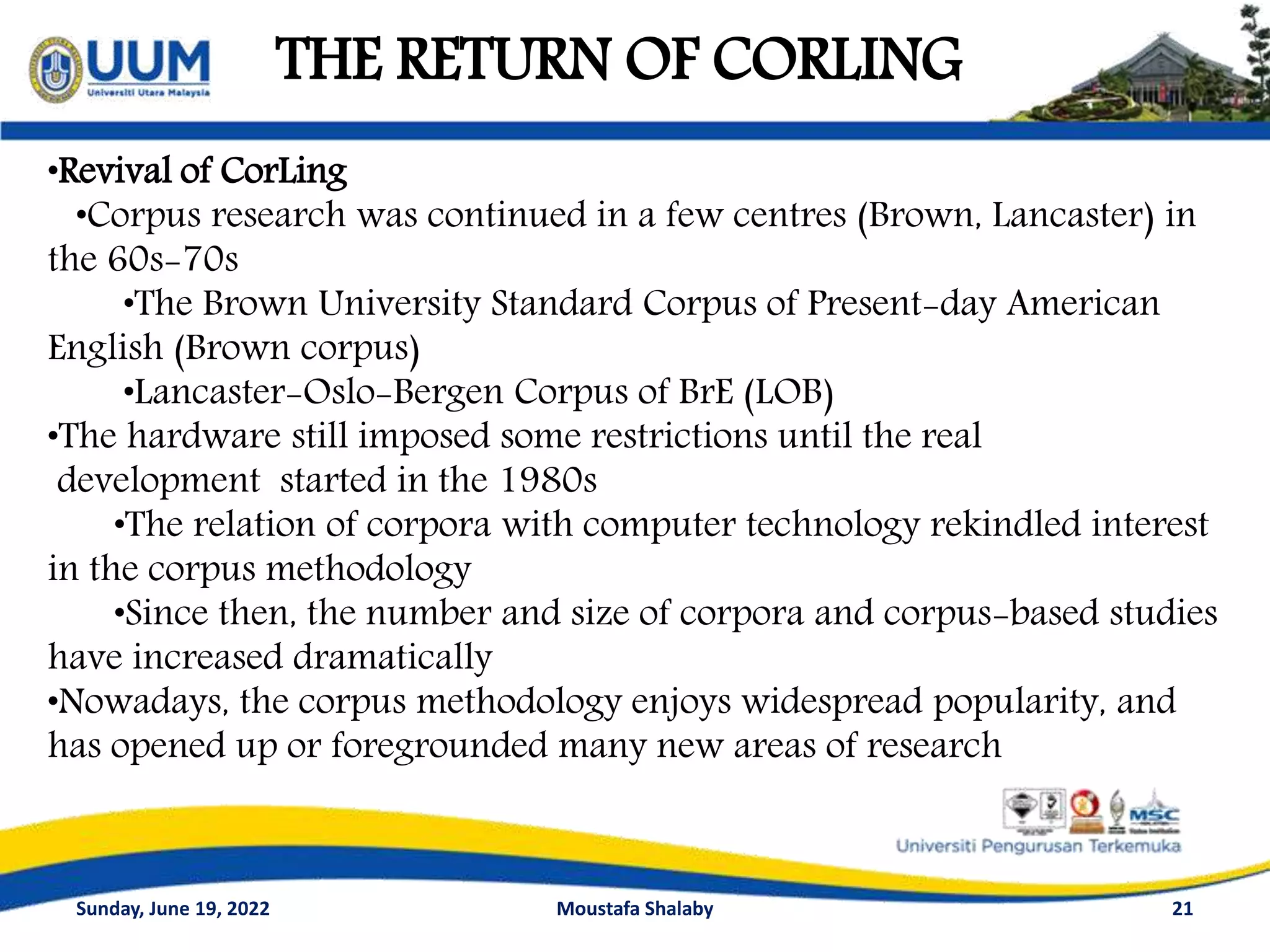
THE RETURN OFCORLING
21
•Revival of CorLing
•Corpus research was continued in a few centres (Brown, Lancaster) in
the 60s-70s
•The Brown University Standard Corpus of Present-day American
English (Brown corpus)
•Lancaster-Oslo-Bergen Corpus of BrE (LOB)
•The hardware still imposed some restrictions until the real
development started in the 1980s
•The relation of corpora with computer technology rekindled interest
in the corpus methodology
•Since then, the number and size of corpora and corpus-based studies
have increased dramatically
•Nowadays, the corpus methodology enjoys widespread popularity, and
has opened up or foregrounded many new areas of research
Sunday, June 19, 2022 Moustafa Shalaby
22.
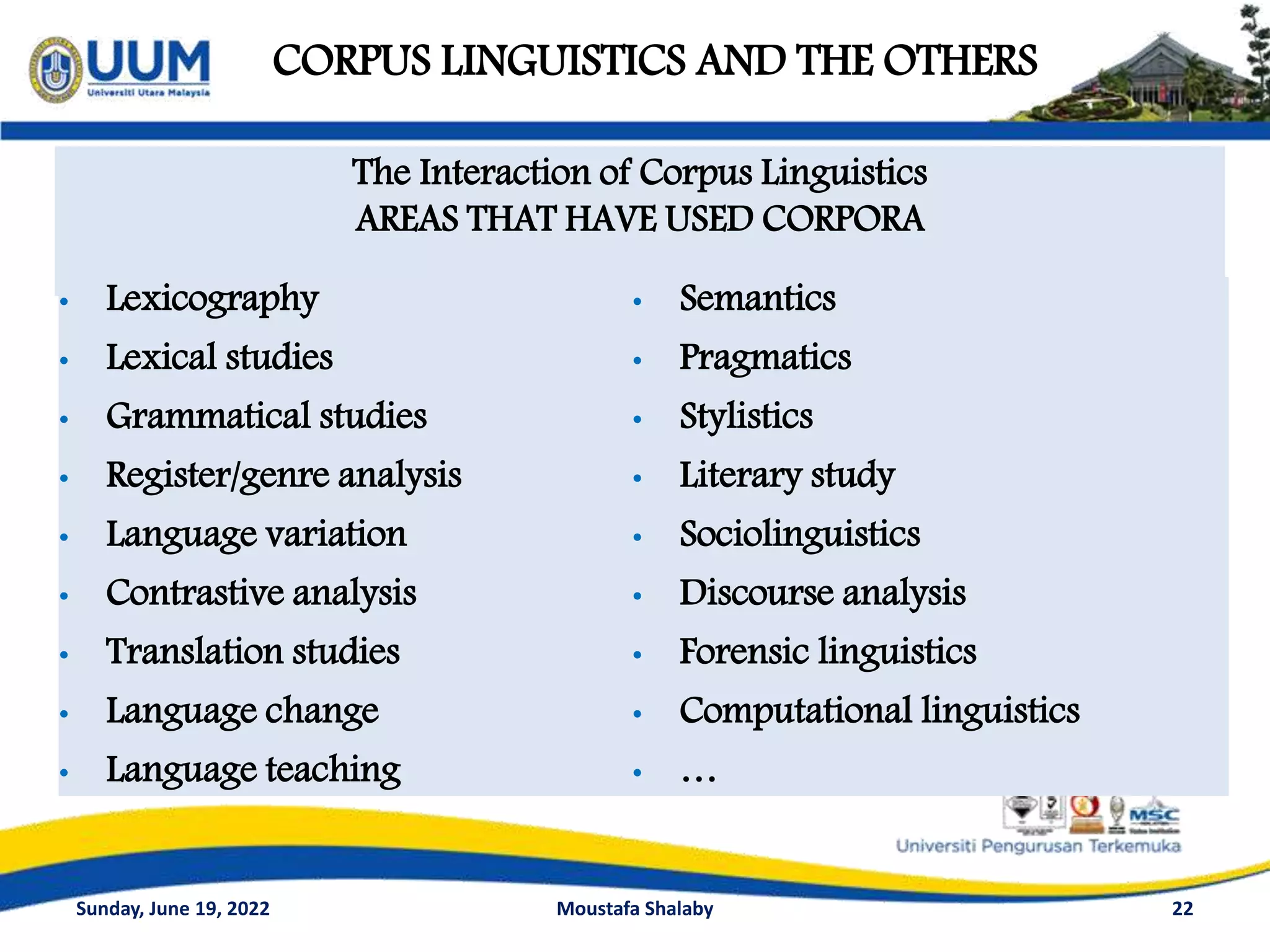
CORPUS LINGUISTICS ANDTHE OTHERS
22
The Interaction of Corpus Linguistics
AREAS THAT HAVE USED CORPORA
• Lexicography
• Lexical studies
• Grammatical studies
• Register/genre analysis
• Language variation
• Contrastive analysis
• Translation studies
• Language change
• Language teaching
• Semantics
• Pragmatics
• Stylistics
• Literary study
• Sociolinguistics
• Discourse analysis
• Forensic linguistics
• Computational linguistics
• …
Sunday, June 19, 2022 Moustafa Shalaby
23.
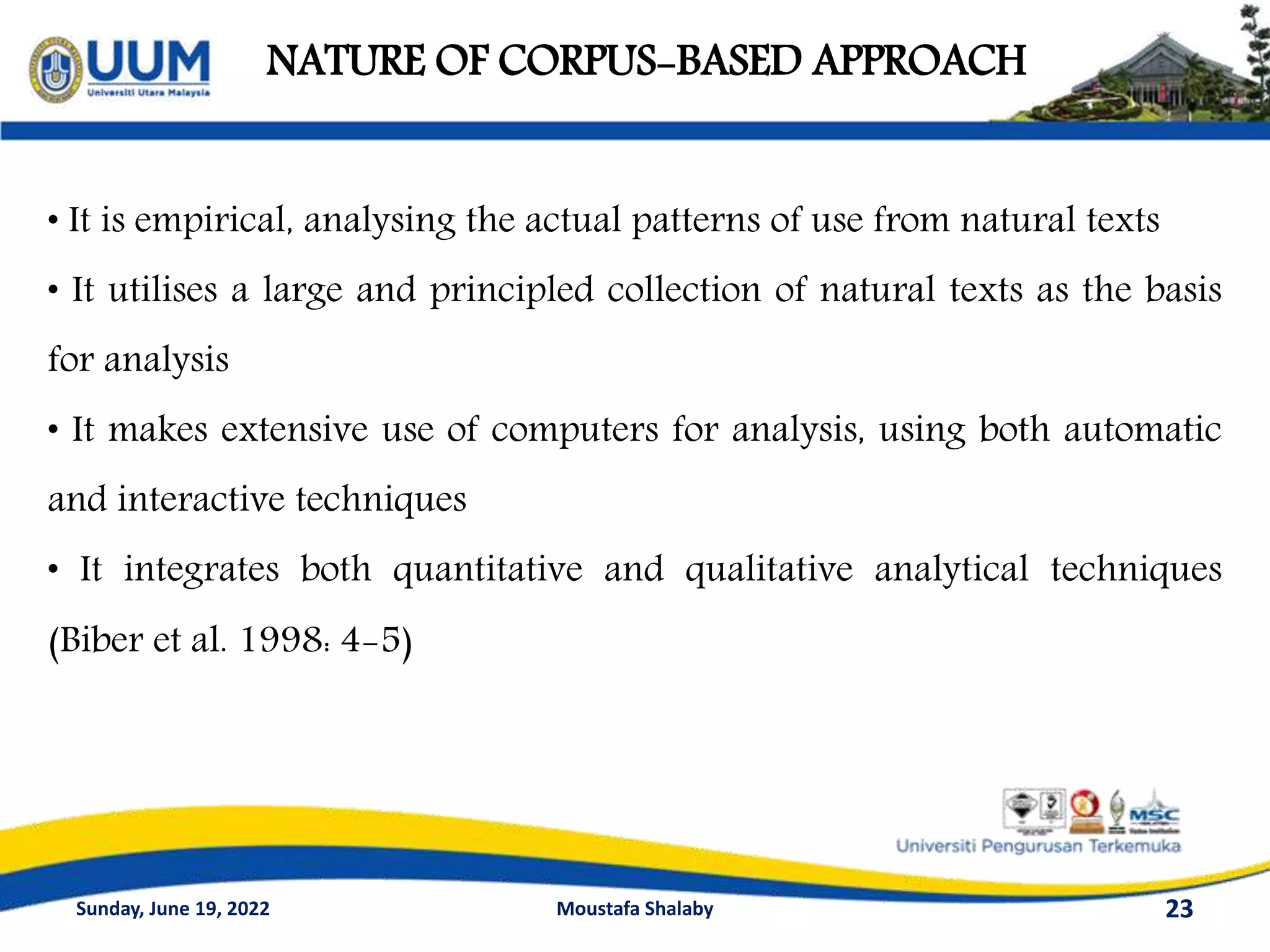
NATURE OF CORPUS-BASEDAPPROACH
23
• It is empirical, analysing the actual patterns of use from natural texts
• It utilises a large and principled collection of natural texts as the basis
for analysis
• It makes extensive use of computers for analysis, using both automatic
and interactive techniques
• It integrates both quantitative and qualitative analytical techniques
(Biber et al. 1998: 4-5)
Sunday, June 19, 2022 Moustafa Shalaby
24.
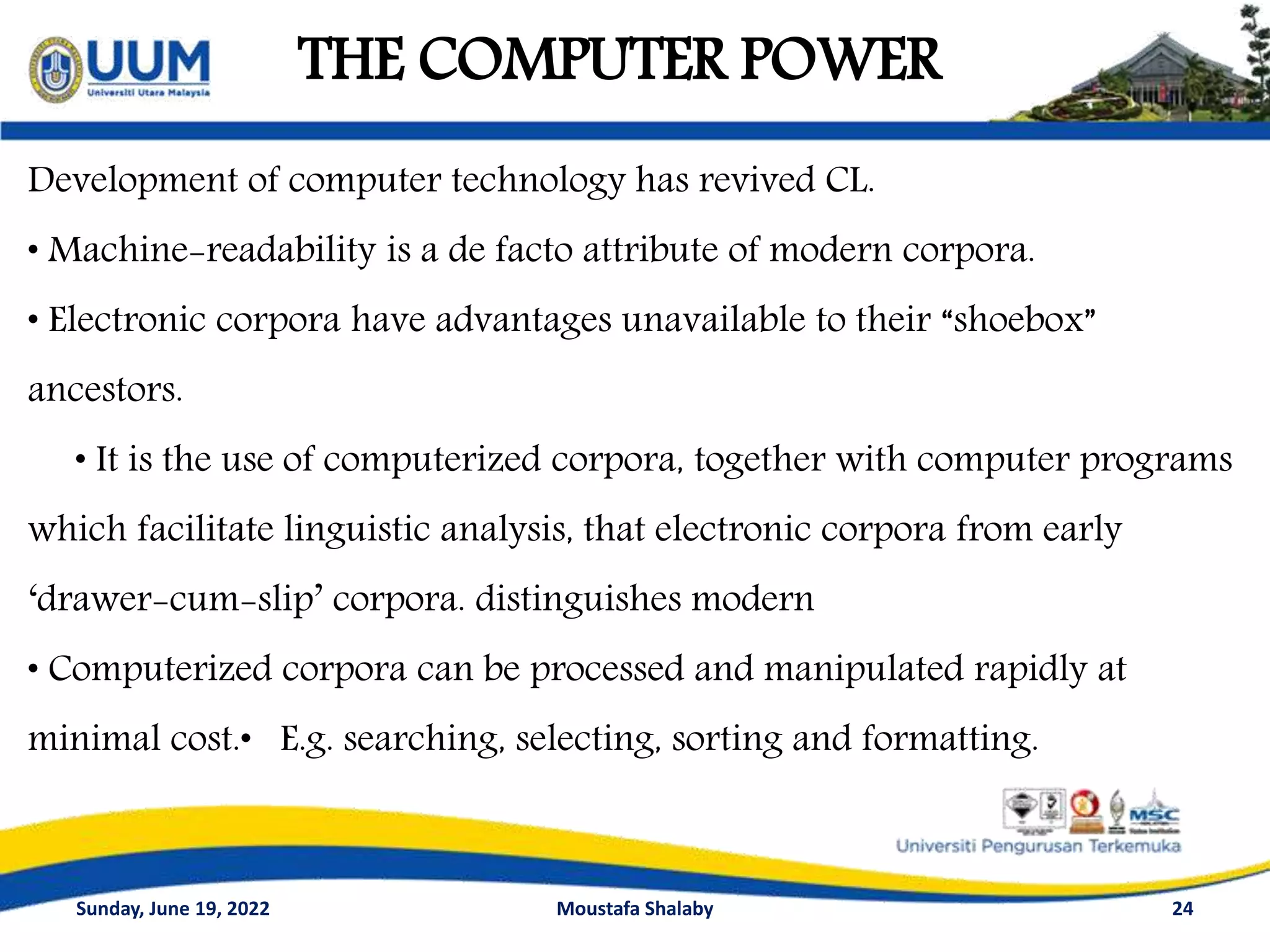
THE COMPUTER POWER
24
Developmentof computer technology has revived CL.
• Machine-readability is a de facto attribute of modern corpora.
• Electronic corpora have advantages unavailable to their “shoebox”
ancestors.
• It is the use of computerized corpora, together with computer programs
which facilitate linguistic analysis, that electronic corpora from early
‘drawer-cum-slip’ corpora. distinguishes modern
• Computerized corpora can be processed and manipulated rapidly at
minimal cost.• E.g. searching, selecting, sorting and formatting.
Sunday, June 19, 2022 Moustafa Shalaby
25.
THE COMPUTER POWER
25
•Computers can process machine-readable data accurately and consistently
• Computers can avoid human bias in an analysis, thus making the result
more reliable
• Machine-readability allows further automatic processing to be performed
on the
corpus so that corpus texts can be enriched with various metadata and
linguistic analyses
• Corpus markup and corpus annotation
Sunday, June 19, 2022 Moustafa Shalaby
26.
WHAT CORPORA CANNOTDO
26
• Corpora do not provide negative evidence.
• Cannot tell us what is possible or not possible.
• Can show what is central and typical in language.
• Corpora can yield findings but rarely provide explanations for
what is observed.
• Interfacing other methodologies
• The use of corpora as a methodology also defines the boundaries of any
given study
• Importance of amenable research questions
• The findings based on a particular corpus only tell us what is true in
that corpus
• Generalization vs. representativeness
Sunday, June 19, 2022 Moustafa Shalaby
27.
ASKING THE RIGHTQUESTION
27
• Corpus linguistics as a methodology is only one of the (many) ways of doing
things
– “doing linguistics”
• The usefulness of corpora depends upon the research question being
investigated
• “They are invaluable for doing what they do, and what they do not do must
be done in another way.” (Hunston 2002: 20)
• The development of the corpus-based approach as a tool in language studies
has been compared to the invention of telescopes in astronomy
• If it is ridiculous to criticize a telescope for not being a microscope, it is
equally pointless to criticize the corpus-based approach for not doing what it
is not intended to do
• It is up to you to formulate research questions amenable to corpus-based
investigation and to decide how to combine corpora with other resources
Sunday, June 19, 2022 Moustafa Shalaby
28.
REFERENCES
Sunday, June 19,2022 Moustafa Shalaby 28
• Aijmer, K. 2009. Corpora and Language Teaching. Amsterdam/Philadelphia. J. Benjamins.
• Aijmer, K., B. Altenberg. 1991. English Corpus Linguistics. Longman: London and New York.
• Altenberg, B. 1998. ‚On the phraseology of spoken English: the evidence of recurrent word combinations‘ in Cowie,
A.P. (ed) Phraseology:Theory Analysis and Applications. Oxford: Oxford University Press.
• Altenberg, B. and Granger ,S. 2001. Grammatical and lexical patterning of make in student writing‘, Applied
Linguistics 22(2): 173-194.
• Aprijaskytė, R. and E. Pareigytė, 1982. Some lexical Difficulties for the Lithuanian Learner of English. Vilnius.
• Aston, G. And Burnard, L. 1998. The BNC Handbook. Edinburgh: Edinburgh University Press.
• Baker, M. 1993. ‘Corpus linguistics and translation studies: Implications and Applications’ in M. Baker, G. Francis
and E. Tognini-Bonelli (eds)Text and technology: In Honour of John Sinclair. Amsterdam: John Benjamins, pp. 17-45.
• Baker, M. 1996. ‘Corpus-based translation studies: The challenges that lie ahead’. In H. Somers (ed.) Terminology,
LSP and Translation: Studies in language engineering, in honour of Juan C. Sager. Amsterdam, John Benjamis, pp.
175-86.
• Barnbrook, G. 1996. Language and Computers: A Practical introduction to the Computer Analysis of language”.
Edinburgh University Press.
• Biber, D. 1990. ‘Methodological issues regarding corpus-based analyses of of linguistic variation’. Literary and
Linguistic Computing 5: 257-269.
• Blum-Kulka, S. 1986. ‘Shifts of cohesion and coherence in translation’, in J.House and S. Blum-Kulka (eds)
Interlingual and InterculturalCommunication: Discourse and cognition in translation and second language
acquisition studies. Tubingen: Gunter Narr, pp. 17-35
![CORPORA VS. INTUITIONS
16
•Not necessarily antagonistic, but rather corroborate each other and can
be gainfully viewed as being complementary.
•Armchair linguists and corpus linguists “need each other. Or better, […]
the two kinds of linguists, wherever possible, should exist in the same
body.” (Fillmore 1992).
•“Neither the corpus linguist of the 1950s, who rejected intuitions, nor the
general linguist of the 1960s, who rejected corpus data, was able to
achieve the interaction of data coverage and the insight that characterize
the many successful corpus analyses of recent years.” (Leech 1991).
•The key to using corpus data is to find the balance between the use of
corpus data and the use of one’s intuitions.
Sunday, June 19, 2022 Moustafa Shalaby](https://image.slidesharecdn.com/computationallinguistics-220619081018-353b1fa2/75/COMPUTATIONAL-LINGUISTICS-pptx-16-2048.jpg)