Chapter 4
Subsurface water & Engineering work
Runoff
Seasonal
spring
Saturated
Subsurfacewater
Chapter Outline
• Introduction
• Effects of subsurface water on engineering structures
• Water quality and engineering work
• Controlling techniques of subsurface water effect
At the end of this chapter
• Students will be able to understand the interaction of
subsurface water with earth material and its effect on
engineering structures
• Students will be acquired knowledge to reduce the
effects of subsurface water on engineering works
I. Introduction to Subsurface water
• Ground water: the water that lies beneath the ground surface,
filling the pore space between grains in bodies of sediment
(soils) and clastic sedimentary rock, and filling cracks,
discontinuities and cavities in all types of rock.
• The subsurface water can flow in different direction depending
on its level and subsurface structures.
• This subsurface flow is facilitated where there is hydraulic
head.
• The flow can be towards or away from engineering structures,
hence it affects the performance of the structures.
Terminologies
• Aquitard -A geologic formation that is saturated but is incapable of
transmitting sufficient quantities of water .
• Aquiclude - A geologic formation which able to hold water but unable to trans
simit
• Aquifer A geologic formation, group of formations, or part of a formation
capable of receiving, storing and transmitting water.
– It can be confined, unconfined or perched aquifer.
• Aquifuge -A geologic formation that is both impermeable and contains no
water. It cannot hold water.
• Capillary Fringe- The transition zone between the saturated and the
unsaturated zone where the pore spaces in soil and/or rock layers are filled with
water and air.
• Cone of Depression A depression in the potentiometric surface in the area
around a well, or group of wells, from which water is being withdrawn.
• Drainage The removal of excess water from the land surface and/or
from the soil profile.
• Gaining Stream A stream that receives ground-water discharge.
• Loosing Stream- A stream that recharge the groundwater.
• Hydraulic Conductivity A measure of the rate at which water will
move through a permeable soil or rock layer.
• Leakage- the accidental admission or escape of liquid or gas
through a hole or crack or it is the concentrated flow of water from
reservoir to down stream passing through geological structures.
• Seepage- the slow escape of a liquid or gas through porous material
or small holes or it is the distributed flow of water from dam
reservoir to down stream passing through porous medium.
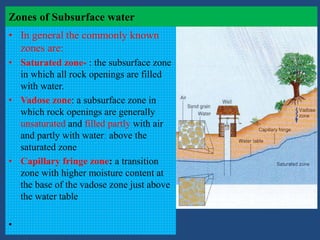
Zones of Subsurface water
• In general the commonly known
zones are:
• Saturated zone- : the subsurface zone
in which all rock openings are filled
with water.
• Vadose zone: a subsurface zone in
which rock openings are generally
unsaturated and filled partly with air
and partly with water; above the
saturated zone
• Capillary fringe zone: a transition
zone with higher moisture content at
the base of the vadose zone just above
the water table
•
Occurrence of Subsurface Water
Runoff
Seasonal
spring
Saturated
SubsurfacewaterGround water occurs when water recharges the subsurface through cracks and pores in a soil or
rock.
The recharges can be natural (precipitation, melting snow & infiltration from stream or lakes)
or artificial (recharge wells, water shade or seepage from hydraulic structures).
Porosity
• The amount of open space in a rock
• It may be primary and secondary porosity
High Porosity Low Porosity
vs.
Amount of Cement
Fracturing
The more cement between
the particles the less pore
space.
Porosity Varies with…
Well sorted (round) soils
have more pore space
than unsorted soils.
Bedrock with more fractures or cracks has more pores
than bedrock without many cracks.
Sorting
Porosity IS NOT affected by
particle size.
Each container has an equal volume of
sediment and equal pore space.
48%
Porosity
48%
Porosity
48%
Porosity
Permeability
– The ability of water to flow
through a soil.
Permeability depends on soil composition
(size and sorting)
Large
Particles
Small
Particles
Sorted
Particles
Unsorted
Particles
** What would
impermeable
mean?**
Large Particles Small Particles
Sorted Particles Unsorted Particles
• More permeable
• Water flows
easily from space
to space
• Less permeable
• It’s hard for
water to find a
path through the
soil
• More permeable
• Plenty of open
spaces that
connect to each
other
• Less permeable
• Small particles
fill up the spaces
leaving little
room for water to
move
Reading Assignment
• Trassimivity,
• Storativity,
• Hydraulic conductivity
• Permeability: the capacity of a rock to transmit a fluid such as water or
petroleum through pores and fractures. permeable: a rock that allows
water to flow easily through it.
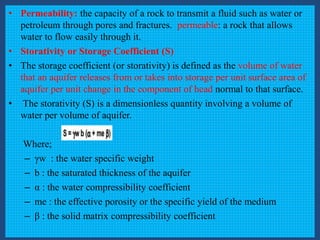
• Storativity or Storage Coefficient (S)
• The storage coefficient (or storativity) is defined as the volume of water
that an aquifer releases from or takes into storage per unit surface area of
aquifer per unit change in the component of head normal to that surface.
• The storativity (S) is a dimensionless quantity involving a volume of
water per volume of aquifer.
Where;
– γw : the water specific weight
– b : the saturated thickness of the aquifer
– α : the water compressibility coefficient
– me : the effective porosity or the specific yield of the medium
– β : the solid matrix compressibility coefficient
II. Effects of subsurface water on engineering
Structures
• Engineering structures like dam, building, highways,
railways, roads and other underground projects such as
mining, tunnels could be affected by the water (surface or
subsurface) in different ways .
• It may pose problems during
• construction stage,
• its performance stage and
• reduce the safe functioning of an engineering project.
• Engineering project can also affects the subsurface water by
altering its quality and flow direction.
The Main Effects of Subsurface Water on Engineering Structures are:
• Eroding the foundation of structures
• Volume change of soil or rocks of the foundations which is resulted in
Settlement or collapse.
• Increasing moisture of slope material that resulted in the sliding of slope by
reducing safety factors.
• Affect excavation and construction activities when it flowing towards the
structures to be constructed.
• Reducing the bearing capacity and shear strength of a material on site.
• Lubricating the contacts between layers or weak zones.
• leakage towards the structures and develop uplift pore pressure which
results in the failure of engineering structures.
• Generally, sub surface water would be resulted in flooding, swelling
of expansive materials, reduction in bearing capacity, uplift
pressures, chemical attack and difficulties during construction due to
flooding to the site.
• To reduce the effects of physical (mechanical) and chemical
activities of subsurface water on Engineering structures.
• The following information should be collected properly during site
investigation
 Distribution and content of sub-surface water.
 Direction and velocity of subsurface water flow in the site
 Depth to water table and its range of fluctuation under
different condition.
 Regions of confined, perched and unconfined water levels.
 Hydro-chemical properties and pollutants that can decompose
the engineering structures.
Effects of Subsurface Water on Dam Site
• Subsurface water is the most and critical problems in the
foundation and abutments of dam project.
• Because in most cases, dam foundation will be situated to
placed at great depth below subsurface water in order to
reduce instability problems.
• In this case, there will be an inflow of water into the
excavation, which may block or retard the construction
activities.
• Rock mass contains discontinuity may serve as reservoir
and conduit for ground water that may pose problems
during excavation.
 Subsurface water conditions in dam projects will be
causes
• Seepage into the storage.
• Water over flow.
• Failure of a dam and flooding downstream side.
• Increase pore water pressure within foundation and
abutments, which is responsible in the reduction of
cohesion/resisting force .
• Pose problems in excavation and construction
activities.
• Erode foundation and damage the structure of the
dam.
• lubricate the discontinuity and facilitate the failure of
dam abutment.
• Subsurface water fluctuations may cause uplift problems
in the dam foundation area which in turn responsible for
the settlement.
• Sub surface water can bring different dissolved chemical
to the foundation, which can react with construction
material and damage overall structures
Generally, dam failures can be grouped into four
classifications which may or may not related to subsurface
water effect:
– Overtopping,
– Foundation failure
– Structural failure and
– Other unforeseen failures.
Effects of Subsurface Water on Tunnel
• The stability of tunnel is one of the most important
subjects in the tunnel constructions, especially when the
groundwater table locates above the tunnel.
• Ground water seepage occurs to the tunnel when the
tunnel intersects the ground water table at certain point on
its extension.
• Tunneling beneath the groundwater table causes changes
in the state of stress and the pore water pressure
distribution.
• When the groundwater table is above the tunnel, the water
can flow towards the tunnel.
• The water near the tunnel can develop pore water pressure around
the tunnel and can results in collapsing of a tunnel.
• The water can saturate the roof of the tunnel passage and results in
ground collapse by reducing the withstand capacity of the soils.
Effects of Subsurface Water on Building Foundations
• Temporary or permanent rising and lowering of the groundwater table
from man-made or natural causes an effect on buildings, streets,
underground utilities and other structures.
• Foundation / base of every engineering structure are on or in the soils
or rocks.
• When the rocks and soils exposed to subsurface water their
engineering properties can be changed by saturation and pore pressure
effects.
• This effect is results in the reduction of bearing capacity, shear
strength, durability, hardness of soils and rocks.
• Generally the effects of ground water on the stability of foundations
are pore water pressure/uplift, saturation of foundation rocks and soils,
dissolving cementing material, developing slippery base and swelling
effects.
Effect of Sub Surface Water on Pavements
• The stability of pavements depend on the presence of
ground water, and types of construction material.
• When the ground water level reaches the base of the
pavement it will have an effect like saturation, reduce the
adhesion in construction material and reduce the strength
of the materials on foundation.
• The fluctuation of subsurface water makes the swelling
and shrinkage of sub grade of the pavements, which in
turn reduce the bearing capacity of the soils.
• During the fluctuation of sub surface water the soil under
the structure is equally saturated and the soils under the
shoulder dry faster than the other and form a crack
parallel to the road on the side of the roads.
• Thus subsurface water bring a distress of pavement.
• Moisture variation and frost action are the main cause of
deterioration of the subgrade.
• When the water content is decreased,
shrinkage cracks develops, which
cause differential settlement in the
rigid pavement and cracks in the
flexible pavement.
• Hence the pavement should be
provided with a suitable drainage
system or the pavement must be
constructed above the maximum level
of the ground water table to keep it
dry.
• Water chemistry- the chemistry of subsurface water can varies
from place to place and from time to time, because it depends on
the material through which it exists or in what chemistry it exist.
• The chemistry of sub surface water are measured in terms of
acidity and total dissolved solid (TDS).
• Depend on the chemistry, subsurface water is the most dissolving
agents on engineering structure which responsible for the formation
of karst, solution cavities.
• This results in the collapsing of structure on the surface above the
karst or solution cavities.
• Also the water can react with carbonate rocks along its path, this
reaction results in the formation of carbonic acid, which is
chemically acidic and easily react with construction materials such
as concrete.
Water Quality and Engineering Structures
• Sulfuric acid also formed when water react with some
evaporate rocks such as gypsum.
• The sulfuric acid will facilitates the weathering process of
the native foundation rock causing decrease in strength.
• When Sulfate present in large amount, is aggressive to
concrete, metallic structures, like rock bolts, steel used as
reinforcement etc.
• This ability water to deteriorate, weathering and eroding
of structure due to its composition is known as
corrosivity.
• In corrosive subsurface water conditions, while doing
excavations, a proper precaution has to be taken to reduce
the effect of corrosion, especially in permanent
excavations.
 Chemistry of ground water affects stability of engineering
structures because of
• Formation of cavern- when water dissolve the carbonate rocks.
– Most caves are formed by the chemical dissolution process.
• Sinkhole-form as a result of lowering the water table by excessive
pumping for human use of the water. Or by dissolving of underground
support.
• Subsidence- results from withdraws of fluids or collapse of underground
caves
Controlling Subsurface Water Effects
Why Drainage & Dewatering?
• Carryout construction activity below water table.
• To increase stability of soil.
• To decrease seepage & pore water pressure.
• Reclamation of water logged areas.
• Release of hydrostatic pressure behind the retaining
structures.
Methods of Subsurface Water Control
1. Lowering Water Table
 Ditches & sumps
 Well point system
 Shallow well system
 Deep well system
 Vacuum method
 Electro-osmosis method
2. Water Exclusion Method
 Sheet pile
 Ground freezing
 Grouting
Controlling Subsurface Water Effects
Ditches & Sumps
• Simplest method
• Useful in Shallow excavations in Coarse grained soils
whose K >10-3 cm/s
• If seepage is significant, it may cause softening of lower
part of slope
• Possibility of piping in the sump bottom
Well point system
 A well point system consists of a number of well points
spaced along a trench or around an excavation site, all
connected to a common header, which is attached to one or
more well point pumps.
• Dewatering system based on gravity flow
• Draws water away from excavation
• Lowers groundwater by up to 6 m
• Low volume output, not for use in very permeable soils
• It is most suitable in shallow aquifers where the water level needs
to be lowered
Multi Stage Well point System
• Used for dewatering excavations which are more than 6m
below the W.T.
• In multistage well point system, round the clock
pumping schedule is necessary because
• Interruption in pumping can create catastrophic
consequences
• One auxiliary pump should be provided for each two
pumps
Deep well Drainage System
• Adopted, when depth of excavation is more than 16 m below the
water table
• The system is useful where artesian water is present
• A 15 to 60 cm dia. Hole is bored, and casing with a long screen ( 5
to 25 cm) is provided
• Submersible pump with capacity to push water up to 30m or more
is installed near the bottom of the well
• Each well has its own pump.
• A row of deep wells are arranged at the toe side of the side slope of
deep excavation.
• Also very helpful where high artesian pressure exists.
Vacuum Method
• Useful for fine grained soils
• (fine, non cohesive soils, Silty sands etc.) particle size D10 is smaller than
0.05mm & its co-efficient of permeability between 10 -3 and 10-5 cm/s.
• It is necessary to apply a suction head in excess of the capillary head to
the dewatering system.
• A hole of 25 cm dia. is created around the well point and the rise pipe by
jetting water under sufficient pressure.
• Vacuum pumps are used to create a vacuum in the sand filling.
• When the vacuum is drawn on the well point, the ground
surface is subjected to unbalanced atmospheric pressure
3. Drainage by Electro-Osmosis
• Used in cohesive soils
• +ve water particles electrostatically bound to –ve soil particles
makes dewatering difficult
• Direct current is passed between two electrode in to saturated soil
mass to break attraction and allow water to flow.
• Soil water travel from positive to negative Cathode made in a form
of well point or a metal tube for pumping out the seeping water.
• Natural flow of water is reversed away from the excavation
• Thereby increasing shear strength of the soil and stability of the
slope
• Very costly
• Used where the main purpose is to increase consolidation and
shear strength of the soil
Ground Freezing
• The principle of ground freezing is to change the water in the soil into a solid
wall of ice.
• This wall of ice is completely impermeable.
• Ground freezing is used for groundwater cutoff, for earth support, for temporary
underpinning, for stabilization of earth for tunnel excavation, to arrest landslides
and to stabilize abandoned mineshafts.
• To freeze the ground, a row of Freeze pipes are placed vertically in the soil and
heat energy is removed through these pipes
• Once the earth temperature reaches 32 °F (0 °C), water in the soil pores turns to
ice.
• A temperature of +20 °F may be sufficient in sands, whereas temperatures a low
as –20 °F may be required in soft clays.
Water Exclusion
1. Sheet Piles/Secant Piles/Diaphragm Wall
• Dual purpose (providing
impermanent support to
excavation and excluding
groundwater)
• The pile block the movement of
water towards the excavation/
construction area and support the
side of excavation.
• The water pressure can
develop and result in failure
of the wall, if it is not well
designed.
• Used where permeability is too high or where access is
difficult (tunnelling)
• Grout is injected of cement into the soil under pressure
via boreholes or drill holes
• May be cementitious, chemical (silica based) or bentonite.
• Can strengthen soil and / or form impermeable barrier.
2. Grouting
1. How water can be reduced the shear strength of soils?
2. Why geologist conduct site investigation?
3. Is earthquake trigger slope failure? How?
4. Do you think Ethiopia is susceptible for earthquake
hazard? Why?
5. Why do you study groundwater condition for engineering
structure design?
6. Why people commonly live near by volcanic active
areas?
Quiz 1

Lecture 4

  • 1.
    Chapter 4 Subsurface water& Engineering work Runoff Seasonal spring Saturated Subsurfacewater
  • 2.
    Chapter Outline • Introduction •Effects of subsurface water on engineering structures • Water quality and engineering work • Controlling techniques of subsurface water effect
  • 3.
    At the endof this chapter • Students will be able to understand the interaction of subsurface water with earth material and its effect on engineering structures • Students will be acquired knowledge to reduce the effects of subsurface water on engineering works
  • 4.
    I. Introduction toSubsurface water • Ground water: the water that lies beneath the ground surface, filling the pore space between grains in bodies of sediment (soils) and clastic sedimentary rock, and filling cracks, discontinuities and cavities in all types of rock. • The subsurface water can flow in different direction depending on its level and subsurface structures. • This subsurface flow is facilitated where there is hydraulic head. • The flow can be towards or away from engineering structures, hence it affects the performance of the structures.
  • 5.
    Terminologies • Aquitard -Ageologic formation that is saturated but is incapable of transmitting sufficient quantities of water . • Aquiclude - A geologic formation which able to hold water but unable to trans simit • Aquifer A geologic formation, group of formations, or part of a formation capable of receiving, storing and transmitting water. – It can be confined, unconfined or perched aquifer. • Aquifuge -A geologic formation that is both impermeable and contains no water. It cannot hold water. • Capillary Fringe- The transition zone between the saturated and the unsaturated zone where the pore spaces in soil and/or rock layers are filled with water and air. • Cone of Depression A depression in the potentiometric surface in the area around a well, or group of wells, from which water is being withdrawn.
  • 6.
    • Drainage Theremoval of excess water from the land surface and/or from the soil profile. • Gaining Stream A stream that receives ground-water discharge. • Loosing Stream- A stream that recharge the groundwater. • Hydraulic Conductivity A measure of the rate at which water will move through a permeable soil or rock layer. • Leakage- the accidental admission or escape of liquid or gas through a hole or crack or it is the concentrated flow of water from reservoir to down stream passing through geological structures. • Seepage- the slow escape of a liquid or gas through porous material or small holes or it is the distributed flow of water from dam reservoir to down stream passing through porous medium.
  • 7.
    Zones of Subsurfacewater • In general the commonly known zones are: • Saturated zone- : the subsurface zone in which all rock openings are filled with water. • Vadose zone: a subsurface zone in which rock openings are generally unsaturated and filled partly with air and partly with water; above the saturated zone • Capillary fringe zone: a transition zone with higher moisture content at the base of the vadose zone just above the water table •
  • 8.
    Occurrence of SubsurfaceWater Runoff Seasonal spring Saturated SubsurfacewaterGround water occurs when water recharges the subsurface through cracks and pores in a soil or rock. The recharges can be natural (precipitation, melting snow & infiltration from stream or lakes) or artificial (recharge wells, water shade or seepage from hydraulic structures).
  • 9.
    Porosity • The amountof open space in a rock • It may be primary and secondary porosity High Porosity Low Porosity vs.
  • 10.
    Amount of Cement Fracturing Themore cement between the particles the less pore space. Porosity Varies with… Well sorted (round) soils have more pore space than unsorted soils. Bedrock with more fractures or cracks has more pores than bedrock without many cracks. Sorting
  • 11.
    Porosity IS NOTaffected by particle size. Each container has an equal volume of sediment and equal pore space. 48% Porosity 48% Porosity 48% Porosity
  • 12.
    Permeability – The abilityof water to flow through a soil. Permeability depends on soil composition (size and sorting) Large Particles Small Particles Sorted Particles Unsorted Particles ** What would impermeable mean?**
  • 13.
    Large Particles SmallParticles Sorted Particles Unsorted Particles • More permeable • Water flows easily from space to space • Less permeable • It’s hard for water to find a path through the soil • More permeable • Plenty of open spaces that connect to each other • Less permeable • Small particles fill up the spaces leaving little room for water to move
  • 14.
    Reading Assignment • Trassimivity, •Storativity, • Hydraulic conductivity
  • 15.
    • Permeability: thecapacity of a rock to transmit a fluid such as water or petroleum through pores and fractures. permeable: a rock that allows water to flow easily through it. • Storativity or Storage Coefficient (S) • The storage coefficient (or storativity) is defined as the volume of water that an aquifer releases from or takes into storage per unit surface area of aquifer per unit change in the component of head normal to that surface. • The storativity (S) is a dimensionless quantity involving a volume of water per volume of aquifer. Where; – γw : the water specific weight – b : the saturated thickness of the aquifer – α : the water compressibility coefficient – me : the effective porosity or the specific yield of the medium – β : the solid matrix compressibility coefficient
  • 16.
    II. Effects ofsubsurface water on engineering Structures • Engineering structures like dam, building, highways, railways, roads and other underground projects such as mining, tunnels could be affected by the water (surface or subsurface) in different ways . • It may pose problems during • construction stage, • its performance stage and • reduce the safe functioning of an engineering project. • Engineering project can also affects the subsurface water by altering its quality and flow direction.
  • 17.
    The Main Effectsof Subsurface Water on Engineering Structures are: • Eroding the foundation of structures • Volume change of soil or rocks of the foundations which is resulted in Settlement or collapse. • Increasing moisture of slope material that resulted in the sliding of slope by reducing safety factors. • Affect excavation and construction activities when it flowing towards the structures to be constructed. • Reducing the bearing capacity and shear strength of a material on site. • Lubricating the contacts between layers or weak zones. • leakage towards the structures and develop uplift pore pressure which results in the failure of engineering structures.
  • 18.
    • Generally, subsurface water would be resulted in flooding, swelling of expansive materials, reduction in bearing capacity, uplift pressures, chemical attack and difficulties during construction due to flooding to the site. • To reduce the effects of physical (mechanical) and chemical activities of subsurface water on Engineering structures. • The following information should be collected properly during site investigation  Distribution and content of sub-surface water.  Direction and velocity of subsurface water flow in the site  Depth to water table and its range of fluctuation under different condition.  Regions of confined, perched and unconfined water levels.  Hydro-chemical properties and pollutants that can decompose the engineering structures.
  • 19.
    Effects of SubsurfaceWater on Dam Site • Subsurface water is the most and critical problems in the foundation and abutments of dam project. • Because in most cases, dam foundation will be situated to placed at great depth below subsurface water in order to reduce instability problems. • In this case, there will be an inflow of water into the excavation, which may block or retard the construction activities. • Rock mass contains discontinuity may serve as reservoir and conduit for ground water that may pose problems during excavation.
  • 20.
     Subsurface waterconditions in dam projects will be causes • Seepage into the storage. • Water over flow. • Failure of a dam and flooding downstream side. • Increase pore water pressure within foundation and abutments, which is responsible in the reduction of cohesion/resisting force . • Pose problems in excavation and construction activities. • Erode foundation and damage the structure of the dam. • lubricate the discontinuity and facilitate the failure of dam abutment.
  • 21.
    • Subsurface waterfluctuations may cause uplift problems in the dam foundation area which in turn responsible for the settlement. • Sub surface water can bring different dissolved chemical to the foundation, which can react with construction material and damage overall structures Generally, dam failures can be grouped into four classifications which may or may not related to subsurface water effect: – Overtopping, – Foundation failure – Structural failure and – Other unforeseen failures.
  • 22.
    Effects of SubsurfaceWater on Tunnel • The stability of tunnel is one of the most important subjects in the tunnel constructions, especially when the groundwater table locates above the tunnel. • Ground water seepage occurs to the tunnel when the tunnel intersects the ground water table at certain point on its extension. • Tunneling beneath the groundwater table causes changes in the state of stress and the pore water pressure distribution. • When the groundwater table is above the tunnel, the water can flow towards the tunnel.
  • 23.
    • The waternear the tunnel can develop pore water pressure around the tunnel and can results in collapsing of a tunnel. • The water can saturate the roof of the tunnel passage and results in ground collapse by reducing the withstand capacity of the soils.
  • 24.
    Effects of SubsurfaceWater on Building Foundations • Temporary or permanent rising and lowering of the groundwater table from man-made or natural causes an effect on buildings, streets, underground utilities and other structures. • Foundation / base of every engineering structure are on or in the soils or rocks. • When the rocks and soils exposed to subsurface water their engineering properties can be changed by saturation and pore pressure effects. • This effect is results in the reduction of bearing capacity, shear strength, durability, hardness of soils and rocks. • Generally the effects of ground water on the stability of foundations are pore water pressure/uplift, saturation of foundation rocks and soils, dissolving cementing material, developing slippery base and swelling effects.
  • 25.
    Effect of SubSurface Water on Pavements • The stability of pavements depend on the presence of ground water, and types of construction material. • When the ground water level reaches the base of the pavement it will have an effect like saturation, reduce the adhesion in construction material and reduce the strength of the materials on foundation. • The fluctuation of subsurface water makes the swelling and shrinkage of sub grade of the pavements, which in turn reduce the bearing capacity of the soils. • During the fluctuation of sub surface water the soil under the structure is equally saturated and the soils under the shoulder dry faster than the other and form a crack parallel to the road on the side of the roads.
  • 26.
    • Thus subsurfacewater bring a distress of pavement. • Moisture variation and frost action are the main cause of deterioration of the subgrade. • When the water content is decreased, shrinkage cracks develops, which cause differential settlement in the rigid pavement and cracks in the flexible pavement. • Hence the pavement should be provided with a suitable drainage system or the pavement must be constructed above the maximum level of the ground water table to keep it dry.
  • 27.
    • Water chemistry-the chemistry of subsurface water can varies from place to place and from time to time, because it depends on the material through which it exists or in what chemistry it exist. • The chemistry of sub surface water are measured in terms of acidity and total dissolved solid (TDS). • Depend on the chemistry, subsurface water is the most dissolving agents on engineering structure which responsible for the formation of karst, solution cavities. • This results in the collapsing of structure on the surface above the karst or solution cavities. • Also the water can react with carbonate rocks along its path, this reaction results in the formation of carbonic acid, which is chemically acidic and easily react with construction materials such as concrete. Water Quality and Engineering Structures
  • 28.
    • Sulfuric acidalso formed when water react with some evaporate rocks such as gypsum. • The sulfuric acid will facilitates the weathering process of the native foundation rock causing decrease in strength. • When Sulfate present in large amount, is aggressive to concrete, metallic structures, like rock bolts, steel used as reinforcement etc. • This ability water to deteriorate, weathering and eroding of structure due to its composition is known as corrosivity. • In corrosive subsurface water conditions, while doing excavations, a proper precaution has to be taken to reduce the effect of corrosion, especially in permanent excavations.
  • 29.
     Chemistry ofground water affects stability of engineering structures because of • Formation of cavern- when water dissolve the carbonate rocks. – Most caves are formed by the chemical dissolution process. • Sinkhole-form as a result of lowering the water table by excessive pumping for human use of the water. Or by dissolving of underground support. • Subsidence- results from withdraws of fluids or collapse of underground caves
  • 30.
    Controlling Subsurface WaterEffects Why Drainage & Dewatering? • Carryout construction activity below water table. • To increase stability of soil. • To decrease seepage & pore water pressure. • Reclamation of water logged areas. • Release of hydrostatic pressure behind the retaining structures.
  • 31.
    Methods of SubsurfaceWater Control 1. Lowering Water Table  Ditches & sumps  Well point system  Shallow well system  Deep well system  Vacuum method  Electro-osmosis method 2. Water Exclusion Method  Sheet pile  Ground freezing  Grouting Controlling Subsurface Water Effects
  • 32.
    Ditches & Sumps •Simplest method • Useful in Shallow excavations in Coarse grained soils whose K >10-3 cm/s • If seepage is significant, it may cause softening of lower part of slope • Possibility of piping in the sump bottom
  • 33.
    Well point system A well point system consists of a number of well points spaced along a trench or around an excavation site, all connected to a common header, which is attached to one or more well point pumps. • Dewatering system based on gravity flow • Draws water away from excavation • Lowers groundwater by up to 6 m • Low volume output, not for use in very permeable soils • It is most suitable in shallow aquifers where the water level needs to be lowered
  • 34.
    Multi Stage Wellpoint System • Used for dewatering excavations which are more than 6m below the W.T. • In multistage well point system, round the clock pumping schedule is necessary because • Interruption in pumping can create catastrophic consequences • One auxiliary pump should be provided for each two pumps
  • 35.
    Deep well DrainageSystem • Adopted, when depth of excavation is more than 16 m below the water table • The system is useful where artesian water is present • A 15 to 60 cm dia. Hole is bored, and casing with a long screen ( 5 to 25 cm) is provided • Submersible pump with capacity to push water up to 30m or more is installed near the bottom of the well • Each well has its own pump. • A row of deep wells are arranged at the toe side of the side slope of deep excavation. • Also very helpful where high artesian pressure exists.
  • 36.
    Vacuum Method • Usefulfor fine grained soils • (fine, non cohesive soils, Silty sands etc.) particle size D10 is smaller than 0.05mm & its co-efficient of permeability between 10 -3 and 10-5 cm/s. • It is necessary to apply a suction head in excess of the capillary head to the dewatering system. • A hole of 25 cm dia. is created around the well point and the rise pipe by jetting water under sufficient pressure. • Vacuum pumps are used to create a vacuum in the sand filling. • When the vacuum is drawn on the well point, the ground surface is subjected to unbalanced atmospheric pressure
  • 37.
    3. Drainage byElectro-Osmosis • Used in cohesive soils • +ve water particles electrostatically bound to –ve soil particles makes dewatering difficult • Direct current is passed between two electrode in to saturated soil mass to break attraction and allow water to flow. • Soil water travel from positive to negative Cathode made in a form of well point or a metal tube for pumping out the seeping water. • Natural flow of water is reversed away from the excavation • Thereby increasing shear strength of the soil and stability of the slope • Very costly • Used where the main purpose is to increase consolidation and shear strength of the soil
  • 38.
    Ground Freezing • Theprinciple of ground freezing is to change the water in the soil into a solid wall of ice. • This wall of ice is completely impermeable. • Ground freezing is used for groundwater cutoff, for earth support, for temporary underpinning, for stabilization of earth for tunnel excavation, to arrest landslides and to stabilize abandoned mineshafts. • To freeze the ground, a row of Freeze pipes are placed vertically in the soil and heat energy is removed through these pipes • Once the earth temperature reaches 32 °F (0 °C), water in the soil pores turns to ice. • A temperature of +20 °F may be sufficient in sands, whereas temperatures a low as –20 °F may be required in soft clays.
  • 39.
    Water Exclusion 1. SheetPiles/Secant Piles/Diaphragm Wall • Dual purpose (providing impermanent support to excavation and excluding groundwater) • The pile block the movement of water towards the excavation/ construction area and support the side of excavation. • The water pressure can develop and result in failure of the wall, if it is not well designed.
  • 40.
    • Used wherepermeability is too high or where access is difficult (tunnelling) • Grout is injected of cement into the soil under pressure via boreholes or drill holes • May be cementitious, chemical (silica based) or bentonite. • Can strengthen soil and / or form impermeable barrier. 2. Grouting
  • 41.
    1. How watercan be reduced the shear strength of soils? 2. Why geologist conduct site investigation? 3. Is earthquake trigger slope failure? How? 4. Do you think Ethiopia is susceptible for earthquake hazard? Why? 5. Why do you study groundwater condition for engineering structure design? 6. Why people commonly live near by volcanic active areas? Quiz 1