ARTIFICIAL RECHARGE
PRESENTED BY
U VAMSHI KRISHNA PRASAD
Why Artificial Recharge?
 In most low rainfall areas of country the
availability of utilizable surface water is so low
that people have to depend largely on ground
water for agriculture and domestic use.
 The problem has been further compounded due
to large scale urbanization and growth of
megacities which has drastically reduced open
lands for natural recharge.
INTRODUCTION
The artificial recharge to ground water aims at
augmentation of ground water reservoir by
modifying the natural movement of surface water
utilizing suitable civil construction techniques.
Artificial recharge techniques normally address to
following issues:
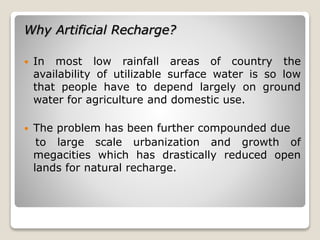
 (i) To maintain the ground water resources.
 (ii) To store underground
excess surface water.
Fig.1 Water Scarcity
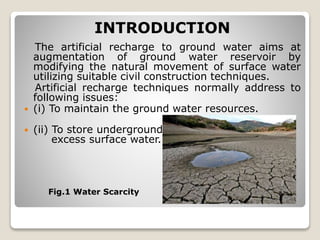
(iii) To improve saline
water intrusion in
costal aquifer.
(iv) To remove bacteriological and other impurities from
sewage and waste water so that water is suitable for
re-use.
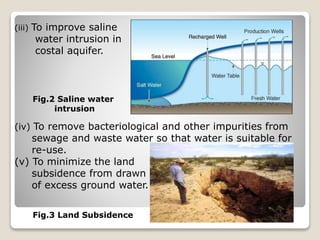
(v) To minimize the land
subsidence from drawn
of excess ground water.
Fig.2 Saline water
intrusion
Fig.3 Land Subsidence
(vi) To improve Physical and Chemical quality
of ground water.
Case study 1
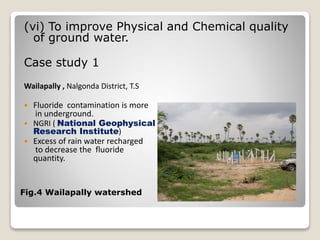
Wailapally , Nalgonda District, T.S
 Fluoride contamination is more
in underground.
 NGRI ( National Geophysical
Research Institute)
 Excess of rain water recharged
to decrease the fluoride
quantity.
Fig.4 Wailapally watershed
DEFINITION
Augmentation of ground water reservoir by man made
structures by using rain water.
QUALITY OF SOURCE WATER
Chemicals and salts:
 Problems which arise are mainly related to quality of raw
waters available for recharge which requires treatment
before being used in recharge installation.
 Changes in soil structure and biological phenomena are
also related to it. For source water and ground water the
chemical and bacteriological analysis is essential.
Sediment load:
 The water used in recharge projects should be free from
silt. Silt may be defined as content of undissolved solid
matter measured in mg/L, which do not exceeds 0.1m/hr.
SOURCES OF WATER FOR RECHARGE
 Precipitation (rainfall) over the demarcated area.
 Large roof areas from where rainwater can be
collected and diverted for recharge.
 Canals from large reservoirs from which water can be
made available for recharge.
 Natural streams from which surplus water can be
diverted for recharge, without violating the rights of
other users.
 Properly treated municipal and industrial wastewaters.
This water should be used only after ascertaining its
quality.
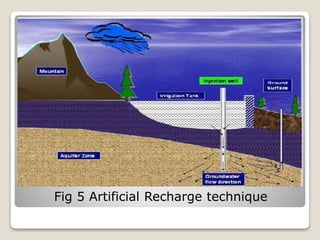
Fig 5 Artificial Recharge technique
Factors Affecting the Artificial
Recharge:
1. Topography
2. Water supply
3. Geology
4. Mechanical properties of geological
materials.
5. Cost
6. Social Benefits
Advantages of Artificial Recharge
 No large storage structures needed to store water. Structures
required are small and cost effective.
 Evaporation losses are negligible
 Quality improvement by infiltration through the permeable media
 Biological purity is very high
 Negligible losses as compared to losses in surface storages.
 Temperature variations are minimum
 It is environment friendly, controls soil erosion and flood and
provides sufficient soil moisture even during summer months
 Water stored underground is relatively immune to natural and
man-made catastrophes.
 No displacement of local pollution.
Implementation of Artificial Recharge
Schemes
Successful implementation of artificial
recharge schemes will essentially involve the
following major components:
 Assessment of source water
 Planning of recharge structures
 Finalisation of specific techniques and designs
 Monitoring and impact assessment
 Financial and economic evaluation
 Operation and maintenance
Methods of Artificial Recharge
They can be broadly classified as:
Direct Method Indirect Method
A) Surface Method A) Induced Recharge
i) Flooding B) Aquifer Modification
ii) Basin i) Hydro-Fracturing
iii) Stream augmentation
iv) Ditch & Furrow
v) Contour Bund
B) Subsurface Method
i) Injection wells
ii) Recharge pits
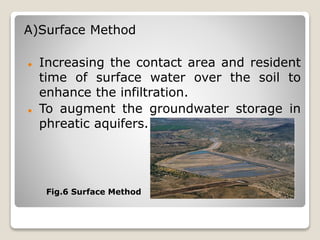
A)Surface Method
 Increasing the contact area and resident
time of surface water over the soil to
enhance the infiltration.
 To augment the groundwater storage in
phreatic aquifers.
Fig.6 Surface Method
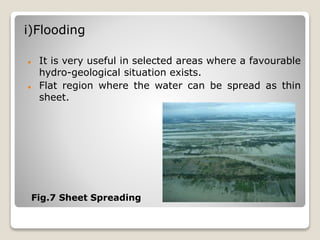
i)Flooding
 It is very useful in selected areas where a favourable
hydro-geological situation exists.
 Flat region where the water can be spread as thin
sheet.
Fig.7 Sheet Spreading
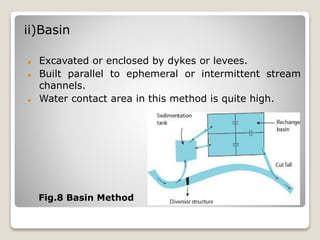
ii)Basin
 Excavated or enclosed by dykes or levees.
 Built parallel to ephemeral or intermittent stream
channels.
 Water contact area in this method is quite high.
Fig.8 Basin Method
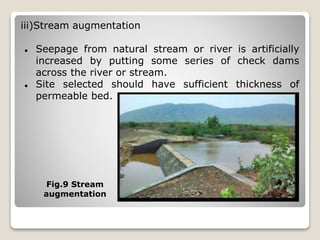
iii)Stream augmentation
 Seepage from natural stream or river is artificially
increased by putting some series of check dams
across the river or stream.
 Site selected should have sufficient thickness of
permeable bed.
Fig.9 Stream
augmentation
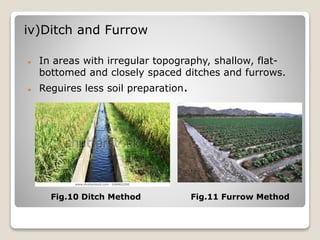
iv)Ditch and Furrow
 In areas with irregular topography, shallow, flat-
bottomed and closely spaced ditches and furrows.
 Reguires less soil preparation.
Fig.11 Furrow MethodFig.10 Ditch Method
B)Subsurface Method
These aim at recharging deeper aquifers that are
overlain by impermeable layers,preventing the
infiltration from surface sources to recharge them
under natural conditions.
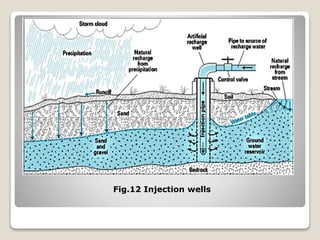
i)Injection wells
These structures are similar to a tube well.
 Directly discharge water into deep water-bearing
zones.
 Suitable only in areas where a thick impervious layer
exists between the surface of the soil and the
aquifer that is to be replenished.
Fig.12 Injection wells
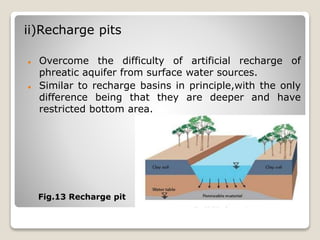
ii)Recharge pits
 Overcome the difficulty of artificial recharge of
phreatic aquifer from surface water sources.
 Similar to recharge basins in principle,with the only
difference being that they are deeper and have
restricted bottom area.
Fig.13 Recharge pit
A)Induced Recharge
 Pumping water from aquifer,which is hydraulically
connected with surface water.
 Improves the quality of surface water.
 The filtration of surface water through soil strata
removes the impurities of the water.
Fig.14 Induced Recharge
B)Aquifer Modification
 Modify the aquifer characteristics to increase its
capacity to store and transmit water.
 After application of it more recharge take place
under natural as well as artificial condition.
i)Hydro-Fracturing
 It is a process whereby hydraulic pressure is applied
to an isolated zone of bore wells to initiate and
propagate fractures and extend existing fractures.
 The water under high-pressure break up the fissures
cleans away clogging and leads to a better contact
with adjacent water bearing strata.
THANK YOU

Artificial recharge 15

  • 1.
  • 2.
    Why Artificial Recharge? In most low rainfall areas of country the availability of utilizable surface water is so low that people have to depend largely on ground water for agriculture and domestic use.  The problem has been further compounded due to large scale urbanization and growth of megacities which has drastically reduced open lands for natural recharge.
  • 3.
    INTRODUCTION The artificial rechargeto ground water aims at augmentation of ground water reservoir by modifying the natural movement of surface water utilizing suitable civil construction techniques. Artificial recharge techniques normally address to following issues:  (i) To maintain the ground water resources.  (ii) To store underground excess surface water. Fig.1 Water Scarcity
  • 4.
    (iii) To improvesaline water intrusion in costal aquifer. (iv) To remove bacteriological and other impurities from sewage and waste water so that water is suitable for re-use. (v) To minimize the land subsidence from drawn of excess ground water. Fig.2 Saline water intrusion Fig.3 Land Subsidence
  • 5.
    (vi) To improvePhysical and Chemical quality of ground water. Case study 1 Wailapally , Nalgonda District, T.S  Fluoride contamination is more in underground.  NGRI ( National Geophysical Research Institute)  Excess of rain water recharged to decrease the fluoride quantity. Fig.4 Wailapally watershed
  • 6.
    DEFINITION Augmentation of groundwater reservoir by man made structures by using rain water. QUALITY OF SOURCE WATER Chemicals and salts:  Problems which arise are mainly related to quality of raw waters available for recharge which requires treatment before being used in recharge installation.  Changes in soil structure and biological phenomena are also related to it. For source water and ground water the chemical and bacteriological analysis is essential. Sediment load:  The water used in recharge projects should be free from silt. Silt may be defined as content of undissolved solid matter measured in mg/L, which do not exceeds 0.1m/hr.
  • 7.
    SOURCES OF WATERFOR RECHARGE  Precipitation (rainfall) over the demarcated area.  Large roof areas from where rainwater can be collected and diverted for recharge.  Canals from large reservoirs from which water can be made available for recharge.  Natural streams from which surplus water can be diverted for recharge, without violating the rights of other users.  Properly treated municipal and industrial wastewaters. This water should be used only after ascertaining its quality.
  • 8.
    Fig 5 ArtificialRecharge technique
  • 9.
    Factors Affecting theArtificial Recharge: 1. Topography 2. Water supply 3. Geology 4. Mechanical properties of geological materials. 5. Cost 6. Social Benefits
  • 10.
    Advantages of ArtificialRecharge  No large storage structures needed to store water. Structures required are small and cost effective.  Evaporation losses are negligible  Quality improvement by infiltration through the permeable media  Biological purity is very high  Negligible losses as compared to losses in surface storages.  Temperature variations are minimum  It is environment friendly, controls soil erosion and flood and provides sufficient soil moisture even during summer months  Water stored underground is relatively immune to natural and man-made catastrophes.  No displacement of local pollution.
  • 11.
    Implementation of ArtificialRecharge Schemes Successful implementation of artificial recharge schemes will essentially involve the following major components:  Assessment of source water  Planning of recharge structures  Finalisation of specific techniques and designs  Monitoring and impact assessment  Financial and economic evaluation  Operation and maintenance
  • 12.
    Methods of ArtificialRecharge They can be broadly classified as: Direct Method Indirect Method A) Surface Method A) Induced Recharge i) Flooding B) Aquifer Modification ii) Basin i) Hydro-Fracturing iii) Stream augmentation iv) Ditch & Furrow v) Contour Bund B) Subsurface Method i) Injection wells ii) Recharge pits
  • 13.
    A)Surface Method  Increasingthe contact area and resident time of surface water over the soil to enhance the infiltration.  To augment the groundwater storage in phreatic aquifers. Fig.6 Surface Method
  • 14.
    i)Flooding  It isvery useful in selected areas where a favourable hydro-geological situation exists.  Flat region where the water can be spread as thin sheet. Fig.7 Sheet Spreading
  • 15.
    ii)Basin  Excavated orenclosed by dykes or levees.  Built parallel to ephemeral or intermittent stream channels.  Water contact area in this method is quite high. Fig.8 Basin Method
  • 16.
    iii)Stream augmentation  Seepagefrom natural stream or river is artificially increased by putting some series of check dams across the river or stream.  Site selected should have sufficient thickness of permeable bed. Fig.9 Stream augmentation
  • 17.
    iv)Ditch and Furrow In areas with irregular topography, shallow, flat- bottomed and closely spaced ditches and furrows.  Reguires less soil preparation. Fig.11 Furrow MethodFig.10 Ditch Method
  • 18.
    B)Subsurface Method These aimat recharging deeper aquifers that are overlain by impermeable layers,preventing the infiltration from surface sources to recharge them under natural conditions. i)Injection wells These structures are similar to a tube well.  Directly discharge water into deep water-bearing zones.  Suitable only in areas where a thick impervious layer exists between the surface of the soil and the aquifer that is to be replenished.
  • 19.
  • 20.
    ii)Recharge pits  Overcomethe difficulty of artificial recharge of phreatic aquifer from surface water sources.  Similar to recharge basins in principle,with the only difference being that they are deeper and have restricted bottom area. Fig.13 Recharge pit
  • 21.
    A)Induced Recharge  Pumpingwater from aquifer,which is hydraulically connected with surface water.  Improves the quality of surface water.  The filtration of surface water through soil strata removes the impurities of the water. Fig.14 Induced Recharge
  • 22.
    B)Aquifer Modification  Modifythe aquifer characteristics to increase its capacity to store and transmit water.  After application of it more recharge take place under natural as well as artificial condition. i)Hydro-Fracturing  It is a process whereby hydraulic pressure is applied to an isolated zone of bore wells to initiate and propagate fractures and extend existing fractures.  The water under high-pressure break up the fissures cleans away clogging and leads to a better contact with adjacent water bearing strata.
  • 23.