


GROUND WATER
IMPROVEMENT
TECHNIQUES
contents
 Introduction
 What is it?
 Why its necessary?
 Selection of suitable site
 Advantages
 Techniques
INTRODUCTION
GROUND WATER
• The water which is stored in the pores of the soil strata by
infiltration is known as groundwater.
• Therefore the groundwater may defined as all the water
present below the earth surface.
AQUIFER
• It is an underground geological formation which contains
sufficient amount of water and required amount of water
can be extracted economically using water wells
WHAT IS ARTIFICIAL RECHARGE?
It is the process by which the
ground water is improved at a
rate much higher than those
under natural condition of
percolation.
IMPORTANCE OF
ARTIFITIAL RECHARGE
To maximize storage(long-term &
seasonal)
Water quality improvement through
dilution
Preventing saline-water intrusion & land
subsidence
Reducing reduction volumes from river
flow
Controlling effects of climate change
IDENTIFICATION OF AREAS FOR
RECHARGE
 Where ground water levels are declining due to
over-exploitation.
 Where substantial part of the aquifer has already
been de-saturated. i.e. regeneration of water in
wells and hand pumps is slow after some water
has been drawn.
 Where availability of water from wells and hand
pumps is inadequate during the lean months.
 Where ground water quality is poor and there is
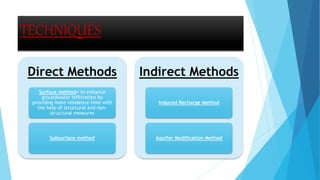
TECHNIQUES
Direct Methods
Surface method= to enhance
groundwater infiltration by
providing more residence time with
the help of structural and non-
structural measures
Subsurface method
Indirect Methods
Induced Recharge Method
Aquifer Modification Method
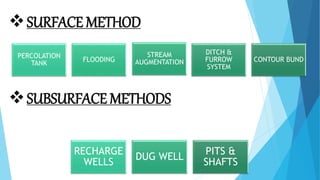
SURFACE METHOD
PERCOLATION
TANK
FLOODING
STREAM
AUGMENTATION
DITCH &
FURROW
SYSTEM
CONTOUR BUND
SUBSURFACE METHODS
RECHARGE
WELLS
DUG WELL
PITS &
SHAFTS
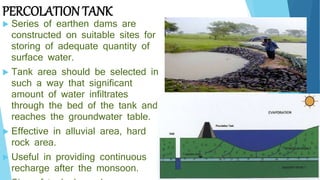
PERCOLATION TANK
 Series of earthen dams are
constructed on suitable sites for
storing of adequate quantity of
surface water.
 Tank area should be selected in
such a way that significant
amount of water infiltrates
through the bed of the tank and
reaches the groundwater table.
 Effective in alluvial area, hard
rock area.
 Useful in providing continuous
recharge after the monsoon.
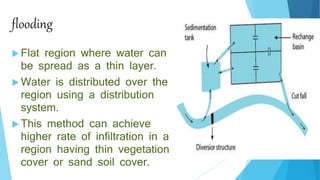
flooding
 Flat region where water can
be spread as a thin layer.
 Water is distributed over the
region using a distribution
system.
 This method can achieve
higher rate of infiltration in a
region having thin vegetation
cover or sand soil cover.
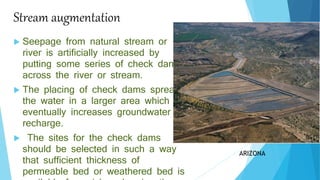
Stream augmentation
 Seepage from natural stream or
river is artificially increased by
putting some series of check dams
across the river or stream.
 The placing of check dams spread
the water in a larger area which
eventually increases groundwater
recharge.
 The sites for the check dams
should be selected in such a way
that sufficient thickness of
permeable bed or weathered bed is
ARIZONA
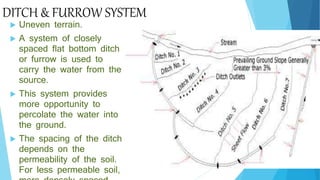
DITCH & FURROW SYSTEM
 Uneven terrain.
 A system of closely
spaced flat bottom ditch
or furrow is used to
carry the water from the
source.
 This system provides
more opportunity to
percolate the water into
the ground.
 The spacing of the ditch
depends on the
permeability of the soil.
For less permeable soil,
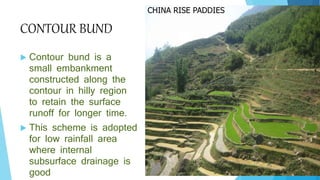
CONTOUR BUND
 Contour bund is a
small embankment
constructed along the
contour in hilly region
to retain the surface
runoff for longer time.
 This scheme is adopted
for low rainfall area
where internal
subsurface drainage is
good
CHINA RISE PADDIES
RECHARGE WELL
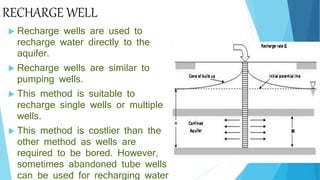
 Recharge wells are used to
recharge water directly to the
aquifer.
 Recharge wells are similar to
pumping wells.
 This method is suitable to
recharge single wells or multiple
wells.
 This method is costlier than the
other method as wells are
required to be bored. However,
sometimes abandoned tube wells
can be used for recharging water
DUG WELL
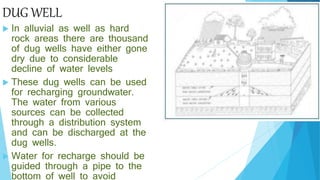
 In alluvial as well as hard
rock areas there are thousand
of dug wells have either gone
dry due to considerable
decline of water levels
 These dug wells can be used
for recharging groundwater.
The water from various
sources can be collected
through a distribution system
and can be discharged at the
dug wells.
 Water for recharge should be
guided through a pipe to the
bottom of well to avoid
PITS & SHAFTS
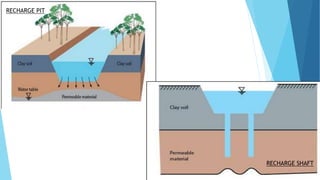
 Recharge pits of variable dimensions
 Most of the time, especially in case of agricultural field, a layer
of less permeable soil exist.
 So the surface flooding methods of recharge do not show
satisfactory performance so recharge pit can be excavated which
are sufficiently deep to penetrate the less permeable strata.
 Recharge shaft is similar to the recharge pits, but the cross
sectional size of the recharge shaft is much lesser than the
recharge pits.
 Like the recharge pits, recharge shafts are also used to recharge
water to unconfined aquifer whose water table is deep below the
land surface and a poorly impermeable strata exist at the surface
RECHARGE PIT
RECHARGE SHAFT
Indirect methods
INDUCED
RECHARGE
AQUIFER
MODIFICATION
METHODS
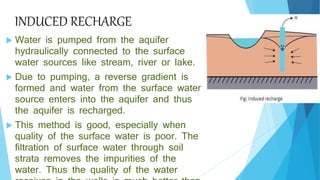
INDUCED RECHARGE
 Water is pumped from the aquifer
hydraulically connected to the surface
water sources like stream, river or lake.
 Due to pumping, a reverse gradient is
formed and water from the surface water
source enters into the aquifer and thus
the aquifer is recharged.
 This method is good, especially when
quality of the surface water is poor. The
filtration of surface water through soil
strata removes the impurities of the
water. Thus the quality of the water
AQUIFER MODIFICATION METHOD
 This is used to change aquifer characteristics so
it can store more water and transmit more water
. After application of it more recharge take place
under natural as well as artificial condition
1. Bore blasting method
2. Hydro-fracturing method
3. Jacket well technique
4. Fracture seal cementation and Pressure
injection grouting
5. Stream blasting method
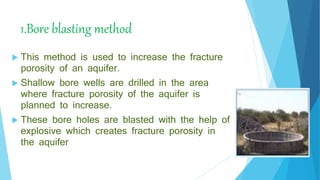
1.Bore blasting method
 This method is used to increase the fracture
porosity of an aquifer.
 Shallow bore wells are drilled in the area
where fracture porosity of the aquifer is
planned to increase.
 These bore holes are blasted with the help of
explosive which creates fracture porosity in
the aquifer
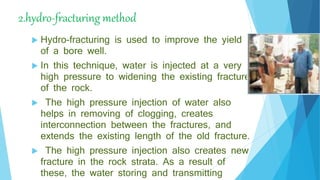
2.hydro-fracturing method
 Hydro-fracturing is used to improve the yield
of a bore well.
 In this technique, water is injected at a very
high pressure to widening the existing fracture
of the rock.
 The high pressure injection of water also
helps in removing of clogging, creates
interconnection between the fractures, and
extends the existing length of the old fracture.
 The high pressure injection also creates new
fracture in the rock strata. As a result of
these, the water storing and transmitting
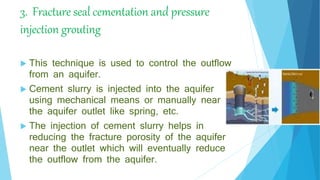
3. Fracture seal cementation and pressure
injection grouting
 This technique is used to control the outflow
from an aquifer.
 Cement slurry is injected into the aquifer
using mechanical means or manually near to
the aquifer outlet like spring, etc.
 The injection of cement slurry helps in
reducing the fracture porosity of the aquifer
near the outlet which will eventually reduce
the outflow from the aquifer.
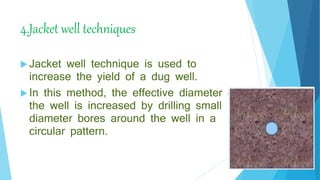
4.Jacket well techniques
 Jacket well technique is used to
increase the yield of a dug well.
 In this method, the effective diameter of
the well is increased by drilling small
diameter bores around the well in a
circular pattern.
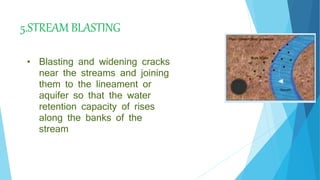
5.STREAM BLASTING
• Blasting and widening cracks
near the streams and joining
them to the lineament or
aquifer so that the water
retention capacity of rises
along the banks of the
stream
ADVANTAGES
1. To enhance the ground water yield in
depleted the aquifer due to urbanization.
2. Conservation and storage of excess
surface water for future requirements
3. To improve the quality of existing
ground water through dilution.
4. To remove bacteriological & other
impurities from sewage and waste water
by natural filtration, so that water is
suitable for re-use
Rooftop rainwater harvesting
 Storing rainwater that falls on rooftops
by channelizing it through pipes into
tanks and using it for household or
agricultural purpose or storing it into
soak pits to recharge groundwater
source.
THANK YOU..

GROUND WATER IMPROVEMENT TECHNIQUES

  • 1.
  • 2.
    contents  Introduction  Whatis it?  Why its necessary?  Selection of suitable site  Advantages  Techniques
  • 3.
    INTRODUCTION GROUND WATER • Thewater which is stored in the pores of the soil strata by infiltration is known as groundwater. • Therefore the groundwater may defined as all the water present below the earth surface. AQUIFER • It is an underground geological formation which contains sufficient amount of water and required amount of water can be extracted economically using water wells
  • 4.
    WHAT IS ARTIFICIALRECHARGE? It is the process by which the ground water is improved at a rate much higher than those under natural condition of percolation.
  • 5.
    IMPORTANCE OF ARTIFITIAL RECHARGE Tomaximize storage(long-term & seasonal) Water quality improvement through dilution Preventing saline-water intrusion & land subsidence Reducing reduction volumes from river flow Controlling effects of climate change
  • 6.
    IDENTIFICATION OF AREASFOR RECHARGE  Where ground water levels are declining due to over-exploitation.  Where substantial part of the aquifer has already been de-saturated. i.e. regeneration of water in wells and hand pumps is slow after some water has been drawn.  Where availability of water from wells and hand pumps is inadequate during the lean months.  Where ground water quality is poor and there is
  • 7.
    TECHNIQUES Direct Methods Surface method=to enhance groundwater infiltration by providing more residence time with the help of structural and non- structural measures Subsurface method Indirect Methods Induced Recharge Method Aquifer Modification Method
  • 8.
    SURFACE METHOD PERCOLATION TANK FLOODING STREAM AUGMENTATION DITCH & FURROW SYSTEM CONTOURBUND SUBSURFACE METHODS RECHARGE WELLS DUG WELL PITS & SHAFTS
  • 9.
    PERCOLATION TANK  Seriesof earthen dams are constructed on suitable sites for storing of adequate quantity of surface water.  Tank area should be selected in such a way that significant amount of water infiltrates through the bed of the tank and reaches the groundwater table.  Effective in alluvial area, hard rock area.  Useful in providing continuous recharge after the monsoon.
  • 10.
    flooding  Flat regionwhere water can be spread as a thin layer.  Water is distributed over the region using a distribution system.  This method can achieve higher rate of infiltration in a region having thin vegetation cover or sand soil cover.
  • 11.
    Stream augmentation  Seepagefrom natural stream or river is artificially increased by putting some series of check dams across the river or stream.  The placing of check dams spread the water in a larger area which eventually increases groundwater recharge.  The sites for the check dams should be selected in such a way that sufficient thickness of permeable bed or weathered bed is ARIZONA
  • 12.
    DITCH & FURROWSYSTEM  Uneven terrain.  A system of closely spaced flat bottom ditch or furrow is used to carry the water from the source.  This system provides more opportunity to percolate the water into the ground.  The spacing of the ditch depends on the permeability of the soil. For less permeable soil,
  • 13.
    CONTOUR BUND  Contourbund is a small embankment constructed along the contour in hilly region to retain the surface runoff for longer time.  This scheme is adopted for low rainfall area where internal subsurface drainage is good CHINA RISE PADDIES
  • 14.
    RECHARGE WELL  Rechargewells are used to recharge water directly to the aquifer.  Recharge wells are similar to pumping wells.  This method is suitable to recharge single wells or multiple wells.  This method is costlier than the other method as wells are required to be bored. However, sometimes abandoned tube wells can be used for recharging water
  • 15.
    DUG WELL  Inalluvial as well as hard rock areas there are thousand of dug wells have either gone dry due to considerable decline of water levels  These dug wells can be used for recharging groundwater. The water from various sources can be collected through a distribution system and can be discharged at the dug wells.  Water for recharge should be guided through a pipe to the bottom of well to avoid
  • 16.
    PITS & SHAFTS Recharge pits of variable dimensions  Most of the time, especially in case of agricultural field, a layer of less permeable soil exist.  So the surface flooding methods of recharge do not show satisfactory performance so recharge pit can be excavated which are sufficiently deep to penetrate the less permeable strata.  Recharge shaft is similar to the recharge pits, but the cross sectional size of the recharge shaft is much lesser than the recharge pits.  Like the recharge pits, recharge shafts are also used to recharge water to unconfined aquifer whose water table is deep below the land surface and a poorly impermeable strata exist at the surface
  • 17.
  • 18.
  • 19.
    INDUCED RECHARGE  Wateris pumped from the aquifer hydraulically connected to the surface water sources like stream, river or lake.  Due to pumping, a reverse gradient is formed and water from the surface water source enters into the aquifer and thus the aquifer is recharged.  This method is good, especially when quality of the surface water is poor. The filtration of surface water through soil strata removes the impurities of the water. Thus the quality of the water
  • 20.
    AQUIFER MODIFICATION METHOD This is used to change aquifer characteristics so it can store more water and transmit more water . After application of it more recharge take place under natural as well as artificial condition 1. Bore blasting method 2. Hydro-fracturing method 3. Jacket well technique 4. Fracture seal cementation and Pressure injection grouting 5. Stream blasting method
  • 21.
    1.Bore blasting method This method is used to increase the fracture porosity of an aquifer.  Shallow bore wells are drilled in the area where fracture porosity of the aquifer is planned to increase.  These bore holes are blasted with the help of explosive which creates fracture porosity in the aquifer
  • 22.
    2.hydro-fracturing method  Hydro-fracturingis used to improve the yield of a bore well.  In this technique, water is injected at a very high pressure to widening the existing fracture of the rock.  The high pressure injection of water also helps in removing of clogging, creates interconnection between the fractures, and extends the existing length of the old fracture.  The high pressure injection also creates new fracture in the rock strata. As a result of these, the water storing and transmitting
  • 23.
    3. Fracture sealcementation and pressure injection grouting  This technique is used to control the outflow from an aquifer.  Cement slurry is injected into the aquifer using mechanical means or manually near to the aquifer outlet like spring, etc.  The injection of cement slurry helps in reducing the fracture porosity of the aquifer near the outlet which will eventually reduce the outflow from the aquifer.
  • 24.
    4.Jacket well techniques Jacket well technique is used to increase the yield of a dug well.  In this method, the effective diameter of the well is increased by drilling small diameter bores around the well in a circular pattern.
  • 25.
    5.STREAM BLASTING • Blastingand widening cracks near the streams and joining them to the lineament or aquifer so that the water retention capacity of rises along the banks of the stream
  • 26.
    ADVANTAGES 1. To enhancethe ground water yield in depleted the aquifer due to urbanization. 2. Conservation and storage of excess surface water for future requirements 3. To improve the quality of existing ground water through dilution. 4. To remove bacteriological & other impurities from sewage and waste water by natural filtration, so that water is suitable for re-use
  • 27.
    Rooftop rainwater harvesting Storing rainwater that falls on rooftops by channelizing it through pipes into tanks and using it for household or agricultural purpose or storing it into soak pits to recharge groundwater source.
  • 28.