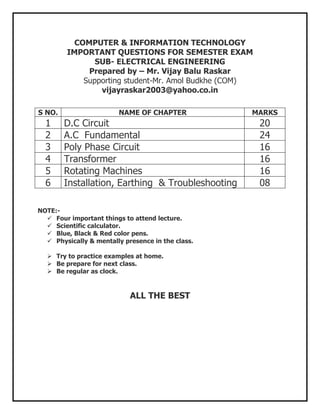
COMPUTER & INFORMATION TECHNOLOGY
         IMPORTANT QUESTIONS FOR SEMESTER EXAM
                SUB- ELECTRICAL ENGINEERING
              Prepared by – Mr. Vijay Balu Raskar
             Supporting student-Mr. Amol Budkhe (COM)
                 vijayraskar2003@yahoo.co.in

S NO.                    NAME OF CHAPTER            MARKS
  1     D.C Circuit                                     20
  2     A.C Fundamental                                 24
  3     Poly Phase Circuit                              16
  4     Transformer                                     16
  5     Rotating Machines                               16
  6     Installation, Earthing & Troubleshooting        08

NOTE:-
   Four important things to attend lecture.
   Scientific calculator.
   Blue, Black & Red color pens.
   Physically & mentally presence in the class.

   Try to practice examples at home.
   Be prepare for next class.
   Be regular as clock.


                            ALL THE BEST
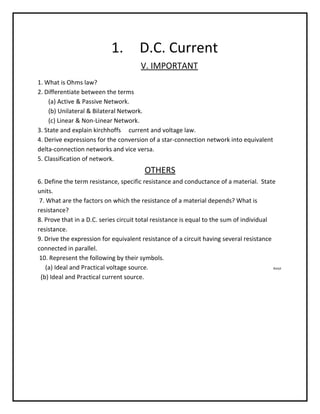
1.         D.C. Current
                                       V. IMPORTANT
1. What is Ohms law?
2. Differentiate between the terms
    (a) Active & Passive Network.
    (b) Unilateral & Bilateral Network.
    (c) Linear & Non-Linear Network.
3. State and explain kirchhoffs current and voltage law.
4. Derive expressions for the conversion of a star-connection network into equivalent
delta-connection networks and vice versa.
5. Classification of network.
                                         OTHERS
6. Define the term resistance, specific resistance and conductance of a material. State
units.
 7. What are the factors on which the resistance of a material depends? What is
resistance?
8. Prove that in a D.C. series circuit total resistance is equal to the sum of individual
resistance.
9. Drive the expression for equivalent resistance of a circuit having several resistance
connected in parallel.
 10. Represent the following by their symbols.
    (a) Ideal and Practical voltage source.                                               Amol

 (b) Ideal and Practical current source.
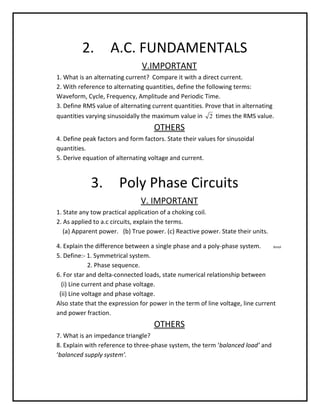
2.         A.C. FUNDAMENTALS
                                V.IMPORTANT
1. What is an alternating current? Compare it with a direct current.
2. With reference to alternating quantities, define the following terms:
Waveform, Cycle, Frequency, Amplitude and Periodic Time.
3. Define RMS value of alternating current quantities. Prove that in alternating
quantities varying sinusoidally the maximum value in 2 times the RMS value.
                                    OTHERS
4. Define peak factors and form factors. State their values for sinusoidal
quantities.
5. Derive equation of alternating voltage and current.


             3.        Poly Phase Circuits
                               V. IMPORTANT
1. State any tow practical application of a choking coil.
2. As applied to a.c circuits, explain the terms.
   (a) Apparent power. (b) True power. (c) Reactive power. State their units.

4. Explain the difference between a single phase and a poly-phase system.        Amol

5. Define:- 1. Symmetrical system.
             2. Phase sequence.
6. For star and delta-connected loads, state numerical relationship between
  (i) Line current and phase voltage.
 (ii) Line voltage and phase voltage.
Also state that the expression for power in the term of line voltage, line current
and power fraction.
                                    OTHERS
7. What is an impedance triangle?
8. Explain with reference to three-phase system, the term ‘balanced load’ and
‘balanced supply system’.
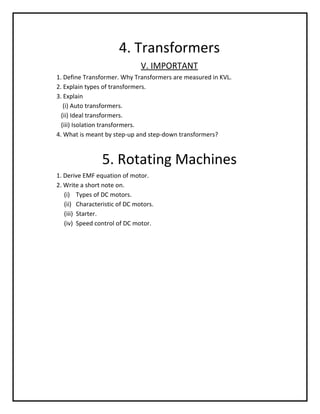
4. Transformers
                               V. IMPORTANT
1. Define Transformer. Why Transformers are measured in KVL.
2. Explain types of transformers.
3. Explain
   (i) Auto transformers.
  (ii) Ideal transformers.
  (iii) Isolation transformers.
4. What is meant by step-up and step-down transformers?


                5. Rotating Machines
1. Derive EMF equation of motor.
2. Write a short note on.
   (i) Types of DC motors.
   (ii) Characteristic of DC motors.
   (iii) Starter.
   (iv) Speed control of DC motor.
6. Installation, Earthing, and
                        Troubleshooting
     1. Explain.
         (i) Types of wire.
         (ii) Fuse.
         (iii) HRC fuses.
         (iv) MCCB
         (v) MCB
         (vi) ELCB
         (vii) Necessity of earthing.                                          Amol

          (viii) Plate earthing.
          (ix) Pipe earthing.
     2. Explain basic principle of operation of a circuit breaker.
     3. What is trouble shooting? Discuss briefly the various problems encountered in
     the wiring installation for the computers.
     4. Why earthing essential in a wiring?
     5. Define

           I.   Current rating
          II.   Minimum fusing current.
         III.   Fusing factor


NOTE:-

   Preferences for practicing all problems
              1) Transformer.
              2) DC motor.
              3) AC fundamentals.
              4) DC circuit.

Electrical Technology Important Questions

  • 1.
    COMPUTER & INFORMATIONTECHNOLOGY IMPORTANT QUESTIONS FOR SEMESTER EXAM SUB- ELECTRICAL ENGINEERING Prepared by – Mr. Vijay Balu Raskar Supporting student-Mr. Amol Budkhe (COM) vijayraskar2003@yahoo.co.in S NO. NAME OF CHAPTER MARKS 1 D.C Circuit 20 2 A.C Fundamental 24 3 Poly Phase Circuit 16 4 Transformer 16 5 Rotating Machines 16 6 Installation, Earthing & Troubleshooting 08 NOTE:-  Four important things to attend lecture.  Scientific calculator.  Blue, Black & Red color pens.  Physically & mentally presence in the class.  Try to practice examples at home.  Be prepare for next class.  Be regular as clock. ALL THE BEST
  • 2.
    1. D.C. Current V. IMPORTANT 1. What is Ohms law? 2. Differentiate between the terms (a) Active & Passive Network. (b) Unilateral & Bilateral Network. (c) Linear & Non-Linear Network. 3. State and explain kirchhoffs current and voltage law. 4. Derive expressions for the conversion of a star-connection network into equivalent delta-connection networks and vice versa. 5. Classification of network. OTHERS 6. Define the term resistance, specific resistance and conductance of a material. State units. 7. What are the factors on which the resistance of a material depends? What is resistance? 8. Prove that in a D.C. series circuit total resistance is equal to the sum of individual resistance. 9. Drive the expression for equivalent resistance of a circuit having several resistance connected in parallel. 10. Represent the following by their symbols. (a) Ideal and Practical voltage source. Amol (b) Ideal and Practical current source.
  • 3.
    2. A.C. FUNDAMENTALS V.IMPORTANT 1. What is an alternating current? Compare it with a direct current. 2. With reference to alternating quantities, define the following terms: Waveform, Cycle, Frequency, Amplitude and Periodic Time. 3. Define RMS value of alternating current quantities. Prove that in alternating quantities varying sinusoidally the maximum value in 2 times the RMS value. OTHERS 4. Define peak factors and form factors. State their values for sinusoidal quantities. 5. Derive equation of alternating voltage and current. 3. Poly Phase Circuits V. IMPORTANT 1. State any tow practical application of a choking coil. 2. As applied to a.c circuits, explain the terms. (a) Apparent power. (b) True power. (c) Reactive power. State their units. 4. Explain the difference between a single phase and a poly-phase system. Amol 5. Define:- 1. Symmetrical system. 2. Phase sequence. 6. For star and delta-connected loads, state numerical relationship between (i) Line current and phase voltage. (ii) Line voltage and phase voltage. Also state that the expression for power in the term of line voltage, line current and power fraction. OTHERS 7. What is an impedance triangle? 8. Explain with reference to three-phase system, the term ‘balanced load’ and ‘balanced supply system’.
  • 4.
    4. Transformers V. IMPORTANT 1. Define Transformer. Why Transformers are measured in KVL. 2. Explain types of transformers. 3. Explain (i) Auto transformers. (ii) Ideal transformers. (iii) Isolation transformers. 4. What is meant by step-up and step-down transformers? 5. Rotating Machines 1. Derive EMF equation of motor. 2. Write a short note on. (i) Types of DC motors. (ii) Characteristic of DC motors. (iii) Starter. (iv) Speed control of DC motor.
  • 5.
    6. Installation, Earthing,and Troubleshooting 1. Explain. (i) Types of wire. (ii) Fuse. (iii) HRC fuses. (iv) MCCB (v) MCB (vi) ELCB (vii) Necessity of earthing. Amol (viii) Plate earthing. (ix) Pipe earthing. 2. Explain basic principle of operation of a circuit breaker. 3. What is trouble shooting? Discuss briefly the various problems encountered in the wiring installation for the computers. 4. Why earthing essential in a wiring? 5. Define I. Current rating II. Minimum fusing current. III. Fusing factor NOTE:-  Preferences for practicing all problems 1) Transformer. 2) DC motor. 3) AC fundamentals. 4) DC circuit.