Pre-Test in
Science 7
Directions: Get your test
notebook in Science and
answer the questions that
follow. Write the letter
and the word/ words from
the given choices.
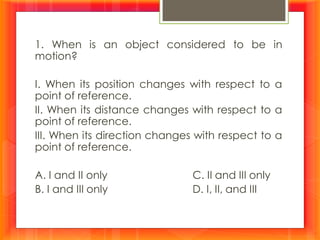
1. When is an object considered to be in
motion?
I. When its position changes with respect to a
point of reference.
II. When its distance changes with respect to a
point of reference.
III. When its direction changes with respect to a
point of reference.
A. I and II only C. II and III only
B. I and III only D. I, II, and III
* For questions 2 and 3, refer to
the table below. Data were
obtained from a 200-meter
dash competition.
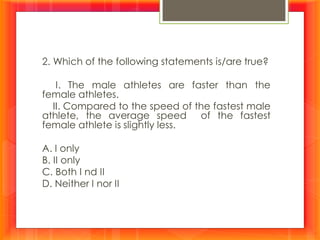
2. Which of the following statements is/are true?
I. The male athletes are faster than the
female athletes.
II. Compared to the speed of the fastest male
athlete, the average speed of the fastest
female athlete is slightly less.
A. I only
B. II only
C. Both I nd II
D. Neither I nor II
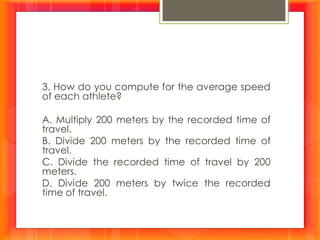
3. How do you compute for the average speed
of each athlete?
A. Multiply 200 meters by the recorded time of
travel.
B. Divide 200 meters by the recorded time of
travel.
C. Divide the recorded time of travel by 200
meters.
D. Divide 200 meters by twice the recorded
time of travel.
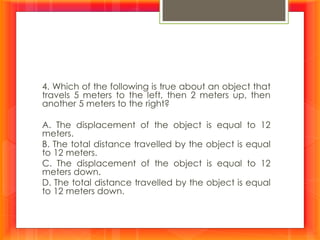
4. Which of the following is true about an object that
travels 5 meters to the left, then 2 meters up, then
another 5 meters to the right?
A. The displacement of the object is equal to 12
meters.
B. The total distance travelled by the object is equal
to 12 meters.
C. The displacement of the object is equal to 12
meters down.
D. The total distance travelled by the object is equal
to 12 meters down.
5. Which of the following statements is NOT
true about the object moving with constant
speed?
A. The object is not accelerating
B. The speed of the object is equal to zero.
C. The distance travelled by the object
increases uniformly
D. The speed of the object remains the
same all throughout the travel
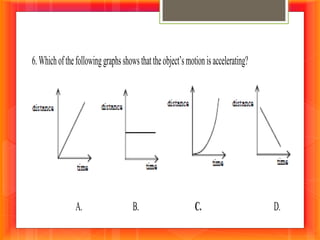
6.Whichofthefollowinggraphsshowsthattheobject’smotionisaccelerating?
A. B. C. D.
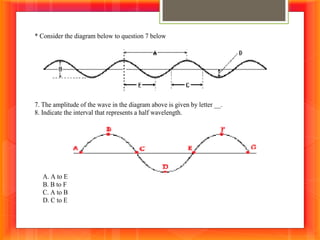
* Consider the diagram below to question 7 below
7. The amplitude of the wave in the diagram above is given by letter __.
8. Indicate the interval that represents a half wavelength.
A. A to E
B. B to F
C. A to B
D. C to E
9. Mechanical waves transport energy from
one place to another through
A. Alternately vibrating particles of the
medium
B. Particles traveling with the wave
C. Vibrating particles and traveling particles
D. None of the above
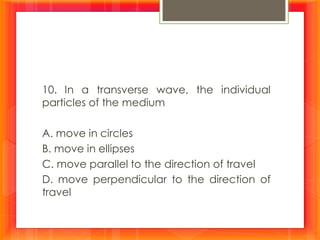
10. In a transverse wave, the individual
particles of the medium
A. move in circles
B. move in ellipses
C. move parallel to the direction of travel
D. move perpendicular to the direction of
travel
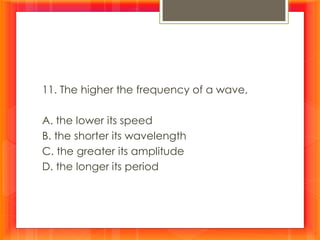
11. The higher the frequency of a wave,
A. the lower its speed
B. the shorter its wavelength
C. the greater its amplitude
D. the longer its period
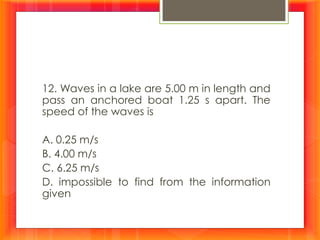
12. Waves in a lake are 5.00 m in length and
pass an anchored boat 1.25 s apart. The
speed of the waves is
A. 0.25 m/s
B. 4.00 m/s
C. 6.25 m/s
D. impossible to find from the information
given
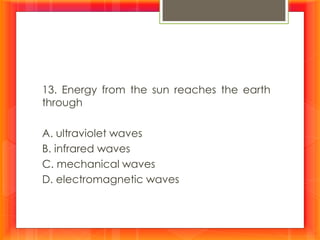
13. Energy from the sun reaches the earth
through
A. ultraviolet waves
B. infrared waves
C. mechanical waves
D. electromagnetic waves
14. Which of the following objects will
produce sound?
A. soft objects
B. radio stations
C. vibrating objects
D. objects under pressure
15. Which of the following best describes a
high frequency sound?
It has _______.
A. low pitch
B. high pitch
C. low energy
D. A and C
Prepared by:
Merra Mae Ramos

Science 7 -3rd Quarter Pretest

  • 1.
  • 2.
    Directions: Get yourtest notebook in Science and answer the questions that follow. Write the letter and the word/ words from the given choices.
  • 3.
    1. When isan object considered to be in motion? I. When its position changes with respect to a point of reference. II. When its distance changes with respect to a point of reference. III. When its direction changes with respect to a point of reference. A. I and II only C. II and III only B. I and III only D. I, II, and III
  • 4.
    * For questions2 and 3, refer to the table below. Data were obtained from a 200-meter dash competition.
  • 5.
    2. Which ofthe following statements is/are true? I. The male athletes are faster than the female athletes. II. Compared to the speed of the fastest male athlete, the average speed of the fastest female athlete is slightly less. A. I only B. II only C. Both I nd II D. Neither I nor II
  • 6.
    3. How doyou compute for the average speed of each athlete? A. Multiply 200 meters by the recorded time of travel. B. Divide 200 meters by the recorded time of travel. C. Divide the recorded time of travel by 200 meters. D. Divide 200 meters by twice the recorded time of travel.
  • 7.
    4. Which ofthe following is true about an object that travels 5 meters to the left, then 2 meters up, then another 5 meters to the right? A. The displacement of the object is equal to 12 meters. B. The total distance travelled by the object is equal to 12 meters. C. The displacement of the object is equal to 12 meters down. D. The total distance travelled by the object is equal to 12 meters down.
  • 8.
    5. Which ofthe following statements is NOT true about the object moving with constant speed? A. The object is not accelerating B. The speed of the object is equal to zero. C. The distance travelled by the object increases uniformly D. The speed of the object remains the same all throughout the travel
  • 9.
  • 10.
    * Consider thediagram below to question 7 below 7. The amplitude of the wave in the diagram above is given by letter __. 8. Indicate the interval that represents a half wavelength. A. A to E B. B to F C. A to B D. C to E
  • 11.
    9. Mechanical wavestransport energy from one place to another through A. Alternately vibrating particles of the medium B. Particles traveling with the wave C. Vibrating particles and traveling particles D. None of the above
  • 12.
    10. In atransverse wave, the individual particles of the medium A. move in circles B. move in ellipses C. move parallel to the direction of travel D. move perpendicular to the direction of travel
  • 13.
    11. The higherthe frequency of a wave, A. the lower its speed B. the shorter its wavelength C. the greater its amplitude D. the longer its period
  • 14.
    12. Waves ina lake are 5.00 m in length and pass an anchored boat 1.25 s apart. The speed of the waves is A. 0.25 m/s B. 4.00 m/s C. 6.25 m/s D. impossible to find from the information given
  • 15.
    13. Energy fromthe sun reaches the earth through A. ultraviolet waves B. infrared waves C. mechanical waves D. electromagnetic waves
  • 16.
    14. Which ofthe following objects will produce sound? A. soft objects B. radio stations C. vibrating objects D. objects under pressure
  • 17.
    15. Which ofthe following best describes a high frequency sound? It has _______. A. low pitch B. high pitch C. low energy D. A and C
  • 18.