CHAPTER 5
GROUND
IMPROVEMENT
(GI)
The need for engineered GI
• Avoid particular site
• Design the structure accordingly
• Remove & replace unsuitable soils
• Attempt to modify the existing ground
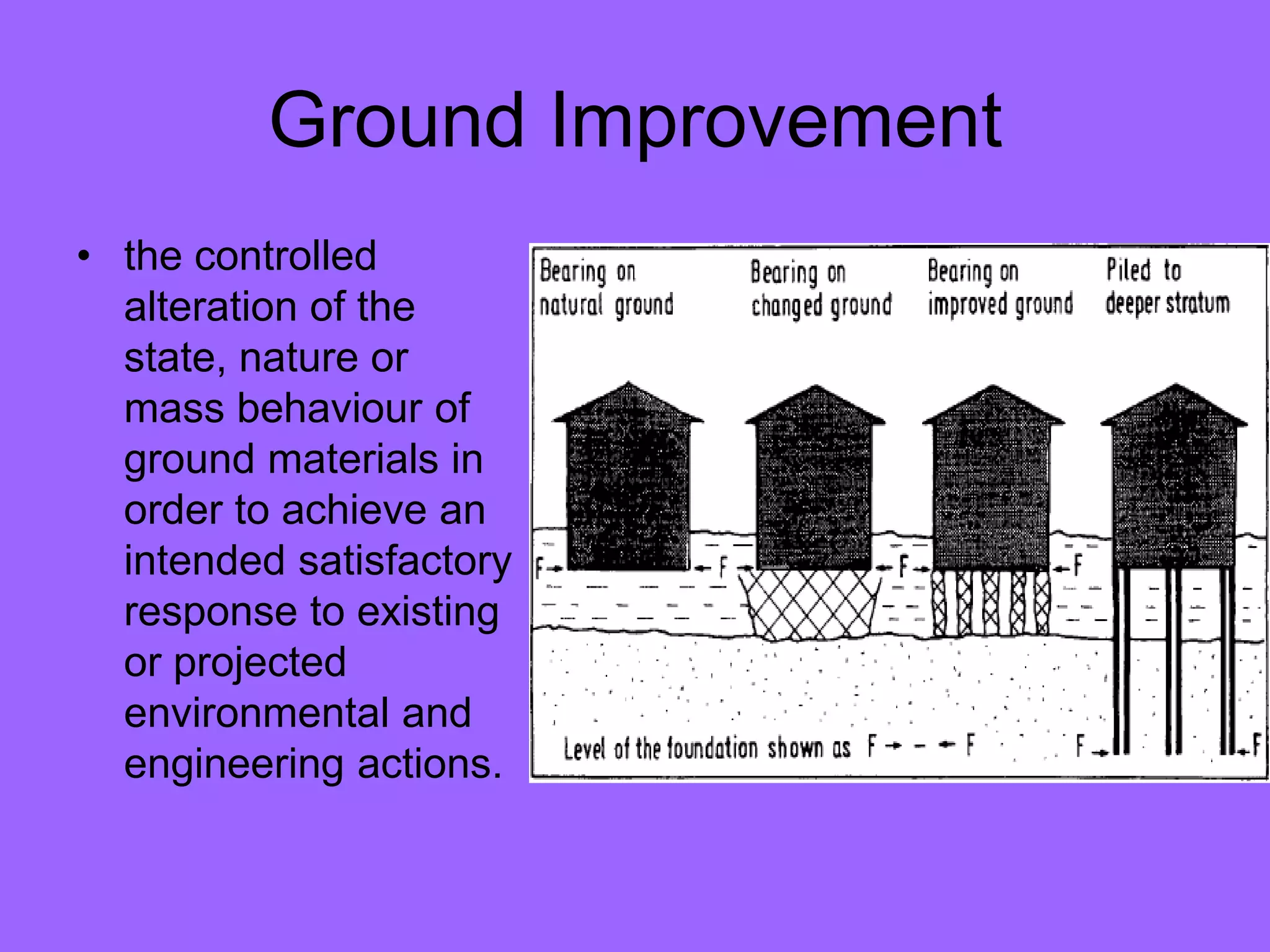
Ground Improvement
• the controlled
alteration of the
state, nature or
mass behaviour of
ground materials in
order to achieve an
intended satisfactory
response to existing
or projected
environmental and
engineering actions.
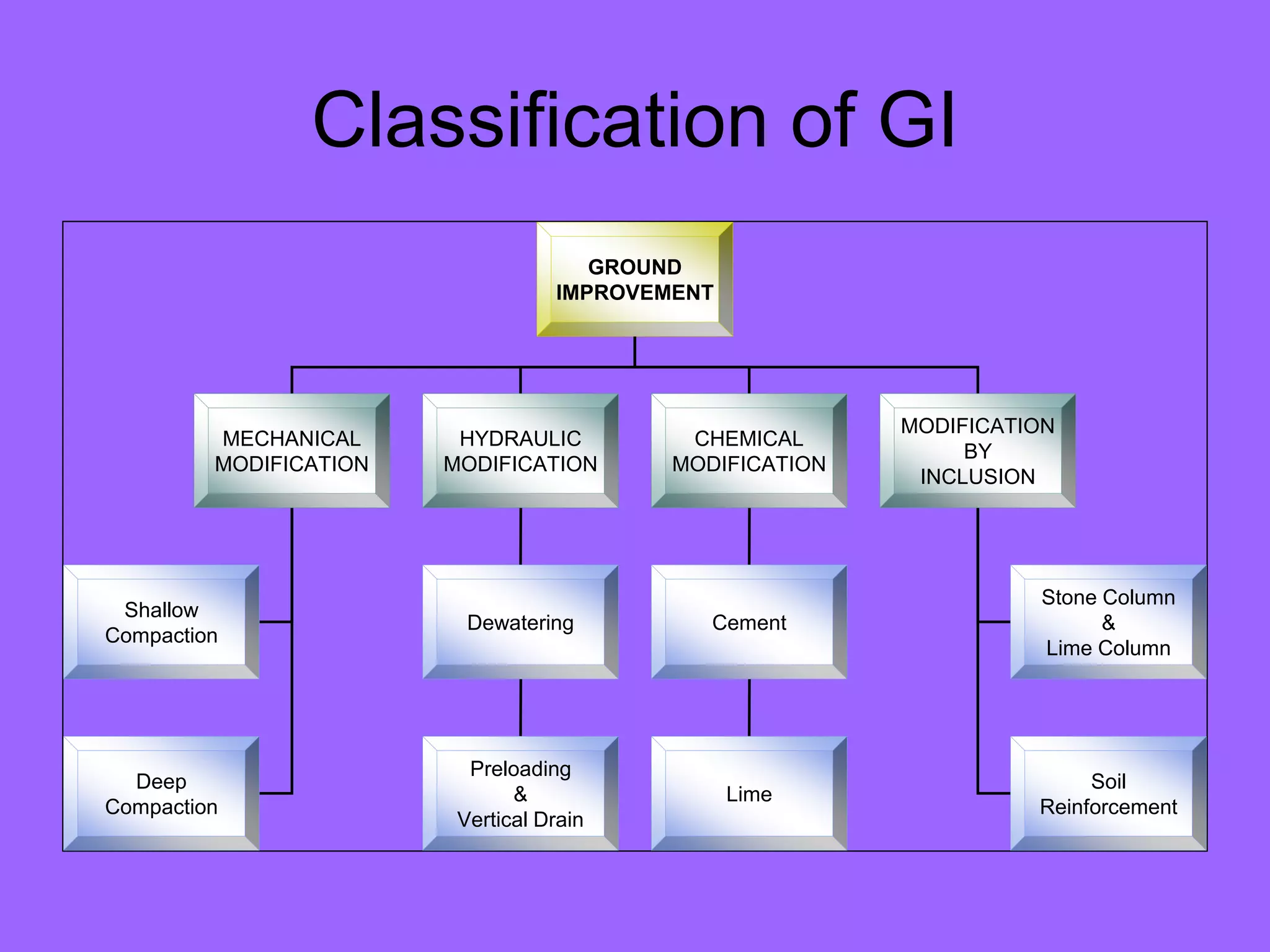
Classification of GI
GROUND
IMPROVEMENT
MECHANICAL
MODIFICATION
HYDRAULIC
MODIFICATION
CHEMICAL
MODIFICATION
MODIFICATION
BY
INCLUSION
Shallow
Compaction
Deep
Compaction
Dewatering Cement
Stone Column
&
Lime Column
Soil
Reinforcement
Preloading
&
Vertical Drain
Lime
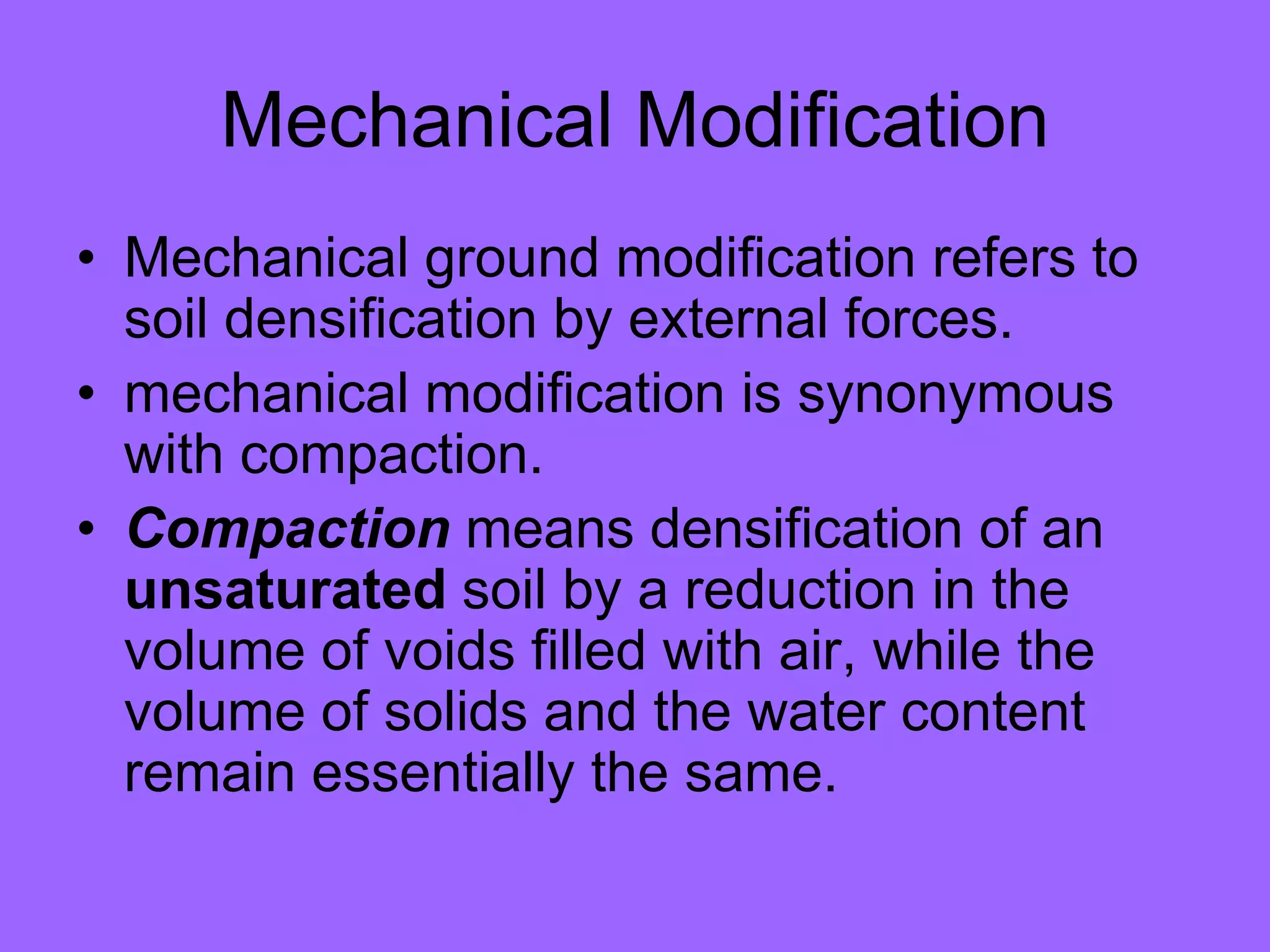
Mechanical Modification
• Mechanical ground modification refers to
soil densification by external forces.
• mechanical modification is synonymous
with compaction.
• Compaction means densification of an
unsaturated soil by a reduction in the
volume of voids filled with air, while the
volume of solids and the water content
remain essentially the same.
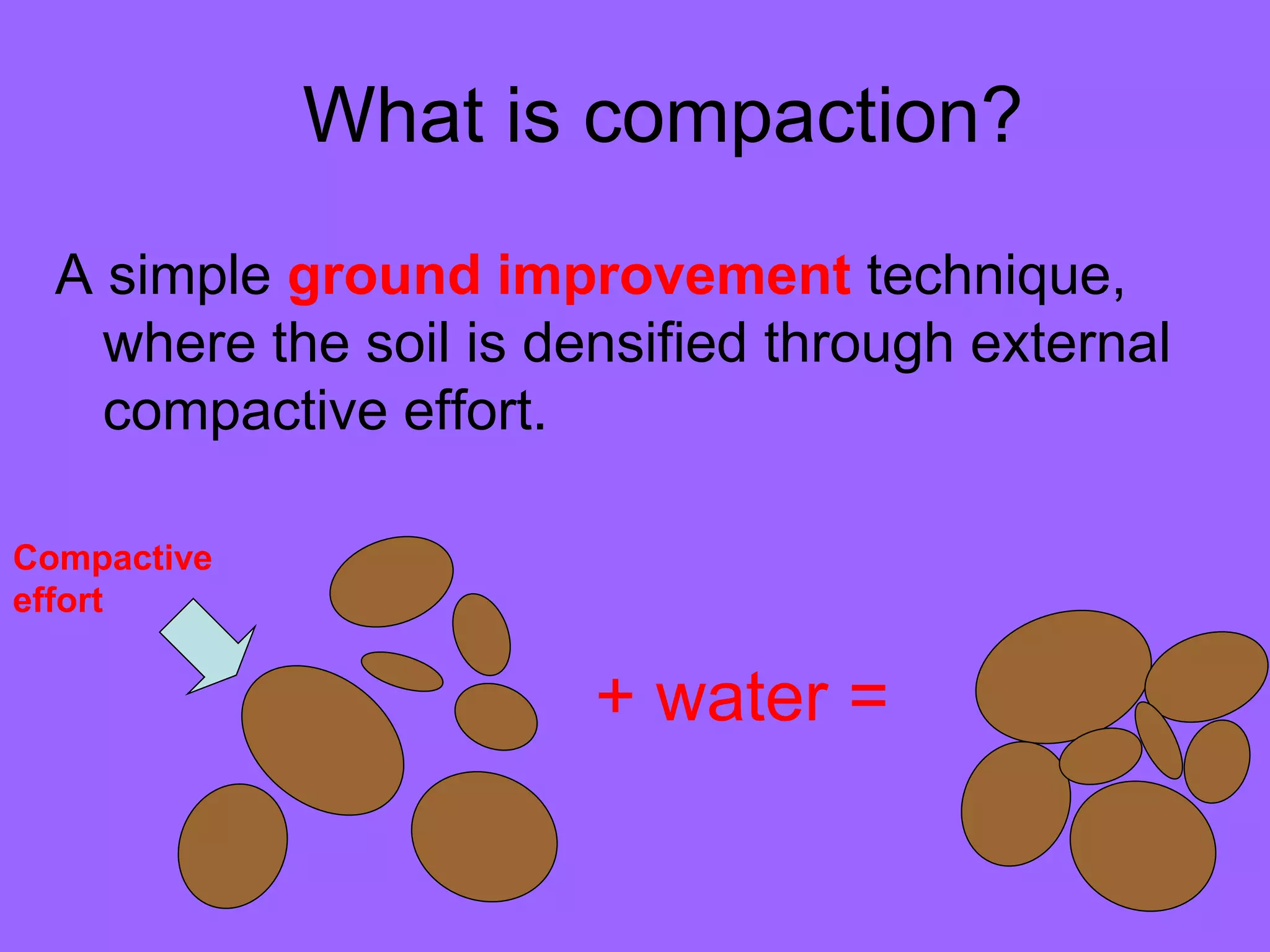
What is compaction?
A simple ground improvement technique,
where the soil is densified through external
compactive effort.
+ water =
Compactive
effort
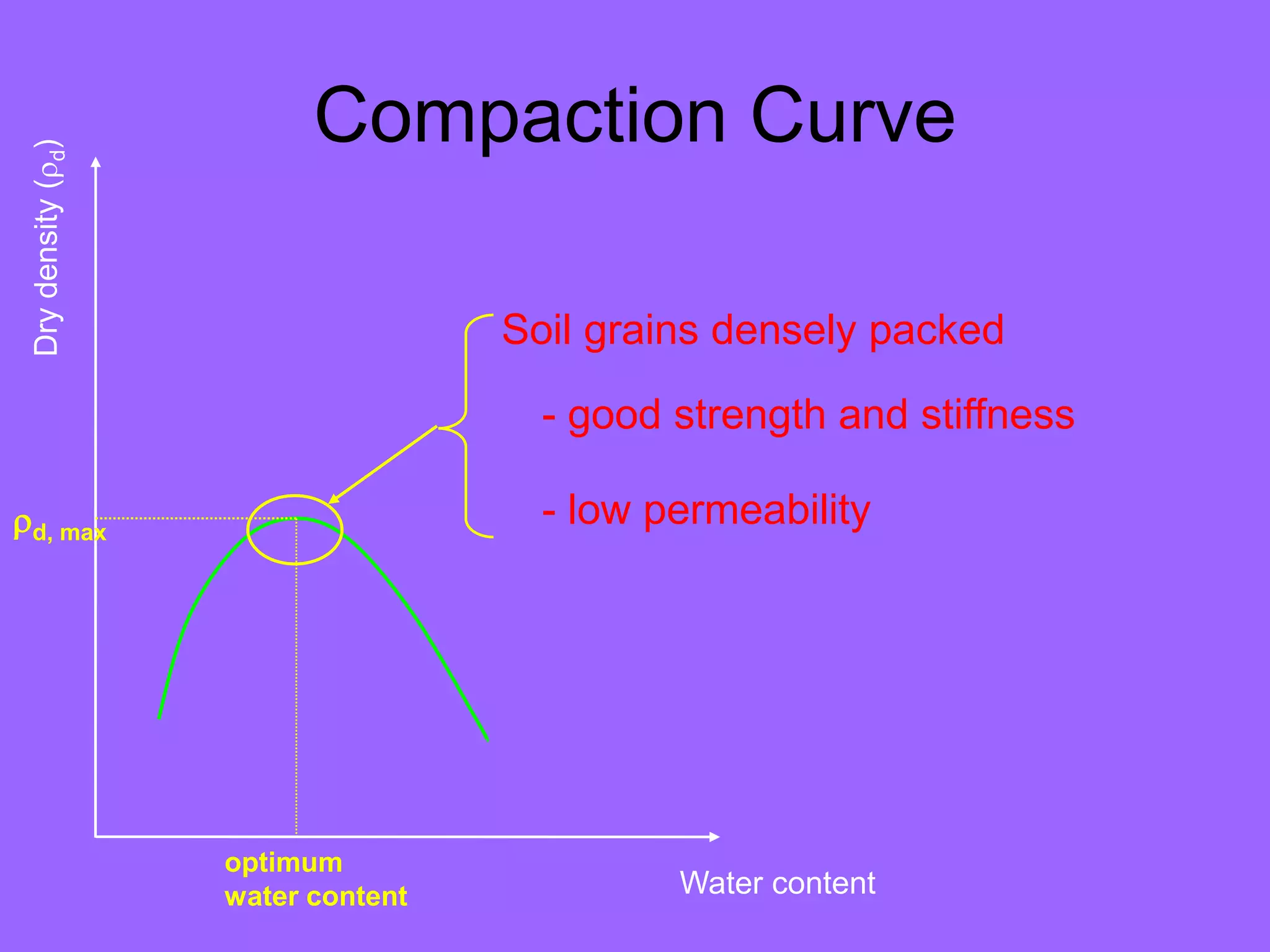
Compaction Curve
Water content
Dry
density
(
d
)
optimum
water content
d, max
Soil grains densely packed
- good strength and stiffness
- low permeability
Stabilization & Consolidation
• Stabilization
• an increase in
strength or a
reduction in the
deformation of a soil
mass
• caused by additives
• Consolidation
• soil mass is reduced
by the expulsion of
water.
• long-term application
of static loads or
electric forces to
saturated soils
Compaction
• Increase shear strength
• Reduce compressibility
• Reduce permeability
• Reduce liquefaction potential
• Control swelling and shrinking
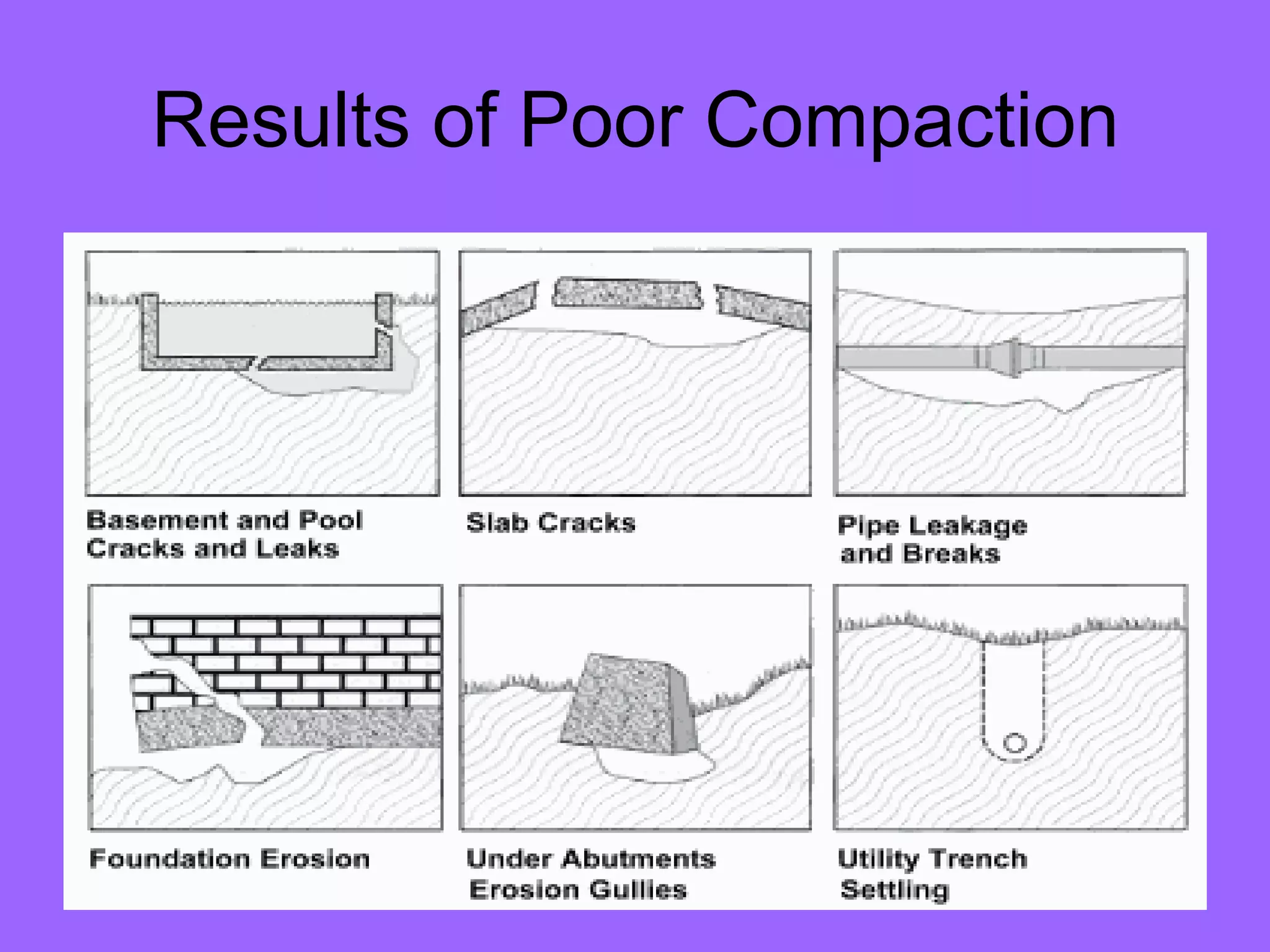
Results of Poor Compaction
Shallow Compaction
• Shallow compaction in the field is
accomplished by rolling or vibrating
• Rolling is done with "sheepsfoot" drums,
round steel drums and rubber tired vehicle.
• Vibratory machines range in size from
small hand-propelled units to large motor-
driven machines
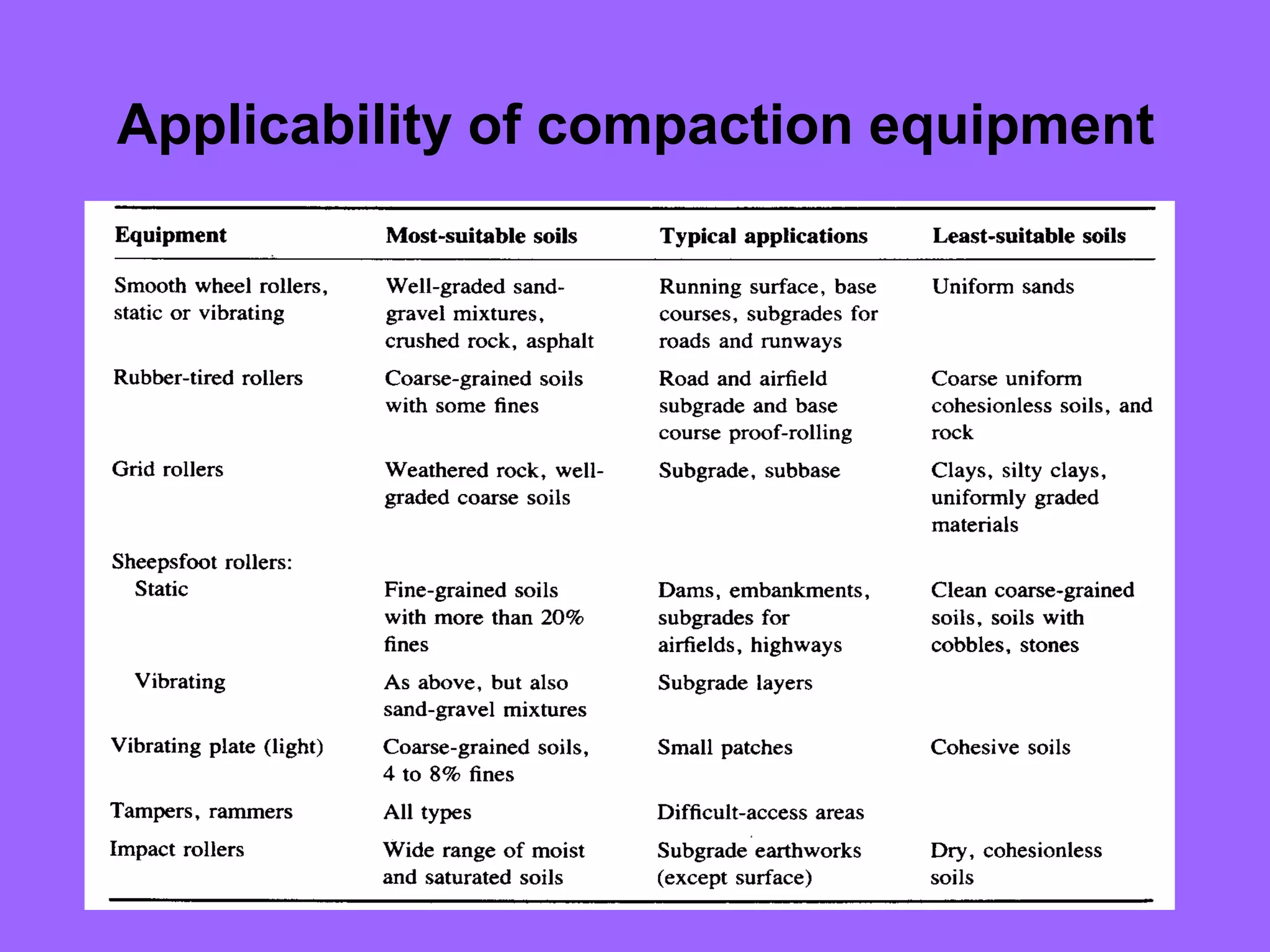
Applicability of compaction equipment
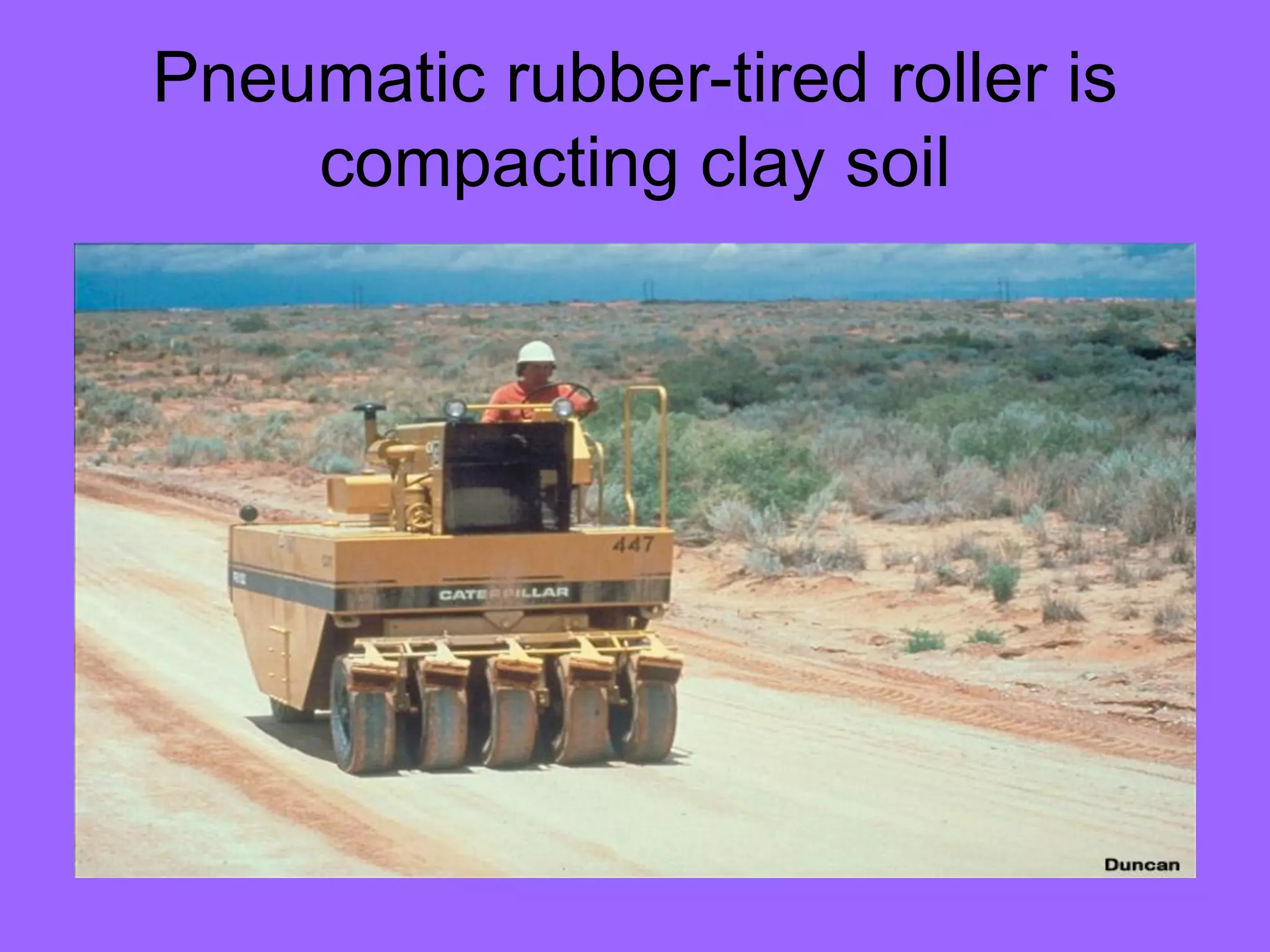
Pneumatic rubber-tired roller is
compacting clay soil
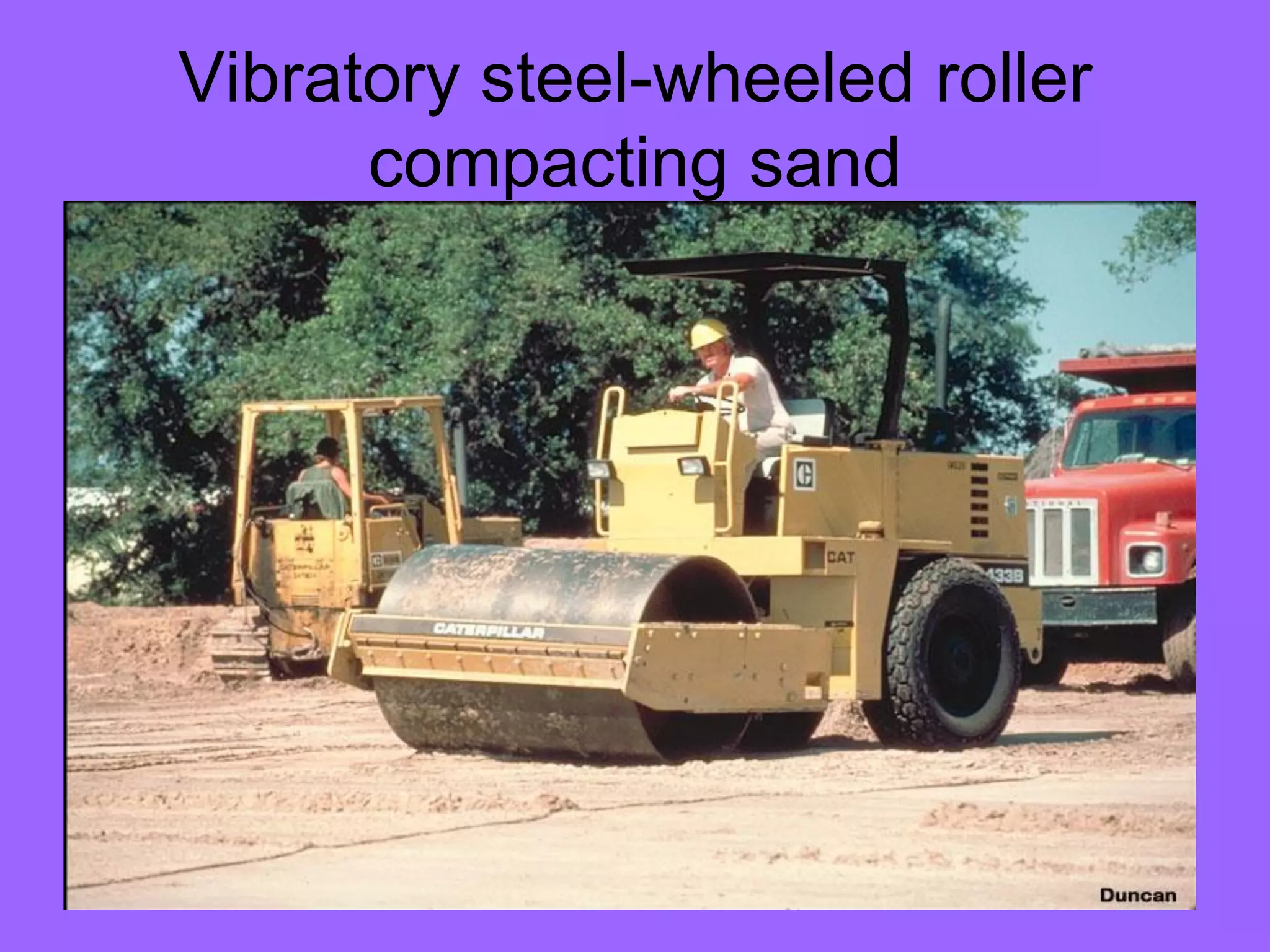
Vibratory steel-wheeled roller
compacting sand
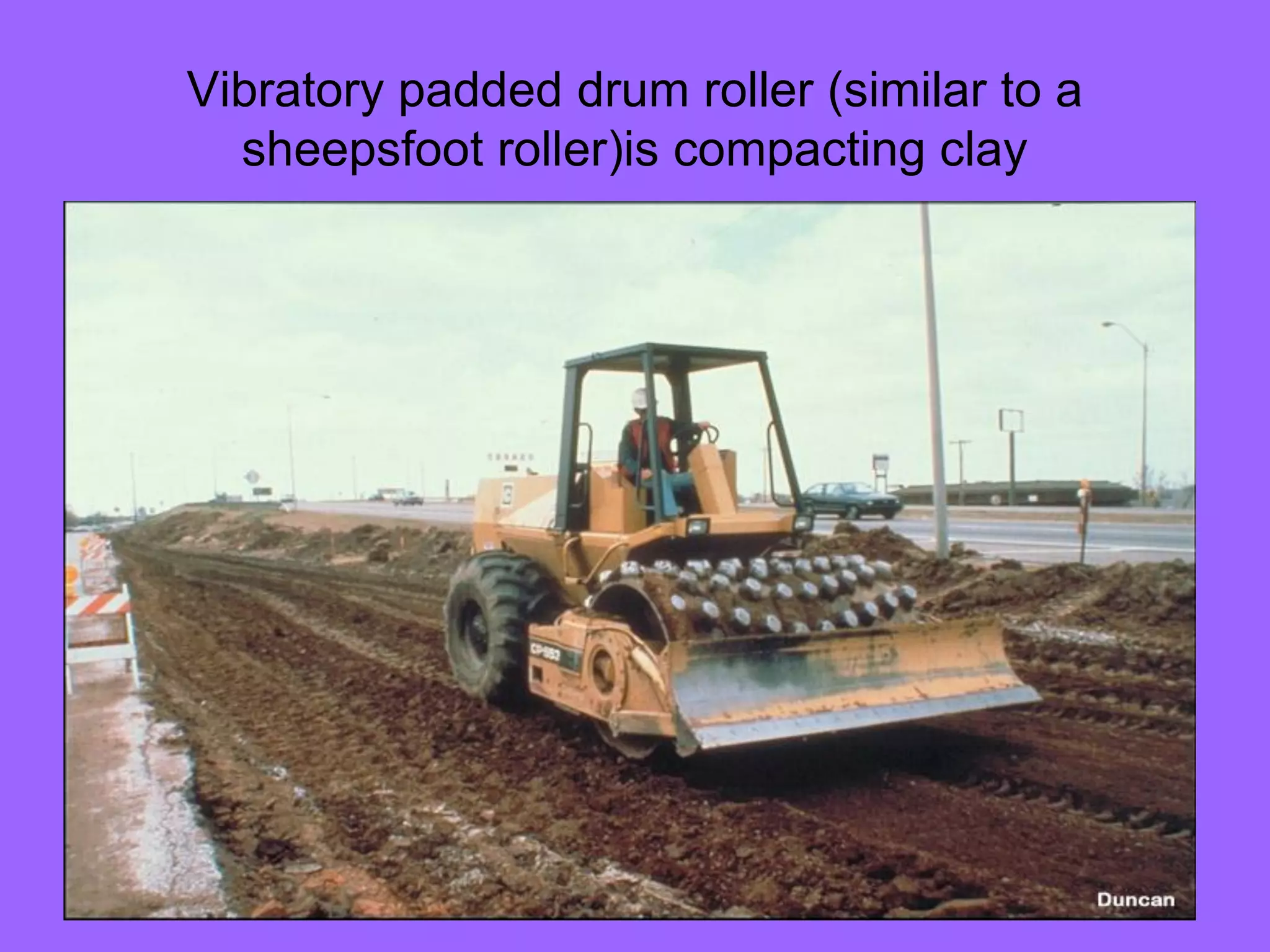
Vibratory padded drum roller (similar to a
sheepsfoot roller)is compacting clay
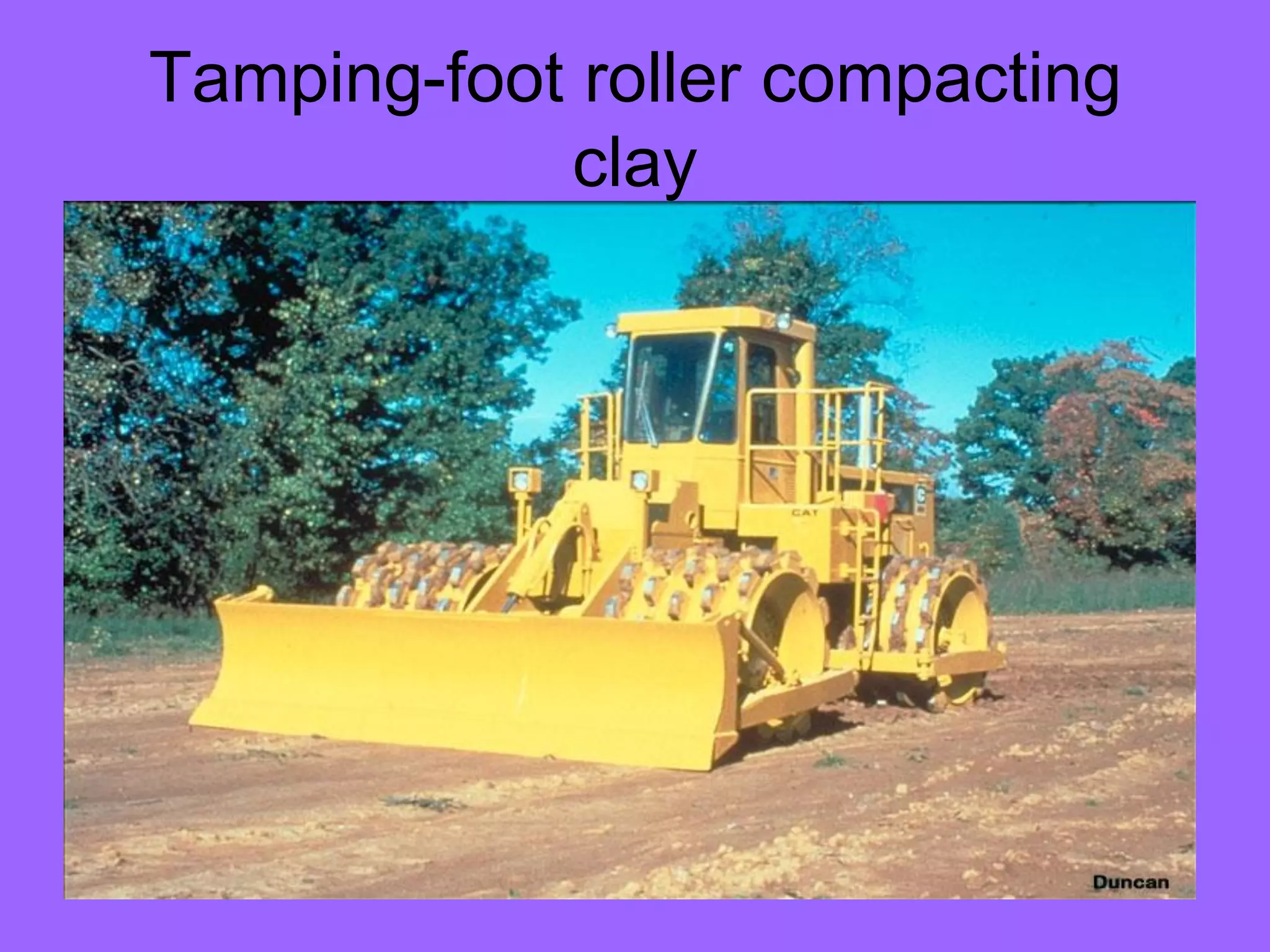
Tamping-foot roller compacting
clay
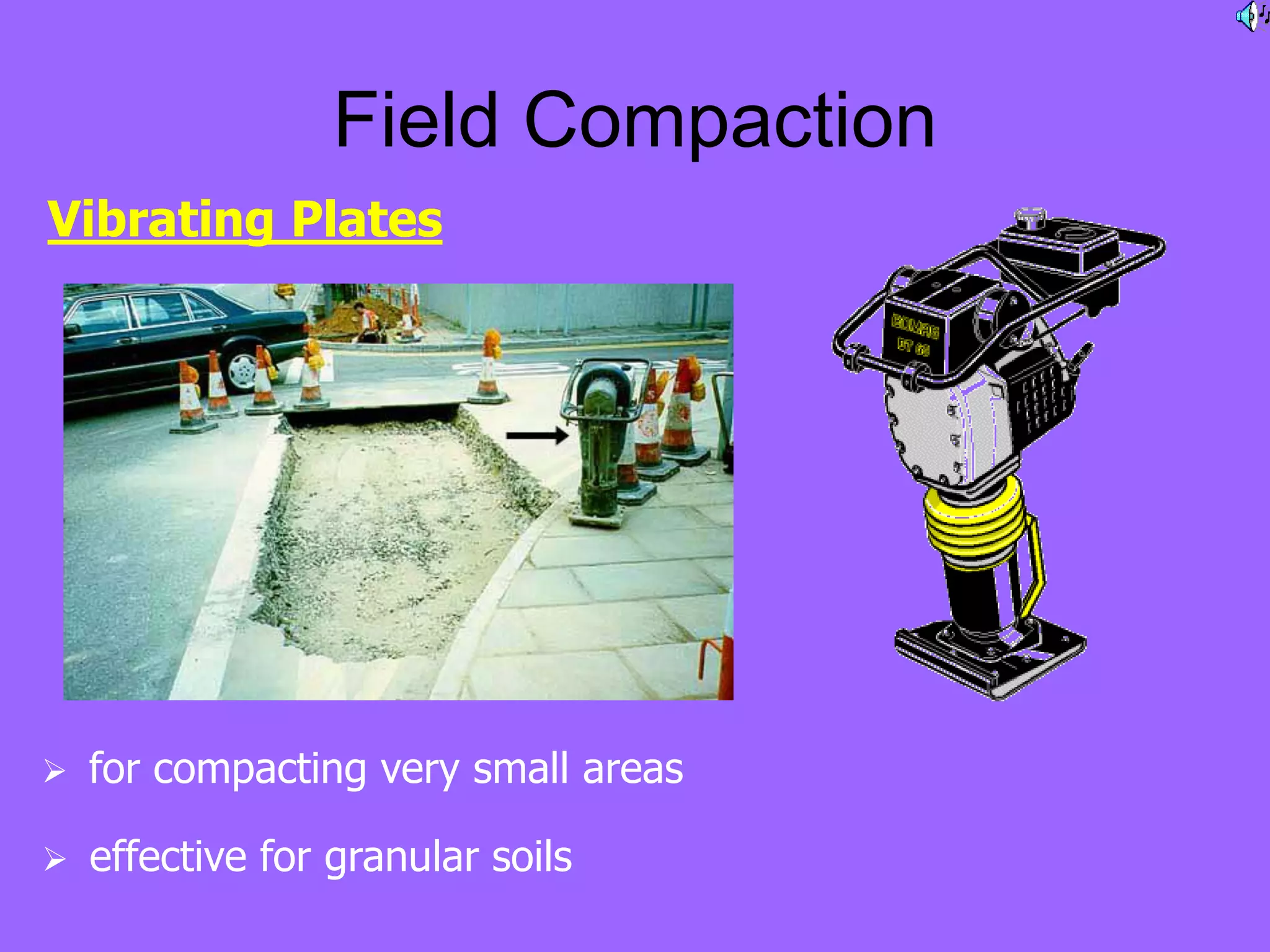
Field Compaction
 for compacting very small areas
Vibrating Plates
 effective for granular soils
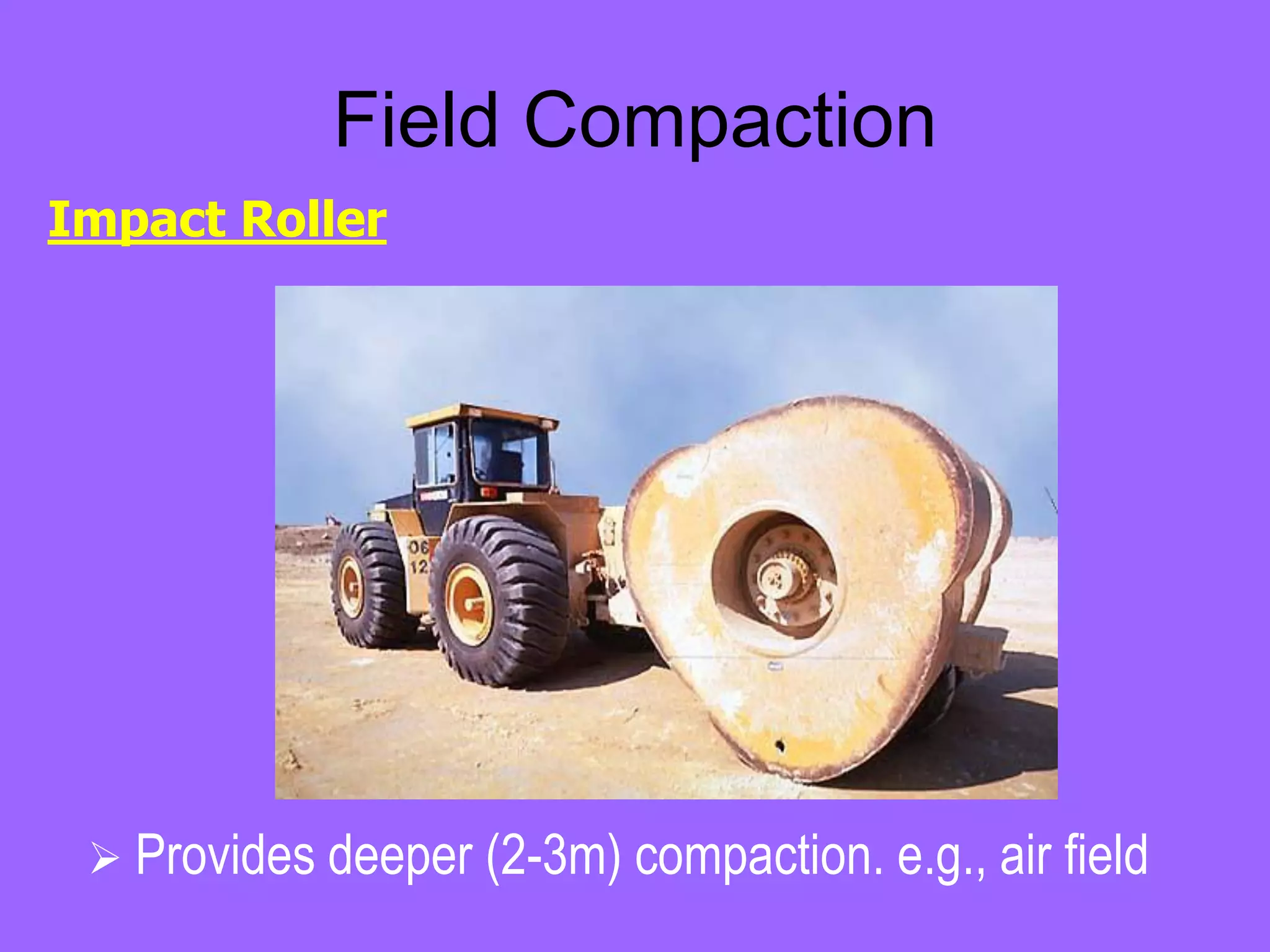
Field Compaction
 Provides deeper (2-3m) compaction. e.g., air field
Impact Roller
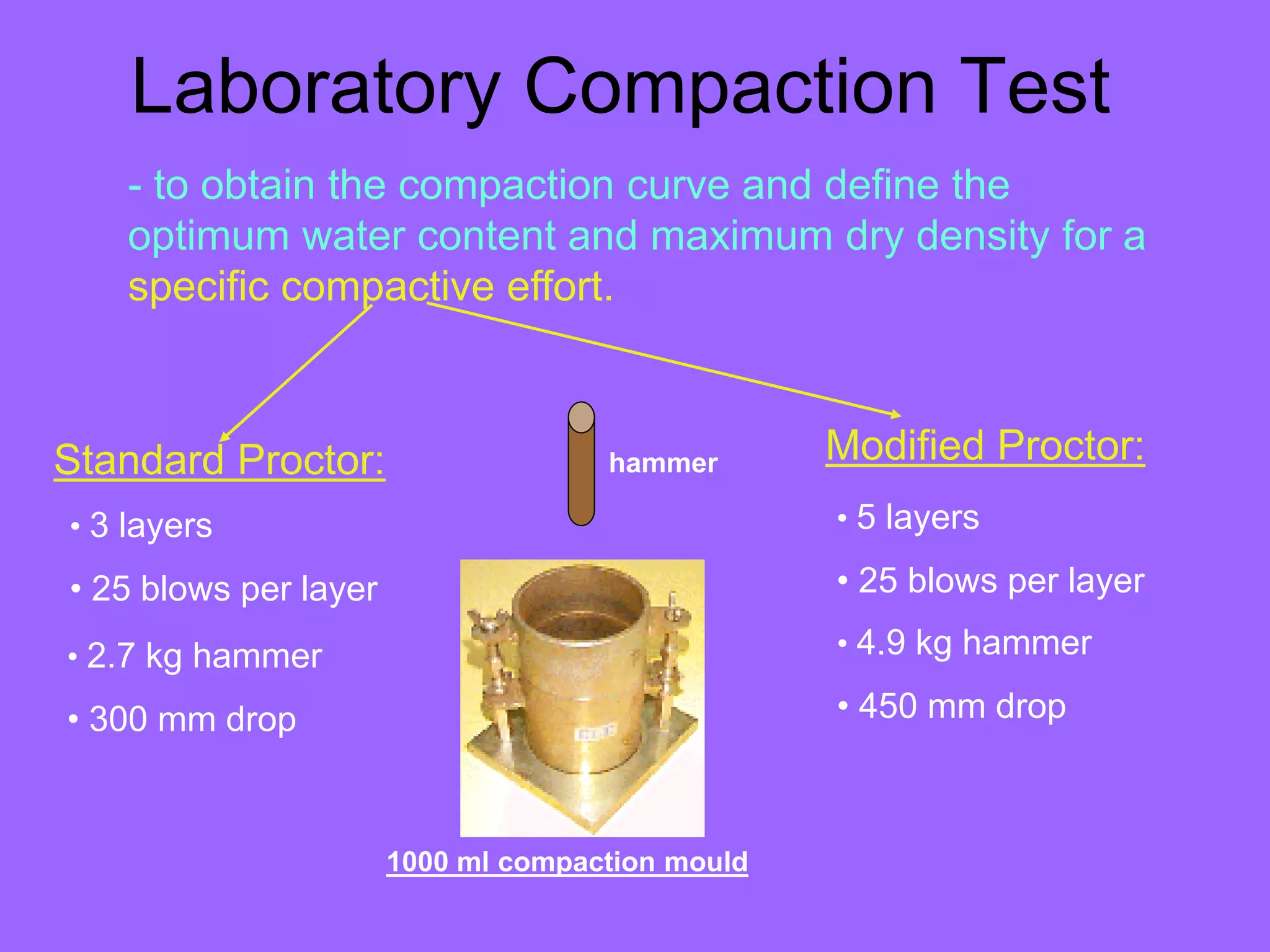
Laboratory Compaction Test
- to obtain the compaction curve and define the
optimum water content and maximum dry density for a
specific compactive effort.
hammer
Standard Proctor: Modified Proctor:
• 3 layers
• 25 blows per layer
• 5 layers
• 25 blows per layer
• 2.7 kg hammer
• 300 mm drop
• 4.9 kg hammer
• 450 mm drop
1000 ml compaction mould
Operational Aspects
of Shallow Compaction
• Operating frequency.
• Number of passes.
• Depth of layers.
• Special consideration for specific materials
• Applicability and production rate.
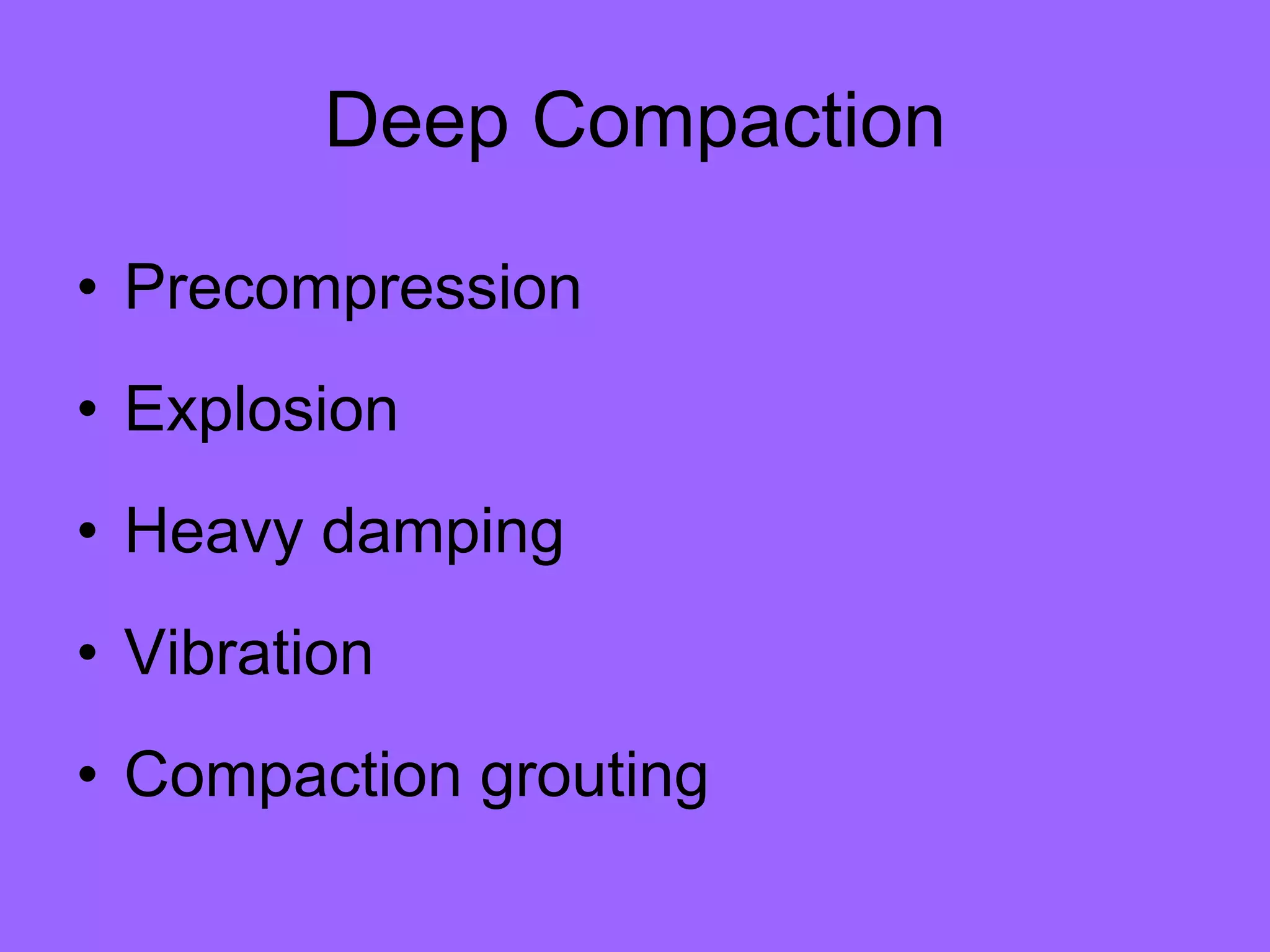
Deep Compaction
• Precompression
• Explosion
• Heavy damping
• Vibration
• Compaction grouting
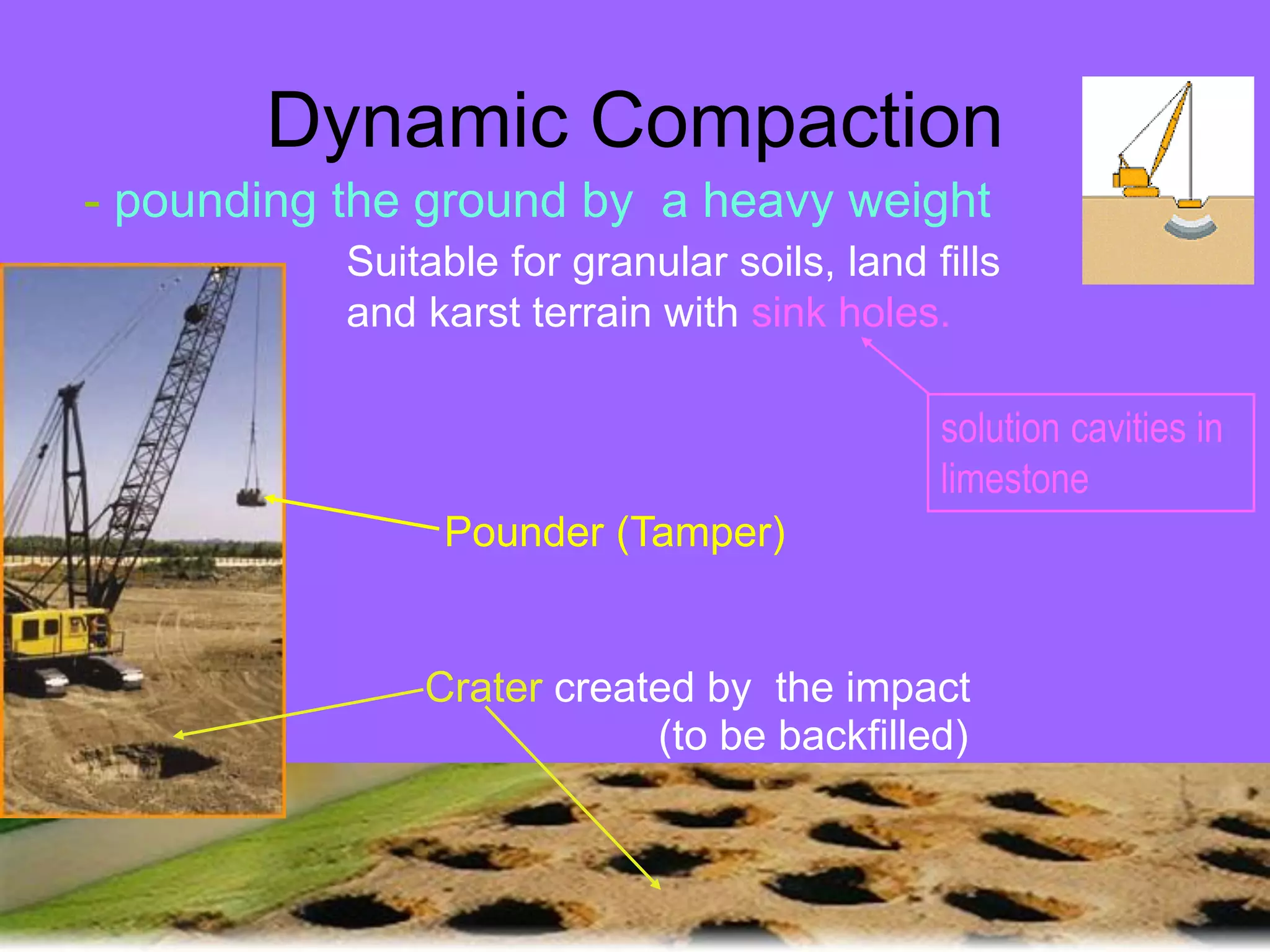
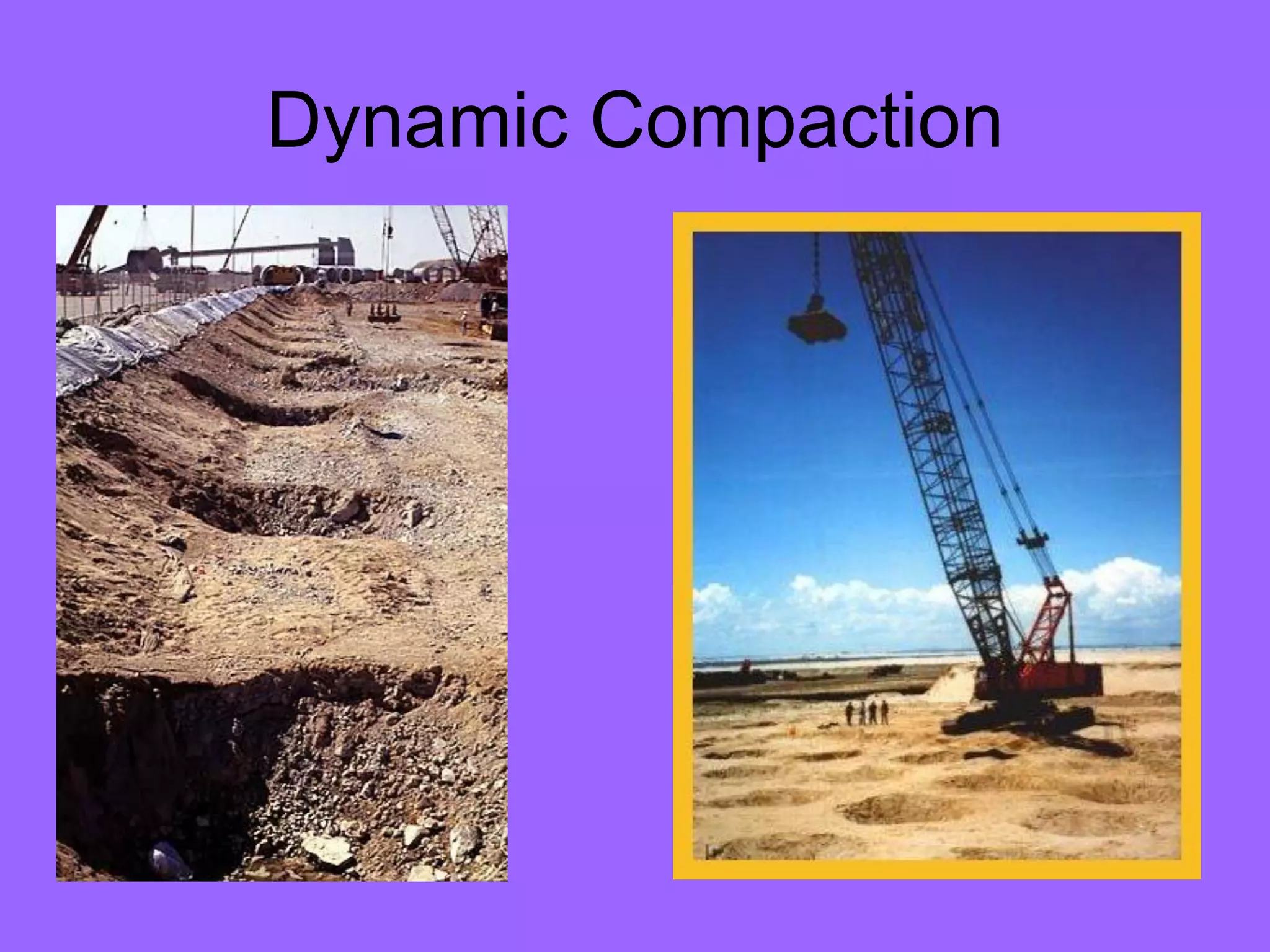
Dynamic Compaction
- pounding the ground by a heavy weight
Suitable for granular soils, land fills
and karst terrain with sink holes.
Crater created by the impact
Pounder (Tamper)
solution cavities in
limestone
(to be backfilled)
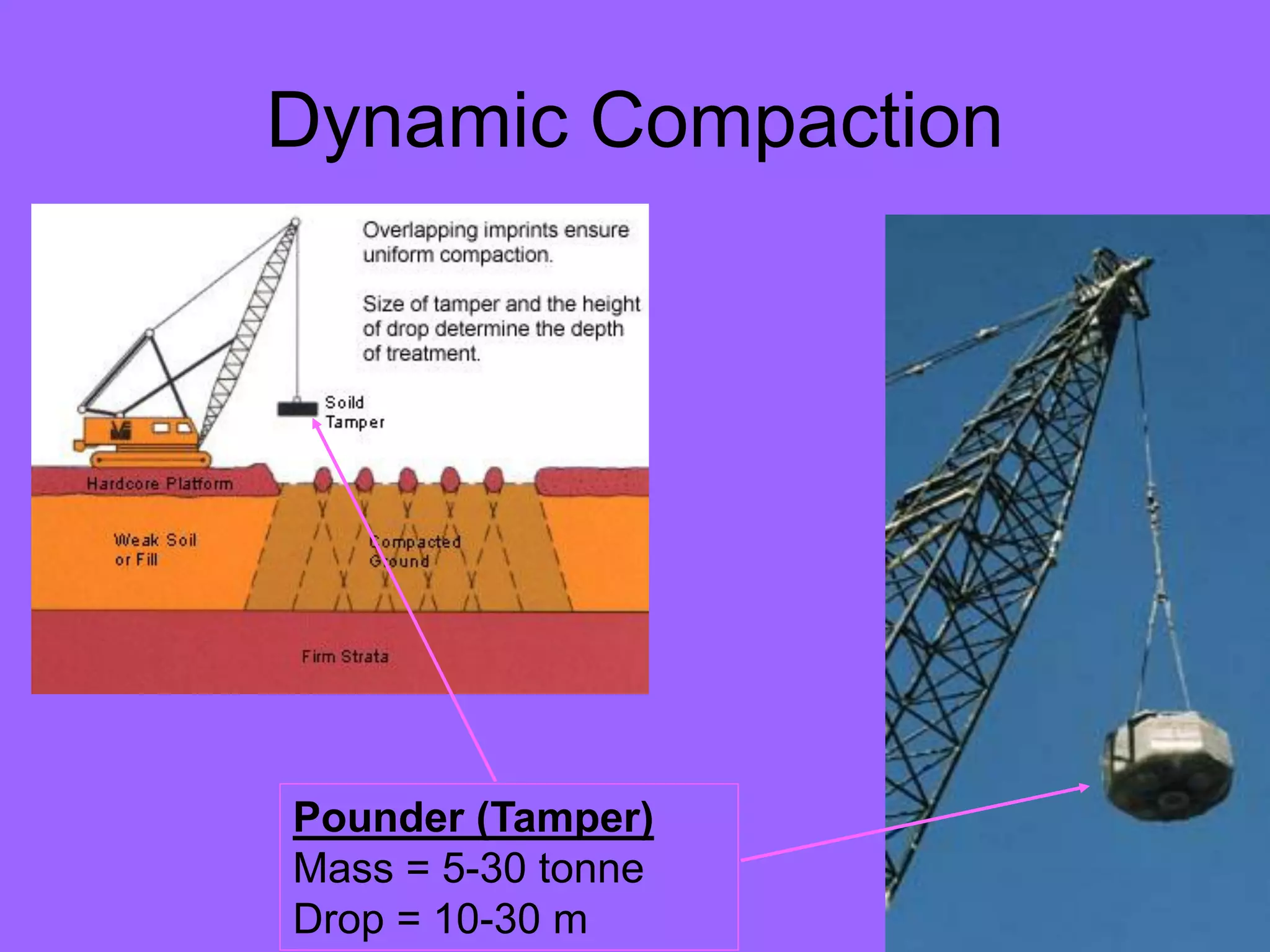
Dynamic Compaction
Pounder (Tamper)
Mass = 5-30 tonne
Drop = 10-30 m
Dynamic Compaction
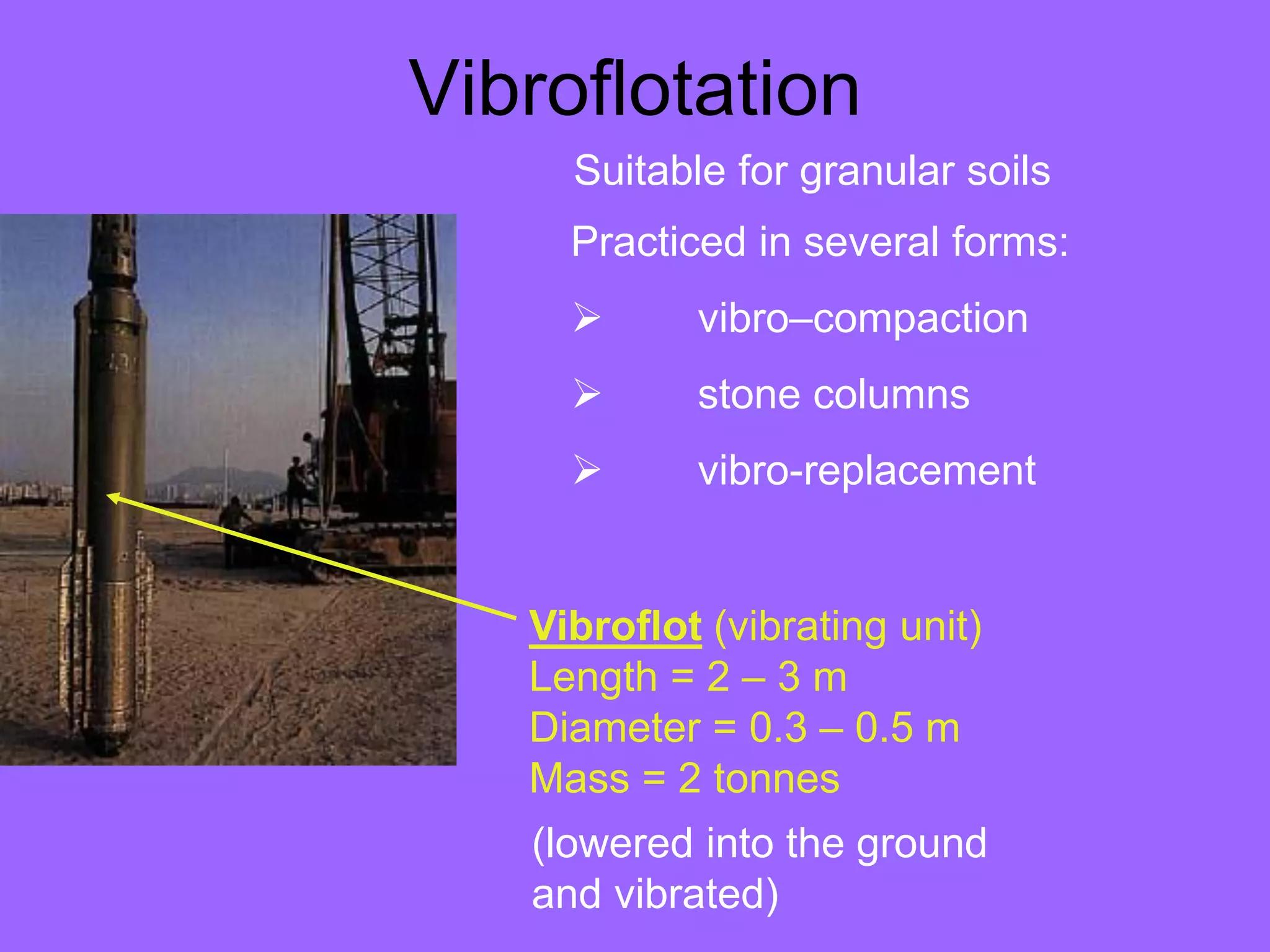
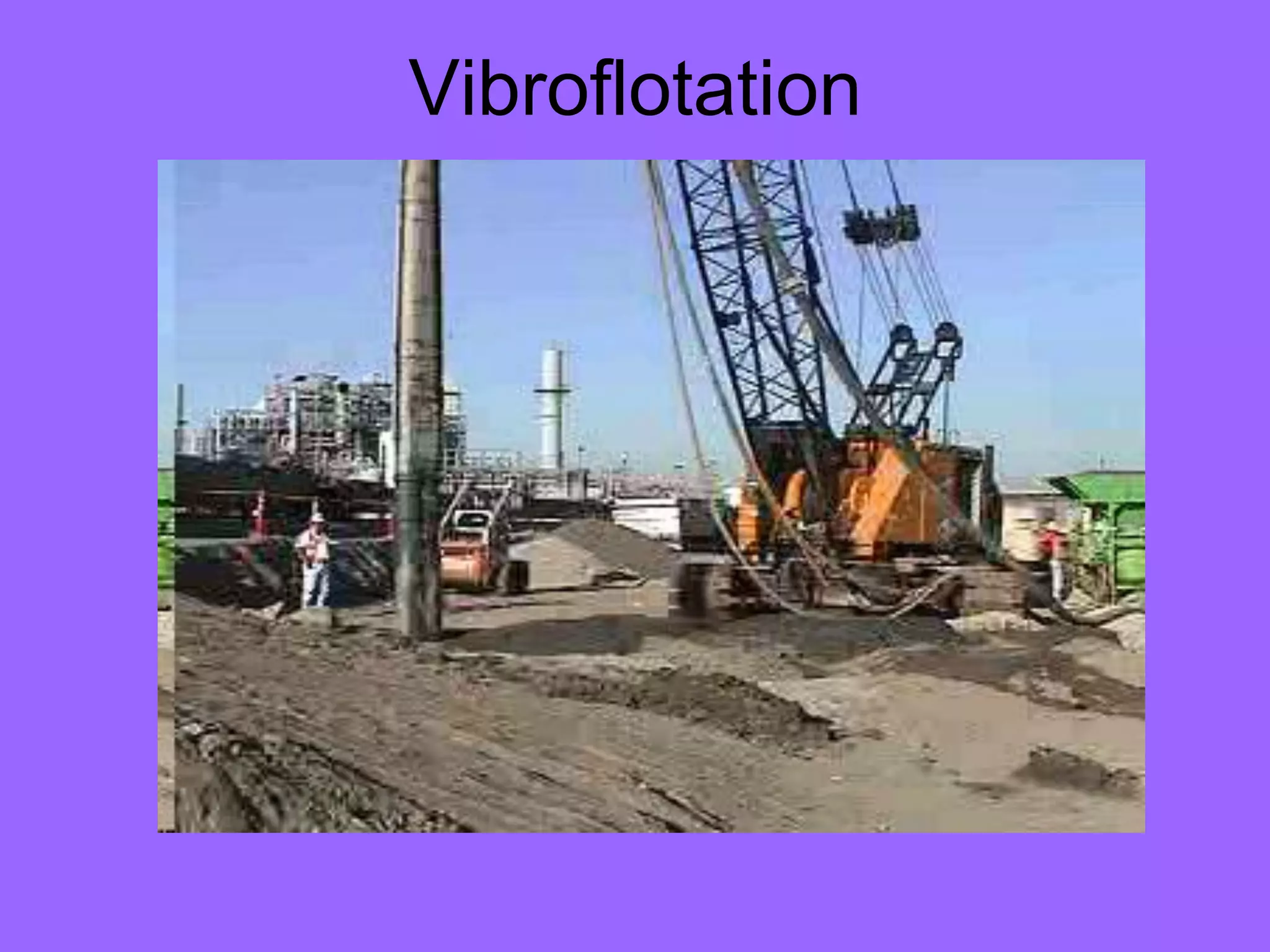
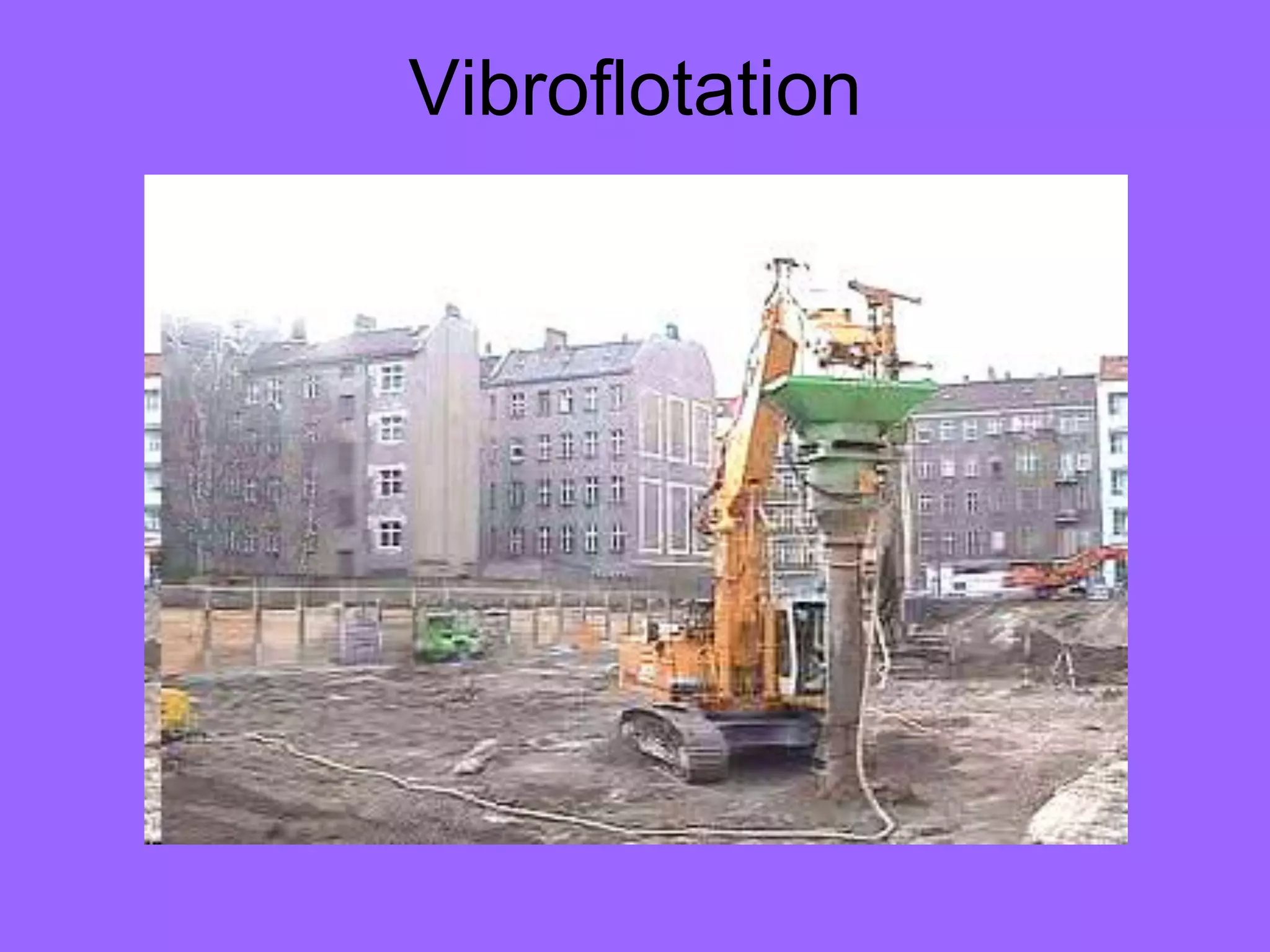
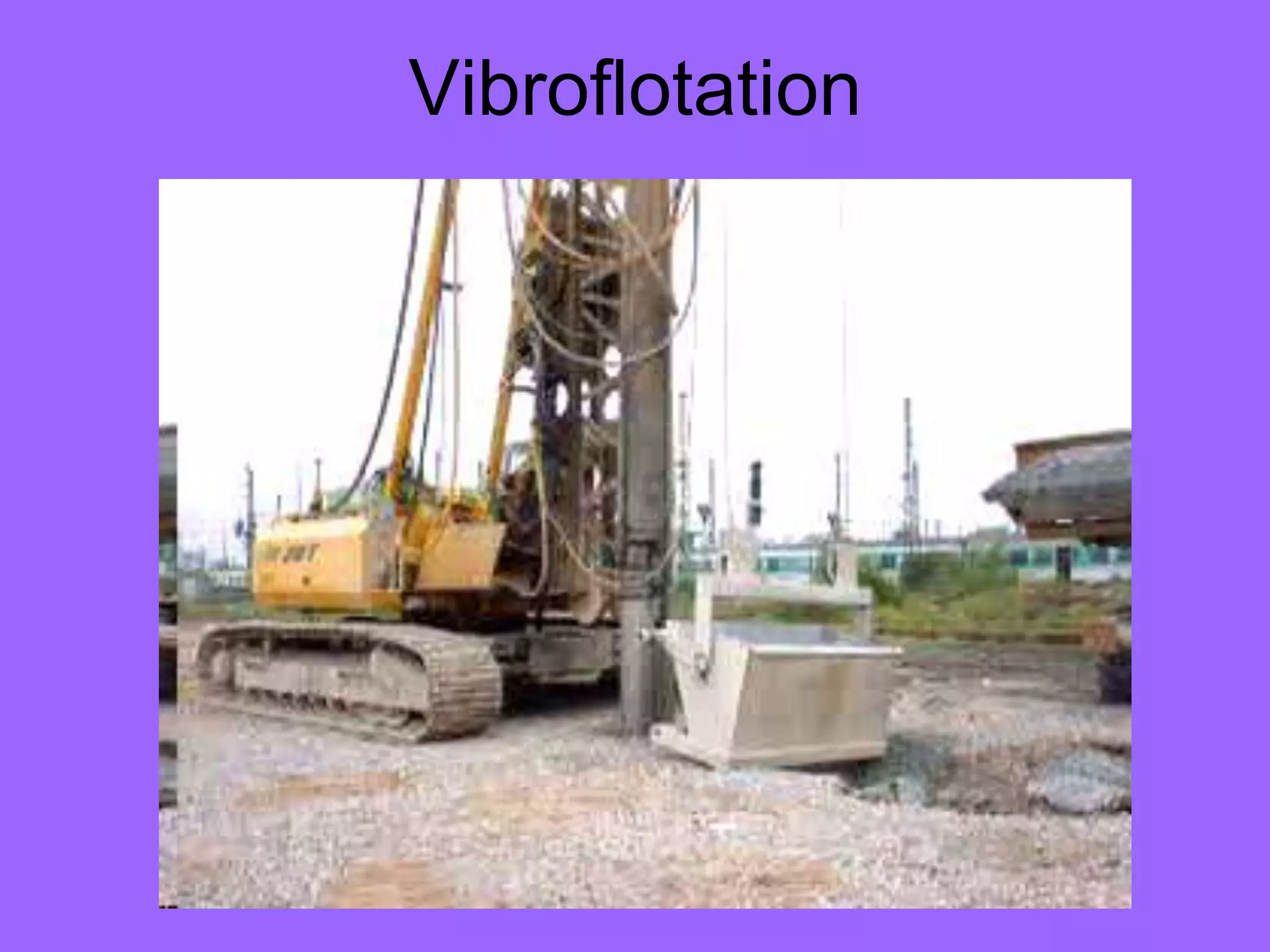
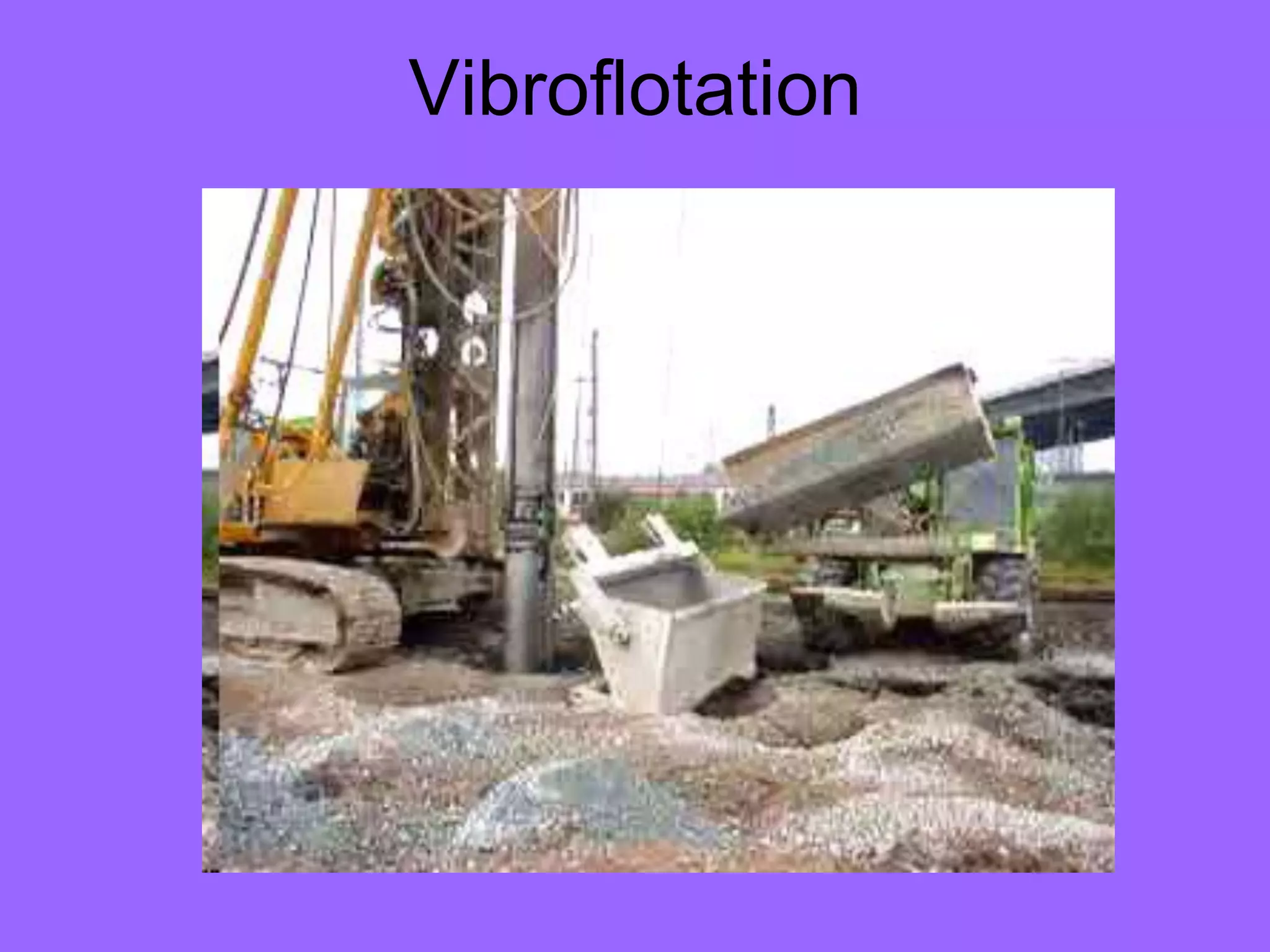
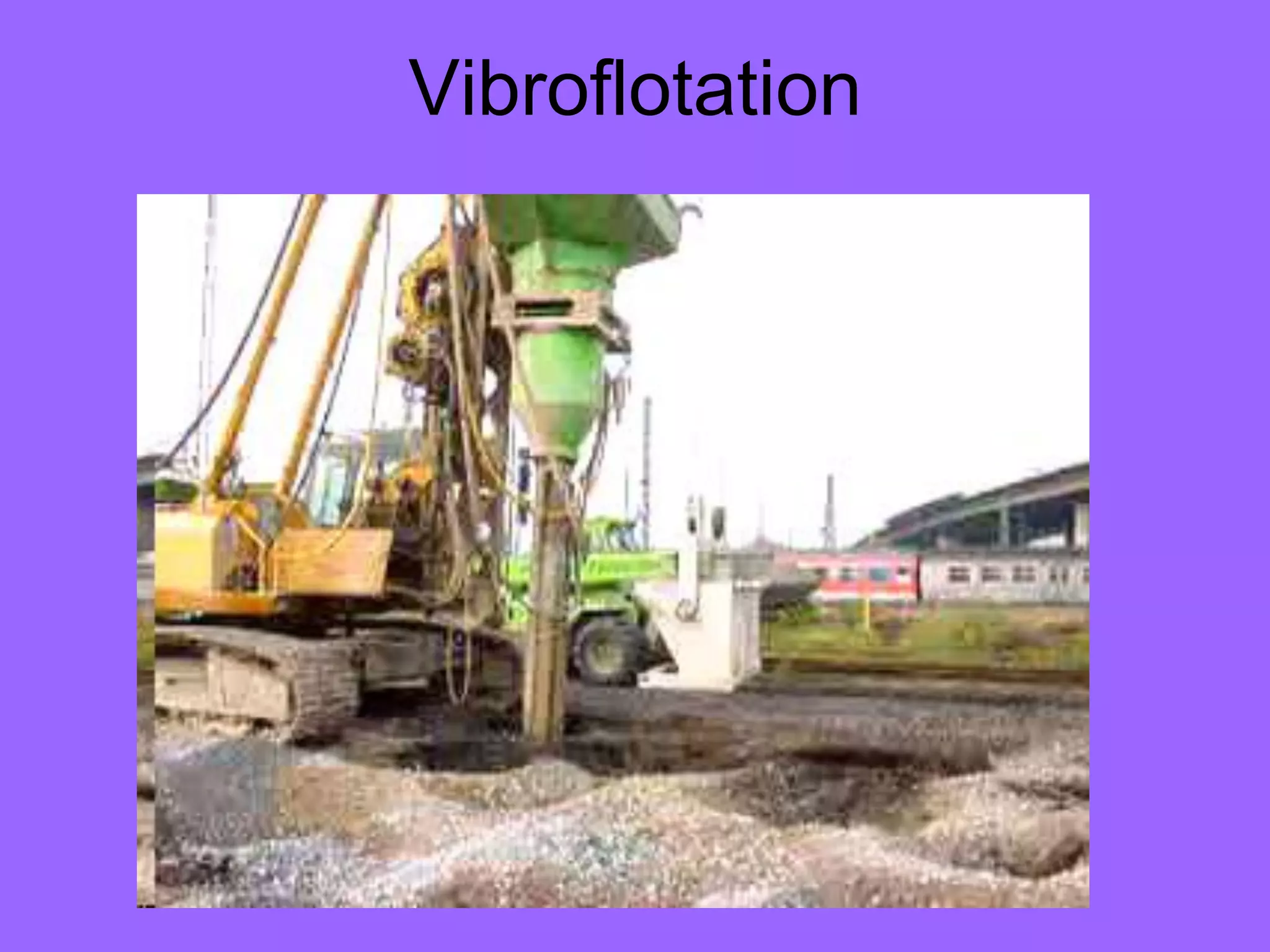
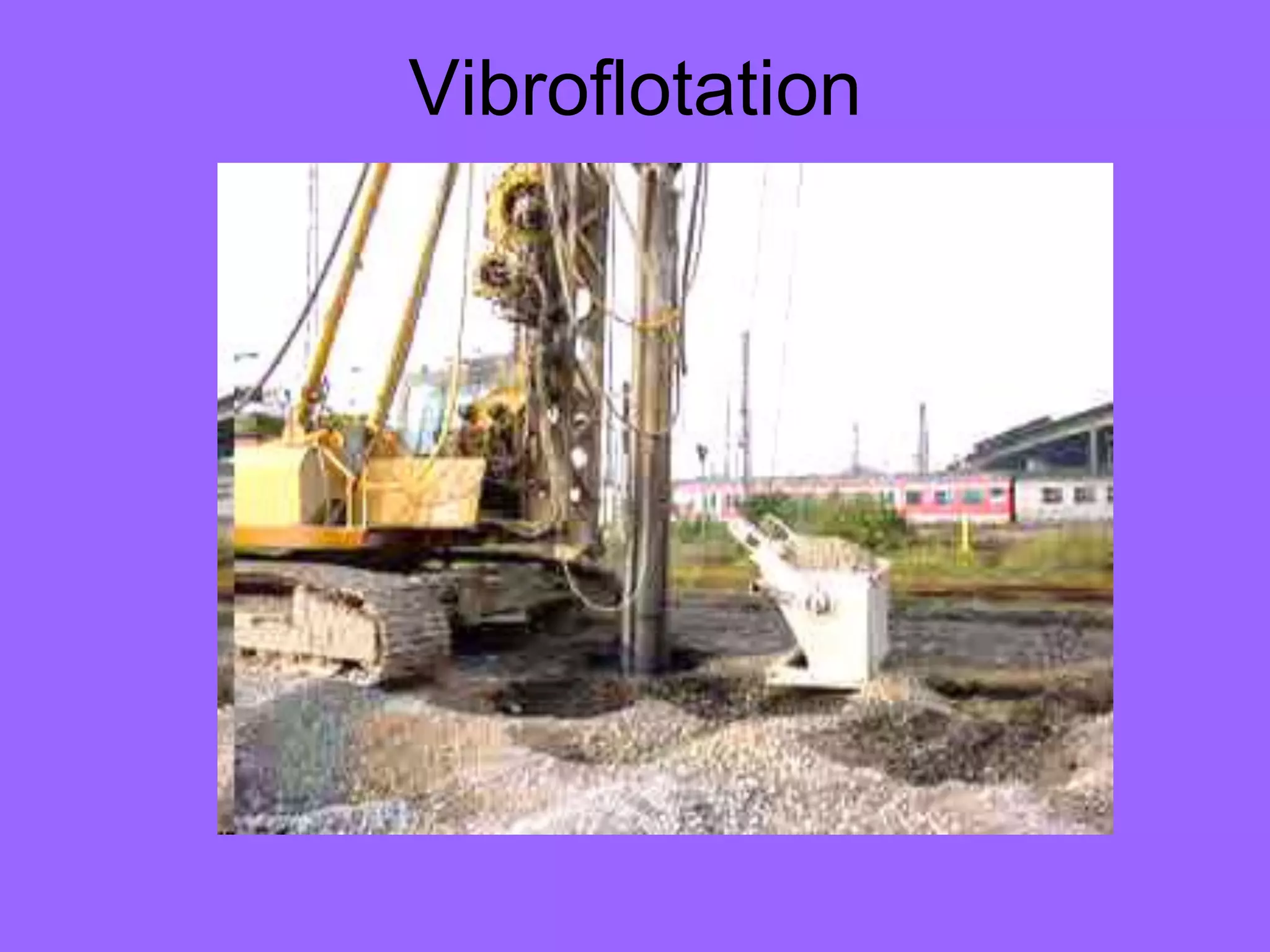
Vibroflotation
Vibroflot (vibrating unit)
Length = 2 – 3 m
Diameter = 0.3 – 0.5 m
Mass = 2 tonnes
Practiced in several forms:
 vibro–compaction
 stone columns
 vibro-replacement
Suitable for granular soils
(lowered into the ground
and vibrated)
Vibroflotation
Vibroflotation
Vibroflotation
Vibroflotation
Vibroflotation
Vibroflotation
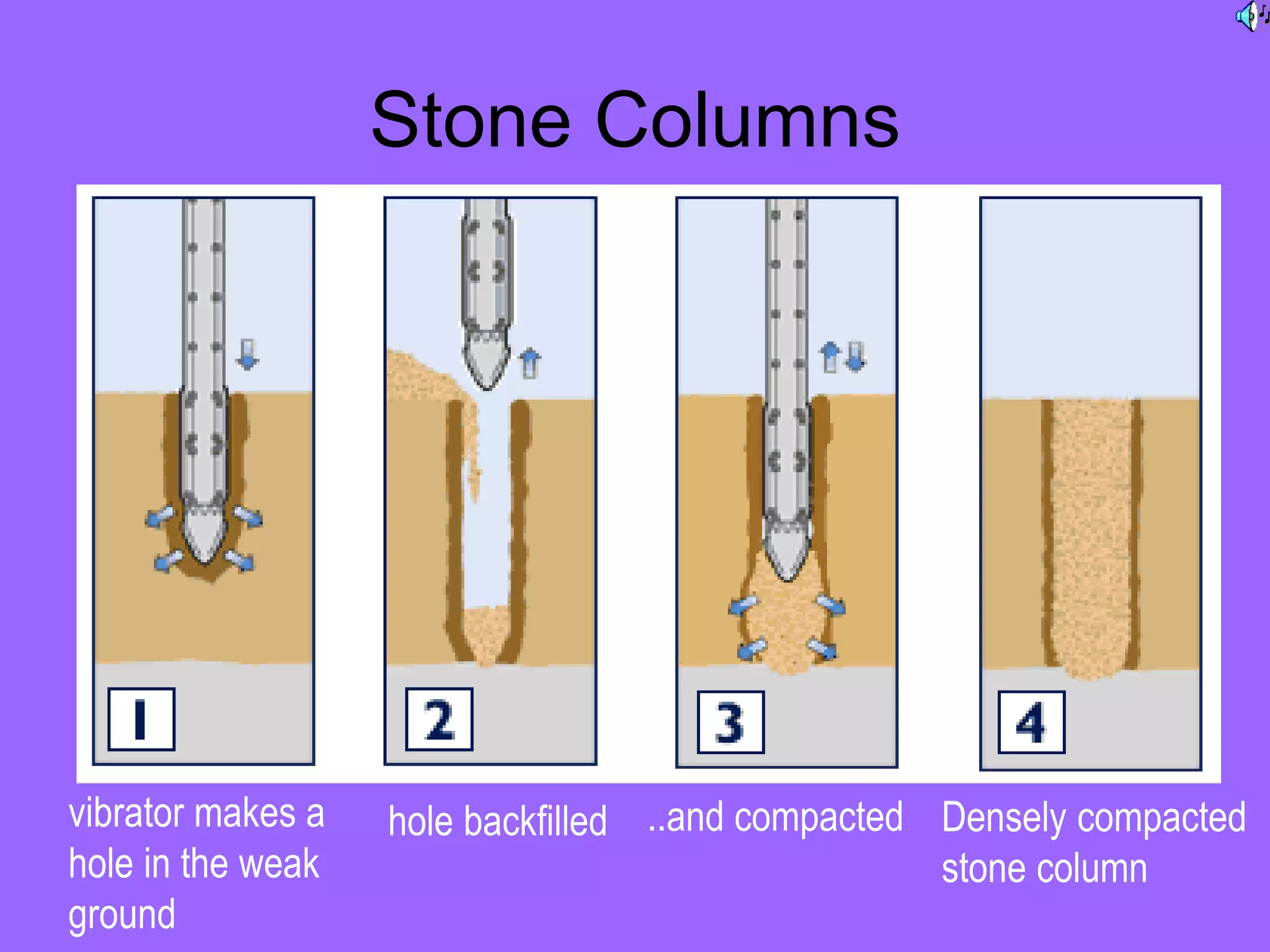
Stone Columns
vibrator makes a
hole in the weak
ground
hole backfilled ..and compacted Densely compacted
stone column
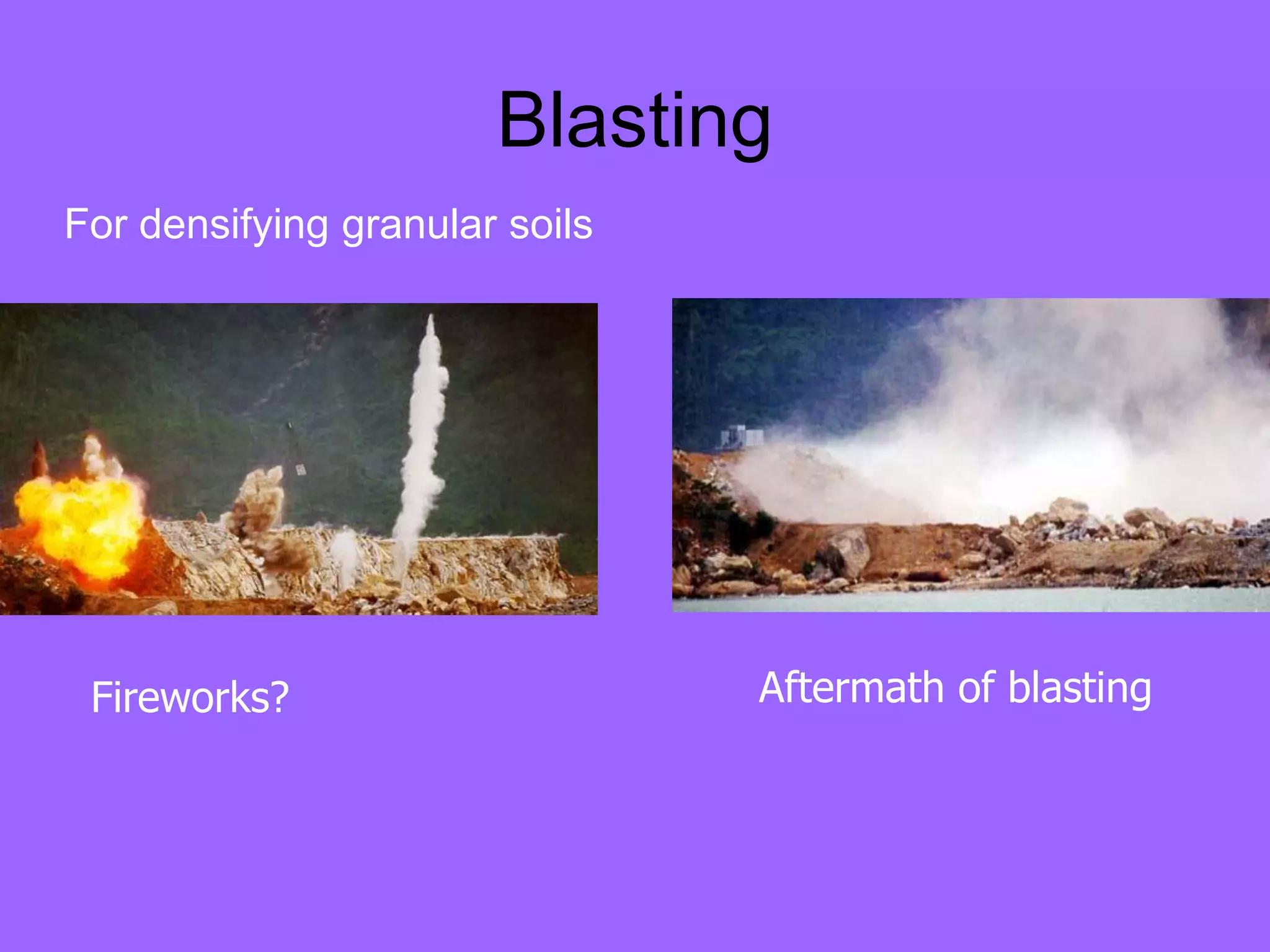
Blasting
Aftermath of blasting
Fireworks?
For densifying granular soils
Earthmoving Equipment
Large Excavator (see minivan on left for scale)
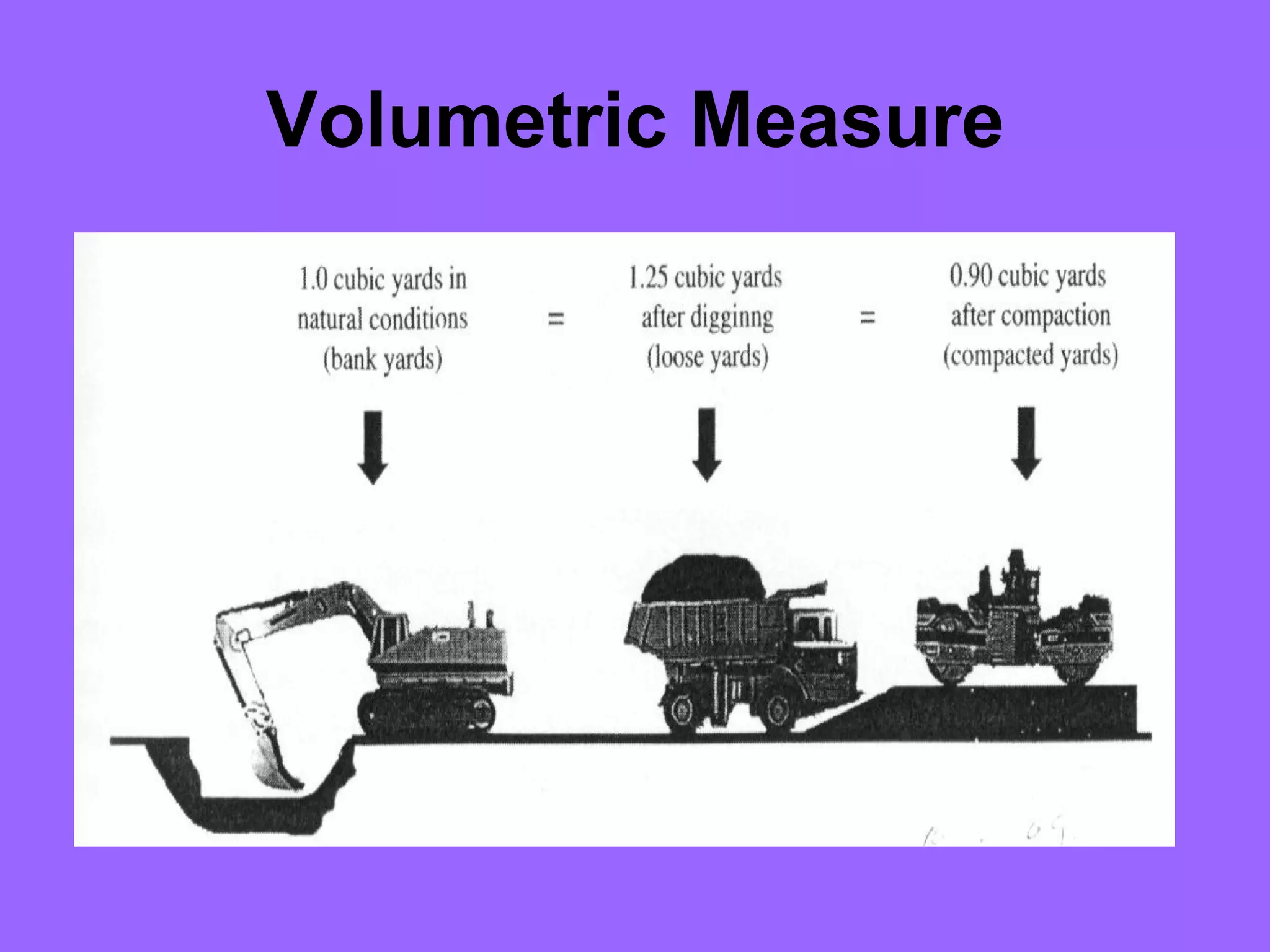
Volumetric Measure
• Bank cubic yard - 1 cubic yard (cy) of
material as it lies in the natural state,
bcy
• Loose cubic yard - 1 cy of material after it
has been disturbed by a loading
process, lcy
• Compacted cubic yard - 1 cy of material in
the compacted state, also referred to as
a net in-place cubic yard, ccy
Volumetric Measure
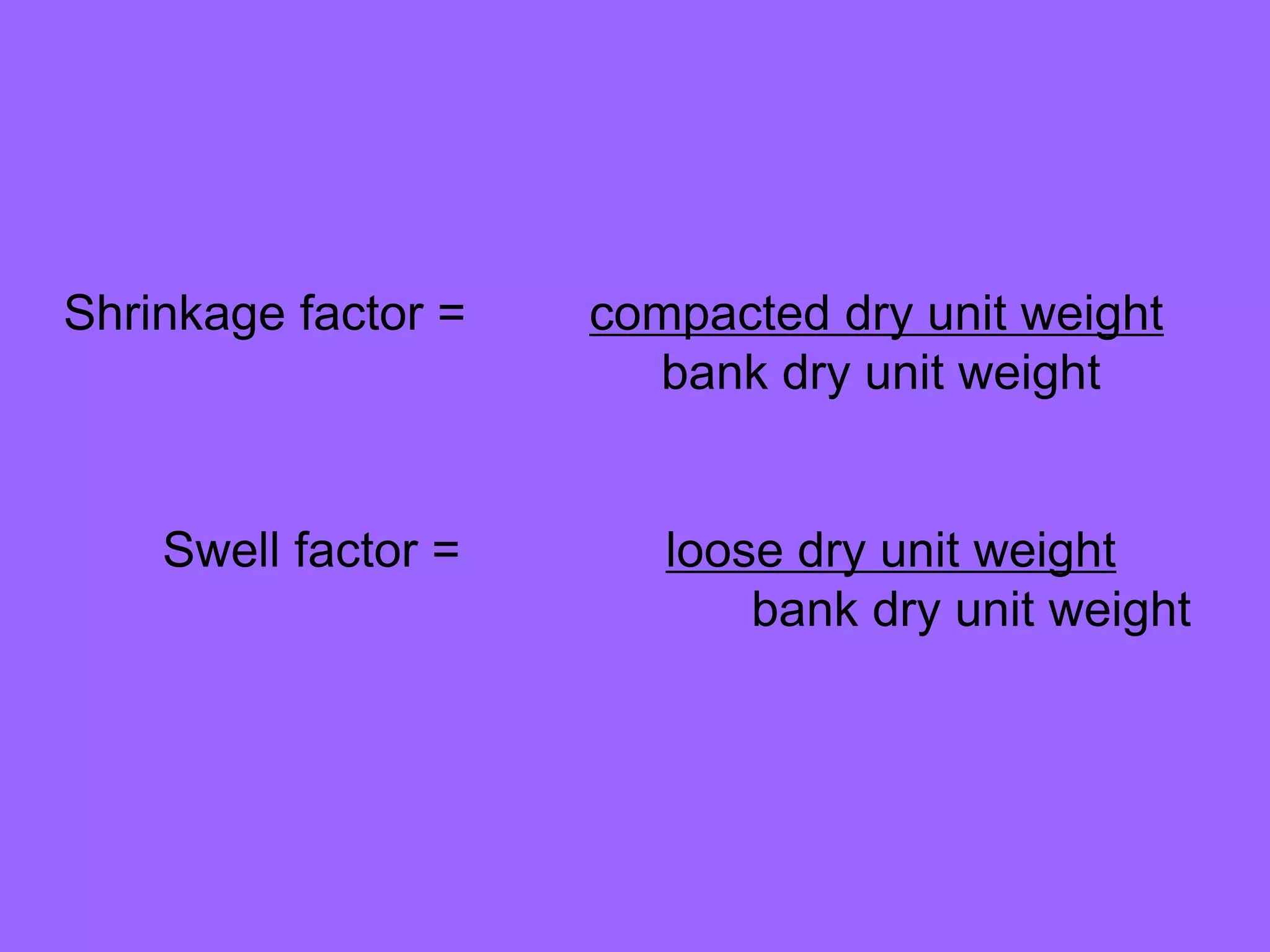
Shrinkage factor = compacted dry unit weight
bank dry unit weight
Swell factor = loose dry unit weight
bank dry unit weight
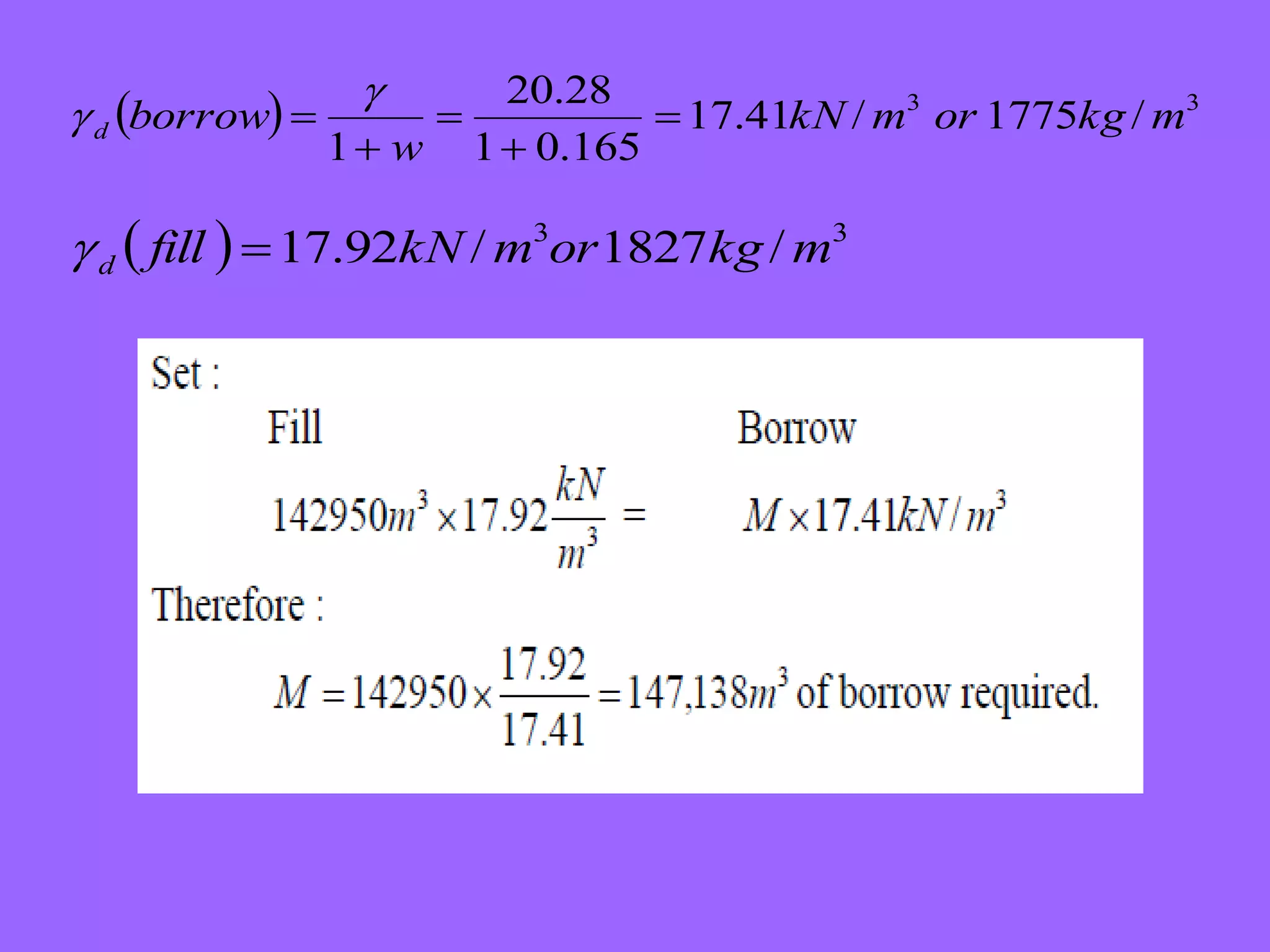
EXAMPLE
An earth fill, when completed, will occupy a net
volume of 142,950 m3. The borrow material that
will be used to construct this fill is a stiff clay. In its
"bank" condition, the borrow material has a wet
unit weight, 20.28 kN/m3, a water content w % of
16.5%, and an in-place void ratio (e) of 0.620. The
fill will be constructed in layers of 20.32 cm depth,
loose measure, and compacted to a dry unit
weight d 17.92 kN/m3 at a water content of 18.3%.
  3
3
/
1775
/
41
.
17
165
.
0
1
28
.
20
1
m
kg
or
m
kN
w
borrow
d 






  3
3
/
1827
/
92
.
17 m
kg
or
m
kN
fill
d 

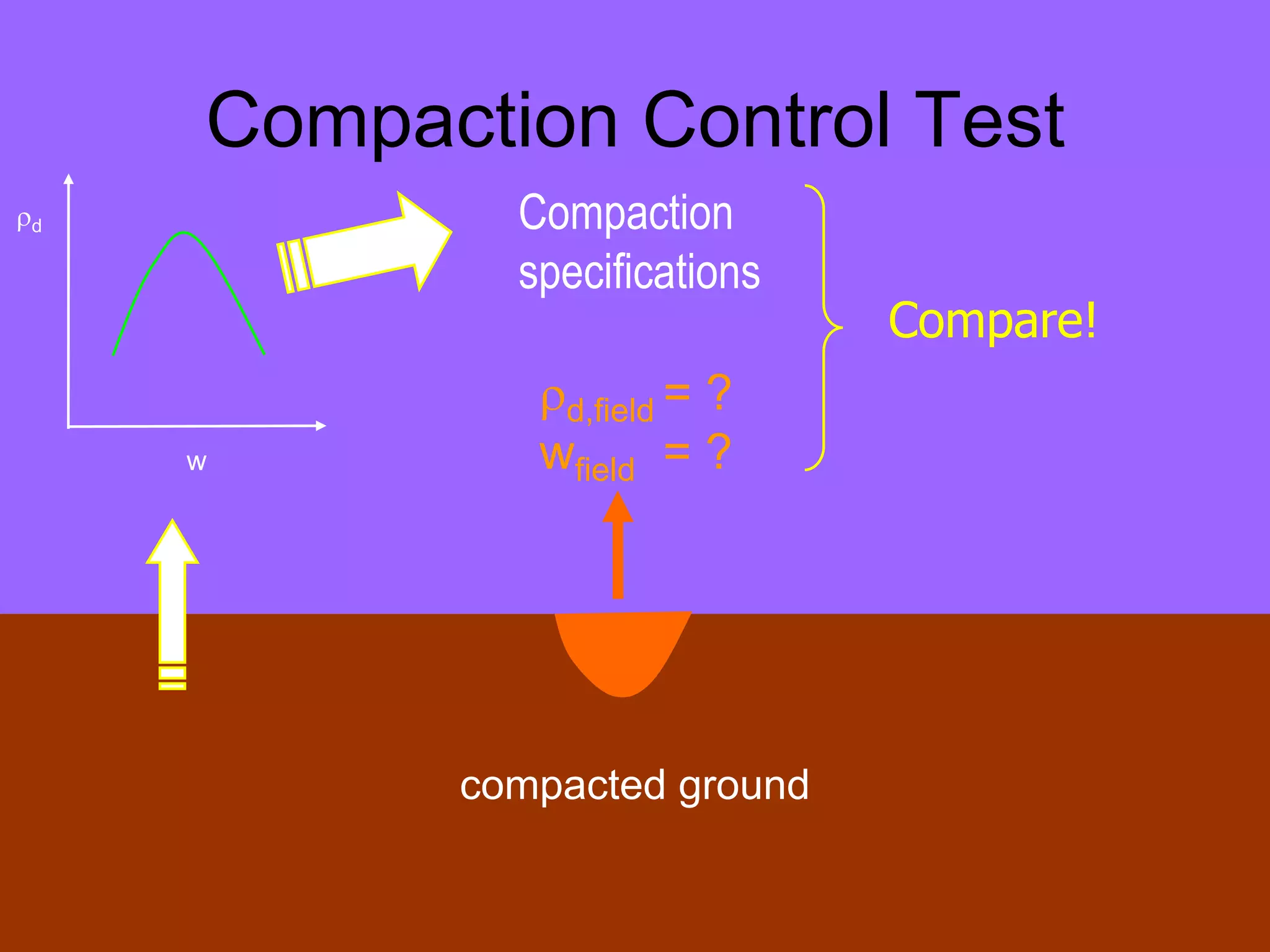
Compaction Control Test
compacted ground
d,field = ?
wfield = ?
Compaction
specifications
Compare!
w
d
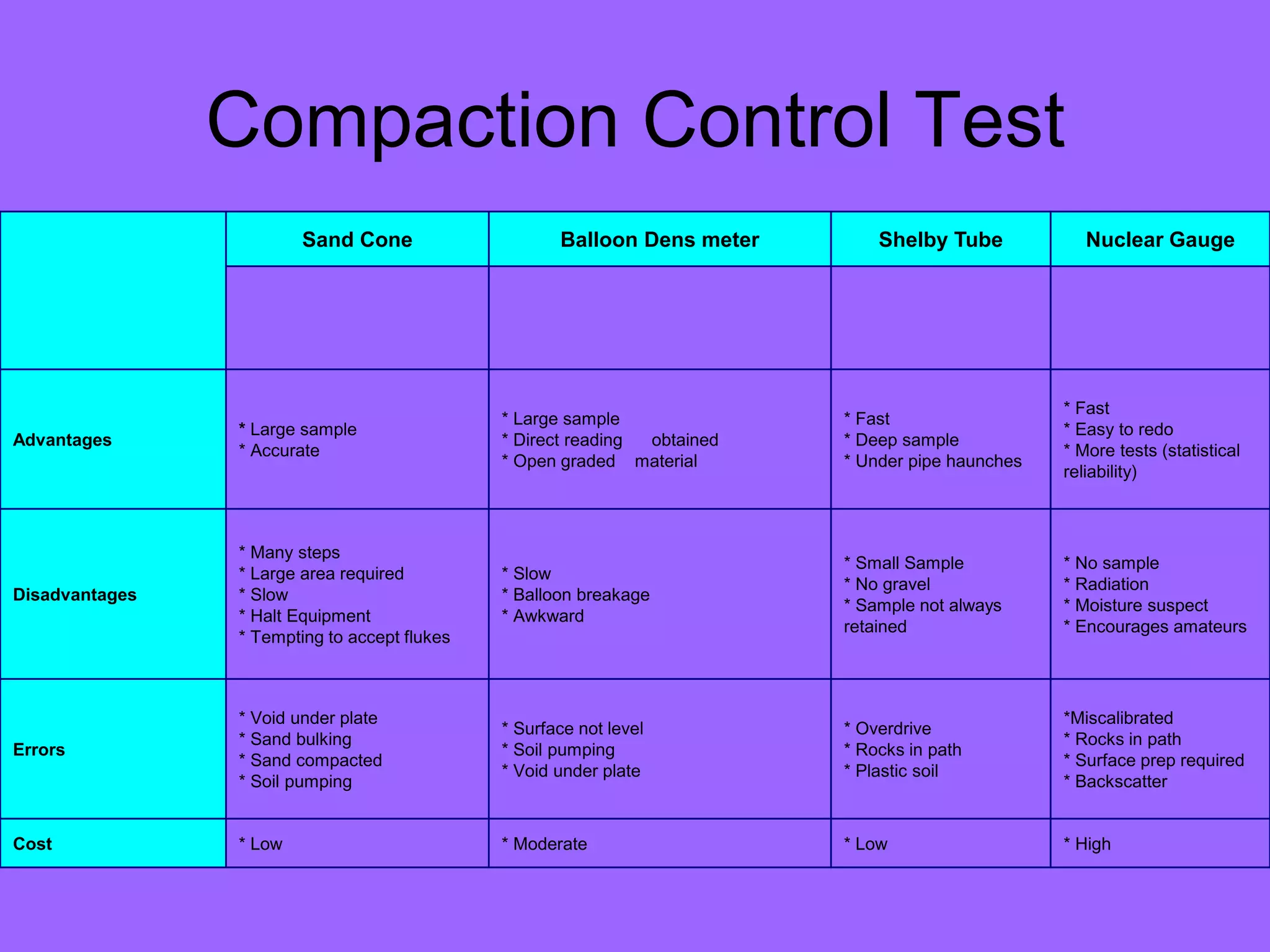
Compaction Control Test
Sand Cone Balloon Dens meter Shelby Tube Nuclear Gauge
Advantages
* Large sample
* Accurate
* Large sample
* Direct reading obtained
* Open graded material
* Fast
* Deep sample
* Under pipe haunches
* Fast
* Easy to redo
* More tests (statistical
reliability)
Disadvantages
* Many steps
* Large area required
* Slow
* Halt Equipment
* Tempting to accept flukes
* Slow
* Balloon breakage
* Awkward
* Small Sample
* No gravel
* Sample not always
retained
* No sample
* Radiation
* Moisture suspect
* Encourages amateurs
Errors
* Void under plate
* Sand bulking
* Sand compacted
* Soil pumping
* Surface not level
* Soil pumping
* Void under plate
* Overdrive
* Rocks in path
* Plastic soil
*Miscalibrated
* Rocks in path
* Surface prep required
* Backscatter
Cost * Low * Moderate * Low * High
HYDRAULIC MODIFICATION
• dewatering - modifying ground by lowering
the water table, redirecting seepage, or
simply reducing its water content
• In coarse-grained soils, dewatering can be
achieved
• In fine-grained soils dewatering becomes
synonymous with forced consolidation.
WHY??
• to provide a dry working area, such as in
excavations for building foundations, dams,
and tunnels
• to stabilize constructed or natural slopes
• to reduce lateral pressures on foundations or
retaining structures
• to reduce the compressibility of granular soils
• to increase the bearing capacity of foundations
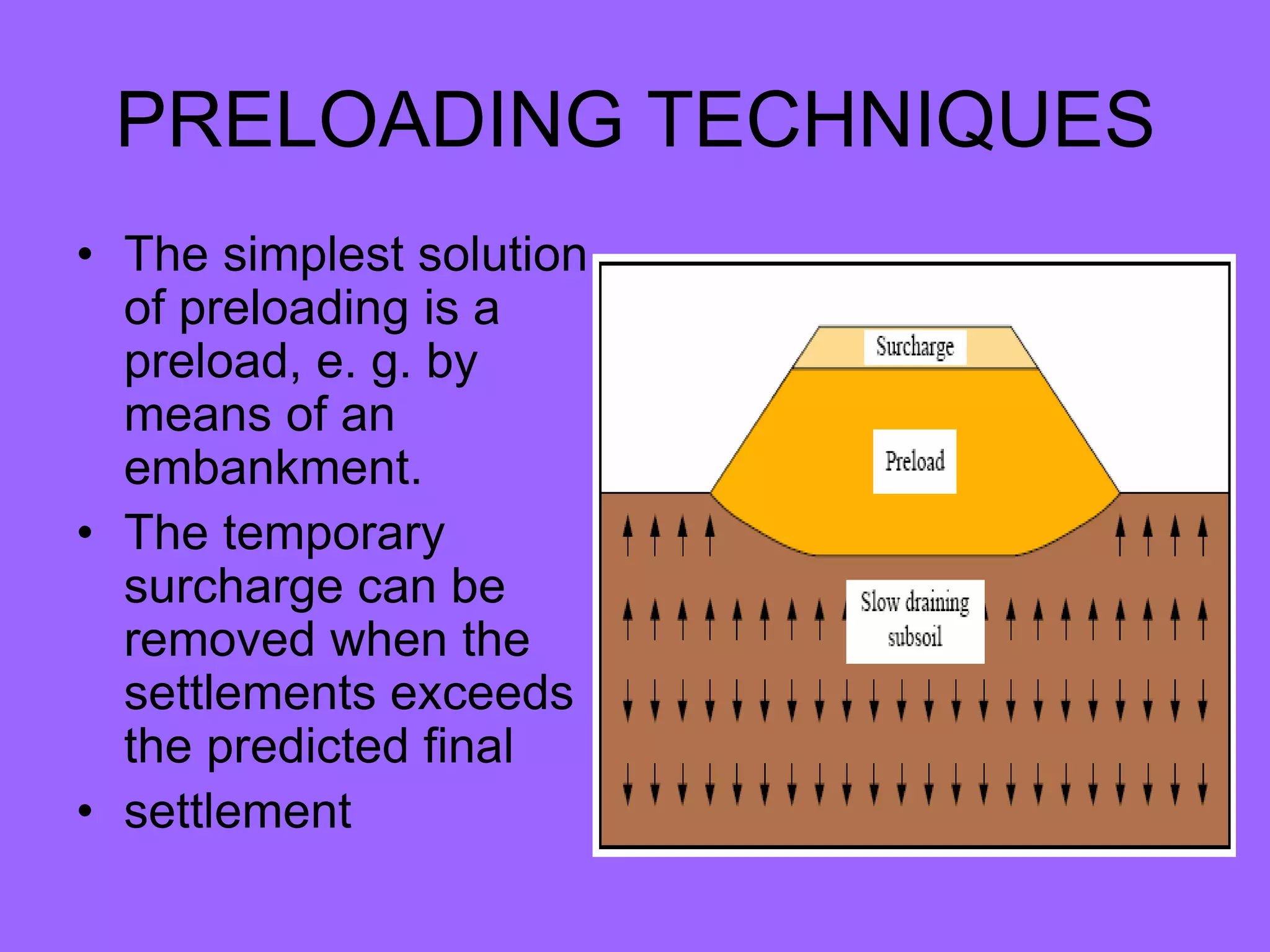
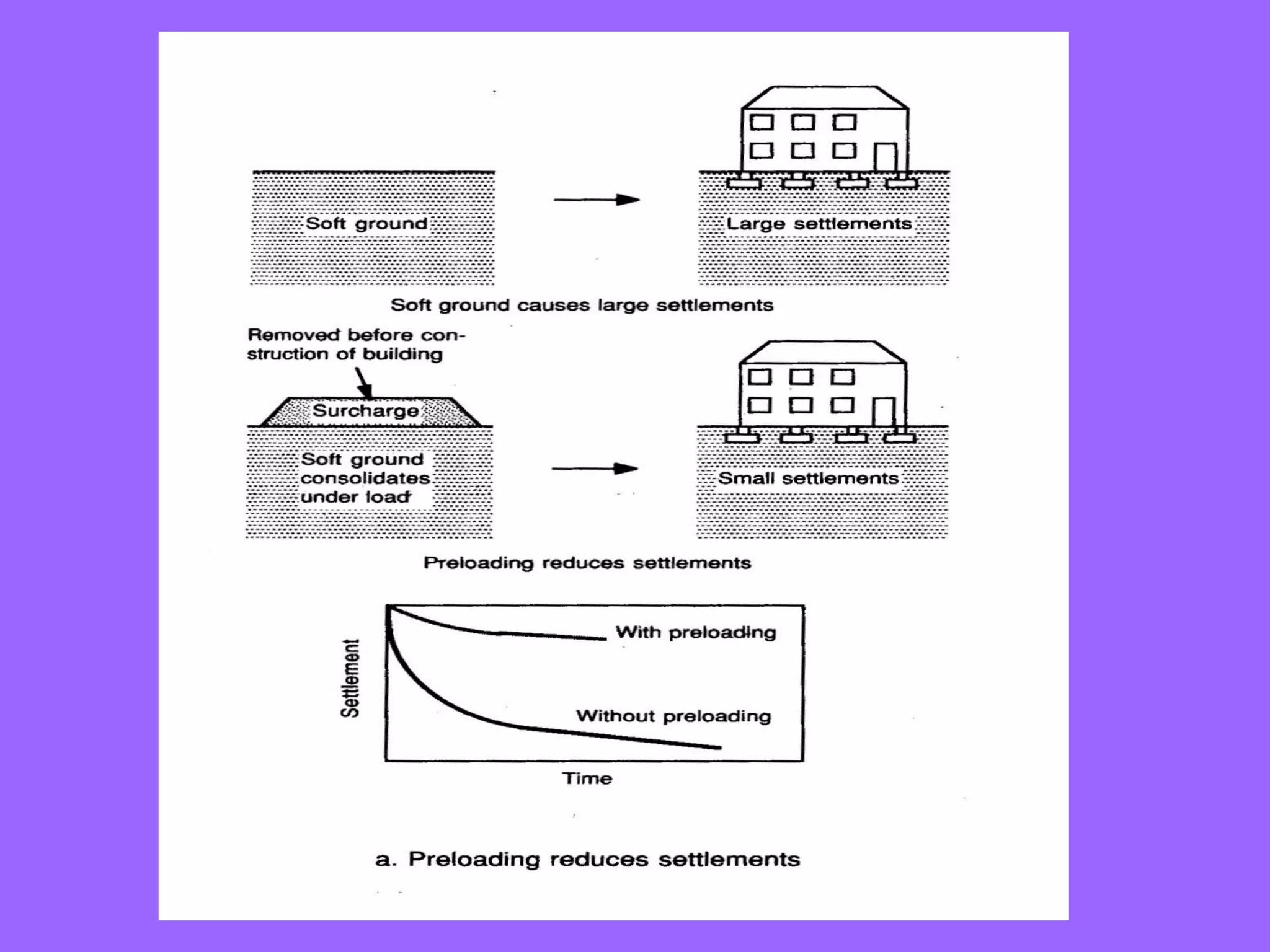
PRELOADING TECHNIQUES
• The simplest solution
of preloading is a
preload, e. g. by
means of an
embankment.
• The temporary
surcharge can be
removed when the
settlements exceeds
the predicted final
• settlement
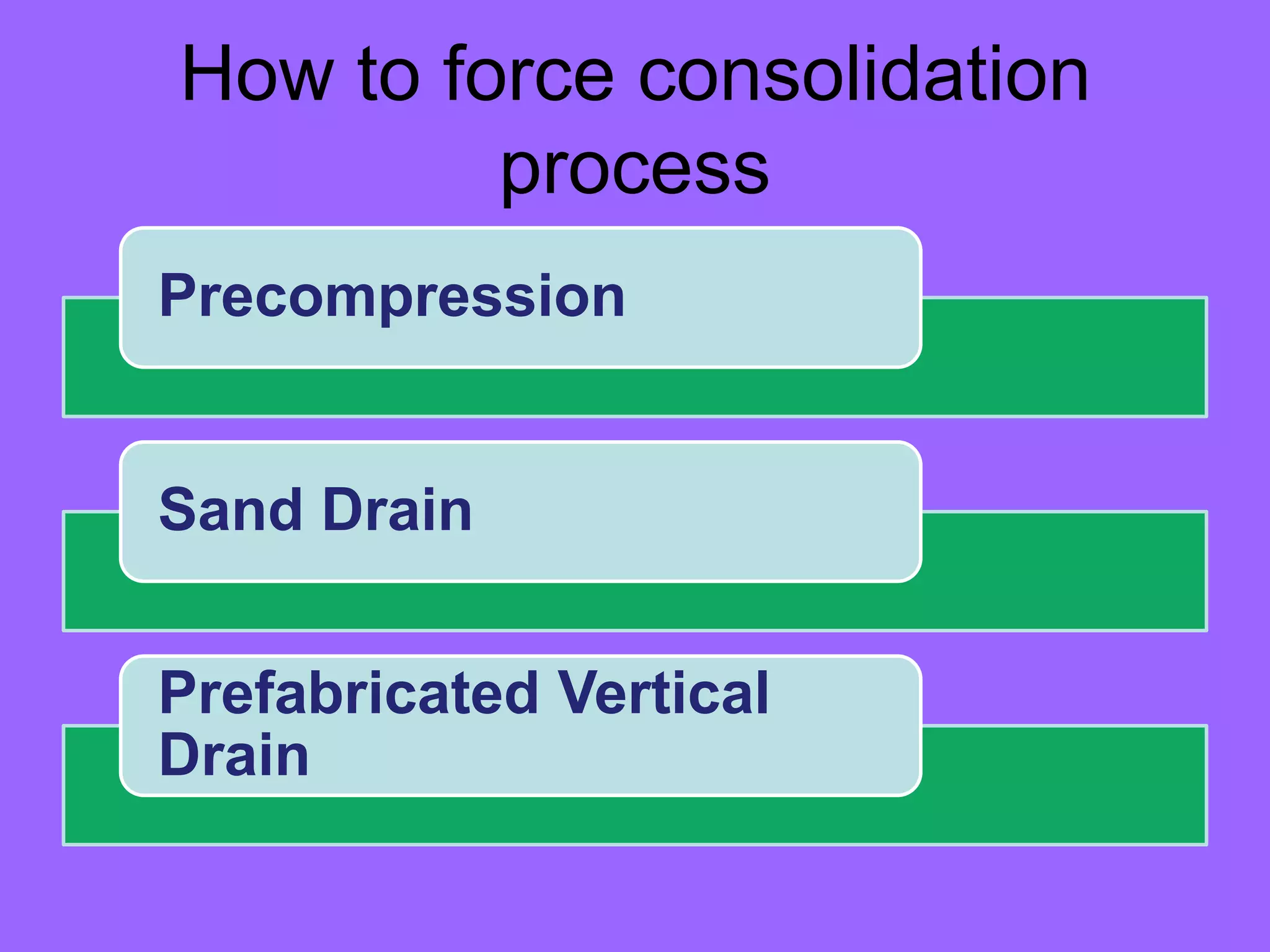
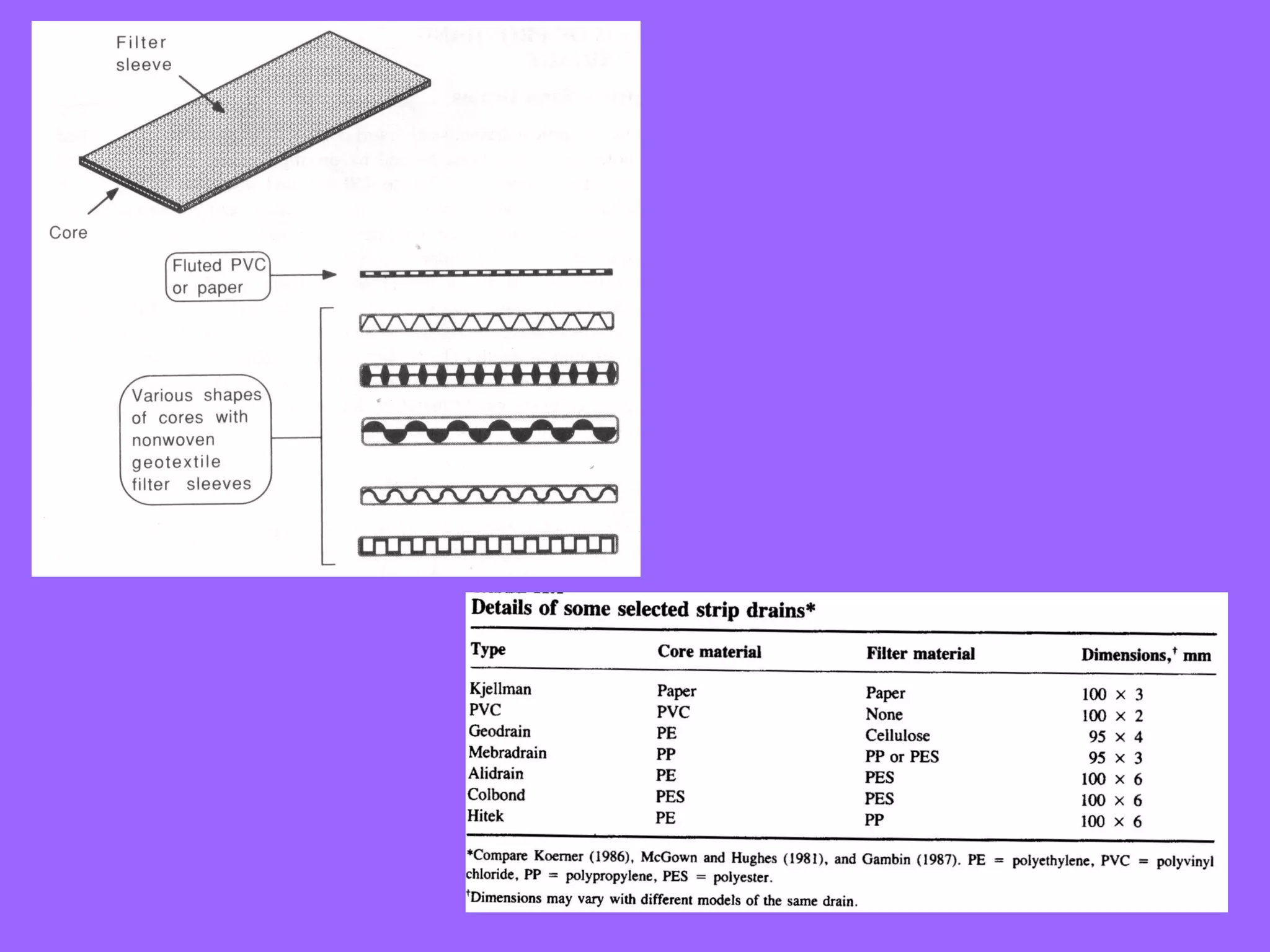
How to force consolidation
process
Precompression
Sand Drain
Prefabricated Vertical
Drain
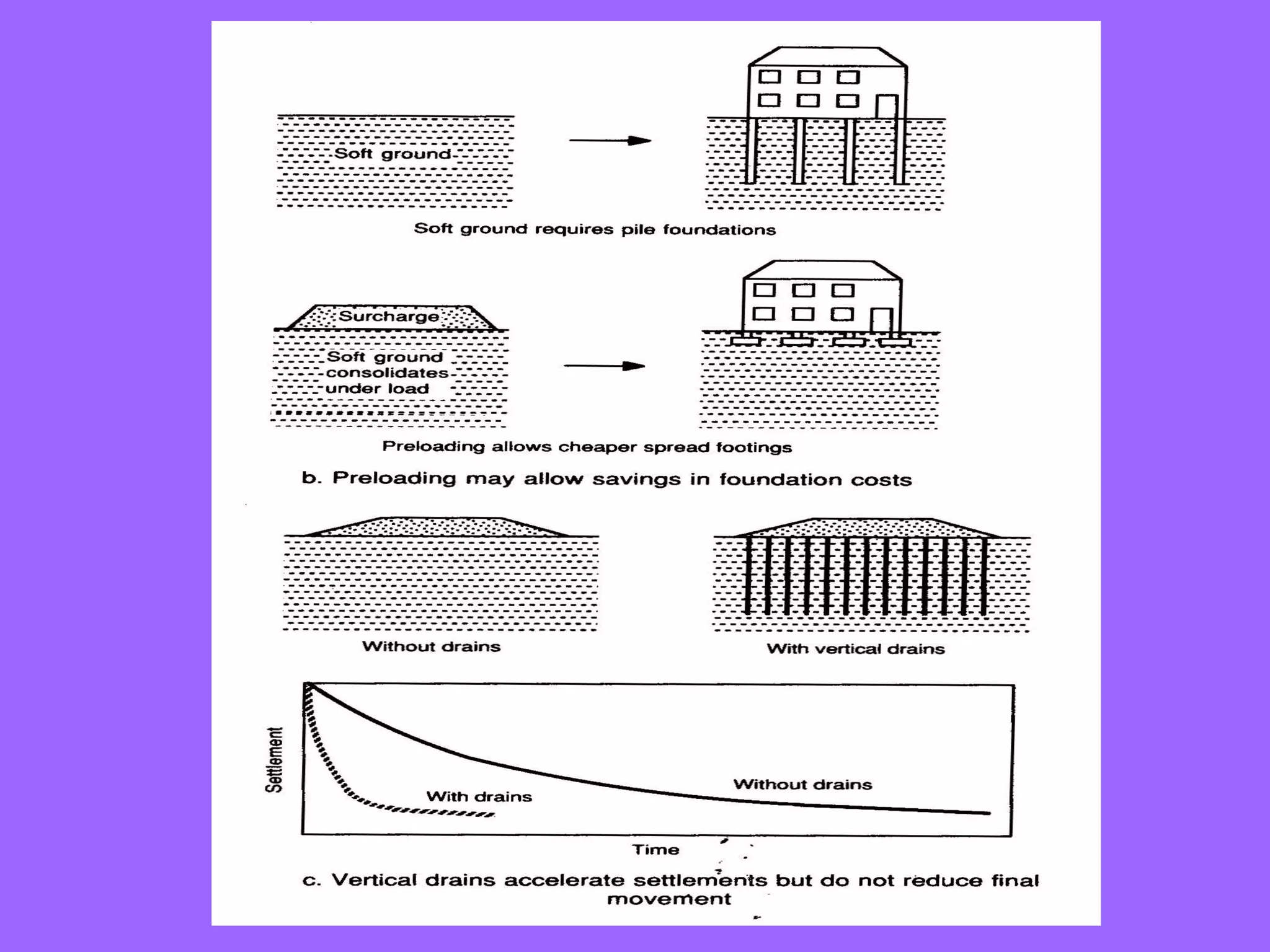
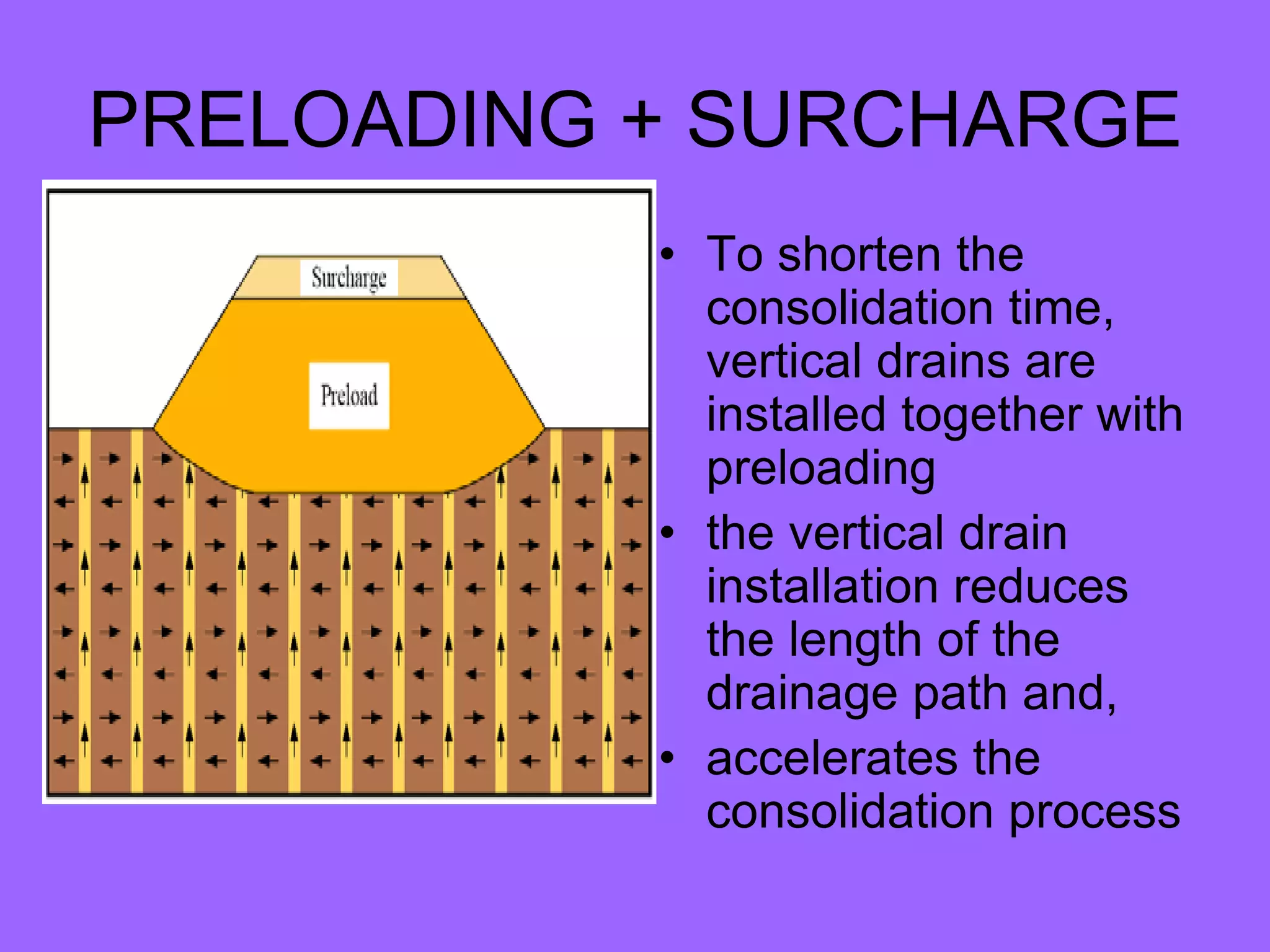
PRELOADING + SURCHARGE
• To shorten the
consolidation time,
vertical drains are
installed together with
preloading
• the vertical drain
installation reduces
the length of the
drainage path and,
• accelerates the
consolidation process
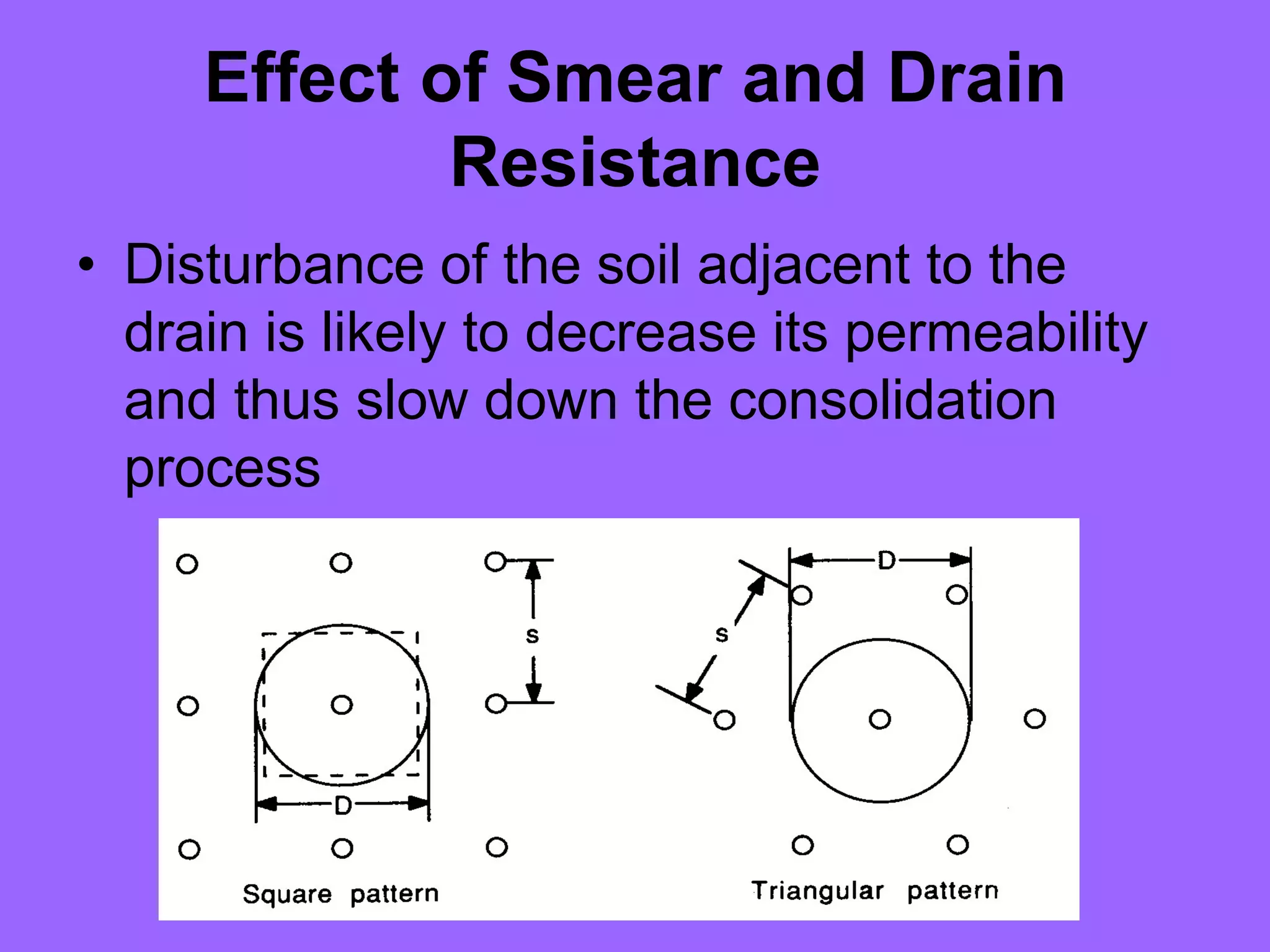
Effect of Smear and Drain
Resistance
• Disturbance of the soil adjacent to the
drain is likely to decrease its permeability
and thus slow down the consolidation
process

chapter5a.pdf

  • 1.
  • 3.
    The need forengineered GI • Avoid particular site • Design the structure accordingly • Remove & replace unsuitable soils • Attempt to modify the existing ground
  • 4.
    Ground Improvement • thecontrolled alteration of the state, nature or mass behaviour of ground materials in order to achieve an intended satisfactory response to existing or projected environmental and engineering actions.
  • 5.
  • 6.
    Mechanical Modification • Mechanicalground modification refers to soil densification by external forces. • mechanical modification is synonymous with compaction. • Compaction means densification of an unsaturated soil by a reduction in the volume of voids filled with air, while the volume of solids and the water content remain essentially the same.
  • 7.
    What is compaction? Asimple ground improvement technique, where the soil is densified through external compactive effort. + water = Compactive effort
  • 8.
    Compaction Curve Water content Dry density ( d ) optimum watercontent d, max Soil grains densely packed - good strength and stiffness - low permeability
  • 9.
    Stabilization & Consolidation •Stabilization • an increase in strength or a reduction in the deformation of a soil mass • caused by additives • Consolidation • soil mass is reduced by the expulsion of water. • long-term application of static loads or electric forces to saturated soils
  • 10.
    Compaction • Increase shearstrength • Reduce compressibility • Reduce permeability • Reduce liquefaction potential • Control swelling and shrinking
  • 11.
    Results of PoorCompaction
  • 12.
    Shallow Compaction • Shallowcompaction in the field is accomplished by rolling or vibrating • Rolling is done with "sheepsfoot" drums, round steel drums and rubber tired vehicle. • Vibratory machines range in size from small hand-propelled units to large motor- driven machines
  • 13.
  • 14.
    Pneumatic rubber-tired rolleris compacting clay soil
  • 15.
  • 16.
    Vibratory padded drumroller (similar to a sheepsfoot roller)is compacting clay
  • 17.
  • 18.
    Field Compaction  forcompacting very small areas Vibrating Plates  effective for granular soils
  • 19.
    Field Compaction  Providesdeeper (2-3m) compaction. e.g., air field Impact Roller
  • 20.
    Laboratory Compaction Test -to obtain the compaction curve and define the optimum water content and maximum dry density for a specific compactive effort. hammer Standard Proctor: Modified Proctor: • 3 layers • 25 blows per layer • 5 layers • 25 blows per layer • 2.7 kg hammer • 300 mm drop • 4.9 kg hammer • 450 mm drop 1000 ml compaction mould
  • 21.
    Operational Aspects of ShallowCompaction • Operating frequency. • Number of passes. • Depth of layers. • Special consideration for specific materials • Applicability and production rate.
  • 22.
    Deep Compaction • Precompression •Explosion • Heavy damping • Vibration • Compaction grouting
  • 23.
    Dynamic Compaction - poundingthe ground by a heavy weight Suitable for granular soils, land fills and karst terrain with sink holes. Crater created by the impact Pounder (Tamper) solution cavities in limestone (to be backfilled)
  • 24.
    Dynamic Compaction Pounder (Tamper) Mass= 5-30 tonne Drop = 10-30 m
  • 25.
  • 26.
    Vibroflotation Vibroflot (vibrating unit) Length= 2 – 3 m Diameter = 0.3 – 0.5 m Mass = 2 tonnes Practiced in several forms:  vibro–compaction  stone columns  vibro-replacement Suitable for granular soils (lowered into the ground and vibrated)
  • 27.
  • 28.
  • 29.
  • 30.
  • 31.
  • 32.
  • 33.
    Stone Columns vibrator makesa hole in the weak ground hole backfilled ..and compacted Densely compacted stone column
  • 34.
  • 35.
    Earthmoving Equipment Large Excavator(see minivan on left for scale)
  • 36.
    Volumetric Measure • Bankcubic yard - 1 cubic yard (cy) of material as it lies in the natural state, bcy • Loose cubic yard - 1 cy of material after it has been disturbed by a loading process, lcy • Compacted cubic yard - 1 cy of material in the compacted state, also referred to as a net in-place cubic yard, ccy
  • 37.
  • 38.
    Shrinkage factor =compacted dry unit weight bank dry unit weight Swell factor = loose dry unit weight bank dry unit weight
  • 39.
    EXAMPLE An earth fill,when completed, will occupy a net volume of 142,950 m3. The borrow material that will be used to construct this fill is a stiff clay. In its "bank" condition, the borrow material has a wet unit weight, 20.28 kN/m3, a water content w % of 16.5%, and an in-place void ratio (e) of 0.620. The fill will be constructed in layers of 20.32 cm depth, loose measure, and compacted to a dry unit weight d 17.92 kN/m3 at a water content of 18.3%.
  • 40.
      3 3 / 1775 / 41 . 17 165 . 0 1 28 . 20 1 m kg or m kN w borrow d         3 3 / 1827 / 92 . 17 m kg or m kN fill d  
  • 41.
    Compaction Control Test compactedground d,field = ? wfield = ? Compaction specifications Compare! w d
  • 42.
    Compaction Control Test SandCone Balloon Dens meter Shelby Tube Nuclear Gauge Advantages * Large sample * Accurate * Large sample * Direct reading obtained * Open graded material * Fast * Deep sample * Under pipe haunches * Fast * Easy to redo * More tests (statistical reliability) Disadvantages * Many steps * Large area required * Slow * Halt Equipment * Tempting to accept flukes * Slow * Balloon breakage * Awkward * Small Sample * No gravel * Sample not always retained * No sample * Radiation * Moisture suspect * Encourages amateurs Errors * Void under plate * Sand bulking * Sand compacted * Soil pumping * Surface not level * Soil pumping * Void under plate * Overdrive * Rocks in path * Plastic soil *Miscalibrated * Rocks in path * Surface prep required * Backscatter Cost * Low * Moderate * Low * High
  • 43.
    HYDRAULIC MODIFICATION • dewatering- modifying ground by lowering the water table, redirecting seepage, or simply reducing its water content • In coarse-grained soils, dewatering can be achieved • In fine-grained soils dewatering becomes synonymous with forced consolidation.
  • 44.
    WHY?? • to providea dry working area, such as in excavations for building foundations, dams, and tunnels • to stabilize constructed or natural slopes • to reduce lateral pressures on foundations or retaining structures • to reduce the compressibility of granular soils • to increase the bearing capacity of foundations
  • 45.
    PRELOADING TECHNIQUES • Thesimplest solution of preloading is a preload, e. g. by means of an embankment. • The temporary surcharge can be removed when the settlements exceeds the predicted final • settlement
  • 46.
    How to forceconsolidation process Precompression Sand Drain Prefabricated Vertical Drain
  • 49.
    PRELOADING + SURCHARGE •To shorten the consolidation time, vertical drains are installed together with preloading • the vertical drain installation reduces the length of the drainage path and, • accelerates the consolidation process
  • 51.
    Effect of Smearand Drain Resistance • Disturbance of the soil adjacent to the drain is likely to decrease its permeability and thus slow down the consolidation process