Biomedical	
  Clusters,	
  Clouds	
  and	
  Commons	
  
Robert	
  Grossman	
  
University	
  of	
  Chicago	
  
Open	
  Cloud	
  Consor=um	
  
October	
  24,	
  2014	
  
DePaul	
  CDM	
  Research	
  Colloquium	
  
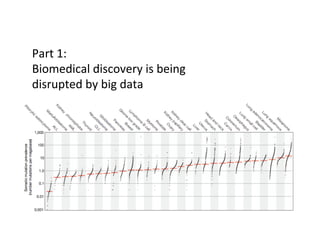
Part	
  1:	
  
Biomedical	
  discovery	
  is	
  being	
  
disrupted	
  by	
  big	
  data	
  
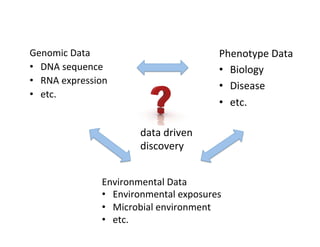
Genomic	
  Data	
  
•  DNA	
  sequence	
  
•  RNA	
  expression	
  
•  etc.	
  
Phenotype	
  Data	
  	
  
•  Biology	
  
•  Disease	
  
•  etc.	


Environmental	
  Data	
  
•  Environmental	
  exposures	
  
•  Microbial	
  environment	
  
•  etc.	
  
data	
  driven	
  
discovery	


We	
  can	
  produce	
  lots	
  of	
  data,	
  but	
  why	
  do	
  
we	
  need	
  so	
  much?	
  	
  
The	
  Dark	
  MaQer	
  of	
  Genomic	
  Associa=ons	
  with	
  Complex	
  Diseases:	
  
Explaining	
  the	
  Unexplained	
  Heritability	
  from	
  Genome-­‐Wide	
  
Associa=ons	
  Studies	
  (NHGRI	
  Workshop	
  held	
  in	
  Feb	
  2-­‐3,	
  2009)	
  
Genome	
  Wide	
  Associa=on	
  Studies	
  Were	
  Disappoin=ng	
  
Where	
  is	
  the	
  missing	
  inheritability?	
  
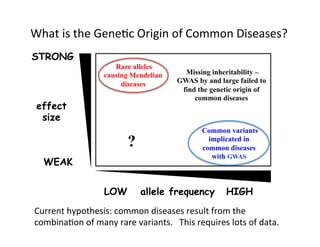
What	
  is	
  the	
  Gene=c	
  Origin	
  of	
  Common	
  Diseases?	
  
allele frequency HIGHLOW
effect
size
WEAK
STRONG
Rare alleles
causing Mendelian
diseases
Common variants
implicated in
common diseases
with GWAS
?
Current	
  hypothesis:	
  common	
  diseases	
  result	
  from	
  the	
  
combina=on	
  of	
  many	
  rare	
  variants.	
  	
  	
  This	
  requires	
  lots	
  of	
  data.	
  
Missing inheritability –
GWAS by and large failed to
find the genetic origin of
common diseases
One	
  Million	
  Genome	
  Challenge	
  
•  Sequencing	
  a	
  million	
  genomes	
  would	
  likely	
  
change	
  the	
  way	
  we	
  understand	
  genomic	
  
varia=on.	
  
•  The	
  genomic	
  data	
  for	
  a	
  pa=ent	
  is	
  about	
  1	
  TB	
  
(including	
  samples	
  from	
  both	
  tumor	
  and	
  normal	
  
=ssue).	
  
•  One	
  million	
  genomes	
  is	
  about	
  1000	
  PB	
  or	
  1	
  EB	
  
•  With	
  compression,	
  it	
  may	
  be	
  about	
  100	
  PB	
  
•  At	
  $1000/genome,	
  the	
  sequencing	
  would	
  cost	
  
about	
  $1B	
  
•  Think	
  of	
  this	
  as	
  one	
  hundred	
  studies	
  with	
  10,000	
  
pa=ents	
  each	
  over	
  three	
  years.	
  
Four	
  Ques=ons	
  
1.  What	
  is	
  the	
  same	
  and	
  what	
  is	
  different	
  about	
  big	
  
biomedical	
  data	
  vs	
  big	
  science	
  data	
  and	
  vs	
  big	
  
commercial	
  data?	
  
2.  What	
  instrument	
  should	
  we	
  use	
  to	
  make	
  
discoveries	
  over	
  big	
  biomedical	
  data?	
  
3.  Do	
  we	
  need	
  new	
  types	
  of	
  mathema=cal	
  and	
  
sta=s=cal	
  models	
  for	
  big	
  biomedical	
  data?	
  
4.  How	
  do	
  we	
  organize	
  large	
  biomedical	
  datasets	
  
and	
  the	
  community	
  to	
  maximize	
  the	
  discoveries	
  
we	
  make	
  and	
  their	
  impact	
  on	
  health	
  care?	
  
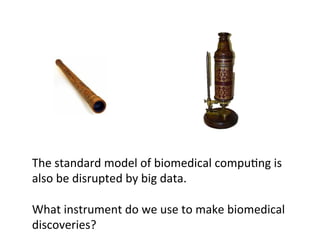
The	
  standard	
  model	
  of	
  biomedical	
  compu=ng	
  is	
  
also	
  be	
  disrupted	
  by	
  big	
  data.	


What	
  instrument	
  do	
  we	
  use	
  to	
  make	
  biomedical	
  
discoveries?	
  
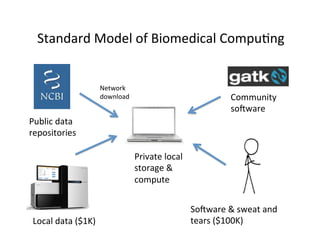
Standard	
  Model	
  of	
  Biomedical	
  Compu=ng	
  
Public	
  data	
  
repositories	
  
Private	
  local	
  
storage	
  &	
  
compute	
  
Network	
  
download	
  
Local	
  data	
  ($1K)	
  
Community	
  
socware	
  
Socware	
  &	
  sweat	
  and	
  
tears	
  ($100K)	
  
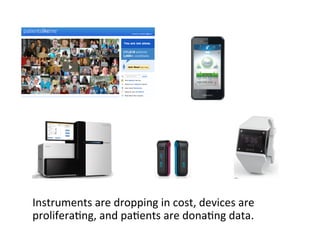
Instruments	
  are	
  dropping	
  in	
  cost,	
  devices	
  are	
  
prolifera=ng,	
  and	
  pa=ents	
  are	
  dona=ng	
  data.	
  
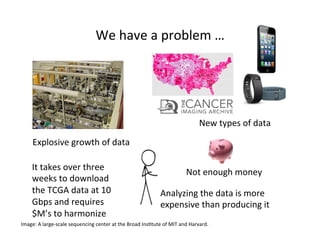
We	
  have	
  a	
  problem	
  …	
  
Image:	
  A	
  large-­‐scale	
  sequencing	
  center	
  at	
  the	
  Broad	
  Ins=tute	
  of	
  MIT	
  and	
  Harvard.	
  
Explosive	
  growth	
  of	
  data	
  
New	
  types	
  of	
  data	
  
It	
  takes	
  over	
  three	
  
weeks	
  to	
  download	
  
the	
  TCGA	
  data	
  at	
  10	
  
Gbps	
  and	
  requires	
  
$M’s	
  to	
  harmonize	
  
Analyzing	
  the	
  data	
  is	
  more	
  
expensive	
  than	
  producing	
  it	
  
Not	
  enough	
  money	
  
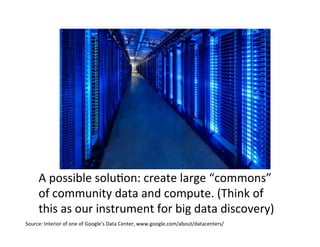
Source:	
  Interior	
  of	
  one	
  of	
  Google’s	
  Data	
  Center,	
  www.google.com/about/datacenters/	
  
A	
  possible	
  solu=on:	
  create	
  large	
  “commons”	
  
of	
  community	
  data	
  and	
  compute.	
  (Think	
  of	
  
this	
  as	
  our	
  instrument	
  for	
  big	
  data	
  discovery)	
  
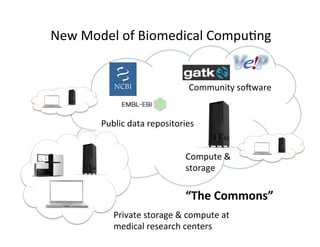
New	
  Model	
  of	
  Biomedical	
  Compu=ng	
  
Public	
  data	
  repositories	
  
Private	
  storage	
  &	
  compute	
  at	
  
medical	
  research	
  centers	
  
Community	
  socware	
  
Compute	
  &	
  	
  
storage	
  
“The	
  Commons”	
  
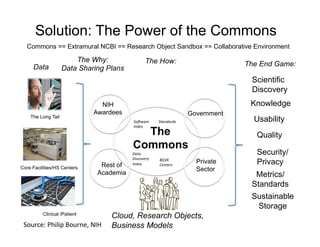
Solution: The Power of the Commons
Data
The Long Tail
Core Facilities/HS Centers
Clinical /Patient
The Why:
Data Sharing Plans
The
Commons
Government
The How:
Data	
  
Discovery	
  
Index	
  
Sustainable
Storage
Quality
Scientific
Discovery
Usability
Security/
Privacy
Commons == Extramural NCBI == Research Object Sandbox == Collaborative Environment
The End Game:
KnowledgeNIH
Awardees
Private
Sector
Metrics/
Standards
Rest of
Academia
So2ware	


  Standards	
  
Index	
  
BD2K	
  
Centers	
  
Cloud, Research Objects,
Business ModelsSource:	
  Philip	
  Bourne,	
  NIH	
  
Part	
  2:	
  
Biomedical	
  Clouds	
  and	
  Commons	
  
•  The	
  Cancer	
  Genome	
  Atlas	
  (TCGA)	
  is	
  a	
  large	
  
scale	
  NIH	
  funded	
  project	
  that	
  is	
  collec=ng	
  and	
  
sequencing	
  disease	
  and	
  normal	
  =ssue	
  from	
  
500	
  or	
  more	
  pa=ents	
  x	
  20	
  cancers.	
  
•  Currently	
  about	
  12,000	
  pa=ents	
  are	
  available.	
  	
  
•  There	
  is	
  about	
  4	
  PB	
  of	
  research	
  data	
  today	
  
and	
  growing.	
  
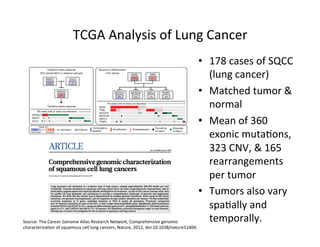
TCGA	
  Analysis	
  of	
  Lung	
  Cancer	
  
•  178	
  cases	
  of	
  SQCC	
  
(lung	
  cancer)	
  
•  Matched	
  tumor	
  &	
  
normal	
  
•  Mean	
  of	
  360	
  
exonic	
  muta=ons,	
  
323	
  CNV,	
  &	
  165	
  
rearrangements	
  
per	
  tumor	
  
•  Tumors	
  also	
  vary	
  
spa=ally	
  and	
  
temporally.	
  Source:	
  The	
  Cancer	
  Genome	
  Atlas	
  Research	
  Network,	
  Comprehensive	
  genomic	
  
characteriza=on	
  of	
  squamous	
  cell	
  lung	
  cancers,	
  Nature,	
  2012,	
  doi:10.1038/nature11404.	
  
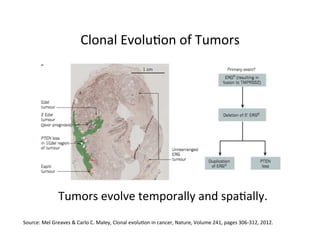
Clonal	
  Evolu=on	
  of	
  Tumors	
  
Tumors	
  evolve	
  temporally	
  and	
  spa=ally.	
  
Source:	
  Mel	
  Greaves	
  &	
  Carlo	
  C.	
  Maley,	
  Clonal	
  evolu=on	
  in	
  cancer,	
  Nature,	
  Volume	
  241,	
  pages	
  306-­‐312,	
  2012.	
  
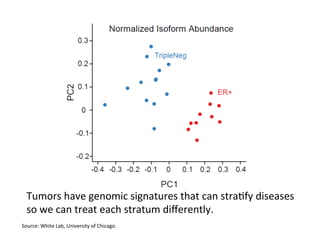
TNBC	
  
ER+	
  
Source:	
  White	
  Lab,	
  University	
  of	
  Chicago.	
  
Tumors	
  have	
  genomic	
  signatures	
  that	
  can	
  stra=fy	
  diseases	
  
so	
  we	
  can	
  treat	
  each	
  stratum	
  differently.	
  
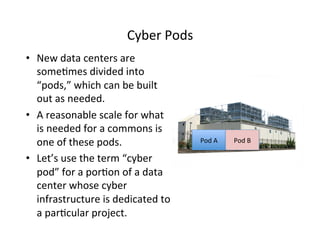
Cyber	
  Pods	
  
•  New	
  data	
  centers	
  are	
  
some=mes	
  divided	
  into	
  
“pods,”	
  which	
  can	
  be	
  built	
  
out	
  as	
  needed.	
  
•  A	
  reasonable	
  scale	
  for	
  what	
  
is	
  needed	
  for	
  a	
  commons	
  is	
  
one	
  of	
  these	
  pods.	
  
•  Let’s	
  use	
  the	
  term	
  “cyber	
  
pod”	
  for	
  a	
  por=on	
  of	
  a	
  data	
  
center	
  whose	
  cyber	
  
infrastructure	
  is	
  dedicated	
  to	
  
a	
  par=cular	
  project.	
  
Pod	
  A	
   Pod	
  B	
  
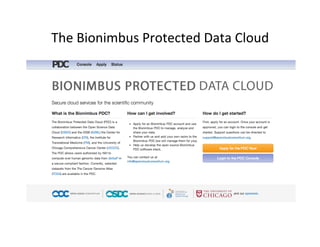
The	
  Bionimbus	
  Protected	
  Data	
  Cloud	
  
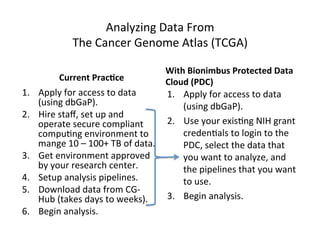
Analyzing	
  Data	
  From	
  	
  
The	
  Cancer	
  Genome	
  Atlas	
  (TCGA)	
  
1.  Apply	
  for	
  access	
  to	
  data	
  
(using	
  dbGaP).	
  
2.  Hire	
  staff,	
  set	
  up	
  and	
  
operate	
  secure	
  compliant	
  
compu=ng	
  environment	
  to	
  
mange	
  10	
  –	
  100+	
  TB	
  of	
  data.	


3.  Get	
  environment	
  approved	
  
by	
  your	
  research	
  center.	
  
4.  Setup	
  analysis	
  pipelines.	
  
5.  Download	
  data	
  from	
  CG-­‐
Hub	
  (takes	
  days	
  to	
  weeks).	
  	
  
6.  Begin	
  analysis.	
  
Current	
  Prac2ce	
  
With	
  Bionimbus	
  Protected	
  Data	
  
Cloud	
  (PDC)	
  
1.  Apply	
  for	
  access	
  to	
  data	
  
(using	
  dbGaP).	
  
2.  Use	
  your	
  exis=ng	
  NIH	
  grant	
  
creden=als	
  to	
  login	
  to	
  the	
  
PDC,	
  select	
  the	
  data	
  that	
  
you	
  want	
  to	
  analyze,	
  and	
  
the	
  pipelines	
  that	
  you	
  want	
  
to	
  use.	
  	
  
3.  Begin	
  analysis.	
  
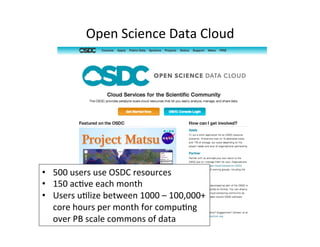
Open	
  Science	
  Data	
  Cloud	
  
•  500	
  users	
  use	
  OSDC	
  resources	
  	
  
•  150	
  ac=ve	
  each	
  month	
  
•  Users	
  u=lize	
  between	
  1000	
  –	
  100,000+	
  
core	
  hours	
  per	
  month	
  for	
  compu=ng	
  
over	
  PB	
  scale	
  commons	
  of	
  data	
  
Goals	
  of	
  the	
  OSDC	
  Commons	
  
•  Build	
  a	
  commons	
  to	
  store,	
  harmonize	
  and	
  analyze	
  
exis=ng	
  biomedical	
  data	
  that	
  scales	
  to	
  5-­‐100+	
  PB	
  
•  The	
  commons	
  must	
  support	
  “permanent”	
  
genomic	
  data,	
  clinical	
  data,	
  environmental	
  data,	
  
social	
  media	
  data,	
  donated	
  data,	
  etc.	
  
•  The	
  commons	
  must	
  provide	
  an	
  interac=ve	
  system	
  
for	
  researchers	
  and	
  eventually	
  pa=ents	
  to	
  upload	
  
their	
  data.	


•  Researchers	
  should	
  be	
  able	
  to	
  “pay	
  for	
  compute.”	
  
•  Pa=ents	
  should	
  be	
  able	
  to	
  use	
  the	
  commons	
  to	
  
inform	
  their	
  treatment.	


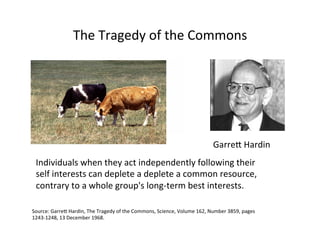
The	
  Tragedy	
  of	
  the	
  Commons	
  
Source:	
  GarreQ	
  Hardin,	
  The	
  Tragedy	
  of	
  the	
  Commons,	
  Science,	
  Volume	
  162,	
  Number	
  3859,	
  pages	
  
1243-­‐1248,	
  13	
  December	
  1968.	
  
Individuals	
  when	
  they	
  act	
  independently	
  following	
  their	
  
self	
  interests	
  can	
  deplete	
  a	
  deplete	
  a	
  common	
  resource,	
  
contrary	
  to	
  a	
  whole	
  group's	
  long-­‐term	
  best	
  interests.	
  
GarreQ	
  Hardin	
  
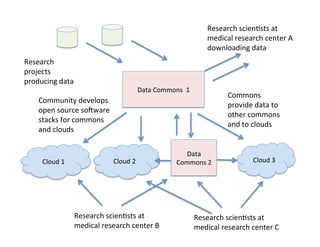
Cloud	
  1	
   Cloud	
  3	
  
Data	
  Commons	
  	
  1	
  
Commons	
  
provide	
  data	
  to	
  
other	
  commons	
  
and	
  to	
  clouds	
  
Research	
  
projects	
  
producing	
  data	
  
Research	
  scien=sts	
  at	
  
medical	
  research	
  center	
  B	
  
Research	
  scien=sts	
  at	
  
medical	
  research	
  center	
  C	
  
Research	
  scien=sts	
  at	
  
medical	
  research	
  center	
  A	
  
downloading	
  data	
  
Community	
  develops	
  
open	
  source	
  socware	
  
stacks	
  for	
  commons	
  
and	
  clouds	
  
Cloud	
  2	
  
Data	
  
Commons	
  2	
  
Cloud	
  1	
  
Data	
  Commons	
  	
  1	
  
Data	
  Commons	
  	
  2	
  
Data	
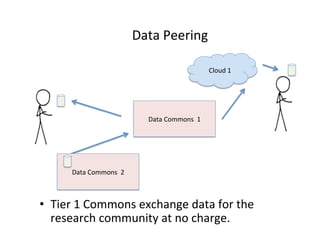
  Peering	
  
•  Tier	
  1	
  Commons	
  exchange	
  data	
  for	
  the	
  
research	
  community	
  at	
  no	
  charge.	
  
OSDC	
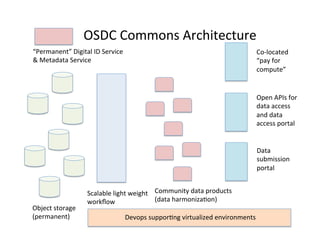
  Commons	
  Architecture	
  
Object	
  storage	
  
(permanent)	
  
Scalable	
  light	
  weight	
  
workflow	
  
Community	
  data	
  products	
  
(data	
  harmoniza=on)	
  
Data	
  
submission	
  
portal	
  
Open	
  APIs	
  for	
  
data	
  access	
  
and	
  data	
  
access	
  portal	
  
Co-­‐located	
  
“pay	
  for	
  
compute”	
  
“Permanent”	
  Digital	
  ID	
  Service	
  
&	
  Metadata	
  Service	
  
Devops	
  suppor=ng	
  virtualized	
  environments	
  
Part	
  3:	
  
Analyzing	
  Data	
  at	
  the	
  Scale	
  of	
  a	
  Cyber	
  Pod	
  
(the	
  need	
  for	
  a	
  new	
  data	
  science)	
  
Source:	
  Jon	
  Kleinberg,	
  Cornell	
  University,	
  www.cs.cornell.edu/home/kleinber/networks-­‐book/	
  
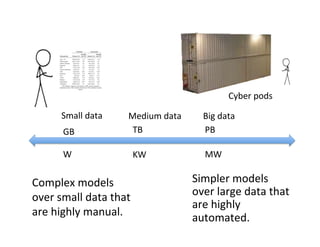
Complex	
  models	
  
over	
  small	
  data	
  that	
  
are	
  highly	
  manual.	
  
Simpler	
  models	
  
over	
  large	
  data	
  that	
  
are	
  highly	
  
automated.	
  
Small	
  data	
   Medium	
  data	
  
GB	
   TB	
   PB	
  
W	
   KW	
   MW	
  
Big	
  data	
  
Cyber	
  pods	
  
Is	
  More	
  Different?	
  	
  Do	
  New	
  Phenomena	
  
Emerge	
  at	
  Scale	
  in	
  Biomedical	
  Data?	
  
Source:	
  P.	
  W.	
  Anderson,	
  More	
  is	
  Different,	
  Science,	
  Volume	
  177,	
  Number	
  4047,	
  4	
  August	
  1972,	
  pages	
  393-­‐396.	
  
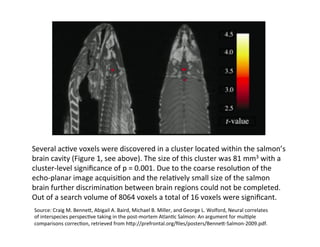
Several	
  ac=ve	
  voxels	
  were	
  discovered	
  in	
  a	
  cluster	
  located	
  within	
  the	
  salmon’s	
  
brain	
  cavity	
  (Figure	
  1,	
  see	
  above).	
  The	
  size	
  of	
  this	
  cluster	
  was	
  81	
  mm3	
  with	
  a	
  
cluster-­‐level	
  significance	
  of	
  p	
  =	
  0.001.	
  Due	
  to	
  the	
  coarse	
  resolu=on	
  of	
  the	
  
echo-­‐planar	
  image	
  acquisi=on	
  and	
  the	
  rela=vely	
  small	
  size	
  of	
  the	
  salmon	
  
brain	
  further	
  discrimina=on	
  between	
  brain	
  regions	
  could	
  not	
  be	
  completed.	
  
Out	
  of	
  a	
  search	
  volume	
  of	
  8064	
  voxels	
  a	
  total	
  of	
  16	
  voxels	
  were	
  significant.	


  Source:	
  Craig	
  M.	
  BenneQ,	
  Abigail	
  A.	
  Baird,	
  Michael	
  B.	
  Miller,	
  and	
  George	
  L.	
  Wolford,	
  Neural	
  correlates	
  
of	
  interspecies	
  perspec=ve	
  taking	
  in	
  the	
  post-­‐mortem	
  Atlan=c	
  Salmon:	
  An	
  argument	
  for	
  mul=ple	
  
comparisons	
  correc=on,	
  retrieved	
  from	
  hQp://prefrontal.org/files/posters/BenneQ-­‐Salmon-­‐2009.pdf.	
  
4.	
  Center	
  for	
  Data	
  Intensive	
  Science	
  	
  
at	
  the	
  University	
  of	
  Chicago	
  
Center	
  for	
  Data	
  Intensive	
  Science	
  
•  New	
  center	
  whose	
  mission	
  is	
  data	
  science	
  and	
  the	
  data	
  
intensive	
  compu=ng	
  that	
  is	
  required	
  to	
  support	
  it.	
  
•  Focus	
  on	
  applica=ons	
  in	
  biology,	
  medicine	
  and	
  health	
  care,	
  
but	
  interested	
  in	
  all	
  of	
  data	
  science.	
  
•  CDIS	
  is	
  organizing	
  around	
  some	
  challenge	
  problems	
  and	
  
building	
  an	
  open	
  data	
  and	
  open	
  source	
  ecosystem	
  to	
  
support	
  big	
  data	
  science.	
  
•  Leveraging	
  “instruments”	
  such	
  as	
  the	
  Protected	
  Data	
  Cloud	
  
and	
  the	
  Open	
  Science	
  Data	
  Cloud.	
  
•  Building	
  data	
  commons	
  for	
  the	
  research	
  community,	
  
star=ng	
  with	
  a	
  data	
  commons	
  for	
  genomic	
  data.	
  
•  POV:	
  “more	
  is	
  different.”	
  
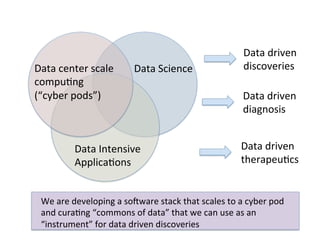
Data	
  Science	
  
Data	
  Intensive	
  
Applica=ons	
  
Data	
  center	
  scale	
  
compu=ng	
  
(“cyber	
  pods”)	
  
Data	
  driven	
  
discoveries	
  
Data	
  driven	
  
diagnosis	
  
Data	
  driven	
  
therapeu=cs	
  
We	
  are	
  developing	
  a	
  socware	
  stack	
  that	
  scales	
  to	
  a	
  cyber	
  pod	
  
and	
  cura=ng	
  “commons	
  of	
  data”	
  that	
  we	
  can	
  use	
  as	
  an	
  
“instrument”	
  for	
  data	
  driven	
  discoveries	
  
Biomedical	
  Commons	
  Clouds	
  (BCC)	
  
•  The	
  not-­‐for-­‐profit	
  Open	
  Cloud	
  Consor=um	
  is	
  
developing	
  and	
  opera=ng	
  a	
  biomedical	
  
commons	
  and	
  cloud	
  called	
  the	
  Biomedical	
  
Commons	
  Cloud	
  or	
  BCC	
  
•  BCC	
  is	
  a	
  global	
  consor=um	
  that	
  includes	
  
universi=es,	
  companies	
  and	
  medical	
  research	
  
centers	
  
•  Please	
  let	
  me	
  know	
  if	
  you	
  are	
  interested	
  
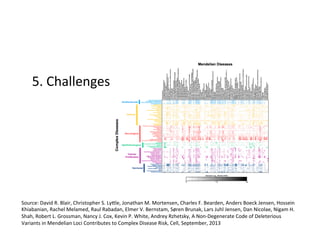
Source:	
  David	
  R.	
  Blair,	
  Christopher	
  S.	
  LyQle,	
  Jonathan	
  M.	
  Mortensen,	
  Charles	
  F.	
  Bearden,	
  Anders	
  Boeck	
  Jensen,	
  Hossein	
  
Khiabanian,	
  Rachel	
  Melamed,	
  Raul	
  Rabadan,	
  Elmer	
  V.	
  Bernstam,	
  Søren	
  Brunak,	
  Lars	
  Juhl	
  Jensen,	
  Dan	
  Nicolae,	
  Nigam	
  H.	
  
Shah,	
  Robert	
  L.	
  Grossman,	
  Nancy	
  J.	
  Cox,	
  Kevin	
  P.	
  White,	
  Andrey	
  Rzhetsky,	
  A	
  Non-­‐Degenerate	
  Code	
  of	
  Deleterious	
  
Variants	
  in	
  Mendelian	
  Loci	
  Contributes	
  to	
  Complex	
  Disease	
  Risk,	
  Cell,	
  September,	
  2013	
  	
  
5.	
  Challenges	
  
The	
  5P	
  Challenges	
  
•  Permanent	
  objects	
  
•  Cyber	
  Pods	
  that	
  scale	
  
•  Data	
  Peering	
  
•  Portable	
  data	
  
•  Support	
  Pay	
  for	
  compute	
  
Challenge	
  1:	
  Permanent	
  Secure	
  Objects	
  
•  How	
  do	
  I	
  assign	
  Digital	
  IDs	
  and	
  key	
  metadata	
  to	
  
“controlled	
  access”	
  data	
  objects	
  and	
  collec=ons	
  
of	
  data	
  objects	
  to	
  support	
  distributed	
  
computa=on	
  of	
  large	
  datasets	
  by	
  communi=es	
  of	
  
researchers?	
  
–  Metadata	
  may	
  be	
  both	
  public	
  and	
  controlled	
  access	
  
–  Objects	
  must	
  be	
  secure	
  
•  Think	
  of	
  this	
  as	
  a	
  “dns	
  for	
  data.”	
  
•  The	
  test:	
  One	
  Commons	
  serving	
  the	
  cancer	
  
community	
  can	
  transfer	
  1	
  PB	
  of	
  BAM	
  files	
  to	
  
another	
  Commons	
  and	
  no	
  bioinforma=cians	
  need	
  
to	
  change	
  their	
  code	
  
Challenge	
  2:	
  Cyber	
  Pods	
  
•  How	
  can	
  I	
  add	
  a	
  rack	
  of	
  compu=ng/storage/
networking	
  equipment	
  to	
  a	
  cyber	
  pod	
  (that	
  has	
  a	
  
manifest)	
  so	
  that	
  	
  
–  Acer	
  aQaching	
  to	
  power	
  
–  Acer	
  aQaching	
  to	
  network	
  
–  No	
  other	
  manual	
  configura=on	
  is	
  required	
  
–  The	
  data	
  services	
  can	
  make	
  use	
  of	
  the	
  addi=onal	
  
infrastructure	
  
–  The	
  compute	
  services	
  can	
  make	
  use	
  of	
  the	
  addi=onal	
  
infrastructure	
  	
  
•  In	
  other	
  words,	
  we	
  need	
  an	
  open	
  source	
  socware	
  
stack	
  that	
  scales	
  to	
  cyber	
  pods.	
  
Challenge	
  3:	
  Data	
  Peering	
  
•  How	
  can	
  a	
  cri=cal	
  mass	
  of	
  data	
  commons	
  
support	
  data	
  peering	
  so	
  that	
  a	
  research	
  at	
  one	
  
of	
  the	
  commons	
  can	
  transparently	
  access	
  data	
  
managed	
  by	
  one	
  of	
  the	
  other	
  commons	
  
– We	
  need	
  to	
  access	
  data	
  independent	
  of	
  where	
  it	
  
is	
  stored	
  
– “Tier	
  1	
  data	
  commons”	
  need	
  to	
  pass	
  community	
  
managed	
  data	
  at	
  no	
  cost	
  
– We	
  need	
  to	
  be	
  able	
  to	
  transport	
  large	
  data	
  
efficiently	
  “end	
  to	
  end”	
  between	
  commons	
  
Challenge	
  4:	
  Biomedical	
  Data	
  Portability	
  	
  
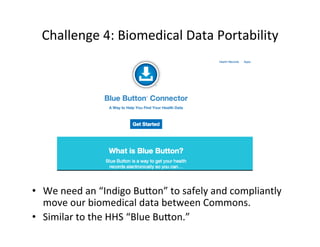
•  We	
  need	
  an	
  “Indigo	
  BuQon”	
  to	
  safely	
  and	
  compliantly	
  
move	
  our	
  biomedical	
  data	
  between	
  Commons.	
  
•  Similar	
  to	
  the	
  HHS	
  “Blue	
  BuQon.”	
  
Challenge	
  5:	
  Pay	
  for	
  Compute	
  Challenges	
  –	
  
Low	
  Cost	
  Data	
  Integra=on	
  
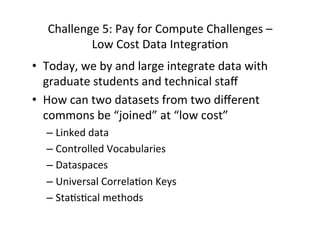
•  Today,	
  we	
  by	
  and	
  large	
  integrate	
  data	
  with	
  
graduate	
  students	
  and	
  technical	
  staff	
  
•  How	
  can	
  two	
  datasets	
  from	
  two	
  different	
  
commons	
  be	
  “joined”	
  at	
  “low	
  cost”	
  
– Linked	
  data	
  
– Controlled	
  Vocabularies	
  
– Dataspaces	
  
– Universal	
  Correla=on	
  Keys	
  
– Sta=s=cal	
  methods	
  
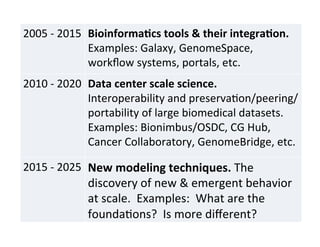
2005	
  -­‐	
  2015	
   Bioinforma2cs	
  tools	
  &	
  their	
  integra2on.	
  
Examples:	
  Galaxy,	
  GenomeSpace,	
  
workflow	
  systems,	
  portals,	
  etc.	
  
2010	
  -­‐	
  2020	
   Data	
  center	
  scale	
  science.	
  	
  
Interoperability	
  and	
  preserva=on/peering/
portability	
  of	
  large	
  biomedical	
  datasets.	
  	
  
Examples:	
  Bionimbus/OSDC,	
  CG	
  Hub,	
  
Cancer	
  Collaboratory,	
  GenomeBridge,	
  etc.	
  
2015	
  -­‐	
  2025	
   New	
  modeling	
  techniques.	
  The	
  
discovery	
  of	
  new	
  &	
  emergent	
  behavior	
  
at	
  scale.	
  	
  Examples:	
  	
  What	
  are	
  the	
  
founda=ons?	
  	
  Is	
  more	
  different?	
  
Ques=ons?	
  
46	
  
Major	
  funding	
  and	
  support	
  for	
  the	
  Open	
  Science	
  Data	
  Cloud	
  (OSDC)	
  is	
  provided	
  by	
  the	
  Gordon	
  and	
  
BeQy	
  Moore	
  Founda=on.	
  	
  This	
  funding	
  is	
  used	
  to	
  support	
  the	
  OSDC-­‐Adler,	
  Sullivan	
  and	
  Root	
  facili=es.	


Addi=onal	
  funding	
  for	
  the	
  OSDC	
  has	
  been	
  provided	
  by	
  the	
  following	
  sponsors:	


•  The	
  Bionimbus	
  Protected	
  Data	
  Cloud	
  is	
  supported	
  in	
  by	
  part	
  by	
  NIH/NCI	
  through	
  NIH/SAIC	
  Contract	
  
13XS021	
  /	
  HHSN261200800001E.	
  	
  
•  The	
  OCC-­‐Y	
  Hadoop	
  Cluster	
  (approximately	
  1000	
  cores	
  and	
  1	
  PB	
  of	
  storage)	
  was	
  donated	
  by	
  Yahoo!	
  
in	
  2011.	
  
•  Cisco	
  provides	
  the	
  OSDC	
  access	
  to	
  the	
  Cisco	
  C-­‐Wave,	
  which	
  connects	
  OSDC	
  data	
  centers	
  with	
  10	
  
Gbps	
  wide	
  area	
  networks.	
  
•  The	
  OSDC	
  is	
  supported	
  by	
  a	
  5-­‐year	
  (2010-­‐2016)	
  PIRE	
  award	
  (OISE	
  –	
  1129076)	
  to	
  train	
  scien=sts	
  to	
  
use	
  the	
  OSDC	
  and	
  to	
  further	
  develop	
  the	
  underlying	
  technology.	
  
•  OSDC	
  technology	
  for	
  high	
  performance	
  data	
  transport	
  is	
  support	
  in	
  part	
  by	
  	
  NSF	
  Award	
  1127316.	
  
•  The	
  StarLight	
  Facility	
  in	
  Chicago	
  enables	
  the	
  OSDC	
  to	
  connect	
  to	
  over	
  30	
  high	
  performance	
  
research	
  networks	
  around	
  the	
  world	
  at	
  10	
  Gbps	
  or	
  higher.	
  
•  Any	
  opinions,	
  findings,	
  and	
  conclusions	
  or	
  recommenda=ons	
  expressed	
  in	
  this	
  material	
  are	
  those	
  
of	
  the	
  author(s)	
  and	
  do	
  not	
  necessarily	
  reflect	
  the	
  views	
  of	
  the	
  Na=onal	
  Science	
  Founda=on,	
  NIH	
  or	
  
other	
  funders	
  of	
  this	
  research.	


The	
  OSDC	
  is	
  managed	
  by	
  the	
  Open	
  Cloud	
  Consor=um,	
  a	
  501(c)(3)	
  not-­‐for-­‐profit	
  corpora=on.	
  If	
  you	
  are	
  
interested	
  in	
  providing	
  funding	
  or	
  dona=ng	
  equipment	
  or	
  services,	
  please	
  contact	
  us	
  at	
  
info@opensciencedatacloud.org.	
  

Biomedical Clusters, Clouds and Commons - DePaul Colloquium Oct 24, 2014

  • 1.
    Biomedical  Clusters,  Clouds  and  Commons   Robert  Grossman   University  of  Chicago   Open  Cloud  Consor=um   October  24,  2014   DePaul  CDM  Research  Colloquium  
  • 2.
    Part  1:   Biomedical  discovery  is  being   disrupted  by  big  data  
  • 3.
    Genomic  Data   • DNA  sequence   •  RNA  expression   •  etc.   Phenotype  Data     •  Biology   •  Disease   •  etc.     Environmental  Data   •  Environmental  exposures   •  Microbial  environment   •  etc.   data  driven   discovery    
  • 4.
    We  can  produce  lots  of  data,  but  why  do   we  need  so  much?    
  • 5.
    The  Dark  MaQer  of  Genomic  Associa=ons  with  Complex  Diseases:   Explaining  the  Unexplained  Heritability  from  Genome-­‐Wide   Associa=ons  Studies  (NHGRI  Workshop  held  in  Feb  2-­‐3,  2009)   Genome  Wide  Associa=on  Studies  Were  Disappoin=ng   Where  is  the  missing  inheritability?  
  • 6.
    What  is  the  Gene=c  Origin  of  Common  Diseases?   allele frequency HIGHLOW effect size WEAK STRONG Rare alleles causing Mendelian diseases Common variants implicated in common diseases with GWAS ? Current  hypothesis:  common  diseases  result  from  the   combina=on  of  many  rare  variants.      This  requires  lots  of  data.   Missing inheritability – GWAS by and large failed to find the genetic origin of common diseases
  • 7.
    One  Million  Genome  Challenge   •  Sequencing  a  million  genomes  would  likely   change  the  way  we  understand  genomic   varia=on.   •  The  genomic  data  for  a  pa=ent  is  about  1  TB   (including  samples  from  both  tumor  and  normal   =ssue).   •  One  million  genomes  is  about  1000  PB  or  1  EB   •  With  compression,  it  may  be  about  100  PB   •  At  $1000/genome,  the  sequencing  would  cost   about  $1B   •  Think  of  this  as  one  hundred  studies  with  10,000   pa=ents  each  over  three  years.  
  • 8.
    Four  Ques=ons   1. What  is  the  same  and  what  is  different  about  big   biomedical  data  vs  big  science  data  and  vs  big   commercial  data?   2.  What  instrument  should  we  use  to  make   discoveries  over  big  biomedical  data?   3.  Do  we  need  new  types  of  mathema=cal  and   sta=s=cal  models  for  big  biomedical  data?   4.  How  do  we  organize  large  biomedical  datasets   and  the  community  to  maximize  the  discoveries   we  make  and  their  impact  on  health  care?  
  • 9.
    The  standard  model  of  biomedical  compu=ng  is   also  be  disrupted  by  big  data.     What  instrument  do  we  use  to  make  biomedical   discoveries?  
  • 10.
    Standard  Model  of  Biomedical  Compu=ng   Public  data   repositories   Private  local   storage  &   compute   Network   download   Local  data  ($1K)   Community   socware   Socware  &  sweat  and   tears  ($100K)  
  • 11.
    Instruments  are  dropping  in  cost,  devices  are   prolifera=ng,  and  pa=ents  are  dona=ng  data.  
  • 12.
    We  have  a  problem  …   Image:  A  large-­‐scale  sequencing  center  at  the  Broad  Ins=tute  of  MIT  and  Harvard.   Explosive  growth  of  data   New  types  of  data   It  takes  over  three   weeks  to  download   the  TCGA  data  at  10   Gbps  and  requires   $M’s  to  harmonize   Analyzing  the  data  is  more   expensive  than  producing  it   Not  enough  money  
  • 13.
    Source:  Interior  of  one  of  Google’s  Data  Center,  www.google.com/about/datacenters/   A  possible  solu=on:  create  large  “commons”   of  community  data  and  compute.  (Think  of   this  as  our  instrument  for  big  data  discovery)  
  • 14.
    New  Model  of  Biomedical  Compu=ng   Public  data  repositories   Private  storage  &  compute  at   medical  research  centers   Community  socware   Compute  &     storage   “The  Commons”  
  • 15.
    Solution: The Powerof the Commons Data The Long Tail Core Facilities/HS Centers Clinical /Patient The Why: Data Sharing Plans The Commons Government The How: Data   Discovery   Index   Sustainable Storage Quality Scientific Discovery Usability Security/ Privacy Commons == Extramural NCBI == Research Object Sandbox == Collaborative Environment The End Game: KnowledgeNIH Awardees Private Sector Metrics/ Standards Rest of Academia So2ware                    Standards   Index   BD2K   Centers   Cloud, Research Objects, Business ModelsSource:  Philip  Bourne,  NIH  
  • 16.
    Part  2:   Biomedical  Clouds  and  Commons  
  • 17.
    •  The  Cancer  Genome  Atlas  (TCGA)  is  a  large   scale  NIH  funded  project  that  is  collec=ng  and   sequencing  disease  and  normal  =ssue  from   500  or  more  pa=ents  x  20  cancers.   •  Currently  about  12,000  pa=ents  are  available.     •  There  is  about  4  PB  of  research  data  today   and  growing.  
  • 18.
    TCGA  Analysis  of  Lung  Cancer   •  178  cases  of  SQCC   (lung  cancer)   •  Matched  tumor  &   normal   •  Mean  of  360   exonic  muta=ons,   323  CNV,  &  165   rearrangements   per  tumor   •  Tumors  also  vary   spa=ally  and   temporally.  Source:  The  Cancer  Genome  Atlas  Research  Network,  Comprehensive  genomic   characteriza=on  of  squamous  cell  lung  cancers,  Nature,  2012,  doi:10.1038/nature11404.  
  • 19.
    Clonal  Evolu=on  of  Tumors   Tumors  evolve  temporally  and  spa=ally.   Source:  Mel  Greaves  &  Carlo  C.  Maley,  Clonal  evolu=on  in  cancer,  Nature,  Volume  241,  pages  306-­‐312,  2012.  
  • 20.
    TNBC   ER+   Source:  White  Lab,  University  of  Chicago.   Tumors  have  genomic  signatures  that  can  stra=fy  diseases   so  we  can  treat  each  stratum  differently.  
  • 21.
    Cyber  Pods   • New  data  centers  are   some=mes  divided  into   “pods,”  which  can  be  built   out  as  needed.   •  A  reasonable  scale  for  what   is  needed  for  a  commons  is   one  of  these  pods.   •  Let’s  use  the  term  “cyber   pod”  for  a  por=on  of  a  data   center  whose  cyber   infrastructure  is  dedicated  to   a  par=cular  project.   Pod  A   Pod  B  
  • 22.
  • 23.
    Analyzing  Data  From     The  Cancer  Genome  Atlas  (TCGA)   1.  Apply  for  access  to  data   (using  dbGaP).   2.  Hire  staff,  set  up  and   operate  secure  compliant   compu=ng  environment  to   mange  10  –  100+  TB  of  data.       3.  Get  environment  approved   by  your  research  center.   4.  Setup  analysis  pipelines.   5.  Download  data  from  CG-­‐ Hub  (takes  days  to  weeks).     6.  Begin  analysis.   Current  Prac2ce   With  Bionimbus  Protected  Data   Cloud  (PDC)   1.  Apply  for  access  to  data   (using  dbGaP).   2.  Use  your  exis=ng  NIH  grant   creden=als  to  login  to  the   PDC,  select  the  data  that   you  want  to  analyze,  and   the  pipelines  that  you  want   to  use.     3.  Begin  analysis.  
  • 24.
    Open  Science  Data  Cloud   •  500  users  use  OSDC  resources     •  150  ac=ve  each  month   •  Users  u=lize  between  1000  –  100,000+   core  hours  per  month  for  compu=ng   over  PB  scale  commons  of  data  
  • 25.
    Goals  of  the  OSDC  Commons   •  Build  a  commons  to  store,  harmonize  and  analyze   exis=ng  biomedical  data  that  scales  to  5-­‐100+  PB   •  The  commons  must  support  “permanent”   genomic  data,  clinical  data,  environmental  data,   social  media  data,  donated  data,  etc.   •  The  commons  must  provide  an  interac=ve  system   for  researchers  and  eventually  pa=ents  to  upload   their  data.       •  Researchers  should  be  able  to  “pay  for  compute.”   •  Pa=ents  should  be  able  to  use  the  commons  to   inform  their  treatment.    
  • 26.
    The  Tragedy  of  the  Commons   Source:  GarreQ  Hardin,  The  Tragedy  of  the  Commons,  Science,  Volume  162,  Number  3859,  pages   1243-­‐1248,  13  December  1968.   Individuals  when  they  act  independently  following  their   self  interests  can  deplete  a  deplete  a  common  resource,   contrary  to  a  whole  group's  long-­‐term  best  interests.   GarreQ  Hardin  
  • 27.
    Cloud  1  Cloud  3   Data  Commons    1   Commons   provide  data  to   other  commons   and  to  clouds   Research   projects   producing  data   Research  scien=sts  at   medical  research  center  B   Research  scien=sts  at   medical  research  center  C   Research  scien=sts  at   medical  research  center  A   downloading  data   Community  develops   open  source  socware   stacks  for  commons   and  clouds   Cloud  2   Data   Commons  2  
  • 28.
    Cloud  1   Data  Commons    1   Data  Commons    2   Data  Peering   •  Tier  1  Commons  exchange  data  for  the   research  community  at  no  charge.  
  • 29.
    OSDC  Commons  Architecture   Object  storage   (permanent)   Scalable  light  weight   workflow   Community  data  products   (data  harmoniza=on)   Data   submission   portal   Open  APIs  for   data  access   and  data   access  portal   Co-­‐located   “pay  for   compute”   “Permanent”  Digital  ID  Service   &  Metadata  Service   Devops  suppor=ng  virtualized  environments  
  • 30.
    Part  3:   Analyzing  Data  at  the  Scale  of  a  Cyber  Pod   (the  need  for  a  new  data  science)   Source:  Jon  Kleinberg,  Cornell  University,  www.cs.cornell.edu/home/kleinber/networks-­‐book/  
  • 31.
    Complex  models   over  small  data  that   are  highly  manual.   Simpler  models   over  large  data  that   are  highly   automated.   Small  data   Medium  data   GB   TB   PB   W   KW   MW   Big  data   Cyber  pods  
  • 32.
    Is  More  Different?    Do  New  Phenomena   Emerge  at  Scale  in  Biomedical  Data?   Source:  P.  W.  Anderson,  More  is  Different,  Science,  Volume  177,  Number  4047,  4  August  1972,  pages  393-­‐396.  
  • 33.
    Several  ac=ve  voxels  were  discovered  in  a  cluster  located  within  the  salmon’s   brain  cavity  (Figure  1,  see  above).  The  size  of  this  cluster  was  81  mm3  with  a   cluster-­‐level  significance  of  p  =  0.001.  Due  to  the  coarse  resolu=on  of  the   echo-­‐planar  image  acquisi=on  and  the  rela=vely  small  size  of  the  salmon   brain  further  discrimina=on  between  brain  regions  could  not  be  completed.   Out  of  a  search  volume  of  8064  voxels  a  total  of  16  voxels  were  significant.      Source:  Craig  M.  BenneQ,  Abigail  A.  Baird,  Michael  B.  Miller,  and  George  L.  Wolford,  Neural  correlates   of  interspecies  perspec=ve  taking  in  the  post-­‐mortem  Atlan=c  Salmon:  An  argument  for  mul=ple   comparisons  correc=on,  retrieved  from  hQp://prefrontal.org/files/posters/BenneQ-­‐Salmon-­‐2009.pdf.  
  • 34.
    4.  Center  for  Data  Intensive  Science     at  the  University  of  Chicago  
  • 35.
    Center  for  Data  Intensive  Science   •  New  center  whose  mission  is  data  science  and  the  data   intensive  compu=ng  that  is  required  to  support  it.   •  Focus  on  applica=ons  in  biology,  medicine  and  health  care,   but  interested  in  all  of  data  science.   •  CDIS  is  organizing  around  some  challenge  problems  and   building  an  open  data  and  open  source  ecosystem  to   support  big  data  science.   •  Leveraging  “instruments”  such  as  the  Protected  Data  Cloud   and  the  Open  Science  Data  Cloud.   •  Building  data  commons  for  the  research  community,   star=ng  with  a  data  commons  for  genomic  data.   •  POV:  “more  is  different.”  
  • 36.
    Data  Science   Data  Intensive   Applica=ons   Data  center  scale   compu=ng   (“cyber  pods”)   Data  driven   discoveries   Data  driven   diagnosis   Data  driven   therapeu=cs   We  are  developing  a  socware  stack  that  scales  to  a  cyber  pod   and  cura=ng  “commons  of  data”  that  we  can  use  as  an   “instrument”  for  data  driven  discoveries  
  • 37.
    Biomedical  Commons  Clouds  (BCC)   •  The  not-­‐for-­‐profit  Open  Cloud  Consor=um  is   developing  and  opera=ng  a  biomedical   commons  and  cloud  called  the  Biomedical   Commons  Cloud  or  BCC   •  BCC  is  a  global  consor=um  that  includes   universi=es,  companies  and  medical  research   centers   •  Please  let  me  know  if  you  are  interested  
  • 38.
    Source:  David  R.  Blair,  Christopher  S.  LyQle,  Jonathan  M.  Mortensen,  Charles  F.  Bearden,  Anders  Boeck  Jensen,  Hossein   Khiabanian,  Rachel  Melamed,  Raul  Rabadan,  Elmer  V.  Bernstam,  Søren  Brunak,  Lars  Juhl  Jensen,  Dan  Nicolae,  Nigam  H.   Shah,  Robert  L.  Grossman,  Nancy  J.  Cox,  Kevin  P.  White,  Andrey  Rzhetsky,  A  Non-­‐Degenerate  Code  of  Deleterious   Variants  in  Mendelian  Loci  Contributes  to  Complex  Disease  Risk,  Cell,  September,  2013     5.  Challenges  
  • 39.
    The  5P  Challenges   •  Permanent  objects   •  Cyber  Pods  that  scale   •  Data  Peering   •  Portable  data   •  Support  Pay  for  compute  
  • 40.
    Challenge  1:  Permanent  Secure  Objects   •  How  do  I  assign  Digital  IDs  and  key  metadata  to   “controlled  access”  data  objects  and  collec=ons   of  data  objects  to  support  distributed   computa=on  of  large  datasets  by  communi=es  of   researchers?   –  Metadata  may  be  both  public  and  controlled  access   –  Objects  must  be  secure   •  Think  of  this  as  a  “dns  for  data.”   •  The  test:  One  Commons  serving  the  cancer   community  can  transfer  1  PB  of  BAM  files  to   another  Commons  and  no  bioinforma=cians  need   to  change  their  code  
  • 41.
    Challenge  2:  Cyber  Pods   •  How  can  I  add  a  rack  of  compu=ng/storage/ networking  equipment  to  a  cyber  pod  (that  has  a   manifest)  so  that     –  Acer  aQaching  to  power   –  Acer  aQaching  to  network   –  No  other  manual  configura=on  is  required   –  The  data  services  can  make  use  of  the  addi=onal   infrastructure   –  The  compute  services  can  make  use  of  the  addi=onal   infrastructure     •  In  other  words,  we  need  an  open  source  socware   stack  that  scales  to  cyber  pods.  
  • 42.
    Challenge  3:  Data  Peering   •  How  can  a  cri=cal  mass  of  data  commons   support  data  peering  so  that  a  research  at  one   of  the  commons  can  transparently  access  data   managed  by  one  of  the  other  commons   – We  need  to  access  data  independent  of  where  it   is  stored   – “Tier  1  data  commons”  need  to  pass  community   managed  data  at  no  cost   – We  need  to  be  able  to  transport  large  data   efficiently  “end  to  end”  between  commons  
  • 43.
    Challenge  4:  Biomedical  Data  Portability     •  We  need  an  “Indigo  BuQon”  to  safely  and  compliantly   move  our  biomedical  data  between  Commons.   •  Similar  to  the  HHS  “Blue  BuQon.”  
  • 44.
    Challenge  5:  Pay  for  Compute  Challenges  –   Low  Cost  Data  Integra=on   •  Today,  we  by  and  large  integrate  data  with   graduate  students  and  technical  staff   •  How  can  two  datasets  from  two  different   commons  be  “joined”  at  “low  cost”   – Linked  data   – Controlled  Vocabularies   – Dataspaces   – Universal  Correla=on  Keys   – Sta=s=cal  methods  
  • 45.
    2005  -­‐  2015   Bioinforma2cs  tools  &  their  integra2on.   Examples:  Galaxy,  GenomeSpace,   workflow  systems,  portals,  etc.   2010  -­‐  2020   Data  center  scale  science.     Interoperability  and  preserva=on/peering/ portability  of  large  biomedical  datasets.     Examples:  Bionimbus/OSDC,  CG  Hub,   Cancer  Collaboratory,  GenomeBridge,  etc.   2015  -­‐  2025   New  modeling  techniques.  The   discovery  of  new  &  emergent  behavior   at  scale.    Examples:    What  are  the   founda=ons?    Is  more  different?  
  • 46.
  • 47.
    Major  funding  and  support  for  the  Open  Science  Data  Cloud  (OSDC)  is  provided  by  the  Gordon  and   BeQy  Moore  Founda=on.    This  funding  is  used  to  support  the  OSDC-­‐Adler,  Sullivan  and  Root  facili=es.     Addi=onal  funding  for  the  OSDC  has  been  provided  by  the  following  sponsors:     •  The  Bionimbus  Protected  Data  Cloud  is  supported  in  by  part  by  NIH/NCI  through  NIH/SAIC  Contract   13XS021  /  HHSN261200800001E.     •  The  OCC-­‐Y  Hadoop  Cluster  (approximately  1000  cores  and  1  PB  of  storage)  was  donated  by  Yahoo!   in  2011.   •  Cisco  provides  the  OSDC  access  to  the  Cisco  C-­‐Wave,  which  connects  OSDC  data  centers  with  10   Gbps  wide  area  networks.   •  The  OSDC  is  supported  by  a  5-­‐year  (2010-­‐2016)  PIRE  award  (OISE  –  1129076)  to  train  scien=sts  to   use  the  OSDC  and  to  further  develop  the  underlying  technology.   •  OSDC  technology  for  high  performance  data  transport  is  support  in  part  by    NSF  Award  1127316.   •  The  StarLight  Facility  in  Chicago  enables  the  OSDC  to  connect  to  over  30  high  performance   research  networks  around  the  world  at  10  Gbps  or  higher.   •  Any  opinions,  findings,  and  conclusions  or  recommenda=ons  expressed  in  this  material  are  those   of  the  author(s)  and  do  not  necessarily  reflect  the  views  of  the  Na=onal  Science  Founda=on,  NIH  or   other  funders  of  this  research.     The  OSDC  is  managed  by  the  Open  Cloud  Consor=um,  a  501(c)(3)  not-­‐for-­‐profit  corpora=on.  If  you  are   interested  in  providing  funding  or  dona=ng  equipment  or  services,  please  contact  us  at   info@opensciencedatacloud.org.