Presented by – Dr. Monika Nema
Monika Nema
 The normal adult thyroid gland is composed
of two lobes joined by the isthmus, which
lies across the trachea anteriorly, below the
level of the cricoid cartilage.
Monika Nema
 Nodulectomy - (a procedure largely
abandoned that consists of enucleation of a
thyroid nodule)
 Lobectomy
Monika Nema
Subtotal thyroidectomy –in which the
posterior capsule and a small portion of
thyroid tissue – 1–2 g – are left on the side
opposite to the lesion
Total thyroidectomy -in which the entire
gland – including the posterior capsule – is
removed.
Monika Nema
 Type of specimen received.
 Orient the specimen.
The isthmus can be used to identify the inferior
and medial aspects of the gland, the lobes taper
superiorly and the posterior surfaces of the
lateral lobes have a concave shape caused by the
trachea.
• Measure the specimen.
• Inspect the posterior aspect of the specimen
for parathyroid glands and lymph nodes
Monika Nema
 Palpate the specimen to assess the
consistency of the thyroid and to localize any
focal lesions before cutting the specimen.
 Cut parallel longitudinal slices 5 mm each.
 Capsule is best demonstrated by cutting
perpendicular to the long axis of each
individual lobe.
 Once the thyroid is sectioned, sequentially
lay out the individual slices in such a way as
to maintain the proper orientation of the
specimen.
Monika Nema
 smooth or nodular?
 If an isolated lesion is identified, record its
size and location, and determine if it is
surrounded by a capsule.
 If nodular:
Mention number, size, and appearance of
nodules (cystic? calcified? hemorrhagic?
necrotic?)
Monika Nema
For diffuse lesions:
 Is the gland symmetrically or asymmetrically
involved?
 Is the lesion confined to the thyroid, or does
it extend beyond the capsule of the thyroid
into the surrounding soft tissues?
 Is the lesion cystic or solid, soft or hard, well
demarcated or poorly defined?
Monika Nema
Sections for histology should be taken to
demonstrate the following:
 (1) all components of a lesion (e.g., solid areas
and cystic areas);
 (2) the interface of the tumor (and its
surrounding capsule) with the adjacent non-
neoplastic thyroid parenchyma;
 (3) the relationship of the tumor to the thyroid
capsule and extrathyroidal soft tissues; and
 (4) the presence of parathyroids, lymph nodes,
and normal-appearing thyroid parenchyma.
Monika Nema
 1 For diffuse and/or inflammatory lesions:
three sections from each lobe and one from
isthmus.
 2 For a solitary encapsulated nodule
measuring up to 5 cm: entire circumference
is taken.
Take one additional section for each
additional centimeter in diameter. Most of
these sections should include the tumor
capsule and adjacent thyroid tissue, if
present
Monika Nema
 Primary task in encapsulated nodule is to
make sure that areas of transcapsular or
vascular invasion are not missed. Since these
areas usually cannot be seen by the naked
eye, they can easily be missed unless the
peripheral portion of the nodule is
extensively sampled.
 The more capsule sampled, the greater
chance of finding invasive foci. Therefore,
the tumor–capsule–thyroid interface of any
encapsulated nodule should be submitted in
its entirety for histologic evaluation.
Monika Nema
 Tangential sections through a round nodule
may give the artifactual microscopic
impression that the tumor infiltrates the
capsule.
Monika Nema
Decapitate the rounded ends from the tumor nodule
To minimize tangential sectioning
Monika Nema
place the flat surface of each end on the cutting board, and then direct each
cut perpendicular to the tumor capsule
To minimize tangential sectioning
Monika Nema
3 For multinodular thyroid glands: one section of
each nodule (up to five nodules), including rim
and adjacent normal gland; more than one
section for larger nodules.
4 For papillary carcinoma: block entire thyroid
gland and (separately) line of resection
5 For grossly invasive carcinoma other than
papillary: three sections of tumor, three of non-
neoplastic gland, and one from line of resection
6 For all cases: submit parathyroid glands if
found on gross inspection
Monika Nema
 Thyroids removed from patients with one of
the multiple endocrine neoplasia (MEN)
syndromes should be extensively sampled for
histology.
 In gross report, note those sections taken
from the middle third of each lobe, as this
area is where C-cell hyperplasia and small
medullary carcinomas are most likely to be
detected.
Monika Nema
Gross appearance of follicular
adenomas.Tumor show focal
hemorrhagic areas
Monika Nema
Diffuse and symmetrical enlargement of the gland.
The consistency is firm but not stony hard as in Riedel thyroiditis.
There is no extension of the process outside the gland. The cut surface is
dstinctly nodular, yellowish gray, and greatly resembles a hyperplastic lymph
node
Monika Nema
The gland is enlarged and multinodular
Monika Nema
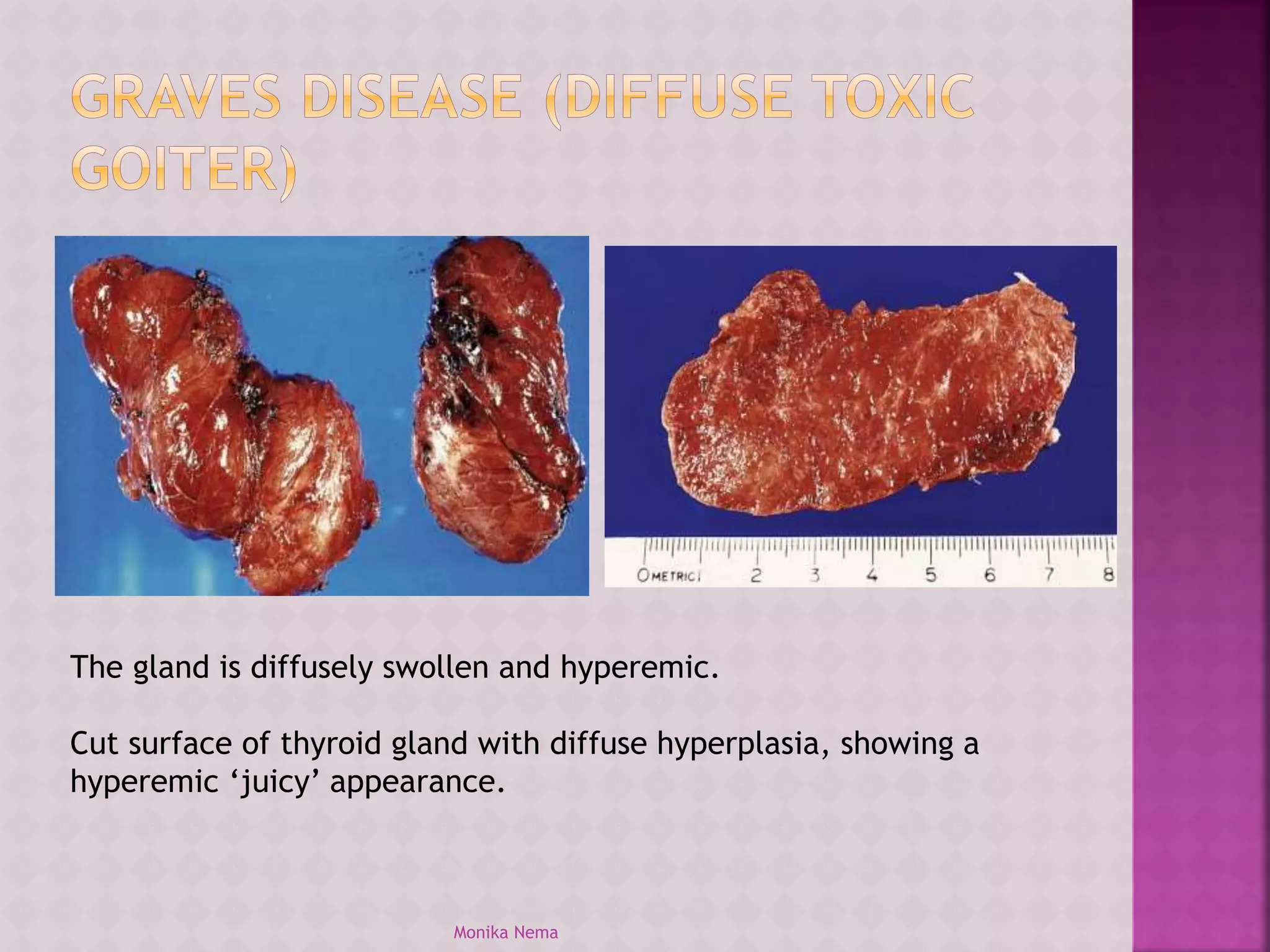
The gland is diffusely swollen and hyperemic.
Cut surface of thyroid gland with diffuse hyperplasia, showing a
hyperemic ‘juicy’ appearance.
Monika Nema
Grossly, gland is enlarged,solid,firm.Sometimes the papillary
formations are evident to the naked eye.
Monika Nema
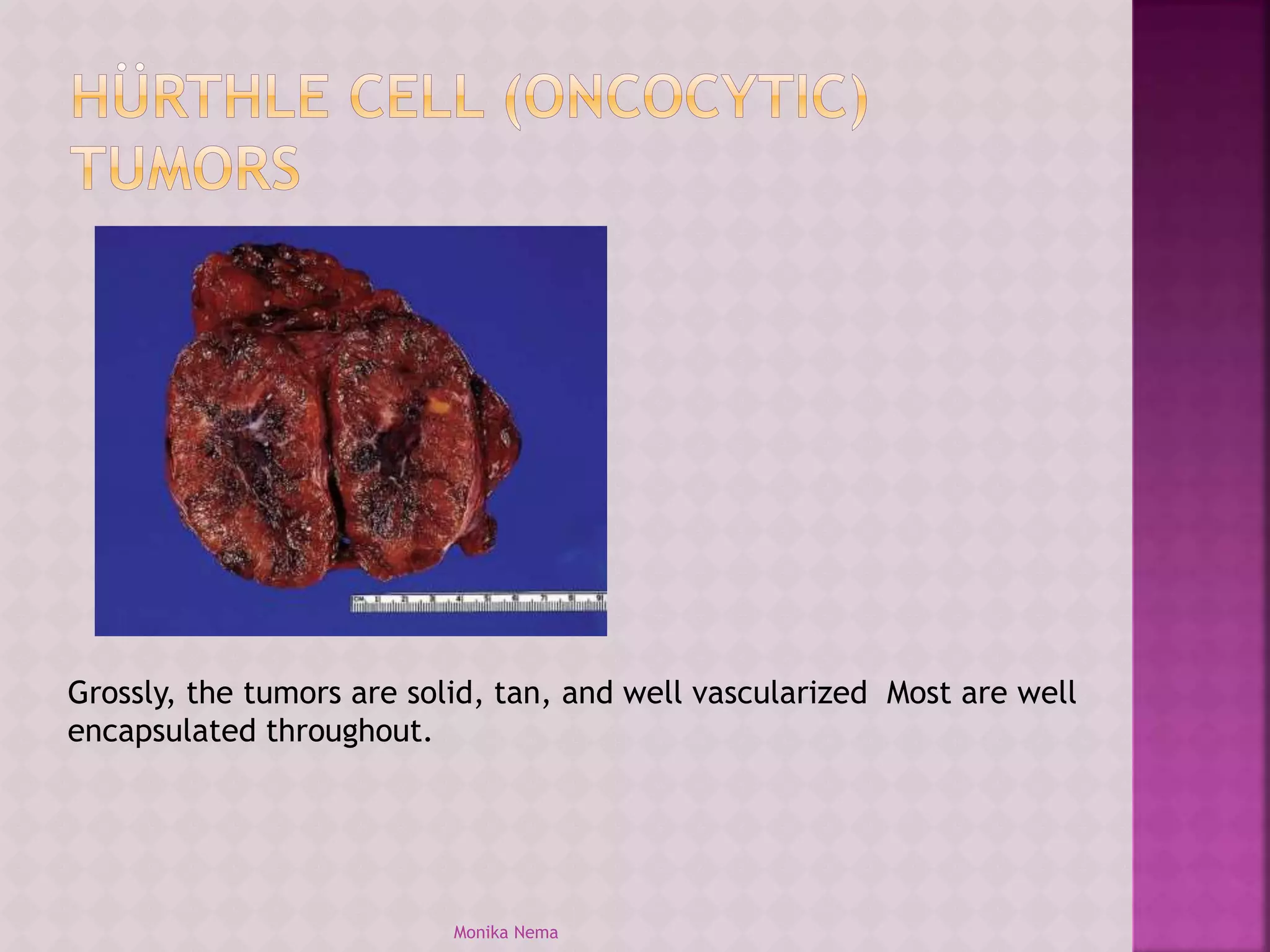
Grossly, the tumors are solid, tan, and well vascularized Most are well
encapsulated throughout.
Monika Nema
Grossly, the typical tumor is solid,
firm, and nonencapsulated but
relatively well circumscribed and
has a gray to yellowish cut surface
Monika Nema
Presentation by- Dr. Monika Nema
Monika Nema

Gross of thyroid gland

  • 1.
    Presented by –Dr. Monika Nema Monika Nema
  • 2.
     The normaladult thyroid gland is composed of two lobes joined by the isthmus, which lies across the trachea anteriorly, below the level of the cricoid cartilage. Monika Nema
  • 3.
     Nodulectomy -(a procedure largely abandoned that consists of enucleation of a thyroid nodule)  Lobectomy Monika Nema
  • 4.
    Subtotal thyroidectomy –inwhich the posterior capsule and a small portion of thyroid tissue – 1–2 g – are left on the side opposite to the lesion Total thyroidectomy -in which the entire gland – including the posterior capsule – is removed. Monika Nema
  • 5.
     Type ofspecimen received.  Orient the specimen. The isthmus can be used to identify the inferior and medial aspects of the gland, the lobes taper superiorly and the posterior surfaces of the lateral lobes have a concave shape caused by the trachea. • Measure the specimen. • Inspect the posterior aspect of the specimen for parathyroid glands and lymph nodes Monika Nema
  • 6.
     Palpate thespecimen to assess the consistency of the thyroid and to localize any focal lesions before cutting the specimen.  Cut parallel longitudinal slices 5 mm each.  Capsule is best demonstrated by cutting perpendicular to the long axis of each individual lobe.  Once the thyroid is sectioned, sequentially lay out the individual slices in such a way as to maintain the proper orientation of the specimen. Monika Nema
  • 7.
     smooth ornodular?  If an isolated lesion is identified, record its size and location, and determine if it is surrounded by a capsule.  If nodular: Mention number, size, and appearance of nodules (cystic? calcified? hemorrhagic? necrotic?) Monika Nema
  • 8.
    For diffuse lesions: Is the gland symmetrically or asymmetrically involved?  Is the lesion confined to the thyroid, or does it extend beyond the capsule of the thyroid into the surrounding soft tissues?  Is the lesion cystic or solid, soft or hard, well demarcated or poorly defined? Monika Nema
  • 9.
    Sections for histologyshould be taken to demonstrate the following:  (1) all components of a lesion (e.g., solid areas and cystic areas);  (2) the interface of the tumor (and its surrounding capsule) with the adjacent non- neoplastic thyroid parenchyma;  (3) the relationship of the tumor to the thyroid capsule and extrathyroidal soft tissues; and  (4) the presence of parathyroids, lymph nodes, and normal-appearing thyroid parenchyma. Monika Nema
  • 10.
     1 Fordiffuse and/or inflammatory lesions: three sections from each lobe and one from isthmus.  2 For a solitary encapsulated nodule measuring up to 5 cm: entire circumference is taken. Take one additional section for each additional centimeter in diameter. Most of these sections should include the tumor capsule and adjacent thyroid tissue, if present Monika Nema
  • 11.
     Primary taskin encapsulated nodule is to make sure that areas of transcapsular or vascular invasion are not missed. Since these areas usually cannot be seen by the naked eye, they can easily be missed unless the peripheral portion of the nodule is extensively sampled.  The more capsule sampled, the greater chance of finding invasive foci. Therefore, the tumor–capsule–thyroid interface of any encapsulated nodule should be submitted in its entirety for histologic evaluation. Monika Nema
  • 12.
     Tangential sectionsthrough a round nodule may give the artifactual microscopic impression that the tumor infiltrates the capsule. Monika Nema
  • 13.
    Decapitate the roundedends from the tumor nodule To minimize tangential sectioning Monika Nema
  • 14.
    place the flatsurface of each end on the cutting board, and then direct each cut perpendicular to the tumor capsule To minimize tangential sectioning Monika Nema
  • 15.
    3 For multinodularthyroid glands: one section of each nodule (up to five nodules), including rim and adjacent normal gland; more than one section for larger nodules. 4 For papillary carcinoma: block entire thyroid gland and (separately) line of resection 5 For grossly invasive carcinoma other than papillary: three sections of tumor, three of non- neoplastic gland, and one from line of resection 6 For all cases: submit parathyroid glands if found on gross inspection Monika Nema
  • 16.
     Thyroids removedfrom patients with one of the multiple endocrine neoplasia (MEN) syndromes should be extensively sampled for histology.  In gross report, note those sections taken from the middle third of each lobe, as this area is where C-cell hyperplasia and small medullary carcinomas are most likely to be detected. Monika Nema
  • 17.
    Gross appearance offollicular adenomas.Tumor show focal hemorrhagic areas Monika Nema
  • 18.
    Diffuse and symmetricalenlargement of the gland. The consistency is firm but not stony hard as in Riedel thyroiditis. There is no extension of the process outside the gland. The cut surface is dstinctly nodular, yellowish gray, and greatly resembles a hyperplastic lymph node Monika Nema
  • 19.
    The gland isenlarged and multinodular Monika Nema
  • 20.
    The gland isdiffusely swollen and hyperemic. Cut surface of thyroid gland with diffuse hyperplasia, showing a hyperemic ‘juicy’ appearance. Monika Nema
  • 21.
    Grossly, gland isenlarged,solid,firm.Sometimes the papillary formations are evident to the naked eye. Monika Nema
  • 22.
    Grossly, the tumorsare solid, tan, and well vascularized Most are well encapsulated throughout. Monika Nema
  • 23.
    Grossly, the typicaltumor is solid, firm, and nonencapsulated but relatively well circumscribed and has a gray to yellowish cut surface Monika Nema
  • 24.
    Presentation by- Dr.Monika Nema Monika Nema

Editor's Notes

  • #3 Normal weight of thyroid gland in adult varies from 25-30 gram.
  • #6 Parathyroid glands are brown to yellow ovoid bodies , 2 to 3 mm in size.
  • #8 Colour Normal- beefy red to brown. Pale – lymphocytic thyroiditis or hashimoto thyroiditis.
  • #18 An adenoma is usually a solitary, completely encapsulated, pale tan to gray mass, soft, gelatinous or fleshy . There may be areas of hemorrhage, fibrosis or calcification. The capsule is usually thin.
  • #21 The gland is diffusely enlarged, but with a very homogenous texture without nodularity. It is usually beefy red in colour.
  • #22 Have a granular or finely nodular texture due to papillae. Tumors are often firm due to fibrosis. Calcification is common. Tumour may have a poorly developed capsule or tumour may grossly invade the capsule. An occult papillary carcinoma may appear as a tiny pale gray depressed scar.