GRIEVANCE &
ITS HANDLING PROCEDURE
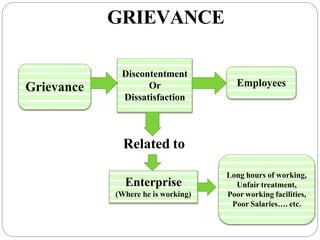
GRIEVANCE
Grievance
Discontentment
Or
Dissatisfaction
Employees
Related to
Enterprise
(Where he is working)
Long hours of working,
Unfair treatment,
Poor working facilities,
Poor Salaries…. etc.
A “grievance” means any discontentment or
dissatisfaction in an employee arising out of
anything related to the enterprise where he is
working.
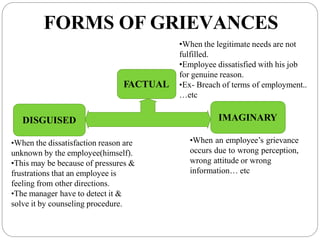
FORMS OF GRIEVANCES
FACTUAL
IMAGINARY
DISGUISED
•When the legitimate needs are not
fulfilled.
•Employee dissatisfied with his job
for genuine reason.
•Ex- Breach of terms of employment..
…etc
•When an employee’s grievance
occurs due to wrong perception,
wrong attitude or wrong
information… etc
•When the dissatisfaction reason are
unknown by the employee(himself).
•This may be because of pressures &
frustrations that an employee is
feeling from other directions.
•The manager have to detect it &
solve it by counseling procedure.
IDENTIFYING GRIEVANCES
EXIT
INTERVIEW
•Employees usually quit organization
or better prospects elsewhere.
•Exit interview, if conducted
carefully, can provide important
information about employees’
grievances.
GRIPE BOXES
•These are boxes in which the
employees can drop their
anonymous complaints.
•These are different from
suggestion boxes( drop
suggestion with intention to
receive reward).
OPINION
SURVEY
•Through Group meetings,
periodically interviews with
employees, collective
bargaining sessions… etc
OPEN-DOOR
POLICY
•General invitation to their
employees to informally drop
in the manager’s room
anytime & talk over their
grievances.
OBSERVATION
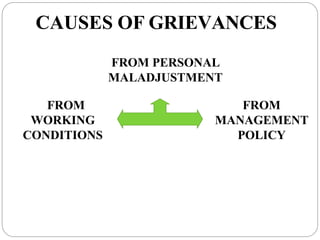
CAUSES OF GRIEVANCES
FROM
WORKING
CONDITIONS
FROM
MANAGEMENT
POLICY
FROM PERSONAL
MALADJUSTMENT
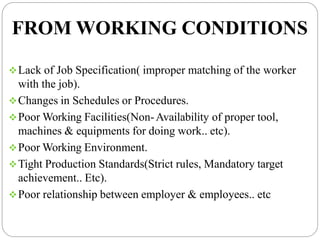
FROM WORKING CONDITIONS
Lack of Job Specification( improper matching of the worker
with the job).
Changes in Schedules or Procedures.
Poor Working Facilities(Non-Availability of proper tool,
machines & equipments for doing work.. etc).
Poor Working Environment.
Tight Production Standards(Strict rules, Mandatory target
achievement.. Etc).
Poor relationship between employer & employees.. etc
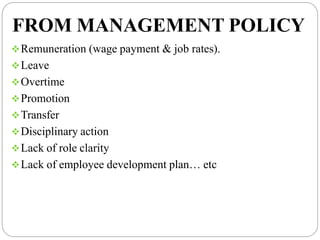
FROM MANAGEMENT POLICY
Remuneration (wage payment & job rates).
Leave
Overtime
Promotion
Transfer
Disciplinary action
Lack of role clarity
Lack of employee development plan… etc
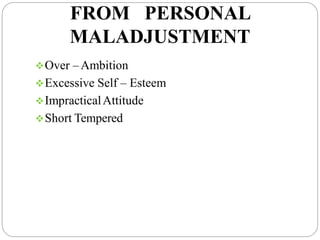
FROM PERSONAL
MALADJUSTMENT
Over –Ambition
Excessive Self – Esteem
ImpracticalAttitude
Short Tempered
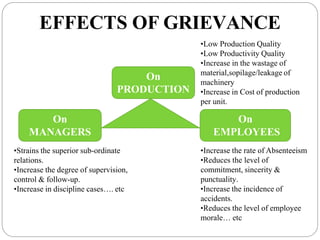
EFFECTS OF GRIEVANCE
On
PRODUCTION
•Low Production Quality
•Low Productivity Quality
•Increase in the wastage of
material,sopilage/leakage of
machinery
•Increase in Cost of production
per unit.
On
EMPLOYEES
•Increase the rate of Absenteeism
•Reduces the level of
commitment, sincerity &
punctuality.
•Increase the incidence of
accidents.
•Reduces the level of employee
morale… etc
On
MANAGERS
•Strains the superior sub-ordinate
relations.
•Increase the degree of supervision,
control & follow-up.
•Increase in discipline cases…. etc
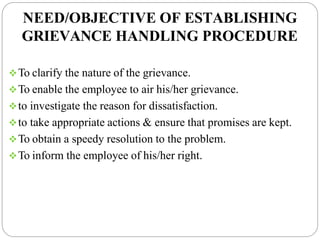
NEED/OBJECTIVE OF ESTABLISHING
GRIEVANCE HANDLING PROCEDURE
To clarify the nature of the grievance.
To enable the employee to air his/her grievance.
to investigate the reason for dissatisfaction.
to take appropriate actions & ensure that promises are kept.
To obtain a speedy resolution to the problem.
To inform the employee of his/her right.
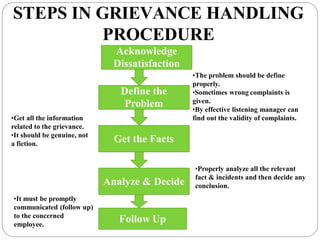
STEPS IN GRIEVANCE HANDLING
PROCEDURE
Acknowledge
Dissatisfaction
Define the
Problem
Get the Facts
Analyze & Decide
Follow Up
•The problem should be define
properly.
•Sometimes wrong complaints is
given.
•By effective listening manager can
find out the validity of complaints.
•Get all the information
related to the grievance.
•It should be genuine, not
a fiction.
•Properly analyze all the relevant
fact & incidents and then decide any
conclusion.
•It must be promptly
communicated (follow up)
to the concerned
employee.
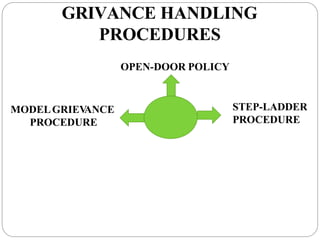
GRIVANCE HANDLING
PROCEDURES
OPEN-DOOR POLICY
STEP-LADDER
PROCEDURE
MODELGRIEV
ANCE
PROCEDURE
OPRN-DOOR POLICY
Any employee can take his grievance
to the chief boss & talk over the
problem.
STEP-LADDER PROCEDURE
The employee with a grievance has
to proceed step by step unless he is
able to redress his grievance.
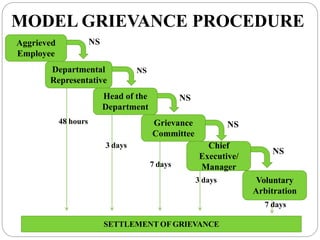
MODEL GRIEVANCE PROCEDURE
Aggrieved
Employee
Grievance
Committee
SETTLEMENT OF GRIEVANCE
Departmental
Representative
Head of the
Department
48 hours
3 days
7 days
Chief
Executive/
Manager
3 days Voluntary
Arbitration
7 days
NS
NS
NS
NS
NS
Grievance and its Handling Procedures.pptx

Grievance and its Handling Procedures.pptx

  • 1.
  • 2.
    GRIEVANCE Grievance Discontentment Or Dissatisfaction Employees Related to Enterprise (Where heis working) Long hours of working, Unfair treatment, Poor working facilities, Poor Salaries…. etc.
  • 3.
    A “grievance” meansany discontentment or dissatisfaction in an employee arising out of anything related to the enterprise where he is working.
  • 4.
    FORMS OF GRIEVANCES FACTUAL IMAGINARY DISGUISED •Whenthe legitimate needs are not fulfilled. •Employee dissatisfied with his job for genuine reason. •Ex- Breach of terms of employment.. …etc •When an employee’s grievance occurs due to wrong perception, wrong attitude or wrong information… etc •When the dissatisfaction reason are unknown by the employee(himself). •This may be because of pressures & frustrations that an employee is feeling from other directions. •The manager have to detect it & solve it by counseling procedure.
  • 5.
    IDENTIFYING GRIEVANCES EXIT INTERVIEW •Employees usuallyquit organization or better prospects elsewhere. •Exit interview, if conducted carefully, can provide important information about employees’ grievances. GRIPE BOXES •These are boxes in which the employees can drop their anonymous complaints. •These are different from suggestion boxes( drop suggestion with intention to receive reward). OPINION SURVEY •Through Group meetings, periodically interviews with employees, collective bargaining sessions… etc OPEN-DOOR POLICY •General invitation to their employees to informally drop in the manager’s room anytime & talk over their grievances. OBSERVATION
  • 6.
  • 7.
    FROM WORKING CONDITIONS Lackof Job Specification( improper matching of the worker with the job). Changes in Schedules or Procedures. Poor Working Facilities(Non-Availability of proper tool, machines & equipments for doing work.. etc). Poor Working Environment. Tight Production Standards(Strict rules, Mandatory target achievement.. Etc). Poor relationship between employer & employees.. etc
  • 8.
    FROM MANAGEMENT POLICY Remuneration(wage payment & job rates). Leave Overtime Promotion Transfer Disciplinary action Lack of role clarity Lack of employee development plan… etc
  • 9.
    FROM PERSONAL MALADJUSTMENT Over –Ambition ExcessiveSelf – Esteem ImpracticalAttitude Short Tempered
  • 10.
    EFFECTS OF GRIEVANCE On PRODUCTION •LowProduction Quality •Low Productivity Quality •Increase in the wastage of material,sopilage/leakage of machinery •Increase in Cost of production per unit. On EMPLOYEES •Increase the rate of Absenteeism •Reduces the level of commitment, sincerity & punctuality. •Increase the incidence of accidents. •Reduces the level of employee morale… etc On MANAGERS •Strains the superior sub-ordinate relations. •Increase the degree of supervision, control & follow-up. •Increase in discipline cases…. etc
  • 11.
    NEED/OBJECTIVE OF ESTABLISHING GRIEVANCEHANDLING PROCEDURE To clarify the nature of the grievance. To enable the employee to air his/her grievance. to investigate the reason for dissatisfaction. to take appropriate actions & ensure that promises are kept. To obtain a speedy resolution to the problem. To inform the employee of his/her right.
  • 12.
    STEPS IN GRIEVANCEHANDLING PROCEDURE Acknowledge Dissatisfaction Define the Problem Get the Facts Analyze & Decide Follow Up •The problem should be define properly. •Sometimes wrong complaints is given. •By effective listening manager can find out the validity of complaints. •Get all the information related to the grievance. •It should be genuine, not a fiction. •Properly analyze all the relevant fact & incidents and then decide any conclusion. •It must be promptly communicated (follow up) to the concerned employee.
  • 13.
  • 14.
    OPRN-DOOR POLICY Any employeecan take his grievance to the chief boss & talk over the problem.
  • 15.
    STEP-LADDER PROCEDURE The employeewith a grievance has to proceed step by step unless he is able to redress his grievance.
  • 16.
    MODEL GRIEVANCE PROCEDURE Aggrieved Employee Grievance Committee SETTLEMENTOF GRIEVANCE Departmental Representative Head of the Department 48 hours 3 days 7 days Chief Executive/ Manager 3 days Voluntary Arbitration 7 days NS NS NS NS NS