EEMPLOYEEMPLOYEE GRIEVANCEGRIEVANCE ANDAND
REDRESSALREDRESSAL
Submitted bySubmitted by
ShibinShibin SS SS
S2 MBAS2 MBAS2 MBAS2 MBA
GIMS ,GIMS , KadakkalKadakkal
WHAT DO WE UNDERSTAND BY ‘EMPLOYEE
GRIEVANCE’?
 Grievance means any type of dissatisfaction ory yp
discontentment arising out of factors related to
an employee’s job which he thinks are unfair.
A i i h l f l th t A grievance arises when an employee feels that
something has happened or is happening to him
which he thinks is unfair, unjust or inequitable.
In an organization, a grievance may arise due to
several factors such as:
1) Violation of management’s responsibility such1) Violation of management s responsibility such
as poor working conditions.
2) Violation of company’s rules and regulations) p y g
3) Violation of labor laws)
4) Violation of natural rules of justice such as
unfair treatment in promotion, etc.
ESSENTIALS OF GRIEVANCE:
 The discontentment arises out of somethingg
connected with the organization.
 A grievance may be expressed or implied.
 The discontent may be rational or irrational.
SOURCES OF GRIEVANCE
 The sources of grievance are group under threeg g p
heads:
1) Grievance resulting from Management
Policies:Policies:
a. Wage rates or scale of pay
b. Overtime
c. Leave
d. Transfer – improper matching of the worker
with the jobwith the job
e. Seniority, promotion and discharges
f. Lack of career planning and employee
d l t ldevelopment plan
g) Lack of role clarity
h) Lack of regard for collective agreement.
i) Hostility towards a labour union.
j) A toc atic leade hi t le of e i oj) Autocratic leadership style of supervisors
2) Grievance resulting from Working
diticonditions:
a) Unrealistic
b) Non-availability of proper tools machines andb) Non-availability of proper tools, machines and
equipment for doing the job.
c) Tight production standards.
d) Bad physical conditions of work place.
e) Poor relationship with the supervisor.
f) Negative approach to discipline.
3) Grievances resulting from Personal factors:
a) Narrow attitude
b) Over-ambition
E i i lic) Egoistic personality
HANDLING OF GRIEVANCE
 It is important to keep some points in mindp p p
while dealing with grievances of subordinates.
These are:
a) A grievance may not be real
b) Grievances may arise out of not one cause,but
ltif imultifarious causes.
c) Every individual does not give expression to his
grievances.g
(CONTD.)
 A manager needs to follow some guidelines to dealg g
effectively with the grievances:
1) The complainant should be given a patient hearing.
) Att t h ld b d t t t th t f th2) Attempts should be made to get at the root of the
problem.
3) The management must show its anxiety to remove
the grievances of the workers
4) If the grievances are real and their causes are
known,attempts should be made to remove theknown,attempts should be made to remove the
causes.
5) If the grievances are imaginary or unfounded,
attempts should be made to counsel the workersattempts should be made to counsel the workers.
EMPLOYEE GRIEVANCE REDRESSAL
 Employee Grievances can be handled by adoptingp y y p g
various measures. These measures are discussed
separately in this section
O d li U d thi d th1. Open door policy: Under this procedure the
employees are free to meet the top executive of
the organisation and get grievances redressed.
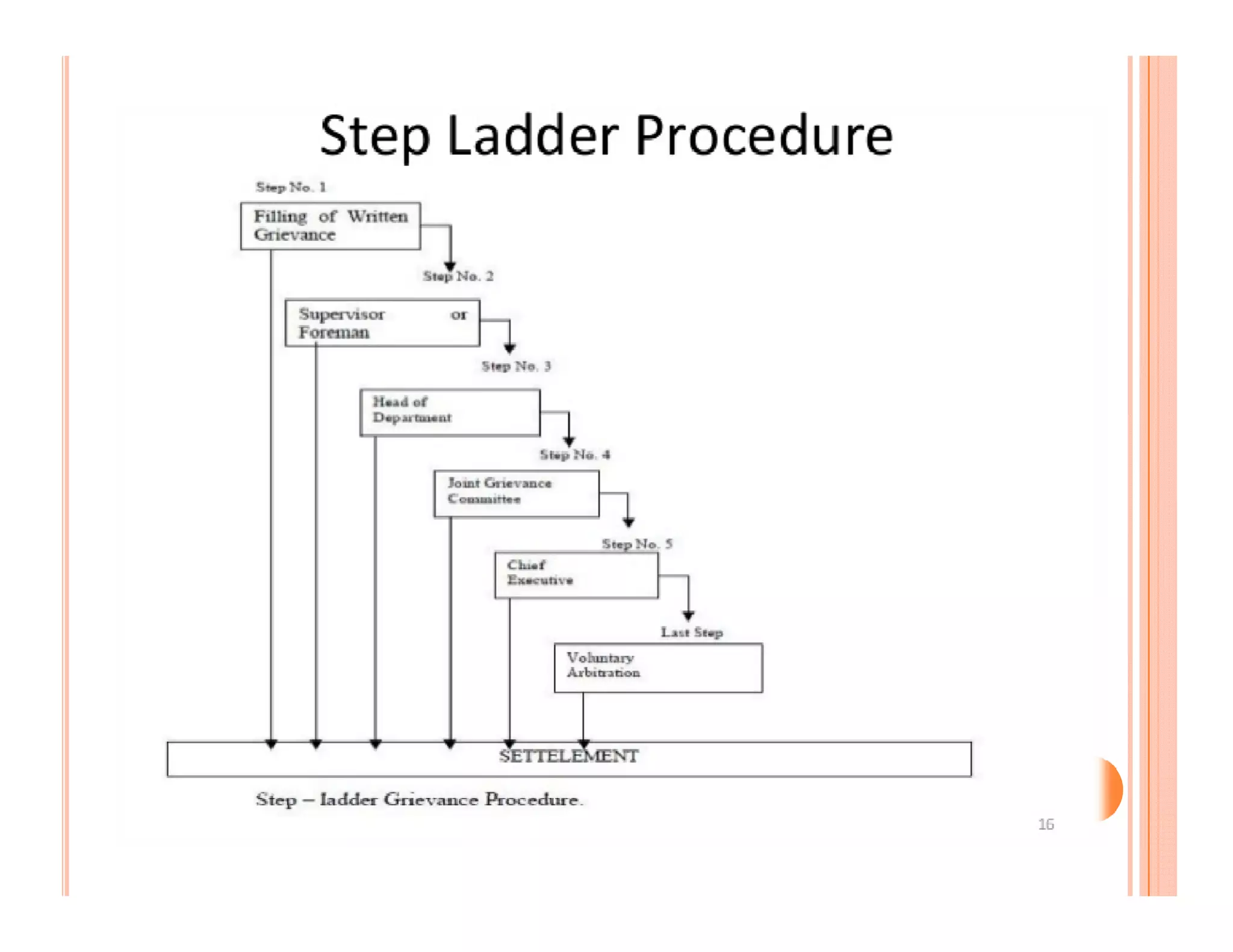
2. Step-ladder procedure: Under this
procedure, the aggrieved employee has to
proceed step by step in getting his grievanceproceed step by step in getting his grievance
heard and redressed.
ESSENTIALS OF A GOOD GRIEVANCE
PROCEDURE
 A grievance procedure must follow certain
principles which are listed below:
1. A grievance should be dealt with in the first
instance at the lowest level.
2. The line of appeal must be made clear to the
employees.
3. Grievances should be dealt with speedily.3. Grievances should be dealt with speedily.
4. If the grievance is against an instruction given by a
superior, it is in the interest of the discipline that
instruction must be carried out.instruction must be carried out.
5. The grievance procedure should be set up with the
participation of the employees and it should be
applicable to all in the organizationapplicable to all in the organization.
(CONTD.)
 A good grievance procedure must:g g p
1. Be simple: It should be simple so that even an
average employee can understand it.
2. Time bound: It should lay down the time limit
which should not be exceeded at every step of
the grievance procedure.the grievance procedure.
3. Involve participation of the employee
leaders: It should be developed with the
i i i f h l d f h lparticipation of the leaders of the employees
and must be applicable to all.
Employee grievance and redressal HRM

Employee grievance and redressal HRM

  • 1.
    EEMPLOYEEMPLOYEE GRIEVANCEGRIEVANCE ANDAND REDRESSALREDRESSAL SubmittedbySubmitted by ShibinShibin SS SS S2 MBAS2 MBAS2 MBAS2 MBA GIMS ,GIMS , KadakkalKadakkal
  • 2.
    WHAT DO WEUNDERSTAND BY ‘EMPLOYEE GRIEVANCE’?  Grievance means any type of dissatisfaction ory yp discontentment arising out of factors related to an employee’s job which he thinks are unfair. A i i h l f l th t A grievance arises when an employee feels that something has happened or is happening to him which he thinks is unfair, unjust or inequitable. In an organization, a grievance may arise due to several factors such as: 1) Violation of management’s responsibility such1) Violation of management s responsibility such as poor working conditions. 2) Violation of company’s rules and regulations) p y g
  • 3.
    3) Violation oflabor laws) 4) Violation of natural rules of justice such as unfair treatment in promotion, etc.
  • 4.
    ESSENTIALS OF GRIEVANCE: The discontentment arises out of somethingg connected with the organization.  A grievance may be expressed or implied.  The discontent may be rational or irrational.
  • 5.
    SOURCES OF GRIEVANCE The sources of grievance are group under threeg g p heads: 1) Grievance resulting from Management Policies:Policies: a. Wage rates or scale of pay b. Overtime c. Leave d. Transfer – improper matching of the worker with the jobwith the job e. Seniority, promotion and discharges f. Lack of career planning and employee d l t ldevelopment plan
  • 6.
    g) Lack ofrole clarity h) Lack of regard for collective agreement. i) Hostility towards a labour union. j) A toc atic leade hi t le of e i oj) Autocratic leadership style of supervisors
  • 7.
    2) Grievance resultingfrom Working diticonditions: a) Unrealistic b) Non-availability of proper tools machines andb) Non-availability of proper tools, machines and equipment for doing the job. c) Tight production standards. d) Bad physical conditions of work place. e) Poor relationship with the supervisor. f) Negative approach to discipline.
  • 8.
    3) Grievances resultingfrom Personal factors: a) Narrow attitude b) Over-ambition E i i lic) Egoistic personality
  • 9.
    HANDLING OF GRIEVANCE It is important to keep some points in mindp p p while dealing with grievances of subordinates. These are: a) A grievance may not be real b) Grievances may arise out of not one cause,but ltif imultifarious causes. c) Every individual does not give expression to his grievances.g
  • 10.
    (CONTD.)  A managerneeds to follow some guidelines to dealg g effectively with the grievances: 1) The complainant should be given a patient hearing. ) Att t h ld b d t t t th t f th2) Attempts should be made to get at the root of the problem. 3) The management must show its anxiety to remove the grievances of the workers 4) If the grievances are real and their causes are known,attempts should be made to remove theknown,attempts should be made to remove the causes. 5) If the grievances are imaginary or unfounded, attempts should be made to counsel the workersattempts should be made to counsel the workers.
  • 11.
    EMPLOYEE GRIEVANCE REDRESSAL Employee Grievances can be handled by adoptingp y y p g various measures. These measures are discussed separately in this section O d li U d thi d th1. Open door policy: Under this procedure the employees are free to meet the top executive of the organisation and get grievances redressed. 2. Step-ladder procedure: Under this procedure, the aggrieved employee has to proceed step by step in getting his grievanceproceed step by step in getting his grievance heard and redressed.
  • 13.
    ESSENTIALS OF AGOOD GRIEVANCE PROCEDURE  A grievance procedure must follow certain principles which are listed below: 1. A grievance should be dealt with in the first instance at the lowest level. 2. The line of appeal must be made clear to the employees. 3. Grievances should be dealt with speedily.3. Grievances should be dealt with speedily. 4. If the grievance is against an instruction given by a superior, it is in the interest of the discipline that instruction must be carried out.instruction must be carried out. 5. The grievance procedure should be set up with the participation of the employees and it should be applicable to all in the organizationapplicable to all in the organization.
  • 14.
    (CONTD.)  A goodgrievance procedure must:g g p 1. Be simple: It should be simple so that even an average employee can understand it. 2. Time bound: It should lay down the time limit which should not be exceeded at every step of the grievance procedure.the grievance procedure. 3. Involve participation of the employee leaders: It should be developed with the i i i f h l d f h lparticipation of the leaders of the employees and must be applicable to all.