A.K. Bohra
Chief Executive Officer
NESCO, WESCO & SOUTHCO
Central Service Office, Bhubaneswar
SMART GRID :
ISSUES & CHALLENGES
with
NET METERING
in
INDIA
Global energy scenario is onset to witness a radical change
by focusing on Green energy, Sustainable growth and
SMART GRID implementation
Smart Grid integrates all the Power system components
(Generation to Demand management) with the help of
advanced communication infrastructure and information
technology
Objective of Smart Grid is to make the Power grid more
efficient, reliable, secure and resilient besides minimizing
addition of capital intensive centralized generation
SMART GRID
It also enables quick demand response, optimal utilization
of Generation - be it small or of any capacity and T&D
infrastructure
Influenced by the Global trend, Indian Power Sector is
embarking to harness the benefits of Smart Grid
initiatives
SMART GRID
 With the involvement of improved technology, upgraded
equipments and compatible codes, the distributed
renewable energy generation is gaining popularity in
today’s competitive power generation
 Harnessing of Renewable source of Energy is also
important from the Environmental point of view and has
to go a long way
 Among the various Renewable source of Energy, Solar
Energy Generation is gaining more popularity because of
its easy installation, cleanliness, zero fuel cost and
maximum availability of Solar irradiance; resulting in
generation at competitive rates with Grid supply
DISTRIBUTED RENEWABLE ENERGY GENERATION
 Across the Globe, distributed generation through Roof Top
Solar PV Panel is encouraged due to the following major
advantages ;
 Help utility to reduced stress on Grid, Peak Demand, T&D loss;
being located at the Load centre
 Real time demand side management reduces burden on
conventional generation
 Reduce Power Bill, provides Backup Power & use of spare roof area
 Earn revenue through Export of Power to the Grid
 Reduce emission of pollutants through community support
 Mass scale integration of power generated through Rooftop
Solar PV panels needs implementation of Micro Grid with
smart features
 However, certain issues are associated with such integration
with Utility Grid
DISTRIBUTED RENEWABLE ENERGY GENERATION
 Metering and Energy Accounting
 Interconnection Arrangements
 Commercial Settlement Process
 Applicability of Regulatory Instruments
ISSUES WITH DISTRIBUTED GENERATION INTEGRATION
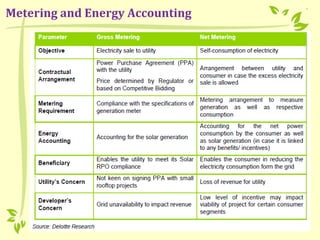
 Metering arrangements for Rooftop Solar PV projects in
use across the Globe are; Gross metering and Net
metering
 Gross Metering : The entire energy generated by
Rooftop Solar PV system is fed directly into the Grid and
the system owner is benefited by feed-in-tariff based on
sale of power to the utility
 Net Metering : The excess/surplus is either sold to or
banked with the utility, thus, combine elements of
captive consumption and exchange of power with the
utility
Metering and Energy Accounting
For installation of small Rooftop Solar PV panel by
Domestic consumers connected to the utility Grid,
effective Net metering is essential and therefore in this
presentation focus is laid on the issues and challenges
with Net Metering
Metering and Energy Accounting
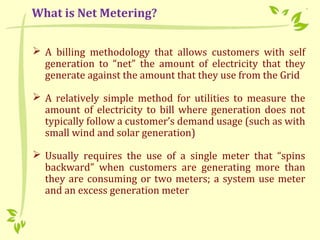
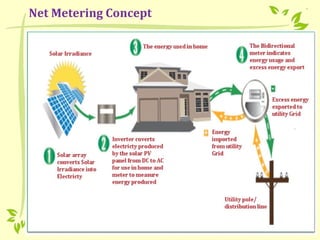
 A billing methodology that allows customers with self
generation to “net” the amount of electricity that they
generate against the amount that they use from the Grid
 A relatively simple method for utilities to measure the
amount of electricity to bill where generation does not
typically follow a customer’s demand usage (such as with
small wind and solar generation)
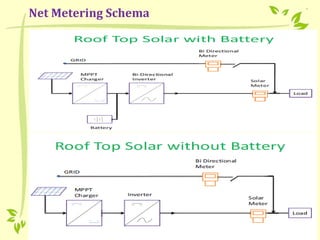
 Usually requires the use of a single meter that “spins
backward” when customers are generating more than
they are consuming or two meters; a system use meter
and an excess generation meter
What is Net Metering?
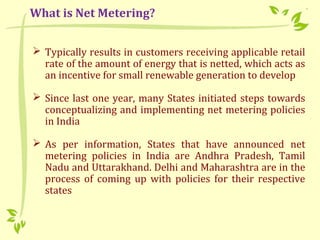
 Typically results in customers receiving applicable retail
rate of the amount of energy that is netted, which acts as
an incentive for small renewable generation to develop
 Since last one year, many States initiated steps towards
conceptualizing and implementing net metering policies
in India
 As per information, States that have announced net
metering policies in India are Andhra Pradesh, Tamil
Nadu and Uttarakhand. Delhi and Maharashtra are in the
process of coming up with policies for their respective
states
What is Net Metering?
Net Metering Concept
Net Metering Schema
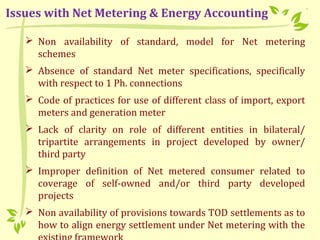
 Non availability of standard, model for Net metering
schemes
 Absence of standard Net meter specifications, specifically
with respect to 1 Ph. connections
 Code of practices for use of different class of import, export
meters and generation meter
 Lack of clarity on role of different entities in bilateral/
tripartite arrangements in project developed by owner/
third party
 Improper definition of Net metered consumer related to
coverage of self-owned and/or third party developed
projects
 Non availability of provisions towards TOD settlements as to
how to align energy settlement under Net metering with the
Issues with Net Metering & Energy Accounting
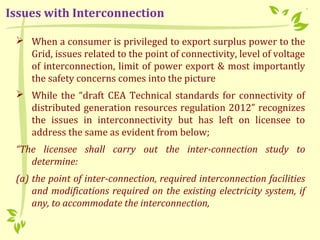
 When a consumer is privileged to export surplus power to the
Grid, issues related to the point of connectivity, level of voltage
of interconnection, limit of power export & most importantly
the safety concerns comes into the picture
 While the “draft CEA Technical standards for connectivity of
distributed generation resources regulation 2012” recognizes
the issues in interconnectivity but has left on licensee to
address the same as evident from below;
“The licensee shall carry out the inter-connection study to
determine:
(a) the point of inter-connection, required interconnection facilities
and modifications required on the existing electricity system, if
any, to accommodate the interconnection,
Issues with Interconnection
(b) the maximum net capacity of the distributed generation
resource at a particular location for single-phase and three
phase generators connected to a shared single-phase system
or three phase system respectively, based on the
configuration of the electricity system and imbalance in the
power flows that distributed generation resource may cause,
(c) likely impact, if any, on the quality of service to consumers
connected to the electricity system and measures to mitigate
the same,
(d) additional measures to ensure safety of the equipment and
personnel.“
Issues with Interconnection
 Contrary to above, international codes like NEC, IEEE 1547 &
UL 1741 takes care of the following:
• Reliable Power Grid Operation
• Protection Against Faults
• Power Quality
• Impact on Utility Monitoring and Switching Equipment
• Testing facilities and Quality Assurance
 While NEC, IEEE & UL Codes specifies electrical
interconnectivity standards, Meter specifications, size of
project and network, testing etc., ANSI specifies the product
specification of inverter, its installation and safety
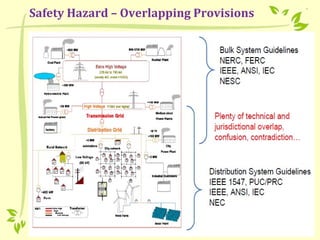
 Connectivity of distributed generation at the medium and
low voltage still need clarity in US due to overlapping
legislative provisions to overcome safety hazards
Issues with Interconnection
Safety Hazard – Overlapping Provisions
 Initially power systems were designed to support only one
way power flow from the point of generation through a
transmission system to distribution level loads
 These systems were not originally intended to
accommodate the back feed of power from distributed
generations at the distribution level
 The introduction of backup flow of power from local
generation causes serious threat to the safety and thus
needs attention
Issues with Interconnection – Safety Concern
 For the safe system operations of an interconnected
distribution generation following is important:
 Self islanding in the event of Grid faults i.e. protection from
distribution system faults
 Auto cut-off from Grid in the event of internal PV system
breakdown ; Cease to feed power to Grid
 Prevention of feeding power to Grid in the event of Grid
fault/System Break down
 Protection to People (Public & Utility workers) and
Property
 Protection from abnormal Voltage & Frequency levels
 Protection while synchronization with Grid
 Protection against injection of Harmonics, DC supply &
Flicker etc. to the Grid
Issues with Interconnection – Safety Concern
 Earlier to prevent reverse power flow, an equipment called
Utility External Disconnection Switch (UEDS) being utilized
by many states in US which was required to be operated
before taking up work by a line worker on line
 Due to non practicability of operations in large distribution
generation network and looking to the introduction of
Meters having inbuilt disconnect switch & supply imbalance
sensing device, use of such device is now not necessary
 The necessity of having disconnection arrangement lockable
and visible Break Separation have been dispensed with in
the amended National Electric Code (NEC) due to these
features incorporated in the Inverter of Solar PV system
Issues with Interconnection – Safety Concern
 In Indian context, these are important and need to be
incorporated
 Besides above, provisions exists in Germany, US and other
advanced Countries related to various product
specifications, connections and testing (at the time of
installation, commissioning & periodical) need to be
replicated in Indian standards
 Some indigenous manufacturers provides equipments not
confirming to such Standards to save cost which cause
hazards
 There is a need for capacity building of Utility Officials who
are neither aware nor trained about the testing to be carried
out on Solar PV system equipments and frequency of such
testing
Issues with Interconnection – Safety Concern
 The overall viability as well as ownership patterns adopted
for development of Net metered roof top solar projects
mainly depends upon applicable charges and commercial
arrangements
 Implementation of net metering based roof top solar system
will require clarity on the energy accounting & Commercial
settlement for electricity consumed from such system as
well as excess energy injected into the Grid
Commercial Settlement Issues
 Commercial settlement in net metering depends upon:
 Definition of eligible consumer
 Generation capacity limits
 Interconnection voltage
 Energy Accounting
 Net metering settlement period
 Restrictions on level of overall or local Grid penetration
 Renewable Purchase Obligation (RPO)
 Application of other charges & incentives (fixed charge,
connectivity charge, TOD, ABT, GBI) etc.
 Forum of Regulators (FOR) though addressed these
issues but are yet to be incorporated in the Codes
Commercial Settlement Issues
 As stated in the foregoing slides, there is lot of Regulatory
infirmity, affecting propagation of Net metering projects
in India
 International experience shows that propagation of
various business models of rooftop Solar segment has a
very high reliance on the policy and regulatory
framework
 Non availability of clearly defined technical standards and
guidelines for Grid connectivity, metering, safety and
security etc. are major barriers in implementation of such
projects
Applicability of Regulatory Instruments
 Current Regulatory framework also lack in addressing the
charges related to wheeling, open access, Cross subsidy etc.
 Indian standards for installation & testing etc. is must in line
with international equipment standards issued by
International Electro technical Commission (IEC)
 Need is to have a code like IEEE 1547 which provides
guidelines for technical requirements, design, construction,
commissioning, acceptance testing, O&M and performance
requirements for interconnecting local electric power
sources to a bulk power transmission grid
Applicability of Regulatory Instruments
 Standards and Codes available like CERC model guidelines
for Rooftop Solar Grid interactive system based on Net
metering and CEA technical standards for connectivity of
the distributed resources regulations 2012 etc. are still
under draft form and not bringing adequate clarity
 However few States like Tamil Nadu & Gujarat have taken
initiative and propose amendment in regulations covering
Net metering, LT connectivity etc.
 The main technology constraint lies with the specification of
meters which necessarily has to be export import type
smart meter with disconnection facility from remote
Applicability of Regulatory Instruments
 Odisha scenario :
 Govt. of Odisha has formed a Company to promote,
develop, implement, operate & maintain renewable energy
projects namely GEDCOL (Green Energy Development
Corporation of Odisha Ltd.)
 Dept. of Science & Technology has published a draft Solar
Policy for the State with a target of adding 135 MW Solar
Energy capacity by 2015-16
 OERC yet to give detailed Scheme, associated metering
arrangement & commercial mechanism between
Consumer, DISCOM & GRIDCO
Applicability of Regulatory Instruments
 The status of policy framework & regulatory provisions in
various States is as under:
Tamil Nadu:
Commercial arrangements : Cap for injecting excess energy to the grid,
will be 90% of the electricity consumption by the eligible consumer
at the end of a settlement period (annually)
Grid penetration restrictions : Restricted to 30% of the distribution
transformer capacity on the basis of first come first served
Metering : Two meters have to be installed, first for measuring solar
power generation and the second for the import/export
measurement
Applicability of Regulatory Instruments
Uttarakhand:
The roof owner of residential/commercial/
industrial/institutional/government establishments are eligible to set up
Solar Power Plant within 300W to 100 kW with battery backup and up to
500 KW without battery backup
Can work on net metering basis wherein the beneficiary pays to the utility
on net meter reading basis only, alternatively two meters can also be
installed to measure the export and import of power separately
Punjab:
Capacity range allowed 1 KW and 500 KW. The maximum capacity of the
Roof Top Solar PV system shall not be more than 80% of the Sanctioned
Connected Load. Injection of power from the rooftop solar PV system shall
not be more than 90% of the consumption from the licensee’s supply by
the consumer in a year
Highlights of various State’s Policies
Andhra Pradesh:
Net Metering permitted for 3 Phase only. Consumers can avail
Government of AP subsidy and MNRE subsidy through New and
Renewable Energy Development Corporation Andhra Pradesh Ltd
(NREDCAP)
A single bi-directional meter should be installed for export and import
energy measurement. DISCOMs shall accord approvals on a first come
first serve basis for Solar Net Metering till the Solar installed Capacity
reaches 50% of the closest upstream Distribution transformer’s rated
capacity
Delhi:
Delhi Electricity Regulatory Commission (DERC) has released a draft net
metering policy. Most of the policy details are similar to the Tamil Nadu
net-metering policy. The final policy will be announced after getting the
inputs of all the stakeholders
Maharashtra:
Maharashtra Electricity Regulatory Commission (MERC) has instructed
for formation of a Working Committee which will come up with a draft
Highlights of various State’s Policies
 Once the Indian Standards, Codes, Regulations are put in
place, it will open a big market for Indian Entrepreneurs to
venture in to the Field of Net Metered Solar PV generating
equipments and integration with Grid
 The product, service may include following:
 Solar PV Panels, Batteries and accessories
 Inverters with protective devices confirming to Standards
 Smart Energy Meter with export, import features and
disconnection facility
 Erection, Commissioning works as per Codes
 Lab testing and site testing of equipments as per provisions
 I.T. enabled services for Meter reading, billing, accounting,
Load dispatching & demand side management and isolation
of generation on demand from line worker etc.
Conclusion
ICC is the right forum for me to take the
opportunity to aware Indian Business
fraternity about the abundance of
business opportunities ahead in this
field; just waiting for YOU!
Thank You

Presentation by A. K. Bohra on Issues & Challenges in Net Metering

  • 1.
    A.K. Bohra Chief ExecutiveOfficer NESCO, WESCO & SOUTHCO Central Service Office, Bhubaneswar SMART GRID : ISSUES & CHALLENGES with NET METERING in INDIA
  • 2.
    Global energy scenariois onset to witness a radical change by focusing on Green energy, Sustainable growth and SMART GRID implementation Smart Grid integrates all the Power system components (Generation to Demand management) with the help of advanced communication infrastructure and information technology Objective of Smart Grid is to make the Power grid more efficient, reliable, secure and resilient besides minimizing addition of capital intensive centralized generation SMART GRID
  • 3.
    It also enablesquick demand response, optimal utilization of Generation - be it small or of any capacity and T&D infrastructure Influenced by the Global trend, Indian Power Sector is embarking to harness the benefits of Smart Grid initiatives SMART GRID
  • 4.
     With theinvolvement of improved technology, upgraded equipments and compatible codes, the distributed renewable energy generation is gaining popularity in today’s competitive power generation  Harnessing of Renewable source of Energy is also important from the Environmental point of view and has to go a long way  Among the various Renewable source of Energy, Solar Energy Generation is gaining more popularity because of its easy installation, cleanliness, zero fuel cost and maximum availability of Solar irradiance; resulting in generation at competitive rates with Grid supply DISTRIBUTED RENEWABLE ENERGY GENERATION
  • 5.
     Across theGlobe, distributed generation through Roof Top Solar PV Panel is encouraged due to the following major advantages ;  Help utility to reduced stress on Grid, Peak Demand, T&D loss; being located at the Load centre  Real time demand side management reduces burden on conventional generation  Reduce Power Bill, provides Backup Power & use of spare roof area  Earn revenue through Export of Power to the Grid  Reduce emission of pollutants through community support  Mass scale integration of power generated through Rooftop Solar PV panels needs implementation of Micro Grid with smart features  However, certain issues are associated with such integration with Utility Grid DISTRIBUTED RENEWABLE ENERGY GENERATION
  • 6.
     Metering andEnergy Accounting  Interconnection Arrangements  Commercial Settlement Process  Applicability of Regulatory Instruments ISSUES WITH DISTRIBUTED GENERATION INTEGRATION
  • 7.
     Metering arrangementsfor Rooftop Solar PV projects in use across the Globe are; Gross metering and Net metering  Gross Metering : The entire energy generated by Rooftop Solar PV system is fed directly into the Grid and the system owner is benefited by feed-in-tariff based on sale of power to the utility  Net Metering : The excess/surplus is either sold to or banked with the utility, thus, combine elements of captive consumption and exchange of power with the utility Metering and Energy Accounting
  • 8.
  • 9.
    For installation ofsmall Rooftop Solar PV panel by Domestic consumers connected to the utility Grid, effective Net metering is essential and therefore in this presentation focus is laid on the issues and challenges with Net Metering Metering and Energy Accounting
  • 10.
     A billingmethodology that allows customers with self generation to “net” the amount of electricity that they generate against the amount that they use from the Grid  A relatively simple method for utilities to measure the amount of electricity to bill where generation does not typically follow a customer’s demand usage (such as with small wind and solar generation)  Usually requires the use of a single meter that “spins backward” when customers are generating more than they are consuming or two meters; a system use meter and an excess generation meter What is Net Metering?
  • 11.
     Typically resultsin customers receiving applicable retail rate of the amount of energy that is netted, which acts as an incentive for small renewable generation to develop  Since last one year, many States initiated steps towards conceptualizing and implementing net metering policies in India  As per information, States that have announced net metering policies in India are Andhra Pradesh, Tamil Nadu and Uttarakhand. Delhi and Maharashtra are in the process of coming up with policies for their respective states What is Net Metering?
  • 12.
  • 13.
  • 14.
     Non availabilityof standard, model for Net metering schemes  Absence of standard Net meter specifications, specifically with respect to 1 Ph. connections  Code of practices for use of different class of import, export meters and generation meter  Lack of clarity on role of different entities in bilateral/ tripartite arrangements in project developed by owner/ third party  Improper definition of Net metered consumer related to coverage of self-owned and/or third party developed projects  Non availability of provisions towards TOD settlements as to how to align energy settlement under Net metering with the Issues with Net Metering & Energy Accounting
  • 15.
     When aconsumer is privileged to export surplus power to the Grid, issues related to the point of connectivity, level of voltage of interconnection, limit of power export & most importantly the safety concerns comes into the picture  While the “draft CEA Technical standards for connectivity of distributed generation resources regulation 2012” recognizes the issues in interconnectivity but has left on licensee to address the same as evident from below; “The licensee shall carry out the inter-connection study to determine: (a) the point of inter-connection, required interconnection facilities and modifications required on the existing electricity system, if any, to accommodate the interconnection, Issues with Interconnection
  • 16.
    (b) the maximumnet capacity of the distributed generation resource at a particular location for single-phase and three phase generators connected to a shared single-phase system or three phase system respectively, based on the configuration of the electricity system and imbalance in the power flows that distributed generation resource may cause, (c) likely impact, if any, on the quality of service to consumers connected to the electricity system and measures to mitigate the same, (d) additional measures to ensure safety of the equipment and personnel.“ Issues with Interconnection
  • 17.
     Contrary toabove, international codes like NEC, IEEE 1547 & UL 1741 takes care of the following: • Reliable Power Grid Operation • Protection Against Faults • Power Quality • Impact on Utility Monitoring and Switching Equipment • Testing facilities and Quality Assurance  While NEC, IEEE & UL Codes specifies electrical interconnectivity standards, Meter specifications, size of project and network, testing etc., ANSI specifies the product specification of inverter, its installation and safety  Connectivity of distributed generation at the medium and low voltage still need clarity in US due to overlapping legislative provisions to overcome safety hazards Issues with Interconnection
  • 18.
    Safety Hazard –Overlapping Provisions
  • 19.
     Initially powersystems were designed to support only one way power flow from the point of generation through a transmission system to distribution level loads  These systems were not originally intended to accommodate the back feed of power from distributed generations at the distribution level  The introduction of backup flow of power from local generation causes serious threat to the safety and thus needs attention Issues with Interconnection – Safety Concern
  • 20.
     For thesafe system operations of an interconnected distribution generation following is important:  Self islanding in the event of Grid faults i.e. protection from distribution system faults  Auto cut-off from Grid in the event of internal PV system breakdown ; Cease to feed power to Grid  Prevention of feeding power to Grid in the event of Grid fault/System Break down  Protection to People (Public & Utility workers) and Property  Protection from abnormal Voltage & Frequency levels  Protection while synchronization with Grid  Protection against injection of Harmonics, DC supply & Flicker etc. to the Grid Issues with Interconnection – Safety Concern
  • 21.
     Earlier toprevent reverse power flow, an equipment called Utility External Disconnection Switch (UEDS) being utilized by many states in US which was required to be operated before taking up work by a line worker on line  Due to non practicability of operations in large distribution generation network and looking to the introduction of Meters having inbuilt disconnect switch & supply imbalance sensing device, use of such device is now not necessary  The necessity of having disconnection arrangement lockable and visible Break Separation have been dispensed with in the amended National Electric Code (NEC) due to these features incorporated in the Inverter of Solar PV system Issues with Interconnection – Safety Concern
  • 22.
     In Indiancontext, these are important and need to be incorporated  Besides above, provisions exists in Germany, US and other advanced Countries related to various product specifications, connections and testing (at the time of installation, commissioning & periodical) need to be replicated in Indian standards  Some indigenous manufacturers provides equipments not confirming to such Standards to save cost which cause hazards  There is a need for capacity building of Utility Officials who are neither aware nor trained about the testing to be carried out on Solar PV system equipments and frequency of such testing Issues with Interconnection – Safety Concern
  • 23.
     The overallviability as well as ownership patterns adopted for development of Net metered roof top solar projects mainly depends upon applicable charges and commercial arrangements  Implementation of net metering based roof top solar system will require clarity on the energy accounting & Commercial settlement for electricity consumed from such system as well as excess energy injected into the Grid Commercial Settlement Issues
  • 24.
     Commercial settlementin net metering depends upon:  Definition of eligible consumer  Generation capacity limits  Interconnection voltage  Energy Accounting  Net metering settlement period  Restrictions on level of overall or local Grid penetration  Renewable Purchase Obligation (RPO)  Application of other charges & incentives (fixed charge, connectivity charge, TOD, ABT, GBI) etc.  Forum of Regulators (FOR) though addressed these issues but are yet to be incorporated in the Codes Commercial Settlement Issues
  • 25.
     As statedin the foregoing slides, there is lot of Regulatory infirmity, affecting propagation of Net metering projects in India  International experience shows that propagation of various business models of rooftop Solar segment has a very high reliance on the policy and regulatory framework  Non availability of clearly defined technical standards and guidelines for Grid connectivity, metering, safety and security etc. are major barriers in implementation of such projects Applicability of Regulatory Instruments
  • 26.
     Current Regulatoryframework also lack in addressing the charges related to wheeling, open access, Cross subsidy etc.  Indian standards for installation & testing etc. is must in line with international equipment standards issued by International Electro technical Commission (IEC)  Need is to have a code like IEEE 1547 which provides guidelines for technical requirements, design, construction, commissioning, acceptance testing, O&M and performance requirements for interconnecting local electric power sources to a bulk power transmission grid Applicability of Regulatory Instruments
  • 27.
     Standards andCodes available like CERC model guidelines for Rooftop Solar Grid interactive system based on Net metering and CEA technical standards for connectivity of the distributed resources regulations 2012 etc. are still under draft form and not bringing adequate clarity  However few States like Tamil Nadu & Gujarat have taken initiative and propose amendment in regulations covering Net metering, LT connectivity etc.  The main technology constraint lies with the specification of meters which necessarily has to be export import type smart meter with disconnection facility from remote Applicability of Regulatory Instruments
  • 28.
     Odisha scenario:  Govt. of Odisha has formed a Company to promote, develop, implement, operate & maintain renewable energy projects namely GEDCOL (Green Energy Development Corporation of Odisha Ltd.)  Dept. of Science & Technology has published a draft Solar Policy for the State with a target of adding 135 MW Solar Energy capacity by 2015-16  OERC yet to give detailed Scheme, associated metering arrangement & commercial mechanism between Consumer, DISCOM & GRIDCO Applicability of Regulatory Instruments
  • 29.
     The statusof policy framework & regulatory provisions in various States is as under: Tamil Nadu: Commercial arrangements : Cap for injecting excess energy to the grid, will be 90% of the electricity consumption by the eligible consumer at the end of a settlement period (annually) Grid penetration restrictions : Restricted to 30% of the distribution transformer capacity on the basis of first come first served Metering : Two meters have to be installed, first for measuring solar power generation and the second for the import/export measurement Applicability of Regulatory Instruments
  • 30.
    Uttarakhand: The roof ownerof residential/commercial/ industrial/institutional/government establishments are eligible to set up Solar Power Plant within 300W to 100 kW with battery backup and up to 500 KW without battery backup Can work on net metering basis wherein the beneficiary pays to the utility on net meter reading basis only, alternatively two meters can also be installed to measure the export and import of power separately Punjab: Capacity range allowed 1 KW and 500 KW. The maximum capacity of the Roof Top Solar PV system shall not be more than 80% of the Sanctioned Connected Load. Injection of power from the rooftop solar PV system shall not be more than 90% of the consumption from the licensee’s supply by the consumer in a year Highlights of various State’s Policies
  • 31.
    Andhra Pradesh: Net Meteringpermitted for 3 Phase only. Consumers can avail Government of AP subsidy and MNRE subsidy through New and Renewable Energy Development Corporation Andhra Pradesh Ltd (NREDCAP) A single bi-directional meter should be installed for export and import energy measurement. DISCOMs shall accord approvals on a first come first serve basis for Solar Net Metering till the Solar installed Capacity reaches 50% of the closest upstream Distribution transformer’s rated capacity Delhi: Delhi Electricity Regulatory Commission (DERC) has released a draft net metering policy. Most of the policy details are similar to the Tamil Nadu net-metering policy. The final policy will be announced after getting the inputs of all the stakeholders Maharashtra: Maharashtra Electricity Regulatory Commission (MERC) has instructed for formation of a Working Committee which will come up with a draft Highlights of various State’s Policies
  • 32.
     Once theIndian Standards, Codes, Regulations are put in place, it will open a big market for Indian Entrepreneurs to venture in to the Field of Net Metered Solar PV generating equipments and integration with Grid  The product, service may include following:  Solar PV Panels, Batteries and accessories  Inverters with protective devices confirming to Standards  Smart Energy Meter with export, import features and disconnection facility  Erection, Commissioning works as per Codes  Lab testing and site testing of equipments as per provisions  I.T. enabled services for Meter reading, billing, accounting, Load dispatching & demand side management and isolation of generation on demand from line worker etc. Conclusion
  • 33.
    ICC is theright forum for me to take the opportunity to aware Indian Business fraternity about the abundance of business opportunities ahead in this field; just waiting for YOU!
  • 34.