

Data Integrity
Greg Bilbrey
Agri Stats, Inc.
September 21, 2015
Science-driven solutionsTM
Agenda
• Agri Stats intro
• Agri Stats data integrity procedures
• Industry data integrity options
• Industry data integrity challenges
• Summary
Agri Stats
• Professional international benchmarking
company – swine, broiler, turkey, eggs.
– USA, Canada, Mexico
– Brazil, Chile
– Russia
– South Korea
• Started 1985
• Office – Fort Wayne, IN; ~100 people
Agri Stats
• 28 companies, 2.3m sows, 50m pigs – USA, CAN
• Companies submit financial and production data
electronically each month.
• Agri Stats audit - each company data monthly.
• Monthly report – month, quarter, 12 months.
• Monthly graphs – company, average, top 25%,
region or sub-region.
Data Integrity
Agri Stats Data Integrity Procedures:
• Formal setup new participants
– One week on site to learn company accounting,
collect data.
– Three weeks in office to finish setup.
– Ensures data & process similar all companies.
• Test report review & reconciliations to check data
before including in comparison.
• Electronic data submission & conversion.
Data Integrity
Agri Stats Data Integrity Procedures:
• Turn company data over to audit team.
• Audit team learns company, audits monthly.
• Know all farms – expect, check for data to make
sure all farms included each month.
– Farms included through PRRS, PEDv, etc.
– Farms excluded from production data when
production stops during depops, costs included
Data Integrity
Agri Stats Data Integrity Procedures:
• Audit team ties to company financials monthly.
– Contact company if new cost centers submitted.
– Contact company if see irregularities in cost or
production data.
• Audit report shows company variance by month
for six consecutive months – tolerance allowance.
– Auditors run for each company before monthly final.
Data Integrity
Agri Stats Data Integrity Procedures:
• Compare feed formula cost to financial cost each
month.
– Check with company for issues if +/- $5/ton.
– Explain reasons to account management team
monthly via audit notes.
– Helps ensure getting accurate cost and current
formulas.
Data Integrity
Agri Stats Data Integrity Procedures:
• Compare Agri Stats calculated final diet kcals to
company formulation each month.
– Checking with company to ensure current formulas
and correct ingredient specs if +/- 10 kcals.
– Helps ensure reporting actual cost, correct nutrient
values, correct kcals for caloric feed conversion.
– Serves as check for system and process.
– Important in feed cost evaluation.
Data Integrity
Agri Stats Data Integrity Procedures:
• Column limits used to check and protect data:
– Min and max limits set on key columns.
– Values outside of limits fall out of data and alert
auditors to issue.
– Audit team checks data submitted, data converted,
calculation and process for errors. If none found then
contact company to resolve issue.
– Allow to limit off if no resolution or known issue that
could identify company (fire, tornado, etc.).
Data Integrity
Agri Stats Data Integrity Procedures:
• Same calculations for all companies:
– Do not use company performance calculations except
as a check.
– Use company raw data in Agri Stats calculations for all
companies.
– Eliminates uncertainty and confusion of calculation
method and variation created by companies using
different calculations.
Industry Data Integrity
Options
Data Integrity
Industry Data Integrity Options:
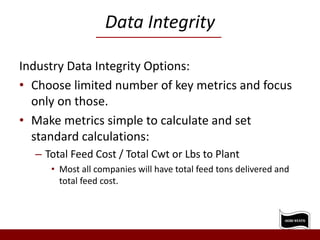
• Choose limited number of key metrics and focus
only on those.
• Make metrics simple to calculate and set
standard calculations:
– Total Feed Cost / Total Cwt or Lbs to Plant
• Most all companies will have total feed tons delivered and
total feed cost.
Data Integrity
Industry Data Integrity Options:
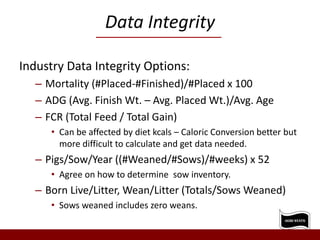
– Mortality (#Placed-#Finished)/#Placed x 100
– ADG (Avg. Finish Wt. – Avg. Placed Wt.)/Avg. Age
– FCR (Total Feed / Total Gain)
• Can be affected by diet kcals – Caloric Conversion better but
more difficult to calculate and get data needed.
– Pigs/Sow/Year ((#Weaned/#Sows)/#weeks) x 52
• Agree on how to determine sow inventory.
– Born Live/Litter, Wean/Litter (Totals/Sows Weaned)
• Sows weaned includes zero weans.
Data Integrity
Industry Data Integrity Options:
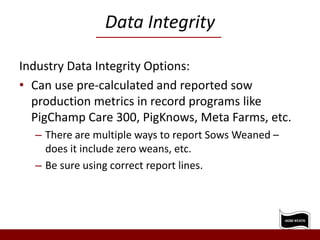
• Can use pre-calculated and reported sow
production metrics in record programs like
PigChamp Care 300, PigKnows, Meta Farms, etc.
– There are multiple ways to report Sows Weaned –
does it include zero weans, etc.
– Be sure using correct report lines.
Data Integrity
Industry Data Integrity Options:
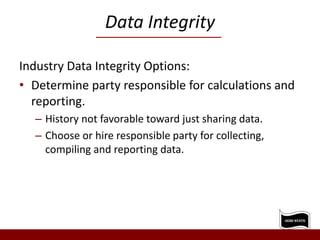
• Determine party responsible for calculations and
reporting.
– History not favorable toward just sharing data.
– Choose or hire responsible party for collecting,
compiling and reporting data.
Industry Data Integrity
Challenges
Data Integrity
Industry Data Integrity Challenges:
• Cost values are harder to calculate and compare.
– What costs should be included?
– How will costs be measured and recorded?
– How will costs be reported?
– Differences in company accounting procedures?
– How to ensure all are including the same costs?
Data Integrity
Industry Data Integrity Challenges:
• Sow cost accounting done four different ways and
each one can vary by company:
– Direct expense of gilt in the month.
• Variation in how companies determine cost per gilt.
– Depreciation.
• 2 years? 2.5 years? No industry set schedule.
– Inventory Change.
• What values used? What method used? No standard.
– Salvage Value.
• No industry standard method for starting value.
Data Integrity
Industry Data Integrity Challenges:
• Facility cost for company owned facilities:
– What labor should be included or excluded?
– How to include labor for vaccination, sorting, preg-
check crews?
– How much overhead or G&A costs to include?
– What about differences in capital interest?
– No industry uniformity or standard procedures.
Data Integrity
Industry Data Integrity Challenges:
• Semen cost:
– All boar stud costs included?
– Labor, depreciation, overhead?
– Semen transportation?
– AI materials easier to include.
– How to handle boar cost, depreciation?
– Differences in genetic royalty methods.
Data Integrity
Industry Data Integrity Challenges:
• Pig Placement cost:
– Cost of weaned pig going into nursery or wean-finish.
– Cost of feeder pig going into finishing.
– Differences in how companies calculate this and what
is included.
– Standard values?
Data Integrity
Industry Data Integrity Challenges:
• Medication and Vaccination cost:
– Can have noise depending on when vaccine is given –
circo given at sow farm when weaned or at nursery?
– Vet costs included? All vet expense?
– Diagnostics and lab tests?
– Include many things then cannot evaluate med &
vaccination cost.
Summary
Data Integrity
• Benchmarking is very important but it is hard to
make sure data is comparable across companies.
• Even if all companies include the same costs the
costs can be calculated differently.
• Lots of variation in cost accounting in industry.
• Companies can select key metrics, common
calculations and implement an effective
benchmarking program.
Data Integrity
• Procedures can be put in place to facilitate data
integrity:
– Common calculations.
– Agree on calculation and data collection procedures.
– Determine tolerance and outlier status and enforce.
– Invest time to develop and implement procedures.
– Have an administrator to compile the data and
enforce procedures.
– Each participant has to commit.
Thank You!
Greg Bilbrey
Agri Stats
260 – 433 – 9969
gbilbrey@agristats.com

Greg Bilbrey - Data Integrity, Using Records for Benchmarking and Operations

  • 1.
    Data Integrity Greg Bilbrey AgriStats, Inc. September 21, 2015 Science-driven solutionsTM
  • 2.
    Agenda • Agri Statsintro • Agri Stats data integrity procedures • Industry data integrity options • Industry data integrity challenges • Summary
  • 3.
    Agri Stats • Professionalinternational benchmarking company – swine, broiler, turkey, eggs. – USA, Canada, Mexico – Brazil, Chile – Russia – South Korea • Started 1985 • Office – Fort Wayne, IN; ~100 people
  • 4.
    Agri Stats • 28companies, 2.3m sows, 50m pigs – USA, CAN • Companies submit financial and production data electronically each month. • Agri Stats audit - each company data monthly. • Monthly report – month, quarter, 12 months. • Monthly graphs – company, average, top 25%, region or sub-region.
  • 5.
    Data Integrity Agri StatsData Integrity Procedures: • Formal setup new participants – One week on site to learn company accounting, collect data. – Three weeks in office to finish setup. – Ensures data & process similar all companies. • Test report review & reconciliations to check data before including in comparison. • Electronic data submission & conversion.
  • 6.
    Data Integrity Agri StatsData Integrity Procedures: • Turn company data over to audit team. • Audit team learns company, audits monthly. • Know all farms – expect, check for data to make sure all farms included each month. – Farms included through PRRS, PEDv, etc. – Farms excluded from production data when production stops during depops, costs included
  • 7.
    Data Integrity Agri StatsData Integrity Procedures: • Audit team ties to company financials monthly. – Contact company if new cost centers submitted. – Contact company if see irregularities in cost or production data. • Audit report shows company variance by month for six consecutive months – tolerance allowance. – Auditors run for each company before monthly final.
  • 8.
    Data Integrity Agri StatsData Integrity Procedures: • Compare feed formula cost to financial cost each month. – Check with company for issues if +/- $5/ton. – Explain reasons to account management team monthly via audit notes. – Helps ensure getting accurate cost and current formulas.
  • 9.
    Data Integrity Agri StatsData Integrity Procedures: • Compare Agri Stats calculated final diet kcals to company formulation each month. – Checking with company to ensure current formulas and correct ingredient specs if +/- 10 kcals. – Helps ensure reporting actual cost, correct nutrient values, correct kcals for caloric feed conversion. – Serves as check for system and process. – Important in feed cost evaluation.
  • 10.
    Data Integrity Agri StatsData Integrity Procedures: • Column limits used to check and protect data: – Min and max limits set on key columns. – Values outside of limits fall out of data and alert auditors to issue. – Audit team checks data submitted, data converted, calculation and process for errors. If none found then contact company to resolve issue. – Allow to limit off if no resolution or known issue that could identify company (fire, tornado, etc.).
  • 11.
    Data Integrity Agri StatsData Integrity Procedures: • Same calculations for all companies: – Do not use company performance calculations except as a check. – Use company raw data in Agri Stats calculations for all companies. – Eliminates uncertainty and confusion of calculation method and variation created by companies using different calculations.
  • 12.
  • 13.
    Data Integrity Industry DataIntegrity Options: • Choose limited number of key metrics and focus only on those. • Make metrics simple to calculate and set standard calculations: – Total Feed Cost / Total Cwt or Lbs to Plant • Most all companies will have total feed tons delivered and total feed cost.
  • 14.
    Data Integrity Industry DataIntegrity Options: – Mortality (#Placed-#Finished)/#Placed x 100 – ADG (Avg. Finish Wt. – Avg. Placed Wt.)/Avg. Age – FCR (Total Feed / Total Gain) • Can be affected by diet kcals – Caloric Conversion better but more difficult to calculate and get data needed. – Pigs/Sow/Year ((#Weaned/#Sows)/#weeks) x 52 • Agree on how to determine sow inventory. – Born Live/Litter, Wean/Litter (Totals/Sows Weaned) • Sows weaned includes zero weans.
  • 15.
    Data Integrity Industry DataIntegrity Options: • Can use pre-calculated and reported sow production metrics in record programs like PigChamp Care 300, PigKnows, Meta Farms, etc. – There are multiple ways to report Sows Weaned – does it include zero weans, etc. – Be sure using correct report lines.
  • 16.
    Data Integrity Industry DataIntegrity Options: • Determine party responsible for calculations and reporting. – History not favorable toward just sharing data. – Choose or hire responsible party for collecting, compiling and reporting data.
  • 17.
  • 18.
    Data Integrity Industry DataIntegrity Challenges: • Cost values are harder to calculate and compare. – What costs should be included? – How will costs be measured and recorded? – How will costs be reported? – Differences in company accounting procedures? – How to ensure all are including the same costs?
  • 19.
    Data Integrity Industry DataIntegrity Challenges: • Sow cost accounting done four different ways and each one can vary by company: – Direct expense of gilt in the month. • Variation in how companies determine cost per gilt. – Depreciation. • 2 years? 2.5 years? No industry set schedule. – Inventory Change. • What values used? What method used? No standard. – Salvage Value. • No industry standard method for starting value.
  • 20.
    Data Integrity Industry DataIntegrity Challenges: • Facility cost for company owned facilities: – What labor should be included or excluded? – How to include labor for vaccination, sorting, preg- check crews? – How much overhead or G&A costs to include? – What about differences in capital interest? – No industry uniformity or standard procedures.
  • 21.
    Data Integrity Industry DataIntegrity Challenges: • Semen cost: – All boar stud costs included? – Labor, depreciation, overhead? – Semen transportation? – AI materials easier to include. – How to handle boar cost, depreciation? – Differences in genetic royalty methods.
  • 22.
    Data Integrity Industry DataIntegrity Challenges: • Pig Placement cost: – Cost of weaned pig going into nursery or wean-finish. – Cost of feeder pig going into finishing. – Differences in how companies calculate this and what is included. – Standard values?
  • 23.
    Data Integrity Industry DataIntegrity Challenges: • Medication and Vaccination cost: – Can have noise depending on when vaccine is given – circo given at sow farm when weaned or at nursery? – Vet costs included? All vet expense? – Diagnostics and lab tests? – Include many things then cannot evaluate med & vaccination cost.
  • 24.
  • 25.
    Data Integrity • Benchmarkingis very important but it is hard to make sure data is comparable across companies. • Even if all companies include the same costs the costs can be calculated differently. • Lots of variation in cost accounting in industry. • Companies can select key metrics, common calculations and implement an effective benchmarking program.
  • 26.
    Data Integrity • Procedurescan be put in place to facilitate data integrity: – Common calculations. – Agree on calculation and data collection procedures. – Determine tolerance and outlier status and enforce. – Invest time to develop and implement procedures. – Have an administrator to compile the data and enforce procedures. – Each participant has to commit.
  • 27.
    Thank You! Greg Bilbrey AgriStats 260 – 433 – 9969 gbilbrey@agristats.com