
Click to edit Master subtitle style

8th
JIEEEC
Amman,
Jordan
17 April 2013
Pavel Loskot
p.loskot@swan.ac.uk
2/32
•
April 2008 workshops defined 2 targets:
•
identify cross-layer techniques to obtain 100x energy reduction
•
identify green network architecture including backhaul
Green Radio project (Jan. 2009 – June 2012)
3/32
Why and How of Green Communications
1. Initial considerations
2. Statistics and observations
3. Metrics and measurements
4. Approaches and solutions
5. Future trends
4/32
Why and how of Green communications
1. Initial considerations
2. Statistics and observations
3. Metrics and measurements
4. Approaches and solutions
5. Future trends
5/32
Green comms – first look
•
energy together with information is one of the most complex and
fundamental subjects
1) Primary contributors to CO2
emissions:
•
electric power generation, transport, manufacturing
•
ICT accounts for only 3% (electronics in household 5%)
2) Rising fuel cost:
•
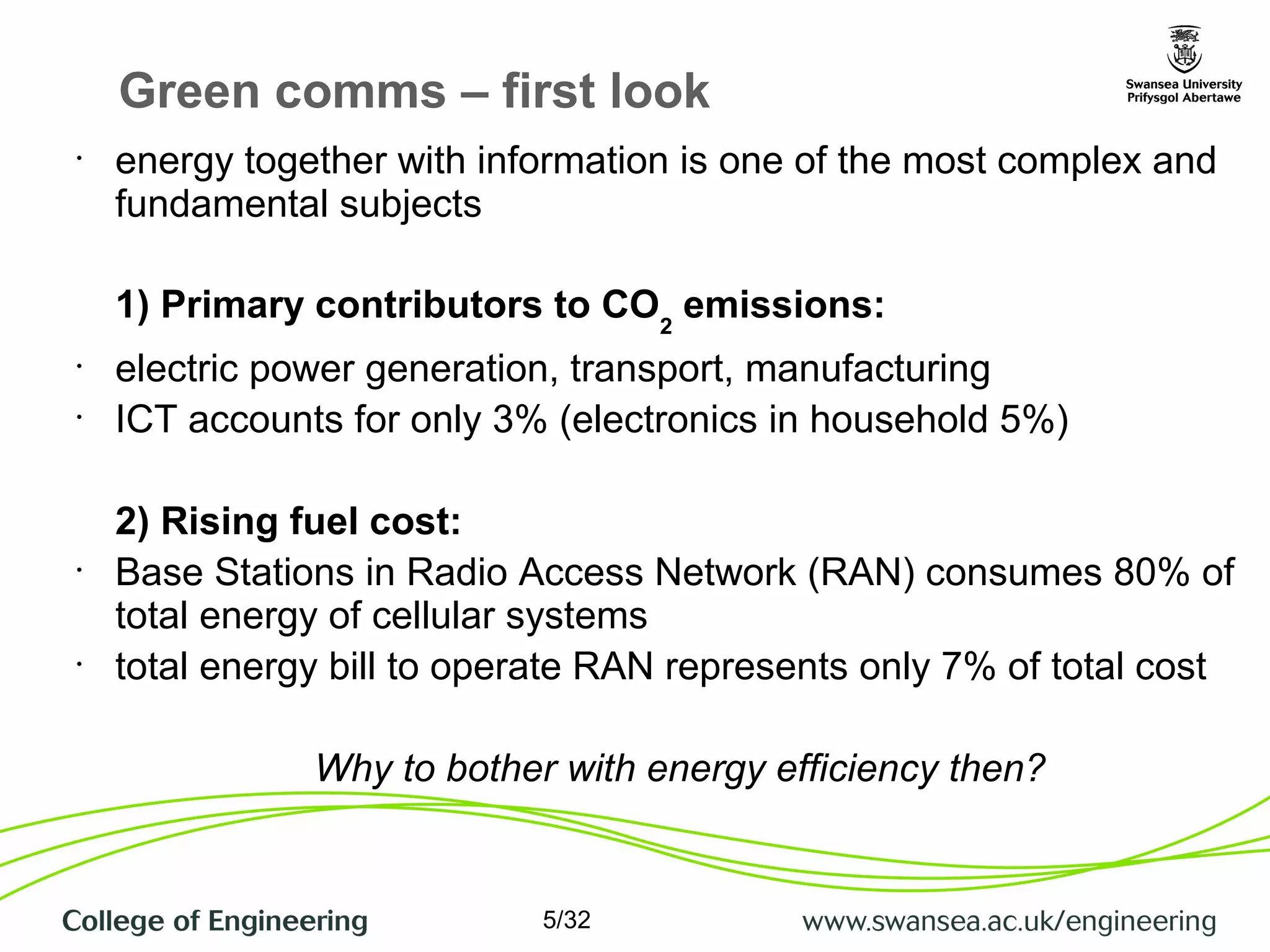
Base Stations in Radio Access Network (RAN) consumes 80% of
total energy of cellular systems
•
total energy bill to operate RAN represents only 7% of total cost
Why to bother with energy efficiency then?
6/32
Green comms – main motivations
•
Growth of wireless access:
•
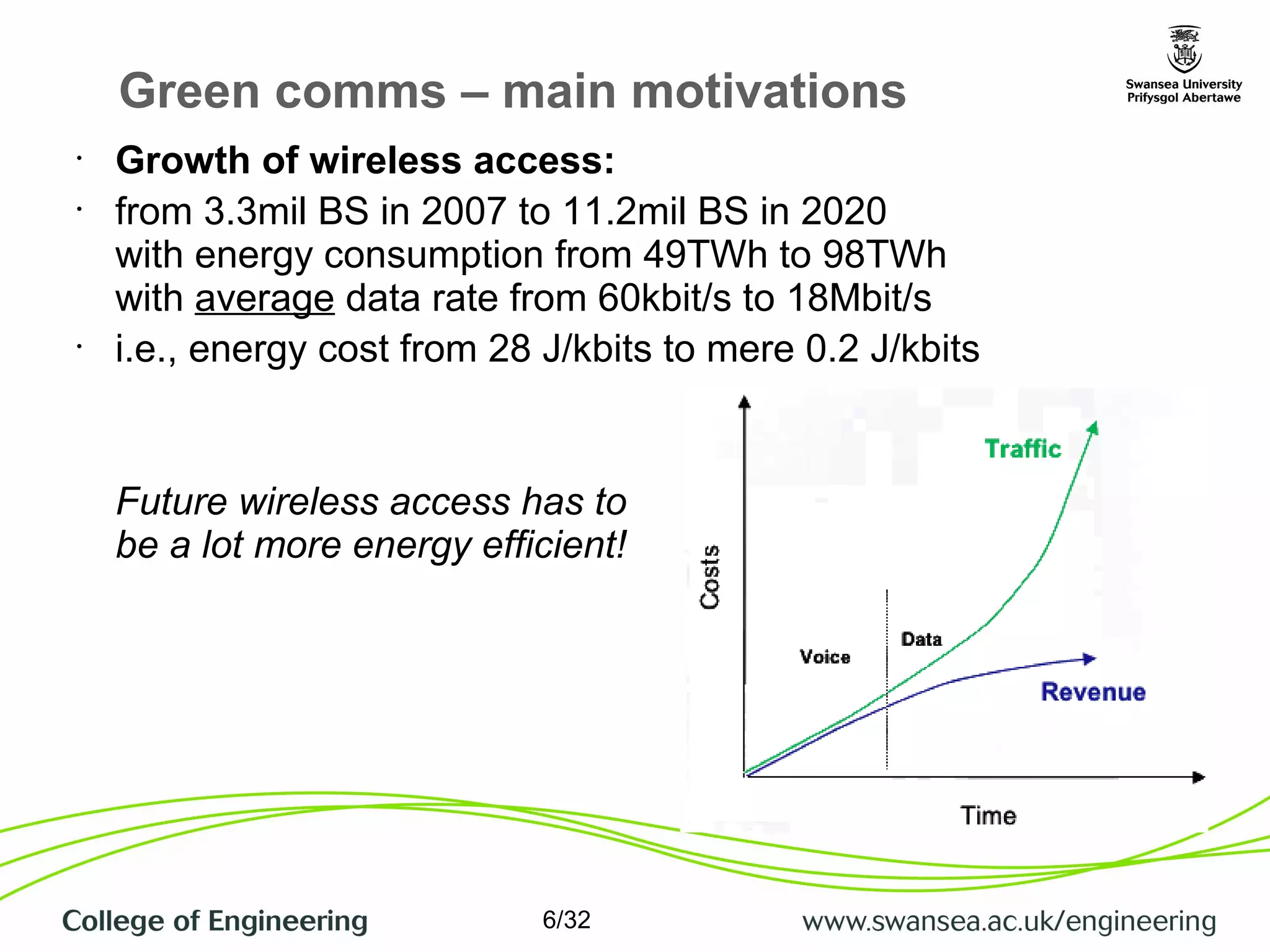
from 3.3mil BS in 2007 to 11.2mil BS in 2020
with energy consumption from 49TWh to 98TWh
with average data rate from 60kbit/s to 18Mbit/s
•
i.e., energy cost from 28 J/kbits to mere 0.2 J/kbits
Future wireless access has to
be a lot more energy efficient!
7/32
Green comms – resource management
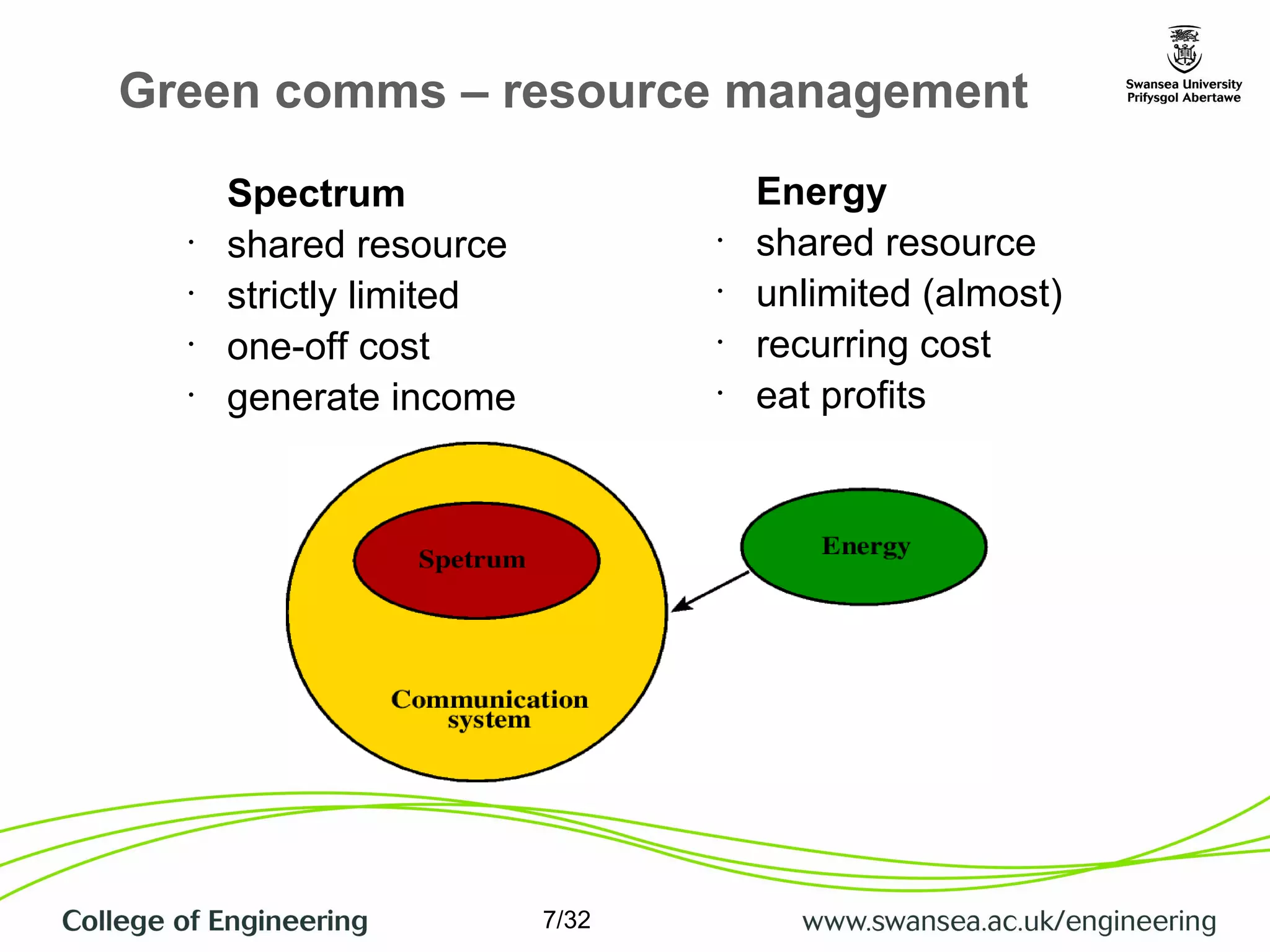
Spectrum
•
shared resource
•
strictly limited
•
one-off cost
•
generate income
Energy
•
shared resource
•
unlimited (almost)
•
recurring cost
•
eat profits
8/32
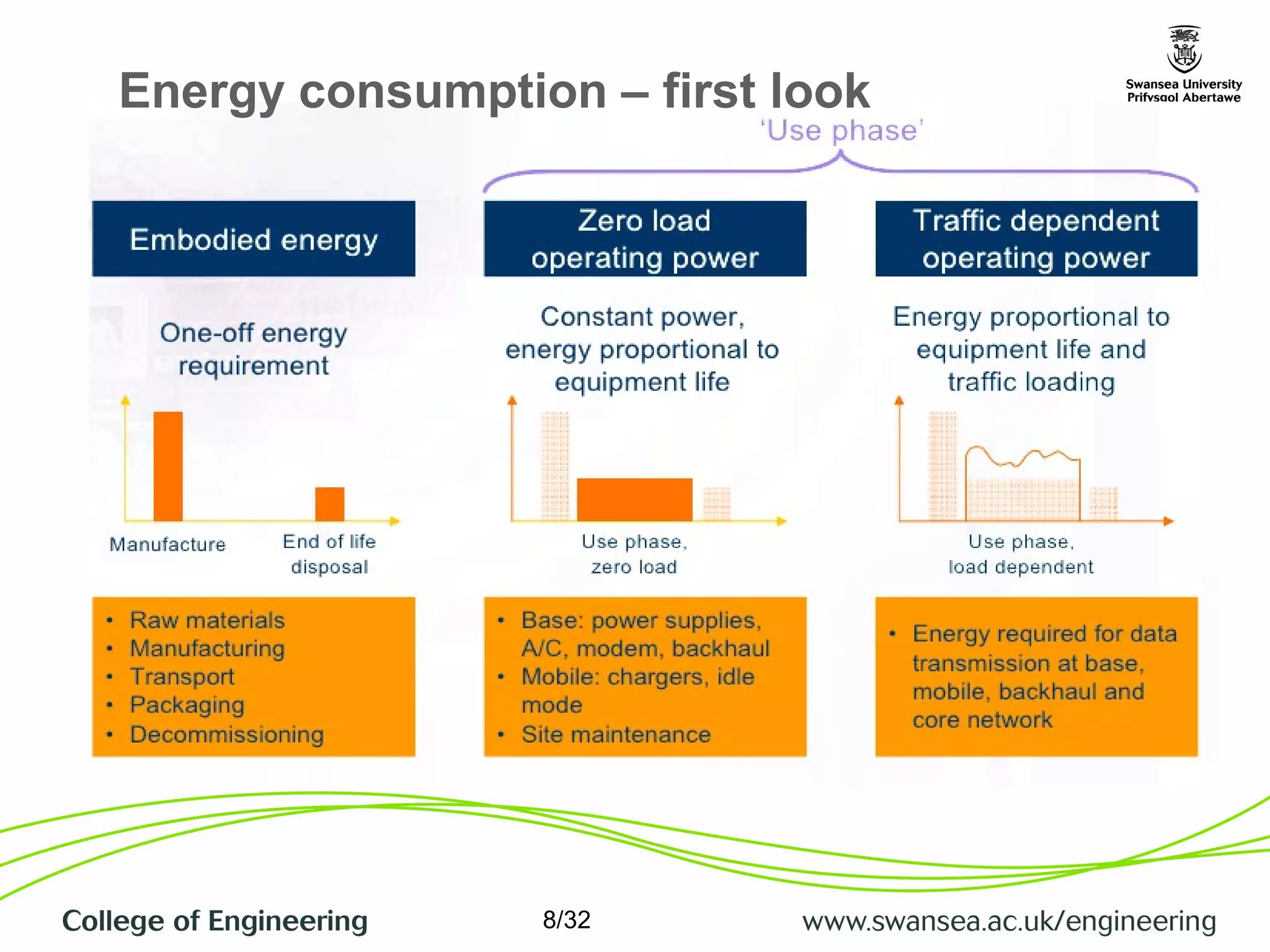
Energy consumption – first look
9/32
Why and how of Green communications
1. Initial considerations
2. Statistics and observations
3. Metrics and measurements
4. Approaches and solutions
5. Future trends
10/32
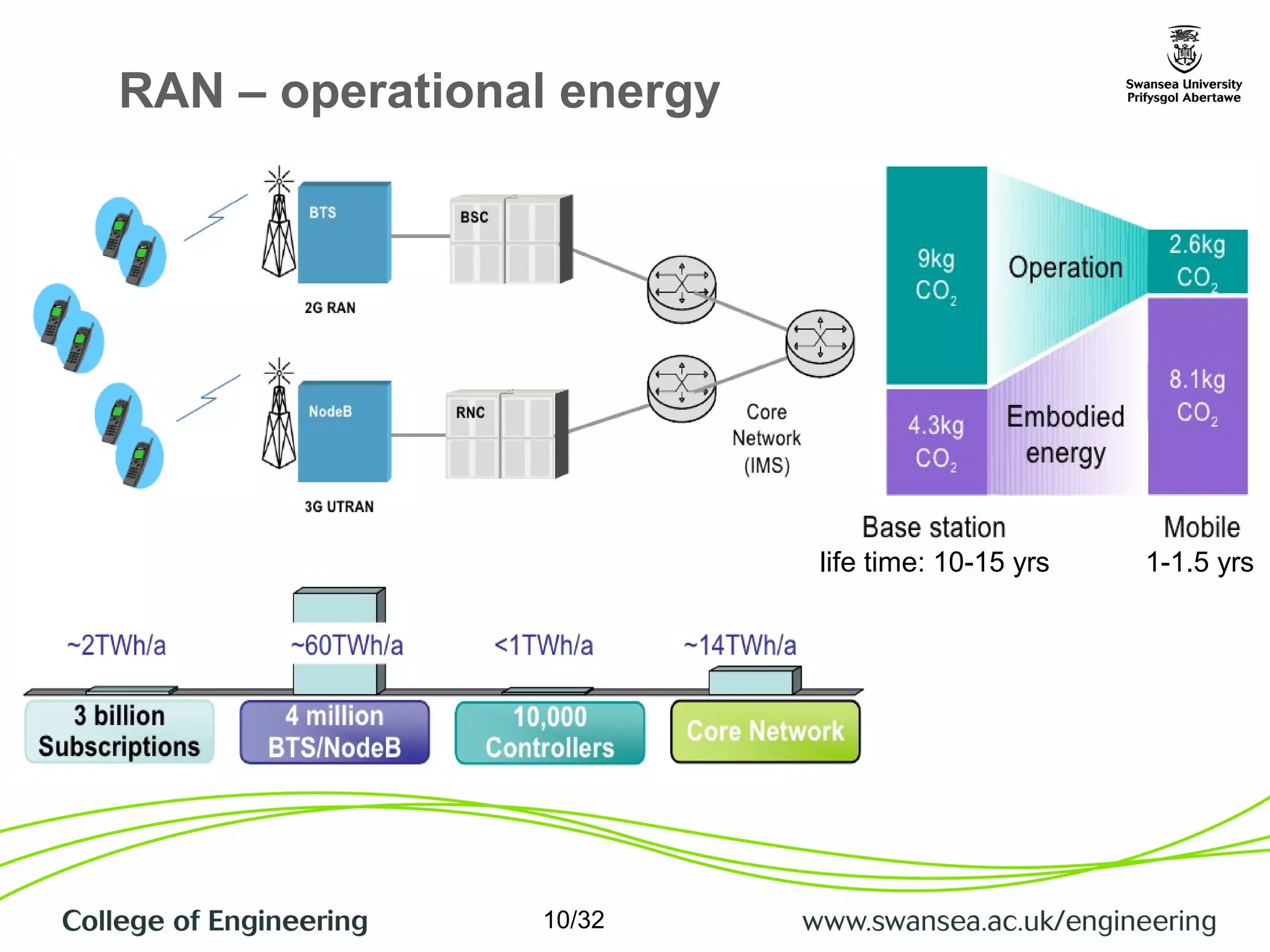
RAN – operational energy
life time: 10-15 yrs 1-1.5 yrs
11/32
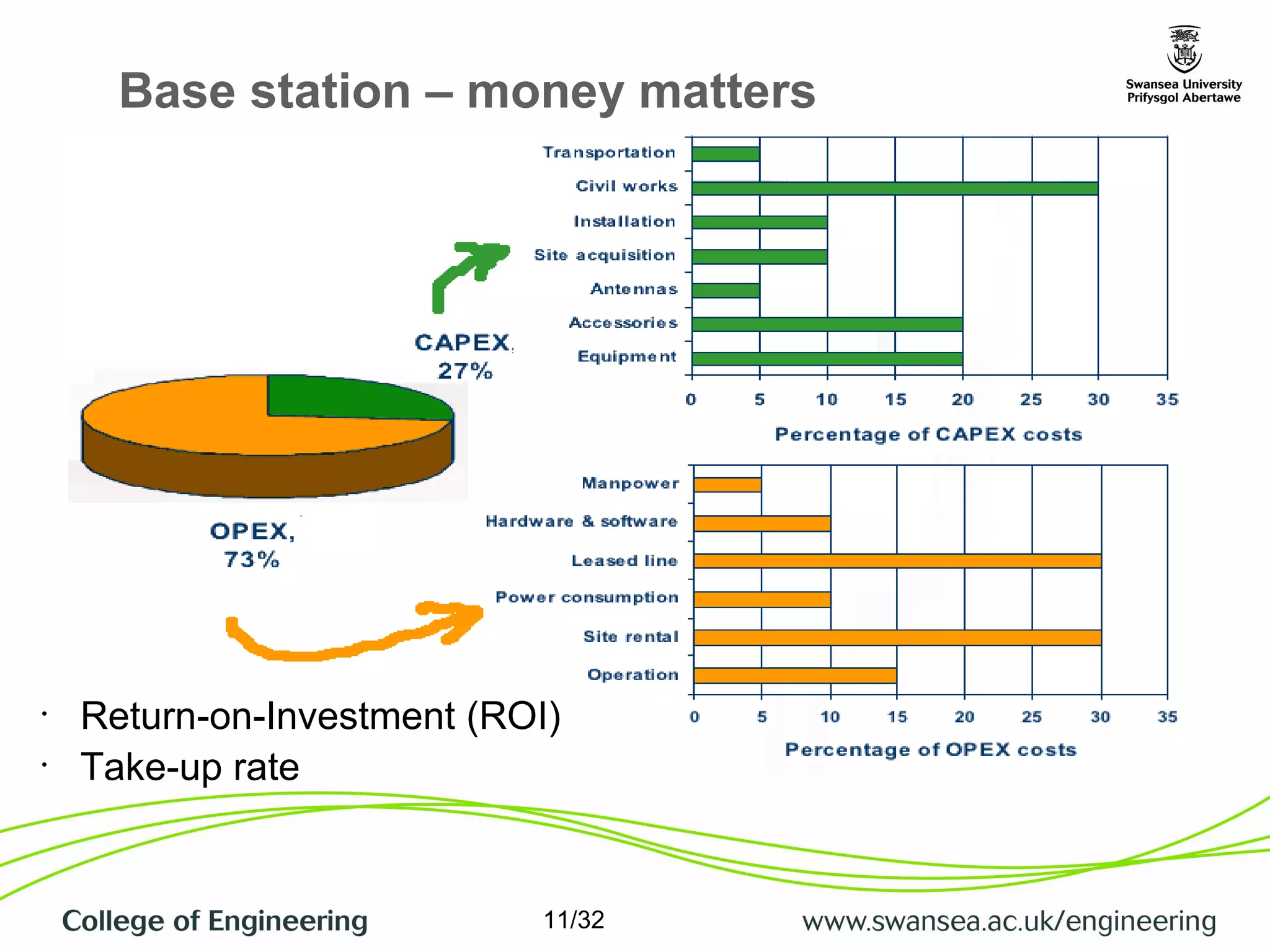
Base station – money matters
•
Return-on-Investment (ROI)
•
Take-up rate
12/32
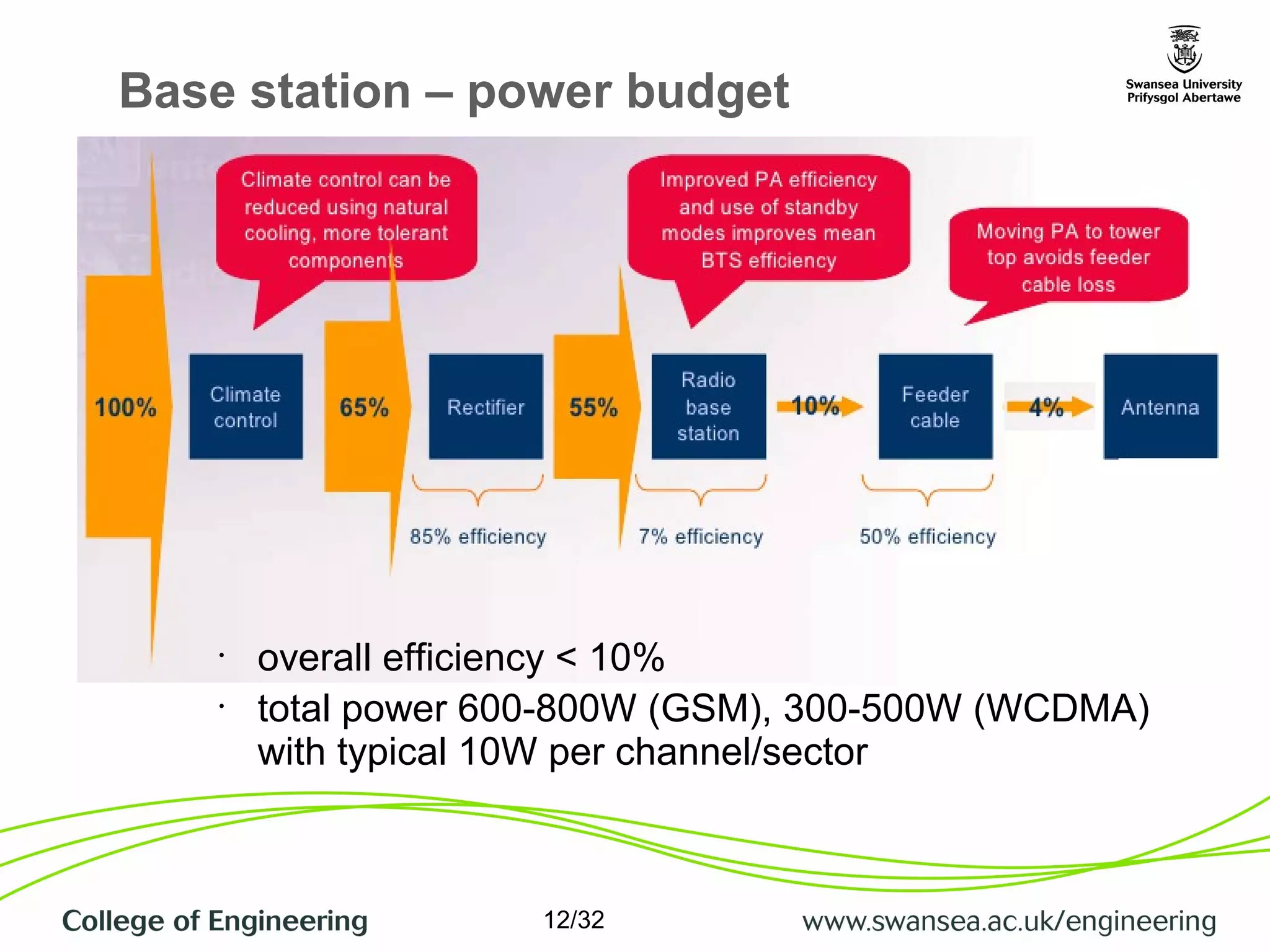
Base station – power budget
•
overall efficiency < 10%
•
total power 600-800W (GSM), 300-500W (WCDMA)
with typical 10W per channel/sector
13/32
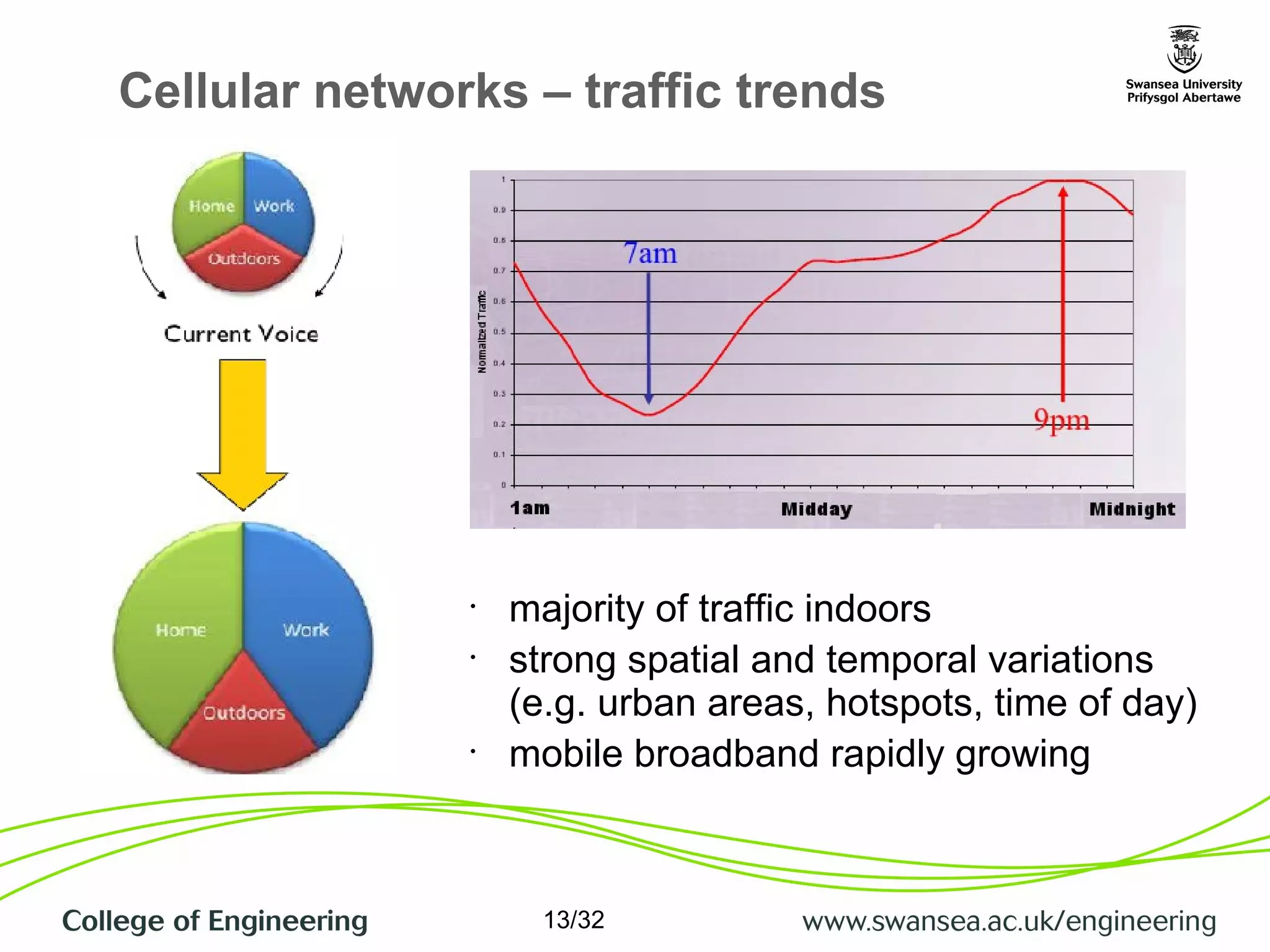
Cellular networks – traffic trends
•
majority of traffic indoors
•
strong spatial and temporal variations
(e.g. urban areas, hotspots, time of day)
•
mobile broadband rapidly growing
14/32
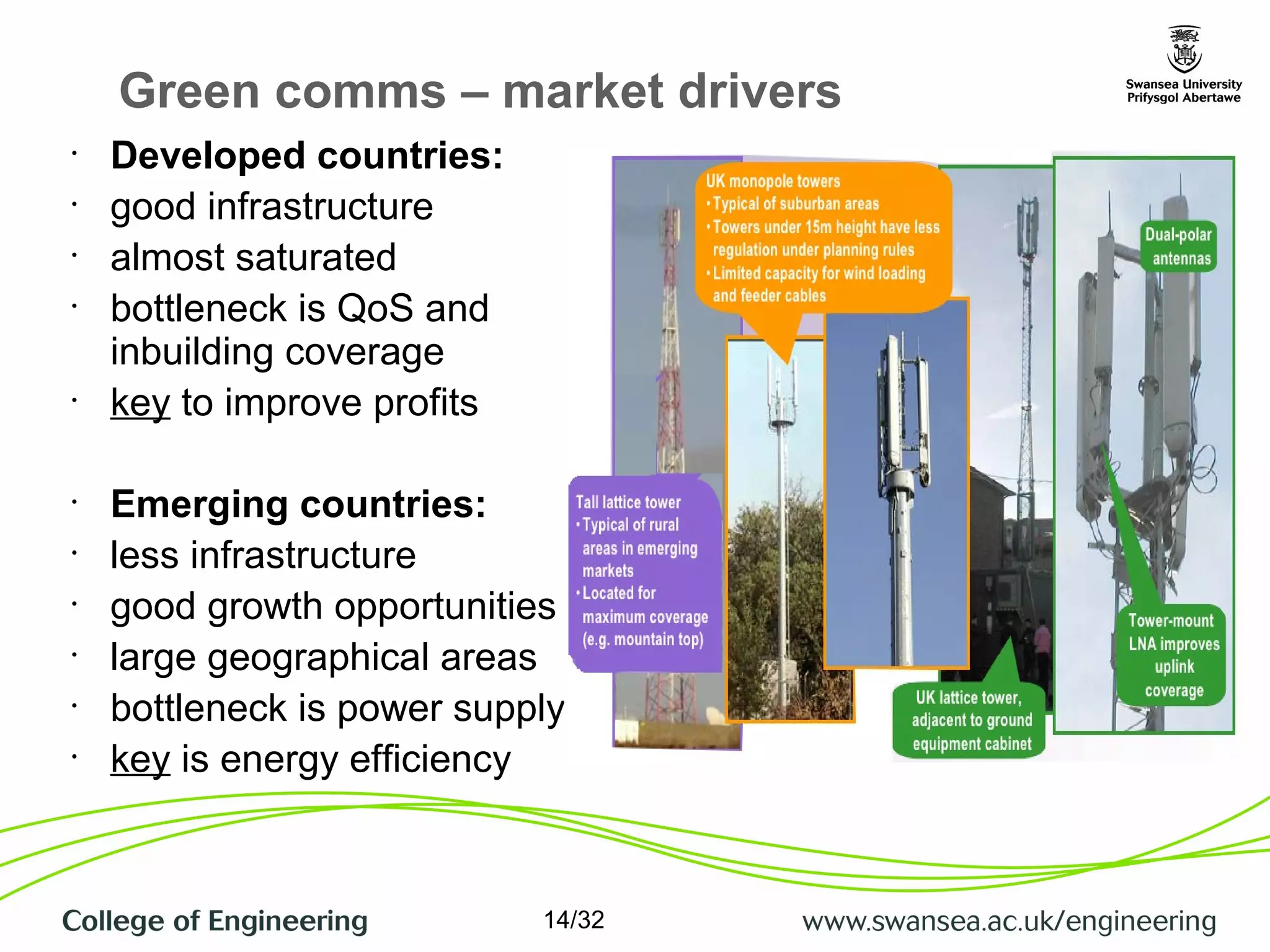
Green comms – market drivers
•
Developed countries:
•
good infrastructure
•
almost saturated
•
bottleneck is QoS and
inbuilding coverage
•
key to improve profits
•
Emerging countries:
•
less infrastructure
•
good growth opportunities
•
large geographical areas
•
bottleneck is power supply
•
key is energy efficiency
15/32
Why and how of Green communications
1. Initial considerations
2. Statistics and observations
3. Metrics and measurements
4. Approaches and solutions
5. Future trends
16/32
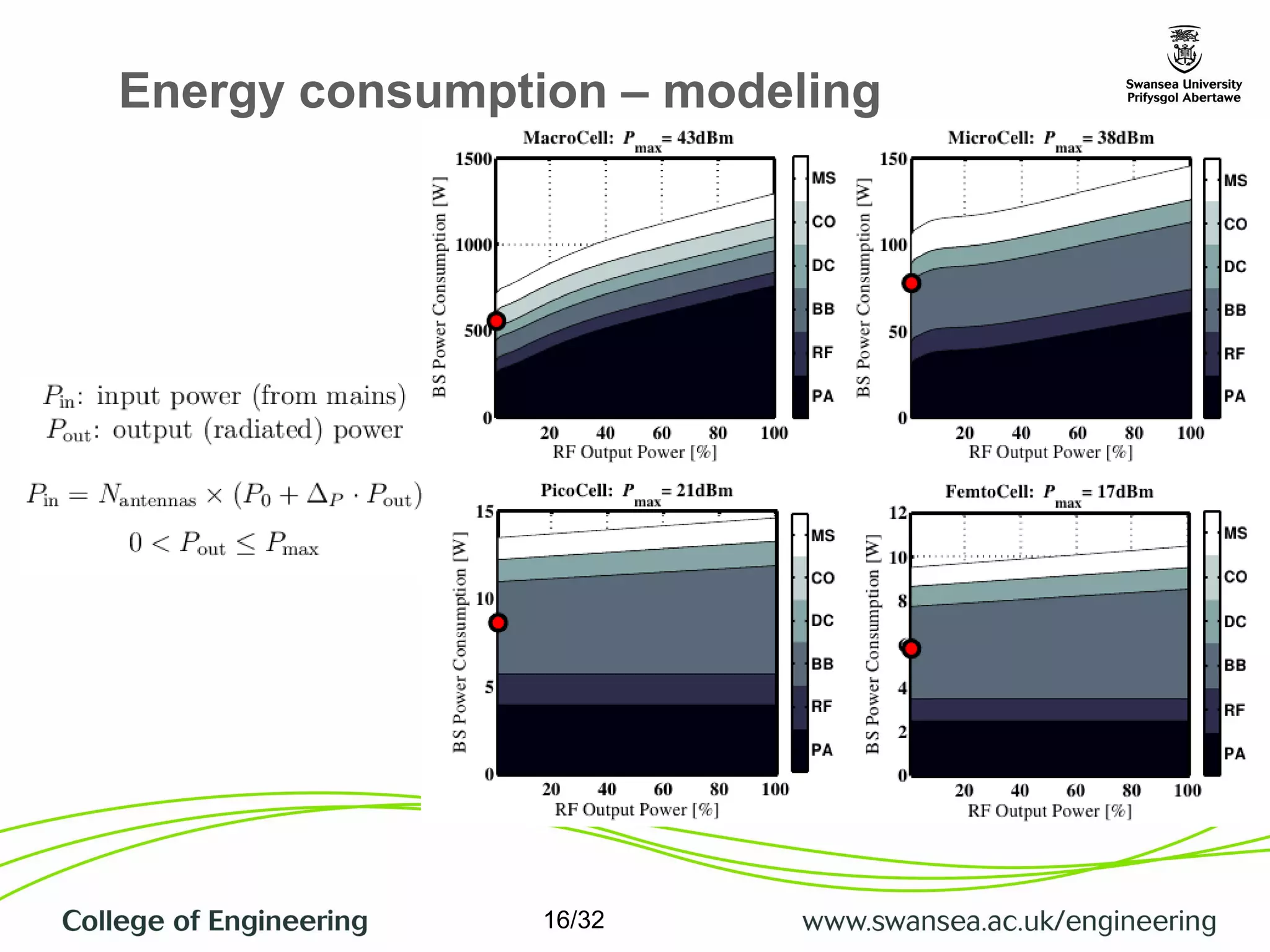
Energy consumption – modeling
17/32
Energy consumption – modeling
•
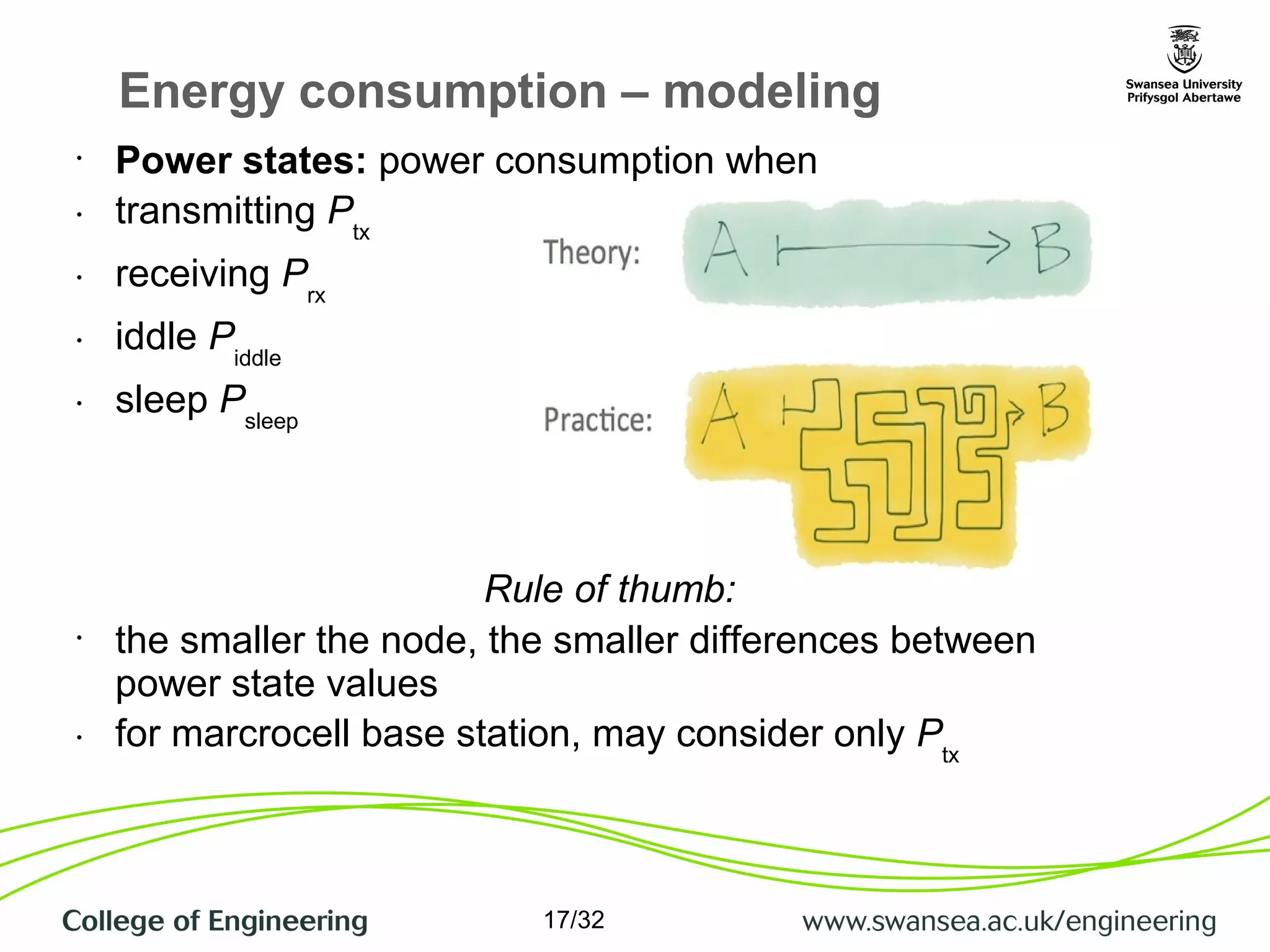
Power states: power consumption when
• transmitting Ptx
• receiving Prx
• iddle Piddle
• sleep Psleep
Rule of thumb:
•
the smaller the node, the smaller differences between
power state values
• for marcrocell base station, may consider only Ptx
18/32
Energy – measurements
•
1. Energy metrics
•
what quantities to report (peak, average, effective values)
•
equipment or whole sub-systems
•
2. Measurement procedures
•
methodology, conditions, vendor-neutral
•
Standardization efforts:
•
European Telecommunications Standards Institute (ETSI)
•
Alliance for Telecommunications Industry Solutions (ATIS)
•
International Telecommunication Union (ITU)
•
Energy Consumption Rating (ECR) Initiative
19/32
Energy – metrics
•
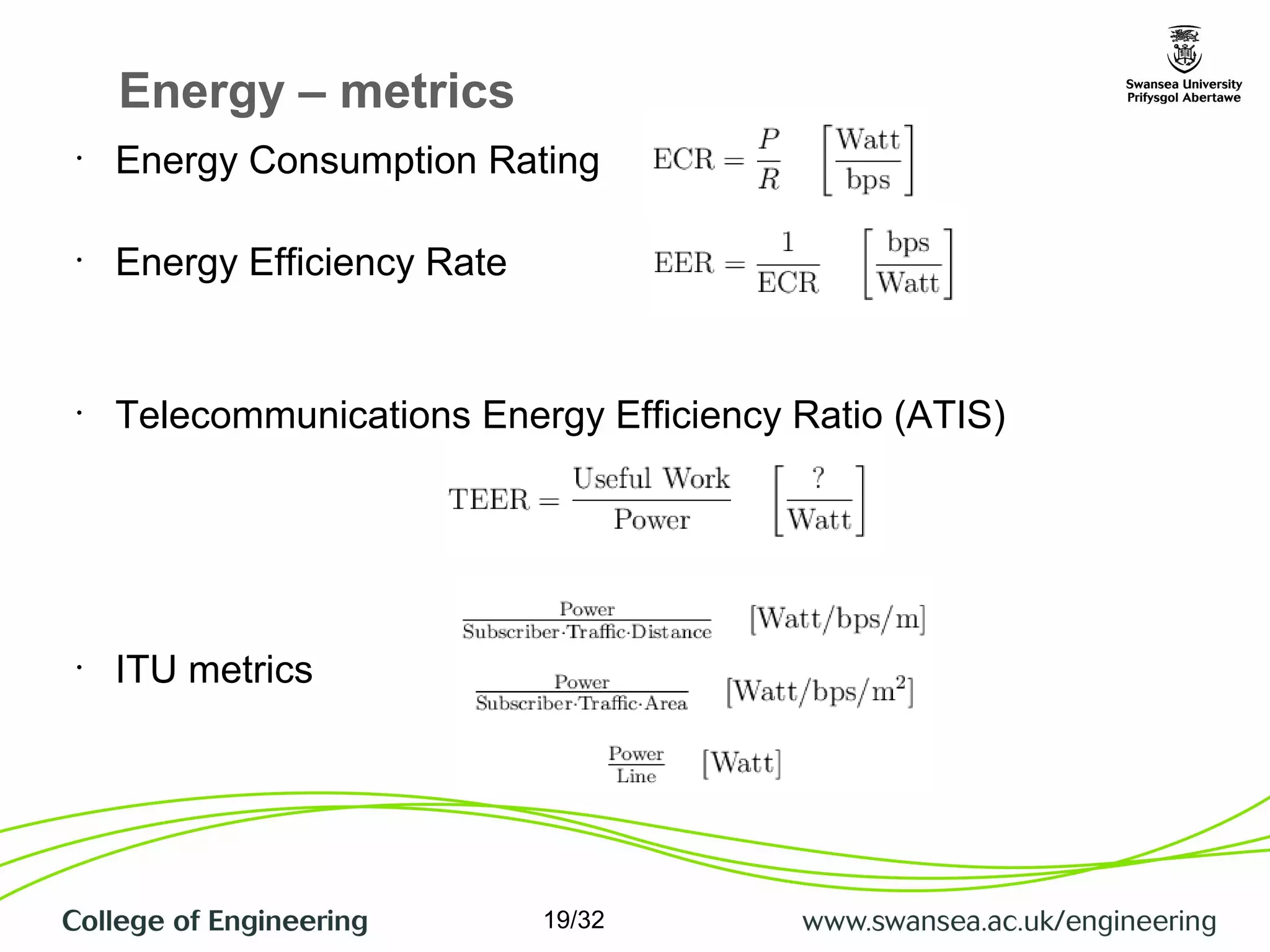
Energy Consumption Rating
•
Energy Efficiency Rate
•
Telecommunications Energy Efficiency Ratio (ATIS)
•
ITU metrics
20/32
Energy metrics – Radio Access Networks
•
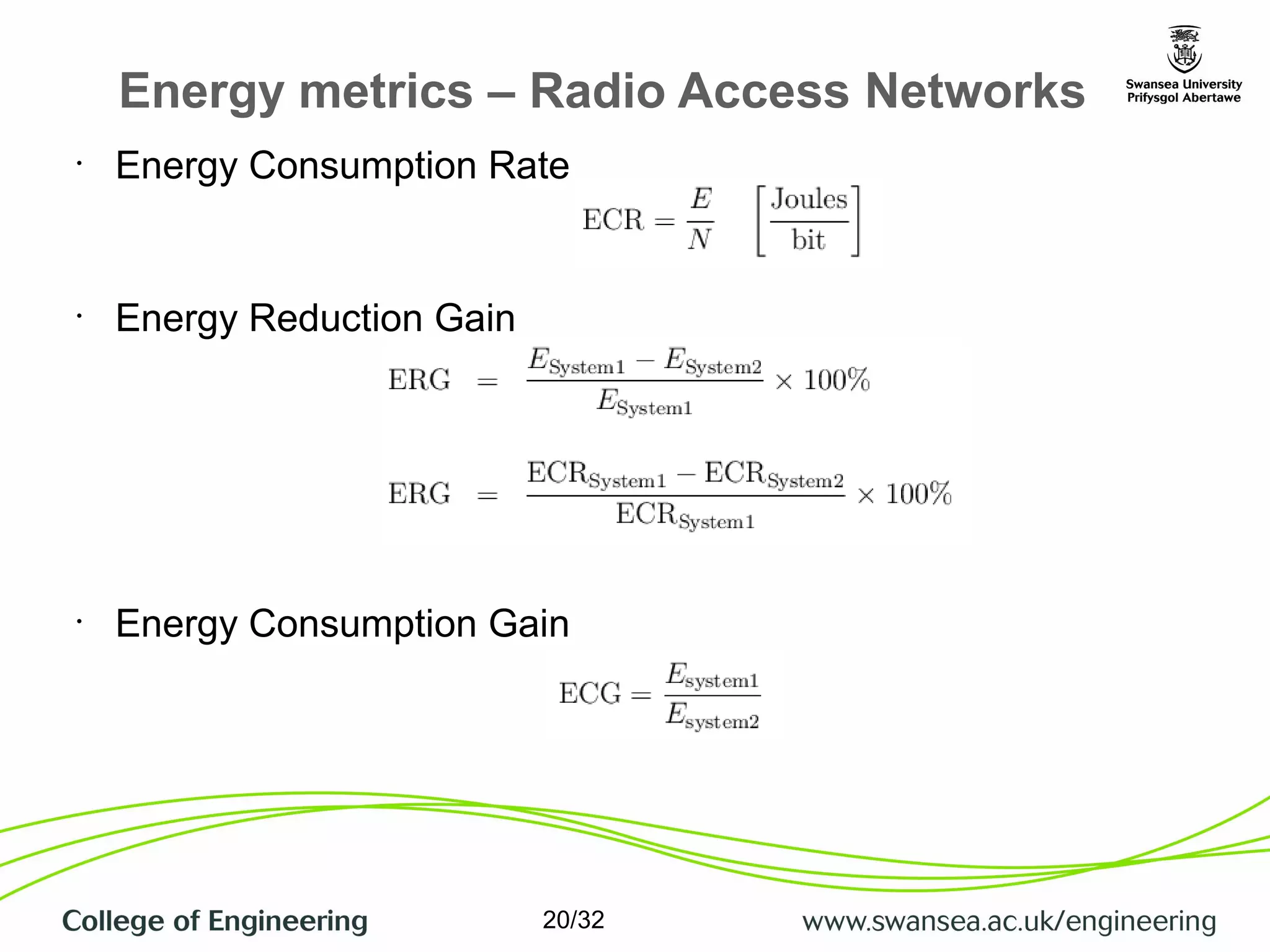
Energy Consumption Rate
•
Energy Reduction Gain
•
Energy Consumption Gain
21/32
Why and how of Green communications
1. Initial considerations
2. Statistics and observations
3. Metrics and measurements
4. Approaches and solutions
5. Future trends
22/32
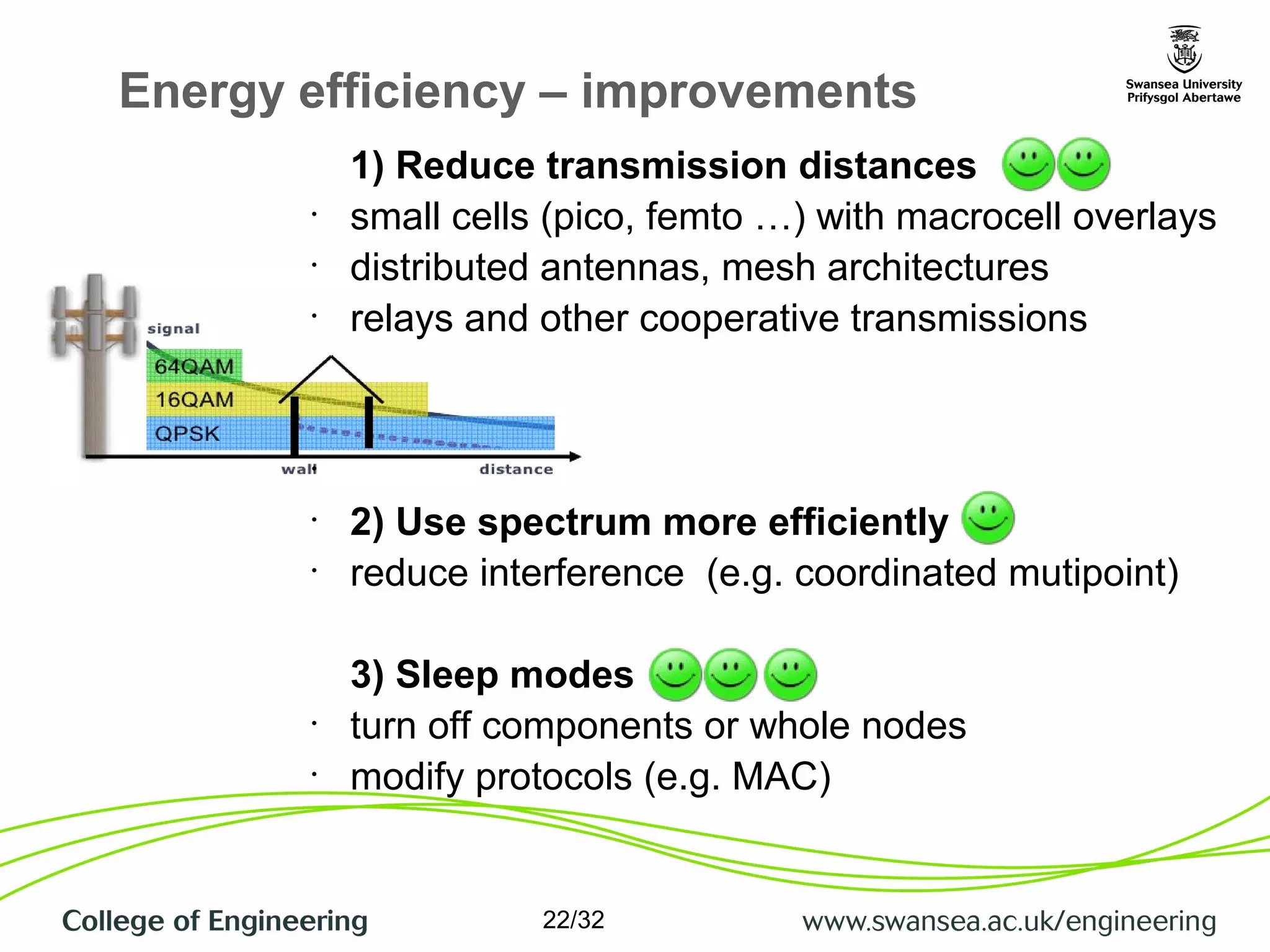
Energy efficiency – improvements
1) Reduce transmission distances
•
small cells (pico, femto …) with macrocell overlays
•
distributed antennas, mesh architectures
•
relays and other cooperative transmissions
•
•
2) Use spectrum more efficiently
•
reduce interference (e.g. coordinated mutipoint)
3) Sleep modes
•
turn off components or whole nodes
•
modify protocols (e.g. MAC)
23/32
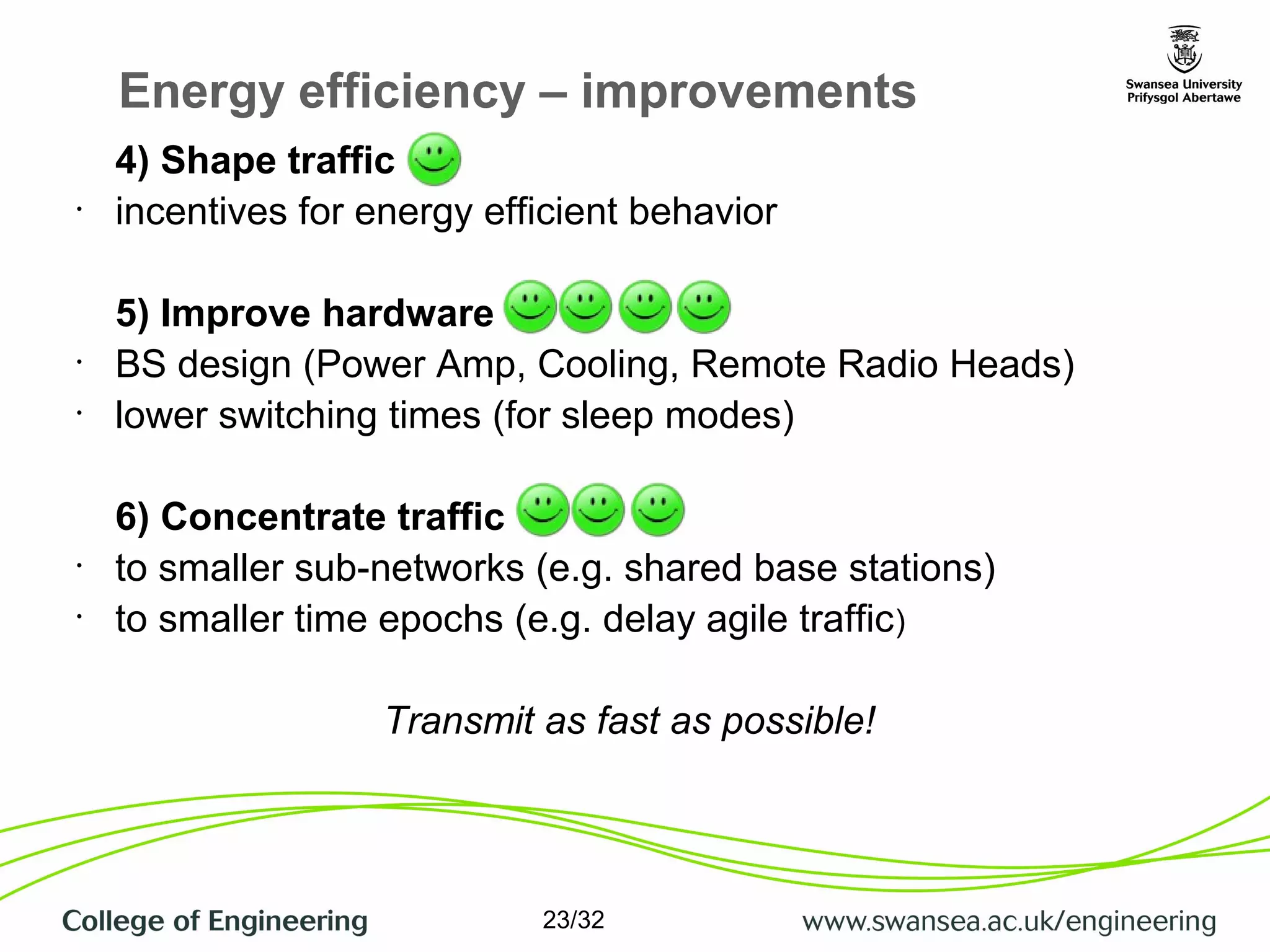
Energy efficiency – improvements
4) Shape traffic
•
incentives for energy efficient behavior
5) Improve hardware
•
BS design (Power Amp, Cooling, Remote Radio Heads)
•
lower switching times (for sleep modes)
6) Concentrate traffic
•
to smaller sub-networks (e.g. shared base stations)
•
to smaller time epochs (e.g. delay agile traffic)
Transmit as fast as possible!
24/32
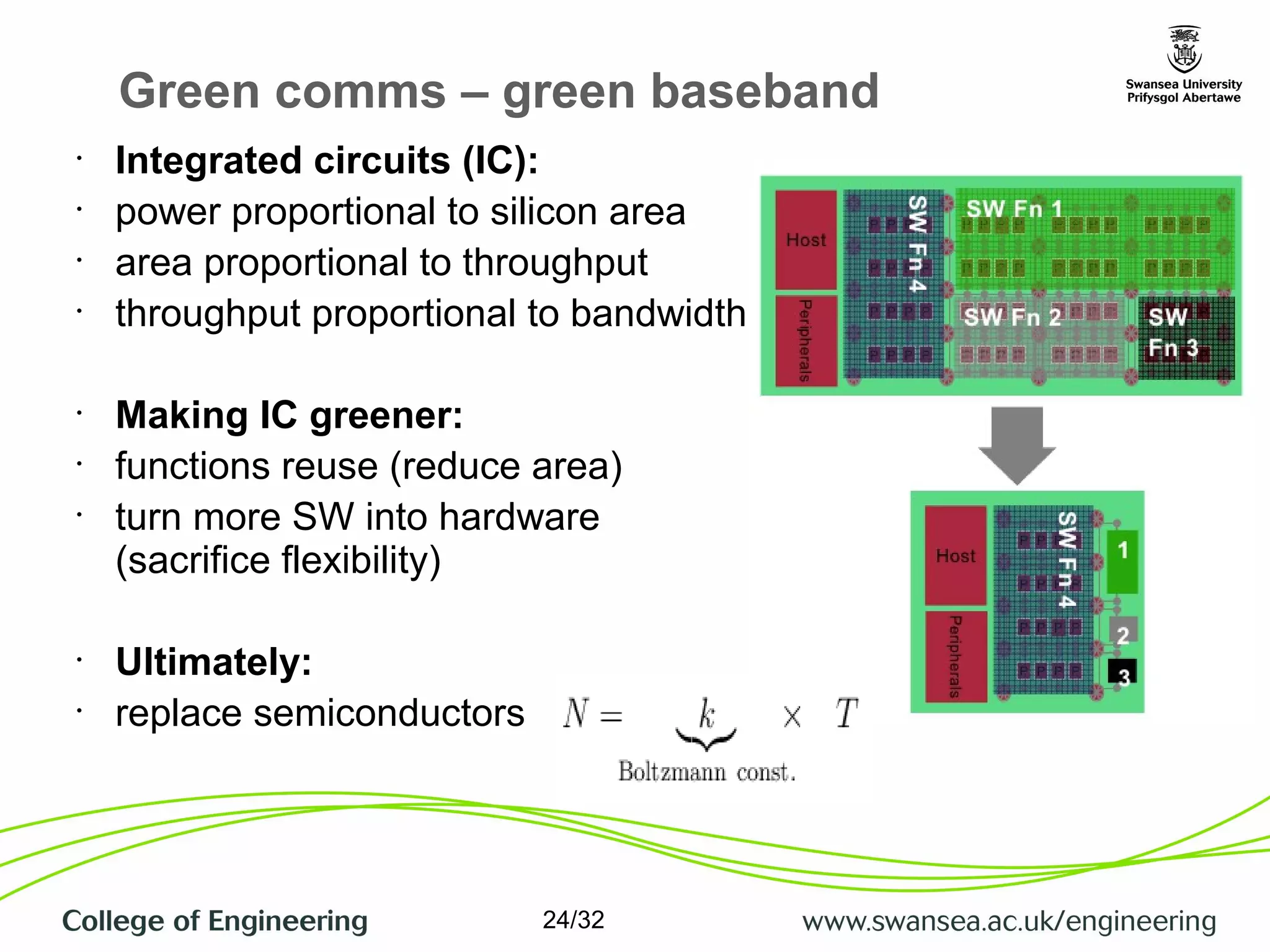
Green comms – green baseband
•
Integrated circuits (IC):
•
power proportional to silicon area
•
area proportional to throughput
•
throughput proportional to bandwidth
•
Making IC greener:
•
functions reuse (reduce area)
•
turn more SW into hardware
(sacrifice flexibility)
•
Ultimately:
•
replace semiconductors
25/32
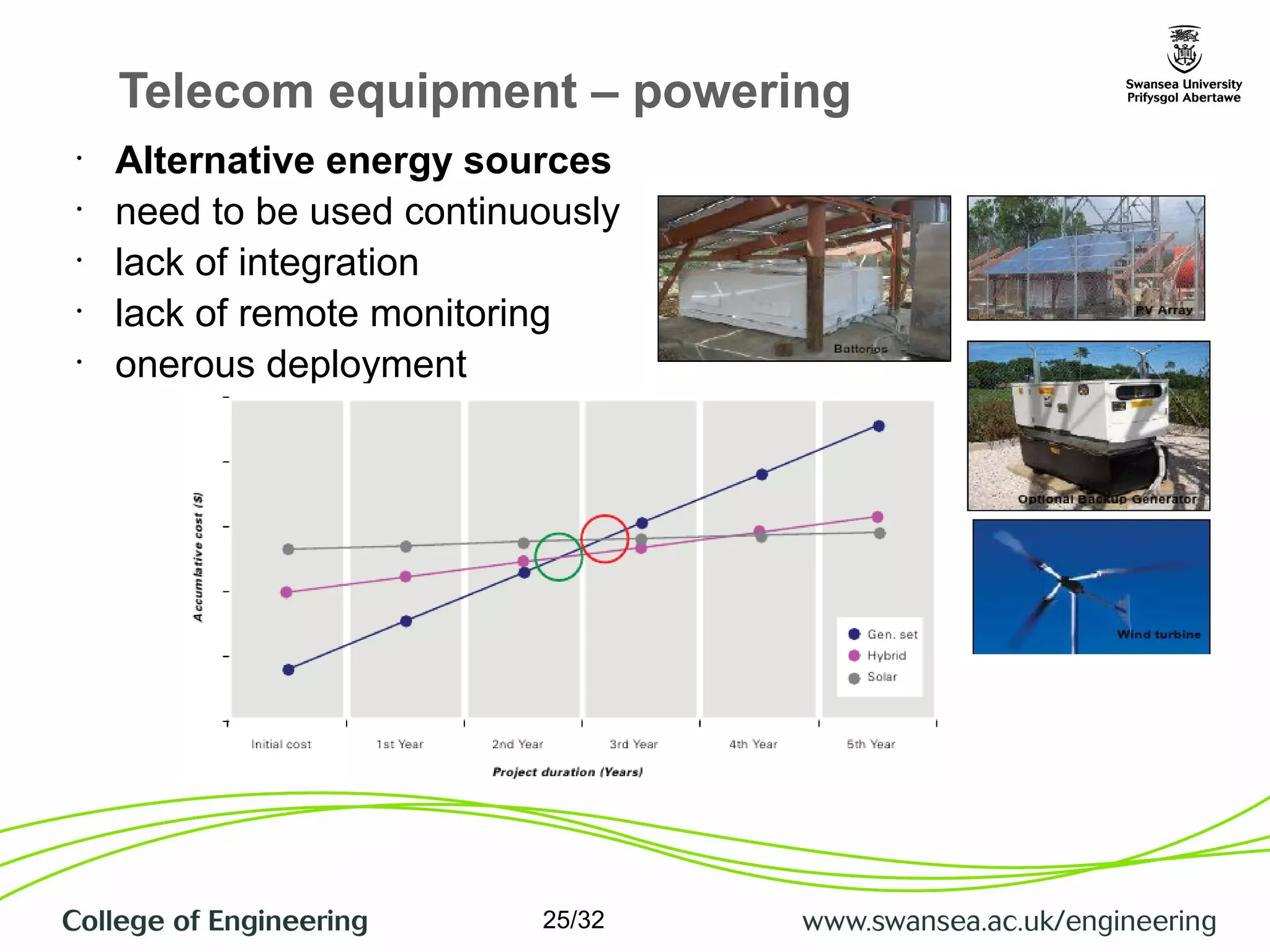
Telecom equipment – powering
•
Alternative energy sources
•
need to be used continuously
•
lack of integration
•
lack of remote monitoring
•
onerous deployment
26/32
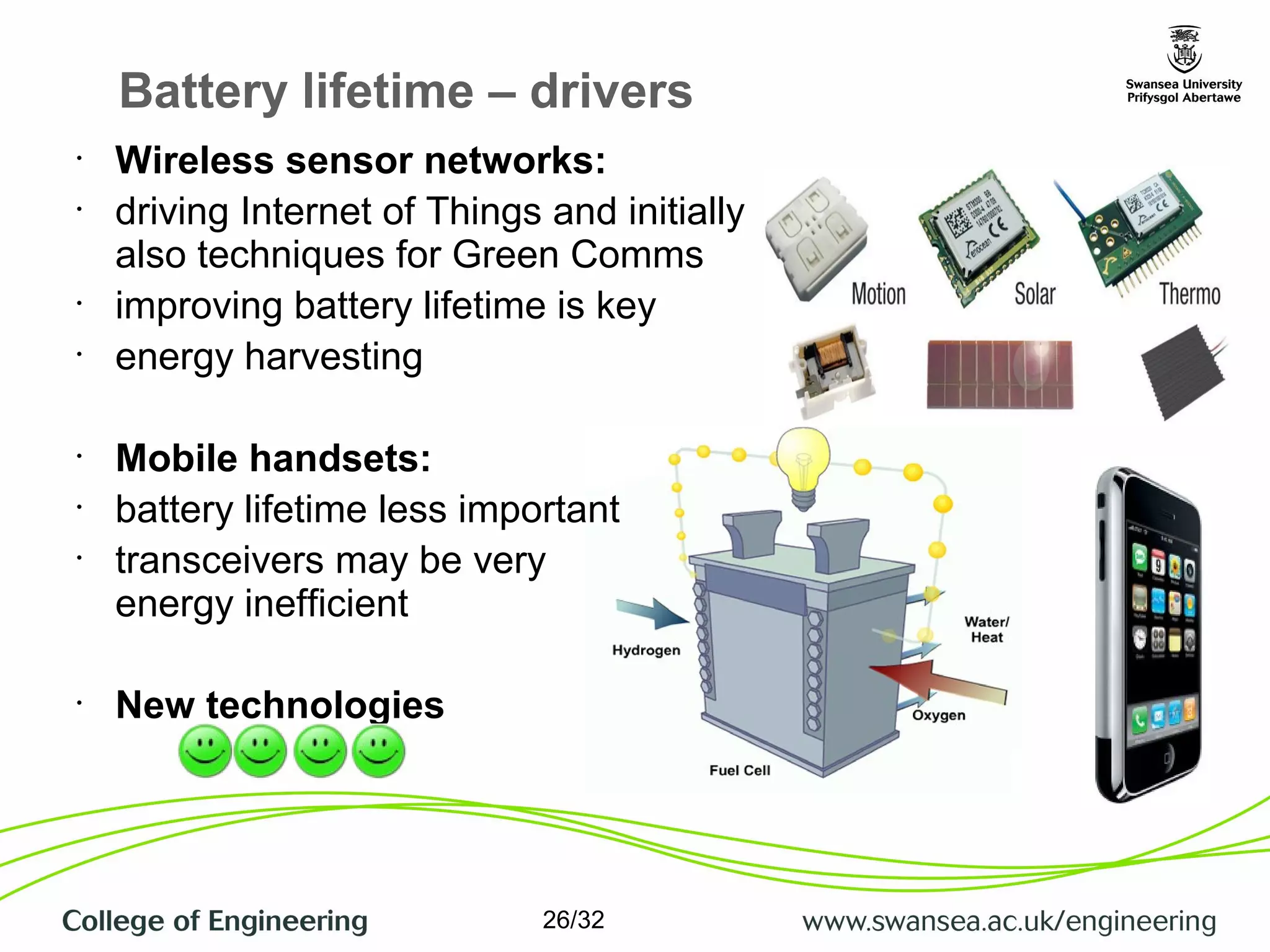
Battery lifetime – drivers
•
Wireless sensor networks:
•
driving Internet of Things and initially
also techniques for Green Comms
•
improving battery lifetime is key
•
energy harvesting
•
Mobile handsets:
•
battery lifetime less important
•
transceivers may be very
energy inefficient
•
New technologies
27/32
Why and how of Green communications
1. Initial considerations
2. Statistics and observations
3. Metrics and measurements
4. Approaches and solutions
5. Future trends
28/32
Green comms – main players
Overall energy
strategic priorities
Spectrum and
max RF powers,
total energy
Max embodied energy,
max operational energy
Coverage and QoS,
energy per bit
Coverage and QoS,
battery lifetime
Operational energy
RF power
29/32
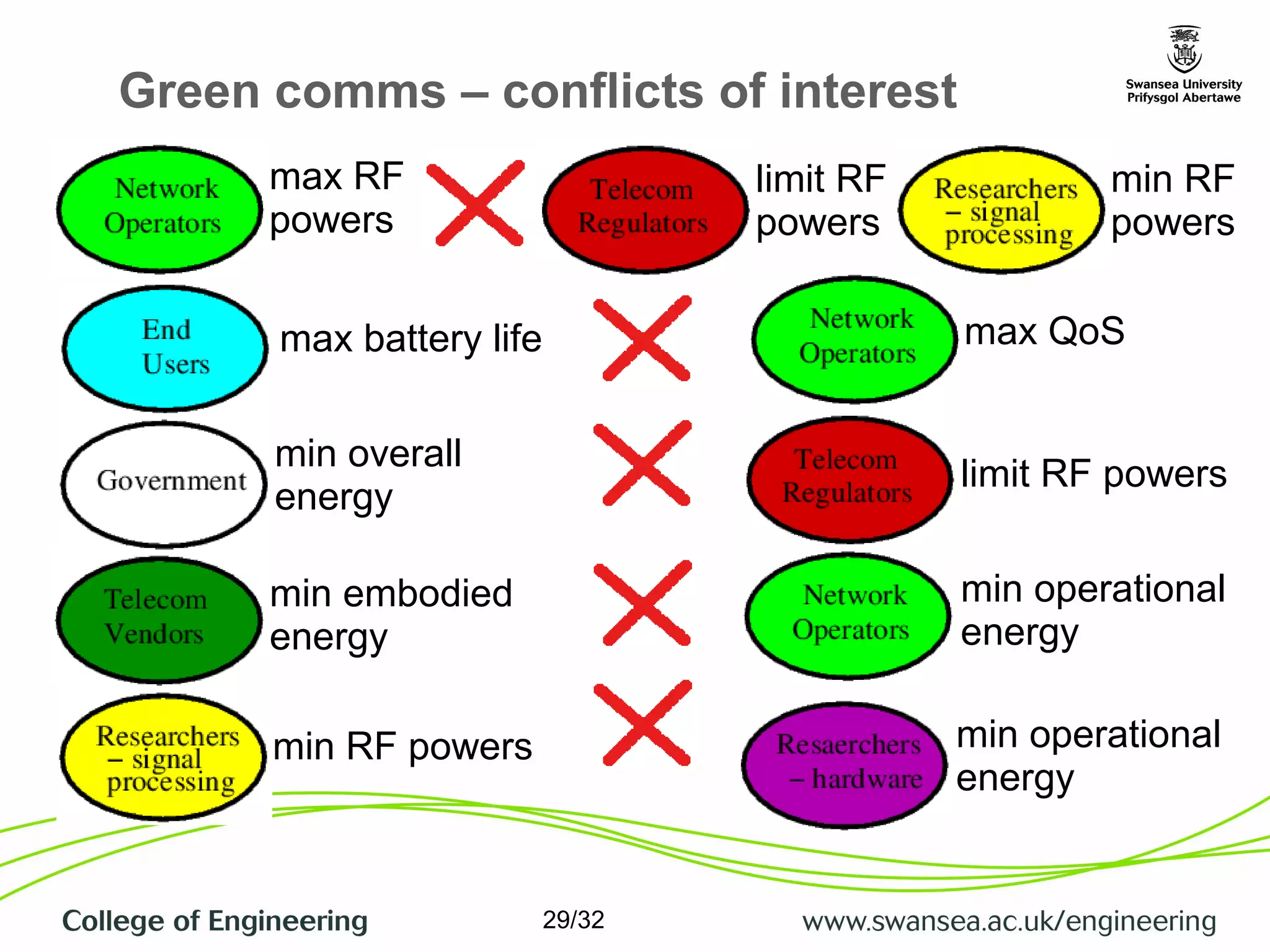
Green comms – conflicts of interest
max RF
powers
min operational
energy
limit RF
powers
max battery life max QoS
min overall
energy
limit RF powers
min embodied
energy
min operational
energy
min RF
powers
min RF powers
30/32
Green comms – future
•
Policies and regulations
•
trade energy in transport for energy in ICT
•
cooperation among network operators
•
define how much ICT services
•
ICT as utility
•
new business models
•
incentives for energy efficiency
•
highly flexible (adaptive)
•
selective availability, beyond best effort
•
Hardware to lead signal processing
•
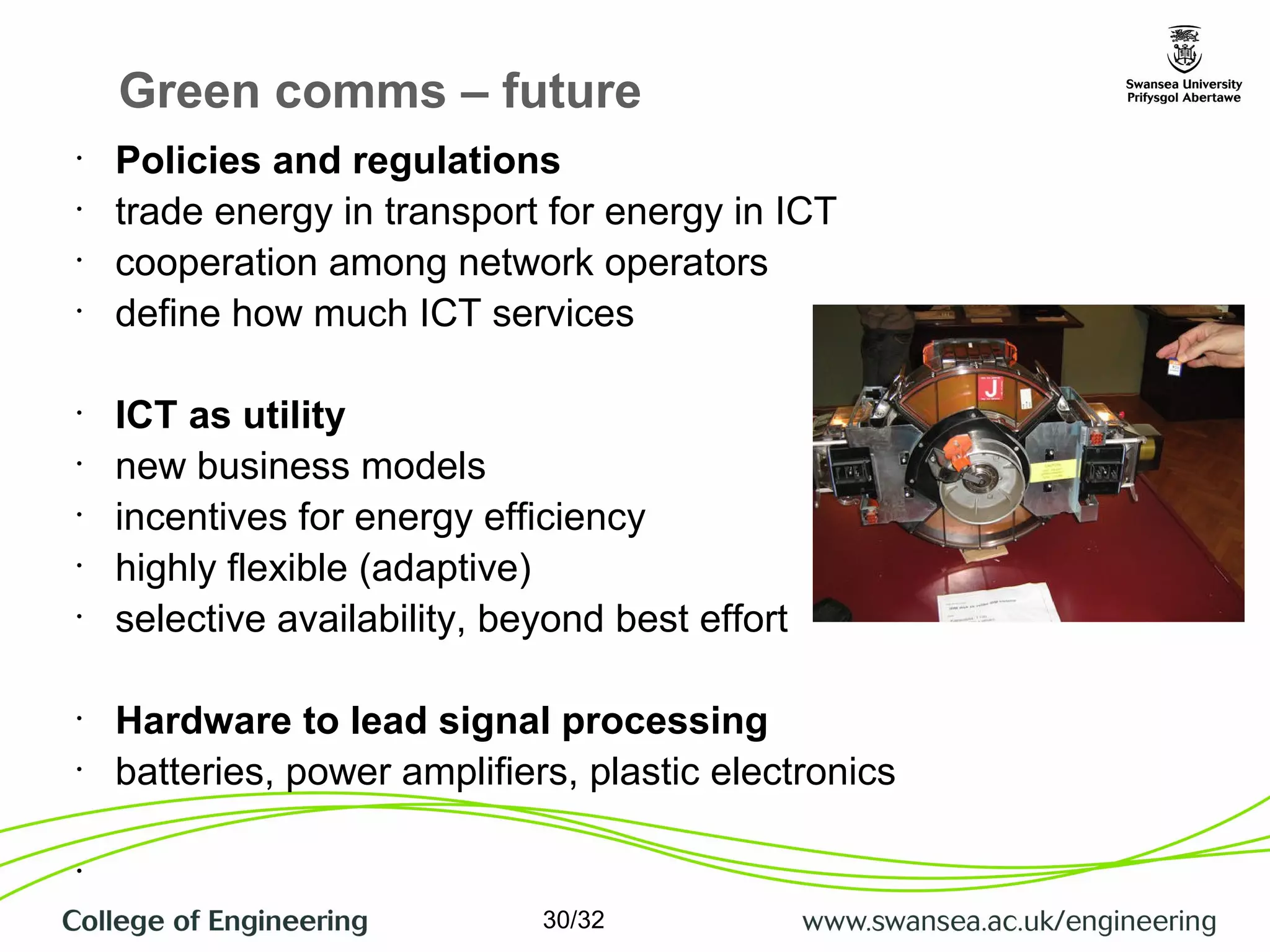
batteries, power amplifiers, plastic electronics
•
31/32
Green comms – concluding remarks
•
Energy minimization
•
holistic approach is mandatory
•
how to align aims of all players is still unclear
•
Publications
•
energy issues is more art than science, papers written by
industrial practitioners more impressive than by academics
•
Standards
•
energy consumption strongly related to implementation, yet
all standards abstract from implementation
For now, it is profits not energy what drives telecom industry!
32/32
Thank you!
Questions?

Energy Efficiency of Telecom Networks

  • 1.
    Click to editMaster subtitle style 8th JIEEEC Amman, Jordan 17 April 2013 Pavel Loskot p.loskot@swan.ac.uk
  • 2.
    2/32 • April 2008 workshopsdefined 2 targets: • identify cross-layer techniques to obtain 100x energy reduction • identify green network architecture including backhaul Green Radio project (Jan. 2009 – June 2012)
  • 3.
    3/32 Why and Howof Green Communications 1. Initial considerations 2. Statistics and observations 3. Metrics and measurements 4. Approaches and solutions 5. Future trends
  • 4.
    4/32 Why and howof Green communications 1. Initial considerations 2. Statistics and observations 3. Metrics and measurements 4. Approaches and solutions 5. Future trends
  • 5.
    5/32 Green comms –first look • energy together with information is one of the most complex and fundamental subjects 1) Primary contributors to CO2 emissions: • electric power generation, transport, manufacturing • ICT accounts for only 3% (electronics in household 5%) 2) Rising fuel cost: • Base Stations in Radio Access Network (RAN) consumes 80% of total energy of cellular systems • total energy bill to operate RAN represents only 7% of total cost Why to bother with energy efficiency then?
  • 6.
    6/32 Green comms –main motivations • Growth of wireless access: • from 3.3mil BS in 2007 to 11.2mil BS in 2020 with energy consumption from 49TWh to 98TWh with average data rate from 60kbit/s to 18Mbit/s • i.e., energy cost from 28 J/kbits to mere 0.2 J/kbits Future wireless access has to be a lot more energy efficient!
  • 7.
    7/32 Green comms –resource management Spectrum • shared resource • strictly limited • one-off cost • generate income Energy • shared resource • unlimited (almost) • recurring cost • eat profits
  • 8.
  • 9.
    9/32 Why and howof Green communications 1. Initial considerations 2. Statistics and observations 3. Metrics and measurements 4. Approaches and solutions 5. Future trends
  • 10.
    10/32 RAN – operationalenergy life time: 10-15 yrs 1-1.5 yrs
  • 11.
    11/32 Base station –money matters • Return-on-Investment (ROI) • Take-up rate
  • 12.
    12/32 Base station –power budget • overall efficiency < 10% • total power 600-800W (GSM), 300-500W (WCDMA) with typical 10W per channel/sector
  • 13.
    13/32 Cellular networks –traffic trends • majority of traffic indoors • strong spatial and temporal variations (e.g. urban areas, hotspots, time of day) • mobile broadband rapidly growing
  • 14.
    14/32 Green comms –market drivers • Developed countries: • good infrastructure • almost saturated • bottleneck is QoS and inbuilding coverage • key to improve profits • Emerging countries: • less infrastructure • good growth opportunities • large geographical areas • bottleneck is power supply • key is energy efficiency
  • 15.
    15/32 Why and howof Green communications 1. Initial considerations 2. Statistics and observations 3. Metrics and measurements 4. Approaches and solutions 5. Future trends
  • 16.
  • 17.
    17/32 Energy consumption –modeling • Power states: power consumption when • transmitting Ptx • receiving Prx • iddle Piddle • sleep Psleep Rule of thumb: • the smaller the node, the smaller differences between power state values • for marcrocell base station, may consider only Ptx
  • 18.
    18/32 Energy – measurements • 1.Energy metrics • what quantities to report (peak, average, effective values) • equipment or whole sub-systems • 2. Measurement procedures • methodology, conditions, vendor-neutral • Standardization efforts: • European Telecommunications Standards Institute (ETSI) • Alliance for Telecommunications Industry Solutions (ATIS) • International Telecommunication Union (ITU) • Energy Consumption Rating (ECR) Initiative
  • 19.
    19/32 Energy – metrics • EnergyConsumption Rating • Energy Efficiency Rate • Telecommunications Energy Efficiency Ratio (ATIS) • ITU metrics
  • 20.
    20/32 Energy metrics –Radio Access Networks • Energy Consumption Rate • Energy Reduction Gain • Energy Consumption Gain
  • 21.
    21/32 Why and howof Green communications 1. Initial considerations 2. Statistics and observations 3. Metrics and measurements 4. Approaches and solutions 5. Future trends
  • 22.
    22/32 Energy efficiency –improvements 1) Reduce transmission distances • small cells (pico, femto …) with macrocell overlays • distributed antennas, mesh architectures • relays and other cooperative transmissions • • 2) Use spectrum more efficiently • reduce interference (e.g. coordinated mutipoint) 3) Sleep modes • turn off components or whole nodes • modify protocols (e.g. MAC)
  • 23.
    23/32 Energy efficiency –improvements 4) Shape traffic • incentives for energy efficient behavior 5) Improve hardware • BS design (Power Amp, Cooling, Remote Radio Heads) • lower switching times (for sleep modes) 6) Concentrate traffic • to smaller sub-networks (e.g. shared base stations) • to smaller time epochs (e.g. delay agile traffic) Transmit as fast as possible!
  • 24.
    24/32 Green comms –green baseband • Integrated circuits (IC): • power proportional to silicon area • area proportional to throughput • throughput proportional to bandwidth • Making IC greener: • functions reuse (reduce area) • turn more SW into hardware (sacrifice flexibility) • Ultimately: • replace semiconductors
  • 25.
    25/32 Telecom equipment –powering • Alternative energy sources • need to be used continuously • lack of integration • lack of remote monitoring • onerous deployment
  • 26.
    26/32 Battery lifetime –drivers • Wireless sensor networks: • driving Internet of Things and initially also techniques for Green Comms • improving battery lifetime is key • energy harvesting • Mobile handsets: • battery lifetime less important • transceivers may be very energy inefficient • New technologies
  • 27.
    27/32 Why and howof Green communications 1. Initial considerations 2. Statistics and observations 3. Metrics and measurements 4. Approaches and solutions 5. Future trends
  • 28.
    28/32 Green comms –main players Overall energy strategic priorities Spectrum and max RF powers, total energy Max embodied energy, max operational energy Coverage and QoS, energy per bit Coverage and QoS, battery lifetime Operational energy RF power
  • 29.
    29/32 Green comms –conflicts of interest max RF powers min operational energy limit RF powers max battery life max QoS min overall energy limit RF powers min embodied energy min operational energy min RF powers min RF powers
  • 30.
    30/32 Green comms –future • Policies and regulations • trade energy in transport for energy in ICT • cooperation among network operators • define how much ICT services • ICT as utility • new business models • incentives for energy efficiency • highly flexible (adaptive) • selective availability, beyond best effort • Hardware to lead signal processing • batteries, power amplifiers, plastic electronics •
  • 31.
    31/32 Green comms –concluding remarks • Energy minimization • holistic approach is mandatory • how to align aims of all players is still unclear • Publications • energy issues is more art than science, papers written by industrial practitioners more impressive than by academics • Standards • energy consumption strongly related to implementation, yet all standards abstract from implementation For now, it is profits not energy what drives telecom industry!
  • 32.