


GREEN MARKETING
&
ECO LABELLING
Presented by
Lijin Mathew
B1 MBA
MCMAT
What is Green Marketing ?
 green marketing is the marketing of products that are
presumed to be environmentally safe.
 In simple terms it refers to the process of selling products
and/or services based on their environmental benefits.
 Such a product or service may be environmentally friendly
in itself or produced or packaged in an environmentally
friendly way.
Why Green Marketing ?
 Environmental Problems
 Rising green demands of customers
 Higher profit margin
 Mutual benefit
 A competitive edge
Benefits of Green Marketing
Some Green Brands…...
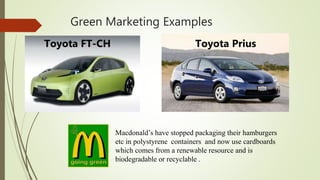
Green Marketing Examples
Toyota FT-CH Toyota Prius
Macdonald’s have stopped packaging their hamburgers
etc in polystyrene containers and now use cardboards
which comes from a renewable resource and is
biodegradable or recyclable .
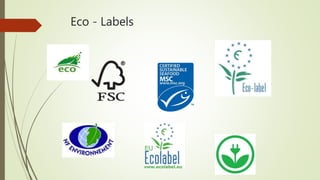
ECO –LABELLING
Eco label is an environmental claim that appears on the
packaging of a product. It is awarded to a manufacturer by
an appropriate authority. ISO 14020 is a guide to the award
of Eco-labels.
Purpose of Eco- Labelling
The government of India launched an Eco-mark Scheme in
1991 to increase consumer awareness in respect of
environment friendly products. The aim of the scheme is to
encourage the customers to purchase those products which
have less harmful environmental impact.
Eco - Labels
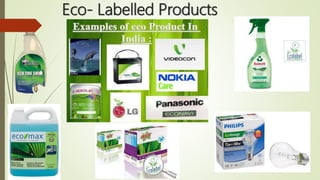
Eco- Labelled Products
Eco –Labelling leads to……
Improvement of image and sales of products
Manufacturer’s being more accountable to environmental
impacts.
Consumer’s awareness that their choice of product do
affect the environment as some products are less
damaging to environmental than others
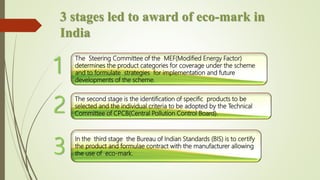
3 stages led to award of eco-mark in
India
The Steering Committee of the MEF(Modified Energy Factor)
determines the product categories for coverage under the scheme
and to formulate strategies for implementation and future
developments of the scheme.
The second stage is the identification of specific products to be
selected and the individual criteria to be adopted by the Technical
Committee of CPCB(Central Pollution Control Board).
In the third stage the Bureau of Indian Standards (BIS) is to certify
the product and formulae contract with the manufacturer allowing
the use of eco-mark.
1
2
3
Products to meet the relevant standards of BIS.
Manufacturers to produce documentary evidence in regard
to compliance of EPA(Environmental Protection Agency).
Water and Air Acts and other rules and regulations such as
Prevention of Food Adulteration Act and rules made there
under.
The product to display the list of critical ingredients in
descending order of quantity present.
The packaging to display the criteria based on which the
product has been labelled environment friendly.
The material used for packaging to be recyclable/reusable
/biodegradable.
The products to be accompanied by detailed instructions for
proper use.
Green Washing
“Green washing,” a term derived from the
term “whitewashing”
“Disinformation disseminated by an organization so as to
present an environmentally responsible public image.”
Why Green Washing ?
 People are becoming more and more aware of the dangers
 People are looking for environmentally friendly products
 High cost for introducing green marketing
Green Washing Firm’s Examples
General Motors
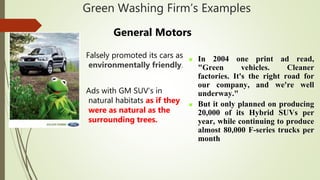
Falsely promoted its cars as
environmentally friendly.
Ads with GM SUV’s in
natural habitats as if they
were as natural as the
surrounding trees.
 In 2004 one print ad read,
"Green vehicles. Cleaner
factories. It's the right road for
our company, and we're well
underway."
 But it only planned on producing
20,000 of its Hybrid SUVs per
year, while continuing to produce
almost 80,000 F-series trucks per
month
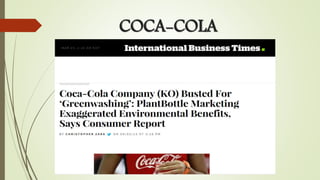
COCA-COLA
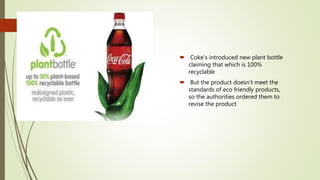
 Coke’s introduced new plant bottle
claiming that which is 100%
recyclable
 But the product doesn’t meet the
standards of eco friendly products,
so the authorities ordered them to
revise the product
Green marketing
Green marketing
Green marketing

Green marketing

  • 1.
    GREEN MARKETING & ECO LABELLING Presentedby Lijin Mathew B1 MBA MCMAT
  • 2.
    What is GreenMarketing ?  green marketing is the marketing of products that are presumed to be environmentally safe.  In simple terms it refers to the process of selling products and/or services based on their environmental benefits.  Such a product or service may be environmentally friendly in itself or produced or packaged in an environmentally friendly way.
  • 3.
    Why Green Marketing?  Environmental Problems  Rising green demands of customers  Higher profit margin  Mutual benefit  A competitive edge Benefits of Green Marketing
  • 4.
  • 6.
    Green Marketing Examples ToyotaFT-CH Toyota Prius Macdonald’s have stopped packaging their hamburgers etc in polystyrene containers and now use cardboards which comes from a renewable resource and is biodegradable or recyclable .
  • 7.
    ECO –LABELLING Eco labelis an environmental claim that appears on the packaging of a product. It is awarded to a manufacturer by an appropriate authority. ISO 14020 is a guide to the award of Eco-labels.
  • 8.
    Purpose of Eco-Labelling The government of India launched an Eco-mark Scheme in 1991 to increase consumer awareness in respect of environment friendly products. The aim of the scheme is to encourage the customers to purchase those products which have less harmful environmental impact.
  • 9.
  • 10.
  • 11.
    Eco –Labelling leadsto…… Improvement of image and sales of products Manufacturer’s being more accountable to environmental impacts. Consumer’s awareness that their choice of product do affect the environment as some products are less damaging to environmental than others
  • 12.
    3 stages ledto award of eco-mark in India The Steering Committee of the MEF(Modified Energy Factor) determines the product categories for coverage under the scheme and to formulate strategies for implementation and future developments of the scheme. The second stage is the identification of specific products to be selected and the individual criteria to be adopted by the Technical Committee of CPCB(Central Pollution Control Board). In the third stage the Bureau of Indian Standards (BIS) is to certify the product and formulae contract with the manufacturer allowing the use of eco-mark. 1 2 3
  • 13.
    Products to meetthe relevant standards of BIS. Manufacturers to produce documentary evidence in regard to compliance of EPA(Environmental Protection Agency). Water and Air Acts and other rules and regulations such as Prevention of Food Adulteration Act and rules made there under. The product to display the list of critical ingredients in descending order of quantity present. The packaging to display the criteria based on which the product has been labelled environment friendly. The material used for packaging to be recyclable/reusable /biodegradable. The products to be accompanied by detailed instructions for proper use.
  • 14.
    Green Washing “Green washing,”a term derived from the term “whitewashing” “Disinformation disseminated by an organization so as to present an environmentally responsible public image.”
  • 15.
    Why Green Washing?  People are becoming more and more aware of the dangers  People are looking for environmentally friendly products  High cost for introducing green marketing
  • 16.
    Green Washing Firm’sExamples General Motors Falsely promoted its cars as environmentally friendly. Ads with GM SUV’s in natural habitats as if they were as natural as the surrounding trees.  In 2004 one print ad read, "Green vehicles. Cleaner factories. It's the right road for our company, and we're well underway."  But it only planned on producing 20,000 of its Hybrid SUVs per year, while continuing to produce almost 80,000 F-series trucks per month
  • 17.
  • 18.
     Coke’s introducednew plant bottle claiming that which is 100% recyclable  But the product doesn’t meet the standards of eco friendly products, so the authorities ordered them to revise the product