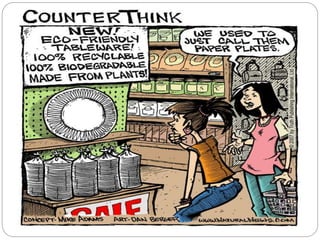
GREEN 
MARKETING
Presented by: 
 Prasana savarimuthu (47) 
 Shrider nadar(37) 
 Ramdas nadar(36) 
 Pravin nadar(35) 
 Mahesh pandey (42) 
 Jay (64)
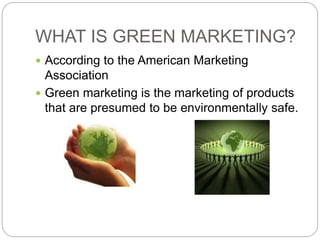
WHAT IS GREEN MARKETING? 
 According to the American Marketing 
Association 
 Green marketing is the marketing of products 
that are presumed to be environmentally safe.
WHAT IS GREEN MARKETING? 
Polonsky (1994) defines green marketing 
 As all activities designed to generate and 
facilitate any exchanges intended to satisfy 
human needs or wants, such that the satisfaction 
of these needs and wants occurs, with minimal 
detrimental impact on the natural environment
Why Green Marketing..? 
 The growing awareness all over the world 
regarding protection of the environment. 
Consumers are becoming more concerned 
about environmental friendly product 
 Manufacturers have recognized environmental 
concerns as a source of competitive 
advantage. and have developed products with 
a green image 
 Various regulations recently framed by the 
government to protect consumers and the 
society at large,led to the adoption of Green 
marketing as a compulsion rather than a 
choice. For example, the ban of plastic bags in 
many parts of the country
EVOLUTION OF GREEN 
MARKETING 
 According to Peattie (2001), the evolution of 
green marketing has three phases: 
 Ecological" green marketing, 
 "Environmental" green marketing 
 "Sustainable" green marketing
Green Products And Its 
Characteristics 
 Products are originally grown. 
 Products those are recyclable, reusable and 
biodegradable. 
 Products with natural ingredients. 
 Products contain recycled contents ,non-toxic chemical. 
 Products contain under approved chemical. 
 Products do not harm or pollute the environment. 
 Products that is not tasted on animals. 
 Products that have eco-friendly packaging i.e reusable, 
refillable containers etc.
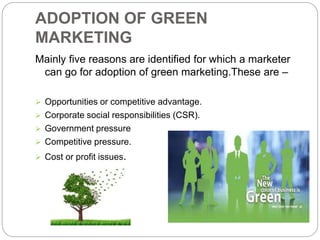
ADOPTION OF GREEN 
MARKETING 
Mainly five reasons are identified for which a marketer 
can go for adoption of green marketing.These are – 
 Opportunities or competitive advantage. 
 Corporate social responsibilities (CSR). 
 Government pressure 
 Competitive pressure. 
 Cost or profit issues.
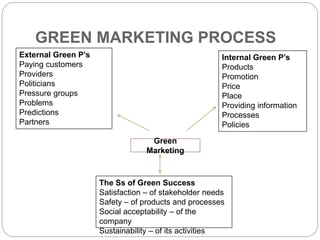
GREEN MARKETING PROCESS 
External Green P’s 
Paying customers 
Providers 
Politicians 
Pressure groups 
Problems 
Predictions 
Partners 
Internal Green P’s 
Products 
Promotion 
Price 
Place 
Providing information 
Processes 
Policies 
Green 
Marketing 
The Ss of Green Success 
Satisfaction – of stakeholder needs 
Safety – of products and processes 
Social acceptability – of the 
company 
Sustainability – of its activities
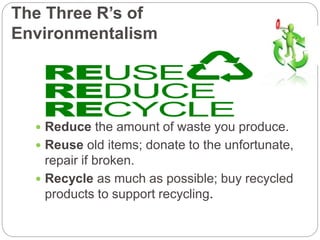
The Three R’s of 
Environmentalism 
 Reduce the amount of waste you produce. 
 Reuse old items; donate to the unfortunate, 
repair if broken. 
 Recycle as much as possible; buy recycled 
products to support recycling.
MARKETING MIX OF GREEN 
MARKETING 
There are 4Ps of marketing mix . They are as 
follows: 
 Product: 
Its all about producing products which are Eco-friendly 
. 
 Price: 
 Value can be added to the product by changing its 
appearance, functionality and through 
customization.
 Place : 
Green place is about managing logistics to cut 
down on transportation emissions. 
PROMOTION: 
 Green promotion involves configuring the 
tools of promotion, such as advertising, 
marketing materials, signage, white papers, 
web sites, videos and presentations by 
keeping people, planet and profits in mind.
Advantages Of Green Marketing 
 It ensures sustained and long term growth 
along with profitability 
 It saves money in the long run, though initially 
the cost is more 
 It helps the companies market their products 
and services keeping the environment 
aspects in mind
Challenges Ahead in Green Marketing 
 Green products require renewable and recyclable 
material, which is costly. 
 Requires a technology, which requires huge 
investment in R & D. 
 Water treatment technology, which is too costly. 
 Majority of the people are not aware of green 
products and their uses. 
 Majority of the consumers are not willing to pay a 
premium for green products. 
 Green marketing should not neglect the economic 
aspect of marketing. Marketers need to understand 
the implications of green marketing.
GOLDEN RULES OF GREEN 
MARKETING 
 KNOW YOU'RE CUSTOMER 
EDUCATING YOUR CUSTOMERS 
BEING GENUINE & TRANSPARENT 
REASSURE THE BUYER 
CONSIDER YOUR PRICING 
GIVING YOUR CUSTOMERS AN 
OPPORTUNITY TO PARTICIPATE 
THUS LEADING BRANDS SHOULD 
RECOGNIZE THAT CONSUMER 
EXPECTATIONS HAVE CHANGED
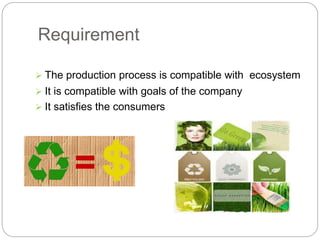
Requirement 
 The production process is compatible with ecosystem 
 It is compatible with goals of the company 
 It satisfies the consumers
The 2012, top 10 Green Brands in India are: 
 1. AMUL 
 2. Dabur India ltd. 
 3. Infosys 
 4. Taj Hotels 
 5. Britannia Industries ltd. 
 6. Suzlon India 
 7. Hindustan Unilever Ltd. 
 8. Wipro technologies ltd. 
 9. Maruti Udyog ltd. 
 10. Godrej Consumer Products
 SBI Green banking programme 
By using eco & power friendly equipment in its 
10,000 new ATMs, SBI has not only saved power 
costs and earned carbon credits, but also set the 
right example fore others to follow. 
 SBI became the first Indian bank to harness wind 
energy through a 15 megawatt wind farm 
developed by Suzlon Energy.
Suzlon Energy 
 The world’s fourth largest wind-turbine maker is 
among the greenest and best Indian companies 
in India. Tulsi Tanti, the visionary behind Suzlon, 
convinced the world that wind is the energy of 
the future and built his factory in Pondicherry to 
run entirely on wind power. Suzlon’s corporate 
building is the most energy-efficient building ever 
built in India.
Wipro Green It. 
Wipro Infotech is India's first company to launch 
environment friendly computer peripherals. For 
the Indian market, Wipro has launched a new 
range of desktops and laptops called Wipro 
Greenware. These products are RoHS 
(Restriction of Hazardous Substances) compliant 
thus reducing e-waste in the environment.
Lead Free Paints From Kansai 
Nerolac 
 Kansai Nerolac Paints Ltd., has always been 
committed to the welfare of society and the 
environment. Kansai Nerolac has worked on 
removing hazardous heavy metals from their 
paints. Lead in paints especially poses danger 
to human health where it can cause damage 
to Central Nervous System, kidney and 
reproductive system. Children are more prone 
to lead poisoning leading to lower intelligence 
levels and memory loss.
 Green marketing final
 Green marketing final

Green marketing final

  • 1.
  • 2.
    Presented by: Prasana savarimuthu (47)  Shrider nadar(37)  Ramdas nadar(36)  Pravin nadar(35)  Mahesh pandey (42)  Jay (64)
  • 3.
    WHAT IS GREENMARKETING?  According to the American Marketing Association  Green marketing is the marketing of products that are presumed to be environmentally safe.
  • 4.
    WHAT IS GREENMARKETING? Polonsky (1994) defines green marketing  As all activities designed to generate and facilitate any exchanges intended to satisfy human needs or wants, such that the satisfaction of these needs and wants occurs, with minimal detrimental impact on the natural environment
  • 5.
    Why Green Marketing..?  The growing awareness all over the world regarding protection of the environment. Consumers are becoming more concerned about environmental friendly product  Manufacturers have recognized environmental concerns as a source of competitive advantage. and have developed products with a green image  Various regulations recently framed by the government to protect consumers and the society at large,led to the adoption of Green marketing as a compulsion rather than a choice. For example, the ban of plastic bags in many parts of the country
  • 6.
    EVOLUTION OF GREEN MARKETING  According to Peattie (2001), the evolution of green marketing has three phases:  Ecological" green marketing,  "Environmental" green marketing  "Sustainable" green marketing
  • 7.
    Green Products AndIts Characteristics  Products are originally grown.  Products those are recyclable, reusable and biodegradable.  Products with natural ingredients.  Products contain recycled contents ,non-toxic chemical.  Products contain under approved chemical.  Products do not harm or pollute the environment.  Products that is not tasted on animals.  Products that have eco-friendly packaging i.e reusable, refillable containers etc.
  • 8.
    ADOPTION OF GREEN MARKETING Mainly five reasons are identified for which a marketer can go for adoption of green marketing.These are –  Opportunities or competitive advantage.  Corporate social responsibilities (CSR).  Government pressure  Competitive pressure.  Cost or profit issues.
  • 9.
    GREEN MARKETING PROCESS External Green P’s Paying customers Providers Politicians Pressure groups Problems Predictions Partners Internal Green P’s Products Promotion Price Place Providing information Processes Policies Green Marketing The Ss of Green Success Satisfaction – of stakeholder needs Safety – of products and processes Social acceptability – of the company Sustainability – of its activities
  • 10.
    The Three R’sof Environmentalism  Reduce the amount of waste you produce.  Reuse old items; donate to the unfortunate, repair if broken.  Recycle as much as possible; buy recycled products to support recycling.
  • 11.
    MARKETING MIX OFGREEN MARKETING There are 4Ps of marketing mix . They are as follows:  Product: Its all about producing products which are Eco-friendly .  Price:  Value can be added to the product by changing its appearance, functionality and through customization.
  • 12.
     Place : Green place is about managing logistics to cut down on transportation emissions. PROMOTION:  Green promotion involves configuring the tools of promotion, such as advertising, marketing materials, signage, white papers, web sites, videos and presentations by keeping people, planet and profits in mind.
  • 13.
    Advantages Of GreenMarketing  It ensures sustained and long term growth along with profitability  It saves money in the long run, though initially the cost is more  It helps the companies market their products and services keeping the environment aspects in mind
  • 14.
    Challenges Ahead inGreen Marketing  Green products require renewable and recyclable material, which is costly.  Requires a technology, which requires huge investment in R & D.  Water treatment technology, which is too costly.  Majority of the people are not aware of green products and their uses.  Majority of the consumers are not willing to pay a premium for green products.  Green marketing should not neglect the economic aspect of marketing. Marketers need to understand the implications of green marketing.
  • 15.
    GOLDEN RULES OFGREEN MARKETING  KNOW YOU'RE CUSTOMER EDUCATING YOUR CUSTOMERS BEING GENUINE & TRANSPARENT REASSURE THE BUYER CONSIDER YOUR PRICING GIVING YOUR CUSTOMERS AN OPPORTUNITY TO PARTICIPATE THUS LEADING BRANDS SHOULD RECOGNIZE THAT CONSUMER EXPECTATIONS HAVE CHANGED
  • 16.
    Requirement  Theproduction process is compatible with ecosystem  It is compatible with goals of the company  It satisfies the consumers
  • 17.
    The 2012, top10 Green Brands in India are:  1. AMUL  2. Dabur India ltd.  3. Infosys  4. Taj Hotels  5. Britannia Industries ltd.  6. Suzlon India  7. Hindustan Unilever Ltd.  8. Wipro technologies ltd.  9. Maruti Udyog ltd.  10. Godrej Consumer Products
  • 18.
     SBI Greenbanking programme By using eco & power friendly equipment in its 10,000 new ATMs, SBI has not only saved power costs and earned carbon credits, but also set the right example fore others to follow.  SBI became the first Indian bank to harness wind energy through a 15 megawatt wind farm developed by Suzlon Energy.
  • 19.
    Suzlon Energy The world’s fourth largest wind-turbine maker is among the greenest and best Indian companies in India. Tulsi Tanti, the visionary behind Suzlon, convinced the world that wind is the energy of the future and built his factory in Pondicherry to run entirely on wind power. Suzlon’s corporate building is the most energy-efficient building ever built in India.
  • 20.
    Wipro Green It. Wipro Infotech is India's first company to launch environment friendly computer peripherals. For the Indian market, Wipro has launched a new range of desktops and laptops called Wipro Greenware. These products are RoHS (Restriction of Hazardous Substances) compliant thus reducing e-waste in the environment.
  • 21.
    Lead Free PaintsFrom Kansai Nerolac  Kansai Nerolac Paints Ltd., has always been committed to the welfare of society and the environment. Kansai Nerolac has worked on removing hazardous heavy metals from their paints. Lead in paints especially poses danger to human health where it can cause damage to Central Nervous System, kidney and reproductive system. Children are more prone to lead poisoning leading to lower intelligence levels and memory loss.