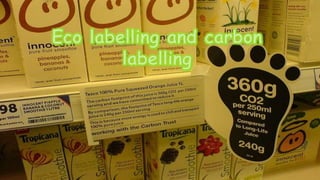
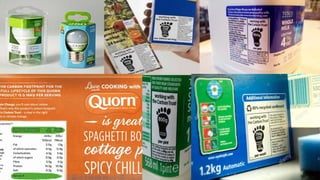
WHAT IS ECO-LABELLING?
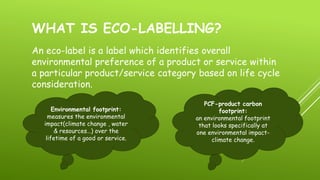
An eco-label is a label which identifies overall
environmental preference of a product or service within
a particular product/service category based on life cycle
consideration.
Environmental footprint:
measures the environmental
impact(climate change , water
& resources…) over the
lifetime of a good or service.
PCF-product carbon
footprint:
an environmental footprint
that looks specifically at
one environmental impact-
climate change.
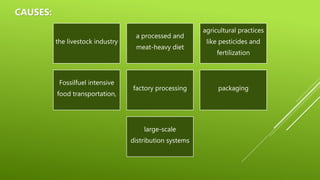
agricultural practices
like pesticides and
fertilization
a processed and
meat-heavy diet
the livestock industry
packaging
factory processing
Fossilfuel intensive
food transportation,
large-scale
distribution systems
CAUSES:
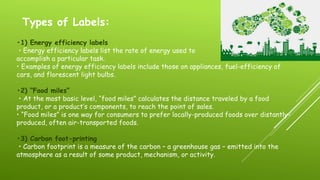
Types of Labels:
•1) Energy efficiency labels
• Energy efficiency labels list the rate of energy used to
accomplish a particular task.
• Examples of energy efficiency labels include those on appliances, fuel-efficiency of
cars, and florescent light bulbs.
•2) “Food miles”
• At the most basic level, “food miles” calculates the distance traveled by a food
product, or a product’s components, to reach the point of sales.
• “Food miles” is one way for consumers to prefer locally-produced foods over distantly-
produced, often air-transported foods.
•3) Carbon foot-printing
• Carbon footprint is a measure of the carbon – a greenhouse gas – emitted into the
atmosphere as a result of some product, mechanism, or activity.
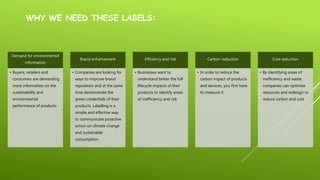
WHY WE NEED THESE LABELS:
Demand for environmental
information
• Buyers, retailers and
consumers are demanding
more information on the
sustainability and
environmental
performance of products
Brand enhancement
• Companies are looking for
ways to improve brand
reputation and at the same
time demonstrate the
green credentials of their
products. Labelling is a
simple and effective way
to communicate proactive
action on climate change
and sustainable
consumption.
Efficiency and risk
• Businesses want to
understand better the full
lifecycle impacts of their
products to identify areas
of inefficiency and risk
Carbon reduction
• In order to reduce the
carbon impact of products
and services, you first have
to measure it
Cost reduction
• By identifying areas of
inefficiency and waste,
companies can optimise
resources and redesign to
reduce carbon and cost
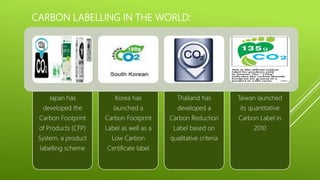
CARBON LABELLING IN THE WORLD:
Japan has
developed the
Carbon Footprint
of Products (CFP)
System, a product
labelling scheme
Korea has
launched a
Carbon Footprint
Label as well as a
Low Carbon
Certificate label
Thailand has
developed a
Carbon Reduction
Label based on
qualitative criteria
Taiwan launched
its quantitative
Carbon Label in
2010
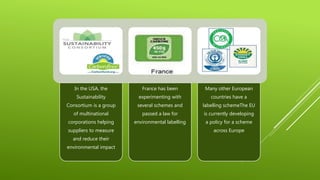
In the USA, the
Sustainability
Consortium is a group
of multinational
corporations helping
suppliers to measure
and reduce their
environmental impact
France has been
experimenting with
several schemes and
passed a law for
environmental labelling
Many other European
countries have a
labelling schemeThe EU
is currently developing
a policy for a scheme
across Europe
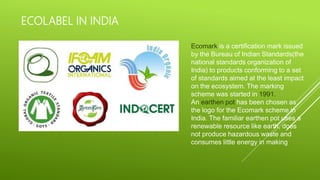
ECOLABEL IN INDIA
Ecomark is a certification mark issued
by the Bureau of Indian Standards(the
national standards organization of
India) to products conforming to a set
of standards aimed at the least impact
on the ecosystem. The marking
scheme was started in 1991.
An earthen pot has been chosen as
the logo for the Ecomark scheme in
India. The familiar earthen pot uses a
renewable resource like earth, does
not produce hazardous waste and
consumes little energy in making
Ecolabelling

Ecolabelling

  • 2.
    WHAT IS ECO-LABELLING? Aneco-label is a label which identifies overall environmental preference of a product or service within a particular product/service category based on life cycle consideration. Environmental footprint: measures the environmental impact(climate change , water & resources…) over the lifetime of a good or service. PCF-product carbon footprint: an environmental footprint that looks specifically at one environmental impact- climate change.
  • 3.
    agricultural practices like pesticidesand fertilization a processed and meat-heavy diet the livestock industry packaging factory processing Fossilfuel intensive food transportation, large-scale distribution systems CAUSES:
  • 4.
    Types of Labels: •1)Energy efficiency labels • Energy efficiency labels list the rate of energy used to accomplish a particular task. • Examples of energy efficiency labels include those on appliances, fuel-efficiency of cars, and florescent light bulbs. •2) “Food miles” • At the most basic level, “food miles” calculates the distance traveled by a food product, or a product’s components, to reach the point of sales. • “Food miles” is one way for consumers to prefer locally-produced foods over distantly- produced, often air-transported foods. •3) Carbon foot-printing • Carbon footprint is a measure of the carbon – a greenhouse gas – emitted into the atmosphere as a result of some product, mechanism, or activity.
  • 5.
    WHY WE NEEDTHESE LABELS: Demand for environmental information • Buyers, retailers and consumers are demanding more information on the sustainability and environmental performance of products Brand enhancement • Companies are looking for ways to improve brand reputation and at the same time demonstrate the green credentials of their products. Labelling is a simple and effective way to communicate proactive action on climate change and sustainable consumption. Efficiency and risk • Businesses want to understand better the full lifecycle impacts of their products to identify areas of inefficiency and risk Carbon reduction • In order to reduce the carbon impact of products and services, you first have to measure it Cost reduction • By identifying areas of inefficiency and waste, companies can optimise resources and redesign to reduce carbon and cost
  • 6.
    CARBON LABELLING INTHE WORLD: Japan has developed the Carbon Footprint of Products (CFP) System, a product labelling scheme Korea has launched a Carbon Footprint Label as well as a Low Carbon Certificate label Thailand has developed a Carbon Reduction Label based on qualitative criteria Taiwan launched its quantitative Carbon Label in 2010
  • 7.
    In the USA,the Sustainability Consortium is a group of multinational corporations helping suppliers to measure and reduce their environmental impact France has been experimenting with several schemes and passed a law for environmental labelling Many other European countries have a labelling schemeThe EU is currently developing a policy for a scheme across Europe
  • 8.
    ECOLABEL IN INDIA Ecomarkis a certification mark issued by the Bureau of Indian Standards(the national standards organization of India) to products conforming to a set of standards aimed at the least impact on the ecosystem. The marking scheme was started in 1991. An earthen pot has been chosen as the logo for the Ecomark scheme in India. The familiar earthen pot uses a renewable resource like earth, does not produce hazardous waste and consumes little energy in making