PRESENTATION
      ON
GREEN
MARKETING
       Prepared By :
       Jaspreet Singh
       Jatin Mahajan
       Jogesh Puri
       Jupinder kaur
Marketing
What is green
marketing?
 Green marketing refers to the process of
  selling products and services based on
  their environmental benefits. Such a
  product or service may be environment
  friendly in itself or produced or packed in
  an environment friendly way.
Evolution of Green
Marketing
The term Green Marketing came into prominence in
  the late 1980s and early 1990s.
 The green marketing has evolved over this period
  of time. The evolution of green marketing had
  three phases. First phase was termed as
  "Ecological" green marketing, and during this
  period all marketing activities were concerned to
  help environment problems and provide remedies
  for environmental problems.
 Second phase was "Environmental" green
  marketing and the focus shifted on clean
  technology that involved designing of
  innovative new products, which take care of
  pollution and waste issues.

 Third phase was "Sustainable" green
  marketing. It came into prominence in the late
  1990s and early 2000. This was the result of
  the term sustainable development which is
  defined as "meeting the needs of the present
  without compromising the ability of future
  generations to meet their own needs."
ASSUMPTION
 The obvious assumption of green
  marketing is that potential consumers will
  view a product or service's "greenness"
  as a benefit and base their buying
  decision accordingly.
 The not-so-obvious assumption of green
  marketing is that consumers will be
  willing to pay more for green products
  than they would for a less-green
  comparable alternative product
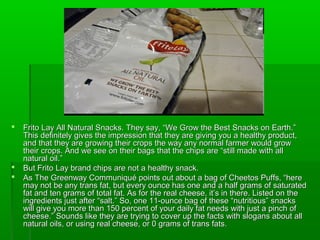
   Frito Lay All Natural Snacks. They say, “We Grow the Best Snacks on Earth.”
    This definitely gives the impression that they are giving you a healthy product,
    and that they are growing their crops the way any normal farmer would grow
    their crops. And we see on their bags that the chips are “still made with all
    natural oil.”
   But Frito Lay brand chips are not a healthy snack.
   As The Greenway Communiqué points out about a bag of Cheetos Puffs, “here
    may not be any trans fat, but every ounce has one and a half grams of saturated
    fat and ten grams of total fat. As for the real cheese, it’s in there. Listed on the
    ingredients just after “salt.” So, one 11-ounce bag of these “nutritious” snacks
    will give you more than 150 percent of your daily fat needs with just a pinch of
    cheese.” Sounds like they are trying to cover up the facts with slogans about all
    natural oils, or using real cheese, or 0 grams of trans fats.
Benefits of Green Marketing
 Companies that develop new and improved products and
  services with environment inputs in mind give themselves
  access to new markets, increase their profit sustainability,
  and enjoy a competitive advantage over the companies
  which are not concerned for the environment.

 Some of the advantages of green marketing are,

  * It ensures sustained long-term growth along with
  profitability.
  * It saves money in the long run, though initially the cost is
  more.
  * It helps companies market their products and services
  keeping the environment aspects in mind. It helps in
  accessing the new markets and enjoying competitive
  advantage.
  * Most of the employees also feel proud and responsible to
  be working for an environmentally responsible company.
US Federal Trade
Commissionmarketing must ensure that
 Firms using green
  their activities are not misleading to consumers
  or industry, and do not breach any of the
  regulations or laws dealing with environmental
  marketing.
 Green marketing claims must;
     Clearly state environmental benefits;
     Explain environmental characteristics;
     Explain how benefits are achieved;
     Ensure comparative differences are justified;
     Ensure negative factors are taken into consideration; and
                                9
     Only use meaningful terms and pictures.
Adoption of Green Marketing
 There are basically five reasons for which a marketer should go
  for the adoption of green marketing. They are

 Opportunities or competitive advantage
   In India, around 25% of the consumers prefer environmental-
  friendly products, and around 28% may be considered healthy
  conscious. There fore, green marketers have diverse and fairly
  sizeable segments to cater to.

   The Surf Excel detergent which saves water (advertised with
  the message—"do bucket paani roz bachana") and the energy-
  saving LG consumers durables are examples of green
  marketing.

   We also have green buildings which are efficient in their use of
  energy, water and construction materials, and which reduce the
  impact on human health and the environment through better
  design, construction, operation, maintenance and waste
  disposal.
 Social Responsibility

 Many companies have started realizing that
 they must behave in an environment-friendly
 fashion. They believe both in achieving
 environmental objectives as well as profit
 related objectives. The HSBC became the
 world's first bank to go carbon-neutral. Other
 examples include Coca-Cola, which has
 invested in various recycling activities. Walt
 Disney World in Florida, US, has an extensive
 waste management program and infrastructure
 in place.
 Governmental Pressure

 Various regulations rare framed by the
 government to protect consumers and the
 society at large. The Indian government too
 has developed a framework of legislations to
 reduce the production of harmful goods and by
 products. These reduce the industry's
 production and consumers' consumption of
 harmful goods, including those detrimental to
 the environment; for example, the ban of
 plastic bags in Mumbai, prohibition of smoking
 in public areas, etc.
 Competitive Pressure

  Many companies take up green marketing to maintain
  their competitive edge. The green marketing initiatives
  by niche companies such as Body Shop and Green &
  Black have prompted many mainline competitors to
  follow suit.

 Cost Reduction

  Reduction of harmful waste may lead to substantial
  cost savings. Sometimes, many firms develop
  symbiotic relationship whereby the waste generated by
  one company is used by another as a cost-effective
  raw material. For example, the fly ash generated by
  thermal power plants, which would otherwise
  contributed to a gigantic quantum of solid waste, is
  used to manufacture fly ash bricks for construction
  purposes.
Green Marketing Mix
 Green Marketing Mix
  The 4 P's of green marketing are that of a conventional
  marketing but the challenge before marketers is to use 4 P's in
  an innovative manner.

 Product
   The ecological objectives in planning products are to reduce
  resource consumption and pollution and to increase
  conservation of scarce resources. The marketer's role in
  product management includes providing product designers with
  market-driven trends and customer requests for green product
  attributes such as energy saving, organic, green chemicals,
  local sourcing, etc.,
   For example, Nike is the first among the shoe companies to
  market itself as green. It is marketing its Air Jordan shoes as
  environment-friendly, as it has significantly reduced the usage
  of harmful glue adhesives. It has designed this variety of shoes
  to emphasize that it has reduced wastage and used
  environment-friendly materials.
 Price
   Price is a critical and important factor of green
  marketing mix. Most consumers will only be
  prepared to pay additional value if there is a
  perception of extra product value. This value may
  be improved performance, function, design,
  visual appeal, or taste. Green marketing should
  take all these facts into consideration while
  charging a premium price. E.g.. Wal Mart
  unveiled its first recyclable cloth shopping bag.
  IKEA , EASYDAY stores started charging
  consumers when they opted for plastic bags and
  encouraged people to shop using its "Big Blue
  Bag".
 Promotion
  There are three types of green advertising: -
 Ads that address a relationship between a
  product/service and the biophysical environment
 Those that promote a green lifestyle by highlighting a
  product or service
 Ads that present a corporate image of environmental
  responsibility

 Place
  The choice of where and when to make a product
  available will have significant impact on the customers.
  Very few customers will go out of their way to buy green
  products.
Strategies
 The marketing strategies for green marketing
 include: -

 Marketing Audit (including internal and
  external situation analysis)
 Develop a marketing plan outlining
  strategies with regard to 4 P's
 Implement marketing strategies
 Plan results evaluation
Challenges Ahead
 Green products require renewable and recyclable
  material, which is costly
 Requires a technology, which requires huge
  investment in R & D
 Water treatment technology, which is too costly
 Majority of the people are not aware of green
  products and their uses
 Majority of the consumers are not willing to pay a
  premium for green products
Some Cases

 McDonald's restaurant's napkins,
  bags are made of recycled paper.

 Coca-Cola pumped syrup directly
  from tank instead of plastic which
  saved 68 million pound/year.
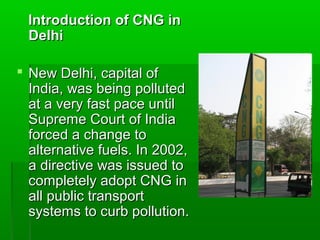
Introduction of CNG in
 Delhi

 New Delhi, capital of
  India, was being polluted
  at a very fast pace until
  Supreme Court of India
  forced a change to
  alternative fuels. In 2002,
  a directive was issued to
  completely adopt CNG in
  all public transport
  systems to curb pollution.
Conclusion
 Green marketing should not neglect the economic aspect
  of marketing. Marketers need to understand the
  implications of green marketing.

 If we think customers are not concerned about
  environmental issues or will not pay a premium for
  products that are more eco-responsible, then we should
  think again. We must find an opportunity to enhance you
  product's performance and strengthen your customer's
  loyalty and command a higher price.

 Green marketing is still in its infancy and a lot of research
  is to be done on green marketing to fully explore its
  potential.
 Marketers also have the responsibility to make
  the consumers understand the need for and
  benefits of green products as compared to non-
  green ones. In green marketing, consumers are
  willing to pay more to maintain a cleaner and
  greener environment.

 Finally, consumers, industrial buyers and
  suppliers need to pressurize the minimizing of the
  negative effects on the environment. Green
  marketing assumes even more importance and
  relevance in developing countries like India.
Bibliography


  www.wikipedia.com

  www. Google.com

49659549 green-marketing

  • 1.
    PRESENTATION ON GREEN MARKETING Prepared By : Jaspreet Singh Jatin Mahajan Jogesh Puri Jupinder kaur
  • 2.
  • 3.
    What is green marketing? Green marketing refers to the process of selling products and services based on their environmental benefits. Such a product or service may be environment friendly in itself or produced or packed in an environment friendly way.
  • 4.
    Evolution of Green Marketing Theterm Green Marketing came into prominence in the late 1980s and early 1990s.  The green marketing has evolved over this period of time. The evolution of green marketing had three phases. First phase was termed as "Ecological" green marketing, and during this period all marketing activities were concerned to help environment problems and provide remedies for environmental problems.
  • 5.
     Second phasewas "Environmental" green marketing and the focus shifted on clean technology that involved designing of innovative new products, which take care of pollution and waste issues.  Third phase was "Sustainable" green marketing. It came into prominence in the late 1990s and early 2000. This was the result of the term sustainable development which is defined as "meeting the needs of the present without compromising the ability of future generations to meet their own needs."
  • 6.
    ASSUMPTION  The obviousassumption of green marketing is that potential consumers will view a product or service's "greenness" as a benefit and base their buying decision accordingly.  The not-so-obvious assumption of green marketing is that consumers will be willing to pay more for green products than they would for a less-green comparable alternative product
  • 7.
    Frito Lay All Natural Snacks. They say, “We Grow the Best Snacks on Earth.” This definitely gives the impression that they are giving you a healthy product, and that they are growing their crops the way any normal farmer would grow their crops. And we see on their bags that the chips are “still made with all natural oil.”  But Frito Lay brand chips are not a healthy snack.  As The Greenway Communiqué points out about a bag of Cheetos Puffs, “here may not be any trans fat, but every ounce has one and a half grams of saturated fat and ten grams of total fat. As for the real cheese, it’s in there. Listed on the ingredients just after “salt.” So, one 11-ounce bag of these “nutritious” snacks will give you more than 150 percent of your daily fat needs with just a pinch of cheese.” Sounds like they are trying to cover up the facts with slogans about all natural oils, or using real cheese, or 0 grams of trans fats.
  • 8.
    Benefits of GreenMarketing  Companies that develop new and improved products and services with environment inputs in mind give themselves access to new markets, increase their profit sustainability, and enjoy a competitive advantage over the companies which are not concerned for the environment.  Some of the advantages of green marketing are, * It ensures sustained long-term growth along with profitability. * It saves money in the long run, though initially the cost is more. * It helps companies market their products and services keeping the environment aspects in mind. It helps in accessing the new markets and enjoying competitive advantage. * Most of the employees also feel proud and responsible to be working for an environmentally responsible company.
  • 9.
    US Federal Trade Commissionmarketingmust ensure that  Firms using green their activities are not misleading to consumers or industry, and do not breach any of the regulations or laws dealing with environmental marketing.  Green marketing claims must; Clearly state environmental benefits; Explain environmental characteristics; Explain how benefits are achieved; Ensure comparative differences are justified; Ensure negative factors are taken into consideration; and 9 Only use meaningful terms and pictures.
  • 10.
    Adoption of GreenMarketing  There are basically five reasons for which a marketer should go for the adoption of green marketing. They are  Opportunities or competitive advantage In India, around 25% of the consumers prefer environmental- friendly products, and around 28% may be considered healthy conscious. There fore, green marketers have diverse and fairly sizeable segments to cater to. The Surf Excel detergent which saves water (advertised with the message—"do bucket paani roz bachana") and the energy- saving LG consumers durables are examples of green marketing. We also have green buildings which are efficient in their use of energy, water and construction materials, and which reduce the impact on human health and the environment through better design, construction, operation, maintenance and waste disposal.
  • 11.
     Social Responsibility Many companies have started realizing that they must behave in an environment-friendly fashion. They believe both in achieving environmental objectives as well as profit related objectives. The HSBC became the world's first bank to go carbon-neutral. Other examples include Coca-Cola, which has invested in various recycling activities. Walt Disney World in Florida, US, has an extensive waste management program and infrastructure in place.
  • 12.
     Governmental Pressure Various regulations rare framed by the government to protect consumers and the society at large. The Indian government too has developed a framework of legislations to reduce the production of harmful goods and by products. These reduce the industry's production and consumers' consumption of harmful goods, including those detrimental to the environment; for example, the ban of plastic bags in Mumbai, prohibition of smoking in public areas, etc.
  • 13.
     Competitive Pressure Many companies take up green marketing to maintain their competitive edge. The green marketing initiatives by niche companies such as Body Shop and Green & Black have prompted many mainline competitors to follow suit.  Cost Reduction Reduction of harmful waste may lead to substantial cost savings. Sometimes, many firms develop symbiotic relationship whereby the waste generated by one company is used by another as a cost-effective raw material. For example, the fly ash generated by thermal power plants, which would otherwise contributed to a gigantic quantum of solid waste, is used to manufacture fly ash bricks for construction purposes.
  • 14.
    Green Marketing Mix Green Marketing Mix The 4 P's of green marketing are that of a conventional marketing but the challenge before marketers is to use 4 P's in an innovative manner.  Product The ecological objectives in planning products are to reduce resource consumption and pollution and to increase conservation of scarce resources. The marketer's role in product management includes providing product designers with market-driven trends and customer requests for green product attributes such as energy saving, organic, green chemicals, local sourcing, etc., For example, Nike is the first among the shoe companies to market itself as green. It is marketing its Air Jordan shoes as environment-friendly, as it has significantly reduced the usage of harmful glue adhesives. It has designed this variety of shoes to emphasize that it has reduced wastage and used environment-friendly materials.
  • 15.
     Price Price is a critical and important factor of green marketing mix. Most consumers will only be prepared to pay additional value if there is a perception of extra product value. This value may be improved performance, function, design, visual appeal, or taste. Green marketing should take all these facts into consideration while charging a premium price. E.g.. Wal Mart unveiled its first recyclable cloth shopping bag. IKEA , EASYDAY stores started charging consumers when they opted for plastic bags and encouraged people to shop using its "Big Blue Bag".
  • 16.
     Promotion There are three types of green advertising: -  Ads that address a relationship between a product/service and the biophysical environment  Those that promote a green lifestyle by highlighting a product or service  Ads that present a corporate image of environmental responsibility  Place The choice of where and when to make a product available will have significant impact on the customers. Very few customers will go out of their way to buy green products.
  • 17.
    Strategies The marketingstrategies for green marketing include: -  Marketing Audit (including internal and external situation analysis)  Develop a marketing plan outlining strategies with regard to 4 P's  Implement marketing strategies  Plan results evaluation
  • 18.
    Challenges Ahead  Greenproducts require renewable and recyclable material, which is costly  Requires a technology, which requires huge investment in R & D  Water treatment technology, which is too costly  Majority of the people are not aware of green products and their uses  Majority of the consumers are not willing to pay a premium for green products
  • 19.
    Some Cases  McDonald'srestaurant's napkins, bags are made of recycled paper.  Coca-Cola pumped syrup directly from tank instead of plastic which saved 68 million pound/year.
  • 20.
    Introduction of CNGin Delhi  New Delhi, capital of India, was being polluted at a very fast pace until Supreme Court of India forced a change to alternative fuels. In 2002, a directive was issued to completely adopt CNG in all public transport systems to curb pollution.
  • 21.
    Conclusion  Green marketingshould not neglect the economic aspect of marketing. Marketers need to understand the implications of green marketing.  If we think customers are not concerned about environmental issues or will not pay a premium for products that are more eco-responsible, then we should think again. We must find an opportunity to enhance you product's performance and strengthen your customer's loyalty and command a higher price.  Green marketing is still in its infancy and a lot of research is to be done on green marketing to fully explore its potential.
  • 22.
     Marketers alsohave the responsibility to make the consumers understand the need for and benefits of green products as compared to non- green ones. In green marketing, consumers are willing to pay more to maintain a cleaner and greener environment.  Finally, consumers, industrial buyers and suppliers need to pressurize the minimizing of the negative effects on the environment. Green marketing assumes even more importance and relevance in developing countries like India.
  • 23.