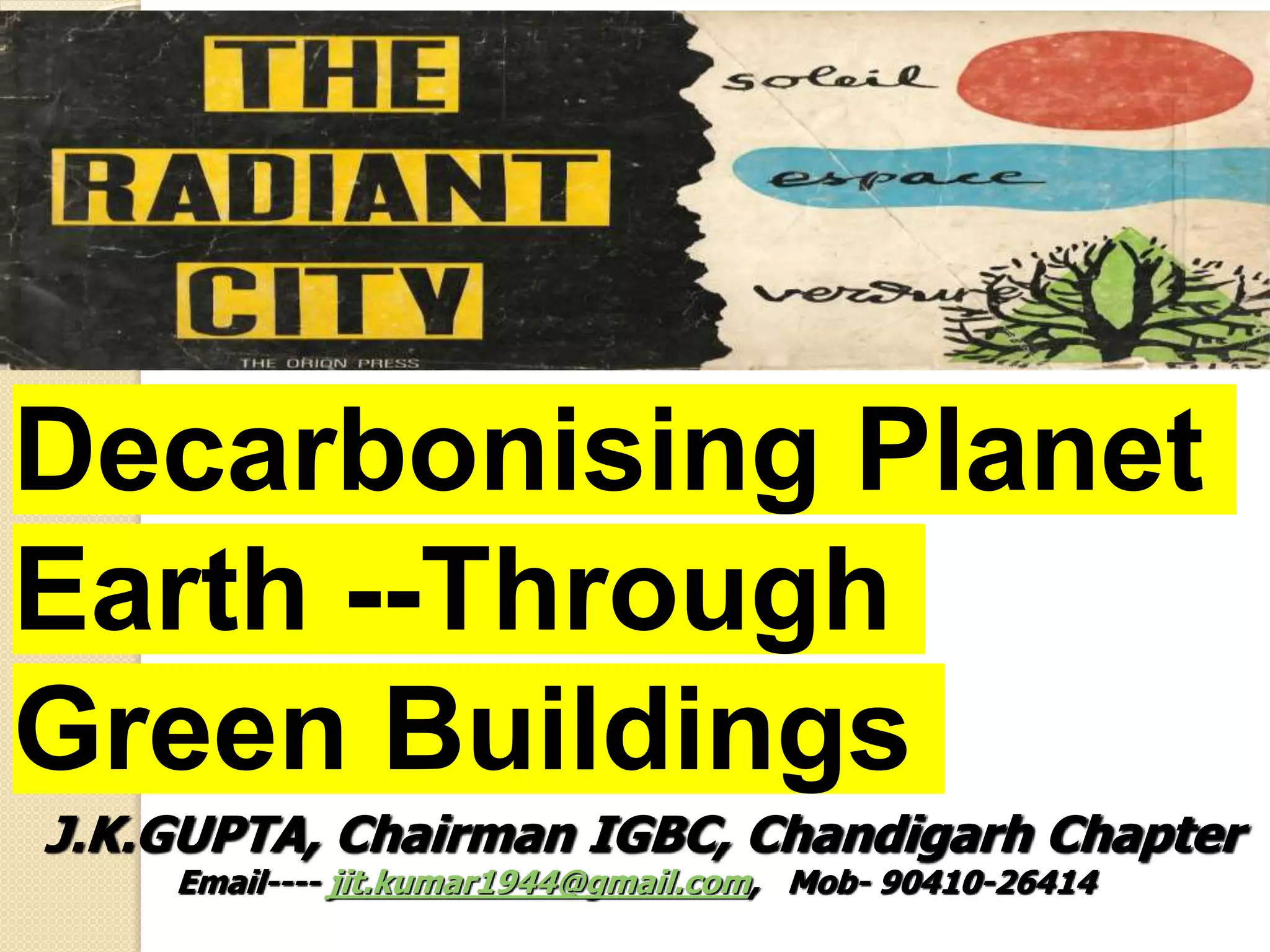
Decarbonising Planet
Earth --Through
Green Buildings
J.K.GUPTA, Chairman IGBC, Chandigarh Chapter
Email---- jit.kumar1944@gmail.com, Mob- 90410-26414
Buildings- Role and Importance
 Buildings-- integral part of human history, growth and
development since inception
 Buildings -- would continue to define future journey of
human growth
 Buildings-- constitute manmade environment-
 Buildings-- remain vital for human growth
 Buildings – are living organism
 Buildings – cater to all human activities
 Buildings- full of dualities and contradictions
 Buildings -- largest consumers of energy
 Buildings - largest consumers of resources
 Buildings – largest generators of waste
 Buildings- largest polluter of environment /ecology
 Buildings --- responsible for largest carbon footprints
 Buildings -- responsible for global warming
 Buildings -- major determinant of global sustainability

Buildings- Role and Importance
 Buildings– providers of optimum/worst living conditions
 Buildings -- make people healthy/sick
 Buildings --critical for human living- 80% human life spent
in buildings
 Buildings --critical for Global sustainability and
decarbinisation- 50% energy used by the buildings
 Buildings vital to overcome human/ ecological concerns
 Making Buildings Sustainable-- essential to make value
addition to resources, environment ,ecology
 Studies revealed —
 A Green School-- makes learning easy and more
meaningful
 A Green House--- makes people happy and healthy
 A Green Hospital-- cures patients quickly
 A Green Shopping Mall-- can increase sale / profits
Context of
Buildings-
Resources/e
nvironment
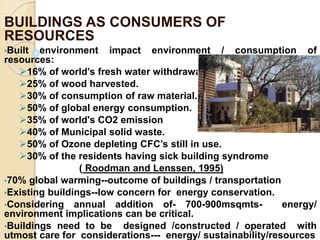
BUILDINGS AS CONSUMERS OF
RESOURCES
•Built environment impact environment / consumption of
resources:
16% of world’s fresh water withdrawal.
25% of wood harvested.
30% of consumption of raw material.
50% of global energy consumption.
35% of world's CO2 emission
40% of Municipal solid waste.
50% of Ozone depleting CFC’s still in use.
30% of the residents having sick building syndrome
( Roodman and Lenssen, 1995)
•70% global warming--outcome of buildings / transportation
•Existing buildings--low concern for energy conservation.
•Considering annual addition of- 700-900msqmts- energy/
environment implications can be critical.
•Buildings need to be designed /constructed / operated with
utmost care for considerations--- energy/ sustainability/resources
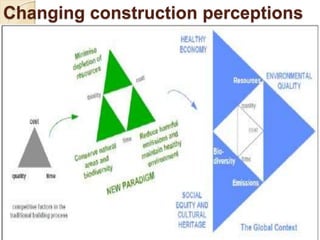
Changing construction perceptions
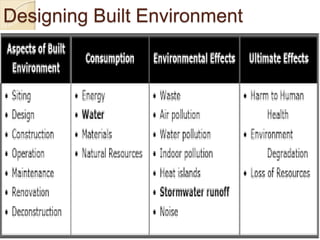
Designing Built Environment

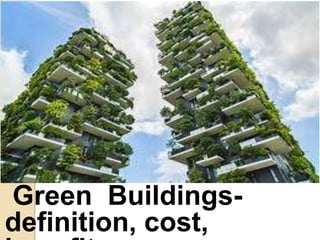
Green Buildings-
definition, cost,
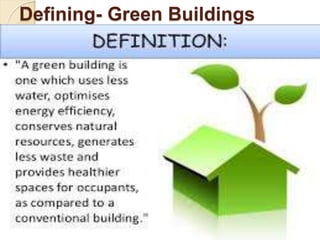
Defining- Green Buildings
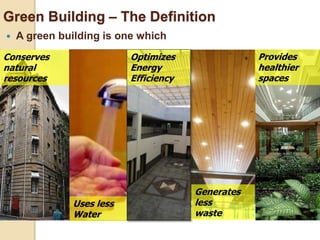
Green Building – The Definition
 A green building is one which
Uses less
Water
Optimizes
Energy
Efficiency
Conserves
natural
resources
Generates
less
waste
Provides
healthier
spaces
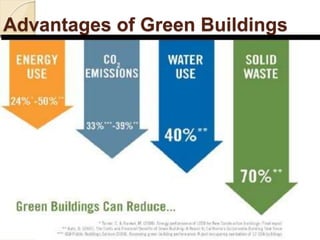
Advantages of Green Buildings
Rediscovery of the Indian
ethos
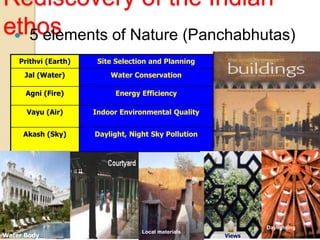
 5 elements of Nature (Panchabhutas)
Prithvi (Earth) Site Selection and Planning
Jal (Water) Water Conservation
Agni (Fire) Energy Efficiency
Vayu (Air) Indoor Environmental Quality
Akash (Sky) Daylight, Night Sky Pollution
Daylighting
Views
Water Body
Local materials
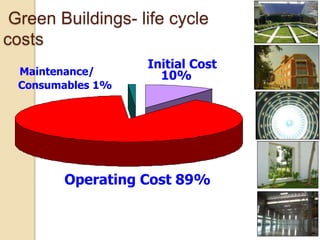
Green Buildings- life cycle
costs
Operating Cost 89%
Maintenance/
Consumables 1%
Initial Cost
10%
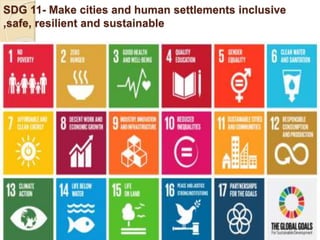
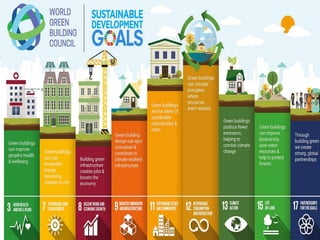
SDG 11- Make cities and human settlements inclusive
,safe, resilient and sustainable
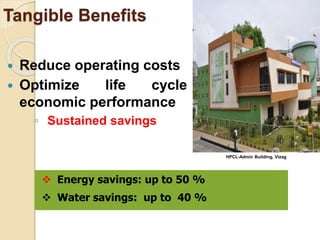
Tangible Benefits
 Reduce operating costs
 Optimize life cycle
economic performance
◦ Sustained savings
 Energy savings: up to 50 %
 Water savings: up to 40 %
HPCL-Admin Building, Vizag
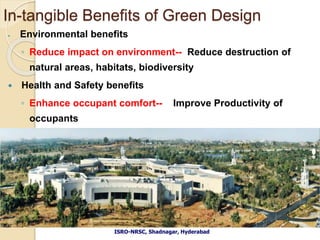
In-tangible Benefits of Green Design
 Environmental benefits
◦ Reduce impact on environment-- Reduce destruction of
natural areas, habitats, biodiversity
 Health and Safety benefits
◦ Enhance occupant comfort-- Improve Productivity of
occupants
ISRO-NRSC, Shadnagar, Hyderabad
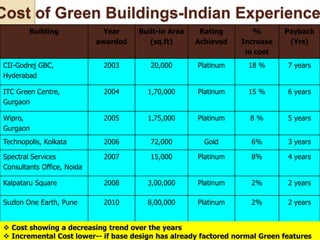
Building Year
awarded
Built-in Area
(sq.ft)
Rating
Achieved
%
Increase
in cost
Payback
(Yrs)
CII-Godrej GBC,
Hyderabad
2003 20,000 Platinum 18 % 7 years
ITC Green Centre,
Gurgaon
2004 1,70,000 Platinum 15 % 6 years
Wipro,
Gurgaon
2005 1,75,000 Platinum 8 % 5 years
Technopolis, Kolkata 2006 72,000 Gold 6% 3 years
Spectral Services
Consultants Office, Noida
2007 15,000 Platinum 8% 4 years
Kalpataru Square 2008 3,00,000 Platinum 2% 2 years
Suzlon One Earth, Pune 2010 8,00,000 Platinum 2% 2 years
Cost of Green Buildings-Indian Experience
 Cost showing a decreasing trend over the years
 Incremental Cost lower-- if base design has already factored normal Green features
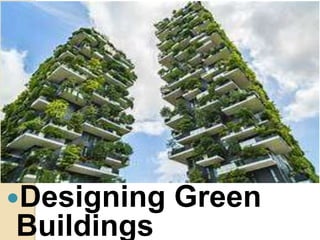
Designing Green
Buildings
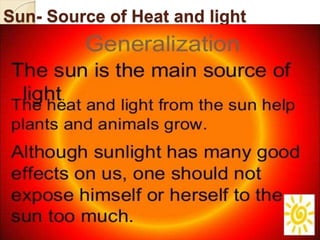
Sun- Source of Heat and light
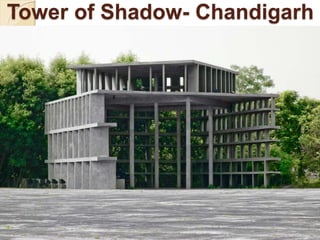
Tower of Shadow- Chandigarh
Designing Traditional Buildings Vs
Green Buildings
1 TB-Involvement of project members --limited to their trade/
specialization
 GB- Project members involved-- right from beginning to
help design/ planning process
2 TB- Project gets more intensive-- as it progresses-Less
time spent in beginning
 GB-Project starts intensively --with more time spent in
beginning
3. TB– Decisions made by few stakeholders individually--
Owner, Architect, Engineers, Contractor
 GB—Decisions made by team
 -- based on research, discussions, brainstorming
sessions
Designing Traditional Buildings Vs
Green Buildings
4 TB- Linear process
 GB— Integrated approach
5. TB- Focus to reduce upfront capital cost
 GB- Focus to reduce long term O&M costs– life cycle costs
6. TB— All systems considered in isolation --leading often to
under/over -designing/ sizing
 GB- Building performance assessed based on impact of each system
individually/collectively to create optimum design
7. TB- Project members undertake limited responsibilities
 GB-Members share equal responsibilities /work jointly
8. TB-Linear process ends-- when construction of project completed
 GB- --Design approach emphasizes-- performance of buildings/user’s
satisfaction through post- evaluation surveys /energy audit
Designing Green Buildings
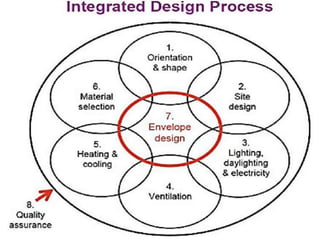
1--Adopting integrated approach to building design
2.--Design based on Climate
 Macro Climate – Regional climate; Meso Climate– local climate
 Micro Climate--Site climate -- based on site characteristics,
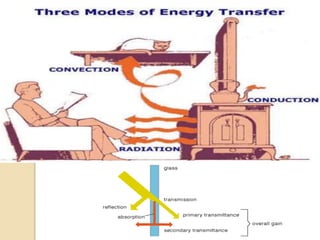
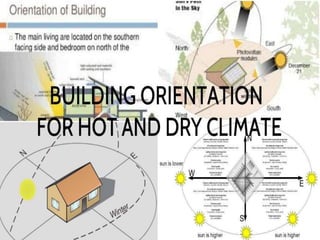
3.--Orientation -- to optimize natural light and heat gain/heat loss
4-- Sun movement-- to maximizes use of solar energy for heating
/lighting
5.--Wind direction---using movement of air for ventilation/ cooling
6. --Planning of Building-- to optimize the size/shape of building,
planning spaces, allocating uses, placing of rooms, circulation,
promoting building efficiency, promoting natural sunlight, air and
ventilation
7. --Designing Building Envelop--–positioning of openings and
projections, planning for shading devices, determining height/ shape
of building, natural lighting and ventilations etc
8.--Materials- Materials used for buildings- low embodied materials
locally available / in natural form, lightweight – reduce self load
9.--Technology- cost- effective, material efficient, speedier construction,
energy efficient
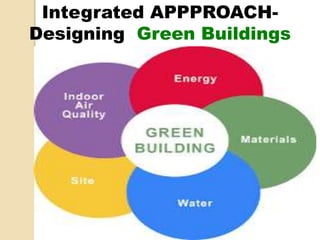
Integrated APPPROACH-
Designing Green Buildings
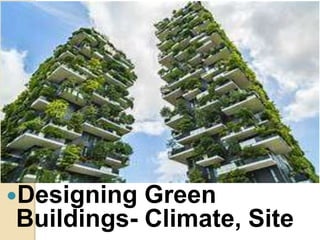
Designing Green
Buildings- Climate, Site
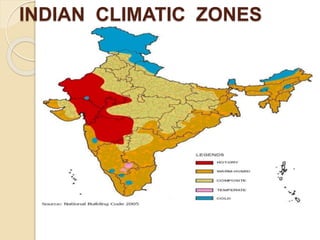
INDIAN CLIMATIC ZONES
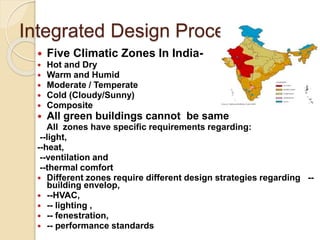
Integrated Design Process
 Five Climatic Zones In India-
 Hot and Dry
 Warm and Humid
 Moderate / Temperate
 Cold (Cloudy/Sunny)
 Composite
 All green buildings cannot be same
All zones have specific requirements regarding:
--light,
--heat,
--ventilation and
--thermal comfort
 Different zones require different design strategies regarding --
building envelop,
 --HVAC,
 -- lighting ,
 -- fenestration,
 -- performance standards
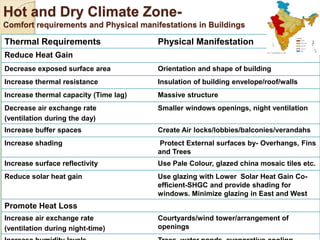
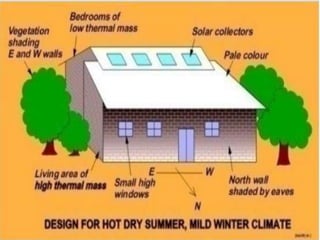
Hot and Dry Climate Zone-
Comfort requirements and Physical manifestations in Buildings
Thermal Requirements Physical Manifestation
Reduce Heat Gain
Decrease exposed surface area Orientation and shape of building
Increase thermal resistance Insulation of building envelope/roof/walls
Increase thermal capacity (Time lag) Massive structure
Decrease air exchange rate
(ventilation during the day)
Smaller windows openings, night ventilation
Increase buffer spaces Create Air locks/lobbies/balconies/verandahs
Increase shading Protect External surfaces by- Overhangs, Fins
and Trees
Increase surface reflectivity Use Pale Colour, glazed china mosaic tiles etc.
Reduce solar heat gain Use glazing with Lower Solar Heat Gain Co-
efficient-SHGC and provide shading for
windows. Minimize glazing in East and West
Promote Heat Loss
Increase air exchange rate
(ventilation during night-time)
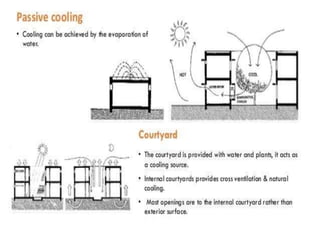
Courtyards/wind tower/arrangement of
openings
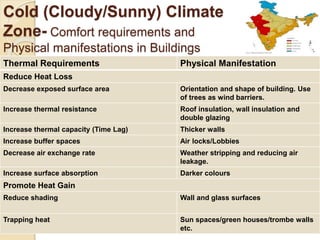
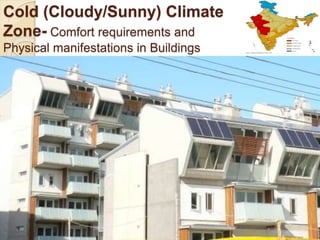
Cold (Cloudy/Sunny) Climate
Zone- Comfort requirements and
Physical manifestations in Buildings
Thermal Requirements Physical Manifestation
Reduce Heat Loss
Decrease exposed surface area Orientation and shape of building. Use
of trees as wind barriers.
Increase thermal resistance Roof insulation, wall insulation and
double glazing
Increase thermal capacity (Time Lag) Thicker walls
Increase buffer spaces Air locks/Lobbies
Decrease air exchange rate Weather stripping and reducing air
leakage.
Increase surface absorption Darker colours
Promote Heat Gain
Reduce shading Wall and glass surfaces
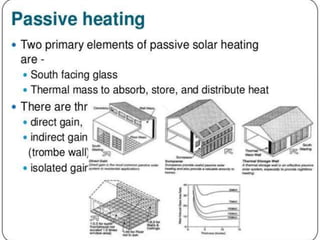
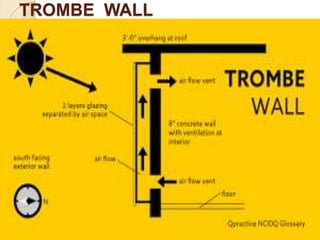
Trapping heat Sun spaces/green houses/trombe walls
etc.
Cold (Cloudy/Sunny) Climate
Zone- Comfort requirements and
Physical manifestations in Buildings
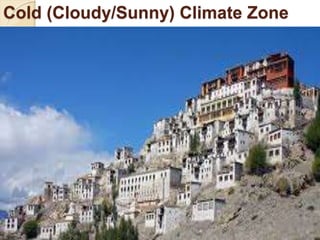
Cold (Cloudy/Sunny) Climate Zone
TROMBE WALL
Site Analysis
Site Planning
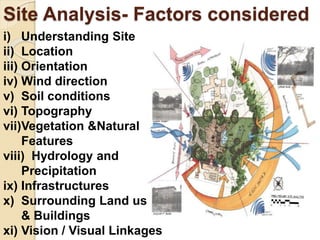
Site Analysis- Factors considered
i) Understanding Site
ii) Location
iii) Orientation
iv) Wind direction
v) Soil conditions
vi) Topography
vii)Vegetation &Natural
Features
viii) Hydrology and
Precipitation
ix) Infrastructures
x) Surrounding Land uses
& Buildings
xi) Vision / Visual Linkages
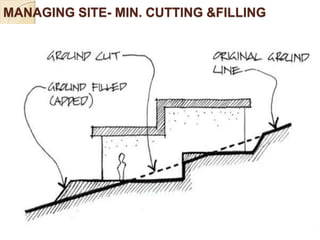
MANAGING SITE- MIN. CUTTING &FILLING
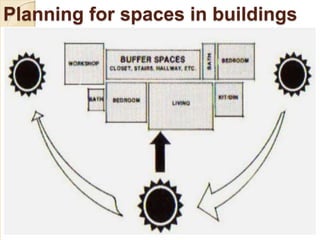
Planning for spaces in buildings
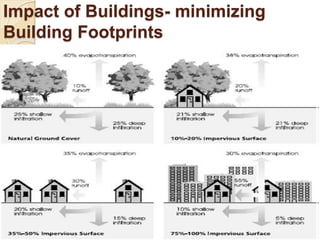
Impact of Buildings- minimizing
Building Footprints
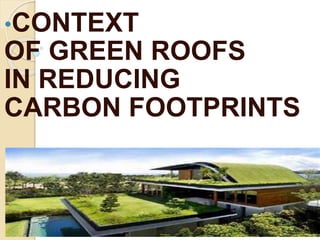
•CONTEXT
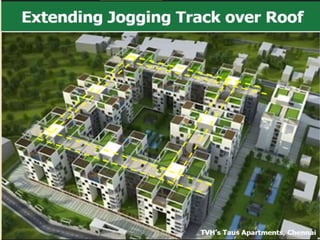
OF GREEN ROOFS
IN REDUCING
CARBON FOOTPRINTS
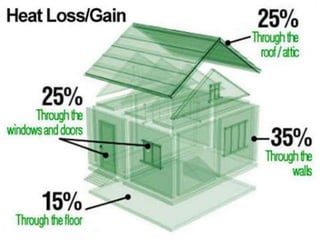
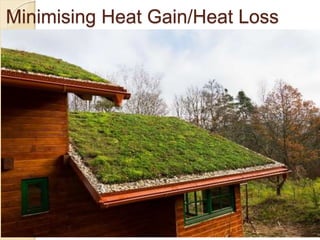
Minimising Heat Gain/Heat Loss
Defining Green Roof
 Green roof—
 Roof typology used as an option
 -- for promoting sustainability in buildings
 Green roof defined as a-
 -- space on the roof
 --comprising of collection of greenery,
 -- planted on top of a man-made structure.
 --used as a solution to manage the temperature within buildings /
 -- bringing nature into cities,
 Green roof or living roof
 - Roof of a building
 - that is partially / completely covered
 -- with vegetation and a growing medium,
 -- planted over a waterproofing membrane.
 -- may also include additional layers
 -- a root barrier and drainage / irrigation systems-
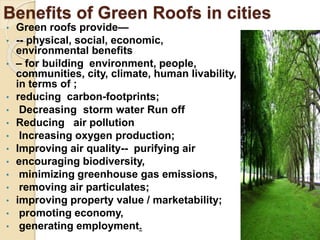
Benefits of Green Roofs in cities
• Green roofs provide—
• -- physical, social, economic,
environmental benefits
• – for building environment, people,
communities, city, climate, human livability,
in terms of ;
• reducing carbon-footprints;
• Decreasing storm water Run off
• Reducing air pollution
• Increasing oxygen production;
• Improving air quality-- purifying air
• encouraging biodiversity,
• minimizing greenhouse gas emissions,
• removing air particulates;
• improving property value / marketability;
• promoting economy,
• generating employment.
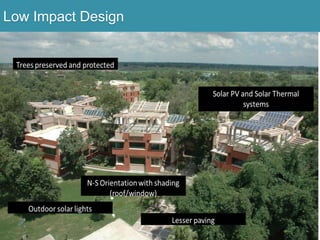
Low Impact Design
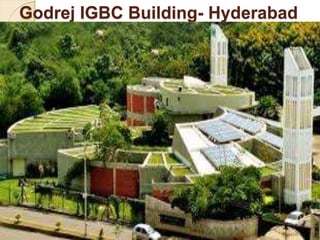
Godrej IGBC Building- Hyderabad
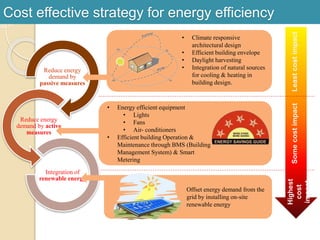
Cost effective strategy for energy efficiency
Reduce energy
demand by
passive measures
Reduce energy
demand by active
measures
Integration of
renewable energy
Least
cost
impact
Some
cost
impact
Highest
cost
impact
• Climate responsive
architectural design
• Efficient building envelope
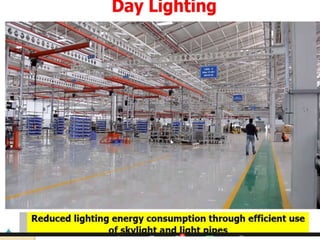
• Daylight harvesting
• Integration of natural sources
for cooling & heating in
building design.
Offset energy demand from the
grid by installing on-site
renewable energy
• Energy efficient equipment
• Lights
• Fans
• Air- conditioners
• Efficient building Operation &
Maintenance through BMS (Building
Management System) & Smart
Metering
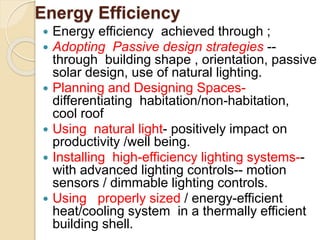
Energy Efficiency
 Energy efficiency achieved through ;
 Adopting Passive design strategies --
through building shape , orientation, passive
solar design, use of natural lighting.
 Planning and Designing Spaces-
differentiating habitation/non-habitation,
cool roof
 Using natural light- positively impact on
productivity /well being.
 Installing high-efficiency lighting systems--
with advanced lighting controls-- motion
sensors / dimmable lighting controls.
 Using properly sized / energy-efficient
heat/cooling system in a thermally efficient
building shell.
Energy Efficiency
 Maximize light/ dark colours for roofing /
wall finish materials in hot/cold regions;
 -- install high R-value wall/ ceiling
insulation;
 -- using minimal glass on east/ west
exposures.
 -- Minimizing electric loads from lighting,
equipment, appliances.
 --Involving alternative energy sources --
photovoltaic /fuel cells
 Computer modelling -- for optimizing
design of electrical and mechanical
systems and building shell.
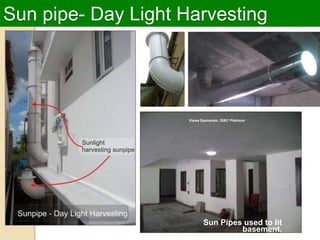
Sun pipe- Day Light Harvesting
Sun Pipes used to lit
basement,
Viswa Syamalam, IGBC Platinum
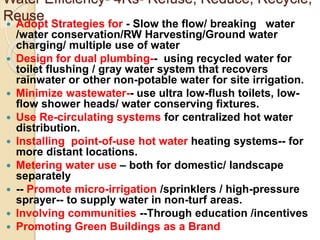
Water Efficiency- 4Rs- Refuse, Reduce, Recycle,
Reuse
 Adopt Strategies for - Slow the flow/ breaking water
/water conservation/RW Harvesting/Ground water
charging/ multiple use of water
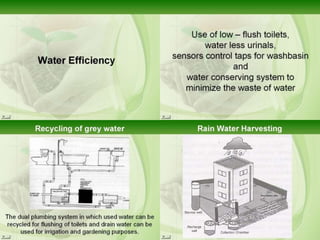
 Design for dual plumbing-- using recycled water for
toilet flushing / gray water system that recovers
rainwater or other non-potable water for site irrigation.
 Minimize wastewater-- use ultra low-flush toilets, low-
flow shower heads/ water conserving fixtures.
 Use Re-circulating systems for centralized hot water
distribution.
 Installing point-of-use hot water heating systems-- for
more distant locations.
 Metering water use – both for domestic/ landscape
separately
 -- Promote micro-irrigation /sprinklers / high-pressure
sprayer-- to supply water in non-turf areas.
 Involving communities --Through education /incentives
 Promoting Green Buildings as a Brand
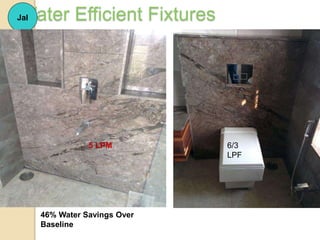
Water Efficient Fixtures
Jal
8 LPM
2/4 LPM
46% Water Savings Over
Baseline
6/3
LPF
5 LPM
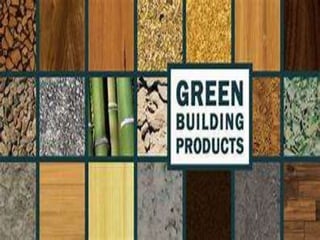
Green Materials
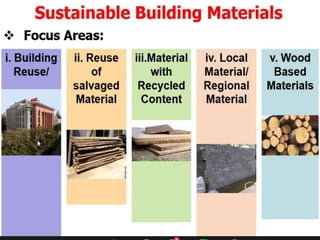
 Materials --for green building are ;
 --obtained from natural, renewable sources
 --managed / harvested in a sustainable way;
 -- obtained locally-- to reduce embedded
energy costs of transportation; or
 -- salvaged from reclaimed materials at
nearby sites.
 -- Materials assessed using green
specifications
 -- looking at Life Cycle Analysis (LCA)
 --- embodied energy, durability, recycled
contents , waste minimisation, and
 ---their ability to be reused or recycled.
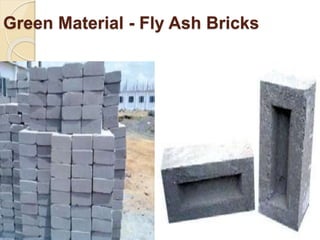
Green Material - Fly Ash Bricks
Green Material- Fly Ash Bricks-
 Reduced Embodied Energy: using Fly ash- lime-
Gypsum bricks-- 40% reduction in embodied energy
of masonry.
 Environment Friendly: Fly ash brick uses unfired
Fly Ash technology – limited CO2 emissions in
manufacturing process
 Excellent Thermal Insulation: The buildings using
fly ash bricks -- cool in summers and warm in
winters.
 High Fire Resistance: -- as these bricks composed of
fly ash as its major constituents, which is un-burnt
residue of the coal fired in a thermal power plant.
 • No Efflorescence: Fly ash bricks resist salt and
other sulphate attack, ensuring no efflorescence in
structure.
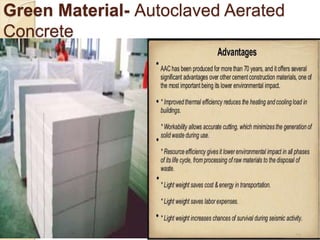
Green Material- Autoclaved Aerated
Concrete
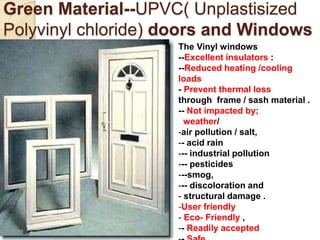
Green Material--UPVC( Unplastisized
Polyvinyl chloride) doors and Windows
The Vinyl windows
--Excellent insulators :
--Reduced heating /cooling
loads
- Prevent thermal loss
through frame / sash material .
-- Not impacted by;
weather/
-air pollution / salt,
-- acid rain
--- industrial pollution
--- pesticides
---smog,
--- discoloration and
- structural damage .
-User friendly
- Eco- Friendly ,
-- Readily accepted
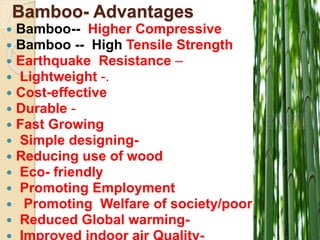
Bamboo- Advantages
 Bamboo-- Higher Compressive
 Bamboo -- High Tensile Strength
 Earthquake Resistance –
 Lightweight -.
 Cost-effective
 Durable -
 Fast Growing
 Simple designing-
 Reducing use of wood
 Eco- friendly
 Promoting Employment
 Promoting Welfare of society/poor-
 Reduced Global warming-
Rise of Prefabricated Building
 Prefab building - last real estate cycle/pushed such construction to
prominence
 During second world war, --majority of skilled construction
manpower/ labourers left job,-- due to recession in construction
industry.
 lead to shortage of manpower-
 when large scale construction started after world war-led to a boom
in high rise apartments blocks
 -- to replace buildings which suffered extensive damage during war
 --contractors turned to prefabricated system to meet demand. which
were;
 -safe, efficient, cost-effective/ quality construction minimum
manpower.
 -- off-site construction considered best option— -to build projects in
limited time-to provide workers with safer working conditions
 -- Search led to the emergence of prefabricated/ modular construction.
 Acute shortage of housing following second world war
 ----Modular is a process of construction rather than a specific type of
building, ------- which defines how building is constructe
 --Japan / Europe had massive rebuilding needs-- turned to
prefabrication /off-site construction
Pre- fabrication/Modular
Construction/off-site-
Advantages
 Building in Hazardous Area
 Assured Quality Construction
 Material Efficiency
 Cost- Efficiency
 Green Construction
 Flexibility
 Reduced Site Disruption
 Time Efficiency
 Safety
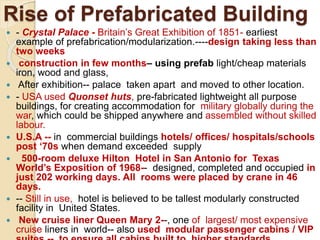
Rise of Prefabricated Building
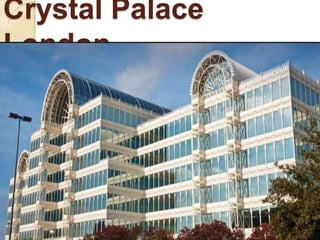
 - Crystal Palace - Britain’s Great Exhibition of 1851- earliest
example of prefabrication/modularization.----design taking less than
two weeks
 construction in few months– using prefab light/cheap materials
iron, wood and glass,
 After exhibition-- palace taken apart and moved to other location.
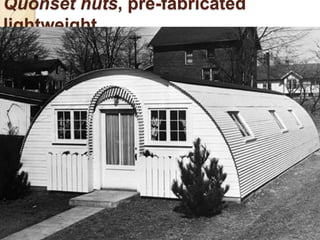
 - USA used Quonset huts, pre-fabricated lightweight all purpose
buildings, for creating accommodation for military globally during the
war, which could be shipped anywhere and assembled without skilled
labour.
 U.S.A -- in commercial buildings hotels/ offices/ hospitals/schools
post ‘70s when demand exceeded supply
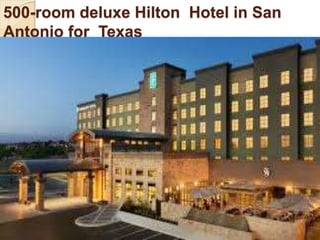
 500-room deluxe Hilton Hotel in San Antonio for Texas
World’s Exposition of 1968-- designed, completed and occupied in
just 202 working days. All rooms were placed by crane in 46
days.
 -- Still in use, hotel is believed to be tallest modularly constructed
facility in United States.
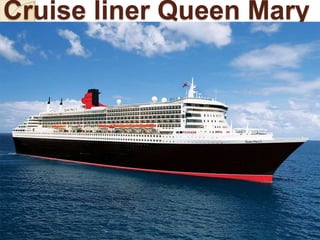
 New cruise liner Queen Mary 2--, one of largest/ most expensive
cruise liners in world-- also used modular passenger cabins / VIP
Crystal Palace
London
Quonset huts, pre-fabricated
lightweight
500-room deluxe Hilton Hotel in San
Antonio for Texas
Cruise liner Queen Mary
2
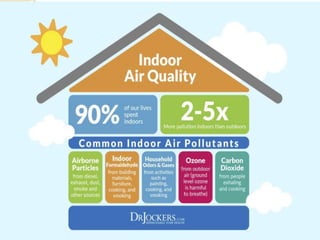
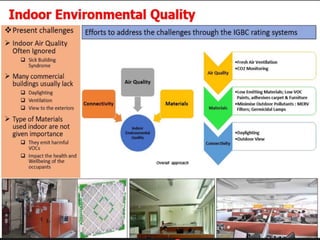
Indoor Air Quality
Good Indoor air quality --essential for work places
-- to foster better health
Good Indoor environmental quality–
-- reduces respiratory disease, allergy,
asthma, eliminates sick building syndrome
-- enhance worker performance.
• When people themselves are
• main source of emission.
--Carbon dioxide concentration /
indoor air quality in interiors
important indicator for determining
whether quality of indoor air is bad/good
• Poor indoor air quality leads to tiredness,
-- lack of concentration and
---- can even bring about illnesses.
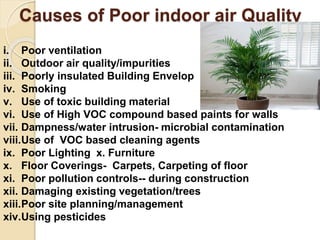
Causes of Poor indoor air Quality
i. Poor ventilation
ii. Outdoor air quality/impurities
iii. Poorly insulated Building Envelop
iv. Smoking
v. Use of toxic building material
vi. Use of High VOC compound based paints for walls
vii. Dampness/water intrusion- microbial contamination
viii.Use of VOC based cleaning agents
ix. Poor Lighting x. Furniture
x. Floor Coverings- Carpets, Carpeting of floor
xi. Poor pollution controls-- during construction
xii. Damaging existing vegetation/trees
xiii.Poor site planning/management
xiv.Using pesticides
Promoting health and wellbeing
 Promoting health and wellbeing by;
 Bringing fresh air inside/ Delivering good indoor air
quality-- through ventilation-- avoiding materials /
chemicals -- creating harmful /toxic emissions.
 Incorporating natural light / views--to ensure building
users’ comfort /enjoyment of surroundings/ reducing
lighting energy needs .
 Designing for ears/ eyes – through Acoustics /sound
insulation-- for promoting concentration, recuperation/
peaceful enjoyment of a building-- in educational, health
/residential buildings.
 Ensuring Environment comfort --through right indoor
temperature
 Passive design/ using plants
 Building management and monitoring systems
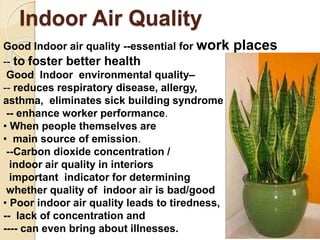
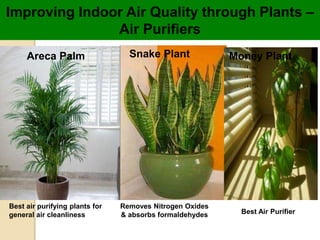
Best air purifying plants for
general air cleanliness
Areca Palm Snake Plant
Best Air Purifier
Money Plant
Removes Nitrogen Oxides
& absorbs formaldehydes
Improving Indoor Air Quality through Plants –
Air Purifiers
Changing
Paradigm of
Construction/
Material
Technologies
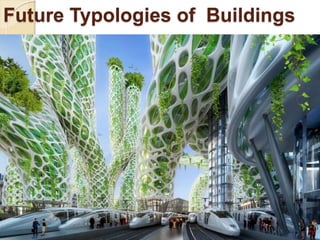
Future Typologies of Buildings
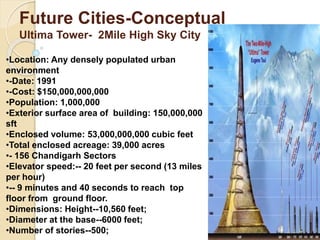
Future Cities-Conceptual
Ultima Tower- 2Mile High Sky City
•Location: Any densely populated urban
environment
•-Date: 1991
•-Cost: $150,000,000,000
•Population: 1,000,000
•Exterior surface area of building: 150,000,000
sft
•Enclosed volume: 53,000,000,000 cubic feet
•Total enclosed acreage: 39,000 acres
•- 156 Chandigarh Sectors
•Elevator speed:-- 20 feet per second (13 miles
per hour)
•-- 9 minutes and 40 seconds to reach top
floor from ground floor.
•Dimensions: Height--10,560 feet;
•Diameter at the base--6000 feet;
•Number of stories--500;
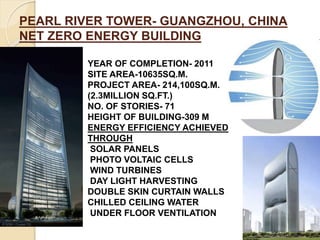
PEARL RIVER TOWER- GUANGZHOU, CHINA
NET ZERO ENERGY BUILDING
YEAR OF COMPLETION- 2011
SITE AREA-10635SQ.M.
PROJECT AREA- 214,100SQ.M.
(2.3MILLION SQ.FT.)
NO. OF STORIES- 71
HEIGHT OF BUILDING-309 M
ENERGY EFFICIENCY ACHIEVED
THROUGH
SOLAR PANELS
PHOTO VOLTAIC CELLS
WIND TURBINES
DAY LIGHT HARVESTING
DOUBLE SKIN CURTAIN WALLS
CHILLED CEILING WATER
UNDER FLOOR VENTILATION
Rating/Evaluating Buildings
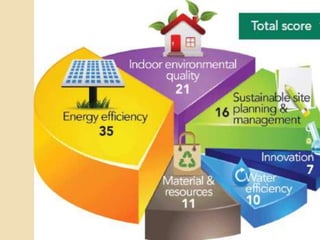
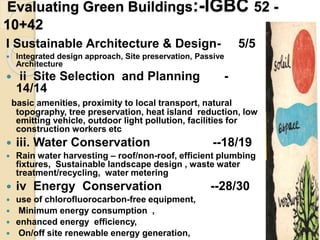
Evaluating Green Buildings:-IGBC 52 -
10+42
I Sustainable Architecture & Design- 5/5
 Integrated design approach, Site preservation, Passive
Architecture
 ii Site Selection and Planning -
14/14
basic amenities, proximity to local transport, natural
topography, tree preservation, heat island reduction, low
emitting vehicle, outdoor light pollution, facilities for
construction workers etc
 iii. Water Conservation --18/19
 Rain water harvesting – roof/non-roof, efficient plumbing
fixtures, Sustainable landscape design , waste water
treatment/recycling, water metering
 iv Energy Conservation --28/30
 use of chlorofluorocarbon-free equipment,
 Minimum energy consumption ,
 enhanced energy efficiency,
 On/off site renewable energy generation,
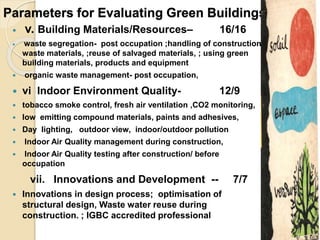
Parameters for Evaluating Green Buildings:
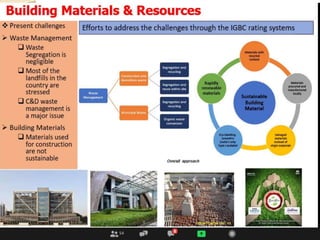
 v. Building Materials/Resources– 16/16
 waste segregation- post occupation ;handling of construction
waste materials, ;reuse of salvaged materials, ; using green
building materials, products and equipment
 organic waste management- post occupation,
 vi Indoor Environment Quality- 12/9
 tobacco smoke control, fresh air ventilation ,CO2 monitoring,
 low emitting compound materials, paints and adhesives,
 Day lighting, outdoor view, indoor/outdoor pollution
 Indoor Air Quality management during construction,
 Indoor Air Quality testing after construction/ before
occupation
vii. Innovations and Development -- 7/7
 Innovations in design process; optimisation of
structural design, Waste water reuse during
construction. ; IGBC accredited professional
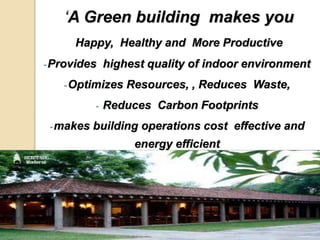
‘A Green building makes you
Happy, Healthy and More Productive
-Provides highest quality of indoor environment
-Optimizes Resources, , Reduces Waste,
- Reduces Carbon Footprints
-makes building operations cost effective and
energy efficient
- – ‘Natural Capitalism’
Go Green! Should be your mantra forlife-pp
/
Visit www.igbc.in
Stay Healthy
Stay Safe
Jit.kumar1944@gmail.com

Decarbonising Planet Earth ThroughGreen Building

  • 1.
    Decarbonising Planet Earth --Through GreenBuildings J.K.GUPTA, Chairman IGBC, Chandigarh Chapter Email---- jit.kumar1944@gmail.com, Mob- 90410-26414
  • 2.
    Buildings- Role andImportance  Buildings-- integral part of human history, growth and development since inception  Buildings -- would continue to define future journey of human growth  Buildings-- constitute manmade environment-  Buildings-- remain vital for human growth  Buildings – are living organism  Buildings – cater to all human activities  Buildings- full of dualities and contradictions  Buildings -- largest consumers of energy  Buildings - largest consumers of resources  Buildings – largest generators of waste  Buildings- largest polluter of environment /ecology  Buildings --- responsible for largest carbon footprints  Buildings -- responsible for global warming  Buildings -- major determinant of global sustainability 
  • 3.
    Buildings- Role andImportance  Buildings– providers of optimum/worst living conditions  Buildings -- make people healthy/sick  Buildings --critical for human living- 80% human life spent in buildings  Buildings --critical for Global sustainability and decarbinisation- 50% energy used by the buildings  Buildings vital to overcome human/ ecological concerns  Making Buildings Sustainable-- essential to make value addition to resources, environment ,ecology  Studies revealed —  A Green School-- makes learning easy and more meaningful  A Green House--- makes people happy and healthy  A Green Hospital-- cures patients quickly  A Green Shopping Mall-- can increase sale / profits
  • 4.
  • 5.
    BUILDINGS AS CONSUMERSOF RESOURCES •Built environment impact environment / consumption of resources: 16% of world’s fresh water withdrawal. 25% of wood harvested. 30% of consumption of raw material. 50% of global energy consumption. 35% of world's CO2 emission 40% of Municipal solid waste. 50% of Ozone depleting CFC’s still in use. 30% of the residents having sick building syndrome ( Roodman and Lenssen, 1995) •70% global warming--outcome of buildings / transportation •Existing buildings--low concern for energy conservation. •Considering annual addition of- 700-900msqmts- energy/ environment implications can be critical. •Buildings need to be designed /constructed / operated with utmost care for considerations--- energy/ sustainability/resources
  • 6.
  • 7.
  • 8.
  • 9.
  • 10.
    Green Building –The Definition  A green building is one which Uses less Water Optimizes Energy Efficiency Conserves natural resources Generates less waste Provides healthier spaces
  • 11.
  • 12.
    Rediscovery of theIndian ethos  5 elements of Nature (Panchabhutas) Prithvi (Earth) Site Selection and Planning Jal (Water) Water Conservation Agni (Fire) Energy Efficiency Vayu (Air) Indoor Environmental Quality Akash (Sky) Daylight, Night Sky Pollution Daylighting Views Water Body Local materials
  • 13.
    Green Buildings- lifecycle costs Operating Cost 89% Maintenance/ Consumables 1% Initial Cost 10%
  • 14.
    SDG 11- Makecities and human settlements inclusive ,safe, resilient and sustainable
  • 16.
    Tangible Benefits  Reduceoperating costs  Optimize life cycle economic performance ◦ Sustained savings  Energy savings: up to 50 %  Water savings: up to 40 % HPCL-Admin Building, Vizag
  • 17.
    In-tangible Benefits ofGreen Design  Environmental benefits ◦ Reduce impact on environment-- Reduce destruction of natural areas, habitats, biodiversity  Health and Safety benefits ◦ Enhance occupant comfort-- Improve Productivity of occupants ISRO-NRSC, Shadnagar, Hyderabad
  • 18.
    Building Year awarded Built-in Area (sq.ft) Rating Achieved % Increase incost Payback (Yrs) CII-Godrej GBC, Hyderabad 2003 20,000 Platinum 18 % 7 years ITC Green Centre, Gurgaon 2004 1,70,000 Platinum 15 % 6 years Wipro, Gurgaon 2005 1,75,000 Platinum 8 % 5 years Technopolis, Kolkata 2006 72,000 Gold 6% 3 years Spectral Services Consultants Office, Noida 2007 15,000 Platinum 8% 4 years Kalpataru Square 2008 3,00,000 Platinum 2% 2 years Suzlon One Earth, Pune 2010 8,00,000 Platinum 2% 2 years Cost of Green Buildings-Indian Experience  Cost showing a decreasing trend over the years  Incremental Cost lower-- if base design has already factored normal Green features
  • 19.
  • 20.
    Sun- Source ofHeat and light
  • 23.
    Tower of Shadow-Chandigarh
  • 24.
    Designing Traditional BuildingsVs Green Buildings 1 TB-Involvement of project members --limited to their trade/ specialization  GB- Project members involved-- right from beginning to help design/ planning process 2 TB- Project gets more intensive-- as it progresses-Less time spent in beginning  GB-Project starts intensively --with more time spent in beginning 3. TB– Decisions made by few stakeholders individually-- Owner, Architect, Engineers, Contractor  GB—Decisions made by team  -- based on research, discussions, brainstorming sessions
  • 25.
    Designing Traditional BuildingsVs Green Buildings 4 TB- Linear process  GB— Integrated approach 5. TB- Focus to reduce upfront capital cost  GB- Focus to reduce long term O&M costs– life cycle costs 6. TB— All systems considered in isolation --leading often to under/over -designing/ sizing  GB- Building performance assessed based on impact of each system individually/collectively to create optimum design 7. TB- Project members undertake limited responsibilities  GB-Members share equal responsibilities /work jointly 8. TB-Linear process ends-- when construction of project completed  GB- --Design approach emphasizes-- performance of buildings/user’s satisfaction through post- evaluation surveys /energy audit
  • 26.
    Designing Green Buildings 1--Adoptingintegrated approach to building design 2.--Design based on Climate  Macro Climate – Regional climate; Meso Climate– local climate  Micro Climate--Site climate -- based on site characteristics, 3.--Orientation -- to optimize natural light and heat gain/heat loss 4-- Sun movement-- to maximizes use of solar energy for heating /lighting 5.--Wind direction---using movement of air for ventilation/ cooling 6. --Planning of Building-- to optimize the size/shape of building, planning spaces, allocating uses, placing of rooms, circulation, promoting building efficiency, promoting natural sunlight, air and ventilation 7. --Designing Building Envelop--–positioning of openings and projections, planning for shading devices, determining height/ shape of building, natural lighting and ventilations etc 8.--Materials- Materials used for buildings- low embodied materials locally available / in natural form, lightweight – reduce self load 9.--Technology- cost- effective, material efficient, speedier construction, energy efficient
  • 27.
  • 29.
  • 30.
  • 31.
    Integrated Design Process Five Climatic Zones In India-  Hot and Dry  Warm and Humid  Moderate / Temperate  Cold (Cloudy/Sunny)  Composite  All green buildings cannot be same All zones have specific requirements regarding: --light, --heat, --ventilation and --thermal comfort  Different zones require different design strategies regarding -- building envelop,  --HVAC,  -- lighting ,  -- fenestration,  -- performance standards
  • 32.
    Hot and DryClimate Zone- Comfort requirements and Physical manifestations in Buildings Thermal Requirements Physical Manifestation Reduce Heat Gain Decrease exposed surface area Orientation and shape of building Increase thermal resistance Insulation of building envelope/roof/walls Increase thermal capacity (Time lag) Massive structure Decrease air exchange rate (ventilation during the day) Smaller windows openings, night ventilation Increase buffer spaces Create Air locks/lobbies/balconies/verandahs Increase shading Protect External surfaces by- Overhangs, Fins and Trees Increase surface reflectivity Use Pale Colour, glazed china mosaic tiles etc. Reduce solar heat gain Use glazing with Lower Solar Heat Gain Co- efficient-SHGC and provide shading for windows. Minimize glazing in East and West Promote Heat Loss Increase air exchange rate (ventilation during night-time) Courtyards/wind tower/arrangement of openings
  • 35.
    Cold (Cloudy/Sunny) Climate Zone-Comfort requirements and Physical manifestations in Buildings Thermal Requirements Physical Manifestation Reduce Heat Loss Decrease exposed surface area Orientation and shape of building. Use of trees as wind barriers. Increase thermal resistance Roof insulation, wall insulation and double glazing Increase thermal capacity (Time Lag) Thicker walls Increase buffer spaces Air locks/Lobbies Decrease air exchange rate Weather stripping and reducing air leakage. Increase surface absorption Darker colours Promote Heat Gain Reduce shading Wall and glass surfaces Trapping heat Sun spaces/green houses/trombe walls etc.
  • 37.
    Cold (Cloudy/Sunny) Climate Zone-Comfort requirements and Physical manifestations in Buildings
  • 38.
  • 39.
  • 40.
  • 41.
    Site Analysis- Factorsconsidered i) Understanding Site ii) Location iii) Orientation iv) Wind direction v) Soil conditions vi) Topography vii)Vegetation &Natural Features viii) Hydrology and Precipitation ix) Infrastructures x) Surrounding Land uses & Buildings xi) Vision / Visual Linkages
  • 42.
    MANAGING SITE- MIN.CUTTING &FILLING
  • 43.
    Planning for spacesin buildings
  • 44.
    Impact of Buildings-minimizing Building Footprints
  • 45.
    •CONTEXT OF GREEN ROOFS INREDUCING CARBON FOOTPRINTS
  • 47.
  • 48.
    Defining Green Roof Green roof—  Roof typology used as an option  -- for promoting sustainability in buildings  Green roof defined as a-  -- space on the roof  --comprising of collection of greenery,  -- planted on top of a man-made structure.  --used as a solution to manage the temperature within buildings /  -- bringing nature into cities,  Green roof or living roof  - Roof of a building  - that is partially / completely covered  -- with vegetation and a growing medium,  -- planted over a waterproofing membrane.  -- may also include additional layers  -- a root barrier and drainage / irrigation systems-
  • 49.
    Benefits of GreenRoofs in cities • Green roofs provide— • -- physical, social, economic, environmental benefits • – for building environment, people, communities, city, climate, human livability, in terms of ; • reducing carbon-footprints; • Decreasing storm water Run off • Reducing air pollution • Increasing oxygen production; • Improving air quality-- purifying air • encouraging biodiversity, • minimizing greenhouse gas emissions, • removing air particulates; • improving property value / marketability; • promoting economy, • generating employment.
  • 51.
  • 52.
  • 54.
    Cost effective strategyfor energy efficiency Reduce energy demand by passive measures Reduce energy demand by active measures Integration of renewable energy Least cost impact Some cost impact Highest cost impact • Climate responsive architectural design • Efficient building envelope • Daylight harvesting • Integration of natural sources for cooling & heating in building design. Offset energy demand from the grid by installing on-site renewable energy • Energy efficient equipment • Lights • Fans • Air- conditioners • Efficient building Operation & Maintenance through BMS (Building Management System) & Smart Metering
  • 55.
    Energy Efficiency  Energyefficiency achieved through ;  Adopting Passive design strategies -- through building shape , orientation, passive solar design, use of natural lighting.  Planning and Designing Spaces- differentiating habitation/non-habitation, cool roof  Using natural light- positively impact on productivity /well being.  Installing high-efficiency lighting systems-- with advanced lighting controls-- motion sensors / dimmable lighting controls.  Using properly sized / energy-efficient heat/cooling system in a thermally efficient building shell.
  • 56.
    Energy Efficiency  Maximizelight/ dark colours for roofing / wall finish materials in hot/cold regions;  -- install high R-value wall/ ceiling insulation;  -- using minimal glass on east/ west exposures.  -- Minimizing electric loads from lighting, equipment, appliances.  --Involving alternative energy sources -- photovoltaic /fuel cells  Computer modelling -- for optimizing design of electrical and mechanical systems and building shell.
  • 58.
    Sun pipe- DayLight Harvesting Sun Pipes used to lit basement, Viswa Syamalam, IGBC Platinum
  • 61.
    Water Efficiency- 4Rs-Refuse, Reduce, Recycle, Reuse  Adopt Strategies for - Slow the flow/ breaking water /water conservation/RW Harvesting/Ground water charging/ multiple use of water  Design for dual plumbing-- using recycled water for toilet flushing / gray water system that recovers rainwater or other non-potable water for site irrigation.  Minimize wastewater-- use ultra low-flush toilets, low- flow shower heads/ water conserving fixtures.  Use Re-circulating systems for centralized hot water distribution.  Installing point-of-use hot water heating systems-- for more distant locations.  Metering water use – both for domestic/ landscape separately  -- Promote micro-irrigation /sprinklers / high-pressure sprayer-- to supply water in non-turf areas.  Involving communities --Through education /incentives  Promoting Green Buildings as a Brand
  • 63.
    Water Efficient Fixtures Jal 8LPM 2/4 LPM 46% Water Savings Over Baseline 6/3 LPF 5 LPM
  • 67.
    Green Materials  Materials--for green building are ;  --obtained from natural, renewable sources  --managed / harvested in a sustainable way;  -- obtained locally-- to reduce embedded energy costs of transportation; or  -- salvaged from reclaimed materials at nearby sites.  -- Materials assessed using green specifications  -- looking at Life Cycle Analysis (LCA)  --- embodied energy, durability, recycled contents , waste minimisation, and  ---their ability to be reused or recycled.
  • 68.
    Green Material -Fly Ash Bricks
  • 69.
    Green Material- FlyAsh Bricks-  Reduced Embodied Energy: using Fly ash- lime- Gypsum bricks-- 40% reduction in embodied energy of masonry.  Environment Friendly: Fly ash brick uses unfired Fly Ash technology – limited CO2 emissions in manufacturing process  Excellent Thermal Insulation: The buildings using fly ash bricks -- cool in summers and warm in winters.  High Fire Resistance: -- as these bricks composed of fly ash as its major constituents, which is un-burnt residue of the coal fired in a thermal power plant.  • No Efflorescence: Fly ash bricks resist salt and other sulphate attack, ensuring no efflorescence in structure.
  • 70.
  • 71.
    Green Material--UPVC( Unplastisized Polyvinylchloride) doors and Windows The Vinyl windows --Excellent insulators : --Reduced heating /cooling loads - Prevent thermal loss through frame / sash material . -- Not impacted by; weather/ -air pollution / salt, -- acid rain --- industrial pollution --- pesticides ---smog, --- discoloration and - structural damage . -User friendly - Eco- Friendly , -- Readily accepted
  • 72.
    Bamboo- Advantages  Bamboo--Higher Compressive  Bamboo -- High Tensile Strength  Earthquake Resistance –  Lightweight -.  Cost-effective  Durable -  Fast Growing  Simple designing-  Reducing use of wood  Eco- friendly  Promoting Employment  Promoting Welfare of society/poor-  Reduced Global warming-
  • 73.
    Rise of PrefabricatedBuilding  Prefab building - last real estate cycle/pushed such construction to prominence  During second world war, --majority of skilled construction manpower/ labourers left job,-- due to recession in construction industry.  lead to shortage of manpower-  when large scale construction started after world war-led to a boom in high rise apartments blocks  -- to replace buildings which suffered extensive damage during war  --contractors turned to prefabricated system to meet demand. which were;  -safe, efficient, cost-effective/ quality construction minimum manpower.  -- off-site construction considered best option— -to build projects in limited time-to provide workers with safer working conditions  -- Search led to the emergence of prefabricated/ modular construction.  Acute shortage of housing following second world war  ----Modular is a process of construction rather than a specific type of building, ------- which defines how building is constructe  --Japan / Europe had massive rebuilding needs-- turned to prefabrication /off-site construction
  • 74.
    Pre- fabrication/Modular Construction/off-site- Advantages  Buildingin Hazardous Area  Assured Quality Construction  Material Efficiency  Cost- Efficiency  Green Construction  Flexibility  Reduced Site Disruption  Time Efficiency  Safety
  • 75.
    Rise of PrefabricatedBuilding  - Crystal Palace - Britain’s Great Exhibition of 1851- earliest example of prefabrication/modularization.----design taking less than two weeks  construction in few months– using prefab light/cheap materials iron, wood and glass,  After exhibition-- palace taken apart and moved to other location.  - USA used Quonset huts, pre-fabricated lightweight all purpose buildings, for creating accommodation for military globally during the war, which could be shipped anywhere and assembled without skilled labour.  U.S.A -- in commercial buildings hotels/ offices/ hospitals/schools post ‘70s when demand exceeded supply  500-room deluxe Hilton Hotel in San Antonio for Texas World’s Exposition of 1968-- designed, completed and occupied in just 202 working days. All rooms were placed by crane in 46 days.  -- Still in use, hotel is believed to be tallest modularly constructed facility in United States.  New cruise liner Queen Mary 2--, one of largest/ most expensive cruise liners in world-- also used modular passenger cabins / VIP
  • 76.
  • 77.
  • 78.
    500-room deluxe HiltonHotel in San Antonio for Texas
  • 79.
  • 82.
    Indoor Air Quality GoodIndoor air quality --essential for work places -- to foster better health Good Indoor environmental quality– -- reduces respiratory disease, allergy, asthma, eliminates sick building syndrome -- enhance worker performance. • When people themselves are • main source of emission. --Carbon dioxide concentration / indoor air quality in interiors important indicator for determining whether quality of indoor air is bad/good • Poor indoor air quality leads to tiredness, -- lack of concentration and ---- can even bring about illnesses.
  • 83.
    Causes of Poorindoor air Quality i. Poor ventilation ii. Outdoor air quality/impurities iii. Poorly insulated Building Envelop iv. Smoking v. Use of toxic building material vi. Use of High VOC compound based paints for walls vii. Dampness/water intrusion- microbial contamination viii.Use of VOC based cleaning agents ix. Poor Lighting x. Furniture x. Floor Coverings- Carpets, Carpeting of floor xi. Poor pollution controls-- during construction xii. Damaging existing vegetation/trees xiii.Poor site planning/management xiv.Using pesticides
  • 84.
    Promoting health andwellbeing  Promoting health and wellbeing by;  Bringing fresh air inside/ Delivering good indoor air quality-- through ventilation-- avoiding materials / chemicals -- creating harmful /toxic emissions.  Incorporating natural light / views--to ensure building users’ comfort /enjoyment of surroundings/ reducing lighting energy needs .  Designing for ears/ eyes – through Acoustics /sound insulation-- for promoting concentration, recuperation/ peaceful enjoyment of a building-- in educational, health /residential buildings.  Ensuring Environment comfort --through right indoor temperature  Passive design/ using plants  Building management and monitoring systems
  • 85.
    Best air purifyingplants for general air cleanliness Areca Palm Snake Plant Best Air Purifier Money Plant Removes Nitrogen Oxides & absorbs formaldehydes Improving Indoor Air Quality through Plants – Air Purifiers
  • 86.
  • 87.
  • 88.
    Future Cities-Conceptual Ultima Tower-2Mile High Sky City •Location: Any densely populated urban environment •-Date: 1991 •-Cost: $150,000,000,000 •Population: 1,000,000 •Exterior surface area of building: 150,000,000 sft •Enclosed volume: 53,000,000,000 cubic feet •Total enclosed acreage: 39,000 acres •- 156 Chandigarh Sectors •Elevator speed:-- 20 feet per second (13 miles per hour) •-- 9 minutes and 40 seconds to reach top floor from ground floor. •Dimensions: Height--10,560 feet; •Diameter at the base--6000 feet; •Number of stories--500;
  • 89.
    PEARL RIVER TOWER-GUANGZHOU, CHINA NET ZERO ENERGY BUILDING YEAR OF COMPLETION- 2011 SITE AREA-10635SQ.M. PROJECT AREA- 214,100SQ.M. (2.3MILLION SQ.FT.) NO. OF STORIES- 71 HEIGHT OF BUILDING-309 M ENERGY EFFICIENCY ACHIEVED THROUGH SOLAR PANELS PHOTO VOLTAIC CELLS WIND TURBINES DAY LIGHT HARVESTING DOUBLE SKIN CURTAIN WALLS CHILLED CEILING WATER UNDER FLOOR VENTILATION
  • 90.
  • 92.
    Evaluating Green Buildings:-IGBC52 - 10+42 I Sustainable Architecture & Design- 5/5  Integrated design approach, Site preservation, Passive Architecture  ii Site Selection and Planning - 14/14 basic amenities, proximity to local transport, natural topography, tree preservation, heat island reduction, low emitting vehicle, outdoor light pollution, facilities for construction workers etc  iii. Water Conservation --18/19  Rain water harvesting – roof/non-roof, efficient plumbing fixtures, Sustainable landscape design , waste water treatment/recycling, water metering  iv Energy Conservation --28/30  use of chlorofluorocarbon-free equipment,  Minimum energy consumption ,  enhanced energy efficiency,  On/off site renewable energy generation,
  • 93.
    Parameters for EvaluatingGreen Buildings:  v. Building Materials/Resources– 16/16  waste segregation- post occupation ;handling of construction waste materials, ;reuse of salvaged materials, ; using green building materials, products and equipment  organic waste management- post occupation,  vi Indoor Environment Quality- 12/9  tobacco smoke control, fresh air ventilation ,CO2 monitoring,  low emitting compound materials, paints and adhesives,  Day lighting, outdoor view, indoor/outdoor pollution  Indoor Air Quality management during construction,  Indoor Air Quality testing after construction/ before occupation vii. Innovations and Development -- 7/7  Innovations in design process; optimisation of structural design, Waste water reuse during construction. ; IGBC accredited professional
  • 94.
    ‘A Green buildingmakes you Happy, Healthy and More Productive -Provides highest quality of indoor environment -Optimizes Resources, , Reduces Waste, - Reduces Carbon Footprints -makes building operations cost effective and energy efficient - – ‘Natural Capitalism’
  • 95.
    Go Green! Shouldbe your mantra forlife-pp / Visit www.igbc.in Stay Healthy Stay Safe Jit.kumar1944@gmail.com