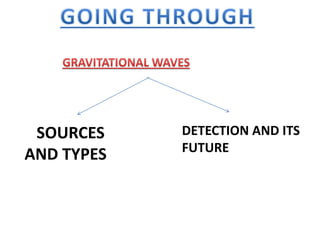
SOURCES
AND TYPES
DETECTION AND ITS
FUTURE
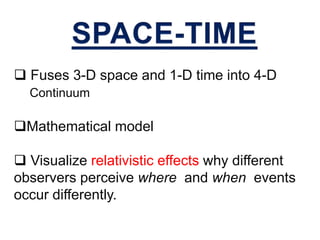
 Fuses 3-D space and 1-D time into 4-D
Continuum
Mathematical model
 Visualize relativistic effects why different
observers perceive where and when events
occur differently.
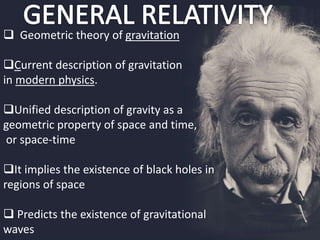
 Geometric theory of gravitation
Current description of gravitation
in modern physics.
Unified description of gravity as a
geometric property of space and time,
or space-time
It implies the existence of black holes in
regions of space
 Predicts the existence of gravitational
waves
Ripples or Oscillations in space time
Travel at the speed of light
Comes from very massive objects
Strength of waves ∝ 1 / distance
from the source
It can penetrate regions of space
that electromagnetic waves cannot
SOURCES OF
GRAVITATIONAL
WAVES
SUPERNOVAE
TWO BLACK HOLES COLLIDING OR
ORBITING EACH OTHER
NEUTRON STAR ORBITING A BLACK
HOLE/NEUTRON STAR
A ROTATING NEUTRON STAR
COLLIDING GALAXIES
 WHITE DWARFS

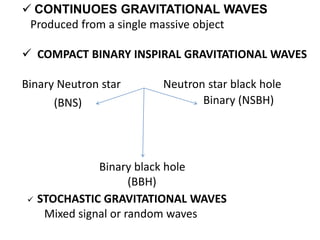
 CONTINUOES GRAVITATIONAL WAVES
Produced from a single massive object
 COMPACT BINARY INSPIRAL GRAVITATIONAL WAVES
Binary Neutron star Neutron star black hole
Binary black hole
(BBH)
Binary (NSBH)
(BNS)
 STOCHASTIC GRAVITATIONAL WAVES
Mixed signal or random waves
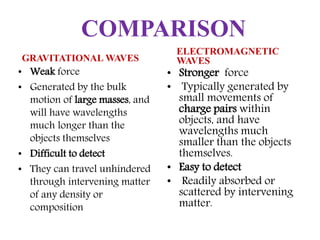
COMPARISON
GRAVITATIONAL WAVES
• Weak force
• Generated by the bulk
motion of large masses, and
will have wavelengths
much longer than the
objects themselves
• Difficult to detect
• They can travel unhindered
through intervening matter
of any density or
composition
ELECTROMAGNETIC
WAVES
• Stronger force
• Typically generated by
small movements of
charge pairs within
objects, and have
wavelengths much
smaller than the objects
themselves.
• Easy to detect
• Readily absorbed or
scattered by intervening
matter.
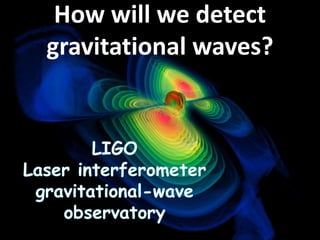
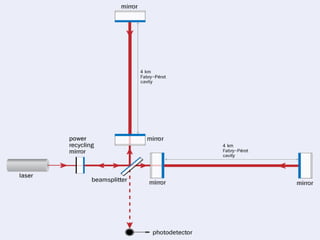
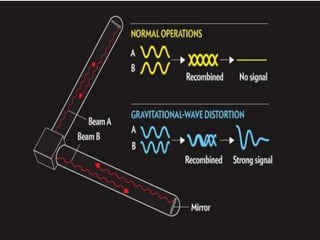
How will we detect
gravitational waves?
 LIGO IS BLIND
 LIGO IS OPPOSITE OF ROUND
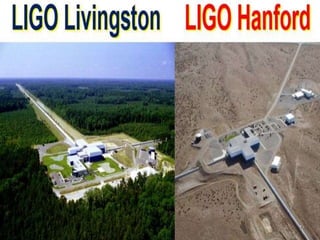
 A SINGLE LIGO DETECTOR
IS NOT ENOUGH
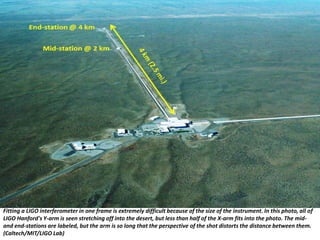
Fitting a LIGO interferometer in one frame is extremely difficult because of the size of the instrument. In this photo, all of
LIGO Hanford's Y-arm is seen stretching off into the desert, but less than half of the X-arm fits into the photo. The mid-
and end-stations are labeled, but the arm is so long that the perspective of the shot distorts the distance between them.
(Caltech/MIT/LIGO Lab)
OPERATING
IN VACCUM
AVOID
AIR
DRIFT IN
PATH OF
LASER
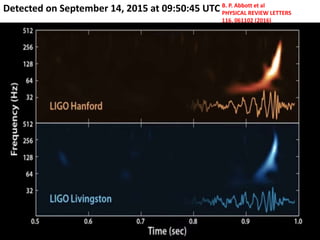
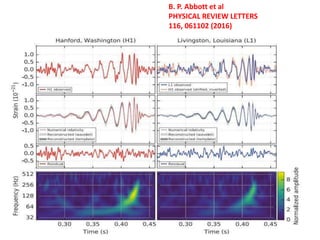
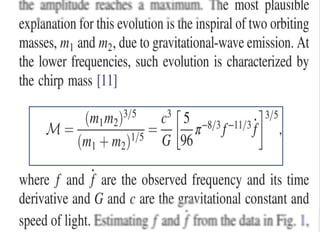
Detected on September 14, 2015 at 09:50:45 UTC
−
B. P. Abbott et al
PHYSICAL REVIEW LETTERS
116, 061102 (2016)
B. P. Abbott et al
PHYSICAL REVIEW LETTERS
116, 061102 (2016)
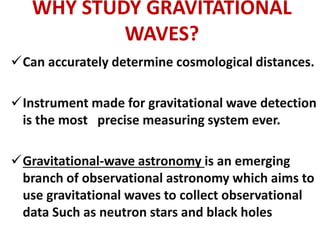
WHY STUDY GRAVITATIONAL
WAVES?
Can accurately determine cosmological distances.
Instrument made for gravitational wave detection
is the most precise measuring system ever.
Gravitational-wave astronomy is an emerging
branch of observational astronomy which aims to
use gravitational waves to collect observational
data Such as neutron stars and black holes
1. Observation of Gravitational Waves from a Binary Black Hole
Merger
PHYSICAL REVIEW LETTERS
B. P. Abbott et al.
(LIGO Scientific Collaboration and Virgo Collaboration)
https://physics.aps.org/featured-article-
pdf/10.1103/PhysRevLett.116.061102
2.Astrophysical and cosmological information about gravitational
waves and the information they carry
Kip S Thorne
Lorentz Lectures , University of Leiden, September 2009
3.LIGO lab Caltech MIThttps://www.ligo.caltech.edu/
Gravitational waves and their detection and future

Gravitational waves and their detection and future

  • 3.
  • 4.
     Fuses 3-Dspace and 1-D time into 4-D Continuum Mathematical model  Visualize relativistic effects why different observers perceive where and when events occur differently.
  • 5.
     Geometric theoryof gravitation Current description of gravitation in modern physics. Unified description of gravity as a geometric property of space and time, or space-time It implies the existence of black holes in regions of space  Predicts the existence of gravitational waves
  • 6.
    Ripples or Oscillationsin space time Travel at the speed of light Comes from very massive objects Strength of waves ∝ 1 / distance from the source It can penetrate regions of space that electromagnetic waves cannot
  • 7.
  • 8.
    SUPERNOVAE TWO BLACK HOLESCOLLIDING OR ORBITING EACH OTHER NEUTRON STAR ORBITING A BLACK HOLE/NEUTRON STAR A ROTATING NEUTRON STAR COLLIDING GALAXIES  WHITE DWARFS 
  • 10.
     CONTINUOES GRAVITATIONALWAVES Produced from a single massive object  COMPACT BINARY INSPIRAL GRAVITATIONAL WAVES Binary Neutron star Neutron star black hole Binary black hole (BBH) Binary (NSBH) (BNS)  STOCHASTIC GRAVITATIONAL WAVES Mixed signal or random waves
  • 12.
    COMPARISON GRAVITATIONAL WAVES • Weakforce • Generated by the bulk motion of large masses, and will have wavelengths much longer than the objects themselves • Difficult to detect • They can travel unhindered through intervening matter of any density or composition ELECTROMAGNETIC WAVES • Stronger force • Typically generated by small movements of charge pairs within objects, and have wavelengths much smaller than the objects themselves. • Easy to detect • Readily absorbed or scattered by intervening matter.
  • 13.
    How will wedetect gravitational waves?
  • 14.
     LIGO ISBLIND  LIGO IS OPPOSITE OF ROUND  A SINGLE LIGO DETECTOR IS NOT ENOUGH
  • 15.
    Fitting a LIGOinterferometer in one frame is extremely difficult because of the size of the instrument. In this photo, all of LIGO Hanford's Y-arm is seen stretching off into the desert, but less than half of the X-arm fits into the photo. The mid- and end-stations are labeled, but the arm is so long that the perspective of the shot distorts the distance between them. (Caltech/MIT/LIGO Lab)
  • 22.
  • 23.
    Detected on September14, 2015 at 09:50:45 UTC − B. P. Abbott et al PHYSICAL REVIEW LETTERS 116, 061102 (2016)
  • 24.
    B. P. Abbottet al PHYSICAL REVIEW LETTERS 116, 061102 (2016)
  • 27.
    WHY STUDY GRAVITATIONAL WAVES? Canaccurately determine cosmological distances. Instrument made for gravitational wave detection is the most precise measuring system ever. Gravitational-wave astronomy is an emerging branch of observational astronomy which aims to use gravitational waves to collect observational data Such as neutron stars and black holes
  • 29.
    1. Observation ofGravitational Waves from a Binary Black Hole Merger PHYSICAL REVIEW LETTERS B. P. Abbott et al. (LIGO Scientific Collaboration and Virgo Collaboration) https://physics.aps.org/featured-article- pdf/10.1103/PhysRevLett.116.061102 2.Astrophysical and cosmological information about gravitational waves and the information they carry Kip S Thorne Lorentz Lectures , University of Leiden, September 2009 3.LIGO lab Caltech MIThttps://www.ligo.caltech.edu/