IIT ROORKEE
GRAVITATIONAL WAVE
DETECTION
EXPLORING THE COSMIC RIPPLES
CONTENT
01
Introduction
02
Background
03
Detection-
LIGO
04
Pulsar Timing
Arrays
05
Future
Developments
06
Advancements
in detection
07
Overview
08
References
• Gravitational waves are produced
whenever an object is accelerated
with respect to another object.
THE ORIGIN
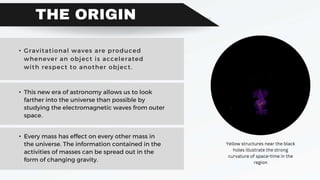
Yellow structures near the black
holes illustrate the strong
curvature of space-time in the
region
• This new era of astronomy allows us to look
farther into the universe than possible by
studying the electromagnetic waves from outer
space.
• Every mass has effect on every other mass in
the universe. The information contained in the
activities of masses can be spread out in the
form of changing gravity.
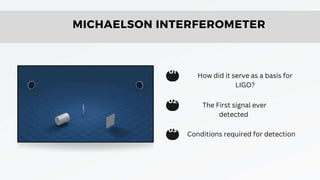
MICHAELSON INTERFEROMETER
How did it serve as a basis for
LIGO?
01
The First signal ever
detected
02
Conditions required for detection
03
01 03
02 Conditions
• Vacuum
• Vibration
Isolation
• High-Power
lasers
LIGO
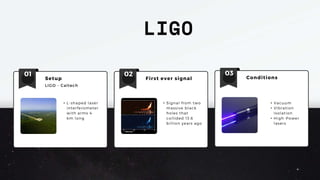
Setup
LIGO - Caltech
• L-shaped laser
interferometer
with arms 4
km long
First ever signal
• Signal from two
massive black
holes that
collided 13.6
billion years ago
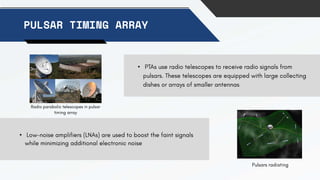
PULSAR TIMING ARRAY
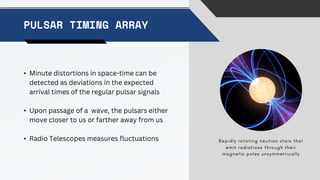
• Minute distortions in space-time can be
detected as deviations in the expected
arrival times of the regular pulsar signals
• Upon passage of a wave, the pulsars either
move closer to us or farther away from us
• Radio Telescopes measures fluctuations
PULSAR TIMING ARRAY
•
•
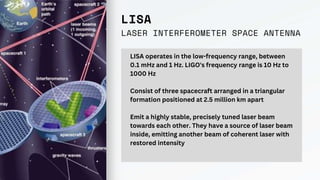
LISA
LASER INTERFEROMETER SPACE ANTENNA
LISA operates in the low-frequency range, between
0.1 mHz and 1 Hz. LIGO's frequency range is 10 Hz to
1000 Hz
Consist of three spacecraft arranged in a triangular
formation positioned at 2.5 million km apart
Emit a highly stable, precisely tuned laser beam
towards each other. They have a source of laser beam
inside, emitting another beam of coherent laser with
restored intensity
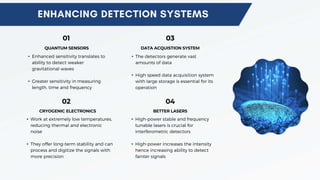
QUANTUM SENSORS
• Enhanced sensitivity translates to
ability to detect weaker
gravitational waves
• Greater sensitivity in measuring
length, time and frequency
01
CRYOGENIC ELECTRONICS
• Work at extremely low temperatures,
reducing thermal and electronic
noise
• They offer long-term stability and can
process and digitize the signals with
more precision
02
DATA ACQUISTION SYSTEM
• The detectors generate vast
amounts of data
• High speed data acquisition system
with large storage is essential for its
operation
03
BETTER LASERS
• High-power stable and frequency
tunable lasers is crucial for
interferometric detectors
• High-power increases the intensity
hence increasing ability to detect
fainter signals
04
OVERVIEW
REFERENCES
•
•
•
•
•
•
•
•
ANY QUESTIONS?
THANK YOU

Gravitational wave detection.pptx

  • 1.
  • 2.
  • 4.
    • Gravitational wavesare produced whenever an object is accelerated with respect to another object. THE ORIGIN Yellow structures near the black holes illustrate the strong curvature of space-time in the region • This new era of astronomy allows us to look farther into the universe than possible by studying the electromagnetic waves from outer space. • Every mass has effect on every other mass in the universe. The information contained in the activities of masses can be spread out in the form of changing gravity.
  • 5.
    MICHAELSON INTERFEROMETER How didit serve as a basis for LIGO? 01 The First signal ever detected 02 Conditions required for detection 03
  • 6.
    01 03 02 Conditions •Vacuum • Vibration Isolation • High-Power lasers LIGO Setup LIGO - Caltech • L-shaped laser interferometer with arms 4 km long First ever signal • Signal from two massive black holes that collided 13.6 billion years ago
  • 7.
    PULSAR TIMING ARRAY •Minute distortions in space-time can be detected as deviations in the expected arrival times of the regular pulsar signals • Upon passage of a wave, the pulsars either move closer to us or farther away from us • Radio Telescopes measures fluctuations
  • 8.
  • 10.
    LISA LASER INTERFEROMETER SPACEANTENNA LISA operates in the low-frequency range, between 0.1 mHz and 1 Hz. LIGO's frequency range is 10 Hz to 1000 Hz Consist of three spacecraft arranged in a triangular formation positioned at 2.5 million km apart Emit a highly stable, precisely tuned laser beam towards each other. They have a source of laser beam inside, emitting another beam of coherent laser with restored intensity
  • 11.
    QUANTUM SENSORS • Enhancedsensitivity translates to ability to detect weaker gravitational waves • Greater sensitivity in measuring length, time and frequency 01 CRYOGENIC ELECTRONICS • Work at extremely low temperatures, reducing thermal and electronic noise • They offer long-term stability and can process and digitize the signals with more precision 02 DATA ACQUISTION SYSTEM • The detectors generate vast amounts of data • High speed data acquisition system with large storage is essential for its operation 03 BETTER LASERS • High-power stable and frequency tunable lasers is crucial for interferometric detectors • High-power increases the intensity hence increasing ability to detect fainter signals 04
  • 12.
  • 13.
  • 14.
  • 15.