Department of Electronics and
Communication Engineering (ECE)
SPACE DEBRIS REMOVAL
SYSTEM
Krishna Institute of Engineering
and Technology
Mohammad Shadab
University Roll No 1302931086
Presented By:- Presented To:
Shipra &Saumya MAM
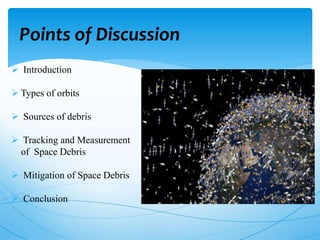
 Introduction
 Types of orbits
 Sources of debris
 Tracking and Measurement
of Space Debris
 Mitigation of Space Debris
 Conclusion
Points of Discussion
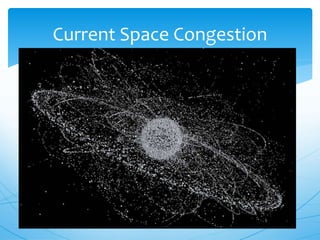
Current Space Congestion
INTRODUCTION
Space Debris , also known as orbital debris , space junk and
space waste , is the collection of defunct objects in orbit around
Earth.
They can include anything from entire used rocket stages and out
of order satellites to explosion fragments, paint flakes, dust, slag
from solid rocket motors, coolant released by Upravlyaemy
Sputnik Aktivnyj (Russian: Управляемый Спутник
Активный),also known in the west as Radar Ocean
Reconnaissance Satellite or RORSAT other small particles from
equipments.
Debris poses a growing threat to satellites and could prevent the
use of valuable orbits in the future.
SPACE SURVEILLANCE NETWORK (SSN)
Debris Size 0.1-1cm 1-10cm >10cm
Total Number at all altitudes 150 million 780,000 23,000
Debris in Low-Earth Orbit 20 million 400,000 15,000
Estimated amount of Space Debris:
 Currently more than 15,000 objects are tracked and kept in catalogue by SSN
 Space debris number is much more than catalogued
Threat of this size?
• Category I (<1cm) - They can make significant
damage to vulnerable parts of a satellite.
• Category II (1-10cm) - They tend to seriously
damage or destroy a satellite in a collision.
• Category III (>10cm) – They may completely
destroy a satellite in a collision and can be
tracked easily.
Categorization:
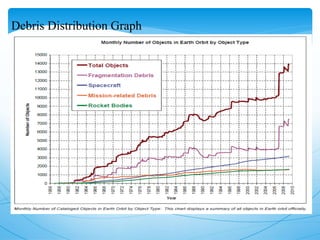
Debris Distribution Graph
 Low Earth Orbit (LEO)
 Medium Earth Orbit (MEO)
 Geostationary Orbit
 Highly Elliptical Orbit
(HEO)
TYPES OF ORBITS
 Proximity
 Altitude Range
 Higher Velocity
 Energy
Low Earth Orbit
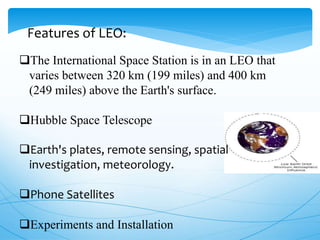
The International Space Station is in an LEO that
varies between 320 km (199 miles) and 400 km
(249 miles) above the Earth's surface.
Hubble Space Telescope
Earth's plates, remote sensing, spatial
investigation, meteorology.
Phone Satellites
Experiments and Installation
Features of LEO:
Presence of debris in LEO a function of altitude(h)
and declination(δ)
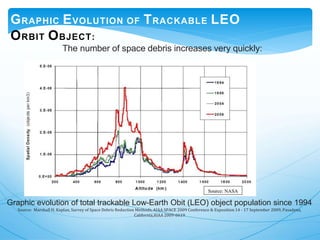
GRAPHIC EVOLUTION OF TRACKABLE LEO
ORBIT OBJECT:
Graphic evolution of total trackable Low-Earth Obit (LEO) object population since 1994
Source: Marshall H. Kaplan, Survey of Space Debris Reduction Methods, AIAA SPACE 2009 Conference & Exposition 14 - 17 September 2009, Pasadena,
California,AIAA 2009-6619
The number of space debris increases very quickly:
Hypervelocity accidents in space
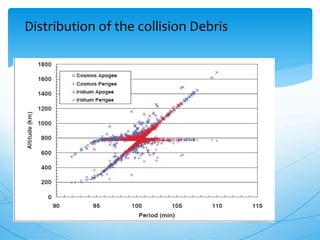
Case of Iridium33 and Cosmos2251
 Fourth hypervelocity accident
 February 10 2009
 Collision velocity 11 km/s
Distribution of the collision Debris
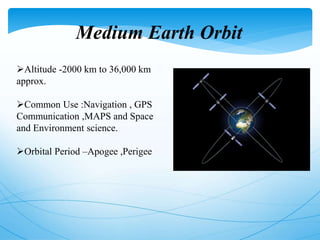
Altitude -2000 km to 36,000 km
approx.
Common Use :Navigation , GPS
Communication ,MAPS and Space
and Environment science.
Orbital Period –Apogee ,Perigee
Medium Earth Orbit
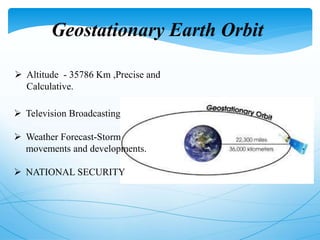
Geostationary Earth Orbit
 Altitude - 35786 Km ,Precise and
Calculative.
 Television Broadcasting
 Weather Forecast-Storm
movements and developments.
 NATIONAL SECURITY
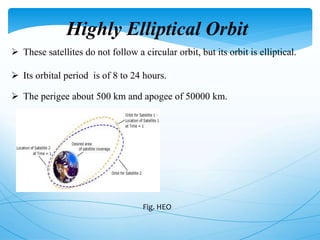
Highly Elliptical Orbit
 These satellites do not follow a circular orbit, but its orbit is elliptical.
 Its orbital period is of 8 to 24 hours.
 The perigee about 500 km and apogee of 50000 km.
Fig. HEO
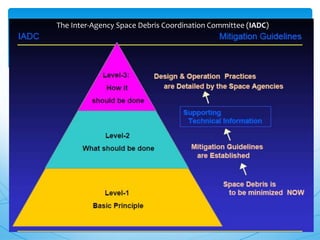
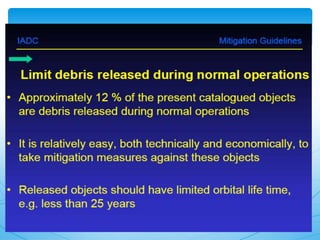
The Inter-Agency Space Debris Coordination Committee (IADC)
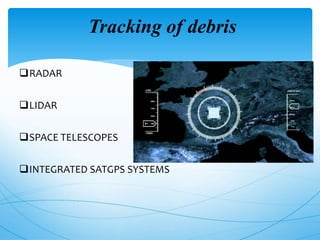
Tracking of debris
RADAR
LIDAR
SPACE TELESCOPES
INTEGRATED SATGPS SYSTEMS
TOOLS
Electro dynamic tethers
 Laser brooms
 Solar sails
 Space nets and collectors
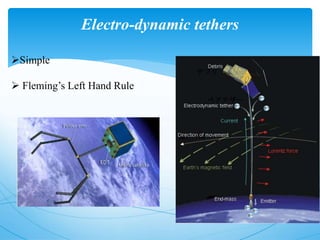
Electro-dynamic tethers
Simple
 Fleming’s Left Hand Rule
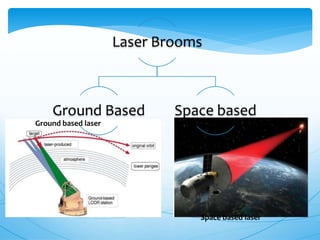
Laser brooms
Fast
Direct Impact
Drag by photon force
Technology is mature
• Could not be move freely in a huge range
• Threat- Space based weapon system
Ground based laser
Space based laser
Laser Brooms
Ground Based Space based
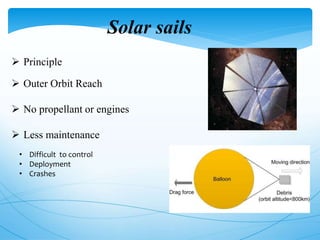
Solar sails
 Principle
 Outer Orbit Reach
 No propellant or engines
 Less maintenance
• Difficult to control
• Deployment
• Crashes
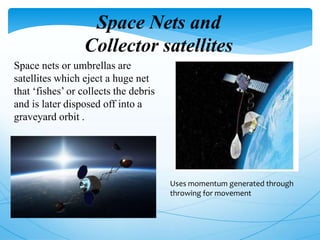
Space Nets and
Collector satellites
Space nets or umbrellas are
satellites which eject a huge net
that ‘fishes’ or collects the debris
and is later disposed off into a
graveyard orbit .
Uses momentum generated through
throwing for movement
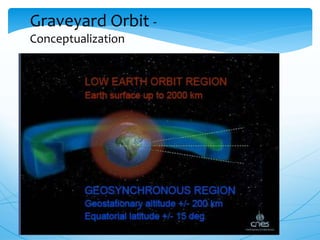
Graveyard Orbit -
Conceptualization
Mathematics Involved
CONCLUSION
 Research and development
 Guidelines By IADC-
Inter Agency Space Debris Coordination Committee
 Implementation
Bullets Raining From The Sky
Space Debris Removal System

Space Debris Removal System

  • 1.
    Department of Electronicsand Communication Engineering (ECE) SPACE DEBRIS REMOVAL SYSTEM Krishna Institute of Engineering and Technology Mohammad Shadab University Roll No 1302931086 Presented By:- Presented To: Shipra &Saumya MAM
  • 2.
     Introduction  Typesof orbits  Sources of debris  Tracking and Measurement of Space Debris  Mitigation of Space Debris  Conclusion Points of Discussion
  • 3.
  • 4.
    INTRODUCTION Space Debris ,also known as orbital debris , space junk and space waste , is the collection of defunct objects in orbit around Earth. They can include anything from entire used rocket stages and out of order satellites to explosion fragments, paint flakes, dust, slag from solid rocket motors, coolant released by Upravlyaemy Sputnik Aktivnyj (Russian: Управляемый Спутник Активный),also known in the west as Radar Ocean Reconnaissance Satellite or RORSAT other small particles from equipments. Debris poses a growing threat to satellites and could prevent the use of valuable orbits in the future.
  • 5.
    SPACE SURVEILLANCE NETWORK(SSN) Debris Size 0.1-1cm 1-10cm >10cm Total Number at all altitudes 150 million 780,000 23,000 Debris in Low-Earth Orbit 20 million 400,000 15,000 Estimated amount of Space Debris:  Currently more than 15,000 objects are tracked and kept in catalogue by SSN  Space debris number is much more than catalogued
  • 6.
    Threat of thissize? • Category I (<1cm) - They can make significant damage to vulnerable parts of a satellite. • Category II (1-10cm) - They tend to seriously damage or destroy a satellite in a collision. • Category III (>10cm) – They may completely destroy a satellite in a collision and can be tracked easily. Categorization:
  • 7.
  • 8.
     Low EarthOrbit (LEO)  Medium Earth Orbit (MEO)  Geostationary Orbit  Highly Elliptical Orbit (HEO) TYPES OF ORBITS
  • 9.
     Proximity  AltitudeRange  Higher Velocity  Energy Low Earth Orbit
  • 10.
    The International SpaceStation is in an LEO that varies between 320 km (199 miles) and 400 km (249 miles) above the Earth's surface. Hubble Space Telescope Earth's plates, remote sensing, spatial investigation, meteorology. Phone Satellites Experiments and Installation Features of LEO:
  • 11.
    Presence of debrisin LEO a function of altitude(h) and declination(δ)
  • 12.
    GRAPHIC EVOLUTION OFTRACKABLE LEO ORBIT OBJECT: Graphic evolution of total trackable Low-Earth Obit (LEO) object population since 1994 Source: Marshall H. Kaplan, Survey of Space Debris Reduction Methods, AIAA SPACE 2009 Conference & Exposition 14 - 17 September 2009, Pasadena, California,AIAA 2009-6619 The number of space debris increases very quickly:
  • 13.
  • 14.
    Case of Iridium33and Cosmos2251  Fourth hypervelocity accident  February 10 2009  Collision velocity 11 km/s
  • 15.
    Distribution of thecollision Debris
  • 16.
    Altitude -2000 kmto 36,000 km approx. Common Use :Navigation , GPS Communication ,MAPS and Space and Environment science. Orbital Period –Apogee ,Perigee Medium Earth Orbit
  • 17.
    Geostationary Earth Orbit Altitude - 35786 Km ,Precise and Calculative.  Television Broadcasting  Weather Forecast-Storm movements and developments.  NATIONAL SECURITY
  • 18.
    Highly Elliptical Orbit These satellites do not follow a circular orbit, but its orbit is elliptical.  Its orbital period is of 8 to 24 hours.  The perigee about 500 km and apogee of 50000 km. Fig. HEO
  • 19.
    The Inter-Agency SpaceDebris Coordination Committee (IADC)
  • 21.
    Tracking of debris RADAR LIDAR SPACETELESCOPES INTEGRATED SATGPS SYSTEMS
  • 22.
    TOOLS Electro dynamic tethers Laser brooms  Solar sails  Space nets and collectors
  • 23.
  • 24.
    Laser brooms Fast Direct Impact Dragby photon force Technology is mature • Could not be move freely in a huge range • Threat- Space based weapon system
  • 25.
    Ground based laser Spacebased laser Laser Brooms Ground Based Space based
  • 26.
    Solar sails  Principle Outer Orbit Reach  No propellant or engines  Less maintenance • Difficult to control • Deployment • Crashes
  • 27.
    Space Nets and Collectorsatellites Space nets or umbrellas are satellites which eject a huge net that ‘fishes’ or collects the debris and is later disposed off into a graveyard orbit . Uses momentum generated through throwing for movement
  • 28.
  • 29.
  • 30.
    CONCLUSION  Research anddevelopment  Guidelines By IADC- Inter Agency Space Debris Coordination Committee  Implementation
  • 31.